

An advertising agency used to be judged mostly by the polish of its creative work and the price of its media buying. That is not enough anymore. In a market where global ad spend moved past the trillion-dollar mark in 2024, digital is forecast to account for 68.4% of worldwide spend in 2025, and programmatic captured 82.4% of digital investment in 2024, a serious agency is no longer just a vendor. It is a commercial operating partner that helps a business decide where to compete, how to show up, and how to measure whether the work is actually moving revenue, demand, and brand strength in the right direction.
That shift explains why the best advertisers are asking harder questions before they hire anyone. They want to know whether the agency can connect strategy to execution, whether it understands the economics of the category, whether it can work across paid media, creative, analytics, and technology, and whether it can help the brand stay disciplined when pressure rises. The need for that discipline is real: Nielsen’s 2025 Annual Marketing Report found that 54% of global marketers planned to reduce ad spend, while only 32% said they measure traditional and digital media holistically, which is exactly the kind of gap a strong agency engagement is supposed to close.
This first part lays the groundwork for the rest of the article. We will look at why an advertising agency still matters, the framework that separates strategic partners from glorified order-takers, the core capabilities that have to work together, and the practical realities of implementation. From there, later parts will move into measurement, optimization, ecosystem design, and the shifts reshaping agency work over the next few years.
Article Outline
- Part 1: Why Advertising Agencies Matter
- Part 2: Framework Overview
- Part 3: Core Components
- Part 4: Professional Implementation
- Part 5: Measurement and Optimization
- Part 6: Ecosystem and Future Trends
Why Advertising Agencies Matter

An advertising agency matters because the modern media environment is too fragmented, too fast, and too expensive for most brands to manage well by instinct alone. Global marketers spent close to $1.1 trillion on advertising in 2024, and that money is now split across search, social, retail media, video, connected TV, creator channels, audio, out-of-home, and a growing layer of automated buying systems. A capable agency helps a business avoid the trap of chasing every new channel at once and instead builds a plan around audience behavior, category economics, and the company’s actual commercial priorities.
It also matters because wasted spend is rarely obvious in real time. The ANA’s programmatic transparency work found that only 36 cents of every dollar entering a demand-side platform effectively reached the consumer in the studied supply paths, with billions in efficiency opportunity still on the table. That does not mean advertising is broken. It means brands need partners who can challenge opaque supply chains, question default settings, reduce unnecessary layers, and translate complex buying decisions into plain business language that finance and leadership teams can trust.
The relationship matters even more when a company wants durable growth rather than random bursts of performance. The 2025 ANA and 4As tenure study showed that average client-agency relationship tenure has more than doubled since 2016, reaching about seven years, while the companion research on the pitch process found that agency reviews can cost marketers more than $400,000. In other words, the market is slowly rediscovering something smart operators have always known: constantly changing partners may feel decisive, but long-term value is usually built when strategy, data, creative judgment, and institutional knowledge have time to compound.
Framework Overview
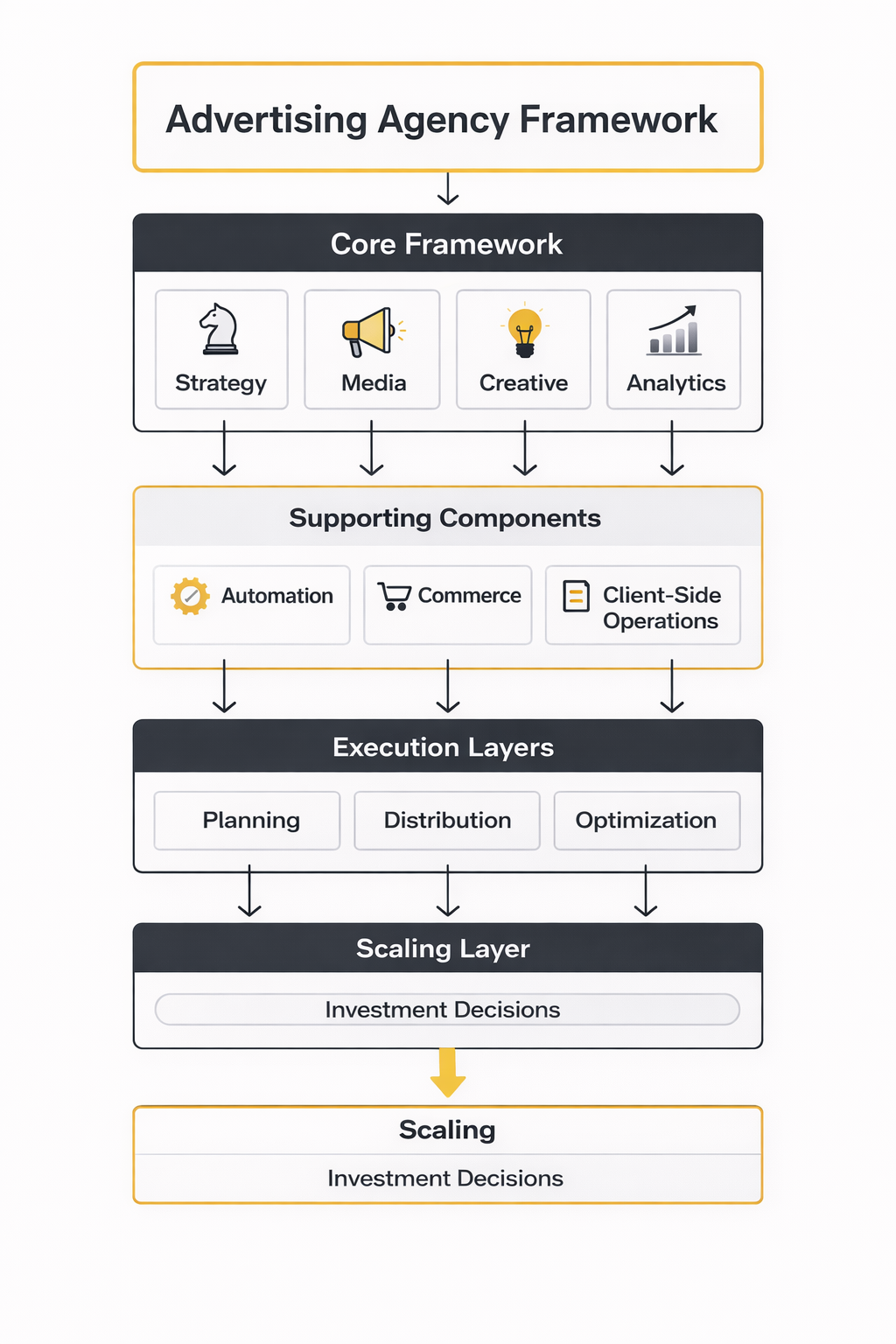
The simplest way to evaluate an advertising agency is to stop thinking about outputs first and start with operating logic. A strong agency framework moves in a clear sequence: commercial objective, audience insight, channel strategy, creative system, execution rhythm, and measurement discipline. That sounds basic, but many disappointing engagements break down because one of those layers is missing. The brand asks for leads without clarifying the acceptable cost. The agency buys media without a clear view of what the sales team can convert. Creative gets refreshed without learning from previous winners and losers. Then everyone argues about performance after the money is already gone.
A better framework starts by defining the job the advertising has to do. Is the goal to create demand, harvest existing demand, defend market share, launch a product, support distribution, or increase customer lifetime value? Once that is clear, the agency can decide how much emphasis belongs on short-term performance versus long-term brand building. That balance matters more now because marketers are under intense pressure to prove ROI, yet the same report shows many teams still do not measure channels together, which makes smart allocation harder than it should be.
The next part of the framework is decision quality. The agency should know what data is reliable, what is directional, what is merely platform-reported, and what still needs human judgment. That is one reason agency capability is changing so quickly. The 4As’ Look Ahead 2025 report describes an industry moving from experimentation to operational use of generative AI, and its joint research with Forrester found that 91% of respondents were either already using or actively exploring GenAI. The implication is not that software replaces agency thinking. It is that the framework now has to include faster research, better production workflows, stronger governance, and more deliberate quality control than agencies could get away with a few years ago.
Core Components
The core components of an advertising agency engagement should work like one system rather than four or five disconnected departments. Strategy identifies the opportunity and the decision criteria. Media turns that strategy into reach, frequency, and attention across the right channels. Creative gives the audience a reason to care, click, remember, or buy. Analytics closes the loop so the business can tell the difference between activity and progress. When one component dominates the others, performance usually becomes fragile. Media without strong creative becomes expensive. Creative without a channel plan becomes invisible. Reporting without business context becomes theatre.
That is why channel knowledge on its own is not enough. Dentsu forecasts retail media to grow 13.9% in 2025, connected TV 10.9%, social 9.2%, and overall digital 7.9%, which tells you where the industry is moving, but not where your next dollar should go. A credible agency has to interpret those shifts through the lens of your category, margins, customer journey, and operational constraints. A B2B firm with a long sales cycle, a local service business, a consumer subscription brand, and an enterprise software company may all buy “digital advertising,” but they should not run the same plan, report on the same cadence, or optimize toward the same outcome.
The final component is process design, and this is where many engagements quietly succeed or fail. A modern advertising agency needs a clean briefing process, clear approval rights, a realistic testing agenda, and a way to keep the account from getting buried under unnecessary procurement friction. The ANA and 4As standardized RFI template was created for exactly that reason: both sides recognized that bloated selection processes waste time, obscure the real fit questions, and make it harder to evaluate a partner on the information that actually matters. When the system is designed well, the agency spends more time improving outcomes and less time producing paperwork that nobody uses after the meeting ends.
Professional Implementation
Professional implementation begins with narrowing the scope before scaling the spend. That means agreeing on the offer, the audience, the conversion path, the creative hypotheses, the reporting window, and the decisions that will be made if the data moves in either direction. It sounds unglamorous, but this is where experienced agencies earn their keep. They know that a weak landing page can kill a strong media plan, that disconnected follow-up can make good leads look bad, and that channel optimization cannot rescue a broken customer journey. If you need the infrastructure side handled more cleanly, tools like ClickFunnels, Systeme.io, Brevo, and Buffer can support funnel building, email operations, and distribution, but the tools only become valuable when the agency or in-house team uses them inside a coherent commercial system.
The second step is building an execution rhythm that matches the complexity of the account. A small local campaign may need weekly optimization and a simple dashboard. A national or multi-market account may need a heavier operating model with creative testing calendars, media pacing reviews, supply-path analysis, and quarterly planning tied to sales seasonality. This is also where transparency becomes non-negotiable. When only 32% of marketers say they measure traditional and digital together, the agency should be the party pushing for clearer definitions, cleaner source data, and reporting that shows what happened, why it happened, and what decision follows next.
Finally, professional implementation means knowing when not to scale. A mature advertising agency does not confuse motion with progress. If the audience fit is weak, the message is off, the sales process is leaking, or the tracking is unreliable, spending more money simply hides the root problem under a bigger bill. The agencies worth keeping are usually the ones willing to say that early, fix the underlying issue, and protect long-term performance even when that means slowing down the campaign before it is ready to accelerate.
Define The Commercial Job First
The first job in the framework is to define the commercial job the advertising agency is being hired to do. That may sound obvious, but there is a huge difference between trying to generate qualified pipeline, launch a new product, defend market share, improve branded search demand, increase average order value, or support a retail rollout. If that job is vague, everything that follows gets vague too, and the account ends up full of activity without much clarity.
This is also where a company has to be honest with itself. Some businesses say they want performance, but what they really need is stronger demand creation. Others say they need awareness, but the real problem is a weak offer, poor conversion flow, or no follow-up discipline after leads arrive. A good advertising agency framework forces those issues into the open early, which is far better than discovering them after weeks of creative production and media spend.
That is one reason longer relationships are becoming more valuable again. The ANA and 4As reported in 2025 that average client-agency tenure had climbed to about seven years, more than double the 2016 level. The deeper point there is not just loyalty. It is that a serious agency becomes more useful when it understands the economics, politics, bottlenecks, and decision patterns inside the business it serves.
Map The Audience And Category Reality
Once the commercial job is clear, the next step is to map reality as it actually exists in the market. That means understanding how customers buy, what alternatives they compare, where they spend time, what they distrust, and what makes them move now instead of later. An advertising agency that skips this step usually falls back on generic targeting and category clichés, which is one of the fastest ways to make a campaign feel expensive and forgettable at the same time.
This part of the framework is more demanding than audience personas or platform interest buckets. It is about identifying buying situations, pressure points, objections, and moments of receptivity. Kantar’s Media Reactions work shows that campaigns become far more impactful when they appear in environments where people are actually receptive to advertising, which is exactly why audience strategy has to go beyond demographic labels and into context, timing, and mindset.
When an advertising agency gets this part right, everything becomes easier to interpret. Messaging sharpens because it speaks to a real tension. Channel selection improves because it follows customer behavior instead of marketer habit. Even reporting becomes more useful, because the team is no longer asking whether an ad performed in the abstract, but whether it performed with the right people in the right commercial situation.
Build The Channel Architecture
After that, the framework needs a channel architecture rather than a random media mix. The point is not to be everywhere. The point is to know what each channel is supposed to do, what it can realistically influence, and how it supports the channels around it. Search may capture existing intent, paid social may create demand or retarget warm audiences, creator partnerships may build trust, retail media may push shoppers closer to purchase, and email may do the quiet follow-up work that makes the whole system more profitable.
This matters even more now because channel growth is not happening evenly. Dentsu’s June 2025 update projected retail media growth at 13.9%, social at 9.2%, and search at 8.3%. Those shifts are useful, but they are not instructions. A modern advertising agency should treat them as market signals, then translate those signals into a plan that fits the client’s margins, sales cycle, market position, and operational limits.
That is also the moment when platform temptation has to be managed. It is easy to get excited by new inventory, new AI tools, and new targeting options. But a framework-led advertising agency knows that more channels do not automatically mean better coverage. In many cases, the smartest plan is narrower, cleaner, and easier to measure.
Design The Creative System
Once the channel architecture is in place, the framework needs a creative system that can carry the strategy without becoming chaotic. This is where many companies still underestimate what an advertising agency should do. Creative is not just the ad itself. It is the offer framing, message hierarchy, angle testing, brand memory structures, landing-page continuity, and the discipline to keep learning what actually resonates instead of chasing novelty for its own sake.
That is becoming more important, not less, as production speeds up. Google, Kantar, and Marketing Week’s 2025 research on the creative measurement gap made the problem plain: marketers have become highly sophisticated at tracking media, but many still fail to measure creative with the same seriousness. A strong advertising agency framework treats creative as a business variable that deserves testing, analysis, and iteration, not as a one-time asset that gets approved and forgotten.
If the business needs a stronger campaign infrastructure around that creative system, this is also where software can support the work. A team may use ClickFunnels for focused conversion paths, Systeme.io for simpler funnel and automation workflows, or Brevo for lifecycle messaging. The key point is that tools should serve the framework, not replace it.
Set The Measurement Rhythm
The final layer of the framework is measurement rhythm. Not just a dashboard. Not just a report. A rhythm. The advertising agency and the client need to know what gets checked weekly, what gets reviewed monthly, what gets reconsidered quarterly, and which decisions each review is supposed to trigger. Otherwise reporting turns into a performance ritual where everyone looks at numbers but nobody changes anything meaningful.
That weakness is still common. Nielsen’s 2025 Annual Marketing Report surveyed 1,400 global marketers, and the broader findings highlighted how many teams still struggle to measure channels holistically even while pressure to prove return keeps rising. That gap is exactly where a smart advertising agency earns trust: by turning fragmented platform data into a decision system the business can actually use.
When this rhythm is built properly, the client starts to see what good agency work really looks like. The meetings become calmer because decisions are clearer. The creative gets stronger because feedback is grounded in evidence instead of opinion. And the account stops feeling like a series of disconnected campaigns and starts functioning like a real growth system.

Strategy And Commercial Planning
The first core component is strategy, but not strategy in the vague, slide-deck sense that clients get tired of hearing about. Good strategy in an advertising agency means defining the commercial problem clearly enough that everything else can be judged against it. If the agency cannot explain what kind of demand it is trying to create, capture, or protect, then the account will drift into a cycle where everyone stays busy and nobody is fully sure whether the work is winning.
This is also where the agency earns the right to be more than a vendor. A serious strategist does not just take a brief and make it prettier. They pressure-test the offer, the category assumptions, the audience priorities, and the competitive context so the business does not spend months optimizing the wrong thing. That sounds basic, but it is still rare, which is one reason average client-agency tenure climbed to about seven years in the ANA and 4As 2025 tenure study: when an agency genuinely understands how the business works, replacing that knowledge becomes expensive and disruptive.
Without this component, everything downstream gets weaker. Creative turns into decoration. Media turns into distribution without direction. Reporting turns into a summary of movement instead of a tool for decision-making.
Media Planning And Buying
The second core component is media planning and buying, which is where an advertising agency turns strategy into real market exposure. This is not just about choosing platforms or negotiating rates. It is about deciding how the brand will reach people, how often, in what context, and with what level of precision, while staying honest about how much control the team actually has once money enters the ecosystem.
That last part matters because digital efficiency is still far from perfect. The ANA’s programmatic transparency work found that only 36 cents of every dollar entering a demand-side platform effectively reached the consumer, and TAG TrustNet’s 2024 benchmark showed spend on made-for-advertising sites had fallen from 15% to 4%, which is good progress but also a reminder that supply-path quality is not something brands should leave on autopilot. A capable advertising agency is supposed to protect the client here by asking better questions about inventory, duplication, waste, verification, and what the channel is truly contributing.
The planning side is just as important as the buying side. Dentsu’s June 2025 update projected retail media growth at 13.9%, social at 9.2%, and search at 8.3%, while IAB Europe’s 2025 retail media study showed how quickly advertisers, agencies, and networks are treating the channel as a more mature part of the media mix. That means a good agency cannot just “run ads.” It has to build a channel architecture that reflects where attention, intent, and first-party data are actually becoming more valuable.
Creative Development And Production
The third core component is creative development and production, and this is where many agency relationships are either won or quietly lost. Businesses often say they want better ads, but what they really need is stronger message clarity, sharper offer framing, cleaner audience tension, and a production process that can create enough variation to learn what works. An advertising agency that only delivers polished assets without improving the commercial message is leaving too much value on the table.
This part of the work is becoming more measurable, which is a good thing. Google, Kantar, and Marketing Week’s 2025 research on the creative measurement gap highlighted a frustrating reality: marketers claim creative quality drives effectiveness, but many still do not measure it with the same discipline they apply to media. That is exactly backwards. Media can amplify a strong idea, but it cannot rescue weak positioning, confused copy, or a campaign that has no memorable shape.
It is also why production speed alone should not impress you. Yes, AI is accelerating content creation, and yes, that can be useful. But a modern advertising agency still needs editorial judgment, taste, brand consistency, and testing discipline, because faster bad creative is still bad creative.
Analytics And Performance Accountability
The fourth core component is analytics and performance accountability. This is the part that tells the client whether the system is actually working, but it has to go much deeper than platform dashboards. A competent advertising agency should be able to explain what happened, why it likely happened, what the data can and cannot prove, and what decision should follow next.
This is harder than it sounds because most businesses still do not have one clean view of performance. Nielsen’s 2025 Annual Marketing Report highlighted how many marketers remain under heavy ROI pressure while still lacking truly holistic measurement across channels. That creates the perfect environment for confusion: one platform claims victory, another claims influence, finance wants harder proof, and the internal team is left trying to reconcile numbers that were never designed to line up neatly.
A strong advertising agency helps reduce that confusion by setting clear definitions early. What counts as a qualified lead, a meaningful sale, incremental growth, or acceptable payback has to be agreed before the campaign starts, not argued over after the money is spent. When that discipline is in place, reporting becomes useful instead of political.
Operations, Technology, And Workflow
The fifth core component is operations, which may sound less exciting than strategy or creative, but it is often where the real difference shows up. Great agencies do not just have smart people. They have clean workflows, reliable approval systems, sensible handoffs, and technology that supports execution instead of slowing it down. That operational layer is what keeps the account from collapsing into missed deadlines, inconsistent messaging, and endless revisions that wear everybody out.
This is where tools can genuinely help when they are used with restraint. A business working with an advertising agency may rely on ClickFunnels for tighter campaign paths, Systeme.io for simpler automation, Brevo for email and lifecycle messaging, or Buffer for distribution workflows. But the real win is never the software itself. The win is having an operating model where the tools are aligned to the strategy, the reporting, and the creative plan instead of becoming yet another pile of disconnected subscriptions.
That is also why process discipline matters during selection. The ANA and 4As introduced a standardized RFI template in 2025 to streamline how marketers evaluate agency capabilities, which tells you a lot about where the industry still struggles. Too many relationships start with unnecessary complexity and then carry that confusion straight into the work.
How The Components Work Together
These components only create real leverage when they reinforce one another. Strategy tells the team what kind of commercial movement matters. Media creates exposure in the right places. Creative gives that exposure persuasive force. Analytics shows what is moving and what needs to change. Operations keeps the whole machine running without burning everyone out.
When one of those parts is weak, the rest suffer fast. You can have strong creative, but if the media plan is sloppy, the work gets seen by the wrong people. You can have excellent reporting, but if the strategy was unclear from the start, the dashboard becomes a very organized way to track confusion.
That is why the best advertising agency relationships feel so different from the average ones. They do not just produce deliverables. They create alignment, which is far rarer and far more valuable than most clients realize when they first start shopping for an agency.
Statistics And Data
If you want to judge an advertising agency properly, you have to look past surface-level campaign results and get comfortable with the numbers underneath them. That does not mean drowning in dashboards. It means understanding which statistics reveal commercial progress, which ones reveal operational risk, and which ones simply make a report look busy without helping anyone make a better decision.
This is where the gap between average and excellent agency work becomes obvious. A weaker team tends to collect numbers after the fact and use them to defend what already happened. A stronger advertising agency uses data before, during, and after execution to shape investment levels, channel choices, creative iteration, and the speed at which the business should scale.
The Big Market Numbers
The first layer of useful data is market context. WARC projected that global ad spend would top $1 trillion for the first time in 2024, while dentsu’s June 2025 forecast put 2025 spending at about $992 billion. That difference is not a contradiction so much as a reminder that forecasting models vary, economic conditions shift, and agency leaders should pay attention to direction, composition, and pressure points rather than acting as though one single number explains the whole market.
What matters more for an advertising agency is how that spending is changing. dentsu forecast digital to reach 68.4% of global ad spend in 2025, with retail media up 13.9%, social up 9.2%, and search up 8.3%. Those figures tell you the center of gravity is still moving toward data-rich, measurable, platform-driven environments, which means an agency has to be increasingly sharp about allocation, signal quality, and the commercial role each channel is supposed to play.
Measurement Gaps That Still Hurt
The second layer of data is not about market size. It is about decision quality. Nielsen’s 2025 Annual Marketing Report highlighted that 54% of global marketers planned to reduce ad spend, yet only 32% said they measure traditional and digital media holistically. That combination is a problem, because budget pressure usually increases the need for better measurement at the exact moment many teams are still working from fragmented views of performance.
This is where a competent advertising agency can create a huge amount of value without spending an extra dollar in media. If leadership is being asked to spend less while still producing growth, then channel-by-channel reporting is not enough. The agency has to help the business separate platform claims from genuine contribution, and that requires a tighter measurement design than many client teams currently have in place.
It also changes the tone of decision-making. When measurement is weak, meetings turn political fast because every stakeholder brings a different data source and a different version of success. When measurement is stronger, the conversation becomes much simpler: what moved, what likely drove it, and what the team should do next.
Retail Media And The Next Budget Shift
One of the clearest examples of this shift is retail media. IAB Europe’s 2025 retail media study drew on more than 180 respondents across 31 markets and showed that the channel is no longer being treated as a side experiment. Buy-side partnerships lasting more than a year rose from 50% to 63%, while the share of buyers working with four to six networks more than doubled from 10% to 24%.
Those numbers matter because they show where complexity is heading. An advertising agency now has to think beyond classic search and social planning and start dealing with retailer networks, first-party data access, off-site activation, and the fact that buyers increasingly want comparable standards. IAB Europe also found that network fragmentation was cited by 51% of respondents and lack of standardisation by 53%, which tells you the opportunity is real but the friction is real too.
This is exactly the kind of data that should influence agency architecture. If a channel is growing quickly but still lacks clean comparability, then the agency cannot treat it like plug-and-play inventory. It needs stronger evaluation frameworks, tighter reporting definitions, and much better discipline around what counts as real incremental value.
Supply Chain Efficiency And Hidden Loss
Some of the most important agency data never shows up in a glossy campaign recap. It lives in the supply chain. The ANA’s programmatic transparency work found that only 36 cents of every dollar entering a demand-side platform effectively reached the consumer, which is one of the clearest reminders that media waste is not always dramatic or easy to spot. A campaign can look active, even busy, while too much value is being absorbed by unnecessary layers, poor placements, or weak supply paths.
The encouraging part is that the industry has made progress, at least in some areas. The 2024 programmatic transparency benchmark reported a 22% improvement from the original ANA study and noted that average spend on made-for-advertising sites had fallen from 15% to 6.2%. That does not mean the problem is solved. It means the data now shows that advertisers and agencies can improve efficiency when they actively manage it instead of assuming the platform stack will do it for them.
For a modern advertising agency, this is a serious accountability issue. Clients do not just need visible impressions or acceptable click-through rates. They need confidence that the path from budget to audience is defensible, and that the agency is paying attention to the parts of the system where leakage tends to hide.
Internal Agency Numbers That Clients Should Care About
The final layer of statistics is internal agency economics, and clients ignore this at their own risk. Basis found in its 2025 Advertising Agency Report that 51.3% of full-service and media agencies are now working with eight or more adtech or martech tools, and 40.0% are juggling ten or more. That is not just an operational detail. It affects speed, reporting consistency, handoffs, data integrity, and how much unnecessary friction gets passed along to the client.
The same report makes the pressure even clearer. 56.1% of respondents cited inefficient processes as one of their biggest challenges, 42.1% pointed to siloed or disconnected systems, and 40.9% said their agencies had conducted layoffs in the past 12 months. Those numbers matter because they affect the client experience directly. If an agency is overloaded, fragmented, or constantly reorganizing, that instability eventually shows up in strategy drift, slower execution, and weaker continuity on the account.
This is also where AI needs to be viewed with a clear head. The 4As reported in 2025 that 75% of respondent agencies are using GenAI, but nearly 80% said they still use it on less than half of their work. That tells you the technology is real, but so is the adoption gap. A smart advertising agency is not the one that mentions AI the most. It is the one that knows where automation genuinely improves research, production, and workflow without letting quality, judgment, or brand safety slip.
How To Read Agency Data The Right Way
The smartest way to use all of this data is not to chase a single magic benchmark. It is to read the numbers in layers. Market data tells you where budgets and attention are moving. Measurement data tells you whether your reporting model is strong enough to guide real decisions. Efficiency data tells you where money may be leaking. Internal agency data tells you whether the partner you hired is built to operate cleanly under pressure.
That layered view is what keeps an advertising agency relationship grounded in reality. It prevents the client from overreacting to a short-term spike, and it stops the agency from hiding behind vanity metrics when deeper structural issues need to be fixed. In the long run, that is what better data is supposed to do: not make the work look more sophisticated, but make the decisions better.
Measurement And Optimization
This is the point where an advertising agency proves whether it is actually helping the business grow or just producing a steady stream of activity. Measurement sounds technical, but the real issue is simpler than most people make it. The agency has to know which signals deserve trust, which signals are only directional, and which ones look impressive in a report while telling you very little about what is happening in the market.
That matters because the pressure to justify spend is getting heavier, not lighter. Nielsen’s 2025 Annual Marketing Report found that 54% of global marketers planned to reduce ad spend, while only 32% said they measure traditional and digital media holistically. An advertising agency that cannot help a client close that gap is going to struggle, because budget pressure and measurement confusion are a bad combination.
Start With Business Outcomes, Not Platform Metrics
The first rule of measurement is that the business outcome comes before the media metric. That means an advertising agency should begin by defining what the client actually needs to improve: qualified pipeline, profitable revenue, lower churn, stronger branded demand, better customer lifetime value, or some other commercial result that matters beyond the marketing team. Once that is clear, the rest of the measurement stack becomes much easier to organize.
Too many accounts do this in reverse. They start by tracking click-through rates, cost per click, video completion rates, and engagement percentages, then try to backfill a story about business impact afterward. That approach creates a lot of motion, but not much clarity. A smarter agency works from the other direction and asks which indicators genuinely deserve attention because they are connected to the commercial job the campaign is meant to do.
This is also why a good advertising agency will challenge the client when goals are vague. If the company cannot define what a qualified lead looks like, how long payback should take, or what kind of lift would justify further investment, then optimization becomes guesswork dressed up as precision.
Separate Reporting From Decision-Making
The second rule is to separate reporting from decision-making, because they are not the same thing. Reporting is the record of what happened. Decision-making is the discipline of choosing what changes next. An advertising agency that confuses the two ends up producing beautiful dashboards that still leave everyone uncertain about what to do.
This distinction matters more now because data volume keeps expanding. Basis reported in 2025 that 51.3% of full-service and media agencies are using eight or more tools, while 40.0% are managing ten or more. That kind of stack can create more visibility, but it can also create more noise. If the agency does not reduce that noise into clear next actions, the client simply gets more charts and more meetings instead of better outcomes.
The best optimization rhythm is surprisingly practical. Weekly reviews should catch pacing issues, glaring creative problems, and broken flows. Monthly reviews should focus on pattern recognition, channel contribution, and offer quality. Quarterly reviews should ask harder questions about allocation, incrementality, and whether the entire system is still aimed at the right opportunity.
Treat Creative As A Measurable Variable
One of the biggest mistakes businesses make is measuring media obsessively while treating creative as a matter of taste. A serious advertising agency cannot afford that habit anymore. Creative is not just the decoration placed on top of strategy. It is one of the main variables shaping attention, recall, conversion, and efficiency, which means it should be tested and reviewed with real discipline.
That gap is still very real in the market. Google, Kantar, and Marketing Week’s 2025 research on the creative measurement gap showed that marketers remain far more advanced at measuring media than they are at measuring creative quality and impact. That matters because a campaign can look inefficient when the deeper problem is not the media plan at all. It may be weak positioning, a forgettable angle, or messaging that never fully connects with the buying tension the audience actually feels.
This is where optimization becomes more human than people expect. The agency has to look at the numbers, of course, but it also has to interpret the work itself. Which creative ideas are earning attention? Which ones are carrying the offer clearly? Which ones are pulling in cheap traffic that does not convert? Those questions matter because better creative often improves performance before any media efficiency trick ever gets the chance.
Use Efficiency Data With A Clear Head
Efficiency data is important, but it has to be handled with care. A lower cost per acquisition can be excellent news, or it can mean the campaign found easier but lower-value conversions. A higher return on ad spend can be encouraging, or it can mean the channel is harvesting branded demand that was going to arrive anyway. A capable advertising agency knows how to read those numbers with context instead of treating them as universal proof.
That is especially important in programmatic and other automated buying environments. The 2024 Programmatic Transparency Benchmark found a 22% improvement over the earlier ANA study, and average spend on made-for-advertising sites fell from 15% to 6.2%. Those are meaningful improvements, but they also underline a deeper point: efficiency does not happen by accident. It improves when advertisers and agencies actively examine where money is going, what inventory quality looks like, and whether the supply path is doing the brand any favors.
Optimization, then, is not just about turning bids up or down. It is about understanding whether the system itself deserves confidence. If the inputs are weak, scaling the budget only magnifies the weakness.
Prepare For Channel Fragmentation
A modern advertising agency also has to optimize in an environment where channels are becoming more fragmented and less comparable. Retail media is one of the clearest examples. IAB Europe’s 2025 retail media report found that fragmentation was cited by 51% of respondents and lack of standardisation by 53%, while 82% prioritized transparency and 75% prioritized measurement options when evaluating partners. That tells you exactly where serious buyers are placing their attention.
For the agency, this means optimization cannot rely on one neat benchmark across every environment. Some channels are better at reach, some at intent capture, some at persuasion, and some at pushing a shopper closer to purchase within a retailer’s ecosystem. The job is to compare them intelligently without pretending they all operate under the same rules.
This is also where client communication matters. The agency has to explain why one channel should be judged by payback speed, another by incremental reach, another by branded search lift, and another by downstream conversion quality. Without that translation, fragmented channels create fragmented thinking.
Build An Optimization Rhythm That Survives Pressure
The most useful optimization systems are the ones that still function when the account gets stressful. When results dip, budgets tighten, or leadership becomes impatient, weak agency teams become reactive. They change too many variables at once, chase whatever metric looks easiest to improve, and confuse movement with progress. Stronger teams stay calmer and protect the logic of the system even when the pressure is real.
That discipline is one of the real reasons businesses keep good partners longer. The ANA and 4As reported in 2025 that average client-agency tenure had climbed to about seven years. That does not happen because every campaign is perfect. It happens because trust grows when the agency has a repeatable way to measure, explain, and improve performance without making the client feel like every bad week requires a whole new strategy.
If the workflow side of that system needs tightening, tools such as Systeme.io, Brevo, Buffer, or ClickFunnels can help with automation, distribution, and cleaner conversion paths. But the real leverage still comes from having an advertising agency that knows how to connect those tools to sound measurement logic instead of letting software dictate the strategy.
What Good Optimization Actually Looks Like
At its best, optimization is not frantic. It is disciplined. The advertising agency watches for patterns, tests creative and allocation choices carefully, checks whether the audience quality matches the commercial goal, and refuses to scale what it does not yet understand. That approach may look slower from the outside, but it usually creates better decisions and more durable performance.
That is the real point of measurement in the first place. It is not there to help the agency defend itself or overwhelm the client with dashboards. It is there to make the next decision better than the last one, which is exactly how a good account compounds into a great one over time.
Ecosystem And Future Trends
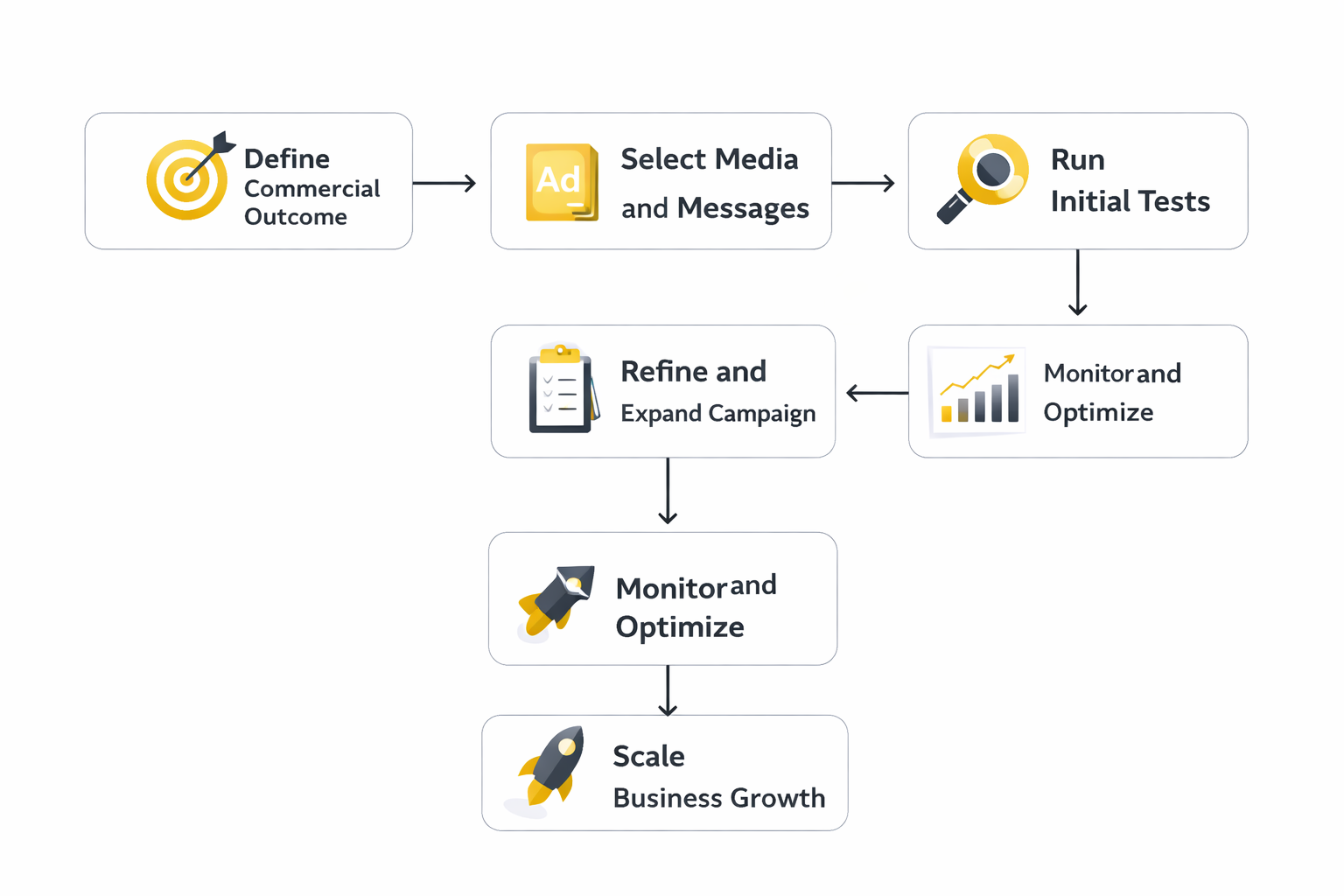
The future of the advertising agency is not about becoming bigger, louder, or more complicated. It is about becoming more connected. Strategy, media, creative, analytics, automation, commerce, and client-side operations now sit inside one ecosystem, and the agencies that thrive are the ones that can keep those moving parts aligned without making the work feel bloated or confusing.
You can already see that shift in the market. dentsu’s June 2025 forecast shows that digital is expected to account for 68.4% of global ad spend in 2025, while IAB Europe’s 2025 retail media study makes it clear that commerce media is maturing fast and forcing brands, retailers, and agencies to collaborate in new ways. That means the old model, where an advertising agency could live comfortably inside a narrow lane and hand off the rest, is becoming harder to sustain.
The technology layer is reshaping the same ecosystem just as quickly. The 4As reported in 2025 that 75% of respondent agencies are using GenAI, but the same research also showed adoption is still uneven across actual day-to-day work. That is the real story. AI is becoming part of the operating environment, but judgment, clarity, and commercial discipline are still what separate a useful agency from one that simply moves faster in the wrong direction.
Where The Agency Model Is Heading
The agency model is moving toward integration, but not in the old-fashioned sense where one holding company promised to do everything. What clients increasingly need is a partner that can connect specialized capabilities without turning the engagement into a maze. They want better planning, faster production, cleaner reporting, stronger data interpretation, and less waste between those functions.
This is one reason longer relationships are becoming more valuable again. The ANA and 4As reported in April 2025 that average client-agency tenure had reached about seven years, more than double the level reported in 2016. That kind of tenure only happens when the agency becomes woven into the client’s operating reality rather than behaving like an interchangeable vendor.
The practical implication is simple. The advertising agency of the next few years will need to think like a systems partner. It will not be enough to pitch good creative or buy media efficiently. The winning agencies will be the ones that can hold the whole growth picture together when the client is dealing with budget pressure, channel fragmentation, measurement gaps, and pressure from leadership to prove every move.
Why Human Judgment Is Still The Advantage
It is tempting to assume that software will flatten the industry and make every advertising agency look more or less the same. In practice, the opposite is happening. When tools become easier to access, judgment becomes more valuable. Businesses still need someone to decide what matters, what is noise, what to test first, and when a campaign should be fixed instead of scaled.
That is especially important because modern advertising data can create false confidence. Nielsen’s 2025 Annual Marketing Report shows that marketers are still struggling to measure channels holistically even while the demand for ROI keeps intensifying. So the challenge is not a shortage of numbers. It is a shortage of interpretation that the business can actually use.
The agencies that stand out from here will be the ones that turn complexity into clarity. They will know when to trust automation, when to challenge platform reporting, when to simplify the media mix, and when a client’s real problem has less to do with ads and more to do with the offer, the funnel, or the sales process waiting on the other side.
FAQ For A Complete Guide
What Does An Advertising Agency Actually Do?
An advertising agency helps a business plan, create, distribute, measure, and improve paid marketing efforts. In a strong engagement, that covers more than ad production. It includes commercial planning, audience strategy, channel allocation, creative direction, reporting, optimization, and the discipline to connect all of that to actual business outcomes instead of vanity metrics.
Is An Advertising Agency Worth It For A Smaller Business?
It can be, but only if the business is ready to use the agency well. A smaller company should not hire an advertising agency just because it feels like the next serious step. It should hire one when it has a clear offer, realistic economics, a working sales process, and enough internal focus to act on what the agency learns instead of treating the engagement like magic.
How Is An Advertising Agency Different From A Marketing Agency?
An advertising agency is usually more focused on paid promotion, media, campaign strategy, and creative built to drive attention and action. A broader marketing agency may also handle content, SEO, CRM, lifecycle work, brand positioning, and other growth functions. In reality, the line keeps blurring, which is why it is smarter to evaluate capabilities and operating style than to obsess over the label.
How Do You Choose The Right Advertising Agency?
Start by asking whether the agency understands the commercial problem, not whether it has the prettiest deck. You want to see how it thinks, how it explains trade-offs, how it handles measurement, and whether it can speak clearly about where growth is likely to come from. Chemistry matters too, but clarity matters more, because unclear partnerships become expensive fast.
Should You Pay An Advertising Agency A Retainer Or A Project Fee?
That depends on the kind of work you need. If the engagement involves ongoing media, testing, reporting, and optimization, a retainer often makes more sense because the value builds over time. If the work is tightly defined, such as a launch campaign or a one-time creative sprint, a project fee can be cleaner. The real priority is making sure the pricing model matches the operating model.
How Long Should You Work With An Advertising Agency Before Judging Results?
That depends on the category, the sales cycle, the quality of the starting infrastructure, and whether the work is demand capture or demand creation. Some fixes show up quickly. Others need time because the agency first has to clean up tracking, improve creative, tighten the funnel, and build enough learning to make confident decisions. What matters is not blind patience. It is having a clear review rhythm and realistic milestones.
What Metrics Should You Watch Most Closely?
The most important metrics are the ones tied to the real commercial objective. For one business that may be qualified pipeline. For another it may be profitable purchases, payback period, branded search lift, or customer lifetime value. An advertising agency should absolutely monitor media and creative signals, but those numbers only matter if they are helping the company move the result it actually cares about.
Can An Advertising Agency Help With Creative And Funnels Too?
Many can, and the best ones usually should. Media performance is heavily shaped by the offer, the message, the landing experience, and what happens after the click. If the business needs a cleaner conversion path, tools like ClickFunnels, Systeme.io, and Brevo can support the infrastructure, but the advertising agency still has to connect those tools to the right strategy and follow-through.
Does AI Make Advertising Agencies Less Valuable?
Not automatically. AI makes certain tasks faster, and that can absolutely reduce waste. But speed is not the same thing as insight. The more accessible tools become, the more businesses need people who can decide what to test, what to ignore, how to protect quality, and how to translate all of that into commercial progress. That is why the strongest agencies are using AI to improve workflows without surrendering judgment.
What Red Flags Should You Watch For?
Be careful with any advertising agency that hides behind jargon, avoids difficult measurement conversations, or promises certainty too early. Other warning signs include weak onboarding, sloppy reporting, no clear testing plan, and an obsession with platform metrics that are disconnected from business outcomes. If the agency cannot explain what it is doing in plain language, it is much harder to trust the optimization decisions happening behind the scenes.
Can You Outgrow An Advertising Agency?
Yes, and that is not always a bad sign. A business may reach a point where it needs more specialized partners, a larger in-house team, or a different operating model. But many companies do not outgrow an advertising agency so much as they outgrow a weak one. The better agencies evolve with the client, deepen their role, and keep contributing as the business becomes more complex.
What Is The Biggest Mistake Clients Make When Hiring An Advertising Agency?
The biggest mistake is expecting the agency to solve structural business problems that advertising alone cannot fix. Weak offers, poor lead follow-up, unclear pricing, low conversion rates, and internal indecision all make campaigns harder to win. Great agency work can create leverage, but it works best when the client is ready to meet it halfway with strong operations and a real willingness to adapt.
Work With Professionals
If you have made it this far, you already understand the main point: an advertising agency should not just make your brand look active. It should help your business make better growth decisions. The right partner brings clarity, commercial discipline, better creative thinking, cleaner measurement, and the ability to keep the entire system moving when the market gets noisy.
That is why choosing well matters so much. Average client-agency tenure now sits at about seven years, which tells you the market is rewarding relationships that create real value over time. So take the selection process seriously, ask tougher questions, and look for an advertising agency that can explain how strategy, media, creative, analytics, and operations will work together in your business instead of handing you disconnected promises.
If you are a marketer who wants to build that kind of career on your own terms, there is also a practical next step. The market still rewards people who can think clearly, execute professionally, and help companies grow without wasting time or budget.
Explore 10K+ Remote Marketing Contracts on MarkeWork.com
Most marketers spend too much time chasing clients, competing on crowded platforms, and losing a percentage of every project to middlemen.
MarkeWork gives you a better way. Browse thousands of remote marketing contracts and connect directly with companies desperate to hire skilled marketers like you without platform commissions and without unnecessary gatekeepers.
If you’re serious about finding better opportunities and keeping 100% of what you earn, you can explore available contracts and create your profile for free at MarkeWork.com.
 Filip Konecny Enterprises