

How to Choose a Social Media Marketing Agency That Actually Drives Growth
A social media marketing agency can look impressive on paper and still be the wrong fit for your business. The problem is not a lack of options. The problem is that most companies are trying to solve three different needs at once: they want stronger brand visibility, more qualified demand, and a system that can keep working after the first burst of campaign energy fades.
That is why this topic matters so much in 2026. The audience is huge, the platforms keep shifting, and the commercial stakes are real. DataReportal’s 2025 global overview shows social media is now woven into daily digital behavior at massive scale, Meta reported 3.58 billion daily active people in December 2025 across its family of apps, and DHL’s 2025 e-commerce trends research across 24 markets found that social commerce is moving from an experiment to an expected buying path. When the channel is this important, hiring the right partner becomes a strategic decision rather than a creative convenience.
The best way to evaluate an agency is not to start with flashy case studies or trendy content formats. Start with structure. In this first part, we will define the six-part roadmap for the full article, explain why a social media marketing agency deserves executive attention, outline the framework smart companies use to evaluate agency work, and break down the components that separate disciplined operators from vendors who simply post content and hope for the best.
Article Outline
- Part 1: Why a Social Media Marketing Agency Matters
- Part 2: The Strategic Framework Behind High-Performing Agency Work
- Part 3: The Core Components Every Agency Engagement Needs
- Part 4: How Professional Implementation Works in the Real World
- Part 5: Measurement, Optimization, and Profitability Control
- Part 6: Choosing the Right Partner, Common Questions, and Long-Term Fit
Why a Social Media Marketing Agency Matters

A serious social media marketing agency does far more than schedule posts. It translates business goals into channel-specific creative, audience targeting, paid distribution, reporting, and operational rhythm. That matters because social platforms are now too complex for most growing companies to manage casually, especially when the same team is also trying to handle sales, customer service, product launches, and retention.
The pressure has increased because the audience no longer behaves in one predictable way. Pew’s 2025 social media fact sheet shows platform usage varies sharply by age and network, which means a company cannot assume the same message, format, or offer will travel equally well everywhere. At the same time, Deloitte’s 2025 digital media trends work points to social platforms becoming a dominant force in how people discover and consume media, while DHL’s 2025 shopper research shows buyers increasingly expect social channels to play a direct role in purchase decisions. When attention, discovery, and conversion all meet on social, weak execution gets expensive very quickly.
This is also where leadership teams often misread the role of an agency. They think they are buying content production when they are really buying pattern recognition, speed of execution, platform fluency, and measurement discipline. Deloitte Digital’s 2025 state of social research found that stronger brands are doubling down on community, content, and conversion together, and that finding is useful because it exposes the real job of an agency: not to make the brand look busy, but to help the brand connect audience attention to commercial outcomes.
Framework Overview
The cleanest way to evaluate a social media marketing agency is to use a four-part framework: business goal, channel fit, execution system, and evidence loop. Business goal comes first because social media only works when it is tied to a clear commercial priority such as lead generation, pipeline quality, customer acquisition, retention, or branded demand. If an agency cannot explain how content, paid media, and reporting connect back to one of those outcomes, you are not looking at a strategy. You are looking at activity.
Channel fit comes next because each platform rewards different behavior. A B2B company trying to create demand with long sales cycles will judge success differently from a consumer brand trying to shorten the path from discovery to checkout. TikTok for Business success stories, Meta’s latest operating results, and Pew’s 2025 platform usage data all point in the same direction: reach is not the same thing as relevance, and relevance is not the same thing as conversion. A strong agency knows when to prioritize short-form discovery, when to use paid amplification, and when to build a narrower but more commercially meaningful presence.
Execution system is the part clients usually see too late. It includes creative briefing, asset production, review cycles, media buying rules, community management standards, approval speed, and escalation paths when performance drops. The final layer is the evidence loop, which means the agency is constantly gathering signals from platform data, audience response, and commercial results so the next month is smarter than the last. Without that loop, even talented teams drift into recycled ideas and vanity reporting.
Core Components
Every worthwhile agency engagement rests on a few non-negotiable components. The first is positioning clarity, because social media amplifies confusion just as efficiently as it amplifies a strong offer. Before creative work begins, the agency should be able to define who the brand wants to reach, what problem it solves, how it sounds, and what action matters most after someone sees the message.
The second component is creative architecture. That means the agency is not producing random posts, but a deliberate mix of attention-grabbing content, authority-building content, proof-driven content, and conversion-oriented content. The 2025 Sprout Social Index highlights a continuing trust gap between executives and the teams doing the social work, which is exactly why creative architecture matters: it gives leadership a way to see how content supports brand, audience insight, and commercial intent instead of reducing everything to likes and impressions.
The third component is measurement that reaches beyond surface metrics. Reach, engagement, video view rates, click-through behavior, assisted conversions, cost per acquisition, lead quality, and retention indicators all have a role, but not all of them deserve equal weight in every business. A social media marketing agency earns its keep when it knows which metrics belong at the top of the dashboard, which ones are diagnostic, and which ones are simply noise.
Professional Implementation
Professional implementation is where a social media marketing agency proves whether its ideas can survive real operating conditions. Content calendars look easy in pitch decks, but the hard part is maintaining message quality while campaigns, product priorities, audience reactions, and budget constraints keep changing. The difference between amateur execution and professional implementation is not effort. It is process under pressure.
In practice, that means the agency should run with a clear cadence. Strategy decisions should feed content production, content production should feed distribution, distribution should feed reporting, and reporting should feed the next round of decisions. When that loop is healthy, the brand does not feel like it is constantly starting over. It feels like each month is compounding the lessons of the previous one.
Professional implementation also depends on realistic alignment with the client team. The strongest agencies do not try to own the entire brand voice from day one. They build it through repeated feedback, sharper performance analysis, and better internal communication until the company can trust the agency not only to publish content, but to represent the business with sound judgment. That trust is what turns social media from a marketing task into a durable growth channel.
Start With the Business Outcome First
The first thing a strong social media marketing agency should lock down is the business outcome. Not “more visibility” in the abstract. Not “better engagement” because it sounds nice in a report. The agency should be able to say whether the real target is more qualified leads, lower acquisition costs, stronger ecommerce conversion, better retention, greater branded search demand, or some combination that genuinely reflects how the company grows.
This sounds obvious, but it is where many companies quietly sabotage themselves. Social media can support multiple outcomes at once, but one of them has to lead. HubSpot’s 2025 State of Marketing findings placed paid social among the highest-ROI channels for B2C marketers, and Sprout Social’s 2025 ROI reporting makes the same broader point from another angle: social can absolutely produce revenue impact, but only when the work is tied to the right commercial objective. If the objective is fuzzy, the agency will default to whatever is easiest to report, and that usually means vanity metrics.
That is why the business outcome has to come first. Once it is named clearly, everything else becomes easier to judge. You can decide whether the platform mix makes sense, whether the creative is doing the right job, whether paid spend is supporting the funnel properly, and whether the agency is solving the right problem instead of performing for the monthly meeting.
Match the Platform to Buyer Behavior
Once the goal is clear, the next step is matching the platform to the way your buyers actually discover, evaluate, and act. That sounds simple until you see how often brands copy what looks popular instead of what fits their audience. A social media marketing agency should be able to explain why a platform deserves investment, what role it plays in the customer journey, and what kinds of content people are most likely to respond to there.
The numbers alone show why this matters. Pew’s latest platform usage breakdown shows YouTube and Facebook still reach enormous audiences in the United States, while Instagram, TikTok, LinkedIn, Reddit, and WhatsApp each occupy very different behavioral niches. On the commerce side, DHL’s 2025 e-commerce trends report found that 70% of global consumers expect to shop primarily through social media by 2030, and DHL’s social commerce analysis points in the same direction: social is no longer just a discovery layer for many brands. It is becoming part of the buying environment itself.
That shift changes what you should demand from an agency. You are not just asking whether they can grow an account. You are asking whether they understand where your buyer wants to be persuaded, where they want proof, where they want entertainment, and where they are ready to act. The right platform mix is not about being everywhere. It is about being present where buyer intent can realistically be moved forward.

Build a System, Not a Content Pile
The third part of the framework is where a social media marketing agency either becomes valuable or starts wasting your time. You do not need random content. You need a system. That system should include messaging priorities, content themes, creative testing logic, production rhythm, approval timelines, paid amplification rules, and a clear idea of what happens when a post or campaign underperforms.
This is more important than most clients realize because social media punishes inconsistency. When teams produce disconnected posts with no narrative, no testing logic, and no conversion path, they may still get occasional spikes, but they do not build momentum. The best agencies work more like operators than artists. They know how to take a positioning angle, translate it into multiple creative formats, distribute it in a way that matches platform behavior, and then tighten the next round using what the market already told them.
That operational mindset matters even more now because platform and audience behavior keep shifting. TikTok’s business insights hub is built around the idea that audience attention is shaped by cultural behavior and creative fluency, not just by media spend. Sprout Social’s research archive repeatedly emphasizes how fast audience expectations move as social matures inside the business. A serious social media marketing agency should already be built for that reality. If they are not, they will constantly look surprised by changes that should have been part of the operating model all along.
Create an Evidence Loop That Improves Every Month
The final layer of the framework is the evidence loop. This is where the agency proves it can learn faster than the market changes. The evidence loop is not just a monthly report with charts. It is a process for connecting audience response, platform performance, creative insights, and actual business outcomes so the next month starts from a stronger position than the last one.
A social media marketing agency that works this way does not treat data as decoration. It treats data as direction. If a certain offer pulls strong click-through but weak conversion, that means something. If short-form video drives low-cost attention but weak lead quality, that means something too. If a founder-led content angle creates stronger branded search demand than polished corporate creative, that matters because it changes where the team should invest its next round of effort.
This is where a lot of agencies lose trust. They show activity metrics without translating them into business meaning. Better teams do the opposite. They explain why the numbers moved, what that suggests about audience intent, what should be tested next, and where the company should keep spending because real leverage is beginning to appear. That kind of evidence loop is what turns a social media marketing agency from a vendor into a growth partner.
What This Framework Reveals About Agency Quality
Once you start looking through this lens, weak agencies become much easier to spot. They talk endlessly about content, but they cannot connect it to a business result. They promise omnipresence, but they cannot explain why each platform deserves budget. They deliver reports, but they do not show what the team learned or what decision should change next. On the surface, that can still look busy and professional. Under pressure, though, it falls apart.
Great agencies feel different because they reduce confusion. They help you see the commercial role of every major decision. They can defend the platform mix, justify the creative direction, and explain what they are optimizing for beyond visibility alone. In a channel as crowded and fast-moving as social, that clarity is not a luxury. It is the thing that keeps your budget from dissolving into motion without progress.
That is the real value of having a framework overview before moving any deeper. It gives you a practical way to judge whether a social media marketing agency is capable of building something durable, measurable, and genuinely useful to the business. And once that structure is in place, the next question becomes even more important: what core components have to exist inside the engagement if you want the whole machine to keep working.
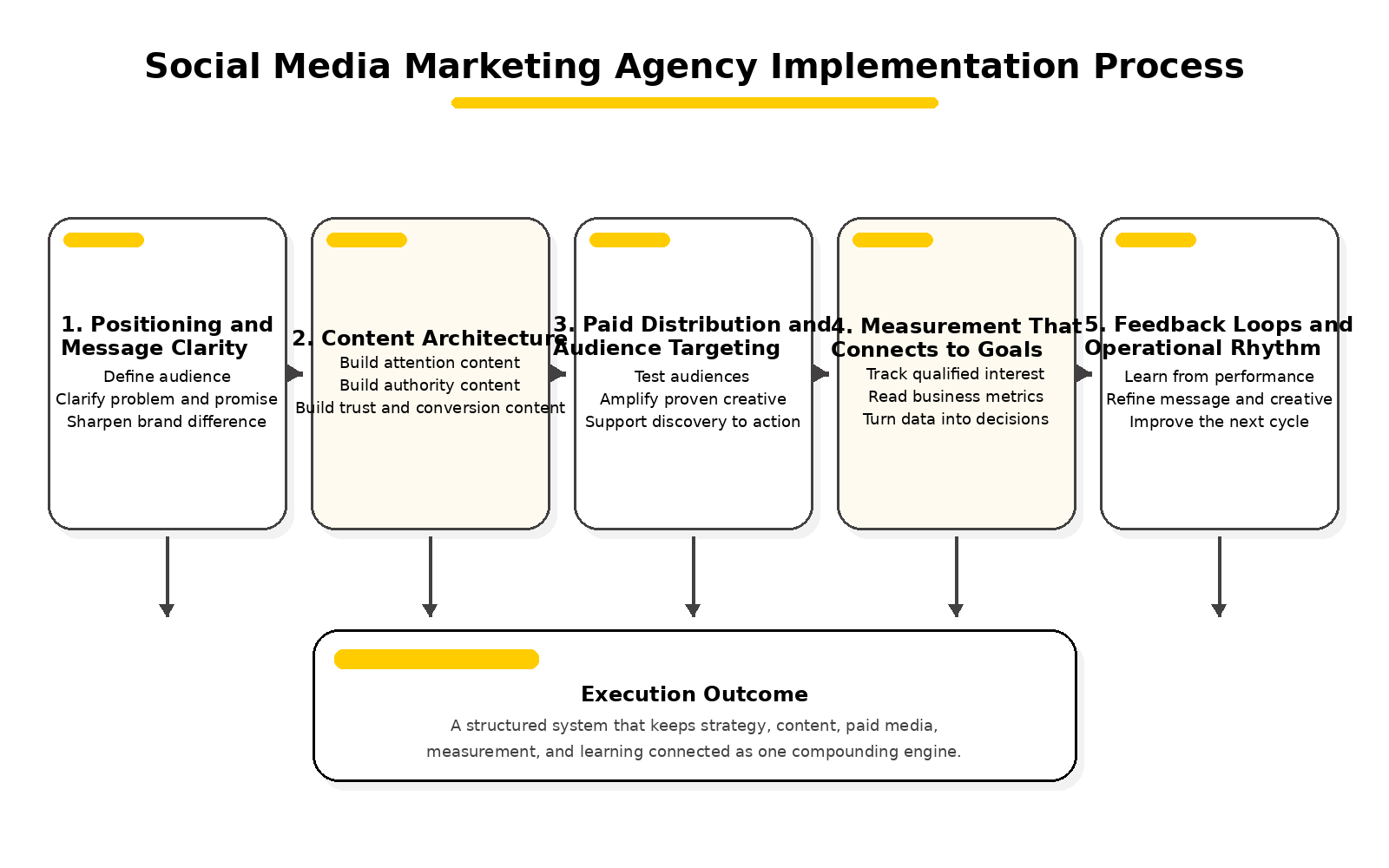
Positioning and Message Clarity
The first core component is positioning. A social media marketing agency cannot fix a weak offer with better editing, and it cannot rescue confused messaging by posting more often. Before content ever goes out, the agency should be able to explain who the brand wants to reach, what pain point or desire it speaks to, how it is different from alternatives, and what kind of promise it is prepared to defend in public every single week.
This is the part many clients underestimate because it feels less exciting than content creation. But without message clarity, every downstream decision gets worse. You end up with posts that sound generic, ads that blend into the feed, and offers that attract the wrong people. A strong social media marketing agency will push for sharper language early because it knows clarity is not a branding luxury. It is what makes creative memorable and what gives paid distribution a real chance to convert.
You can also see why this matters by looking at how fragmented platform use has become. Pew’s 2025 study of U.S. adults shows that YouTube and Facebook still reach the broadest audiences, while Instagram, LinkedIn, TikTok, Reddit, WhatsApp, and other networks each play very different roles. If your message is vague, that fragmentation will expose it immediately. If your message is sharp, a good agency can adapt it without losing the brand’s center.
Content Architecture That Earns Attention
The second core component is content architecture. Not content volume. Not a giant calendar full of filler. Content architecture means the agency knows which pieces are supposed to attract attention, which ones are supposed to build authority, which ones are supposed to create trust, and which ones are supposed to drive the next step. That structure is what keeps a brand from sounding repetitive or random.
This is especially important now because audience expectations have changed. People do not reward brands for merely showing up. They respond when the message feels useful, entertaining, distinctive, or emotionally relevant to the moment they are in. TikTok’s What’s Next 2025 report frames this around evolving community behavior and creative fluency, while Deloitte’s 2025 Digital Media Trends research describes a media environment increasingly shaped by creators, social platforms, and user-generated content. Those shifts matter because they raise the bar for any social media marketing agency trying to produce work that feels alive instead of corporate.
When content architecture is strong, the audience feels progression instead of repetition. One piece may introduce a problem. The next may show a perspective the audience had not considered. Another may bring in proof, customer experience, product context, or founder conviction. Over time, that creates a narrative people can follow. And that narrative is what gives social content the power to support both brand strength and revenue goals at the same time.
Paid Distribution and Audience Targeting
The third core component is paid distribution. Organic content still matters, but most companies that hire a social media marketing agency need more than occasional reach from the algorithm. They need a reliable way to place strong creative in front of the right audience segments, test offers under controlled conditions, and scale what works without burning money on broad impressions that never become demand.
This is where discipline matters more than enthusiasm. Paid social should not be treated like a magic switch that fixes weak messaging. It works best when the positioning is already clear and the creative is already proving that it can hold attention. Then paid distribution becomes an amplifier. The agency can test audiences, compare hooks, build remarketing paths, and support the larger sales journey with intent instead of guesswork.
The commerce side of social makes this even more important. DHL’s 2025 e-commerce trends report found that social commerce is becoming a mainstream buyer expectation, and EMARKETER’s late-2025 forecast on TikTok Shop shows how quickly platform-native buying behavior is growing. A capable social media marketing agency should already understand that paid distribution is no longer just about traffic. In many cases, it is directly shaping the path from discovery to purchase.
Measurement That Connects to Business Goals
The fourth core component is measurement, and this is where agencies either become strategic partners or stay trapped as content vendors. A social media marketing agency should never stop at impressions, likes, or surface-level engagement. Those signals can be useful, but only when they are tied to business meaning. The real question is whether the social program is creating qualified interest, stronger brand demand, lower acquisition friction, or better customer movement through the funnel.
This point is bigger than many executives realize. Sprout Social’s 2025 ROI analysis notes that 65% of leaders want direct connections between social campaigns and business goals, yet only 30% of marketers believe they can measure social media ROI well. The 2025 Sprout Social Index and HubSpot’s 2025 State of Marketing research reinforce the same broader reality from different angles: social has become a serious growth channel, but many teams still struggle to translate platform performance into commercial language. That gap is exactly why measurement has to be one of the core components, not an afterthought added at the end of the month.
The best agencies report numbers in a way that helps the business decide what to do next. They explain whether the creative is attracting the right people, whether the offer is strong enough, whether traffic quality is improving, and whether conversion signals justify more investment. That kind of reporting creates confidence because it turns data into decisions. Without it, even decent results can feel fragile and hard to defend internally.
Feedback Loops and Operational Rhythm
The final core component is the feedback loop that keeps the whole system improving. A social media marketing agency should not behave like a monthly content factory that disappears once the assets are delivered. It should operate like a team that listens to the market, learns from performance, refines the message, and comes back with stronger creative and smarter distribution choices every cycle.
This is where operational rhythm becomes a competitive advantage. Deloitte Digital’s 2025 state of social research shows major brands are investing across community, creators, commerce, and content at the same time, which means the winning teams are not treating social as a single tactic anymore. Sprout’s 2025 research and HubSpot’s current marketing statistics hub point to the same practical lesson: the strongest programs learn fast, adjust fast, and keep linking audience signals back to business priorities.
That is why these core components matter so much. Positioning gives the work direction. Content architecture gives it shape. Paid distribution gives it scale. Measurement gives it meaning. Feedback loops give it momentum. And when a social media marketing agency has all of those pieces working together, you are no longer paying for posts. You are building a marketing engine that can actually compound over time.
Statistics and Data

If you want to judge a social media marketing agency properly, statistics and data have to move from the appendix into the center of the conversation. This is where hype gets stripped away. A polished pitch can make almost any agency sound impressive, but the real test is whether the numbers reveal market opportunity, audience behavior, rising platform costs, and a believable path from attention to revenue.
The good news is that the market is large enough to reward smart execution in a serious way. DataReportal’s 2026 global overview shows social media remains one of the largest concentration points of digital attention in the world, while Meta’s latest full-year results reported 3.58 billion daily active people across its family of apps in December 2025. That combination matters because it tells you two things at once: the opportunity is enormous, and competition for quality attention is not going away.
That is why a social media marketing agency should never present raw numbers without context. Reach only matters if it reaches the right people. Engagement only matters if it signals meaningful interest. Traffic only matters if it creates commercial movement. The deeper you get into the data, the more obvious it becomes that the strongest agencies are not obsessed with one number. They are obsessed with interpreting the relationship between numbers.
Audience Scale and Platform Reality
The first thing the numbers make clear is that platform choice cannot be casual. The audience is massive, but it is not uniform, and that is exactly where a social media marketing agency either earns trust or starts wasting budget. Pew’s 2025 study of U.S. adults found that YouTube and Facebook remain the only major platforms used by a majority across all age groups, while younger adults stand out sharply in their use of Instagram, Snapchat, TikTok, and Reddit. That is not a small detail. It changes everything about creative format, tone, media allocation, and conversion expectations.
For an agency, this means platform recommendations should never sound generic. If the audience is younger and highly culture-responsive, the work has to look and feel different than it would for a brand targeting established decision-makers with longer buying cycles. A strong social media marketing agency reads platform data as behavioral evidence, not just market trivia. It knows that scale is attractive, but fit is what protects profitability.
This is also why copying another brand’s channel mix usually ends badly. One company can grow through TikTok-led discovery, while another gets stronger returns from Instagram retargeting and LinkedIn authority content. The platform reality is simple: huge reach does not guarantee business relevance. Good agencies know the difference, and the data makes that difference impossible to ignore.
Social Commerce Is No Longer Optional
The second major signal in the data is that buying behavior is moving closer to the social feed. That shift is one of the biggest reasons companies are hiring a social media marketing agency in the first place. Social is no longer just a top-of-funnel awareness tool for many brands. It is increasingly part of how people discover products, validate them, and purchase them without leaving the ecosystem for very long.
DHL’s 2025 E-Commerce Trends Report found that 70% of consumers expect to do most of their shopping on social media by 2030, and DHL’s own report hub also highlights the broader mobile and convenience context behind that shift. These are not small directional clues. They suggest that the agencies building for the next few years need to understand storefront behavior, creator influence, product discovery loops, and in-platform conversion, not just content calendars.
That has a practical consequence for how you evaluate agency work. If a social media marketing agency still talks about social as though it only exists to “build awareness,” it is probably behind the market. Awareness still matters, of course, but the data says consumer expectations are moving closer to commerce. Agencies that understand this will shape creative, offers, landing experiences, and paid support around that reality instead of treating sales as somebody else’s department.
Why Measurement Gaps Still Hurt Brands
One of the most revealing parts of the current data is that businesses want social to drive measurable growth, yet many teams still struggle to prove that connection cleanly. That gap creates tension inside almost every serious engagement with a social media marketing agency. Leadership wants certainty. The channel offers a mix of direct and indirect effects. The agency’s job is to reduce that ambiguity as much as possible.
Sprout Social’s 2025 ROI findings show that 65% of leaders want direct links between social campaigns and business goals, while only 30% of marketers say they are very confident in measuring social media ROI. The 2025 Sprout Social Index supports the same broader picture: companies increasingly expect social to prove business value, but the operational systems are not always mature enough to make that easy. That is exactly why weak agencies hide behind activity metrics. They know many clients feel the performance pressure, but not all of them know how to interrogate the reporting.
A better social media marketing agency closes that gap by translating performance into business language. It explains not only what happened, but what likely caused it, what behavior changed, and what the company should do next. When that translation is missing, even good numbers feel hollow. When it is present, the data becomes a tool for conviction rather than confusion.
Cost Pressure and the Value of Better Creative
The next thing the statistics tell us is that paid social has real commercial power, but the margin for sloppy execution keeps shrinking. Meta’s 2025 full-year results reported that ad impressions across its family of apps rose 12% for the year while the average price per ad increased 9%. That combination matters because it suggests brands are competing in an environment where volume is still growing, but cost discipline matters more than ever.
For a social media marketing agency, this changes the standard completely. The agency cannot just launch campaigns and call it a day. It has to make creative quality, audience targeting, landing-page continuity, and offer strength work together well enough to justify the spend. In a more expensive media environment, the difference between mediocre creative and sharp creative becomes painfully obvious on the balance sheet.
This is also why good agencies obsess over testing. They know rising platform efficiency does not automatically mean your account will perform better. It means the platforms are getting better at monetizing attention. Your agency still has to earn results inside that system. The data does not make the job impossible, but it does punish laziness faster than it used to.
What the Best Agencies Do With the Data
The strongest agencies do not collect numbers just to make reports look intelligent. They use data to make sharper decisions about message-market fit, creative direction, platform allocation, remarketing priorities, and conversion friction. That is the real difference between a social media marketing agency that compounds value and one that constantly starts over every month with a different trend and a different excuse.
HubSpot’s current marketing statistics collection continues to show paid social near the top tier of ROI-producing channels for many marketers, and Deloitte’s 2025 Digital Media Trends research reinforces how deeply social platforms now shape attention and media consumption. Put those signals together and the message is clear: social is too important to be managed by taste alone. It has to be managed by evidence.
That does not mean the human side disappears. It means the human side becomes more disciplined. Great agencies still care about story, creative tension, emotional relevance, and audience psychology. They just refuse to separate those things from the data. And that is exactly how a social media marketing agency stops being a posting service and starts becoming a serious growth operator.
How to Read the Numbers Without Getting Lost
The final lesson from all of this is that data is only helpful when it is interpreted in the right order. Start with the business goal. Then look at platform fit. Then examine whether the creative is holding attention. Then judge the quality of the traffic or leads. Then look at downstream conversion and revenue contribution. That sequence matters because it keeps you from overreacting to isolated metrics that look dramatic but do not actually explain the health of the system.
If a social media marketing agency can walk you through the numbers in that order, you are usually dealing with a team that understands the job. If it jumps straight from impressions to celebration, or from a weak month to excuses about the algorithm, something is missing. The data should make the strategy clearer, not foggier.
That is the whole point of statistics and data in this part of the article. They are not there to impress you. They are there to help you see the market more clearly, judge agencies more accurately, and make better decisions with less guesswork. And once you understand how to read the numbers, the next step is learning how the broader ecosystem around a social media marketing agency shapes long-term performance.
Agency Selection and Long-Term Fit
Choosing a social media marketing agency is not really about finding the team with the slickest pitch deck. It is about finding the team you can trust when performance dips, platform costs rise, creative gets stale, and leadership starts asking harder questions. That is when the real relationship begins, and that is why long-term fit matters more than first-impression polish.
The market is big enough to make this decision matter. DataReportal’s 2026 global overview shows social media remains one of the biggest attention environments in the world, Meta’s latest full-year results show both ad impressions and average price per ad continuing to rise, and DHL’s 2025 e-commerce trends research shows social commerce expectations climbing fast. Put those together and the message is simple: a social media marketing agency is no longer a nice extra for many brands. It is often tied directly to growth, efficiency, and competitive position.
The right agency should make your business feel sharper over time. The wrong one will make you feel busy, dependent, and strangely uncertain even when reports look positive. That is why the final test is not whether an agency can produce content. It is whether it can understand your business deeply enough to make social media support the outcomes you actually care about.

FAQ – Built for a Complete Guide
What does a social media marketing agency actually do?
A strong social media marketing agency does much more than post content. It helps shape positioning, build creative systems, manage paid distribution, analyze performance, and keep social activity tied to commercial goals such as leads, sales, retention, or brand demand. If the agency only talks about posting frequency and visual polish, you are probably looking at a content vendor rather than a serious growth partner.
How do I know if my business really needs one?
You usually need a social media marketing agency when social has become too important to run casually but you do not want to build the whole capability in-house yet. That often happens when your team lacks the time, platform fluency, paid media skill, or creative operating rhythm to do the channel justice. If social already influences discovery, trust, and conversion in your market, weak execution has a real cost, and that is usually the moment outside help starts making sense.
How much should an agency focus on ROI?
It should focus on ROI a lot, but not in a shallow way. Sprout Social’s 2025 ROI research shows leaders increasingly want direct links between social and business goals, yet many marketers still struggle to measure that relationship with confidence. A good social media marketing agency understands that tension and helps you combine direct revenue data, assisted conversion signals, brand demand, lead quality, and cost efficiency instead of pretending one number tells the whole story.
Which platforms should an agency prioritize?
The answer depends on buyer behavior, not trend pressure. Pew’s 2025 platform study makes it clear that usage patterns differ meaningfully across networks, and that means channel mix should be built around who your buyers are, how they evaluate options, and where they are most likely to take action. A reliable social media marketing agency should be able to explain why each platform deserves attention instead of telling you to be everywhere at once.
Should I hire for organic social, paid social, or both?
For most serious growth goals, the best answer is both, but with different jobs for each. Organic social helps shape brand perception, build trust, create proof, and keep the audience warm over time. Paid social gives a social media marketing agency more control over audience targeting, testing, retargeting, and scale. When the two work together, the business gets something far stronger than isolated campaigns. It gets a system that can create momentum and then amplify it intelligently.
How long does it usually take to see results?
That depends on the offer, creative quality, budget, audience temperature, and how strong the starting position is. Some paid campaigns can show useful signals quickly, especially when the market fit is already good. But a social media marketing agency that is also helping with messaging, creative systems, audience learning, and trust-building is usually doing work that compounds over time. Fast feedback matters, but sustainable results usually come from repeated learning cycles rather than one early spike.
What red flags should I watch for before signing?
Watch for agencies that promise guaranteed outcomes, avoid business questions, overuse vanity metrics, or cannot explain how they will measure real success. Be careful with teams that talk endlessly about aesthetics but very little about positioning, distribution, optimization, or profitability control. A trustworthy social media marketing agency should welcome hard questions because it knows the relationship will eventually be judged under pressure, not just during onboarding.
What should I ask on the first call with a social media marketing agency?
Ask how the agency connects social activity to business outcomes. Ask what metrics it uses for awareness, for lead generation, for ecommerce, and for retention. Ask how it handles weak performance, how often it tests creative, how it thinks about attribution, and what kind of access or feedback it needs from your team. Those questions reveal far more than asking how many posts are included each month.
Can an agency help with social commerce, not just awareness?
Yes, and in many markets it should. DHL’s 2025 global shopper research found that 70% of consumers expect to shop primarily through social media by 2030, which means the line between attention and transaction is getting thinner. A capable social media marketing agency should understand product discovery, storefront behavior, creator influence, paid support, and how content can reduce friction on the path to purchase.
How do I judge whether the reporting is actually good?
Good reporting should make decisions easier, not just make the agency look busy. You should come away knowing what changed, why it probably changed, what the data suggests about audience behavior, what needs to be improved, and where budget or effort should move next. If a social media marketing agency sends dashboards full of numbers without commercial interpretation, the reporting may be detailed but still weak.
Does an agency need deep experience in my industry?
Industry familiarity helps, but it is not always the deciding factor. What matters more is whether the agency can learn your buyer psychology, grasp your sales motion, and translate that understanding into smart creative and distribution choices. A social media marketing agency with strong operating discipline can often ramp into a new category faster than a niche agency with stale thinking and weak systems.
Is building an in-house team better than hiring an agency?
Not automatically. In-house teams can offer speed, context, and close alignment, but they also require hiring, management, tools, and enough internal leadership to keep the function sharp. A social media marketing agency can give you broader skill coverage faster, especially if you need strategy, creative, paid media, and measurement support all at once. The better choice depends on your budget, urgency, team maturity, and how central social is to your growth model.
How do I know if the agency is the right long-term fit?
Long-term fit shows up in the way the agency thinks, not just the way it presents itself. Does it understand your economics? Does it adapt when the data changes? Does it communicate clearly when results are mixed? Does it push for stronger decisions instead of protecting weak assumptions? A strong social media marketing agency should make your business smarter over time, not more dependent on smoke and mirrors.
Work With Professionals
If you have made it this far, you already know the decision is bigger than content production. A social media marketing agency should help you clarify your market, sharpen your message, improve your economics, and keep learning as platforms and buyer behavior evolve. That kind of support can be incredibly valuable, but only when the relationship is built on evidence, strategic honesty, and the discipline to improve what is actually driving the business.
The opportunity is real, but so is the risk of choosing badly. The 2025 Sprout Social Index shows brands are under growing pressure to prove the business impact of social, while Sprout Social’s 2026 content strategy research shows marketers are still working to align content choices with what audiences and organizations now expect. That is exactly why the right social media marketing agency can become a serious advantage. It helps you move faster without getting sloppier, and it helps you grow without losing sight of profitability.
If you are serious about making social media work at a higher level, work with people who understand that performance is never just about posts. It is about positioning, creative, timing, targeting, measurement, and constant adjustment. When those parts line up, social stops feeling like a gamble and starts acting like a real business asset.
Explore 10K+ Remote Marketing Contracts on MarkeWork.com
Most marketers spend too much time chasing clients, competing on crowded platforms, and losing a percentage of every project to middlemen.
MarkeWork gives you a better way. Browse thousands of remote marketing contracts and connect directly with companies desperate to hire skilled marketers like you — without platform commissions and without unnecessary gatekeepers.
If you’re serious about finding better opportunities and keeping 100% of what you earn, you can explore available contracts and create your profile for free at MarkeWork.com.
 Filip Konecny Enterprises