

Social Media Marketing: Building a System That Actually Grows Revenue
Social media marketing is no longer the side project brands hand to an intern when everything else is done. It now sits at the center of discovery, trust, customer care, creator partnerships, and increasingly, direct sales. When global social media use continues to climb past the five-billion-user mark and the typical internet user still spends 2 hours and 21 minutes a day on social platforms, the real question is not whether a business should show up, but how it should show up in a way that feels worth following.
That matters even more now because audiences do not move through social platforms in a straight line anymore. People discover products in short-form video, validate brands through comments and creator mentions, ask support questions in DMs, and sometimes buy without ever leaving the app. A serious social media marketing strategy has to connect those moments into one system instead of treating posting, ads, creators, and community as separate jobs.
Article Outline
- Why Social Media Marketing Matters
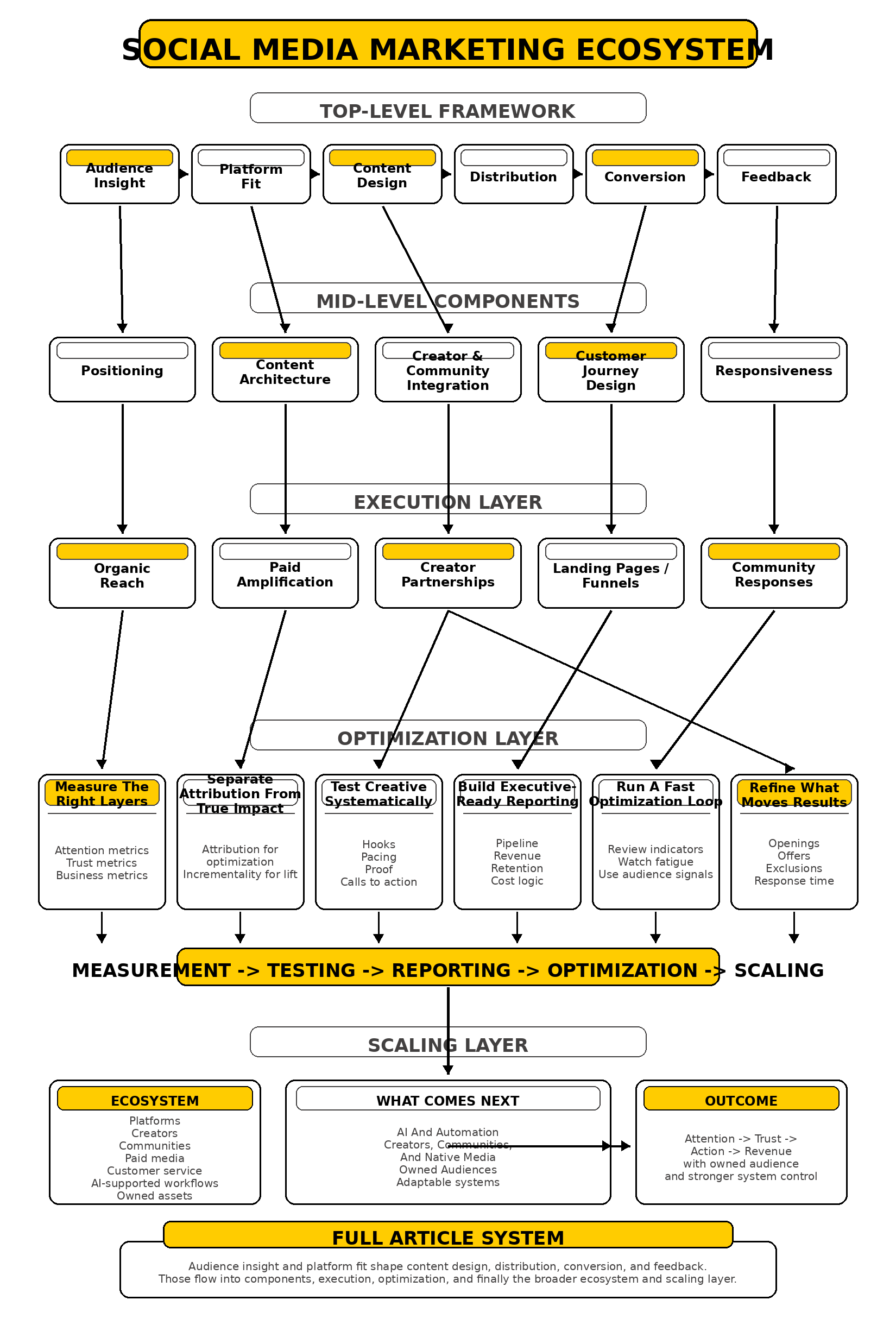
- Framework Overview
- Core Components
- Professional Implementation
- Measurement and Optimization
- Ecosystem, Trends, and FAQ
Why Social Media Marketing Matters

The biggest reason social media marketing matters is simple: attention has fragmented, but social still gathers it better than almost any other digital environment. Research published in Pew Research Center’s 2025 social media fact sheet shows that major platforms remain deeply embedded in daily life across age groups, while DataReportal’s 2025 social analysis shows that people use social for far more than chatting with friends. They go there to fill spare time, read news, follow entertainment, shop, and even handle work-related activity.
That shift changes the job of marketing. A brand is not competing only with direct competitors anymore; it is competing with creators, memes, breaking news, group chats, and algorithmic recommendations that refresh every second. That is why weak social media marketing feels invisible so quickly, while strong social media marketing can compress the distance between first impression and first purchase.
The business case gets stronger when you look at behavior around creators and commerce. Snapchat’s 2025 write-up on its global study with OMG and eye square shows that 68% of consumers say they have seen brand-sponsored creator content, which tells you audiences already expect brands to collaborate with trusted voices. On the platform side, TikTok’s economic impact report says small and midsize business activity tied to paid advertising and organic growth on TikTok supported nearly $15 billion in revenue in the United States in 2023, which is a strong reminder that social media marketing is not just about engagement screenshots anymore.
There is also a service layer that many companies still underestimate. Social has become a front door for support, and customers increasingly judge brands by how they respond in public or in DMs. Sprout Social’s 2025 customer care research notes that 73% of consumers expect a response within 24 hours or sooner, so the brands that treat social as a publishing channel only are usually missing one of the highest-trust moments in the entire customer journey.
Framework Overview
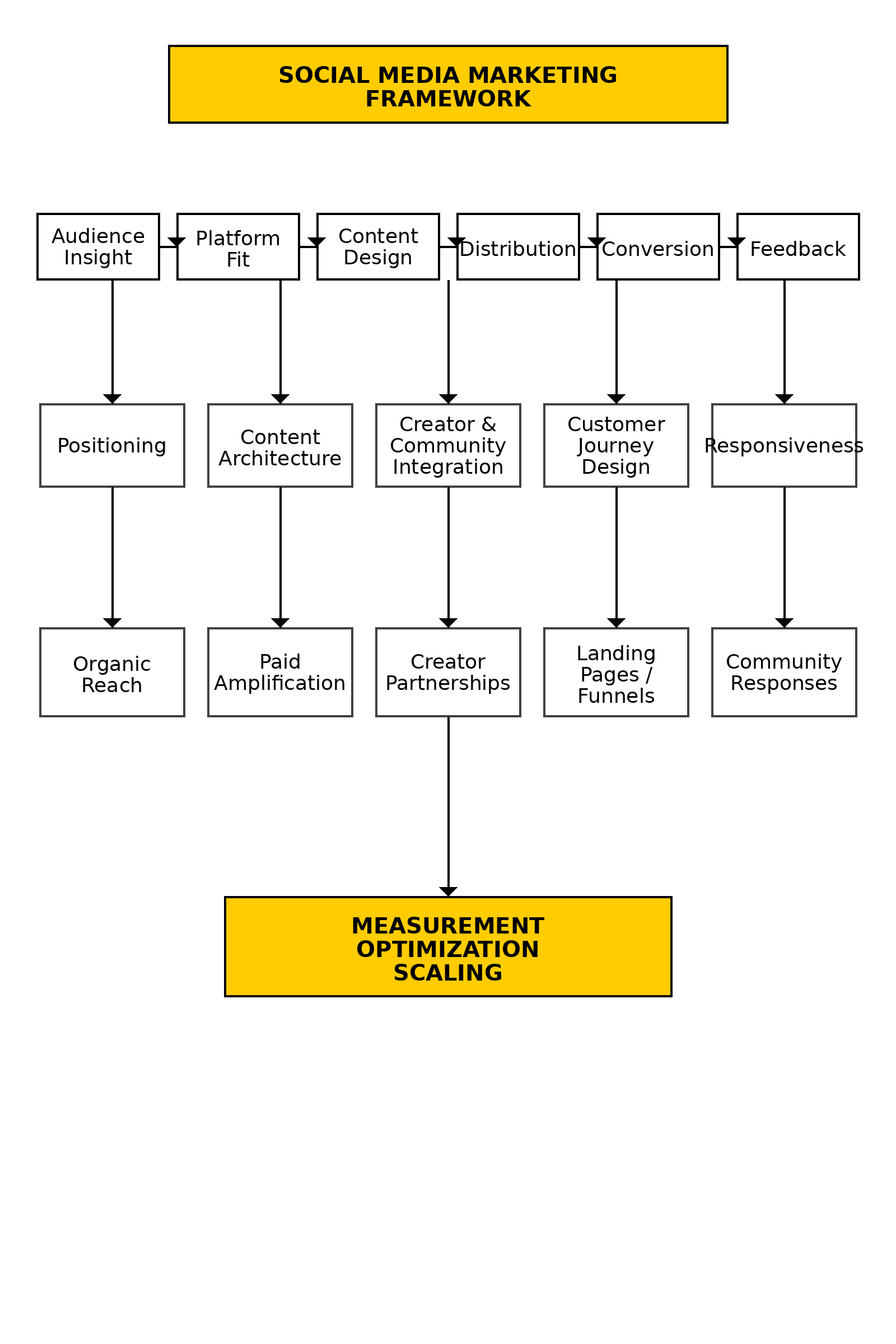
A professional social media marketing framework starts with one uncomfortable truth: posting more is not a strategy. Most underperforming brands are not losing because they lack effort; they are losing because they lack sequence. They publish content without a clear audience promise, run ads without a conversion path, hire creators without a measurement model, and answer comments without learning from them.
The better way to think about social media marketing is as a loop with six connected stages: audience insight, platform fit, content design, distribution, conversion, and feedback. Audience insight tells you what people care about, what they fear, what they buy, and what language they actually use. Platform fit forces you to respect that the same message will land differently on LinkedIn, Instagram, TikTok, YouTube, Pinterest, and X because each platform rewards different behaviors, formats, and expectations.
Content design comes next because creative is the delivery vehicle for strategy, not a decorative layer added at the end. Distribution covers both organic reach and paid amplification, which should support each other instead of operating in separate silos. Conversion then turns attention into something measurable such as a lead, a sale, a booked call, a newsletter signup, or a product page visit, while feedback closes the loop by showing what actually changed in audience behavior after the campaign ran.
This framework also reflects how people behave today. DataReportal reports that adults now cite an average of 4.66 primary reasons for using social media, which means brands are meeting audiences inside mixed-intent environments rather than neat funnel stages. Someone might open an app to relax, discover a product through a creator, read reviews in comments, message the brand, and come back days later through retargeting, all without ever thinking of that experience as a funnel.
You can also see why community matters so much when fan behavior becomes part of distribution. Google’s YouTube Culture and Trends reporting shows that shopping and fandom on YouTube increasingly grow through creators, communities, and tagged products, while its 2024 culture report found that 73% of fans turn to YouTube for content about their fandom. In other words, modern social media marketing works best when the audience is not just receiving content but helping circulate it.
Core Components
The first core component is positioning. Before a brand worries about posting frequency, it needs a recognizable point of view. Social media marketing gets stronger when people can quickly understand who the brand is for, what problem it solves, what tone it uses, and why its content deserves a place in the feed.
The second component is content architecture. That means building repeatable content pillars instead of improvising every post from scratch. A strong setup usually includes attention content to earn reach, authority content to build trust, proof content to reduce risk, conversation content to invite replies and saves, and conversion content that gives people a clear next step.
The third component is creator and community integration. This is where many teams still think too narrowly, because they treat creators as media inventory instead of relationship bridges. Snapchat’s creator commerce research and YouTube’s culture reporting both point in the same direction: audiences respond better when brand messages feel native to the people and communities they already trust, not when they interrupt the experience with stiff corporate language.
The fourth component is customer journey design. Social media marketing should make it obvious where a click leads, what happens after a DM, how a visitor joins an email list, and what offer appears next. When the path is muddy, even good creative underperforms because interest leaks out before it becomes revenue.
The fifth component is responsiveness. Comments, saves, shares, profile visits, story replies, and DMs are not background noise; they are live market research. Brands that listen carefully on social usually find product objections, content ideas, buying triggers, and customer service issues faster than brands that wait for quarterly reports to tell them what their audience already said in public.
Professional Implementation
Professional implementation begins with choosing a business goal before choosing a platform. If the goal is demand generation, your social media marketing system should be mapped around reach, retargeting, landing pages, and follow-up. If the goal is trust, the system should lean harder on education, proof, creators, testimonials, and fast response times inside comments and messages.
Execution also gets easier when the workflow is boring in the best possible way. A publishing calendar, a repeatable approval process, and a simple reporting cadence will outperform random bursts of inspiration almost every time. Teams that want cleaner execution often centralize scheduling with tools such as Buffer, tighten audience and hashtag research with Flick, and connect social interest to owned email follow-up with Brevo.
Conversion infrastructure matters just as much as content quality. If a campaign is driving interest, the next step should feel frictionless, whether that means a simple form, a lead magnet, a booking page, or a focused funnel. Brands that need fast deployment often pair social media marketing campaigns with landing-page systems such as Systeme.io or ClickFunnels so the click from a post or ad lands somewhere built to convert instead of somewhere built to distract.
The final piece is organizational discipline. Someone has to own insights, someone has to own creative velocity, someone has to own response quality, and someone has to own revenue attribution. Once those responsibilities are clear, social media marketing stops feeling chaotic and starts behaving like the growth system it should have been from the start.
Audience Positioning Comes Before Content
One of the easiest mistakes in social media marketing is starting with content ideas before getting brutally clear on the audience. When that happens, brands post often, work hard, and still wonder why nothing really moves. The problem is not usually effort. The problem is that generic content attracts generic attention, and generic attention almost never turns into sales.
Audience positioning fixes that because it forces sharper decisions. You stop trying to speak to everyone and start speaking to the exact group most likely to care, buy, and stay. That shift matters because people follow far more than friends and family on social now, which means your brand is competing in a feed crowded with entertainers, subject-matter experts, news, creators, and niche communities that already know how to hold attention.
Good positioning usually answers four questions. Who exactly is this for, what pain or desire do they already feel, what transformation are they after, and why should they trust you over the endless alternatives in their feed. Once those answers are clear, your social media marketing starts sounding less like “content for everyone” and more like a signal for the people you actually want.
Content Architecture Gives You Consistency Without Becoming Boring
After positioning comes content architecture, which is just a practical way of saying you need repeatable categories that keep your message focused. Without that structure, teams end up posting random tips, random promotions, and random trends, then calling the inconsistency a creativity problem. It is not a creativity problem. It is a system problem.
A strong content architecture usually balances five kinds of posts: attention content that earns reach, authority content that teaches, proof content that lowers risk, conversation content that invites replies, and conversion content that gives people a clear next step. Social media marketing feels a lot lighter once those buckets are defined because you are no longer inventing your strategy every morning. You are executing a strategy that already exists.
This is also where format discipline matters. YouTube’s latest shopping report shows how creators, tagged products, and viewer behavior are increasingly intertwined, and YouTube’s creator partnerships push makes it even easier for brands to collaborate directly with creators. In practical terms, that means your content architecture should leave room for native creator content, not just polished brand creative that looks like an ad the second it appears.
Community And Creators Turn Reach Into Trust
This is where social media marketing becomes much more powerful than standard broadcasting. A profile can publish every day and still feel cold if there is no real conversation happening around it. On the other hand, a brand with a smaller audience can outperform a bigger competitor when its comments, DMs, shares, and creator relationships make the brand feel alive.
That trust layer matters because people increasingly use social to validate what they are already considering. Snapchat’s 2025 creator commerce study found that 68% of consumers have seen brand-sponsored creator content, which tells you creator partnerships are not some experimental side tactic anymore. They are part of how people now discover, evaluate, and remember brands.
Creators also work best when you stop treating them like rented distribution and start treating them like translators. They understand audience language, pacing, tone, and platform culture in a way many internal teams do not. That is why social media marketing campaigns often improve when brands give creators a clear objective, useful guardrails, and enough freedom to make the message sound like something their audience would actually believe.
Conversion Paths Need To Feel Frictionless
Plenty of social media marketing fails at the exact moment it should start making money. The content works, the audience clicks, interest is real, and then the next step is messy. The landing page is unclear, the form is too long, the offer is vague, or there is no obvious bridge from social attention to business action.
That is why the conversion path deserves as much thought as the post itself. If someone clicks from a Reel, TikTok, Shorts video, or carousel, the destination should match the promise that got the click in the first place. When the message stays consistent, the user feels momentum. When the message changes, the user feels doubt.
For businesses building funnels around social media marketing, tools such as ClickFunnels, Systeme.io, and Fillout can make that transition smoother because they let you move from attention to lead capture without stitching together a clumsy experience. The point is not the tool by itself. The point is removing unnecessary friction while interest is still hot.
Build A Workflow Your Team Can Actually Sustain
A lot of businesses sabotage their own social media marketing by building a workflow that looks exciting for two weeks and impossible by week three. They commit to too many platforms, too many content formats, and too many approvals. Then they wonder why the whole thing collapses the moment the team gets busy.
A better approach is to build around sustainable output. Pick the platforms that fit your audience, define the formats you can produce well, and decide how often you can realistically publish without lowering quality. That may sound less glamorous than “be everywhere,” but it is the kind of discipline that keeps your social media marketing alive long enough to compound.
Execution tools can help here, but only when they support a real process. Teams often use Buffer to keep publishing organized, Flick to tighten research and planning, and Moosend or Brevo to keep the follow-up sequence moving after social captures the lead. When the handoff from post to email to sales conversation is clean, your marketing starts feeling like one system instead of disconnected tasks.
Organic And Paid Should Strengthen Each Other
One of the most expensive mistakes in social media marketing is treating organic and paid like two different universes. Organic tells you what messages, hooks, objections, and themes resonate with real people in public. Paid lets you scale what is already working and put it in front of the right audience faster.
That connection is becoming more important as platforms lean further into full-funnel behavior. TikTok’s 2025 product messaging is built around full-funnel growth, and TikTok’s Oxford Economics-backed SMB report tied platform activity to nearly $15 billion in revenue in the United States in 2023. You do not need to believe every platform’s self-description to see the direction clearly: social media marketing is moving closer to the point of transaction, not farther away from it.
That is why smart teams often test ideas organically before funding them harder. If a hook earns watch time, comments, saves, or qualified clicks on its own, it has already shown you something valuable. Paid media can then amplify a message with evidence behind it instead of guessing from scratch.
A Real Example Of Fast, Native Execution
The pressure was on long before most brands realized what was happening. Feeds were getting faster, platform culture was changing in real time, and polished corporate content was starting to look tired the second it loaded. While bigger brands were still arguing over approval chains, Duolingo was turning its green owl into one of the most recognizable personalities on TikTok and beyond, and that shift changed how marketers talked about brand voice on social.
The backstory matters because Duolingo did not win by acting like a textbook company that happened to have an account. It leaned into entertainment, timing, comments, and internet culture in a way that felt native to the platform rather than imported from a brand book. The company’s leadership has openly discussed that approach in places like HubSpot’s breakdown of the brand’s TikTok strategy, while Adweek’s reporting on Duolingo’s social presence captured how aggressively the brand embraced personality over polish.
The wall was obvious. Language learning is not naturally the kind of category people wake up hoping to watch in a feed full of celebrities, creators, news, and comedy. If Duolingo had played it safe, it likely would have ended up sounding like every other educational brand trying to appear relatable without risking anything. That is the exact kind of middle ground that makes social media marketing disappear.
The epiphany was that the mascot could do what the category itself could not. A chaotic, self-aware, fast-moving character could join trends, react to culture, and create recurring audience expectations in a way a traditional brand account never could. Once that clicked, the work stopped looking like “let’s publish content” and started looking like “let’s build a living character that belongs on the platform.”
The journey from there was not just about posting jokes. Duolingo used speed, native editing, recurring bits, creator-style framing, and strong audience awareness to make its content feel like something people would share even if they never planned to learn a language. TikTok for Business has highlighted Duolingo as a platform-native success story, which makes sense because the brand understood one of the core truths of modern social media marketing: attention grows when the content feels like the platform instead of fighting it.
The final conflict is the one every brand faces after breakout success. Once the audience expects personality, the brand has to keep delivering without becoming a parody of itself. Trends get copied, formats age, and what felt fresh six months ago can start feeling forced surprisingly fast. That is where implementation matters more than hype, because the team has to keep reading audience signals instead of assuming yesterday’s formula will work forever.
The dream outcome is bigger than follower counts. Duolingo showed that social media marketing can make a brand more memorable, more culturally relevant, and more discoverable when it commits to platform-native execution. The deeper lesson is not “be weird like Duolingo.” It is that serious growth often comes from respecting how people actually behave on social, then building a team and workflow that can meet them there without flinching.
Measurement and Optimization
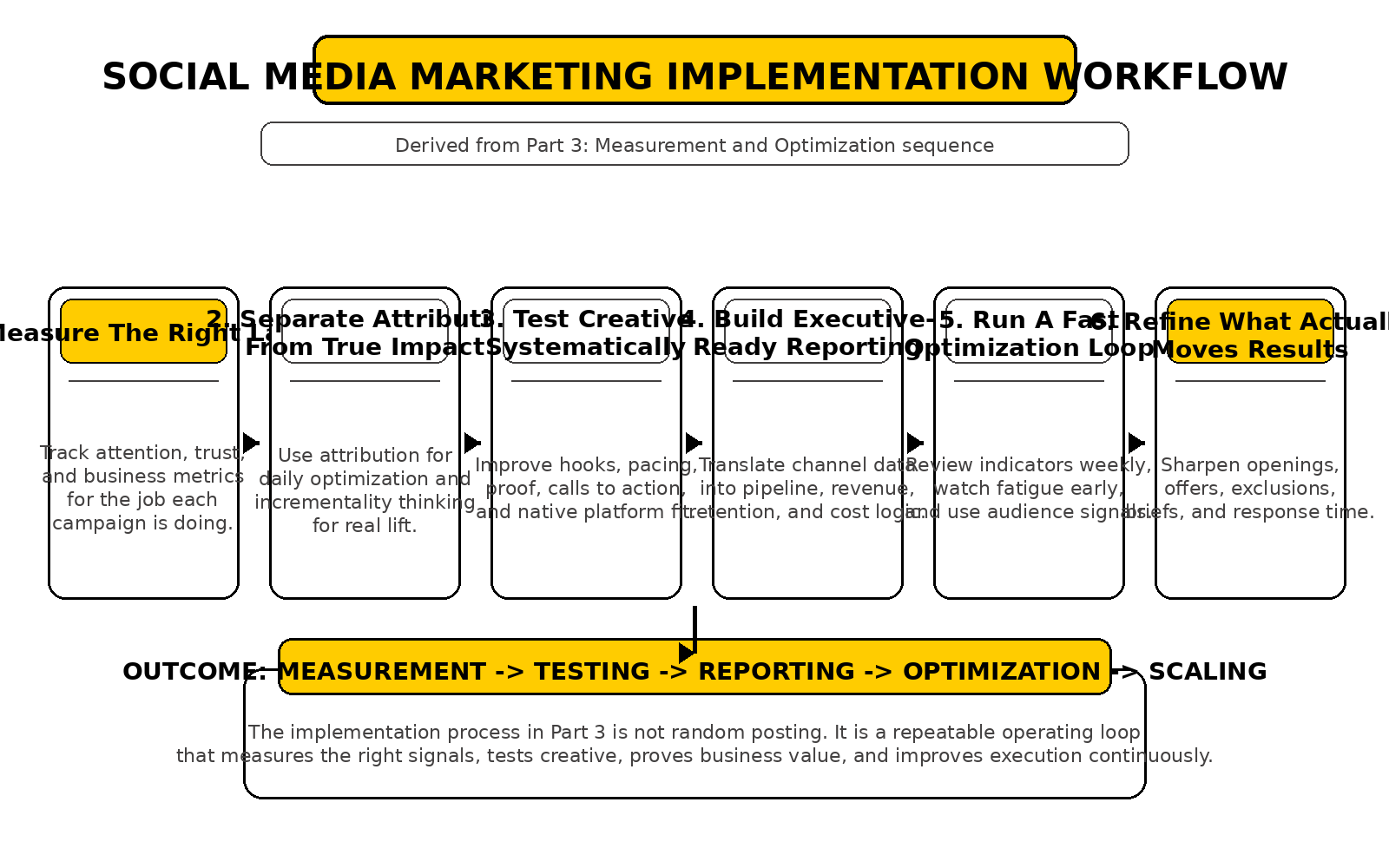
This is the point where a lot of social media marketing either becomes a real growth engine or quietly turns into busywork. The reason is simple. If you do not know what your content, ads, creator partnerships, and community efforts are actually doing for the business, you will end up optimizing for whatever is easiest to screenshot instead of whatever is hardest to ignore in your revenue numbers.
Strong measurement starts with accepting that not every useful metric belongs in the same bucket. Reach, watch time, saves, click-throughs, leads, purchases, reply time, and retention all matter, but they do different jobs. The businesses that get the best results from social media marketing usually know exactly which metrics are there to diagnose attention, which ones signal trust, and which ones prove commercial impact.
That is also why this section matters so much. Once your system is live, measurement is what keeps you from drifting into guesswork, trend-chasing, or false confidence. It gives you a way to decide what to double down on, what to fix, and what to stop doing before it burns more time and money.
Measure The Metrics That Match The Job
One of the easiest ways to weaken social media marketing is to mash every number into one dashboard and hope the answer becomes obvious. It rarely does. A top-of-funnel video should not be judged the same way as a retargeting ad, and a support-heavy community account should not be forced into the exact same success model as a lead-generation campaign.
A better approach is to divide your measurement into layers. Attention metrics tell you whether people even noticed what you published. Consider reach, impressions, watch time, hold rate, shares, and saves because they reveal whether the content had enough pull to interrupt the scroll in the first place.
Trust metrics come next. Comments with real questions, profile visits, creator mentions, DMs, repeat viewers, and branded search lift all tell you whether your social media marketing is creating belief instead of just temporary curiosity. Then you move into business metrics such as qualified leads, booked calls, assisted conversions, revenue by campaign, customer acquisition cost, and customer lifetime value.
This layered view matters because different goals require different proof. HubSpot’s 2025 social media marketing report shows that marketers are still juggling awareness, community, and revenue goals at the same time, which is exactly why one number can never tell the whole story. Social media marketing becomes easier to improve once you stop asking one metric to explain everything and start matching each metric to the role it is supposed to play.
Do Not Confuse Attribution With True Impact
This is where things get real. A lot of social media marketing looks profitable inside platform dashboards because those dashboards are designed to show you the conversions that can be connected back to platform activity. That is useful, but it is not the same thing as knowing what would have happened if the campaign never ran.
That is why incrementality has become such an important part of serious measurement. Google’s measurement guidance calls incrementality testing the industry’s gold standard for understanding advertising’s true impact in a privacy-first environment, because it focuses on the lift created by exposure rather than just the conversions that can be assigned after the fact. In plain English, attribution helps you optimize day to day, but incrementality helps you understand whether your social media marketing is actually creating additional growth.
Google’s modern measurement playbook makes an important distinction here that many teams miss: attribution-based KPIs are still useful for in-channel optimization, while incrementality-based KPIs are stronger for planning and budget allocation. That is a much healthier way to think about the problem. You do not need to throw attribution away. You just need to stop pretending it can answer questions it was never built to answer on its own.
This matters especially when social media marketing influences people before they are ready to click. A creator mention can spark interest, a short-form video can create recall, and a sequence of retargeting impressions can keep a product top of mind until the eventual search or direct visit happens somewhere else. When that chain exists, last-click reporting almost always understates what social actually contributed.
Creative Testing Is Where Optimization Gets Serious
Once your tracking model is strong enough, the next big advantage usually comes from creative testing. That is not glamorous advice, but it is the truth. Most social media marketing performance problems are not caused by some mysterious algorithm issue. They come from weak hooks, unclear offers, stale creative, poor pacing, or a message that does not feel native to the platform.
The 2024 Meta, Kantar, and CreativeX research release is useful here because it puts scale behind what great marketers have felt for years. The study examined 56,984 Meta assets across 1,295 campaigns and 13.1 billion impressions, and it found that human presence, clear brand integration, visual dynamism, and faster storytelling were all tied to meaningfully higher effectiveness. That is not a minor creative preference. It is a reminder that social media marketing improves when creative choices are treated as performance decisions, not decoration.
The numbers in that study are especially revealing because they show how much opportunity still sits on the table. The same research notes that only 31% of campaigns used a human presence and only 36% integrated the brand and product effectively into the story. In other words, many brands are still making it harder than necessary for people to care and harder than necessary for the business to be remembered.
This is why strong teams test creative in rounds instead of one-offs. They test different openings, different narrative frames, different creator voices, different proof elements, different calls to action, and different edit speeds. Then they look for patterns instead of clinging to a single “winning” post, because social media marketing performance usually improves through repeated learning, not a lucky viral hit.
Build Reports That Executives Will Actually Trust
There is another problem that does not get enough attention. Even when the social team knows the channel is working, leadership may still see it as soft, hard to measure, or strategically secondary. That gap matters because weak executive trust usually means weaker budgets, fewer resources, slower approvals, and more pressure to prove the same point over and over again.
Sprout Social’s 2025 Index is helpful because it frames this tension clearly around an executive trust gap, using survey data from more than 4,000 consumers, 900 social practitioners, and 322 marketing leaders collected in late 2024. That is a strong reminder that better social media marketing is not just about making better content. It is also about making the business case in a language leadership already respects.
The fix is not to drown everyone in dashboards. It is to connect channel metrics to commercial questions executives already care about. What did social contribute to pipeline, revenue, branded search growth, lower acquisition costs, better retention, stronger creator efficiency, or faster customer support resolution? Once social media marketing is tied directly to business decisions, it stops sounding like a creative side project and starts sounding like operational leverage.
This is also where clean tracking infrastructure makes life easier. If you want clearer source data, consistent campaign naming, and cleaner link-level attribution, tools such as Dub can help you keep traffic analysis tighter across campaigns. And if your social media marketing depends on lead capture rather than immediate purchase, using a focused form flow through Fillout can make it much easier to see whether interest is turning into qualified intent instead of disappearing into a generic contact page.
Create An Optimization Loop Instead Of A Monthly Autopsy
A lot of teams report too slowly to improve fast. They post for weeks, pull a monthly report, notice a few surprises, and move on without building those lessons back into the next cycle. That is not optimization. That is documentation.
A stronger rhythm for social media marketing is much tighter. Review leading indicators several times a week, review conversion behavior weekly, review creative fatigue before performance drops too far, and review bigger budget decisions through a monthly or quarterly incrementality lens. That kind of loop gives you enough speed to adjust while the campaign is still alive and enough discipline to separate temporary noise from a real trend.
The loop should also include customer language, not just dashboard numbers. The comments people leave, the objections they repeat, the phrasing they use in DMs, and the questions they ask before buying often reveal what your next creative angle should be. In many cases, the best optimization insight in social media marketing is not hidden in a chart at all. It is sitting in public view under the post.
If you want that loop to move faster, AI can help with research, summarization, and workflow support, but it should not replace judgment. A tool such as Firecrawl can help gather structured page data when you are comparing competitor offers or campaign landing pages, while Chatbase can support faster handoffs when social traffic lands on a site and still needs answers before converting. The key is using support tools to reduce friction, not using them as an excuse to stop thinking carefully about what the audience is telling you.
What Good Optimization Looks Like In Practice
Good optimization in social media marketing is usually less dramatic than people expect. It rarely means throwing everything out because one post underperformed. More often, it means spotting the small things that compound: a stronger first two seconds, a clearer offer, better audience exclusions, a sharper creator brief, a faster response time, or a simpler path from attention to action.
It also means knowing when not to optimize the wrong thing. A campaign designed to create recall may never look spectacular through direct-response reporting in its first week, but that does not mean it failed. On the other hand, a campaign that appears efficient inside a platform dashboard may still deserve scrutiny if it is not creating genuinely incremental revenue or if it is leaning too heavily on people who were already likely to buy.
That is the bigger lesson here. Social media marketing gets better when measurement becomes part of the operating system, not a report you glance at after the fact. Once you measure the right layers, test creative with intention, separate attribution from true lift, and build a faster optimization loop, you stop hoping your social efforts are working. You start knowing what is working, why it is working, and what to do next.
Statistics and Data
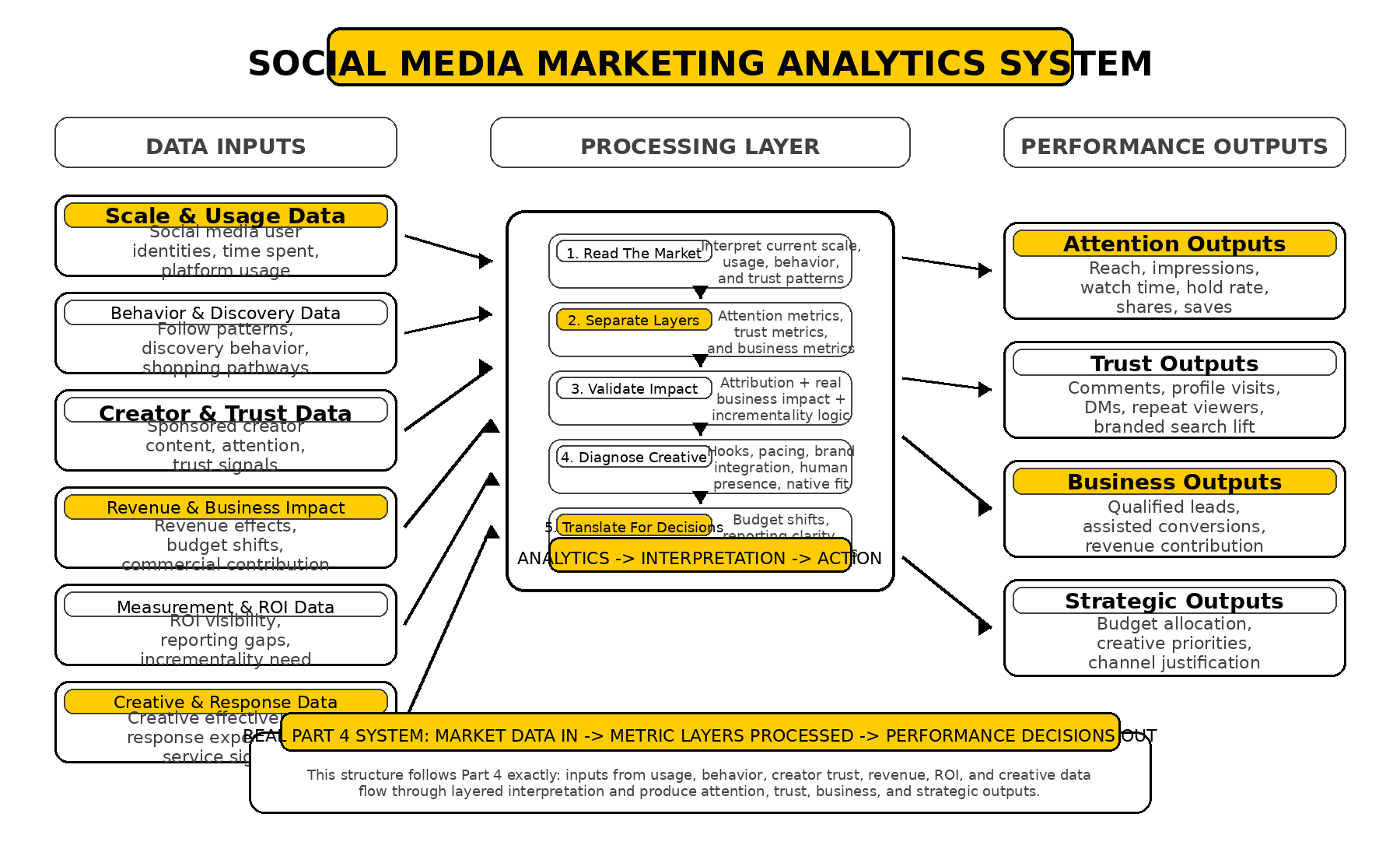
If you want to understand where social media marketing is headed, the numbers tell a very clear story. Social is not just big. It is deeply woven into how people discover products, follow creators, compare options, validate brands, and eventually decide whether they trust what they are seeing enough to act on it.
That is why the best way to read this section is not as a pile of random stats, but as evidence of how the channel really works now. Some numbers explain scale, some explain behavior, some explain trust, and some explain why measurement is getting more serious. Put together, they show why social media marketing now belongs much closer to revenue strategy than many businesses still realize.
Scale And Usage Data Show Why Social Still Commands Attention
The raw scale is massive. DataReportal’s 2026 global overview shows the number of social media user identities worldwide has climbed past 5.3 billion, which is one of the clearest signals you can ask for that social media marketing still sits inside one of the largest attention environments on earth. That kind of scale matters because even as platforms fragment, the total pool of reachable attention is still enormous.
Usage depth matters just as much as total reach. DataReportal’s 2025 global overview report shows the average internet user still spends more than two hours a day on social platforms, while its 2025 state of social report shows adults now cite an average of 4.66 primary reasons for using social media. That means people are not entering these platforms with one neat intention. They are relaxing, researching, shopping, reading news, following creators, and filling spare time all at once.
The audience mix also keeps evolving. Pew Research Center’s 2025 U.S. platform usage study found that YouTube is used by 84% of U.S. adults and Facebook by 71%, while Instagram reached the 50% mark and platforms such as TikTok, WhatsApp, and Reddit continued gaining traction in important segments. For social media marketing, that means platform choice should be driven less by hype and more by where your audience already spends attention in a commercially useful mindset.
Behavior And Discovery Data Explain How People Move From Interest To Intent
One reason social media marketing has become so powerful is that discovery no longer belongs to search alone. People increasingly run into products, services, opinions, and creators before they actively go looking for them. Social puts brands in front of audiences earlier, which can shape memory and preference before the final click happens somewhere else.
DataReportal’s 2025 breakdown of who people follow shows that fewer than half of adult users mainly follow people they know in real life, while entertainers, meme accounts, communities, and interest-based creators take a growing share of attention. That matters because social media marketing now competes in creator-led feeds, not just friend-led feeds. Brands that still post like they are interrupting a personal scrapbook are often using the wrong playbook for the environment they are actually in.
The same pattern shows up in video-led shopping ecosystems. YouTube’s 2025 shopping report analyzed the top 5,000 most-purchased products from the first half of 2025 and the top 1,000 videos by transaction on tagged products during a 60-day period in 2025, which is a strong sign that creator content, community behavior, and product discovery are increasingly connected. In practical terms, social media marketing works better when it understands that people often buy through content they would have watched anyway.
Creator And Trust Data Show Why Native Content Performs Better
Creator influence is no longer a side note in social media marketing. It is part of the infrastructure. People trust creators because they deliver recommendations, demonstrations, opinions, and reactions in a format that feels more personal than a standard brand message.
Snapchat’s 2025 creator commerce study found that 68% of consumers had seen brand-sponsored creator content, and it also reported that creator ads held attention 12% longer and generated 8% longer playtime than standard brand ads in the research sample. Those numbers matter because they point to a very practical truth: when a message feels native to the platform and credible through the messenger, social media marketing gets more time to work before the viewer scrolls away.
Transparency matters too. Snapchat’s marketer guide to creator success found that 89% of users said it is important for creators to make sponsored relationships clear. That is a useful reminder that trust is not built by hiding the brand relationship. It is built by pairing clarity with content that still feels useful, entertaining, or genuinely worth watching.
Revenue And Business Impact Data Make The Commercial Case Harder To Ignore
It is easy to talk about awareness on social. The more serious question is whether social media marketing can drive real business outcomes. Recent platform and industry research says yes, but only when the work is tied to a system instead of treated as a random content stream.
TikTok’s Oxford Economics-backed 2024 SMB report estimated that paid advertising and marketing activity on TikTok drove nearly $15 billion in revenue for U.S. businesses in 2023, while the broader contribution tied to SMB use of TikTok supported $24.2 billion in U.S. GDP that year. Those are not small, theoretical effects. They suggest that social media marketing can influence both direct commercial activity and the wider business ecosystem around it.
Budget behavior among leaders is shifting for the same reason. Sprout Social’s 2025 impact report release found that 8 in 10 marketing leaders were reallocating funds from other channels to social. That does not mean every brand should blindly do the same thing. It does mean decision-makers increasingly see social media marketing as a channel that deserves more serious investment when it can prove customer acquisition, loyalty, and revenue contribution.
Measurement And ROI Data Reveal Where Many Teams Still Struggle
Here is the uncomfortable part. Even as leaders push more money toward social, many teams still struggle to prove the full value of what they are doing. That tension is one of the most important data points in the whole category because it explains why measurement discipline is turning into a competitive advantage.
Sprout Social’s 2025 ROI statistics roundup highlights that 65% of leaders want direct connections between social campaigns and business goals, 52% want quantifiable cost savings, and 45% want better visualization of social data. In the same reporting, 97% of leaders believed they could communicate social media’s value, but only 30% of marketers believed they could measure social media ROI well. That gap matters because social media marketing becomes much easier to defend once the reporting language matches the questions leadership already asks.
The bigger measurement shift is not only about attribution dashboards. Google’s guidance on incrementality testing describes incrementality as the industry’s gold standard for understanding advertising’s true impact in a privacy-first environment, while Google’s modern measurement playbook explains why attribution, incrementality experiments, and marketing mix modeling work best as a layered system rather than isolated answers. For social media marketing, that means the next generation of reporting will be less about a single perfect number and more about building a clearer picture from multiple forms of evidence.
Creative Effectiveness Data Shows Why Execution Changes Results
One of the most useful things recent research has done is move the conversation away from vague creative advice and toward evidence. Great social media marketing is not only about posting often. It is about how the creative is built, how fast it gets to the point, whether the brand is clearly integrated, and whether the message looks like it belongs on the platform.
The 2024 Meta, Kantar, and CreativeX study examined 56,984 Meta assets across 1,295 campaigns and 13.1 billion impressions over three years. The study tied stronger performance to factors such as human presence, clearer brand and product integration, visual dynamism, and faster storytelling. Those findings matter because they reinforce something the best operators already know: social media marketing often wins or loses in the first moments of the creative, long before the dashboard tells you what happened.
The same study also showed how much room there still is for improvement. Only 31% of campaigns in the dataset used human presence, and only 36% effectively integrated the brand and product into the story. That means a surprising amount of social media marketing is still making simple mistakes that reduce both memorability and commercial payoff.
Customer Response Data Proves Social Is Also A Service Channel
There is one more layer many businesses still underestimate. Social media marketing is not just about publishing and promoting. It is also about how the business behaves once people reply, ask questions, complain, or try to move closer to a purchase.
Sprout Social’s 2025 customer care research found that 73% of consumers expect a response from brands within 24 hours or less on social. That expectation changes how you should think about the channel. A post may create the first spark, but the follow-up interaction often determines whether the brand feels trustworthy enough to buy from.
That service expectation also connects directly to conversion. When response quality is poor, the whole system weakens. When response quality is fast, human, and informed, social media marketing does not just generate awareness. It helps close the distance between interest and action.
What The Data Really Means For Your Strategy
The big takeaway is not that every brand should chase every platform, creator, or new feature. It is that social media marketing now sits at the intersection of attention, trust, commerce, and customer experience. The data keeps pointing in the same direction: the channel works best when it is treated as a connected business system rather than a content calendar with prettier graphics.
That also means the opportunity is still very real for businesses willing to get serious. The market is large, user behavior is commercially valuable, creators are shaping trust, and better measurement models are making it easier to prove what is actually driving lift. So if you have been treating social media marketing like a side activity, the numbers suggest that mindset is already out of date.
Ecosystem, Trends, and What Comes Next
If you really want to understand where social media marketing is going, stop looking at it as a single channel. It is now an ecosystem made up of platforms, creators, communities, paid media, customer service, AI-supported workflows, and owned assets such as email lists, landing pages, and first-party data. The brands that grow fastest are usually the ones that stop treating social like a place to post and start treating it like a system that connects attention to action.
That shift matters because the feed is no longer the whole story. A person might discover you through a creator clip, validate you through comments, click through to a landing page, join your email list, come back from a retargeting ad, and then buy after a support reply clears up one last objection. When social media marketing is built to support that entire journey, it becomes much harder for competitors to copy what makes it work.
The next stage is already taking shape. Sprout Social’s 2025 State of Social Media research shows audiences want brands to be relevant and human without trying too hard, while its 2025 Index release highlights that a third of consumers think brands jumping on viral trends is embarrassing. That is a useful warning sign. The future of social media marketing is not endless trend-chasing. It is sharper positioning, better execution, and more trust per impression.
The Social Media Marketing Ecosystem Is Bigger Than The Feed
One of the biggest mistakes businesses still make is assuming social success begins and ends on-platform. In reality, strong social media marketing depends on what sits around the platform just as much as what happens inside it. That includes how fast your team replies, where the click goes, how the offer is framed, what data you collect, and how well you follow up after the initial moment of interest.
That is why the ecosystem matters so much. Social creates motion, but other assets turn that motion into something durable. A useful email sequence, a focused funnel, a strong CRM record, and a clean retargeting setup can do more for long-term performance than another week of random posting ever will.
This is also where your stack starts to matter. A team using Buffer for publishing, Brevo for follow-up, and Copper for relationship tracking is usually in a better position than a team relying on screenshots, memory, and a messy inbox. Social media marketing becomes more predictable when the surrounding system is built to catch the attention you worked so hard to earn.
AI And Automation Are Changing Execution, Not Replacing Strategy
AI is already reshaping social media marketing, but not in the simplistic way people often talk about it. The real advantage is not pushing a button and flooding the internet with generic posts. The real advantage is speeding up research, iteration, repurposing, workflow support, customer assistance, and creative testing so your team can move faster without letting quality collapse.
The platforms themselves are making that direction impossible to ignore. TikTok World 2025 framed its roadmap around full-funnel growth powered by AI, creativity, and community, while YouTube’s 2025 big bets described AI as one of the platform’s central priorities for how people create and consume content. That does not mean AI will magically fix weak positioning or poor offers. It does mean social media marketing teams that learn to use AI well will operate with far more speed than teams that refuse to adapt.
The smarter use case is support, not surrender. Tools such as Chatbase can help handle common questions once social traffic lands on your site, and Comp AI can help teams that need to move faster without creating unnecessary compliance headaches. The point is not to hand your brand voice to software. The point is to remove friction so human judgment can focus where it matters most.
Creators, Communities, And Native Media Will Keep Winning
There is a reason creator-led content keeps growing in influence. It feels more native, more watchable, and more believable than polished brand messaging that was clearly designed in a vacuum. People do not open social apps hoping to consume corporate language. They open them hoping to feel something, learn something, laugh at something, or discover something worth sharing.
YouTube’s 2025 shopping report makes this especially clear by showing how creators, communities, and tagged products are increasingly linked in real purchase behavior. TikTok Next 2026 points in the same direction by framing the coming year around evolving audience interests and behaviors rather than static content formulas. Social media marketing is moving toward content that feels like it belongs to the culture of the platform, not content that merely appears on it.
That means brands need to get better at briefs, better at partnerships, and better at trust. A creator should not sound like a human disguise for a corporate script. They should sound like themselves, with enough clarity around the message that the audience understands the offer without feeling manipulated by it.
Owned Audiences Will Become Even More Important
This is the part many businesses still avoid because it feels less exciting than views and follower counts. But as algorithms shift, privacy rules tighten, and paid reach gets more expensive, owned audiences become a form of insurance. If your social media marketing can attract attention but cannot move people into an email list, CRM, booking flow, or customer database, you are building on rented land.
The good news is that the bridge is easier to build than many people think. A simple lead magnet, a focused opt-in page, a quiz, a booking link, or a short application flow can turn passing attention into a relationship you can continue outside the feed. That is one reason businesses often connect social media marketing campaigns to tools such as Systeme.io, ClickFunnels, or Fillout rather than sending traffic to a homepage that asks the visitor to do all the thinking.
The strategic payoff is huge. Once you own the relationship, your social media marketing stops starting from zero every time you publish. You already have a list, a sequence, a sales process, or a remarketing pool that can keep working long after the original post disappears from the feed.
What Smart Brands Will Do Next
The smartest brands are not waiting for one perfect platform formula to arrive. They are building adaptable systems. They are tightening positioning, publishing natively, testing creative faster, working with creators more intelligently, improving response quality, and moving more of their audience into assets they control.
They are also getting more selective. Instead of trying to show up everywhere, they are choosing the channels and formats that fit the business model best. That matters because social media marketing becomes much more profitable when the strategy is narrow enough to be executed well and broad enough to keep compounding.
If you take anything from this section, take this: the future will reward businesses that care about people more than hacks. Tools will change. Platforms will change. Trend formats will change. But social media marketing will keep working for the brands that understand their audience deeply, communicate clearly, and build an ecosystem strong enough to turn attention into trust, and trust into revenue.
FAQ for a Complete Guide to Social Media Marketing
What Is Social Media Marketing, Really?
Social media marketing is the work of using social platforms to attract attention, build trust, start conversations, and turn that momentum into business results. That can include organic content, paid campaigns, creator partnerships, community management, customer support, lead generation, and direct sales. It works best when all of those pieces are connected instead of being treated like separate jobs.
The easiest way to think about it is this: social media marketing is not just posting. It is building a system that helps the right people notice you, believe you, and take the next step. That next step might be a click, a message, a booked call, an email signup, or a purchase.
Why Is Social Media Marketing So Important For Businesses Today?
Because attention is already there, and buyer behavior keeps moving closer to social. DataReportal’s 2026 global overview shows social media user identities worldwide have moved past 5.3 billion, which tells you this is not a niche channel anymore. It is one of the largest attention environments any business can reach.
It matters even more because people do not only use social to be entertained. They use it to discover brands, validate offers, ask questions, compare options, and keep up with the people or companies they trust. That means strong social media marketing can influence the customer long before they fill out a form or pull out a credit card.
Which Platforms Should Businesses Focus On First?
Start with the platforms where your audience already pays attention in a useful mindset, not the platforms everybody else is talking about this week. Pew Research Center’s 2025 platform usage study shows platform adoption still varies a lot by age and behavior, so the right answer depends on who you want to reach and what action you want them to take.
If your business relies on visual storytelling, product discovery, and short-form attention, Instagram, TikTok, and YouTube may matter most. If your business depends on authority, thought leadership, or relationship building in professional circles, LinkedIn may carry more weight. The smartest move is usually to dominate one or two channels first instead of spreading yourself thin across six.
How Often Should You Post On Social Media?
You should post as often as you can maintain quality, consistency, and relevance without exhausting your team or boring your audience. There is no universal number that magically works for every business because platform dynamics, format choices, audience behavior, and business goals all change the answer.
A better question is whether your output is sustainable and strong enough to build momentum. If you can post three times a week with clear positioning, strong hooks, and real follow-through, that will usually beat posting every day with rushed content that nobody remembers. In social media marketing, consistency matters, but consistency without quality becomes invisible fast.
Is Organic Social Better Than Paid Social?
They do different jobs, which is why treating them like rivals usually creates bad strategy. Organic social media marketing helps you learn what messages resonate, build trust in public, develop a recognizable voice, and create ongoing audience familiarity. Paid social helps you reach targeted audiences faster, scale proven messages, and move people through specific conversion paths with more control.
The strongest brands use both together. Organic tells you what the audience responds to naturally, and paid helps you push the best-performing angles harder. When those two sides talk to each other, social media marketing becomes more efficient and much easier to optimize.
How Long Does It Take To See Results From Social Media Marketing?
Some signals show up quickly, while meaningful business results usually take longer. You may see better reach, stronger engagement, more profile visits, or more direct messages within days or weeks if the content is strong and the offer is clear. But deeper outcomes such as consistent lead flow, stronger brand recall, lower acquisition costs, or better sales efficiency usually take more time to build.
That is why patience and feedback matter so much. Social media marketing often compounds when the strategy is consistent, the creative improves, and the business learns from real audience behavior. Most brands do not fail because social cannot work. They fail because they stop before the system has time to mature.
What Kind Of Content Works Best In Social Media Marketing?
The content that works best is content that matches audience intent, platform behavior, and the next business step you want the viewer to take. That can include educational posts, short-form videos, founder content, customer proof, creator collaborations, behind-the-scenes clips, product demonstrations, live responses, and clear offer-driven posts.
What matters most is not choosing one magic format. It is building a content mix with a job behind it. Some content should earn attention, some should build trust, some should answer objections, and some should move people toward action. That is when social media marketing starts working like a real system instead of a stream of disconnected ideas.
Do Small Businesses Really Need Social Media Marketing?
In most cases, yes, because smaller businesses often need trust and visibility more urgently than larger brands do. Social media marketing gives smaller companies a way to show personality, demonstrate expertise, answer questions quickly, and stay top of mind without needing a giant media budget.
It is also one of the few places where smaller brands can still compete through relevance and speed. A small business that understands its audience deeply, publishes useful content, and responds like a human can often outperform a much larger competitor that sounds polished but forgettable.
How Do You Measure ROI In Social Media Marketing?
You measure ROI by connecting channel activity to business outcomes, not by staring at likes in isolation. That means looking at layers such as reach, watch time, profile visits, clicks, lead quality, booked calls, sales, repeat purchases, support outcomes, and assisted conversions. Different metrics matter at different stages, which is why serious social media marketing needs a measurement model instead of one favorite number.
Google’s guidance on incrementality testing is useful here because it explains why attribution alone cannot answer every business question. Attribution is helpful for optimization, but understanding true lift often requires broader measurement thinking. In other words, if you want better social media marketing decisions, you need better questions as much as better dashboards.
Should Brands Work With Creators?
Usually yes, if the partnership makes strategic sense and the creator actually fits the audience you want to influence. Creator content often works because it feels more native, more believable, and more connected to how people already consume social content. The message lands through someone the audience chose to follow, which changes the level of trust from the start.
Snapchat’s 2025 creator commerce research is one of several recent signals pointing in that direction. But the real lesson is bigger than one report. Social media marketing tends to improve when creators are treated like trusted translators of the message, not like rented ad space wearing human skin.
How Important Is Community Management?
It is far more important than many businesses think. Community management is where attention turns into trust because it is the part of social media marketing that proves whether the brand is actually listening. Comments, replies, DMs, and public interactions often shape how people feel about a business just as much as the original post does.
That matters even more because expectations have risen. Sprout Social’s customer care guidance reflects how strongly people now expect brands to respond quickly and usefully on social. A great post can open the door, but poor follow-through can close the sale before it ever happens.
Can AI Help With Social Media Marketing?
Yes, but the best use of AI is support, not replacement. AI can help with research, idea generation, content repurposing, response suggestions, workflow support, landing-page assistance, and faster testing cycles. That can make your social media marketing much more efficient, especially when your team needs to move faster without letting quality collapse.
The mistake is thinking AI removes the need for positioning, audience understanding, or judgment. It does not. It simply helps a strong strategy move faster. Used well, it reduces friction. Used badly, it creates bland content at scale.
What Are The Biggest Social Media Marketing Mistakes?
The biggest mistakes are usually strategic, not technical. Businesses try to talk to everyone, copy trends that do not fit their brand, post without a conversion path, ignore comments, judge everything by vanity metrics, and give up before consistency has time to compound. Those mistakes make the work feel busy without making it effective.
Another common mistake is treating social media marketing like a content calendar instead of a customer journey. When the content, offer, follow-up, and measurement are disconnected, even good creative struggles to turn into revenue. The fix is not more noise. The fix is a stronger system.
Do You Need A Funnel Behind Social Media Marketing?
If you want consistent commercial results, yes, you usually need some kind of funnel or at least a clear next-step path. That does not have to mean a complicated multi-page machine. It can be as simple as a focused landing page, a lead form, a booking flow, a quiz, or a short email sequence that keeps the conversation moving.
The reason this matters is simple. Social media marketing creates interest, but interest needs somewhere to go. Businesses often make that handoff easier with tools such as Systeme.io, ClickFunnels, and Fillout because those tools help reduce friction between the post and the action.
What Does A Good Social Media Marketing Strategy Look Like?
A good strategy is clear enough to guide execution and flexible enough to improve through feedback. It starts with audience clarity, platform choice, content pillars, conversion paths, measurement rules, and response standards. Then it gets sharper over time through testing, listening, and performance review.
The biggest sign you have a good strategy is that your work starts feeling connected. Your content sounds like it belongs to the same brand. Your offers match your audience. Your reporting tells you what to do next. And your social media marketing starts contributing to business growth instead of asking for endless patience without proof.
Work With Professionals
There comes a point where doing everything yourself starts costing more than getting expert help. If your social media marketing feels inconsistent, hard to measure, or too dependent on last-minute ideas, working with professionals can save you time, sharpen your positioning, and give you a system that actually compounds. That is especially true when you need better creative, stronger reporting, faster execution, or a cleaner path from attention to revenue.
Professional support also helps when you want to move faster without losing control. A strong partner can help with strategy, content systems, creator workflows, paid distribution, funnels, reporting, and audience nurturing without forcing you to rebuild everything from scratch. And if you are a marketer yourself, the upside can go the other way too: your social media marketing skills can become a serious source of income when you know how to position and sell them.
If you want to communicate more clearly, capture leads more effectively, and organize your workflow around real business outcomes, tools such as Buffer, Flick, Brevo, Copper, and Dub can help support a stronger operating system around the work. The important thing is not chasing software for its own sake. It is building a setup that helps your social media marketing perform at a higher level with less friction.
Explore 10K+ Remote Marketing Contracts on MarkeWork.com
Most marketers spend too much time chasing clients, competing on crowded platforms, and losing a percentage of every project to middlemen.
MarkeWork gives you a better way. Browse thousands of remote marketing contracts and connect directly with companies desperate to hire skilled marketers like you without platform commissions and without unnecessary gatekeepers.
If you’re serious about finding better opportunities and keeping 100% of what you earn, you can explore available contracts and create your profile for free at MarkeWork.com.
 Filip Konecny Enterprises