

SMS Marketing: The Strategic Foundation for Faster, More Profitable Customer Communication
SMS marketing has become one of the few channels that still feels immediate, personal, and hard to ignore when it is used the right way. That does not mean blasting discounts to a list and hoping for the best. It means building a permission-based communication system that reaches people at moments when speed, relevance, and trust actually matter.
What makes this topic so important in 2026 is that the gap between careless texting and professional SMS marketing keeps getting wider. Consumers are more willing to engage when messages are useful, but they are also less tolerant of brands that text too often, text without clear consent, or treat the channel like a shortcut. The businesses that win with SMS are usually the ones that respect the inbox, connect messages to real customer intent, and treat compliance and personalization as part of the same strategy rather than separate tasks.
This first part lays the groundwork for the rest of the article. You will see why SMS marketing matters now, what a strong framework looks like, which components actually drive results, and how professionals turn texting into a dependable revenue and retention channel instead of a risky side tactic.
Article Outline
This article is organized into six connected parts so you can move from the big picture to execution without losing the thread. Each section builds on the previous one, because strong SMS marketing depends on structure, not random campaigns. Use the page jumps below to navigate to the section you want.
- Part 1: Why SMS Marketing Matters
- Part 1: SMS Marketing Framework Overview
- Part 1: Core Components of SMS Marketing
- Part 1: Professional SMS Marketing Implementation
- Part 2: Compliance and Consent
- Part 3: List Growth and Campaign Strategy
- Part 4: Automation, Personalization, and Timing
- Part 5: Analytics, Testing, and Optimization
- Part 6: Ecosystem, Future Trends, and FAQ

Why SMS Marketing Matters
The main reason SMS marketing matters is simple: it sits closer to a customer’s attention than almost any other permission-based channel. Email can be powerful, social media can create demand, and paid ads can generate reach, but text messaging meets people on a device they check constantly throughout the day. That closeness is exactly why the channel can perform so well, and it is also why poor execution damages trust so quickly.
Recent research from Twilio’s 2024 State of Customer Engagement Report found that consumers spend an average of 54% more on brands that personalize experiences, while Attentive’s 2025 consumer study reported that 81% of consumers ignore irrelevant messages. Put those two findings together and the lesson becomes clear: SMS marketing is not valuable because it is fast alone, but because it gives brands a fast path to relevant communication when they already have permission and context. Speed without relevance feels intrusive. Speed with relevance feels useful.
There is also a structural reason businesses keep investing here. Klaviyo’s 2024 benchmark report is based on more than 3 billion texts, which tells you this is no longer a niche tactic for a handful of ecommerce brands. It is a mature operating channel with its own benchmarks, workflows, compliance demands, and revenue models. That maturity matters because it changes how serious businesses should think about SMS: not as a promotional add-on, but as infrastructure for retention, conversion, customer service, reminders, launches, and lifecycle messaging.
Another reason SMS marketing deserves attention is that the legal and carrier environment has become stricter, not looser. The FCC confirmed new TCPA consent-revocation rules with major compliance obligations taking effect on April 11, 2025, while a narrow cross-category revocation requirement was delayed to April 11, 2026 in the FCC’s April 7, 2025 order. In plain English, SMS marketing matters because it can produce exceptional business value, but only for brands that run it with real operational discipline.
SMS Marketing Framework Overview
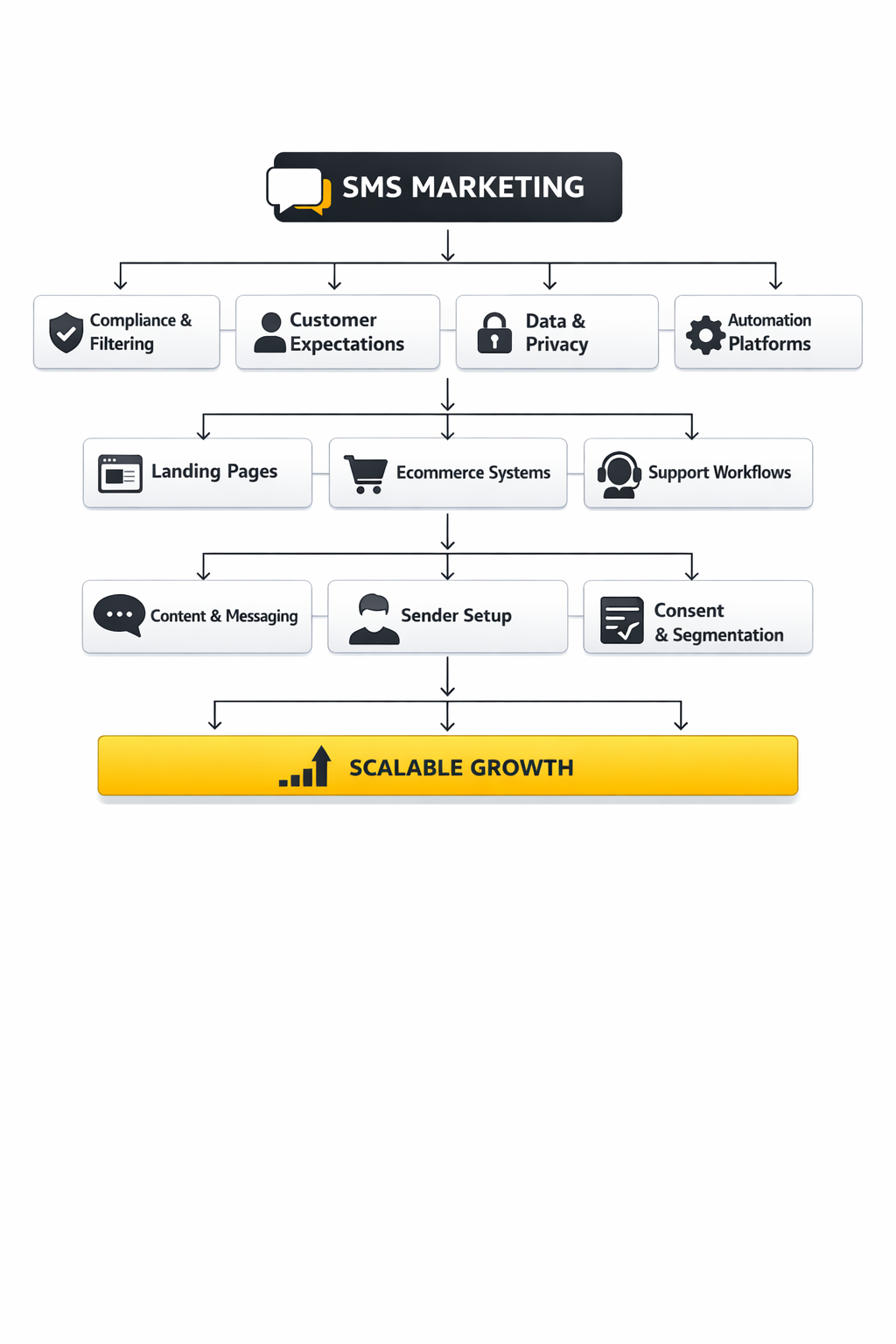
A useful way to think about SMS marketing is as a four-layer framework rather than a sequence of isolated campaigns. The first layer is permission, because without documented consent you do not have a real SMS program at all. The second layer is context, which means knowing why this person subscribed, where they are in the customer journey, and what kind of message would actually help them right now. The third layer is delivery, which covers timing, carrier rules, sender setup, and the practical mechanics that decide whether your message is received and trusted. The fourth layer is optimization, where you measure performance, learn from response patterns, and improve message strategy over time.
This framework matters because many weak SMS programs focus almost entirely on the message copy and ignore the system around it. They obsess over writing a sharper offer, while the real problem is that they collected low-quality opt-ins, sent the wrong message at the wrong stage, or failed to connect texting with the rest of the customer experience. Strong SMS marketing feels coherent because the message a customer receives makes sense in the larger relationship they already have with the brand.
Professional operators also understand that SMS should rarely work alone. Twilio’s 2024 Global Messaging Engagement Report and Twilio’s 2025 State of Customer Engagement Report both point toward a broader engagement reality: customers respond better when communication is coordinated across channels and tailored to their preferences. That means SMS performs best when it strengthens email, onsite journeys, customer support, and purchase flows instead of competing with them.
Once you see SMS marketing through that framework, the channel becomes easier to manage. Instead of asking, “What should we text this week?” you start asking better questions. Are we collecting the right kind of consent, sending texts at moments of real customer value, protecting deliverability, and learning from what subscribers actually do after the message arrives?
Core Components of SMS Marketing
At the center of every effective SMS marketing program are a few components that sound obvious but are often handled poorly in practice. The first is consent capture. The source of the opt-in shapes everything that follows, because a subscriber who joined for shipping updates behaves differently from someone who joined for early product access, and both behave differently from someone who subscribed for recurring discounts. List growth is not just about quantity; it is about acquiring the right expectation from the beginning.
The second component is segmentation. SMS becomes much more powerful when brands stop sending one message to everyone and start dividing audiences by lifecycle stage, buying behavior, location, engagement, product interest, or urgency. This is one reason broad personalization data matters so much. Attentive’s 2025 Consumer Trends Report emphasizes that shoppers respond when brands make discovery and messaging more relevant, and the same principle applies directly to SMS campaign design.
The third component is message architecture. That includes the opening words, the offer or update itself, the call to action, the landing destination, and the opt-out language where required. Great SMS marketing copy is usually not clever for the sake of being clever. It is clear, timely, and easy to act on. Because the channel is short by nature, every wasted word carries more cost than it would in email or on a landing page.
The fourth component is delivery infrastructure. Carrier policies, sender registration, and traffic quality influence whether your messages arrive reliably or get filtered. In the United States, The Campaign Registry plays a central role in 10DLC brand and campaign registration, and providers such as Microsoft’s Azure Communication Services documentation make it clear that registration is part of reliable, compliant business messaging rather than a technical afterthought. When businesses ignore this layer, they often blame copy or offer quality for performance problems that actually begin with setup and trust signals.
The fifth component is measurement. You need more than a click rate to understand whether your SMS marketing is healthy. Revenue per recipient, unsubscribe trends, response behavior, list-source quality, assisted conversions, and offer fatigue tell a much richer story. This is where serious teams pull SMS out of the “campaign blast” category and treat it like a measurable operating channel with its own economics.
Professional SMS Marketing Implementation
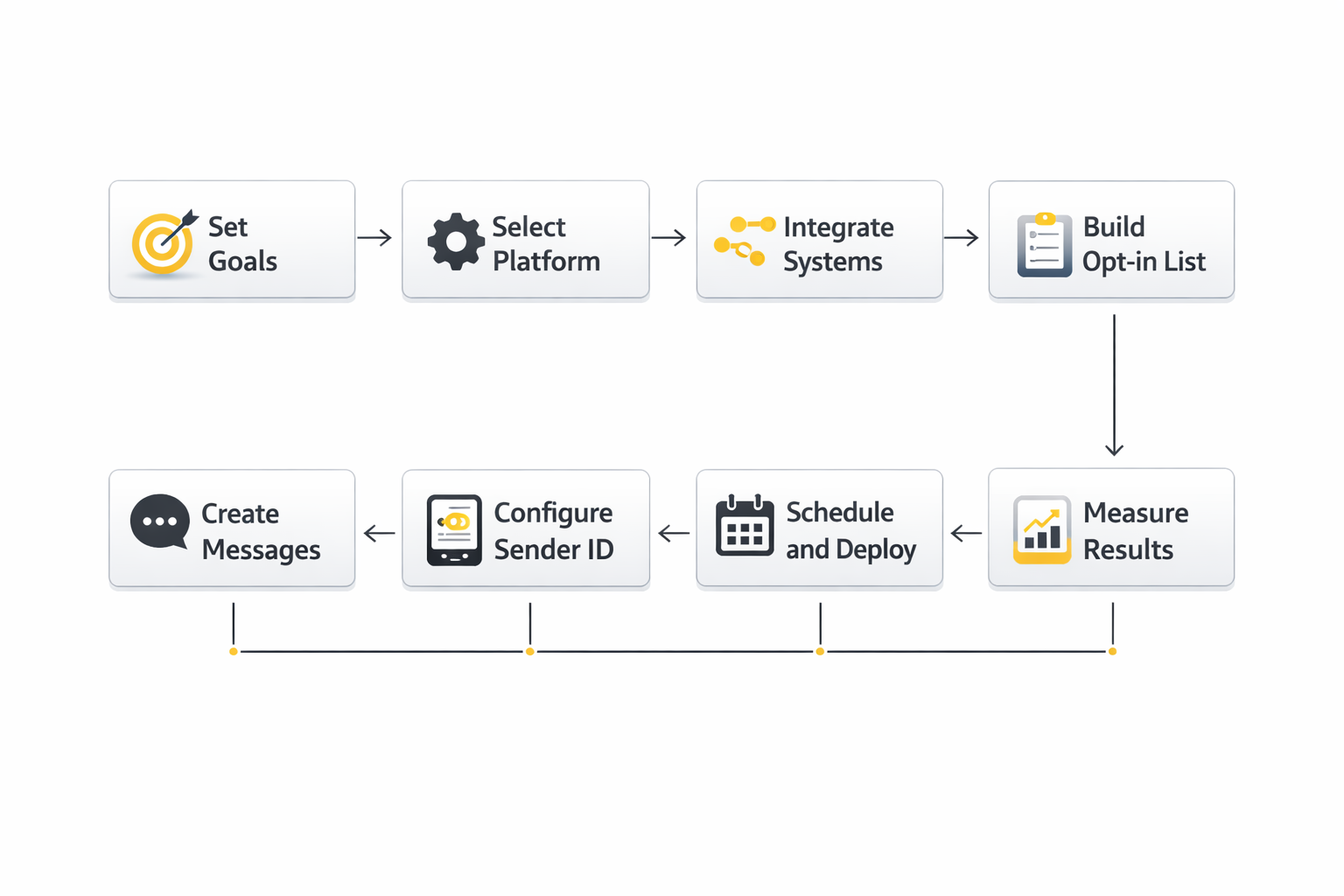
Professional implementation begins with choosing the role SMS should play in the business before sending a single campaign. For some brands, the best use case is urgency: restocks, flash offers, cart recovery, or appointment reminders. For others, the smarter approach is relationship building through onboarding, post-purchase care, loyalty messaging, and customer-service follow-through. The point is not to use SMS for everything. The point is to use it where speed, directness, and mobile attention create a real advantage.
The next step is to build the program around rules instead of moods. That means documented consent flows, clear frequency expectations, defined segments, approved message types, escalation logic for support issues, and a process for honoring opt-outs fast. The compliance side is not optional window dressing. The CTIA messaging security guidance and the CTIA messaging principles and best practices both reflect how much the industry now prioritizes consumer trust and protection from unwanted traffic.
Implementation also becomes much stronger when SMS is connected to the tools that shape the rest of the customer journey. A business may use a landing-page platform such as ClickFunnels or Systeme.io to collect segmented opt-ins, route traffic into specific offers, and keep the message-to-page experience consistent. The reason that matters is practical: a text message only performs as well as the next step it sends the customer to.
At a more advanced level, professional SMS marketing uses automation without sounding robotic. Welcome flows, browse or cart reminders, replenishment prompts, appointment confirmations, win-back sequences, and support follow-ups all work better when they feel tied to customer behavior rather than the company’s calendar. That is also where a platform such as Brevo or Moosend can fit into a broader communication stack, especially for businesses that want email and SMS to reinforce each other instead of running in silos.
The final mark of professional implementation is restraint. The best teams know that just because a text can be sent immediately does not mean it should be. They protect the channel by making each message earn its place. That discipline is what keeps SMS marketing profitable over the long term, and it sets up the rest of this article, where we will move into compliance, list growth, campaign design, automation, measurement, and the wider ecosystem around the channel.
Compliance and Consent
This is the part of SMS marketing that separates serious operators from people who are just hoping nothing goes wrong. When a brand gets compliance right, texting feels clear, useful, and welcome. When it gets compliance wrong, everything starts to crack at once: complaints rise, carriers get suspicious, opt-outs spike, and the entire channel becomes harder to trust.
The legal side matters because text messaging is not a casual playground for aggressive promotion. The FCC’s TCPA consent rules and the 2024 consent order text make it clear that businesses sending autodialed marketing texts need prior express consent, and that consumers must be able to revoke that consent through any reasonable method. The operational side matters just as much, because the CTIA messaging security best practices and the wireless messaging principles used across the ecosystem show how heavily the industry now leans toward consumer protection, sender transparency, and traffic monitoring.
In other words, good SMS marketing starts long before the first campaign goes out. It starts when a business decides how it will ask for permission, how clearly it will explain what people are signing up for, how fast it will honor stop requests, and how carefully it will document the entire process. That foundation is not bureaucracy. It is what lets you build something profitable without putting the whole program at risk.
What Valid Consent Looks Like
Valid consent in SMS marketing is not vague interest, and it definitely is not silence. A customer browsing your site, buying once, or handing over a phone number for a receipt does not automatically mean they agreed to recurring promotional texts. Real consent is specific, affirmative, and tied to a clear explanation of what kind of messages the person should expect.
That is why strong signup language matters so much. A proper opt-in makes the brand name obvious, explains that automated marketing texts may be sent, clarifies that consent is not a condition of purchase, and points people to terms and privacy details when required by your setup. The reason businesses do this is not just to look polished. It is because consent that is sloppy at the moment of capture becomes expensive later when a complaint, audit, or carrier review forces the company to prove what the subscriber actually agreed to.
There is another important layer here. SMS marketing often overlaps with transactional and relationship messaging, and that distinction matters. The FTC’s CAN-SPAM compliance guide explains that messages with commercial content and transactional content are judged by their primary purpose, which means businesses need to be disciplined about how they classify and structure texts. If a brand blurs the line carelessly, it creates confusion for the customer and risk for itself at the same time.
Opt-Outs And Revocation Rules
One of the biggest mistakes in SMS marketing is treating opt-outs like an inconvenience instead of a core part of the channel. The truth is that the easier you make it for people to leave, the healthier your list becomes. People who no longer want your messages are not hidden revenue waiting to be unlocked. They are future complaints waiting to happen if you keep pushing after the relationship has already cooled off.
The FCC has moved this issue into much sharper focus. The agency set April 11, 2025 as the key effective date for broader consent-revocation rules, then issued a later January 6, 2026 extension order that pushed a specific revocation requirement in section 64.1200(a)(10) to January 31, 2027. That does not weaken the main lesson for marketers. It reinforces it. Businesses need systems that recognize and process stop requests quickly, consistently, and across the full messaging workflow, because regulators are clearly moving toward easier consumer control rather than less of it.
In practice, that means your SMS marketing program should never depend on a subscriber using one perfect keyword in one perfect format. If someone replies with a clear request to stop, the business should be ready to honor it. This is one of those areas where smart brands do more than the minimum, because every bit of friction you remove from the opt-out process protects list quality, keeps complaint rates lower, and signals that your company actually respects the people it is texting.
Recordkeeping And Proof Of Consent
Most businesses think about consent at the front end and forget about proof until they need it. By then, the damage is already done. If you cannot show when someone opted in, where they opted in, what language they saw, and what kind of messages they were told to expect, your SMS marketing program is standing on memory instead of evidence.
This is where professional execution gets much more serious. You want a documented trail that covers the source page, timestamp, phone number, campaign or form name, consent language version, and any later changes in preference. If a subscriber moves from one list segment to another, updates their interests, or replies with a keyword that changes what they should receive, that history should be stored cleanly enough that a real human can review it later and understand exactly what happened.
The infrastructure side matters here too. The Campaign Registry and its 2025 10DLC overview materials reflect how much the ecosystem now cares about identifying who is sending messages and what those campaigns are for. Carriers and downstream providers want transparency, and that pressure works its way back to brands. If your SMS marketing setup is undocumented, loosely classified, or inconsistent with how your traffic is registered, you are making deliverability and compliance harder than they need to be.
The Danger Of Shortcuts
Shortcuts are incredibly tempting in SMS marketing because the channel feels so direct. A business sees strong response rates from a clean, permission-based list and starts wondering how much faster it could grow if it imported old customer phone numbers, pre-checked consent boxes, bundled promotional texts into every form, or sent one “test campaign” before the full compliance system was ready. That is usually the moment the quality of the program starts to collapse.
The wireless ecosystem has become more aggressive about filtering unwanted or suspicious traffic for a reason. The 2025 CTIA security guidance focuses heavily on protecting consumers from fraud, impersonation, and unwanted messaging, while The Campaign Registry’s 2025 updates point to rising concern around smishing, spoofing, and trust in business messaging. Those pressures do not just affect bad actors. They affect every sender whose practices look sloppy enough to trigger scrutiny.
That is why borrowed lists, hidden disclosures, unclear frequency promises, and poorly labeled campaigns are so dangerous. Even when they seem to “work” at first, they fill the list with lower-intent subscribers, increase unsubscribe behavior, and make the whole channel less stable. SMS marketing pays best when the list is smaller but cleaner, the permission is stronger, and every message feels like it was actually earned.

Building A Compliance-First Culture
The best way to keep SMS marketing profitable over time is to stop treating compliance as the legal team’s problem and start treating it as an operating philosophy. That means marketing, support, sales, and whoever manages your messaging platform all need to understand the same ground rules. Everyone touching the channel should know what counts as a valid opt-in, what kinds of texts fall into which category, how opt-outs are handled, and when a campaign should be paused rather than pushed.
This kind of culture also makes day-to-day decisions much easier. Instead of asking whether you can squeeze one more promotional text out of a gray-area situation, you start asking whether the message is clearly expected, genuinely helpful, and fully defensible. That shift is powerful, because it pulls SMS marketing out of the short-term hustle mindset and turns it into a cleaner asset that can keep generating revenue without constant compliance anxiety.
And that is where the channel gets exciting again. Once consent is handled well, records are clean, and stop mechanisms work the way they should, you can focus on growth with a lot more confidence. That sets up the next part perfectly, because after compliance and consent are secure, the next question becomes how to grow a list the right way and turn that list into campaigns people actually want to receive.
List Growth And Campaign Strategy
Once the compliance side of SMS marketing is locked down, the next challenge is building a list that can actually make you money. This is where a lot of brands get impatient. They start chasing raw subscriber volume, but a big list means very little if the people joining do not really want the messages, do not recognize the value, or only signed up for a one-time discount they never intended to use again.
The better approach is to think about list growth and campaign strategy as one system. The way you attract subscribers shapes the kinds of campaigns that will work later. If people join because they expect insider access, early drops, appointment updates, or genuinely useful reminders, your SMS marketing has room to grow into a trusted channel. If they join through a vague prompt with no clear promise, every future campaign has to fight against confusion from the start.
That is also why timing and relevance matter so much. Twilio’s 2025 customer engagement findings show that 71% of consumers abandon irrelevant experiences, while Attentive’s 2025 consumer trends report shows that 81% of consumers ignore irrelevant messages. Those numbers do not just tell you to personalize. They tell you that SMS marketing gets stronger when list growth, segmentation, and campaign planning are designed together instead of being handled as separate jobs.
Growing An SMS List The Right Way
The right way to grow an SMS marketing list is to make the value of subscribing obvious before the person enters a phone number. That sounds simple, but most weak signup experiences bury the value in generic language like “stay updated” or “hear from us.” People do not hand over access to one of the most personal spaces on their phone for vague promises. They do it when they understand exactly what they will get and why it will be worth the interruption.
This is where clarity starts doing a lot of heavy lifting. A strong form explains the brand, the kind of texts subscribers will receive, the likely frequency, and the benefit of being on the list. That benefit might be early access, faster support, restock alerts, order-related updates, appointment reminders, VIP offers, or product drops. The point is not to invent a flashy hook. The point is to connect the signup to a real customer need.
Privacy and trust matter here more than many marketers realize. IAB’s 2025 consumer privacy research shows that a company’s data privacy policy influences whether people shop with or use its services, and that consumers are more willing to share data with businesses they trust to protect it. That matters directly for SMS marketing because list growth is not just a conversion problem. It is a trust problem. If your brand does not feel transparent at the point of signup, more aggressive copy will not fix it.
Where High-Quality Subscribers Actually Come From
The highest-quality SMS marketing subscribers usually come from moments of existing intent. Someone browsing a specific product category, waiting for a restock, moving through checkout, booking a service, or trying to stay informed about an order is already telling you something valuable about why they might want texts. Those are the moments when SMS feels helpful rather than forced, because the offer to subscribe matches what the person is already trying to do.
That is one reason website forms, checkout opt-ins, post-purchase flows, and dedicated landing pages tend to outperform random list-building gimmicks over time. If you are sending traffic into a focused offer, using a tool such as ClickFunnels or Systeme.io to build a dedicated page can make the subscriber promise much clearer than trying to squeeze everything into a generic site popup. The cleaner the path, the more likely it is that the people who join will understand why they joined in the first place.
Operational guidance from AWS on compliant SMS opt-in workflows reinforces this point from another angle. The opt-in process works best when program details, opt-out methods, privacy links, and signup disclosures are all visible and understandable. That does not just protect compliance. It improves list quality because people are far less likely to opt in by accident or with the wrong expectations.
How To Use Incentives Without Attracting The Wrong People
Incentives can absolutely help SMS marketing grow faster, but they need to be used with discipline. A discount can increase opt-ins, yet it can also attract the exact kind of subscriber you do not want: someone who joins for a code, buys once if the math works, and tunes out the moment the immediate reward is gone. When that happens at scale, the list looks bigger while the channel gets weaker.
The smarter move is to match the incentive to the brand and to the stage of the journey. A retail brand might use early access, limited drops, or restock priority. A service business might offer faster confirmations, reminders, or booking updates. A content-driven brand might offer insider alerts when something important goes live. That kind of positioning tends to create a healthier relationship than dangling a generic percentage off every time.
The personalization data supports that logic. Twilio’s 2025 report found that 88% of consumers are more likely to buy when engagement is personalized in real time, and Attentive’s 2025 report shows shoppers are focused on easier product discovery and messages that actually fit their interests. In practical terms, that means the best incentive in SMS marketing is often not the biggest discount. It is the clearest promise of relevance.
Campaign Strategy That Does Not Burn The List
Once subscribers are in, campaign strategy becomes the difference between a list that keeps producing revenue and a list that burns out. The easiest mistake is overusing SMS because it works quickly. A brand sees immediate clicks or sales from a strong offer, then starts texting too often, repeating the same kind of promotion, and slowly teaching subscribers that every message feels the same. The short-term numbers may look decent for a while, but fatigue builds underneath them.
Healthy SMS marketing campaigns usually have variety and intent. Some messages are promotional, some are informational, some are tied to urgency, and some are there to support the customer journey after purchase or before a key decision. Benchmarks from Klaviyo’s 2024 SMS report based on more than 3 billion texts show why this matters: automated flows can generate up to 30 times more revenue per recipient than one-off campaigns because they are more timely and targeted. That should shift how you think about campaign strategy. The goal is not to blast harder. The goal is to send messages at moments when the customer already has a reason to care.
This is also where segmentation starts paying for itself. New subscribers should not get the same texts as repeat buyers. Someone who clicked a product alert should not get the same message as someone who only wants support updates. SMS marketing becomes much more profitable when campaigns are planned around behavior, intent, and timing rather than a single calendar everyone is forced into.
Coordinating SMS With Email And Landing Pages
One of the biggest opportunities in SMS marketing is not inside the text itself. It is in what happens before and after the text. If your signup form makes one promise, your message says something slightly different, and the landing page feels disconnected from both, performance will suffer even if the copy sounds good in isolation. Customers feel that disconnect immediately, even when they cannot explain it in technical terms.
That is why coordinated channel strategy matters so much. SMS should work with email, not against it. Email can carry more detail, education, and story. SMS can create urgency, reinforce timing, and move people quickly when action matters most. If you are building forms and capture flows, a tool such as Fillout can help collect cleaner preferences at signup, while platforms like Brevo or Moosend can support a broader email-and-SMS system where each channel does its own job properly.
That kind of coordination matters even more in a privacy-conscious environment. IAB’s 2025 findings show that trust, transparency, and clear data practices influence whether consumers engage with businesses at all. So when your SMS marketing feels consistent from the opt-in page to the message to the destination, you are not just improving conversion mechanics. You are making the whole experience feel safer, cleaner, and more believable.
What To Focus On Before You Scale
Before scaling SMS marketing, make sure the fundamentals are doing their job. Look at where subscribers are coming from, what promise got them to opt in, which segments are engaging, which campaigns are causing fatigue, and whether automated flows are carrying enough of the revenue load. If those basics are shaky, adding more traffic or sending more messages usually amplifies the problem rather than solving it.
This is the part that many businesses want to skip because it is not as exciting as launching another promotion. But it matters like crazy. A smaller list with clean expectations, good segmentation, and targeted campaigns will usually outperform a larger list built on weak intent and repetitive messaging. SMS marketing rewards discipline far more than noise.
And that is exactly why the next step is so important. Once your list is growing the right way and your campaign structure is starting to make sense, the next level is using automation, personalization, and timing to make the entire channel feel sharper without making it feel robotic.
Statistics And Data
The deeper you get into SMS marketing, the more obvious it becomes that instinct is not enough. You can have a strong offer, clean copy, and a decent list, but if you ignore timing, behavior, and message relevance, performance starts slipping fast. Data is what keeps the channel honest. It shows you whether your messages are helping people move forward or whether you are just creating noise on a device they protect fiercely.
This is also where a lot of marketers get misled. They see one campaign perform well and assume they have cracked the code, when in reality the result may have come from urgency, seasonality, or a highly engaged segment that would have responded almost no matter what. Good SMS marketing gets much more reliable when you stop reading isolated wins as proof of a complete strategy and start looking at the patterns underneath them.
The patterns right now are remarkably clear. Twilio’s 2025 State of Customer Engagement findings show that 71% of consumers abandon irrelevant experiences, while Attentive’s 2025 consumer trends report says 81% ignore irrelevant messages. Put those side by side and the takeaway hits hard: SMS marketing does not win because it is short. It wins because it is relevant at the exact moment a customer is willing to care.
What The Best SMS Marketing Data Is Really Telling You
The most useful SMS marketing data is not there to make you feel good. It is there to reveal where attention is being earned and where it is being wasted. That sounds obvious, but many teams still lean too heavily on surface metrics and treat them like final answers. A click spike can look exciting, yet it tells you very little if unsubscribes rise right behind it or if the traffic converts poorly once it lands.
That is why performance data needs context. Klaviyo’s 2025 benchmark report draws from a selection of billions of emails and text messages, and the value of a dataset that large is not just scale. It is pattern recognition. When you look across that much volume, the same themes keep showing up: better segmentation, stronger automation, clearer intent, and sharper timing tend to outperform broad promotional sending.
There is another layer hiding inside that story. Twilio’s 2024 personalization report found that 89% of business leaders see personalization as crucial to success, which lines up with what customers are signaling in newer engagement research. Businesses are not investing in personalization because it sounds trendy. They are doing it because the data keeps showing that generic messaging is becoming easier to ignore and more expensive to rely on.
Personalization Metrics That Change The Game
Personalization in SMS marketing is not about dropping a first name into a message and pretending that counts as relevance. Real personalization changes what is sent, when it is sent, and who receives it. The numbers make that painfully clear. Twilio reported in 2025 that 88% of consumers are more likely to buy when engagement is personalized in real time, and that finding says far more than any generic “best practice” article ever could.
The same direction shows up in purchase intent data. Attentive’s 2025 report highlights that 90% of shoppers are more likely to buy when rich messaging features improve discovery and relevance. Even though that extends beyond plain SMS into richer mobile experiences, the principle still matters here: customers respond when the message helps them make a decision faster, with less friction and more confidence.
In plain English, better SMS marketing data keeps pushing marketers toward the same conclusion. Stop thinking about messages as broadcasts and start thinking about them as responses to signals. If someone viewed a product, abandoned a cart, waited on a restock, booked a service, or signed up for a specific category alert, you already have the beginnings of a message that feels timely instead of intrusive.
Timing Data And Why It Matters More Than Marketers Think
Timing changes everything in SMS marketing because the channel lives so close to real human attention. A message that feels perfect at one moment can feel unnecessary or annoying just a few hours later. That is why timing is not a cosmetic optimization. It is part of the offer itself. The exact same text can perform very differently depending on where the customer is in the buying cycle and what triggered the message in the first place.
This is one reason real-time engagement keeps showing up in the research. Twilio’s 2025 report ties stronger buying intent to personalized communication delivered in the right moment, not just to personalization in the abstract. That is a big deal, because it tells you that timing is not secondary to relevance. It is one of the main ingredients that creates relevance in the first place.
The practical lesson is simple. SMS marketing performs best when timing follows behavior. Welcome messages should land close to signup. Cart reminders should arrive while intent is still warm. Back-in-stock alerts should feel immediate. Appointment or order messages should help the customer right when uncertainty would otherwise start creeping in. When the timing is off, even strong copy starts feeling disconnected from real life.
Automation Data That Proves Manual Blasts Are Not Enough
If there is one category of data that should make marketers rethink their entire SMS strategy, it is automation performance. Manual campaigns still matter, especially for launches, flash offers, or major announcements. But the strongest revenue signal in modern SMS marketing usually comes from flows that respond to what the customer just did rather than what the brand feels like promoting that day.
Klaviyo’s 2025 benchmark report and WisdomInterface’s 2025 benchmark findings both point in the same direction: automated flows such as welcome, abandoned cart, and browse abandonment can generate dramatically higher revenue per recipient than standard campaigns, with benchmarks showing up to 30 times more revenue per recipient in the strongest cases. That does not mean every automated text will magically outperform every campaign. It means the structure of automation is closer to how customers actually behave.
That difference matters because automation makes SMS marketing less dependent on constant manual effort. Instead of trying to guess the perfect send every day, you build a system that reacts to real intent. When someone signs up, browses, hesitates, buys, or goes quiet, the brand can respond with a message that feels connected to the moment. That is why automated SMS often feels more personal even when it is fully system-driven behind the scenes.
The Metrics That Deserve More Attention
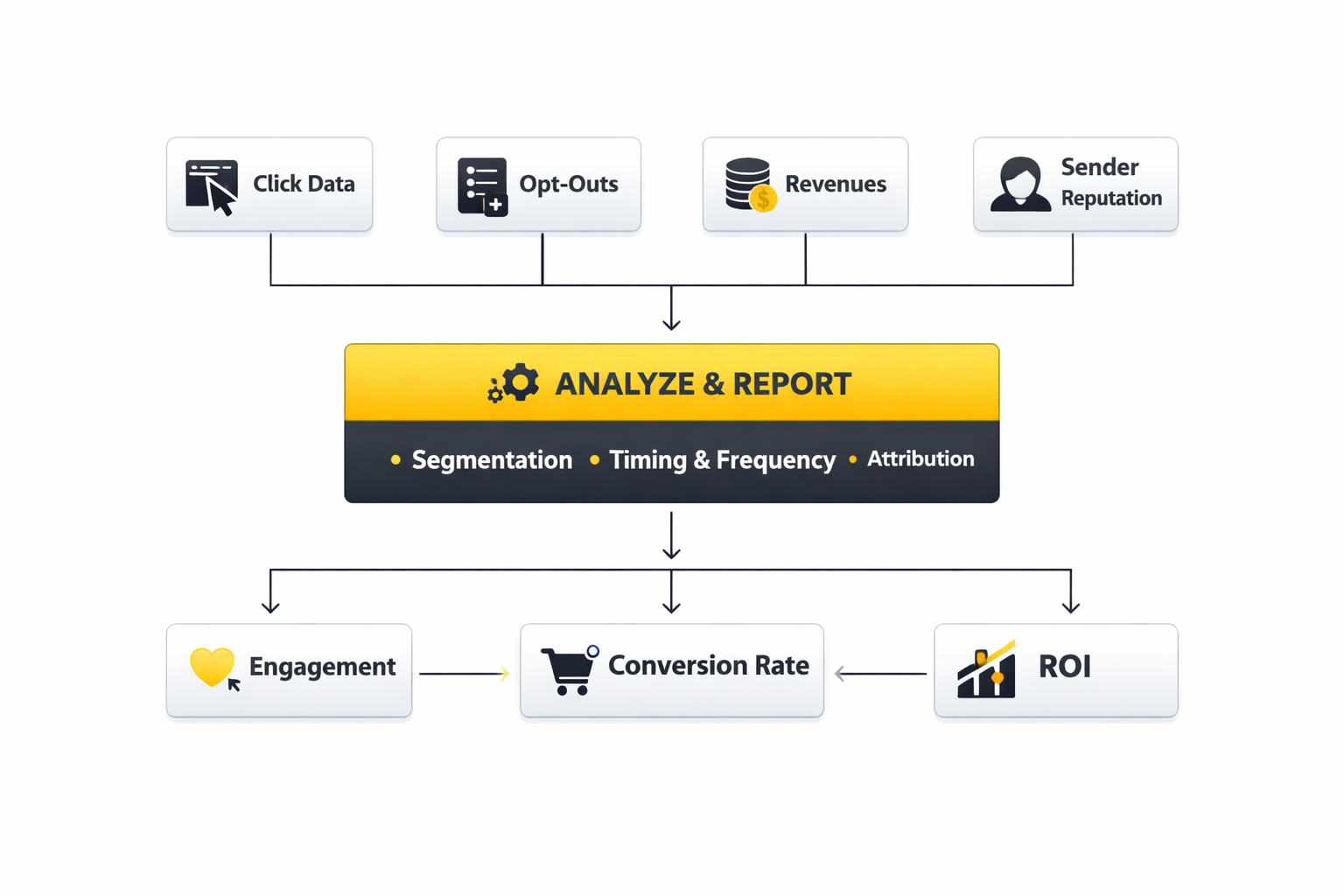
A lot of marketers still focus too hard on vanity metrics because they are easy to spot and easy to celebrate. But healthy SMS marketing needs a tougher scoreboard. Revenue per recipient, unsubscribe rate, conversion rate, segment-level performance, source quality, and flow-versus-campaign comparison all tell you much more about whether the channel is improving or quietly eroding.
Klaviyo’s benchmark ecosystem now emphasizes click rates, conversion rates, revenue per recipient, and unsubscribe rates by industry, and that shift is useful because it pushes marketers toward fuller interpretation. A campaign with strong clicks and weak revenue may be attracting curiosity but not intent. A campaign with solid revenue and a rising unsubscribe rate may still be a problem if it is teaching the list to expect constant pressure. Good SMS marketing is not about maximizing one number at the expense of the relationship.
This is where discipline starts to separate professionals from dabblers. Data should not just tell you which message won. It should tell you whether the win is repeatable, whether it hurt list health, and whether the result came from better targeting, stronger timing, or a one-off burst of urgency that will not hold up next month.
Privacy Data And The Trust Layer Behind Performance
There is one more kind of data that marketers cannot afford to ignore, and that is trust data. SMS marketing happens in a private space, which means performance is tied not only to the message itself but to how the customer feels about the brand’s right to be there. If trust weakens, the channel gets harder to sustain even when the offers stay attractive.
IAB’s 2025 consumer privacy research shows that privacy awareness is rising, that consumers care about how their data is used, and that transparency influences engagement. That matters for SMS marketing in a very direct way. The more clearly you explain what people are signing up for, the easier it becomes to personalize responsibly without creating suspicion.
So the real story behind the statistics is bigger than clicks, conversions, or even revenue. The best SMS marketing data keeps pointing back to the same operating truth: relevance, timing, automation, and trust work together. When those four elements are aligned, the numbers usually improve together. When one of them slips, the rest rarely stay strong for long.
How To Turn Statistics Into Better Decisions
The point of all these numbers is not to fill a dashboard and admire it. The point is to make better decisions faster. If your SMS marketing data shows strong performance from automated flows and weaker results from broad campaigns, that is not just a reporting note. It is a signal to rebalance where your energy goes. If personalization improves click quality but unsubscribes climb when frequency rises, that tells you the channel wants more precision, not more volume.
This is why serious growth with SMS marketing almost always comes from refinement rather than brute force. You study what subscribers respond to, cut what feels repetitive, improve the journeys that align with real intent, and keep testing timing until the message lands closer to the moment of need. That process is not glamorous, but it is where the money is.
And that brings us naturally to the next stage. Once you understand what the data is really saying, the next move is to zoom out and look at the broader ecosystem around SMS marketing, where channels, platforms, customer expectations, and the future of mobile messaging all start colliding.
Analytics, Testing, And Optimization
This is where SMS marketing starts separating the people who send messages from the people who build real systems. Anybody can launch a campaign and hope it performs. Very few businesses are willing to look hard at the numbers, admit what is not working, and keep refining until the channel becomes sharper, more profitable, and more trusted month after month.
The reason this matters so much is simple. SMS marketing can produce fast results, and fast results have a way of making weak strategy look stronger than it really is. One timely offer can create a spike. One holiday push can make the dashboard look amazing. But if you are not tracking the right metrics and testing the right variables, you can end up scaling something that only worked because the moment happened to be right.
The best operators do not let that happen. They keep asking better questions. Which subscriber sources create the healthiest long-term value, which flows outperform one-off sends, which segments are getting fatigued, and which messages create revenue without damaging trust? That mindset is what turns SMS marketing from a quick win into a dependable growth channel.
Why Analytics Matter More Than Open-Rate Thinking
One of the easiest mistakes in SMS marketing is thinking too narrowly about performance. Because texts are usually seen quickly, marketers sometimes assume visibility equals success. It does not. The real job of analytics is to show whether attention turned into meaningful action and whether that action came at a healthy cost to the relationship.
That is why smarter teams care much more about downstream behavior than vanity signals. Klaviyo’s live SMS benchmark data emphasizes metrics such as click rates, conversion rates, revenue per recipient, and unsubscribe rates by industry. That mix matters because it forces you to read performance as a whole. A message that gets clicks but weak revenue may be attracting curiosity rather than real buying intent. A message that drives sales while pushing unsubscribes up too fast may be quietly weakening the list for future sends.
The deeper truth is that analytics protects SMS marketing from self-deception. It keeps you from assuming that louder always means better. It helps you see when relevance is strong, when fatigue is setting in, and when your best results are coming from behavior-based journeys instead of calendar-based blasts.
The Metrics That Actually Deserve Your Attention
If you want SMS marketing to improve, you need a scoreboard that reflects how the channel really works. Revenue per recipient matters because it tells you whether each send is creating economic value instead of just activity. Conversion rate matters because it reveals whether the traffic is serious once it clicks through. Unsubscribe rate matters because it tells you whether the message felt useful or exhausting. Segment-level performance matters because averages can hide a lot of damage inside one broad result.
This is also where source tracking becomes incredibly important. A subscriber who joined for restock alerts may behave very differently from someone who joined through a checkout opt-in or a popup discount. The number on the list is not enough. You need to know what promise brought the person in, what kind of message they expected, and how their behavior changes over time. That is what gives your SMS marketing context instead of just data.
Klaviyo’s campaign SMS and MMS benchmarks reinforce the importance of looking at click, conversion, and unsubscribe rates together rather than in isolation. That is a much healthier way to optimize, because real improvement in SMS marketing usually shows up across several connected metrics at once, not in one flashy number that hides two others getting worse.
Why Testing Needs A Real Structure
Testing in SMS marketing is powerful, but only when it is disciplined. A lot of businesses say they test, when what they really do is change three things at once, watch one campaign perform well, and then declare a winner. That is not testing. That is improvisation with a spreadsheet.
Real testing works best when you isolate one meaningful variable at a time. That variable might be the opening line, the offer framing, the call to action, the landing page, the send time, the segment, or the difference between a campaign and an automated flow. The goal is not to run endless experiments for the sake of it. The goal is to learn something clean enough that you can confidently use it again.
This becomes even more important as expectations around relevance rise. Attentive’s 2025 consumer trends report highlights that 81% of consumers ignore irrelevant messages, while Twilio’s 2025 State of Customer Engagement report shows that 71% abandon irrelevant experiences. When people are this quick to tune out, sloppy testing is expensive. SMS marketing gets better when each test is designed to help you send fewer wrong messages, not just slightly better versions of the same noisy one.
What To Test First
If your SMS marketing program is still maturing, start by testing the variables that most directly affect relevance and action. That usually means timing, audience segment, offer type, and landing-page alignment. Marketers often obsess over copy before they have fixed the deeper issue, which is that the message is reaching the wrong people or sending them to a page that does not continue the promise of the text.
Timing is one of the highest-leverage tests because it changes how the message feels before the customer even reads the full offer. A browse reminder sent while intent is still fresh is a different experience from the same reminder delivered after the urgency has cooled off. A restock alert feels valuable when it is immediate and much less powerful when it arrives after the customer has moved on.
Offer structure is another strong place to test, but not always in the obvious way. In some cases the best result does not come from a larger discount. It comes from a clearer reason to act, better product relevance, or tighter page continuity after the click. That is why tools used to build destination pages, forms, and follow-up flows matter so much. A platform such as ClickFunnels or Systeme.io can help you align the message with the next step instead of treating the text as if it does all the selling on its own.
Why Automation Usually Beats Manual Guesswork
One of the clearest signals in modern SMS marketing is that automated flows tend to outperform manual campaigns when the flow is tied to real customer behavior. That does not mean campaigns are useless. It means campaigns should stop carrying the entire strategy on their backs.
Klaviyo’s 2025 benchmark reporting and related benchmark guidance consistently point marketers toward the strength of behavior-based flows, with automated SMS often generating far higher revenue per recipient than one-off campaigns. That makes sense when you think about how customers actually behave. A welcome message after signup, a cart reminder after hesitation, or a replenishment prompt near the moment of need will usually feel more relevant than a broad promotion sent to everyone at once.
This is where optimization becomes less about forcing more sends and more about designing smarter systems. A connected stack using tools like Brevo or Moosend can make it easier to coordinate SMS with email so each channel supports the other. When that happens, SMS marketing becomes more efficient because it no longer has to do every job by itself.
How To Spot Fatigue Before It Becomes A Problem
Fatigue is one of the quiet killers of SMS marketing because it rarely announces itself dramatically at first. The list may still be generating revenue. Clicks may still look decent. But underneath that surface, the same people start responding less often, unsubscribes rise on certain message types, and more campaigns have to work harder to get the same result they used to get with less effort.
The solution is not simply to text less. It is to notice why the list is tiring out. Sometimes the problem is frequency. Sometimes it is repetitive offers. Sometimes it is weak segmentation. Sometimes it is the slow buildup of irrelevant sends that made subscribers stop believing the next text will be worth opening. The data tells you which one it is, but only if you are paying attention to patterns instead of isolated wins.
This is another place where broader engagement research matters. Twilio’s 2025 findings show that 88% of consumers are more likely to buy when engagement is personalized in real time, while the same report shows how quickly irrelevance drives abandonment. That should push every SMS marketing operator toward the same conclusion: fatigue is usually a relevance problem wearing a frequency mask.
Optimization Is Really About Better Decisions
The word optimization can make this part of SMS marketing sound more technical than it really is. At its core, optimization means making better decisions with clearer feedback. You learn which acquisition sources create stronger subscribers. You learn which send times feel natural instead of disruptive. You learn whether a campaign should become an automated flow, whether a segment needs to be narrowed, and whether a landing page is pulling its weight after the click.
The businesses that get the most from SMS marketing are usually not the ones chasing every tactic. They are the ones willing to look honestly at what the numbers are saying and then act on it. That takes patience. It takes restraint. It also takes confidence, because real optimization often means cutting things that once seemed productive but are no longer helping the channel stay healthy.
And that is the right place to leave this part. Once your analytics, testing, and optimization process is strong, the next step is to zoom all the way out and look at the wider ecosystem around SMS marketing, where richer messaging, platform choices, customer expectations, and the future of mobile communication all start coming together.
The SMS Marketing Ecosystem And Where It Is Headed Next
By this point, it should be obvious that SMS marketing is no longer just a simple texting tactic. It sits inside a much bigger communication ecosystem that includes compliance standards, carrier filtering, customer expectations, data privacy, automation platforms, landing pages, ecommerce systems, support workflows, and richer mobile messaging formats that keep evolving. If you only look at the message itself, you miss the real game. The real game is how all of these moving parts work together to create trust, timing, and action.
That matters even more now because customer expectations are rising while messaging infrastructure is becoming more sophisticated. Twilio’s 2025 customer engagement research shows that consumers are far more likely to buy when engagement feels personalized in real time, while Attentive’s 2025 consumer trends report shows that irrelevant messages are still being ignored at scale. That combination tells you exactly where SMS marketing is headed. The future belongs to brands that can be more relevant, more timely, more transparent, and more coordinated across channels without becoming invasive.
So the final piece of this guide is not about one more tactic. It is about understanding the environment around SMS marketing, because the brands that understand the ecosystem are the ones most likely to stay effective as the channel keeps changing.

Why The Ecosystem Matters
The ecosystem matters because SMS marketing does not operate in a vacuum. Every message passes through a chain of expectations and systems before it creates a result. The subscriber has to understand why they joined. The platform has to store consent and preferences correctly. The sender setup has to be recognized and trusted. The content has to fit carrier and industry rules. The landing experience has to continue the promise of the message. And the brand has to prove, over time, that texting it was worth allowing in the first place.
This is why the strongest SMS marketing programs usually feel cleaner rather than louder. They are connected to good forms, clear preference collection, strong segmentation, solid analytics, and a landing-page or ecommerce experience that picks up the conversation without friction. A stack built around tools like Fillout, Brevo, Moosend, or ClickFunnels is not automatically better on its own, but it becomes powerful when each tool helps keep the customer journey consistent from opt-in to conversion.
That consistency is where the money usually is. It is also where trust is built. And once trust is built, SMS marketing stops feeling like interruption and starts feeling like a useful part of the customer relationship.
RCS And The Next Layer Of Mobile Messaging
One of the biggest shifts around SMS marketing is the growing importance of RCS, which is pushing business messaging toward richer and more interactive experiences. The GSMA’s Universal Profile exists to simplify global deployment of RCS, and the July 2025 Universal Profile 3.1 publication shows how quickly the standard is maturing. The GSMA has also published new RCS encryption specifications, which is a major signal that richer messaging is being pushed toward a more secure and interoperable future.
That does not mean SMS marketing disappears. It means the ecosystem around it gets broader. SMS remains incredibly valuable because it is universal, immediate, and dependable, while RCS opens the door to richer branded experiences where supported. A lot of businesses are going to end up using both. The smart move is not to treat this like a winner-takes-all fight. The smart move is to understand which customer moment needs the reliability of SMS and which one could benefit from richer messaging.
The adoption curve is already moving. Infobip’s 2025 messaging trends release published through GSMA highlights fivefold RCS adoption growth in 2024, while the GSMA’s RCS ecosystem overview shows how many different industry players are now involved. So the real future of SMS marketing is not isolation. It is coexistence inside a larger mobile messaging system.
Privacy, Trust, And The Future Of Permission
If there is one force that will keep shaping SMS marketing for years, it is trust. Customers are not becoming more casual about privacy. They are becoming more aware of how brands collect, use, and activate their data. IAB’s 2025 consumer privacy study makes that clear, showing that privacy policies and data practices influence whether people use a company’s services or buy from it at all.
That trend matters because permission is becoming more than a checkbox. In strong SMS marketing, permission is the beginning of an ongoing relationship. If a brand gets the opt-in but abuses the access, the channel weakens. If the brand stays clear, relevant, and respectful, the channel grows stronger because every message reinforces the idea that subscribing was a good decision.
Regulation and industry guidance are also pushing in that direction. The FCC’s 2024 public notice on consent revocation rules, the FCC’s January 6, 2026 extension order, and the CTIA messaging security best practices all point toward the same operating truth: consumer control, transparency, and message integrity are not optional details. They are part of what makes modern SMS marketing viable.
How Platforms Will Shape Results
The platform layer of SMS marketing is going to matter even more going forward because execution is getting more complex. Businesses need better consent capture, stronger cross-channel automation, cleaner segmentation, deeper reporting, and more flexible ways to coordinate messaging with forms, checkout, scheduling, CRM data, and landing pages. That is why platform decisions now shape not only convenience but performance.
For some businesses, the best growth comes from building cleaner acquisition funnels and directing subscribers into more specific journeys. In those cases, tools such as Systeme.io or ClickFunnels can help make the promise-to-page transition tighter. For others, the real leverage comes from combining email and SMS more effectively through platforms like Brevo or Moosend. The point is not that one tool wins for everyone. The point is that the future of SMS marketing will belong to brands whose systems are integrated enough to act on customer intent quickly and cleanly.
That is also why small operational details matter more than they used to. Better forms, better preference capture, better attribution, and better message sequencing compound over time. When the stack gets sharper, the messages usually get sharper too.
What Success Will Look Like Next
The brands that win with SMS marketing over the next few years are probably not going to be the ones sending the most texts. They are going to be the ones using the channel with the most discipline. They will know when to text, when to let email carry the heavier explanation, when to escalate into richer messaging, and when to hold back because the customer has not earned another interruption yet.
Success will also look more behavior-driven and less calendar-driven. Automation will keep taking a larger share of value because it aligns messaging with moments of intent. Richer mobile formats will expand for brands that can use them well. Compliance standards will keep tightening where abuse creates pressure. And customers will continue rewarding the businesses that make communication feel more useful than intrusive.
So if you want the simplest possible summary of the future, here it is: SMS marketing will keep working, but only for brands that respect the ecosystem around it. The channel is still powerful. It is just less forgiving of lazy execution than it used to be.
FAQ For A Complete SMS Marketing Guide
What Is SMS Marketing?
SMS marketing is the use of permission-based text messages to communicate with customers for promotions, reminders, alerts, lifecycle messaging, and other business purposes. The channel is powerful because it is direct and mobile-first, but it performs best when messages are relevant and clearly expected. In practice, strong SMS marketing is less about blasting offers and more about reaching the right person at the right moment with a message that actually helps them do something.
Is SMS Marketing Still Effective In 2026?
Yes, but it is effective for different reasons than many people assume. The channel still benefits from speed and visibility, yet the real edge comes from relevance, timing, and trust. Twilio’s 2025 customer engagement data and Attentive’s 2025 research both show how quickly people disengage from irrelevant communication, which means SMS marketing works best when it feels personalized and useful rather than frequent for its own sake.
Is SMS Marketing Legal?
Yes, but only when it is done with proper consent and in line with applicable laws, regulations, carrier rules, and industry guidance. In the United States, the FCC’s consent revocation rules and related TCPA obligations make it clear that consumers must be able to stop unwanted robotexts using reasonable methods. That means legal SMS marketing is built on clean opt-ins, documented records, transparent disclosures, and fast opt-out handling.
How Often Should You Send SMS Messages?
There is no universal number that works for every brand, and that is exactly why frequency should not be chosen in isolation. The right cadence depends on why the subscriber joined, what type of messages they expect, how segmented the list is, and whether the texts are genuinely tied to moments of intent. If subscribers joined for restocks, appointment reminders, or urgent updates, more frequent texts may feel natural. If every message feels like the same promotion repeated over and over, even a modest frequency can burn the list out.
What Makes An SMS Campaign Perform Well?
A strong SMS marketing campaign usually has five things working together: clear audience selection, tight timing, relevant offer framing, a frictionless destination, and a subscriber base that understands why it is receiving the message. Marketers sometimes over-focus on writing better copy when the deeper problem is poor segmentation or a weak landing-page match. The best-performing messages feel obvious to the customer because they arrive when action already makes sense.
Should SMS And Email Work Together?
Absolutely. Email and SMS do different jobs, and the smartest businesses let each channel do what it does best. Email can handle more detail, education, and longer persuasion, while SMS can drive urgency, reinforce timing, and move someone quickly when the moment is right. Platforms like Brevo and Moosend can help businesses coordinate both channels instead of forcing SMS marketing to carry the entire relationship on its own.
What Is The Difference Between SMS And RCS?
SMS is the traditional text channel that works almost universally across mobile devices and networks. RCS is a newer standard for richer business messaging that supports more interactive experiences in supported environments. The GSMA’s Universal Profile and the GSMA’s encryption milestone for RCS show where the technology is heading. For most brands, this is not a question of replacing SMS marketing entirely. It is a question of understanding when plain-text reliability is best and when richer messaging can add value.
How Do You Grow An SMS List Without Lowering Quality?
You grow it by making the subscription value specific and by collecting opt-ins in moments where customer intent is already present. That usually means forms tied to product interest, checkout activity, restock demand, appointments, or clearly defined VIP access rather than generic “stay updated” promises. Cleaner acquisition paths built through tools like Fillout, ClickFunnels, or Systeme.io can help a lot, but list quality still comes down to clarity, consent, and expectation-setting.
What Metrics Should You Track In SMS Marketing?
The most useful metrics are the ones that show both commercial performance and list health. Revenue per recipient, conversion rate, unsubscribe rate, segment-level performance, source quality, and the difference between automated flows and manual campaigns all tell a much fuller story than clicks alone. Klaviyo’s benchmark environment for SMS is a useful reminder that good SMS marketing is not about one standout number. It is about seeing whether the whole system is getting stronger.
Are Automated SMS Flows Better Than Campaigns?
Often, yes, especially when the flow is tied to real behavior such as signup, browse activity, cart abandonment, replenishment timing, or post-purchase milestones. Automated SMS marketing tends to feel more relevant because it reacts to what the customer just did instead of what the brand happens to want to send that day. Campaigns still matter, but automation usually creates the strongest long-term efficiency when it is well designed.
How Do You Avoid Subscriber Fatigue?
You avoid fatigue by protecting the channel. That means tighter segmentation, stronger variety in message types, more behavior-based sends, better timing, and less temptation to overuse the list just because it responded well once. Fatigue is usually a relevance problem before it becomes a frequency problem. If the message keeps matching what the customer cares about, SMS marketing can stay healthy much longer.
Can Small Businesses Win With SMS Marketing?
Yes, and in some cases small businesses have an advantage because they can stay closer to what their customers actually want. They can build cleaner lists, send more contextual messages, and avoid the bloated approval processes that often slow larger brands down. What small businesses cannot afford to do is treat SMS marketing casually. They still need consent discipline, clear positioning, and a system strong enough to keep the channel professional from day one.
When Should You Work With Professionals?
You should consider working with professionals when SMS marketing starts becoming important enough that mistakes are expensive. That might be when compliance concerns increase, when the list grows fast, when automation becomes more complex, when cross-channel coordination starts breaking down, or when results flatten and you are not sure why. Getting expert help can save a lot of wasted sends, weak segmentation, and preventable trust damage.
Work With Professionals
There comes a point where trying to figure out every moving piece of SMS marketing on your own starts costing more than it saves. The channel can absolutely be profitable, but it gets much stronger when strategy, compliance awareness, segmentation, automation, landing pages, and measurement are all working together instead of being patched together one by one. That is usually the moment businesses benefit from experienced help.
If you are building acquisition funnels, you may need better landing-page and conversion systems through tools like ClickFunnels or Systeme.io. If you are trying to coordinate email and SMS more intelligently, platforms like Brevo and Moosend may fit better. And if the real challenge is simply finding skilled marketers who know how to make this work in the real world, the best move is often to stop hunting randomly and go where serious opportunities and talent are easier to find.
The truth is that SMS marketing rewards execution. Not theory. Not hype. Execution. So if you want better results, sometimes the fastest path is getting the right people around the project and building the system properly from the start.
Explore 10K+ Remote Marketing Contracts on MarkeWork.com
Most marketers spend too much time chasing clients, competing on crowded platforms, and losing a percentage of every project to middlemen.
MarkeWork gives you a better way. Browse thousands of remote marketing contracts and connect directly with companies desperate to hire skilled marketers like you without platform commissions and without unnecessary gatekeepers.
If you’re serious about finding better opportunities and keeping 100% of what you earn, you can explore available contracts and create your profile for free at MarkeWork.com.
 Filip Konecny Enterprises