

SEO Marketing: A Practical Growth Framework for Modern Brands
SEO marketing still does something very few channels can do at scale: it meets people at the exact moment they are looking for an answer, a product, a comparison, or a provider. That is why it keeps showing up in serious growth conversations even while AI products, social platforms, and paid media keep fighting for attention. The difference now is that strong SEO marketing is no longer just about rankings. It is about building a search presence that earns trust, captures demand, and turns visibility into measurable business results.
That shift matters because Google’s own documentation makes it clear that search success comes from content built for people first, not pages created mainly to manipulate rankings. Google also explains that its systems evaluate many signals at the page level, while marketers can use Search Console and Analytics together to connect search visibility with real business actions such as leads, signups, and sales. In other words, SEO marketing works best when it stops being treated like a bag of tricks and starts being run like an integrated marketing system built on relevance, usability, and proof.
There is also a strategic reason brands are leaning back into this channel. Recent research from Conductor’s 2025 State of SEO report found that organic search produced 33% of overall website traffic across seven industries in 2024, while BrightEdge reported in September 2025 that AI search referrals were growing quickly but still accounted for less than 1% of referral traffic. That does not mean brands should ignore AI discovery. It means the smartest move is to strengthen the foundation that already drives demand while making that same foundation easier for AI systems to interpret.
Article Outline
- Part 1: Why SEO Marketing Matters
- Part 2: Framework Overview
- Part 3: Core Components
- Part 4: Professional Implementation
- Part 5: Measurement And Analytics
- Part 6: SEO Marketing Ecosystem And FAQ
Why SEO Marketing Matters
SEO marketing matters because it compounds. A paid campaign can switch on demand quickly, but it usually stops the moment spending stops. A well-structured search strategy keeps building momentum through pages, topic clusters, product assets, internal links, reviews, and brand mentions that continue working long after publication. That compounding effect is one of the main reasons experienced marketers keep protecting SEO budgets even when newer platforms get more hype.
It also matters because search sits closer to intent than most channels. Someone casually scrolling social media may become a customer later, but someone searching for pricing, alternatives, implementation guidance, or category comparisons is already moving through a decision process. Google’s Search Console Performance report documentation shows exactly how marketers can track impressions, clicks, CTR, and average position, which makes SEO marketing unusually transparent compared with channels that are harder to connect to specific queries and landing pages.
There is a brand angle here too. When a company consistently appears for educational searches, commercial queries, and branded comparisons, it starts to feel established before a sales conversation ever begins. That is why effective SEO marketing is not just a traffic play. It is a credibility system that helps a business earn attention before competitors ever get a chance to pitch.
Framework Overview

The easiest way to think about SEO marketing is as a framework with four connected layers: technical access, search intent, content depth, and conversion design. Technical access makes sure search engines can crawl, index, and understand the site. Search intent ensures every page matches what people are actually trying to do. Content depth demonstrates expertise and usefulness. Conversion design turns that visibility into action once a visitor lands.
This is exactly where many brands get stuck. They publish content without fixing crawl or indexing issues. Or they improve technical SEO while sending visitors to pages that do not answer the query well enough to earn trust. Google’s SEO Starter Guide and ranking systems documentation both reinforce the same core idea: search performance improves when Google can understand pages clearly and users find them genuinely useful.
That means the framework has to be run as one system, not as isolated tasks handed off across disconnected teams. The content team needs the same keyword and intent map as the product marketer. The developer needs to understand what structured data, internal linking, and page speed support the visibility goal. The analyst needs to connect search queries with revenue events, not just report on rankings in a vacuum.
Core Components
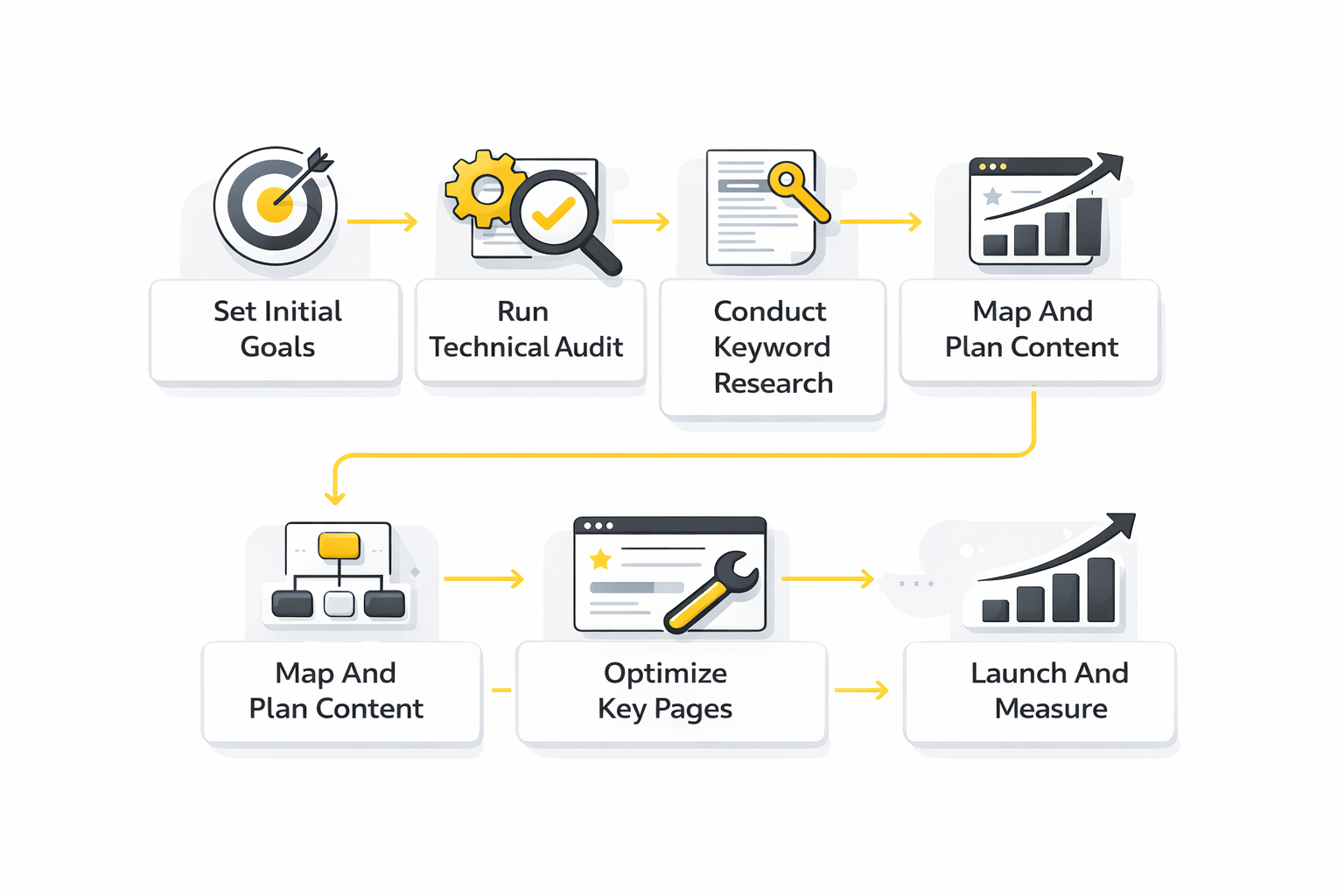
The first core component is content built around real intent. Google’s guidance on helpful, reliable, people-first content is direct about this: pages should exist to serve an audience, show depth, and leave the visitor satisfied. In practical marketing terms, that means a page targeting “seo marketing” cannot just repeat the phrase. It needs to explain the concept, show how it works, answer objections, and help the reader decide what to do next.
The second component is technical clarity. Google’s documentation on page experience and structured data makes the point clearly: search engines need clean signals. Pages should load reliably, work well on mobile, be served securely, and use markup where appropriate so search systems can understand what the page is about. Technical SEO does not replace strong messaging, but it removes the friction that prevents strong messaging from being discovered.
The third component is measurement tied to business outcomes. Google’s guide on using Search Console and Google Analytics data for SEO explains why comparing search clicks with on-site sessions and conversion behavior creates a fuller picture. That matters because ranking in position three for a vanity keyword is not a win if the page never drives pipeline, revenue, or qualified leads. Mature SEO marketing focuses on qualified traffic, assisted conversions, and pages that move buyers forward.
Professional Implementation
Professional implementation starts with choosing the role SEO marketing should play inside the wider customer journey. For some brands, it is top-of-funnel education. For others, it is the channel that captures bottom-of-funnel comparisons, category searches, and branded demand. The mistake is trying to make every page do everything at once. A professional system assigns clear jobs to each page type, then builds internal links and calls to action that guide visitors into the next step.
It also helps to build landing environments that are designed for both discoverability and conversion. If a business needs fast, campaign-ready pages that can support lead magnets, webinars, or offer-specific funnels, tools like ClickFunnels or Systeme.io can help simplify page deployment. When the goal is to turn organic traffic into email subscribers and nurture them properly, a platform like Brevo becomes much more useful once the SEO page and the email sequence are planned together instead of in separate silos.
There is a workflow side to implementation as well. SEO marketing becomes far more effective when content briefs, publishing calendars, and follow-up actions are streamlined. That is why teams often pair their search process with tools for content planning, social distribution, and scheduling, whether that means using Buffer to extend the reach of newly published pages or Cal.com to reduce friction when an organic visitor is ready to book a call. The channel grows faster when every next step feels obvious and easy.
Most of all, professional implementation treats SEO marketing as an operating discipline. Pages are audited, improved, and refreshed when the evidence supports it. Search Console data is reviewed for shifts in query mix, CTR, and page-level performance. Content is expanded when readers need more depth, and simplified when it is hiding the answer behind unnecessary filler. That is how a search program stops being a publishing habit and starts becoming a durable source of growth.
Start With Audience And Search Intent
Everything begins with intent because a keyword only becomes valuable when you understand the reason behind it. Someone searching “seo marketing” might want a basic definition, a strategic framework, a service provider, or a better way to explain the channel to their team. If you miss that intent and write a page that answers the wrong question, even solid optimization work will struggle to create meaningful results.
This is why the strongest SEO marketing plans group terms by intent rather than by volume alone. Informational searches deserve educational pages, commercial searches need comparison or solution content, and transactional searches need pages that make action feel easy and natural. Google Search Console’s Performance report gives marketers direct visibility into clicks, impressions, CTR, and average position, which makes it easier to see whether a page is merely showing up or actually matching what searchers want.
Once intent is clear, writing becomes much easier. You stop forcing the keyword into awkward phrases and start speaking the way a smart human would naturally explain the topic. That is when SEO marketing begins to feel less like optimization theater and more like persuasive communication.
Build Topic Architecture Instead Of Isolated Pages
One of the biggest reasons SEO campaigns stall is that brands publish disconnected articles with no real structure tying them together. A better framework organizes content into clear topic clusters, where pillar pages handle broader themes and supporting pages answer narrower questions, comparisons, or use cases. That structure helps users move deeper into the subject and gives search engines stronger contextual signals about what the site truly covers.
This is also where internal linking stops being an afterthought and becomes a strategic asset. Google’s documentation on crawlable links and site discoverability keeps reinforcing a basic truth: links are not just navigation elements, they are part of how content gets discovered and understood. In practical terms, a strong SEO marketing framework connects related pages so authority, context, and user attention can flow naturally from one resource to the next.
For teams managing large content inventories, mapping that architecture manually can get messy fast. Tools like Firecrawl can help extract and review site content at scale, which makes it easier to spot thin pages, overlapping topics, and linking gaps before they turn into bigger problems. That kind of visibility keeps your framework clean and prevents the content library from slowly becoming chaos.
Make Technical Clarity Part Of The Framework
Great messaging is wasted if search engines cannot crawl the site properly or if users land on pages that feel broken, slow, or confusing. Technical clarity does not mean obsessing over every minor SEO myth that circulates online. It means making sure the site can be discovered, indexed, rendered correctly, and experienced smoothly on the devices people actually use.
Google explains in its documentation on page experience that user experience can affect how pages perform in search, and its guidance on structured data shows how clear markup helps Google understand content more accurately. In a real SEO marketing workflow, that means cleaning up indexation issues, improving template consistency, using schema where it makes sense, and making sure your most important pages are not hidden behind weak navigation or technical friction.
This layer often gets ignored because it is not as exciting as writing content or watching rankings move. But technical problems quietly kill performance all the time. The framework only works when the foundation is strong enough to support everything built on top of it.
Turn Search Visibility Into Business Action
A lot of marketers talk about traffic as if it is the finish line, but traffic alone does not pay salaries, generate pipeline, or grow a company. A complete SEO marketing framework plans the next step before the visitor ever lands on the page. That could mean subscribing to a newsletter, booking a call, requesting a demo, downloading a resource, or moving to a product page with stronger buying intent.
This is where SEO needs to work hand in hand with page design, messaging, forms, and follow-up systems. Google’s guide on using Search Console and Google Analytics together makes the point clearly: when you compare search visibility with on-site behavior, you get a far more useful picture of what organic traffic is actually doing. That is the difference between celebrating impressions and building a system that produces qualified leads or sales.
If you are building conversion paths around organic traffic, practical tools matter. A lightweight form system like Fillout can make lead capture feel smoother, and if you want a clean visual reminder of what a focused marketing workflow should look like, this banner is worth a click.

How The Framework Works In Practice
When this framework is working properly, every piece supports the next one. Intent shapes the page, architecture strengthens relevance, technical clarity removes friction, and conversion design gives the visit a purpose. Instead of publishing content and hoping it does something eventually, you are building a system where each page has a job and every improvement compounds over time.
That is also the right way to think about modern search behavior. BrightEdge reported in September 2025 that AI search referrals were still under 1% of total referral traffic even as the channel was growing, which is a good reminder not to abandon the core search engine ecosystem in favor of hype. The smarter move is to build pages so clear, useful, and well-structured that they can perform in classic search and remain understandable in AI-assisted discovery environments too.
That is the real framework overview. SEO marketing works best when it is treated like a connected growth system, not a pile of disconnected tasks. Once that clicks, the rest of the strategy gets a whole lot easier to execute.
Content Quality And Topical Depth
The first core component is content that actually deserves attention. Google’s guidance on helpful, reliable, people-first content keeps repeating the same message in different forms: create pages for people, show real expertise, and leave the reader satisfied enough that they do not need to go searching again for the same answer. That sounds simple, but it eliminates a huge amount of weak SEO marketing almost instantly.
This is where many pages fail. They technically target the keyword, but they do not really help the person behind the search. They define the topic, toss in a few generic points, repeat the phrase too often, and then wonder why rankings stall or traffic never converts. Content quality in SEO marketing means answering the real question, dealing with objections, giving context, and helping the reader move from confusion to clarity.
Topical depth matters because search engines are trying to surface sources that appear genuinely useful, not just superficially relevant. Google’s ranking systems guide explains that its systems are designed to better surface original and helpful content, which is why thin copy and copycat articles struggle over time. If you want your pages to keep working, they need enough substance to earn trust, not just enough words to look complete.
Technical Foundation And Accessibility
The second core component is technical clarity. Not because technical SEO is glamorous, but because even strong content underperforms when search engines cannot crawl it cleanly or users land on a page that feels broken, cluttered, or slow. Google’s SEO Starter Guide and its broader documentation on crawling and indexing make it clear that discoverability is not optional. If Google cannot reliably find, render, and understand your pages, your content is fighting with one hand tied behind its back.
This part of SEO marketing includes the basics that too many teams skip when they are in a rush to publish. Clean site architecture, crawlable navigation, sensible URL structure, mobile usability, and pages that load reliably all sit here. Google’s advice on URL structure and crawlable links is practical for a reason: the easier it is for both users and search engines to move through your site, the more clearly your content can be understood.
Accessibility belongs in this conversation too, even when teams do not label it as SEO. Google’s developer-facing SEO guide for web developers specifically points out that sites should be secure, fast, accessible, and work on all devices. That should tell you everything you need to know. Technical SEO is not just about pleasing crawlers. It is about removing friction so real humans can get what they came for.
Page Experience And Performance
The third component is page experience, and this is one of the easiest places to lose conversions even when visibility is strong. Google’s documentation on page experience says page experience can impact how a site ranks, but the bigger reason to care is what happens after the click. If a page jitters while loading, takes too long to show the main content, or feels sluggish when someone tries to interact with it, trust starts dropping before they have even read the first paragraph.
The metrics behind that experience are not abstract. Google’s guide to Core Web Vitals explains that these measurements focus on loading performance, interactivity, and visual stability, while web.dev’s Core Web Vitals resource frames them as essential metrics for a healthy site. That matters because SEO marketing is not just about winning impressions. It is about keeping the click you already earned.
In plain English, speed and stability shape perception. A fast, steady page feels professional and trustworthy. A slow, jumpy page feels risky, even if the copy itself is excellent. That is why performance is not a nice extra in SEO marketing. It is part of the product.
Site Structure And Internal Links
The fourth component is structure, especially the way pages connect to each other. A site with strong topic organization helps users understand where to go next and helps search engines understand how ideas relate across the domain. This is one of the least flashy parts of SEO marketing, but it quietly shapes how authority and relevance flow through the entire site.
Google’s documentation on crawlable links notes that Google generally crawls links when they are standard HTML anchor elements with an href attribute, and it also recommends anchor text that makes sense for both people and search engines. That sounds basic, but it has major implications. Good internal links do more than move users around. They clarify meaning, connect related ideas, and help important pages receive stronger contextual support.
When site structure is weak, content starts competing with itself. Similar pages overlap, important resources get buried, and supporting pages fail to strengthen the main commercial assets that matter most. When structure is strong, SEO marketing becomes easier to scale because every new page adds context and support instead of creating confusion.
Structured Data And Search Understanding
The fifth component is structured data, which helps search engines interpret page content more accurately. Google’s introduction to structured data markup explains that this markup helps Google understand content on the page. That matters because search engines are not reading with intuition the way humans do. They rely on technical clues, patterns, and consistent signals to classify what a page contains.
Structured data is not magic, and it will not save weak content. But when it is used properly, it reduces ambiguity. A page can more clearly signal whether it is an article, product, organization, breadcrumb trail, or another supported content type. In a competitive SEO marketing environment, that clarity matters because the cleaner your signals are, the easier it becomes for search systems to connect your page with the right search context.
This is another good reminder that modern SEO marketing is about precision, not hacks. The goal is not to sprinkle markup everywhere and hope for a miracle. The goal is to help search engines understand the truth of the page more efficiently.
Authority, Trust, And Brand Signals
The sixth component is authority, but not in the shallow sense people often use when they reduce the subject to backlinks alone. Authority in SEO marketing comes from the total pattern a brand creates: useful content, clear expertise, strong mentions, earned links, branded searches, consistent messaging, and a site that feels credible when someone lands on it. Links still matter, but they matter most when they are reinforcing something real.
Google’s ranking systems documentation makes clear that its systems try to surface original content and high-quality reviews, while its Search Essentials define the core requirements that keep content eligible to appear and perform well. Put those ideas together and the message is hard to miss. Trust is not built through one trick. It is built through consistency.
This is also where brand becomes a powerful SEO marketing asset. When people recognize your name, search for it directly, or encounter it repeatedly in useful contexts, the search click becomes easier to win and the visit becomes easier to convert. Authority is not just about ranking higher. It is about feeling safer to choose.
Measurement And Feedback Loops
The last core component is measurement, because without it, even a decent SEO marketing strategy can drift into busywork. Google’s guide on using Search Console and Google Analytics data together for SEO explains why combining pre-click and post-click data gives a better view of how people experience the site before and after they land. That is the kind of visibility you need if you want to make real decisions instead of educated guesses.
This is especially important now because clicks are getting harder to earn on some query types. Search Engine Land’s coverage of Seer Interactive’s study reported that organic CTR for informational queries with AI Overviews dropped 61% since mid-2024, which means visibility alone is not enough to judge performance. At the same time, Conductor’s 2025 State of SEO report still found that organic search produced 33% of overall website traffic across seven industries in 2024, so the channel remains incredibly valuable even as the click landscape changes.
That is why feedback loops matter so much. You need to know which pages are earning impressions, which queries are driving qualified visits, which pages lose people immediately, and which ones push them deeper into the journey. SEO marketing gets stronger when every component feeds better decisions back into the system. That is how good teams keep improving while everyone else keeps guessing.
Statistics And Data

If you want to get serious about SEO marketing, you have to stop treating data like decoration. The numbers are not there to make a report look impressive. They are there to tell you where attention is building, where trust is breaking, and where your content is creating business value instead of just consuming time.
The tricky part is that SEO data is easy to misread when you only look at one metric in isolation. A rise in impressions can mean growth, but it can also mean your pages are being shown for broader and less qualified searches. A drop in click-through rate can point to a problem with your title and meta description, but it can also reflect major changes in the search results page itself. That is why good SEO marketing depends on context, not just dashboards.
What follows is the data that matters most right now, and more importantly, how to think about it without fooling yourself. That is where the real advantage comes from.
What The Big-Picture Data Says
The first big number worth paying attention to is still organic search’s share of traffic. Conductor’s 2025 State of SEO report found that organic search produced 33% of overall website traffic across seven industries in 2024, and the same report says 91% of respondents saw SEO positively impact website performance and marketing goals in that year. That tells you something important right away: SEO marketing is not a side hobby for serious brands. It is still one of the main engines moving people onto websites in the first place.
At the same time, the shape of search behavior is clearly shifting. BrightEdge’s 2025 research says AI search referrals are growing fast, but still account for less than 1% of referral traffic, while organic search continues to drive the majority of traffic and conversions. That is exactly why smart marketers are not abandoning classic search optimization. They are strengthening the core while making their content easier to surface in newer discovery environments too.
There is also a warning hidden in the broader market data. Bain’s research on zero-click behavior says 80% of consumers rely on zero-click results for at least 40% of their searches. That means SEO marketing now has to win in two places at once: in the click itself, and in the brand impression created before the click ever happens.
The Metrics That Actually Matter
Most teams track too much and understand too little. The essential starting point is still the set of metrics Google exposes directly in the Search Console Performance report: clicks, impressions, click-through rate, and average position. Those four numbers are simple, but they become powerful when you compare them over time by page, query, device, and country.
Clicks tell you whether searchers are choosing you. Impressions show whether Google is even putting you in the conversation. CTR helps you see whether the search result itself is compelling enough to earn attention. Average position gives directional context, but it should never be treated like a trophy metric on its own because one page can rank in many different positions for many different queries at the same time.
This is why SEO marketing gets better when you read metrics as relationships rather than as isolated snapshots. Rising impressions with flat clicks usually mean visibility is widening faster than relevance or appeal. Rising clicks with stable positions often mean your result is becoming more attractive, which is a sign that better page targeting, stronger titles, or improved brand recognition may already be working.
Why CTR Needs More Care Now
Click-through rate deserves more attention now than it used to because the search results page has become more crowded, more visual, and more dynamic. AI summaries, rich results, knowledge panels, local packs, videos, and shopping features can all absorb attention before a standard organic result gets its chance. That means a CTR drop is not always a sign that your SEO marketing is weakening. Sometimes it means the search environment itself has changed around you.
A useful example comes from Search Engine Land’s coverage of Seer Interactive data, which reported that organic CTR for informational queries fell sharply when AI Overviews appeared. Whether a brand likes that trend or not, the takeaway is clear: you cannot judge performance from rankings alone anymore. SEO marketing has to be measured by the quality of the click, the intent behind the query, and what happens after the visitor lands.
That is also why pages targeting bottom-of-funnel searches often deserve a different reporting lens from pages built for awareness. A lower-CTR informational page that introduces the brand to the right audience can still have strategic value. A commercial page with weak CTR and weak conversion behavior is a much bigger issue, because it suggests the page is underperforming at the exact moment revenue should be easiest to influence.
What Happens After The Click
Search Console is excellent for understanding visibility, but it does not tell the whole story by itself. Google’s own guide on using Search Console and Google Analytics data together for SEO explains why combining the two gives you a better view of what happens before and after a visitor lands on the site. That matters because SEO marketing is not finished when someone clicks. In many ways, that is where the harder part begins.
Once a visitor arrives, you need to know whether they keep reading, engage with the page, move deeper into the site, sign up, request a demo, or disappear after a few seconds. A page can look healthy in Search Console and still be weak for business if it attracts curiosity without moving people toward action. When that happens, the fix is usually not more keyword optimization. It is better intent matching, better page design, and a clearer next step.
This is where a practical measurement stack becomes useful. If you need better attribution around shared campaign links, content assets, or outbound calls to action, a tool like Dub can help keep links cleaner and easier to track across the wider marketing system. That does not replace your SEO data, but it can make the journey around that data easier to understand.
How To Avoid Bad SEO Reporting
Bad SEO reporting usually starts with vanity metrics. Teams celebrate ranking improvements for keywords that do not convert, traffic spikes from pages that never lead anywhere, or impression growth that comes from being shown for irrelevant searches. That kind of reporting feels exciting for a while, but it eventually leads to bad decisions because the numbers are disconnected from business reality.
A better SEO marketing report asks a tougher set of questions. Which pages are gaining qualified visibility? Which queries are bringing in the right kind of visitor? Which landing pages are creating engagement, leads, or revenue movement after the click? And which pages are quietly losing ground even though overall traffic still looks fine?
Once you frame the data that way, reporting becomes much more honest. You stop chasing numbers that flatter the team and start paying attention to numbers that improve the business. That is the moment SEO marketing becomes a management discipline instead of a publishing ritual.
Building A Data System That Lasts
There is one more issue many teams discover too late: Google Search Console is incredibly useful, but it is not a permanent archive for long-range trend analysis. Google’s documentation on bulk data export to BigQuery explains that you can schedule a daily export of Search Console performance data to BigQuery, where you can run more complex analysis and keep a deeper historical record. That is a smart move if SEO marketing is important enough to the business that year-over-year visibility and query trends really matter.
This becomes even more important when the market is changing quickly. Adobe’s 2025 holiday-season analysis reported that AI-driven traffic surged across industries, with retail traffic rising 693% year over year. That does not mean AI has replaced search as the core engine yet, but it does mean the traffic mix is evolving fast enough that marketers need historical records strong enough to spot real behavioral shifts instead of reacting to noise.
The brands that win with SEO marketing over the next few years will not just publish more content. They will build better systems for interpreting what their data is really saying. That is the game now. Not more reporting for the sake of reporting, but cleaner insight, faster decisions, and a much tighter connection between search visibility and actual growth.
SEO Marketing Ecosystem

By this point, the bigger picture should be clear: SEO marketing is not one tactic, one plugin, or one content sprint. It is an ecosystem made up of strategy, technical health, content quality, site structure, conversion design, analytics, and ongoing refinement. When those pieces work together, search becomes much more than a traffic source. It becomes a durable growth system that keeps building trust every time someone looks for an answer you are qualified to give.
That is also why so many businesses struggle with SEO marketing for longer than they should. They often focus on the visible surface layer, like publishing articles or updating keywords, while ignoring the surrounding system that makes those actions effective. Google’s Search Essentials, the people-first content guidance, and the Search Console Performance report documentation all point in the same direction: the pages that win are usually the pages supported by a stronger overall environment.
That environment includes brand signals too. Conductor’s 2025 State of SEO report found that organic search produced 33% of overall website traffic across seven industries in 2024, while BrightEdge’s 2025 research showed that AI search referrals were growing but still represented less than 1% of referral traffic. So even as discovery evolves, classic search remains too important to treat casually. The brands that win are the ones that build a full ecosystem instead of chasing isolated tricks.
FAQ For This Complete Guide
What Is SEO Marketing?
SEO marketing is the process of using search-focused strategy, technical improvements, content, and measurement to help a business earn more visibility in search and turn that visibility into meaningful results. It is not limited to rankings. In practice, SEO marketing includes understanding search intent, creating genuinely useful pages, improving crawlability, and guiding visitors toward the next logical action once they arrive. That broader view lines up with Google’s own guidance in its SEO Starter Guide and Search Essentials.
Is SEO Marketing Still Worth It In 2026?
Yes, and the current data makes that hard to ignore. Conductor’s 2025 State of SEO report found that organic search drove 33% of overall website traffic across seven industries in 2024, and 91% of respondents said SEO positively impacted website performance and marketing goals. At the same time, BrightEdge’s 2025 findings showed that while AI search referrals are growing quickly, organic search still remains the primary driver of traffic and the majority of conversions. That tells you SEO marketing is still one of the strongest long-term channels available when it is run properly.
How Long Does SEO Marketing Take To Work?
It depends on the site, the competition, the technical condition of the domain, and the type of search terms you are targeting. SEO marketing usually rewards consistency rather than speed, which means the first improvements can appear relatively quickly on some pages while stronger compounding gains often take months. That is why the right expectation is not instant domination. The right expectation is steady improvement backed by better data, better pages, and better alignment with what people are actually searching for.
What Metrics Should I Track First?
Start with the metrics Google exposes directly in the Search Console Performance report: clicks, impressions, average CTR, and average position. Then connect those with on-site engagement and conversion behavior using the approach Google outlines in its guide on using Search Console and Google Analytics data together for SEO. That combination gives you a much more realistic view of whether SEO marketing is simply creating visibility or actually creating business value.
Is SEO Marketing Just About Keywords?
No, and that is one of the biggest reasons weak SEO strategies fail. Keywords matter because they reveal language and intent, but SEO marketing only becomes effective when those keywords are connected to content quality, page experience, internal linking, technical clarity, and conversion design. Google’s people-first content guidance makes this clear by emphasizing usefulness and satisfaction, not keyword repetition for its own sake.
Do AI Search Tools Replace SEO Marketing?
Not at this stage. They change discovery patterns, but they do not remove the need for clear, trustworthy, well-structured content. BrightEdge’s 2025 research says AI search referrals are rising quickly, yet still account for less than 1% of referral traffic, while organic search continues to deliver the majority of traffic and conversions. The smart move is not to abandon SEO marketing. It is to make your content strong enough to perform in both traditional search and emerging AI-driven discovery.
Why Are Rankings Not Enough?
Because a ranking without clicks, engagement, or conversions can still be a weak business result. Google’s own reporting framework in Search Console separates impressions, clicks, CTR, and average position for a reason. Those numbers do not always move together. A page can rank reasonably well and still underperform if the search snippet is weak, the intent match is off, or the landing page does not do a good enough job once the visitor arrives.
Does Technical SEO Still Matter If My Content Is Great?
Absolutely. Great content is easier to waste than many people realize. Google’s documentation on crawling and indexing and its SEO Starter Guide make it clear that pages need to be discoverable, understandable, and usable. If your site architecture is messy, your internal linking is weak, or your important pages are difficult to crawl, even strong content can end up underperforming.
How Often Should I Update SEO Content?
You do not need to update pages just to feel busy. You should update them when the evidence supports it. That could mean impressions are rising but clicks are weak, the page is ranking for the wrong queries, the information is dated, or competitors are now answering the topic better. Strong SEO marketing treats updates as strategic improvements, not as a ritual. The goal is to make the page more useful, more accurate, and more aligned with current search behavior.
What Is The Biggest SEO Marketing Mistake Businesses Make?
One of the biggest mistakes is treating SEO marketing like a collection of disconnected tasks instead of a coordinated system. Businesses publish articles without a content architecture, chase keywords without understanding intent, or celebrate traffic without checking whether any of it leads to revenue. That is why so many efforts feel busy but not powerful. The problem is rarely a lack of activity. It is usually a lack of cohesion.
Should I Handle SEO Marketing Myself Or Hire Someone?
That depends on your stage, your internal skills, and how much search matters to your revenue model. If you are early, you can absolutely learn the fundamentals and make progress yourself. But once SEO marketing becomes a serious growth channel, many businesses benefit from experienced help because the work spans strategy, technical review, content planning, analytics, and conversion design. A professional can often shorten the learning curve and help you avoid expensive false starts.
What Tools Help With SEO Marketing Workflows?
The best tools are the ones that make execution and follow-through easier, not the ones that create more dashboards than decisions. For example, Firecrawl can help teams review and extract site content at scale, Fillout can make lead capture cleaner on SEO landing pages, and Brevo can help nurture people who enter your world through organic search. The point is not the tool itself. The point is building a smoother system around the traffic SEO marketing earns.
Can Small Businesses Still Win With SEO Marketing?
Yes, especially when they stop trying to out-publish giant brands on broad topics and start owning the right niche, the right audience questions, and the right local or category-specific intent. SEO marketing often rewards relevance, clarity, and trust more than raw size alone. A smaller business with strong positioning, genuinely helpful pages, and a focused internal linking structure can outperform larger competitors on the searches that actually matter most to its revenue.
Work With Professionals
There comes a point where learning the basics is not the hard part anymore. The hard part is building momentum, keeping quality high, and making sure your SEO marketing work connects to revenue instead of drifting into endless content production. That is where experienced professionals can make a real difference.
A good SEO partner does more than chase rankings. They help clarify intent, tighten structure, improve the pages that matter most, and build a measurement system that shows what is actually working. If your business depends on visibility, trust, and inbound demand, getting that help earlier can save a lot of wasted time later.
For marketers themselves, that demand is part of the opportunity. Businesses still need people who can connect strategy, content, and performance into one system. And if you are one of those people, better opportunities are out there when you know where to look.
Explore 10K+ Remote Marketing Contracts On MarkeWork.com
Most marketers spend too much time chasing clients, competing on crowded platforms, and losing a percentage of every project to middlemen.
MarkeWork gives you a better way. Browse thousands of remote marketing contracts and connect directly with companies desperate to hire skilled marketers like you without platform commissions and without unnecessary gatekeepers.
If you’re serious about finding better opportunities and keeping 100% of what you earn, you can explore available contracts and create your profile for free at MarkeWork.com.
 Filip Konecny Enterprises