
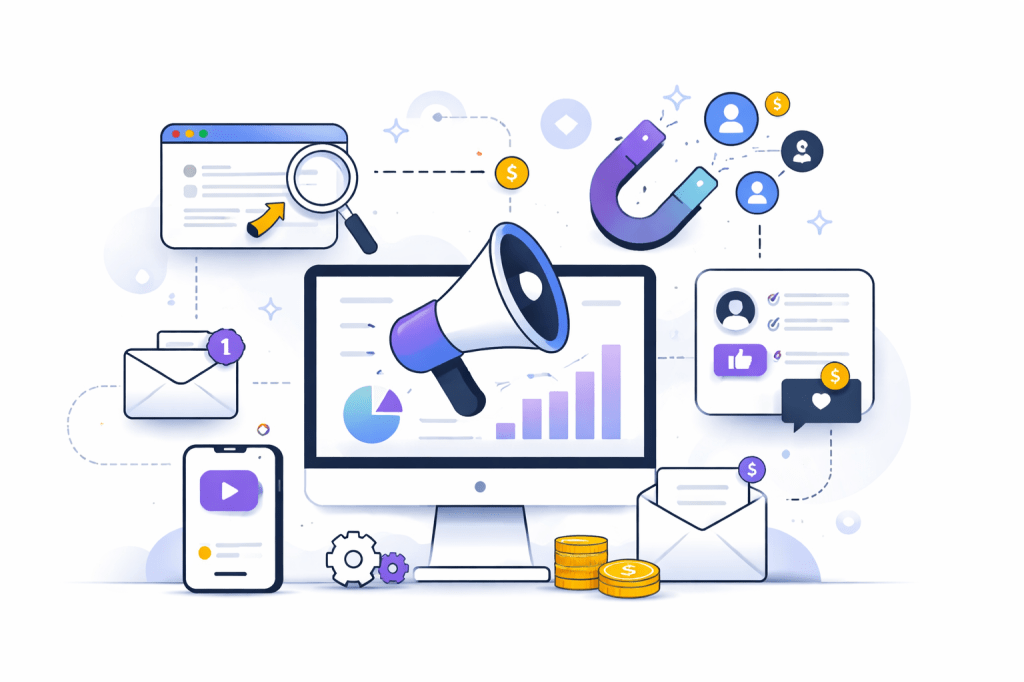
Online Marketing: Strategy, Channels, and Growth Framework
Online marketing is where modern demand gets created, captured, and converted. People discover brands while searching, scrolling, watching, comparing, and checking reviews, which means your visibility now depends on how well your message travels across search engines, social platforms, email, websites, and conversion-focused landing pages. When the system is built well, online marketing does not feel like a pile of disconnected tactics; it feels like a reliable engine that turns attention into leads, customers, and repeat revenue.
That matters because digital behavior is now too large to treat as secondary. Digital 2025 from DataReportal shows that billions of people are active online every day, and UNCTAD’s latest e-commerce analysis shows how deeply online channels are woven into business sales around the world. At the same time, platform economics keep proving the same point from the supply side: Meta reported $200.97 billion in 2025 revenue, and Alphabet said Google Search and Other advertising revenue reached $63.1 billion in Q4 2025 alone. Brands are spending there because buyers are already there.
In this first part, we will establish the logic behind online marketing before getting into execution. You will see why it matters, how the overall framework works, which core components deserve the most attention, and what professional implementation looks like when you stop improvising and start building a real system.
Article Outline
- Why Online Marketing Matters
- Online Marketing Framework Overview
- Core Components of Online Marketing
- Professional Online Marketing Implementation
- Measurement and Analytics
- Online Marketing Ecosystem and FAQs
Why Online Marketing Matters
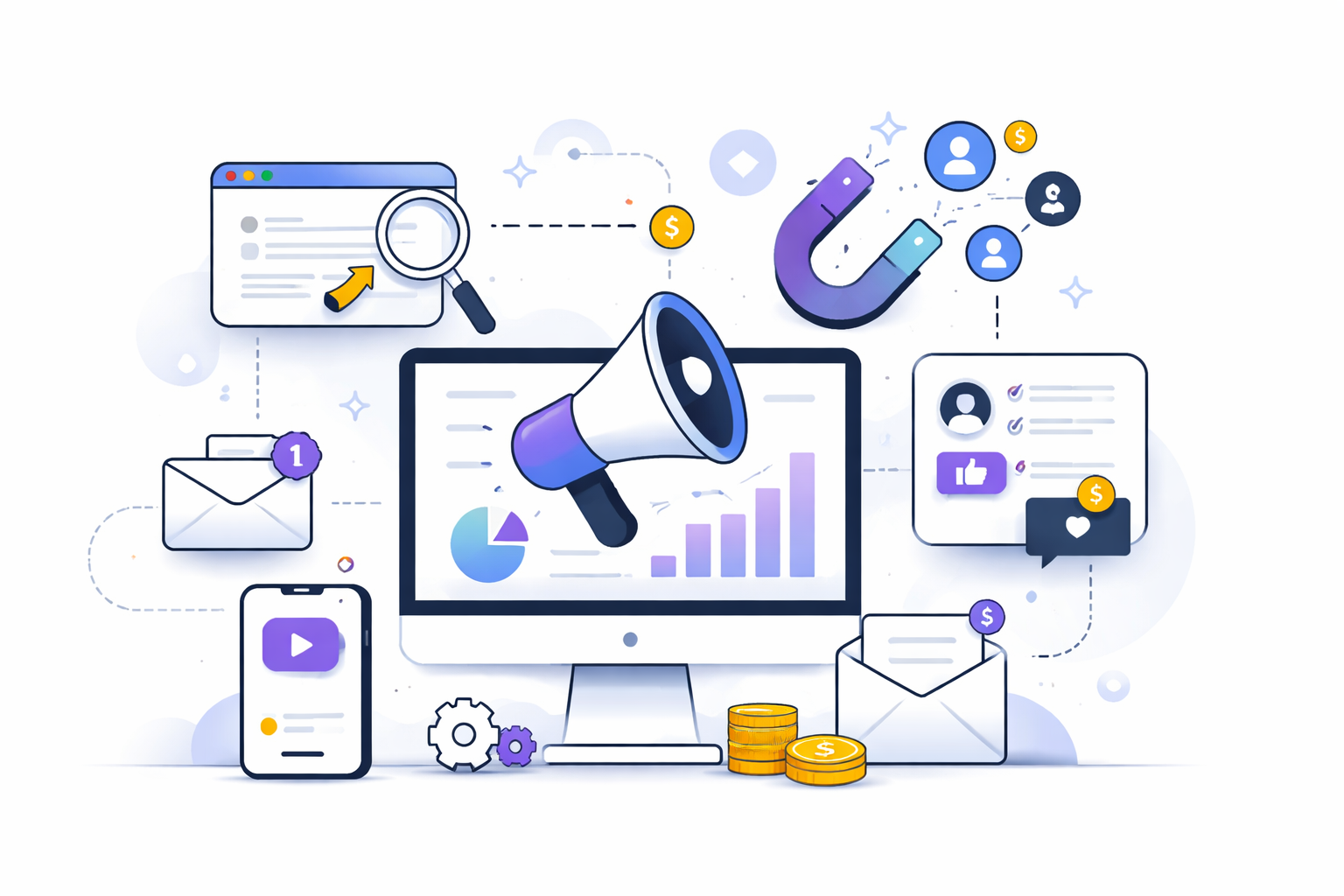
Online marketing matters because customer intent shows up digitally long before a sale happens. Google’s work on the messy middle of purchase behavior explains why people move back and forth between exploration and evaluation instead of following a neat linear funnel. That means brands need to be present at multiple moments, not just when someone is finally ready to buy.
The scale alone makes the opportunity impossible to ignore. DataReportal’s 2025 global report shows how widespread internet and social media usage has become, while UNCTAD’s 2024 technical note shows that business e-commerce sales across 43 economies rose to almost $27 trillion in 2022. Those are not niche numbers that apply only to software companies or global retailers; they reflect a broad shift in how people research, compare, and buy.
There is also a competitive reason this matters. When Alphabet keeps reporting strong search advertising growth and Meta keeps expanding ad impressions and revenue, that is the market telling you where attention is being priced and fought over. If your business is absent, inconsistent, or slow online, you are not simply missing a trend; you are giving better-positioned competitors an easier path to your customers.
Online Marketing Framework Overview
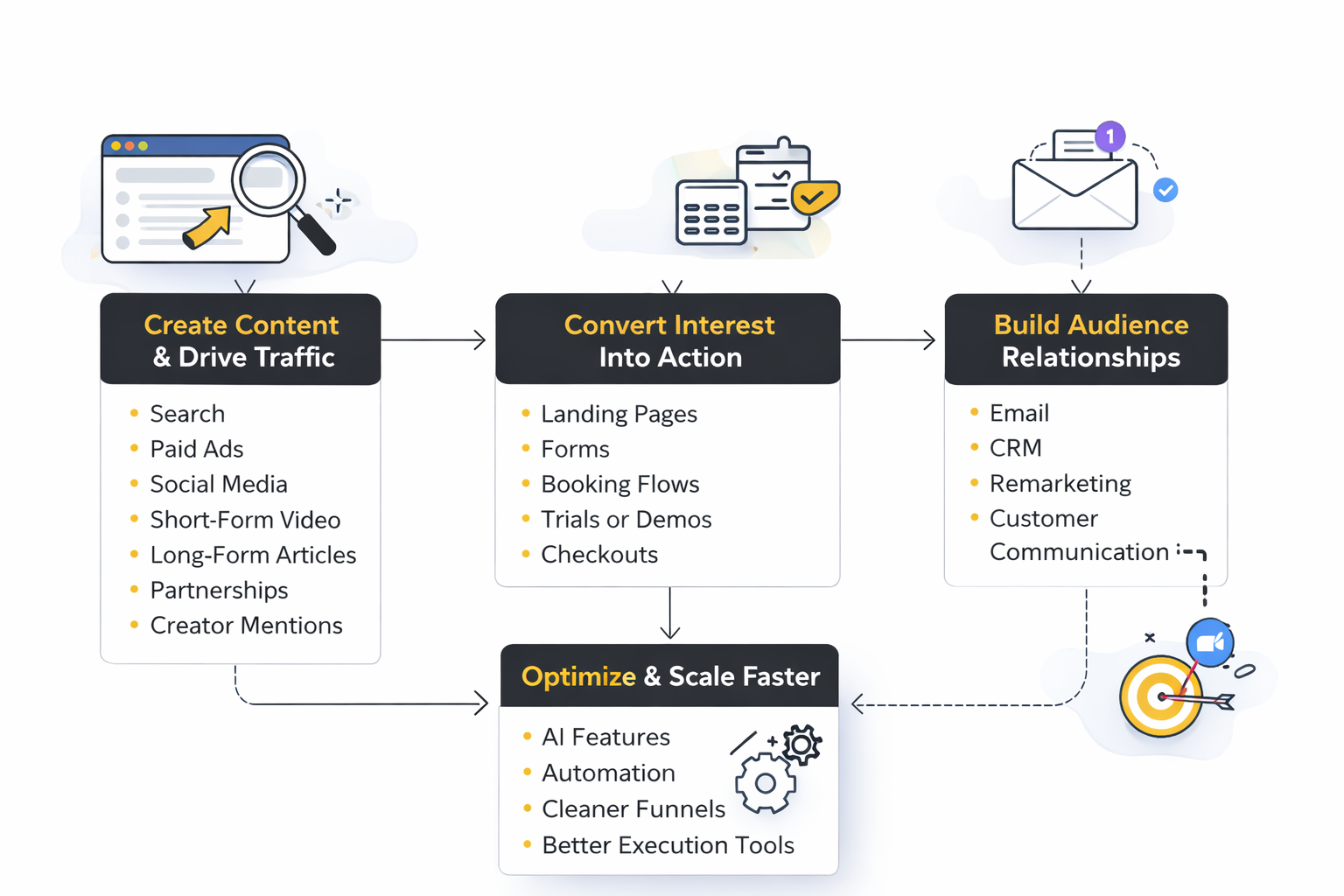
A strong online marketing framework starts with a simple truth: channels do different jobs. Search captures existing demand, social creates discovery and repeated exposure, email deepens relationships, content builds trust, and landing pages convert attention into action. Problems begin when businesses ask one channel to do everything or judge every tactic by the same metric.
The cleaner way to think about it is as a connected system with four layers: audience insight, traffic acquisition, conversion architecture, and retention. Audience insight tells you who you are trying to reach and what problem they are actively trying to solve. Traffic acquisition gets you in front of them through organic search, paid media, social content, partnerships, and referrals, while conversion architecture makes sure the click actually has somewhere persuasive to go. Retention then turns a first transaction into a longer relationship through email, remarketing, customer education, and repeat offers.
This framework is also more realistic than the old idea of a perfectly controlled funnel. Google’s more recent analysis of AI-driven search behavior makes it clear that people now move between streaming, scrolling, shopping, and searching in more fluid ways. So the job of online marketing is not to force people through a rigid path; it is to make the next useful step obvious, credible, and friction-free wherever they happen to encounter you.
Core Components of Online Marketing
The first core component is owned infrastructure. Your website, landing pages, email list, analytics setup, and CRM should not depend entirely on the rules of a third-party platform. Social reach can fluctuate, paid costs can rise, and algorithms can change quickly, but your site and list remain the foundation that lets you keep building momentum rather than starting over every quarter.
The second component is discoverability. This includes search visibility, helpful content, local presence where relevant, paid search, and social content that earns attention instead of begging for it. Google’s own explanation of its advertising model reinforces the point that relevance is what makes digital ads effective, and Mailchimp’s benchmarking approach shows the same principle inside email: the best performance usually comes from sending the right message to the right segment, not blasting the same message to everyone.
The third component is conversion. Professional online marketing does not stop at traffic reports because traffic alone does not pay the bills. You need a clear offer, tight copy, persuasive proof, an easy next step, and a follow-up mechanism that keeps the conversation going after the first click. This is why businesses often combine funnel builders and automation tools such as ClickFunnels, Systeme.io, Brevo, and Moosend when they want to connect pages, forms, nurturing, and sales logic in one place.
The fourth component is distribution discipline. Great content with weak distribution usually underperforms mediocre content with a serious system behind it. That is why marketing teams rely on tools for publishing, scheduling, and repurposing across channels, whether that means planning campaigns in Buffer, sharpening social workflows with Flick, or using a stronger publishing engine built around focused landing-page experiences. The principle is the same in every case: consistency beats random bursts of effort.
Professional Online Marketing Implementation
Professional implementation starts with strategy before software. The best marketers define the market, the promise, the offer, the conversion path, and the measurement plan before they get distracted by platform features. That sounds simple, but it is where many businesses lose months of momentum by posting content, buying ads, or redesigning pages without deciding what outcome each asset is supposed to drive.
It also requires channel fit. Not every business needs the same mix, and not every audience behaves the same way online. HubSpot’s State of Marketing research keeps showing that marketers are balancing AI, trust, and channel efficiency more carefully than before, which is another way of saying that thoughtful execution is outperforming noisy execution. The goal is not to be everywhere; the goal is to be effective where your buyers already pay attention.
Finally, professional implementation means building for compounding returns. A strong page can keep converting. A useful article can keep ranking. A well-segmented email list can keep generating repeat revenue. A solid scheduling and CRM stack can keep reducing friction inside the team. That is why companies often invest in practical infrastructure like iMallin for commerce workflows, Copper for relationship management, Cal.com for booking, and Fillout for cleaner lead capture. Good online marketing feels smoother over time because the system keeps learning, the assets keep working, and the next campaign does not have to begin from zero.
That is the foundation for the rest of this article. Next, we move into measurement and analytics so you can see how professionals decide what is actually working, what is underperforming, and where the next gains in online marketing usually come from.
Measurement and Analytics
If you want online marketing to grow instead of drift, measurement has to move from “nice to have” into the center of the strategy. Too many businesses look at traffic, likes, and impressions, feel good for a moment, and then wonder why revenue still feels unpredictable. The real job of analytics is to show which channels attract qualified people, which pages move them forward, and where the money leaks out of the system before a sale happens.
This is also where disciplined marketers separate motion from progress. Google’s own guidance on conversion measurement makes it clear that tracking is what helps you understand which campaigns, keywords, and ads actually drive valuable actions, while Google Analytics documentation on attribution explains why credit needs to be assigned across the customer journey rather than dumped onto a single click. When you measure online marketing that way, optimization becomes less emotional and far more profitable.
What to Measure First
The first thing to measure is not everything. It is the handful of actions that prove commercial intent, such as qualified leads, booked calls, purchases, form completions, demo requests, and revenue by channel. Once those are cleanly tracked, supporting metrics like landing-page conversion rate, cost per acquisition, return on ad spend, average order value, and email-driven revenue start to tell a coherent story instead of creating noise.
This is why value-based measurement matters so much. Google Ads explains conversion values as a way to measure the true business impact of campaigns rather than just counting raw conversions, and that shift is huge because not every lead or sale is worth the same amount. A business that treats all conversions as equal often scales the wrong campaigns, while a business that tracks value can put more budget behind the traffic that actually turns into meaningful revenue.
In practice, that usually means building a clean flow from traffic source to landing page to form or checkout to CRM or email system. Tools such as Fillout for lead capture, Brevo for email automation, and Copper for contact and pipeline visibility can make that chain easier to maintain, but the technology only helps if the underlying definitions are clear. You need to know exactly what counts as a lead, what counts as a sales opportunity, and what counts as revenue, or your reports will look precise while quietly misleading you.
Attribution Without Self-Deception
Attribution is where online marketing gets tricky because customer journeys are rarely clean anymore. Someone might discover your brand on social media, return through search, join your list from a landing page, and finally buy after an email sequence or retargeting campaign. If you only reward the last click, you can end up cutting the very channels that created the demand in the first place.
That is exactly why platforms have been pushing more advanced attribution models. Google Analytics lets advertisers choose how key events receive credit, and Google Ads now supports conversions created directly from Analytics events so reporting can stay more consistent across systems. The point is not that every model is perfect. The point is that a serious online marketing operation stops pretending one touchpoint magically did all the work.
Even then, attribution has limits, which is why more marketers are leaning on experimentation. Google’s work on incrementality testing and its newer guidance on making incrementality part of measurement strategy both push toward a more honest question: what happened because of the marketing, not merely alongside it. That is a more demanding standard, but it protects you from the false confidence that comes from dashboards giving too much credit to whichever platform is best at claiming wins.
Privacy, Consent, and Data Quality
Measurement is not just a reporting problem anymore. It is also a privacy, consent, and data-quality problem, because incomplete tagging, broken events, missing consent signals, and fragmented platforms can distort your view of performance before you even start analyzing it. When that happens, teams often make the mistake of blaming the channel when the real failure is the tracking setup.
The industry has been moving hard in this direction for a reason. IAB’s State of Data 2025 report puts privacy, protection, accuracy, and reliability near the center of modern measurement conversations, and Google’s measurement foundation guidance focuses directly on tag diagnostics, setup accuracy, and stronger conversion tracking. None of that is glamorous, but it is the kind of work that makes every future optimization more trustworthy.
For most businesses, the practical answer is to prioritize first-party data and cleaner operational systems. That means capturing permission-based email addresses, tying form fills and purchases back to the original source where possible, and creating reporting views that the marketing team and the sales team can both trust. If you want cleaner scheduling data around demos and discovery calls, Cal.com can help standardize the booking side, while link-level tracking through tools like Dub can make campaign attribution easier to audit across promotions and traffic sources.
Turning Reports Into Decisions
The final step is where most online marketing teams still leave money on the table. They gather data, review it, maybe even build a nice-looking dashboard, but they do not turn the findings into sharper offers, better pages, tighter audiences, or stronger follow-up. Analytics only becomes valuable when it changes what you do next.
That is why the best review process is brutally simple. Look at where qualified traffic is coming from, where conversion rates are strongest, where customer value is highest, and where the funnel breaks. Then act on it with speed: rewrite the page, pause the weak campaign, expand the audience that converts, fix the form, shorten the path, strengthen the email sequence, or build a better funnel in a platform such as ClickFunnels or Systeme.io if your current setup is creating friction instead of removing it.
That is how measurement turns into growth. Not through endless reports, not through vanity metrics, and not through random experimentation with no baseline, but through a steady cycle of tracking, interpretation, and decisive action. In the next part, we will move into the broader online marketing ecosystem so you can see how channels, tools, automation, content, and customer journeys fit together when the whole machine is working the way it should.
The Online Marketing Ecosystem
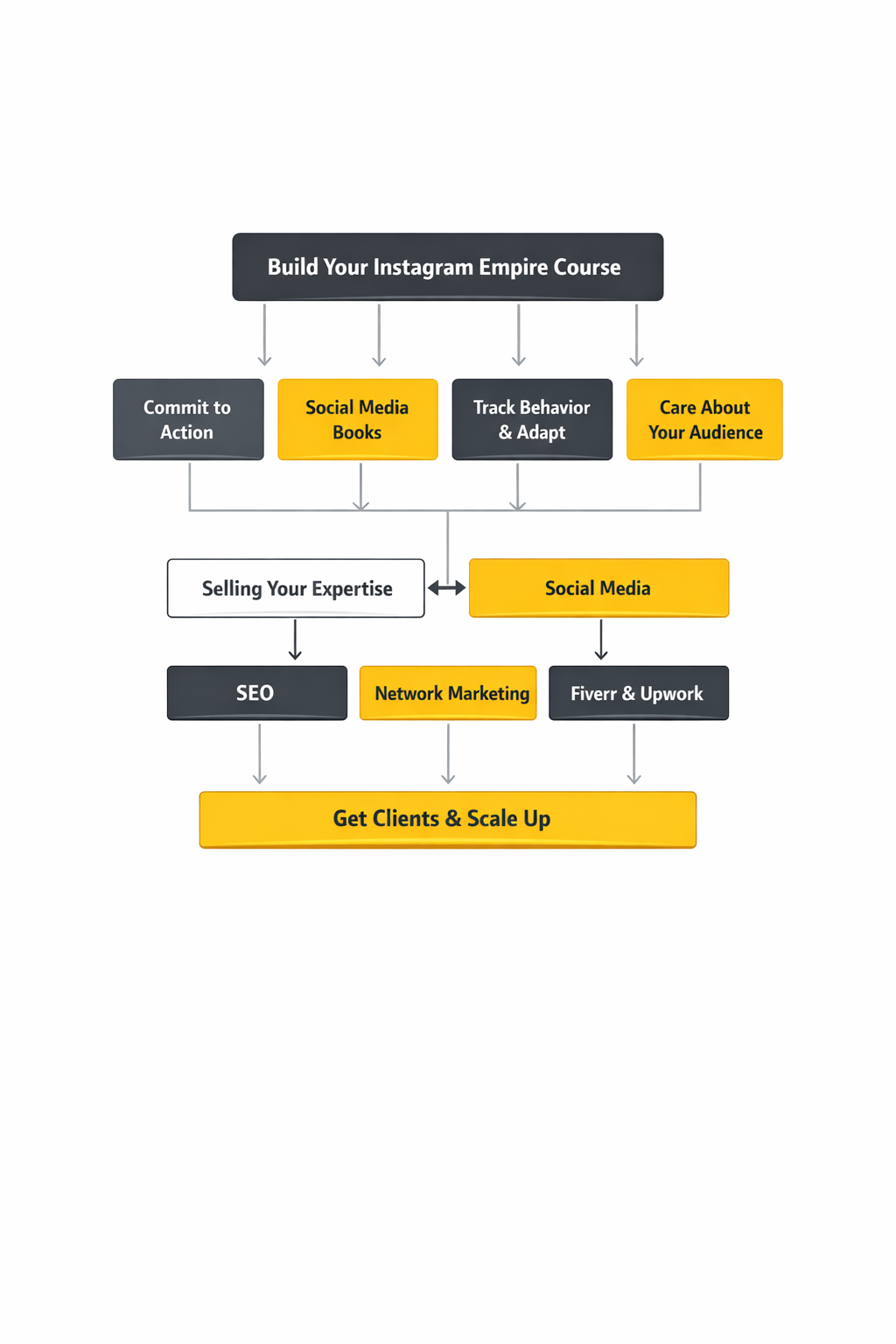
Online marketing works best when you stop thinking in isolated channels and start thinking in connected movements. A person might discover you through a short video, search your brand a day later, read one article, join your list, click an email, and only then decide to buy. That is why the ecosystem matters so much: the real win comes from how your channels reinforce each other, not from any single tactic looking impressive on its own.
The size of that ecosystem keeps expanding. IAB’s full-year 2024 Internet Advertising Revenue Report shows U.S. digital advertising reached a record $259 billion in 2024, while WPP Media’s 2025 global forecast says more than half of content-driven advertising revenue now comes from creator-led platforms such as YouTube, TikTok, and Instagram Reels. In other words, online marketing is no longer just search plus a few ads on the side. It is a living system built from search, social, video, commerce, creators, automation, and first-party data.
When Search, Social, and Video Work Together
Search captures intent, social creates repeated exposure, and video gives your brand a faster way to earn attention and trust. That mix is more important now because people do not move through the internet in neat straight lines anymore. Google’s analysis of AI-driven search behavior describes people as streaming, scrolling, shopping, and searching in completely new ways, while McKinsey’s 2025 research on AI-powered search says roughly half of consumers already use AI-powered search and more than 70% of those users ask top-of-funnel questions there.
That changes how online marketing should be built. Social content and video are no longer just “awareness” channels that sit far away from revenue. They increasingly shape what people remember, what they later search for, and which brands make it into the final comparison set when they are ready to act.
You can see that shift in the platforms themselves. Alphabet’s Q4 2025 earnings call said YouTube’s annual revenue passed $60 billion across ads and subscriptions, and Meta’s 2025 annual report makes it plain that advertising remains the financial engine behind Facebook, Instagram, and the rest of its family of apps. The practical lesson is simple: when people spend huge portions of their attention inside search, video, and social environments, your online marketing system has to treat those surfaces as connected stages of one buying journey.
Commerce, Email, and Owned Audiences
The next layer of the ecosystem is where borrowed attention becomes owned attention. This is the part many businesses rush through because chasing clicks feels exciting, while building infrastructure feels slower. But if your online marketing depends entirely on rented platforms, every algorithm change, policy shift, or auction spike can hit you harder than it should.
That is why owned assets still deserve serious respect. Your website, landing pages, forms, email list, CRM, customer data, and checkout flow are what allow attention to compound instead of disappearing after each campaign. Shopify’s 2025 annual report says the company is focused on helping merchants build a commerce presence across multiple channels and geographies, and it now includes buyer acquisition and advertising inside merchant solutions. That is a strong signal of where the market is going: commerce and marketing are merging more tightly, and the businesses that connect them well will usually move faster than the ones still treating them as separate departments.
Email remains one of the strongest bridges in that process because it gives you a direct way to continue the conversation after the first click. It is not flashy, but it is dependable when done right. Tools like Brevo, Moosend, and Systeme.io make it easier to connect opt-ins, nurture sequences, offers, and segmentation, which matters because online marketing gets stronger the moment follow-up becomes systematic instead of random.
Automation, AI, and Execution Speed
Another reason the ecosystem matters is that online marketing has become too fast for manual execution alone. Campaigns need pages, emails, repurposed content, lead routing, scheduling, reporting, and optimization, often all at once. If every asset requires a fresh scramble, growth becomes exhausting and the team spends more time coordinating than actually moving the market.
That is where automation and AI start to matter in a practical way. Shopify’s 2025 filing says it is integrating AI-enabled features across its platform, and Google’s recent marketing analysis points to AI as a major force reshaping how people search and how advertisers can respond to that behavior. The opportunity is not just to generate more content faster. It is to reduce friction across the system so the right message reaches the right person with better timing and less wasted effort.
That is also why smart operators keep a flexible toolkit around them. A cleaner funnel in ClickFunnels, faster publishing with Buffer, sharper social execution through Flick, easier lead collection in Fillout, and better booking flow via Cal.com can remove the kind of friction that quietly kills results. The point is not to collect tools for the sake of it. The point is to make your online marketing system move faster, cleaner, and with fewer broken handoffs.
How a Modern Online Marketing Stack Comes Together
A modern stack usually starts with a content and traffic layer, then connects to a conversion layer, and finally feeds into a relationship layer. Content and traffic bring people in through search, paid ads, social posts, short-form video, long-form articles, partnerships, and creator mentions. Conversion turns that interest into action through landing pages, forms, booking flows, trials, demos, and checkouts, while relationship systems keep the momentum alive through email, CRM updates, remarketing, and customer communication.
When those layers are aligned, online marketing becomes far less fragile. A campaign can still work even if one post underperforms or one ad gets more expensive, because the broader machine is still carrying momentum across multiple touchpoints. That resilience is a major advantage at a time when WPP Media is highlighting the growing weight of creator platforms and retail media, and when McKinsey is warning that AI-powered discovery is already changing how buyers find and evaluate brands.
The businesses that keep winning online are not always the ones shouting the loudest. More often, they are the ones with the better system. They know how to turn attention into intent, intent into action, and action into a longer relationship. In the next part, we will get even more practical and look at how to allocate effort across channels so your online marketing budget, content, and time go where they can produce the strongest return.
Statistics and Data
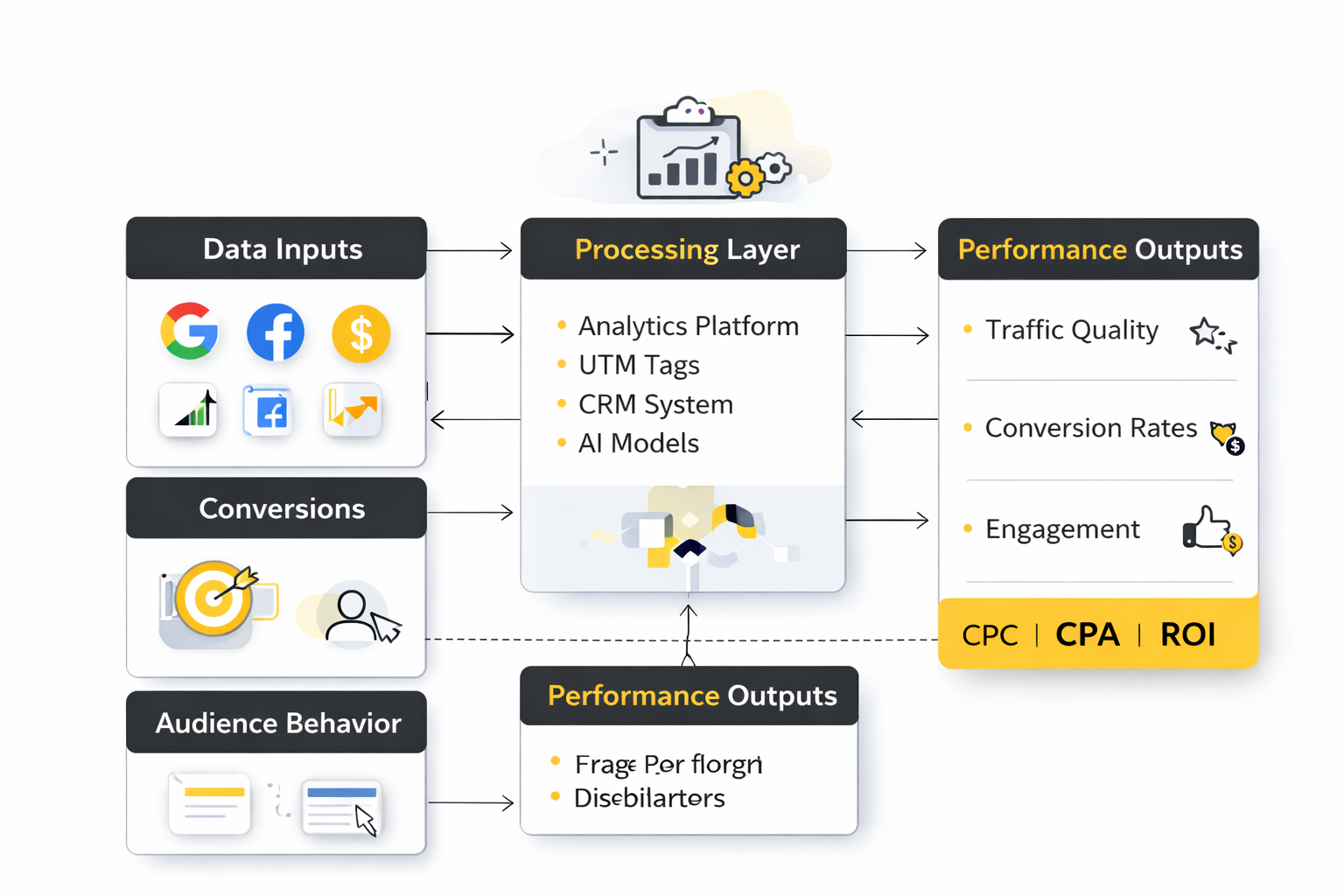
If you want to understand where online marketing is headed, the numbers tell a very clear story. DataReportal’s Digital 2025 Global Overview Report shows that internet use and social platform participation continue to operate at massive global scale, while UNCTAD’s latest e-commerce note says business e-commerce sales across 43 economies were estimated to reach almost $27 trillion in 2022 after another year of growth. That matters because it confirms something every serious operator can already feel in the market: online marketing is no longer a support function sitting off to the side of the business; it is one of the main environments where buying decisions are formed.
The advertising side is just as revealing. IAB and PwC’s full-year 2024 Internet Advertising Revenue Report says U.S. digital advertising reached a record $259 billion in 2024, up 15% year over year. Numbers like that do not grow because brands are experimenting casually. They grow because digital channels keep proving that they can deliver measurable reach, targeting, and revenue at a scale that traditional media alone cannot match anymore.
Platform Scale and Market Pressure
Some of the strongest online marketing data comes straight from the platforms that sell attention for a living. Meta’s full-year 2025 results show $200.97 billion in revenue, a 22% year-over-year increase, with ad impressions across its Family of Apps up 12% for the year and average price per ad up 9%. That combination matters because it shows both scale and monetization strength at the same time: more ads are being delivered, and those ads are still valuable enough for pricing to rise.
The same pattern appears elsewhere. Alphabet’s Q4 2025 earnings call says Google Search and Other advertising revenue rose 17% to $63.1 billion in the quarter, while YouTube’s annual revenue surpassed $60 billion across ads and subscriptions for the full year. When two of the biggest digital ecosystems in the world keep posting numbers like that, the market is telling you something important: online marketing is where attention is being bought, sold, and turned into business growth at industrial scale.
There is another layer to this pressure, and it affects smaller businesses just as much as enterprise brands. When huge platforms continue to expand ad inventory, audience data, and AI-assisted optimization, competition naturally intensifies. That means weak offers, unclear landing pages, poor follow-up, and fuzzy targeting get exposed faster than they used to, because the market becomes less forgiving as more money pours into the same digital spaces.
What the Data Says About Execution
Statistics become far more useful when they move from market size into operational performance. HubSpot’s 2025 ROI report says customers using its marketing tools saw a 167% increase in website traffic after six months, with the methodology based on more than 100,000 customers for that traffic dataset. You should always read vendor studies carefully, but this kind of data still matters because it points to a bigger truth: when online marketing systems are organized well, gains often come from consistency, integration, and speed of execution rather than from discovering one magical tactic.
That same report also notes that customers using HubSpot’s marketing plans generated more form submissions over time and that customers using AI-assisted sales features saw faster deal progression. Again, the big takeaway is not that one brand of software is the secret. It is that online marketing performance tends to improve when traffic generation, conversion tracking, CRM visibility, and follow-up workflows stop living in separate silos.
This is exactly why implementation choices matter so much. A cleaner lead capture flow through Fillout, stronger email follow-up in Brevo or Moosend, and a tighter funnel build inside ClickFunnels or Systeme.io can make the data easier to trust because the customer path is simpler and easier to measure.
How to Read Online Marketing Numbers Correctly
The biggest mistake people make with online marketing statistics is treating them like universal promises. A giant platform’s revenue growth does not mean your next campaign will automatically work. A benchmark from a software company does not mean your business should expect identical results. The useful way to read the data is to ask what it reveals about direction, buyer behavior, and competitive standards.
For example, the combination of record digital ad revenue, multi-trillion-dollar online commerce activity, and continued growth in ad delivery and pricing from Meta tells you that online marketing is still expanding, not fading. It also tells you that attention is expensive, which means efficiency matters more than ever. That should push you toward better messaging, stronger conversion design, tighter analytics, and a more serious retention strategy.
Good data should sharpen your decisions, not overwhelm you. If the numbers show that the market is getting more digital, more competitive, and more measurable, then your response should be equally clear. Build the assets you control, strengthen the channels that already match your audience, and make sure your reporting is tight enough to tell you what is truly driving revenue. In the next part, we will turn that logic into action and look at the practical moves that make online marketing work in the real world when budgets, time, and attention are all under pressure.
How to Prioritize Your Online Marketing Efforts
Once you understand the landscape, the next question is where to put your time and money first. This is where a lot of businesses get stuck, because online marketing keeps offering more channels, more tools, and more shiny opportunities than any team can realistically manage at once. The smartest move is not to chase everything. It is to build in layers, starting with the channels closest to revenue and then expanding only after the system underneath them is strong enough to hold that growth.
The market data supports that disciplined approach. IAB’s 2025 Outlook Study shows that brands and agencies are leaning hard into performance-focused investment while also dealing with cross-platform measurement pressure, and Google’s work on incrementality testing keeps pushing the same idea from another angle: budget decisions get better when they are driven by proven lift, not assumptions. That means your online marketing priorities should be based on what can be measured, improved, and scaled, not on what sounds exciting in a strategy meeting.
Start With Existing Demand
If your business already has people searching for the problem you solve, search should usually be near the front of the line. That does not always mean a huge ad budget on day one. It means making sure your site, landing pages, offer pages, and core content are strong enough to capture intent when it appears, because online marketing gets much easier when you are meeting people who are already looking for help.
This is one reason search and commerce channels keep holding so much weight. Alphabet’s latest earnings commentary shows how powerful commercial search remains, while WPP Media’s end-of-year 2025 forecast says commerce advertising is projected to reach $178.2 billion globally in 2025 and surpass total TV ad revenue for the first time. When buyers are close to action, online marketing dollars tend to work harder because the gap between attention and conversion is shorter.
The practical lesson is simple: begin where intent is already visible. Clean up your pages, tighten your message, improve your forms, and make sure the next step is obvious. If your funnel is clunky, rebuilding it in something like ClickFunnels or Systeme.io can be a faster win than spending more money to send new traffic into a broken path.
Build Owned Audiences Early
The next priority is building assets you control. Online marketing becomes far less fragile when every campaign is not forced to start from zero. Your email list, CRM records, lead forms, booking links, customer data, and on-site conversion paths are what turn one-time attention into something you can work with again later.
Email still matters here because it gives you direct access without having to re-rent the same audience every time. Mailchimp’s campaign benchmarking explanation shows that benchmarking is built from hundreds of millions of emails, which tells you just how mature and measurable the channel still is. The point is not that email is old-school. The point is that in online marketing, owned attention is usually cheaper to activate repeatedly than borrowed attention.
That is why the second layer of prioritization should nearly always include lead capture and follow-up. Tools such as Fillout for forms, Brevo for automation, Moosend for campaigns, and Copper for relationship visibility help make that layer easier to run consistently. When that foundation is missing, online marketing feels busy but strangely forgettable because too many people disappear after the first click.
Expand Into Attention Channels With Purpose
Once demand capture and follow-up are working, then it makes sense to go broader with discovery channels. This is where social media, creators, short-form video, partnerships, and wider top-of-funnel campaigns can become incredibly valuable. But they work best when you already know where you want that attention to go and what the follow-up sequence looks like after people engage.
The reason this matters more now is that attention keeps fragmenting while creator-led media keeps gaining budget share. IAB’s 2025 Creator Economy Ad Spend & Strategy Report says U.S. creator ad spend is projected to reach $37 billion in 2025, up 26% year over year, and WPP Media’s mid-year 2025 forecast says more than half of content-driven advertising revenue now comes from creator-led environments like TikTok, YouTube, Kuaishou, and Instagram Reels. That does not mean every business should suddenly throw its budget into influencer deals. It means online marketing now rewards brands that understand how discovery happens before a search, not just after it.
So expand into attention channels with a job to do. Use them to create demand, deepen memory, and make your brand easier to recognize later when people start comparing options. And if you need a cleaner content workflow to stay consistent, tools such as Buffer and Flick can help you keep execution moving without turning your team into a full-time content firefighting unit.
Test Faster Than Your Competitors
Prioritization is not a one-time decision. It is an ongoing cycle of testing, reading the signal correctly, and moving resources toward what is genuinely creating lift. That matters because online marketing is now too dynamic for fixed channel loyalties. What worked six months ago may still work, but it should have to prove it.
This is exactly why experimentation has become such a serious topic. Google’s recent piece on marketing experimentation says the minimum cost of certain incrementality experiments in Google Ads was lowered in 2025 from a previous high of $100,000 to $5,000, and Google’s Conversion Lift documentation explains how brands can measure conversions directly driven by ad exposure. The larger point is not about one ad platform. It is that better online marketing decisions come from proving impact instead of guessing it.
In practice, that means testing offers, landing pages, audience segments, creative angles, and follow-up sequences in a steady rhythm. It also means being willing to cut what looks busy but does not create meaningful progress. The businesses that improve fastest are usually not the ones with perfect certainty. They are the ones willing to learn faster, simplify faster, and reallocate faster.
What Good Prioritization Looks Like in Practice
Good prioritization in online marketing usually looks less glamorous than people expect. It is not ten platforms, twelve dashboards, and nonstop content production. More often, it is one solid offer, one clear funnel, one strong follow-up system, one dependable reporting setup, and a small number of channels being run well enough to compound.
That is the discipline that gives you room to grow without losing control. Start with intent. Build owned assets. Add broader attention channels when the backend can support them. Then test relentlessly so each new layer earns its place. In the final part, we will wrap the article by answering the most important questions people still have about online marketing, so the whole framework feels practical, usable, and easy to carry into real execution.
FAQ for a Complete Online Marketing Guide
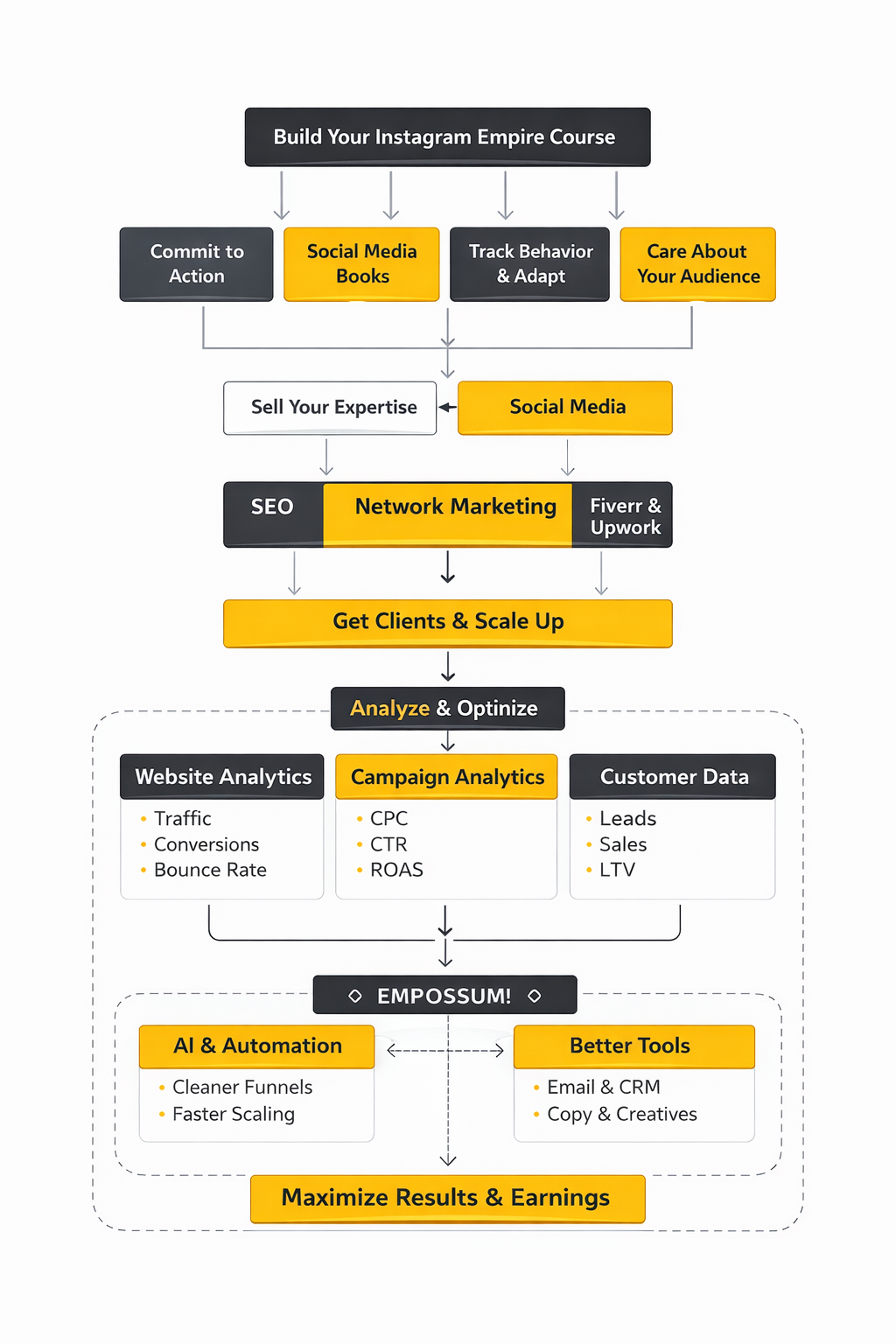
What is online marketing, really?
Online marketing is the system businesses use to attract attention, earn trust, generate leads, and create sales through digital channels. That includes search, websites, landing pages, email, social media, video, paid ads, partnerships, and customer follow-up. It matters because digital behavior now sits at enormous scale, with DataReportal’s 2025 global report showing billions of people actively using the internet and social platforms every day.
Why is online marketing so important for modern businesses?
Because buying journeys now happen across screens, searches, feeds, videos, and inboxes long before someone fills out a form or makes a purchase. That is not a theory anymore; IAB’s 2024 digital ad revenue release says U.S. internet advertising reached $258.6 billion in 2024, which shows where brands keep investing to reach buyers. If your business is not visible and convincing online, you are making it easier for competitors to step into moments that should have belonged to you.
How long does online marketing take to start working?
It depends on the channel and on how strong your offer already is. Paid search and paid social can create feedback quickly, while SEO, email list growth, brand authority, and content compounding usually take longer. The better question is not how fast online marketing can create a spike, but how fast you can build a system that keeps working after the first campaign is over.
Is SEO better than social media?
Not by default, because they do different jobs. Search usually captures existing intent, while social often creates discovery, repetition, and memory before that intent becomes visible. A strong online marketing strategy uses both when they fit the audience, especially now that McKinsey’s 2025 research on AI-powered search says 40 to 55 percent of consumers in major sectors are already using AI-based search in purchase decisions, which makes discovery and search behavior even more connected than before.
What channels should a beginner focus on first?
Start with the channels closest to revenue and easiest to measure. For many businesses, that means a clear website or landing page, one reliable traffic source, basic email follow-up, and conversion tracking that actually works. Online marketing gets overwhelming when people try to master every platform at once, but it gets manageable when you begin with one offer, one path, and one way to keep the conversation going after the first click.
How much should I spend on online marketing?
There is no universal number that fits every business, because spend only makes sense in relation to margin, customer value, and conversion efficiency. The smart approach is to spend at a level where you can collect meaningful data without putting the business under unnecessary pressure. That is also why tools for cleaner funnels and automation, such as ClickFunnels, Systeme.io, and Brevo, often matter just as much as the budget itself, because wasted clicks usually come from bad systems rather than from low spend alone.
What metrics actually matter in online marketing?
The most important metrics are the ones tied to commercial movement: qualified leads, booked calls, purchases, revenue by channel, customer acquisition cost, and customer value over time. Vanity metrics like raw traffic, impressions, or follower counts can be useful for context, but they should never be treated as the final scoreboard. Google’s Conversion Lift documentation is useful here because it centers the idea of incremental impact, which is exactly how mature online marketing should be judged.
Does email still work, or has it been replaced by social media?
Email still works because it gives you a direct relationship with people who have already shown interest. Social platforms are valuable, but they are rented ground, and their algorithms can change faster than your business can comfortably adapt. That is why owned audience building remains so important in online marketing, and why tools like Moosend and Brevo still earn attention from operators who care about consistent follow-up and repeat revenue.
Can small businesses still compete in online marketing against huge brands?
Yes, but not by trying to outspend them everywhere. Smaller businesses win by being sharper, faster, and more specific with their positioning, offers, and follow-up. Big brands may have larger budgets, but they also tend to move slower, which gives smaller operators a real advantage when they understand their audience deeply and build a tighter conversion path.
How is AI changing online marketing?
AI is changing both discovery and execution. On the discovery side, buyers are using AI-powered search and recommendation experiences more often, while on the execution side, platforms are pushing harder into AI-assisted campaign optimization, measurement, and content workflows. Google Ads’ 2025 product highlights and McKinsey’s 2025 State of AI survey both point in the same direction: AI is becoming embedded in everyday marketing operations, but it still creates the most value when strategy, message, and measurement are already solid.
What is the biggest mistake people make with online marketing?
The biggest mistake is treating tactics like strategy. People launch ads without a clear offer, post content without a conversion path, or build traffic before the follow-up system exists. Online marketing becomes much more effective when every action has a job, every channel has a purpose, and every click has somewhere useful to go next.
Do I need a lot of tools to succeed with online marketing?
No, and in many cases too many tools make the system worse. What you need is a small stack that covers pages, capture, follow-up, scheduling, and reporting without creating confusion. That could mean using Fillout for lead capture, Cal.com for bookings, Buffer for publishing, and Copper for relationship management, but the real goal is simplicity that helps online marketing move faster and cleaner.
How do I know if my online marketing is actually working?
You know it is working when the business outcomes are improving in a way you can explain. That means more qualified leads, better conversion rates, stronger customer value, lower waste, and clearer evidence that specific channels are creating real lift. Good online marketing does not just feel busy; it produces movement you can see in the pipeline, the inbox, the calendar, and the bank account.
Work With Professionals
There comes a point where trying to piece online marketing together on your own starts costing more than getting experienced help. That usually happens when campaigns are running, traffic is coming in, and yet growth still feels uneven because the message, funnel, tracking, and follow-up are not fully aligned. At that stage, working with professionals is less about outsourcing effort and more about shortening the path to clarity.
The best professionals do not just post more content or launch more ads. They help you tighten the offer, improve the conversion path, clean up the measurement, and focus attention where it can actually create revenue. In a market where digital ad revenue keeps setting records and commerce media keeps expanding globally, good execution matters because competition is not slowing down.
If you are serious about building a stronger online marketing engine, the right help can save you months of trial and error. That might mean hiring a strategist, a performance marketer, a funnel builder, an email specialist, or a full-stack operator who knows how to connect the pieces into one clean system. What matters is not hiring the biggest name. What matters is finding someone who can turn scattered effort into measurable progress.
Explore 10K+ Remote Marketing Contracts on MarkeWork.com
Most marketers spend too much time chasing clients, competing on crowded platforms, and losing a percentage of every project to middlemen.
MarkeWork gives you a better way. Browse thousands of remote marketing contracts and connect directly with companies desperate to hire skilled marketers like you without platform commissions and without unnecessary gatekeepers.
If you’re serious about finding better opportunities and keeping 100% of what you earn, you can explore available contracts and create your profile for free at MarkeWork.com.
 Filip Konecny Enterprises