

Network marketing still attracts strong opinions because it sits at the intersection of entrepreneurship, direct selling, community building, and regulation. That mix creates opportunity, but it also creates confusion. Some people see a flexible way to build customer relationships around products they already believe in, while others immediately worry about hype, aggressive recruiting, and shaky income promises.
That tension is exactly why this topic matters now. The latest global statistics from the World Federation of Direct Selling Associations show a worldwide direct selling market that remained huge in 2024, with $163.9 billion in retail sales and 104.3 million independent contractors, while U.S. industry figures highlighted by the Direct Selling Association’s 2025 factsheet point to a market that is still substantial even after the pandemic-era reset. At the same time, the Federal Trade Commission’s guidance on multi-level marketing and its 2024 report on income disclosure statements make it clear that modern network marketing has to be judged by real retail demand, honest disclosures, and compensation tied to actual product sales.
So this article is not going to treat network marketing as a magic shortcut or dismiss it with lazy stereotypes. Instead, it will break down how the model works, why it survives, where it fails, and what professional implementation looks like when a company wants to build something durable instead of chasing short-term sign-ups.
Article Outline
- Part 1: Why Network Marketing Matters
- Part 2: Framework Overview
- Part 3: Core Components
- Part 4: Professional Implementation
- Part 5: Measurement and Optimization
- Part 6: Frequently Asked Questions
Why Network Marketing Matters
Network marketing matters because it is really a trust-and-distribution system before it is anything else. Products move through relationships, and that still matters in a world where buyers are overloaded with ads, skeptical of polished claims, and more likely to listen to people they already know. That is one reason Nielsen continues to show that recommendations from people consumers know remain the most trusted form of promotion, which helps explain why person-to-person selling has not disappeared even as digital commerce keeps expanding.
But the importance of network marketing is not the same thing as automatic legitimacy. The FTC’s business guidance draws a bright line between lawful multi-level marketing and unlawful pyramid structures by focusing on whether rewards are connected to sales to real end users. That distinction changes everything. A company can have community, coaching, events, and a tiered compensation plan, but if the economic engine is driven more by recruitment than by retail value, the model becomes fragile both commercially and legally.
That is also why the topic deserves a more serious conversation than it usually gets. The FTC’s review of 70 income disclosure statements found that many statements emphasized top earners, left out key context, or failed to account for expenses, and the companion consumer guidance noted that most participants in the reviewed set made $1,000 or less per year, with some companies showing that most participants made nothing at all. In other words, network marketing matters not because every opportunity is good, but because the gap between a healthy model and a harmful one can be enormous for the people involved.
For brands, the model still matters because it offers something standard retail often cannot: education, follow-up, and community at the point of purchase. That is especially relevant in categories like wellness, beauty, and household products, where customer retention depends on habit, explanation, and personal support. The challenge is that today’s consumers also expect transparency, and PwC’s 2024 Voice of the Consumer Survey makes the broader point that trust is now central to growth for consumer-facing businesses, not a nice extra to add later.
Framework Overview
The easiest way to understand network marketing is to stop thinking about it as a recruiting game and start looking at it as a layered commercial system. At the base, there has to be a product people genuinely want to buy without pressure. On top of that sits a retail channel built around individual sellers who create demand, answer questions, and keep customers engaged. Only after those two layers are healthy does the team-building element make sense, because expansion should strengthen customer service and market reach rather than become the whole purpose of the business.
That framework is more than theory. Even company-owned materials from major operators now lean heavily into retail sales, digital tools, and customer access instead of old-school “join now and get rich” messaging. Amway’s U.S. income disclosure explicitly states that people cannot earn money simply by sponsoring others and that compensation is based on product sales, while Mary Kay’s economic sustainability materials describe a digital selling model that helps customers shop online, in person, or through social platforms while still connecting them with an independent consultant.
When you look at it this way, network marketing becomes easier to evaluate. A strong model has retail demand, repeat customers, clear onboarding, honest economics, and tools that help sellers operate professionally. A weak model hides behind motivational language, blurs the difference between customers and recruits, and depends on the idea that endless team expansion will fix a product or retention problem that was never solved in the first place.
This framework also explains why the model keeps evolving instead of vanishing. Traditional home parties and paper catalogs have given way to live video, direct messages, short-form content, personalized online shops, and automated follow-up. That shift mirrors broader commerce patterns, and it is one reason network marketing still survives inside a digital economy that rewards convenience, social proof, and ongoing customer contact.
Core Components
The first core component is product-market fit. If the product does not solve a real problem, create a repeat buying habit, or inspire genuine advocacy, no compensation plan can save the business for long. The strongest network marketing companies typically operate in categories where demonstration, explanation, and ongoing use matter, because those are the settings where relationship-based selling still has a real advantage over anonymous shelf placement.
The second core component is retail-first compensation. This is not just a compliance issue; it is a business quality issue. When commissions are grounded in actual customer purchases, the organization has a reason to improve product experience, customer support, retention, and reorder behavior. When incentives drift toward sign-ups without strong retail demand beneath them, the field starts optimizing for volume theatre instead of durable revenue.
The third component is training that develops competence rather than dependency. Good training helps people understand products, learn compliant messaging, manage follow-up, and serve customers better. Bad training turns into a motivational loop that keeps repeating lifestyle promises while avoiding the harder subjects of margin, churn, compliance, and the everyday work needed to keep customers buying after the first order.
The fourth component is disclosure. The FTC’s 2025 proposed rule changes on deceptive earnings claims show just how much pressure is building around substantiation, transparency, and the way opportunities are marketed. In practical terms, that means professional network marketing has to show what typical results look like, not just what the top fraction of the field achieved under unusual circumstances.
The fifth component is culture. Network marketing always amplifies behavior, because people copy what they see leaders doing. If leaders demonstrate patience, customer care, accurate claims, and ethical selling, the field tends to move in that direction. If leaders reward hype, scarcity tactics, and social pressure, the same network effect that could have built a healthy brand starts multiplying risk instead.
Professional Implementation
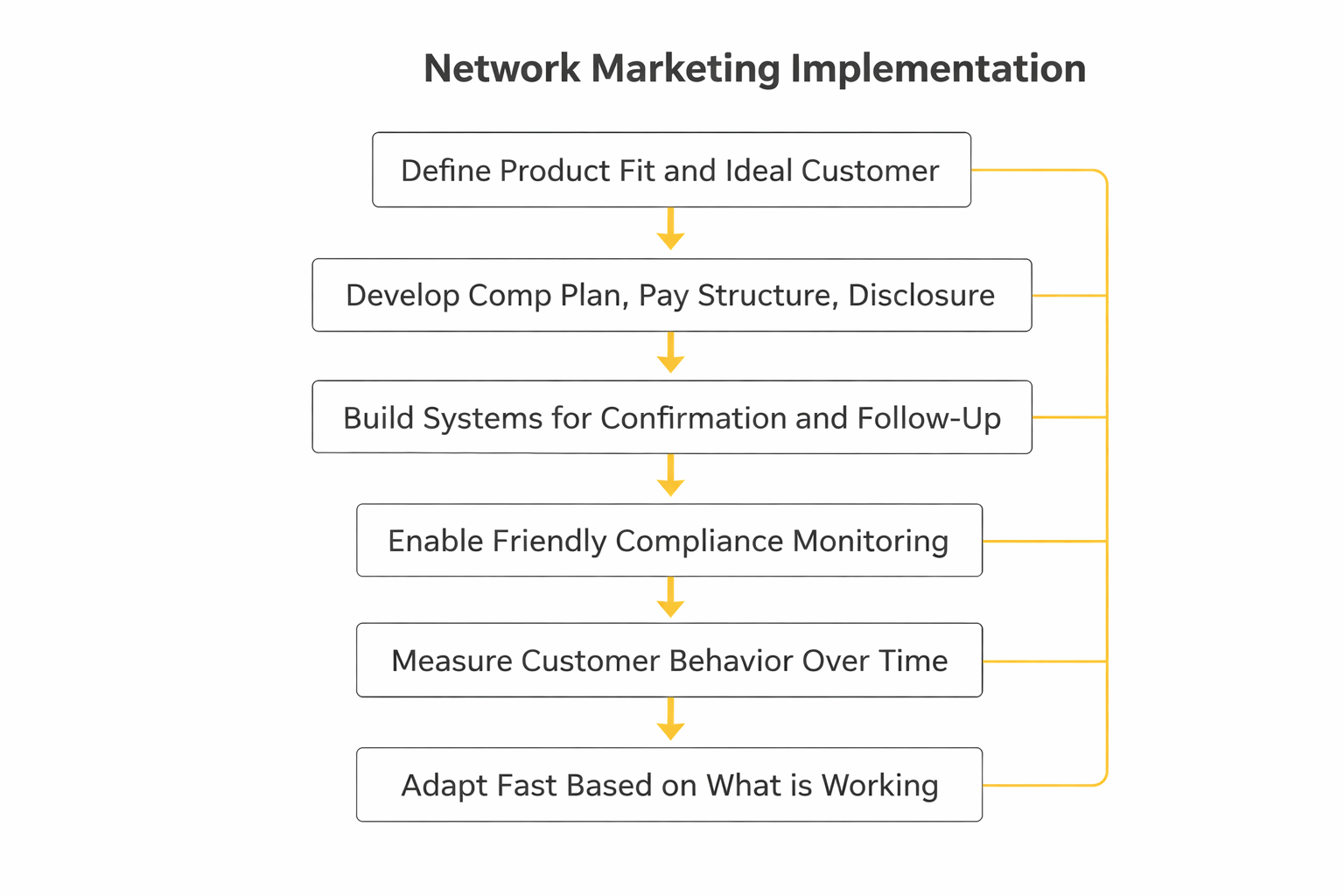
Professional implementation starts with a simple question: would this business still make sense if recruiting slowed down tomorrow? If the answer is yes because customers keep ordering, referrals keep coming, and the product experience is strong, the company has something real to build on. If the answer is no, then the business does not have an implementation problem so much as a structural one.
In practice, professional network marketing looks much more operational than glamorous. Companies need clear product education, compliant scripts, transparent disclosures, clean customer journeys, and systems that help distributors spend more time serving buyers and less time wrestling with admin. That is why even established players now emphasize digital enablement, with Mary Kay highlighting digital resources that support online, in-person, and social selling and Herbalife’s 2024 annual report describing expanded distributor training, events, and platform support as part of its turnaround effort.
For smaller teams, implementation also means building the right infrastructure around the human relationship. A prospect who wants more information should be able to land on a simple page, understand the product, request follow-up, and receive useful communication without being pushed into an awkward recruiting conversation. That is where tools like ClickFunnels, Systeme.io, and Brevo can support lead capture, onboarding, and follow-up in a way that feels more like a professional retail process and less like improvised hustle.
The final piece is leadership discipline. A network amplifies whatever gets rewarded, so professional implementation depends on leaders who correct exaggerated claims fast, keep the focus on customer outcomes, and treat retention as a more important signal than headline recruiting spikes. That may sound less exciting than the loudest promises in the market, but it is the difference between a network marketing organization that burns hot for a season and one that can still earn trust a few years later.
How to Measure Network Marketing Performance
If you want network marketing to work in the real world, you have to measure what is happening below the hype. Sign-ups can look exciting for a month and still hide a weak business underneath. What tells the truth is whether customers stay, whether distributors keep selling after the initial push, and whether revenue is coming from real product demand instead of momentum that disappears as soon as the recruiting energy cools off.
That is why the smartest operators track retail activity first. The Federal Trade Commission’s 2024 review of 70 MLM income disclosure statements found that most participants in the statements it examined made $1,000 or less per year, while the FTC’s consumer summary noted that in at least 17 of those companies, most participants made no money at all. Those numbers matter because they force a harder question: is the organization creating repeat customers and capable sellers, or is it cycling people through the system faster than it creates lasting value?
A better scorecard starts with customer retention, average reorder frequency, conversion from prospect to first purchase, and the percentage of distributors who are actually serving customers rather than sitting inactive. You also want to separate discount buyers from true business builders whenever possible, because the Direct Selling Association’s 2025 state-level data makes it clear that a large share of people involved in direct selling participate mainly for personal consumption rather than for serious business building. That distinction helps you read your numbers honestly instead of treating every enrollment as proof of commercial traction.
Retail Quality Metrics Come Before Team Size
One of the biggest mistakes in network marketing is treating team size as the headline metric. A large organization with weak reorder behavior can be far less healthy than a smaller one with excellent customer retention and strong average order values. The numbers from the DSA’s 2025 U.S. factsheet, which shows $34.7 billion in U.S. retail sales in 2024, 34.3 million customers, and 5.4 million direct sellers, reinforce how important retail activity is when you evaluate the model seriously.
In practical terms, this means every team should know how many first-time buyers become repeat buyers within 30, 60, and 90 days. It should know which products generate the highest reorder rates and which distributors consistently convert interest into customer loyalty. Once you see those patterns clearly, recruiting becomes more disciplined because you are adding people into a system that already knows how to create value for buyers.
Compliance Metrics That Protect Growth
Compliance sounds boring until it becomes the thing that saves a company from a painful correction. The FTC’s guidance on multi-level marketing keeps returning to the same core idea: a company has to be able to show that compensation is tied to genuine sales to real end users. That means professional organizations do not just measure sales volume. They also watch refund rates, unusual ordering patterns, income claim violations, complaint trends, and how often field messaging crosses the line from product education into exaggerated earnings promises.
When leaders monitor those signals early, growth becomes much easier to trust. They can step in before one reckless post or one misleading webinar creates a legal and reputational problem for the whole organization. In a business model built on duplication, protecting the quality of what gets duplicated is just as important as increasing the quantity of it.
And this is also where better infrastructure starts to make a huge difference. A simple lead form built with Fillout, cleaner email follow-up through Brevo, and link tracking with Dub can make a network marketing team feel dramatically more professional because people stop guessing which conversations, pages, and offers are actually producing customers.

The Modern Network Marketing Ecosystem
Network marketing does not operate in the same environment it did a decade ago. The old picture of hotel meetings, home presentations, and paper brochures is no longer enough to explain how the best teams actually move products today. The modern ecosystem is digital, multi-touch, and much more demanding because prospects now expect faster answers, easier checkout, more proof, and less pressure.
That shift is one reason trust has become even more valuable. Nielsen’s trust data still shows that recommendations from people consumers know carry more weight than most paid media, while PwC’s 2024 Voice of the Consumer survey argues that reassurance and reliability are becoming central to how people choose brands. That is good news for network marketing only if the field behaves like a trusted retail channel. If it behaves like a pressure machine, the same social dynamic turns into resistance instead of leverage.
So the ecosystem today has to connect several moving parts: social discovery, simple education, compliant follow-up, customer service, and community. A short video might create awareness, a message thread might handle objections, an email sequence might explain the product more clearly, and a customer group might keep usage high after the sale. When those parts work together, network marketing starts to look less like an outdated model and more like relationship commerce with stronger human support.
Content, Community, and Conversion
The strongest teams now treat content as the front door and community as the retention engine. They are not just telling people to join. They are answering real product questions, showing how the product fits into daily life, and giving buyers a reason to stay engaged after checkout. That is a very different posture from the old spray-and-pray recruiting style, and it tends to create better customers before it creates more distributors.
Tools can support that shift when they are used with restraint and clarity. A team that wants to stay consistent across channels can schedule content with Buffer, manage customer relationships inside Copper, and use Chatbase to answer basic product questions faster on a landing page. None of those tools fixes a weak offer, but they do help a solid offer travel further without forcing every distributor to reinvent the wheel.
Where Network Marketing Fits Now
The broader industry numbers show why this conversation is worth taking seriously. WFDSA’s latest global statistics put worldwide direct selling at $163.9 billion in retail sales in 2024 with 104.3 million independent representatives, which tells you the model is still enormous even after several years of pressure and reset. But size alone does not prove quality. It just proves that demand for person-to-person commerce still exists at scale.
Where network marketing fits now is in categories where people want explanation, demonstration, accountability, and repeat support. It works best when the product earns loyalty on its own and the network simply makes that loyalty easier to spread. Once a company forgets that and starts acting as though the opportunity is the product, the ecosystem stops compounding in a healthy way and starts feeding on itself instead.
Professional Network Marketing Implementation
Once you understand the structure of network marketing, the next question is simple: how do you run it without turning it into chaos? This is where most organizations either become credible or start sliding into the same old problems. A professional network marketing business is not built on excitement alone. It is built on systems, training, retail discipline, and a level of transparency that can survive real scrutiny.
The reason this matters so much is that the model is still big enough to reward companies that get it right, but exposed enough to punish companies that get sloppy. The Direct Selling Association’s 2025 U.S. industry overview puts the market at $34.7 billion in retail sales in 2024, with 34.3 million customers and 5.4 million direct sellers, while the WFDSA global statistics report shows $163.9 billion in worldwide retail sales in 2024 and 104.3 million independent representatives. Those numbers tell you there is still real demand here. They do not tell you every company deserves that demand, and that is exactly why implementation matters so much.
If you want the model to hold up, you have to make it easy for honest people to sell honestly. That means better onboarding, better product education, better customer follow-up, and fewer vague promises. It also means designing the business so that retail success comes first and team growth is a result of that success, not a substitute for it.
Implementation Starts With Retail Proof
The first sign of a professionally implemented network marketing model is that customers would still buy the product even if they never joined the business. That sounds obvious, but it is where the entire system either stands or falls. The FTC’s business guidance on multi-level marketing keeps coming back to one core idea: compensation and claims have to be grounded in real sales to real end users. Once a company drifts away from that, every flashy webinar and every fast recruiting month starts resting on unstable ground.
This is why implementation should begin with retail proof, not recruitment scripts. A company should know which products sell best without discount distortion, which offers drive repeat orders, and which customer segments stay active after the first purchase. If leadership cannot answer those questions clearly, then the field is being asked to build momentum on guesswork rather than evidence.
You can see how strongly this theme has entered the mainstream of the industry in official company materials. Amway’s 2024 U.S. income disclosure states plainly that an IBO cannot earn money by merely sponsoring or recruiting others, and Amway’s business reference guide says compensation is based on product sales. That does not settle every debate around the model, but it does show where serious implementation has to point: toward retail demand that can be documented, repeated, and supported.
Training That Creates Competence
A lot of network marketing training sounds energetic and still leaves people unprepared for the real work. They hear motivational language, see big lifestyle imagery, and get told to stay positive, but they never really learn how to explain the product, handle objections, or follow up without sounding desperate. That kind of training creates dependency because people stay emotionally activated while remaining commercially weak.
Professional implementation flips that. The goal is to help a new distributor become useful fast. They should know what problem the product solves, who it is right for, what the reasonable expectations are, what claims they must avoid, and how to keep a customer engaged after the sale. When training does that well, the field becomes calmer, more credible, and far easier to duplicate because people are no longer improvising their entire business from scratch.
This shift toward practical support shows up in company-owned materials too. Mary Kay’s economic sustainability page highlights digital tools that support its sales force, while the company’s own history notes that Mary Kay InTouch went live to connect consultants with online business-building tools and education. On the public company side, Herbalife’s 2024 annual report ties its business model to trained distributors and describes a large-scale platform business, and its earlier report on the Herbalife One digital platform emphasized distributor e-commerce, customer loyalty, and data-enabled solutions. The pattern is hard to miss: serious network marketing companies are leaning into infrastructure because pure enthusiasm no longer covers operational weakness.
Compliance Has To Be Built In, Not Added Later
One of the biggest mistakes in network marketing is treating compliance like a legal department issue that lives somewhere off to the side. In reality, compliance is part of product messaging, recruiting conversations, compensation communication, social media behavior, and customer retention. If it is not built into the everyday system, it will not exist where it matters most, which is out in the field where people are posting, presenting, and persuading in real time.
The pressure around this is not theoretical. The FTC’s 2024 staff report on MLM income disclosure statements found that many disclosures highlighted top earners or left out important context, and the related FTC consumer alert explains that, in the statements reviewed, most participants made $1,000 or less per year and that at least 17 companies showed that most participants made nothing at all. Then the pressure tightened further when the agency proposed new changes and a new rule in early 2025, with the FTC saying the proposals are meant to deter deceptive earnings claims and the proposed MLM earnings claim rule laying out requirements around substantiation and deceptive recruitment materials.
So professional implementation means the business itself should make misleading behavior harder, not easier. Claims libraries should be approved. Income conversations should come with disclosure requirements already built in. Recruiting materials should be reviewed before they spread. The healthier the system, the less it relies on every individual suddenly becoming an expert at legal interpretation under pressure.
Systems That Make Follow-Up Easier
There is another reason network marketing often underperforms, and it has nothing to do with the compensation plan. Most teams simply lose people in the follow-up. A prospect shows interest, asks a question, disappears for a week, forgets why they cared, and then the distributor has no structured way to bring the conversation back to life. That is not a motivation problem. It is a systems problem.
Good implementation closes that gap by making follow-up simple, repeatable, and useful. A prospect should be able to move from interest to information to purchase without being dragged through a confusing maze of chat screenshots, random voice notes, and vague promises. That usually means clear landing pages, a basic CRM or lead tracker, educational email sequences, and a content flow that answers common questions before they turn into objections.
That is exactly why digital infrastructure is becoming more important inside modern network marketing teams. A funnel builder like ClickFunnels or Systeme.io can help create a cleaner prospect journey, while tools like Brevo, Moosend, and Buffer can support follow-up and content distribution without forcing every distributor to invent their own backend. The point is not to stack software for the sake of it. The point is to make the customer experience feel organized enough that trust can actually grow instead of leaking away between conversations.
Leadership Behavior Sets The Tone
At the end of the day, every network marketing system becomes a mirror of what leadership rewards. If leaders celebrate verified customer sales, careful claims, consistent service, and long-term retention, the organization starts to normalize professionalism. If leaders reward public hype, exaggerated lifestyle storytelling, and recruitment spikes without asking where the retail demand came from, the system learns the wrong lesson very quickly.
This matters because network effects amplify behavior, not just revenue. A leader does not have to tell thousands of people to make bad claims for bad claims to spread. They only have to reward the few people who do it and stay silent while the rest copy what appears to work. That is why strong implementation is partly operational and partly cultural. Systems matter, but the signals sent by leadership matter just as much.
The best network marketing organizations understand this and act like stewards, not just promoters. They know that trust compounds more slowly than hype, but it also lasts much longer. And in a model where people are literally attaching their names, relationships, and reputations to the offer, that difference is not small. It is the whole game.
Statistics and Data
If you want to understand network marketing without getting lost in emotion, look at the numbers first and then ask what those numbers actually mean. Big revenue totals can make the channel look unstoppable, but revenue alone does not tell you whether a company is driven by loyal customers, temporary momentum, or recruiting-heavy behavior that cannot hold up over time. That is why the most useful way to read network marketing data is to separate scale, participation, retail activity, and actual earnings outcomes instead of throwing everything into one bucket.
On the scale side, the channel is still far from small. The latest WFDSA global report shows $163.9 billion in worldwide retail sales in 2024 and 104.3 million independent representatives. In the United States, the Direct Selling Association’s 2025 industry overview reports $34.7 billion in retail sales in 2024, 34.3 million customers, and 5.4 million direct sellers. Those are serious numbers, and they show that relationship-driven selling still has a real place in modern commerce even after years of platform shifts, inflation pressure, and heavier regulatory attention.
But large industry totals do not automatically mean the average participant is thriving. That is where the conversation gets more honest. The FTC’s 2024 analysis of 70 MLM income disclosure statements found that most participants shown in those statements made $1,000 or less per year, and the FTC’s public release on that review emphasizes that many disclosures highlighted top earners or left out important context. So the statistics do not support a lazy conclusion that network marketing is either universally broken or universally profitable. They support a much more useful conclusion: the industry is large, but participant outcomes are highly uneven, which makes the quality of the business model incredibly important.
What the Big Numbers Really Show
The first thing the big numbers show is endurance. Network marketing has been criticized for years, heavily scrutinized by regulators, challenged by e-commerce, and still remains a meaningful retail channel. The WFDSA report notes that global retail sales in 2024 were still above pre-pandemic levels, which tells you the model has not disappeared under pressure. It has adapted, and in many cases it has become more digital, more platform-enabled, and more dependent on repeat customers than on old-school offline presentation models.
The second thing those numbers show is that participation is not the same as business success. A channel can have millions of participants and still leave a huge share of them inactive, lightly engaged, or involved primarily as product users rather than true business builders. That is one reason the DSA’s 2025 state data matters so much: it highlights that participation inside direct selling often includes people whose involvement is personal, part-time, or occasional rather than fully commercial. If you ignore that distinction, you end up reading enrollment numbers as proof of entrepreneurial success when they may simply reflect broad low-intensity participation.
The third thing the data shows is concentration. A relatively small share of companies and leaders capture a disproportionate amount of industry attention, sales volume, and recruiting energy. That means averages can hide a lot. When someone talks about network marketing using only one company’s strongest leaders or most polished testimonials, they are often describing the visible peak of a much wider and less glamorous landscape.
Earnings Data Needs Context
This is where people often get misled. An income disclosure statement can sound transparent and still leave out the details that matter most. The FTC staff report summary explains that many reviewed disclosures did not account for expenses, and some emphasized large dollar figures earned by a very small number of participants. That matters because gross commissions do not tell you what a participant kept after product purchases, tools, travel, event costs, samples, software, or the time invested trying to create momentum.
That is exactly why earnings data should never be read in isolation. A clean-looking chart is not enough. You want to know how many participants earned anything at all, what share earned modest amounts, how many were active for the full year, whether retail profit was included, and whether the disclosed income is gross or net of expenses. Without that context, a disclosure can feel informative while still leaving the average reader with the wrong impression.
The regulatory pressure around this is clearly rising. In January 2025, the FTC proposed rule changes and a new rule aimed at deceptive earnings claims in MLM and money-making promotions, and the related Federal Register notice for the proposed MLM earnings claim rule makes it clear that regulators want stronger substantiation and clearer disclosures. So if you are evaluating a network marketing company today, earnings data is not just a curiosity. It is one of the clearest tests of whether the company is trying to build trust or simply manage perception.
The Metrics That Actually Matter
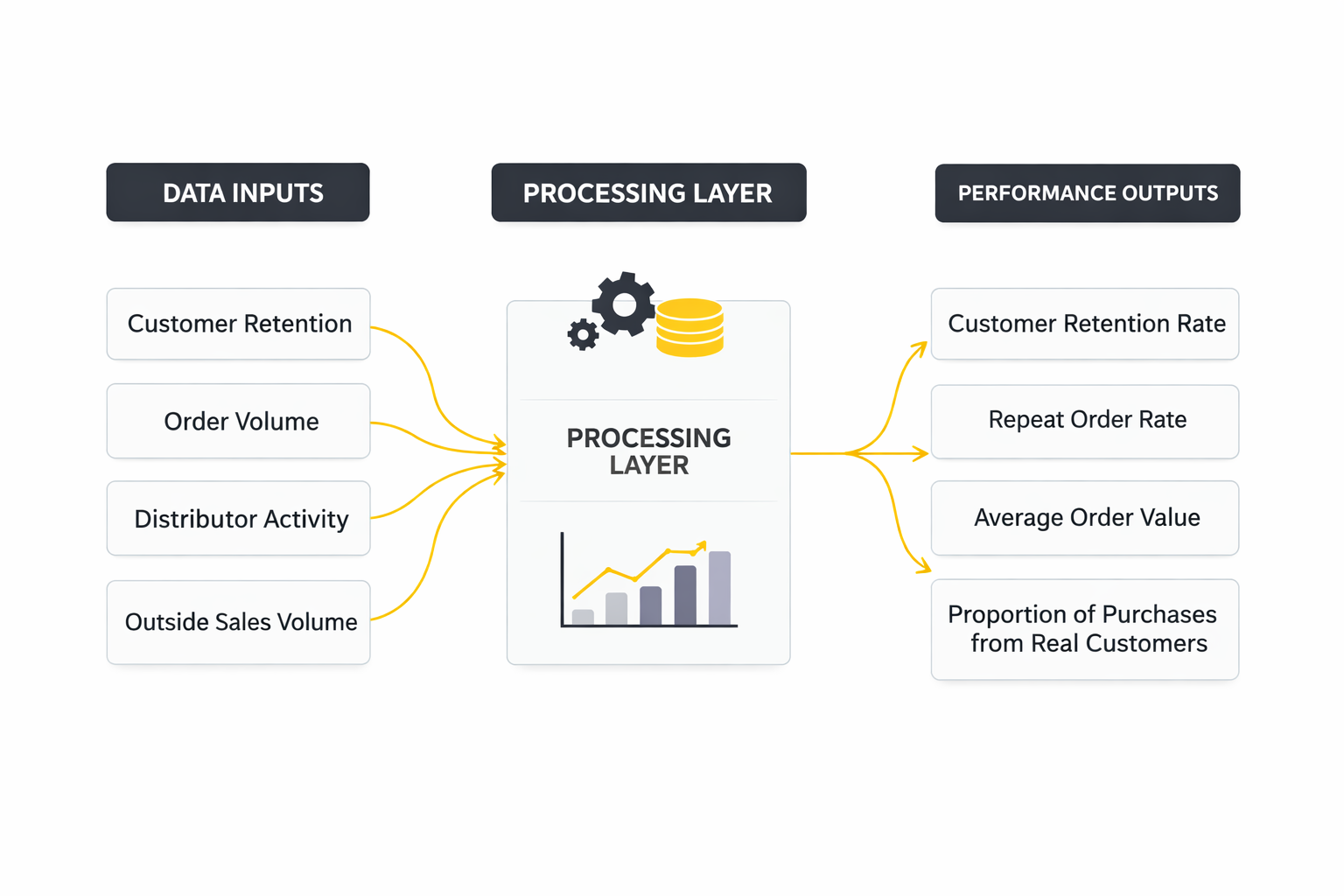
If I were looking at a network marketing company seriously, I would care less about headline enrollment and much more about a tighter set of operational metrics. I would want to see customer retention, repeat order rate, average order value, refund rate, distributor activity rate, and the percentage of volume that comes from genuine outside customers rather than internal consumption. Those numbers tell you whether the model is supported by real demand or whether it needs a constant stream of new enthusiasm just to keep standing.
This is also where network marketing starts to look a lot more like any other serious business. The companies and teams that win are usually the ones that track behavior closely and adapt fast. They know which offers convert, which follow-up messages recover abandoned interest, and which content actually helps a buyer move from curiosity to confidence. That is why infrastructure matters so much. A team using Dub for cleaner link tracking, Fillout for structured lead capture, and Brevo for email follow-up can measure real customer movement much more clearly than a team trying to run everything from scattered chats and guesswork.
And once you can measure clearly, you can improve honestly. That is the whole point. Network marketing becomes much easier to evaluate when you stop asking whether the concept sounds exciting and start asking whether the numbers show durable retail behavior, realistic earnings communication, and customer value that lasts beyond the first wave of promotion.
What Happens Next in Network Marketing
By this point, one thing should be obvious: network marketing is not disappearing, but it is being forced to grow up. The old version that relied on vague hype, loose recruiting claims, and weak customer follow-through is running into a much harder environment. Buyers are more skeptical, regulators are more active, and distributors themselves now have access to better tools, better benchmarks, and better ways to compare one opportunity against another.
You can see that pressure from both sides. On one side, the market is still big enough to matter, with the WFDSA’s 2024 global report showing $163.9 billion in worldwide retail sales and 104.3 million independent representatives. On the other side, the FTC’s 2025 proposed rule changes and new proposed MLM earnings claim rule make it clear that companies using deceptive earnings messaging should expect a tougher road ahead. That combination is important because it means the opportunity is still real, but the room for sloppy execution is shrinking fast.
So the future of network marketing will probably belong to the organizations that act more like serious retail businesses and less like motivational machines. They will need stronger product proof, more transparent disclosures, cleaner follow-up systems, and leadership that understands trust is not a soft metric. It is the whole business.
The Winners Will Look More Professional
The most successful network marketing teams over the next few years are likely to look a lot more operational than the stereotype people still carry around in their heads. They will be easier to understand, easier to verify, and easier to buy from. The prospect journey will make sense. The product explanation will be clearer. The claims will be tighter. And the customer will not feel like they are being pushed into a life decision when all they wanted was a product that solves a problem.
That shift lines up with the broader consumer environment. PwC’s 2024 Voice of the Consumer survey argues that reassurance and reliability now sit near the center of consumer decision-making, which fits perfectly with what network marketing should be good at when it is done right. A channel built on relationships has a real advantage when trust is scarce, but only if the people inside the channel behave like trustworthy operators.
That is also why smarter infrastructure is becoming a competitive edge. Teams that use tools like ClickFunnels for cleaner onboarding, Systeme.io for simpler funnel and email workflows, and Copper for relationship tracking are not just stacking software for fun. They are reducing friction, protecting follow-up, and making it easier to run a network marketing business that feels organized enough to earn confidence.
Why Trust Will Decide Everything
There is a reason trust keeps coming up throughout this article. Network marketing multiplies human behavior. If the behavior is helpful, patient, and grounded in real customer value, the model can create loyal buyers and stable teams. If the behavior is exaggerated, impatient, and obsessed with appearance over substance, the same network effect can spread damage just as quickly.
The pressure to get this right is not theoretical anymore. The FTC’s proposed MLM earnings claim rule focuses directly on deceptive earnings representations and substantiation, which tells you where regulators believe some of the deepest problems still sit. That should push companies toward more disciplined communication, but it should also push distributors to ask better questions before they ever join. If a company cannot explain its numbers clearly, separate retail customers from recruits cleanly, and describe typical outcomes honestly, that is not a small red flag. It is the red flag.
At the same time, trust is also where the upside lives. A business model built around human recommendation can still outperform colder channels when the offer is strong and the relationship is real. The challenge is that people can feel the difference faster than ever now. They know when they are being helped, and they know when they are being handled.
Final Thoughts on Network Marketing
If you strip away the noise, network marketing is really a test of whether a company can turn trust into repeatable commerce without corrupting the trust that made the sale possible in the first place. That is a harder challenge than most people admit. It requires a product worth talking about, a compensation structure that rewards real demand, a field that knows how to communicate responsibly, and systems that help people follow through instead of falling apart after the first burst of excitement.
The good news is that the path forward is not mysterious. The businesses that keep customers, measure honestly, train carefully, and communicate with discipline are the ones most likely to survive the next wave of scrutiny. The weak ones will keep trying to shortcut reality with bigger claims and louder promises. That may still create moments of momentum, but it does not create a durable network marketing business.
So if you are evaluating an opportunity, building a team, or studying the model from the outside, keep coming back to the same question: is this built on retail value that can stand on its own? If the answer is yes, there is something to work with. If the answer is no, no amount of energy, branding, or recruiting theater is going to fix what is missing underneath.
FAQ for a Complete Guide to Network Marketing
What is network marketing, really?
Network marketing is a distribution model where independent sellers promote products directly to customers and may also earn compensation when they help build sales teams. That sounds simple, but the important detail is where the money really comes from. A healthier version of network marketing is driven by real product demand, while a riskier version starts leaning too heavily on recruitment energy instead of customer value.
The reason that distinction matters is that the channel is still large enough to be taken seriously. The latest WFDSA statistics report shows $163.9 billion in global retail sales in 2024 and 104.3 million independent representatives. So this is not some tiny corner of commerce. It is a real channel, but one that has to be evaluated carefully.
Is network marketing the same as an MLM?
In everyday conversation, people usually use the terms interchangeably. MLM is the legal and regulatory label that shows up more often in government guidance, while network marketing is the softer business label that companies and distributors tend to prefer. The real question is not which term gets used. The real question is whether the business rewards genuine retail sales to real end users or whether it starts drifting toward recruitment-led behavior.
That is exactly why the FTC’s business guidance on multi-level marketing matters so much. It makes clear that a lawful MLM is not supposed to operate like a pyramid scheme, and that companies should be able to show compensation tied to real sales rather than simply to enrolling new participants.
Is network marketing legal?
Yes, network marketing can be legal, but legality depends on how the business is structured and how it behaves in practice. A company does not become legitimate just because it sells products and has a compensation plan. If the business relies more on recruitment than on retail demand, or if it uses deceptive income messaging, the risk profile changes fast.
The regulatory pressure here is very real. The FTC’s January 2025 announcement on proposed rule changes and a proposed new MLM earnings claim rule shows that deceptive earnings claims remain a major enforcement concern. So yes, network marketing can be legal, but only when the underlying economics and the public messaging hold up.
Can you actually make money in network marketing?
Some people do, but that answer needs a lot more honesty than the industry often gives it. The biggest mistake is jumping from “some people earn well” to “most people can expect that outcome.” Those are completely different claims, and confusing them is one of the fastest ways to misread the opportunity.
The FTC’s 2024 report reviewing 70 MLM income disclosure statements found that most participants shown in those statements made $1,000 or less per year, and the FTC’s consumer explanation of those findings says that in at least 17 of those companies, most participants made no money at all. So the honest answer is that income is possible, but typical outcomes are usually much more modest than promotional content suggests.
Why do so many people fail in network marketing?
People often fail because they enter a system that looks emotionally powerful but is commercially weak. They are sold a dream before they are taught a process. They join without understanding the product-market fit, the real customer demand, the actual work required, or the typical economics once time and expenses are counted.
There is also a structural issue here. The FTC’s summary of its 2024 disclosure review notes that many income statements highlighted top earners or left out key context, which means people may enter with expectations that were never grounded in the most likely outcome. When expectations are inflated and systems are weak, disappointment is almost built in from the start.
What should you look for before joining a network marketing company?
You should start with the product, not the pitch. Ask whether customers would still buy the product if there were no business opportunity attached to it. Then look at repeat orders, refund behavior, typical earnings disclosures, compliance culture, and whether the company makes it easy to understand what normal outcomes look like.
It also helps to compare company messaging with official materials. For example, Amway’s 2024 U.S. income disclosure states that an IBO cannot earn money by merely sponsoring or recruiting others, while the company’s business reference guide says compensation is based on product sales. Whether someone loves or hates the company is not the point here. The point is that you want this kind of clarity before you ever treat an opportunity seriously.
What metrics matter most in network marketing?
The most important metrics are not usually the flashiest ones. Team size can look impressive and still hide a weak business underneath. What tells the truth is customer retention, reorder rate, average order value, refund rate, distributor activity rate, and the percentage of sales volume coming from genuine outside customers rather than internal consumption.
This is one reason the broader market data should be read carefully. The Direct Selling Association’s 2025 U.S. factsheet reports $34.7 billion in retail sales in 2024, 34.3 million customers, and 5.4 million direct sellers, while the DSA’s 2025 state-level data also separates business builders from discount buyers. That distinction matters because enrollment alone does not tell you who is truly selling and who is simply participating at a low level or for personal use.
Does social media help network marketing?
Yes, but only when it is used to educate, follow up, and build trust instead of just broadcasting lifestyle promises. Social media can make network marketing more scalable because it lowers the friction between awareness and conversation. At the same time, it also makes bad claims spread faster, and that is why careless teams often create bigger problems for themselves online than they ever did offline.
The winners here are usually the people who use content to answer real questions and make the next step easy. A simple funnel built with ClickFunnels, a follow-up system inside Systeme.io, and consistent scheduling through Buffer can make a team feel much more professional because interest stops getting lost between conversations.
How important is compliance in network marketing?
It is not just important. It is foundational. In network marketing, compliance is what protects the business from becoming the kind of story regulators, journalists, and former participants use as a warning. If income claims, health claims, and recruiting messages are not tightly managed, the network effect that could have built credibility starts multiplying risk instead.
The FTC’s proposed MLM earnings claim rule is a strong signal of where things are going. The proposal would require substantiation to be maintained and shared on request, and it would prohibit providing participants with recruitment materials containing deceptive earnings claims. That means the future belongs to organizations that make disciplined communication easier, not harder.
Is network marketing worth it for beginners?
It can be worth studying, but it is not automatically worth joining. For a beginner, the best-case scenario is that network marketing becomes a hands-on education in selling, follow-up, customer psychology, and relationship-based business building. The worst-case scenario is that it becomes an expensive lesson in hype, pressure, and weak economics.
That is why beginners should move slowly and ask better questions than the average recruit. They should look for transparent disclosures, strong retail proof, realistic onboarding, and products that customers genuinely reorder. If those things are missing, then the excitement in the room is probably doing more work than the business model itself.
What does the future of network marketing look like?
The future of network marketing looks more digital, more measured, and much more dependent on trust. The channel is still large, but it is under pressure to behave like a serious retail business instead of a loose collection of motivational claims. Companies that improve customer experience, simplify follow-up, and communicate honestly will have a far better chance of surviving what comes next.
You can already see that divide forming. The WFDSA’s latest report shows the channel still operating at enormous global scale, while the FTC’s 2025 rulemaking push shows tolerance for deceptive earnings promotion getting lower, not higher. Put those together and the message is clear: network marketing is not vanishing, but it is being forced to mature.
Should you build your own system if you are serious about network marketing?
If you are serious, yes. Relying entirely on a company’s replicated page or a leader’s scripts leaves you too dependent on someone else’s infrastructure. A cleaner personal system helps you educate prospects, capture leads, track conversations, and build a customer journey that feels organized instead of improvised.
That does not mean overcomplicating everything. It means using tools that reduce friction and make your follow-up more consistent. Something as simple as Fillout for forms, Brevo for email, Copper for relationship tracking, and Dub for clean link analytics can make a network marketing workflow feel dramatically more professional.
Work With Professionals
If you are reading this as a marketer, strategist, or growth-minded operator, there is a bigger takeaway here. The most valuable skill is not blindly defending or attacking network marketing. It is knowing how to build systems that create trust, move people through a buying journey, and turn attention into real customer value without leaning on weak promises.
That is exactly why working with professionals matters. Strong operators know how to tighten messaging, simplify funnels, improve follow-up, and make the customer journey feel cleaner from the first click to the final sale. Whether you are building inside network marketing or beyond it, those skills travel well and they compound.
Explore 10K+ Remote Marketing Contracts on MarkeWork.com
Most marketers spend too much time chasing clients, competing on crowded platforms, and losing a percentage of every project to middlemen.
MarkeWork gives you a better way. Browse thousands of remote marketing contracts and connect directly with companies desperate to hire skilled marketers like you without platform commissions and without unnecessary gatekeepers.
If you’re serious about finding better opportunities and keeping 100% of what you earn, you can explore available contracts and create your profile for free at MarkeWork.com.
 Filip Konecny Enterprises