

Marketing Agency Guide: How Modern Firms Drive Growth With Strategy, Systems, and Measurement
A marketing agency is not just a vendor you hire to post on social media or launch a few ads. In the strongest companies, the agency becomes the outside team that brings strategy, execution, creative direction, channel expertise, and reporting into one disciplined growth system. That matters more now than it did a few years ago, because the work is harder, the channels are more fragmented, and leadership wants clearer proof that marketing is actually moving revenue.
You can see that pressure in the market. Gartner reported that average marketing budgets held at 7.7% of company revenue in 2025, while Deloitte’s 2025 CMO Survey highlighted how leaders are trying to balance profitability, AI adoption, talent constraints, and brand investment at the same time. That is exactly why so many businesses start looking for a marketing agency that can do more than execute tasks and can actually help them make smarter decisions.
This first part lays the groundwork. We will define what a modern marketing agency should do, show the six-part structure of the full article, and walk through the framework, components, and implementation principles that separate serious agencies from expensive chaos.
Article Outline
- Part 1: Why a Marketing Agency Matters
- Part 2: Marketing Agency Framework Overview
- Part 3: Core Components of a Modern Marketing Agency
- Part 4: Professional Implementation in the Real World
- Part 5: Measurement, Analytics, and Optimization
- Part 6: Agency Ecosystem, Selection, and Common Questions
Why a Marketing Agency Matters

The reason businesses hire a marketing agency is simple: growth has become too complex for guesswork. One team has to understand positioning, paid media, organic visibility, conversion paths, content, creative, customer data, and performance reporting, and most companies do not have deep in-house expertise in all of those areas at once. A good agency closes that gap fast and gives leadership a clearer way to move from scattered activity to coordinated execution.
That need is being reinforced by the data. Nielsen’s 2025 Annual Marketing Report frames the current environment as one where marketers are trying to balance short-term performance with long-term brand building while proving impact across fragmented media. When a business feels like every platform is demanding budget, every dashboard is telling a different story, and every quarter comes with more pressure, a marketing agency matters because it creates prioritization before it creates campaigns.
There is also a practical reason this model keeps winning. The best agencies have already seen multiple funnels, multiple industries, multiple channel failures, and multiple reporting mistakes, so they spot weak assumptions faster than an isolated internal team often can. That outside pattern recognition is valuable because it prevents a business from spending six months “testing” problems an experienced marketing agency could have identified in six days.
Marketing Agency Framework Overview
The cleanest way to understand a marketing agency is to think of it as a framework with five connected layers: strategy, audience insight, channel execution, conversion infrastructure, and measurement. If one of those layers is weak, the whole thing starts leaking performance. Strong agencies know that better ads cannot save a broken offer, more traffic cannot rescue a weak sales process, and prettier branding cannot cover up bad measurement.
That is why modern agency work has shifted away from isolated channel management and toward integrated systems. Think with Google’s MMM handbook and its unified marketing measurement guidance both point to the same reality: brands need cross-channel thinking if they want to understand what is truly driving results. In other words, the right marketing agency should not just “run Facebook” or “do SEO.” It should understand how demand is created, captured, converted, and measured across the whole journey.
Once you see the framework that way, agency selection becomes much easier. You stop asking whether the team can produce assets and start asking whether it can connect business goals to audience psychology, channel choices, funnel design, and decision-grade reporting. That shift alone saves companies from hiring agencies that look busy but never become strategically useful.
Core Components of a Modern Marketing Agency
The first core component is strategic clarity. A marketing agency should be able to define the offer, the audience, the competitive angle, and the growth objective before it starts producing content or buying traffic. Without that clarity, the work becomes a sequence of disconnected tasks that may look productive on the surface but never compound.
The second component is channel expertise with restraint. A serious agency understands paid search, paid social, SEO, email, organic content, landing pages, and creative testing, but it does not force every client into every channel. HubSpot’s current marketing data hub continues to show that ROI differs sharply by business model, audience, and channel mix, which is exactly why channel selection should come after strategy instead of before it.
The third component is operational discipline. A modern marketing agency needs clear workflows, realistic timelines, asset pipelines, campaign calendars, approval systems, and reporting routines that clients can actually trust. That operational layer is often invisible during the sales process, but it is the thing that determines whether the relationship feels calm and professional or constantly reactive and exhausting.
The fourth component is measurement maturity. Think with Google noted that only 44% of senior marketing analytics professionals use attribution, MMM, and incrementality experiments together, which tells you how many teams are still working with incomplete measurement stacks. A valuable marketing agency helps a business move away from vanity metrics and toward metrics that connect activity to pipeline, revenue, efficiency, and customer quality.
Professional Implementation in the Real World
Professional implementation starts with sequencing. A capable marketing agency does not try to fix brand, funnel, content, paid media, CRM, and reporting all at once unless the client has the resources to support that pace. It decides what must be repaired first, what can be layered in next, and what should wait until there is enough clean data to make better decisions.
This is where tooling becomes useful, but only after the operating model is clear. Many agencies pair campaign execution with platforms for page building, automation, scheduling, and lead handling, which is why businesses often explore tools such as ClickFunnels for offer pages and funnels, Systeme.io for lean automation workflows, Buffer for publishing operations, or Brevo for email and CRM coordination. The mistake is assuming the software is the strategy. The right marketing agency uses tools to support a plan, not to replace one.
Implementation also has to reflect how marketing is changing right now. Adobe’s 2025 AI and Digital Trends in B2B Journeys report found that 87% of senior executives surveyed expected AI integrated into customer journeys and marketing workflows to deliver measurable returns by the end of 2025, while Salesforce’s latest State of Marketing report shows how heavily teams are leaning into AI, data, and personalisation. A professional marketing agency should absolutely use AI where it creates speed and leverage, but it still needs humans making the calls on positioning, creative judgment, offer design, and business priorities.
That is the real dividing line. Amateur agencies sell motion. Professional agencies build systems that make growth more predictable, reporting more credible, and execution much easier to manage. In the next part, that framework becomes more concrete, because understanding a marketing agency at a high level is useful, but seeing how the structure works in detail is what helps you choose or build one intelligently.
The Framework Starts With Business Reality
A serious marketing agency starts by understanding the business, not by rushing into tactics. That means getting brutally clear on revenue goals, margins, sales capacity, buying cycles, offer strength, and where growth is actually constrained right now. If a company has a weak offer, a long sales cycle, poor follow-up, or no conversion infrastructure, launching more campaigns without fixing those issues is just a faster way to waste budget.
This sounds obvious, but it is where a lot of agency relationships quietly fail. One side thinks they are buying growth, while the other side is really delivering content calendars, ad management, or reports that never touch the real bottleneck. The framework only works when the marketing agency understands what the business is trying to achieve and what must be true operationally for marketing to help deliver it.
Positioning Comes Before Promotion
The next layer is positioning, and this is where a marketing agency earns its keep. Before traffic, content, or automation can work, the business has to know who it is for, why it is different, what pain it solves, and what promise it can credibly make. If that message is muddy, every channel becomes more expensive because the audience has to work too hard to understand why they should care.
You can see the logic behind this in how marketing leaders are prioritizing stronger data and personalization. Salesforce’s latest State of Marketing report describes a market where marketers are investing heavily in AI, data, and personalization, but those investments only help when the underlying message is clear. A marketing agency that skips positioning may still produce attractive work, but it will struggle to create the kind of compounding response that comes from a message people instantly recognize as relevant.
Channel Selection Should Follow Strategy
Once the message is right, the framework moves into channel selection. This is where many businesses get pulled off course because every platform feels urgent and every vendor claims their specialty is the one thing that matters most. A strong marketing agency slows that chaos down and asks a better question: where is this audience most reachable, most persuadable, and most likely to convert profitably?
The answer is rarely “everywhere.” HubSpot’s current marketing data shows that ROI varies sharply by format and channel, which is exactly why channel strategy should be shaped by audience behavior and business model rather than hype. For some companies, a marketing agency should prioritize search because intent is already there; for others, it should lean harder into content, paid social, email, partnerships, or outbound systems because demand needs to be created before it can be captured.
The Funnel Has To Match The Buyer
The framework gets much stronger once the marketing agency maps the actual buyer journey. Not the fantasy version where people see one ad and instantly buy, but the real path: attention, curiosity, trust, evaluation, and action. Different businesses need different funnel depths, and that is one of the fastest ways to tell whether an agency understands growth or is just recycling templates.
A high-consideration B2B service may need educational content, remarketing, lead magnets, email nurture, and strong sales follow-up before revenue appears. A simpler consumer offer might convert through a cleaner path with fewer steps, stronger creative, and faster decision-making. The framework matters because it helps a marketing agency build a system that matches the buyer’s level of risk, interest, and urgency instead of forcing every business into the same funnel shape.
Measurement Must Connect The Channels
This is the part many teams talk about and far fewer actually get right. If a marketing agency measures each channel in isolation, it can miss the way channels support each other, distort attribution, and push spend toward whatever happens to look good in a dashboard. That creates short-term confidence and long-term confusion.
Google’s guidance on unified online marketing measurement and its deeper work on unified marketing measurement both point to the same reality: modern performance needs a connected view, not disconnected platform stories. A reliable marketing agency does not pretend one metric can explain everything. It builds a measurement approach that blends platform data, CRM outcomes, conversion quality, and business results so the client can make decisions with far more confidence.
Execution Needs An Operating Cadence
Even the best strategy falls apart without rhythm. A professional marketing agency needs a steady cadence for planning, production, launches, reporting, and optimization, otherwise the work becomes reactive and clients start feeling like they are paying for motion without momentum. The framework only becomes real when the agency can translate strategic priorities into a weekly and monthly operating system.
That cadence should include what gets tested, when creative gets refreshed, how results are reviewed, which decisions depend on more data, and where responsibility sits on both sides. This is one of the least glamorous parts of agency work, but it is one of the most valuable because it reduces confusion and keeps the team focused on what actually moves the business forward.
Technology Should Support The Framework, Not Replace It
Most businesses now expect a marketing agency to work with automation, CRM data, landing page systems, reporting tools, and AI-assisted workflows. That makes sense, because modern execution is too complex to manage well with manual processes alone. But the trap is believing that adding more software automatically creates better marketing.
The right tools only become valuable when they sit inside a clear operating model. Some businesses use ClickFunnels to structure landing pages and funnel paths, Systeme.io to simplify automations and follow-up, Brevo to connect email and CRM workflows, or Buffer to keep publishing operations organized. Those tools can be incredibly useful, but a marketing agency still has to make the judgment calls about audience, offer, creative direction, timing, and measurement or the software just helps the team move faster in the wrong direction.
AI Belongs Inside Human Judgment
AI has now become part of the framework whether agencies like it or not. The stronger teams are using it to accelerate research, variation testing, production support, summarization, workflow speed, and parts of analysis that used to eat hours every week. But the agencies getting the best results are not handing the whole job over to AI and hoping it somehow produces strategic clarity on its own.
Adobe’s 2025 B2B digital trends report makes the case that leaders are using AI to speed execution and improve measurable outcomes, while IAB’s 2025 State of Data research shows how deeply AI is reshaping planning, activation, and measurement. That is important, but it does not eliminate the need for judgment. A marketing agency still needs people who can interpret what the business actually needs, decide what not to do, and protect the brand from sounding like everyone else using the same tools.
What This Framework Really Does
When the framework is working, a marketing agency stops feeling like a collection of freelancers, specialists, and software licenses and starts acting like a growth system. Strategy informs positioning, positioning informs channels, channels feed the funnel, the funnel connects to measurement, and reporting informs the next decision. Everything has a place, which means the business can finally tell whether marketing is creating momentum or just creating noise.
That is the real value here. The framework does not make growth automatic, and it does not guarantee easy wins, but it gives a business something far more valuable than random activity: a way to make better decisions repeatedly. In the next part, we will move from the structure itself into the specific components a modern marketing agency needs if it wants to turn that framework into results that hold up in the real world.
Strategic Leadership Is The First Component
The first thing a serious marketing agency needs is strategic leadership. That does not just mean a founder with opinions or a team that can speak confidently on a sales call. It means someone inside the agency can look at the business model, offer, customer journey, sales process, margins, and growth goals, then turn all of that into a plan that makes commercial sense.
Without this component, everything else gets weaker. The creatives may produce solid assets, the media buyers may run disciplined campaigns, and the account team may stay organized, but if nobody is steering the work from a clear commercial point of view, the client ends up with activity instead of progress. A strong marketing agency needs strategic leadership because businesses are not hiring for content alone; they are hiring for better decisions.
Audience And Market Intelligence
The second core component is audience and market intelligence. A marketing agency has to understand what people care about, how they buy, what they fear, what they compare, what kind of proof they need, and what language actually makes them pay attention. That sounds simple when people say it fast, but in reality it requires research, pattern recognition, listening, and the ability to separate what customers say from what they actually do.
This is one reason so many average campaigns fail even when they are technically well executed. If the agency does not understand buyer motivations deeply enough, the message stays generic and the targeting gets too shallow. A great marketing agency builds its work on real market understanding because that is what gives every landing page, ad angle, email sequence, and piece of creative a much better chance of landing.
Positioning And Message Development
Once the agency understands the market, it has to turn that insight into positioning and message development. This is where a marketing agency decides how the business should be perceived, what it should emphasize, which pains it should speak to, what objections need to be handled early, and why the brand should feel distinct instead of interchangeable. When that work is weak, every channel becomes more expensive because the audience has to do too much interpretation on its own.
That is even more important now because technology is making it easier for everyone to produce “good enough” content at scale. Salesforce’s latest State of Marketing report shows how aggressively marketers are investing in AI, data, and personalization, but those tools do not solve unclear positioning. A marketing agency still needs sharp human judgment to craft a message that feels specific, relevant, and worth responding to.
Creative Production That Can Actually Perform
Creative production is another essential component, but it has to be judged by more than surface polish. A marketing agency should be able to produce visual assets, copy, video, landing pages, and campaign variations that match the brand while still being built to perform in the real world. That means the creative team needs more than taste. It needs context, speed, testing discipline, and enough business awareness to understand what the asset is supposed to do.
The standard for this work keeps rising because audiences are overwhelmed with content and platforms reward relevance fast. HubSpot’s 2025 AI research for marketers reflects how quickly teams are using AI to increase content output and campaign speed, which means bland creative gets buried even faster than it used to. A capable marketing agency treats creative as a revenue lever, not decoration, and that changes the level of seriousness in the work.
Channel Specialists With Range And Restraint
Another core component is channel expertise, but not the kind that becomes obsessed with one platform and tries to force every client into the same playbook. A strong marketing agency needs specialists who understand paid search, paid social, email, SEO, content distribution, conversion paths, and remarketing, while also knowing when a channel is the wrong fit. That balance matters because skill without restraint can still waste a lot of money.
Businesses often get seduced by agencies that are very loud about one channel because the message sounds simple and decisive. The problem is that a channel-first mindset can quickly override the actual needs of the business. The best marketing agency teams have range, but they also have the discipline to say no when a tactic looks exciting yet does not fit the offer, the audience, or the economics of the account.
Conversion Infrastructure And Funnel Operations
A marketing agency also needs conversion infrastructure. This is the part many clients do not think about enough when they hire help, even though it shapes the outcome of almost everything. If the offer is unclear, the landing pages are weak, the forms are clumsy, the scheduling flow is messy, the follow-up emails are late, or the CRM is disorganized, then even strong traffic generation will leak value before it ever becomes revenue.
That is why good agencies care about more than top-of-funnel attention. They think about the whole path from click to lead to sale. Some teams use ClickFunnels to structure offer pages and guided funnel journeys, Systeme.io to keep automations simple and easier to manage, Fillout to reduce friction in forms and qualification flows, or Cal.com to tighten up booking and handoff processes. The tools are helpful, but the deeper point is that a marketing agency needs a real conversion system behind the campaigns or the client will mistake lead generation problems for traffic problems.
Data, Measurement, And Decision Discipline
Measurement is another non-negotiable component, but it has to be more mature than screenshot reporting and platform metrics. A marketing agency should know how to connect campaign activity to conversion quality, revenue contribution, cost efficiency, and long-term learning. If the team cannot do that, it will eventually optimize for whatever looks pretty in a dashboard instead of what helps the business grow.
This area is getting harder, not easier, which is why agencies that can think clearly here have a real edge. Google’s work on unified online marketing measurement and its deeper unified marketing measurement framework both make the same point: modern measurement cannot rely on isolated channel views. A marketing agency needs decision discipline around data because clients are not paying for reports; they are paying for clarity on what to do next.
Account Management And Client Trust
Even the best technical team can lose a client if communication breaks down. That is why account management is a core component rather than a support role that sits off to the side. A marketing agency needs people who can translate strategy into plain language, keep projects moving, surface risks early, protect timelines, and make the client feel like somebody is actually in control.
This matters because trust is fragile in agency relationships. The client usually cannot see every decision, every test, or every failure point in real time, so they are making a judgment based on clarity, consistency, and honesty. Edelman’s trust research continues to show how trust shapes institutional confidence, and that same principle plays out in agency work every week: when communication is weak, confidence drops fast, even if the team is working hard behind the scenes.
Operational Systems And Workflow Clarity
A modern marketing agency also needs operational systems that keep the work from collapsing into chaos. This includes project management, approval flows, campaign calendars, asset libraries, QA processes, naming conventions, and clear ownership across the team. These things are not glamorous, and clients rarely ask about them during the sales process, but they often determine whether the engagement feels smooth or constantly stressful.
As more teams bring AI into production, workflow clarity becomes even more important. Adobe’s 2025 AI and Digital Trends in B2B Journeys report shows how much emphasis leaders are putting on using AI for speed and measurable outcomes, and IAB’s 2025 State of Data report makes it clear that AI is reshaping campaign planning and execution across the industry. None of that removes the need for good operations. It actually increases it, because faster production without strong workflows just creates faster confusion.
Technology Stack And Automation Layer
Technology is another core component, but it should sit underneath the strategy instead of taking over the relationship. A marketing agency today is expected to work across CRM systems, reporting platforms, automation tools, social schedulers, workflow software, and AI-enabled research or content tools. That stack can create a serious advantage when it is chosen well and kept simple enough for the team to manage consistently.
What matters is not having the most software. What matters is having the right stack for the client’s stage, complexity, and goals. Some agencies may use Brevo for email and CRM coordination, Buffer for organized publishing workflows, Flick for social media support, or Copper when tighter relationship tracking is part of the growth model. A sharp marketing agency picks tools that reduce friction, strengthen follow-up, and improve visibility without turning the client into a full-time operator of the stack.
Continuous Learning And Optimization
The final component that pulls everything together is continuous learning. A marketing agency has to notice what is changing, test what matters, kill what is underperforming, double down on what is working, and keep sharpening the offer and message as the market evolves. Without that mindset, even a strong agency can slowly become stale while telling itself it is staying consistent.
This is the real difference between a team that manages campaigns and a team that drives growth. The better agency is not the one that never misses. It is the one that learns faster, adjusts faster, and makes better decisions with each cycle. When a marketing agency has all of these components working together, it stops feeling like outsourced labor and starts feeling like a serious competitive advantage.
Statistics And Data
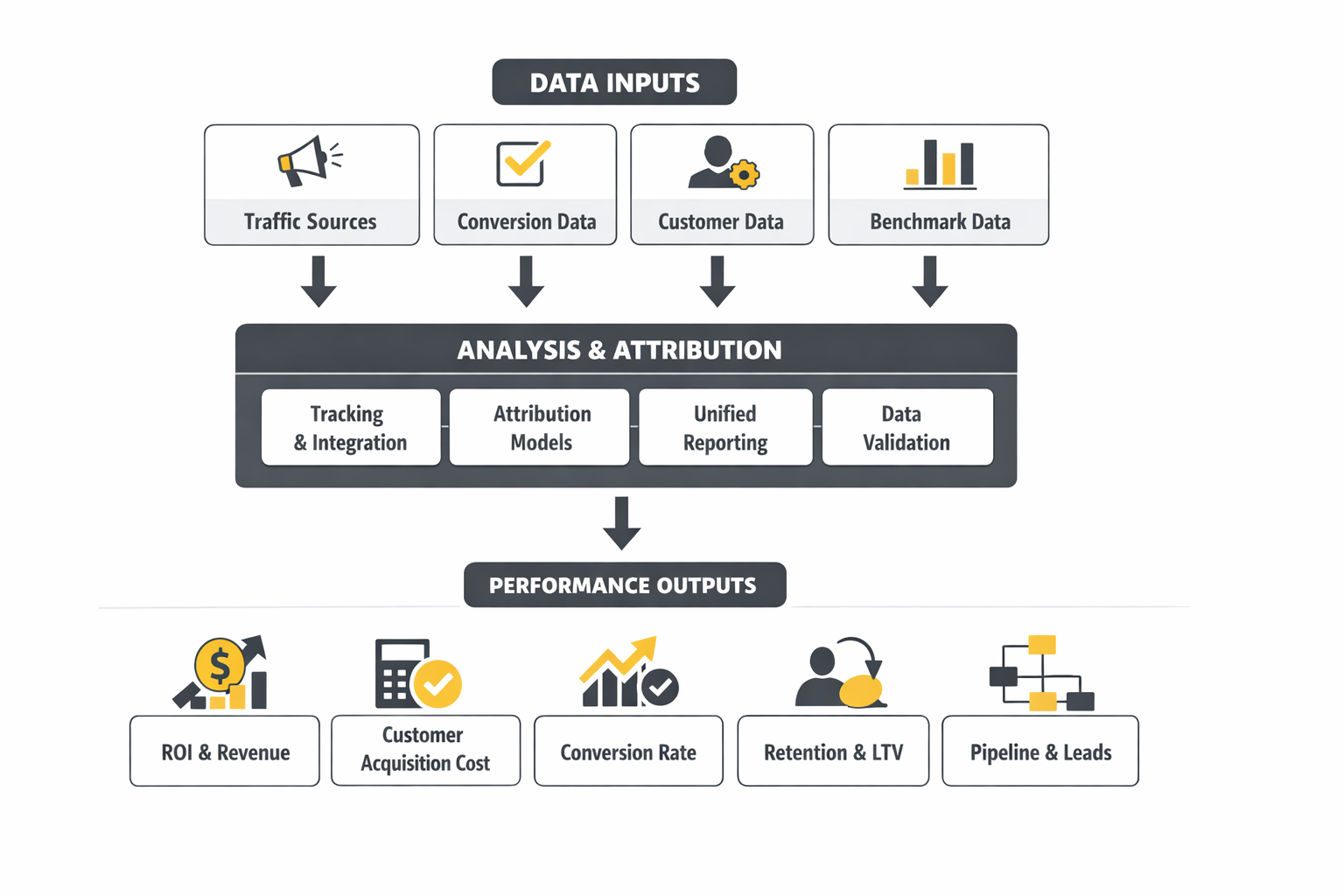
If a marketing agency cannot make sense of the numbers, it eventually becomes a creative service with a nice presentation and very little strategic value. Data is what tells you whether the message is landing, whether the offer is strong enough, whether the channel mix is helping or hurting, and whether the business is actually getting closer to profitable growth. That is why the best agencies do not treat analytics as a reporting add-on at the end of the month. They use it as the control system that shapes decisions all the way through the work.
The market pressure behind this is obvious. Gartner’s 2025 CMO spend survey showed marketing budgets holding at 7.7% of company revenue for the second year in a row, which means there is not much room for waste. At the same time, Nielsen’s 2025 Annual Marketing Report makes it clear that marketers are still trying to balance short-term performance with long-term brand building while dealing with fragmented media and more difficult measurement. In that kind of environment, a marketing agency needs more than dashboards. It needs judgment about which numbers matter, which ones mislead, and which ones should drive action right now.
The Most Useful Metrics Are Tied To Decisions
A marketing agency should never collect data just because a platform makes it easy to display. The most useful metrics are the ones that help a team decide what to do next. That usually means the agency is looking at business outcomes first, then working backward into the leading indicators that influence those outcomes, rather than drowning the client in surface-level numbers that feel busy but never change strategy.
That is why strong agencies care more about the relationship between metrics than isolated snapshots. Traffic without conversion context is incomplete. Leads without quality context are risky. Lower acquisition costs without revenue quality can quietly destroy profitability. A good marketing agency uses data to connect the whole story, not just to highlight the one number that makes the monthly report look flattering.
Why Vanity Metrics Create Bad Decisions
One of the fastest ways for a marketing agency to lose credibility is to overemphasize vanity metrics. Impressions, reach, likes, video views, and raw click volume can all be useful in the right context, but they become dangerous when they are used as substitutes for meaningful business movement. It is very easy to make a campaign look active. It is much harder to show that the activity is producing better customers, stronger economics, or more predictable growth.
This matters because reporting shapes behavior. If the agency keeps celebrating numbers that are easy to inflate, it will gradually train both the client and the internal team to optimize toward appearances instead of outcomes. A disciplined marketing agency knows that vanity metrics have a place, but only when they are clearly linked to deeper indicators like conversion rate, sales-qualified pipeline, customer acquisition cost, retention, or revenue contribution.
Channel Data Needs A Unified View
Modern marketing becomes much easier to misunderstand when each channel is analyzed in isolation. A paid search campaign may look like the hero in one dashboard, while brand content, remarketing, email nurture, or direct traffic are doing a large share of the invisible support work somewhere else. If a marketing agency never connects those dots, it can end up overfunding the easiest-to-measure channel and underinvesting in the channels that make the whole system work.
This is exactly why a more unified measurement model matters now. Google’s guidance on unified online marketing measurement and its deeper unified marketing measurement framework both make the case that brands need connected approaches that can blend different forms of evidence instead of relying on one lens. A smart marketing agency does not pretend any single attribution view is perfect. It builds a broader interpretation of what is driving performance, where uncertainty still exists, and how the next round of decisions should account for that.
Attribution Is Helpful, But Never Complete
Attribution is useful, but it becomes a problem when people treat it like perfect truth. A marketing agency should absolutely use attribution data, especially when it helps explain which touchpoints are creating momentum and where prospects are entering the funnel. But the agency also has to understand the blind spots: dark social, offline influence, delayed sales cycles, imperfect tracking, device switching, and the fact that many conversions are shaped by multiple interactions long before the last click gets credit.
That is why stronger teams pair attribution with business context, CRM outcomes, and testing discipline. They know that the goal is not to worship one reporting method. The goal is to get close enough to reality that budget decisions improve over time. A mature marketing agency can hold two ideas at once: attribution is useful, and attribution on its own is not enough.
The Right KPIs Change By Business Model
Not every business should be measured the same way, and a marketing agency that forgets that usually forces clients into lazy reporting templates. A software company with a longer sales cycle may care deeply about product-qualified leads, activation rates, pipeline velocity, and retention trends. An ecommerce brand may focus more on contribution margin, repeat purchase behavior, average order value, and blended customer acquisition cost. A service business may live and die by booked calls, show rates, close rates, and lead-to-client conversion quality.
The reason this matters is simple: the agency cannot optimize intelligently unless it knows what success looks like commercially. A marketing agency should always tailor KPIs to how value is actually created inside the business. When that happens, reporting becomes a lot more useful because every number has a clear relationship to revenue, sales efficiency, or long-term growth strength.
Benchmark Data Is Useful Only With Context
Benchmark data can be helpful, but only when the agency treats it as a conversation starter rather than a verdict. It is useful to know how a campaign compares to wider market patterns, because it can reveal whether poor performance is truly a creative or funnel issue or whether the economics of the category are shifting more broadly. But comparisons become misleading very quickly if the business model, audience sophistication, price point, sales cycle, or offer strength are ignored.
That is why a good marketing agency uses benchmark data carefully. HubSpot’s current marketing statistics hub remains useful because it shows how much variation exists across channels and tactics, and that variation is the whole point. Numbers become dangerous when they are stripped of context. A wise agency uses them to ask sharper questions, not to pressure a client into copying someone else’s targets blindly.
Data Quality Is A Growth Issue
Many companies assume they have a performance problem when they really have a data-quality problem. Broken tracking, duplicate leads, CRM chaos, poor source tagging, inconsistent UTM use, missing offline conversion data, and unclear definitions can make even a competent marketing agency look ineffective. If the measurement layer is unreliable, the team will waste a huge amount of time reacting to noise instead of improving what matters.
This is one reason better agencies spend time cleaning foundations before making aggressive promises. The quality of the data determines the quality of the decisions, and the quality of the decisions determines whether the client feels like marketing is becoming more predictable. A serious marketing agency knows that fixing data hygiene is not boring back-office work. It is one of the most profitable things a growth team can do.
AI Is Changing How Agencies Work With Data
AI is making analytics faster, but not automatically better. A marketing agency can now use AI to summarize trends, surface anomalies, speed up reporting workflows, generate hypotheses, and help identify weak points across campaigns much faster than before. That is real leverage, and the best teams are using it. But speed only helps when the underlying interpretation is grounded in business reality.
Adobe’s 2025 AI and Digital Trends in B2B Journeys report reflects how much emphasis marketers are placing on AI-driven speed, personalization, and measurable performance, and that has obvious implications for agency work. The advantage does not come from producing more charts more quickly. It comes from helping the client move from raw data to better choices with less delay and less confusion. That still requires human judgment, especially when the numbers conflict or when short-term performance starts pushing against long-term brand health.
Reporting Should Create Clarity, Not Theater
There is a huge difference between reporting and performance theater. Some agency reports are loaded with screenshots, charts, and commentary that make the work look sophisticated while avoiding the real questions. What is improving? What is declining? What likely caused it? What did we learn? What are we changing next? A strong marketing agency answers those questions directly, even when the answers are uncomfortable.
Clients rarely need more pages. They need more clarity. That means the agency should explain what happened in plain language, show the evidence, state where uncertainty remains, and recommend the next moves with conviction. When reporting is done that way, it stops feeling like a ritual and starts becoming one of the most valuable parts of the relationship.
Statistics Only Matter When They Change Action
This is the simplest way to think about the whole subject. Statistics and data matter because they help a marketing agency decide where to lean in, where to pull back, what to test, what to repair, and what to stop believing. If the numbers are not improving decisions, then they are just decoration.
The agencies that create the most value are the ones that can turn messy information into calm direction. They do not obsess over every fluctuation, and they do not ignore the details either. They look at the numbers in context, connect them to commercial reality, and help the client act with more confidence. That is what makes data powerful, and that is what separates a serious marketing agency from one that is simply good at building reports.
Measurement, Analytics, And Optimization
This is where a marketing agency proves whether it is actually helping a business grow or simply generating attractive activity. Measurement tells you what happened, analytics helps you understand why it happened, and optimization is the discipline of turning those lessons into better decisions. When those three pieces work together, marketing gets sharper over time instead of becoming a repeating cycle of reports, opinions, and random changes.
The reason this matters so much right now is that teams are under pressure to justify every move. Marketing budgets stayed at 7.7% of company revenue in 2025, and Nielsen’s 2025 marketing research shows that leaders are still trying to balance efficiency, brand building, and fragmented measurement across channels. That means a modern marketing agency cannot just deliver numbers. It has to help a business see what deserves more investment, what needs repair, and what should be cut before it burns more time and money.
Optimization Starts After The Launch, Not Before It
A lot of people talk about campaign launches as if that is the finish line, but a good marketing agency knows the real work starts once live data begins coming in. The first version of a campaign is usually an educated guess built on research, experience, and positioning. Optimization is what turns that first guess into something more resilient by testing assumptions against actual market behavior.
This is why agencies that obsess over getting everything perfect before launch often move too slowly, while agencies that launch without a plan usually create chaos. The sweet spot is disciplined speed. A smart marketing agency gets the campaign into the market with a clear hypothesis, watches closely, and then improves the system based on evidence rather than ego.
You Optimize A System, Not Just An Ad
One of the biggest mistakes businesses make is assuming optimization means tweaking headlines or adjusting bids inside an ad platform. Sometimes it does mean that, but that is only one layer. A marketing agency should be optimizing the whole growth system: offer strength, audience fit, creative angles, landing page clarity, form friction, follow-up speed, email nurture, sales handoff, and how all of those pieces interact.
That broader view matters because weak results are often blamed on the wrong thing. A campaign may look underwhelming because the message is wrong, not because the media buying is poor. Or the traffic may be fine while the real issue sits on the landing page or inside the sales process. A serious marketing agency does not isolate performance problems too early. It traces them through the entire path until it finds what is actually suppressing growth.
The Best Agencies Build Test-And-Learn Loops
Optimization gets much better when it is built around a real learning loop. That means the marketing agency forms a hypothesis, runs a controlled change, measures the result, interprets the evidence, and then feeds that lesson into the next round of work. When that loop is missing, teams still make changes, but they are really just guessing in public and hoping the numbers improve.
That approach is backed by both research and platform guidance. The 2025 International Journal of Research in Marketing paper on personalization, experimentation, and optimization frames personalization as part of a real test-and-learn discipline rather than a loose creative instinct, while Google’s 2026 guidance on experimentation and incrementality testing makes the case that marketers need clearer cause-and-effect evidence if they want to move from “we think” to “we know.” That is exactly how a capable marketing agency should operate: not with random tweaks, but with a reliable learning rhythm.
Small Wins Compound Faster Than Big Rebuilds
There are moments when a business truly needs a full rebuild, but most optimization work is more practical than dramatic. A stronger offer angle, a better lead form, clearer proof near the call to action, faster follow-up, improved segmentation, or tighter remarketing can quietly create a much bigger result than a total redesign. The strongest marketing agency teams know how to stack these smaller wins until the overall system behaves very differently.
That is an important mindset shift because clients often expect transformation to look loud. In reality, a lot of durable growth comes from steady refinement rather than flashy reinvention. A disciplined marketing agency does not chase novelty for its own sake. It looks for leverage, and leverage often hides inside details that seemed minor until they started compounding.
Personalization Only Works When It Creates Value
Personalization is one of the most powerful optimization levers available, but only when it makes the experience genuinely more useful. If it is superficial, creepy, or mechanically overdone, it can make performance worse instead of better. A marketing agency should think about personalization as a way to reduce friction, increase relevance, and help the buyer move faster with more confidence.
There is strong evidence for that direction. Adobe’s 2025 customer engagement research found that 78% of customers want consistent brand experiences, while 87% of organizations using AI-driven personalization reported stronger customer engagement. BCG’s 2024 work on what consumers want from personalization also found that personalized offers can generate three times higher ROI than mass promotions when they deliver real value. A marketing agency should take that as both an opportunity and a warning: personalization can work extremely well, but only when it improves the customer’s experience rather than simply making the brand feel more technologically advanced.

Incrementality Is Becoming A Serious Advantage
One of the most useful shifts in modern optimization is the move toward incrementality. A marketing agency that relies only on last-click or platform-reported conversions can easily overestimate what a campaign is really adding. Incrementality asks a harder question: what happened because of the marketing that would not have happened otherwise?
That question matters because it protects businesses from paying to claim credit for demand that was already on its way. Google’s 2026 experimentation article explains how lower-cost incrementality testing is making this type of measurement more accessible, and it cites a Rocket Mortgage example where testing revealed a campaign generated 23% more value than the company’s original model estimated. The deeper lesson is not just that testing is useful. It is that a marketing agency can make much better optimization decisions when it understands what is truly incremental instead of merely visible in a dashboard.
AI Can Speed Up Optimization, But Not Replace Judgment
AI is making optimization faster across almost every serious marketing workflow. A marketing agency can now use AI to summarize patterns, draft variant ideas, identify anomalies, speed up audience analysis, and reduce the time it takes to move from raw information to a tested change. That is real leverage, and ignoring it would be foolish.
But speed is not wisdom. SAS reported in 2025 that 85% of marketing teams were actively deploying GenAI, with 93% of CMOs and 83% of marketing teams reporting ROI, which tells you the tools are becoming operational rather than experimental. At the same time, a marketing agency still needs people who can interpret conflicting signals, challenge weak assumptions, and decide which changes actually fit the client’s market, offer, and brand. AI can help the team move faster, but judgment is still what keeps optimization pointed in the right direction.
Reporting Should Point To The Next Move
The best optimization reporting is not just descriptive. It is directional. A marketing agency should be able to say what improved, what weakened, what likely caused the shift, what remains uncertain, and what the team plans to change next. If reporting ends at observation, it is incomplete. The client needs interpretation, not a prettier spreadsheet.
This is also where trust is built. When an agency is honest about ambiguity, clear about tradeoffs, and confident enough to recommend a next step, the relationship starts to feel strategic instead of administrative. A strong marketing agency uses reporting as the bridge between measurement and action, because numbers only become valuable when they lead somewhere useful.
Optimization Is How An Agency Earns Its Keep
At the end of the day, optimization is where a marketing agency earns its real value. Strategy gets the direction right. Execution gets the work into the market. Measurement tells the truth. But optimization is what turns that truth into momentum. It is the discipline that prevents a business from repeating the same mistakes while hoping for different results.
That is why the strongest agencies do not treat optimization like a minor line item after the campaign is already running. They treat it as the engine that makes the whole relationship more profitable over time. In the final part, we will step back and look at the bigger ecosystem around a marketing agency, how businesses should choose the right partner, and which common questions matter most before signing anything.
Agency Ecosystem, Selection, And Common Questions

By the time a business starts seriously comparing options, the real question is no longer whether it needs outside help. The real question is which kind of marketing agency belongs in its ecosystem, how that agency should work with internal teams, and what signs separate a serious growth partner from a polished distraction. That matters even more now because Gartner found that marketing budgets remained flat at 7.7% of company revenue in 2025, while Deloitte’s 2025 CMO Survey shows leaders balancing profitability, AI adoption, brand investment, and operating discipline at the same time.
A strong marketing agency should fit into the business like a force multiplier, not like a second company creating more meetings, more dashboards, and more confusion. That means the best choice is rarely the loudest agency, the cheapest agency, or even the most specialized agency on paper. It is the one that understands your commercial reality, can make the hard calls clearly, and has the operating discipline to turn strategy into measurable execution without making the whole relationship feel exhausting.
How The Agency Ecosystem Really Works
Most businesses do not need one magic provider that does absolutely everything. What they need is an ecosystem that makes sense. In some companies, the right setup is an internal marketing lead working with a marketing agency for media buying, creative testing, analytics, and funnel improvements. In others, the best structure is a lean internal team supported by specialist partners for SEO, email, automation, web development, or content production.
The mistake is trying to solve structural problems with branding alone. If the business lacks strategic leadership, sales follow-up, CRM discipline, or clean measurement, even a capable marketing agency will struggle to create clarity quickly. The ecosystem works when the client knows what should stay in-house, what should be outsourced, and who owns the final commercial decisions when tradeoffs appear.
What To Look For When Choosing A Marketing Agency
When you evaluate a marketing agency, start with business fit before channel fit. Can the team explain how it thinks about margin, sales capacity, customer quality, retention, and revenue timing, or does it jump straight into tactics? Can it describe where growth usually breaks and how it would diagnose your situation, or does every solution sound suspiciously similar no matter who the client is?
You should also pay close attention to how the agency talks about measurement and trust. Edelman’s 2025 Trust Barometer shows how fragile institutional trust has become, and that same reality plays out in agency relationships every week. A trustworthy marketing agency is direct about uncertainty, careful with claims, and confident enough to show you how it makes decisions instead of hiding behind vague language and decorative reports.
Red Flags That Should Make You Walk Away
If a marketing agency guarantees outcomes before understanding your economics, that is a red flag. If it cannot explain how it will measure success beyond platform dashboards, that is another one. If it pushes every client into the same service bundle, avoids hard questions about client fit, or talks as if AI has removed the need for human judgment, you are probably looking at a team that sells confidence more easily than it delivers results.
Another warning sign is operational fog. If the proposal feels sharp but you still cannot tell who will actually do the work, how decisions will be made, what the testing cadence looks like, or how reporting ties to revenue, the relationship may become frustrating very quickly. A good marketing agency reduces ambiguity. It does not charge you extra for living inside it.
Where Tools Fit Inside The Ecosystem
Technology absolutely matters, but it should support the operating model rather than become the whole story. A marketing agency may use tools for funnel building, email, CRM workflows, reporting, scheduling, or AI-assisted production, but the software only helps if the underlying strategy is sound. That is why some businesses do well with ClickFunnels for guided funnel builds, Systeme.io for simpler automations, Brevo for email and CRM coordination, Buffer for publishing workflows, or Fillout for cleaner lead capture.
The key is not owning more tools. The key is knowing which tools actually remove friction inside your particular system. A sharp marketing agency will simplify the stack where possible, document how it is used, and make sure the client is not trapped inside a maze of subscriptions that nobody fully understands six months later.
FAQ For This Complete Guide
What Does A Marketing Agency Actually Do?
A marketing agency helps a business create and capture demand more effectively. That can include strategy, positioning, paid media, SEO, content, email, funnel design, analytics, reporting, creative production, and optimization. The better agencies do not just execute isolated tasks. They connect those functions into a system that helps leadership make better growth decisions.
When Should A Business Hire A Marketing Agency?
A business should usually hire a marketing agency when growth has become too complex for the current team, when internal execution is inconsistent, or when leadership needs outside expertise to move faster with less waste. Flat budgets and higher accountability make this decision more urgent, which is part of why Nielsen’s 2025 marketing research focuses so heavily on clarity, cross-media measurement, and balancing short-term performance with long-term brand strength.
Is It Better To Build In-House Or Hire An Agency?
That depends on the business stage, budget, and the kind of expertise required. In-house teams are often stronger for brand continuity, product knowledge, and day-to-day proximity. A marketing agency is often stronger for specialized expertise, outside pattern recognition, and moving quickly across channels without the cost of hiring every role full time. In many cases, the best answer is a hybrid model rather than an either-or decision.
How Do You Know If An Agency Is Any Good?
Look at how the team thinks, not just what it says it can do. A strong marketing agency should ask sharp commercial questions, explain how it handles measurement, describe how it tests and learns, and talk honestly about fit. It should make strategy easier to understand, not harder. If the pitch sounds impressive but you still do not know how the work will actually create better decisions, that is not a great sign.
Should A Marketing Agency Specialize In One Channel?
Specialization can be valuable, but it is not automatically better. Some businesses benefit from a specialist paid search or SEO partner. Others need a marketing agency that understands the full funnel and can connect channels intelligently. The right choice depends on where the real bottleneck sits. If the issue is broader than one channel, hiring a narrow specialist may only solve part of the problem.
How Important Is AI When Choosing An Agency?
AI matters, but it should not be the main reason you hire a marketing agency. What matters is whether the agency uses AI to improve speed, research, testing, workflow efficiency, and personalization without letting the work become generic or careless. IAB’s 2025 State of Data report and Adobe’s 2025 B2B digital trends research both show how deeply AI is reshaping campaign planning, activation, and measurement, but the winning agencies still rely on human judgment to interpret the data and make the strategic calls.
What Metrics Should An Agency Report On?
A marketing agency should report on the metrics that help the business make decisions, not just the ones that make a dashboard look lively. That usually means tying channel data to conversion quality, pipeline, revenue impact, cost efficiency, and trend direction. Vanity metrics can have context value, but they should never sit at the center of the conversation unless they clearly connect to commercial outcomes.
How Long Does It Take To See Results?
That depends on the channel mix, the strength of the offer, the buying cycle, the quality of existing data, and how much needs fixing before optimization can really begin. A marketing agency can often identify weak points quickly, but meaningful business results may take longer when the funnel, message, sales process, or tracking need repair first. Fast promises sound nice, but real progress usually comes from disciplined execution plus enough time for learning loops to compound.
What Should A Client Prepare Before Hiring An Agency?
The client should get clear on goals, margins, current performance, sales capacity, internal decision-makers, and the real growth constraints inside the business. The clearer that starting point is, the easier it becomes for a marketing agency to recommend the right scope, build a realistic plan, and avoid wasting the first month discovering basics that leadership should already know.
What Is A Good First Project For A New Agency Relationship?
A good first project usually creates clarity fast. That might be an audit of tracking and funnel performance, a positioning refresh, a paid acquisition pilot, a landing page rebuild, or a reporting cleanup that gives the business a much cleaner view of what is happening. The best first step is rarely the biggest step. It is the one that reduces uncertainty and helps the agency-client relationship earn trust quickly.
Do Small Businesses Need A Marketing Agency?
Not every small business needs one, but many do benefit from focused outside help. A small company may not need a full-service engagement, yet it can still gain a lot from strategic guidance, funnel repairs, paid media support, email systems, or local SEO execution. The right marketing agency for a smaller company is usually one that understands constraints and prioritizes leverage rather than trying to sell an oversized package.
How Do You Avoid Getting Stuck With The Wrong Agency?
Set expectations clearly, define success in commercial terms, ask exactly how decisions will be made, and pay close attention to how the team handles difficult questions before the contract is signed. The wrong marketing agency often reveals itself early through vague answers, inflated certainty, or an unwillingness to talk about risk. The right one will usually feel calmer, clearer, and much more grounded in how your business actually works.
Work With Professionals
If you want a marketing agency relationship to work, treat it like a growth decision rather than a procurement task. Choose the team that understands the business, speaks plainly about tradeoffs, and can build a system that holds up when results are under pressure. That is what professionals do. They do not just launch campaigns. They create clarity, keep learning, and help growth become far more repeatable.
And if you are building your own stack alongside agency support, it helps to use tools that reduce friction instead of adding it. Some teams tighten up lead capture with Fillout, streamline scheduling with Cal.com, centralize customer communication with Brevo, or build cleaner conversion paths with ClickFunnels. The platform matters less than the discipline behind it, but the right tools can make that discipline much easier to maintain.
Explore 10K+ Remote Marketing Contracts on MarkeWork.com
Most marketers spend too much time chasing clients, competing on crowded platforms, and losing a percentage of every project to middlemen.
MarkeWork gives you a better way. Browse thousands of remote marketing contracts and connect directly with companies desperate to hire skilled marketers like you without platform commissions and without unnecessary gatekeepers.
If you’re serious about finding better opportunities and keeping 100% of what you earn, you can explore available contracts and create your profile for free at MarkeWork.com.
 Filip Konecny Enterprises