
Lead Generation: The Practical Foundation for Predictable Growth
Lead generation is not just about getting more names into a database. It is the discipline of creating steady demand, attracting the right people at the right moment, and moving them toward a real buying decision without wasting time, budget, or trust. When that system is weak, businesses feel it everywhere: revenue gets uneven, sales teams chase poor-fit prospects, and marketing starts looking busy without actually creating momentum.
That is exactly why lead generation deserves a more professional approach than most companies give it. The strongest teams build it like an operating system, not like a collection of random campaigns, and that shift matters even more now that buyers are doing deeper research on their own. 6sense’s 2024 B2B Buyer Experience Report found that many buyers have already formed a strong preference before they ever speak with sales, while Gartner’s March 2026 sales survey shows just how strongly modern buyers lean toward self-directed research.
So this article is built to help you think about lead generation the way experienced operators do. Instead of bouncing between trendy tactics, we are going to walk through the structure that makes the entire machine work, from why it matters in the first place to implementation, measurement, and long-term resilience. If you want lead generation that keeps producing even when channels shift, this is the framework you want to understand.
Article Outline
- Part 1: Why Lead Generation Matters
- Part 2: Lead Generation Framework Overview
- Part 3: Core Components of Lead Generation
- Part 4: Professional Lead Generation Implementation
- Part 5: Lead Generation Measurement and Optimization
- Part 6: Building a Resilient Lead Generation Ecosystem
Why Lead Generation Matters
Lead generation matters because it sits between visibility and revenue. A business can publish content, run ads, attend events, and build a brand, but until those activities consistently turn anonymous attention into qualified opportunities, growth stays fragile. That is why serious operators do not evaluate lead generation as a vanity function; they evaluate it as the bridge between marketing effort and commercial results.
The pressure on that bridge has increased. Gartner’s latest findings show that buyers increasingly prefer a rep-free experience, and 6sense’s buyer research shows that many decisions are shaped long before a salesperson joins the conversation. In plain English, that means your lead generation system now has to educate, qualify, and build preference earlier than it used to.
There is also a strategic reason this matters beyond top-line growth. McKinsey’s 2024 B2B Pulse research found that commercial teams blending personalization, data, and AI are far more likely to gain market share, which tells you something important: lead generation is no longer just a pipeline exercise. It is a competitive advantage when it is run with precision, and a silent tax on the business when it is not.
Framework Overview
A professional lead generation framework starts with a simple truth: not every lead is created at the same stage of awareness, with the same level of intent, or with the same path to conversion. That means the goal is not to force every prospect through one rigid funnel. The goal is to build a system that matches the buyer’s journey while still giving your business a clear process for capture, qualification, follow-up, and conversion.
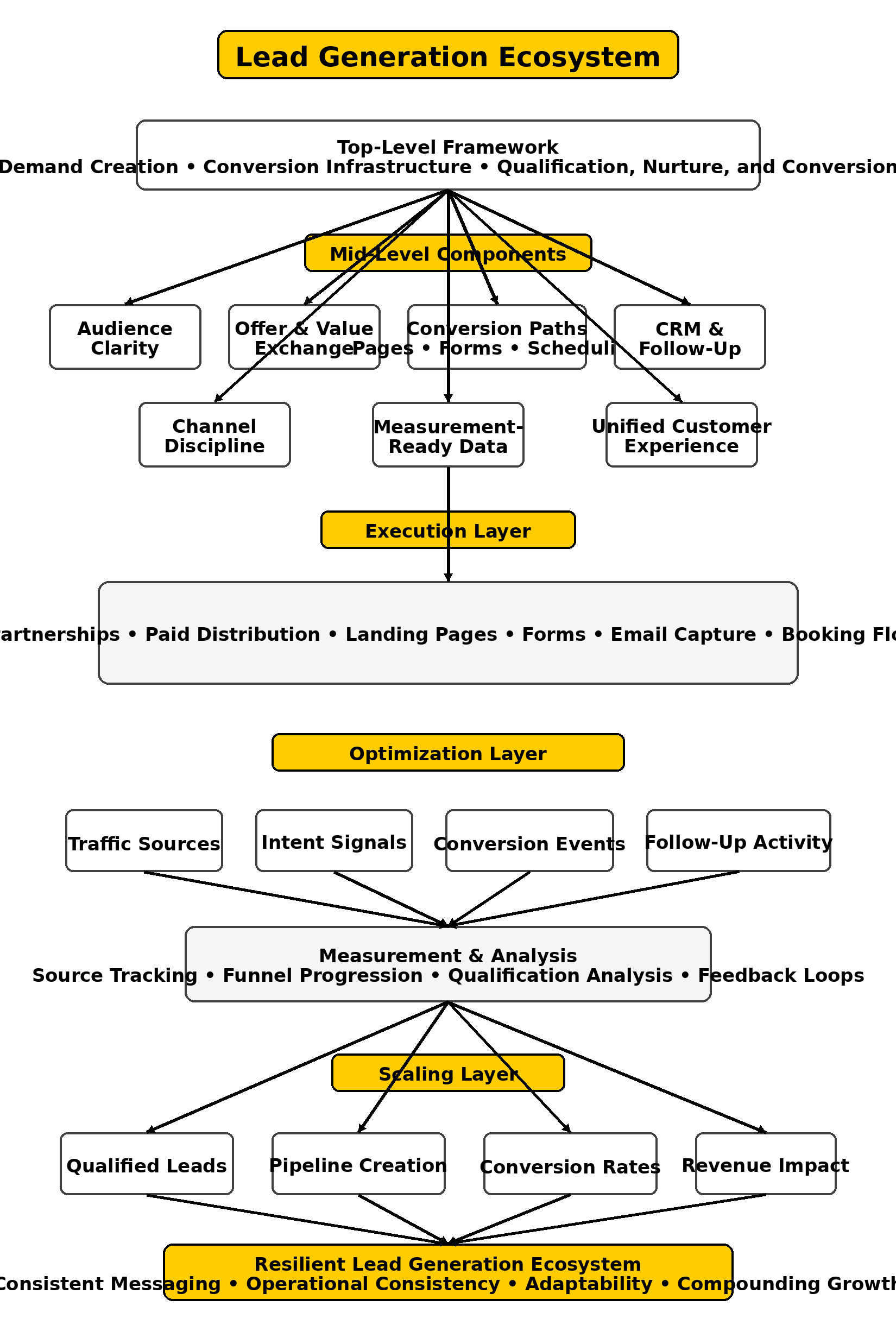
The framework works best when you think in layers. At the top, you have demand creation through content, search, social, partnerships, and paid distribution. In the middle, you have conversion infrastructure such as landing pages, forms, scheduling, and messaging, and at the bottom, you have qualification, nurturing, and handoff so the right leads move forward without friction.
This layered view is far more useful than a tactic-first mindset. Salesforce’s State of Marketing report keeps pointing to the same pattern across high-performing teams: they connect data, personalization, and automation rather than treating each campaign like a separate island. Once you see lead generation as a connected framework instead of a series of disconnected moves, the path to predictable growth becomes much clearer.
Core Components of Lead Generation
The first core component is audience clarity. If you do not know who you want, what problem they are trying to solve, and what urgency surrounds that problem, your campaigns may still attract attention, but they will pull in the wrong kind of attention. Strong lead generation begins with tight positioning, sharp messaging, and an offer that feels relevant enough to earn the next click or reply.
The second core component is conversion architecture. That includes landing pages, forms, calls to action, email capture points, booking flows, and the technology connecting them together. Businesses that want a faster path to deploying funnels often use platforms such as ClickFunnels or Systeme.io, while teams focused on cleaner data collection often rely on tools like Fillout to improve how prospects enter the system in the first place.
The third component is follow-up quality. A lead is not valuable simply because it was captured; it becomes valuable when the next step feels timely, useful, and aligned with intent. That is where CRM structure, segmentation, and communication tools matter, whether you are managing sales relationships in Copper, automating email sequences through Brevo, or building always-on qualification support with Chatbase.
The fourth component is channel discipline. Not every company should pursue search, paid social, cold outreach, newsletters, communities, webinars, and partnerships all at once. HubSpot’s current marketing research and Content Marketing Institute’s B2B content benchmarks both reinforce the same broader lesson: results improve when content, distribution, and audience intent actually match instead of being spread thin across every possible channel.
Professional Lead Generation Implementation
Professional implementation begins by refusing to improvise the customer journey. Before traffic is scaled, the serious work is defining the offer, mapping the handoff points, setting qualification rules, and making sure every captured lead lands somewhere useful rather than disappearing into a spreadsheet graveyard. That operational layer is not glamorous, but it is usually the difference between a campaign that looks active and one that compounds.
The next step is building a clean execution stack that your team can actually manage. A lean business may combine landing pages, email automation, and simple funnel logic inside ClickFunnels or Systeme.io, while a content-led brand may pair lead capture with distribution through Buffer and add newsletter growth with Moosend. The best implementation is not the one with the most tools; it is the one where every tool has a job and every handoff can be traced.
Finally, implementation has to respect how buyers actually behave today. Recent Gartner research, 6sense buyer data, and McKinsey’s omnichannel findings all point in the same direction: people want relevance, flexibility, and a smoother path to decision. So professional lead generation is not just about generating more leads; it is about designing a buying experience that makes the right people want to move forward.
Lead Generation Framework Overview
If you want lead generation to work consistently, you cannot treat it like a random pile of tactics. A real framework gives every moving part a job, shows how strangers turn into qualified opportunities, and makes it obvious where things are breaking when results slow down. That matters even more now because 67% of B2B buyers prefer a rep-free experience, which means your system has to do more of the persuading before a salesperson ever enters the picture.
The easiest way to think about a lead generation framework is as a sequence of connected layers rather than a single funnel graphic. First, you create demand and attract attention. Then you capture interest through a focused offer, qualify the response, nurture the relationship, and route the opportunity into the right next step without confusion or delay.
That sounds simple, but most businesses skip the structure and go straight to traffic. They run ads, post content, or buy software before they have decided what the lead should do next, and that is exactly why their lead generation ends up feeling expensive, messy, and unpredictable. The framework fixes that by forcing each stage to support the next one.
The Demand And Capture Layer
The first layer is demand and capture. This is where your business earns attention through search, content, social media, partnerships, outbound outreach, or paid campaigns, then gives people a reason to respond with a click, a booking, a form submission, or a reply. Good lead generation starts here, but not with noise; it starts with relevance.
That relevance has become more important, not less. In the 2025 B2B Buyer Experience Report from 6sense, buyers showed just how early preferences are formed, and the same research explains that the timeline for influencing B2B buyers is shrinking. In other words, your lead generation framework has to help the right people recognize themselves in your message quickly, because the window to shape their decision is tighter than most teams think.
Once attention exists, capture has to feel frictionless. The offer, page, form, and call to action should make the next step feel obvious, not like work. That is one reason many businesses standardize their capture process with tools like ClickFunnels, Systeme.io, or Fillout instead of rebuilding every lead capture experience from scratch.

The Qualification Layer
The next layer decides whether a lead deserves immediate attention, slower nurturing, or disqualification. This is where many businesses lose money without realizing it, because they treat every lead as equally valuable even when intent, budget, timing, and fit are wildly different. A solid lead generation framework protects the sales team from chaos by sorting people properly before human effort gets wasted.
This is not just about adding more form fields. It is about understanding buying context and group dynamics. Gartner found that 74% of B2B buyer teams demonstrate unhealthy conflict during the decision process, and the same release explains that buyer groups are far more likely to report a high-quality deal when they experience relevance at the group level. That should change how you think about lead generation, because the framework is not just qualifying one person; it is often helping an entire buying group move toward consensus.
This is also where your data model matters. CRM rules, lead scoring, intake logic, and source tracking should all support qualification instead of sitting in separate tools that never speak to each other. Businesses that want tighter control here often connect qualification and relationship management inside systems like Copper, then pair that with faster scheduling through Cal.com when a lead is ready to move.
The Nurture And Conversion Layer
Not every lead is ready to buy today, and a mature framework accepts that instead of fighting it. Nurturing is the layer that keeps interest alive, builds trust, answers objections, and helps the prospect take the next logical step when timing becomes right. Without that layer, lead generation turns into a leaky bucket where decent opportunities disappear simply because nobody stayed in touch with enough relevance.
This is where consistency beats intensity. A clean nurture sequence, useful educational content, and well-timed reminders usually outperform random bursts of follow-up because they respect how people actually make decisions. Research in Salesforce’s State of Marketing report shows that marketers are leaning harder into unified experiences, AI, and personalization, which makes sense because buyers notice when the journey feels connected across email, web, social, and direct outreach.
The conversion layer should also reduce hesitation wherever possible. Sometimes that means a simple email sequence through Brevo. Sometimes it means using conversational support with Chatbase so leads can get answers without waiting. The point is not to use more software for the sake of it; the point is to remove unnecessary friction between interest and action.
The Measurement And Feedback Layer
The final layer is measurement and feedback, and this is the part that keeps the whole framework honest. If you do not know which channels bring qualified leads, which offers create serious intent, and where prospects are dropping off, then you are not really running a framework at all. You are guessing and hoping the numbers stay kind to you.
The best teams use measurement to improve decisions, not just to build prettier dashboards. McKinsey’s 2024 B2B Pulse research found that data-driven commercial teams blending personalized experiences with gen AI are 1.7 times more likely to increase market share. That is a strong reminder that lead generation improves when feedback loops are fast, specific, and tied to revenue outcomes instead of vanity metrics.
Once this layer is in place, the framework starts compounding. You stop asking whether lead generation is working in general and start asking better questions: which audience converts faster, which message creates stronger intent, which source produces the best opportunities, and which part of the journey is slowing everything down. That is when lead generation begins to feel less like a gamble and more like a real growth system.
Audience And Intent Clarity
The first component is knowing exactly who you want and what kind of intent they are showing. Lead generation falls apart fast when every visitor gets treated like the same buyer, because a curious reader, an active evaluator, and a ready-to-buy prospect are not asking for the same thing. Your messaging, call to action, and follow-up all need to change based on that reality.
This is one reason modern buying behavior matters so much. 6sense’s 2025 buyer research makes it clear that preferences are shaped earlier than many teams assume, while Gartner’s March 2026 survey shows that many B2B buyers still want a rep-free experience for much of the journey. Put those two realities together and the lesson becomes obvious: lead generation has to speak clearly to intent before sales ever gets involved.
That means the first job is not “get more leads.” It is “attract the right people with the right expectation.” Businesses that ignore that distinction usually brag about volume while quietly dealing with poor fit, weak conversion rates, and sales teams that stop trusting marketing.
Offer And Value Exchange
The second component is the offer itself. People do not become leads because you asked nicely. They become leads because the next step feels valuable enough to justify the click, the form fill, the demo request, or the reply. If the value exchange is vague, generic, or badly timed, lead generation suffers even when traffic quality is strong.
This is where businesses often need more honesty. A weak webinar, a forgettable newsletter signup, or a landing page with no clear promise will not suddenly become effective just because you drive more traffic to it. The offer has to match both the buyer’s urgency and the level of commitment you are asking for.
That is also why high-performing teams treat offers like assets, not placeholders. Content Marketing Institute’s 2025 B2B research keeps pointing back to a simple truth: the teams getting stronger results are not just producing more content, they are aligning content and buyer needs more intentionally. In lead generation terms, that means every offer should answer one question cleanly: why should this person take the next step right now?
Conversion Infrastructure
The third component is conversion infrastructure, and this is where strategy becomes operational. You need pages, forms, scheduling flows, email capture, routing logic, and tracking that work together without forcing prospects to jump through unnecessary hoops. When this layer is clumsy, people who were ready to act start slipping away for reasons that have nothing to do with demand.
This is not just a design issue. It is a trust issue. Every extra field, broken page, confusing layout, or delayed response introduces doubt, and doubt is brutal in lead generation because it shows up exactly when motivation is most fragile. The smoother the path feels, the more likely it is that interest turns into action.
That is why many businesses standardize this part of the stack instead of improvising it every time. Some build fast with ClickFunnels or Systeme.io. Others focus on cleaner intake flows with Fillout. The specific tool matters less than the principle: the infrastructure should make conversion easier, not harder.
Follow-Up And Routing
The fourth component is what happens after the lead arrives. This is where a surprising number of businesses lose deals they could have won, not because the lead was bad, but because the handoff was slow, generic, or badly organized. Lead generation is not finished when the form is submitted. In many ways, that is the moment the real work starts.
Speed matters, but relevance matters even more. A lead who asked for pricing should not enter the same path as someone who downloaded an early-stage educational resource. One needs a buying conversation. The other needs trust, context, and a reason to stay engaged until timing improves.
This is exactly why routing and relationship management deserve more attention. Teams often use Copper to keep lead ownership and pipeline movement cleaner, Brevo to automate sequences without losing consistency, and Cal.com when the right next step is getting a qualified lead booked quickly. Good lead generation does not just create demand. It makes sure that demand lands in the right hands in the right way.
Measurement-Ready Data
The fifth component is measurement-ready data. Not vanity dashboards. Not bloated reports full of numbers nobody acts on. What you actually need is clean data that tells you which source brought the lead in, which message converted them, what they did next, and whether any of that turned into revenue.
This is where many teams think they are more advanced than they really are. They may have analytics installed, but they still cannot answer basic commercial questions with confidence. When that happens, lead generation becomes harder to improve because nobody knows whether a problem started with targeting, the offer, the page, the follow-up, or the sales handoff.
The advantage of getting this right is huge. McKinsey’s 2024 B2B Pulse research found that data-driven commercial teams combining personalized experiences with gen AI are 1.7 times more likely to increase market share. That should tell you something important: better data is not just about reporting. In lead generation, it is one of the fastest paths to better decisions and stronger growth.
Channel Fit And Consistency
The final component is channel fit. A lot of businesses sabotage their lead generation by trying to be everywhere at once, which sounds ambitious but usually creates weak execution across the board. It is far better to dominate a few channels that match your audience and sales motion than to spray effort across platforms that never really compound.
This is where consistency becomes a strategic advantage. Salesforce’s latest State of Marketing report highlights how strongly marketers are focusing on unified experiences, personalization, and data-backed execution across channels. That matters because lead generation improves when your emails, pages, paid campaigns, content, and outreach feel connected instead of stitched together by accident.
So when you look at the core components as a whole, the pattern becomes clear. Audience clarity brings the right people in. The offer gives them a reason to respond. Infrastructure makes the action easy. Follow-up keeps momentum alive. Data shows you what is working. Channel discipline helps everything compound. Get those components working together, and lead generation starts to feel a lot less fragile.
Statistics And Data
This is the part where lead generation either becomes real or stays theoretical. Once you start looking at current data, a clear pattern shows up: buyers are more independent, content has to do more of the selling, and the businesses that win are the ones that measure what happens between first touch and revenue instead of obsessing over vanity numbers. If you want your lead generation strategy to hold up, you need to understand what the market is actually telling you right now.
The latest numbers do not point to a world where businesses can get away with weak messaging, sloppy follow-up, or disconnected tools. They point to a market where trust, speed, relevance, and data discipline all matter at once. That is why this section is so important, because the statistics are not just interesting; they explain why professional lead generation now has to be built with much more intention than it did even a few years ago.
Buyer Behavior Is Pushing Lead Generation Upstream
Modern lead generation is happening earlier in the buying journey than many teams are prepared for. Gartner reported in March 2026 that 67% of B2B buyers prefer a rep-free experience, and the same research noted that 45% used AI during a recent purchase. That matters because it means lead generation now has to educate, reassure, and move people closer to a decision before sales ever gets a real chance to influence the outcome.
The pressure gets even stronger when you look at how quickly buyers form preferences. In the 2025 B2B Buyer Experience Report from 6sense, 94% of buyers said they ordered their shortlist according to preference during the selection phase before engaging sellers, and the early favorite still wins 77% of the time. That should wake up any business that still thinks lead generation begins when a prospect asks for a demo, because by then a huge amount of persuasion has already happened.
When you combine those two findings, the implication is hard to ignore. Lead generation is no longer just a top-of-funnel activity that hands off loose names to sales. It has become part of the buying experience itself, which means every page, email, ad, form, and follow-up message has to help shape preference long before a human conversation starts.
Content And Channels Still Do The Heavy Lifting
If buyer behavior is shifting upstream, then content and distribution have to carry more weight. Content Marketing Institute’s 2025 B2B research found that 74% of B2B marketers say content marketing helped generate demand and leads in the last 12 months, which is a strong reminder that good lead generation is not powered by traffic alone. It is powered by useful assets that create enough trust for someone to take the next step.
The same research is helpful because it shows where teams are actually seeing results instead of where they merely hope results will come from. Videos were rated the most effective content type by 58% of B2B marketers, while case studies and customer stories followed at 53%. On the distribution side, in-person events were cited as effective by 52% and webinars by 51%, which tells you something practical: lead generation gets stronger when content is both credible and delivered in formats that allow deeper engagement.
Paid acquisition still matters too, but not all paid channels perform the same way. 61% of B2B marketers said SEM or PPC produced the best results among paid channels, ahead of social media advertising and sponsorships. So if your lead generation strategy is relying heavily on one trendy platform while ignoring search intent, there is a good chance you are leaving qualified demand on the table.
AI Is Changing The Economics Of Execution
One of the biggest shifts in lead generation is not just what buyers are doing, but what marketing teams can now do faster. HubSpot’s 2026 State of Marketing shows how deeply AI has entered everyday marketing work, with 61% of marketers saying marketing is experiencing its biggest disruption in 20 years because of AI. That number matters because it explains why lead generation workflows are being rebuilt right now across content creation, personalization, qualification, and follow-up.
The Content Marketing Institute data makes that shift even more specific. Only 19% of B2B marketers say AI is integrated into daily processes and workflows, yet 45% already report more efficient workflows from generative AI and 56% say AI-powered automation is a high or medium priority for 2025. That gap is interesting because it suggests many teams are still early, which creates a real opportunity for businesses that integrate AI with purpose instead of just experimenting in random corners of the stack.
This is exactly where operational tools can start to matter in a very practical way. A business might use ClickFunnels to tighten conversion paths, Brevo to automate lead nurturing without letting follow-up go cold, or Buffer to keep distribution consistent across channels. The tool itself is not the story. The story is that lead generation improves when faster execution is paired with cleaner systems rather than more chaos.
Better Data Creates Better Lead Generation Decisions
There is a huge difference between collecting data and actually using it well. McKinsey’s 2024 B2B Pulse research found that data-driven commercial teams that blend personalized customer experiences with gen AI are 1.7 times more likely to increase market share. That is one of the clearest signals in the market right now, because it ties smarter execution directly to commercial outcomes instead of treating analytics as a reporting exercise.
The broader marketing picture points in the same direction. Salesforce’s State of Marketing report highlights that teams are leaning hard into unified customer experiences across mobile, social, and web, while personalization remains a critical priority. In lead generation terms, that means the businesses pulling ahead are not just publishing more or spending more; they are building systems where channel data, customer signals, and follow-up logic actually support one another.
That has a very practical takeaway for anyone serious about growth. Track which sources produce qualified leads, which offers move people forward, which landing pages leak intent, and which follow-up sequences actually turn into conversations. Once those numbers are visible, lead generation becomes much easier to improve because you are no longer guessing where the friction lives.
What These Numbers Really Mean For Your Strategy
The statistics do not say that lead generation has become impossible. They say it has become less forgiving. Buyers are more self-directed, expectations are higher, and sloppy systems are easier to expose because people have so many ways to compare options before ever speaking to a company.
That is why strong lead generation now depends on a few non-negotiables. You need content that builds preference early, conversion paths that feel effortless, follow-up that matches intent, and measurement that reaches all the way to revenue. When those elements come together, the data starts working for you instead of warning you that something is broken.
And that is the real point of statistics and data in this conversation. They are not there to make an article sound impressive. They are there to show you why disciplined lead generation wins, why disconnected marketing loses, and why the businesses that adapt fastest are the ones that keep turning market shifts into growth.
Lead Generation Measurement And Optimization
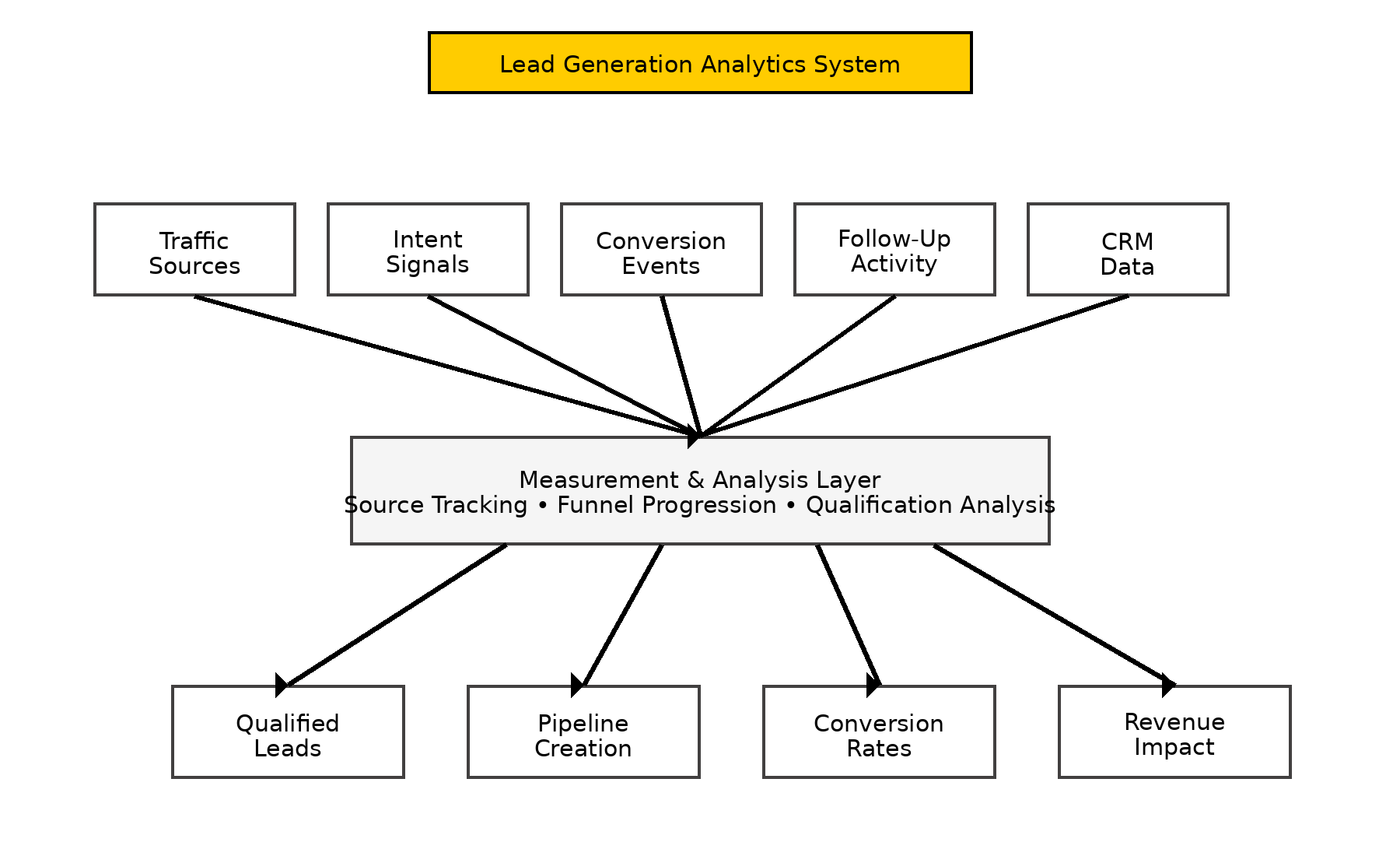
This is where lead generation stops being a guessing game. You can have strong messaging, solid traffic, and a decent offer, but if you are not measuring what turns attention into qualified opportunities, you are going to make expensive decisions with false confidence. The businesses that grow more predictably are not always the ones with the biggest budgets; they are usually the ones that know exactly where momentum is building and where it is leaking away.
That is why measurement and optimization deserve their own section instead of being treated like a technical afterthought. A professional lead generation system should tell you which channels create serious intent, which assets move buyers forward, and which steps in the journey create friction. Once that visibility is in place, optimization becomes much more practical because you are improving a real system, not arguing over opinions.
Measure Qualified Pipeline, Not Just Lead Volume
The first trap to avoid is celebrating volume without checking quality. A spike in form fills can look exciting for about five minutes, but it means very little if those contacts never book, never reply, and never turn into revenue. Lead generation gets healthier when the core question changes from “How many leads did we get?” to “How many of these leads actually moved the business forward?”
This shift matters because modern buying journeys are more self-directed than they used to be. Gartner reported in March 2026 that 67% of B2B buyers prefer a rep-free experience, which means a lot of the real evaluation is happening before sales gets involved. If your lead generation reporting still ends at raw capture numbers, you are missing the part of the journey that actually determines commercial value.
The better approach is to track progression. Look at how many leads become qualified conversations, how many qualified conversations become pipeline, and how many of those opportunities close. That is the reporting structure that makes lead generation useful to the business instead of merely visible to the marketing team.
Track Source Quality And Intent Signals
Not all traffic sources deserve equal trust. Some channels bring people who are curious but uncommitted, while others bring buyers who already understand the problem and are actively looking for a solution. If you do not separate those realities in your measurement, you will eventually overinvest in channels that look efficient on the surface but quietly underperform where it counts.
This is why source quality needs to be measured alongside intent signals. A lead who arrives through a high-intent search query, spends time on a pricing page, and books a call is telling you a very different story from someone who casually downloaded a top-of-funnel asset and disappeared. In the 2025 B2B Buyer Experience Report from 6sense, 94% of buyers said they ordered their shortlist by preference before engaging sellers, which is exactly why these intent signals matter so much in lead generation. By the time a lead appears, the buying process is often much further along than it looks.
When you understand source quality properly, optimization gets sharper. You stop asking which channel generated the most activity and start asking which channel created the strongest buying intent. That one change can save a business a huge amount of wasted spend.
Optimize Conversion Paths Before Scaling
A lot of businesses try to fix lead generation by buying more traffic. That can work for a while, but if the conversion path is weak, all you are really doing is paying more people to hit the same friction points. Optimization should start with the path itself: the page, the message, the form, the offer, the scheduling flow, and the first follow-up.
This is where clean infrastructure creates a real advantage. When your funnel is simple enough to understand, you can see where people hesitate and test improvements without breaking everything else. Businesses often use platforms like ClickFunnels, Systeme.io, or Fillout because they make these paths easier to standardize, test, and improve over time.
The main point is simple: do not scale confusion. Fix the conversion journey first, then add more volume to a path that already works. That is how lead generation becomes more efficient instead of just more expensive.
Use Follow-Up Speed And Consistency As Real Metrics
One of the most overlooked parts of lead generation measurement is what happens after the lead arrives. Teams spend weeks debating ad creative or page copy, then leave follow-up speed, message relevance, and routing quality mostly unexamined. That is a mistake, because a promising lead can lose momentum fast when the first response is slow, generic, or sent by the wrong person.
Optimization here should be brutally practical. Measure time to first response. Measure meeting-book rate by source and by offer. Measure reply rate across different nurture sequences. Then compare those numbers against pipeline creation, because that is where you start seeing whether your lead generation engine is truly supporting the sales process or quietly damaging it.
This is also where automation can help without making communication feel robotic. A business may use Brevo to keep nurturing consistent, Copper to maintain cleaner ownership and tracking, and Cal.com to remove friction when a lead is ready to book. Good lead generation is not just about attracting interest. It is about keeping that interest alive long enough for real opportunity to form.
Build Feedback Loops That Reach Revenue
The most valuable optimization work happens when marketing and sales are looking at the same reality. If marketing is reporting on leads while sales is complaining about quality, the business is stuck with two dashboards and no truth. Lead generation improves much faster when feedback loops go all the way from first touch to closed revenue.
This is exactly why better data discipline matters so much. McKinsey’s 2024 B2B Pulse research found that data-driven commercial teams that combine personalized experiences with gen AI are 1.7 times more likely to increase market share. That is not just an analytics story. It is a lead generation story, because stronger feedback loops make it easier to double down on what is working and cut what is quietly draining performance.
The practical takeaway is to build reviews around decisions, not just dashboards. Which source created the best-fit opportunities this month? Which offer brought in leads that actually advanced? Which campaign looked efficient but produced weak pipeline? Those are the questions that make lead generation smarter month after month.
Continuous Optimization Beats Big Overhauls
The final thing to understand is that lead generation usually improves through steady refinement, not dramatic reinvention. Most businesses do not need to rebuild everything from scratch. They need to tighten one offer, simplify one form, improve one follow-up sequence, clean one routing rule, or shift budget away from one underperforming channel.
This is one reason the best teams tend to outperform over time. Salesforce’s State of Marketing report keeps highlighting the importance of unified customer experiences and stronger personalization across channels, and that kind of improvement rarely comes from one giant fix. It comes from a culture of testing, learning, and adjusting with discipline.
So if you want better lead generation, do not chase random hacks. Build a measurement system that tells the truth, optimize the journey where real friction exists, and keep tightening the parts that move qualified buyers toward action. That is how lead generation becomes something you can trust, not just something you hope keeps working.
Building A Resilient Lead Generation Ecosystem

If you want lead generation that keeps working even when channels shift, costs rise, or buyer behavior changes again, you have to think beyond campaigns. A resilient ecosystem is what happens when your content, offers, conversion paths, CRM, follow-up, analytics, and team workflows all support one another instead of operating like separate little islands. That kind of setup is not just more efficient. It is far harder to break.
This matters because the market is not standing still. Gartner’s March 2026 survey found that 67% of B2B buyers prefer a rep-free experience, while 6sense’s 2025 buyer research shows that 94% of buyers rank their shortlist by preference before talking to sellers. Those two realities together make one thing crystal clear: lead generation now has to create trust, preference, and momentum long before the sales conversation begins.
That is why the most durable businesses build systems, not stunts. They do not rely on one ad account, one lucky webinar, or one channel that happens to be hot for six months. They create an ecosystem where each part strengthens the next, so when one source weakens, the whole machine still keeps producing opportunities.
How The Ecosystem Stays Strong
A strong lead generation ecosystem starts with message consistency. Your content should sound like it belongs to the same brand as your landing pages, your nurture emails, your outreach, and your sales conversations. When that consistency is missing, prospects feel the disconnect immediately, and trust gets weaker right at the moment it should be getting stronger.
The second layer is operational consistency. A resilient system routes leads cleanly, follows up on time, and keeps data organized enough to show what is working. That is one reason businesses often connect tools for funnel building, email, scheduling, and CRM instead of letting every part of lead generation live in its own silo. Some use ClickFunnels for structured conversion journeys, Brevo for follow-up automation, Copper for relationship management, and Cal.com for fast scheduling once intent becomes serious.
The third layer is adaptability. HubSpot’s 2026 State of Marketing shows that 61% of marketers believe marketing is seeing its biggest disruption in 20 years because of AI, which means resilient lead generation has to be flexible enough to absorb major changes in content production, discovery, and buyer expectations without falling apart every quarter.
Why Ecosystems Outperform One-Off Campaigns
One-off campaigns can produce wins, and there is nothing wrong with that. The problem is that they are rarely dependable on their own. If your lead generation rises and falls with isolated pushes, every month begins with pressure and every slowdown feels like an emergency.
An ecosystem solves that problem by compounding. Content attracts attention. Offers convert that attention into leads. Email and CRM systems maintain momentum. Sales conversations close the right opportunities. Analytics reveal where to improve. Then the next round performs better because the learning stays inside the system.
This is the exact kind of compounding advantage the best teams are chasing. McKinsey’s 2024 B2B Pulse research found that data-driven commercial teams blending personalized experiences with gen AI are 1.7 times more likely to increase market share. That is not luck. That is what happens when lead generation is treated like an operating system instead of a collection of random marketing moves.
FAQ For A Complete Guide To Lead Generation
What Is Lead Generation?
Lead generation is the process of turning attention into identifiable business opportunities. That usually means getting a prospect to take a step such as filling out a form, booking a call, subscribing to a list, requesting a quote, or replying to outreach. The real goal is not just collecting contact details. It is moving the right people closer to a buying decision.
Why Is Lead Generation Important?
Lead generation matters because it connects marketing activity to revenue potential. Without it, content, ads, partnerships, and outbound efforts may create visibility but still fail to create predictable business growth. It matters even more now because Gartner found that 67% of B2B buyers prefer a rep-free experience, which means your lead generation system has to do more of the persuasion before sales gets involved.
How Is Lead Generation Different From Demand Generation?
Demand generation creates awareness, interest, and market attention. Lead generation captures that attention and turns it into a measurable next step. The two work best together. Demand generation warms the market, while lead generation gives people a clear path to act once they are interested.
What Makes A Good Lead?
A good lead is not just someone who converted. It is someone who fits the business, shows real intent, and has a believable path toward becoming revenue. The best way to judge lead quality is to look at progression through the pipeline, not just raw volume. A low-volume source that creates strong-fit opportunities can be far more valuable than a high-volume source that produces mostly noise.
Which Channels Work Best For Lead Generation?
The best channel depends on audience behavior, buying intent, and offer quality. That said, strong current data still points to content and search playing major roles. Content Marketing Institute’s 2025 B2B research shows that 74% of B2B marketers say content marketing helped generate demand and leads in the last 12 months, and 61% say SEM or PPC delivers the best paid-channel results. The smartest move is usually to focus on the channels that match your buyers instead of trying to be everywhere at once.
How Many Leads Do I Need?
That depends on your conversion rates, deal size, sales cycle, and lead quality. A business with strong close rates may need far fewer leads than one with weak qualification and long follow-up delays. This is why lead generation works better when you measure all the way from first touch to closed revenue. Once you know the real conversion path, you can calculate how many qualified leads you actually need instead of guessing.
Should I Focus On More Traffic Or Better Conversion?
Most businesses should improve conversion before scaling traffic. If your offer is unclear, your page is weak, or your follow-up is inconsistent, buying more traffic usually just increases waste. Tighten the path first, then scale what is already working. That is how lead generation becomes more efficient instead of more expensive.
How Fast Should I Follow Up With A Lead?
As fast as your system can respond without sacrificing relevance. Speed matters because intent fades quickly, especially when buyers are comparing multiple options at once. The strongest teams do not just respond quickly. They respond with context that matches the lead’s actual action, whether that means educational nurturing, a direct sales conversation, or a simple booking flow.
Does AI Help With Lead Generation?
Yes, when it is used to improve execution rather than create more noise. AI can speed up content production, support personalization, improve lead qualification, and help teams maintain follow-up at scale. HubSpot’s 2026 State of Marketing report shows that 61% of marketers see AI as the biggest disruption in 20 years, and 80% say they use AI for content creation. The real advantage appears when AI is connected to a clean system instead of being layered onto a messy one.
What Should I Measure In Lead Generation?
Start with qualified lead volume, pipeline creation, source quality, conversion rate by offer, time to follow-up, meeting-book rate, and revenue by channel. Those numbers tell you where intent is strong and where friction is blocking momentum. McKinsey’s 2024 B2B Pulse research is especially useful here because data-driven teams blending personalization with gen AI are 1.7 times more likely to increase market share. That tells you measurement is not just about reporting. It is a growth lever.
Is Lead Generation Still Effective If Buyers Avoid Sales?
Yes, but it has to do more work earlier in the journey. Buyers may avoid sales conversations at first, but they are still researching, comparing, and forming preferences. 6sense found that 94% of buyers rank their shortlist before engaging sellers, and the early favorite wins 77% of the time. That means lead generation is still highly effective, but the content, messaging, and conversion experience have to build belief before the call ever happens.
Can Small Businesses Compete With Bigger Brands In Lead Generation?
Yes, especially when they are more focused, faster, and more relevant. Bigger brands often have more budget, but smaller businesses can still win by narrowing their audience, improving their offer, and creating a smoother path from interest to action. Lead generation rewards clarity and consistency more than sheer size, particularly in specialized markets where trust and fit matter more than broad visibility.
What Tools Are Useful For Lead Generation?
The best tools are the ones that reduce friction and keep the system connected. Businesses often use ClickFunnels or Systeme.io for funnels and landing pages, Fillout for cleaner form flows, Brevo for follow-up automation, and Copper for CRM management. The right stack is the one that helps your lead generation process stay clear, measurable, and easy to improve.
Work With Professionals
There comes a point when trying to patch lead generation together on your own starts costing more than getting help. That usually happens when traffic is coming in but quality is uneven, the follow-up process is inconsistent, or your team knows something is leaking but cannot clearly see where. At that stage, working with professionals is not about handing off responsibility. It is about getting a sharper strategy, better systems, and faster progress.
The right professionals do more than run campaigns. They help clarify positioning, tighten offers, improve conversion paths, connect the technology stack, and build reporting that reaches all the way to revenue. That is the kind of work that turns lead generation from a stressful monthly guessing game into a system the business can actually trust.
Explore 10K+ Remote Marketing Contracts on MarkeWork.com
Most marketers spend too much time chasing clients, competing on crowded platforms, and losing a percentage of every project to middlemen.
MarkeWork gives you a better way. Browse thousands of remote marketing contracts and connect directly with companies desperate to hire skilled marketers like you without platform commissions and without unnecessary gatekeepers.
If you’re serious about finding better opportunities and keeping 100% of what you earn, you can explore available contracts and create your profile for free at MarkeWork.com.
 Filip Konecny Enterprises