
Instagram Marketing: Strategy, Reach, and the Framework That Actually Works
Instagram marketing is not just about posting pretty images and hoping something takes off. It is one of the few channels where brand discovery, community building, direct response, and social commerce can all happen inside the same ecosystem, which is exactly why so many businesses keep pouring serious attention into it. When you treat it like a real growth channel instead of a casual content feed, Instagram can help you shape demand, capture intent, and move people from curiosity to conversion with surprising speed.
That matters even more now because the platform is still massive, still culturally influential, and still tied into Meta’s broader advertising machine. Instagram’s potential ad reach climbed by 5.5% year over year in January 2025, adding 90.8 million reachable users, while half of U.S. adults say they use Instagram and roughly six in ten U.S. teens still use it. If your audience buys visually, follows creators, researches products socially, or responds to brand personality, you cannot afford to treat Instagram like an optional extra.
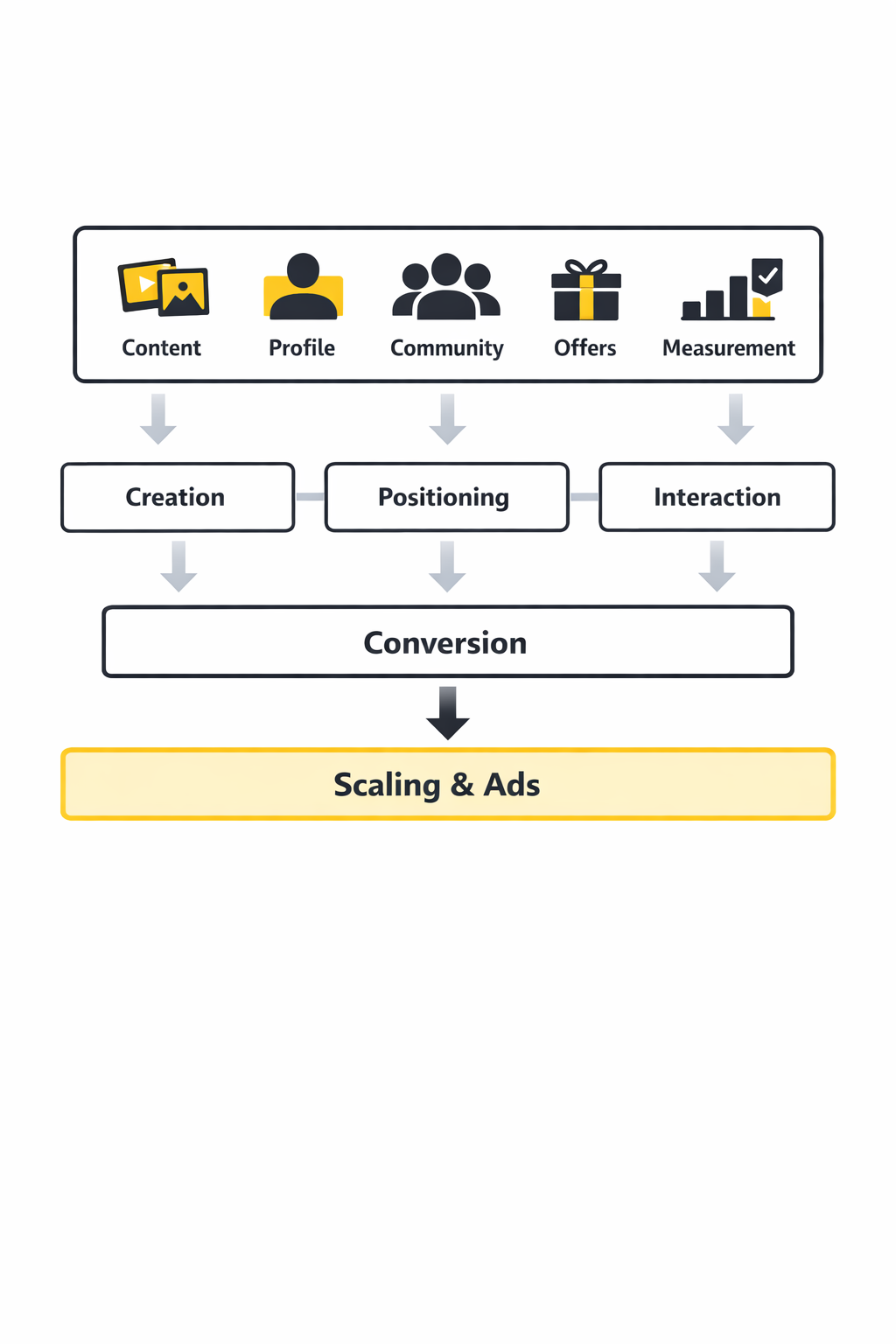
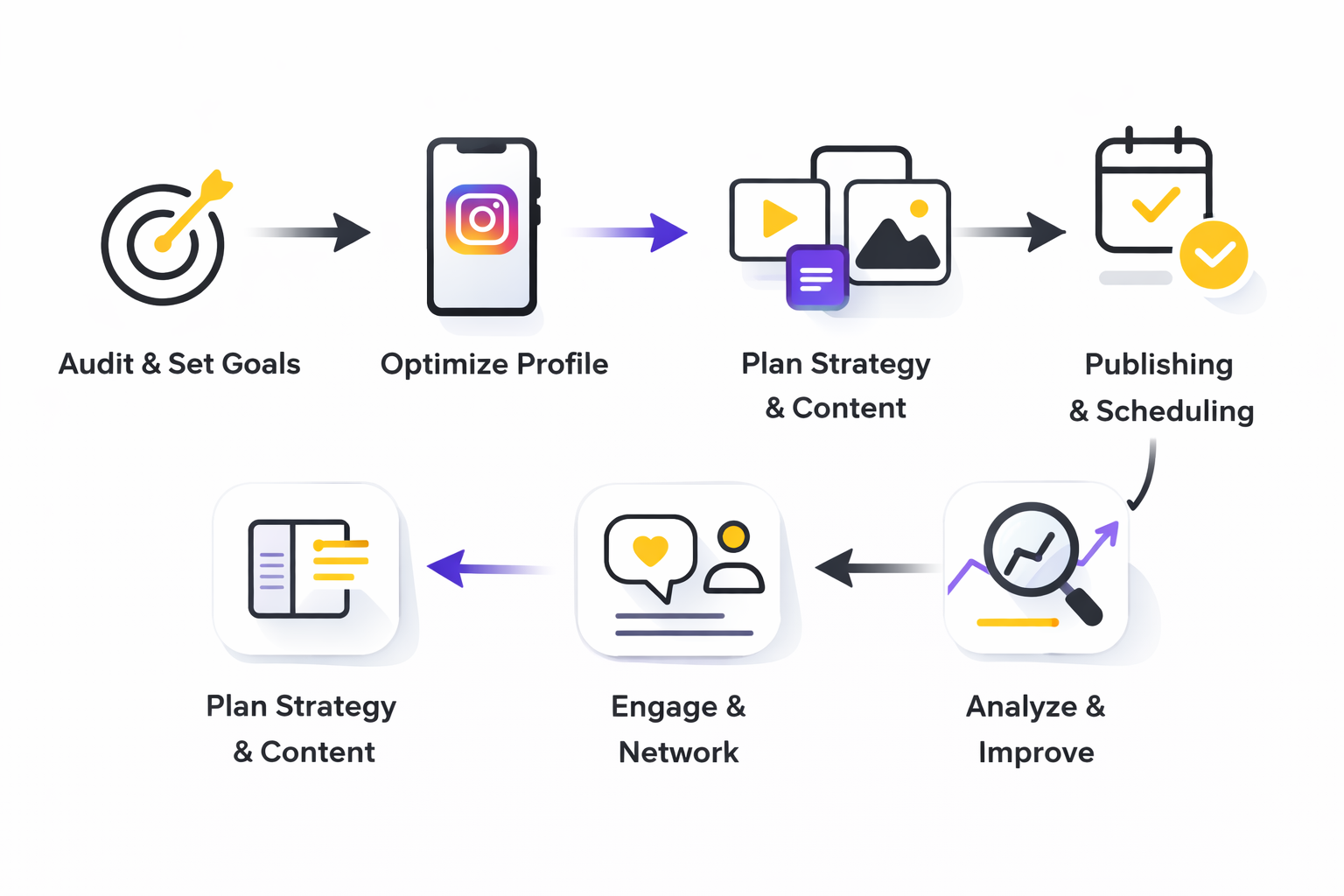
The smart way to approach Instagram marketing is to stop thinking in isolated tactics and start thinking in systems. Your profile, content mix, conversion path, offers, collaborations, measurement stack, and ad strategy all have to work together. This first part gives you the big-picture foundation so the rest of the article can build into a professional strategy rather than a pile of random tips.
Article Outline
- Why Instagram Marketing Matters
- Framework Overview
- Core Components
- Professional Implementation
- Analytics and Optimization
- Instagram Marketing FAQ
Why Instagram Marketing Matters
Instagram keeps earning attention because it sits right at the intersection of reach, relevance, and commercial intent. Its advertising audience represented 31.3% of the world’s internet users at the start of 2025, and the platform’s audience still centers heavily around the 25 to 34 age range, which is a prime bracket for both consumer spending and brand loyalty. That gives businesses a channel where storytelling and performance marketing can reinforce each other instead of competing for budget.
It also matters because buyer behavior has shifted toward social discovery. More than half of shoppers now discover products through social platforms, and Gen Z is more likely to buy through Instagram or TikTok than Facebook. When someone finds your brand on Instagram, watches a Reel, taps into Stories, reads comments, checks tagged products, and lands on your offer page, that is not random browsing anymore. That is a buying journey happening in public view.
There is also a scale advantage hiding in plain sight. Instagram marketing benefits from Meta’s wider infrastructure, and Meta reported that ad impressions across its Family of Apps rose 18% year over year in Q4 2025. In practical terms, that means organic content, creator collaborations, retargeting, and paid distribution can all plug into a much larger system than most brands realize. That is why disciplined operators use Instagram to build audience memory first and then convert that attention with sharper offers, better follow-up, and cleaner campaign structure.
For many businesses, the biggest mistake is assuming Instagram marketing only works for fashion, beauty, travel, or lifestyle brands. In reality, any business with a visual process, a teachable point of view, strong customer outcomes, or repeatable proof can build momentum here. Coaches can turn expertise into authority, ecommerce brands can shorten the path from interest to sale, and local businesses can create familiarity before a prospect ever visits the website or walks through the door.
Framework Overview
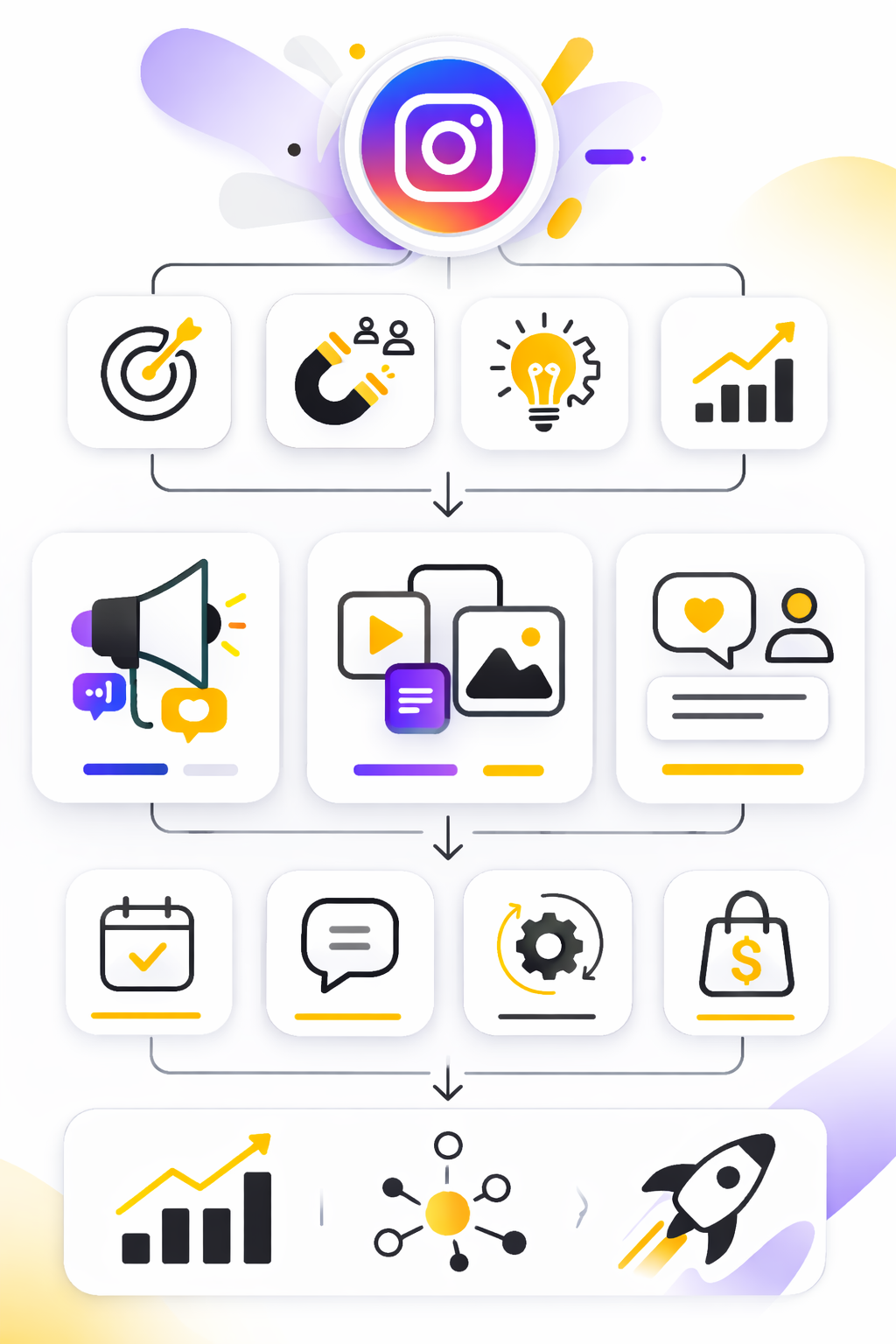
The cleanest way to think about Instagram marketing is through a six-part framework: positioning, profile design, content architecture, community interaction, conversion pathways, and optimization. Positioning defines why someone should care about your brand. Profile design makes your account instantly understandable. Content architecture creates repeatable formats that educate, entertain, and sell without feeling chaotic. Community interaction turns passive viewers into warm prospects. Conversion pathways move attention into email lists, offers, demos, or purchases. Optimization keeps the whole machine from stalling.
This matters because most brands fail on Instagram for structural reasons, not because the platform “stopped working.” They post inconsistently, chase trends with no angle, neglect their profile, and send traffic into weak funnels. A stronger setup starts with a clear destination: if someone discovers you today, what do you want them to believe, what do you want them to do next, and what proof will help them trust you enough to do it?
That is where tools can help, but only when they fit the strategy instead of replacing it. A scheduler like Buffer can keep your publishing cadence consistent, while a research tool like Flick can help you organize ideas, hashtags, and content planning more intelligently. The tool does not create the strategy for you, but it can remove enough friction that you actually follow through.
Instagram itself has pushed creators toward a more professional operating model as well. Meta’s Best Practices hub inside the professional dashboard now focuses on creation, engagement, reach, monetization, and guidelines, which mirrors the way serious brands already need to think. In other words, the platform is quietly telling you the same thing high-level marketers have known for years: the accounts that win are not the ones posting the most, but the ones running a clearer system.
Core Components of Effective Instagram Marketing
The core components of Instagram marketing are not mysterious, but they do need to work together. A lot of businesses get stuck because they obsess over content frequency while ignoring the things that actually make the content convert. If your positioning is weak, your profile is unclear, your posts are disconnected, and your next step is vague, even strong reach can turn into wasted attention.
That is why the best Instagram marketing strategy is built like a system. You need a profile that makes people understand you fast, a content structure that earns attention consistently, a trust-building layer that makes your brand feel real, and a conversion path that tells people what to do next. Once those pieces are in place, every post becomes more valuable because it is feeding the same machine instead of working alone.
Profile Positioning Comes First
Your Instagram profile is not a digital business card. It is your landing page inside the platform, which means it has one job: help the right person understand who you help, why you matter, and where they should go next. When someone lands on your account after seeing a Reel, a Story mention, or a shared post, they decide very quickly whether they want more from you or whether they are moving on.
That is why clear positioning matters more than clever wording. Your name field should improve discoverability, your bio should explain the value you bring, and your pinned posts should act like your best sales team, welcoming new visitors with proof, point of view, and a clear next action. Instagram marketing works better when the account itself reduces friction instead of creating it.
There is a practical reason this matters so much. Instagram’s own creator education now centers on creation, engagement, reach, monetization, and guidelines inside the professional dashboard, which is another way of saying your account needs to be run deliberately, not casually. The businesses that win are the ones that make their profile say, in seconds, “You are in the right place.”
Your Content System Needs Distinct Jobs
One of the biggest mistakes in Instagram marketing is expecting every post to do everything at once. Some content should stop the scroll, some should deepen trust, some should answer objections, and some should push for action. When you try to make every post entertain, educate, inspire, and sell in the same breath, the result usually feels crowded and forgettable.
A stronger content system separates those jobs. Reels are often the best discovery format because they can pull in cold audiences at scale, Stories are ideal for daily trust and conversational selling, and carousels are excellent when you need to explain an idea with more depth. Meta’s own ad documentation reflects that format logic too, with different creative requirements across Reels, Stories, Shop, and carousel placements and specific guidance that Reels ads behave much like organic Reels, including comments, likes, saves, shares, and skips.
That matters because content format is not just an aesthetic choice. It affects how people consume your message, how long they stay with it, and what kind of action they are likely to take next. Great Instagram marketing is not about being everywhere inside the app. It is about matching the format to the intent.
Community and Social Proof Turn Attention Into Trust
Reach by itself does not build a business. Plenty of accounts get views and still struggle to turn that attention into leads, sales, or referrals because the audience does not feel any real connection. That gap is usually a community problem, not a content problem.
Instagram gives brands a public trust layer that many other channels do not. People can read comments, watch how you reply, see tagged posts, notice whether customers mention you, and judge whether your audience seems genuinely interested or just passively present. In practical terms, that means your comment section, Stories replies, user-generated content, and collaborations are all part of your sales process whether you planned for that or not.
This is one reason social discovery keeps becoming more commercially important. More than half of shoppers now discover products on social platforms, and younger buyers are especially likely to make purchases through visually driven social environments such as Instagram and TikTok. If people are discovering brands socially, then trust also has to be built socially, in full view.
That does not mean you need to reply to every message like a customer support department. It means you need to show signs of life. Real comments, thoughtful responses, reposted customer wins, and visible interaction all tell a prospect that there are actual humans behind the brand and that other people care enough to participate.
Every Instagram Marketing Strategy Needs a Conversion Path
A surprising number of businesses put real effort into Instagram marketing and still leave money on the table because they never build a proper path out of the platform. They create attention, but they do not direct it. The audience likes the content, maybe even trusts the brand, but nobody is being moved toward a next step with enough clarity.
Your conversion path should fit your business model. For some brands, that means product pages and tagged catalog items. For service businesses, it may mean a lead form, a booking page, or a well-written application funnel. For creators and educators, it may mean an email list, a webinar, or a low-ticket offer that turns followers into buyers.
What matters is that the path exists and is easy to follow. Since Meta has shifted shopping more toward discovery and website-based completion, with reporting around new shopping features emphasizing that buyers are increasingly being sent to external checkout experiences, businesses need the transition from Instagram to website to feel seamless rather than improvised. In other words, Instagram marketing should create momentum, and your funnel should be ready to catch it.

Professional Implementation of Instagram Marketing
Once the foundation is in place, professional implementation is what separates serious operators from accounts that are simply “active.” This is the stage where strategy becomes process. You are no longer asking what to post today. You are deciding how Instagram marketing fits into your wider demand generation, content production, sales process, and measurement infrastructure.
This is also where discipline becomes a competitive advantage. A lot of brands can create a few good posts. Far fewer can maintain message consistency, publish with intention, connect organic and paid efforts, and keep improving based on actual performance data. That is why implementation matters so much: it is where momentum is either built or lost.
Operate With a Real Publishing Workflow
Professional Instagram marketing does not rely on inspiration alone. It runs on workflow. That means planning content themes ahead of time, turning one core idea into multiple assets, keeping approvals moving, and making sure your publishing calendar reflects actual business priorities rather than whatever feels urgent that day.
This is where process tools become useful. A platform like Buffer can help you schedule and maintain consistency, while Flick can support content research and organization when you need a clearer view of what to publish and why. The point is not to become dependent on software. The point is to remove enough operational friction that your strategy actually gets executed.
Good workflow also protects quality. When content is planned, reviewed, and repurposed properly, you are less likely to publish weak filler or drift away from the positioning that made your account valuable in the first place. That kind of consistency compounds over time, and on Instagram, compounding matters.
Blend Organic Content, Creator Partnerships, and Paid Distribution
Many brands still treat organic content, influencer work, and ads as separate worlds. That is a mistake. The more effective approach is to see them as connected layers of the same growth system. Organic content builds familiarity, creators add borrowed trust and relevance, and paid distribution scales what is already working.
Instagram has been making that workflow easier to manage. Meta expanded its Creator Marketplace so brands can discover creators, review portfolios, and collaborate more directly, while also stating that partnership ads are one of the most performant and transparent ways for brands and creators to run ads together. That matters because creator content often performs best when it is not left to organic reach alone.
Professional Instagram marketing takes the strongest organic signals and gives them more room to work. If a certain angle, hook, or creator asset is already generating saves, shares, replies, or strong watch time, that is often the exact material worth testing with paid amplification. You are not guessing from scratch at that point. You are scaling evidence.
Build Tracking That Can Survive Real-World Attribution Problems
One of the least glamorous parts of Instagram marketing is tracking, and yet it is one of the most important. If you cannot see which campaigns, creators, posts, or landing pages are producing meaningful results, you eventually start making decisions based on vibes, not evidence. That is where wasted spend and bad strategic calls start to pile up.
Meta has pushed advertisers toward a more resilient setup for a reason. Its business guidance on the Conversions API explains how server-side event sharing helps businesses prepare their measurement approach, and even many implementation guides built around Meta’s framework now recommend using browser and server signals together rather than relying on the pixel alone. For a business running Instagram marketing seriously, this is not just technical cleanup. It directly affects optimization, audience building, and how confidently you can scale.
The practical takeaway is simple. Send traffic to pages you control, use clear campaign naming, separate top-of-funnel and bottom-of-funnel intent, and make sure your tracking setup is good enough to tell you what is genuinely moving revenue. Professional implementation is not about making your reporting dashboard look sophisticated. It is about making better decisions with less guesswork.
Set a Higher Standard for Execution
At a certain point, Instagram marketing stops being about hacks and starts being about standards. Is the message clear? Does each format have a purpose? Does the profile convert curiosity into interest? Are you capturing demand when it appears? Are you measuring enough to improve what matters?
That is the mindset shift that changes results. Businesses that treat Instagram like a real marketing channel build systems, refine their assets, and get better over time. Businesses that treat it like a place to “post sometimes” usually stay stuck wondering why effort is not turning into growth.
The good news is that this is learnable. You do not need to master every feature at once. You just need to commit to building Instagram marketing professionally, one strong component at a time, and then keep tightening the system until attention turns into trust and trust turns into revenue.
Analytics and Optimization
This is the point where Instagram marketing either becomes a real growth channel or stays a busy-looking hobby. You can post consistently, build a decent profile, and even attract strong engagement, but if you never learn how to read the signals properly, you will keep guessing. And guessing is expensive because it tricks you into doing more of what feels productive instead of more of what actually moves the business forward.
The good news is that optimization does not have to be complicated. It just has to be honest. You need to know which numbers deserve your attention, which numbers are only supporting signals, and how to tell whether a content problem is really a targeting problem, a funnel problem, or an offer problem in disguise.
What to Measure First
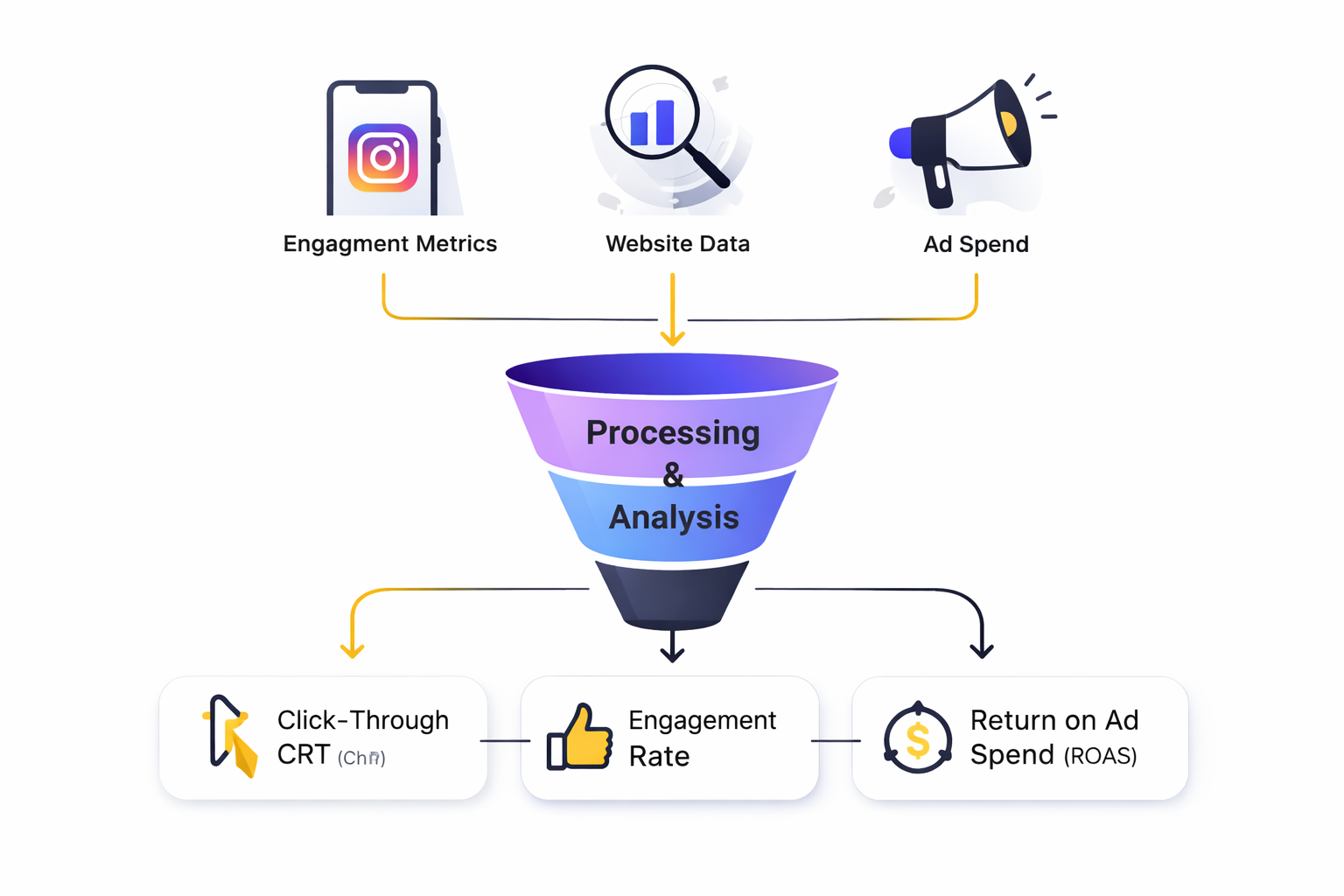
The smartest way to measure Instagram marketing is to separate attention metrics from business metrics. Attention metrics tell you whether content is earning reach and interest. Business metrics tell you whether that attention is turning into something valuable. If you blur those two categories together, you can end up celebrating vanity wins while revenue stays flat.
Start with the basics that actually help you think clearly. On the content side, look at views, watch time, shares, saves, profile visits, and replies. Meta has been leaning even harder into this kind of creator education, with its Best Practices hub in the professional dashboard focusing on creation, engagement, reach, monetization, and guidelines, which is a strong signal that better measurement is now part of better content, not something separate from it.
On the business side, look at link clicks, landing-page conversion rate, lead quality, cost per result, and revenue generated from Instagram-driven traffic. If your goal is lead generation, that means following the user beyond the app. A clean landing page, a simple form built with something like Fillout, and a follow-up sequence inside Brevo make it much easier to see whether your Instagram marketing is producing interest that can actually turn into money.
How to Read Signals Correctly
Not every strong metric means the same thing, and that is where a lot of marketers get confused. High reach with low profile visits usually means your hook worked but your positioning did not pull people deeper. Strong saves and shares with weak clicks often mean the content is useful, but the offer is either unclear or too far removed from the topic. Heavy clicks with weak conversions usually point to a landing-page or offer problem rather than an Instagram problem.
This is why context matters so much. A Reel that brings in new viewers may be doing its job even if it does not convert immediately, because discovery content and conversion content are not supposed to behave the same way. Instagram marketing works best when you judge each asset by its role in the system rather than forcing every post to perform like a sales page.
Meta’s broader ad business makes this even more important. In its Q4 2025 results, Meta said ad impressions across the Family of Apps rose 18% year over year, which tells you there is still massive opportunity to earn distribution, but more distribution also means more noise. When impressions rise, weak messaging gets exposed faster. That is why smart operators do not just ask, “Did this reach people?” They ask, “Did this reach the right people, and what did they do next?”
How to Test Without Fooling Yourself
Testing sounds exciting, but most bad testing creates false confidence. Changing five variables at once and then calling the winner “the best ad” does not tell you much. It only tells you that one messy bundle beat another messy bundle. If you really want Instagram marketing to improve, you need cleaner tests and better patience.
That means testing one meaningful variable at a time whenever possible. Compare one hook against another. Compare one landing page against another. Compare creator-led creative against brand-led creative. Meta’s Experiments tool is built specifically for A/B testing campaigns against each other, and its existence matters because proper testing is not optional when spend rises and the margin for error gets thinner.
You also need to resist the urge to declare winners too early. A few encouraging hours are not a trend. A handful of low-cost clicks are not proof that the campaign is healthy. The best Instagram marketing teams let the data mature enough to reveal patterns, then they make one clear decision at a time instead of thrashing the account with constant reactive edits.
Use Platform Diagnostics Instead of Pure Guesswork
When performance drops, many marketers immediately assume the algorithm turned against them. Sometimes the truth is much simpler. The creative may not be resonating, the audience may be misaligned, or the click may be leading to a weak page that breaks the momentum built inside Instagram. That is exactly why platform diagnostics matter.
Meta’s ad relevance diagnostics are designed to help advertisers identify whether creative assets, post-click experience, or audience targeting are hurting results. That is useful because it forces you to stop talking in vague terms like “this campaign feels off” and start looking at where the friction actually lives. Instagram marketing gets more profitable when you diagnose the system instead of blaming the channel.
The same logic applies beyond ads. If organic posts are getting reach but not replies, maybe the content is interesting without being relational. If Stories are getting opens but weak taps forward, maybe they are too slow. If profile visits rise after a Reel but follows do not, your bio, pinned posts, or positioning may be losing people right at the moment of highest curiosity.
Track Beyond the Pixel
If you are serious about Instagram marketing, basic pixel tracking is no longer enough on its own. Too many user journeys now cross devices, browsers, and privacy barriers for you to rely on the simplest possible setup and still expect clean reporting. That does not mean you need a giant enterprise stack. It does mean you should take tracking seriously before you scale.
Meta’s own business documentation explains that the Conversions API creates a more direct connection between marketing data and the systems that optimize targeting, measure outcomes, and improve cost efficiency. That matters because better event quality does not just help reporting after the fact. It can improve how campaigns optimize while they are running.
In practical terms, that means using consistent UTMs, checking event quality, and making sure your website or funnel is not the blind spot in your Instagram marketing. If you are driving traffic to a lead magnet, webinar, booking page, or product offer, your measurement has to follow the journey far enough to tell you whether the click was cheap, useful, or actually profitable.
When to Scale and When to Fix
One of the hardest parts of Instagram marketing is knowing whether a campaign needs more budget or more work. Many businesses scale too early because one piece of content shows promise. Others keep polishing weak assets because they are afraid to push harder once something starts working. Both mistakes waste time.
You scale when the message is landing, the conversion path is stable, and the economics still make sense after the first wave of results. You fix things when the top of the funnel looks healthy but the bottom does not, or when the content is clearly failing to attract the right kind of attention in the first place. The difference sounds simple, but it becomes much easier to see once you stop obsessing over single metrics and start reading the whole path.
That is the real power of optimization. Instagram marketing gets better when you stop treating performance like a mystery and start treating it like feedback. The brands that grow are not the ones with magical instincts. They are the ones willing to look at the evidence, make clean adjustments, and keep tightening the system until the numbers finally tell the same story the strategy was supposed to tell all along.
Statistics and Data
If you want to take Instagram marketing seriously, you need to look at the numbers without getting hypnotized by them. Raw reach, impressions, views, and follower counts can be useful, but only when they are connected to a real business question. The right statistics should help you understand whether Instagram is still worth the effort, where the opportunity is, and what kind of performance should make you lean in harder.
That is exactly why this section matters. A lot of people talk about Instagram marketing in vague terms, but the platform is big enough, commercial enough, and mature enough that the data tells a much clearer story now. And that story is pretty simple: Instagram still commands massive attention, it still matters to buyers, and it is still deeply important to Meta’s advertising business.
Audience Scale and Reach
Instagram is still operating at a scale that most businesses cannot ignore. DataReportal reported that Instagram’s potential advertising reach hit 1.74 billion users in January 2025, which is one of the clearest signs that the platform remains a global discovery engine rather than a niche social app. Even more importantly for marketers, that figure was up 5.5% year over year, adding 90.8 million users to Instagram’s potential ad reach, which tells you the platform is not simply surviving on old momentum.
That kind of scale matters because it changes the ceiling of what Instagram marketing can do. You are not just publishing into a social network with isolated pockets of attention. You are operating inside one of the largest commercial media environments on the internet, which means the upside is meaningful if your content, offer, and conversion path are aligned.
There is also a strong age-distribution advantage built into that audience. Instagram’s largest ad audience segments in early 2025 were users aged 25 to 34, which is a prime age range for both B2C purchasing and professional decision-making. That helps explain why Instagram marketing can work for ecommerce brands, consultants, educators, software companies, and local service businesses without forcing all of them into the same playbook.
Usage in the United States
When marketers wonder whether Instagram is still relevant in the United States, the answer is not subtle. Pew Research found in 2025 that 50% of U.S. adults use Instagram, which made it the only platform besides YouTube and Facebook to clear the 50% mark in that survey. That level of adoption means Instagram marketing is not dependent on chasing a tiny early-adopter crowd. It is now part of mainstream digital behavior.
The youth picture matters too, especially if your brand depends on future demand rather than only current demand. Pew’s 2024 survey found that 61% of U.S. teens use Instagram, which is a strong reminder that the platform still holds cultural weight among younger audiences even as the broader social landscape gets more fragmented. That matters because cultural relevance often drives commercial relevance a little later.
For Instagram marketing, this creates a rare balance. The platform is large enough to reach established adult buyers, but still culturally alive enough to shape what younger audiences notice, follow, and eventually buy. Few channels can claim both at the same time, which is exactly why Instagram keeps showing up in serious marketing plans.
Shopping and Discovery Data
The commercial side of Instagram marketing makes even more sense when you look at how people actually discover products now. Salesforce reported in 2025 that 53% of shoppers discover products through social platforms, up from 46% in 2023, while 76% of Gen Z shoppers said they use social media to find products. That is a huge shift because it means discovery is no longer happening only through search engines, storefronts, or direct traffic.
That shift becomes even more powerful when social platforms are not just discovery channels but buying environments. DHL’s 2025 E-Commerce Trends Report found that 7 in 10 shoppers have already made a purchase through social media, and the same share expects social platforms to become their primary shopping destination by 2030. That does not mean every sale must happen inside Instagram itself. It means Instagram marketing increasingly sits at the front end of transactions that people are comfortable starting socially.
This is where many businesses underestimate the channel. They still treat Instagram as a place for awareness only, even though the buying journey is already starting there. When someone discovers the brand on Instagram, watches a Reel, checks Stories, taps the bio link, and buys later through a landing page or store, Instagram has still done serious commercial work even if the final checkout happened elsewhere.
Instagram’s Value to Meta
Another way to understand the strength of Instagram marketing is to look at how valuable Instagram has become inside Meta’s business itself. eMarketer projected that Instagram would generate $32.03 billion in U.S. ad revenue in 2025, and that it would account for 50.3% of Meta’s U.S. advertising revenue. That is not a side business anymore. That is a core engine.
The broader Meta advertising machine is still growing as well. Meta reported that ad impressions across its Family of Apps increased 18% year over year in Q4 2025, while average price per ad rose 6%. When impressions and pricing both rise, it usually means attention is still there and advertiser demand is still strong.
For anyone building an Instagram marketing strategy, that matters because it shows the platform is not being treated internally like a fading asset. Meta is still monetizing it aggressively, improving the ad system around it, and tying it into a broader ecosystem of placements, measurement tools, and creator monetization features. In plain English, the company running the platform is still very motivated to make Instagram commercially powerful.
What These Numbers Actually Mean
The statistics are useful, but the real value comes from interpreting them correctly. Big reach tells you the platform is still worth testing. Strong U.S. adoption tells you it is still mainstream. High social discovery numbers tell you people are comfortable finding brands there. Rising ad revenue tells you businesses are still betting real money on the channel.
Put all of that together and the message becomes hard to miss. Instagram marketing still matters because it sits at the center of attention, discovery, influence, and monetization. That does not guarantee your strategy will work automatically, but it does tell you the opportunity is real enough that ignoring it would be a strategic mistake for a lot of brands.
The smartest move is not to obsess over every statistic. It is to let the data confirm what kind of channel Instagram really is: large, commercially relevant, and capable of driving serious outcomes when you stop treating it like a casual posting app and start building around it like a professional marketer.
FAQ for This Complete Instagram Marketing Guide
What is Instagram marketing, really?
Instagram marketing is the process of using Instagram to attract attention, build trust, and move people toward a business goal such as a sale, a lead, a booking, or an email signup. The important part is that it is not just “posting on Instagram.” Effective Instagram marketing connects content, profile positioning, community interaction, offers, and measurement into one system that actually helps the business grow.
That is why the platform still matters so much. Instagram’s potential ad reach was reported at 1.74 billion users in January 2025, and half of U.S. adults use Instagram. When that much attention is concentrated in one place, businesses that know how to communicate clearly and convert cleanly have a real advantage.
Does Instagram marketing still work in 2026?
Yes, but it works differently than it did a few years ago. It is less about posting random lifestyle content and hoping the algorithm blesses you, and more about building a clear brand position, publishing content with purpose, and moving people into a stronger conversion path. The brands that treat Instagram casually tend to struggle, while the brands that treat it like a real marketing channel still find plenty of upside.
The broader data supports that. Meta reported that ad impressions across its Family of Apps rose 18% year over year in Q4 2025, which tells you there is still enormous distribution happening inside the ecosystem. Instagram marketing is not dead. Weak execution is what usually dies first.
How many followers do you need before Instagram marketing starts working?
You do not need a huge following for Instagram marketing to become useful. A smaller account with sharp positioning, strong proof, and a clear offer can outperform a much larger account that attracts the wrong people. Follower count helps, but relevance and trust matter more.
This is one of the biggest mindset shifts serious marketers need to make. If your content attracts the right audience and your profile makes your value obvious, even a modest account can generate meaningful leads or sales. A lot of businesses stay stuck because they obsess over audience size before they fix audience fit.
What content types work best for Instagram marketing?
The best content types depend on the job you need the content to do. Reels are excellent for discovery, carousels are strong for explanation and teaching, and Stories are one of the best places to build daily trust and guide people toward action. The mistake is expecting every format to perform the same way.
Instagram itself keeps reinforcing that different formats serve different purposes. Meta’s Best Practices hub inside the professional dashboard focuses on creation, engagement, reach, monetization, and guidelines, which mirrors the way experienced marketers already think. Good Instagram marketing assigns each format a role instead of throwing content into the app without a plan.
How often should you post on Instagram?
You should post often enough to stay visible and learn from the data, but not so often that quality falls apart. For most businesses, consistency beats intensity. A steady publishing rhythm with strong ideas will almost always outperform bursts of rushed content followed by long silence.
The right answer depends on your resources, but the principle is simple: build a schedule you can maintain without lowering standards. If you want help keeping that rhythm organized, a tool like Buffer can make scheduling and planning much easier. Instagram marketing improves when the system is sustainable, not when it is exhausting.
Do hashtags still matter for Instagram marketing?
Hashtags still matter, but they are no longer the main event. They can help categorize content and support discoverability at the margins, but they will not rescue weak positioning, boring hooks, or a confusing profile. If the content itself is not compelling, hashtags are not going to save it.
That is why smart Instagram marketing treats hashtags as a supporting tool rather than a growth strategy. Research tools such as Flick can help you stay organized and more intentional with topic planning, but the real leverage still comes from message, relevance, and audience fit. The content has to earn attention first.
Should you focus on organic content or Instagram ads?
The best answer is usually both, but in the right order. Organic content helps you discover what your audience responds to, what kind of language they engage with, and what positioning feels strongest. Paid campaigns can then amplify what is already showing signs of life instead of forcing you to guess from scratch.
This matters because Instagram marketing becomes much more efficient when ads are built on real audience signals. Organic tells you what resonates. Paid helps you scale it. If you skip the learning stage and jump straight into spend, you can end up paying to distribute weak creative at a much larger scale.
How should you measure success in Instagram marketing?
You should measure success by separating attention metrics from business metrics. Attention metrics include things like views, saves, shares, profile visits, and replies. Business metrics include leads, bookings, conversion rate, revenue, and customer value. When you mix those together carelessly, you end up celebrating activity instead of results.
That is why serious Instagram marketing needs a better follow-through system after the click. A clean form with Fillout and follow-up sequences in Brevo can help you see whether traffic from Instagram is actually producing leads you want. If the click happens but the business result never follows, the problem may not be Instagram at all.
Can Instagram marketing work for B2B companies and service businesses?
Yes, absolutely. Instagram marketing can work for B2B companies, consultants, agencies, coaches, and local services when the message is built around outcomes, expertise, and credibility rather than generic branding. People still buy from people, and Instagram is one of the strongest places to make expertise visible in a human way.
For a service business, that might mean showing behind-the-scenes work, explaining decision-making, sharing client wins with permission, and using Stories to answer common objections. For B2B brands, it often means making the value understandable faster. Instagram does not need to look like LinkedIn to create business opportunities.
How long does it take for Instagram marketing to produce results?
It depends on your offer, your audience, your starting point, and how strong your execution is. Some businesses can generate traction quickly if they already have a sharp offer and know who they want to reach. Others need more time because their message is unclear, their content is inconsistent, or their funnel is weak.
The important thing is not to confuse early signals with final results. A few strong posts can tell you that you are moving in the right direction, but real Instagram marketing momentum usually comes from repetition, refinement, and honest measurement over time. This is one of those channels where patience and discipline are not optional.
Do brands need creators or influencers for Instagram marketing now?
Not every brand needs creators, but more brands should take creator partnerships seriously. Creator-led content can feel more native, build trust faster, and give you more creative angles than brand-made assets alone. That is especially useful when your in-house content starts looking polished but predictable.
Meta has been building around this reality directly. Its Creator Marketplace expansion emphasized easier collaboration between brands and creators and highlighted partnership ads as a strong, transparent format. In many cases, Instagram marketing gets stronger when borrowed trust and paid amplification work together.
Is Instagram still a strong platform for product discovery and shopping?
Yes, and this is one of the most important reasons businesses keep investing in Instagram marketing. Buyers are increasingly comfortable discovering products through social platforms, evaluating brands there, and beginning the purchase journey before ever reaching a website. That shifts Instagram from “awareness only” into a real commercial channel.
The trend is bigger than one platform. Salesforce reported in 2025 that 53% of shoppers discover products through social platforms, while DHL found that 7 in 10 shoppers have already bought through social media. Instagram marketing becomes far more powerful once you realize discovery itself is already part of the sale.
What is the biggest mistake businesses make with Instagram marketing?
The biggest mistake is treating Instagram like a content slot machine instead of a business system. Businesses post without clear positioning, chase trends without a strategy, ignore their profile, neglect the follow-up path, and then blame the platform when nothing compounds. That approach almost guarantees frustration.
The better way is to tighten the message, assign every content format a purpose, build a real next step, and keep refining based on what the audience actually does. Instagram marketing gets much easier to understand once you stop asking for random virality and start building for consistent conversion. That is the shift that changes everything.
Work With Professionals
You can absolutely build your own Instagram marketing system, and for many businesses that is the right place to start. But there comes a point where guessing costs more than getting expert help. If your content is inconsistent, your funnel leaks, your tracking is weak, or your offer is not translating on-platform, working with experienced marketers can save you a ton of time and help you stop spinning your wheels.
This is especially true if you want faster execution. Great Instagram marketing is not just about ideas. It is about content planning, creative production, messaging, conversion design, automation, testing, and follow-up working together. That is a lot to manage if you are also running the business.
If you need systems that support Instagram traffic after the click, tools like ClickFunnels or Systeme.io can help you build stronger conversion paths, and Copper can support relationship management when leads start coming in. The real goal is not to add more tools for the sake of it. The goal is to build an Instagram marketing engine that turns attention into revenue without everything falling apart behind the scenes.
Explore 10K+ Remote Marketing Contracts on MarkeWork.com
Most marketers spend too much time chasing clients, competing on crowded platforms, and losing a percentage of every project to middlemen.
MarkeWork gives you a better way. Browse thousands of remote marketing contracts and connect directly with companies desperate to hire skilled marketers like you without platform commissions and without unnecessary gatekeepers.
If you’re serious about finding better opportunities and keeping 100% of what you earn, you can explore available contracts and create your profile for free at MarkeWork.com.
 Filip Konecny Enterprises