
Influencer Marketing: Strategy, Structure, and Professional Execution
Influencer marketing has moved far beyond the stage where brands simply paid for a post and hoped for attention. It now sits at the intersection of media, commerce, community, and trust, which is why serious teams treat it as a structured growth channel rather than a side experiment. A large meta-analysis covering 1,531 effect sizes from 251 papers shows that influencer marketing materially affects consumer decision-making, but it also makes one thing clear: results improve when brands design programs around credibility, fit, and measurable outcomes instead of chasing reach alone.
That shift is happening at the same time platforms are building more direct infrastructure for creator partnerships. YouTube BrandConnect now gives brands a self-service way to find creators and manage branded content campaigns, while TikTok’s 2025 trend report frames creator collaboration as part of a broader move toward content that feels participatory, culturally fluent, and community-driven. In other words, the platform layer now supports what the market already learned the hard way: creator partnerships work best when they feel native to how people actually consume content.
The strategic pressure is only getting stronger. HubSpot’s 2025 social media marketing report says marketers are seeing stronger results from creators with fewer than 100,000 followers, and Sprout Social’s 2025 research shows always-on programs outperform stop-start campaigns by a wide margin in B2B as well. That combination matters because it changes how smart brands budget, brief, approve, and measure influencer marketing from the very beginning.
Article Outline
This article is organized into six connected parts so you can move from first principles to practical execution without losing the big picture.
- Why Influencer Marketing Matters
- Influencer Marketing Framework Overview
- Core Components of an Effective Program
- Professional Implementation
- Measurement and Analytics
- Future Ecosystem and Trends
Why Influencer Marketing Matters

Influencer marketing matters because attention is no longer won by brand authority alone. People now discover products through creators who filter options, translate product value into everyday language, and give audiences a reason to care before they ever visit a product page. That makes the creator less like rented media space and more like a trusted distribution layer sitting between the brand and the buyer.
The effectiveness of that layer depends on trust, not celebrity for its own sake. The academic evidence is increasingly consistent here: the recent meta-analysis in the Journal of the Academy of Marketing Science and a 2024 review of 93 articles on influencer marketing effectiveness both point back to credibility, relevance, and engagement as central drivers of performance. That is why a smaller creator with tighter audience alignment often outperforms a bigger account with weaker audience fit.
The market is responding to that reality. HubSpot found in 2025 that marketers are seeing more success with small influencers than with larger ones, which signals a maturing channel rather than a shrinking one. Brands are becoming more selective, more performance-aware, and far more interested in whether creator content can move real business metrics instead of generating vanity engagement.
Consumer expectations are also shaping the channel. Sprout Social reports that 67% of consumers say the best brand and influencer collaborations feel honest and unbiased, which tells you exactly where bad campaigns fall apart. When the content sounds scripted, over-produced, or disconnected from the creator’s normal voice, the partnership stops functioning as trust transfer and starts feeling like ordinary advertising.
That is also why disclosure is not a legal footnote but a strategic requirement. The FTC’s guidance for social media influencers and the ASA’s influencer guide both make the same principle clear: audiences should be able to recognize when content is advertising. Even better, the ASA’s 2024 disclosure study published in 2025 shows transparency is improving, which is good for the entire channel because cleaner disclosure makes creator recommendations more credible, not less.
Influencer Marketing Framework Overview
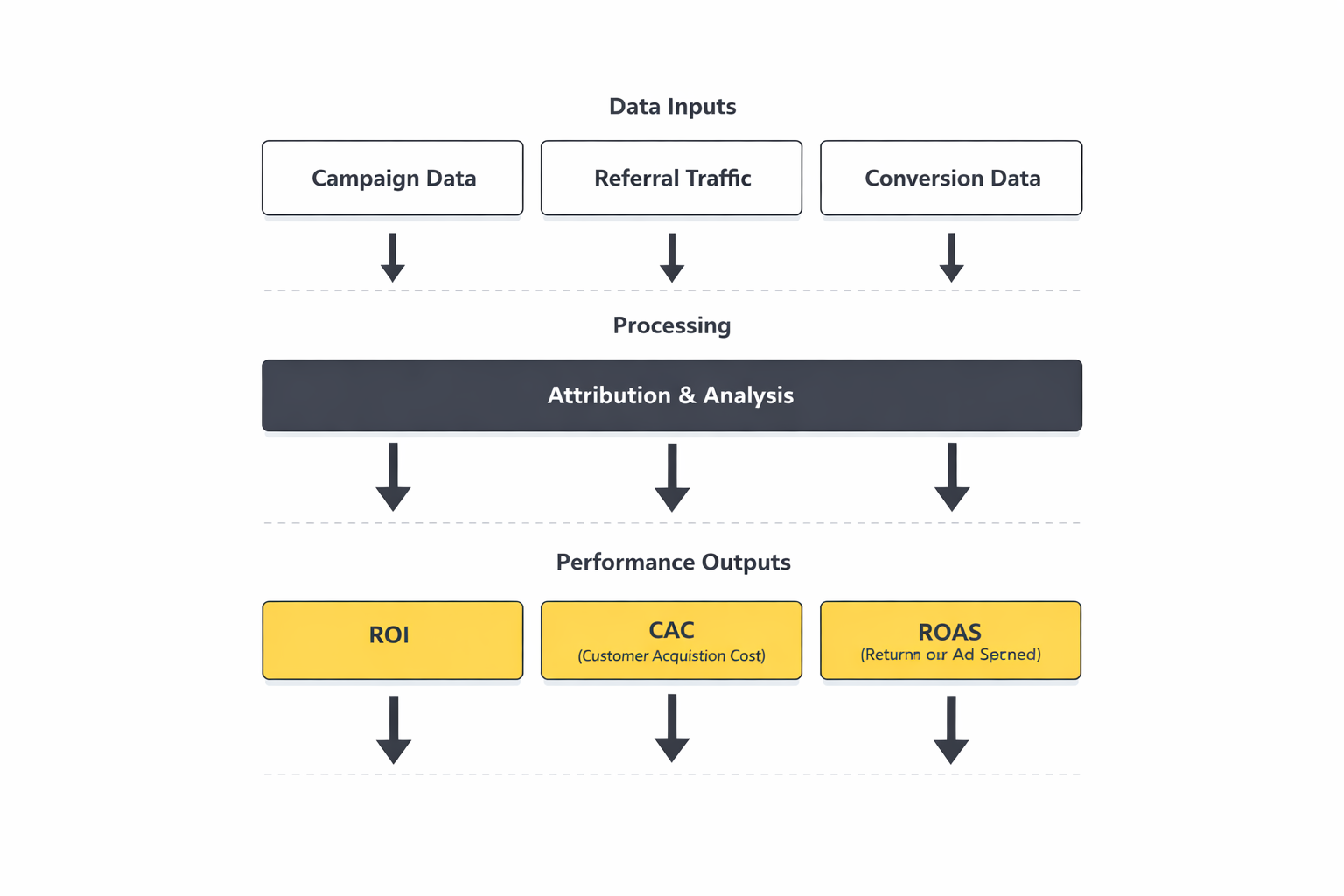
A practical influencer marketing framework begins with one question: what job should the creator partnership do for the business? If the answer is vague, the campaign usually becomes vague too. Brands that perform well in this space separate awareness, consideration, conversion, retention, and insight gathering into distinct goals before they ever start creator outreach.
Once the goal is clear, the next layer is creator selection. This is where many teams make expensive mistakes because they shop for follower counts instead of audience fit, content behavior, and category credibility. The better approach is to match product complexity, buying cycle, and platform format to the kind of creator who can explain the offer naturally and repeatedly without exhausting audience trust.
The third layer is content architecture. A single sponsored post can still work, but most professional influencer marketing programs are stronger when they combine several touchpoints such as short-form discovery content, deeper explanation, community interaction, and retargetable assets. That thinking fits neatly with TikTok’s view that brands now need to build with creators and communities rather than broadcast at them.
Distribution comes next, and this is where platform mechanics matter. On YouTube, BrandConnect exists specifically to help brands find creators and track campaign performance, which reflects how much the channel has professionalized. On other platforms, the same principle holds even when the tooling looks different: creator content should not only be published, but also amplified, repurposed, and evaluated as part of a larger media system.
The final layer is feedback. A framework is not complete until the brand can learn which creators, hooks, formats, offers, and audience segments actually changed behavior. This is one reason always-on influencer programs are outperforming intermittent ones in 2025 research: continuity creates enough data to improve creative judgment instead of forcing every campaign to start from zero.
Core Components of an Effective Program
The first core component is audience-fit analysis. A creator can look perfect on paper and still be wrong for the campaign if their audience follows for entertainment while the product needs trust, explanation, or repeat exposure to convert. Effective influencer marketing starts by mapping creator-audience expectations, category proximity, and the creator’s normal content rhythm before any deal terms are discussed.
The second component is offer clarity. Creators do not rescue weak positioning; they amplify what is already there. If the product promise is muddy, the landing experience is clumsy, or the call to action is too broad, creator content will only send more people into confusion.
The third component is creative freedom with strategic guardrails. This is not a contradiction. Sprout Social found that 65% of influencers want to be involved early in creative or product-development conversations rather than receive rigid briefs, and that makes sense because creators understand what their audiences will instantly reject. Brands still need clear non-negotiables, but the message usually lands better when creators can translate the idea into their own delivery style.
The fourth component is relationship design. Short campaigns can produce spikes, but sustained value tends to come from repeat collaboration, better creator familiarity with the product, and a growing sense that the partnership is real rather than transactional. That logic is supported by Sprout’s finding that 71% of influencers offer discounts for longer-term partnerships, which means continuity can improve both economics and creative consistency.
The fifth component is compliance and brand safety. This is where mature programs separate themselves from opportunistic ones. The FTC and ASA make it clear that disclosure must be understandable to ordinary viewers, so effective programs build compliance into briefs, approvals, contracts, and post-launch review rather than treating it as a last-minute checkbox.
The sixth component is data continuity. If a team cannot connect creator outputs to traffic quality, assisted conversions, branded search lift, email capture, or sales efficiency, it will struggle to defend budget no matter how good the campaign looked publicly. Strong influencer marketing programs are built to learn, which means measurement is not something added later but something designed into the program from day one.
Professional Implementation
Professional implementation starts with operational discipline. Before any outreach begins, define campaign objectives, creator criteria, required disclosures, approval rules, content usage rights, and the exact path you want traffic to take after the audience clicks. That level of preparation is what turns influencer marketing from scattered activity into a repeatable system.
It also helps to build a lightweight stack around the campaign so execution does not become chaotic as creator volume increases. A dedicated landing page built in ClickFunnels or Systeme.io can keep the offer focused, while Fillout can collect creator applications or partner intake information in a cleaner way than long email threads. If your team needs to coordinate calls and approvals across multiple stakeholders, Cal.com can remove a lot of back-and-forth before the campaign even goes live.
Once content is in motion, consistency matters more than intensity. Sprout Social’s 2025 data on always-on programs suggests that brands get better outcomes when they keep creator relationships active instead of treating every campaign like a one-off stunt. That is one reason many teams now use tools such as Buffer for publishing coordination, Flick for social research and optimization, and Brevo for follow-up sequences that capture and nurture the traffic creators send.
Professional execution also means respecting platform-native workflows rather than forcing the same process everywhere. YouTube BrandConnect is built for structured brand deals and performance visibility, while TikTok’s current direction rewards fast cultural adaptation and creator-community chemistry. A serious team adapts the workflow to the platform instead of pretending one briefing format and one asset style can carry the whole program.
Finally, professional implementation requires restraint. The temptation in influencer marketing is to scale too early, add too many creators, or dilute the message across too many offers. In practice, the better move is usually to start with a tight creator set, document what actually works, improve the workflow, and then scale once the system is producing signals you can trust.
Measurement and Analytics
This is where a lot of brands either grow up fast or waste a ton of money. Influencer marketing looks exciting on the surface because views, likes, comments, and shares are easy to spot, but none of those numbers tell the full story unless they connect to something the business actually cares about. The moment you start measuring influencer marketing like a real revenue channel instead of a vanity project, your decisions get sharper, your briefs get better, and your budget starts working harder.
The first thing to understand is that measurement has to match the actual job of the campaign. If the creator partnership is meant to build awareness, then branded search lift, reach quality, view-through behavior, and audience growth matter. If the goal is conversion, then you need cleaner tracking through landing pages, promo codes, affiliate links, assisted conversions, and post-click behavior, especially now that measurement is still cited as the biggest roadblock to influencer program success and platforms like Google now explicitly support Lift measurement and standard reporting for creator partnership ads.
The real danger is acting as if one metric can tell the whole truth. A creator might produce modest direct sales but significantly improve branded search demand, email signups, or retargeting efficiency. That is why strong influencer marketing analytics usually combine immediate response data with broader commercial signals, which lines up with newer academic work showing that ROI in influencer marketing is often misread when teams ignore effects such as memory, loyalty, and delayed action.
What to Track in Influencer Marketing
A good measurement system starts with layers. At the content layer, look at watch time, saves, shares, click-through behavior, and the quality of comments rather than raw engagement totals alone. At the traffic layer, track landing-page engagement, bounce patterns, form completion, product-page depth, and whether creator traffic behaves differently from paid social or search traffic.
Then move to the business layer, because this is where the truth usually shows up. Measure assisted conversions, new-customer rate, average order value, subscription starts, repeat purchase behavior, and incremental lift where you can. That broader view matters even more now that IAB projects U.S. creator ad spend reached $37 billion in 2025, up 26% year over year, because the more money brands push into influencer marketing, the less tolerance there is for fuzzy reporting.
You also want consistency in naming and structure. If one creator is sending traffic to a homepage, another to a blog post, and a third to a generic product collection, the data becomes noisy fast. Brands that get the best read on influencer marketing performance usually standardize links, offers, landing pages, and attribution windows before the campaign launches, not after the numbers disappoint them.

Why Attribution Gets Messy
Attribution gets messy in influencer marketing because people rarely see a creator recommendation and buy in a perfectly straight line. They might watch a video on TikTok, search the brand name later, read reviews, see a retargeting ad, and only then convert. If your reporting system only gives credit to the final click, the creator may look weaker than they really were even though they started the buying journey.
That is one reason professional teams treat creator content as both media and signal. The content creates demand, but it also improves how later channels perform by warming up the audience before search, email, remarketing, or direct traffic get the final conversion. When brands understand that, they stop asking whether influencer marketing “caused” every sale and start asking how it changed the efficiency of the whole customer acquisition system.
This is also where cleaner campaign infrastructure helps a lot. Dedicated landing pages in ClickFunnels or Systeme.io, link-level tracking through Dub, and lead capture flows in Brevo make it much easier to see what creator traffic is doing after the click. Without that structure, a brand can spend serious money on influencer marketing and still walk away with reports that sound busy but explain almost nothing.
Professional Reporting and Optimization
Once the campaign is live, reporting should not be a giant spreadsheet dump at the end of the month. It should show which creators are generating qualified traffic, which formats are holding attention, which hooks are moving people into action, and where the funnel is leaking. The point of analytics is not to admire the campaign after it happened, but to make the next round stronger while there is still time to improve it.
This is where a lot of teams make a simple but expensive mistake: they optimize for what is easiest to count instead of what matters most. A creator with lower top-line reach may still be the better partner if their audience clicks more, stays longer, signs up at a higher rate, or buys with less discount pressure. That kind of disciplined optimization is becoming essential as influencer marketing becomes more formalized across major platforms, with YouTube BrandConnect built specifically to support brand deals and Google positioning creator partnerships as a measurable part of modern media planning.
If you want a cleaner operating rhythm, create a simple review cycle after every launch. Look at what the audience responded to, what the creator naturally did well, what the landing experience failed to do, and whether the offer itself was strong enough. Influencer marketing gets far more profitable when brands stop treating each collaboration like a one-time performance and start treating every campaign as training data for the next one.
Future Ecosystem and Trends
The future of influencer marketing is not just more creators, more spending, or more sponsored posts. It is a shift toward a broader creator ecosystem where content, commerce, community, paid amplification, AI support, and compliance all start blending together. That matters because brands that still think in terms of “pay for one post and move on” are going to look outdated very quickly.
The money moving into the space shows how serious that transition has become. IAB’s 2025 report and coverage of it in Marketing Dive both point to creator advertising growing far faster than the broader media market. That does not mean every creator program will win, but it does mean influencer marketing is being absorbed into the main body of media strategy instead of living off to the side as an experimental tactic.
You can already see that shift in how major companies talk. Unilever said in March 2025 that it planned to move 50% of its ad budget to social media and work with 20 times more influencers, which is not the language of a brand treating creators as a niche add-on. It is the language of a company that believes trust, discovery, and cultural relevance now travel through creators at scale.
The Creator Economy Is Getting More Professional
One of the clearest trends is professionalization. Platforms are building tools for creator matching, paid amplification, and reporting. Brands are putting legal structures, usage-rights clauses, safety checks, and approval workflows around influencer marketing in a way that looks much closer to media buying than the casual partnerships people associated with the channel a few years ago.
That does not make the work less creative. It simply means the creative side now has more operating discipline around it. Google’s measurement support for partnership ads, YouTube’s BrandConnect infrastructure, and the European Commission’s Influencer Legal Hub all point in the same direction: influencer marketing is becoming more accountable, more structured, and more visible to regulators and executives alike.
The upside is obvious. Better systems make it easier to scale good partnerships, protect both sides contractually, and understand performance with more confidence. The downside is that lazy campaigns will stand out faster, because once the channel matures, weak strategy can no longer hide behind novelty.
AI Will Shape Workflows, Not Replace Trust
AI is going to change influencer marketing, but not in the simplistic way people often talk about it. The most immediate impact is on workflow: research, briefing, editing support, transcription, idea clustering, performance analysis, and content repurposing. That is why IAB reported in late 2025 that nearly three-quarters of brands were already using or planning to use AI in creator marketing workstreams.
What AI does not automatically solve is audience trust. People follow creators because they respond to personality, timing, taste, lived experience, and the feeling that a real person is filtering the internet for them. Even as AI tools become more common, the core value in influencer marketing still comes from credible humans who can make a recommendation feel believable inside a culture, a niche, or a community.
That is why the brands that win will probably use AI behind the scenes while protecting authenticity in public. Tools like Firecrawl for structured web data, Wispr Flow for faster drafting, and Chatbase for support workflows can absolutely help an influencer marketing team move faster. But speed is only useful when the underlying creator partnership still feels honest, relevant, and human.
Community-Led Commerce Will Keep Growing
The next major shift is that influencer marketing will keep moving closer to commerce, but not in a cold, transactional way. The strongest creator campaigns increasingly act like guided buying journeys where discovery, education, social proof, and conversion happen inside one connected system. That matches the direction of TikTok’s 2025 trend report, which emphasizes participatory culture, community fluency, and creator-led brand behavior rather than generic brand broadcasting.
This matters because the old split between “brand campaign” and “sales campaign” is getting weaker. A creator can introduce the product, answer objections, demonstrate real use, and drive the click in the same content ecosystem. When the funnel gets compressed like that, influencer marketing becomes much more valuable to brands that are willing to build the operational structure around it.
That also opens the door to better downstream systems. Once creator traffic lands in the right place, brands can segment, nurture, and follow up more intelligently through tools such as Moosend, ScaledMail, or Copper. The creator may start the relationship, but the business still needs a smart back-end if it wants influencer marketing to become a compounding asset rather than a temporary spike.
What Smart Brands Should Do Next
At this point, the smartest move is not to ask whether influencer marketing works. That question is too basic now. The real question is whether your team can build a system that finds the right creators, gives them the right structure, measures what matters, and keeps learning faster than competitors who are still winging it.
That means choosing fewer creators more carefully, building offers that convert cleanly, and documenting what happens after every campaign. It also means respecting the legal and ethical side of the channel, because transparency is becoming more visible across markets, with the UK’s ASA reporting on disclosure rates and the FTC continuing to stress clear sponsorship disclosure. The brands that treat those rules as trust-builders instead of annoyances are going to be in a much stronger position.
And this is the bigger truth running through all of it: influencer marketing is no longer just about borrowing attention. It is about building belief at scale through people audiences already want to hear from. Once you understand that, the channel stops looking trendy and starts looking like one of the most important growth systems a modern brand can build.
Implementation Playbook for Influencer Marketing
Once you move past the theory, influencer marketing becomes an execution game. This is where brands either build a machine that keeps getting stronger with every campaign or create a messy pile of one-off creator deals that never quite add up to anything meaningful. The difference usually comes down to whether the team treats implementation as a real operating system with clear rules, fast feedback, and enough structure to support creativity without suffocating it.
That matters even more now because creator partnerships are no longer sitting on the edge of the media plan. IAB’s 2025 creator ad spend research shows brands are treating creators as a distinct channel, and YouTube’s 2025 brand partnership updates show the platforms themselves are building more infrastructure for sponsored content, dynamic sponsorships, and easier brand-creator collaboration. In plain English, the channel is getting more professional, which means sloppy implementation gets exposed faster than ever.
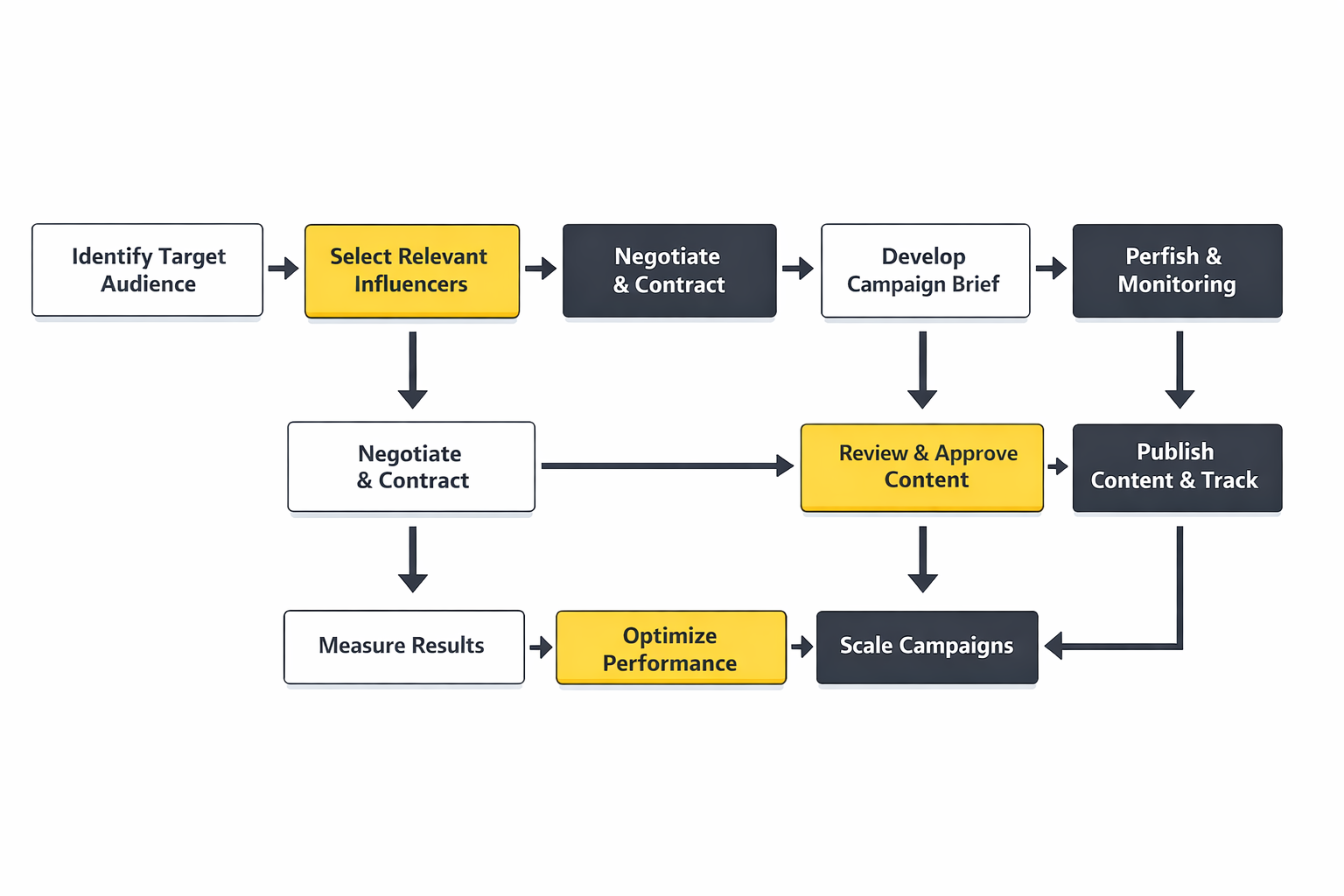
If you want influencer marketing to produce reliable results, you need a practical workflow. That includes who owns creator sourcing, how briefs are approved, where assets live, how landing pages are built, how links are tracked, and what happens after the campaign sends traffic. A lot of brands talk about authenticity, but the campaigns that really work usually have strong back-end discipline supporting that front-end trust.
How to Build an Influencer Marketing Workflow
A workable influencer marketing system starts before you ever message a creator. First, define the campaign job with brutal clarity. Is the goal to generate awareness in a new category, launch a product, collect leads, increase direct sales, improve credibility, or create reusable creative assets for paid media? If you skip that step, everything else gets fuzzy, from who you hire to how you measure performance.
Next, create a simple operating map. One person should own creator selection, one person should control approvals, one person should manage links and landing pages, and one person should review performance after launch. Smaller teams can combine those roles, but the roles themselves still need to exist because influencer marketing breaks down fast when nobody knows who is responsible for what.
Then build the campaign path itself. A creator should never be sent into the wild with a discount code and a vague hope that something good happens. You want a clear sequence: outreach, fit check, product alignment, briefing, draft review if needed, launch timing, tracking setup, community monitoring, performance review, and next-step decision. That sounds basic, but it is exactly the kind of discipline that separates a professional creator program from random sponsorship spending.
How to Brief Creators Without Killing Performance
This is one of the biggest pressure points in influencer marketing. Brands are often scared to give creators too much freedom, while creators know perfectly well that over-scripted content usually dies the moment it hits a real audience. The right answer sits in the middle: protect the brand where you must, then give the creator room to make the message feel native to their audience and format.
The best briefs are not giant instruction manuals. They are clear on the essentials: the product truth, what must be said, what cannot be said, the desired audience action, the core angle, and any legal or disclosure requirements. Everything else should be framed as guidance, because creators are usually far better at understanding the pacing, tone, and structure their audience will actually respond to.
That approach lines up with what the market is saying. Sprout Social’s recent influencer marketing research shows many creators want earlier involvement in campaign planning rather than being handed rigid instructions at the end. That is not just a preference issue. It is a performance issue, because when creators help shape the idea early, the final content usually feels more believable and lands with less resistance.
Choosing the Right Creator Format and Platform
Not every influencer marketing campaign should look the same, and this is where many brands quietly waste money. A product that needs explanation may perform far better in a long-form YouTube integration than in a fast TikTok clip. A visually obvious product may do great in short-form content, while a more complex service may need a creator who can build trust over several touchpoints before asking for the click.
The platform changes the job. TikTok’s 2025 trend report pushes hard on creator-community chemistry and culturally fluent content, while YouTube’s 2025 Brandcast messaging and BrandConnect support documentation reinforce how creator partnerships on YouTube can function inside a broader video and performance ecosystem. That does not mean one platform is better than the other. It means your influencer marketing plan has to match the kind of attention your product actually needs.
It also means format matters just as much as platform. Some creators are brilliant at demonstration, some are brilliant at trust-building, and some are brilliant at making a product feel culturally relevant. If you hire someone for the wrong job just because they have audience size, the campaign will underperform and the team will blame influencer marketing when the real problem was poor role fit.
Building Landing Pages and Conversion Paths
Here is the part a lot of brands still underestimate: creator content can be excellent and still fail because the click goes nowhere useful. If a creator drives qualified attention and the audience lands on a cluttered homepage, a generic product collection, or a page that does not match the promise in the content, you are making the hardest part of influencer marketing work for nothing. Trust was built on the creator side, then quietly lost on the brand side.
That is why strong implementation requires a dedicated conversion path. The landing page should reflect the creator’s message, keep the offer obvious, and remove anything that makes the next step harder than it needs to be. Tools like ClickFunnels or Systeme.io can make that easier when you need campaign-specific pages fast, especially if different creators are sending different types of traffic.
If the campaign is lead-driven rather than purchase-driven, the form experience matters just as much. A clean intake process built with Fillout, followed by a nurture sequence in Brevo or Moosend, gives your influencer marketing traffic somewhere sensible to go after the moment of interest. That is one of the simplest ways to stop creator campaigns from producing expensive bursts of attention that never become durable business results.
Tracking Links, Codes, and Post-Click Behavior
If you want to improve influencer marketing over time, you need cleaner signal than “this creator felt strong” or “that video seemed to do well.” Every creator should have a distinct tracking setup, and every campaign should make it easy to tell what happened after the click. That usually means unique links, creator-specific landing pages where appropriate, sensible attribution windows, and a dashboard the team can actually use without digging through five tools and three spreadsheets.
It also helps to separate what you want to know now from what you want to learn later. In the short term, you want to see click quality, conversions, form completion, revenue, or assisted actions. Over the longer term, you want to understand which creator types, hooks, offers, and audience segments produce the most valuable traffic. A link management layer like Dub can help keep that cleaner, especially when influencer marketing starts spreading across multiple creators and multiple campaign paths.
This is also where implementation discipline protects budget. A campaign that cannot be tracked clearly is almost impossible to improve honestly. And once teams lose trust in the numbers, they usually stop learning from the program and start making creator decisions based on instinct alone, which is a dangerous way to scale anything.
Managing Communication, Approvals, and Timelines
Influencer marketing gets chaotic when communication lives in ten different inboxes and nobody can see the full picture. Even a small creator program benefits from a simple coordination system that handles outreach, deadlines, approvals, payment milestones, and post-campaign review in one repeatable flow. That does not have to be complex, but it does have to be visible.
For many teams, the easiest win is reducing friction around scheduling and creator onboarding. A tool like Cal.com can handle calls and approvals without endless email chains, while Buffer can help keep the surrounding publishing calendar organized when influencer marketing needs to line up with broader brand content. The goal is not to add software for the sake of it. The goal is to make sure execution does not collapse under the weight of avoidable admin work.
Approval timelines need special attention. If a creator has to wait too long for feedback, the content loses momentum, the timing gets awkward, and the partnership starts feeling harder than it should. Fast, focused feedback usually wins here. Say what matters, avoid rewriting the creator’s voice, and keep the campaign moving.
How to Scale Influencer Marketing Without Breaking Trust
Scaling influencer marketing is not about hiring as many creators as possible as quickly as possible. That is how brands end up with bloated rosters, uneven quality, and a ton of spend going into content that looks active but does not move the business. The smarter move is to scale in layers: find a small set of creators who genuinely fit, refine the offer and landing path, document what works, and only then expand volume.
This matters more now because the market is getting bigger and more competitive at the same time. IAB’s 2025 spend projection makes it clear that creator investment is rising fast, while HubSpot’s 2025 social media research shows marketers continue to see strong results from smaller creators with tighter audience relationships. That combination is a reminder that scale does not automatically come from bigger names. Often it comes from repeating the right kind of fit over and over again.
There is also a trust ceiling every brand needs to respect. If you flood the market with repetitive creator reads, audiences catch on quickly and the message loses force. Good scaling in influencer marketing feels like expansion, not saturation. You want more proof, more distribution, and more learning, but you do not want the audience to feel like the entire internet is reading the same script.
The Teams That Win at Execution
The teams that win with influencer marketing are not always the loudest or the most experimental. They are usually the ones that care enough to build a repeatable process, stay close to audience behavior, and tighten the conversion path after every campaign. They know creator trust is valuable, so they protect it. They know operations matter, so they build systems that support speed without turning the campaign into corporate sludge.
That is the bigger lesson behind professional implementation. The magic is not in a random post going viral or a creator shouting louder than everyone else. The magic is in building an influencer marketing system where the creator, the message, the platform, the offer, and the post-click experience all work together so naturally that the audience never feels pushed, but still ends up taking action.
And if you are serious about making that happen, do not wait for perfect conditions. Start small, document everything, fix what breaks, and get back on the battlefield fast. That is how influencer marketing stops being a trendy idea and starts becoming a real growth asset.
Statistics and Data in Influencer Marketing
If you want to understand where influencer marketing is really going, the numbers tell a very clear story. This is no longer a side tactic that brands test when they feel adventurous. The channel is getting bigger, more structured, and a lot more accountable, which means the data now matters just as much as the creative.
The biggest headline is scale. IAB’s 2025 Creator Economy Ad Spend & Strategy Report says U.S. creator ad spend is projected to reach $37 billion in 2025, up 26% year over year, and the same report shows that spending more than doubled from $13.9 billion in 2021 to $29.5 billion in 2024. That kind of growth does not happen when a channel is still treated like an experiment. It happens when brands decide influencer marketing is becoming part of the core media mix.
Market Size and Budget Trends
The budget data gets even more interesting when you look at how buyers think about creators. IAB reports that 48% of creator ad buyers now consider creators a “must buy”, which is a huge mindset shift. Once a channel reaches that point, the conversation changes from “Should we try this?” to “How do we get better at this before everyone else does?”
Marketer survey data points in the same direction. HubSpot found that 46% of marketers plan to increase their investment in influencer marketing in 2025, while 47% expect to maintain current spending. Put those numbers together and you get the real picture: brands are not backing away from influencer marketing at all, and the growth is being driven by both new money and sustained confidence from teams already using it.
That is why analytics discipline matters so much now. The moment spending starts climbing this fast, weak reporting gets exposed fast too. Brands can get away with vague measurement when budgets are tiny, but once influencer marketing starts commanding serious investment, every campaign has to prove it is doing something useful for the business.
What the Data Says About Creator Size
One of the most useful data points in the whole category is that bigger is not automatically better. HubSpot reports that 67% of marketers already work with micro-influencers, and 32% say small creators with 1,000 to 100,000 followers will be a better investment than large influencers in 2025. On top of that, HubSpot’s 2025 Social Media Marketing Report says marketers are seeing more success with small influencers than with larger ones.
This matters because it pushes brands to stop shopping for social proof and start shopping for audience fit. Smaller creators often have tighter communities, stronger trust, and a delivery style that feels much less like advertising. That does not mean macro creators never work, but it does mean influencer marketing gets a lot more interesting when you stop assuming reach is the same thing as influence.
There is also a budget advantage hiding in this trend. Micro-creators often let brands spread spend across multiple audience pockets instead of placing one expensive bet on a single large account. In practice, that usually creates better testing conditions, more creative variation, and a stronger chance of finding repeatable patterns you can scale later.
How Brands Are Actually Operating
Another revealing number is how early most programs still are. Sprout Social’s Q1 2025 Pulse Survey found that almost 80% of brands partner with 10 influencers or fewer. That tells you the market is growing fast, but it also tells you a lot of teams are still in the stage where they are testing, learning, and trying to build a repeatable system.
At the same time, the appetite to expand is obvious. The same Sprout data shows that 59% of marketers plan to expand their creator bench in 2025. So the real story is not that brands have mastered influencer marketing already. The real story is that they believe enough in the channel to invest further, even while many of them are still figuring out how to run it well.
That creates a huge opportunity for teams willing to get serious about process. When most brands are still managing relatively small creator rosters, the companies that build a better system now can gain an edge before the market gets even more crowded. In other words, the data says growth is coming, but it also says there is still room to out-execute competitors who are treating influencer marketing too casually.
Creative Performance and Collaboration Data
The performance data also explains why some campaigns feel natural while others fall flat. Sprout Social reports that 65% of influencers want to be involved in the creative process early, which should not surprise anyone who has watched over-scripted sponsored content die on contact with a real audience. If creators know their audience best, then locking them out of the message development process is usually a fast way to weaken performance.
The consumer side of the data says something similar. Sprout found that 67% of consumers say the best brand and influencer collaborations are honest and unbiased. That number matters because it makes the real standard painfully obvious: the partnership has to feel believable first, or the rest of the campaign hardly matters.
This is where a lot of brands get themselves into trouble. They want influencer marketing to feel authentic, but then they hand creators stiff talking points, generic claims, and heavy review processes that strip out the creator’s voice. The data is pointing in the other direction. Clear strategy matters, but strong campaigns still need room for human delivery.
Conversion and ROI Signals
The conversion data is strong enough that brands cannot dismiss influencer marketing as a pure awareness play anymore. HubSpot says 77% of marketers believe influencer marketing delivers better ROI than other marketing channels, while 85% say it was effective for them in the past year. Those are not soft, polite numbers. They suggest a lot of marketers already see creators as a real driver of business performance.
Consumer behavior data supports that view from the other side. Sprout reports that 86% of consumers make a purchase inspired by an influencer at least once per year, and 49% say influencer content drives purchases on a daily, weekly, or monthly basis. Once you see figures like that, it becomes hard to argue that influencer marketing sits only at the top of the funnel.
What this really means is that brands need cleaner tracking. If creators are affecting both demand and purchases, then the campaign should be built so the business can actually see what happens after the click. That is where a simple stack using Dub for cleaner link tracking, ClickFunnels for creator-specific landing pages, or Brevo for post-click nurture can make the data far more useful.
Measurement and Platform Infrastructure Data
The platforms themselves are also telling us where influencer marketing is heading. Google says its creator partnerships hub is now available in more than 20 markets, and Google Ads states that standard reporting and Lift measurement are available for partnership ads powered by BrandConnect. That is a major signal that creator campaigns are being folded into more formal media planning and measurement systems.
Why does that matter? Because better infrastructure changes behavior. Once brands can find creators, link sponsored assets, test creator content against standard ads, and measure lift in a structured way, influencer marketing starts becoming easier to justify inside larger organizations. The data stops living in screenshots and subjective recap decks and starts entering the same performance conversation as other paid channels.
That does not solve every attribution problem, of course. But it does raise the bar. The more platforms invest in creator tooling and measurement, the less acceptable it becomes for brands to run influencer marketing with vague goals, inconsistent tracking, and no real post-campaign learning process.
Trust, Disclosure, and What the Numbers Reveal
There is one more set of numbers brands should not ignore, and that is disclosure data. The UK’s ASA found that about 57% of the influencer ads it analysed complied with its disclosure rules, while 34% included no disclosure at all. Even more revealing, ASA research shows 80% of the UK online population prefers it when influencers are clear that they are advertising something.
Those numbers tell a very simple story. Audiences want clarity, regulators want clarity, and brands that ignore clarity are taking a risk with trust. The irony is that clean disclosure does not weaken influencer marketing at all. In many cases, it makes the partnership feel more honest, which is exactly what the best-performing campaigns need anyway.
So when you step back and look at the full picture, the statistics are not random facts sitting in isolation. They tell one connected story: budgets are rising, smaller creators are winning more often, brands are still early in their maturity, audiences respond to honesty, and the platforms are building better measurement tools around the channel. That is exactly why influencer marketing is becoming one of the most important systems for modern brand growth rather than just another social media tactic.
Common Mistakes and Next-Level Advantages
This is where influencer marketing gets brutally honest. A lot of brands think the hard part is finding creators, but that is usually the easy part. The hard part is avoiding the mistakes that quietly drain budget, damage trust, and make the team think the channel is weaker than it really is.
The brands that pull ahead are not always the ones spending the most. They are the ones that learn faster, protect creator trust more carefully, and build a better system around every campaign. That matters in a market where creator ad spend is projected by IAB to hit $37 billion in the U.S. in 2025, because once that much money is moving into a channel, small mistakes stop being small very quickly.
The Biggest Influencer Marketing Mistakes
The first big mistake is hiring for optics instead of outcomes. A creator may look impressive in a pitch deck and still be completely wrong for the offer, the audience, or the platform behavior you actually need. That is why a lot of influencer marketing campaigns underperform even when the creator seems “big enough” on paper.
The second mistake is treating the creator like rented ad space. The audience is there because of the creator’s tone, rhythm, judgment, and credibility, not because they want to hear a brand-approved script. When a campaign strips all of that away, it usually loses the one thing influencer marketing is supposed to deliver better than traditional media: believable attention.
The third mistake is weak infrastructure. Brands spend time negotiating rates, then send traffic to a page that does not match the message, fails to explain the offer, or makes the next step harder than it needs to be. In those situations, the creator did their job, but the brand built a broken runway.
Why Short-Term Thinking Hurts Results
Another mistake that shows up all the time is expecting influencer marketing to prove itself in one burst of activity. That can happen, of course, but it is a shallow way to evaluate the channel. The stronger programs usually build over time because creators get better at telling the story, the audience becomes more familiar with the product, and the brand learns which hooks and formats actually move people.
That is exactly why always-on programs keep gaining traction. Sprout Social’s 2025 creator economy data shows 59% of marketers plan to expand their influencer bench in 2025, and that expansion only makes sense if brands believe repeated creator relationships are worth developing. Once you see influencer marketing as a compounding system instead of a one-time stunt, your decisions get smarter almost immediately.
Short-term thinking also creates emotional overreactions. One creator underperforms, and suddenly the team decides the whole channel is flawed. That is like running one paid search ad badly and concluding search does not work. Professional teams do not panic that quickly. They diagnose, adjust, and keep moving.
How to Build a Real Competitive Advantage
The real advantage in influencer marketing is not access to creators. Plenty of brands can get access. The real advantage is knowing how to brief better, test faster, track cleaner, and turn each campaign into something the next campaign can build on. That kind of learning loop becomes extremely hard to beat once it is in place.
This is one reason smaller teams can still outperform bigger brands. They often move faster, make decisions with less committee drag, and give creators more room to sound human. In a space where 65% of influencers say they want earlier involvement in creative or product-development conversations, brands that collaborate well can gain an edge without having the largest budget in the room.
Competitive advantage also comes from combining influencer marketing with a stronger back-end. A focused campaign page in ClickFunnels, cleaner forms through Fillout, and follow-up flows in Brevo can help turn creator attention into something far more measurable and durable. The creator opens the door, but the system behind the door decides how much value you keep.
Trust, Compliance, and Brand Safety
There is no next-level influencer marketing strategy that can afford to ignore compliance. Once creators are speaking on behalf of a brand, the legal and reputational stakes become very real. The audience needs to understand what is sponsored, the creator needs to disclose clearly, and the brand needs to make sure the campaign is not built on vague assumptions about what is allowed.
The direction of travel is obvious. The European Commission’s Influencer Legal Hub exists specifically to help creators, brands, and agencies understand EU consumer protection rules, while the FTC’s influencer guidance continues to stress that disclosures must be clear and easy to notice. This is not a side issue anymore. It is part of doing the work professionally.
There is also a trust upside here that many brands miss. Clean disclosure can actually make influencer marketing stronger because it signals honesty instead of trying to sneak persuasion past the audience. That matters when the ASA’s 2025 report on 2024 monitoring found 34% of influencer ads still carried no disclosure at all. In a market where many players are still getting this wrong, simply being clear can become a brand advantage.
Why Relationships Beat Transactions
One of the easiest ways to weaken influencer marketing is to make every creator deal feel disposable. If the relationship starts with a rigid brief, drags through slow approvals, and ends the moment the post goes live, you are not building anything that can get stronger over time. You are just buying isolated moments of attention and hoping they add up.
Better brands do the opposite. They stay close to creators who genuinely fit, listen to what those creators are seeing in their audience, and keep refining the partnership instead of resetting everything from zero. That kind of relationship depth is increasingly important because creators are not just distribution partners anymore. They are market sensors, creative translators, and in many cases the first people to notice when audience behavior starts changing.
This is also where influencer marketing starts becoming harder for competitors to copy. A competitor can imitate your offer or your creator category, but it is much harder to imitate years of trust, shared learning, and mutual confidence between a brand and a creator. Relationship quality may not look flashy in a report, but it often explains why some programs keep winning while others never quite click.
Where the Smart Money Goes Next
The smartest investment from here is not blind expansion. It is thoughtful expansion. Brands should keep moving budget toward creators, but they should do it with better structure, clearer measurement, and tighter creator fit than the average company brings to the channel.
You can already see the market heading there. Google has been expanding BrandConnect and creator-linking workflows for YouTube partnerships, while TikTok’s 2025 trend report keeps pushing brands toward creator-led, community-native storytelling. That tells you the future of influencer marketing is not random sponsorship noise. It is more integrated, more measurable, and more deeply connected to how people actually discover and trust products.
So here is the bottom line: the biggest wins will go to brands that stop acting like influencer marketing is a trendy add-on and start treating it like a real operating capability. The opportunity is huge, but it will not reward laziness. It will reward the teams that care enough to build the machine, learn from the data, and protect the trust that makes the whole channel work in the first place.
FAQ Built for the Complete Guide

The best way to finish a guide on influencer marketing is to answer the questions people ask when they are about to spend real money, hire real creators, or build a serious program from scratch. That is what this section is for. Instead of recycling vague advice, these answers focus on what actually matters when you want influencer marketing to produce trust, traffic, and revenue without turning into a chaotic side project.
What is influencer marketing in simple terms?
Influencer marketing is a strategy where a brand works with a creator who already has audience trust and uses that relationship to create awareness, credibility, or sales. The reason it works is not just reach. It works because the creator acts like a filter, a translator, and in many cases a source of social proof that feels more believable than traditional advertising.
The channel has grown far beyond occasional sponsorships. IAB’s 2025 creator ad spend report shows how central creators have become to modern media budgets, while YouTube BrandConnect reflects how platforms now support influencer marketing as a structured partnership model rather than an improvised tactic.
Does influencer marketing still work?
Yes, but it works best when brands stop treating it like a vanity channel. The strongest programs match the right creator to the right audience, build a clean path after the click, and measure more than surface engagement. When those pieces line up, influencer marketing can move both demand and conversion rather than just generating noise.
The market data points in that direction. HubSpot’s 2025 research shows most marketers still rate influencer marketing as effective, and Sprout Social’s current consumer and creator data reinforces that audiences continue to buy through creator-led recommendations when the partnerships feel honest and relevant.
Is influencer marketing only for big brands?
Not at all. In many cases, smaller brands can move faster and get better results because they are more willing to work closely with smaller creators, test more specific angles, and keep the message simpler. That matters because influencer marketing often rewards audience fit and trust more than raw budget size.
This is one reason smaller creators matter so much. HubSpot’s 2025 Social Media Marketing Report says marketers are seeing more success with small influencers than with larger ones, which gives leaner brands a real opening if they build the campaign well.
How do you choose the right creators?
Start with audience fit, not follower count. The creator needs to make sense for the product, the buying cycle, and the kind of trust the offer requires. A creator who is excellent at entertainment may still be completely wrong for a product that needs explanation, proof, and repeated exposure before someone buys.
It also helps to look at how the creator normally speaks about products. If every sponsorship sounds forced, that is a warning sign. If the creator has a clear voice and a loyal audience that responds thoughtfully, the odds of influencer marketing working go up fast because the recommendation already lives inside a believable relationship.
Are micro-influencers better than macro-influencers?
They are not always better, but they are often a smarter bet. Micro-influencers usually have tighter communities, stronger engagement quality, and lower costs, which gives brands more room to test multiple creator fits instead of making one expensive bet. That is especially useful when you are still learning what kind of influencer marketing actually works for your offer.
The trend is clear enough that it is hard to ignore. HubSpot reports that a meaningful share of marketers expect smaller creators to be a better investment than larger influencers in 2025, and Sprout Social’s 2025 creator economy data shows many brands are still working with relatively small creator rosters, which makes careful testing even more valuable.
How much budget should you set aside for influencer marketing?
There is no universal number because the right budget depends on creator size, content format, usage rights, platform mix, and whether the campaign is designed for awareness, sales, or reusable creative assets. The better question is whether your budget is large enough to test several creator fits and support the post-click experience properly. If you can only afford the creator fee and nothing else, the campaign is already under pressure.
That is one reason rising spend matters. IAB’s 2025 forecast of $37 billion in U.S. creator ad spend suggests brands are committing real money to the channel, which means budgeting now has to cover operations, measurement, and conversion infrastructure as well as the creator partnership itself.
What metrics should you track?
Track the metrics that match the campaign’s job. If the campaign is built for awareness, measure reach quality, watch time, branded search lift, saves, shares, and audience growth. If it is built for conversion, focus on click quality, landing-page behavior, form completion, promo code use, assisted conversions, and revenue.
The mistake is assuming one metric tells the whole story. Influencer marketing often affects several stages of the customer journey at once, which is why Google’s reporting for partnership ads powered by BrandConnect and Google’s creator partnerships hub documentation matter so much. The platforms themselves are pushing brands toward more structured measurement because surface engagement alone is not enough anymore.
How do you handle disclosures correctly?
You handle them clearly, early, and without trying to hide the commercial relationship. If a creator has a material connection with a brand, the audience should be able to understand that quickly and without guessing. That is not just a compliance issue. It is a trust issue, and trust is the whole engine behind influencer marketing in the first place.
The FTC’s disclosure guidance for social media influencers makes it clear that people should be able to tell when there is a brand relationship, and the European Commission’s Influencer Legal Hub gives creators, agencies, and brands practical EU guidance on disclosure and consumer law. The smartest brands do not treat those rules as annoying extras. They treat them as part of the professional standard.
What platform is best for influencer marketing?
The best platform is the one that matches how your audience wants to discover and evaluate the product. Some offers benefit from quick, emotionally immediate short-form content. Others need longer explanation, demonstration, or repeated exposure before people feel ready to act.
That is why platform choice should follow audience behavior, not trend chasing. TikTok’s 2025 trend report points toward creator-community chemistry and culturally native storytelling, while YouTube BrandConnect reflects a stronger ecosystem for structured creator partnerships tied into broader video and paid media workflows.
Should creators get a strict brief?
They should get a clear brief, not a suffocating one. The brand needs to define the product truth, the offer, any mandatory claims, usage-rights expectations, and the desired audience action. But once those essentials are protected, the creator usually needs room to shape the message in a way their audience will actually accept.
That is not a soft creative preference. It is a performance issue. Sprout Social reports that many creators want earlier involvement in the creative process, and that makes sense because creators usually know which tone, pacing, and framing will sound natural to their audience long before the brand does.
How do you turn clicks into revenue?
You make the path after the click feel as deliberate as the content before the click. If the creator’s message is focused but the landing experience is cluttered or generic, people lose momentum fast. Good influencer marketing does not end with the post. It carries the promise all the way through the page, the form, the offer, and the follow-up sequence.
That is why a lot of brands build campaign-specific funnels. A landing page in ClickFunnels or Systeme.io, cleaner data collection through Fillout, and smarter follow-up in Brevo or Moosend can make influencer marketing far more profitable because the interest the creator generated actually has somewhere useful to go.
Can B2B brands use influencer marketing?
Yes, and many of them should. In B2B, the creator is often not a celebrity-style influencer at all, but a credible operator, educator, niche expert, or founder whose audience trusts their judgment. That is still influencer marketing. The shape is different, but the core mechanism is the same: trust transfers more efficiently through a respected person than through a polished brand statement alone.
This is also why B2B teams should think less about “viral reach” and more about authority, clarity, and buyer relevance. The creator who can explain a real problem clearly to the right professional audience may be far more valuable than a much bigger account that cannot move serious buying conversations forward.
How long should an influencer program run?
Long enough to learn something real. One-off tests can be useful, but the biggest wins in influencer marketing usually come when the brand can see patterns across several creators, several content angles, and several rounds of post-click behavior. That is when you start improving the system instead of judging the channel based on one isolated outcome.
The broader market has already started leaning that way. Sprout Social’s 2025 data showing many marketers plan to expand their creator benches fits with the idea that brands increasingly see creator relationships as something to develop over time rather than rent for a moment and forget.
What is the biggest mistake brands make?
The biggest mistake is thinking influencer marketing is mostly about finding people with an audience. It is not. It is about finding the right people, giving them a message that can live naturally in their voice, building a clean path after the click, and learning from the results faster than competitors do.
When brands get that wrong, they often blame the creator or the channel. But the real failure usually happened earlier, in weak creator fit, clumsy briefing, bad landing pages, or lazy measurement. Influencer marketing can be incredibly strong, but it does not reward sloppiness for long.
Work With Professionals
If you have made it this far, you already know influencer marketing is not some cute little add-on you squeeze into a social calendar when you have spare time. It is a real growth channel, and when it is built properly, it can create trust, attention, and revenue in ways that ordinary brand messaging struggles to match. But it also takes work. You need the right creators, the right brief, the right pages, the right tracking, and the discipline to keep improving after every campaign.
That is why a lot of businesses eventually decide not to wing it. They bring in people who know how to build the machine, keep it compliant, protect the brand, and turn creator energy into measurable business outcomes. Whether you are building the strategy yourself or hiring for support, the opportunity is real, but so is the gap between casual execution and professional execution.
If you need better systems around your campaigns, there are useful tools that can help. Buffer can keep supporting content organized, Flick can help with social optimization workflows, Dub can improve link tracking, and Cal.com can remove friction from meetings and approvals. None of those tools replaces strategy, but the right stack can make influencer marketing far easier to run well.
Explore 10K+ Remote Marketing Contracts on MarkeWork.com
Most marketers spend too much time chasing clients, competing on crowded platforms, and losing a percentage of every project to middlemen.
MarkeWork gives you a better way. Browse thousands of remote marketing contracts and connect directly with companies desperate to hire skilled marketers like you without platform commissions and without unnecessary gatekeepers.
If you’re serious about finding better opportunities and keeping 100% of what you earn, you can explore available contracts and create your profile for free at MarkeWork.com.
 Filip Konecny Enterprises