
Email Marketing: The Strategic Foundation for Consistent Growth
Email marketing keeps winning for one simple reason: it gives you direct access to people who have already raised their hands and said they want to hear from you. That matters more now that paid acquisition is expensive, platform algorithms are unpredictable, and brands are under pressure to build stronger first-party relationships instead of renting attention from social networks or ad platforms. The teams still pulling ahead are the ones treating email as an owned business asset, not as a side channel they remember to use when sales get soft.
The channel has also matured. Recent work from DMA’s 2024 email benchmarking report, Litmus’ 2024 State of Email Trends, and HubSpot’s current State of Marketing research points in the same direction: strong email programs are becoming more segmented, more automated, more privacy-aware, and far more tied to the rest of the customer journey. In other words, the game is no longer about blasting promotions to a giant list. It is about relevance, timing, trust, and operational discipline.
That is exactly what this article is going to unpack. In this first part, we will establish why email marketing still deserves serious attention, what the full framework looks like, which components matter most, and how professionals actually put the system into motion. The later parts will build on this foundation with measurement, optimization, ecosystem strategy, and practical answers to the questions that usually determine whether a program scales or stalls.
Article Outline
- Why Email Marketing Matters
- Framework Overview
- Core Components
- Professional Implementation
- Measurement and Optimization
- Email Marketing Ecosystem and FAQ
Why Email Marketing Matters
Email marketing matters because it sits at the intersection of reach, control, and intent. A social follower may never see your next post, and a paid campaign can become unprofitable the moment auction costs rise, but an email subscriber has given you durable permission to continue the conversation. That permission is incredibly valuable when your goal is not just to create awareness, but to move someone from curiosity to consideration to purchase and then back again for repeat business.
There is another reason smart companies keep investing here: email is one of the clearest ways to turn audience attention into first-party data. Litmus’ guidance on zero-party and first-party data collection through email and its broader work on privacy foundations in email marketing make the point well. When subscribers tell you what they want, what they bought, how often they want to hear from you, and what problems they are trying to solve, you are no longer guessing. You are learning directly from the relationship you own.
That is why weak email marketing feels noisy while strong email marketing feels personal. The strongest programs do not treat the inbox as a dumping ground for announcements. They use it to deepen trust, create predictable traffic, recover abandoned opportunities, support launches, and extend customer lifetime value long after the first click or first purchase.
Email Marketing Framework Overview
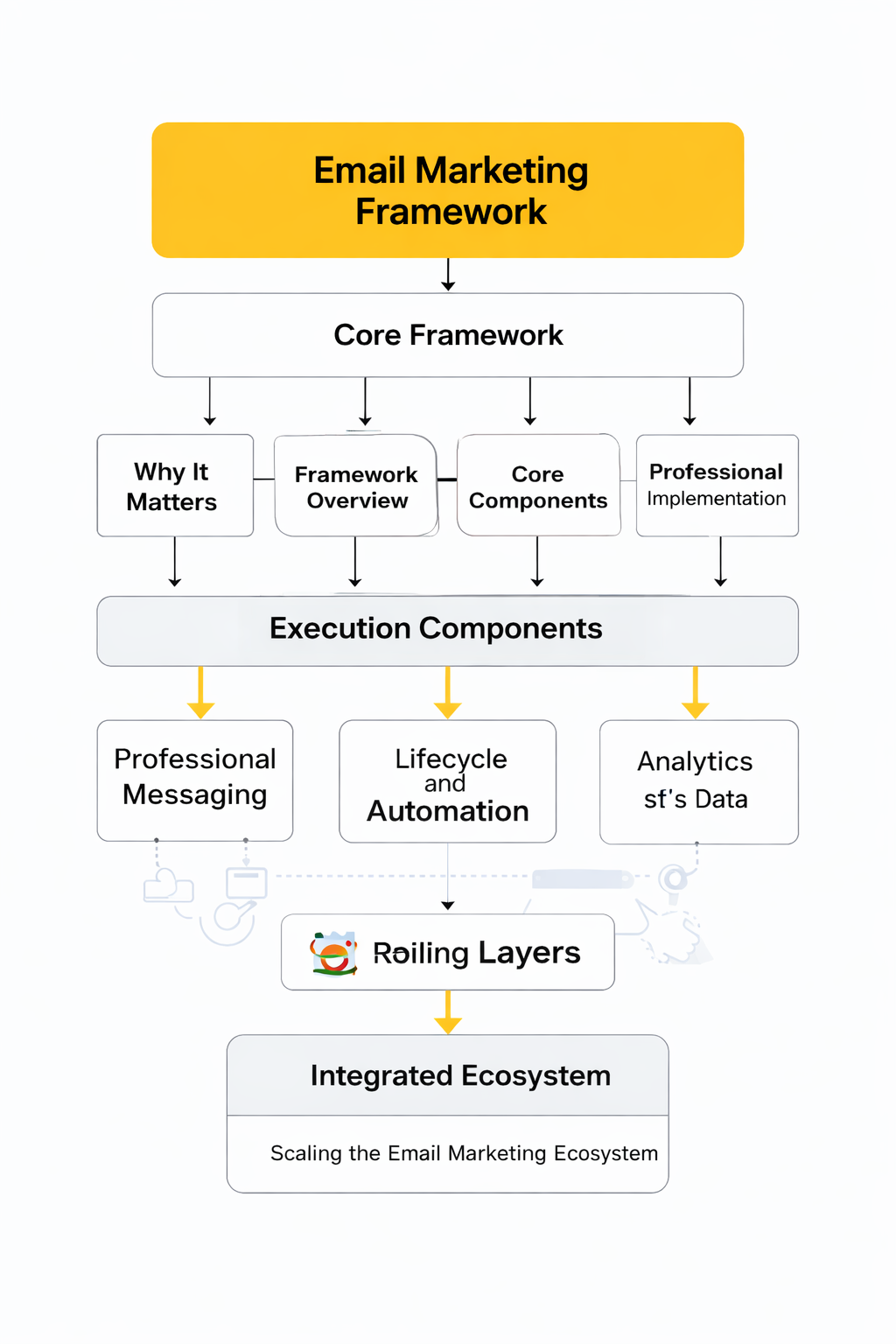
A practical email marketing framework starts with acquisition, moves into segmentation, then progresses into messaging, automation, deliverability, and measurement. That sequence matters because email rarely fails on copy alone. It usually fails much earlier, when the wrong people are added to the list, when consent is weak, when the offer is vague, or when the business has no clear logic for what should be sent after a person subscribes, browses, buys, or goes quiet.
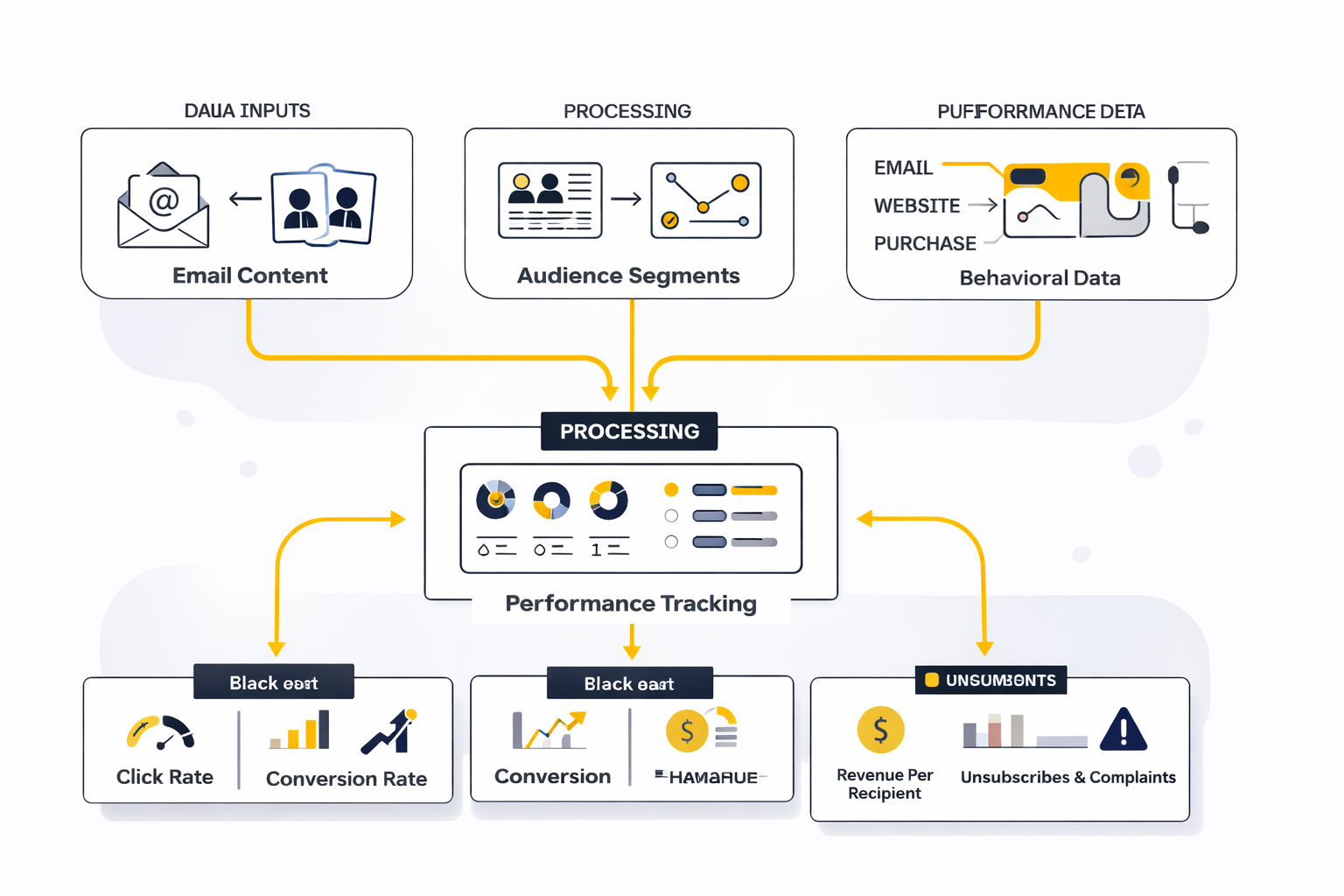
The best way to think about the framework is as a connected system rather than a collection of campaigns. Acquisition brings in the right subscribers. Segmentation ensures those subscribers do not all receive the same thing. Campaigns and flows deliver timely communication. Deliverability protects inbox placement. Measurement tells you whether the system is creating business results or simply generating activity that looks busy on a dashboard.
This more disciplined view has become even more important as privacy changes have made old reporting habits less trustworthy. Apple Mail Privacy Protection’s impact on open-rate reporting forced marketers to rethink which signals actually matter, and Mailchimp’s breakdown of open rate versus click-driven engagement metrics reinforces the same lesson. A modern framework does not obsess over vanity metrics. It follows engagement, conversion quality, revenue contribution, complaint rates, and subscriber health.
Core Components of Email Marketing
The first core component is list quality. If your list is built on weak promises, vague signup forms, or people who never truly wanted your emails, nothing downstream will perform the way it should. Strong email marketing begins with clear consent, a compelling reason to subscribe, and ongoing list hygiene that protects your sender reputation rather than inflating your subscriber count for the sake of appearances.
The second core component is segmentation. This is where email starts to feel intelligent instead of generic. Litmus found that more than 90% of surveyed marketers said segmentation boosts performance, which makes sense because relevance almost always beats volume. A subscriber who just downloaded a guide, viewed a pricing page, or bought a product should not receive the same message as someone who has not engaged in six months.
The third core component is automation. This is where much of the real leverage comes from because timely emails outperform random sends. Klaviyo’s 2024 benchmark research shows just how powerful automated flows can become when they are triggered by real behavior, and Shopify’s current email marketing statistics roundup highlights the same pattern with triggered messages producing materially stronger revenue outcomes than standard promotional blasts. A welcome sequence, abandoned-cart flow, browse-abandonment flow, post-purchase series, win-back sequence, and preference-management path are not “advanced extras.” They are the operational core of a serious program.
The fourth core component is deliverability. This is the part many teams ignore until performance collapses. Yet sender authentication, complaint control, and unsubscribe usability are no longer optional details. Google’s sender guidelines FAQ and Yahoo’s sender requirements and best practices have made that unmistakably clear for bulk senders. If your technical setup is weak, your email marketing strategy can be smart on paper and still fail in the inbox.
Professional Email Marketing Implementation
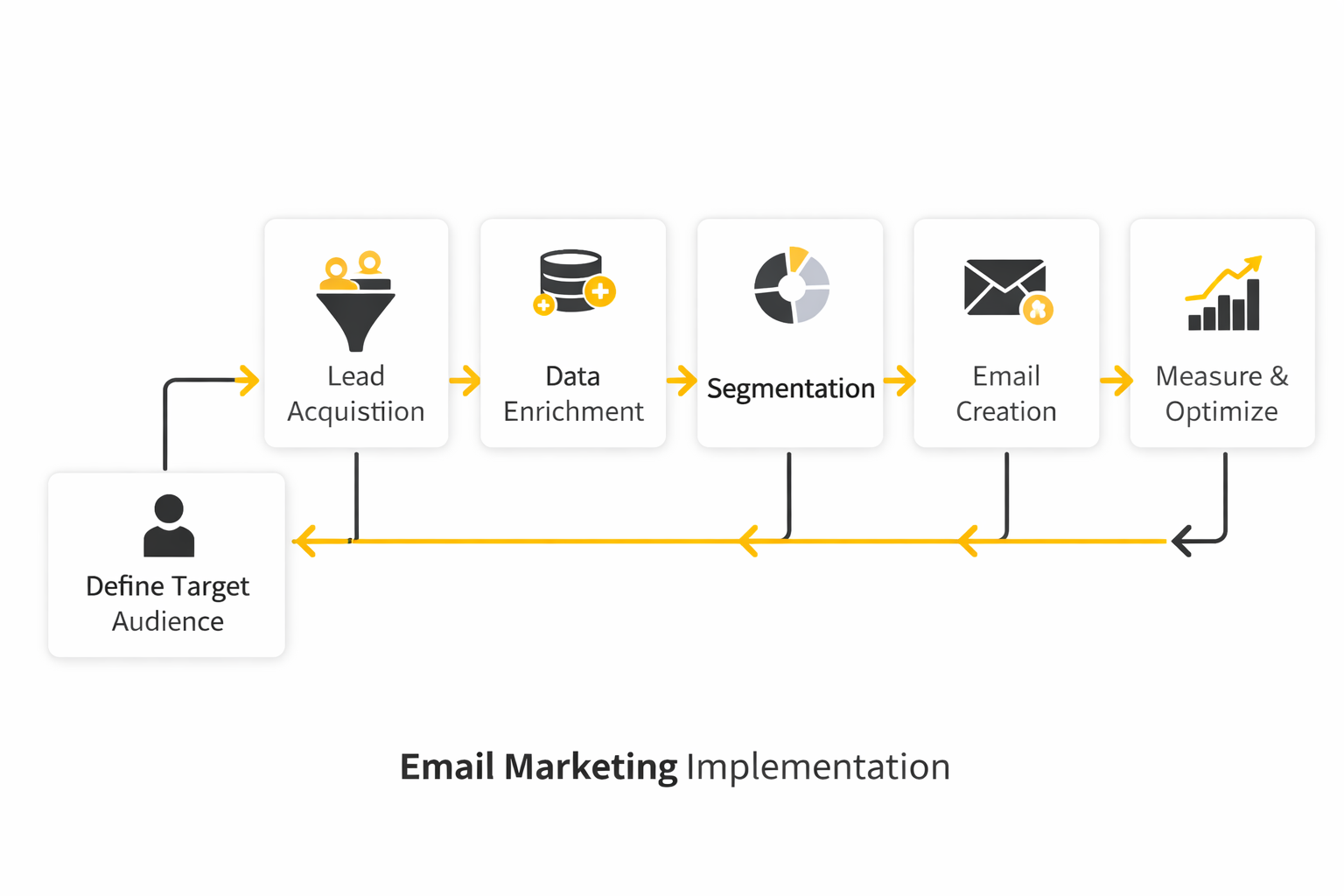
Professional implementation starts by deciding what role email should play in the business. For some brands, email is mainly a retention channel. For others, it is the engine that turns content into leads, nurtures deals, or brings cold visitors back before they disappear. The mistake is trying to copy another company’s cadence or campaign style without first defining the commercial job email is supposed to do inside your own growth model.
Once that role is clear, professionals build infrastructure before they scale volume. That means setting up domain authentication, preference management, event tracking, naming conventions, suppression rules, template systems, and a reporting model that connects sends to outcomes. It also means choosing a platform that matches the complexity of your business. If you want a lightweight system for newsletters, automations, and transactional communication, Brevo is a practical option to evaluate. If your priority is simple automation with room to grow, Moosend is another platform worth considering. If your business depends on tying email to landing pages, order flows, and conversion funnels, many teams also look at ClickFunnels as part of the stack rather than treating email as a standalone tool.
A real-world example shows what professional implementation looks like when it is done with discipline. Brevo’s Oliviers&Co case study is not interesting because it promises magic. It is interesting because the company first centralized customer data, then improved segmentation, then activated automations across markets, and only then did the revenue gains become visible. The result was not a lucky campaign. It was a cleaner system that produced better lead recovery, smarter targeting, and measurable web revenue growth.
That is the mindset to keep as we move into the next parts of the article. Great email marketing is rarely the product of one clever subject line or one dramatic promotion. It is usually the result of a professional operating system that makes every future send more relevant, more timely, and more profitable than the last one.
Measurement and Optimization
Once your email marketing foundation is in place, the next job is to measure the right things and improve them without getting distracted by vanity numbers. This is where a lot of businesses lose the plot. They stare at dashboards, celebrate a nice-looking open rate, and completely miss the fact that the emails are not generating enough clicks, not creating enough revenue, or quietly damaging deliverability because the audience is losing interest.
Good optimization starts with a simple mindset shift: email performance is not about proving that people saw a message. It is about proving that the message moved the business forward. That means your reporting has to connect email marketing activity to engagement quality, conversion behavior, revenue contribution, unsubscribe patterns, complaint signals, and long-term list health instead of treating every send like an isolated creative exercise.
Which Email Metrics Actually Matter
The most useful metrics are the ones that help you make a better decision on the next send. Click rate tells you whether the offer and message were strong enough to create action. Conversion rate tells you whether the landing page, product, or next step actually matched the promise of the email. Revenue per recipient, order rate, unsubscribe rate, spam complaints, and list growth quality tell you whether the program is becoming more valuable or just louder over time, which is why both Mailchimp’s email reporting guidance and Klaviyo’s live email benchmark resources place so much emphasis on metrics beyond opens.
Open rate still has some directional value, but it cannot carry the whole reporting model anymore. Litmus showed that Apple Mail Privacy Protection accounted for 55% of all opens as of March 2024, which is exactly why serious email marketing teams now treat opens as a secondary signal instead of the headline number. When more than half of recorded opens can be distorted by privacy protections, it is reckless to judge subject lines, resend strategies, or subscriber quality on that metric alone.
This is also why you need to separate campaign metrics from flow metrics. Promotional campaigns often tell you how compelling your current offer is, while automated sequences reveal how healthy your lifecycle strategy really is. Klaviyo’s flow benchmark guidance and its broader 2024 benchmark report built on more than 325 billion emails both reinforce the same lesson: behavior-triggered emails should be evaluated differently because they operate at moments of much stronger intent than standard broadcasts.

How To Read Benchmarks Without Fooling Yourself
Benchmarks are helpful, but only when you use them like a map instead of a trophy cabinet. Looking at an average click rate or unsubscribe rate can tell you whether you are in the right neighborhood, but it cannot tell you why your results are strong or weak. Industry averages from Mailchimp, platform-level comparisons in Mailchimp’s campaign benchmarking documentation, and cross-industry performance data from Klaviyo are useful because they create context, not because they hand you a finished strategy.
The mistake is chasing averages without accounting for your business model, list source, purchase cycle, or send type. A daily deals brand, a B2B SaaS company, and a creator selling a premium course should not expect the same response patterns, even if all three send well-designed emails. Benchmarks help you ask better questions, but your own segmentation, buying cycle, and traffic source quality determine whether a metric is healthy in your specific case.
That is why professional email marketing teams compare performance in layers. They look at campaign results by segment, by acquisition source, by device mix, by geography, by customer lifecycle stage, and by message type. When you do that, the numbers stop feeling random and start revealing where the friction actually is.
How To Run Tests That Actually Teach You Something
Testing is where optimization becomes real, but only if you are disciplined about it. Too many marketers change five things at once, get a slightly better result, and then have no idea what caused the improvement. The smarter approach is the one Mailchimp recommends in its A/B testing guidance: test one meaningful variable at a time, decide in advance what success means, and connect the winner to the business outcome you actually care about.
In practical terms, that means your test should start with a specific question. Are you trying to improve click quality with a clearer call to action? Are you trying to improve conversion rate by matching the email angle more closely to the landing page? Are you trying to reduce unsubscribes by changing cadence, offer style, or audience selection? When the question is fuzzy, the result is usually useless, even if the numbers look interesting for a day or two.
The strongest email marketing programs also know where testing matters most. Subject lines, from names, send times, offer framing, email length, creative density, and call-to-action placement are all fair game, and Mailchimp’s testing documentation lays those variables out clearly. But the biggest gains often come from testing strategy rather than cosmetics: sending fewer emails to weak segments, tightening the promise of the lead magnet, splitting flows by intent level, or changing the timing between messages so the sequence feels helpful instead of desperate.
When Deliverability Is the Real Problem
Sometimes optimization is not a copy problem at all. Sometimes the real issue is that your emails are not reaching the inbox consistently enough for the creative to get a fair shot. That is why deliverability deserves a permanent place inside your email marketing measurement model, especially now that mailbox providers have become more explicit about what they expect from bulk senders.
Google’s sender guidelines FAQ and Yahoo’s sender best practices made 2024 a turning point by pushing harder on authentication, easy unsubscribes, and complaint control. Those standards are not technical footnotes for your ops team to worry about later. They shape whether your messages reach real people, which means they shape revenue just as directly as your copy, your segmentation, and your offer strategy.
You can usually spot a deliverability problem when performance weakens across multiple campaigns at the same time, especially if click quality drops alongside rising unsubscribes or spam complaints. Yahoo’s complaint feedback loop documentation, Google’s subscription message guidelines, and Customer.io’s deliverability best practices all point toward the same conclusion: remove cold contacts more aggressively, honor expectations around frequency, make opting out easy, and stop treating a large but disengaged list like an asset when it is really a liability.
That is the real heart of measurement and optimization. Great email marketing is not about squeezing one more percentage point out of a subject line and calling it a day. It is about building a reporting and testing discipline that tells the truth, protects your sender reputation, and helps every campaign and automation get sharper over time.
Advanced Email Marketing Implementation

This is the point where email marketing stops being a nice idea and starts becoming a real operating system inside the business. A lot of brands never make that jump. They send campaigns, hope something sticks, and then wonder why revenue feels inconsistent even though the list keeps growing.
Professional implementation is what closes that gap. It gives email marketing a job, connects it to customer behavior, and makes sure every message exists for a reason instead of being thrown together because the calendar says it is time to send something.
Build The Stack Before You Scale
The smartest move is to build your infrastructure before you chase volume. That means your sending domain needs proper authentication, your events need to be tracked cleanly, your subscriber sources need to be labeled correctly, and your team needs to know which actions should trigger which emails. Google’s sender guidelines, the companion guidelines FAQ, and Yahoo’s sender best practices all reinforce the same reality: if the technical layer is sloppy, the marketing layer pays the price.
This matters because deliverability problems rarely announce themselves in a dramatic way on day one. They show up slowly through weaker inbox placement, softer engagement, and a growing mismatch between how strong your offer should be and how weak the campaign result actually is. Once that starts happening, marketers often blame subject lines or design when the real problem is that the foundation was never built properly in the first place.
That is why your platform choice matters more than people admit. If you want a system built around newsletters and lightweight automations, Brevo is worth a look. If your focus is lean automation and simpler lifecycle flows, Moosend can make sense. If the business depends on tight coordination between pages, offers, and conversion flows, many operators prefer to evaluate ClickFunnels as part of the broader system rather than treating email marketing as an isolated tool.
Map Email To the Customer Journey
Email marketing works best when it follows the customer journey instead of interrupting it. A new subscriber needs a different sequence from a first-time buyer. A returning customer, a pricing-page visitor, and someone who has gone silent for 90 days all need different messages too, because they are living in completely different moments of intent.
This is exactly why segmentation and automation keep showing up as priority areas in current research. Litmus’ 2024 State of Email Trends report found that segmentation remains one of the most effective tactics marketers use to improve results, while Mailchimp’s overview of email segmentation explains the practical reason why: relevance improves when the message actually matches the subscriber’s context. That sounds obvious, but in practice it requires real planning, not just a few tags inside the platform.
So the implementation question becomes very simple. What should happen after someone subscribes, browses, abandons a cart, buys, requests support, or stops engaging? Once you answer that clearly, email marketing becomes much easier to scale because you are no longer inventing the strategy from scratch every time you sit down to build a campaign.
Treat Automation Like Revenue Infrastructure
A lot of businesses still treat automation like a bonus feature they will “get to later.” That is a mistake. Automated email marketing flows are usually where the channel becomes most efficient because they reach people when intent is already present instead of trying to manufacture interest from a cold start.
The pattern is visible across current platform data and case studies. Klaviyo’s 2024 benchmark research based on more than 325 billion emails shows how meaningful the performance gap can be between behavior-triggered flows and standard campaigns, and its case study on Nuun shows what that looks like inside a real business: email revenue rose 820% after the brand built stronger automations and lifecycle programs. That kind of result does not come from one clever send. It comes from designing a system that reacts to behavior consistently and at scale.
The same principle shows up in other official case studies too. Klaviyo’s story on Corkcicle describes how consolidating tools and modernizing lifecycle execution helped the brand grow flow revenue by 93%, while Customer.io’s case study on Mysa shows how deeper segmentation and personalization drove a 592% increase in email marketing revenue. Those numbers are impressive, but the bigger lesson is even more important: email marketing gets stronger when automation is treated like infrastructure, not decoration.
Make Data Useful, Not Just Available
Most companies already have more customer data than they are using well. The problem is not access. The problem is that the data is often scattered across ecommerce platforms, forms, CRM fields, support tools, and product events, which makes it hard to turn into clear messaging decisions.
Email marketing implementation gets dramatically better once you simplify that mess. Instead of collecting everything possible, focus on the signals that actually change what a subscriber should receive next: source of signup, category interest, last purchase date, browsing activity, lead status, plan type, engagement recency, and declared preferences. Litmus’ work on zero-party and first-party data in email is useful here because it highlights something too many teams forget: the most valuable data is often the data a customer willingly gives you when the relationship feels clear and worth continuing.
This is also where privacy changes have forced better discipline. The old habit of leaning too hard on open rates made weak strategy look smarter than it was. With Apple’s privacy changes distorting that metric, as discussed in Litmus’ analysis of how Mail Privacy Protection changed email measurement and Omeda’s explanation of the impact on open-rate reporting, email marketing teams have had to shift toward clicks, conversions, revenue, retention, and subscriber quality. In the long run, that is healthier because it forces the program to be judged by business outcomes instead of flattering signals.
Create An Execution Rhythm Your Team Can Keep
One of the biggest reasons email marketing breaks down is that the team builds an ambitious strategy they cannot maintain. They launch complex flows, promise weekly campaigns, talk about personalization, and then the whole system starts slipping because approvals are messy, reporting is inconsistent, and no one knows who owns what. The issue is not a lack of ideas. The issue is that the operating rhythm was never designed to survive real work.
A better model is boring in the best possible way. Decide who owns segmentation, who writes copy, who builds emails, who checks links and rendering, who reviews legal or compliance concerns, and who signs off on reporting after the send. Brevo’s Email Strategy Benchmark report is helpful here because it shows how much variation exists in send frequency, email design, and format across brands, which is a reminder that there is no magic cadence that saves weak execution.
The goal is not to look busy. The goal is to build an email marketing system your team can run consistently without chaos. Once that happens, quality compounds, learning compounds, and revenue compounds too, because every send is connected to a real process instead of a last-minute scramble.
Statistics And Data
If you want to get serious about email marketing, you need numbers that actually help you make decisions. Not random percentages. Not vanity screenshots. Not a benchmark pulled out of context and treated like gospel. The best data tells you what is normal, what is improving, and where the real leverage is hiding inside your list, your campaigns, and your automations.
That is also why raw benchmarks can be dangerous in the wrong hands. Different platforms measure differently, industries behave differently, and privacy changes have made some older habits far less reliable than they used to be. So the smart move is to treat email marketing statistics as directional signals, then compare them against your own segmentation, traffic sources, and customer journey instead of pretending one number can explain everything.
Broad Benchmark Data For Email Marketing
One of the clearest large-scale reference points comes from Mailchimp’s benchmark data. On that page, Mailchimp reports average campaign results across all users at 35.63% for open rate, 2.62% for click rate, and 0.22% for unsubscribe rate. Those figures are useful because they give you a starting line, but they become more valuable when you look at how much they shift by industry. Ecommerce, for example, sits lower on clicks than education or nonprofits, which immediately tells you that context matters more than any universal “good” number.
There is another important detail on the same Mailchimp page that too many marketers gloss over: those averages were built from campaigns sent to at least 1,000 subscribers and last updated in December 2023. That does not make the data weak. It makes it specific. And specificity is what good email marketing analysis needs, because the worst thing you can do is compare your modern lifecycle program to a benchmark you do not fully understand.
Zeta Global’s Q3 2024 Email Marketing Benchmark Report adds another layer that matters. Its executive summary notes that open rates were down across all verticals and message types, while click rates continued to improve across the industry except in financial services and triggered messages, and click-to-conversion rates in travel, hospitality, and entertainment rose by more than 20% year over year. That is a powerful reminder that email marketing performance cannot be reduced to opens anymore. In some cases, a lower open trend can coexist with stronger downstream business results.
Lifecycle And Automation Data
The strongest email marketing programs are not built on one-off campaigns. They are built on lifecycle thinking, and recent research makes that very hard to ignore. In Litmus’ 2024 State of Email in Lifecycle Marketing report, 44% of marketers say they use lifecycle emails to activate, engage, and retain customers, 36% say they want to create more automated emails over the next 12 months, and 34% say they need to improve retention even though it is not treated as a major KPI. That combination tells a very revealing story. Marketers know retention matters, they know automation matters, but many teams are still not measuring those priorities with the seriousness they deserve.
That gap creates opportunity for the businesses willing to move faster. When email marketing is mapped to the customer journey instead of treated like a generic broadcast tool, performance becomes easier to improve because the messages are tied to real behavior. A welcome series, browse flow, abandoned-cart sequence, post-purchase path, reactivation sequence, and preference-management journey all solve different problems, and the brands that understand that are usually the ones pulling more revenue out of the same audience.
Klaviyo’s 2024 benchmark report leans in the same direction. Its big benchmark takeaways point to automation as the conversion-driven marketer’s secret weapon, which lines up with what marketers see in the field every day: the closer an email is tied to intent, the more likely it is to produce action. That is why email marketing feels average when it is driven by a calendar and feels powerful when it is driven by behavior.
Segmentation And Personalization By The Numbers
Segmentation deserves its own place in the data because it is one of the rare tactics that keeps showing up as broadly effective across different studies. In Litmus’ 2024 State of Email Trends report, email segmentation was the only tactic where more than 90% of respondents said it boosted performance at least some. That is not a small signal. That is the kind of finding that should change how a business prioritizes its workload.
The reason this matters so much is simple: relevance compounds. When your email marketing program segments by intent, purchase history, geography, engagement recency, or self-selected preferences, the message stops feeling like a mass send and starts feeling like it belongs in that inbox. That usually improves more than just clicks. It helps protect deliverability, reduces fatigue, and makes future campaigns easier to optimize because you are learning from clearer audience groups instead of one giant mixed list.
Litmus’ report also makes the practical side of segmentation harder to ignore. The examples it highlights, including purchase history, email engagement, time zone, and self-selected preferences, are not exotic enterprise-only tactics. They are accessible moves that many teams can implement right now. And that is good news, because in email marketing the easiest wins are often the ones people delay for far too long.
How Privacy Changed Email Marketing Data
Any honest statistics section on email marketing has to deal with one uncomfortable truth: open rates are no longer sturdy enough to carry your reporting model on their own. Apple’s Mail Privacy Protection changed that conversation in a major way, and Litmus explains the operational impact clearly in its analysis of email analytics after Mail Privacy Protection. The issue is not that open rates became completely useless. The issue is that they became much easier to misread.
That change is exactly why the healthier metric stack now leans toward clicks, click-to-conversion rate, revenue per recipient, unsubscribe rate, complaint rate, and retention impact. Zeta’s Q3 2024 benchmark data is useful here because it shows how clicks and conversions can tell a much more interesting story than opens alone. When click quality improves even while open activity softens, the conclusion is not that email marketing is weakening. The conclusion is that the smarter measurement model is closer to business outcomes than the old one was.
This shift has also made email marketing strategy better in one important sense. It forces teams to focus on whether the message created action, not just whether an image pixel fired. And that is exactly where serious marketers should want the standard to be.
What The Best Email Marketing Data Actually Tells You
When you step back and look at the numbers together, the message is pretty clear. Broad campaign benchmarks from Mailchimp give you useful baseline expectations. Lifecycle data from Litmus shows where marketers are trying to go next. Trend data from Litmus’ 2024 trends report shows that segmentation keeps paying off. And performance analysis from Zeta Global reinforces that downstream engagement and conversion trends matter more than obsessing over opens.
So what should you take from all of this? Email marketing is still a performance channel, but only when you read the data with context and maturity. If your list is growing but your clicks are weak, the problem is probably relevance. If opens look healthy but revenue is flat, the problem is probably the offer or the next step. If automation is underbuilt, retention is being left on the table. And if segmentation is shallow, you are almost certainly making the whole job harder than it needs to be.
That is the real value of statistics and data in email marketing. They are not there to impress you. They are there to expose what needs to be fixed, show you where the biggest upside is, and keep you honest about whether your program is truly improving or just getting noisier.
Email Marketing Ecosystem
Email marketing becomes far more powerful when you stop treating it like a standalone channel. On its own, it can still drive traffic, sales, and retention. But when it is connected to your forms, CRM, site behavior, checkout flow, customer support signals, and reporting stack, it starts acting like the central nervous system of your marketing instead of just another broadcast tool.
That shift matters because most businesses do not actually have an email problem. They have a coordination problem. The list lives in one place, lead data lives somewhere else, product behavior sits in another tool, and the reporting is split across dashboards that never really talk to each other. The result is predictable: weak segmentation, repetitive messaging, poor timing, and a customer experience that feels fragmented even when the team is working hard.
Why The Ecosystem Matters
The modern email marketing ecosystem is built around first-party relationships. That matters more than ever as privacy rules tighten, third-party data becomes less dependable, and marketers are pushed to earn better information directly from customers. Litmus makes that case clearly in its work on lifecycle marketing and the broader state of email research, both of which point to email as one of the most reliable places to collect consent, preferences, and behavioral insight over time.
The opportunity is huge, but most brands are still underbuilt here. A widely cited 2024 report distributed through HubSpot’s 2024 State of Marketing materials noted that 87% of marketing leaders see email as critical to success, yet only 24% of programs are highly integrated with other marketing channels. That gap tells you exactly where the advantage is now. The businesses that unify their systems are going to learn faster, personalize better, and waste less effort than the ones still running email marketing in isolation.
Consumer expectations are moving in the same direction. The 2024 State of Personalization report from Twilio and the 2024 State of CX Personalization report from Medallia and CXPA both reinforce the same theme: customers expect relevant experiences, while brands are still struggling to connect the data and systems required to deliver them consistently. Email marketing is often the cleanest place to start fixing that problem because it sits so close to consent, preference capture, purchase behavior, and repeat engagement.
The Core Layers Of The Ecosystem
The first layer is acquisition. This includes the forms, landing pages, pop-ups, lead magnets, checkout opt-ins, and booking flows that bring people into your world. If those entry points are vague or disconnected, the rest of your email marketing system has to work much harder than it should. That is why the strongest programs define the source, intent, and promise behind every signup instead of throwing every contact into one giant list and hoping segmentation can clean it up later.
The second layer is customer data. This is where profile fields, browsing behavior, purchase history, support activity, and declared preferences come together. Mailchimp’s documentation on segmenting options and how segments work shows just how many practical ways marketers can use audience data once it is structured properly. The point is not to collect everything. The point is to collect the few signals that actually change what someone should receive next.
The third layer is orchestration. This is where automations, campaigns, and cross-channel journeys come together in a coordinated sequence. Microsoft’s overview of Customer Insights – Journeys describes this clearly: modern marketing is about guiding prospects and customers through automated messaging, decision points, and connected experiences rather than blasting one generic message to everybody at once. That is exactly how a mature email marketing ecosystem behaves.
The fourth layer is conversion infrastructure. Email should not drop people into a confusing next step. It should move them into a landing page, scheduling flow, checkout page, product experience, or sales conversation that feels like a natural continuation of the message they just opened. That is one reason businesses looking to connect forms, pages, and follow-up automations often evaluate tools like ClickFunnels, while teams wanting a lighter all-in-one email and automation setup often look at Brevo or Moosend. The best choice depends on the business model, but the principle stays the same: email marketing gets stronger when the handoff to the next experience is seamless.
How Great Teams Connect Email To Other Channels
The smartest teams do not ask whether email marketing or another channel matters more. They ask how each channel can make the others stronger. Email can reinforce content marketing by nurturing readers after a download. It can support paid traffic by converting leads that were too expensive to win on the first click. It can strengthen social by moving casual followers into an owned audience. And it can make customer success better by following up after onboarding, support interactions, renewals, or expansion opportunities.
This kind of orchestration is becoming standard among stronger operators. Braze’s 2024 Global Customer Engagement Review and its summary of key 2024 customer engagement trends both point toward the same operational reality: customers experience brands across channels, so marketers need systems that can coordinate timing, relevance, and follow-up across those channels. Email marketing remains central in that mix because it provides a durable identity layer and a natural place to continue the relationship after the first interaction happens elsewhere.
That is also why integration with scheduling, intake, and lead qualification tools matters more than people realize. When somebody requests a demo, books a call, fills out a questionnaire, or asks for pricing, those actions should shape what happens next in email. If you want a cleaner handoff between lead capture and follow-up, tools like Fillout for richer forms or Cal.com for scheduling can make the rest of the email marketing workflow feel much more intentional.
The Hidden Risk Of A Broken Ecosystem
A broken ecosystem does not always look broken from the outside. Campaigns still go out. Dashboards still populate. Leads still come in. But the underlying customer experience starts to fray. People receive irrelevant emails after they already bought. Sales teams get leads without context. Support issues do not suppress promotional messages. Old segments keep receiving offers that no longer fit. And over time, trust erodes because the business keeps acting like it does not really know the customer it is talking to.
That is one reason deliverability has become an ecosystem issue, not just a technical checklist. Google’s sender guidelines FAQ and Yahoo’s sender best practices made it clear in 2024 that authentication, complaint control, and easy unsubscribes are now table stakes. But those outcomes are shaped by more than DNS records. They are shaped by whether your ecosystem is sending the right message to the right person at the right time often enough to stay useful and not so often that people start reporting you as noise.
In other words, bad integration creates bad email marketing even when the copy sounds fine. If the underlying data is stale, if suppression rules are weak, or if lifecycle signals never make it back into the system, the inbox will expose those cracks fast. That is why the best operators think about deliverability, relevance, consent, and data quality as one connected discipline instead of separate projects.
What A Healthy Email Marketing Ecosystem Looks Like
A healthy email marketing ecosystem is not necessarily the most complex one. It is the one where every core part has a clear job. Acquisition captures the right people with the right promise. Customer data updates cleanly. Segmentation reflects real behavior. Automations follow actual intent. Sales and support signals feed back into messaging. Reporting connects activity to revenue, retention, and subscriber health. And the business keeps refining the system instead of piling on more tools to compensate for weak foundations.
When that happens, email marketing becomes one of the few channels that keeps getting smarter as the business grows. Every signup teaches you something. Every click sharpens segmentation. Every purchase improves follow-up. Every unsubscribe clarifies fit. And every connected system makes the next message more relevant than the last one. That is what makes the ecosystem so valuable. It does not just help you send more email. It helps you build a business that understands its audience better over time.
FAQ For a Complete Email Marketing Guide
By this point, you have seen how email marketing works as a system, not just a tactic. But even when the strategy is clear, the same practical questions keep coming up. That is normal. Email marketing looks simple from the outside, yet the details around list growth, segmentation, automation, deliverability, and reporting are exactly where the results are won or lost.
So let’s wrap this guide the right way. Below are the questions that matter most if you want to build an email marketing program that actually performs, keeps trust intact, and turns your list into a real business asset instead of a pile of contacts you barely use.
What Is Email Marketing Really Meant To Do?
Email marketing is meant to help you build and monetize a direct relationship with people who have agreed to hear from you. That includes generating leads, nurturing interest, recovering missed opportunities, driving sales, improving retention, and creating repeat engagement after the first purchase. When it is done right, email marketing becomes one of the few channels you actually control instead of renting attention from someone else’s platform.
The reason this matters is simple. Platforms change, ad costs rise, and algorithms can crush your reach overnight. Your email list gives you a way to keep the relationship going on your own terms, which is exactly why official resources from Mailchimp, Litmus, and Brevo keep treating email as a core owned channel rather than an optional add-on.
Is Email Marketing Still Worth It In 2026?
Yes, but only if you treat it like a serious system. Email marketing is still worth it because it gives you direct access to people who already know your brand, which makes it incredibly valuable for nurturing, retention, launches, and repeat purchases. What is not worth it is lazy email marketing that sends generic promotions to disengaged lists and then blames the channel when results fall flat.
The brands still winning with email are the ones that focus on relevance, timing, automation, and first-party data. That is the thread running through current guidance from Litmus, Mailchimp, and Klaviyo. Email marketing still works like crazy, but it rewards discipline much more than it rewards volume.
How Often Should You Send Emails?
There is no magic number that works for every business. The right frequency depends on your offer, your audience, the stage of the customer journey, and whether the message is genuinely useful. A newsletter brand may be able to send several times a week. A B2B service business may do better with a lighter cadence and stronger lifecycle automation. An ecommerce brand may mix promotional campaigns with post-purchase and browse-based sequences.
The smarter question is not, “What is the perfect frequency?” It is, “How often can I send valuable emails without training people to ignore me?” If unsubscribes, complaints, or disengagement start climbing, your email marketing rhythm probably needs work. Guidance from Google’s sender guidelines FAQ and Yahoo’s sender best practices makes it clear that subscriber expectations and complaint control are now part of the real performance equation.
What Are The Most Important Email Automations To Build First?
If you are starting from scratch, build the flows that match the highest-intent moments. That usually means a welcome sequence, an abandoned-cart flow if you sell online, a browse-abandonment sequence, a post-purchase series, a re-engagement flow, and a preference or onboarding path if the business model needs more qualification. Those automations matter because they react to real behavior instead of forcing every subscriber through the same generic messaging.
This is where email marketing starts becoming efficient. You stop relying on constant manual sending and start letting the system respond to what people actually do. That is why lifecycle guidance from Litmus and platform resources from Klaviyo and Brevo keep pushing marketers toward automation as a core growth engine.
What Metrics Should You Track In Email Marketing?
You should track the metrics that help you make better decisions, not just the ones that look impressive in a dashboard. Click rate, conversion rate, revenue per recipient, unsubscribe rate, spam complaints, list growth quality, and performance by segment are far more useful than staring at open rate in isolation. Open rate still gives you some directional context, but it should not be the number running your whole strategy.
That shift happened for a reason. Privacy changes, including the ones discussed in Litmus’ analysis of email analytics after Mail Privacy Protection, made opens easier to misread. That is why email marketing teams with their heads on straight now prioritize actions and outcomes over superficial visibility signals.
Why Is Segmentation So Important?
Segmentation matters because relevance beats volume. If a new lead, a repeat customer, and an inactive subscriber all receive the same email, the message is probably too generic to feel right for any of them. Email marketing gets dramatically better the moment you start grouping people by intent, purchase history, engagement recency, preferences, geography, or lifecycle stage.
This is not just theory. Current resources from Litmus and practical documentation from Mailchimp both point toward segmentation as one of the most consistently useful levers in the channel. It improves message fit, helps protect deliverability, and gives you cleaner insight into what is actually working.
How Do You Grow An Email List The Right Way?
You grow it by making a clear promise to the right people and then keeping that promise. That can happen through useful lead magnets, content upgrades, product waitlists, newsletter opt-ins, checkout subscriptions, webinar registration, resource libraries, or booking flows. What matters is that the person understands what they are signing up for and actually wants the relationship you are offering.
What you do not want is inflated list growth built on weak incentives, vague forms, or names gathered without real intent. Bad list growth creates bad email marketing later because disengaged subscribers damage performance and trust. That is why so much official guidance around email marketing keeps coming back to consent, expectations, and list hygiene.
How Do You Improve Email Deliverability?
You improve deliverability by treating it like an operating discipline, not a technical afterthought. That means authenticating your domain properly, honoring unsubscribes fast, keeping complaints low, removing cold subscribers when necessary, and making sure your messaging stays relevant enough that people do not mark it as spam. Deliverability improves when your entire email marketing system respects the subscriber instead of trying to squeeze every last send out of a tired list.
The standards here have gotten tighter, not looser. Google’s sender guidelines, the updated Google FAQ for bulk senders, and Yahoo’s best practices all make that very clear. If your email marketing program ignores authentication, complaint control, and easy opt-outs, you are taking a real performance risk whether you realize it or not.
Should Small Businesses Invest In Email Marketing?
Absolutely, and in many cases they should invest earlier than they think. Small businesses usually have tighter budgets, less room for wasted spend, and more to gain from channels they own. Email marketing helps level the field because it lets a smaller company keep the conversation going without paying for every touchpoint all over again.
It also helps small businesses build trust over time, which is often where the real sale happens. A person may not buy on the first visit, the first consultation, or the first click. Email marketing gives you a way to stay present, educate the lead, answer objections, and bring people back when the timing is right. That is a huge advantage when every lead matters.
What Makes An Email Good?
A good email is clear, relevant, timely, and easy to act on. It has one main point, one clear next step, and a reason to exist beyond filling space on the calendar. Good email marketing does not hide behind fancy design or clever wording. It respects the reader’s time, gets to the point, and gives the person a reason to care right now.
That also means a good email does not need to be complicated. Sometimes the best-performing messages are surprisingly simple because they sound direct, human, and useful. The goal is not to impress other marketers. The goal is to move the subscriber one step forward.
What Tools Do You Need For Email Marketing?
You need a platform that fits your current complexity and does not trap you when you grow. At the very least, you need list management, segmentation, automation, templates, analytics, and reliable sending infrastructure. Depending on your business, you may also need stronger forms, CRM integration, landing pages, ecommerce triggers, or scheduling and intake tools connected to the email flow.
That is why businesses evaluate tools differently. Some teams want a more straightforward solution like Brevo or Moosend. Others need pages, forms, and conversion flows tied closely together, which is why they look at ClickFunnels. The real question is not which tool is coolest. It is which one supports the kind of email marketing system you are actually trying to run.
Can Email Marketing Work Together With Other Channels?
It should. In fact, email marketing becomes much more powerful when it is connected to content, paid traffic, social media, CRM activity, customer success, sales calls, and on-site behavior. Email can nurture the lead that came from paid ads. It can follow up after somebody books a call. It can support onboarding after purchase. It can reactivate people who first found you through social but were not ready to buy yet.
That is why the ecosystem matters so much. The stronger the connection between email and the rest of your stack, the more relevant your messaging becomes. Email marketing should not live in its own little bubble. It should help coordinate the rest of your growth system.
How Long Does It Take To See Results From Email Marketing?
You can see early wins quickly if you already have traffic, a healthy list, and obvious automation gaps. A welcome sequence, abandoned-cart flow, or better segmentation can create noticeable improvement faster than many channels. But the biggest email marketing wins usually come from compounding, not from one dramatic campaign. Better data, smarter automations, cleaner targeting, and stronger trust build over time.
That is the part a lot of people do not want to hear. Email marketing is not magic just because the channel is powerful. It still takes work to set up the right infrastructure, understand your audience, write better messages, and refine the system month after month. But once it starts compounding, it becomes one of the most reliable growth assets a business can own.
Work With Professionals
There comes a point where trying to piece everything together on your own starts costing more than it saves. You can absolutely learn email marketing yourself, and you should understand the fundamentals. But if your business depends on better retention, stronger automation, cleaner deliverability, or a more intelligent lifecycle system, bringing in professionals can collapse months of trial and error into a much faster path.
That does not mean hiring blindly. It means finding people who understand strategy, data, copy, segmentation, automation logic, and the technical side of email marketing well enough to build something that actually lasts. The right professional does not just send prettier campaigns. They help you create a system that makes every lead, every subscriber, and every customer interaction more valuable over time.
Explore 10K+ Remote Marketing Contracts on MarkeWork.com
Most marketers spend too much time chasing clients, competing on crowded platforms, and losing a percentage of every project to middlemen.
MarkeWork gives you a better way. Browse thousands of remote marketing contracts and connect directly with companies desperate to hire skilled marketers like you without platform commissions and without unnecessary gatekeepers.
If you’re serious about finding better opportunities and keeping 100% of what you earn, you can explore available contracts and create your profile for free at MarkeWork.com.
 Filip Konecny Enterprises