
Email Campaign Strategy That Wins Attention, Trust, and Revenue
An email campaign is no longer just a batch of promotional messages you schedule and hope will perform. It is one of the few marketing assets you actually control, which matters even more now that search, social, and paid distribution are shaped by platform shifts, rising acquisition costs, and tighter privacy rules. That is a big reason email continues to rank among the highest-ROI channels for B2C marketers, while the DMA’s 2025 benchmark study shows the channel is still scaling at enormous volume rather than fading away.
What separates a strong email campaign from a forgettable one is not clever wording alone. It is the combination of list quality, audience intent, deliverability, offer design, message structure, timing, and measurement discipline. This first part builds that foundation so the rest of the article can move from strategy into execution, analytics, and long-term scaling without treating email like an isolated tactic.
Article Outline
- Why It Matters
- Framework Overview
- Core Components
- Professional Implementation
- Analytics and Optimization
- Ecosystem and Scale
Why It Matters
The case for building a serious email campaign is simple: you get direct access to people who already know your brand, you are not renting attention from an algorithm, and you can connect messaging to revenue with far more precision than in many awareness channels. HubSpot’s current marketing data places email among the strongest ROI drivers for B2C brands, while the latest Litmus ROI analysis still shows a large share of teams seeing returns between 10:1 and 36:1 or better. That does not mean every send prints money, but it does mean a disciplined email campaign deserves a place near the center of your growth strategy rather than at the edge of it.
The audience is there, too. Recent market data collected by HubSpot points to roughly 4.6 billion global email users in 2025, which is why email remains one of the rare channels that can work across ecommerce, SaaS, media, services, education, and nonprofit models. When the reachable market is that broad, the real constraint is not whether people use email, but whether your campaign gives them a reason to open, read, click, and stay subscribed.
There is also a defensive reason to take email seriously. Google’s bulk sender requirements and Yahoo’s sender best practices have pushed deliverability, authentication, and unsubscribe experience out of the technical basement and into everyday marketing operations. A modern email campaign is not just creative and copy. It is reputation management, consent management, and brand trust made visible in the inbox.
Framework Overview
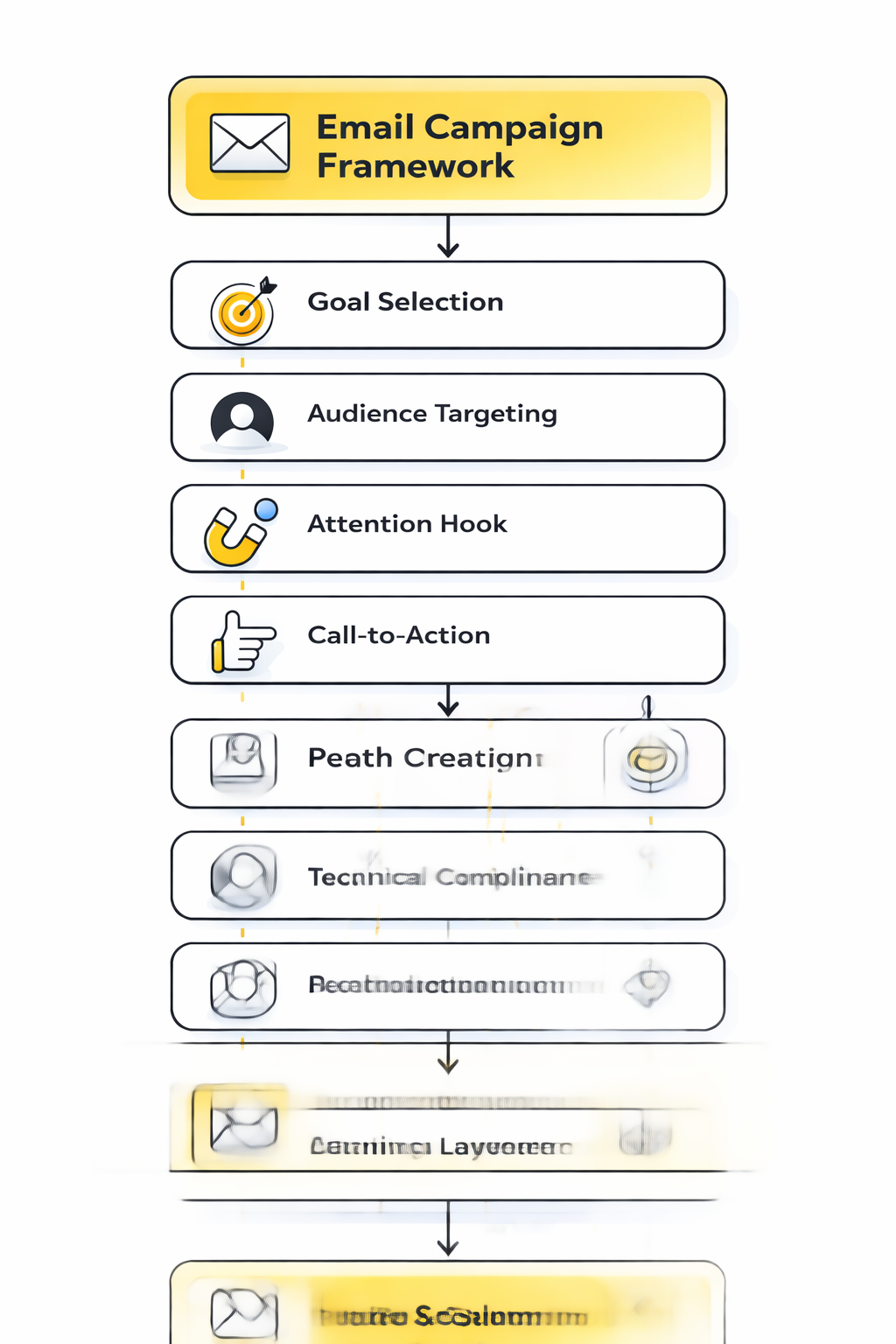
The cleanest way to think about an email campaign is as a sequence rather than a single send. First, you define the business goal so the campaign is built to drive one clear action instead of ten competing ones. Then you match that goal to one audience segment, one stage of awareness, one promise, and one conversion path, because relevance almost always beats volume in email. That matters even more in a market where Litmus has highlighted the shift away from vanity metrics and toward privacy-proof measurement, and where HubSpot’s recent research shows personalized and segmented experiences are strongly tied to more leads and purchases.
After that, the campaign framework becomes easier to manage. You need a signup source that sets expectations, a welcome or context-setting message, a message arc that moves the reader from interest to action, and a destination page that feels like the natural continuation of the email rather than a jarring handoff. When those pieces line up, the campaign feels coherent; when they do not, even a high open rate can hide weak business performance.
This is also why open rates should be handled with caution. Recent benchmark coverage from HubSpot makes the point directly: opens can still be directional, but privacy changes have made them less reliable as a stand-alone measure of success. A strong email campaign framework therefore treats opens as an early signal, clicks as a stronger behavioral sign, and conversion or downstream revenue as the real test.
Core Components
Every high-performing email campaign rests on five core components: list quality, deliverability, message relevance, conversion design, and measurement. List quality comes first because a weak list poisons everything downstream. If people did not clearly ask to hear from you, or if they signed up for one thing and received something else, the campaign starts with friction instead of trust.
Deliverability comes next because the best creative work in the world cannot produce results from the spam folder. Google’s sender guidelines, its newer subscription guidance, and Yahoo’s published sender standards all point in the same direction: authenticate your domain, make opt-outs easy, keep complaint rates low, and send messages people actually expect. In practical terms, that means your email campaign should be built around permission and consistency, not short-term list inflation.
Message relevance is where strategy becomes visible to the reader. Subject lines need to earn attention honestly, the opening must confirm why the email matters now, the body has to do one job well, and the call to action should sound like the natural next step rather than a forced pitch. This is exactly why segmented campaigns matter so much; marketers keep leaning into them because current HubSpot research shows personalized experiences are closely associated with stronger purchase and lead outcomes, and the Litmus State of Email reporting continues to center relevance, data quality, and performance proof as core challenges.
Conversion design is the piece many teams underweight. If your email promises one thing and the landing page asks for something bigger, slower, or more confusing, the campaign leaks momentum right at the point of decision. That is why the best email campaign builders think about the click before they write the email: they define the destination, the offer, the proof, and the friction points first, then write the message that earns the visit.
Measurement turns all of this into a repeatable system. Benchmarks from providers like Mailchimp are useful for orientation, but the more important question is whether one campaign beat your own prior baseline for the same segment, offer, and goal. Averages can tell you if you are in the neighborhood; they cannot tell you whether your campaign is improving in a way that compounds over time.
Professional Implementation
Professional implementation begins by choosing tools that fit the campaign you are actually trying to run, not the one you imagine you might need three years from now. If your priority is a clean email engine with automation and compliance-friendly workflows, Brevo and Moosend are sensible places to start. If your campaign depends heavily on funnels, upsells, and tightly controlled conversion paths, tools like ClickFunnels or Systeme.io can make the handoff from email to offer much easier to manage.
But software is only part of professional implementation. Process matters just as much: define ownership, set approval rules, test rendering before launch, use naming conventions that make reporting readable, and build a pre-send checklist that covers links, segmentation, suppressions, personalization tokens, legal footer requirements, and mobile rendering. The reason disciplined teams do this is straightforward: email clients still vary widely in usage and rendering environments, so a message that looks polished in one inbox can quietly break in another if nobody checks.
Real businesses are still proving how much this discipline matters. In a recent Klaviyo case study on Ruroc, the brand tied more tailored email experiences to significant revenue growth, and Tatcha’s 2025 campaign results show how coordinated lifecycle messaging can contribute a large share of ecommerce revenue rather than acting like a side channel. The lesson is not that one platform is magical. It is that a professional email campaign works best when segmentation, lifecycle timing, creative consistency, and conversion architecture all pull in the same direction.
That is the standard worth aiming for from day one. Build each email campaign as a business system, not a one-off blast, and the channel becomes easier to measure, easier to optimize, and much harder for competitors to copy. In the next part, the focus shifts to analytics and optimization so you can see what is truly moving performance instead of reacting to surface-level numbers.
Analytics and Optimization
This is where an email campaign either grows up or stays stuck. Plenty of marketers still stare at open rates first because they are easy to spot, but that can send you in the wrong direction when Apple Mail Privacy Protection masks real open behavior and when platforms like MailerLite now openly warn that real opens are lower than what dashboards report. The smarter move is to treat opens as a rough signal, then let clicks, conversion rate, revenue per recipient, unsubscribe rate, complaint rate, and downstream purchase behavior tell you whether the email campaign actually did its job.
Benchmarks are useful here, but only if you handle them like guardrails instead of goals. Mailchimp’s benchmark dataset puts overall averages at 35.63% opens, 2.62% clicks, and 0.22% unsubscribes, while MailerLite’s 2025 median across 3.6 million campaigns shows 43.46% opens, 2.09% click rate, and the same 0.22% unsubscribe rate. Those differences are exactly why a serious email campaign should compare itself to similar sends inside the same business first, because provider datasets, list hygiene rules, and industry mix can shift the numbers more than most people expect.
Testing What Actually Moves Revenue
The best optimization work starts before you send anything. You decide what one variable deserves the test, you keep the audience stable enough to trust the result, and you judge the winner on business impact instead of chasing whichever version got a prettier vanity metric. That means subject line tests are useful, but only when they are tied to what happens after the click, because a flashy subject line that lifts opens but attracts the wrong traffic can quietly damage the whole email campaign.
The most valuable tests usually happen deeper in the flow anyway. You learn more by testing whether a shorter path converts better than a longer nurture sequence, whether a product-led email outperforms a story-led email, whether urgency helps or harms the segment, and whether a landing page mismatch is the real reason conversions stall. That is why teams using platforms like Brevo, Moosend, or a funnel stack such as ClickFunnels gain an edge when they connect email tests to actual revenue events instead of stopping at inbox metrics.
How Winning Teams Read the Data
Strong teams read email performance like a sequence of causes, not a pile of disconnected numbers. If opens are fine but clicks are weak, the problem is often the message-body fit, the offer, or the call to action. If clicks are healthy but sales disappoint, the landing page, checkout flow, pricing, or audience match is usually the wall. And if unsubscribes spike, that is often your market telling you the promise that got the subscriber in is no longer aligned with the message they are receiving now.
You can see this more clearly when lifecycle data is connected across campaigns and automations. Tatcha’s 2025 New Year promotion worked because the team did not treat email like a one-off blast; the campaign sat inside a fuller retention system, and the result was 20% year-over-year ecommerce revenue growth, 70% growth in flow revenue, and 47% of ecommerce revenue attributed to Klaviyo. That is the kind of outcome an email campaign can produce when optimization is tied to customer journey design rather than isolated message tweaks.

Building an Ecosystem That Scales
An email campaign becomes dramatically more valuable when it stops operating alone. The inbox might be where the relationship deepens, but the data that makes that relationship relevant often comes from forms, product browsing, purchase history, loyalty behavior, customer support signals, and sometimes SMS or onsite personalization. Once those pieces start talking to each other, your email campaign stops feeling like a scheduled broadcast and starts behaving like a responsive growth system.
This is where a lot of businesses either level up or hit a ceiling they cannot explain. They keep sending more campaigns, but performance gets flatter because the messages are not drawing from enough context. Google’s current sender rules for high-volume Gmail traffic make that even more important, because the safest route to the inbox is no longer brute-force frequency. It is consistent relevance, clear consent, strong authentication, and an email campaign ecosystem that makes people want the next message instead of hunting for the unsubscribe link.
When Email Works Better With Other Channels
Email scales better when it is allowed to do the job it is best at. It is excellent for onboarding, education, replenishment, reactivation, product discovery, and long-form persuasion. But there are moments when another channel can sharpen the timing, which is why strong brands increasingly connect email with SMS, onsite prompts, and segmented retargeting rather than forcing one channel to carry the entire conversation.
Mixtiles is a great real-world example. Their team built journeys where email and SMS support each other instead of competing, and the result was nearly 40% of all revenue coming from email and SMS, with 40% of owned revenue driven by automation. That matters because it shows scale did not come from sending louder messages; it came from connecting channels in a way that kept the customer experience coherent.
Scaling Without Losing Relevance
The fear many marketers have is that scale kills personality. It does if you scale by cloning generic sends across the whole database. It does not if you scale by expanding segmentation logic, strengthening automation, and building modular assets that let one team create more relevant messages without starting from zero each time.
You can see that principle in Corkcicle’s growth story, where consolidating email, SMS, and reviews supported a 93% increase in flow revenue. The point is not that every brand needs the same stack. The point is that a scalable email campaign needs one source of customer truth, a clean segmentation model, disciplined automation, and enough content structure to personalize without descending into chaos.
That is also why the best systems are boring in the right places. Naming conventions are clear. Segments are documented. Suppression logic is respected. Reporting is consistent. Whether you run the engine inside Systeme.io, Brevo, or a more funnel-heavy setup, the brands that keep winning with email campaign strategy are the ones that make scaling feel organized rather than frantic.
Once you have that ecosystem in place, the conversation changes. You are no longer asking whether email still works. You are asking how far you can push it when every send is backed by stronger data, clearer intent, and a system built to improve with each campaign. That is the point where email stops being a marketing task and starts becoming a compounding business asset.
How to Build an Email Campaign the Right Way

The fastest way to weaken an email campaign is to start with the email itself. That sounds backwards, but it is true. The real build process starts by deciding what the campaign needs to achieve, which audience should receive it, what promise is strong enough to earn attention, and what exact action should happen after the click.
Once those pieces are clear, the rest becomes much easier to execute well. You can map the path from signup to first conversion, decide whether the campaign should be a single send or a sequence, and make sure the landing page finishes the argument the email starts. That is what separates a professional email campaign from the kind of rushed blast that gets sent on Friday afternoon and forgotten by Monday.
There is also a technical reason to be methodical here. Google has made it clear that starting in November 2025, Gmail is increasing enforcement on non-compliant traffic, which means campaign planning now has to include compliance and inbox placement from the beginning instead of treating them like cleanup work. A good email campaign is not only persuasive. It is properly authenticated, expected by the subscriber, and structured in a way mailbox providers can trust.
Start With List Quality and Consent
If the list is weak, the whole email campaign is built on sand. That is why smart teams spend more time thinking about how subscribers got onto the list than most people realize. If someone joined for a discount, a guide, a webinar, or a product update, the campaign should honor that original expectation instead of swerving into unrelated promotions that feel like bait and switch.
Yahoo still says the quiet part out loud in its sender best practices: use confirmed opt-in methods and keep marketing mail separate from transactional traffic where possible. That matters because inbox providers do not judge your email campaign only by what you send today. They also judge it by the reputation patterns created by what you sent last month, how often people ignore you, how often they complain, and whether your sending behavior looks organized or reckless.
This is exactly why list growth should not be chased at any cost. A smaller list of people who clearly want the next message is worth far more than a bloated database full of half-interested names collected through friction-heavy popups and vague promises. In practice, a stronger email campaign usually begins by tightening signup language, cleaning inactive contacts, and making the first few messages feel like a natural continuation of the moment that earned the subscription in the first place.
Design the Sequence Before Writing the Copy
Most underperforming campaigns are not really copy problems. They are sequence problems. The email asks for a big decision before enough trust exists, or it repeats the same angle three times, or it sends a warm reader to a cold landing page. When that happens, the campaign feels off even if every sentence looks polished on its own.
A better approach is to design the flow first. Decide what the first message needs to do, what objection the second message should answer, what proof belongs in the third, and where urgency should appear without making the whole email campaign feel desperate. That way each send has a job, each message advances the conversation, and the reader never feels like they are being shoved through a funnel they did not ask for.
This is one reason automated flows keep outperforming many manual sends over time. Klaviyo’s 2025 guidance on the most effective email automations keeps returning to the same idea: welcome flows, browse abandonment, cart abandonment, post-purchase sequences, win-back messages, and replenishment emails work because they are tied to behavior, not guesswork. A strong email campaign becomes much easier to scale when the sequence responds to what the customer actually did.
Production and Quality Assurance
This is the part people skip when they are in a hurry, and it is exactly where expensive mistakes creep in. A broken link, a mismatched personalization token, an offer that expires on the landing page before the email says it does, or a design that looks clean on desktop and messy on mobile can undercut an otherwise strong email campaign in seconds. Nobody sees the care that went into production when it is done right, but they definitely feel it when it is done badly.
Litmus keeps pushing this point in its 2025 deliverability guidance because deliverability is influenced by both technical setup and marketing quality, and because pre-send testing helps catch problems before they reach the inbox. That should change how you think about implementation. Testing is not a nice extra for perfectionists. It is part of the campaign itself, because an email that lands poorly, renders badly, or triggers suspicion is not a finished asset just because someone approved the copy.
In practical terms, professional quality assurance means reviewing mobile rendering, checking dark mode behavior, confirming the unsubscribe path, validating UTM parameters, and making sure the body copy matches the page it links to. If you are building more funnel-driven campaigns, tools such as ClickFunnels can make that handoff easier to control. If you want a simpler email-first system, Brevo or Moosend can give you a cleaner implementation path without overcomplicating the stack.
Launch Rhythm and Operational Discipline
Even a well-built email campaign can lose power when the sending rhythm is sloppy. If you disappear for weeks and then suddenly send every day, people feel the inconsistency. If different teams mail the same audience without shared rules, fatigue builds fast. That is why implementation is not just about building assets. It is about protecting the subscriber experience over time.
Professional teams solve this with clear operational discipline. They define who owns segmentation, who signs off on offers, which suppression rules always apply, and how campaign calendars interact with automated flows. That structure may not sound glamorous, but it is often the difference between a brand that compounds trust and one that keeps wondering why each new email campaign seems to perform a little worse than the last.
The payoff for doing this well is massive because the system gets stronger with each launch. Campaigns become easier to ship, testing becomes more reliable, and the business learns faster. That is the point where email stops feeling chaotic and starts feeling like a dependable growth asset that you can improve month after month instead of rebuilding from scratch every time.
What Real Implementation Looks Like in Practice
A good example is Callie’s Hot Little Biscuit. They were not trying to win with louder promotions or a flood of random sends. They built behavior-based loyalty automations that rewarded customers at specific purchase milestones, which turned the email campaign from a generic promotional channel into a retention engine aligned with how customers actually bought.
That mattered because the brand already knew many buyers purchased only a couple of times per year, and there was a clear wall they needed to break through. Instead of hoping frequency alone would fix it, they tied the messaging to real purchase behavior and introduced rewards that made the next order feel earned and timely. The result, documented in Klaviyo’s official case study coverage, was 157.8% year-over-year growth in revenue from flows.
That story is useful because it highlights what professional implementation really means. It is not about stuffing more messages into the calendar. It is about building an email campaign around behavior, incentives, timing, and operational consistency so that every send feels more relevant than the last one. When you get that right, the campaign does not just perform better. It becomes easier to trust, easier to measure, and much harder for competitors to imitate.
Statistics and Data
If you want an email campaign to improve, you have to look at the numbers in the right order. That starts with understanding what the channel is still capable of doing at scale. HubSpot’s 2025 marketing dataset still places email at the top for B2C ROI, while Litmus’s 2025 ROI analysis shows that most teams reporting on email returns land somewhere between 10:1 and 36:1, with another meaningful share reporting even higher returns.
That does not mean every campaign automatically performs well. It means the upside is still there for businesses that treat email like a measurable system rather than a random promotional blast. The data keeps pointing in the same direction: when an email campaign is permission-based, relevant, and tied to a clear conversion path, the channel remains one of the strongest revenue levers available.
Benchmark Ranges That Actually Help
Benchmarks are useful, but only when you treat them as context instead of worshipping them like fixed targets. Mailchimp’s current benchmark report puts overall averages at 35.63% for open rate, 2.62% for click rate, and 0.22% for unsubscribe rate. MailerLite’s 2025 benchmark study, built from 3.6 million campaigns sent by 181,000 approved accounts between December 2024 and November 2025, reports a 43.46% median open rate, a 2.09% click rate, a 6.81% click-to-open rate, and a 0.22% unsubscribe rate.
Those differences matter because they show how easy it is to misread performance when you compare one email campaign to the wrong reference point. Provider methodology, list quality controls, account mix, and industry composition all affect the averages. So the best use of benchmark data is not to panic when your numbers fail to match someone else’s chart, but to ask whether your own campaign is improving against a stable baseline for the same audience, offer, and send type.
Why Open Rate Needs More Context
Open rate still has value, but it is no longer reliable enough to lead the whole conversation. Apple’s Mail Privacy Protection changed how open behavior is recorded, and email platforms now openly explain that reported opens can be inflated or distorted. Mailchimp’s reporting guide still defines an open as image loading or a link click, while MailerLite’s 2025 analysis notes that open data should be handled carefully because platform changes affect what marketers see in dashboards.
That is why a good email campaign does not stop at opens. If opens are healthy but clicks are weak, the message body, offer, or CTA may be underperforming. If clicks are solid but conversions are disappointing, the problem usually lives on the landing page, the checkout path, or the audience-to-offer fit. The number only becomes useful when you understand what it is pointing toward.
The Metrics That Deserve More Attention
The most valuable email campaign metrics are usually the ones that sit closer to business outcomes. Click rate matters because it shows whether the message created enough interest to move someone forward. Click-to-open rate matters because it helps you judge whether people who did notice the email found the actual content compelling enough to act. Unsubscribe rate and complaint behavior matter because they tell you whether the campaign is building trust or quietly eroding it.
Mailbox providers are making that last point impossible to ignore. Google’s sender guidelines now make it clear that Gmail is increasing enforcement on non-compliant high-volume traffic, and Yahoo’s current FAQ confirms that one-click unsubscribe is required for promotional mail, not just as a courtesy but as part of the modern sending standard. That means unsubscribe behavior is no longer just a soft engagement signal inside your dashboard. It is tied to the long-term health of your sending reputation.
What the Data Says About Scale
Scale only helps when the system behind the campaign stays healthy. Mailchimp explains that its campaign benchmarking compares performance against hundreds of millions of emails, which is useful because it reminds you how much data now sits behind these averages. Klaviyo’s 2025 results show more than 193,000 customers using its platform by year-end, up from more than 167,000 a year earlier, which speaks to how heavily brands are still investing in owned retention channels.
But bigger lists and bigger platforms do not guarantee better outcomes. They simply make the consequences of weak segmentation, poor consent practices, or sloppy campaign operations larger and more expensive. A scaled email campaign works when the audience receives mail they expected, the sending behavior stays consistent, and the business knows how to read performance without overreacting to one attractive number.
Real Performance Proof From Brands
The strongest statistics are the ones tied to real operating businesses. Tatcha’s 2025 campaign results show 20% year-over-year ecommerce revenue growth, 70% growth in flow revenue, and 47% of ecommerce revenue attributed to Klaviyo. Corkcicle’s case study documents a 93% increase in flow revenue after improving how its owned channels worked together.
Those numbers matter because they show what happens when an email campaign is plugged into a broader system instead of treated like a standalone send. The lift did not come from decorative copy changes alone. It came from better lifecycle logic, stronger segmentation, and tighter coordination between message timing, customer behavior, and revenue objectives.
How to Read Your Own Data Without Fooling Yourself
The easiest trap in email analytics is chasing the wrong win. A subject line can increase opens and still hurt sales if it attracts curiosity without real buying intent. A discount-heavy email campaign can produce a spike in clicks and still weaken profitability if it trains the list to wait for lower prices. A send with fewer clicks can even be the better campaign if the people who clicked were more qualified and converted at a much higher rate.
That is why serious teams judge performance in layers. First they confirm delivery and inbox health. Then they look at click behavior, unsubscribe pressure, and complaint signals. After that they move to conversion rate, revenue per recipient, and downstream customer value, because those numbers reveal whether the email campaign is actually helping the business grow rather than simply producing attractive dashboard screenshots.
Segmentation That Gets Smarter Over Time
The easiest way to make an email campaign feel generic is to keep talking to everyone as if they are at the same stage, want the same thing, and should respond to the same angle. That is almost never true. A first-time subscriber, a loyal buyer, a lapsed customer, and someone who only clicks educational content are not the same audience just because they all sit inside the same database.
This is where better segmentation starts to compound. It helps you send fewer irrelevant messages, protect engagement, and make each campaign feel more personal without having to write every email from scratch. Graza’s customer-first segmentation work helped the brand attribute 29% of its revenue to Klaviyo, while Taylor Stitch’s segmentation-focused program lifted email revenue per recipient by 60%, which tells you exactly why smarter targeting is one of the fastest ways to strengthen an email campaign without simply sending more.
What matters most is not building the fanciest segments on day one. It is building segments that actually reflect business reality. Start with recency, purchase behavior, browsing intent, product interest, and engagement depth, then expand once the campaign is generating enough clean data to support more nuanced targeting.
Deliverability as a Growth Lever
Most people still talk about deliverability like it is a technical problem for someone in the background to handle. It is not. Deliverability is a growth issue because the most persuasive email campaign in the world cannot create revenue if mailbox providers do not trust the sender or if subscribers keep signaling that the messages are not wanted.
That is why the rules around inbox placement deserve much more attention now. Google’s current sender FAQ makes it clear that bulk senders should keep spam rates below 0.1% and avoid ever reaching 0.3%, while Validity’s 2025 benchmark report highlights the same pressure points around DMARC, one-click unsubscribe, and complaint control. Yahoo has reinforced that direction too in its best-practices guidance, which means a modern email campaign has to earn inbox trust continuously, not just pass a setup checklist once.
This is where a lot of brands quietly lose momentum. They push frequency harder when results soften, instead of fixing list quality, relevance, and sending discipline. The better move is usually the opposite: tighten targeting, clean inactive contacts, keep promises aligned with signup intent, and make the unsubscribe path easy enough that frustrated people leave cleanly instead of punishing the campaign with spam complaints.
Automation That Still Feels Human
Automation only becomes dangerous when it sounds automated. People do not mind receiving well-timed messages triggered by their behavior. What they do mind is receiving stiff, repetitive, context-blind emails that reveal the system before the message has a chance to feel useful. That is why a strong email campaign uses automation for timing and relevance, not as an excuse to sound robotic.
The best automated campaigns feel surprisingly considerate. They arrive because someone viewed a product, abandoned a cart, completed a purchase, stopped engaging, or reached a meaningful milestone. Klaviyo’s current automation examples keep returning to these lifecycle moments for a reason: they work best when the email is tied to a real customer signal instead of an arbitrary calendar slot.
There is real proof behind that approach. Rumpl’s email segmentation and automation work drove 19% year-over-year email revenue growth, and Andie Swim’s segmented flow strategy increased flow revenue by 55%. Those results are not about sending more automated messages for the sake of it. They came from building an email campaign that reacts to customer behavior in a way that feels timely, specific, and useful.
Choosing the Right Stack Without Making It Too Complicated
A lot of marketers slow themselves down by building a stack that looks impressive on paper but is awkward to operate in real life. A better email campaign setup is one your team can actually manage with consistency. That means your forms, segmentation, automation, landing pages, analytics, and suppression rules should work together cleanly enough that the team spends more time improving campaigns and less time untangling tools.
For some businesses, that means using a simpler platform where the essentials are easy to control. Brevo and Moosend can make a lot of sense when the goal is to run a clear, efficient email campaign engine without unnecessary complexity. For businesses that need tighter funnel control and a more aggressive conversion path, ClickFunnels or Systeme.io can make the handoff from email to offer much easier to manage.
The right answer depends on how your business actually sells. If your team cannot maintain the workflows, keep the data clean, and understand the reporting, the stack is too complicated no matter how powerful the feature list looks. The best email campaign technology is the one that helps you execute consistently, test intelligently, and keep the customer journey clear from the inbox to the final conversion.
Where Email Campaign Strategy Goes Next
The future of an email campaign is not about cramming more sends into the calendar. It is about becoming more precise. The brands that keep winning are learning faster from behavior, tightening the link between email and onsite experience, and using owned data to make every message feel more intentional instead of more intrusive.
You can already see the direction of travel in the numbers and the case studies. Klaviyo finished 2025 with more than 193,000 customers, which tells you how seriously brands are still taking owned-channel infrastructure, and July’s segmentation-focused program shows how far careful targeting can go, with the brand reporting 230x ROI from a highly personalized approach. That does not mean every business will mirror those exact results. It does mean the path forward is getting clearer: tighter segmentation, stronger deliverability discipline, more behavior-driven automation, and a cleaner connection between message and conversion.
That is where email becomes hard to beat. When the system is well built, every campaign teaches you something, every send improves the data, and every improvement makes the next email campaign easier to personalize, easier to trust, and more likely to produce meaningful revenue. That is not just good marketing. That is a real business advantage.
FAQ for the Complete Guide
What is an email campaign, really?
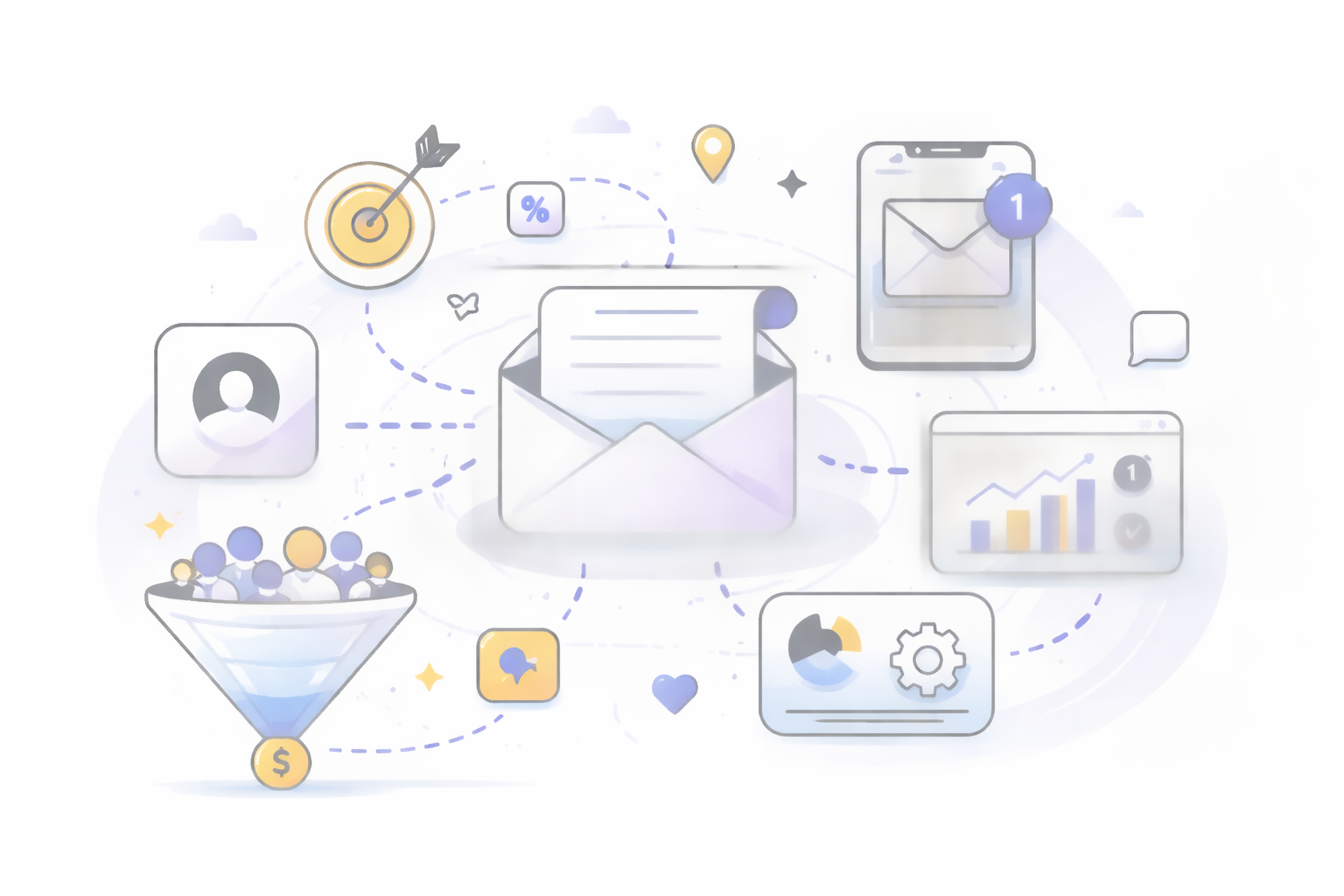
An email campaign is a planned sequence of messages built to move someone toward a specific action. Sometimes that action is a sale. Sometimes it is a signup, a booked call, a product trial, a repeat purchase, or a reactivation. What matters is that the campaign has a clear goal, a clear audience, and a message flow that feels intentional instead of random.
That distinction matters because a lot of businesses still send one-off broadcasts and call it strategy. A real email campaign connects the signup source, the message sequence, the offer, and the conversion path. When those pieces line up, email becomes far more than a newsletter. It becomes a system that builds trust and revenue at the same time.
Is an email campaign still worth it in 2026?
Yes, and the current data still supports that without much ambiguity. HubSpot’s recent marketing data continues to rank email among the best-ROI channels for B2C brands, and Litmus’s current ROI analysis shows many marketers still reporting returns between 10:1 and 36:1 or more. That does not mean every campaign performs automatically. It means the channel is still strong enough to reward businesses that execute with discipline.
The real reason email remains valuable is control. You are not depending entirely on an algorithm to decide who sees your message. You are building a direct relationship with people who already gave you permission to contact them, and that is a huge advantage in a marketing environment where paid acquisition keeps getting more expensive and platform rules keep changing.
How many emails should be in a campaign?
There is no universal number that magically works for every business. A welcome email campaign may need only three to five emails to move a new subscriber toward a first conversion. A launch campaign might need more messages because the audience needs proof, urgency, and repeated exposure before acting. A post-purchase campaign may keep going for weeks because its job is to increase retention, not force an immediate sale.
The better question is whether each email has a job. If the second email repeats the first one without adding anything useful, it probably should not exist. If the next email removes an objection, deepens trust, or helps the reader make a decision, it belongs in the sequence.
What metrics matter most in an email campaign?
The most useful metrics are the ones closest to business outcomes. Click rate matters because it shows whether the message created real interest. Conversion rate matters because it shows whether the click turned into action. Revenue per recipient matters because it helps you judge whether the campaign is economically strong, not just emotionally satisfying inside a dashboard.
Open rate still has some value, but it should not dominate your reporting anymore. Apple’s Mail Privacy Protection changed how open behavior is measured, so reported opens can be less trustworthy than they used to be. That is why a good email campaign uses opens as a signal, not as the final verdict.
What is a good open rate for an email campaign?
A good open rate depends on your industry, list quality, and the type of message you send. Mailchimp’s benchmark data currently shows an overall average open rate around 35.63%, while MailerLite’s 2025 benchmark analysis reports a median open rate of 43.46% across millions of campaigns. Those numbers are useful for context, but they are not the whole story.
If your campaign earns high opens and weak clicks, the subject line may be doing more work than the body. If the open rate is lower but the people who do open convert well, the campaign may still be strong. The healthier way to use open rate is to compare it against your own historical baseline and then read it together with clicks, unsubscribes, and conversions.
How important is deliverability now?
It is critical. Deliverability is no longer a side topic for technical teams to handle quietly in the background. Google’s sender guidelines and Yahoo’s sender FAQ now make it very clear that authentication, one-click unsubscribe for promotional email, and complaint control are part of basic modern email operations. If your campaign ignores those rules, performance can fall apart before the copy even gets a chance to work.
That is why deliverability should be treated like a growth lever. A clean list, consistent sending habits, good segmentation, and easy opt-outs all help inbox placement. In other words, the same things that make an email campaign better for the subscriber also make it safer for the sender.
Should I use double opt-in?
In many cases, yes, because it improves list quality even if it slows list growth a little. A smaller list of people who clearly want your emails is often far more valuable than a larger list full of weak intent. Yahoo’s sender best practices explicitly recommend confirmed opt-in methods, which shows how strongly inbox providers value clean consent.
Double opt-in is not mandatory in every situation, but it can reduce fake addresses, trap accounts, and low-quality signups that drag down campaign performance later. If your business depends on long-term deliverability and trust, cleaner consent is usually worth the tradeoff.
How often should I send emails?
You should send often enough to stay familiar and useful, but not so often that the list feels crowded. There is no perfect schedule that fits every audience because the right rhythm depends on what people signed up for, how often you have something worth saying, and how strong your segmentation is. A daily email campaign can work in some businesses. A weekly or biweekly rhythm is smarter in others.
The mistake is not sending too much or too little in the abstract. The mistake is breaking expectations. If people joined because they wanted regular insights or deals and then barely hear from you, that weakens the relationship. If they expected occasional messages and suddenly get flooded, that creates friction and complaints.
Should I rely more on automation or manual campaigns?
You usually need both, but automation should do more of the heavy lifting than many businesses realize. Manual campaigns are helpful for launches, announcements, and timely promotions. Automated campaigns are better for welcome sequences, browse abandonment, cart recovery, post-purchase education, replenishment, and win-back efforts because they respond to behavior rather than forcing every subscriber into the same timeline.
Current lifecycle guidance from Klaviyo keeps emphasizing automated flows for exactly this reason. They make the campaign more relevant because the timing is connected to what the customer actually did, not just what the brand wanted to send that day.
What tools should I use to build an email campaign?
The best tool is the one your team can operate consistently without turning every send into a technical project. If you want a straightforward email-first platform, Brevo and Moosend are practical options for many businesses. If your campaign is tightly connected to landing pages, order bumps, or funnel logic, ClickFunnels or Systeme.io can make the conversion path easier to manage.
The wrong move is choosing software based only on feature count. A complicated stack that nobody on the team can maintain will weaken the campaign no matter how impressive the demo looks. The right stack helps you segment cleanly, automate intelligently, measure clearly, and launch without chaos.
How long does it take for an email campaign to start producing results?
Some campaigns produce results almost immediately, especially if the audience is warm and the offer is strong. Abandonment sequences, replenishment emails, and launch campaigns can drive revenue quickly because they target people who already have buying intent. Other campaigns take longer because their job is to educate, build trust, or bring inactive subscribers back to life.
The important thing is not expecting every campaign to behave the same way. A well-built email campaign compounds over time because each send teaches you something about the audience, sharpens your segmentation, and improves the next sequence. That is why strong email programs often look better after a few months of disciplined iteration than they do in the first week.
What usually causes unsubscribe spikes?
Most unsubscribe spikes are caused by broken expectations, weak targeting, or message fatigue. If the signup promise said one thing and the campaign delivered something else, people leave. If the content is too broad, too repetitive, or too sales-heavy for that segment, people leave. If the frequency suddenly jumps without warning, people leave.
And that is not always bad news. Sometimes unsubscribes are just the market helping you clean the list. What matters more is whether the campaign is creating avoidable friction. If people are leaving because the email no longer fits their intent, that is a signal to improve segmentation and message relevance rather than simply trying to suppress the number.
What is the fastest way to improve an underperforming email campaign?
Start by tightening the basics before chasing advanced tactics. Make sure the audience is right, the promise is clear, the landing page matches the email, and the call to action feels like the natural next step. Then look at whether the campaign is over-mailing cold segments, relying too heavily on open rate, or sending traffic into a weak conversion path.
Most struggling campaigns do not need a complete reinvention. They need cleaner segmentation, better offer-message alignment, and stronger operational discipline. Once those pieces improve, testing subject lines, message structure, and timing becomes much more useful because the campaign is no longer fighting foundational problems.
Work With Professionals
If you want your email campaign to perform at a higher level, it helps to work with people who understand strategy, deliverability, copy, lifecycle design, and conversion architecture as one connected system. That is the difference between sending more emails and building a channel that compounds. The inbox is still one of the best places to create trust and revenue, but only when the campaign is built with care from the first signup to the final conversion.
That is also why serious marketers keep getting hired to solve email problems that businesses cannot fix on their own. Many brands know email matters. Far fewer know how to build a clean system that keeps producing results without burning the list, hurting deliverability, or leaning on short-term gimmicks. If you can do that well, your skill set stays valuable.
Explore 10K+ Remote Marketing Contracts on MarkeWork.com
Most marketers spend too much time chasing clients, competing on crowded platforms, and losing a percentage of every project to middlemen.
MarkeWork gives you a better way. Browse thousands of remote marketing contracts and connect directly with companies desperate to hire skilled marketers like you without platform commissions and without unnecessary gatekeepers.
If you’re serious about finding better opportunities and keeping 100% of what you earn, you can explore available contracts and create your profile for free at MarkeWork.com.
 Filip Konecny Enterprises