
Digital Marketing Agency: What to Look For, How It Does the Work, and Why It Pays Off
Hiring a digital marketing agency sounds simple until you are the one making the decision. One firm promises explosive growth, another talks about brand storytelling, and a third leads with dashboards, automation, and attribution models that sound impressive but do not tell you what will actually happen to your pipeline. That is why this topic matters so much right now: the channel mix is getting harder to manage, buyers are moving across search, social, email, video, and owned media faster than most internal teams can keep up with, and the cost of getting it wrong keeps rising.
The pressure is not imaginary. U.S. digital advertising revenue hit a record $259 billion in 2024, while Google says its products and advertising tools helped drive more than 2 billion direct connections every month in 2024 for American businesses through calls, bookings, directions, messages, and reviews. At the same time, the latest CMO Survey supported by Deloitte shows marketing leaders are under intense pressure to prove value, which is exactly where a strong agency relationship can either become a multiplier or an expensive distraction.
A good agency does not just run ads or publish content. It helps you connect strategy, creative, media buying, technology, data, and conversion so the whole system works together instead of fighting itself. In this first part, we are going to map the structure of that system, explain why businesses still turn to agencies even when they have in-house talent, and show what professional implementation really looks like when the goal is sustainable growth instead of random activity.
Article Outline
- Part 1: Why a Digital Marketing Agency Matters
- Part 2: Framework Overview
- Part 3: Core Components
- Part 4: Professional Implementation
- Part 5: Analytics and Optimization
- Part 6: Agency Ecosystem and Long-Term Growth
Why a Digital Marketing Agency Matters
A digital marketing agency matters because modern marketing is no longer one channel, one campaign, or one person wearing five hats. Search behavior is shifting, paid media platforms keep automating more decisions, creative fatigue happens faster, privacy rules keep changing measurement, and customers expect a joined-up experience whether they first meet you through Google, Instagram, LinkedIn, YouTube, or your email list. When a business tries to manage all of that without a clear operating model, it usually ends up with fragmented data, inconsistent messaging, and spend that looks busy without becoming profitable.
That is one reason agencies still play such a large role. HubSpot states in its 2025 annual report that its Solutions Partners represented about 29% of customers and roughly 48% of revenue in 2024, which is a strong signal that businesses continue to rely on outside experts for strategy, execution, and implementation. The same logic shows up in platform ecosystems too, where the Google Partners directory exists specifically because many brands want certified specialists managing campaigns on their behalf rather than guessing their way through a high-stakes ad account.
There is also a practical reason companies hire agencies even when they already have a marketing team. The latest Salesforce State of Marketing report says it surveyed nearly 4,500 marketers worldwide and found that 83% recognize the shift toward personalized, two-way engagement, yet only one in four are satisfied with how they use data to power those moments. That gap is exactly where a strong agency can help: not by replacing internal knowledge, but by bringing process, specialist depth, faster testing, and a more disciplined way to turn customer data into campaigns that actually convert.
Framework Overview
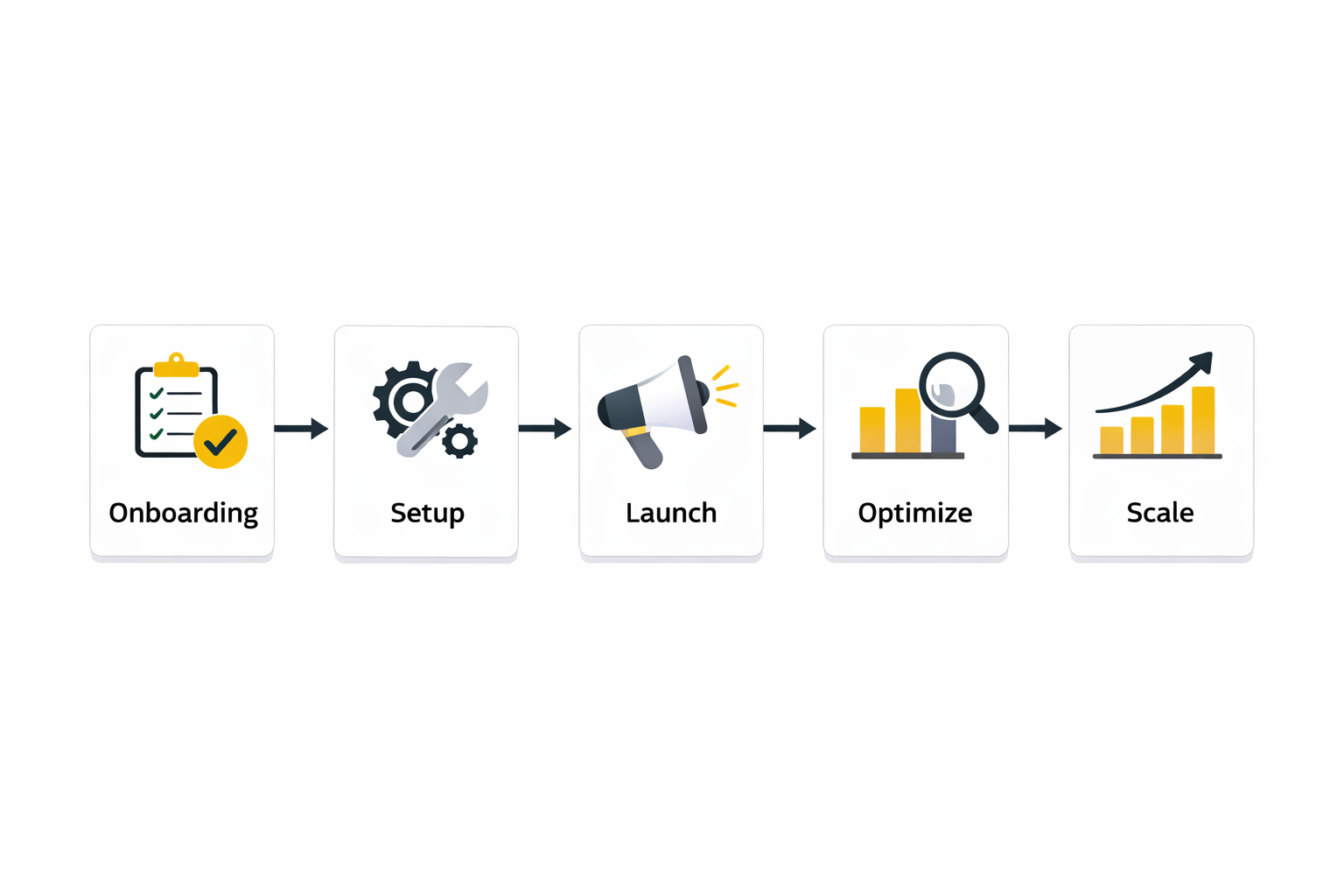
The easiest way to understand a digital marketing agency is to stop thinking about it as a vendor and start thinking about it as an operating framework. At the top sits business strategy: revenue goals, margins, positioning, target audience, and the buying journey you are trying to influence. Under that sits channel strategy: which platforms deserve investment, what role each one plays, how messaging changes across the funnel, and where traffic should go once attention is captured.
From there, the framework moves into execution. That includes research, offer development, creative production, landing pages, paid media, search visibility, email nurture, CRM workflows, reporting, and ongoing optimization. It sounds obvious when written out, but this is where many engagements break down because businesses buy isolated services instead of a system, and then wonder why clicks do not turn into revenue.
The best agencies build the framework in the right order. They begin with commercial priorities, translate them into channel and content decisions, and then connect every campaign to measurement from day one. That is why tools matter too: agencies often combine CRM, automation, forms, scheduling, analytics, and funnel software into one working stack, using platforms such as Systeme.io, Brevo, and Cal.com when the business needs a cleaner path from traffic to lead capture to booked calls.
Core Components
The core components of a digital marketing agency engagement usually fall into five working areas: strategy, traffic, conversion, retention, and measurement. Strategy defines who you are targeting, what makes the offer compelling, and how the brand should sound across channels. Traffic covers organic search, paid search, paid social, partnerships, creator relationships, email acquisition, and whatever else is needed to create qualified attention instead of vanity reach.
Conversion is where serious agencies separate themselves from cosmetic ones. It includes landing pages, lead magnets, forms, call booking flows, nurturing sequences, sales enablement, and the often-neglected work of improving offer clarity so prospects do not bounce after the click. That is why funnel-building tools and lightweight automation matter in agency operations, and why some teams use platforms such as ClickFunnels or Fillout when a campaign needs a faster route from ad impression to completed inquiry.
Retention and measurement complete the picture. Email, SMS, remarketing, customer education, and lifecycle automation help turn the first conversion into repeat revenue, while reporting keeps the team grounded in reality. When HubSpot says in its 2025 ROI report that customers working with a Solutions Partner were part of analyses tied to more deals created and more deals closed, the takeaway is not that every partner is automatically exceptional; it is that coordinated execution across these components can materially change outcomes.
Professional Implementation
Professional implementation is where all the nice-looking strategy documents either become useful or get exposed. A strong digital marketing agency does not start by pushing random tactics into the market. It starts by auditing the current situation, cleaning up tracking, understanding the economics of the offer, identifying where leads are leaking, and agreeing on what counts as a qualified result before the first campaign goes live.
That discipline matters because modern marketing platforms are powerful but unforgiving. One broken attribution setup can make a winning campaign look weak, a slow landing page can kill paid traffic, and unclear handoff between marketing and sales can bury real demand. The teams that handle implementation well usually combine channel expertise with operational rigor, using scheduling, CRM, workflow, and campaign tools together instead of treating each one like its own island; that is where software such as Buffer, Flick, Copper, and Chatbase can support execution when they fit the model.
Just as important, professional implementation is iterative. The first version of a campaign is not the finish line; it is the opening test. The best agencies launch with a clear hypothesis, read the data fast, improve creative and conversion paths without ego, and keep tightening the system until the numbers start reflecting the business goal rather than the agency’s activity report.
Start With the Commercial Foundation First
A smart digital marketing agency does not begin by asking which platform you want to be on. It begins by asking what a qualified lead is worth, how fast you need results, whether the business can handle demand, and what has already failed. That sounds basic, but it is the difference between a campaign that looks active and one that actually supports growth.
This matters even more now because digital marketing is operating at a level of scale and competition that punishes vague strategy. The Google Economic Impact data for 2024 says Google helped drive more than 2 billion direct connections every month through calls, bookings, directions, messages, and reviews, which means your prospects are already moving through digital touchpoints whether your internal systems are ready for them or not. If the business cannot connect those touchpoints to sales conversations, the agency framework breaks before the campaign even has a chance.
That is why the first stage of the framework should always lock in the economics of the offer, the sales handoff, and the definition of success. If those pieces are fuzzy, performance data becomes misleading, creative decisions become random, and channel recommendations become little more than educated guesswork. A strong agency earns its keep by removing that fuzziness before it starts spending your money.
Align the Audience, Offer, and Data
Once the commercial foundation is in place, the next layer of the framework is alignment. A digital marketing agency has to connect the right audience with the right promise and then make sure the data setup can tell you whether that promise is working. If even one of those three pieces is off, the campaign will often underperform for reasons that are blamed on the channel when the real problem sits in positioning or tracking.
That is not theory. The 10th edition of Salesforce’s State of Marketing says it surveyed 4,500 marketing leaders worldwide, and one of the clearest findings is that while 83% recognize the shift toward personalized, two-way engagement, only one in four are satisfied with how they use data to power those experiences. Adobe reached a similar conclusion in its 2025 AI and Digital Trends: Data and Insights report, which was built from responses from more than 3,200 marketers and CX professionals plus 8,000 consumers and highlights how fragmented data keeps brands from delivering real-time personalization.
That is why good agencies obsess over audience clarity, offer strength, and first-party data long before they brag about ad hacks. They want clean forms, useful CRM fields, real segmentation, and a message that sounds like it was written for an actual buyer instead of a spreadsheet. When those pieces click into place, the campaign starts to feel coherent because it finally is.
Build the Channel Architecture Around Conversion
The next step in the framework is channel architecture, but this is where a lot of businesses get distracted by shiny objects. A digital marketing agency should not be choosing channels based on what is trendy in a podcast clip or what another company in a different market says is working. It should be building a path that turns attention into action, and that means every traffic source needs a job, every landing page needs a clear purpose, and every call to action needs to fit the buyer’s stage.
This is also where the agency’s tech stack becomes practical instead of theoretical. Email platforms, forms, scheduling tools, CRMs, and landing page builders are not separate toys; they are part of the same conversion path. Depending on the model, an agency may connect tools such as Brevo, Fillout, Cal.com, or Systeme.io so that traffic does not die the moment someone clicks.
The reason this matters so much is that conversion infrastructure compounds results. In the 2024 HubSpot Annual ROI Report, customers working with partners were associated with 53% more inbound leads and 3x more deals closed than those without partners in the compared groups. That does not mean every partner is great, but it does show what happens when someone is actively connecting marketing execution to systems, follow-up, and pipeline movement instead of treating campaigns like isolated tasks.
Run the Framework as a Measurement System
The final layer of the framework is the one that keeps everything honest: measurement, governance, and iteration. A digital marketing agency should be able to explain how tracking works, where attribution is imperfect, what gets reviewed weekly, what gets reviewed monthly, and which decisions are based on signal instead of vanity. Without that rhythm, even strong campaigns become hard to improve because nobody knows what to trust.
That is especially important in a privacy-conscious environment where measurement is changing fast. Google’s digital marketing playbook for privacy and performance makes the point directly: brands need stronger investments in data and insights so ads stay relevant and measurement stays accurate as privacy expectations rise. The same guide highlights how first-party data, site tagging, consent-aware measurement, and structured experimentation all support better performance, which is exactly why a serious agency framework has to include governance instead of just campaign launch dates.
When you look at the whole picture, the framework is not complicated because it has more moving parts. It is complicated because every part affects every other part. The agency that wins for you is the one that can keep strategy, creative, media, data, and conversion working together long enough for the results to become predictable instead of accidental.
Strategy and Positioning
The first core component is strategy, because without it the rest of the work turns into motion without direction. A digital marketing agency needs to understand who the business serves, why buyers should care, what problem the offer solves, and what makes that offer worth choosing over every other option in the market. If that foundation is vague, even good creative and smart media buying will struggle because the message itself is doing too little heavy lifting.
This is exactly why positioning deserves more time than many businesses give it. The latest Salesforce State of Marketing report points out that 83% of marketers recognize the shift toward personalized, two-way engagement, which means generic messaging has even less room to survive than it did a few years ago. When an agency gets positioning right, the campaigns stop sounding like marketing and start sounding like a real answer to a real problem.
That strategic layer also influences every later decision. It shapes the hook in the ads, the promises on the landing page, the tone in the emails, and even the way sales conversations should begin. In other words, strategy is not the pretty document you get at the beginning; it is the decision system the agency uses all the way through the engagement.
Traffic Generation
The second core component is traffic generation, but this is where people often get distracted by channel hype. A digital marketing agency should never treat traffic like a vanity contest. The point is not to get more eyeballs in the abstract. The point is to attract the right people, on the right platform, with the right intent, and then send them to a place that can continue the conversation instead of dropping it.
That matters because the scale of digital attention is enormous now. The IAB full-year 2024 report shows that U.S. digital advertising revenue reached $259 billion, which tells you just how competitive paid visibility has become. On top of that, Google’s 2024 economic impact data says its products and advertising tools helped drive more than 2 billion direct monthly connections between American businesses and customers through calls, bookings, directions, messages, and reviews, which is a reminder that demand is out there, but it has to be captured with precision.
This is why the best agencies do not blindly recommend every channel at once. They look at search intent, buying temperature, audience behavior, creative fit, and speed to result. In some cases the smartest move is search ads and landing pages, in others it is organic content plus retargeting, and in others it is a tighter outbound or creator-led play. The skill is not being everywhere. The skill is knowing where to show up first.
Conversion and Funnel Design
The third core component is conversion, and this is where a digital marketing agency proves whether it actually understands business or just understands promotion. A click is not a result. Reach is not a result. Even leads are not the real result if the leads are weak, confused, or poorly nurtured. Conversion work is what turns interest into a meaningful next step.
That includes the landing page, the lead form, the call to action, the email follow-up, the booking flow, and the handoff into sales. It is also why agencies frequently use dedicated tools to shorten the distance between discovery and action, whether that means building pages in ClickFunnels, collecting better lead data through Fillout, or creating lighter customer journeys inside Systeme.io. Those tools are not magic on their own, but they can remove friction fast when the agency knows exactly what step needs to happen next.
You can see the importance of this connective work in the 2025 HubSpot ROI report, which shows analyses where customers using connected systems and partner-supported setups were associated with stronger deal creation and closed-won outcomes. The big lesson is simple: conversion improves when the campaign, the page, the data capture, and the follow-up system are designed together rather than patched together after launch.
Retention and Lifecycle Marketing
The fourth core component is retention, and this is one that businesses often ignore because acquisition feels more exciting. A digital marketing agency that knows what it is doing will not stop at the first conversion. It will think about what happens after the lead comes in, after the first sale closes, and after the customer has spent enough time with the brand to either deepen the relationship or quietly disappear.
This is where email, remarketing, segmentation, customer education, and lifecycle automation become critical. The work is less flashy than a cold traffic campaign, but it is usually far more profitable because it helps the business squeeze more value from attention it already paid for. Tools like Brevo and Moosend can support that retention layer when the agency needs to build sequences, re-engagement flows, or promotional campaigns that feel timely instead of repetitive.
Retention also gives the agency better feedback. When customers stay engaged, reply to emails, come back, upgrade, or book again, the team learns which offers and messages are actually strong. That feedback loop makes acquisition better too, because the business is no longer guessing what real buyers respond to after the first click.
Measurement and Optimization
The fifth core component is measurement, because without it the agency is basically narrating performance instead of understanding it. A digital marketing agency has to know which numbers are leading indicators, which ones are lagging indicators, where attribution is messy, and what should happen when the data points in different directions. This is not just about dashboards. It is about judgment.
That job is becoming harder, which is exactly why it matters more. Adobe’s 2025 AI and Digital Trends research highlights findings from more than 3,200 marketers and CX professionals and 8,000 consumers, and one of the recurring themes is that fragmented data still blocks the kind of timely personalization and decision-making brands want. In other words, having more tools does not automatically create more clarity. It can just create more noise unless the agency builds a reporting rhythm that is tied to decisions.
Real optimization happens when the team can look at the whole system and respond intelligently. Maybe the ad is fine but the landing page is undercutting intent. Maybe the page converts but the follow-up is too slow. Maybe the leads are decent but the offer attracts the wrong segment. Measurement lets the agency spot those fractures early, and optimization is the discipline of fixing them before they become expensive habits.
Statistics and Data

The numbers behind a digital marketing agency matter because they tell you whether the agency is building real momentum or just creating the appearance of activity. Digital marketing has become too expensive, too crowded, and too measurable for vague reporting to be acceptable. Once you see how much money is flowing through these channels, how hard marketers are working to unify their data, and how much partner-led execution influences revenue for major platforms, it becomes obvious why strong agencies win on systems, not slogans.
Digital Spend Keeps Rising, Which Raises the Stakes
A digital marketing agency is operating in a market where the volume of money moving through online channels is massive. The IAB Full Year 2024 Internet Ad Revenue Report shows that U.S. digital advertising revenue reached a record $259 billion, which is a useful reminder that your competitors are not sitting on the sidelines waiting for cheaper attention. They are already investing, testing, and learning, which means an agency has to bring more than basic campaign management if it wants to create an edge.
You can see the same intensity in how search and direct digital connections continue to shape business outcomes. Google’s 2024 economic impact data says its products helped drive more than 2 billion direct connections every month through calls, bookings, directions, messages, and reviews. For any business thinking about whether a digital marketing agency is still worth it, that number answers the question pretty quickly: the demand is there, but capturing it requires speed, clean execution, and a system that can turn that attention into revenue.
That is why agencies that treat media buying like a side task get exposed fast. When the market is this large, a weak landing page, a confused offer, or slow follow-up can quietly destroy an otherwise promising campaign. The bigger the channel gets, the less room there is for loose execution.
Marketers Still Struggle With Data, Even While Everything Is Measurable
This is one of the biggest paradoxes in modern marketing. Businesses have more dashboards, more tools, and more conversion events than ever before, yet they still struggle to turn all of that information into clear decisions. The latest Salesforce State of Marketing report says 83% of marketers recognize the shift toward personalized, two-way engagement, but only one in four are satisfied with how they use data to make those moments happen.
Adobe found much the same thing in its 2025 AI and Digital Trends report, which was built from responses from more than 3,200 marketers and customer experience professionals plus 8,000 consumers. The report makes a blunt point that matters to every digital marketing agency: fragmented data is still blocking real-time personalization and slowing down decision-making. In plain English, that means plenty of businesses are collecting information without turning it into better campaigns, better follow-up, or better customer experiences.
That gap is exactly where a strong agency becomes valuable. It is not there just to deliver reports. It is there to make the data usable, to decide what matters, and to stop teams from drowning in metrics that look impressive but never change the next move.
Agency and Partner Models Are Driving Real Revenue
One of the strongest signals that agencies still matter comes from the platforms that depend on them. HubSpot states in its 2025 annual report that solutions partners and partner-referred customers represented about 29% of customers and 48% of revenue in 2024. That is not a small side channel. That is a major piece of how one of the best-known marketing software companies grows.
That matters because it shows something bigger than one company’s numbers. It shows that businesses do not just buy software and magically produce results. They often need outside specialists to shape the strategy, build the workflows, launch the campaigns, and connect marketing execution with sales outcomes. In other words, the digital marketing agency is not disappearing in the age of software; in many cases, it is becoming more important because the software stack is getting more complex.
This is also why agency tool choices matter so much. A team may run campaign communication through Brevo, manage publishing and social scheduling through Buffer, or keep pipeline visibility cleaner with Copper. None of those tools replaces strategy, but the right setup can make an agency faster, more consistent, and a whole lot better at turning activity into something you can actually measure.
Privacy and Measurement Are Now Linked
Another important data point is that measurement is no longer just about tagging everything and hoping for the best. Privacy expectations have changed how businesses collect data, how platforms report performance, and how agencies prove value. Google’s marketing playbook for privacy and performance explains why first-party data, better site tagging, and consent-aware measurement are now central to performance, not optional extras that sit in the background.
That shift changes the job of a digital marketing agency in a very practical way. The agency now has to care about how data is captured, how conversion signals are passed into ad platforms, and how accurately the business can see what happened after the click. If that infrastructure is weak, the reporting becomes fuzzy, the optimization cycle slows down, and budget decisions start leaning on guesswork again.
The agencies that handle this well are usually the ones that stop treating analytics as a monthly ceremony. They build measurement into the campaign from the start, test the integrity of the tracking, and keep improving the setup so the business is not making expensive decisions based on half the picture.
What Numbers Actually Deserve Attention
All of this data is only useful if a digital marketing agency knows which numbers deserve attention. That usually starts with qualified leads, sales-qualified opportunities, booked calls, close rate, cost to acquire a customer, return on ad spend where it can be measured responsibly, and customer lifetime value. Traffic, impressions, and click-through rate still matter, but only in the context of whether they are feeding the parts of the system that generate revenue.
This is where many businesses finally realize whether their agency is thinking like a partner or just a service provider. A service provider shows charts. A partner shows which channel is pulling in qualified demand, which landing page is leaking it, which offer is converting best, and where the handoff into sales is slowing everything down. Those are the numbers that make a digital marketing agency worth paying for, because those are the numbers that tell you what to do next.
When you put the evidence together, the picture is pretty clear. Digital spend is still rising, marketers still struggle to unify and activate their data, partner-led ecosystems continue to drive serious revenue, and privacy-aware measurement has become part of performance itself. That is exactly why the best agencies are not just running campaigns anymore. They are building decision systems that help businesses grow without flying blind.
Analytics and Optimization
A digital marketing agency earns its keep in the optimization phase, not in the launch phase. Launching campaigns is the easy part because almost anyone can push ads live, publish content, or wire up an email sequence. The hard part is reading the signals correctly, knowing what needs to change first, and improving performance without breaking the pieces that are already working.
This is why analytics cannot be treated like a monthly slideshow. When a business is spending in crowded channels, every delay in interpretation costs money, and every wrong conclusion compounds waste. The best agencies build a rhythm where reporting leads directly to action, which is exactly what brands need in a market where the digital ad economy reached $259 billion in the United States in 2024.

Measure What Actually Moves Revenue
A digital marketing agency should care about revenue-linked metrics before vanity metrics. Impressions, reach, and clicks can still be useful, but only as early indicators that help explain what happened further down the funnel. If those numbers are rising while qualified leads, booked calls, opportunities, and closed deals stay flat, the campaign is not healthy no matter how attractive the dashboard looks.
That commercial focus is one reason partner-supported setups keep showing up in performance studies. The 2024 HubSpot Annual ROI Report found that customers working with partners saw 53% more inbound leads and 3x more deals closed than those without partners in the compared groups. That does not prove every agency is great, but it does show what happens when analytics, execution, and follow-up are connected instead of managed in isolation.
So when you evaluate performance, start where the business feels the result. Ask whether the campaign is producing better-fit opportunities, whether sales is seeing stronger intent, and whether the cost to acquire a real customer is getting healthier over time. That is how a digital marketing agency moves from reporting activity to proving value.
Build a Clean Attribution System Before You Trust the Numbers
Optimization breaks down fast when attribution is messy. A digital marketing agency can only improve what it can see with reasonable confidence, and that means the tracking layer has to be treated like infrastructure, not an afterthought. UTM discipline, CRM source mapping, form tracking, call tracking, offline conversion imports, and consistent campaign naming sound boring, but they are the difference between a smart decision and a guess dressed up as insight.
That matters even more now because privacy expectations and measurement changes have made lazy tracking less reliable. Google’s privacy and performance marketing playbook makes a strong case for first-party data, sitewide tagging, and more resilient measurement practices as the foundation for better optimization. The message is simple: if your data collection is weak, your optimization loop will be weak too.
This is also where the agency’s systems approach shows up. It may use Copper to keep opportunity data clean, Brevo to connect nurture activity back to source quality, or Fillout to collect richer lead information at the point of conversion. None of these tools fixes attribution on its own, but together they make it much easier to understand which campaigns are creating buyers instead of just traffic.
Optimize Creative, Offers, and Funnel Steps Together
One of the biggest mistakes a business can make is assuming optimization means changing only the ads. Sometimes the ad is the problem, but often the real issue sits deeper in the journey. A digital marketing agency has to look across the whole path: the promise in the creative, the clarity of the offer, the speed of the page, the friction in the form, the strength of the follow-up, and the gap between what marketing promises and what sales delivers.
This is why marketers still struggle even though they have more data than ever. The Salesforce State of Marketing report found that while 83% of marketers recognize the shift toward personalized, two-way engagement, only one in four are satisfied with how they use data to power those experiences. Adobe’s 2025 AI and Digital Trends: Data and Insights report pushes in the same direction, noting that it surveyed more than 3,200 marketers and customer experience professionals along with 8,000 consumers and found that fragmented data is still blocking real-time personalization.
The takeaway is that optimization is rarely one-dimensional. The agency that wins does not keep swapping headlines forever while ignoring a broken booking flow or a weak nurture sequence. It improves the campaign like a system, because that is what the buyer experiences on the other side.
Create a Weekly Optimization Cadence
A digital marketing agency should have a repeatable cadence for optimization. Weekly reviews are usually where tactical decisions happen: budgets shift, underperforming creative gets cut, fresh messaging angles get tested, search terms are refined, and landing page friction points are addressed. Monthly reviews are where the bigger patterns come into focus: which audience segments are becoming more efficient, which offers are attracting the strongest leads, and whether the overall channel mix still makes sense.
That need for structured review shows up in broader market research too. Nielsen said in its 2025 Annual Marketing Report announcement that the study was based on responses from 1,400 global marketing professionals, and one of the recurring themes in Nielsen’s 2025 materials is the need for clearer cross-media measurement and more holistic visibility into performance. That is exactly the discipline agencies need when campaigns span search, social, content, email, and retargeting at the same time.
The point of cadence is not bureaucracy. It is speed with control. When the agency knows what gets checked, when it gets checked, and what decisions come out of each review, optimization becomes faster and more reliable instead of reactive and emotional.
Bring Sales Feedback Into the Analytics Loop
This is the part many agencies talk around because it forces accountability. A digital marketing agency can generate leads all day long, but if those leads are poor quality, unready, mismatched to the offer, or impossible for the sales team to close, the campaign is not really working. That is why the analytics loop has to include the sales conversation, not just the marketing dashboard.
Once sales feedback is tied back to campaigns, the numbers become much more useful. You can see which ad sets produce serious buyers, which keywords attract researchers instead of decision-makers, and which messages create curiosity without purchase intent. That is when optimization becomes commercially intelligent, because the agency is no longer asking only what generated a click; it is asking what generated revenue.
This also makes creative decisions sharper. If sales hears the same objection repeatedly, the agency can address it in the next landing page version, email sequence, or ad angle. When that loop is tight, a digital marketing agency stops operating like an outsourced channel manager and starts acting like a true growth partner.
Know When to Scale and When to Stop
Good optimization is not endless tinkering. A digital marketing agency also needs the judgment to know when a campaign has earned more budget, when it needs more time, and when it should be shut down. Scale too early and you can magnify flaws that were merely hidden by low spend. Wait too long and you leave profitable growth on the table while competitors move faster.
This is where experience really starts to matter. The agency has to read signal strength, not just raw volume. It should know whether improving the funnel first will make future scale safer, whether the creative is already tiring out, and whether the business can operationally handle more demand if the campaign starts working better. That kind of judgment is hard to fake, and it is often the difference between a lucky month and a repeatable acquisition engine.
In the end, analytics and optimization are where a digital marketing agency proves whether it can think beyond tactics. The work is not just to collect data. The work is to turn that data into better decisions, better campaigns, better customers, and a growth system that becomes more efficient the longer it runs.
Agency Ecosystem and Long-Term Growth

A digital marketing agency becomes truly valuable when it stops acting like a loose collection of services and starts functioning like an ecosystem. Strategy, creative, media buying, analytics, CRM, automation, content, sales coordination, and retention all affect each other. When those parts are disconnected, businesses feel like they are working hard without getting the compounding results they expected. When they are connected properly, growth becomes a lot more stable because every campaign teaches the next one what to do better.
You can see why this matters by looking at the way the market itself is evolving. The IAB’s full-year 2024 report shows U.S. digital advertising revenue reached $259 billion, while Google’s 2024 economic impact data says its tools helped drive more than 2 billion direct connections every month for American businesses. That kind of scale rewards businesses that have a real operating system behind their marketing, and it punishes businesses that are still treating every channel like a separate experiment.
The ecosystem model is also why agencies are not disappearing as software gets better. HubSpot states in its 2025 annual report that solutions partners and partner-referred customers represented about 29% of customers and 48% of revenue in 2024. That says something important: businesses still need specialists who can connect the software stack, the growth strategy, and the day-to-day execution in a way that produces measurable commercial outcomes.
That is also why the best digital marketing agency relationships usually extend beyond ad management. They often involve tighter CRM workflows through Copper, cleaner lifecycle communication through Brevo, better scheduling and handoff through Cal.com, more efficient funnel building through Systeme.io, or faster campaign deployment through ClickFunnels. The tools are not the story by themselves. The story is how a skilled team uses them together so that traffic, conversion, sales, and retention stop fighting each other and start building on each other.
FAQ for a Complete Guide
What does a digital marketing agency actually do?
A digital marketing agency helps a business attract attention, convert that attention into leads or sales, and improve results over time through measurement and optimization. That can include strategy, SEO, paid media, landing pages, content, email marketing, analytics, CRM workflows, reporting, and retention campaigns. The strongest agencies do not just offer isolated services; they connect those services so the whole customer journey makes sense from first click to final sale.
Is hiring an agency better than building an in-house team?
It depends on the stage of the business, but an agency is often the faster option when you need specialist depth across several channels without hiring multiple full-time people. In-house teams usually win on brand immersion and internal alignment, while agencies often win on speed, pattern recognition, and cross-client experience. Many of the best setups are hybrid, where the internal team owns vision and priorities while the agency handles specialist execution and optimization.
How do I know if an agency is any good?
Look for clarity, not just confidence. A good digital marketing agency can explain how it thinks, what it measures, how it defines a qualified result, and what will happen in the first 30 to 90 days. It should also be comfortable talking about tracking, sales handoff, offer strength, and conversion friction instead of pretending every problem can be solved by “running more ads.”
What services should I prioritize first?
Start with the service that addresses your biggest growth constraint. If demand is weak, traffic generation may come first. If traffic exists but conversions are poor, landing pages, funnel design, or offer clarity may matter more. If leads are coming in but sales quality is inconsistent, CRM setup, qualification, follow-up, and lifecycle marketing may create the biggest lift.
How long does it take to see results from a digital marketing agency?
The honest answer depends on the channel, the offer, the competitiveness of the market, and how clean the foundation is when the agency starts. Paid search or paid social can produce early signals quickly, while SEO, authority content, and email list development usually take longer but can compound more powerfully over time. What matters most is whether the agency sets realistic expectations and shows meaningful progress instead of promising miracles.
What metrics should I watch most closely?
The most useful metrics are the ones closest to revenue: qualified leads, booked calls, sales-qualified opportunities, close rate, customer acquisition cost, and customer lifetime value. Top-of-funnel numbers like impressions, clicks, and traffic still matter, but only when they help explain movement in the numbers that actually affect the business. If a digital marketing agency cannot connect campaign metrics to business outcomes, the reporting is incomplete no matter how polished it looks.
Why do some agencies fail even when they get traffic?
Because traffic alone does not fix a broken offer, a weak landing page, poor sales follow-up, or messy attribution. A lot of disappointing agency relationships come from a mismatch between what the campaign is generating and what the business is ready to handle. This is also why the latest Salesforce State of Marketing report is so relevant: it says 83% of marketers recognize the shift toward personalized, two-way engagement, yet only one in four are satisfied with how they use data, which shows how often businesses still struggle to turn attention into well-managed customer journeys.
Should my agency specialize in my industry?
Industry experience can help, especially in regulated or highly technical markets, but it is not the only thing that matters. A digital marketing agency with strong strategic thinking, sharp conversion skills, and a disciplined measurement culture can often outperform a niche specialist that only repeats standard playbooks. The ideal balance is an agency that learns your business fast and combines that understanding with proven cross-industry execution skills.
How important are data and attribution?
They are central, not optional. Adobe’s 2025 AI and Digital Trends report says it surveyed more than 3,200 marketers and CX professionals plus 8,000 consumers and found that fragmented data is still blocking real-time, one-to-one personalization. A strong agency does not just collect dashboards; it builds a measurement system that helps the business decide where to invest, what to fix, and what to scale.
Do certifications and partner badges matter?
They matter, but they should not be the only thing you look at. Official programs such as the Google Partners directory and the Google Ads partner guidance can help you identify agencies that meet platform requirements and manage accounts professionally. Still, certifications tell you more about platform familiarity than about strategic judgment, creativity, or how well the agency will fit your business.
What questions should I ask before signing with an agency?
Ask how the agency defines success, what it needs from your side, how reporting works, which metrics drive decisions, who will actually do the work, and what the first testing roadmap looks like. You should also ask how the agency handles attribution gaps, sales feedback, landing page optimization, and creative fatigue. Those questions reveal whether the team thinks like a true growth partner or just a service vendor with a polished sales deck.
Can a small business benefit from a digital marketing agency?
Yes, but only if the business is clear on its priorities and financially ready to support the work. A small business does not need every service at once. In many cases, the right digital marketing agency can help most by tightening one or two critical areas first, such as local search visibility, lead capture, or paid traffic to a focused offer, and then expanding once the early system starts producing consistent results.
How does an agency fit into the bigger marketing ecosystem?
It fits in as a connector. The agency should sit between strategy, channel execution, measurement, and operational follow-through so the business is not making isolated decisions. Nielsen’s 2025 Annual Marketing Report says it surveyed 1,400 marketers around the world, and one of the clearest lessons from the current environment is that marketers need better visibility across channels and budgets, not more disconnected activity. That is exactly the role a strong agency should play.
Work With Professionals
If you are serious about growth, do not look for a digital marketing agency that only promises more activity. Look for one that can make your whole system stronger. That means clearer positioning, cleaner tracking, better campaign execution, stronger conversion paths, and tighter coordination between marketing and sales. The right agency should not leave you with more noise. It should leave you with more control, better decisions, and results you can actually build on.
There is a reason businesses continue to rely on specialists even while software keeps getting smarter. The channels are more crowded, the data is more fragmented, and the expectations on marketers are higher than ever. A good agency helps you cut through that complexity, focus on what matters, and keep moving even when the market shifts.
Explore 10K+ Remote Marketing Contracts on MarkeWork.com
Most marketers spend too much time chasing clients, competing on crowded platforms, and losing a percentage of every project to middlemen.
MarkeWork gives you a better way. Browse thousands of remote marketing contracts and connect directly with companies desperate to hire skilled marketers like you without platform commissions and without unnecessary gatekeepers.
If you’re serious about finding better opportunities and keeping 100% of what you earn, you can explore available contracts and create your profile for free at MarkeWork.com.
 Filip Konecny Enterprises