
Digital Marketing: Strategy, Channels, and Practical Execution
Digital marketing is no longer a side function that supports the “real” business. It is where discovery happens, where trust is built, where buying decisions are shaped, and where long-term customer relationships are maintained. When a market becomes more competitive, attention gets more expensive, and buyers compare more options before acting, digital marketing becomes the system that helps a business stay visible, relevant, and profitable.
That matters even more now because the size of the digital environment keeps expanding. DataReportal’s 2025 global overview shows just how deeply digital behavior is woven into daily life, while Insider Intelligence’s 2025 forecast projects worldwide ad spending above $1 trillion, with more than 75% of that total going to digital. In other words, businesses are not investing in digital marketing because it sounds modern; they are investing because that is where customer attention, measurement, and commercial leverage increasingly live.
This first part lays the foundation. You will see why digital marketing matters, how the full framework fits together, which components deserve the most attention, and what professional implementation looks like when a business wants results instead of random activity.
Article Outline
- Part 1: Why Digital Marketing Matters
- Part 2: Framework Overview
- Part 3: Core Components
- Part 4: Professional Implementation
- Part 5: Measurement and Optimization
- Part 6: Future Trends and FAQ
Why Digital Marketing Matters
Digital marketing matters because modern buying behavior is fragmented across search, social platforms, video, marketplaces, email, review sites, and brand-owned websites. Global social media usage data shows that internet users do not spend time on just one network, and the average person actively uses multiple platforms each month. That changes the job of marketing: the goal is no longer to “be online,” but to guide people through a series of connected touchpoints without losing consistency, relevance, or momentum.
It also matters because digital marketing is unusually measurable compared with most legacy channels. Nielsen’s explanation of cross-media measurement makes the point clearly: advertisers need to deduplicate audiences, understand reach and frequency, and see how each channel contributes to overall performance. A business that can connect traffic, leads, sales, retention, and customer value to specific campaigns has a major advantage over a business that is still guessing which half of its budget is working.
There is also a direct financial case for doing this well. IAB’s 2024 revenue report recorded a record $259 billion in U.S. digital advertising revenue, which tells you two things at once: competition is intense, and brands keep seeing enough value to keep increasing spend. That means digital marketing is not important simply because it is popular. It is important because it is now one of the clearest places where strategy, customer insight, and execution show up in revenue.
Digital Marketing Framework Overview
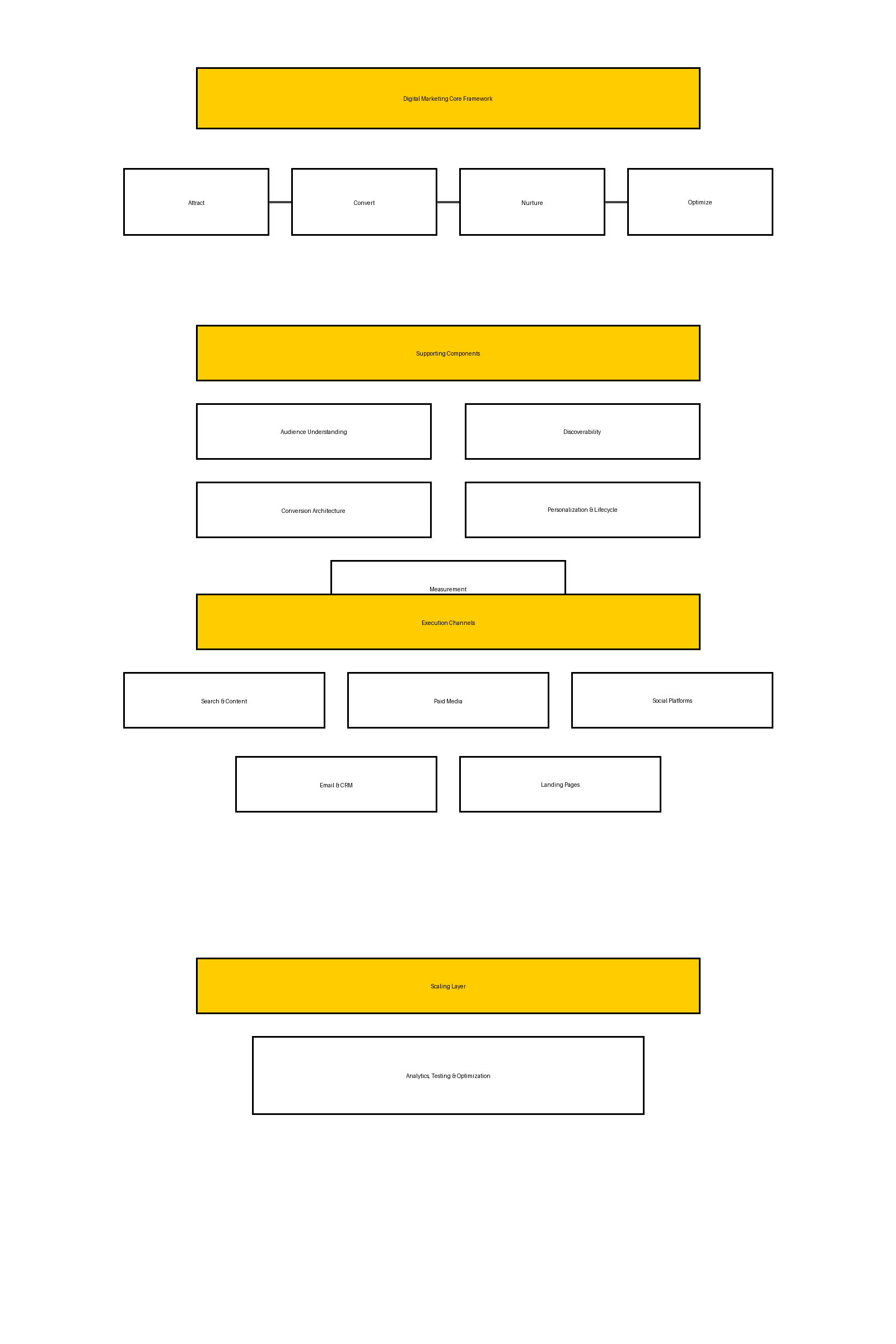
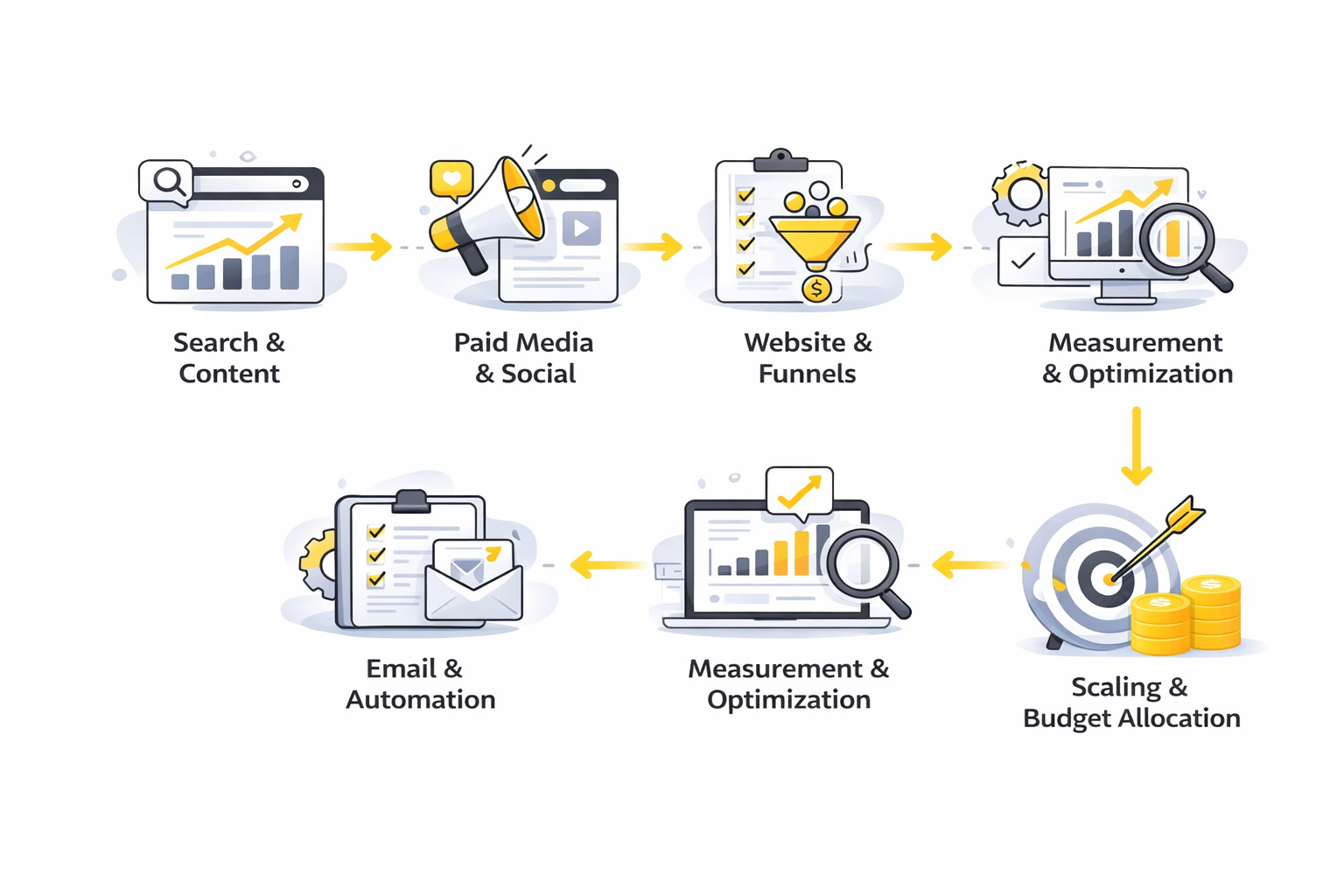
A strong digital marketing framework starts with one simple idea: every channel should serve a job, and every job should support a business objective. Search content can capture demand. Paid media can accelerate reach. Email can deepen the relationship. Social can increase attention, community, and distribution. Landing pages and offers can convert that attention into action. Analytics then tells you what deserves more investment and what needs to be fixed.
This sounds obvious, but many businesses still treat digital marketing like a pile of disconnected tactics. They publish content because they feel they should, run ads because competitors are doing it, and send emails only when they remember. A real framework prevents that drift by forcing alignment between audience, message, channel, offer, and measurement.
The best way to think about the framework is as a system with four connected stages: attract, convert, nurture, and optimize. You attract attention through discoverable and promotable content, convert that attention through focused pages and offers, nurture interest through follow-up and remarketing, and optimize the whole machine through measurement and testing. Google’s SEO guidance and McKinsey’s work on measurement and personalization both reinforce the same principle: sustainable performance comes from structured systems, not isolated hacks.
Core Components
The first core component is audience understanding. Without a clear view of who you are trying to reach, what problem they are trying to solve, and how they evaluate options, every other marketing decision becomes weaker. Channel selection, messaging, content angle, creative format, pricing pressure, and conversion flow all become much easier when the audience profile is specific instead of vague.
The second component is discoverability. This includes search engine optimization, content strategy, platform-native publishing, and any effort that increases the chance that the right person finds your business at the right moment. Google’s own documentation is refreshingly blunt on this point: there are no secret tricks, but strong fundamentals make it easier for search engines to crawl, index, and understand your content. That is exactly why good digital marketing is usually less glamorous than people expect. The businesses that win are often the ones that keep improving clarity, structure, and usefulness.
The third component is conversion architecture. Traffic by itself is not an achievement if the visit goes nowhere. Offers, landing pages, forms, calls to action, product pages, demos, lead magnets, checkout flows, and follow-up sequences all belong here. This is where digital marketing stops being a visibility game and becomes a commercial system.
The fourth component is personalization and lifecycle management. Once someone has visited, subscribed, started a trial, or purchased, digital marketing should become more relevant rather than more generic. McKinsey’s personalization research points to lower acquisition costs, stronger revenue growth, and better ROI when brands tailor communication intelligently. That does not mean creepy over-targeting. It means using behavior, intent, and stage awareness to send better messages to the right people at the right time.
The fifth component is measurement. Performance marketing without measurement becomes noise, and brand marketing without measurement becomes faith. Businesses need channel-level metrics, campaign-level metrics, funnel metrics, and business metrics to work together. That is why serious digital marketing teams do not stop at clicks and impressions; they follow the path from reach to revenue and then use that evidence to reallocate effort.
Professional Implementation
Professional implementation begins with decisions, not tools. A business needs a clear goal, a clearly defined audience, a focused offer, a content and channel plan, and a measurement model before it starts adding software. When those basics are in place, tools become force multipliers instead of distractions.
In practice, that usually means building a stack around four functions: publishing, conversion, communication, and reporting. A team might use a funnel or landing page platform such as ClickFunnels or Systeme.io to structure offers and capture leads, an email platform such as Brevo to handle lifecycle communication, and scheduling or social workflow tools such as Buffer or Flick to support consistent distribution. The point is not that one exact stack is perfect for everyone. The point is that professional implementation requires the channel workflow to be reliable enough that strategy can actually compound over time.
It also requires discipline around testing. McKinsey’s guidance on measurement playbooks and incrementality testing is especially useful here because it pushes marketers away from vanity metrics and toward proof. A professional digital marketing program tests offers, creative angles, audiences, landing page structure, nurture sequences, and budget allocation on purpose. That is how improvement becomes systematic rather than accidental.
Finally, professional implementation respects the difference between short-term response and long-term brand building. The IPA’s long-and-short effectiveness work remains a valuable reminder that marketing can lose its way when every decision is judged only by immediate clicks. Digital marketing works best when it captures demand that already exists, creates demand that does not exist yet, and builds enough trust that future conversions become easier and cheaper.
That balance is what separates busy marketing from effective marketing. When the framework is sound, the channels support each other, the offer is clear, and the data loop is working, digital marketing stops feeling chaotic. It becomes a repeatable growth system.
Digital Marketing Measurement and Optimization
The moment digital marketing becomes serious is the moment a business stops asking, “Did this campaign get attention?” and starts asking, “Did this campaign create profitable movement?” That sounds like a small difference, but it changes everything. Impressions, clicks, and reach still matter, yet they only become useful when they are tied to lead quality, revenue contribution, retention, and customer value over time.
That shift is becoming more important because the market is bigger, faster, and more crowded than it used to be. IAB’s full-year 2024 revenue report put U.S. digital advertising revenue at $259 billion after 15% year-over-year growth, while IAB Europe’s 2024 AdEx benchmark showed the European digital advertising market rising past €100 billion for the first time and finishing at €118.9 billion. When that much money is flowing into the same ecosystem, digital marketing optimization stops being a nice extra and becomes one of the few ways to protect margin while still growing.
There is another reason measurement now deserves more respect than many businesses give it. Google’s guidance on incrementality testing describes it as the gold standard for understanding true advertising impact in a privacy-first environment, and Google’s 2024 marketing growth framework makes the broader point that stronger first-party data, consent-aware measurement, and better analytics foundations are no longer optional. If you cannot tell the difference between activity and impact, your digital marketing budget will eventually drift toward whatever looks busy instead of whatever actually works.
What to Measure in Digital Marketing
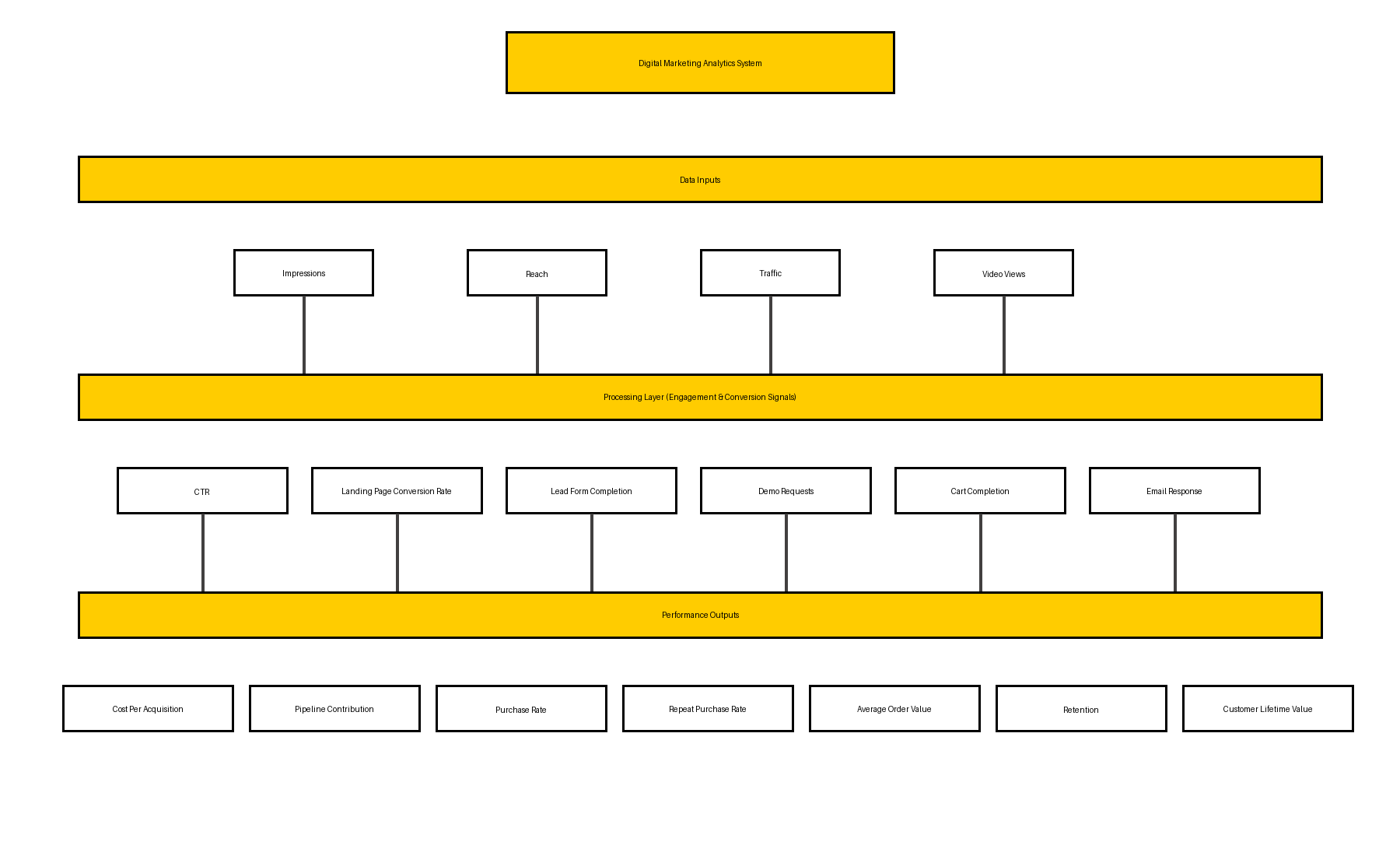
The healthiest way to measure digital marketing is to stack metrics in layers. At the top, you have attention metrics such as impressions, video views, reach, and traffic. In the middle, you have engagement and conversion signals such as click-through rate, landing page conversion rate, lead form completion, qualified demo requests, cart completion, and email response behavior. At the bottom, where the real business conversation happens, you have cost per acquisition, pipeline contribution, purchase rate, repeat purchase rate, average order value, retention, and customer lifetime value.
This layered view matters because a single metric can mislead you when it is isolated from the rest of the journey. A campaign can have a low click-through rate and still be valuable if it reaches high-intent buyers who convert at a strong rate later. Another campaign can look brilliant on surface metrics while sending cheap but weak traffic that almost never turns into real customers. Good digital marketing does not chase one number. It follows the relationship between numbers.
Salesforce’s ninth State of Marketing report and Adobe’s 2025 AI and Digital Trends research both point in the same direction: marketers have more data than ever, but fragmented systems still make it hard to activate that data in real time. That is why the strongest measurement setups are usually not the most complicated ones. They are the ones that make it easy to answer a few high-value questions clearly, repeatedly, and without debate.
Attribution, Testing, and Decision-Making
Attribution is useful, but it is not magic. In digital marketing, buyers often discover a brand through one channel, research through another, subscribe through a third, and convert days or weeks later after several reminders. When someone tries to give all the credit to the final click, the story becomes too neat to be true. That is why modern teams increasingly combine attribution with experimentation, especially when the goal is to understand what created incremental growth instead of what simply appeared at the end of the path.
Google’s modern measurement playbook frames the issue well by pushing marketers to measure online and offline sales, short-term and long-term impact, and the combined influence of channels rather than pretending every conversion belongs to one touchpoint. That approach is much closer to how real buyers behave. It also helps explain why some digital marketing tactics look weaker in isolation than they really are. Brand-building activity often prepares the ground that performance campaigns later harvest.
The practical takeaway is simple: use attribution to identify patterns, use testing to verify causation, and use business results to decide where money should go next. When those three work together, optimization becomes calmer and smarter. Instead of reacting to every short-term fluctuation, you start to see which channels introduce demand, which channels convert it efficiently, and which channels keep customers engaged after the sale.

A Real Example of Digital Marketing Optimization
The pressure was obvious before the result ever looked impressive. IBM was trying to move faster, create more campaign variations, and keep quality high at the same time, which is the exact kind of tension that breaks a digital marketing workflow when demand for content rises faster than a team can produce it. The usual answer would have been to either slow down, increase costs, or accept weaker personalization. None of those outcomes was attractive.
The backstory matters because IBM was not experimenting in a vacuum. Its teams were already working inside a large, complex enterprise environment where brand consistency, scale, and speed all matter at once. That made digital marketing execution harder, not easier, because every new asset, message variation, and audience segment created more operational weight. The company needed a better content engine, not just another brainstorm.
The wall came when traditional production logic could not keep pace with what modern campaigns were asking for. Personalization sounds great until a team has to create dozens or hundreds of usable variations fast enough for the market to care. The more channels and segments you add, the easier it becomes for digital marketing to turn into a bottleneck instead of a growth lever. That is where many teams stall, even when their strategy is sound.
The epiphany was not simply “use AI.” It was realizing that faster content creation only matters if it improves campaign performance and keeps the work commercially safe. Adobe’s write-up on IBM’s Firefly pilot, Axios’s reporting on the rollout, and Adobe’s later partnership update all describe the same turning point: IBM used Firefly to generate large volumes of marketing variations quickly, then measured what happened rather than assuming speed alone would create value.
The journey that followed was practical instead of theatrical. IBM generated 100 to 200 assets and more than 1,000 campaign variations in minutes, then used that output to support more personalized marketing at scale. This was not a fake success story built around vague inspiration. It was a real digital marketing workflow change tied to live campaign execution, measurable response, and a decision to expand how the teams used the system.
The final conflict is the part marketers often skip because it sounds less glamorous than the headline. More volume creates more choices, and more choices make governance, creative judgment, and measurement even more important. If a team cannot evaluate what should be deployed, adjusted, or retired, faster production just creates faster confusion. That is why this example matters: the operational change was only valuable because it stayed connected to performance.
The dream outcome was not just that the team worked faster. The campaign performed far above IBM’s benchmark, with engagement reported at 26 times higher than expected, and that result made the broader lesson hard to ignore. Digital marketing optimization is strongest when it connects creativity, production speed, targeting, and measurement in one loop instead of treating them like separate jobs.
How to Improve Digital Marketing Without Wasting Budget
The smartest way to improve digital marketing is usually not to launch more channels at once. It is to tighten the path between message, audience, offer, and measurement. A business that improves targeting, landing page clarity, follow-up timing, and conversion tracking will often outperform a business that keeps adding new platforms without fixing its existing leaks.
That is why optimization should happen in an order that makes commercial sense. Start with tracking integrity. Then improve the offer and landing experience. After that, work on audience quality, creative testing, lifecycle follow-up, and channel expansion. This sequence is less exciting than jumping to the newest tactic, but it is how digital marketing becomes dependable instead of random.
When this process is handled well, budget decisions become easier and less emotional. You stop defending channels because they are fashionable or familiar. You start funding them because the data, the tests, and the customer journey all point in the same direction. That is what separates professional digital marketing from digital noise.
Building a Digital Marketing Execution System
Knowing that digital marketing matters is one thing. Building a system that keeps working when campaigns get more complex, channels multiply, and customer expectations rise is something else entirely. This is where a lot of businesses get stuck, because they keep adding tactics without building the operational backbone that allows those tactics to support each other.
The pressure is only getting heavier. WPP Media’s latest global forecast puts 2025 ad revenue at $1.14 trillion, which means digital marketing execution now happens inside a market that is enormous, competitive, and brutally fast-moving. In that environment, the businesses that win are rarely the ones doing the most random activity. They are the ones with a cleaner system for turning attention into leads, leads into customers, and customers into repeat revenue.
A proper digital marketing system has to do four things well at the same time. It has to attract the right people, move them toward a meaningful action, keep the relationship alive after that first action, and make it easy to measure what deserves more budget. If one of those pieces breaks, the whole machine starts leaking value.
Search, Content, and Discovery
Search and content sit at the front of the system because they help people find you when intent is already forming. That is why digital marketing usually becomes more powerful when it stops chasing volume for its own sake and starts publishing content that answers real questions, clarifies real problems, and helps people make real decisions. When a business consistently creates useful pages, articles, landing pages, and resource content, it gives itself more ways to show up at the exact moment a prospect is looking for a solution.
Google’s SEO Starter Guide keeps this grounded in reality by focusing on crawlability, clarity, and usefulness rather than tricks. That matters because a healthy digital marketing strategy is not built on gaming search engines for a few weeks. It is built on making content easier for both humans and search systems to understand, which is a much stronger long-term play.
This is also why content should never be treated like filler between ad campaigns. In digital marketing, content creates the entry points that reduce acquisition costs over time. A good article, a well-structured service page, or a sharp comparison page can keep pulling in qualified visitors long after the day it was published, and that kind of compounding effect is hard to replace with paid traffic alone.
Paid Media and Social Amplification
Paid media and social distribution give digital marketing its acceleration layer. Organic discovery can build durable momentum, but paid reach allows a business to test faster, distribute offers more aggressively, and put strong creative in front of the exact audiences it wants to reach. The key is that these channels should not operate like separate kingdoms. Paid media works better when it is amplifying a clear message, a proven offer, and a destination that is ready to convert.
The market data makes that even clearer. DataReportal’s 2025 advertising trends analysis shows how much global marketing investment is now concentrated in digital channels, while IAB’s 2025 outlook highlights the continued importance of social, video, and retail media in budget planning. So when a business runs paid campaigns inside its digital marketing system, the goal is not to buy random clicks. The goal is to buy qualified attention and move it into an owned environment where the relationship can continue.
This is exactly where discipline matters. A weak offer with a bigger budget usually just fails faster. A sharp offer, matched with strong audience selection and creative that speaks to the right problem, gives digital marketing a chance to scale without turning spend into waste.
Website, Funnels, and Conversion Flow
The website is where digital marketing either proves its value or exposes its weaknesses. If the traffic arrives and the page is confusing, slow, generic, or poorly structured, the system collapses at the most expensive point in the journey. That is why the website should not be treated like a digital brochure. It should function like a conversion environment built to help the visitor understand the offer, trust the brand, and take the next logical step.
This is where funnels, landing pages, lead capture, and checkout flow come in. A business that wants tighter control over offers and conversions often uses tools like ClickFunnels or Systeme.io to structure pages and automate key steps in the path from first click to first sale. The tool itself is not the magic. What matters is that digital marketing becomes easier to optimize when the offer path is clear, the calls to action are obvious, and the next step does not force the user to guess.
That is why conversion flow deserves more respect than it usually gets. Many businesses assume they have a traffic problem when they actually have a clarity problem. Once the message, page structure, proof, and call to action line up properly, digital marketing often starts performing better without needing a dramatic jump in traffic volume.
Email, Automation, and Relationship Building
Email remains one of the most reliable parts of digital marketing because it gives you direct access to people who already raised their hand. That matters more than ever when platform algorithms shift, paid media costs fluctuate, and social reach can disappear overnight. A good email system allows a business to follow up after downloads, demos, abandoned carts, consultations, and purchases without starting from zero every single time.
Salesforce’s tenth State of Marketing report and Litmus’s State of Email research hub both reflect the same reality: marketers are leaning harder into first-party data, personalization, and lifecycle communication because rented attention is getting less dependable. That makes email one of the stabilizers inside a modern digital marketing system. It lets you build continuity instead of relying only on interruption-based channels.
This is also where a practical software stack starts helping. A platform such as Brevo can support list growth, segmentation, and automated follow-up, while publishing tools like Buffer can keep content distribution consistent across social channels. Used together, these tools do not replace strategy. They simply make digital marketing easier to execute consistently, which is exactly what most teams need more of.
The Measurement Loop and Team Workflow
No digital marketing system stays healthy for long if the team cannot see what is happening inside it. Measurement has to be built into the workflow, not bolted on after a campaign is already running. That means campaign naming conventions, clean tracking, shared dashboards, consistent review cycles, and a clear definition of what counts as success before money goes out the door.
Google’s modern measurement playbook is useful here because it pushes marketers to think beyond the last click and focus on business impact across the whole journey. That is a healthier way to run digital marketing because it forces teams to connect content, paid media, CRM activity, sales outcomes, and retention instead of pretending each channel lives in isolation.
When this loop is working, digital marketing becomes easier to improve without panic. You can see which pages deserve testing, which campaigns are attracting the wrong audience, which email sequences are doing real work, and which channels are helping revenue instead of just producing nice-looking dashboards. That is when execution stops feeling chaotic and starts feeling like a real growth system.
Digital Marketing Statistics and Data
If you want to understand where digital marketing is headed, the numbers tell a very clear story. DataReportal’s 2025 global overview shows that the world now has 5.56 billion internet users, while the same research also puts active social media user identities at 5.24 billion worldwide. That means digital marketing is operating inside an environment where online access is no longer a niche behavior. It is the default commercial environment for a huge share of the planet.
The scale gets even more interesting when you look at how people actually behave once they are connected. DataReportal’s social media dataset shows that 93.8% of the world’s internet users now use social media each month, the typical user actively uses 6.75 different platforms, and people spend an average of 18 hours and 36 minutes per week on social platforms. For anyone building a digital marketing strategy, that changes the job completely. You are not trying to reach people in one neat channel anymore. You are trying to stay relevant across a messy, overlapping, high-attention ecosystem.
Digital Ad Spend Keeps Climbing
Budget trends show the same momentum. WPP Media’s global advertising forecast projects total global ad revenue at $1.14 trillion in 2025, with commerce media alone expected to reach $178.2 billion. That matters because digital marketing is no longer just competing with other digital tactics. It is competing inside an increasingly sophisticated ad economy where retail media, creator platforms, search, video, and AI-shaped discovery are all fighting for the same budgets.
In the United States, IAB’s full-year 2024 revenue report says digital advertising reached a record $259 billion, up 15% year over year. Europe is moving in the same direction, with IAB Europe’s 2024 AdEx benchmark putting the European digital advertising market at €118.9 billion after it passed the €100 billion mark for the first time. When those markets are both expanding at this scale, the message is hard to miss: digital marketing is not where the industry is experimenting anymore. It is where the industry is concentrating serious money.
Social Media Data Changes How Marketers Plan
The most useful social media data is not just the platform size. It is the behavior behind that size. DataReportal’s latest platform analysis shows that YouTube ads can now reach 2.58 billion users each month, compared with Facebook’s 2.35 billion, and that there are now seven social platforms that each claim at least one billion monthly users. That is a huge shift from the era when a brand could rely on one dominant network and feel covered.
There is also a subtler lesson inside the same data. GWI findings cited in DataReportal’s analysis show that users now interact with an average of 6.75 platforms every month, and the broader 2025 social data points to a portfolio effect rather than a winner-take-all effect. In plain English, that means digital marketing gets stronger when the message is adapted to platform behavior instead of blindly duplicated everywhere. The data does not support lazy omnipresence. It supports smart channel selection.
Measurement and Personalization Data
One of the biggest shifts in digital marketing is not just where people spend time, but how brands are trying to understand that behavior. Adobe’s 2025 AI and Digital Trends: Data and Insights report surveyed more than 3,200 marketers and customer experience professionals along with 8,000 consumers, and the central message is that fragmented data is still blocking real-time, one-to-one personalization. That matters because personalization has been marketed as a solved problem for years, but the numbers keep showing that operational reality is much messier.
Salesforce’s ninth State of Marketing report adds another important layer, drawing on insights from nearly 5,000 marketers worldwide and focusing heavily on unified data strategy, personalization at scale, and AI implementation. This is one of the clearest signs that digital marketing is becoming more dependent on systems quality, not just creative quality. A team can have strong copy, sharp design, and a healthy ad budget, but if its data is fragmented and its reporting is weak, performance will still be harder to improve.
What the Data Really Means for Businesses
All of this data points in the same direction. Digital marketing is growing because digital behavior is growing, but it is also getting more complex because audiences are spread across more platforms, more devices, and more decision-making moments. The 2025 global data, the U.S. revenue figures, and the European benchmark numbers all confirm the same pattern: more money is flowing into digital channels because that is where consumer attention and commercial opportunity now live.
But the data also warns against sloppy execution. When people use multiple platforms, budgets keep rising, and measurement gets harder, digital marketing rewards businesses that are more disciplined than their competitors. The companies that win are usually the ones that understand the numbers well enough to simplify the right things, not the ones that panic and try to do everything at once.
Where Digital Marketing Is Heading Next
Digital marketing is not slowing down. It is getting more layered, more automated, and more demanding at the same time. The businesses that keep winning will not be the ones chasing every shiny new tactic, but the ones that understand where buyer behavior is moving and build systems strong enough to adapt before the rest of the market catches up.
You can already see that shift in the data. WPP Media’s December 2025 forecast projects global ad revenue at $1.14 trillion in 2025, while commerce media alone is expected to reach $178.2 billion and overtake total TV ad revenue. That tells you something important right away: digital marketing is becoming even more connected to platforms that sit close to the point of purchase, not just the point of attention.
At the same time, the search environment is changing in ways that will reshape how people discover brands. Google’s May 2025 update says AI Overviews are now available in more than 200 countries and territories and in more than 40 languages, and Google’s AI Mode announcement from I/O 2025 makes it clear that search is moving toward deeper, more conversational, AI-assisted experiences. That means digital marketing is entering a phase where ranking, visibility, content structure, and brand trust all have to work together more tightly than before.
AI Search and Discovery Will Change the Game
One of the biggest changes in digital marketing is that discovery is becoming less linear. A person may still use classic search results, but now they may also see AI summaries, conversational search experiences, multimodal results, product recommendations, and assistant-like responses that compress research into a much shorter journey. That changes how brands earn attention. It is no longer enough to simply publish content and hope the click comes through.
Google’s own description of AI Mode explains that the system can break a query into subtopics and issue multiple searches at once, which is a very different experience from typing one keyword and scanning ten blue links. Google also says that in major markets such as the U.S. and India, AI Overviews are driving over 10% more usage for the kinds of queries where they appear. For digital marketing teams, that is a wake-up call. Content now has to be useful enough to deserve citation, clear enough to be interpreted correctly, and distinctive enough that the brand is remembered even when the click path changes.
This does not mean classic SEO is dead. It means digital marketing now needs a stronger blend of SEO, authority building, content depth, brand clarity, and conversion readiness. The teams that adapt early will be easier to discover in AI-shaped environments, while the ones still producing generic content will become easier to ignore.
First-Party Data Will Matter Even More
Another major shift is the growing value of first-party data. For years, marketers could lean heavily on third-party signals, loose tracking, and platform-level optimization. That era is fading. In its place, digital marketing is becoming more dependent on owned data, consent-aware measurement, and a much tighter connection between acquisition, retention, and customer intelligence.
IAB’s State of Data 2025 report says signal deprecation has already pushed the industry toward first-party data, alternative IDs, and data clean rooms, and the same report notes that only 30% of agencies, brands, and publishers have fully integrated AI across the media campaign lifecycle. That gap matters because digital marketing will reward businesses that build better internal data foundations before AI and automation become even more deeply embedded in campaign execution.
In practical terms, this means email lists matter more, CRM hygiene matters more, website tracking integrity matters more, and owned audience relationships matter more. It also means tools that help marketers capture, organize, and activate that data can become a real advantage. For example, a business that uses Brevo for email and customer communication, or a link and attribution platform like Dub to understand traffic sources more clearly, is usually in a stronger position than a business that depends entirely on platform dashboards it does not control.
The Best Digital Marketing Will Be More Integrated
Digital marketing is also becoming less siloed. Search, paid media, email, CRM, content, creator partnerships, analytics, and conversion optimization used to be handled like separate disciplines with separate scoreboards. That approach is getting weaker because the customer journey itself is too connected for those walls to hold. The businesses that grow fastest are increasingly the ones that make those systems talk to each other.
IAB’s 2025 report lays out just how broad AI’s future role may become, from building media plans and generating audience segments to forecasting performance and reshaping attribution. That points toward a version of digital marketing where strategy, execution, and optimization become more tightly linked inside one operating system. The challenge is that more integration also creates more complexity, which is exactly why sloppy teams will struggle even more than they do now.
This is where workflow starts to matter as much as creativity. A team needs a reliable way to move from idea to asset, from asset to campaign, and from campaign to measured business result. That is one reason some marketers are building leaner, more connected stacks with tools for scheduling, automation, CRM, and reporting rather than piling on disconnected software. Even something as simple as using Buffer for consistent publishing can become more valuable when it fits into a bigger digital marketing system instead of operating on its own island.
What Businesses Should Do Right Now
If you are serious about improving digital marketing results over the next few years, the smartest move is not to wait for the market to become easier. It will not. The smarter move is to strengthen the assets you control, sharpen the message you send, and make your measurement cleaner while competitors are still distracted by noise.
That means publishing content that deserves attention, building landing pages that convert, capturing first-party data responsibly, improving lifecycle follow-up, and treating AI as a force multiplier instead of a replacement for judgment. It also means being careful with your stack. Tools are useful when they reduce friction and improve execution, but they become expensive clutter when they are added without a clear role inside the digital marketing system.
The businesses that come out ahead will usually be the ones that stay practical. They will use new technology, but they will not worship it. They will study the numbers, but they will not lose sight of the human being making the purchase. And they will keep asking the question that matters most in digital marketing: does this make it easier for the right person to trust us, choose us, and stay with us?
Digital Marketing FAQ and Next Steps
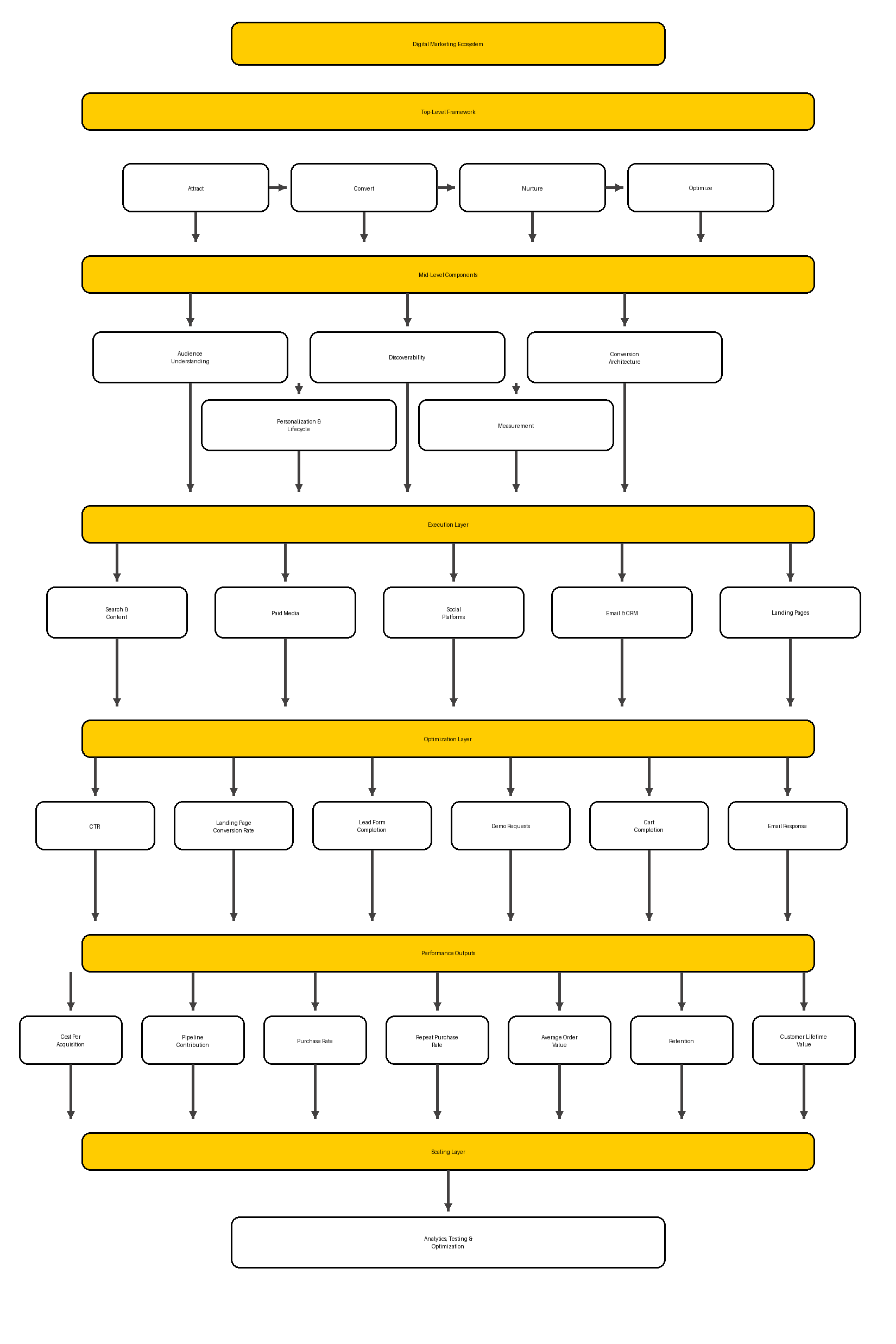
By this point, the big picture should be clear. Digital marketing is not one tactic, one platform, or one campaign type. It is an ecosystem that connects discovery, persuasion, conversion, retention, and measurement, and it works best when those parts support each other instead of pulling in different directions.
The reason this matters so much right now is scale. Digital 2025 global data shows 5.56 billion internet users and 5.24 billion active social media user identities worldwide, while IAB’s full-year 2024 report put U.S. digital ad revenue at $259 billion. In a market that large, digital marketing rewards clarity, consistency, and systems thinking far more than random bursts of activity.
FAQ Built for the Complete Guide
What is digital marketing in plain English?
Digital marketing is the process of attracting attention, building trust, and generating sales through online channels such as search engines, websites, email, social media, paid ads, and digital content. The simplest way to think about it is this: digital marketing helps the right people discover your business, understand why it matters, and take the next step. The reason it feels so broad is that modern buyers move across many channels before they make a decision, which is exactly what the latest global digital behavior data continues to show.
Why is digital marketing so important for businesses now?
It matters because attention, research, comparison, and buying behavior have all shifted online. A business can be excellent offline and still lose because it is weak where customers actually evaluate options. That is why digital marketing has become such a central growth lever, and why WPP Media’s 2025 forecast and IAB Europe’s 2024 benchmark both show major budgets continuing to flow into digital channels.
What are the main types of digital marketing?
The main types are search engine optimization, paid search, paid social, content marketing, email marketing, social media marketing, influencer or creator partnerships, affiliate marketing, conversion optimization, and lifecycle automation. A strong digital marketing strategy rarely relies on only one of them for long. Usually, one or two channels do the heavy lifting at a given stage, while the others help reinforce the journey and improve conversion quality.
Is SEO better than paid ads?
Neither is automatically better. SEO is powerful because useful content and technically sound pages can keep generating qualified traffic over time, which is why Google’s SEO guidance focuses so heavily on crawlability, structure, and helpful content. Paid ads are powerful because they let you reach targeted audiences quickly and scale winning offers faster, especially when systems like Google Ads Smart Bidding can optimize around conversions. In digital marketing, SEO is usually the compounding play, while paid media is the acceleration play.
How long does digital marketing take to work?
That depends on the channel, the offer, and how strong the foundation is before you start. Paid campaigns can produce signals quickly, but lasting profitability still takes testing and refinement. SEO and content can take longer to mature, which Google openly acknowledges, but they often become more valuable over time because they keep creating entry points long after publication. The honest answer is that digital marketing can show early movement fast, but stable growth usually comes from consistency rather than impatience.
Does email marketing still work in digital marketing?
Yes, and it remains one of the most dependable parts of the system because it gives you direct access to people who already know your brand. That matters even more as platforms change their algorithms and privacy rules tighten. Mailchimp’s email benchmark resource and Salesforce’s State of Marketing research both reinforce the same point: owned audiences and better use of first-party data are becoming more valuable, not less. That is why many businesses build follow-up systems with tools like Brevo instead of relying entirely on rented attention.
What metrics should I track first?
Start with the metrics that connect activity to business outcomes. Traffic, reach, and clicks are useful, but by themselves they can become vanity metrics very quickly. In digital marketing, the smarter starting set is usually traffic quality, conversion rate, cost per lead or sale, qualified lead volume, revenue by channel, repeat purchase behavior, and customer lifetime value. Google’s guidance on incrementality is especially helpful here because it reminds marketers to separate apparent performance from true business impact.
How much should a small business spend on digital marketing?
There is no universal number that makes sense for every business. The right budget depends on your margins, your average customer value, how competitive the category is, how long the sales cycle runs, and whether you already have a strong organic foundation. The more useful question is whether your digital marketing spend can be traced to qualified pipeline, revenue, and retention. A smaller budget with sharp targeting, better pages, and consistent follow-up often beats a larger budget spent on scattered campaigns.
Is AI replacing digital marketers?
AI is changing the job, but the stronger pattern so far is augmentation rather than replacement. IAB’s State of Data 2025 release says only 30% of agencies, brands, and publishers have fully integrated AI across the media campaign lifecycle, which tells you the industry is still in transition. Meanwhile, Google’s AI Overviews expansion shows how much the discovery environment is already shifting. Digital marketing professionals who learn how to combine judgment, strategy, creative thinking, and AI-assisted execution will be in a much stronger position than those who either ignore AI or expect it to do all the thinking for them.
What tools do I actually need to start?
You need far fewer tools than most software ads want you to believe. A practical digital marketing stack often starts with a good website or funnel builder, one email platform, analytics, and a simple way to manage publishing or campaigns. For some businesses that might mean using ClickFunnels or Systeme.io for offer delivery, Brevo for email automation, and Buffer for consistent social scheduling. The best tool stack is the one that supports the strategy clearly without creating extra noise.
What is the biggest digital marketing mistake businesses make?
The biggest mistake is treating digital marketing like a pile of unrelated tactics instead of one connected system. Businesses publish random content, launch ads with weak offers, collect leads without a follow-up process, and then act surprised when results feel unstable. The problem usually is not a lack of effort. It is a lack of alignment between message, audience, channel, offer, and measurement.
Can digital marketing work without social media?
Yes, depending on the business model. Some companies grow mostly through search, referrals, partnerships, email, and strong websites. That said, social media remains a huge part of modern attention flow, and current social usage data shows just how much time people still spend across multiple platforms every month. So digital marketing can work without social media being the star, but most businesses are still wise to understand how social fits into the broader ecosystem.
How do I know if my digital marketing is actually working?
You know it is working when the system is creating profitable movement, not just visible activity. That means stronger lead quality, better conversion rates, healthier retention, clearer attribution, and more confidence about where the next dollar should go. If your digital marketing reports look busy but do not make budget decisions easier, the measurement layer probably still needs work.
Work With Professionals
There comes a point where learning the theory is not enough. Digital marketing gets more demanding as channels multiply, AI changes discovery, and measurement becomes more complex. When that happens, the fastest path forward is often working with people who already know how to build systems that generate leads, sales, and retention without wasting months on guesswork.
If you are building funnels, campaigns, lifecycle automations, or content systems, it helps to use tools that make execution cleaner rather than harder. That might mean a funnel platform like ClickFunnels, an all-in-one setup like Systeme.io, or an email and CRM workflow through Brevo. The tool does not replace skill, but it can make strong digital marketing much easier to execute consistently.
Most marketers spend too much time chasing clients, competing on crowded platforms, and losing a percentage of every project to middlemen.
MarkeWork gives you a better way. Browse thousands of remote marketing contracts and connect directly with companies desperate to hire skilled marketers like you without platform commissions and without unnecessary gatekeepers.
If you are serious about finding better opportunities and keeping 100% of what you earn, you can explore available contracts and create your profile for free at MarkeWork.com.
 Filip Konecny Enterprises