

Digital Agency Guide for Modern Business Growth
A digital agency can look simple from the outside. You hire a team, launch a website, run some ads, publish content, and hope revenue follows. In real life, the best results come when strategy, creative work, media buying, analytics, and sales follow-up are all connected instead of being managed as separate projects.
That matters even more now because customer behavior is fragmented. E-commerce accounted for 16.4% of total U.S. retail sales in 2025, internet advertising revenue reached $258.6 billion in 2024, and around 40% to 55% of consumers in major sectors are already using AI-based search during purchase decisions. A business that treats marketing as a loose collection of tactics usually loses speed, clarity, and margin long before it loses visibility.
This first part lays the foundation. You will see why a digital agency matters, how the core framework works, which components deserve the most attention, and what professional implementation looks like when the goal is not just more traffic, but a business that converts attention into measurable growth.
Article Outline
- Part 1: Why a Digital Agency Matters
- Part 2: Digital Agency Framework Overview
- Part 3: Core Components of a Digital Agency
- Part 4: Professional Digital Agency Implementation
- Part 5: Measurement and Optimization
- Part 6: Scaling the Digital Agency Ecosystem
Why a Digital Agency Matters
A digital agency matters because most businesses no longer win on visibility alone. They win when their message is clear, their site is fast, their offer is compelling, and their follow-up is disciplined enough to turn interest into booked calls, purchases, or qualified leads. Without that coordination, even a brand with decent traffic can feel busy while staying stuck.
The market is pushing companies toward this kind of integration. HubSpot’s latest marketing data shows website, blog, and SEO as the top ROI-generating channel for marketers, while Google’s people-first content guidance makes it clear that thin, search-engine-first publishing is not a durable strategy. A serious digital agency helps a company stop chasing disconnected hacks and start building assets that compound.
There is also a financial reason to treat this seriously. McKinsey reports that personalization can reduce acquisition costs by as much as 50%, lift revenues by 5% to 15%, and increase marketing ROI by 10% to 30%. Those gains do not usually come from one brilliant campaign; they come from a disciplined operating model that keeps customer data, messaging, creative, and measurement moving in the same direction.
Framework Overview
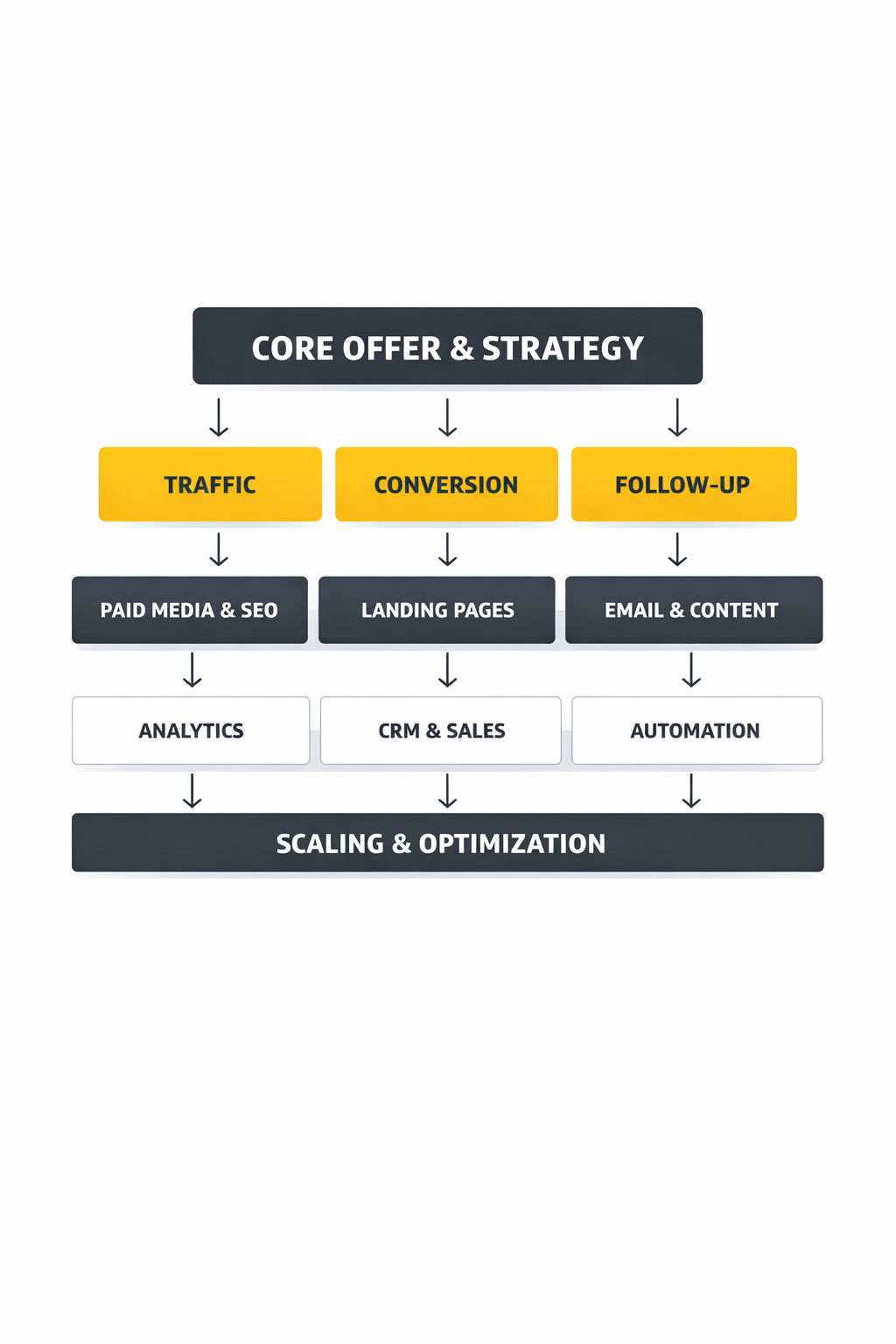
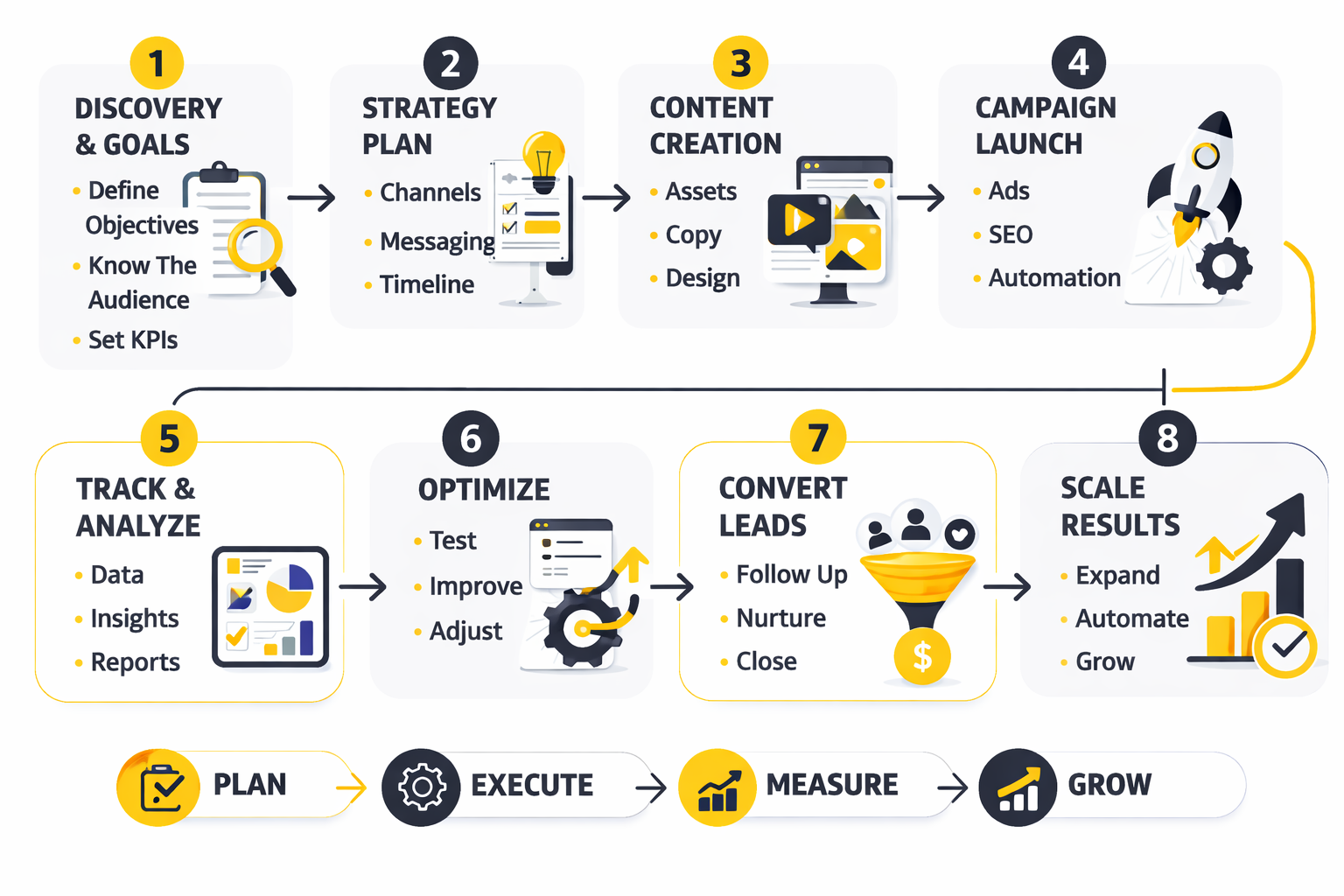
The simplest way to understand a digital agency is to see it as a growth framework rather than a bundle of services. First comes diagnosis, where the team studies the audience, the offer, the sales process, the data quality, and the competitive position. Then comes strategy, where priorities are chosen so the business does not try to fix branding, SEO, paid media, email, conversion rate optimization, and analytics all at once with no clear order.
Once the strategy is set, execution moves through build, distribution, and optimization. The build phase covers assets such as landing pages, ad creatives, content systems, tracking, and CRM flows. Distribution puts those assets in front of the right audiences through search, paid social, email, partnerships, local discovery, and increasingly the AI-driven environments where buyers now compare options before ever talking to sales.
The final layer is feedback. A professional digital agency reviews what actually happened, not what the original plan hoped would happen, then adjusts budgets, messaging, audience segments, and user journeys based on evidence. That sounds obvious, but it is exactly where many businesses break down because they have activity everywhere and accountability nowhere.
Core Components
The first core component is positioning. If the market cannot understand what a company does, who it helps, and why it is different, no amount of paid traffic will fix the problem for long. Strong agencies spend more time on message-market fit than many clients expect, because they know that weak positioning poisons every ad, email, landing page, and sales call that follows.
The second core component is the website and conversion system. A site must do more than look polished; it has to load cleanly, guide the visitor, and remove friction at every decision point. That is why teams pay attention to Core Web Vitals, including LCP, INP, and CLS, but they also study forms, offer structure, call-to-action placement, proof elements, and what happens after the click.
The third core component is distribution, which includes SEO, content, paid media, email, and social channels. The strongest agencies do not assume every client needs every channel at the same intensity. They choose a mix that matches buying behavior, budget, margin, and sales cycle, then connect distribution to analytics so the business can see which channels bring attention, which bring qualified demand, and which only create noise.
Professional Implementation
Professional implementation starts with restraint. A good digital agency does not promise to fix everything in thirty days, because real growth work begins with sequencing. The team identifies the biggest bottleneck first, whether that is poor conversion tracking, weak positioning, a slow site, low-quality lead flow, or a broken handoff between marketing and sales, and then builds a process around solving that problem before piling on more complexity.
It also requires a tool stack that supports execution instead of distracting from it. Some teams move faster with ClickFunnels or Systeme.io when a campaign needs a focused funnel, while others prefer pairing a site build with Brevo for email workflows, Cal.com for booking, and Copper for CRM visibility. The tool itself is never the strategy, but the wrong stack can absolutely slow a good strategy down.
Professional implementation also means reporting on business outcomes rather than vanity metrics. HubSpot reports that marketers increasingly focus on lead quality, conversion rate, ROI, customer acquisition cost, and lead volume, which is exactly how an agency should think. When the work is managed well, the client stops asking whether the agency is busy and starts asking whether the system is becoming more profitable, more predictable, and easier to scale.
Digital Agency Framework Overview
The easiest way to understand how a digital agency should work is to stop thinking in terms of random services and start thinking in terms of a system. A business does not grow because it bought SEO, paid ads, email marketing, and design from the same vendor. It grows when those pieces are arranged in the right order, tied to one commercial goal, and improved fast enough to keep pace with buyer behavior.
That shift matters because digital channels are still getting bigger, more competitive, and more expensive to misuse. IAB’s Full Year 2024 Internet Advertising Revenue Report shows digital ad revenue climbed to $258.6 billion in the United States, which means more money is flowing into the same attention economy your business is trying to win. When the market gets that crowded, a digital agency framework cannot be built on guesswork or busywork.
Start With Commercial Diagnosis
The first stage of a strong digital agency framework is diagnosis. Before anyone writes copy, redesigns pages, launches campaigns, or builds automations, the agency needs to understand the offer, margin profile, sales cycle, lead quality, close rate, and where the current funnel actually breaks. That sounds basic, but skipping this step is exactly why so many companies end up celebrating traffic increases that never turn into meaningful revenue.
This is also where the agency decides what kind of growth problem it is solving. Sometimes the issue is weak demand generation. Sometimes the traffic is already there, but the website, forms, or booking flow are leaking value. In other cases, the real problem is fragmented customer experience, and that matters because Salesforce found that 85% of customers expect consistent interactions across departments and 56% expect all offers to be personalized.
A good diagnosis phase protects everyone from false confidence. It keeps the client from spending money in the wrong place, and it keeps the agency from promising speed where sequencing matters more than speed. When this part is done right, the rest of the framework stops feeling like a pile of marketing tasks and starts feeling like a business plan with execution attached to it.
Map the Customer Journey Before Choosing Channels
Once the diagnosis is clear, the next step is mapping how people actually move from awareness to action. A digital agency should not pick channels because they are trendy, loud, or easy to sell in a proposal. It should pick channels based on where the buyer discovers options, how much trust they need before they convert, and what information they require at each stage of the decision.
That is why the framework begins with customer journey thinking rather than channel obsession. Search still matters because people use it when intent is high, and Google continues to emphasize helpful, reliable, people-first content instead of thin pages designed only to rank. At the same time, discovery often begins on social platforms, review sites, video platforms, communities, marketplaces, and AI-assisted research tools, so the agency has to decide where the first touch happens and where the conversion moment should happen.
When this journey is mapped correctly, channel selection becomes much cleaner. SEO might carry educational intent, paid media might accelerate demand, email might recover abandoned prospects, and sales outreach might close high-value opportunities that need more human trust. The framework works because each channel has a job, not because the agency is trying to look full-service for the sake of it.
Align Assets, Data, and Automation
After the journey is mapped, the framework moves into alignment. This is the part where the agency makes sure the message, landing pages, forms, CRM fields, email flows, reporting logic, and follow-up sequences all support the same outcome. If those pieces are disconnected, the business ends up paying for attention it cannot properly capture or convert.
This is where a digital agency becomes valuable at an operational level instead of just a creative one. Strong teams know that personalization and measurement depend on better foundations, which is why McKinsey describes effective personalization as a system built on data, decisioning, design, distribution, and measurement. In plain English, that means the framework needs clean inputs, clear logic, strong creative, disciplined delivery, and a way to prove what is working.
Tool choice sits inside this layer, but it should never lead it. Some businesses move faster with a focused funnel stack built in ClickFunnels, while others prefer using Brevo for lifecycle email, Cal.com for frictionless scheduling, or Copper when visibility into deal flow matters more than adding another shiny app. The point is not to collect software. The point is to make sure the framework can move a prospect from first click to qualified conversation without dropping the thread halfway through.

Build an Optimization Loop That Never Goes Dark
The final piece of the framework is the optimization loop. A digital agency should never launch a campaign, hand over a dashboard, and disappear into vague monthly reporting. It needs a recurring process for reviewing performance, identifying friction, testing changes, and deciding what deserves more budget, more creative support, or a completely different angle.
This is where the gap between activity and progress becomes obvious. HubSpot’s current marketing data highlights lead volume, lead-to-customer conversion, conversion rate, ROI, and customer acquisition cost as the metrics marketers care about most, and that is the right mindset for an agency too. Impressions and clicks can still be useful, but only as supporting signals inside a broader commercial picture.
The best digital agency framework keeps this loop tight. The team watches how prospects behave, studies what sales hears on calls, reviews what content pulls qualified intent, and improves the system without waiting for a complete quarterly reset. That is how an agency stops being a vendor that delivers tasks and becomes a growth partner that helps the business get sharper, faster, and harder to ignore.
Core Components of a Digital Agency
If a digital agency is going to produce real growth, it needs more than talent and good intentions. It needs the right components working together in the right order. That is where many businesses get frustrated, because they think they bought marketing help when what they really bought was a scattered mix of tasks that never turned into momentum.
The smartest way to look at this is simple. A digital agency needs clear positioning, a high-converting web experience, reliable traffic channels, retention systems that keep leads warm, and measurement that ties effort back to business results. When those components are aligned, the work stops feeling random and starts feeling powerful.
Positioning and Offer Clarity
The first component is positioning. Before a digital agency touches ads, SEO, or email, it has to answer the hardest commercial question in the room: why should anyone choose this business instead of the alternatives already in the market. If that answer is vague, every downstream tactic becomes more expensive and less effective.
This is why strong agencies spend real time on the offer, the audience, and the promise being made. The job is not to invent clever slogans. The job is to create a message that feels immediately relevant to the right person, because once the market understands the value clearly, the rest of the system gets lighter and faster.
That clarity matters even more in a crowded digital economy. U.S. retail e-commerce reached 16.6% of total sales in the fourth quarter of 2025, which means more businesses are fighting for attention, trust, and clicks in the same commercial space. A digital agency that cannot sharpen positioning will waste money trying to outbid confusion.
Website and Conversion Experience
The second component is the website and the conversion path around it. A digital agency should never treat the website like a pretty brochure that sits in the background while paid campaigns do the heavy lifting. The website is where curiosity turns into action, and if that experience is slow, unclear, or cluttered, the entire acquisition system starts leaking value.
This is where user experience becomes commercial, not cosmetic. Google’s guidance on Core Web Vitals makes it clear that loading performance, interactivity, and visual stability all shape real user experience, and page experience matters most when many relevant pages are competing for the same query. In other words, when your content is good but your experience is sloppy, a competitor with a smoother experience can still take the win.
A serious digital agency looks beyond speed scores too. It studies headlines, page structure, forms, proof elements, booking flow, mobile friction, checkout anxiety, and what happens after someone clicks the call to action. That is where conversion rate is really born, not in dashboards, but in the small decisions that make a visitor feel guided instead of lost.
Traffic Acquisition Channels
The third component is traffic acquisition. This is the part people usually get excited about first because it feels visible and fast, but a digital agency has to treat channel selection like strategy, not entertainment. Not every business needs the same mix of SEO, paid social, search ads, short-form video, partnerships, email capture, and outbound follow-up.
What matters is matching the channel to the buyer’s intent. Search is powerful when demand already exists, and Google keeps reinforcing that helpful, reliable, people-first content is what its systems want to surface over content built mainly to manipulate rankings. Paid media can accelerate reach, but the agency has to know whether it is amplifying a strong offer or just paying to expose weak messaging faster.
This is also where discipline matters because more spend does not automatically mean better strategy. Digital ad revenue in the United States hit $258.6 billion in 2024, which tells you one thing very clearly: attention is expensive, and the market is crowded. A digital agency earns its value by choosing the right channels, sequencing them properly, and resisting the urge to do everything at once.
CRM, Email, and Follow-Up Systems
The fourth component is retention and follow-up. A digital agency should not think its work ends when the lead form is submitted or the first purchase happens. A huge amount of commercial value lives in the handoff between marketing and sales, in the nurture sequence after first contact, and in the consistency of the customer experience after the initial conversion.
This is where CRM hygiene, email automation, scheduling flow, and lead routing stop being “back-end details” and start becoming growth levers. Salesforce found that 85% of customers expect consistent interactions across departments and 56% expect all offers to be personalized. That tells you exactly why disconnected follow-up hurts so much: the customer feels the gap immediately.
A capable digital agency builds this part carefully. That may mean using Brevo for lifecycle email, Cal.com for fast booking, or Copper to keep leads and deals visible across the team. The software is not the hero, but the structure behind it absolutely matters, because fast, relevant follow-up is often the difference between wasted demand and closed business.
Measurement and Decision-Making
The fifth component is measurement. A digital agency should know what happened, why it happened, and what needs to change next. That sounds obvious, but a lot of reporting still revolves around surface metrics that look busy in a monthly presentation and say almost nothing about business health.
That is why good agencies focus on a tighter set of signals. HubSpot’s current marketing data highlights ROI, conversion rate, lead volume, lead quality, and customer acquisition cost as the metrics marketers care about most, and that is the right lens. Those numbers force the agency to connect creative work, media spend, sales process, and website performance instead of hiding behind impressions and vanity engagement.
Measurement also supports better personalization and smarter budget decisions. McKinsey notes that strong personalization can cut acquisition costs by as much as 50%, lift revenue by 5% to 15%, and improve marketing ROI by 10% to 30%. A digital agency can only chase that kind of upside when its tracking, segmentation, and reporting are clean enough to show what is actually working.
How the Components Work Together
Here is the truth that separates strong agencies from weak ones: none of these components work well in isolation. Great positioning without distribution stays invisible. Great traffic without a strong website gets wasted. Great follow-up without measurement turns into guesswork. Great analytics without a compelling offer just gives you cleaner data about a weak market position.
That is why a digital agency has to build the whole system with intention. Each component supports the next one, and each one becomes more valuable when the surrounding parts are solid. Once that happens, growth stops feeling like luck and starts feeling like something you can actually engineer.
Measurement and Optimization
A digital agency becomes truly valuable when it can tell you what is working, what is wasting money, and what needs to change next. That sounds obvious, but this is the point where a lot of businesses get lost because they mistake activity for progress. Traffic, impressions, and follower growth can look exciting on a report, but if they are not tied to leads, sales, retention, or margin, they do not tell the whole story.
This is why serious teams measure performance in layers. They track attention, engagement, conversion, pipeline quality, customer value, and operational speed together instead of obsessing over one shiny number. Once a digital agency learns to connect those layers, decision-making becomes calmer, faster, and a lot more profitable.
Statistics and Data
The numbers around digital growth are telling a very clear story right now. IAB’s Full Year 2024 Internet Ad Revenue Report shows that U.S. digital advertising revenue reached $258.6 billion, which means competition for attention is not slowing down. A digital agency cannot survive in that environment by launching campaigns blindly and hoping the math works out later.
The buying environment is changing too. The U.S. Census Bureau reported that e-commerce accounted for 16.6% of total retail sales in the fourth quarter of 2025, which reinforces how important the online buying journey has become even for businesses that still close deals offline. When more commercial discovery and comparison happens online, a digital agency has to care deeply about page experience, conversion flow, and follow-up speed because that is where revenue gets won or lost.
Customer expectations are rising at the same time. Salesforce found that 85% of customers expect consistent interactions across departments and 56% expect all offers to be personalized. That is a huge deal because it means performance is no longer just about creative and targeting. It is also about how smoothly sales, service, automation, and messaging work together after the first click.
The upside for getting that right is significant. McKinsey notes that stronger personalization can reduce acquisition costs by as much as 50%, lift revenues by 5% to 15%, and increase marketing ROI by 10% to 30%. That is exactly why a modern digital agency needs clean data, clear segmentation, and a process for turning customer signals into smarter campaigns instead of more generic noise.
Which Metrics Actually Matter
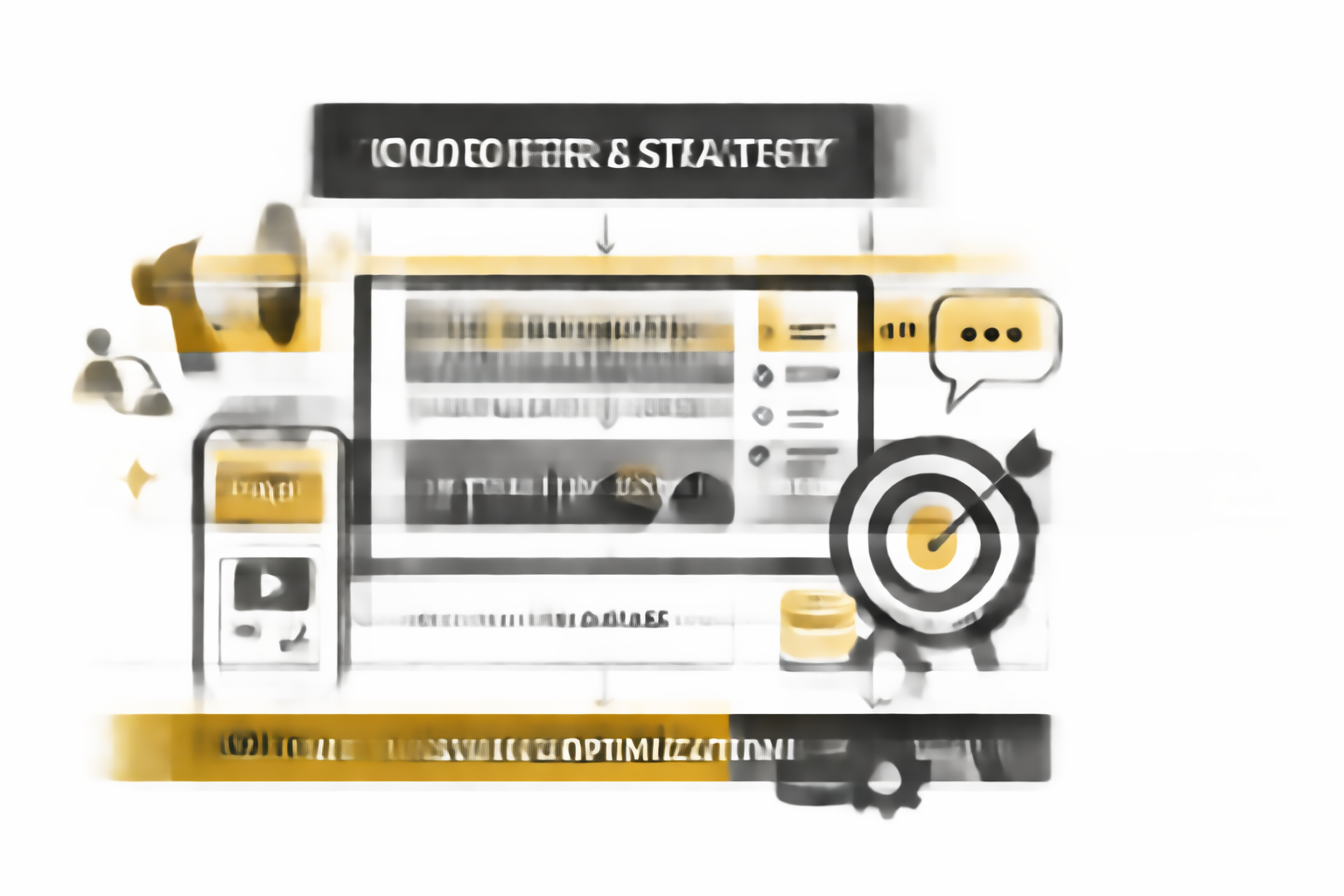
The right metrics depend on the business model, but a professional digital agency usually watches the same core chain. It starts with qualified traffic, moves into conversion rate, lead quality, cost per acquisition, pipeline contribution, close rate, and customer lifetime value. Looking at only one of these in isolation is how teams end up making decisions that look smart in one dashboard and expensive everywhere else.
This is why marketers keep focusing on commercial metrics instead of vanity numbers. HubSpot’s current marketing data highlights ROI, conversion rate, lead volume, lead quality, and customer acquisition cost as the metrics marketers care about most. That is the right instinct, because those numbers force a digital agency to prove it is improving the business, not just producing motion.
It also helps the client ask better questions. Instead of asking whether traffic went up, they can ask whether qualified demand improved, whether follow-up speed is hurting close rates, or whether a landing page is filtering the wrong prospects into the funnel. That is when reporting stops being a formality and starts becoming a decision-making tool.
Why AI Search Changes Reporting
One of the biggest changes in measurement right now is that discovery no longer happens only through traditional search results and ads. Buyers are using AI-assisted search experiences to compare options, summarize information, and narrow decisions before they ever land on a brand website. That means a digital agency now has to think about visibility across a broader discovery ecosystem, not just rankings and paid clicks.
McKinsey describes AI search as a new front door to the internet and notes that only 16% of brands systematically track AI search performance. That gap matters because if buyers are researching in new environments and the brand is not monitoring visibility there, reporting becomes incomplete before the campaign is even over. A digital agency that wants to stay sharp has to expand what it measures as buyer behavior expands too.
This does not mean traditional SEO becomes irrelevant. It means the agency has to connect content quality, structured information, brand mentions, reviews, and authority signals more deliberately. When reporting evolves with real user behavior, the business gets a much more honest view of where growth is coming from.
Using Data to Improve Execution
The best digital agency teams do not collect data just to make reports look impressive. They use it to improve execution week after week. If the data shows traffic is strong but leads are weak, the problem may be positioning or landing page clarity. If lead volume is healthy but deals are stalling, the issue may be offer quality, qualification, or the handoff between marketing and sales.
That is where operational tools become useful, not because software is magical, but because cleaner execution creates cleaner data. A team may use Brevo to tighten lifecycle email, Copper to keep opportunity tracking visible, or Cal.com to remove booking friction. The important part is that the data coming out of those systems helps the agency make faster and better decisions instead of guessing which part of the funnel is failing.
That same mindset applies to pages and funnels. If a campaign needs a cleaner path from click to conversion, some teams move faster by building focused flows in ClickFunnels or Systeme.io. The platform is not the strategy, but a digital agency that can connect tools, data, and commercial priorities will always move with more confidence than one that is still optimizing in the dark.
Data Without Context Is Dangerous
There is one more truth worth saying plainly: data can mislead just as easily as it can guide. A digital agency can celebrate cheaper clicks while attracting the wrong audience. It can brag about lower acquisition costs while average order value drops. It can show rising conversions while retention quietly gets worse in the background.
That is why context matters so much. Numbers only become useful when they are interpreted inside the real economics of the business, the quality of the offer, and the behavior of actual customers. When a digital agency remembers that, statistics stop being decoration in a report and start becoming the raw material for smarter growth.
FAQ for a Complete Digital Agency Guide
A lot of people understand the basic idea of a digital agency, but they still have practical questions once it is time to hire one, build one, or improve the results they are getting. That is normal. The real difference comes from understanding how a digital agency works in the real world, where budgets are limited, buyers are distracted, and every weak link in the funnel gets exposed fast.
The questions below cover the issues that come up most often. They are built to help you think more clearly about what a digital agency should actually do, what you should expect, and how to avoid wasting time on activity that looks impressive but does not move the business forward.
What does a digital agency actually do?
A digital agency helps businesses attract attention, turn that attention into leads or sales, and improve the systems that support growth. That can include strategy, website optimization, paid advertising, SEO, content, email, CRM setup, analytics, and conversion improvement. The important part is not the list of services by itself. The important part is whether the agency can connect those services to a real business goal and make them work together.
When should a business hire a digital agency?
A business should usually hire a digital agency when growth has become too important to leave to scattered freelancers, random experiments, or internal teams that are already overloaded. That moment often shows up when lead flow is inconsistent, paid campaigns are getting expensive, the website is underperforming, or nobody can clearly explain which channels are driving profitable results. A digital agency makes the most sense when the company needs both execution and a clearer commercial game plan.
Is a digital agency better than building an in-house team?
It depends on the stage of the business and the kind of growth problem you need to solve. An in-house team can be powerful when the company has enough budget, strong leadership, and enough marketing complexity to justify full-time specialists. A digital agency is often the better move when the business needs broader expertise faster, wants outside perspective, or cannot yet justify hiring multiple specialists across strategy, creative, media, automation, and analytics.
How do you know if a digital agency is good?
A good digital agency asks smart questions before it makes promises. It wants to understand your margins, sales process, positioning, offer strength, and current bottlenecks before talking about tactics. You can usually tell a strong agency by the way it thinks: it focuses on outcomes, explains tradeoffs clearly, and talks about conversion, lead quality, retention, and profitability instead of hiding behind vague language about reach and visibility.
What services should a digital agency offer first?
The first services should depend on the biggest bottleneck in the business, not on what is easiest to sell. If the offer is unclear, the agency should start with positioning and messaging. If traffic is already there but conversions are weak, website and funnel optimization should come first. If the business has a strong foundation but not enough demand, then a digital agency may move into SEO, paid traffic, content, or lifecycle email to bring more qualified people into the system.
How long does it take a digital agency to get results?
That depends on the channel mix and on what you mean by results. Paid media can produce signal quickly, but profitable scaling still takes testing, creative refinement, and conversion work. SEO and content usually take longer, especially because Google keeps emphasizing people-first, genuinely useful content over thin pages built only to manipulate rankings. A strong digital agency sets expectations based on the actual growth model rather than selling a fantasy timeline.
What metrics should a digital agency report on?
A digital agency should report on the numbers that reveal business health, not just campaign motion. That usually includes conversion rate, cost per acquisition, qualified lead volume, lead quality, pipeline contribution, close rate, customer value, and return on investment. That focus lines up with what current marketing data from HubSpot shows marketers care about most, because those metrics force the agency to stay accountable to commercial outcomes instead of vanity metrics.
Does a digital agency need to use AI?
A digital agency should understand AI, but it should not treat AI like a replacement for judgment. AI can speed up research support, production workflows, data organization, and parts of campaign ideation, but someone still has to make the strategic decisions. That matters even more now because buyers are increasingly using AI search as part of how they evaluate brands and options, so the agency has to adapt both operations and visibility strategy.
Why do some digital agencies fail to deliver?
Most of the time, a digital agency fails because it tries to do too much without enough strategy, enough focus, or enough accountability. Sometimes the problem is poor client fit. Sometimes the agency launches channels before fixing positioning or conversion issues. Sometimes reporting is weak, so the team keeps doing more work without learning what is actually helping. Failure usually comes from misalignment, not from a lack of activity.
Can a small business benefit from a digital agency?
Yes, but only if the work is matched to the economics of the business. A small business does not need a giant, bloated marketing stack just to look sophisticated. It needs a digital agency that can identify the few moves most likely to create traction, whether that is improving the offer, building a better landing page, tightening follow-up, or running a focused acquisition campaign with clear commercial intent.
What is the difference between a digital agency and a marketing consultant?
A consultant usually gives direction, diagnosis, and recommendations. A digital agency should go further by turning strategy into actual execution and ongoing optimization. In practice, the best agencies often combine both roles. They help the client think more clearly, then they build, launch, measure, and improve the system instead of leaving the client alone with a slide deck full of advice.
Should a digital agency build funnels or websites?
It should build whatever best supports the buying journey. Sometimes a full website is the right long-term asset because the brand needs authority, content depth, and multiple paths to conversion. Other times a focused funnel works better for a specific campaign, offer, or sales process, which is why some teams use tools like ClickFunnels or Systeme.io when they need a tighter path from click to conversion. A good digital agency chooses the structure based on the goal, not on personal preference.
How important is personalization for a digital agency?
It is extremely important because modern buyers expect relevant experiences, not generic messaging blasted at everyone the same way. That expectation is not imaginary either. Salesforce reports that 56% of customers expect all offers to be personalized and 85% expect consistent interactions across departments. A digital agency that cannot connect audience insight, messaging, automation, and follow-up will struggle to meet that standard.
What should happen after a lead converts?
This is where a lot of growth systems quietly fall apart. After a lead converts, the digital agency should make sure the follow-up process is fast, clear, and relevant, whether that means email nurturing, calendar booking, CRM routing, or sales handoff. Tools like Brevo, Cal.com, and Copper can help support that flow, but the real goal is to make sure interest does not die in the gap between first action and real conversation.
Work With Professionals
If you have made it this far, you already understand something most people miss. A digital agency is not just a vendor that posts content, launches ads, or sends a few reports at the end of the month. At its best, it becomes the system that helps a business clarify its message, tighten its funnel, improve its data, and turn demand into real revenue.
That is why working with professionals matters. The internet is crowded, paid attention is expensive, and customer expectations keep rising. Digital ad revenue keeps climbing, online commerce keeps taking a larger share of total retail activity, and the businesses that win are usually the ones with sharper systems, not just louder campaigns.
If you want stronger results, the move is not to keep piling random tactics on top of a weak foundation. The move is to work with people who understand how positioning, conversion, acquisition, automation, and measurement fit together. That is where a digital agency proves its worth, and that is where growth starts to become more predictable instead of more chaotic.
Explore 10K+ Remote Marketing Contracts on MarkeWork.com
Most marketers spend too much time chasing clients, competing on crowded platforms, and losing a percentage of every project to middlemen.
MarkeWork gives you a better way. Browse thousands of remote marketing contracts and connect directly with companies desperate to hire skilled marketers like you without platform commissions and without unnecessary gatekeepers.
If you’re serious about finding better opportunities and keeping 100% of what you earn, you can explore available contracts and create your profile for free at MarkeWork.com.
 Filip Konecny Enterprises