

Affiliate Marketing: A Practical Framework For Growth
Affiliate marketing keeps winning for one simple reason: it aligns cost with performance in a way many channels still struggle to match. Instead of paying first and hoping results show up later, brands can structure deals around clicks, leads, or sales, which is exactly why the channel has stayed relevant while the rest of digital marketing keeps changing.
That relevance is not theoretical. The 2025 PMA Performance Marketing Industry Study says affiliate marketing spending in the United States climbed to $13.62 billion in 2024 and generated $113 billion in e-commerce sales, accounting for 9.4% of all U.S. e-commerce sales. At the same time, IAB and PwC reported that overall internet advertising revenue reached $258.6 billion in 2024, up 14.9% year over year, which tells you something important: marketers are spending more, but they are also under more pressure to prove what each dollar actually did.
That is where affiliate marketing becomes powerful. It can help brands scale with creators, publishers, email partners, review sites, communities, and niche experts without betting the entire budget on guesswork. In this first part, we are going to build the foundation so you can understand why the model matters, how the framework fits together, what the moving pieces are, and how professionals put the whole thing into motion.
Article Outline
- Part 1: Why Affiliate Marketing Matters
- Part 2: Framework Overview
- Part 3: Core Components
- Part 4: Professional Implementation
- Part 5: Analytics And Optimization
- Part 6: Affiliate Marketing FAQ And Next Steps
Why Affiliate Marketing Matters

Affiliate marketing matters because it gives both sides of the relationship a clear reason to care about the outcome. The brand wants profitable growth, and the affiliate wants to earn more by sending qualified traffic that actually converts. When those incentives are structured well, the channel becomes less about buying attention and more about building a network of people and platforms that already influence purchase decisions.
The scale of that opportunity is hard to ignore. The PMA study found that affiliate investment in 2024 helped drive $113 billion in U.S. e-commerce sales, while the same report estimated that companies using affiliate strategies can attribute roughly 15% to 20% of sales to the channel. That is a serious commercial footprint, not a side tactic buried in the marketing plan.
It also matters because the customer journey is getting messier. The 2025 research from Partnerize found that publishers can influence conversions at an average rate 2.06 times higher than traditional last-click attribution captures, while impact.com’s 2025 affiliate marketing report says 94% of brands are experimenting with or planning to adopt alternative attribution models. In plain English, affiliate marketing is no longer just a bottom-of-funnel coupon play. It is increasingly a full-journey channel that touches discovery, evaluation, trust, and conversion.
Performance Pressure Is Rising
Modern marketers are under pressure from two directions at once. Budgets still need to grow revenue, but leadership teams want cleaner evidence before approving that next increase. When digital ad revenue is growing at nearly 15% annually, competition gets fiercer, and channels that cannot defend their economics start to look expensive very quickly.
Affiliate marketing fits this environment because it is built around measurable outcomes. That does not mean it is effortless or risk-free, but it does mean the economics are easier to explain in a boardroom than a vague brand campaign that cannot connect attention to action. If you are trying to grow while protecting margin, that matters a lot.
There is also a practical advantage here. Instead of relying on one media platform or one ad account, a good affiliate program creates distribution through many partners at once. That diversification helps a business avoid becoming dangerously dependent on any single source of traffic.
Trust Has Become The Real Asset
People do not buy just because a link exists. They buy because the person or platform sharing that link has already done the hard work of earning attention and trust. That is why affiliate marketing performs best when it is built around relevance, authority, and honest recommendations rather than spammy tactics that worked fifteen years ago.
This is also why creator partnerships are moving closer to the center of affiliate strategy. impact.com reported that 59% of brands plan to allocate at least 25% of their affiliate budgets to creator partnerships, and Rakuten Advertising’s 2025 product launch focused heavily on transparency, brand safety, and tools that bring creator commerce and affiliate marketing closer together. That is a sign of where the channel is heading: less anonymous link dumping, more relationship-based commerce.
When you understand that shift, affiliate marketing stops looking like a trick and starts looking like what it really is: a scalable trust-and-distribution system tied to measurable outcomes.
Framework Overview
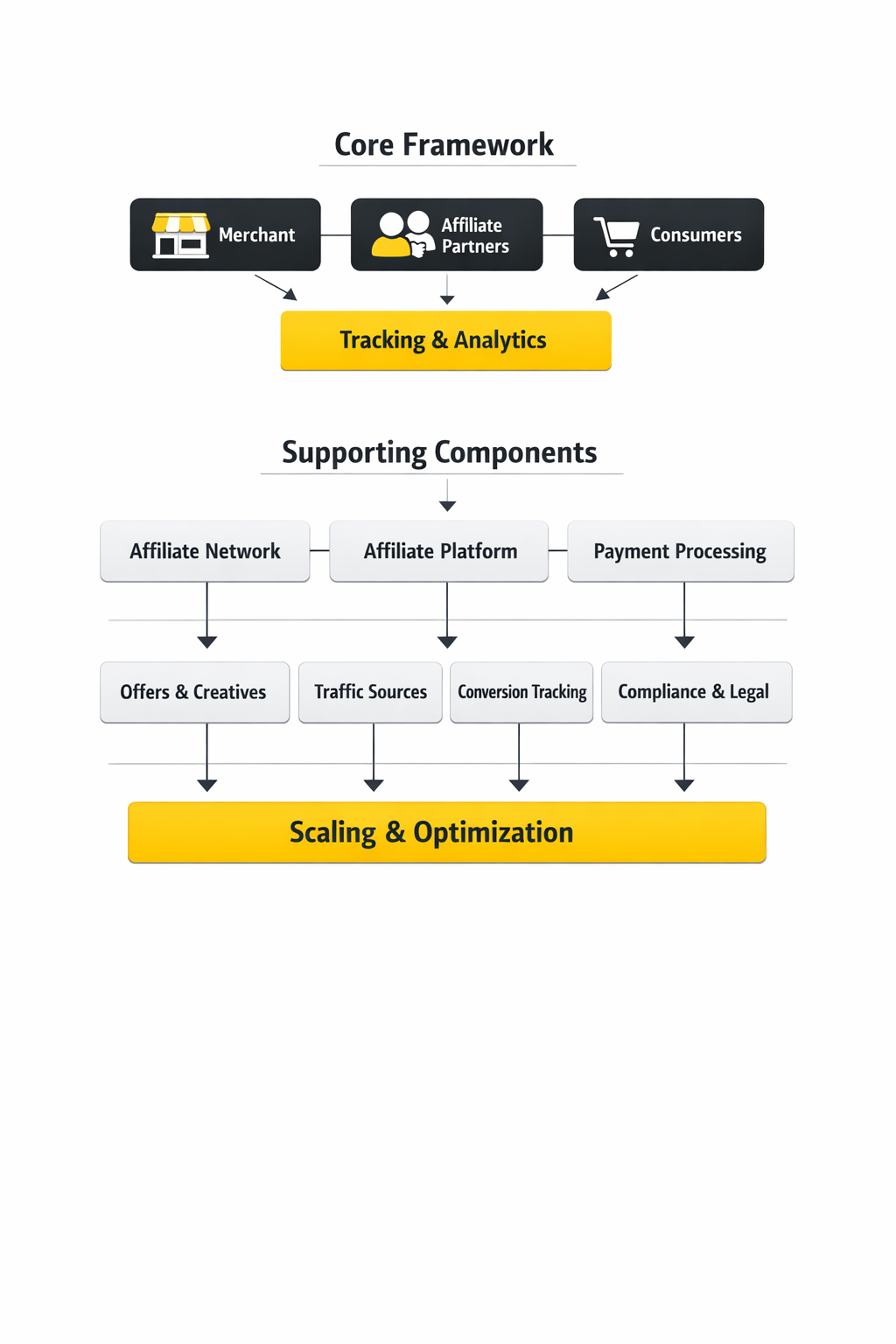
The easiest way to understand affiliate marketing is to see it as a four-part system. First, a business needs an offer worth promoting. Second, it needs partners who can reach the right audience. Third, it needs tracking and attribution that record what really happened. Fourth, it needs payouts and relationship management that keep high-quality partners engaged for the long term.
That sounds simple, but most affiliate programs fail because one of those layers is weak. Sometimes the product is fine but the commission makes no sense. Sometimes the commission is attractive but the creative assets are poor. Sometimes the program recruits affiliates aggressively but measures them badly, which creates mistrust and causes good partners to leave.
The professional view is different. Strong affiliate marketing is not just a link plus a dashboard. It is a structured system where economics, positioning, tracking, content, and compliance all work together.
The Four-Part System
The first part is the offer itself. If the landing page is weak, the pricing is confusing, or the product does not solve a real problem, no amount of affiliate recruitment will save the program. Affiliates can send attention, but they cannot manufacture product-market fit.
The second part is partner fit. The best affiliate relationships happen when the audience already trusts the publisher, creator, or media property that is doing the recommending. That is why a niche reviewer, educator, newsletter operator, or community builder can outperform a much larger partner with a generic audience.
The third and fourth parts are measurement and incentives. impact.com’s research shows that brands are actively moving beyond last-click models, while Partnerize’s research shows just how much influence traditional attribution can miss. If you measure poorly, you reward poorly, and if you reward poorly, your best partners eventually take their energy somewhere else.
What The Framework Is Really Doing
At a deeper level, this framework is doing three jobs at once. It is creating reach through outside partners, creating trust through third-party recommendation, and creating accountability through performance-based economics. That combination is what makes affiliate marketing so attractive when it is managed well.
It also explains why the channel is evolving so quickly. The rise of creators, AI-assisted shopping, editorial commerce, and more fragmented customer journeys means the old model of rewarding only the final click is not enough anymore. Brands that understand the full framework are in a better position to recruit the right partners, set fair terms, and protect the channel from becoming a race to the bottom.
So before you obsess over networks, software, or outreach templates, lock in the framework. Once the structure is right, execution gets dramatically easier.
Core Components
Every affiliate program, whether it is tiny or enterprise-level, rests on a handful of core components. You need the offer, the partner mix, the commission model, the tracking layer, the content assets, and the compliance rules. Miss one of those, and the system becomes unstable fast.
The offer is the starting point because it determines conversion potential. The partner mix matters because different affiliates influence different parts of the buying journey. Review sites, creators, loyalty partners, comparison publishers, newsletter operators, educators, and communities all play different roles, and impact.com’s 2025 report highlights that leading brands usually build ecosystems with three to four different partner types rather than leaning too hard on just one.
The rest of the components exist to make sure good influence gets tracked, rewarded, and repeated. When those pieces line up, affiliate marketing becomes a sustainable growth channel instead of a messy collection of disconnected links.
Offer, Commission, And Partner Fit
Your offer has to be easy to explain and easy to believe. Affiliates do better when they can quickly understand what the product is, who it helps, why it is different, and what action the audience should take next. That sounds basic, but unclear positioning quietly kills a huge number of programs before they ever get traction.
Commission design is just as important. A weak commission turns great partners away, but an overly generous commission can wreck unit economics if the program attracts low-quality traffic or demand that would have converted anyway. The goal is not to offer the biggest payout in the market. The goal is to offer a payout that is attractive, defensible, and aligned with the true value of the partner’s contribution.
Then comes partner fit. A software product, for example, may perform best with educators, niche YouTube channels, consultants, and newsletter operators, while an e-commerce brand might get stronger results from creators, editorial commerce sites, and loyalty partners. Picking the right partner types early saves you from months of activity that looks busy but does not move revenue.
Tracking, Assets, And Rules
Tracking is the invisible machinery that determines whether a program feels fair. If the attribution model is too narrow, affiliates feel underpaid. If tracking breaks, trust disappears even faster. That is one reason Rakuten Advertising’s 2025 updates emphasized transparency APIs, fraud detection, anomaly monitoring, and creator-friendly visibility into conversion journeys.
Creative assets matter more than many brands expect. Affiliates need product feeds, landing pages, messaging angles, talking points, email swipes, banners when relevant, and often simple explanations of which audience pain points convert best. The easier you make it for partners to communicate the value clearly, the more likely they are to promote consistently.
Finally, there are the rules. The FTC’s endorsement guidance makes it clear that people who are paid or otherwise compensated to recommend products need to disclose that relationship, and the ASA’s affiliate marketing guidance says both the business and the affiliate marketer can be responsible for compliance. In other words, professionalism in affiliate marketing is not optional. It is part of the operating model.
Professional Implementation
Professional implementation starts with discipline, not hype. Before you recruit a single affiliate, you need to know what action you want to reward, what margin you can afford to share, which partner types fit the product, how tracking will work, and what disclosures or promotional restrictions apply. That preparation may not feel exciting, but it is what separates a real growth engine from a chaotic side project.
It also helps to think in stages. First, build the offer and landing experience. Then configure tracking, commission rules, terms, and partner assets. Only after that should you begin outreach and recruitment, because bringing partners into a half-built system is one of the fastest ways to burn goodwill before the program has a chance to mature.
The good news is that implementation is easier now than it used to be. A business can stand up landing pages with ClickFunnels or an all-in-one system like Systeme.io, connect email follow-up through Brevo, and manage social distribution with tools like Buffer. The tools help, but the real edge still comes from having a sharp offer, clean economics, and partner relationships built on trust.
Implementation Checklist For Serious Operators
Start by clarifying the commercial model. Decide whether the program pays on leads, sales, trials, booked calls, subscriptions, or some other verified action. Then model the maximum payout you can sustain without damaging profitability, including refunds, churn, repeat purchase behavior, and any incrementality concerns.
Next, build the partner experience. Create a landing page that converts, write a clear program overview, prepare approved messaging, explain the commission terms in plain language, and make it obvious how partners can contact you when they need support. Good affiliates notice immediately when a brand respects their time.
Then lock in governance. The Google Search spam policies make it clear that affiliate links themselves are not the problem when they are treated appropriately, but low-value publishing and search manipulation absolutely are. Pair that with the FTC disclosure expectations and the ASA’s guidance on affiliate ads, and the message is obvious: serious affiliate marketing is performance marketing with operational standards, not a shortcut around them.
Where This Goes Next
Once the program is live, the next challenge is not launching more links. It is learning which partners influence discovery, which ones close demand, which commission structures create healthy growth, and which metrics are lying to you. That is why the next parts of this article will move deeper into analytics, optimization, and the evolving ecosystem around creators, attribution, and AI-assisted shopping.
For now, the big takeaway is simple. Affiliate marketing works best when you stop treating it like a hack and start treating it like a professional channel with strategy, systems, and standards. Do that, and you give yourself a much better chance of building something that grows without becoming fragile.
Continue reading in Part 2 with Framework Overview and keep these anchors in place so the full six-part article connects cleanly inside WordPress.com.
Affiliate Marketing Framework Overview
If you want affiliate marketing to work, you need a framework before you need more affiliates. That is the part too many businesses skip, and it is exactly why they end up with a program that looks active on the surface but never becomes a serious revenue channel. The framework gives you the logic behind the channel, so every decision you make after that has a reason instead of being a random guess.
The easiest way to think about it is this: affiliate marketing is not just about getting links out into the world. It is about building a system where the right partners promote the right offer to the right audience, while your tracking, payouts, and compliance rules make the relationship sustainable. When that system is tight, the channel can scale without turning into a mess.
The growth of the industry makes that structure even more important. The 2025 PMA industry study shows U.S. affiliate marketing spend reached $13.62 billion in 2024 and helped generate $113 billion in e-commerce sales, while impact.com’s 2025 research shows brands are moving more budget into partnerships because they want channels that can prove performance without relying on increasingly expensive acquisition tactics elsewhere.
The Six-Part Map Behind The Full Article
This article is built in six parts because that mirrors how affiliate marketing actually works in the real world. You start by understanding why the channel matters, then you move into the framework itself, then the core components, then implementation, then analytics, and finally the practical questions that come up once you are serious about growth. That order matters because strong execution only happens after the underlying structure is clear.
Part 1 established the business case. This part is about seeing how all the pieces connect so you do not mistake individual tactics for the strategy itself. In the next parts, we will go deeper into the components, the execution layer, and the metrics that tell you whether the program is actually healthy or just busy.
If you ever lose the thread while building your own program, go back to the article outline and follow the same path again: Why Affiliate Marketing Matters, Framework Overview, Core Components, Professional Implementation, Analytics And Optimization, and Affiliate Marketing FAQ And Next Steps.
The Four Layers Of The Framework
At its core, affiliate marketing works through four connected layers. The first is the offer, because no affiliate can rescue a product that is weak, unclear, overpriced, or badly positioned. The second is distribution, meaning the publishers, creators, educators, comparison sites, newsletters, loyalty platforms, and niche communities that actually put the offer in front of people who might care.
The third layer is attribution and tracking. That is where many businesses get a rude awakening, because the customer journey is now too fragmented to judge everything by the final click alone. Partnerize’s 2025 Clickless Affiliation research found publishers influence conversions at an average rate 2.06 times higher than traditional attribution captures, which means plenty of value can disappear if the framework only rewards whoever happened to show up at the end.
The fourth layer is incentives and governance. That includes commissions, approval rules, disclosure standards, traffic policies, communication, and the practical details that make good affiliates want to stay in the program. Without that final layer, even a promising program starts leaking trust.
Why Framework Comes Before Recruitment
A lot of people get excited about affiliate marketing and jump straight into recruitment. They start inviting creators, bloggers, and publishers before they have fully worked out the terms, the assets, the tracking logic, or even the real economics of the offer. That usually backfires, because the first impression a serious partner gets from your program tends to stick.
Good affiliates do not just look at commission rates. They look at whether the landing page converts, whether the brand explains its value clearly, whether tracking feels reliable, whether communication is responsive, and whether the program seems stable enough to justify their time. That is why framework work is not boring admin; it is the difference between attracting professionals and attracting noise.
This is also where technology can either support the strategy or distract from it. A business can build funnel pages with ClickFunnels, use Systeme.io for an all-in-one setup, or handle follow-up with Brevo. Those tools can absolutely help, but the framework still has to come first or the tools just make a weak system run faster.
Different Partner Types Fit Different Moments
One of the biggest mistakes in affiliate marketing is assuming every partner plays the same role. They do not. A creator on YouTube may help people discover a product and trust it for the first time, while a review site may help them compare options, and a loyalty or coupon partner may close demand that is already near the finish line.
That matters because your framework should be built around influence across the journey, not just whichever partner can grab the last tracked interaction. Rakuten Advertising’s 2025 product updates focused on transparency, brand safety, and tools that bridge creator and affiliate marketing, which tells you exactly where the market is moving. The channel is becoming broader, more professional, and more dependent on knowing what kind of partner is creating what kind of value.
The 2025 impact.com report also shows how quickly creator partnerships are moving toward the center of affiliate strategy, with 59% of brands planning to allocate at least 25% of affiliate budgets to creators. That does not mean every brand should chase creators first. It means the framework needs enough flexibility to support multiple partner types without forcing them all into the same box.

Measurement Changes The Way You Build
Once you understand that not every partner contributes in the same way, the framework starts to get sharper. You stop obsessing over vanity numbers and start asking better questions. Which partners create first-touch awareness, which ones move high-intent buyers closer to a decision, and which ones are simply collecting credit for demand that was already going to convert anyway?
That shift in thinking is why attribution has become such a big conversation in affiliate marketing. impact.com found that 94% of brands are experimenting with or planning to adopt alternative attribution models, which makes perfect sense in a world where discovery often begins across search, social, editorial content, AI-generated recommendations, and creator media rather than inside one neat click path.
If your framework cannot see the journey clearly, it cannot reward partners fairly. And when partners are not rewarded fairly, the best ones eventually take their effort somewhere else. That is why measurement is not a reporting detail buried at the end of the process. It is one of the central pillars of the framework itself.
Compliance Is Part Of The Framework
There is another reason a real framework matters: compliance. A lot of people still talk about affiliate marketing as if it lives in a gray area where everybody can push aggressive tactics and clean things up later. That is a fast way to damage trust with customers, partners, and platforms all at once.
The FTC’s endorsement guidance makes it clear that material connections need to be disclosed, and the ASA’s affiliate marketing guidance makes it clear that affiliate content can fall under advertising rules when brands have editorial control or when the commercial nature needs to be obvious to users. On top of that, Google’s search spam policies are very clear that low-value, manipulative, or reputation-abusing publishing can trigger penalties, which matters a lot for anyone planning to build affiliate content for organic traffic.
So the framework is not just about growth. It is about building a channel that can keep growing without collapsing under bad incentives, weak disclosures, sloppy tracking, or low-quality publishing. That is what professional affiliate marketing actually looks like.
What To Carry Into Part 3
If there is one thing to remember from this part, it is this: affiliate marketing works best when you treat it like a system, not a shortcut. The offer, the partner mix, the tracking logic, the commission structure, and the compliance standards all depend on each other. When one part is weak, the whole channel gets harder to scale.
That is why the next step is not more theory for the sake of theory. It is getting specific about the pieces that make the framework function in practice. In Core Components, we will break down the exact building blocks that separate a fragile affiliate program from one that has a real shot at becoming a major growth engine.
Core Components Of Affiliate Marketing
If you want affiliate marketing to become a real growth channel, you need to get the core components right. This is where the channel either starts to compound or quietly falls apart behind the scenes. A lot of businesses think they have an affiliate strategy when they really just have a sign-up page, a commission number, and some hope.
The truth is that strong affiliate marketing rests on a handful of connected pieces that all support each other. The offer has to be worth promoting. The economics have to make sense. The partner mix has to match the way people actually buy. The tracking has to feel fair. And the content, communication, and compliance standards have to be solid enough that serious partners want to stay.
The channel is large enough now that getting these basics wrong is expensive. The 2025 PMA Performance Marketing Industry Study shows affiliate marketing spend in the United States reached $13.62 billion in 2024 and helped drive $113 billion in e-commerce sales, which means affiliate marketing is not some side tactic anymore. When this much money is flowing through the channel, the businesses that win are usually the ones that treat the fundamentals like a system instead of an afterthought.
The Offer Comes First
No affiliate can save a weak offer. If the product is confusing, the landing page is sloppy, the pricing feels off, or the transformation is hard to explain, even a talented partner is going to struggle to turn attention into revenue. That is why the first core component of affiliate marketing is not the affiliate at all. It is the offer itself.
A good offer gives affiliates something clear to talk about. It tells them what problem the product solves, who it is really for, why it is different, and what action should happen next. That clarity matters because partners are not just sending traffic. They are translating your value to an audience that may have never heard of you before.
This is also where practical tools can help if your funnel is weak. Businesses often use ClickFunnels or Systeme.io to tighten the path from click to conversion, but the important point is not the software itself. The important point is that affiliate marketing performs better when the partner can send people into a clean, believable, high-conviction offer instead of a page that leaves them confused.
Economics Make Or Break The Channel
The second core component is economics. You need a commission structure that is attractive enough to recruit quality partners but disciplined enough to protect your margins. Go too low, and the best affiliates ignore you. Go too high, and you can create a program that looks exciting right up until finance realizes it is cannibalizing profit.
This is why mature affiliate programs think beyond one flat payout. Different partner types contribute in different ways, and that should influence how you structure incentives. Content creators, review publishers, loyalty partners, comparison sites, and B2B referral partners do not all create value in the same part of the journey, so treating them like identical traffic sources usually leads to distorted results.
The push toward better economics is happening across the industry. CJ’s 2025 trends report highlights that 57% of brands planned to increase affiliate spend in 2025 while 85% of publishers said stronger commissions were essential to continued success, which tells you exactly where the tension lives. Brands want growth, publishers want fair reward, and the programs that last are the ones that can balance both without losing discipline.
Partner Fit Shapes The Results
Affiliate marketing gets a lot easier when you stop treating all affiliates as if they do the same job. They do not. Some are built for discovery. Some are built for comparison. Some are built for conversion at the last moment. Some are built around trust with a tight niche audience that buys because the recommendation feels personal and informed.
This matters because the wrong partner mix can make a perfectly good program look broken. If you recruit mostly bottom-of-funnel partners, you may see conversions without building much real demand. If you recruit mostly awareness partners without enough measurement discipline, you may think the program is underperforming when it is actually influencing buyers earlier in the journey.
The market is adjusting to that reality in a big way. impact.com’s 2025 affiliate marketing research shows 59% of brands plan to allocate at least 25% of affiliate budgets to creator partnerships, and Adobe’s Cyber Monday 2024 recap found affiliates and partners, including influencers, drove 20.3% of revenue on Cyber Monday, while influencer-driven traffic converted six times more than social media overall. That is a huge signal that partner type is not a minor detail. It is one of the biggest levers in the entire channel.
Tracking And Attribution Create Trust
The fourth core component is tracking. This is the invisible layer that determines whether affiliates believe your program is fair. If clicks are not recorded correctly, if conversions disappear, or if attribution only rewards whoever happened to grab the final interaction, good partners start to lose trust very quickly.
That problem has become bigger as the customer journey has become more fragmented. A buyer may discover a product through a creator, compare it through a review article, revisit through email, and then convert after a branded search. If your setup only recognizes the very last step, you end up underpaying influence that mattered and overpaying the touchpoint that happened to arrive at the end.
The industry knows this is a real problem. Partnerize’s 2025 Clickless Affiliation research found publishers influence conversions at an average rate 2.06 times higher than traditional attribution captures, while impact.com’s 2025 study shows 94% of brands are experimenting with or planning to adopt alternative attribution models. That is not a niche debate. It is a direct response to the fact that old measurement models are missing real value.
How The Pieces Come Together In Practice
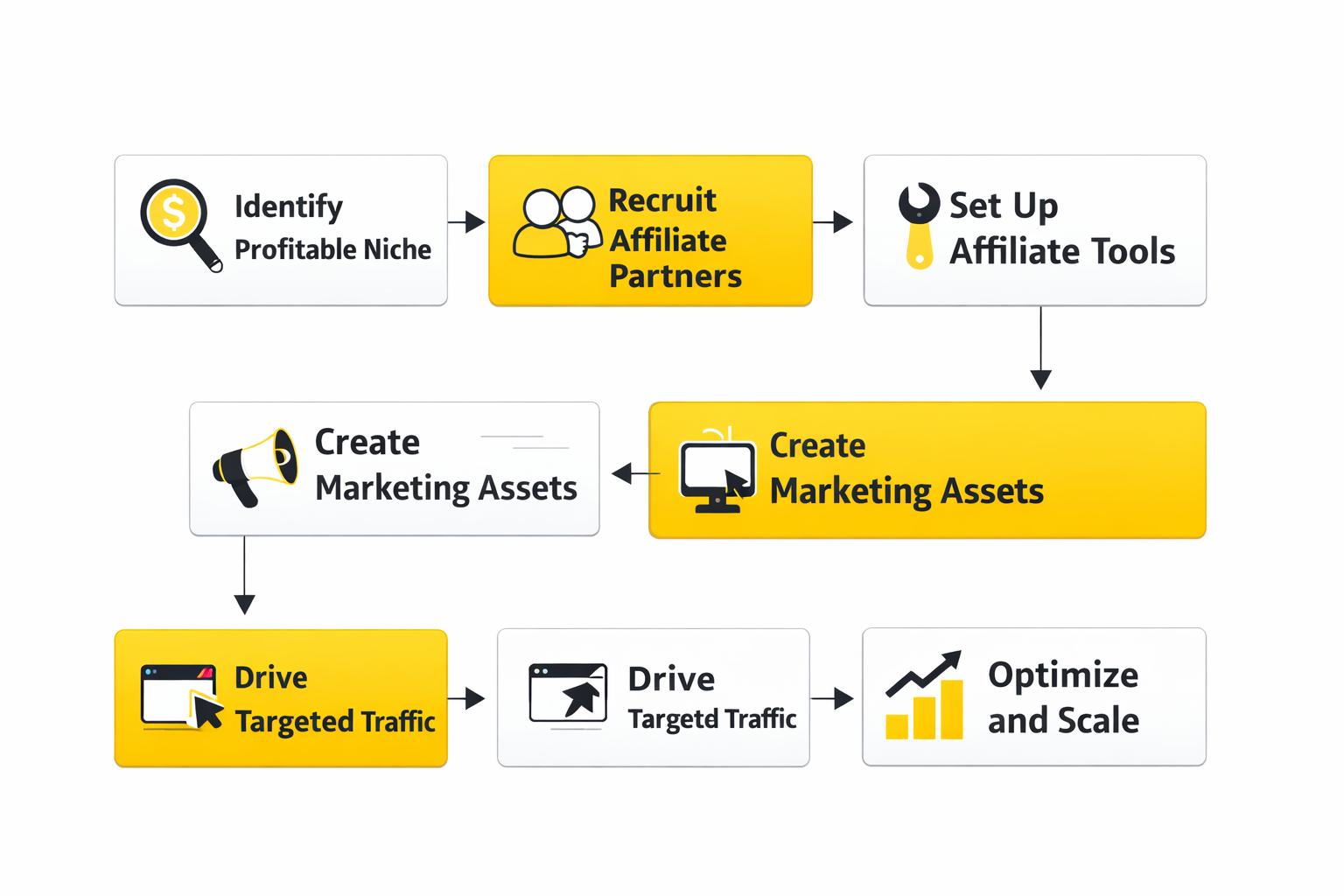
Once you see the structure clearly, affiliate marketing starts to make a lot more sense. The offer creates the promise. The economics create motivation. The partner mix creates reach and trust. The tracking layer decides how that influence gets recognized. Then everything after that is about making the system easier to use and harder to break.
That is why weak programs often feel confusing to everyone involved. The affiliates are unsure what to promote, the brand is unsure which partners matter, and the reporting does not explain why performance moves the way it does. Strong programs feel almost boring by comparison because the building blocks are clear, the relationships are well-managed, and the measurement tells a believable story.
If you are serious about scaling, this is also where operational tools start to become useful rather than distracting. A business may use Brevo to support follow-up sequences, Buffer to coordinate promotional distribution, or Dub to manage and organize links more cleanly. None of those tools replaces strategy, but they can strengthen the implementation once the fundamentals are already in place.
Creative Assets Help Partners Sell
The fifth core component is creative support. Great affiliates do not just need a tracking link. They need the raw material that helps them communicate the offer in a way that feels natural to their platform and audience. That can include landing pages, product feeds, offer angles, approved claims, images, email copy, talking points, demos, testimonials, and guidance on who converts best.
This is where many brands accidentally make affiliate marketing harder than it needs to be. They approve partners into the program and then leave them to figure everything out alone. That can work if the partner already knows the product deeply, but most of the time it slows down promotion and weakens the quality of the message.
Good creative support also protects consistency. When affiliates understand the strongest pain points, the best use cases, and the claims they should avoid, the whole channel becomes more persuasive and safer at the same time. That matters more now because the bar for truthful promotion is rising, and anything sloppy can create both legal risk and performance problems.
Compliance And Brand Safety Are Core Components Too
A lot of people treat compliance like it belongs in the fine print, but in affiliate marketing it is one of the core components. If the partner does not disclose material relationships, if the content makes unsupported claims, or if low-value pages are built just to rank and siphon traffic, the program may grow for a while and then run straight into a wall.
The standards are not vague here. The FTC’s endorsement guidance says endorsements have to be honest, not misleading, and clear about material connections that could affect how consumers evaluate the recommendation. On the search side, Google’s spam policies make it clear that manipulative, low-value, or reputation-abusing content can be demoted or removed from visibility.
That is one reason the infrastructure side of the industry is evolving. Rakuten Advertising’s 2025 product launch focused on transparency, compliance, brand safety, and better visibility into the conversion journey, which shows where the market is going. Serious affiliate marketing is becoming more transparent, more measurable, and less tolerant of shortcuts that create hidden risk.
Relationships Keep The Best Affiliates Active
The last core component is relationship management. This part gets overlooked because it is not as flashy as recruitment or reporting, but it is often the difference between a program that attracts one-off promotion and one that earns consistent support from its best partners. Good affiliates want to know that someone is paying attention, responding quickly, and making the program easier to win with.
That means communication matters. So does commission clarity. So does speed when tracking breaks, when a promo code fails, or when a landing page suddenly stops converting. If your best partners have to chase answers every time something goes wrong, they will eventually put their attention somewhere else.
This is also why the strongest programs do not think about affiliates as disposable traffic sources. They think about them as distribution partners who are helping shape demand in public. That mindset changes how you recruit, how you support, and how you scale the channel over time.
What These Core Components Really Tell You
When you zoom out, the message is simple. Affiliate marketing is not one thing. It is a stack of interconnected components that either reinforce each other or weaken each other. A strong offer with bad tracking will struggle. Great tracking with weak economics will struggle. Good economics with poor partner fit will struggle too.
That is why the best operators obsess over the whole system. They know that small weaknesses in the foundation become expensive once the program grows. They also know that when the components are aligned, affiliate marketing can become one of the cleanest and most scalable ways to grow revenue without betting everything on one platform.
In the next part, we will move from the building blocks into execution. That is where Professional Implementation comes in, and that is where the channel either starts looking like a real business asset or stays stuck as an idea that never quite gets off the ground.
Statistics And Data
If you want to understand where affiliate marketing is going, you have to look at the numbers the right way. Not as random stats thrown on a page to sound impressive, but as signals that tell you how the channel is changing, where the money is moving, and what kind of operators are likely to win over the next few years. That is the real value of statistics and data in affiliate marketing: they help you separate hype from direction.
The first signal is scale. The 2025 PMA Performance Marketing Industry Study shows U.S. affiliate marketing spend reached $13.62 billion in 2024 and helped generate $113 billion in e-commerce sales. That matters because it confirms affiliate marketing is no longer some overlooked side channel sitting in the corner of a broader digital strategy. It is large, commercially meaningful, and growing fast enough that the businesses treating it casually are likely to get outpaced by the ones building actual systems around it.
The second signal is growth quality. The same PMA study shows affiliate marketing spend rose 49.8% from 2021 to 2024, with a 14.42% compound annual growth rate, which is roughly double the pace of the broader e-commerce market over the same period. That tells you something important: this is not just a channel growing because everything online is growing. It is gaining ground because brands are actively leaning into it.
Affiliate Marketing Analytics And Optimization
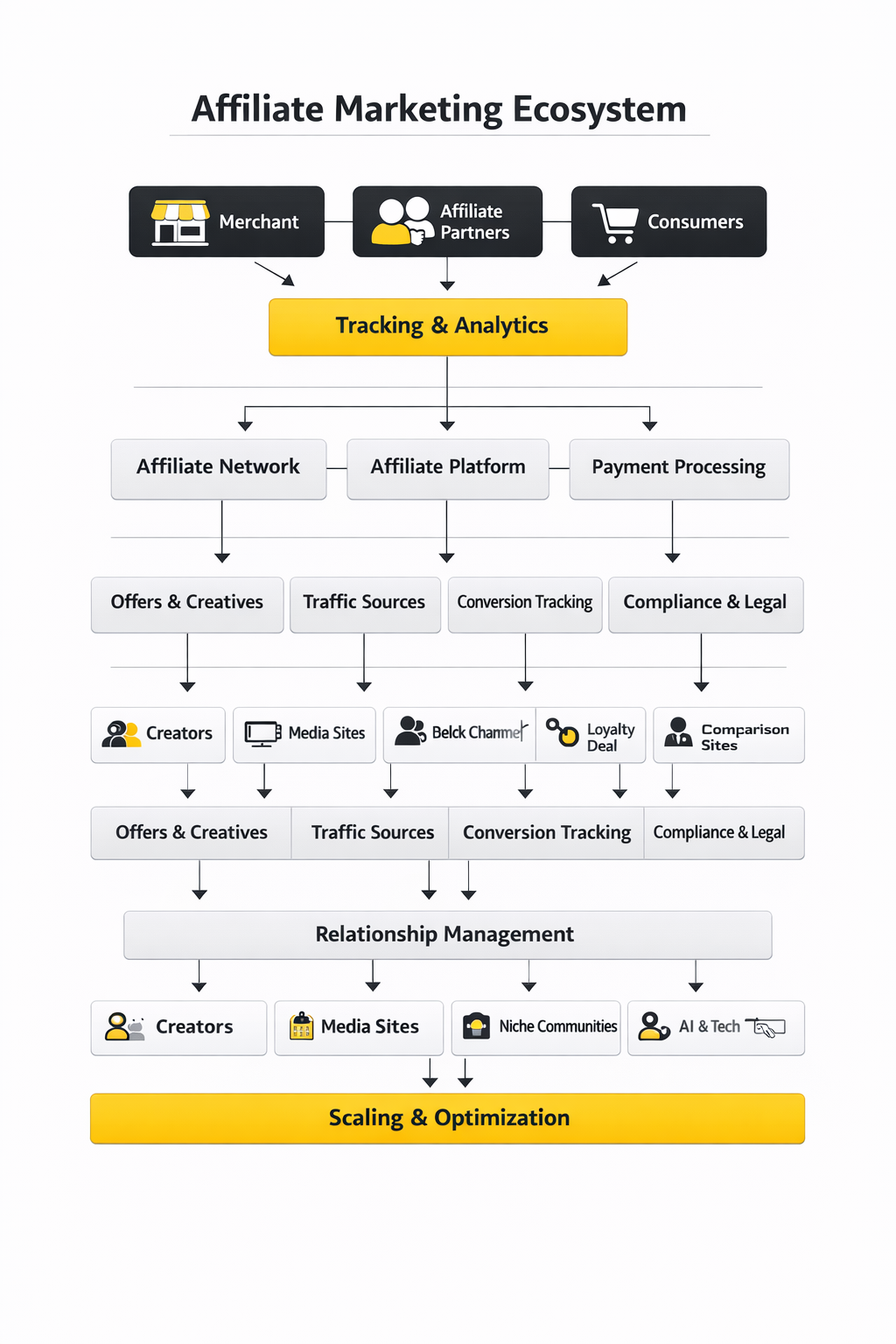
Once a program is live, affiliate marketing turns into a measurement game very quickly. You stop asking whether the channel can work and start asking which partners are actually moving revenue, which placements are creating real influence, and which payouts still make sense once you account for margin, refunds, and assisted conversions. This is where analytics becomes the difference between a channel that scales intelligently and one that grows in a way that looks good on paper but gets weaker underneath.
That is also why optimization in affiliate marketing is rarely about one magic metric. You need to understand the relationship between click volume, conversion rate, average order value, customer quality, new-versus-returning customer mix, and the role each partner type plays in the buying journey. If you only look at the last conversion event, you can easily reward the wrong behavior and miss the partners who are doing the heavier lifting earlier in the funnel.
This challenge is getting harder, not easier. Partnerize’s 2025 Clickless Affiliation research found that publishers influence conversions at an average rate 2.06 times higher than traditional attribution captures. In other words, a lot of the value in affiliate marketing does not disappear because it was not real. It disappears because old measurement models were never designed to see the full journey clearly.
What The Biggest Numbers Are Really Saying
One of the most useful things data can do is show you where brand behavior is changing. impact.com’s 2025 State of Affiliate Marketing report found that 74% of brands are increasing affiliate budgets because acquisition costs are rising in other channels. That is not just a vote of confidence in affiliate marketing. It is also a sign that performance pressure is forcing brands to favor channels that can defend their economics more clearly.
That same impact.com report found 59% of brands plan to allocate at least 25% of their affiliate budgets to creator partnerships. That shift matters because it shows the channel is moving beyond the old stereotype of coupon sites and cashback traffic. Creator-led commerce is becoming one of the biggest growth layers inside affiliate marketing, which changes how brands think about recruitment, attribution, content support, and long-term partner value.
So when you see those numbers, do not just read them as market trivia. Read them as a strategy memo. Brands are increasing spend, creator partnerships are taking a larger share of that spend, and affiliate marketing is becoming more central because it can connect reach, trust, and accountability in a way many other channels cannot.
Why Last-Click Data Is Not Enough
This is where a lot of affiliate programs get into trouble. They look at a dashboard, sort by last-click conversions, and assume they now understand who the top partners are. That is tempting because it is simple, but simplicity is not the same thing as truth.
The customer journey has become too fragmented for that. A shopper may first hear about a product from a creator, spend a few days researching it through editorial content, come back through a newsletter mention, and only convert after one final interaction that gets 100% of the tracked credit. That does not mean the final touchpoint created all the value. It just means the reporting system was designed to see the end more clearly than the journey.
The pressure to fix that is already visible in the market. impact.com reports that 94% of brands are experimenting with or planning to adopt alternative attribution models, which tells you that serious operators are not satisfied with narrow reporting anymore. They want analytics that reflect influence, not just whichever click happened to arrive last.
Cyber Monday Showed Where Influence Is Going
One of the clearest recent examples of affiliate marketing’s growing commercial weight came during the 2024 holiday season. Adobe’s Cyber Monday 2024 recap found that affiliates and partners, including influencers, accounted for 20.3% of revenue on Cyber Monday, up 6.8% year over year. That is not a niche contribution buried in the margins. That is a meaningful share of one of the biggest online shopping days of the year.
What makes that number even more interesting is the conversion quality behind it. The same Adobe data found influencer-driven traffic converted six times more than social media overall. That tells you the value is not just in sending people to a site. It is in trusted recommendation attached to buying intent, which is exactly why affiliate marketing keeps becoming more important as attention gets harder to win.
That kind of data should change the way you think about optimization. Instead of treating creators, editorial publishers, and traditional affiliates as interchangeable sources of clicks, you start asking which partner types drive higher-intent traffic, stronger conversion behavior, and better customer quality. That is where smarter growth begins.
The Metrics That Actually Deserve Your Attention
There are plenty of numbers you can track in affiliate marketing, but not all of them deserve the same weight. Clicks matter, but only as a starting point. Conversion rate matters, but only when you read it alongside traffic quality, partner type, device behavior, and landing-page experience. Revenue matters, but it matters a lot more when you separate gross revenue from contribution margin.
The metrics worth caring about most are the ones that help you make better decisions. Which partners are bringing in net-new customers instead of just intercepting demand that already existed? Which partners tend to drive higher average order values? Which traffic sources produce customers who stay longer, buy again, or churn less? Those are the questions that turn analytics into strategy.
This is also why affiliate marketing is getting more sophisticated operationally. If your current setup makes it hard to see these patterns clearly, it may be worth improving the rest of the stack with better landing pages, better follow-up, or cleaner link management through tools like ClickFunnels, Brevo, or Dub. The goal is not to collect more dashboards. The goal is to create cleaner signals you can actually trust.
How To Use Data Without Getting Lost In It
There is a trap here, and it catches a lot of people. They collect more reports, more partner views, more conversion logs, more payout breakdowns, and more spreadsheets than they can meaningfully interpret. Suddenly they have more data than ever and less clarity than before.
The way out is simple, but not easy. You need to decide which questions matter most to the business right now. Are you trying to recruit more top-of-funnel partners, improve conversion efficiency, protect margin, reduce overpayment on low-value traffic, or identify the affiliates most responsible for new customer acquisition? Once you know the question, the useful data becomes much easier to identify.
That is how professionals use statistics and data in affiliate marketing. They do not worship numbers just because they are numbers. They use them to diagnose where growth is real, where attribution is broken, where economics are slipping, and where the next optimization effort is most likely to pay off.
The Real Point Of Affiliate Marketing Data
The real point of all this data is not to make the program look sophisticated. It is to help you build a channel that gets stronger as it grows. That means rewarding the right partners, understanding the difference between influence and interception, and making decisions that improve both revenue quality and relationship quality over time.
When you look at the recent numbers together, the picture becomes pretty clear. The market is bigger. Budgets are rising. Creator partnerships are taking a larger share of attention. Last-click reporting is under pressure. And the businesses that know how to read those signals are going to build better affiliate programs than the ones still operating with outdated assumptions.
In the next part, we will widen the lens and look at the broader questions and next steps that matter once the program is up and running. But before moving on, make sure this point sticks: statistics and data only matter when they help you make better decisions, and in affiliate marketing, better decisions are what separate channel growth from channel noise.
Affiliate Marketing Ecosystem And Future Direction
By this point, you can probably see that affiliate marketing is bigger than a commission model and a tracking link. It is an ecosystem made up of brands, creators, publishers, loyalty platforms, deal partners, technology providers, analytics tools, and compliance standards that all influence each other. Once you understand that, you stop asking whether affiliate marketing works and start asking where in the ecosystem your business can create the most leverage.
This matters because the ecosystem is not standing still. The 2025 PMA Performance Marketing Industry Study shows affiliate marketing spend in the United States reached $13.62 billion in 2024 and helped generate $113 billion in e-commerce sales, while the same body of research shows the channel is evolving in composition, not just in size. Growth at that level usually means one thing: the old playbook is being replaced by something broader, more competitive, and more demanding.
So this part is really about where affiliate marketing is heading next. Not in a vague, motivational way, but in the practical sense that helps you decide what kind of partners to recruit, what kind of assets to build, what kind of tracking discipline to adopt, and what kind of channel you are actually trying to create.
The Ecosystem Is Getting Broader
For years, a lot of people reduced affiliate marketing to coupon sites, cashback platforms, and product review pages. Those partners still matter, and in many cases they matter a lot, but the ecosystem is clearly wider now. Creators, niche communities, newsletters, SaaS integration partners, B2B referral partners, editorial commerce teams, and even AI-assisted discovery layers are becoming part of how buyers encounter and evaluate products.
The numbers back that up. impact.com’s 2025 State of Affiliate Marketing report found that 59% of brands plan to allocate at least 25% of affiliate budgets to creator partnerships, which tells you the center of gravity is shifting. The ecosystem is becoming more relationship-driven, more content-led, and more dependent on trust than the old stereotype of affiliate marketing ever suggested.
This is good news for businesses that actually care about building something durable. A broader ecosystem gives you more ways to match the right partner with the right audience and the right stage of the buying journey. It also means lazy, one-size-fits-all programs are going to look weaker and weaker as the market matures.
Deal And Loyalty Partners Are Changing Too
It would be a mistake to think the future of affiliate marketing belongs only to creators. Deal and loyalty partners are still a major part of the ecosystem, but their role is changing. The channel is moving away from a simplistic view where all value is captured at the very end through a coupon box and toward a broader understanding of how promotions influence shoppers before checkout.
The PMA’s 2025 white paper on the future of deals and discounts says loyalty held steady at 35% of spend while coupon share declined from 16% to 10%. That matters because it suggests a structural shift, not just a seasonal fluctuation. Buyers still respond to value, but the way that value is delivered is becoming more seamless, earlier in the journey, and less dependent on the old ritual of hunting for a last-minute code.
That shift should change how you think about recruitment. Instead of dismissing an entire partner category based on outdated assumptions, look more closely at what role the partner actually plays. Some help close demand, some build consideration, and some reduce friction when the buyer is already leaning toward a purchase but still needs one more reason to act.
Creator Commerce Is Becoming Central
If there is one ecosystem trend you cannot ignore, it is the convergence between creator marketing and affiliate marketing. That convergence is happening because brands want trust and accountability at the same time. Traditional creator campaigns can be powerful for awareness, but affiliate structures add a performance layer that helps brands understand what happened after the content went live.
The commercial evidence is getting harder to ignore. Adobe’s Cyber Monday 2024 recap found that affiliates and partners, including influencers, accounted for 20.3% of revenue on Cyber Monday, and influencer-driven traffic converted six times more than social media overall. That is exactly why brands are moving budget toward creators inside affiliate programs rather than treating creators and affiliates as completely separate worlds.
The smartest takeaway here is not that every business should rush into influencer deals tomorrow morning. It is that the affiliate marketing ecosystem now rewards brands that can support creators properly with better landing pages, clearer messaging, flexible compensation, and measurement that reflects more than a single final click.
Technology Is Becoming Part Of The Competitive Edge
As the ecosystem becomes more complex, the operational side of affiliate marketing matters more. Tracking resilience, first-party data, attribution flexibility, fraud prevention, compliance monitoring, and partner communication are no longer nice extras. They are becoming part of the competitive edge.
You can see that in the way networks and platforms are positioning themselves. Rakuten Advertising’s 2025 product launch focused on transparency, brand safety, compliance, and creator growth, which is a very clear signal about where the industry sees pressure building. The future of affiliate marketing is not just more partners. It is better visibility into what those partners are doing, how they influence the journey, and whether the economics still make sense.
That is also why brands are cleaning up the rest of their stack. Better funnel control with ClickFunnels, simpler all-in-one infrastructure through Systeme.io, cleaner link management with Dub, and stronger follow-up through Brevo all become more valuable when the ecosystem itself gets more demanding. Technology does not fix weak strategy, but it absolutely helps strong operators execute at a higher level.
Measurement Will Reshape The Ecosystem
One of the biggest forces shaping the future of affiliate marketing is measurement. Not because measurement sounds exciting, but because compensation, recruitment, and partner trust all depend on it. If the ecosystem keeps using outdated models that miss most of the journey, it will keep rewarding the wrong behaviors.
That is why so much attention is shifting toward incrementality and multi-touch understanding. impact.com’s 2025 incrementality research makes the case that partnership value extends beyond last-click metrics, and Partnerize’s 2025 research found publishers influence conversions at an average rate 2.06 times higher than traditional attribution captures. Once you accept that, the future of affiliate marketing looks very different from the old dashboard view most people are used to.
The practical implication is huge. Brands that can measure influence more intelligently will recruit better partners, protect margin more effectively, and keep stronger relationships because partners will feel the program reflects reality more fairly. Brands that stay stuck in overly narrow reporting are going to keep overpaying some partners while undervaluing others.
Compliance Will Matter More, Not Less
As the ecosystem grows, compliance becomes even more important. That is because growth attracts scrutiny, and scrutiny tends to expose all the lazy habits people got away with when the channel felt smaller and less visible. Brands that think they can grow affiliate marketing while being casual about disclosure, content quality, or promotional claims are setting themselves up for problems later.
The standards are already clear enough to act on. The FTC’s endorsement guidance explains that material relationships need to be disclosed, and Google’s spam policies make it very clear that manipulative, deceptive, or low-value publishing can damage visibility. In other words, the future of affiliate marketing belongs to operators who can combine persuasion with transparency, not the ones trying to hide commercial intent behind thin content and shaky tactics.
This is not bad news. It is actually an advantage for serious businesses. When the market starts penalizing sloppy behavior more aggressively, the brands and publishers that already play clean tend to gain ground.
What The Next Wave Will Reward
The next wave of affiliate marketing is likely to reward five things more than anything else: strong offers, smarter attribution, better partner support, clearer compliance, and a wider understanding of how buying journeys actually work now. That may not sound glamorous, but it is exactly the kind of foundation that turns a promising channel into a dependable one.
It also means the ecosystem is getting more professional. The days when a brand could throw a program online, offer a basic payout, and expect the right partners to do all the heavy lifting are fading. The businesses that win from here will be the ones that make affiliate marketing easier to trust, easier to measure, and easier for strong partners to build around.
If that sounds like more work, it is. But it is also why the opportunity is still so attractive. A more mature ecosystem raises the standard, and raised standards tend to create room for operators who are willing to do things properly.
Looking Ahead To Part 6
At this stage, you have the big picture. You have seen why affiliate marketing matters, how the framework works, what the core components are, how the analytics layer changes decision-making, and where the broader ecosystem is heading next. The final step is to answer the practical questions that naturally come up once somebody decides to take the channel seriously.
That is what we will do in Affiliate Marketing FAQ And Next Steps. We will clear up the biggest misunderstandings, cover the questions people ask when they are about to implement or scale a program, and bring the whole article to a finish in a way that is actually useful instead of vague.
Affiliate Marketing FAQ And Next Steps
By now, you have seen how affiliate marketing works as a system, not just a tactic. You have seen why the channel matters, how the framework fits together, what the core components are, how analytics changes decision-making, and where the broader ecosystem is heading. The final step is clearing up the questions that usually show up right when someone is ready to take action.
That matters because affiliate marketing sounds simple on the surface, but the details are where results are made or lost. A lot of people start with excitement and then get stuck on questions around commissions, traffic quality, tracking, creator partnerships, compliance, and whether the channel still has room to grow. So let’s finish strong and answer the things that actually matter.
FAQ Built For The Complete Guide
1. What Is Affiliate Marketing Really?
Affiliate marketing is a performance-based growth model where a business rewards partners for driving a defined action, usually a sale, lead, trial, or qualified conversion. That sounds straightforward, but the real strength of affiliate marketing is that it combines outside distribution with measurable economics. Instead of relying only on your own ads, content, or outbound efforts, you build a network of people and platforms that can influence buyers and then get rewarded when that influence turns into results.
That is one reason the channel keeps expanding. The 2025 PMA Performance Marketing Industry Study shows U.S. affiliate spend reached $13.62 billion in 2024 and helped generate $113 billion in e-commerce sales. Those are not side-channel numbers. They show that affiliate marketing has become a meaningful part of modern digital commerce.
2. Is Affiliate Marketing Still Worth It In 2026?
Yes, but only if you treat it seriously. The days of tossing up a few links and hoping for magic are fading, yet the opportunity itself is still very real because brands are under pressure to find growth channels they can actually measure. That is why affiliate marketing keeps attracting attention while customer acquisition costs rise elsewhere.
impact.com’s 2025 State of Affiliate Marketing report found that 74% of brands are increasing affiliate budgets because other acquisition channels are getting more expensive. So yes, affiliate marketing is still worth it. It is just worth it most for the people and companies willing to build good offers, recruit the right partners, and manage the channel like a business asset instead of a shortcut.
3. How Long Does It Take To See Results From Affiliate Marketing?
That depends on what you are starting with. If your offer already converts well, your tracking is clean, and you have a few relevant partners ready to promote, you can see movement fairly quickly. But if the offer is weak, the landing page is unclear, or the partner mix is wrong, the channel can stay quiet longer than expected even if the idea itself is solid.
The smarter way to think about timing is this: affiliate marketing does not usually reward impatience. It rewards setup quality, partner fit, and relationship consistency. The businesses that win are often the ones that keep improving the offer, supporting strong partners, and paying close attention to where conversions are actually coming from instead of quitting just before the channel starts compounding.
4. What Kind Of Businesses Benefit Most From Affiliate Marketing?
Affiliate marketing works best for businesses with a clear value proposition, measurable conversions, and an offer that people are genuinely comfortable recommending. That can include e-commerce brands, SaaS companies, education businesses, financial products, creator tools, B2B services, and subscription offers. The common thread is not industry. It is whether the business has something affiliates can explain, trust, and sell without twisting themselves into knots.
This is why good partner fit matters more than copying somebody else’s model. A software company may do best with educators, consultants, review sites, and YouTube creators, while a consumer brand may lean harder into editorial commerce, deal partners, and lifestyle creators. The point is not to look like every other program. The point is to recruit the kinds of partners that make sense for the way your customers actually buy.
5. Do You Need A Big Audience To Start As An Affiliate?
No, and this is one of the biggest misunderstandings in affiliate marketing. A huge audience can help, but relevance and trust matter more than raw size in a lot of cases. A smaller newsletter, niche YouTube channel, focused blog, or tightly built community can outperform a broader audience if the recommendation lands with the right people at the right moment.
That is part of why creator partnerships are growing so fast inside the channel. Adobe’s Cyber Monday 2024 recap found affiliates and partners, including influencers, drove 20.3% of revenue on Cyber Monday, and influencer-driven traffic converted six times more than social media overall. That tells you something important: it is not just about reach. It is about trusted reach connected to buying intent.
6. How Do You Choose The Right Commission Structure?
You choose the right commission by balancing attractiveness with financial reality. If the payout is too weak, strong affiliates ignore the offer. If the payout is too generous, the program can grow in ways that look exciting but destroy margin once refunds, churn, or cannibalized sales show up.
The best commission structures reflect how value is actually created. Some businesses pay per sale, some per lead, some per booked call, and some use hybrid structures when the buying cycle is longer. The right answer depends on the product, the profit model, and the partner type involved. A flat number is easy to launch, but a thoughtful structure is what usually makes the program sustainable.
7. Is Last-Click Attribution Enough For Affiliate Marketing?
Not anymore, at least not if you want to understand the channel properly. Last-click is simple, and that simplicity is exactly why it became popular, but the buyer journey is now too fragmented for that model to tell the whole truth. A creator may create demand, an editorial review may deepen trust, and a final partner may capture the closing click. Giving all the credit to the last touch can make the reporting feel neat while making the strategy worse.
The pressure to evolve is already obvious. Partnerize’s 2025 research found publishers influence conversions at an average rate 2.06 times higher than traditional attribution captures, while impact.com reported that 94% of brands are experimenting with or planning to adopt alternative attribution models. So no, last-click is not enough if you care about seeing the channel clearly.
8. What Metrics Should You Watch Most Closely?
The most useful affiliate marketing metrics are the ones that help you make decisions, not the ones that just make reports look busy. Clicks matter, but they are only the starting point. Conversion rate matters, but it matters much more when you read it alongside traffic quality, average order value, partner type, refund behavior, and new-versus-returning customer mix.
The stronger questions are usually these: which partners bring in new customers, which ones raise order value, which ones influence earlier stages of the journey, and which ones are simply catching conversions that were going to happen anyway? When you ask those questions, analytics becomes strategic. When you ignore them, the channel can look healthy while the economics quietly drift in the wrong direction.
9. How Important Is Compliance In Affiliate Marketing?
It is extremely important, and it is getting more important as the ecosystem matures. Affiliate marketing is not some loophole where disclosure and content quality suddenly stop mattering. If an affiliate relationship exists, users should not have to guess whether money is involved, and if a claim is being made, it has to be truthful and supportable.
The FTC’s endorsement guidance makes that expectation very clear, and Google’s spam policies are also clear that low-value, manipulative, or reputation-abusing content can trigger penalties. So compliance is not some boring extra step tagged on at the end. It is part of how professional affiliate marketing works from the start.
10. Are Creators Now The Center Of Affiliate Marketing?
Creators are becoming a much bigger part of the channel, but they are not the whole channel. Affiliate marketing still includes publishers, review sites, loyalty platforms, deal partners, B2B partners, educators, and communities. What is changing is that creators now offer a blend of trust, attention, and measurable performance that brands find increasingly attractive.
impact.com’s 2025 research found that 59% of brands plan to allocate at least 25% of affiliate budgets to creator partnerships. That does not mean every program should be built around influencers alone. It means the affiliate ecosystem is broadening, and the brands that learn how to support creators well will have a stronger position going forward.
11. Can Beginners Make Money With Affiliate Marketing?
Yes, but beginners usually do best when they stop chasing fast money and start building trust. A lot of people enter affiliate marketing thinking the opportunity is in dropping links everywhere they can. In reality, the opportunity is in becoming useful enough that people pay attention when you recommend something.
That can happen through content, email, social media, reviews, tutorials, niche communities, or problem-solving resources built around a specific audience. Beginners who focus on usefulness tend to last longer and improve faster. Beginners who focus only on shortcuts usually burn out before they ever develop the kind of credibility that makes affiliate marketing work consistently.
12. What Tools Help Most When Building The Channel?
The right tools depend on what problem you are solving, but some categories matter more than others. If your offer needs a cleaner funnel, a platform like ClickFunnels or Systeme.io can help tighten the path to conversion. If your follow-up needs work, Brevo can strengthen lifecycle communication. If your link structure is getting messy, Dub can make link management cleaner.
The important part is not collecting tools for the sake of it. The important part is using tools to strengthen the offer, the tracking, the communication, and the visibility of what is happening inside the channel. Strong tools amplify strong thinking. They do not replace it.
13. What Is The Biggest Mistake People Make With Affiliate Marketing?
The biggest mistake is treating affiliate marketing like a hack instead of a system. People focus on the link, the platform, or the payout and ignore the bigger structure underneath. Then they wonder why the program attracts weak partners, low-quality traffic, poor conversion rates, or results that disappear as quickly as they arrived.
The channel works best when the offer is strong, the partner mix is thoughtful, the economics are disciplined, the tracking is believable, and the relationships are real. That may sound less exciting than “easy passive income,” but it is the exact reason serious operators keep winning while everybody else keeps restarting from scratch.
14. What Should You Do Next If You Are Serious About Affiliate Marketing?
Start by getting honest about where you are. If you are a brand, tighten the offer, model the economics, and define what kind of partner you actually want before you begin heavy recruitment. If you are an affiliate, focus on one audience, one problem set, and one communication style that people can trust before trying to scale.
Then keep going. Affiliate marketing rewards the people who stay in the game long enough to learn what makes buyers respond, what makes partners stay active, and what makes the numbers tell the truth. The opportunity is still huge, but it belongs to people willing to do the real work behind the scenes.
Work With Professionals
At some point, growth stops being about gathering more random tips and starts becoming about working with the right people. That is true whether you are building an affiliate program for a business, growing as a creator, or turning your marketing skills into something companies will gladly pay for. The market is full of opportunity, but the best opportunities rarely go to the people who keep hiding in the crowd.
If you are serious about becoming more valuable, you need to put yourself where serious businesses are already looking. That means sharpening your skills, understanding channels like affiliate marketing at a deeper level, and positioning yourself where companies can find you without ten middlemen getting in the way. When you do that, your work starts speaking louder than the noise.
And that is the bigger takeaway from this whole guide. Affiliate marketing is not just about links or commissions. It is about understanding how modern growth really works, how trust turns into action, and how professionals build systems that scale without falling apart.
Explore 10K+ Remote Marketing Contracts on MarkeWork.com
Most marketers spend too much time chasing clients, competing on crowded platforms, and losing a percentage of every project to middlemen.
MarkeWork gives you a better way. Browse thousands of remote marketing contracts and connect directly with companies desperate to hire skilled marketers like you without platform commissions and without unnecessary gatekeepers.
If you’re serious about finding better opportunities and keeping 100% of what you earn, you can explore available contracts and create your profile for free at MarkeWork.com.
 Filip Konecny Enterprises