

Impact-Site-Verification: fe9f2efe-dd9a-4bad-afb0-05a8ce7bb3a5
If you run a small business, you already know social media can work. The frustrating part is that “posting more” rarely feels like progress, and hiring help can feel like buying a mystery box. What you actually need is a clear package: what’s included, what it’s meant to achieve, how it’s measured, and how it scales when something finally starts clicking.
This guide breaks down social media marketing packages for small business in a way that’s easy to compare and even easier to implement. It’s built around what small businesses are prioritizing right now—many are planning to hold or increase marketing spend in 2025, even with economic pressure, because the demand for predictable lead flow and repeat customers doesn’t go away. LocaliQ’s 2025 SMB trends data captures that shift clearly.
It also reflects where your customers already are. With billions of active social identities globally, social platforms aren’t just “top of funnel” anymore—they’re discovery, trust-building, customer support, and sometimes the checkout itself. DataReportal’s Digital 2025 social section is a useful pulse-check on how much attention is concentrated there.
Article Outline
- What Are Social Media Marketing Packages for Small Business?
- Why Social Media Marketing Packages Matter
- Framework Overview
- Core Components
- Professional Implementation
What Are Social Media Marketing Packages for Small Business?

Social media marketing packages for small business are structured service bundles that turn “we should do social” into a repeatable system. Instead of paying for scattered tasks (a few posts here, a random ad there), you’re paying for an outcome-driven setup that combines strategy, production, publishing, engagement, and measurement.
A solid package answers five practical questions upfront:
- Who are we trying to reach, and what do they want on each platform?
- What content will we publish, and how often?
- How will we convert attention into leads, bookings, or sales?
- Where will paid promotion amplify what’s working (if at all)?
- How will we know it’s working without drowning in vanity metrics?
That clarity matters because small businesses tend to buy social marketing in “bursts” (a launch, a slow month, a new location). Packages make performance steadier by making the work steady.
They also align with how many small businesses are actively investing. In a survey commissioned by Intuit SMB MediaLabs, small businesses reported leaning into social as a channel they believe performs, including respondents who planned to expand social media advertising when increasing ad budgets. Intuit’s 2025 Small Business Advertising Trends Report lays out those patterns in detail.
Why Social Media Marketing Packages Matter
Most small businesses don’t fail at social because they lack effort. They fail because the work is fragmented. Someone makes a few posts. Someone boosts one. Someone replies to comments when they remember. Then a month passes, results are unclear, and social gets labeled “not worth it.”
A package fixes the fragmentation by treating social like an operating system, not a side project. That matters more now because customer behavior has shifted: people use social platforms to discover brands, judge credibility, and decide whether a business feels trustworthy before they ever click a website. Even basic platform adoption data helps explain why: usage remains broad across multiple networks, which raises the bar for consistency and responsiveness. Pew Research Center’s 2025 social media use findings are a good reference point for how mainstream multi-platform behavior has become.
Packages also protect your budget. When deliverables are clearly defined, you avoid paying for busywork. When measurement is built in, you avoid “we think it’s working” reporting. And when there’s an actual production workflow, you avoid the hidden cost most owners underestimate: context switching and last-minute content emergencies.
Finally, social doesn’t exist in isolation anymore. The biggest platforms are still fundamentally ad-driven businesses, which means paid distribution continues to shape what content gets reach at scale. Looking at ad revenue trends helps explain why organic-only strategies often hit a ceiling. Meta’s full-year 2025 results show just how dominant advertising remains in the ecosystem.
Framework Overview
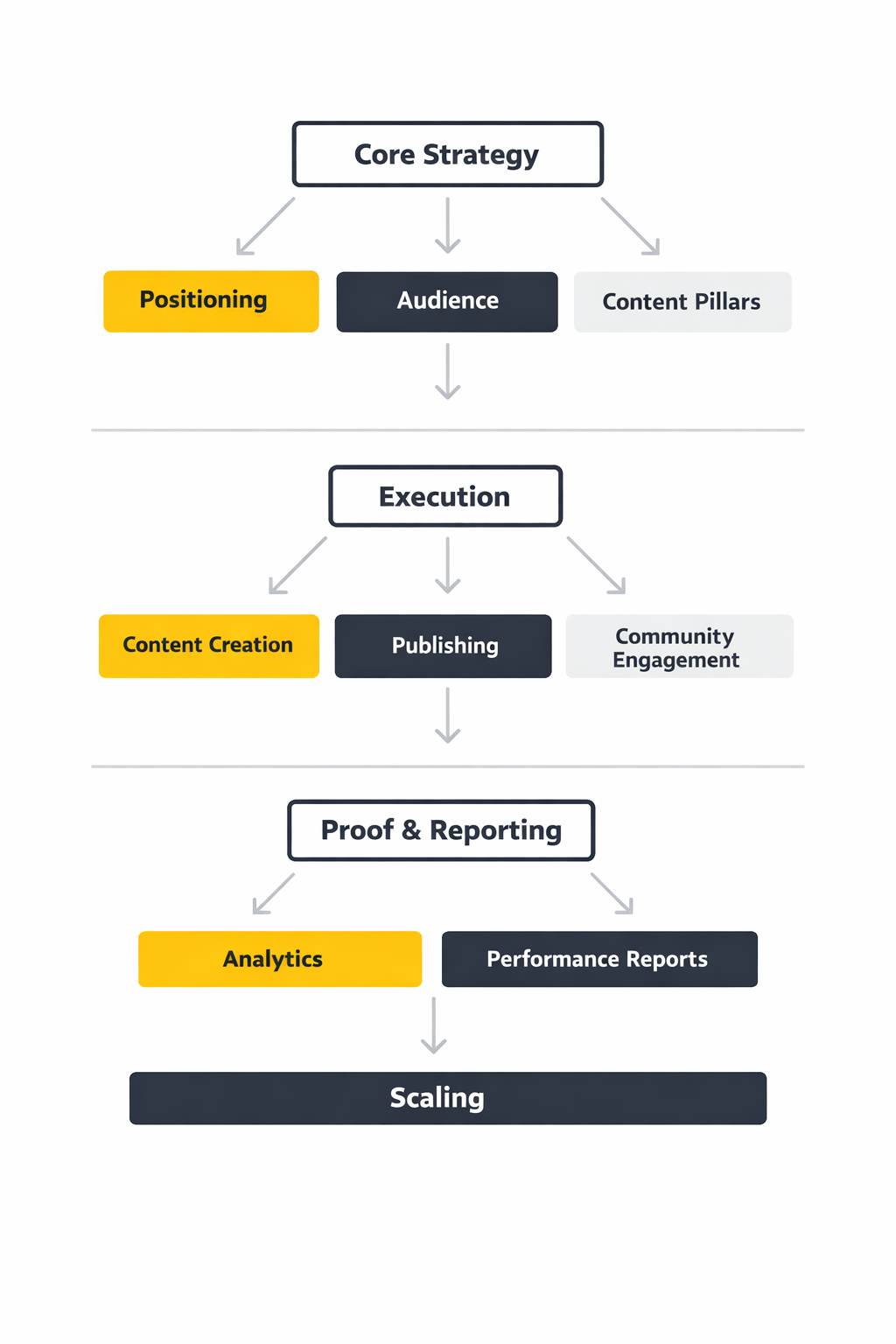
To make packages easy to compare (and easy to sell or buy), this framework uses a simple idea: every effective package should cover foundation, execution, and proof.
- Foundation: positioning, audience, platform choices, and a content plan that matches how your customers actually decide.
- Execution: consistent production and publishing, with an engagement routine that prevents your brand from looking abandoned.
- Proof: measurement that connects activity to outcomes, using a small set of metrics that the business owner can understand quickly.
When this is done well, you get a package that feels less like “a social media person” and more like a miniature marketing department—just scoped to what a small business can realistically sustain.
One reason this approach holds up is that it mirrors how modern social teams are being structured: more specialization, more accountability, and more emphasis on measurable impact. Sprout Social’s 2025 Impact of Social Media report highlights how organizations are thinking about the function as a serious business driver, not a posting queue.
Core Components
Even though packages can be priced and labeled differently, the strongest ones tend to include the same building blocks—just in different quantities and levels of depth.
- Strategy and positioning: a short, practical plan that sets the tone, content pillars, and goals for each platform.
- Content production: short-form video, graphics, photos, and copywriting packaged into predictable monthly deliverables.
- Publishing and cadence: a schedule that matches your capacity and audience behavior (consistency beats volume).
- Community and customer care: response expectations, review/rating monitoring, and escalation rules so nothing important gets missed.
- Paid amplification: optional ad support to scale what already performs, rather than “ads as a substitute for strategy.”
- Reporting: a simple dashboard plus a monthly narrative that explains what happened and what changes next.
What changes from package to package is not whether these components exist, but how much you get of each—and how tightly they’re connected to business outcomes.
Professional Implementation
A package looks professional when it runs on process, not personality. That means there’s a clear intake, a repeatable workflow, and a feedback loop that improves performance month over month.
In practice, professional implementation usually includes:
- A kickoff that produces decisions: target audience, offers, brand voice, and platform priorities—no vague “we’ll figure it out.”
- A production pipeline: topic planning, scripting, creation, review, scheduling, and publishing with clear deadlines.
- A measurement routine: weekly quick checks for signals, plus monthly reporting that ties activity to leads, calls, bookings, or sales.
- A testing habit: small experiments with hooks, formats, creative angles, and audiences—without constantly reinventing the whole strategy.
This is also where many small businesses see the biggest relief. Instead of social being “another thing to do,” it becomes something that quietly runs—and gets smarter—while the owner focuses on delivery and operations.
Step By Step Implementation
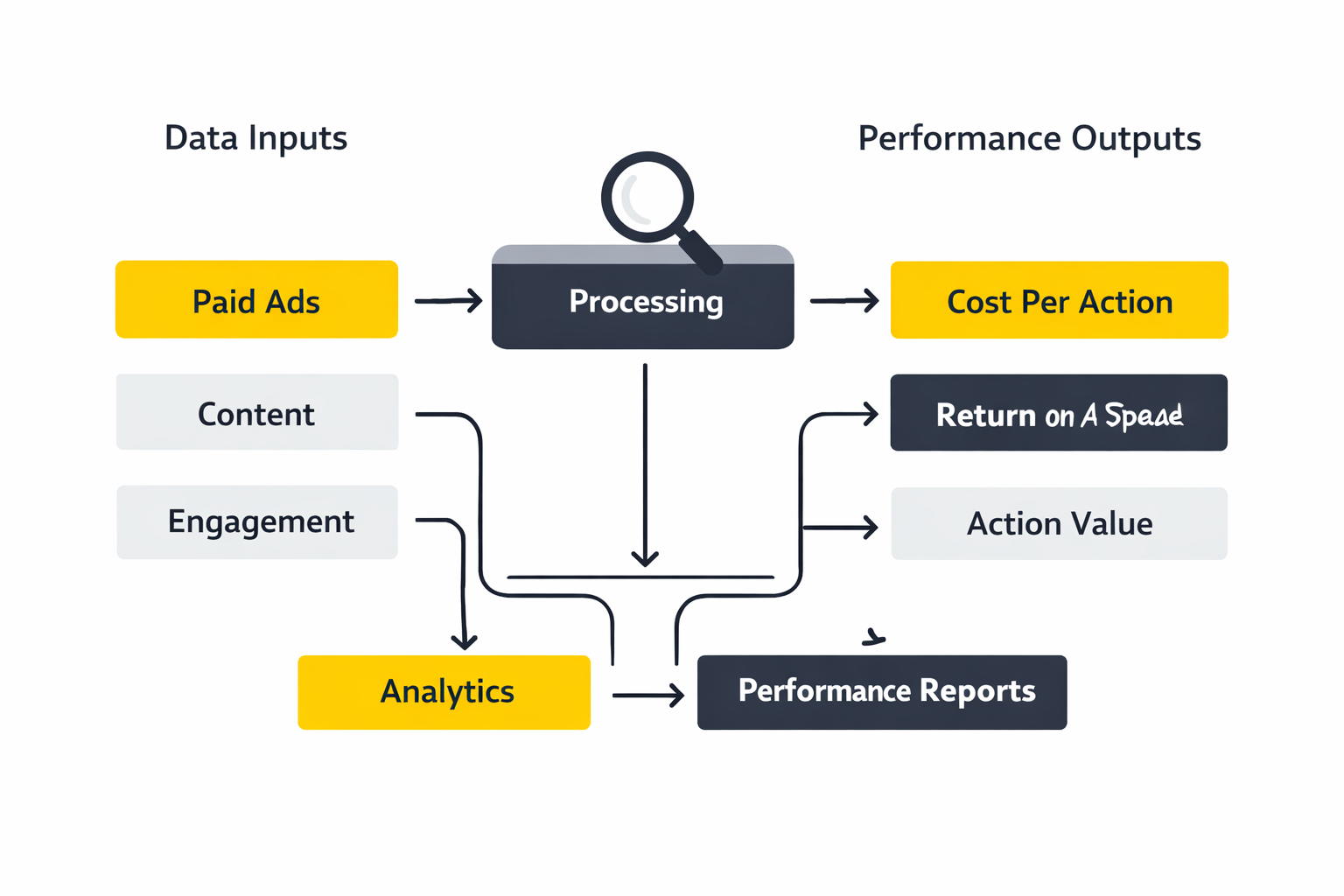
The fastest way to make social media marketing packages for small business actually work is to treat implementation like onboarding a new team member. You don’t start by “posting more.” You start by making decisions that remove friction: what you’re selling, who it’s for, what you’ll say repeatedly, and how you’ll measure progress without getting lost in noise.
Step 1: Run a real intake, not a “quick chat”
Start with a short intake that forces clarity: top offers, margins, service areas, seasonality, and what counts as a lead. If the business has multiple audiences, pick a primary one for the first 60 days. This is the point where a package becomes a plan instead of a bundle of deliverables.
Lock down access early too. Make sure the business has admin control of accounts, ad accounts, and pixels before anything goes live. If you’ll run Meta ads or track conversions seriously, you’ll eventually need more reliable data connections than browser-only tracking, so plan for that in advance with Meta’s Conversions API overview and the implementation path in Meta’s get-started documentation.
Step 2: Audit what exists and decide what stays
Audit isn’t about judging the past. It’s about deciding what’s worth reusing so you can move faster. Pull a short list of posts that created real business outcomes: inquiries, bookings, store visits, email signups, or product page clicks.
Then decide three things: what themes to repeat, what to stop doing, and what content gaps to fill. If the business is on LinkedIn, it’s worth aligning cadence and engagement habits with LinkedIn’s own guidance around posting and responding quickly, captured in the LinkedIn Page posting best-practices guide.
Step 3: Build content pillars that match how customers choose
Pick three to five pillars that the business can talk about forever without running out of ideas. For most small businesses, these pillars map cleanly to how customers decide: proof, education, behind-the-scenes, offers, and community.
Make the pillars practical by attaching formats to them. Proof might be short testimonials and “before/after” explainers. Education might be quick tips that answer the questions customers ask right before they buy. Behind-the-scenes might be process videos that build trust without feeling salesy.
Step 4: Turn pillars into a monthly calendar you can actually ship
Plan one month at a time, but only commit to what the team can sustain. Consistency beats hero weeks followed by silence. Map content to a simple rhythm: weekly pillar posts, a recurring offer slot, and a light engagement routine.
For Meta platforms, keep scheduling simple and reliable through best practices for using the Planner in Meta Business Suite and the how-to steps in Meta’s guide to scheduling Facebook and Instagram content. When a small business can see the month at a glance, it stops feeling like content is “due every day,” and starts feeling like a manageable production cycle.
Step 5: Build a production loop that reduces decision fatigue
Batch production is the quiet superpower of every strong package. Set one filming or asset day, one editing day, and one scheduling day. Use the same checklist every time: hook, visual, caption, call-to-action, link, tags, and a quick quality check.
The goal is not perfection. The goal is repeatability. If the business owner has to re-approve every post from scratch, you’ll eventually lose momentum. Instead, approve pillars and style once, then approve content in batches.
Step 6: Define how the brand will show up in conversations
Engagement is where trust forms, and it’s also where packages fail if it’s vague. Decide response windows and escalation rules. If a question needs the owner, route it. If it’s common, create saved replies. If it’s sensitive, move it to a private channel.
LinkedIn explicitly frames posting as a back-and-forth dialogue and encourages responding close to real time in its Page posting guide. That’s a useful standard even if you’re mainly on other platforms.
Step 7: Set tracking rules before you need answers
If you only start tracking after the first campaign runs, you’ll end up debating “what worked” based on guesses. Use clean link tagging for every meaningful click path, using Google Analytics URL builder guidance for UTM parameters or the tool itself via Google’s GA4 Campaign URL Builder.
Then build a lightweight dashboard the owner can understand quickly. If you want a simple reporting layer without custom engineering, Looker Studio’s Google Analytics connector is a straightforward way to keep reporting consistent.
Execution Layers
Implementation gets easier when you think in layers. Each layer supports the next, and the package becomes scalable because you’re not trying to do everything at once.
Layer 1: Foundation
This is where you lock positioning, pillars, cadence, and voice. You also establish the “rules of the road” for approvals, publishing, and response expectations. If this layer is shaky, every later improvement is fragile.
Layer 2: Content Engine
This is the repeatable machine: templates, batch production, and a monthly calendar. The content engine is what keeps a small business visible even when the owner is busy. It’s also where you build a library of reusable assets that makes next month easier than this month.
Layer 3: Distribution
Distribution is scheduling, cross-posting where it makes sense, and resharing content in formats that fit each platform. For many small businesses, reliable scheduling through Meta Business Suite is enough to keep this layer running without extra tools.
Layer 4: Community and Customer Care
This is how the brand behaves when someone comments, asks a question, or complains. A good package doesn’t just “manage social.” It protects the business’s reputation by making sure people don’t feel ignored.
Layer 5: Measurement and Decision-Making
This layer exists so you can confidently change what you’re doing. It’s built on tracking discipline and simple reporting. The point isn’t to report everything. It’s to report what helps the owner make a decision.
Optimization Process
Optimization should feel like steady progress, not chaos. In social media marketing packages for small business, the best optimization loop is simple: watch signals weekly, make decisions monthly, and run controlled tests when you have a clear hypothesis.
Weekly Signals
Weekly checks keep you from drifting. Look for patterns you can act on quickly: which formats are holding attention, which topics are getting saves or shares, and which posts are pulling people into DMs or click paths you can track.
On Meta platforms, this can be as simple as reviewing what’s scheduled and what’s performing inside the Planner and Insights workflow described in Meta’s Planner best practices.
Monthly Decisions
Monthly is where you make real changes. You decide which pillar to double down on, which offer needs a different angle, and where the funnel is leaking. You also decide if it’s time to add paid amplification or keep building organic momentum.
If LinkedIn is part of the package, use its own guidance to keep improvement grounded: test posting times, respond quickly, and build a dialogue, as laid out in LinkedIn’s Page posting guide.
Controlled Experiments
When you test, test one thing at a time. Change the hook, not the whole video. Change the audience, not the offer and the creative and the landing page all at once. This is where paid testing becomes valuable because it can speed up learning.
For Meta ads, structured experiments are supported directly through Meta’s A/B testing tools, which are designed to help you compare strategies without guessing. For TikTok performance creative, it’s smart to build your creative checklist around the practical guidance in TikTok’s creative best practices for performance ads so your tests stay focused on what the platform actually rewards.
Implementation Stories
Stories matter because they show what implementation feels like in real life. The “how” is rarely neat. It’s usually a scramble, a moment of clarity, and then a system that keeps the business from sliding back into randomness.
Bellanomi’s TikTok-First Build, Then the Pivot Pressure
The moment the orders surged, it didn’t feel like winning. It felt like the floor dropped out. Notifications kept coming, boxes piled up, and every new comment carried the same implied promise: if you can’t deliver, the internet will notice.
Amanda Okafor started Bellanomi from her basement, building attention through educational TikTok content about the African net sponge. The growth wasn’t built on a massive team or a polished studio. It was built on showing up consistently and explaining something customers didn’t understand yet, as described in Allure’s profile of Bellanomi.
Then the wall hit: popularity creates operational strain. When a product becomes a scroll-stopper, the business has to answer DMs, handle customer anxiety, and keep content going while shipping orders. If your package doesn’t include workflow and customer care rules, a viral moment can burn a small business out instead of lifting it up.
The epiphany was realizing that visibility isn’t the same as stability. If TikTok is your primary engine, you still need an ecosystem that can survive changes in policy, trends, or platform uncertainty. Okafor’s plan to expand beyond TikTok into other channels is part of the same story: a small business learning to convert attention into something resilient, not just exciting, as noted in the same Allure feature.
The journey looks like what good packages do: formalize the production cycle, standardize replies, and make tracking non-negotiable. When links and conversion paths are tagged consistently using UTM parameters in Google Analytics URL builders, the business can see which posts drive actions instead of just applause.
The final conflict is that growth forces choices. The business has to decide what content to keep making, which questions to answer publicly, and which parts of the workload need help before the brand voice gets diluted. Without that decision-making layer, momentum becomes a trap.
The dream outcome is a brand that can ride waves without being destroyed by them. That’s what implementation is really for: not just getting results, but building a system that keeps results possible even when the platform, the season, or the workload changes.
The TikTok Shop Wave, and the Content Pressure Nobody Mentions
For a lot of UK small businesses, the drama wasn’t a slow decline. It was the opposite: sales spikes that arrived faster than the team could handle. Livestreams and shoppable videos turned content into commerce in real time, and that kind of velocity punishes businesses that don’t have a workflow.
The backstory is simple: traditional discovery has gotten harder, and social has become a shortcut to attention. That shift is part of why so many small businesses have joined TikTok Shop in the UK, covered in The Guardian’s reporting on TikTok Shop adoption.
The wall shows up as pressure to constantly produce. When the channel rewards frequent publishing and live selling, it’s easy to feel like you can never step away. A small business can have a great product and still lose momentum because content becomes the bottleneck.
The epiphany is realizing you can’t “hustle your way out” of a system problem. What’s needed is a package that protects the business: a batch production rhythm, an engagement plan, and a clear set of offers that can be repeated without sounding repetitive.
The journey looks like tightening the loop. Creative becomes more disciplined by following platform guidance such as TikTok’s performance creative best practices, while measurement becomes more consistent with clean tagging via Google’s GA4 Campaign URL Builder. Even without complex tooling, that combination creates learning instead of guesswork.
The final conflict is that success makes everything public. If shipping slips or support lags, the comment section becomes a scoreboard. That’s why professional packages treat customer care as part of marketing operations, not an optional add-on.
The dream outcome is what every small business wants from social commerce: steady demand without constant panic. That only happens when implementation builds a system that can keep publishing, keep responding, and keep learning even when the business is busy fulfilling what it just sold.
Statistics And Data

Numbers don’t make a strategy, but they do keep social media marketing packages for small business honest. When you know what “normal” looks like, you stop chasing random spikes and start building a system that improves month after month.
At the market level, the audience is enormous and still growing. Kepios’ tracking shows 5.24 billion active social media user identities in early 2025, and their more recent roll-up shows 5.66 billion user identities by October 2025. Those are “identities,” not unique humans, but it still tells you one thing: your customers are almost certainly checking social daily, even if they don’t post.
On the money side, ad demand stays strong, which affects how far organic reach can realistically go. Meta reported 12% full-year growth in ad impressions and 9% growth in average price per ad in 2025, a reminder that the auction is competitive and getting more expensive over time. In the broader ecosystem, the IAB and PwC’s most recent U.S. industry accounting shows social advertising revenue rising to $88.8 billion in 2024, reinforcing why paid distribution is often part of a modern package.
For a small business, the practical takeaway is simple: you don’t need to obsess over every metric, but you do need a few dependable signals that connect social activity to business outcomes.
Performance Benchmarks
Benchmarks are only useful when they’re treated like guardrails, not goals. Different tools measure differently (reach vs impressions, engagement per follower vs per view), so the healthiest way to use benchmarks is to watch for “way below normal,” “in the pocket,” or “clearly above normal,” then dig into why.
Organic Engagement Benchmarks
Engagement is your early warning system. It tells you whether your content is resonating before you spend money amplifying it. The catch is that engagement rates swing depending on how they’re calculated and what content formats you’re posting.
- Instagram format engagement: Carousels and Reels often lead, but the exact numbers depend on methodology. Socialinsider’s early 2026 benchmarks put carousel engagement around 0.55%, while Sprout’s 2025 analysis cites higher averages like 0.99% for carousels and 1.23% for Reels. Treat that as a range, then track your own baseline consistently.
- Cross-network engagement (by industry): Hootsuite’s 2025 engagement benchmarks show wide variation by sector and platform, with examples like LinkedIn averaging in the 3%+ range for multiple industries while Facebook tends to sit lower. That gap is normal, and it’s why “good performance” looks different on each network.
Paid Performance Benchmarks
Paid benchmarks help you spot two problems quickly: weak creative (low CTR) and weak economics (high CPC/CPA). For small-business packages, the most useful paid benchmarks are CTR and cost per click or link click, because they show whether your message is compelling enough to earn attention at a sane price.
- Meta (Facebook/Instagram) CTR: Depending on objective and dataset, reported averages vary. WordStream and LocaliQ report traffic-campaign CTR around 1.71% and 1.71%, while other benchmark roundups for broad objectives reference values closer to 0.9%. When a client asks “is this good,” anchor to your objective and compare like-for-like.
- TikTok CPM and CTR: Costs also vary by market and creative quality, but multiple trackers land in a similar band. Lebesgue’s 2026 update cites an average CPM around $4.8 and CTR around 0.61%. Gupta Media’s tracker reported $4.20 CPM in January 2025 and later updates like $6.21 CPM in June 2025, which is a helpful reality check for seasonal movement.
- LinkedIn CTR: Sponsored Content CTR tends to be lower than consumer platforms, but often with higher intent for B2B. Recent benchmark discussions commonly cluster around roughly sub-1% CTR ranges, with some summaries explicitly citing 0.44%–0.65% as a typical band for Sponsored Content.
Analytics Interpretation
Analytics becomes powerful when it answers business questions without a long meeting. In social media marketing packages for small business, interpretation should follow a simple logic: confirm you’re reaching the right people, confirm you’re earning attention, confirm you’re driving actions you can track, then confirm those actions are worth the cost.
Layer 1: Quality Reach
Reach is only meaningful when it’s the right reach. If reach rises but inquiries don’t, the content may be entertaining the wrong audience or your call-to-action is too vague. If reach falls but leads rise, you may be getting more efficient because the content is clearer and better targeted.
For packages that mix organic and paid, keep an eye on auction pressure. Meta’s reporting that average ad prices increased in 2025 is a reminder that your costs can rise even when your creative stays the same, which is why watching platform-level trend signals like average price per ad growth matters when you explain results to a client.
Layer 2: Attention
Attention is where most small businesses misread the room. A post can get likes and still be weak if it doesn’t create saves, shares, clicks, DMs, or comments that show intent. If engagement is dropping across your account, you don’t automatically need “better content”; you often need clearer hooks and more consistent formats so the audience knows what you stand for.
When you interpret Instagram engagement, remember that different benchmark sources report different baselines because they calculate engagement differently. That’s why it’s smarter to treat external numbers as a range, like the spread between Socialinsider’s carousel engagement and Sprout’s format-based averages, and then focus on your own trendline.
Layer 3: Actions You Can Track
This is where you separate “social activity” from “social impact.” Track website visits, form starts, form submits, booking clicks, phone calls, or product purchases—whatever your business actually values. The easiest way to keep this clean is consistent link tagging, using UTM parameter standards in Google Analytics or the tool itself via Google’s GA4 campaign URL builder.
Layer 4: Economics
Economics is the layer clients care about most, and it’s also where you need to be careful with conclusions. A higher CPC isn’t always “bad” if lead quality rises and sales close faster. A lower CPM isn’t always “good” if the traffic is low intent. The cleanest explanation is usually cost per meaningful action, not cost per click.
If you need more reliable conversion signals on Meta—especially when iOS and browser limitations muddy attribution—plan for more resilient tracking options. Meta’s own documentation on Conversions API and the practical steps in its get-started guide are useful references when you’re standardizing packages.
Case Stories
These stories are not “inspiration.” They’re a window into what happens when analytics stops being a report and starts being a steering wheel.
Stepful’s Lead Surge, Then the CPA Panic
Leads were pouring in, and somehow it still felt like the campaign was losing. Costs were climbing, the team was watching numbers fluctuate by the hour, and the fear was simple: if this doesn’t stabilize, we’ll have to shut it down. The volume looked impressive, but the economics looked fragile.
Stepful had a straightforward growth problem: they needed to reach prospects efficiently, not just loudly. They’d already tested TikTok campaigns, but performance wasn’t yet predictable enough to trust. That’s a common moment for small teams—right when a channel shows promise, the volatility makes it hard to commit.
The wall was cost per acquisition. When CPA feels out of control, teams often react by changing everything at once—creative, targeting, budgets, objectives—then they lose any chance to learn what actually caused the problem. That kind of thrashing is expensive, and it can kill a channel before it matures.
The shift came from a clearer measurement-and-objective alignment. Stepful changed their approach by switching to TikTok’s Lead Generation objective, and that forced the campaign structure to match the real goal instead of chasing surface-level signals. TikTok’s published success story breaks down the decision and the outcomes in its Stepful case study.
The journey that followed wasn’t magic—it was discipline. They optimized around the lead form experience, tracked submissions as the true success event, and let the system learn instead of resetting it every day. The results were substantial: more than 85K lead form submissions with a 9.6% form submission rate, plus massive delivery volume that proved the funnel could handle scale.
Then came the part that always shows up when lead volume spikes: operational strain. More leads means more follow-up, more scheduling, and more pressure on the team to respond fast before prospects go cold. If the package doesn’t include a handoff system, “better marketing” can create a worse customer experience.
The dream outcome is what small businesses actually want from paid social: steady lead flow at a cost the business can sustain. In Stepful’s case, the campaign change drove a CPA drop from $23 per lead to $13.29, described as a 40%+ decrease. That’s the kind of result you can build a monthly package around because it’s measurable, repeatable, and tied to a business outcome.
Pretty Wire’s ROAS Reset, and the Reporting Problem That Triggered It
The campaign didn’t look “bad” at first glance, and that was the problem. The team had numbers, but they didn’t have confidence, and every decision felt like gambling. When reporting feels blurry, you either overspend hoping it works, or underspend and never learn.
Pretty Wire wanted performance they could scale without constantly babysitting the account. Like a lot of brands, they were chasing efficiency while trying not to drown in day-to-day optimizations. They needed a setup where the system could do more of the routine work, without losing control of outcomes.
The wall was optimization fatigue. When a channel requires constant manual tweaks, the team eventually runs out of attention, and performance drifts. The real cost isn’t just ad spend—it’s the cognitive load of managing campaigns with no clear “next best action.”
The turning point was leaning into an automation-first structure with clearer performance signals. Pinterest frames this as Performance+ simplifying management while improving outcomes, and their official story lays out the shift in the Pretty Wire success case. Instead of treating optimization as endless tinkering, they treated it as a system upgrade.
The journey was about tightening the feedback loop: cleaner campaign structure, clearer success events, and a process that made iteration easier. Pinterest reports that Pretty Wire’s best-performing campaign saw ROAS double, alongside a +100% CTR increase and a 52% drop in CPA. Those metrics matter because they describe both attention quality and economic efficiency improving at the same time.
Then reality did what it always does: success raises expectations. When CPA drops and ROAS rises, stakeholders want more spend, more growth, and faster scaling. If the measurement system isn’t stable, scaling turns into a fight about attribution instead of a plan.
The dream outcome is a package that sells itself because the numbers tell a clean story. When you can show “we paid less for better actions” and you can tie it to a repeatable system, clients stop asking for constant reassurance. That’s when analytics becomes a growth asset instead of a monthly deliverable.
Professional Promotion
Promotion isn’t just ads. In the context of social media marketing packages for small business, “professional promotion” means you can explain performance in a way that makes the business owner feel in control.
The most effective way to do that is to promote the package through proof: a simple dashboard, a clear narrative, and a consistent improvement loop. Use external benchmarks to set expectations, then shift the conversation to the client’s baseline and trendline, using credible benchmark references like Hootsuite’s 2025 benchmark explainer and platform-specific benchmarks like Socialinsider’s Instagram data as context—not as a verdict.
- Lead with the business outcome: “Calls, bookings, checkouts, inquiries,” then support it with the simplest relevant metrics.
- Show one chart that matters: month-over-month trend for a key action (not a wall of vanity metrics).
- Explain the “why” in plain language: hook strength, format choice, offer clarity, and distribution—so the owner understands what you’ll change next.
- Use tracking discipline as a selling point: consistent UTMs via Google’s GA4 URL builder and improved Meta signal quality via Conversions API are not “technical extras”; they’re how you avoid debates about what caused results.
- Make optimization part of the package identity: a monthly test plan and a documented decision rule for scaling or pausing spend, so the client sees a system, not improvisation.
When you promote packages this way, you’re not pitching “posts” or “ads.” You’re pitching clarity: a predictable workflow, measurable outcomes, and a business owner who can finally stop guessing whether social is worth it.
Future Trends
The next wave of social media marketing packages for small business will feel less like “posting” and more like running a compact growth engine. Platforms are moving faster, customers are shopping inside feeds more aggressively, and brands are being judged on trust signals in public.
- AI-assisted commerce layered onto everyday posts: Social platforms are increasingly testing features that turn content into shopping surfaces, sometimes even generating product suggestions automatically. That shift is already visible in emerging “shop the look” and “find similar” style features discussed in The Verge’s reporting on AI shopping overlays, and it’s reinforced by the rapid build-out of AI shopping assistants like LTK’s new AI chatbot for product discovery.
- Human-made authenticity becomes a premium signal: As AI-generated content becomes more common, audiences are reacting emotionally when a brand’s output feels synthetic. The backlash around AI-forward campaigns, including reactions described in Business Insider’s look at Gucci’s AI ad controversy, is a reminder that tools can accelerate production, but they can’t replace taste and credibility.
- Creators shift from “reach partners” to performance partners: Advanced packages will increasingly treat creator partnerships like measurable media, not brand experiments. That theme shows up across 2026 trend analysis, including the “influence and performance ecosystems” focus in Hootsuite’s Social Media Trends 2026 overview.
- Faster creative cycles become the default: Teams that can ship, learn, and iterate quickly will win. “Fastvertising” and rapid experimentation are explicitly called out in Hootsuite’s 2026 trends summary, and you can already see brands reorganizing around short feedback loops instead of monthly content plans.
- Measurement becomes more conservative and more valuable: As attribution gets noisier, packages that build disciplined tracking and explain results in plain language will feel safer to buy. Clients won’t just ask “what did we post,” they’ll ask “what did we learn, and what are we changing next?”
The practical implication is simple: future-proof packages don’t rely on one platform trick. They build a repeatable system that can adapt when formats, algorithms, and shopping features change.
Strategic Framework Recap
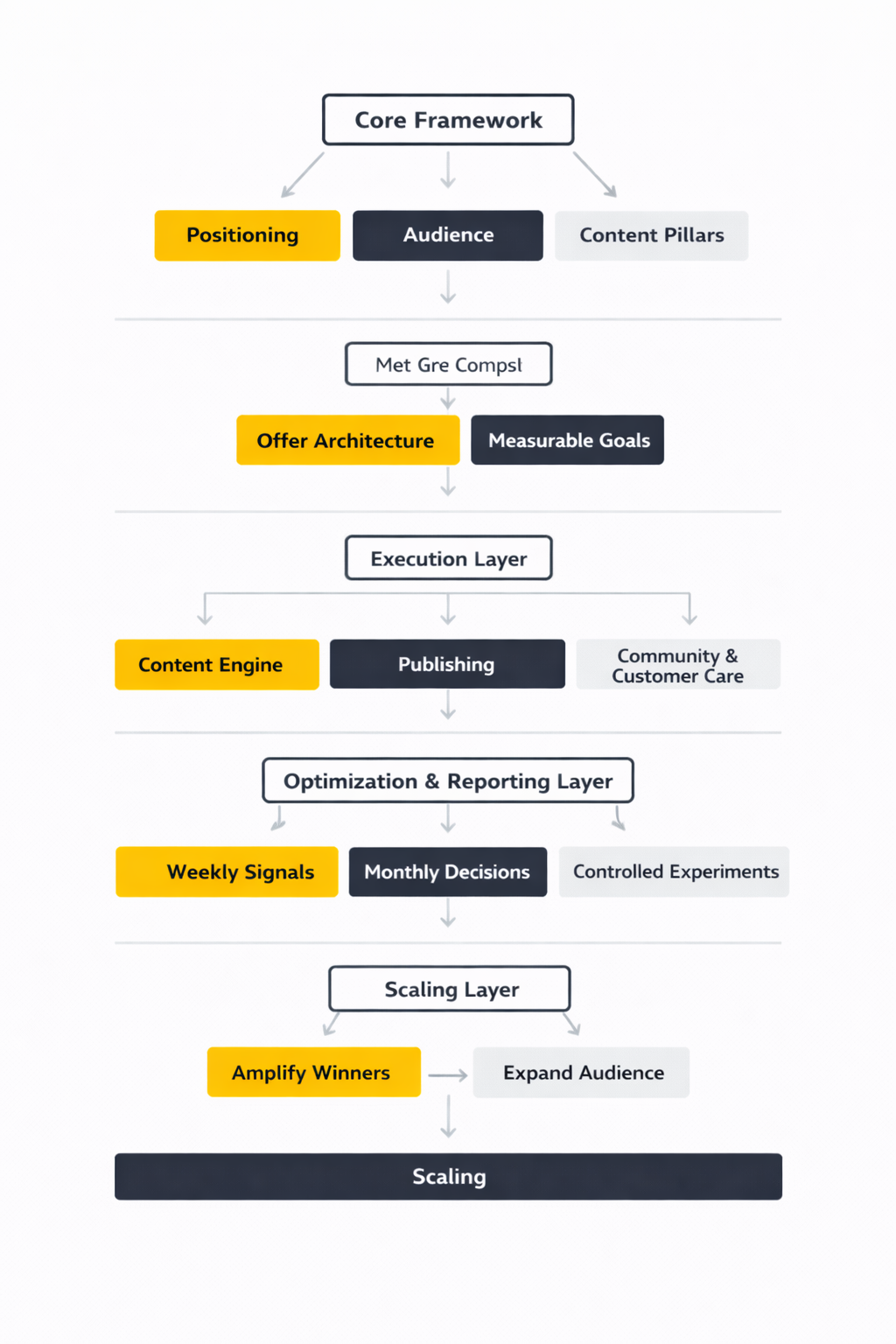
If you want social media marketing packages for small business to be easy to sell and easy to deliver, keep the structure simple. The strongest packages behave like an ecosystem, where each piece supports the next.
- Foundation: clear positioning, clear audience, clear content pillars, and a cadence the business can sustain.
- Execution: a repeatable production loop, reliable publishing, and a real engagement routine that protects trust.
- Proof: simple tracking, consistent reporting, and an optimization rhythm that turns results into decisions.
- Scale: amplify winners, refresh creative before it burns out, and expand carefully without breaking operations.
When those layers work together, the business stops guessing. Social becomes something you can steer instead of something you hope will work.
FAQ – Built for the Complete Guide
1) What’s the difference between social media management and a full package?
Management is usually “create and post content.” A full package connects content to outcomes: messaging, publishing, community, tracking, reporting, and a plan for improving results over time.
2) How many posts per week should a small business expect in a package?
There isn’t one magic number. A better question is: what cadence can be maintained without quality dropping? Most small businesses do better with a consistent schedule they can sustain than a high-volume month followed by silence.
3) Should paid ads be included in social media marketing packages for small business?
Only if the business is ready to track meaningful actions and has an offer worth amplifying. Paid should scale what works, not compensate for unclear positioning or weak creative.
4) What results should a business expect in the first 30 days?
The first month is often about establishing consistency, rebuilding trust signals, and creating a baseline. You can still see early wins, but the most reliable outcome is clearer data on what resonates and what doesn’t.
5) How do you prevent “random content” from taking over?
Lock content pillars and a calendar rhythm. When a “random idea” appears, it should be filtered through the pillars: does it support proof, education, behind-the-scenes trust, offers, or community?
6) What metrics matter most for a small business?
Pick a small set tied to the business goal: inquiries, calls, booking clicks, form submissions, store visits, or purchases. Engagement and reach matter most when they help explain why those actions rose or fell.
7) How do packages handle customer messages and comments?
Professional packages define response windows and escalation rules. The owner shouldn’t be dragged into every comment, but they also shouldn’t be surprised by unanswered questions or negative feedback sitting in public.
8) Is it better to focus on one platform or multiple?
Most small businesses should win on one primary platform first, then expand. Multi-platform is useful when the business has enough content supply and a clear reason each platform supports the customer journey.
9) How long does it take for social packages to start producing predictable leads?
Predictability usually takes a few cycles of learning. If you’re publishing consistently, tracking correctly, and improving creative based on signals, predictability becomes realistic over 60–120 days rather than one viral moment.
10) What should a client deliver to make the package work?
Fast approvals, access to accounts, basic business context, and honest feedback on lead quality. Packages fail most often when feedback arrives too late or the business can’t follow up quickly on inquiries.
11) How do you avoid creative burnout over time?
Build a refresh system: rotate angles, formats, and proof points. Treat creative like a pipeline, not a one-time project.
12) What makes a package “premium” versus “basic”?
Premium packages don’t just include more posts. They include a stronger workflow, tighter measurement, faster iteration, and clearer accountability for outcomes.
Work With Professionals
At some point, most small businesses hit the same ceiling: they know social matters, but they can’t keep the machine running without sacrificing operations. And for marketers, there’s a different kind of ceiling: you know you can deliver, but finding steady clients can feel like an endless chase.
That’s why marketplaces built specifically for marketing work are getting attention. MARKEWORK positions itself as a marketing marketplace where companies and marketers connect directly, and it emphasizes two details freelancers care about: no project fees or commissions and direct communication without a middle layer.
If you’re a freelancer building social media marketing packages for small business, the dream is simple: a pipeline that doesn’t depend on luck. MARKEWORK’s work board shows meaningful activity, including 1,007 active listings visible with more listings unlockable, and their pricing page highlights access to thousands of job listings on a straightforward subscription model.
Instead of spending your week pitching into the void, you can set up a profile that makes your offer clear, apply to roles that match your skills, and move conversations forward without platform gates. The platform’s flow is designed to be simple for marketers, outlined in its “Why Us” page, and it’s built around speed, clarity, and fit rather than complex bidding wars.
When you’re ready to stop treating client acquisition like a second full-time job, start where the work is already organized for marketing specialists, and keep what you earn without per-project platform cuts.
 Filip Konecny Enterprises