

Social Content Agency: A Practical Guide to Strategy, Systems, and Scale
Social doesn’t fail because brands “don’t post enough.” It fails when the work is treated like a stream of one-off ideas instead of a repeatable system that turns attention into trust, and trust into revenue.
A strong social content agency builds that system for you: the strategy, the production engine, the creative direction, and the measurement that proves what’s working. Done well, it’s less about “going viral” and more about showing up with consistency and intent—so your audience knows what you stand for and what to do next.
The challenge is that social platforms now sit at a scale that rewards disciplined execution. The world is operating on 5.24 billion social media user identities, mirrored in the same headline figures in We Are Social’s Global Digital Report 2025 and the dedicated state-of-social section—which is exactly why brands that “wing it” get drowned out.
Article Outline
- What a Social Content Agency Is
- Why a Social Content Agency Matters
- Framework Overview
- Core Components
- Professional Implementation
What a Social Content Agency Is

A social content agency is a specialist partner that plans, produces, and optimizes content designed for social platforms—on purpose, on schedule, and with measurable outcomes. That can include organic social content, short-form video, creator partnerships, paid creative, community management support, and the content strategy that ties it all together.
The key difference between an agency and “a person posting for the brand” is the operating system behind the output. An agency should be able to explain how ideas become assets, how assets become campaigns, how campaigns become learnings, and how those learnings become the next set of higher-performing posts.
In practice, the best agencies behave like an embedded studio plus a performance team:
- Studio to develop narratives, formats, and creative direction that fit each platform.
- Production to ship consistently—scripts, edits, design, motion, and publishing workflows.
- Performance to measure what the audience rewards and to iterate quickly without losing the brand voice.
If you’re evaluating partners, a quick litmus test is whether they talk only about “content” or whether they can map content to business outcomes. Content is the vehicle; the destination is demand, loyalty, retention, or pipeline—depending on what you actually need.
Why a Social Content Agency Matters
Social is now one of the most crowded marketplaces on earth. When billions of people share the same attention channels, the winners aren’t the brands with the most ideas—they’re the brands with the best systems for turning insight into creative, and creative into repeatable results.
That’s why many teams end up stuck in a frustrating loop: a few posts perform, a few flop, and nobody can explain why. Without a consistent production rhythm, you can’t test enough. Without clear creative direction, you can’t build recognizable patterns. Without measurement discipline, you can’t learn faster than competitors.
There’s also a budget reality behind the shift toward professional social execution. Creator-led advertising has become a serious line item: U.S. creator ad spend was projected to reach $37 billion in 2025, backed by the full IAB report PDF and covered in mainstream business reporting like Business Insider’s summary. When spend moves, expectations move with it—and leadership starts asking for a real strategy instead of “more posts.”
A social content agency matters because it helps you:
- Compress the learning curve by running structured experiments on creative, formats, hooks, and distribution.
- Protect brand consistency while still adapting to platform-native behavior and trends.
- Scale output without chaos through repeatable workflows that don’t burn out internal teams.
- Prove ROI using clear metrics tied to goals—so content decisions stop being subjective debates.
Framework Overview

This guide uses a simple framework you can use to assess any social content agency (or build the capability in-house). It’s designed to keep the work practical: if a partner can’t execute these layers consistently, you’ll feel it in uneven performance and constant resets.
The framework has five layers that work in a loop:
- Positioning: the message the audience should remember after they scroll past you 100 times.
- Editorial intelligence: what you publish, who it’s for, and why it belongs on that platform.
- Production system: how content gets made fast without looking cheap or off-brand.
- Distribution and amplification: how organic, creators, and paid work together instead of competing.
- Measurement and iteration: how you learn, decide, and improve week after week.
Notice what’s missing: “posting daily” as a strategy. Frequency can help, but only if the system behind it is strong enough to keep quality and learning intact.
Core Components
A capable social content agency is usually built around a small set of roles and responsibilities that show up no matter the niche. The names may differ, but the functions shouldn’t.
Strategy That Translates Into Creative
Strategy is only useful if it becomes decisions: what to say, what not to say, what formats to repeat, and what series to build. The best strategies read like a creative playbook, not a slide deck full of generic audience personas.
Creative Direction and Platform Craft
Each platform rewards a different kind of clarity. Creative direction is where “brand” meets “native.” It defines the visual language, tone, and recurring structures—so your content feels coherent even when you experiment.
Production That Doesn’t Break Under Volume
Production is where good plans usually die. A social content agency should have a workflow that prevents bottlenecks: clear briefs, fast approvals, a defined asset pipeline, and templates that speed up output without becoming repetitive.
Analytics That Lead to Decisions
Reporting isn’t the goal—decisions are. A strong team can look at performance and say: “We’re doubling down on these two formats, retiring that hook, and shifting our posting mix because the audience is telling us something.”
Collaboration and Governance
Social touches product, sales, support, and leadership. Agencies that perform long-term know how to collaborate without turning every post into a committee decision. Clear ownership and a predictable feedback loop matter as much as creative talent.
Professional Implementation
The biggest promise a social content agency can make isn’t “better content.” It’s predictability: a clear process from kickoff to weekly shipping to monthly learning, with roles and timelines that stop social from feeling like a constant fire drill.
In the next parts of this guide, you’ll see what implementation looks like when it’s done professionally—how strategy becomes a content engine, how creative gets systemized without turning generic, and how measurement turns into simple, repeatable decisions your team can actually stick to.
Step-by-Step Implementation

Implementation is the moment a social content agency either becomes a growth engine or turns into a “pretty posts” vendor. Strategy is helpful, but it’s the weekly operating rhythm that decides whether the work compounds. This section is a practical rollout sequence you can apply whether you’re hiring an agency, building in-house, or doing a hybrid model.
Step 1: Define the One Outcome That Matters for the Next 90 Days
Pick a single measurable outcome that you can defend in a room with skeptical stakeholders. That might be qualified traffic to a specific page, demo requests from one ICP, email captures from one lead magnet, or sales-qualified conversations in DMs. When the outcome is clear, a social content agency can design content that builds toward it instead of chasing whatever the algorithm rewarded yesterday.
Step 2: Turn Positioning Into Three Repeatable Content Pillars
Most brands fail here because they confuse “topics we can talk about” with “reasons someone should care.” Create three pillars that map to the audience’s real problems, doubts, and desires, then commit to them for a full quarter. This is also where your agency should lock in a few repeatable formats, because consistency makes it easier to learn what resonates.
Step 3: Build a Weekly Production Sprint
Social content performs better when it’s produced like a system, not a burst of last-minute drafts. A simple sprint might look like: Monday research and scripting, Tuesday filming, Wednesday editing, Thursday scheduling, Friday review and learnings. If you’re worried this sounds “too rigid,” remember that output volume is already high across the market, with Sprout’s benchmarks noting brands published an average of 9.5 posts per day in 2024—you need rhythm to compete without burning out.
Step 4: Lock the Approval Path Before You Scale Output
Approval chaos is the silent killer of social performance. Define who approves what, what “good” looks like, and how feedback should be given so creative doesn’t get rewritten by committee. If your brand needs governance, tools that support approval workflows and permissions are not “enterprise fluff,” they’re operational safety rails, which is why companies like Sprout explicitly describe message approval workflows and publishing governance as core platform capabilities.
Step 5: Instrument Measurement That You’ll Actually Use
Don’t build a reporting cathedral. Build a few decision metrics that link content to outcomes, then review them on a fixed cadence. For paid amplification and conversion-focused work, prioritize durable measurement setups like Meta’s Conversions API, TikTok’s Events API, and the LinkedIn Insight Tag so your social content agency isn’t optimizing based on broken signals.
Step 6: Build a “Series Library,” Not a Random Content List
One-off posts are fragile. Series are compounding assets because they train the audience to expect something, and they make production easier over time. Start with two series that you can publish every week for twelve weeks, then add a third once the process is stable.
Step 7: Run a Monthly Reset With Clear Keep, Kill, Create Decisions
At the end of each month, your agency should bring you a simple set of decisions: what to keep doing, what to stop doing, and what to create next. This is where benchmarks help you avoid emotional overreactions to normal variance. For example, Emplifi’s benchmark reporting highlights how collaboration formats have been rising over time, with the share of brands using collaborative content increasing to 4.1% by Q4 2024, which can inform whether you test collab posts intentionally instead of treating them like a trend.
Execution Layers
When a social content agency is executing well, you can usually “see the layers” behind the content. It doesn’t feel like content is being made for content’s sake. It feels like each piece is doing a job, and each job fits into a bigger system.
Layer 1: Audience Intelligence
This is the ongoing work of understanding what your audience is anxious about, curious about, and trying to accomplish. It includes listening, search behavior, community feedback, sales calls, and support tickets. The point is to prevent the team from becoming trapped inside their own assumptions.
Layer 2: Creative Direction
Creative direction is where brand consistency meets platform-native behavior. It defines what “on brand” looks like in the feed: your recurring hooks, visual language, tone, and the difference between a playful post and a sloppy one. Without this layer, output might increase, but recognition and trust don’t.
Layer 3: Production Operations
This is the unglamorous layer that makes the glamorous layer possible. Templates, shot lists, caption patterns, edit conventions, and a file system that doesn’t collapse after week three. If you want speed without quality loss, this layer has to be designed on purpose.
Layer 4: Distribution and Amplification
Distribution is more than “posting.” It includes timing, repurposing, creator partnerships, paid amplification, and how content gets reused in email, landing pages, and sales enablement. A modern social content agency treats organic as the creative lab and paid as the amplifier when something proves it deserves budget.
Layer 5: Measurement and Learning
This layer only works if it produces decisions. The team should be able to say: “This format is winning because it holds attention,” or “This series is stalling because the hook is unclear,” then ship improvements quickly. That learning speed matters even more in short-form video, where Metricool’s analysis of over 5 million short-form videos shows how competitive the format has become.
Optimization Process
Optimization is not “tweak captions until engagement goes up.” It’s a disciplined loop that helps a social content agency improve the work without losing the brand’s personality. The secret is to optimize the inputs you control, not the outcomes you can’t.
What to Test First
- Hook clarity: Does the first second make the value obvious, or does it assume patience?
- Format repeatability: Can this be turned into a series without feeling repetitive?
- Message-to-audience match: Is the content solving a real problem for a defined person?
- Conversion path: Is it clear what happens after someone likes the content?
A Testing Cadence That Doesn’t Melt the Team
Pick two variables per week and keep everything else stable. That might mean testing two hooks for the same idea, or two edits for the same video, or two CTAs across a series. Over a month, you’ll have enough signal to make meaningful decisions without turning production into a science fair.
Decision Rules That Keep You Honest
Define in advance what “good enough” looks like so you don’t rewrite history based on one spike. Benchmarks can help, but the most reliable baseline is your own trailing 30 days. If your agency can’t show how decisions are made, optimization becomes vibes.
Implementation Stories
Implementation gets real when the work is under pressure—public scrutiny, internal panic, or a sudden operational shift. One of the clearest recent examples of a company forcing a systems-level change is Duolingo’s move toward being “AI-first,” not because it’s trendy, but because it shows what happens when a team decides the old way of producing content can’t scale.
Duolingo’s “AI-First” Shift Shows What Operational Change Actually Feels Like
The backlash hit fast. A memo intended to signal a strategic pivot landed in public view and immediately triggered anger, skepticism, and fear about what the company would do next. The story became bigger than the company’s intentions, and the pressure wasn’t theoretical—it was playing out in headlines and comments in real time, including coverage like The Verge’s reporting on the memo and contractor changes.
The backstory matters because Duolingo wasn’t making a “fun social media move.” The CEO framed the shift as a platform-level change, comparing it to betting on mobile early, and posted the full internal email publicly through Duolingo’s own LinkedIn post. The core argument was about speed and scale: creating and updating huge volumes of learning content is hard to do manually. In parallel, outside reporting showed the company making broader strategic tradeoffs to prioritize growth, like the Reuters coverage of a strategy shift in early 2026. Reuters’ report on Duolingo’s growth-first focus
Then came the wall: trust. People assumed the change was mostly about cost-cutting, and the company suddenly had to operate inside a storm of interpretation it didn’t control. Even supportive audiences questioned whether product quality would suffer, whether creative work would become generic, and what “AI-first” really meant day-to-day. The CEO later acknowledged that the initial communication didn’t provide enough context, which is exactly what happens when a strategic shift outruns the operational narrative. Luis von Ahn’s follow-up on LinkedIn
The epiphany was not “we should stop.” It was “we need to explain the system.” When you change how content gets produced, the public doesn’t judge your internal intentions—they judge what they think the change will do to the experience. That’s why von Ahn moved from a bold announcement to a clarifying vision, and why coverage emphasized the need for a “mind shift” rather than a simple staffing reduction. Financial Times interview coverage
The journey, from an operational perspective, looks like a social content agency implementation at high stakes. First, define the constraint: content volume can’t scale fast enough with the old process. Next, redesign the workflow so automation handles repetitive production work while humans focus on creative and strategic decisions. And then standardize how teams are evaluated and resourced so the new system doesn’t stay optional, a move described in reporting on how AI use would factor into hiring, performance reviews, and headcount decisions. Business Insider’s summary of the memo’s operational constraints
The final conflict is what every organization faces when it changes production systems: implementation is messy. Some people will hate the idea on principle, some will fear quality loss, and some will resist because the tools and habits are unfamiliar. Duolingo’s leadership had to manage that tension publicly, with coverage noting surprise at the backlash and the need to reframe the message so audiences understood what was actually changing. Fortune’s coverage of the backlash reaction
The dream outcome, if the system works, is speed without creative collapse. More content shipped, more experiments run, and more room for humans to focus on the parts that actually require judgment and taste. That’s the same promise a strong social content agency makes to clients: build a production engine that can scale, then protect the brand’s voice while you iterate. Duolingo’s story shows the cost of getting the system wrong is loud—and the benefit of getting it right is compounding. The Washington Post’s look at AI-first workplace shifts
Professional Implementation Playbook
Here’s what “professional implementation” looks like when a social content agency is doing the work at a level you can trust. It’s not about fancy dashboards. It’s about removing friction so the team can ship, learn, and improve without drama.
Week 1: Set the System
- Define the 90-day outcome and the few metrics you’ll use to judge progress.
- Lock pillars and series so ideation doesn’t restart from zero every week.
- Agree on approvals with a documented process and deadlines that prevent limbo.
Week 2: Ship the First Full Sprint
- Run the first production sprint end-to-end and capture where time actually gets lost.
- Publish with intent across a small set of formats so results are comparable.
- Instrument tracking so clicks, conversions, and downstream behavior are visible.
Weeks 3–4: Improve the Bottleneck, Not the Creative
Early on, the biggest gains usually come from fixing workflow friction, not “trying harder.” Shorten feedback loops, standardize briefs, and reduce context switching. A social content agency that can’t diagnose operational bottlenecks will often blame creativity, when the real problem is the system around it.
Monthly: Turn Results Into Decisions
Every month should end with a short, concrete plan: which series continues, which gets retired, and which gets rebuilt with a better hook. Use external benchmarks carefully—only as guardrails, not as goals—and keep the focus on what your own audience is rewarding. When this cadence is in place, social stops feeling like guesswork and starts behaving like a reliable growth function.
Statistics and Data

When a social content agency talks about “performance,” the only honest follow-up is: performance of what, exactly? Reach without retention is noise. Engagement without intent is entertainment. And clicks without downstream behavior can quietly drain budget while everyone celebrates a pretty dashboard.
The role of analytics is to turn social from a creative lottery into a learning system. That means tracking enough data to make decisions, but not so much that you end up doing reporting theater instead of improving content.
In practice, the healthiest setups use benchmarks as guardrails, not as goals. You want to know what “normal” looks like across your industry and platform mix, then you want to beat your own baseline month after month.
Performance Benchmarks
Benchmarks help a social content agency answer the questions leadership actually cares about: Are we posting at a serious pace? Are we earning attention in a way that’s competitive? And are we building signals the algorithms will reward next month, not just this week?
Publishing Volume: The Market Is Posting More Than Most Teams Realize
If your output feels “busy,” it’s worth sanity-checking it against the broader market. Sprout Social’s 2024 report found brands averaged 10 posts per day across networks in 2023, and the 2025 benchmark reporting shows brands averaged 9.5 posts per day across networks in 2024.
Those numbers don’t mean you should copy the volume. They explain why consistency matters: the feed is a high-velocity environment, and a social content agency needs enough output to run experiments without gambling the entire month on three posts.
Engagement: Healthy Ranges Exist, but Definitions Can Break Comparisons
Engagement benchmarks can be useful, but only if you’re comparing the same formula. Some teams calculate engagement per follower, others per reach, others per impressions, and those can tell very different stories.
Hootsuite’s industry-wide analysis frames average engagement rates as falling between 1.4% and 2.8% across platforms in 2025, and it pairs with their deeper breakdown on average engagement rate by industry. The point isn’t to chase a single “good number,” but to pick one method and keep it consistent so your trend line is trustworthy.
Shares: The Signal Many Teams Underweight Until It’s Too Late
As algorithms prioritize content that spreads, shares become a practical KPI for “this was worth passing on.” Dash Social’s 2025 benchmark announcement highlighted that shares rose 31% on TikTok and 86% on Instagram in its reporting window, while its release also summarized platform-level benchmarks like TikTok engagement at 5% versus 3.6% on Instagram and 3.4% on YouTube.
This is exactly why a social content agency should look beyond likes. Likes are easy. Shares usually mean the content helped someone look smart, feel seen, or solve a problem—and those motivations are far closer to business outcomes.
Collaboration Posts: A Quiet Lever With a Measurable Trend Line
Collaborative publishing is one of those tactics that looks small until you realize it changes distribution. Emplifi’s 2025 Social Media Benchmarks Report notes the share of brands posting collaborative content rose from 1.7% in Q1 2023 to 4.1% by Q4 2024.
The takeaway isn’t “do collabs.” It’s that distribution mechanics evolve, and a strong social content agency watches those mechanics with data, then tests them inside a controlled content system.
Analytics Interpretation
Most analytics problems are not “we don’t have enough data.” They’re “we’re reading the wrong meaning into the data we already have.” A social content agency earns trust when it can explain what the numbers are really saying, then translate that into a next-week plan that feels obvious in hindsight.
Interpret Metrics in Three Levels: Attention, Trust, and Action
Attention metrics tell you whether the platform is giving you distribution and whether people are choosing to stop scrolling. Think reach, views, and early retention. If these are weak, your hook, creative framing, or format probably needs work.
Trust metrics tell you whether the content is building relationship, not just getting seen. Saves, shares, meaningful comments, and repeat viewing behavior sit here. When trust is rising, your audience is basically telling the algorithm, “send me more of this.”
Action metrics tell you whether content is helping the business, not just the feed. This is clicks that behave like intent, conversions that match your goal, and assisted paths that show social is part of the decision journey. If the action layer is weak, you may not have a clear offer, a clear CTA, or a clean landing experience.
Common Misreads That Make Teams Spiral
Confusing reach spikes with strategy. A single spike can come from timing, trend adjacency, or platform testing, not from a repeatable idea. The fix is to turn spikes into hypotheses, then rebuild them as series you can test.
Optimizing for engagement that doesn’t convert. Not all engagement is equal. If content wins laughs but never produces intent, it may be helping awareness while starving pipeline—and a social content agency should be able to say that clearly.
Overreacting to week-to-week noise. Social is volatile by nature. The antidote is a monthly decision rhythm where you compare against your trailing baseline and make deliberate keep/kill/create choices instead of emotional pivots.
What “Good Reporting” Looks Like in Real Life
A useful report is short enough that a busy operator reads it, and specific enough that it forces decisions. It highlights what changed, why it likely changed, and what the team will do next. It also calls out what you’re going to stop doing, because subtraction is where focus comes from.
This is also where modern benchmarks can help you upgrade your KPI mix. If shares are rising as a market signal in Dash Social’s reporting, and engagement ranges vary widely by platform in Hootsuite’s analysis, then your reporting should reflect that reality instead of treating every platform like a smaller version of Instagram.
Case Stories
Analytics becomes real when it changes behavior under pressure. One of the cleanest examples comes from Sprout Social using its own platform and reporting insights to overhaul how it handled customer care across social channels.
Sprout Social’s Inbox Hit a Breaking Point, Then Reporting Turned Into a System
The messages kept coming, and the uncomfortable truth was that time was working against them. When a customer asks for help on social, every minute feels public—even if it’s just one person waiting, the delay can look like indifference. Sprout’s own case study describes a reality shaped by scale, with 36,000 messages handled in Smart Inbox in 2023 sitting behind the scenes like a constant stress test.
The backstory wasn’t a lack of effort; it was a workflow that had outgrown the old habits. The team cared about the experience because their customers are marketers who notice response time and tone immediately. That’s why Sprout framed the work as a customer care quality problem, not a “let’s reply faster” vanity project, in its detailed breakdown of how the team used reporting to improve support.
The wall showed up in the hours where coverage was thinner and response times drifted beyond what felt acceptable. Sprout specifically describes using its Inbox Activity Report to find where average time to action was highest, including the after-hours window they identified as an opportunity to improve. When your bottleneck lives in a time block, “work harder” doesn’t solve it—you need staffing logic and routing logic, which is exactly what the case study explains.
The epiphany was that the answer wasn’t more dashboards, it was sharper questions. Instead of asking, “How are we doing?” they asked, “Where, exactly, does time-to-action break down, and what behavior change would fix it?” That shift is visible in how Sprout describes turning reporting into operational decisions, reinforced by multiple references to the same results in third-party summaries like a LinkedIn post sharing the outcomes and compiled product narratives like Cuspera’s summary of the case.
The journey was practical and unglamorous: adjust coverage, tighten process, and make tagging and routing consistent so the team could learn from what was happening instead of drowning in it. Sprout reports a 37% increase in tag rate, which matters because tags are the connective tissue between “messages” and “insights you can act on.” When tagging becomes consistent, you can see patterns, prioritize issues, and route work without guessing.
The final conflict was the risk that speed would come at the cost of empathy. Faster replies can turn robotic if teams over-template or rush judgment, especially when the inbox is heavy. The discipline is building a system that protects tone while increasing velocity, which is why Sprout positions the work as improving support quality through process and reporting, not just raw throughput, in its own write-up.
The dream outcome was measurable, and it wasn’t subtle: Sprout reports a 55% decrease in average response time, backed by the same result referenced in places like a recap of the metrics. This is what “analytics” should feel like inside a social content agency: not a report that gets filed away, but a feedback loop that makes the work more reliable next week than it was last week.
Professional Promotion
Promotion is where analytics and creative finally shake hands. A social content agency should treat promotion as a disciplined way to scale what already works, not a way to rescue content that never earned attention organically.
Promote Proven Content, Not Hopes
The simplest promotion rule is also the most profitable: only amplify posts that already show strong trust signals. When a post earns shares and saves, it’s telling you it has message-market fit. Dash Social’s reporting that shares are rising sharply on TikTok and Instagram is a reminder that “pass-along value” is becoming a practical proxy for what deserves budget.
Use Paid to Fund Creative Iteration
Promotion isn’t just distribution; it’s a testing environment. A professional team uses small budgets to test hooks, edits, and angles, then reallocates spend to the variants that hold attention and drive action. This is how a social content agency avoids the trap of guessing which creative will work at scale.
Connect Promotion to a Simple Funnel the Team Can Maintain
Promotion works best when the path is clean: a clear offer, a clear next step, and a landing experience that matches the promise of the content. If your action metrics are weak, the fix is often not “better targeting,” but a tighter message bridge between post and page.
Report Promotion in a Way That Improves the Next Month
A promotion report should answer three questions in plain language: what creative won, what audience cluster responded, and what the team will build next because of it. If your reporting can’t produce those decisions, you don’t have a promotion system—you have spending with commentary.
Advanced Strategies
When a social content agency moves from “shipping content” to “compounding results,” the biggest shift is mindset: you stop treating every post like a standalone asset and start treating content like a product with a roadmap. The goal isn’t more ideas. It’s fewer ideas with deeper leverage.
Advanced strategy is also where most teams get tempted by complexity. The best operators do the opposite: they add sophistication behind the scenes, then keep the output simple, consistent, and unmistakably human.
Build Series That Accumulate Proof
One-offs can go viral, but series build memory. A strong social content agency creates “repeatable containers” (formats + promise + cadence) that let audiences instantly recognize value. Instead of asking, “What do we post tomorrow?” you ask, “What’s episode 6 of the thing people already care about?”
If you want a hard reality check on why series matter, look at how quickly budgets are moving toward creator-led formats that can scale consistently. IAB’s research projects $37B in U.S. creator economy ad spend in 2025, backed by the same figure in IAB’s announcement and summarized in Business Insider’s coverage.
Design a Creator Ecosystem You Can Reuse
Creator work becomes expensive when every partnership is a one-time event. Advanced teams build a bench of creators who understand the brand voice, the product, and the audience. Over time, briefs get shorter, content gets sharper, and approvals get easier.
Most importantly, a creator ecosystem gives you distribution mechanics you can’t buy with posting frequency alone. That’s why a social content agency should treat creator relationships like supply chain strategy: predictable inputs, repeatable outputs, and clean permissions for repurposing.
Amplify Organic Winners Instead of Forcing “Ad Creative”
When content already works organically, you’re not guessing what people want—you’re funding what they’ve already voted for. TikTok makes this concept explicit with Spark Ads, which are built to promote organic posts while keeping engagement attached to the original post. That matters because it lets paid spend reinforce social proof instead of resetting the conversation inside a cold ad unit.
Upgrade Measurement Before You Scale Spend
Scaling without reliable measurement is how teams convince themselves something works, then wonder why it stops working the moment they increase budget. If a social content agency is pushing paid amplification or conversion goals, you want sturdier tracking than browser-only signals. Meta’s Conversions API exists specifically to connect first-party events to ad delivery and measurement, which becomes more important as tracking environments stay fragmented.
Scaling Framework
Scaling is not “posting more.” It’s building a system where output increases while quality stays stable and learning speed improves. A social content agency that scales well usually has a clear framework across four areas: production, distribution, governance, and feedback loops.
1) Production: Modular Content, Not Custom Work Every Time
Think in modules: hook library, proof clips, demo snippets, objection answers, and brand moments. When those modules exist, your team can assemble new posts quickly without starting from zero. This is how you keep volume high without turning content into bland templates.
2) Distribution: One Idea, Many Native Expressions
Scaling also means making your best ideas travel. A single insight can become: a short video, a carousel-style breakdown, a comment-led thread, a founder post, and a repurposed clip for Shorts. The key is to keep the “core meaning” consistent while adapting the delivery to each platform’s behavior and tools.
YouTube keeps investing in Shorts creation workflows to lower production friction, including updates like expanded editing features and changes like how Shorts views are counted, which affects how teams interpret reach when they compare platforms.
3) Governance: Fast Approvals Without Brand Drift
As output grows, brand drift becomes the hidden cost. Scaling teams fix this with a lightweight governance layer: clear do/don’t rules, a small set of brand “non-negotiables,” and a feedback standard that prevents endless subjective edits. This is where many social content agency relationships either mature or break, because the only thing worse than slow approvals is fast approvals that create inconsistent messaging.
4) Feedback Loops: Monthly Decisions, Not Weekly Panic
At scale, you need calm decision-making. Run a monthly reset that forces choices: keep, kill, rebuild. Benchmarks can help you frame what’s normal and what’s exceptional; they just shouldn’t replace your own baseline.
Industry benchmark providers are increasingly publishing platform-level comparisons that can help teams set expectations, like Emplifi’s 2025 benchmarks, Dash Social’s H1 2025 industry benchmark reports, and Socialinsider’s regularly updated social media benchmark tracking.
Growth Optimization
Optimization is where scaling becomes profitable. Without it, you just create more content that performs about the same. With it, every month becomes a compounding improvement cycle.
Increase Creative Diversity to Fight Fatigue
Most “algorithm problems” are actually fatigue problems: the same angle, the same structure, the same delivery—until the audience stops reacting. Meta has been unusually direct about creative diversity and optimization, publishing work on how creative variety across formats and messaging connects to performance.
The practical move is simple: keep the pillar stable, rotate the creative approach. You can talk about the same idea through a customer story, a teardown, a myth-bust, a behind-the-scenes clip, or a one-minute framework. Variety protects attention without forcing you to reinvent your strategy every week.
Use Distribution Math Instead of “Post More”
Growth comes from multiplying what works across channels and audiences. A social content agency should deliberately stack distribution levers: collaborations, creator whitelisting, employee advocacy, repurposing into Shorts, and selective paid amplification. When you stack these levers, you get more total reach without relying on a single platform’s mood.
TikTok’s own ecosystem continues to formalize this idea, including how brands can use organic posts as paid units through Spark Ads, and how the platform frames culture and creative behavior shifts in reports like TikTok’s Next 2026 Trend Report.
Operationalize Creator Marketing So It Stops Feeling Random
If creators are part of your growth plan, your process needs to be repeatable: how you source creators, how you brief them, how you approve content, and how you measure impact. The reason this matters is that creator marketing is no longer a side bet. It’s becoming a core budget line for many brands, reflected in IAB’s projection of $37B U.S. creator ad spend in 2025.
Keep Measurement Honest as You Scale
As spend and output increase, measurement errors become expensive quickly. A professional social content agency will standardize how it defines success (what counts as a view, what counts as engagement, what counts as an attributable action), and it will upgrade tracking where needed. On Meta, that often means implementing Conversions API so your optimization isn’t built on missing signals.
Scaling Stories
Scaling isn’t a theory when pressure hits. It’s the moment a team realizes the old content workflow can’t support the growth goals, the platform mix, or the paid spend they’re trying to run. One real-world example that shows how scaling decisions happen under stress is the Danish train operator DSB’s move to strengthen its measurement and conversion setup with Meta.
DSB’s Conversion Tracking Started Leaking, Then the Team Rebuilt the System Before Performance Could Slip
The anxiety didn’t show up as a dramatic crisis at first. It showed up as uncertainty: numbers that didn’t quite line up, results that were harder to trust, and the nagging feeling that the system was getting less predictable. When teams can’t trust attribution, every decision turns into a debate instead of an improvement.
As that uncertainty grew, the stakes felt higher because every campaign carried public expectations. DSB isn’t selling novelty; it’s selling reliability, and reliability is exactly what measurement chaos undermines. The pressure sits on the team quietly until it becomes unavoidable: if you can’t prove what’s working, you can’t confidently scale what’s working.
That’s when the wall hit. The team couldn’t keep pushing spend and expecting performance to stay stable if the signal quality kept degrading. A scaling plan built on shaky tracking is a plan that collapses the moment budget increases. They needed a sturdier foundation, not another round of creative tweaks.
The backstory is that ad platforms have been shifting toward first-party and server-side signal quality for years. Teams that rely entirely on browser tracking often feel the pain later than they expect, and by the time it hurts, it’s already affecting decision speed. DSB’s challenge was a familiar one: keep campaigns effective while the tracking environment becomes more constrained.
At the same time, expectations for social-driven performance haven’t softened. People still discover, decide, and buy through social, and leadership still expects marketers to connect content performance to outcomes. That tension creates the demand for systems that are both creative and measurable.
So the team was stuck between two realities: they needed to run modern social promotion, but their measurement confidence wasn’t where it needed to be for aggressive scaling.
The epiphany was that the fix wasn’t “better reporting.” It was better inputs. Instead of trying to interpret imperfect data more cleverly, they improved the data being sent into the platform. That’s exactly why Meta positions Conversions API as a way to connect more reliable signals for measurement and optimization, explained in Meta’s overview of Conversions API.
Once you accept that signal quality is a scaling constraint, the priorities change fast. You stop treating measurement as a back-office task and start treating it as performance infrastructure. That’s the mindset shift that separates a posting team from a scaling team.
And it’s the same mindset a serious social content agency brings: creative is the engine, but measurement is the steering wheel.
The journey was a rebuild of the operational layer, not a reinvention of the brand voice. DSB implemented the Conversions API and enriched it with additional first-party data, described directly in Meta’s DSB success story page. They didn’t need a new personality; they needed cleaner signals to make smarter decisions with the personality they already had.
That kind of work is rarely glamorous, but it’s the difference between scaling with confidence and scaling with hope. Once signals improve, teams can promote content more aggressively because they can actually learn from what happens next. The content machine becomes more accountable, which makes it easier to protect budget.
It also makes collaboration smoother: creative, media, and analytics stop arguing about whose numbers are “right” and start iterating together.
The final conflict is that implementation is never frictionless. Teams have to coordinate tech, privacy, governance, and campaign operations without stalling the publishing cadence. If they pause content to “fix tracking,” momentum dies; if they ignore tracking to “keep posting,” performance becomes harder to scale.
This is where process maturity matters. A social content agency that’s built for growth will keep shipping content while the measurement foundation is being strengthened, using controlled tests rather than broad chaos. The work has to happen in parallel.
And when it does, the organization gets something rare: speed without guesswork.
The dream outcome is scaling that feels stable. DSB reports seeing an improvement in conversions after this work, expressed as an 18% increase in conversions in Meta’s case study. More importantly, the team earns the right to scale because they can measure outcomes with greater confidence.
That’s the real win: not a one-time lift, but a system that lets you invest in what works, cut what doesn’t, and move faster each month. When you see scaling as infrastructure, growth becomes something you can repeat.
And that’s the promise of a strong social content agency at scale: compounding improvement, not occasional spikes.
Professional Promotion at Scale
Promotion at scale is where many teams accidentally burn the brand. They boost too much, too fast, and they turn a strong voice into a volume machine. Professional promotion keeps the human tone intact while building a repeatable system for amplifying what’s already working.
Set Promotion Rules the Team Can Follow Without Debates
A simple rule set protects budget and prevents impulse spending. Promote content that earns trust signals (shares, saves, meaningful comments), then use paid to expand reach. If a post doesn’t work organically, don’t “rescue it” with spend—fix the idea or the execution.
Stack Promotion Levers Instead of Overloading One Channel
At scale, the best systems combine levers: creator partnerships, collaboration posts, employee amplification, and paid. This is one reason creator marketing is getting budget share so quickly, reflected in IAB’s projection of $37B U.S. creator ad spend in 2025, echoed across trade coverage and IAB’s own release.
Amplify Natively, Not Through Forced “Ad Voice”
Scaling works best when the ad unit still feels like content. That’s why native amplification formats matter, like TikTok’s Spark Ads model for promoting organic posts. The goal is to keep the content’s social proof and tone intact while extending reach.
Make Promotion a Monthly Creative Investment Plan
When promotion is professional, it becomes predictable. You decide in advance how much budget funds experimentation, how much funds scaling proven winners, and how much funds evergreen content that converts consistently. Then you report in plain language: what creative won, why it likely won, and what you’ll build next month because of it.
Future Trends
The next wave of social won’t reward the brands that post the most. It will reward the brands that feel the most real, build the tightest feedback loops, and ship content systems that can scale without turning into “AI slop.” The flood is already visible in mainstream coverage of low-quality generative content and the trust problems it creates. Clickbait morphing into AI slop and research-based reporting about AI slop appearing in a meaningful share of recommended videos are signals that the bar for authenticity is rising, not falling.
For a social content agency, this creates a clear opportunity: become the team that can use AI for speed while protecting the human parts that earn trust—taste, narrative, proof, and community. Trend reporting keeps pointing in the same direction: AI will be everywhere, but audiences will reward the brands that still feel human. Sprout’s 2026 trends and Hootsuite’s 2026 trends page both emphasize how fast the environment is changing and why brands need to adapt their operating systems, not just their posting habits.
Social Becomes a Discovery Engine, Not Just a Feed
People already use social platforms to decide what to buy, who to trust, and what to believe. That’s not a vibe shift—it’s a scale shift, with Digital 2025 reporting 5.24 billion active social media user identities and the same figure echoed in the broader Digital 2025 global overview. As discovery moves into social, content that answers questions clearly (and proves it) becomes more valuable than content that simply entertains.
Serialized Content Gets a Competitive Edge
“One great post” is too fragile as a strategy. Series create memory and reduce production friction. That’s why it matters that consumers say they want brands to show up with repeatable value—Sprout reports 58% want brands to interact with audiences and 57% want original content series. For a social content agency, this is permission to build recurring shows, not random posts.
Creator Partnerships Keep Moving From “Experiment” to “Core Budget”
Creator collaboration is becoming a default path to distribution, not a nice-to-have. That budget movement is visible in the IAB’s projection that U.S. creator ad spend would reach $37 billion in 2025, reinforced in the full IAB report PDF and repeated in independent coverage like Marketing Dive. The practical implication: agencies that can run creator ops like a system will outcompete agencies that treat creators like one-off collaborations.
Measurement Shifts Toward First-Party Signals
As tracking stays constrained, the teams that keep signal quality high will make better decisions and scale with more confidence. That’s why more brands adopt durable approaches like Meta’s Conversions API and the plain-language explanation in Meta’s Business Help Center. A social content agency that can’t connect content to outcomes will be forced to sell “engagement” while the market demands proof.
Strategic Framework Recap
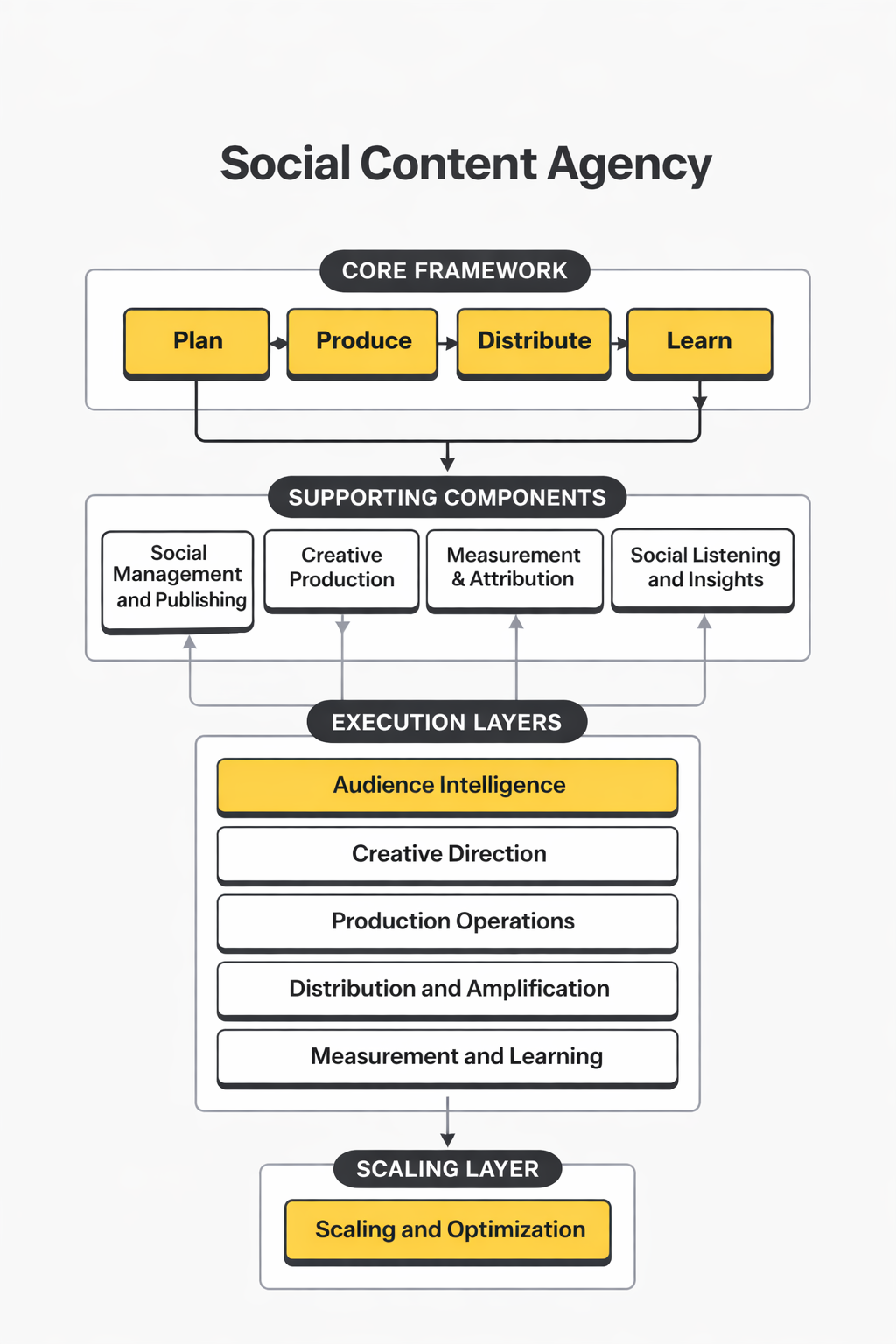
If you only remember one thing from this guide, make it this: a social content agency is valuable when it runs a compounding system, not a posting calendar. The ecosystem works when every layer supports the next.
- Positioning gives content a point of view people can recognize.
- Series and pillars turn that point of view into repeatable value.
- Production operations keep output consistent without burning the team.
- Distribution multiplies winners across formats, creators, collaborations, and selective paid.
- Measurement turns performance into decisions, not opinions.
When those layers work together, you stop chasing spikes and start building a brand presence that grows because it learns.
FAQ – Built for This Social Content Agency Guide
What does a social content agency actually do day to day?
It plans and produces content, publishes it consistently, manages approvals and collaboration, and reviews performance to decide what to improve next. The best partners treat this like an operating system: strategy becomes series, series becomes production sprints, and sprints create enough signal to optimize with confidence.
When should I hire a social content agency instead of building in-house?
Hire when you need consistent output and learning speed faster than you can build internally, or when your team is stretched thin and social is turning into a constant fire drill. If social is important to revenue but your internal team can’t run experiments reliably, an agency can bridge the gap quickly.
What should I look for in a high-quality social content agency?
Look for clear process, proof of repeatable outcomes, and a way of working that reduces chaos. The best sign is how they talk about decisions: if they can explain how analytics becomes next-week actions, they’re likely running a real system.
What deliverables should I expect in the first month?
Expect a content playbook, defined pillars and series, a production workflow, a publishing cadence, and measurement that fits your goals. You should also see the first full sprint shipped end-to-end, because the fastest learning comes from real publishing, not endless planning.
How many platforms should a social content agency manage at once?
Fewer than most brands think. Two to three core platforms is often enough to build a learning loop, then expand once you have stable series and production rhythm. Spreading thin across every platform usually reduces quality and makes measurement harder to interpret.
How should a social content agency use AI without harming trust?
Use AI for speed—drafting, cutting repetitive work, and generating variations—while keeping humans responsible for creative direction, proof, and tone. Trend analysis keeps warning that audiences will push back when content feels automated or deceptive, which is part of why social trend coverage focuses so heavily on authenticity and ethics in 2026. Sprout’s 2026 trends discussion of AI and ethics
What metrics matter most for social content performance?
Start with clarity: attention (views, reach, retention), trust (shares, saves, meaningful comments), and action (clicks with intent, conversions, assisted paths). If you need conversion accountability, prioritize measurement setups that keep signal quality high, including tools like Conversions API where relevant.
How are social content agency services usually priced?
Common models are monthly retainers, per-project packages, and performance-linked hybrids. A retainer is typically best for consistent output and learning loops, while projects fit one-time launches. The key is to align pricing with the workflow you want: if you want weekly sprints, choose a model that supports consistent cadence.
How long does it take to see results from a social content agency?
You often see early momentum within a few weeks (better consistency, clearer series, stronger hooks), but compounding results usually show over 60–90 days because you need enough cycles to learn what your audience rewards. The advantage of a real system is that each month becomes smarter than the last.
Do we need paid promotion, or can we grow organically?
You can grow organically, but paid promotion can scale proven winners faster—especially when you promote organic posts that already earned trust signals. Formats like TikTok Spark Ads exist specifically to amplify organic content without losing the social proof attached to it.
How do we avoid burnout when content volume needs to increase?
Protect the team with series, templates that don’t feel generic, and a predictable sprint rhythm. The market is crowded—Sprout’s benchmarks show brands average roughly 9.5 posts per day across networks in 2024—so scaling output without a system usually breaks people before it beats competitors.
Work With Professionals
If you’re a freelancer reading this, you already know the quiet frustration: you can do the work, but the pipeline feels unpredictable. One month you’re busy, the next month you’re refreshing job boards and wondering which “opportunity” is real.
That’s exactly why marketplaces that remove middlemen matter. Markework positions itself as a marketing marketplace where you can build a profile, connect directly, and avoid platform-style project fees—framed as no middleman and no project fees. And when you zoom out, the demand is clearly there: just one slice of the market shows scale, with Indeed listing 14,720 remote “marketing $10,000” roles—proof that companies are actively looking for marketing operators they can trust.
Imagine what changes when you’re not forced to hand over a percentage of every contract just to get introduced. Upwork, for example, states its freelancer service fee can range from 0% to 15% per contract. Even if you love those platforms, it’s hard not to feel the drag when you’re doing great work and watching a cut disappear.
Markework’s promise is simpler: get visible, get matched, and keep the relationship direct—so you can focus on doing the kind of work a great social content agency does every week: ship consistently, learn fast, and prove results.
If you want more clients without platform fees eating your upside, start where the work is already being posted and the process is built for marketers.
 Filip Konecny Enterprises