

If you run a small business, social media can feel like a daily quiz you never agreed to take. One week you’re posting consistently, the next week you’re buried in customer work, and your feeds go quiet—right when people are actively looking for businesses like yours.
This is exactly why social media packages for small businesses exist. The right package isn’t “more content.” It’s a predictable system: what gets published, where, how it gets made, how results get tracked, and how you adjust without starting from scratch every month.
Article Outline
- What Social Media Packages for Small Businesses Are
- Why Social Media Packages Matter for Small Businesses
- Framework Overview
- Core Components
- Professional Implementation
- Part 2: Package Types and Pricing Logic
- Part 3: Choosing Platforms and Content Mix
- Part 4: Analytics That Actually Help Decisions
- Part 5: Scaling the System Without Burning Out
- Part 6: FAQs and Next Steps
What Social Media Packages for Small Businesses Are

A social media package is a bundled, repeatable service that turns your marketing goals into a monthly delivery plan. Instead of buying “posts,” you’re buying an operating model: planning, production, publishing, engagement, and measurement—usually with a clear scope and a clear cadence.
For small businesses, the big advantage is consistency without chaos. You’re not reinventing your social strategy every Monday. You’re building a system that fits your real constraints: limited time, limited internal creative resources, and the reality that marketing can’t steal focus from fulfilling orders or serving clients.
Most social media packages for small businesses fall somewhere on a spectrum:
- Foundational: keep your profiles active, clarify your message, and publish reliably.
- Growth: improve content quality, build community, and tighten targeting with light paid support.
- Performance: run social like a revenue channel with testing, retargeting, and deeper reporting.
What matters is not the label—it’s the fit. A package is “good” when it matches how your business actually sells (walk-ins, bookings, quotes, ecommerce, recurring services) and when it produces signals you can act on.
Why Social Media Packages Matter for Small Businesses
Social has become a discovery engine, especially for local and service businesses. When people don’t know who to trust, they check what you post, how customers interact with you, and whether your business feels active and credible right now—not six months ago.
That behavior shows up clearly in consumer research. Social media was the top way consumers said they discover small businesses in the VistaPrint/Wix Small Business Marketing Report, with many also saying they visited a local business after seeing a social post. The same report highlights social discovery and visits driven by posts. And it lines up with broader findings that social is now a major place people learn about new brands and products. Recent Horowitz Research coverage points to social as a primary brand-learning source for many consumers, while other consumer surveys also show a large share of people discovering businesses via social.
So why does packaging matter, specifically? Because the hardest part of social media isn’t creativity—it’s operations. A good package creates:
- Momentum: a publishing rhythm that keeps you visible even during busy weeks.
- Message clarity: fewer random posts, more consistent themes that customers remember.
- Faster decisions: simple reporting that tells you what to double down on next month.
- Lower risk: approvals, access control, and brand guardrails so mistakes don’t go public.
It also helps you choose platforms rationally. Audience behavior differs by network, and the “best platform” depends on who you serve. For example, platform reach patterns in the U.S. remain highly uneven across YouTube, Facebook, Instagram, TikTok, LinkedIn, and others. Pew Research Center’s 2025 platform usage report is a good reminder that your customers are not “everywhere” equally—and your package shouldn’t pretend they are.
Framework Overview
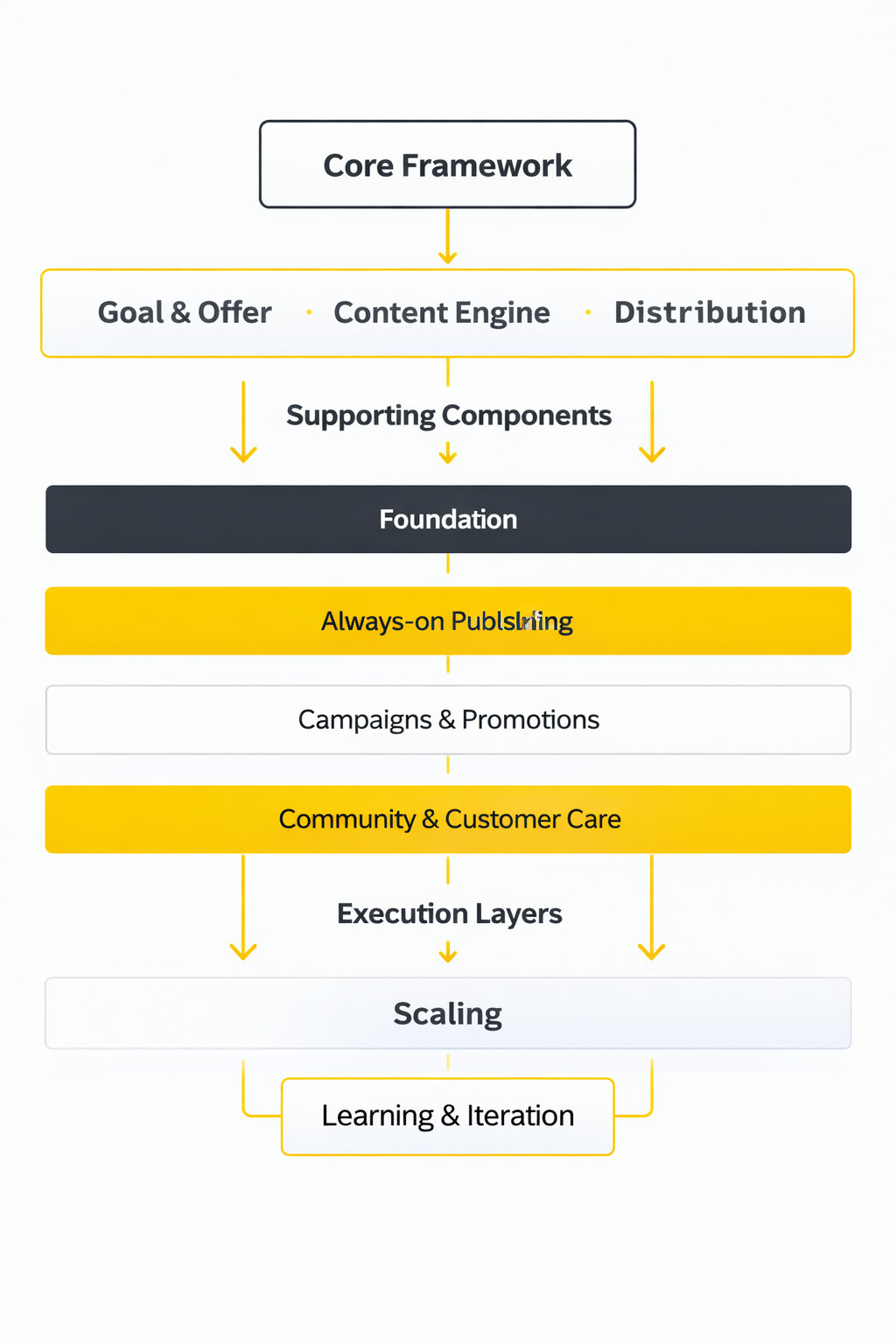
To judge any package quickly (including your own if you’re building it in-house), use this framework:
- Goal: What business outcome is this package meant to influence—bookings, calls, store visits, quote requests, email signups, ecommerce orders?
- Audience and offer: Who is this for, what problem do they want solved, and what’s the simplest next step?
- Content engine: How do ideas become posts without bottlenecks? What gets reused? What gets filmed? What gets templated?
- Distribution: Which platforms, what frequency, and what formats (video, carousels, stories, short updates)?
- Engagement: Who responds, how fast, and what counts as a “must-reply” message?
- Measurement: Which numbers tell you if this is working, and what decision will each metric support?
- Iteration: What gets tested next month—and what gets cut?
That last point is where most packages quietly fail. They deliver output, but they don’t create learning. If nothing changes month to month, you’re paying for activity—not progress.
Core Components
The strongest social media packages for small businesses are built from the same building blocks. The difference is how deep each block goes, and how much is handled for you versus with you.
Strategy and Positioning
This is the part that prevents “random posting.” Strategy defines your content pillars (the themes you repeat), your visual boundaries, and your voice. It also decides what not to do—because small teams don’t have the bandwidth to chase every trend.
If you’re planning to use social for acquisition, strategy is where you connect content to a customer journey: what helps someone discover you, what builds trust, and what gets them to take a next step. Many social leaders also believe social plays a direct role in acquisition, which is why packages increasingly include tighter funnels and clearer calls-to-action. The Sprout Social 2025 Impact of Social Media report discusses social’s link to acquisition and engagement.
Content Production
Production is where scope needs to be painfully clear. A package should spell out what’s included (and what’s not): number of posts, number of short videos, design templates, editing rounds, captions, hashtags, and whether you’re providing raw materials (photos, offers, promos) or the provider is capturing them.
It also should match how people actually consume social right now: more video, more proof, more “behind the scenes,” and less overly polished corporate messaging. If a package can’t reliably produce content you’re proud to show customers, it’s not a package—it’s a posting schedule.
Community and Customer Care
For many small businesses, the comment section and DMs are not “engagement.” They’re sales and support. A real package defines response times, escalation rules (when a message becomes a phone call), and tone guidelines so replies feel human but consistent.
This is also where reputation gets protected: review responses, light moderation, and knowing when to take a conversation private.
Paid Social and Retargeting
Not every small business needs ads immediately, but many benefit from small, controlled spend—especially retargeting people who already visited your site, engaged with your posts, or watched your videos.
Here’s what you want from the package scope: clear objectives (leads, messages, traffic, purchases), basic creative testing, and a simple retargeting layer. If the provider can’t explain where the money goes and what gets learned, don’t let them “just boost posts.”
When budgeting comes up, it helps to remember how common advertising has become even for smaller teams. Intuit’s 2025 Small Business Advertising Trends Report shows many small businesses plan to advertise and allocate meaningful budget to it—useful context when deciding whether your package should include paid management.
Analytics and Reporting
Reporting should answer three questions, in plain language:
- What worked? Which themes, formats, and topics earned attention or drove actions?
- What didn’t? What should be reduced, redesigned, or dropped?
- What’s next? What are we testing next month and why?
The best packages keep reporting lightweight but decision-focused. And they ground platform choices in real audience behavior, not assumptions. If you want a reality check on where audiences actually are and how digital habits are shifting, DataReportal’s Digital 2025 overview is a helpful reference point to pair with your own performance data.
Professional Implementation
A package can look great on paper and still fail in the real world if implementation is messy. Professional delivery is mostly about removing friction: approvals, access, version control, and predictable timelines.
Workflow and Approvals
You want a workflow that respects your time. That usually means:
- A monthly planning window (themes, offers, key dates).
- A single review moment for a batch of content (instead of approving one post at a time).
- Clear deadlines and default rules (for example: if no feedback is received by a date, content schedules as planned).
This is the difference between “done for you” and “done to you.” You stay in control without becoming the bottleneck.
Tooling and Access
Implementation should also include safe access practices: business manager access (not sharing passwords), role-based permissions, and a clean handover process if you ever switch providers. This is boring until the day it saves you.
Quality Guardrails
Guardrails are what keep content consistent: brand voice notes, visual templates, approved claims, and a simple checklist before anything goes live. This is especially important if your business is in a regulated category or if you’ve been burned by sloppy posting before.
In Part 2, we’ll map these components into real package types and explain the pricing logic behind them—so you can tell the difference between a fair scope and a “cheap” package that quietly pushes critical work back onto you.
Step-by-Step Implementation

The easiest way to make social media packages for small businesses actually work is to treat them like a rollout, not a pile of deliverables. You’re building a small operating system that can survive busy weeks, staff changes, and shifting priorities without collapsing into “we’ll post when we can.”
This step-by-step process is designed to get you live fast, then stabilize quality, then earn the right to scale.
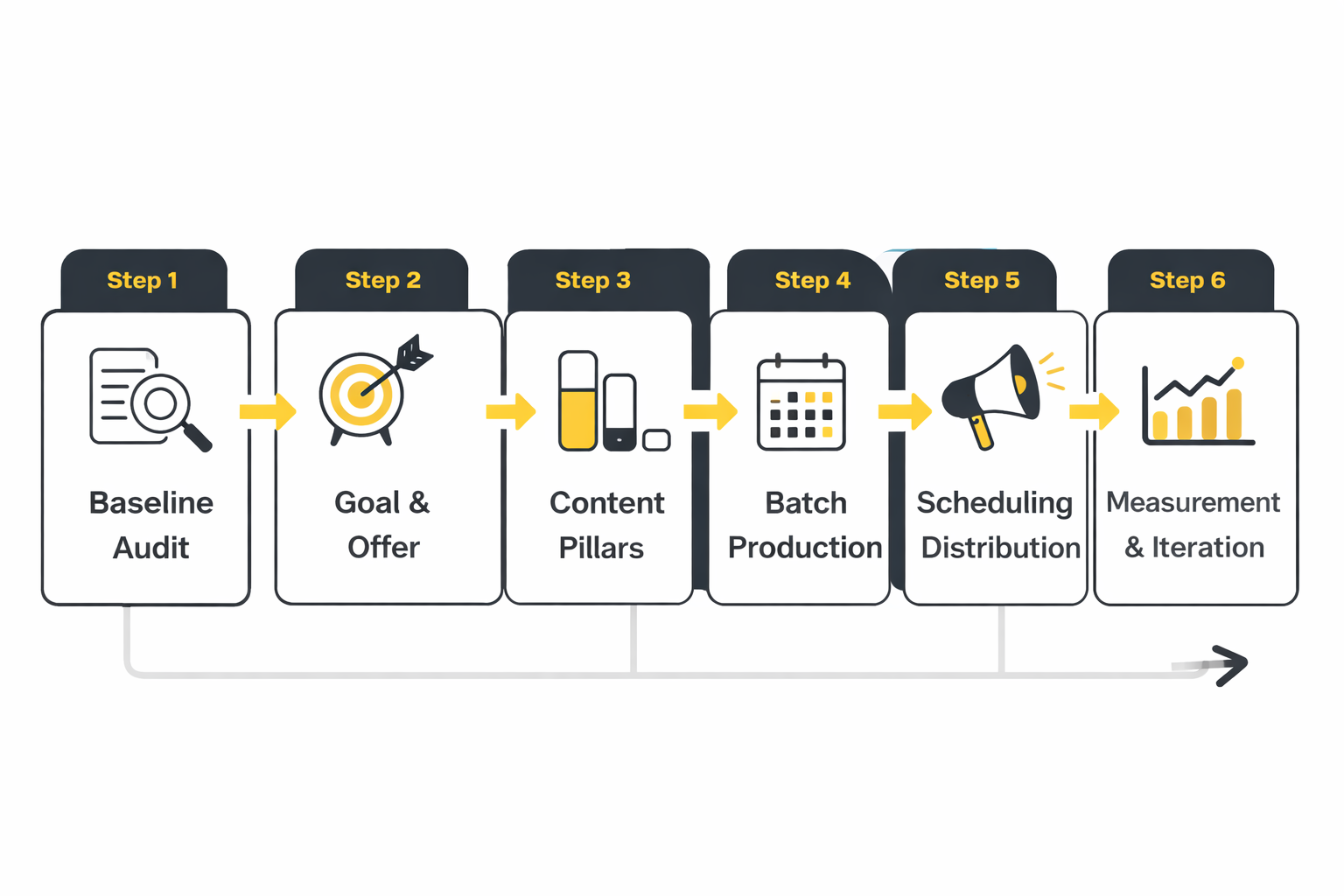
Step 1: Start with a baseline audit that’s brutally practical
Skip the vanity review of follower counts and jump straight to what affects outcomes: what offers you’re pushing, which posts create meaningful inquiries, and where people drop off. If social is expected to drive leads, make sure the basics are in place first: conversion-friendly landing pages, a clear next step, and tracking that won’t leave you guessing later.
If your package includes TikTok lead generation, for example, TikTok’s own playbooks emphasize using on-platform lead forms and measurement through the TikTok Pixel so campaigns can be optimized properly. TikTok’s Stepful case study highlights Lead Generation with web forms and Pixel setup as part of the approach.
Step 2: Lock one goal and one offer per cycle
Most small businesses lose momentum because every week becomes a new mini-campaign. Pick one primary objective for the next 30 days (bookings, quote requests, store visits, email signups, product purchases) and one core offer that content can orbit around.
This is where social media packages for small businesses become less stressful: the team isn’t asking, “What should we post today?” They’re asking, “How do we move this offer forward in a way that feels helpful?”
Step 3: Build content pillars around proof, not opinions
Create three to five repeating themes that are easy to produce and easy for customers to recognize. The winning move is to anchor those pillars in proof: customer outcomes, process clarity, behind-the-scenes realities, and answers to the questions people ask before they buy.
When brands focus on human, real-world content instead of polished corporate messaging, performance often improves because it matches how people use social now. Deloitte’s research on social-first brands emphasizes doubling down on community, content, and conversion rather than relying on outdated assumptions. Deloitte Digital’s 2025 State of Social research overview
Step 4: Batch production into a predictable rhythm
Consistency comes from batching, not from willpower. A professional package typically has one planning moment, one production window, and one approval window—then scheduling runs in the background.
A calendar becomes the single source of truth: what’s publishing, when, and why. If you’ve never run a calendar before, it helps to borrow proven structures that include post dates, formats, hooks, and production notes so nobody is guessing at the last minute. Hootsuite’s social media calendar guide lays out what a calendar includes and why it keeps teams consistent
Step 5: Schedule distribution, then protect room for real-time
Scheduling gives you stability, but real-time engagement builds trust. The balance is simple: schedule the dependable “always-on” content, then leave enough weekly capacity to respond to what customers ask, comment, and message.
That responsiveness is no longer optional. In consumer research on brand engagement, a meaningful share of people now expect fast replies in DMs, and the tolerance for silence is shrinking. Emplifi’s 2025 Social Pulse survey report is frequently cited for this shift, including the finding that 32% of consumers expect a DM response within an hour, echoed in summary reporting like MarketingCharts’ write-up on response expectations.
Step 6: Measure weekly, decide monthly
Weekly measurement is for steering; monthly measurement is for strategy. Track leading indicators weekly (reach quality, saves, replies, link clicks, lead volume, message intent) so you can adjust quickly. Then do one monthly review that ends with a decision list: what stays, what changes, what gets tested next.
This is where social media packages for small businesses stop being “management” and become growth infrastructure.
Execution Layers
Execution gets easier when you separate the work into layers. Each layer has a different job, a different cadence, and a different definition of “done.” When packages fail, it’s usually because everything gets mashed together into one vague checklist.
Layer 1: Foundation
This layer makes the account credible and operationally safe: profile hygiene, consistent bio language, accurate contact details, clear link destinations, and permissions set up so the business owns the accounts. If this is shaky, everything else becomes fragile—especially when ads or multiple collaborators get involved.
Layer 2: Always-on publishing
This is the heartbeat of social media packages for small businesses: a repeatable set of posts that keep you visible and recognizable. The goal isn’t to go viral; it’s to show up consistently with themes your ideal customers actually care about.
Always-on content is where batching and scheduling shine, because you can build a month that feels intentional instead of improvised.
Layer 3: Campaigns and promotions
Campaigns are short bursts tied to a specific objective: a seasonal offer, a new service, a product drop, an event, or a hiring push. This layer is where you decide whether paid distribution belongs in the package, because paid works best when it amplifies something already validated in organic.
If the package includes lead generation, execution should include the full chain: ad creative, lead capture, follow-up workflow, and quality checks. TikTok’s case study content shows how campaigns can be structured around lead forms and optimization signals that go deeper than surface engagement. Stepful’s Deep Funnel Optimization case story describes optimizing beyond lead submissions toward deeper actions
Layer 4: Community and customer care
This layer protects trust. Replies, DMs, and comment handling aren’t “nice to have” anymore—people treat social like a front desk. If a package doesn’t define response expectations and escalation rules, the business ends up losing leads in silence.
The fastest way to professionalize this layer is to define a response window, a tone guide, and a simple escalation path. The need for speed is backed by consumer research showing a significant portion of people expect rapid DM responses. Emplifi’s 2025 Social Pulse report plus coverage like Social Media Today’s breakdown and MarketingCharts’ summary all point in the same direction: delayed replies now carry real cost.
Layer 5: Learning and iteration
This is the layer most packages ignore, but it’s the layer that compounds results over time. Learning means documenting what worked, tagging content by theme, and turning insights into next month’s plan. Without that loop, you’re buying activity instead of progress.
Optimization Process
Optimization doesn’t mean constantly changing everything. For social media packages for small businesses, optimization is a calm, repeatable cycle: isolate one variable, test it, and keep what improves outcomes.
1) Tag content so you can learn faster
Every post should be tagged internally by pillar (education, proof, behind-the-scenes, offer, community), format (short video, carousel, static), and intent (awareness, consideration, conversion). This turns your analytics review into pattern recognition instead of gut feelings.
2) Improve the hook before you change the topic
Small businesses often assume the topic is wrong when the real issue is the opening. Before you throw away a content theme, rewrite the hook, tighten the first sentence, or change the first three seconds of the video. Keep the core idea the same so you can learn what actually caused improvement.
3) Adjust distribution order, not just frequency
Instead of posting “more,” post smarter. If a format performs well organically, promote it or repurpose it before you create something brand new. This is where paid can become efficient: it amplifies proven creative rather than gambling on untested assets.
4) Optimize for lead quality when leads are the goal
If the package is lead-driven, the real question isn’t “How many leads?” It’s “How many qualified leads became customers?” TikTok’s materials on Deep Funnel Optimization describe shifting optimization signals deeper into the funnel so campaigns prioritize higher-intent actions rather than shallow conversions. Stepful’s Deep Funnel Optimization case story
5) Use a two-speed review cadence
Run a quick weekly check to catch issues early (broken links, creative fatigue, unanswered messages). Then run a monthly decision meeting where you commit to changes: what you’re doubling down on, what you’re dropping, and what you’re testing next.
The goal is stability with progress—so the package feels like a system, not a constant scramble.
Implementation Stories
Real implementation stories rarely sound like “we posted more and everything worked.” They sound like a team hitting a wall, rebuilding the workflow, and finally getting results that don’t depend on heroics.
Stepful: Turning Social Into an Enrollment Engine Instead of a Content Chore
Start at a point of high drama: Stepful was trying to grow into a massive healthcare staffing shortage, and the pressure wasn’t abstract—it showed up as real seats that needed to be filled and real students who needed a fast path into work. Growth mattered, but growth without a repeatable acquisition system would have meant constant reinvention. Every missed week on social translated into lost attention in a market where people scroll past generic education ads in seconds. TechCrunch’s coverage of Stepful’s growth story
Backstory: Stepful is an online training company built around helping people get certified and hired into entry-level healthcare jobs, and their positioning is clear on Stepful’s website. As they scaled, the company attracted serious investor attention, including a publicly announced $12M Series A in February 2024 and a $31.5M Series B announcement in November 2024. That kind of growth raises the bar on acquisition: social can’t be “nice branding,” it has to support enrollment at pace. Business Wire’s release on Stepful’s 2025 recognition
The wall: The biggest constraint wasn’t a lack of content ideas; it was the gap between attention and action. Even strong organic content can leave you with comments and curiosity but no clean way to capture intent, measure it, and follow up quickly. When that happens, teams either chase vanity metrics or they burn out trying to “post harder.” Stepful needed a workflow that connected content, lead capture, and measurement into one loop. TikTok’s Stepful Lead Generation case study
Epiphany: The shift came when Stepful treated social like a performance channel with structured mechanics, not as a stream of posts. TikTok’s lead-generation framework made that practical: a clear objective, on-platform forms that reduce friction, and measurement infrastructure that lets campaigns learn. The playbook wasn’t “more content,” it was “better conversion plumbing.” A technical overview of TikTok Lead Generation Ads
Journey they went on to reach the goal: Stepful implemented TikTok Lead Generation and built around tactics like lead forms, Pixel measurement, and Spark Ads to leverage proven organic content. Those execution choices are called out directly in TikTok’s Stepful case study tips and takeaways. They also pushed optimization deeper, using TikTok’s Deep Funnel Optimization so the system could prioritize higher-intent actions instead of stopping at raw lead volume. That approach is described in TikTok’s DFO story on Stepful.
Final conflict: As soon as lead volume rises, a new problem appears: not all leads are equal, and messy follow-up can erase marketing gains. Stepful’s own case materials describe focusing on deeper-funnel signals to improve quality, which is exactly what small businesses run into when they scale from “some leads” to “lots of leads.” Even with better optimization, teams still have to align marketing with enrollment operations so speed doesn’t destroy the customer experience. The need for fast, structured response is reinforced by consumer research showing many people now expect prompt replies to social messages. Emplifi’s 2025 Social Pulse report
Dream outcome: Stepful’s TikTok case study publishes concrete performance outcomes, and those numbers are echoed in multiple places tied to the campaign narrative. The same lead volume and cost-per-lead improvements appear in TikTok’s Stepful case study, in TikTok’s education industry page that references the results and links to the case study, TikTok’s education industry page, and in a TikTok employee’s LinkedIn post sharing the published case study outcomes. LinkedIn post referencing the Stepful TikTok case study results
Set service-level expectations for engagement
Packages that include community management should define response windows and escalation paths. This is no longer a “nice detail.” A meaningful portion of consumers now expect fast DM replies, including the widely cited finding that 32% expect a response within an hour, supported by the underlying research and multiple summaries. Emplifi’s 2025 Social Pulse report Social Media Today’s coverage MarketingCharts’ summary
Run everything through one calendar and one approval loop
A professional package doesn’t ask you to approve content one post at a time in scattered messages. It gives you a batch review window and a single source of truth calendar that includes creative notes, posting dates, and platform-specific requirements. When the calendar is real, the business stops feeling like social is “random” and starts seeing it as an organized channel. Hootsuite’s social media calendar overview
Make measurement credible with tracking discipline
If your package promises leads or sales influence, measurement can’t be vibes. Use consistent tracking conventions, keep landing pages aligned with the offer, and make sure paid campaigns have measurement signals set up correctly. TikTok’s published guidance in Stepful’s case materials repeatedly points back to this: forms, pixels, and optimization signals are part of implementation, not an optional extra. Stepful Lead Generation case study
End every month with decisions, not reports
Professional social media packages for small businesses create an iteration habit. The monthly review should end with three commitments: what you’re repeating, what you’re improving, and what you’re testing. That’s how the system gets stronger over time without needing more hours from the owner.
Statistics and Data
By the time a small business owner asks about social media packages for small businesses, they usually have the same quiet fear: “What if we post for months and it still doesn’t move revenue?” Data is what turns that fear into something you can manage, because it forces every decision to answer one question: what changed in the business after we shipped the work?
The first wake-up call is customer attention. People don’t treat social like a billboard anymore; they treat it like a front desk. In Emplifi’s 2025 consumer survey, 32% of consumers expect a DM response within one hour, and the same report shows how quickly a “slow reply” becomes a “lost customer” problem.
The second wake-up call is cost pressure. When the platform economy expands, it usually means more advertisers competing for the same eyeballs. Meta’s own earnings releases show that ad impressions and average price per ad both rose year-over-year in 2025, which is a polite way of saying: if your creative and targeting aren’t improving, you’re likely paying more for the same outcomes.
The third wake-up call is behavior. Social is increasingly where people discover and decide. Deloitte’s State of Social research (2025) frames this shift clearly: brands that win treat social as a system that blends community, content, and conversion instead of separating “posting” from “selling.” That’s exactly why measurement belongs inside the package, not bolted on later.
Performance Benchmarks
Benchmarks are helpful when they do one job: keep you from panic-optimizing. A weak week doesn’t mean the package is failing, and a strong week doesn’t mean you’ve found a magic format. Benchmarks give you a baseline so you can ask better questions, like “Is this normal seasonality?” or “Did we actually change something that would explain the shift?”
Here are a few practical benchmarks that fit naturally into social media packages for small businesses:
- Speed benchmark (customer care): If you treat DMs and comments like support tickets, the expectations are blunt. Emplifi’s 2025 survey breaks response-time expectations down clearly, including 32% wanting a reply within one hour and meaningful chunks expecting answers within 6, 12, and 24 hours. For many local businesses, this is the simplest “benchmark win” because it’s mostly process, not budget.
- Format benchmark (short-form video mix): If your package includes Instagram, Reels isn’t a “nice to have.” Emplifi’s 2025 benchmarks report notes that Reels grew to about 38% of brand posts by the end of 2024. That doesn’t mean you should copy-paste trends; it means your content plan should realistically include video capacity.
- Engagement benchmark (reach engagement): Emplifi’s network-level reporting shows a median video reach engagement rate around 2.2% for Instagram in 2024 (down from 2.6% in 2023 in their dataset). This is useful because it stops teams from obsessing over vanity spikes and pushes them toward repeatable creative patterns.
- Spend benchmark (Reels ads behavior): Even if you’re not running big budgets, paid distribution patterns signal where attention is going. Emplifi’s benchmarks report shows median Reels ad spend per account in Q4 2024 as $763 on Facebook Reels and $317 on Instagram Reels in their data. The point isn’t to match those numbers; it’s to understand that Reels is where many advertisers are actively testing, which raises the bar on creative.
- Inventory benchmark (Reels share of Instagram impressions): Tinuiti’s digital ads benchmark reporting notes that Reels represented about 26% of Instagram ad impressions in Q3 2025. If you’re buying Instagram ads and not thinking about Reels placements, you’re ignoring a large slice of available delivery.
The real trick is using benchmarks to choose what to improve. If engagement is fine but leads are flat, you don’t need “more entertaining posts.” You need a tighter offer, clearer CTAs, and a landing or DM flow that doesn’t leak intent.
Analytics Interpretation
A dashboard can be dangerously convincing. It’s full of charts, and it feels like progress. But analytics only helps small businesses when it answers business-shaped questions, not platform-shaped ones.
Here’s a simple way to interpret results inside social media packages for small businesses without getting lost:
- Start with the outcome, then trace backward. If the outcome is bookings, you need a trail you can follow: bookings → leads → clicks/DMs → content/ads. That trail tells you where the system is breaking.
- Separate “distribution” metrics from “persuasion” metrics. Reach, impressions, and video views mostly tell you whether the platform distributed your content. Saves, replies, DM starts, and form completions tell you whether the message persuaded someone.
- Look for consistency before you chase scale. If your lead volume depends on one viral post, you don’t have a marketing system yet. Your goal is repeatable weekly performance, then gradual growth.
- Use time windows that match buying behavior. A restaurant might see same-day impact. A B2B service business might need weeks of touchpoints. Deloitte’s State of Social research emphasizes the full-journey nature of social; your reporting window should match that reality.
- Make response time a tracked KPI if you sell anything that involves trust. Social care is often a conversion lever. Emplifi’s data on DM response-time expectations is a reminder that “we’ll respond tomorrow” can quietly erase revenue today.
One more lens that keeps teams sane: don’t interpret a metric without naming the decision it will change. If the answer is “none,” it’s noise. Remove it from the report and spend that attention budget on creative and offers.
Case Stories
Real stories are useful because they show how numbers behave when people behave. Not in a tidy “we changed one thing and won” way, but in the messy way small businesses actually live: the phone rings mid-shift, reviews hit at the worst time, and the owner is still the one answering DMs.
RedPro USA Turned Instagram DMs Into A Lead Pipeline
It started with the kind of pressure that makes your stomach drop. RedPro USA was running ads, getting interest, and still watching inquiries evaporate before they became real conversations. Every day that passed felt like money slipping through their fingers, because the clicks were there, but the certainty wasn’t.
The backstory was familiar: growth meant juggling too much. They needed more leads, but they also needed leads that could be handled without building a call center. The team wanted a simpler path where a prospect could raise a hand and get a human reply quickly, without bouncing through a maze of pages.
The wall came when “more traffic” stopped helping. Clicks didn’t automatically create trust, and forms didn’t guarantee follow-through. Even when people were interested, the delay between curiosity and contact was long enough for them to cool off, second-guess, or choose someone else.
The shift was a small epiphany with a big implication: stop forcing prospects to travel. Instead of pushing everyone to a landing page and hoping they’d complete a form, they leaned into a behavior people already do all day—sending messages. They used click-to-message ads so the first conversion step was simply starting a DM conversation.
Then the journey became operational, not magical. They built a process for fast replies, quick qualification questions, and clear next steps. It wasn’t about clever copy; it was about removing friction, making the handoff feel human, and treating the inbox like a sales queue.
Of course, things went wrong on the way. When message volume rises, slow response times can creep back in, and a busy day can undo a week of momentum. Keeping the pipeline healthy meant protecting time to respond, templating answers without sounding robotic, and tightening the qualifying questions so the team didn’t drown.
The dream outcome showed up as clean, countable progress. Meta’s published success story notes that RedPro USA generated 100 leads via ads that click to Instagram Direct in May 2025, and that 60 of those leads were qualified in the same period. The bigger lesson for social media packages for small businesses is simple: sometimes the “funnel” isn’t a website—it’s a conversation that starts where the customer already is.
Stepful Used TikTok Lead Forms To Cut Cost Per Lead
The tension hit when Stepful needed more prospective students, fast, and the usual playbook wasn’t delivering enough at a sustainable cost. When a growth target is tied to enrollment timelines, “we’ll keep testing” doesn’t feel like strategy—it feels like gambling. Every week without efficient leads made the runway feel shorter.
The backstory was that Stepful operates in a competitive space where attention is expensive and trust matters. People don’t casually sign up for training programs; they need reassurance, clarity, and a low-friction way to take the first step. That meant the ads couldn’t just entertain—they had to convert intent into a real contact method.
The wall was cost. Lead volume might rise, but if the cost per lead climbs with it, you’re building a bigger problem. Stepful needed a way to turn TikTok attention into measurable submissions without losing people in the “tap, load, wait, abandon” gap that happens when you send mobile users off-platform.
The epiphany was to let the platform do what it’s built for: keep users in-flow. Instead of treating TikTok like a billboard that sends people elsewhere, they leaned into TikTok’s Lead Generation objective and native forms. The form became the conversion moment, not the website.
The journey was disciplined testing. They ran lead-focused creative, optimized toward submissions, and let the system learn who was likely to complete the form. TikTok’s own case materials describe the results: over 85K lead form submissions and a CPA drop from $23 to $13.29 when compared to previous TikTok campaigns.
But the final conflict was what happens after the lead. A pile of form submissions isn’t the same as qualified prospects, and follow-up speed determines whether intent turns into action. Stepful had to make sure the downstream process could keep pace, because delay can quietly waste even “cheap” leads.
The dream outcome was more than lower costs—it was a clearer growth engine. The case shows how native lead capture can change the economics of a channel when the offer, creative, and follow-up system work together. For small businesses, the takeaway isn’t “copy Stepful,” it’s “reduce friction, then measure what the reduced friction actually did.”
Professional Promotion
When you sell social media packages for small businesses, the reporting is part of the product. Not because clients love spreadsheets, but because they’re buying peace of mind. They want to know what’s working, what’s not, and what you’re doing next—without feeling like they need a marketing degree to understand it.
A professional analytics layer usually comes down to a few habits:
- Make one “north star” metric non-negotiable. Bookings, calls, store visits, quote requests, trial starts—pick the one that matters and build the report around it.
- Show the chain, not just the number. If the north star moved, show which inputs moved first (creative, offer, distribution, response time). If it didn’t move, show where the chain broke.
- Report decisions, not activity. “We posted 20 times” is activity. “We doubled down on Reels because it’s a growing share of brand output and inventory” is a decision that ties back to reality, including benchmarks like Reels’ rising share of posts and its growing share of Instagram ad impressions.
- Include one customer-care metric if DMs matter to sales. If response time is slow, no creative fix will save you. The “one hour expectation” data in Emplifi’s 2025 survey makes this easy to justify without sounding dramatic.
- End every report with a plan. Three concrete tests, one clear hypothesis each, and what “better” looks like before you launch. This is how packages feel like strategy instead of random content.
That’s how analytics becomes promotional without being salesy: the work speaks for itself, because the client can see the system getting sharper month by month.
Future Trends
The next wave of social media packages for small businesses will feel less like “content services” and more like a compact growth system that protects time, protects brand safety, and makes results easier to measure.
Here are the trends shaping what clients will expect next, and what strong packages will quietly build in before anyone asks.
Messaging becomes the default conversion path
For a lot of small businesses, the fastest path from curiosity to customer is still a conversation. The trend isn’t just “more DMs,” it’s DMs becoming the first conversion step in the funnel. That makes response speed and inbox operations part of performance marketing, not customer service.
This shift is being pulled by consumer expectations. Emplifi’s 2025 consumer research highlights that 32% of consumers expect a DM response within one hour, which is exactly why future-ready packages will include response windows, saved-reply systems that still sound human, and escalation rules that prevent leads from dying in silence.
Short-form video operations become standardized
Small businesses aren’t “becoming creators.” They’re being forced to build lightweight production habits because short-form video is where attention and ad inventory keep shifting.
On the organic side, Emplifi’s benchmarks show how brand output evolved, including Reels growing to about 38% of brand posts by the end of 2024. On the paid side, Tinuiti’s benchmark reporting notes that Reels represented about 26% of Instagram ad impressions in Q3 2025. Packages that don’t include a real video workflow will feel outdated fast.
Commerce inside the feed expands, even for small brands
Even if a small business never uses in-app checkout, audiences are getting used to buying without leaving the platform. That changes expectations around speed, proof, and frictionless offers.
TikTok’s own UK newsroom reported that Black Friday 2025 hit 27 items sold per second and BFCM sales were up 50% vs. 2024. It also notes TikTok Shop now supports more than 200,000 SMBs in the UK. That kind of momentum pushes every other platform to keep tightening the “see it, want it, buy it” loop.
Ad cost pressure keeps rising, so creative becomes the real lever
As more advertisers compete, weak creative gets punished. Small businesses won’t be able to “set and forget” boosted posts and expect stable results.
Meta’s earnings releases show the direction clearly, including average price per ad rising 9% year-over-year for full-year 2025. This is why the strongest social media packages for small businesses will include creative testing and iteration as a standard monthly habit, not an upsell.
Regulation and trust expectations increase
Small businesses usually feel regulation late, but they still feel it. Platform rules, privacy rules, and consumer skepticism all push toward cleaner tracking, clearer claims, and safer account ownership practices.
In Europe, the Digital Markets Act continues to reshape platform behavior and marketplace dynamics at the “gatekeeper” level. European Commission updates on DMA enforcement are a reminder that platform ecosystems can change fast, and the best packages keep ownership, access, and measurement resilient.
Strategic Framework Recap
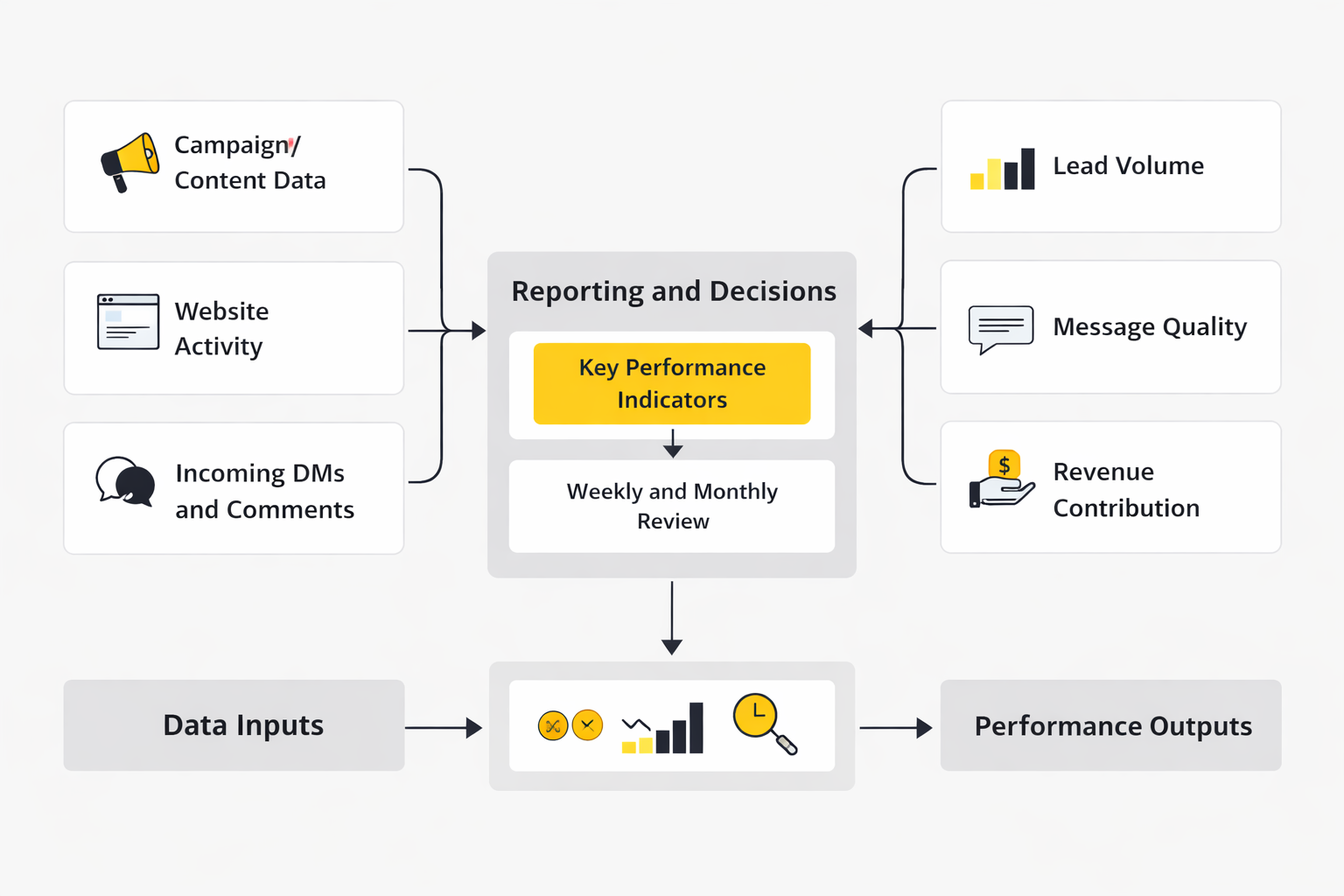
If you want a simple way to evaluate social media packages for small businesses, come back to one core idea: the package should be a system that compounds, not a list of posts.
- Goal: one outcome that matters (bookings, leads, sales, store visits) and one clear offer per cycle.
- Content engine: content pillars built around proof, produced in batches, shipped on a calendar.
- Distribution: a realistic platform and format mix that matches capacity and attention trends.
- Engagement: response rules and inbox ownership so conversations don’t get dropped.
- Measurement: tracking that ties activity to outcomes and ends with monthly decisions.
- Iteration: a small set of tests each month so the system gets sharper over time.
When those pieces are present, the package feels calm. When they’re missing, social turns into recurring panic and random posting, no matter how talented the creator is.
FAQ – Built for This Complete Guide
1) What should be included in social media packages for small businesses?
At minimum: a content plan (themes and offers), production (posts and short-form video if relevant), scheduling, basic community management, and reporting that ends with decisions. If the package includes paid, it should also include creative testing, tracking setup, and a clear optimization cadence.
2) How many posts per week is “enough” for a small business?
Enough is the amount you can sustain without quality collapsing. Many small businesses do better with fewer, stronger pieces shipped consistently than with daily posts that feel rushed. Your package should be designed around a production rhythm you can keep during busy seasons.
3) Should a package include Reels or short-form video?
If your customers spend time on Instagram, short-form video is hard to ignore. Brand posting behavior has shifted meaningfully, including Reels growing to about 38% of brand posts by the end of 2024. A good package doesn’t force daily video, but it does include a realistic way to produce video consistently.
4) What’s the biggest red flag in a proposal for a social package?
Vague scope and vague measurement. If you can’t tell what happens each week, how approvals work, and how results turn into next-month changes, you’re likely buying activity. A reliable package makes responsibility and cadence painfully clear.
5) Do we need paid ads inside the package?
Not always at the beginning. Many small businesses should stabilize organic operations first: consistent publishing, strong proof content, and fast engagement. Paid becomes valuable when you have something worth amplifying and you can track what the spend actually produces.
6) What metrics matter most for small businesses?
The metrics that connect to your business outcome. For many, that’s message intent (DM starts), leads, booking clicks, call clicks, and conversion rate on the next step. Vanity metrics like views and likes can be useful for creative learning, but they’re not the finish line.
7) How fast should we reply to DMs and comments?
As fast as your category requires, but faster than “tomorrow” if you want social to convert. Consumer expectations are tightening, including 32% of consumers expecting a DM response within one hour. If your package treats engagement as optional, it will leak leads.
8) How do we keep brand voice consistent if multiple people create content?
Use templates and guardrails: content pillars, example captions, do/don’t language rules, and a small library of reusable formats. A shared asset library and a single approval loop also prevents “three different voices” showing up in the same week.
9) What should a monthly report look like for a small business?
Simple and decision-focused: what worked, what didn’t, and what changes next. It should also show the chain from content to action (DMs, clicks, leads, bookings) so you can see where the system is strong or leaking.
10) How do we know if the package is working if sales cycles are long?
Use leading indicators that match the journey: saves, replies, DM intent, lead quality, and conversion rates on the next step. Social can influence decisions for weeks, so you’re looking for steady upward movement in signals that historically correlate with revenue in your business.
11) What’s the smartest way to scale a package without burning out?
Template what repeats, batch production, and scale distribution before adding platforms. As demand grows, protect inbox response time and protect quality. Scaling works when the system gets more efficient, not when the workload simply gets bigger.
12) Will social commerce matter if we’re not a big brand?
It can, especially if you sell products that benefit from demonstration and trust-building. TikTok’s UK reporting shows how fast in-app buying behavior is accelerating, including 27 items sold per second on Black Friday 2025 and support for 200,000+ SMBs in the UK. Even if you don’t use native checkout, audiences are getting used to faster buying journeys.
Work With Professionals
If you’re building social media packages for small businesses, you already know the hard part isn’t the strategy. It’s the pipeline. One month you’re booked solid, the next month you’re refreshing your inbox and wondering how you’ll replace a client who just paused.
Meanwhile, the market demand is real. Large job boards routinely show massive volumes of remote marketing roles and contracts, including pages that list over 14,000 remote marketing job results for a single filtered query. The problem isn’t that companies aren’t hiring. The problem is access, friction, and platforms that tax you on every win.
Markework is built around a simpler idea: connect marketers and companies directly, skip the middle layer, and keep the economics clean. The platform positions itself as a marketing marketplace with direct communication and no project fees, and its pricing model makes the promise concrete with subscription plans that emphasize no commissions and no project fees.
When you’re trying to grow as a marketing freelancer, that matters. You’re not losing a percentage of every project to a platform fee. You’re not stuck behind gated conversations. You can negotiate directly, protect your rates, and build relationships that turn into recurring work.
And it doesn’t feel empty. Markework’s work board shows 1,007 active listings visible on the marketplace, with the note that creating an account unlocks full access. If what you want is momentum, the workflow is straightforward: build a profile, apply consistently, and talk to companies without a middleman.
The dream is simple: fewer hours chasing leads, more hours doing the work you’re proud to ship—while keeping 100% of what you earn because the platform isn’t taking a cut of every deal.
 Filip Konecny Enterprises