

Businesses everywhere are competing for attention in the same crowded digital space. More than 5 billion people now use social media worldwide, making platforms like Instagram, LinkedIn, TikTok, and Facebook some of the most powerful marketing channels ever created. But building a consistent presence across those platforms requires far more than occasional posting.
This is where professional social media management becomes essential. Companies increasingly outsource strategy, content production, scheduling, and analytics to specialists who understand how algorithms, audience behavior, and content formats evolve. Naturally, one of the first questions businesses ask is how social media management services pricing actually works.
The answer is rarely simple. Pricing can vary dramatically depending on the number of platforms, the complexity of content, the scale of campaigns, and whether a freelancer, agency, or internal team handles the work. Industry analyses show that most businesses pay somewhere between $500 and $5,000 per month for professional social media management, though enterprise campaigns can exceed $10,000 monthly when advanced strategy, video production, and paid media management are included.
Understanding these price structures is important for both sides of the market. Businesses need clarity about what they are paying for, while freelancers and agencies must build pricing models that reflect the real workload behind successful social media marketing.
This guide breaks down the economics behind social media management services pricing, explains the factors that influence costs, and outlines a practical framework used by professionals to structure their services.
Article Outline
- What Social Media Management Services Pricing Means
- Why Social Media Management Pricing Matters
- Framework Overview
- Core Components of Social Media Pricing
- Professional Implementation
What Social Media Management Services Pricing Means

Social media management services pricing refers to the structured way professionals charge for planning, creating, publishing, and analyzing content across social platforms. It covers everything from editorial calendars and graphic design to audience engagement and performance reporting.
At its core, pricing reflects the amount of strategic work required to maintain and grow a brand’s presence online. A simple account that posts a few times per week on one platform requires far less effort than a multi-channel strategy involving daily content, short-form video production, community moderation, and paid advertising campaigns.
Because the workload varies widely, pricing models tend to fall into several categories. Monthly retainers are the most common because social media marketing works best when executed consistently over time. Businesses hire a freelancer or agency to manage ongoing activity such as content planning, publishing schedules, audience engagement, and reporting.
Another model involves hourly billing for consulting, audits, or short-term projects. Industry research indicates that freelance social media specialists typically charge between $35 and $150 per hour, while agencies often charge $75 to $300 per hour depending on expertise and scope.
Finally, some providers use package-based pricing. These bundles define a fixed number of platforms, posts, and services. Packages simplify decision-making for clients because they clearly outline what is included in each tier of service.
Regardless of the model used, the goal remains the same: align the cost of social media management with the level of strategy, creativity, and operational work required to achieve measurable results.
Why Social Media Management Pricing Matters
Pricing is not just a budgeting concern. It directly influences the quality of social media marketing a company receives.
When businesses underestimate the workload behind professional social media management, they often expect complex strategies at extremely low budgets. The result is inconsistent posting, limited analytics, and campaigns that fail to generate meaningful engagement or conversions.
On the other hand, a well-structured pricing model ensures that the resources invested match the expected outcomes. Strategic content planning, video editing, audience interaction, and performance analysis require time and specialized skills.
Research comparing professionally managed accounts with unmanaged ones highlights the impact of consistent execution. Brands that invest in structured social media management often see significantly stronger results, including higher reach, faster audience growth, and stronger engagement rates over time. These improvements stem from data-driven planning, optimized posting schedules, and ongoing experimentation with content formats.
For freelancers and agencies, pricing clarity also protects sustainability. Managing multiple social channels involves a continuous workflow that includes ideation, design, writing, publishing, monitoring comments, responding to messages, and analyzing performance metrics. Without a pricing structure that reflects this workload, maintaining service quality becomes nearly impossible.
In short, understanding social media management services pricing allows businesses to allocate marketing budgets realistically while enabling professionals to deliver results that justify the investment.
Framework Overview
A practical framework for understanding social media management services pricing breaks the work into several layers of responsibility. Each layer contributes to the final cost because it requires different types of expertise and time commitment.
The first layer is strategic planning. Before content is ever published, professionals analyze the brand’s target audience, competitors, and market positioning. This phase includes defining content themes, messaging guidelines, and measurable performance goals.
The second layer is content production. This involves writing captions, designing graphics, producing video clips, and preparing posts that align with the overall strategy. Visual storytelling has become especially important as platforms prioritize short-form video and interactive formats.
The third layer is operational execution. Posts must be scheduled, published, monitored, and optimized. Engagement with followers, responses to comments, and direct message management are all part of maintaining an active online community.
The final layer focuses on analytics and optimization. Social media performance is tracked using engagement metrics, reach, audience growth, and conversion data. Professionals analyze these results and adjust the strategy accordingly to improve outcomes over time.
Each layer adds complexity and value to the service. As businesses require more platforms, more content formats, or deeper analytics, pricing naturally increases to reflect the expanded scope of work.
Core Components of Social Media Pricing
Although pricing structures differ between providers, most social media management services are built around several core components that determine the final cost.
The first component is the number of social media platforms being managed. Handling one platform like Instagram requires less coordination than managing five or six channels simultaneously. Each additional platform introduces different content formats, audience behaviors, and scheduling requirements.
The second component is posting frequency. Brands that publish content daily require far more creative production and editorial planning than those posting once or twice per week. High posting frequency increases the workload across writing, design, scheduling, and performance tracking.
Content complexity is another major factor. Basic packages may include simple text posts and template graphics, while advanced packages include professional photography, animation, and short-form video production. As video content becomes more dominant across platforms, production costs increasingly influence overall pricing.
Community management also plays a significant role. Responding to comments, messages, and customer questions can require continuous monitoring throughout the day. Businesses with large audiences often require dedicated support to maintain timely communication with followers.
Finally, reporting and strategic optimization contribute to pricing. High-quality social media management includes regular performance analysis and recommendations for improving engagement, reach, and conversions.
When these components are combined, it becomes easier to understand why pricing varies so widely across providers and service tiers.
Professional Implementation
Turning pricing theory into a real service offering requires careful structuring. Professionals who manage social media effectively typically organize their services into tiers that correspond with the level of strategic support provided.
An entry-level tier usually focuses on basic account management. This includes content scheduling, simple graphics, and a limited number of posts per week on one or two platforms. These packages often appeal to small businesses that need consistent activity but do not require complex campaigns.
Mid-level packages expand the service scope. They typically include multi-platform management, custom graphics, audience engagement, and monthly analytics reports. Businesses at this stage are often looking to grow their audience and build stronger brand visibility.
Premium tiers deliver full-scale digital marketing support. These packages combine social media strategy, advanced content production, advertising management, and detailed performance analysis. They are designed for companies that rely heavily on social media as a primary growth channel.
The key to successful implementation lies in aligning deliverables with measurable outcomes. When pricing structures clearly define what services are included, businesses understand the value they receive, and social media professionals can maintain a sustainable workload while delivering high-quality results.
Step By Step Implementation
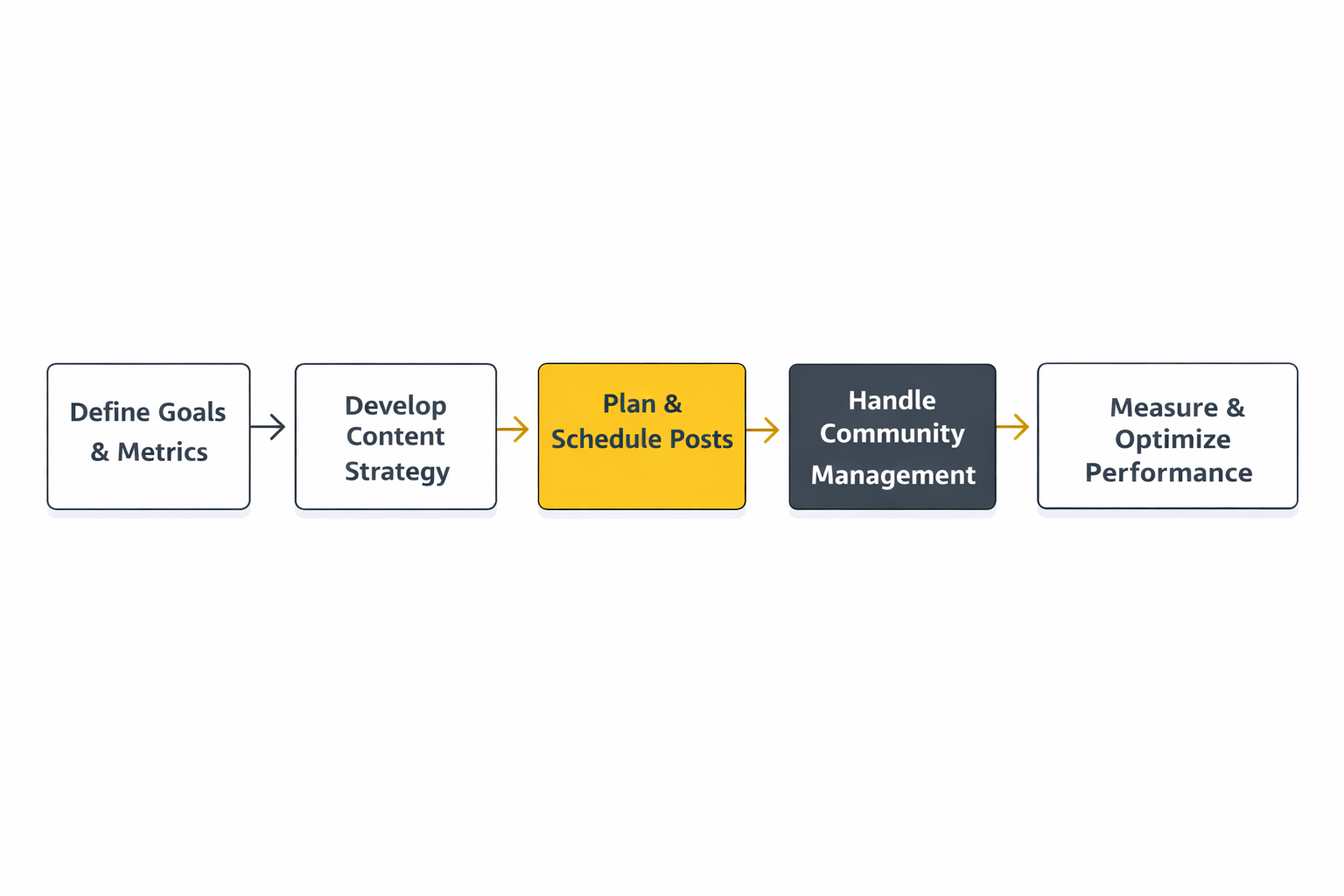
When clients ask about social media management services pricing, they usually want one thing: a clear path from “what you’ll do” to “what it will cost.” The fastest way to get there is to implement pricing as a process, not a guess.
Step 1: Map the business outcome before you map the work. Start with what the client actually needs social to do: demand generation, recruiting, customer care, product awareness, community growth, or all of the above. Social matters because of its scale and daily relevance in people’s lives, and the size of the audience is no longer a rounding error. The Digital 2025 global report puts social media user identities at 5.24 billion, which is a helpful reminder that “we’ll just post sometimes” rarely matches the reality of what the channel can deliver. :contentReference[oaicite:0]{index=0}
Step 2: Run a pricing-oriented audit. The purpose of an audit here is not to produce a long PDF. It’s to identify scope drivers that directly change cost, like the number of platforms, approval complexity, brand safety requirements, and how fast the client expects responses to comments and messages. If the brand expects near-real-time replies, that’s not “a nice-to-have,” it’s staffing.
Step 3: Convert scope into units. Units are what make pricing stable. Common units include: platforms managed, content pieces produced, rounds of revisions, community management coverage windows, and reporting cadence. Once everything has a unit, the work stops feeling fuzzy and starts feeling like a system.
Step 4: Decide what gets bundled and what becomes an add-on. Bundling is how you keep the base package predictable. Add-ons are for things that can explode in effort: short-form video editing, influencer coordination, UGC sourcing, paid social management, social listening, and crisis response support.
Step 5: Attach tool costs to the right layer. Tools aren’t just “software overhead.” They enable capabilities that clients feel: faster publishing, fewer errors, cleaner reporting, and more consistent customer care. When you’re using a platform that meaningfully reduces reporting time, you can justify higher-value work on strategy and creative, instead of billing clients for manual spreadsheet labor.
Step 6: Put the workflow into the contract. Clear expectations prevent pricing disputes. Spell out approvals, turnaround times, the revision policy, what “community management” includes, and what happens when the client wants to add a new platform mid-month.
Step 7: Establish a 30-day reset point. The first month is where assumptions meet reality. The goal is not to renegotiate constantly; it’s to validate whether the unit assumptions were correct and to adjust scope if the workload is meaningfully different than planned.
Execution Layers
If you want social media management services pricing to feel fair to both sides, the execution has to be layered. Layers make it obvious why two “social media packages” can cost wildly different amounts without either side being dishonest.
Layer 1: Strategy And Governance
This layer includes positioning, brand voice, content pillars, audience definition, and guardrails for what the brand will and won’t do on social. It also includes governance: approvals, escalation paths, and brand safety rules. If the brand is regulated or has strict legal review, governance becomes a real production constraint, and pricing needs to reflect that.
Layer 2: Content Production
This is where time disappears if you don’t define units. Writing, design, video editing, templates, thumbnails, hooks, captions, and accessibility elements like subtitles all live here. On platforms like LinkedIn, video and storytelling craft matter enough that LinkedIn has published dedicated research on what correlates with impact in B2B video, including a creative analysis at scale in The Art & Science of Video Storytelling. :contentReference[oaicite:1]{index=1}
Layer 3: Publishing And Quality Control
Publishing is not just clicking “post.” It’s formatting, tagging, link hygiene, thumbnail choices, hashtag strategy where relevant, and cross-platform adaptation. Quality control includes checking that the post matches the brand voice, that the creative fits the platform’s specs, and that the post won’t embarrass the client because a broken link slipped through.
Layer 4: Community And Customer Care
This layer is where many retainers break if it isn’t priced correctly. A brand that expects quick replies is asking for availability, not just skill. Research and consumer surveys regularly show that responsiveness is a major reason people value brand presence on social, and Hootsuite’s consumer trend reporting has been cited for the idea that fast responses are what users want most from brands on social. :contentReference[oaicite:2]{index=2}
Layer 5: Measurement And Optimization
This includes dashboards, reporting narratives, experiment design, and decisions about what to do next month. If reporting is superficial, clients question value and churn. If reporting is actionable, it becomes a decision engine the client can use beyond marketing.
Optimization Process
Pricing is easier to defend when your optimization process is visible. Clients rarely complain about cost when they can see momentum, learning, and decisions being made with discipline.
Start with a baseline that’s honest. Capture current performance and operational reality: how long content takes to approve, what formats the client can realistically produce, and what customer care expectations look like. The point is not to inflate the numbers; it’s to define what “better” should mean in this specific business.
Run optimization as a monthly loop, not a random burst of ideas. Each month should include (1) a plan, (2) an execution window, (3) measurement, and (4) a decision: double down, modify, or stop. When that loop exists, the retainer stops feeling like an expense and starts feeling like an operating system.
Use experimentation that matches the client’s risk tolerance. Some brands want bold creative tests. Others want controlled iteration. Either is fine, but it changes the workload. Rapid testing requires faster creative production and quicker approvals, which changes social media management services pricing because it changes how much work must happen in a fixed timeframe.
Automate reporting so humans can think. Forrester’s Total Economic Impact study on Sprout Social describes major efficiency improvements, including a reduction in time spent on social reporting, which is a practical example of how tooling can shift effort away from manual tasks and toward strategy. If you’re using a reporting stack that meaningfully reduces reporting time, document that in your process and explain what you’re doing with the saved time. :contentReference[oaicite:3]{index=3}
Define what triggers a scope change. Optimization often increases volume: a post goes viral, inbound messages spike, leadership wants daily posting, or a new product launch appears. Your agreement should state what counts as “normal variance” and what requires a scope adjustment, so the relationship stays healthy.
Implementation Stories
Here’s what disciplined implementation can look like in the real world, using published case details. The point isn’t to copy a brand’s exact tools, but to see how operational changes translate into measurable outcomes and, ultimately, how teams justify investment.
How Sprout Social Turned Customer Care Into A Measurable System
The week the volume spiked, the team wasn’t just busy. They were drowning. Messages were coming in faster than humans could triage them, and the longer a question sat unanswered, the more it looked like the brand simply didn’t care. :contentReference[oaicite:4]{index=4}
It felt like the worst kind of public failure: not a single big mistake, but a thousand small misses stacking up in plain view. And the damage wasn’t theoretical, because social customer care happens where other customers can watch the whole exchange unfold.
Inside the business, the pressure kept rising because there was no single source of truth. Everyone had a different guess about what was happening, which posts were driving conversations, and which questions were urgent. Even well-intentioned effort turned into duplicated work and conflicting replies.
Before the crisis, the operation looked normal on paper. Multiple teams shared responsibility for replies, and reporting was treated as a periodic task rather than a daily steering wheel. The team could handle routine days, but it wasn’t built for bursts of demand. :contentReference[oaicite:5]{index=5}
Like many organizations, they were doing “enough” when the pressure was low. But social doesn’t stay low pressure for long, and platform dynamics can turn a single day into a week of elevated inbound.
They also had a visibility problem. Without consistent tagging and unified reporting, they couldn’t reliably answer basic questions like which topics created the most inbound, or where response time was slipping.
The wall they hit wasn’t a lack of effort. It was a lack of structure. Messages lived across channels and workflows, and the team couldn’t move fast enough without sacrificing consistency and quality. :contentReference[oaicite:6]{index=6}
That wall creates a specific pricing reality: if you’re charging for “posting,” but the business is really demanding customer care performance, your pricing model is aimed at the wrong target.
In other words, they weren’t failing because the people weren’t talented. They were failing because the operating model didn’t match the job.
The shift happened when they treated social customer care like an operational discipline instead of a side task. They invested in unified workflows, clearer categorization, and reporting that could actually guide staffing and prioritization. :contentReference[oaicite:7]{index=7}
They also made measurement more concrete. Rather than vague ideas of “being more responsive,” they focused on response time and operational throughput.
Once you choose a measurable target, the work changes. Tool configuration, tagging, and routing start to matter as much as the tone of the reply.
Implementation meant doing the unglamorous work first. They handled inbound through a unified inbox workflow, set up consistent tagging, and used reporting to identify where time was being lost. :contentReference[oaicite:8]{index=8}
They built a rhythm where insights weren’t trapped in a dashboard. They became weekly decisions: what needs templates, what needs escalation, and what needs a better product answer upstream.
As the system matured, the team could spend less time searching for context and more time actually helping people.
Then, something predictable happened: growth created new friction. Better visibility uncovered more work, because now the team could see the volume they had previously missed. What looked like “more problems” was actually the system finally telling the truth. :contentReference[oaicite:9]{index=9}
They had to adjust staffing assumptions, tighten workflows, and ensure the brand voice stayed consistent as more people touched responses.
That’s a key lesson for pricing: better systems often reveal real scope, and pricing has to be able to flex without feeling like a bait-and-switch.
The outcome was a measurable improvement in responsiveness, backed by their published case study metrics. Their case study reports a 55% decrease in average response time, alongside increased tagging adoption and large-scale message handling through their workflow. :contentReference[oaicite:10]{index=10}
More importantly, they transformed customer care from reactive scrambling into an operation they could manage. And once social becomes an operation, investing in it feels less like “marketing spend” and more like a performance lever.
That’s the quiet reason social media management services pricing can’t be based only on how many posts you publish. If you’re responsible for the public-facing relationship with customers, you’re pricing an outcome, not a calendar.
Statistics And Data
Pricing conversations get much easier when you can point to real numbers: what brands typically pay, what marketers typically charge, and what performance looks like when social is managed with consistency.
One of the clearest ways to anchor expectations is to separate “management” from “production” and “paid.” Sprout Social’s 2025 breakdown shows how quickly budgets rise when content creation, platform management, and paid social are all treated as ongoing operating costs, not occasional tasks, with an example stack totaling $19,000 per month across content creation, social advertising, and platform management. That’s not a universal bill for everyone, but it’s a useful reference point for why social media management services pricing can look “high” when a client is effectively asking for a mini media studio plus an always-on customer communication channel.
At the other end of the market, rate data shows where freelancer-led engagement and basic publishing often lands. Upwork’s current cost guide lists a median hourly rate of $20 for social media managers, typically ranging from $14 to $35, which helps explain why smaller brands can sometimes stay in an affordable range when the scope is limited to a few hours per week and a narrow deliverable set.
Agency pricing looks different because clients are buying a coordinated team, processes, and tooling. Clutch’s pricing guide notes that the average hourly cost for social media marketing agencies listed on its marketplace falls in the $25–$49 range, with many projects under $10,000. That data is not a guarantee of quality, but it does highlight how common it is for buyers to shop on price and compare providers based on rate bands.
Tooling also affects what “fair pricing” feels like. Buffer’s own plan structure shows how modern social teams often pay per channel, with TechRadar’s review summarizing tiers that start at $5 per month per channel (annual billing) for essential publishing, then scale for collaboration and reporting. If a client wants multi-platform scheduling, analytics, approvals, and brand-safe publishing at scale, the software bill alone can become a real line item that needs to be covered in the retainer.
Performance Benchmarks
Benchmarks are useful, but only when you know what you’re comparing. A “good engagement rate” is not a universal number because different reports use different definitions, sample sizes, and account types. The goal is to use benchmarks to spot directionally whether your content is landing, not to panic because one report’s global average doesn’t match your niche.
On the platform side, Socialinsider’s latest benchmarks (published January 15, 2026) put brand engagement rates at roughly 3.70% on TikTok, 0.48% on Instagram, and 0.15% on Facebook. The spread is a reminder that platform mechanics matter: TikTok’s discovery system makes it easier to earn attention without a massive follower base, while Facebook and Instagram often reward different behaviors and content types.
Rival IQ’s 2024 industry benchmark report also shows TikTok leading its cross-network comparison, reporting a median TikTok engagement rate of 2.63% in its dataset. If you’re comparing TikTok to Instagram, the gap isn’t necessarily your creative “being better” on TikTok; it may be the platform’s content distribution model doing what it does best.
Posting frequency and content formats can change the math, too. Emplifi’s 2025 social media benchmarks report highlights that Instagram Reels became the most-used post type by the end of 2024, and it notes video reach engagement rates moving from 2.6% in 2023 to 2.2% in 2024, while also reporting an average reach engagement rate of 1.7% for TikTok video in its comparison. Even without chasing every decimal point, the direction is clear: short-form video remains central, but results fluctuate as feeds evolve and competition rises.
If you want benchmarks that connect publishing cadence to engagement outcomes, Hootsuite’s 2025 benchmarks article shares examples where engagement varies with weekly posting frequency by industry and network, such as showing a “highest engagement rate” point within industry-specific posting patterns across platforms. That makes it a practical reference when setting expectations for how much content is needed to sustain momentum, especially when you’re negotiating social media management services pricing around posting volume and turnaround time. Hootsuite’s benchmark breakdown by industry and posting frequency is particularly helpful for clients who keep asking for “more posts” without understanding what cadence is realistic for their audience and team.
Analytics Interpretation
Analytics should do one job in pricing discussions: explain what the client is paying for in a way that feels concrete. If reporting is just screenshots of dashboards, it won’t justify a retainer. If reporting translates performance into decisions and outcomes, it becomes the clearest argument for why a professional rate is rational.
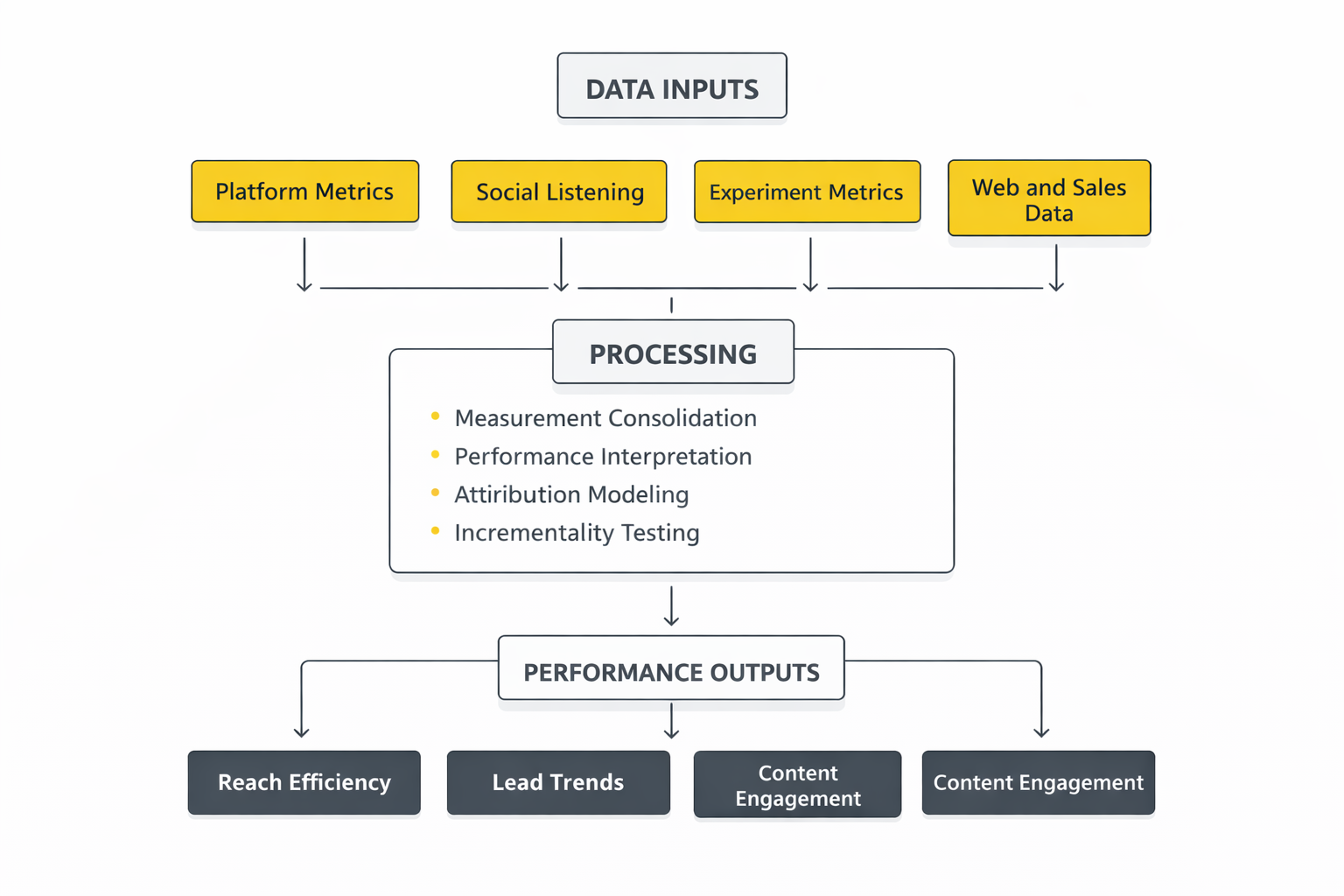
Start with a “three-layer” reading of results. First, measure attention (reach, video views, impressions) to understand distribution. Second, measure resonance (saves, shares, comments, profile visits) to understand whether the content is actually landing. Third, measure business intent (link clicks, sign-ups, store visits, qualified leads) to connect social activity to what the company truly cares about.
Interpret platform benchmarks as context, not as targets. If your TikTok engagement is below a benchmark while your conversion actions are rising, you may be winning where it matters most. If your engagement is high but your profile-to-site clicks are flat, your creative might be entertaining without moving people to the next step.
Look for operational truth, not vanity comfort. Sprout Social’s 2025 industry benchmarks emphasize how inbound engagements and outbound engagements can reveal whether a brand is building two-way relationships, noting that brands saw a jump in average inbound engagements in 2024 and highlighting proactive outbound engagement as a major opportunity. That matters because community management is often the most underestimated cost driver in social media management services pricing, and the numbers help you justify coverage levels. Sprout Social’s benchmark discussion on inbound and outbound engagements is a useful way to show clients why “posting” and “managing” are two different jobs.
Use incrementality logic when budgets get serious. When a client’s spend or expectations rise, the question shifts from “Did we get clicks?” to “Did social create outcomes that wouldn’t have happened otherwise?” That’s where experiments like holdouts and lift tests become persuasive, because they help separate true impact from coincidence.
Case Stories
Real analytics stories are rarely tidy. They usually start with pressure, confusion, and a team realizing that “we post a lot” is not the same as “we can prove what’s working.” Here’s a published example that shows how measurement and execution decisions can translate into outcomes that justify higher-tier service pricing.
DSW, Tinuiti, And Meta: When Measurement Became The Strategy
The launch window hit and the numbers looked fine at first glance, but the leadership questions got sharper by the day. Online sales were measurable, yet store traffic patterns suggested something bigger was happening that the dashboards couldn’t fully explain. The uncomfortable possibility hung in the air: the brand might be spending money efficiently while still undervaluing what paid social was actually driving. Tinuiti’s DSW case study
DSW wasn’t a digital-only brand; it was nearly 500 stores plus an ecommerce engine, and customers moved between both constantly. Paid social had always been a driver, but the optimization approach centered on online conversions because that’s what was easiest to track. The team could see the surface-level performance, but they couldn’t confidently connect it to the full omnichannel reality. Tinuiti’s DSW case study
The wall arrived when “good results” stopped being a satisfying answer. If optimization only rewarded online events, then in-store impact could be real while still being treated like it didn’t exist. That meant budgets, creative decisions, and bidding strategies might be constrained by incomplete measurement. And once the organization realized that, it was hard to ignore. Tinuiti’s DSW case study
The turning point was not a new ad format; it was the decision to treat offline measurement as a first-class input. The teams leaned into Meta’s capability to optimize for both online and offline outcomes and built a plan around proving incrementality. Instead of asking, “Did it convert?” they started asking, “What did it change?” Tinuiti’s DSW case study
The journey began with experiments designed to produce truth, not comfort. Tinuiti designed a conversion lift test with a 30% holdout so results could be compared against a baseline that received no ads. They integrated offline conversion data and structured the campaign to feed machine learning with a more complete view of outcomes, aligning creative and bidding to omnichannel behavior. Tinuiti’s DSW case study
Then, the messy part showed up: measurement clarity often reveals that your old playbook was underpowered. Aligning ecommerce and POS data, validating significance, and keeping creative variety high is operationally demanding, and it can expose gaps in workflow that were invisible before. In other words, proving impact can temporarily make the process feel harder, even when the strategy is getting better. Tinuiti’s DSW case study
The outcome was the kind of result that makes pricing discussions feel obvious rather than defensive. The case study reports +23% omni purchases, a +16% lift in revenue, and a -29% incremental CPA, along with a note that the approach increased ROAS by 15% and decreased omni CPA by 18% compared to business-as-usual optimization. Those aren’t just performance stats; they’re proof that measurement and execution depth can create economic impact worth paying for. Tinuiti’s DSW case study
Professional Promotion
Analytics-led work is one of the most reliable ways to grow both results and revenue, but only if you package it in a way clients can understand. The reality is simple: most clients don’t want more charts; they want fewer doubts. When you turn reporting into decision-making, social media management services pricing starts to feel like an investment in clarity.
Sell the operating system, not the hours. Clients rarely brag about buying “20 hours of posting.” They do brag about having a predictable content engine, a response workflow that doesn’t collapse under pressure, and reporting that tells them what to do next. That’s the value you should name and price.
Anchor your offer to market reality. If a client is shopping, they will see ranges and rate bands everywhere. It helps to reference credible market signals like Upwork’s current hourly ranges for social media managers and Clutch’s agency rate bands so you can explain why your pricing sits where it does based on scope, depth, and accountability.
Make your “analytics tier” tangible. Define what’s included: a monthly performance narrative, a short list of experiments for the next cycle, and a clear call on what to stop doing. Tie it to platform benchmarks like Socialinsider’s engagement rate comparisons so the client can see whether you’re winning attention, resonance, or business intent in a way that matches the platform’s reality.
Protect the client experience with boundaries. If the client wants deeper analytics, faster iteration, or more channels, that is an upgrade, not a “quick favor.” The more you operationalize this in your packages, the easier it becomes to raise prices without friction, because the client is buying a clearer system, not a vague promise.
Future Trends
The next wave of social media management services pricing will be shaped less by “how many posts” and more by what it takes to stay credible, compliant, and effective in feeds that are changing fast.
AI transparency is turning into operational work. As labeling requirements expand, teams will need repeatable checks for what was generated, what was edited, and what must be disclosed. In the EU, the timeline for AI-generated content transparency rules becoming applicable on 2 August 2026 is already published, and it’s a real clue about where the market is going: clients won’t just want “content,” they’ll want content that can withstand scrutiny.
Platforms are actively fighting synthetic content overload. When user trust drops, performance drops, and everyone pays the price. TikTok has already described controls to help users reduce AI-generated content in feeds alongside labeling and watermarking approaches in its trust and safety updates, summarized in coverage of TikTok’s plans to give users more control over AI content. This trend matters for pricing because it raises the bar for originality and brand voice. “Generic” content becomes less competitive, and higher-quality production becomes a premium.
Creator partnerships are moving from experimental to budgeted. If you’re pricing a retainer today, it’s increasingly normal for clients to ask for creator sourcing, brief writing, usage rights, and performance reporting alongside organic management. The spending shift is visible in industry reporting like the IAB’s projection of $37B U.S. creator ad spend in 2025. The practical implication is simple: creator operations are a distinct layer of work, and pricing will keep separating “social management” from “creator program management.”
Social customer care will be priced like a service level. As more buying and support conversations move into DMs and comments, brands will demand defined response windows and escalation workflows. The 2025 benchmark that 73% of consumers expect a response within 24 hours or sooner is a strong signal: clients won’t only compare you on creative quality, they’ll compare you on responsiveness and reliability.
Measurement will become more conservative and more valuable at the same time. Privacy constraints and noisy attribution make reporting harder, which increases the value of marketers who can design clear experiments, interpret messy signals, and communicate confidence levels without pretending analytics are perfect.
Strategic Framework Recap

If you want social media management services pricing to feel fair, scalable, and easy to explain, the framework comes down to a few decisions that should never be left vague.
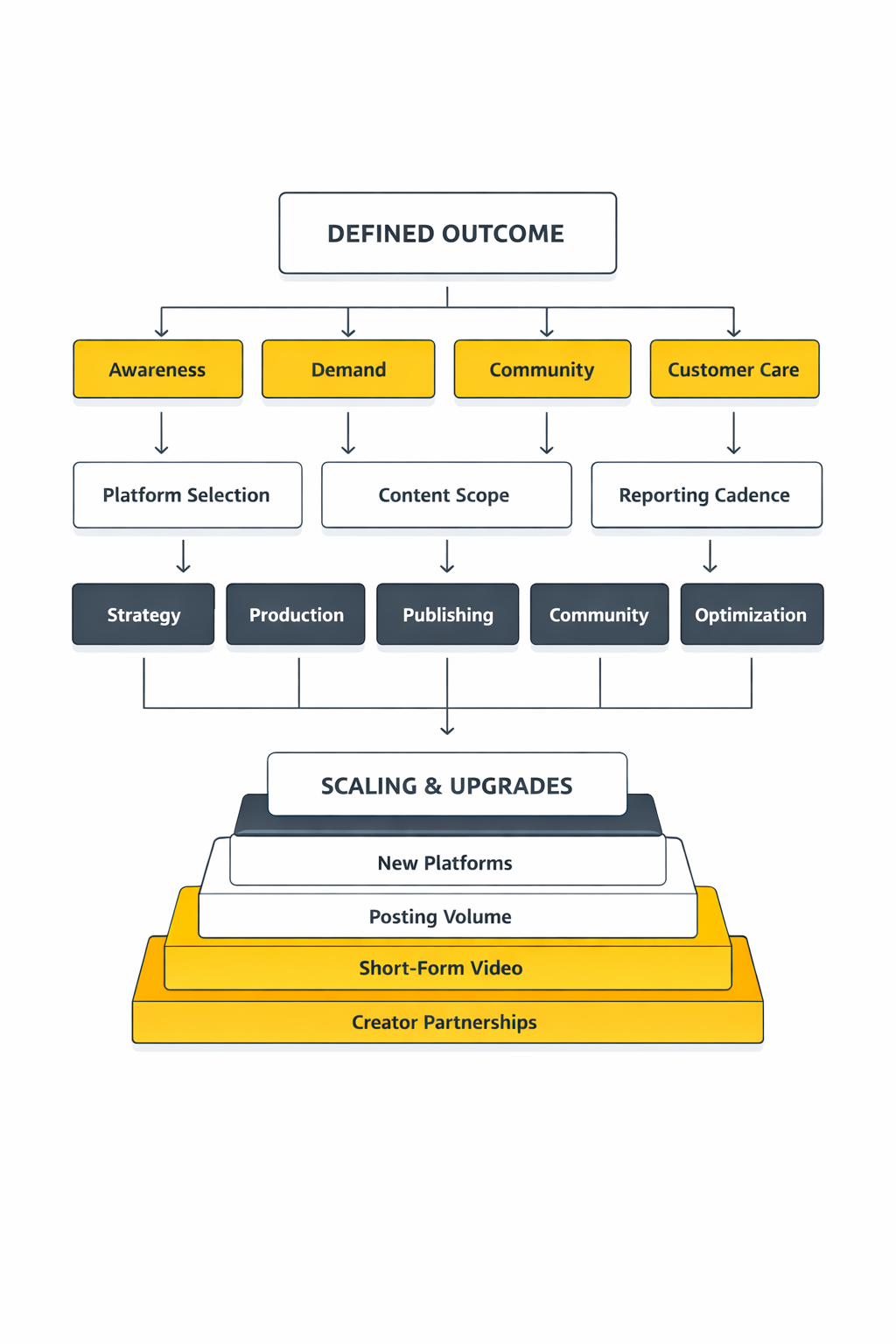
- Define the outcome first: awareness, demand, community growth, customer care, recruiting, or a blend.
- Translate scope into units: platforms, content pieces, revision rounds, response coverage windows, and reporting cadence.
- Separate layers of execution: strategy, production, publishing, community, and optimization.
- Build upgrade paths: new platforms, higher posting volume, short-form video, creator programs, paid management, social listening, and crisis support.
- Make analytics decision-ready: every report should end with what to do more of, what to change, and what to stop.
This is the “ecosystem” logic behind pricing: clients aren’t buying posts. They’re buying a system that can produce consistency, respond under pressure, and improve over time.
FAQ – Built For Social Media Management Services Pricing Complete Guide
What’s usually included in social media management services pricing?
Most packages include strategy alignment, content planning, publishing, basic community engagement, and reporting. Higher tiers often add short-form video production, social listening, creator partnerships, and paid social management.
Why do prices vary so much between freelancers and agencies?
Agencies typically price in a team, process, and tool stack, which can increase reliability and output. Freelancers can be more cost-efficient for narrow scopes, but the price rises quickly when clients want multi-platform coverage, faster turnaround, and deeper analytics.
Should I pay hourly or choose a monthly retainer?
Hourly works well for audits, training, or short projects. Retainers are usually better for ongoing growth because they lock in consistency and make optimization possible month to month.
How many platforms should a small business manage?
Start with one primary platform and one secondary platform if you can maintain consistent quality. Adding platforms too early usually dilutes content quality and slows response time, which can make the spend feel wasted.
What deliverables should be written into a social media contract?
List platforms, posting frequency, content formats, revision rounds, approval timelines, community management coverage windows, reporting cadence, and what counts as out-of-scope work. Clear boundaries protect both sides.
How do I know if my pricing is working?
If you’re a provider, pricing is working when you can consistently deliver quality without burnout and still have time to optimize. If you’re a client, pricing is working when performance improves and you can see clear decisions being made from reporting.
What metrics matter most for pricing and scope?
Volume drivers: inbound messages, comment volume, posting frequency, and the number of platforms. Outcome drivers: reach trends, saves/shares, link clicks, qualified leads, and customer care response time.
Should community management be a separate line item?
Often yes. Community management is availability-based work, especially if the brand expects fast replies. Many teams price it as a service level with defined response windows rather than bundling it into “posting.”
What are common hidden costs in social media management?
Short-form video editing time, extra revision cycles, last-minute launch support, creator usage rights, stock assets, social listening tools, and the operational overhead of approvals and compliance reviews.
How do AI tools change social media management services pricing?
AI can reduce some production time, but it also adds new work: review, brand-safety checks, originality improvements, and disclosure workflows where required. Many clients pay more for confidence and quality control, not less for faster drafts.
When should I upgrade my package?
Upgrade when you add a platform, increase posting frequency, need faster content turnaround, want video-first execution, start creator partnerships, or require more analytics depth and experimentation.
Work With Professionals
You can feel it the moment your workload outgrows your calendar. Clients want faster turnaround, platforms demand video, and the inbox fills with questions that can’t wait until “next week.” If you’re a marketing freelancer, the pressure isn’t just delivering great work. It’s keeping your pipeline full while you deliver.
That’s why marketplaces built specifically for marketing can change everything. Markework’s active listings page shows 1,007 active listings and makes it clear the platform is structured around real marketing roles and projects, not generic gig noise. The flow is simple: build a profile, browse focused opportunities, and connect directly with companies.
The best part is the business model. The platform emphasizes no middleman and no project fees, and its pricing page makes the same promise explicit for both marketers and companies: no commissions and no project fees. When you’re building a freelance career, keeping what you earn isn’t a small detail. It’s the difference between “busy” and “profitable.”
If you want more clients for social media management, the strategy is straightforward: package your services clearly, price them like a system, and then place that offer in front of companies that are already searching for marketing talent. Markework is designed for exactly that kind of momentum—direct communication, clear listings, and a marketplace focused on marketing outcomes.
 Filip Konecny Enterprises