
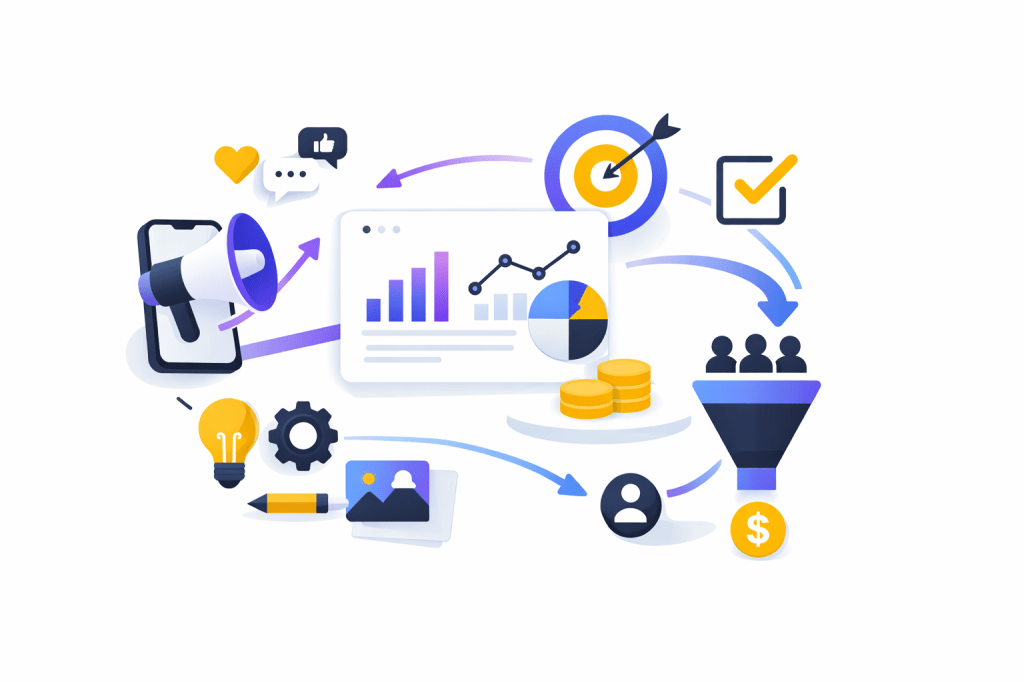
Digital advertising has shifted dramatically in the past decade. What used to revolve around television placements and static display banners now happens inside constantly evolving social feeds where algorithms determine what people see every second. Businesses trying to compete in this environment quickly realize that running occasional ads is rarely enough. Consistent growth usually requires a structured approach — and that is where social media advertising packages come in.
The scale of this market shows why structured advertising strategies matter so much. Global spending on social platforms continues to surge, with projections showing the market exceeding $317 billion in social media ad spending by 2026. For many brands, these platforms have become the primary channel for acquiring customers, building brand recognition, and launching new products.
But simply boosting posts or experimenting with random campaigns rarely produces predictable results. Social platforms reward advertisers who operate with clear targeting, structured testing, and ongoing optimization. Social media advertising packages were designed to provide exactly that — a defined system for planning, executing, and improving campaigns over time.
This article explores how these packages work, why they matter for modern marketing strategies, and how organizations structure them to produce measurable business outcomes.
Article Outline
- What Social Media Advertising Packages Are
- Why Social Media Advertising Packages Matter
- Framework Overview
- Core Components
- Professional Implementation
What Social Media Advertising Packages Are

Social media advertising packages are structured service bundles designed to help businesses run paid campaigns across platforms such as Facebook, Instagram, TikTok, LinkedIn, Pinterest, and YouTube. Instead of paying for isolated tasks like creating a single advertisement or boosting a post, companies invest in a complete system that covers strategy, creative production, campaign management, and performance analysis.
The goal is to transform advertising from a one-off experiment into a repeatable growth engine. Within a typical package, marketers plan campaigns, define target audiences, launch ads, test variations, and continually optimize performance. This structured process helps businesses control costs while gradually improving the return they receive from advertising spend.
The economics behind these packages often reflect the complexity of the work involved. Agencies frequently charge either a flat monthly fee or a percentage of advertising spend to manage campaigns. Industry pricing surveys show that many agencies charge between 10% and 20% of advertising spend for campaign management, while dedicated social advertising management services often range from $1,500 to $5,000 or more per month depending on scope and scale.
Those costs typically cover a wide range of services. Strategic planning determines the right audiences and messaging. Creative teams produce the visual and video assets required for each campaign. Media buyers manage the bidding systems inside advertising platforms, while analysts track performance data to identify which campaigns should be scaled or refined.
Without this coordinated approach, advertising efforts tend to become fragmented. Businesses may run campaigns sporadically, target audiences inconsistently, or stop optimizing ads before the algorithms have enough data to deliver reliable performance. Structured advertising packages exist to prevent those problems and replace guesswork with a systematic process.
Why Social Media Advertising Packages Matter
Social platforms have evolved into one of the most competitive advertising environments in history. Billions of users interact with content every day, while sophisticated machine-learning systems determine which advertisements appear in each person’s feed. Companies that approach this ecosystem without a clear structure often struggle to achieve consistent results.
The scale of opportunity explains why so many organizations invest in professional campaign management. Marketing research shows that social platforms deliver measurable performance when campaigns are properly optimized. Across major networks, advertisers report an average return of roughly $4.20 for every $1 spent on social media advertising. Achieving that level of efficiency, however, usually requires disciplined campaign management rather than occasional experimentation.
Audience behavior also makes social advertising uniquely powerful. Social platforms combine demographic data, behavioral signals, and interest tracking, enabling advertisers to reach highly specific groups of people. Instead of broadcasting messages to broad audiences, businesses can target users who already demonstrate interest in particular products, industries, or lifestyles.
Engagement patterns reinforce the value of this approach. On most social platforms, average engagement rates fall between 1.4% and 2.8% depending on the network. While those percentages may appear small, they represent millions of interactions when campaigns reach large audiences. Structured advertising packages help companies design campaigns that turn these interactions into meaningful actions such as purchases, sign-ups, or inquiries.
Another reason these packages matter is the increasing complexity of advertising tools themselves. Modern ad platforms include features such as automated bidding, dynamic creative testing, audience lookalike modeling, and AI-driven targeting. Without specialized knowledge, many businesses struggle to configure these tools effectively. Structured packages provide the expertise needed to navigate these systems and unlock their full potential.
Framework Overview
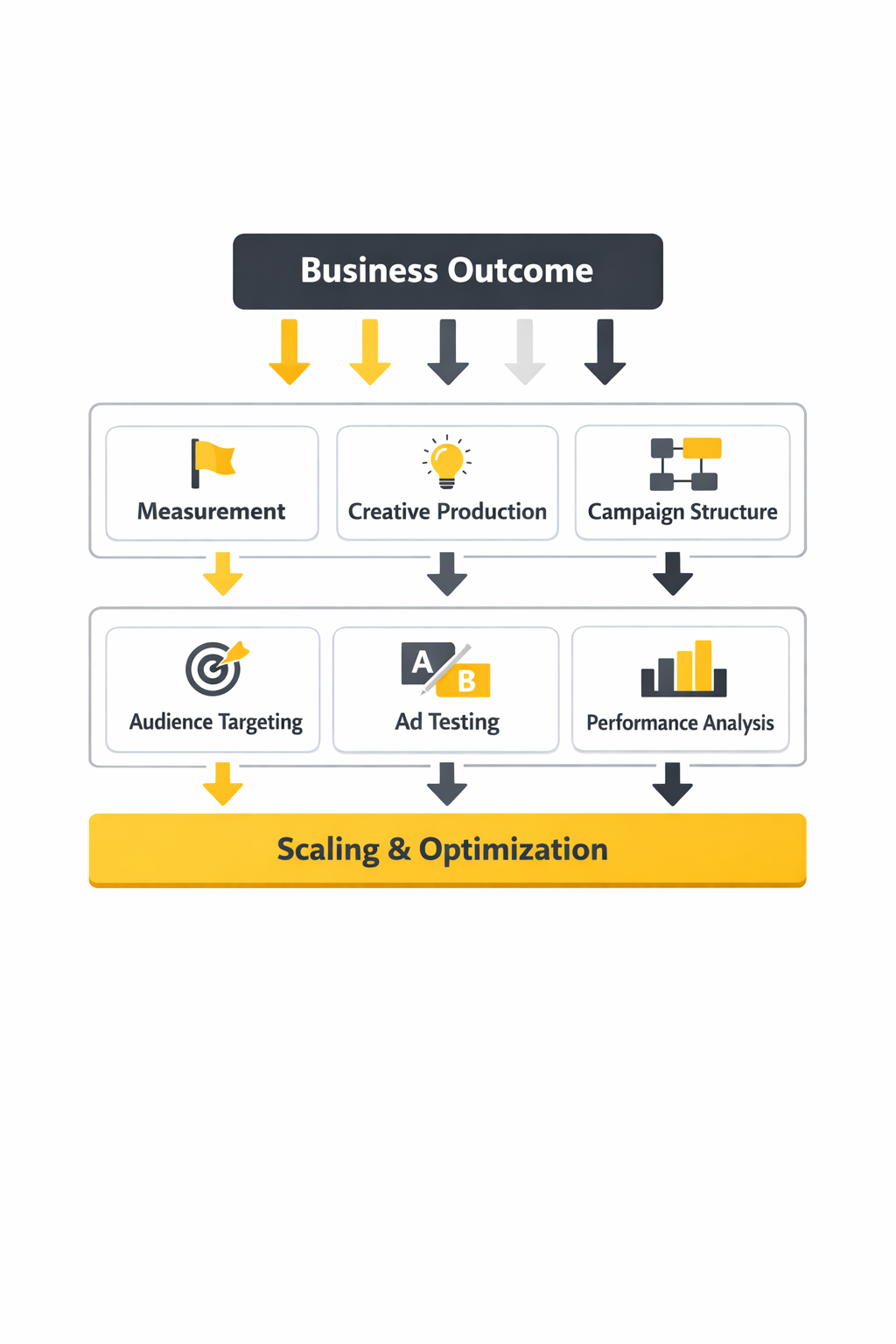
Most social media advertising packages follow a similar operational framework. While the exact structure varies between agencies and consultants, the underlying workflow usually progresses through several key stages that transform an advertising idea into measurable business results.
The process typically begins with strategic planning. Marketers analyze the business model, target audience, and competitive environment to determine which platforms are most likely to deliver results. A B2B software company may prioritize LinkedIn advertising, while a fashion retailer may focus on Instagram, TikTok, or Pinterest where visual content performs especially well.
Once the strategic direction is established, campaign architecture is designed. This involves defining audiences, budgeting structures, and testing frameworks. Advertisers create multiple ad sets targeting different demographic segments or interests so that algorithms can learn which groups respond most strongly to each message.
The next stage centers on creative development. Successful social advertising depends heavily on visuals, storytelling, and rapid experimentation. Teams often produce multiple versions of an advertisement — varying headlines, images, or videos — so that campaigns can test different combinations and identify the most effective creative approach.
After campaigns launch, optimization becomes the ongoing focus. Advertising platforms constantly generate performance data showing how users interact with each ad. Skilled campaign managers analyze these signals and gradually adjust targeting, budgets, and creative assets to improve results. Over time, this iterative process allows campaigns to scale efficiently while reducing wasted spend.
This structured framework is the core reason social media advertising packages exist. Rather than treating advertising as a series of isolated tasks, they organize the entire process into a repeatable system that continuously improves performance.
Core Components
Although different agencies describe their offerings in different ways, most social media advertising packages share several essential components. These elements ensure that campaigns move from initial planning to measurable outcomes without losing strategic focus along the way.
Strategic Campaign Planning
Effective campaigns begin with clear objectives. Some companies focus on generating leads, while others prioritize e-commerce sales, app installs, or brand awareness. Strategic planning identifies the right goals and determines which advertising formats — such as video ads, carousel ads, or lead-generation forms — are most likely to achieve them.
Audience Research and Targeting
One of the defining strengths of social media advertising lies in precise audience targeting. Campaign managers use platform data to identify users based on demographics, interests, behaviors, and purchasing patterns. Lookalike audience modeling can even identify new prospects who resemble existing customers, dramatically expanding reach while maintaining relevance.
Creative Production
In social feeds crowded with content, creative quality determines whether an advertisement is ignored or engaged with. Many advertising packages therefore include the design of images, videos, and copywriting tailored to each platform’s format and audience expectations.
Campaign Management
Launching advertisements is only the beginning of the process. Campaign managers monitor performance metrics, adjust budgets, pause underperforming ads, and scale campaigns that show strong results. Continuous management prevents wasted spend and helps advertising budgets generate the highest possible return.
Analytics and Reporting
Modern advertising platforms generate detailed performance data. Advertising packages typically include analytics dashboards and regular reports that translate this data into actionable insights. Businesses can see how many people viewed their ads, clicked through to their website, or ultimately converted into customers.
When these components operate together, social media advertising becomes a disciplined growth strategy rather than a collection of disconnected marketing experiments.
Professional Implementation
While many advertising tools are accessible to anyone with a social media account, implementing campaigns at a professional level requires far more than simply launching ads. Advertising platforms evolve constantly, introducing new targeting features, bidding systems, and creative formats that require continuous learning.
Professional marketers therefore treat social media advertising as an ongoing optimization process rather than a one-time campaign. They monitor performance data daily, test new audience segments, experiment with creative variations, and refine bidding strategies based on real-time results.
This level of attention becomes particularly important as advertising budgets grow. When campaigns reach thousands or even millions of users, small improvements in targeting or messaging can significantly increase overall profitability. Structured advertising packages give businesses access to the expertise and systems required to manage these complexities.
Ultimately, the purpose of social media advertising packages is not simply to run ads. It is to create a structured marketing engine capable of reaching the right audiences, communicating compelling messages, and turning online attention into sustainable business growth.
Step-by-Step Implementation
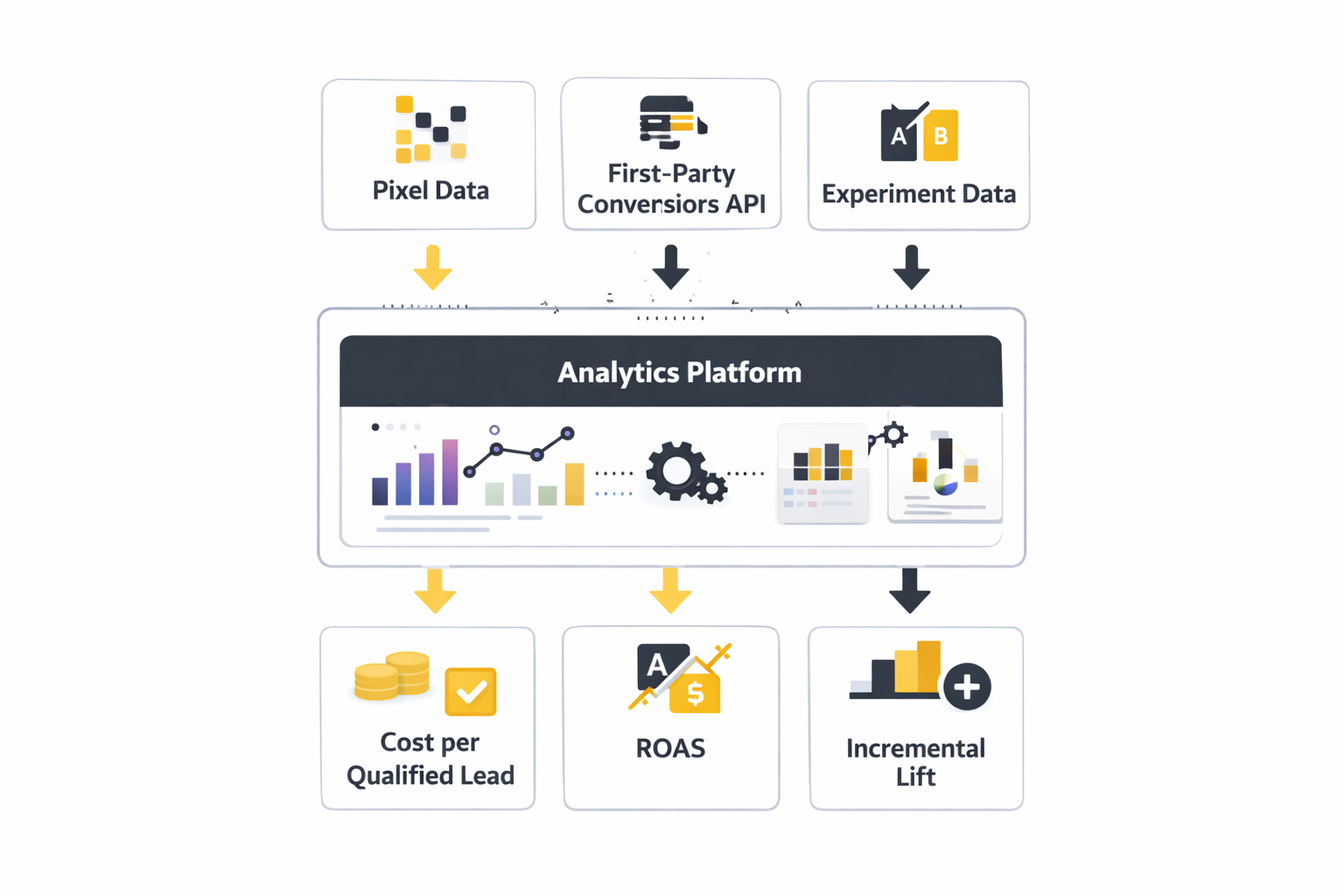
A good set of social media advertising packages doesn’t start with ad creatives. It starts with decisions that make the rest of the work easier: what the business is trying to achieve, how success will be measured, and what the customer journey looks like from first touch to purchase or booked call. When those basics are unclear, campaigns tend to “work” in dashboards but fail to move the business forward.
The implementation flow below is written for agencies, in-house teams, and freelancers who want repeatable execution. You can run it on Meta, TikTok, LinkedIn, or a multi-platform mix, as long as each step is treated as a gate that must be passed before spending more.
Step 1: Lock the Outcome and Budget Guardrails
Start by picking one primary outcome per campaign: purchases, qualified leads, booked calls, or app installs. Then set guardrails that protect profit, not vanity metrics: a maximum cost per acquisition, a minimum conversion rate, and a weekly spending cap until the campaign proves it can hold efficiency. This is where social media advertising packages become a business tool instead of a creative exercise.
Step 2: Build a Measurement Foundation You Can Trust
Tracking needs to be strong enough that you can tell the difference between a creative problem and a funnel problem. That usually means clean UTMs, consistent event naming, and a clear view of what happens after the click. If you’re working on TikTok and want proof of incremental impact beyond last-click attribution, the Conversion Lift Study methodology is worth understanding before you scale spend.
Step 3: Align the Offer With the Landing Experience
Your ad and your landing page should feel like the same conversation, not two different brands. If the ad promises a quick style upgrade, the landing page should lead with the same outcome and remove friction from the path to purchase. Many “ad problems” are actually alignment problems that only show up after you watch user behavior, not just platform metrics.
Step 4: Design Campaign Architecture for Learning
Structure campaigns so the platform can learn fast and you can interpret results without guessing. Separate prospecting from retargeting, keep the number of variables per test low, and make sure budgets aren’t so fragmented that nothing exits the learning phase. When social media advertising packages are built for learning, optimization becomes a series of obvious moves instead of endless debate.
Step 5: Produce Creatives in Batches With a Test Plan
Build a small library of ads that test different angles, not just different colors. One set can focus on product benefits, another on social proof, another on urgency, and another on the “why now” narrative. A practical cadence comes from a real performance example: Quay refreshed TikTok creatives every 7–14 days during a July–August 2024 effort, which kept ads aligned with how quickly feeds fatigue.
Step 6: Launch, Stabilize, Then Scale
Launch with controlled budgets so you can identify early signal without paying for expensive mistakes. Stabilize by trimming obvious waste, tightening placements if needed, and pushing spend toward the best-performing creative and audience combinations. Only then scale, ideally in steps that allow performance to hold rather than spiking costs through aggressive changes.
Execution Layers
One reason social media advertising packages outperform ad-hoc management is that they separate execution into layers. Each layer has its own job, its own quality checks, and its own “failure modes” that can be diagnosed quickly. When you treat everything as one messy campaign, you lose the ability to see what’s actually driving results.
Layer 1: Strategy and Positioning
This layer defines the promise your ads are making and why someone should care right now. It includes the audience thesis, the offer framing, and the messaging angles that will be tested. If this layer is weak, the platform will still spend your budget, but you’ll pay more for every conversion because the market isn’t compelled.
Layer 2: Creative System
This layer turns strategy into ad assets that look native in a feed. It also sets standards: the hook has to earn attention in seconds, the middle has to build belief, and the close has to make the next step feel easy. The best teams treat creative like a pipeline, not a one-time deliverable, because the feed changes faster than most brands can rewrite their strategy.
Layer 3: Media Buying and Structure
This is where targeting, bidding, placements, and budgets become an engineering problem. Your goal is to give the platform clean inputs so it can find buyers efficiently, while keeping your tests interpretable. When BMW Group Malaysia used LinkedIn to translate an ideal customer profile into campaign audiences, their approach relied on multiple targeting permutations and exclusions to avoid duplication, supporting results such as 21% lower cost per lead and 42% lower cost per impression versus benchmarks.
Layer 4: Analytics and Decision-Making
This layer decides what to scale, what to fix, and what to kill. It connects platform data to business outcomes so you don’t optimize toward metrics that feel good but don’t pay bills. As ad ecosystems grow, the scale is massive—Meta reported Family daily active people at 3.58 billion on average for December 2025—which means you need disciplined analysis to avoid drowning in noise.
Optimization Process
Optimization is where social media advertising packages prove their value. The point isn’t to “tweak settings,” it’s to run a loop that turns performance data into better creative, better targeting, and better economics. A strong loop is calm, consistent, and boring—in the best way—because it’s built to compound learning over time.
1) Diagnose the Bottleneck Before You Touch Anything
Start by identifying where momentum breaks: the scroll, the click, the add-to-cart, the checkout, or the lead qualification step. If click-through is strong but purchases are weak, the fix likely lives on the landing page or in the offer. If impressions are high but attention is low, the fix is almost always creative, not budget.
2) Improve Creative First, Because It Impacts Everything
Creative influences your cost per thousand impressions, your click rate, and the quality of the audience the algorithm finds. When the creative is clear and compelling, platforms can deliver ads more efficiently and learn faster. This is why many teams build a rhythm of new variations rather than waiting for performance to collapse.
3) Refine Audiences With Intent, Not Guesswork
Audience work should be tied to a hypothesis: “This group cares about X, so this angle should resonate.” When you change audiences without a clear reason, performance swings become impossible to interpret. Keep changes deliberate, document what changed, and link each change to an expected effect.
4) Scale in Steps That Preserve Signal
Scaling too quickly can raise costs and blur whether improvements are real or random. A safer approach is incremental budget increases paired with close monitoring of conversion efficiency. If efficiency drops, pause the scale and return to creative and funnel alignment before pushing spend again.
5) Validate Incrementality When It Matters
Attribution can undercount or overcount the true impact of paid social, especially when customers take multiple sessions to convert. When budgets become meaningful, incrementality tests reduce uncertainty and help justify investment in upper-funnel work. TikTok’s lift-study approach explains how splitting audiences into treatment and control groups can isolate the incremental effect of ads on outcomes like purchases and add-to-cart actions, which is the logic behind a Conversion Lift Study.
Implementation Stories
Some of the most useful lessons about execution come from moments when a brand needs proof, fast, that paid social is doing real work. The story below is built from a documented campaign and measurement design, with the narrative anchored in what the teams publicly shared about objectives, methods, timing, and results.
Quay and Monks: Proving TikTok Impact When Efficiency Had to Hold
High Drama
Scaling is exhilarating until it threatens the one number everyone cares about: acquisition cost. Quay wanted to expand on TikTok while holding CPA goals and protecting bottom-line performance, which created immediate pressure on the media plan. At the same time, leadership needed more than dashboard wins—they needed confidence that TikTok was driving incremental outcomes, not just capturing credit.
Backstory
Quay had already built a presence on TikTok, so the question wasn’t whether the channel could generate attention. The real question was whether TikTok could push people from interest to action across the lower funnel, from search to add-to-cart to purchase. The brand and its agency, Monks, set the objective around validating TikTok’s effectiveness across the consumer journey, not just optimizing for surface-level metrics.
The Wall
Traditional reporting can make paid social look better or worse than it really is, especially when customers bounce between channels before buying. That ambiguity becomes a brick wall the moment you try to scale, because every budget increase feels like a gamble. Quay needed a way to separate “people who would have bought anyway” from “people who bought because they saw the ads.”
The Epiphany
The team leaned into an experiment design rather than an opinion battle. TikTok’s approach split audiences into treatment and control groups so the brand could measure incremental changes in behaviors like search, add-to-cart, and purchases. The decision to quantify incrementality reframed the whole effort: the goal wasn’t just to run campaigns, it was to prove the business effect with a structured test.
The Journey
The execution combined multiple campaign types—Catalog Ads Retargeting, Web Conversion, and Smart+ Web Campaigns—built for lower-funnel outcomes. Creative was refreshed on a fast cadence, every 7–14 days, keeping ads aligned with how quickly feed environments change. The campaign design, timing, and measurement details were documented in TikTok’s Quay Conversion Lift case study for July–August 2024, which laid out the method and the observed lifts across key actions.
Final Conflict
A lift study adds rigor, but it also raises the standard of truth. If the ads don’t create incremental action, the experiment exposes it, and there’s nowhere to hide behind attribution models or optimistic reporting. The team also had to keep performance stable while running a methodical plan, because experimentation without discipline can burn budget quickly. Even the creative refresh cadence becomes a risk if production can’t keep up, because stale creative can flatten results before the test window closes.
Dream Outcome
The lift study showed that the ads influenced real behavior changes across the funnel, not just impressions. Quay saw lifts including 417% in search, 70% in add-to-cart actions, and 54% in purchases in the exposed group, with the effort surpassing ROAS targets by 91%. More importantly, the brand walked away with a repeatable pattern: a structured mix of campaign types, a creative refresh rhythm, and a measurement method that supports confident scaling.
Professional Implementation in the Real World
At a professional level, the difference isn’t access to features—it’s the discipline to run a system. Social media advertising packages work best when responsibilities are clear: someone owns measurement integrity, someone owns creative output, and someone owns media decisions tied to business economics. When those roles blend into one overwhelmed generalist, campaigns tend to drift toward whatever is easiest to do that week.
The most reliable teams also document decisions like engineers. They track what changed, why it changed, and what result they expected, which makes learning compound instead of resetting every month. That habit matters even more as platforms evolve, budgets grow, and the audience landscape expands at massive scale, as shown by metrics like Meta’s December 2025 Family daily active people figure of 3.58 billion.
If you want a simple professional standard, use this: every week, your system should produce at least one clear insight and one clear action. The insight might be that a specific angle resonates with a specific audience segment, or that a landing page is leaking conversions after the click. The action might be a new creative batch, a revised offer framing, or a measured budget increase—small moves that, done consistently, turn social media advertising packages into a predictable growth engine.
Statistics and Data

The moment you start selling or buying social media advertising packages, you inherit a data problem: the platforms are full of numbers, but only a handful of them actually explain why performance is moving. Good packages don’t drown clients in dashboards. They translate signal into decisions, and they do it in a way that holds up when budgets scale.
A simple reality check helps frame the stakes. Meta’s own 2025 results show a marketplace where delivery volume and prices are both climbing: ad impressions across the Family of Apps rose year over year, while the average price per ad also increased, including a 9% increase in the average price per ad for full-year 2025. In practice, that means “doing nothing” tends to get more expensive over time, so measurement and optimization aren’t optional if you want to protect unit economics.
At the same time, brand-level data shows that platform dynamics can shift quickly. Emplifi’s 2025 social benchmarks report highlights how brands changed activity levels on X during 2024 and includes a quarterly view of paid CPM movement across major platforms. The takeaway isn’t “copy these exact CPMs.” It’s that paid delivery costs move with competition and inventory, which is why analytics inside social media advertising packages should be built to spot trend changes early rather than explain them after the budget is gone. You can see that cost movement visualized in the Emplifi Social Media Benchmarks Report 2025.
When packages are built well, they usually treat data in three layers:
- Business outcomes: revenue, qualified leads, booked calls, retention events.
- Funnel behavior: product views, add-to-cart, form starts, call booking steps.
- Delivery diagnostics: CPM, frequency, click-through behavior, placement efficiency, creative fatigue patterns.
This layered view prevents a common trap: optimizing delivery metrics while the business outcome stays flat. It also makes it easier to diagnose what changed. If CPM rises but conversion rate holds, you can often out-create the problem. If conversion rate drops while CPM stays stable, the leak is probably offer alignment, landing performance, or lead quality.
Performance Benchmarks
Benchmarks are useful when you treat them like guardrails, not goals. A “good” click-through rate depends on creative style, audience temperature, placement mix, and how much the offer relies on trust. The fastest way to misuse benchmarks is to chase a number you saw in a report while ignoring whether the traffic is actually buying or qualifying.
Still, benchmarks matter because they help you ask better questions. If your CPM is rising sharply and your creative hasn’t changed, it might be a competitive pressure problem rather than a creative problem. Emplifi’s dataset shows CPM patterns shifting across platforms over time, which is exactly why cost benchmarks should be checked quarterly instead of once a year. That cross-platform cost view is part of the Emplifi 2025 benchmarks report.
In well-run social media advertising packages, benchmarks typically get used in three practical ways:
- Early-warning alerts: when CPM or frequency drifts outside a normal range for that account, you investigate before results collapse.
- Creative health checks: if spend is stable but CTR trends down across multiple creatives, you prioritize new angles rather than micro-tweaking bids.
- Funnel reality checks: if click behavior looks fine but purchases or qualified leads are lagging, you audit the landing experience and offer clarity first.
If you want one benchmark that’s always worth tracking, it’s consistency. A package that produces stable performance week to week is often more valuable than one that spikes for two weeks and then burns out. Stable performance means the system is learning and adapting, not gambling on a single creative hit.
Analytics Interpretation
Most reporting fails at the interpretation step. Teams collect the right numbers, but they don’t connect them to the decision that needs to be made next. That’s why professional social media advertising packages increasingly lean on experimentation and incrementality rather than relying on platform-reported attribution alone.
Incrementality matters because customer journeys are messy. People see an ad, forget it, search later, get reminded by email, then buy on a different device. If you only look at last-click, you’ll often undervalue upper-funnel work and over-credit whichever channel happens to be closest to the purchase moment. Google’s marketing publication makes the case for testing as a practical way to measure true impact in a privacy-first world, framing marketing experimentation and incrementality testing as a way to separate correlation from causation.
Platform lift studies are one of the most actionable versions of this idea because they’re designed to be run by advertisers, not just data science teams. Meta’s measurement tools explain how randomized control and exposed groups can show whether ads actually caused incremental conversions through a Conversion Lift test. TikTok offers a similar concept and positions its approach as an experimentation-based way to quantify ROI in its Conversion Lift Study overview.
When you interpret analytics inside a package, you want to answer five questions in order:
- What changed? A metric moved, but which one moved first?
- Where did it change? One placement, one audience, one creative angle, one geo?
- Why did it change? Competition, fatigue, tracking changes, seasonality, landing friction?
- What should we do next? A specific action you can test within seven days.
- How will we know it worked? A success threshold tied to business outcomes, not just platform metrics.
That last point is the difference between “reporting” and “management.” Reporting describes the past. Management uses the past to make a decision that improves the next cycle.
Case Stories
Analytics feels abstract until a brand is forced to prove that the numbers mean something real. The story below is anchored in a publicly documented lift study that shows how a team used measurement to connect social spend to outcomes across a messy, multi-step journey.
Torrid: When a Full-Funnel Plan Needed Proof Beyond Last-Click
Professional Promotion
In the real world, packages win or lose on how well they communicate progress. Most businesses don’t need a 40-slide report; they need a clear sense of whether the system is working and what’s being done next. Professional social media advertising packages treat reporting as part of the product, not an afterthought.
A strong promotion strategy for packages usually leans on proof that feels grounded and understandable:
- One primary KPI tied to money: purchases, qualified leads, booked calls, or pipeline value.
- Two supporting KPIs that explain movement: conversion rate and cost per result are often the most honest pair.
- One creative insight per week: what message is winning and why it matters.
- One clear experiment in motion: what you’re testing, what you expect to happen, and when you’ll decide.
This is also where lift studies and incrementality frameworks become part of the sales narrative in a responsible way. When you can explain how a Conversion Lift test or a Conversion Lift Study isolates causal impact, clients feel the difference between “we ran ads” and “we measured real business lift.”
The best promotion doesn’t hype results that can’t be sustained. It sells the process: a system that learns, a system that documents changes, and a system that ties decisions to outcomes. When that’s what your package delivers, the numbers don’t need to be inflated to look impressive—they become believable, and that credibility is what keeps clients paying month after month.
Future Trends
The next wave of social media advertising packages will be won by teams who can move fast without breaking measurement. Platforms are leaning harder into automation, creators are taking a larger share of attention, and advertisers are being pushed toward privacy-safe signals and experiments that prove incremental impact.
On the spend side, the market is still expanding. Social ad spend is projected to reach $317.33B in 2026, while broader forecasts expect global advertising investment to surpass $1T in 2026. That growth attracts competition, which usually means higher costs for advertisers who don’t keep their creative and optimization systems fresh.
At the same time, the center of gravity is shifting toward creator-driven formats. WPP Media’s outlook has been covered widely, including reporting that highlights how creator-led social content is positioned to overtake traditional media in ad revenue and how user-generated content continues to gain share. That structural shift is discussed in coverage of creator ad revenue growth and reinforced by WPP Media’s forecast update reported by Reuters.
For anyone building or buying social media advertising packages, these are the trends that are already shaping how packages need to be structured:
- Automation-first buying: more of the “how” is delegated to platform systems, and more value shifts to creative, offer clarity, and clean conversion signals. TikTok’s direction is laid out in its Smart+ Playbook.
- Creator-native creative: brands win attention when ads feel like content, not interruptions. Macro trend reporting for 2026 leans heavily into cultural formats and shifting audience behavior in Hootsuite’s Social Trends 2026.
- More pressure on costs: Meta’s marketplace dynamics already show cost pressure, including a full-year 2025 increase in average price per ad, which tends to reward disciplined optimization and punish “set and forget.”
- Experiment-led measurement: as attribution gets noisier, incrementality testing becomes the credibility layer that helps teams scale confidently. Google has been actively improving measurement features and highlighting incrementality testing improvements.
- Retail media and marketplace spillover: ad dollars increasingly follow closed-loop ecosystems, which affects how social is positioned in the mix. This shift is a recurring theme in major forecasts, including coverage of retail media growth in 2025 forecasts.
The practical implication is simple: future-proof social media advertising packages will look less like “monthly management” and more like an operating system—creative production, testing, measurement, and scaling protocols that keep working even as platforms change their rules.
Strategic Framework Recap

If you read the entire guide and want the shortest usable version, here it is: social media advertising packages work when they turn chaos into a loop. You choose a business outcome, build measurement you trust, ship creative in batches, structure campaigns for learning, and run an optimization rhythm that makes decisions obvious.
Across the earlier parts, the framework can be summarized into five repeatable commitments:
- Outcome first: every campaign has one primary goal tied to revenue or qualified pipeline, not a collection of “nice metrics.”
- Signal integrity: your conversion signals reflect real value, so platforms optimize toward what matters (not just what’s easy to track).
- Creative as a system: you don’t wait for performance to collapse before producing new angles; you refresh on a cadence that matches feed fatigue.
- Scaling with proof: you scale budgets when efficiency holds and experiments confirm the impact is incremental, using frameworks supported by tools like incrementality testing improvements.
- Reporting that drives action: every reporting cycle ends with a decision, a test, and a clear definition of success.
That’s the difference between “we ran ads” and “we built a growth machine.” And it’s why packages that feel simple on the surface are often backed by disciplined internal operations.
FAQ – Built for This Complete Guide
Q: What exactly is included in social media advertising packages?
A: The best packages include strategy, creative production, campaign setup, ongoing optimization, and reporting tied to business outcomes. Many also include measurement upgrades like conversion APIs or experiment design when budgets justify it.
Q: Should I buy a package that focuses on one platform or multiple platforms?
A: If you’re early-stage, a single-platform package often wins because it concentrates learning and budget. Multi-platform packages make more sense when you already have a validated offer and you’re expanding volume rather than searching for product-market fit.
Q: How do I know if performance is “good” for my industry?
A: Use benchmarks as guardrails, then judge success by unit economics: cost per qualified lead, cost per purchase, conversion rate, and payback period. Cost pressure can rise even when your execution is strong, which is why marketplace dynamics like Meta’s average price per ad increase make consistent optimization important.
Q: What’s the biggest reason packages fail?
A: Misalignment between the ad promise and the landing experience. Teams often blame targeting or bids when the real issue is that the offer is unclear, the page is slow, or the next step feels risky.
Q: How fast should creatives be refreshed?
A: Refresh when signals show fatigue, not on a fixed calendar. That said, many performance teams keep a steady cadence because feeds change quickly—TikTok case documentation shows brands refreshing creatives every 7–14 days in some performance-focused efforts, as described in TikTok’s Quay lift case study.
Q: Do automated campaign types reduce the need for expertise?
A: They reduce manual knobs, but they increase the value of the inputs you control—creative, offer, and conversion signal quality. TikTok frames this input-driven approach clearly in the Smart+ Playbook.
Q: What’s the difference between attribution and incrementality?
A: Attribution assigns credit based on observed paths. Incrementality asks a tougher question: did the ads create new conversions that wouldn’t have happened otherwise? Incrementality testing is becoming easier to run at scale as platforms improve tooling, including Google’s incrementality testing improvements.
Q: When is it worth running lift tests?
A: When your spend is large enough that uncertainty is expensive. Lift tests are especially useful when you run full-funnel campaigns and want to prove causal impact rather than relying on last-click behavior.
Q: How should reporting look in a well-built package?
A: It should be decision-driven: one money KPI, a short explanation of what changed, one insight about creative or audience behavior, and one experiment that will be evaluated within a clear time window.
Q: Are social media advertising packages still worth it as costs rise?
A: Rising costs are exactly why structured packages matter. When the market grows—like the projected $317.33B in social ad spend in 2026—competition tends to intensify, and the advertisers with disciplined systems usually keep efficiency longer than those running sporadic campaigns.
Q: What should I ask before hiring an agency or freelancer for a package?
A: Ask how they build conversion signals, how they produce creative at volume, how they decide what to test next, and how they prove incrementality when attribution is unclear. If answers sound like vague “best practices,” it’s a risk sign.
Work With Professionals
If you’re building social media advertising packages as a freelancer, the hard part usually isn’t delivering results—it’s keeping your pipeline full without giving away margin to platforms that take a cut. If you’ve ever landed a client and thought, “I can do this all day, I just need more of these,” you already know what you’re really chasing: momentum.
That’s where MARKEWORK.com fits naturally. It’s positioned as a focused marketing marketplace where you can build a profile, connect directly with companies, and avoid the usual platform friction. The platform emphasizes direct communication and no project fees, and the pricing page highlights access to thousands of job listings through simple monthly plans.
Picture what that changes for your week. Instead of spending hours pitching into crowded feeds, you build a profile that does the explaining for you—skills, rates, proof—and you apply to listings that already want what you sell. Instead of losing margin to commissions, you keep your economics clean because there are no project fees or commissions, and you handle contracts and payments directly with the client.
The most valuable part is psychological: you stop acting like you’re “hoping” for a client and start operating like you’re choosing the right one. You can target roles aligned with your strongest offer—paid social, lifecycle, SEO, analytics—then build a pipeline that supports better work, better boundaries, and better income consistency.
 Filip Konecny Enterprises