

If you’ve ever opened an ad manager and wondered why yesterday’s clicks were cheap but today’s cost twice as much, you’re not alone. The conversation around social media ads cost is often oversimplified into “$X per click” or “$Y per thousand impressions.” In reality, what you pay is influenced by auction dynamics, audience competition, creative quality, seasonality, and even how well your landing page converts.
Understanding the true structure behind pricing is what separates brands that scale profitably from those that burn budget without clear returns. In this first part, we’ll break down what social media ads cost actually means, why it matters strategically, and how to think about it as a framework rather than a flat number.
Article Outline
- What Social Media Ads Cost Really Means
- Why Social Media Ads Cost Matters for Business Growth
- Framework Overview for Managing Social Media Ads Cost
- Core Components That Shape Social Media Ads Cost
- Professional Implementation Strategies
What Social Media Ads Cost Really Means

When people ask about social media ads cost, they usually expect a fixed benchmark. But there is no universal rate card. Most major platforms, including Meta Ads, TikTok Ads, and LinkedIn Ads, operate on real-time auction systems. That means advertisers bid for access to specific audiences, and prices fluctuate constantly based on demand.
At its core, social media ads cost is the total amount you pay to achieve a defined outcome. That outcome might be impressions (CPM), clicks (CPC), leads (CPL), or purchases (CPA). What you’re really buying isn’t just visibility — you’re buying attention inside a competitive marketplace.
For example, during peak retail periods like Black Friday or Q4 holiday campaigns, brands aggressively compete for the same audiences. Industry tracking data published by WordStream’s paid media benchmarks and AdRoll’s advertising cost reports consistently show seasonal CPM inflation driven by increased advertiser demand. The mechanism is simple: more bidders, higher clearing price.
But auction pressure is only part of the story. Platforms also reward relevance. If your ad generates strong engagement, click-through rates, and positive user feedback, the algorithm may lower your effective cost. In other words, creative quality directly influences what you pay.
So when evaluating social media ads cost, the better question isn’t “How much does it cost?” It’s “How efficiently does it convert?” A $15 cost per thousand impressions can be cheap if it produces high-value conversions. A $4 CPM can be expensive if it drives no meaningful action.
Why Social Media Ads Cost Matters for Business Growth
Every growth strategy ultimately comes down to unit economics. If customer acquisition costs exceed customer lifetime value, scaling becomes impossible. That’s why understanding social media ads cost isn’t a marketing detail — it’s a financial lever.
Public earnings reports from companies like Meta Platforms and Alphabet consistently highlight advertising efficiency as a driver of performance marketing returns. As auction systems mature and machine learning optimization improves, platforms increasingly allocate impressions based on predicted conversion probability. That makes cost directly tied to data quality and campaign structure.
When businesses fail to analyze their advertising cost structure properly, they often misdiagnose performance problems. They blame “expensive ads” when the real issue is low conversion rate. Or they reduce budgets when they should improve targeting.
Strategically, social media ads cost matters because:
- It determines scalability. Profitable acquisition costs allow reinvestment and compounding growth.
- It influences competitive positioning. Brands that optimize better can outbid competitors sustainably.
- It affects forecasting accuracy. Stable cost structures make revenue predictions more reliable.
- It shapes cash flow. Paid media often requires upfront spend before revenue is realized.
Viewed through this lens, advertising cost is not an expense to minimize blindly — it’s an investment variable to control intelligently.
Framework Overview for Managing Social Media Ads Cost
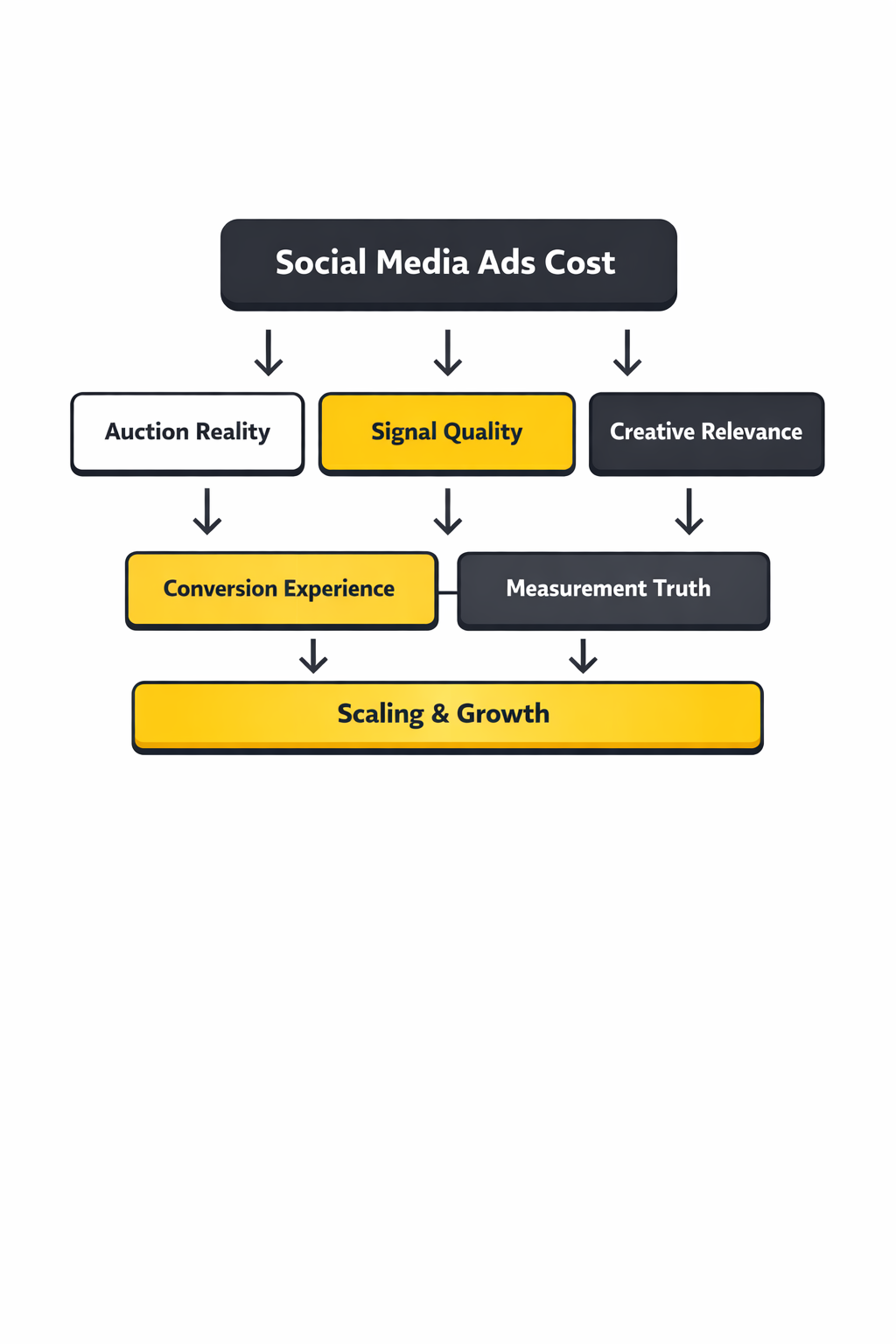
To manage social media ads cost effectively, you need a structured framework rather than reactive adjustments. A clear model helps you diagnose performance issues systematically instead of guessing.
The framework can be broken into four interconnected layers:
1. Auction Environment
This includes seasonality, industry competition, geographic targeting, and macroeconomic shifts. For instance, advertising competition typically spikes during major commercial events, increasing CPMs across industries.
2. Audience Strategy
Broad audiences may produce lower CPMs but weaker conversion rates. Highly refined audiences often cost more per impression but deliver stronger purchase intent. The balance between reach and relevance plays a central role in total cost efficiency.
3. Creative Performance
Ad platforms reward engagement signals. Strong hooks, compelling offers, and clear value propositions improve click-through rates and conversion likelihood. Over time, better engagement reduces effective cost.
4. Conversion Infrastructure
Landing page speed, messaging alignment, checkout friction, and trust signals all impact conversion rate. Improving on-site experience can reduce cost per acquisition without changing ad spend at all.
When you examine social media ads cost through these layers, optimization becomes intentional rather than experimental.
Core Components That Shape Social Media Ads Cost
Let’s look more closely at the specific variables that consistently influence pricing.
Bidding Model
Most platforms allow automated bidding, cost caps, or manual bid strategies. Automated systems leverage machine learning to optimize toward conversion goals. Manual controls provide predictability but require close monitoring.
Ad Relevance Signals
Click-through rate, watch time (for video), engagement, and feedback signals affect delivery. Higher relevance often translates into lower effective CPMs and CPCs over time.
Audience Saturation
Small, frequently targeted audiences experience ad fatigue. As frequency increases, performance drops and cost per result rises. Rotating creatives and expanding targeting pools can stabilize cost trends.
Placement Mix
Different placements (feeds, stories, reels, in-stream video) carry different competition levels. Diversifying placements allows algorithms to allocate budget toward lower-cost inventory where performance remains strong.
These components interact continuously. Adjusting one variable without considering the others can distort performance interpretation. That’s why isolated “CPC benchmarks” rarely tell the full story.
Professional Implementation Strategies
Managing social media ads cost at a professional level requires disciplined measurement and structured experimentation.
First, define a clear profitability target. Instead of chasing the lowest cost per click, calculate your maximum allowable acquisition cost based on customer lifetime value and margin structure.
Second, structure campaigns to isolate variables. Test creative angles separately from audience segments. This approach makes cost drivers easier to identify.
Third, monitor blended metrics. Looking only at campaign-level cost can mask funnel inefficiencies. Evaluate CPM, CTR, conversion rate, and cost per acquisition together to understand where friction exists.
Finally, treat optimization as an ongoing system rather than a one-time adjustment. Auction dynamics evolve daily. Creative fatigue sets in. Audience behavior shifts. Sustainable cost efficiency comes from continuous refinement rather than sporadic intervention.
In the next part, we’ll move deeper into platform-specific pricing dynamics and compare how costs differ across major networks — and why those differences matter when allocating budget strategically.
Step-by-Step Implementation
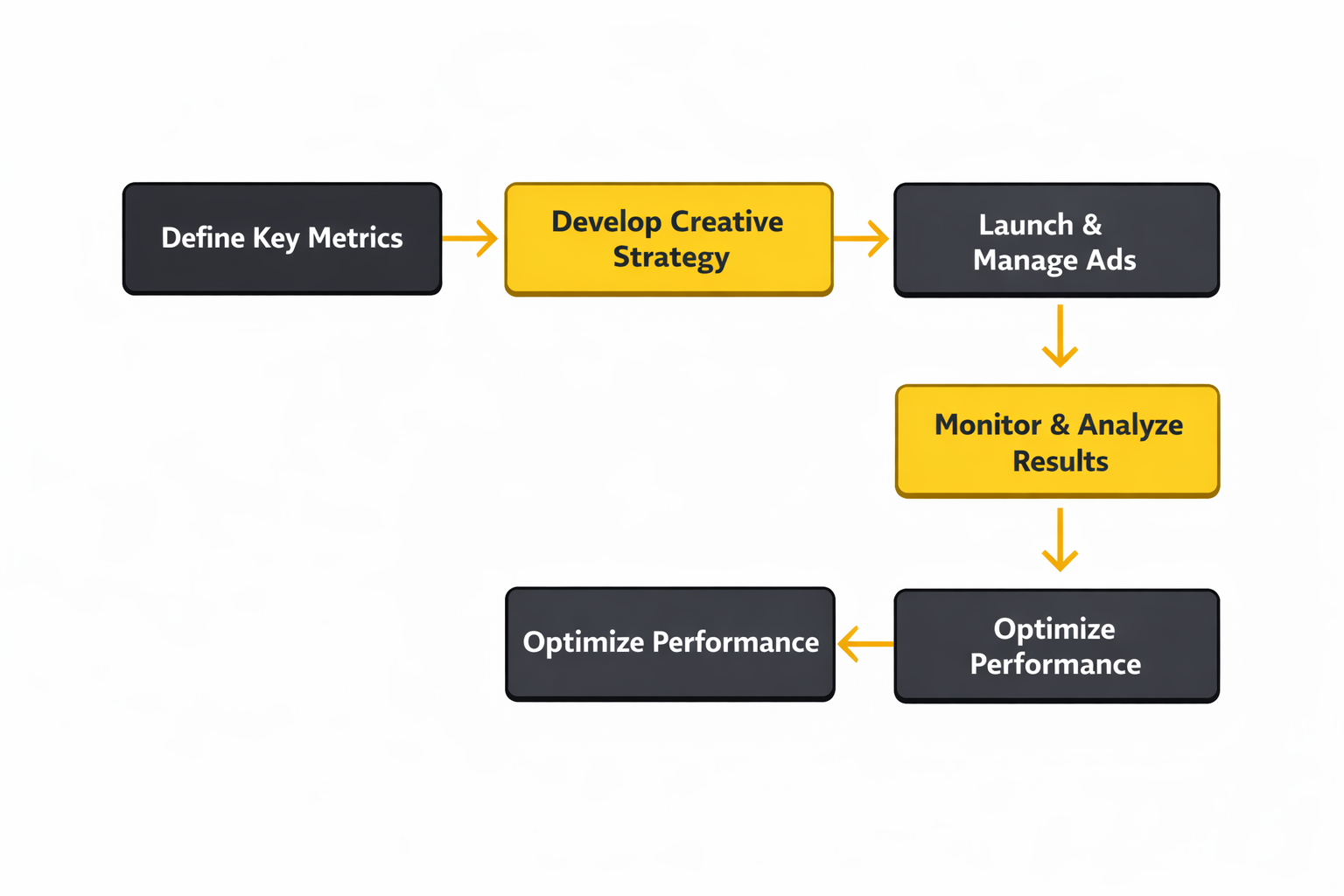
Lowering social media ads cost starts with a simple truth: you can’t optimize what you can’t reliably measure. Ad platforms run auctions in real time, and they reward advertisers who give the algorithm clean signals and a consistent conversion path. Your job is to build a system the platform can learn from, not a collection of one-off tactics.
Use this sequence when you’re setting up campaigns from scratch or rebuilding after costs creep up.
Step 1: Define the “cost” that actually matters
Pick a single primary cost metric that matches the business model: cost per qualified lead, cost per first purchase, or cost per booked call. If the business can’t explain what “good” looks like, the ad account will drift into vanity metrics and the budget will quietly leak.
Step 2: Align the conversion event with real value
Make the optimization event as close to revenue as possible while still generating enough data for learning. If you optimize for clicks when you really need purchases, you’ll often get cheap traffic that doesn’t buy. Meta’s own breakdown of how the ad auction selects winning ads makes it clear the system is trying to maximize value, not your traffic volume.
Step 3: Instrument tracking like your budget depends on it
Ensure your pixel/tag fires consistently, deduplicates events, and maps correctly across the funnel. If you’re using server-side signals, treat that as a reliability upgrade, not a “nice-to-have.” The cleaner the signal, the faster platforms can find people likely to convert, which is one of the most direct paths to stabilizing social media ads cost.
Step 4: Build a campaign structure that can teach the algorithm
Create a structure that separates prospecting from retargeting and separates cold creative tests from scaling campaigns. This isn’t about complexity. It’s about knowing what caused the change when costs move. If three variables change at once, you don’t learn — you just react.
Step 5: Launch with learning-friendly budgets and guardrails
Start with budgets that generate enough conversion volume to exit learning, then add guardrails (cost caps, bid strategies, or pacing rules) after the system has signal stability. TikTok’s own guidance on bidding methods inside TikTok Ads Manager highlights that auction outcomes depend on both bid and relevance, which means premature “tight caps” can choke delivery before the platform learns.
Step 6: Make creative iteration non-negotiable
Most accounts don’t fail because of targeting. They fail because the creative stops working and nobody ships replacements fast enough. Meta’s diagnostic approach to quality ranking and TikTok’s explanation of why bidding and relevance jointly determine auction rank both point to the same reality: stronger ads can win auctions without simply paying more.
Step 7: Tighten the landing experience before you touch the bid
If click costs rise, many teams immediately tweak bids. That’s often backwards. Fix the conversion rate first. Google’s update confirming INP replaced FID as a Core Web Vital on March 12, 2024 (also documented on web.dev and summarized by Search Engine Land) is a useful reminder: the modern web experience is increasingly measured by responsiveness, not just load time, and slow interactions are conversion killers.
Execution Layers
Professionals reduce social media ads cost by working in layers. Each layer has its own “levers,” and each lever solves a different kind of problem. When you know which layer is failing, you stop doing random optimizations and start making targeted fixes.
Auction layer
This is where bids, budgets, pacing, and competition live. You can’t control the market, but you can control how intelligently you participate in it. Meta’s investor reporting shows pricing does move at the platform level, with “average price per ad” increasing year over year in its 2025 results, as shown in the earnings release, the SEC filing, and the published financial exhibit.
Signal layer
This is tracking quality, event mapping, attribution consistency, and data freshness. If signals are noisy, platforms optimize toward the wrong users. Fixing signal quality doesn’t always feel like “marketing,” but it’s one of the highest-leverage moves you can make when costs feel unpredictable.
Creative layer
This is where you earn your auction efficiency. Creative doesn’t just “improve CTR.” It changes how platforms interpret relevance, which affects distribution. If your creative strategy is “one hero ad,” you should expect cost spikes the moment that ad fatigues.
Funnel layer
This is the landing page, checkout, lead form, and follow-up flow. If the funnel is weak, every click becomes more expensive because fewer people convert. That’s why paid media teams that partner closely with CRO teams often outperform teams that only live inside ads managers.
Optimization Process
A good optimization process doesn’t chase daily fluctuations. It treats cost changes as a diagnosis problem. When social media ads cost rises, the question is: which layer shifted, and what evidence supports that conclusion?
1) Start with a “cost tree,” not a single number
Break CPA (or CPL) into inputs you can test: CPM, CTR, conversion rate, and average order value (if relevant). If CPA rises but CTR is stable, the issue is rarely the ad itself. If CPM rises across multiple campaigns, the issue may be competitive pressure or audience saturation.
2) Separate learning issues from performance issues
When a campaign is new, volatile results are normal. The fix is usually consistency: stable budgets, stable events, and enough volume. When a mature campaign changes suddenly, treat it as a signal that either the market shifted or the creative fatigued.
3) Use controlled experiments with one variable at a time
If you change the audience, creative, and landing page in the same week, you lose the ability to learn. Set a rhythm where each test has a clear hypothesis and a defined success metric before launch.
4) Optimize for stable systems, not “hero weeks”
The goal is a cost baseline you can forecast, not a one-time win that collapses next month. This is where measurement discipline matters. Industry measurement discussions increasingly emphasize mixing approaches, including MMM, because platform-level attribution can be incomplete; that shift shows up in reporting and commentary such as EMARKETER’s overview of MMM’s resurgence and TikTok’s own push to help advertisers measure more holistically with MMM.
Implementation Stories
Here’s what implementation looks like when things get real and budgets are on the line.
When a catalog strategy stopped being “optional” and started being survival
The week the numbers turned, it didn’t feel subtle. Clicks were still coming in, but the cost per acquisition started drifting upward day after day. The team watched their dashboards like a heart monitor, trying to spot the moment they could intervene before the spend became indefensible.
They weren’t new to paid social. talabat had already been running large-scale campaigns and had an established creative pipeline, but scale has a downside: the bigger the machine, the harder it is to pivot quickly. When performance starts slipping, every day of slow decision-making costs real money and creates pressure across marketing and finance.
The wall hit when creative fatigue arrived faster than production could keep up. Static assets that had performed for weeks began to stall, and what used to be a steady acquisition engine started behaving like a leaky bucket. Retargeting got expensive, prospecting got noisier, and the team faced the uncomfortable question: are we paying more because the auction changed, or because our creative system can’t respond fast enough?
The epiphany was that they didn’t actually have a targeting problem — they had a production velocity problem. If they could generate relevant variations at scale, the auction would have more options to learn from and more chances to match the right user with the right product. That meant moving away from “one-off ads” and toward templated, repeatable creative that could be refreshed without rebuilding everything from scratch.
They shifted toward video-driven catalog creative workflows, using templated production so product-level variations could be generated faster and reused across placements and channels. Smartly describes this shift in its breakdown of how talabat used video templates for catalog ads and in a dedicated case study focused on the operational change behind the campaign approach at scale, rather than treating each ad as a standalone project.
Then the final conflict arrived: operational friction. Templates only work if product data stays clean, feeds stay stable, and the team agrees on rules that keep creative on-brand without slowing iteration. When data issues or approvals break the cycle, velocity collapses and you’re right back where you started — paying more because the system can’t adapt fast enough.
The dream outcome wasn’t “one magical ad.” It was a repeatable machine: feed-based creative variation, quicker refresh cycles, and a campaign structure that made it easier to learn what was working without constantly rebuilding campaigns. That’s the kind of foundation that tends to keep social media ads cost under control over time, because you’re solving the root cause: you can respond to performance shifts faster than the auction can punish you.
Professional Implementation
If you want a professional standard for controlling social media ads cost, focus on consistency, speed of learning, and clean feedback loops.
- Set one primary cost KPI and a small set of supporting diagnostics (CPM, CTR, conversion rate). If you add ten KPIs, you’ll manage none of them well.
- Build a weekly testing cadence that ships new creative predictably. Cost control is often a creative operations problem disguised as a bidding problem.
- Protect signal quality by auditing tracking and event mapping regularly, especially after site releases or tag changes.
- Separate exploration from scaling so you always know whether you’re learning or harvesting results.
- Fix conversion friction before adjusting bids so you’re improving efficiency rather than just paying differently for the same outcomes.
In Part 4, we’ll go deeper into analytics and monitoring — how to detect early warning signals, build dashboards that actually help decisions, and spot the difference between normal volatility and a real cost problem.
Statistics And Data
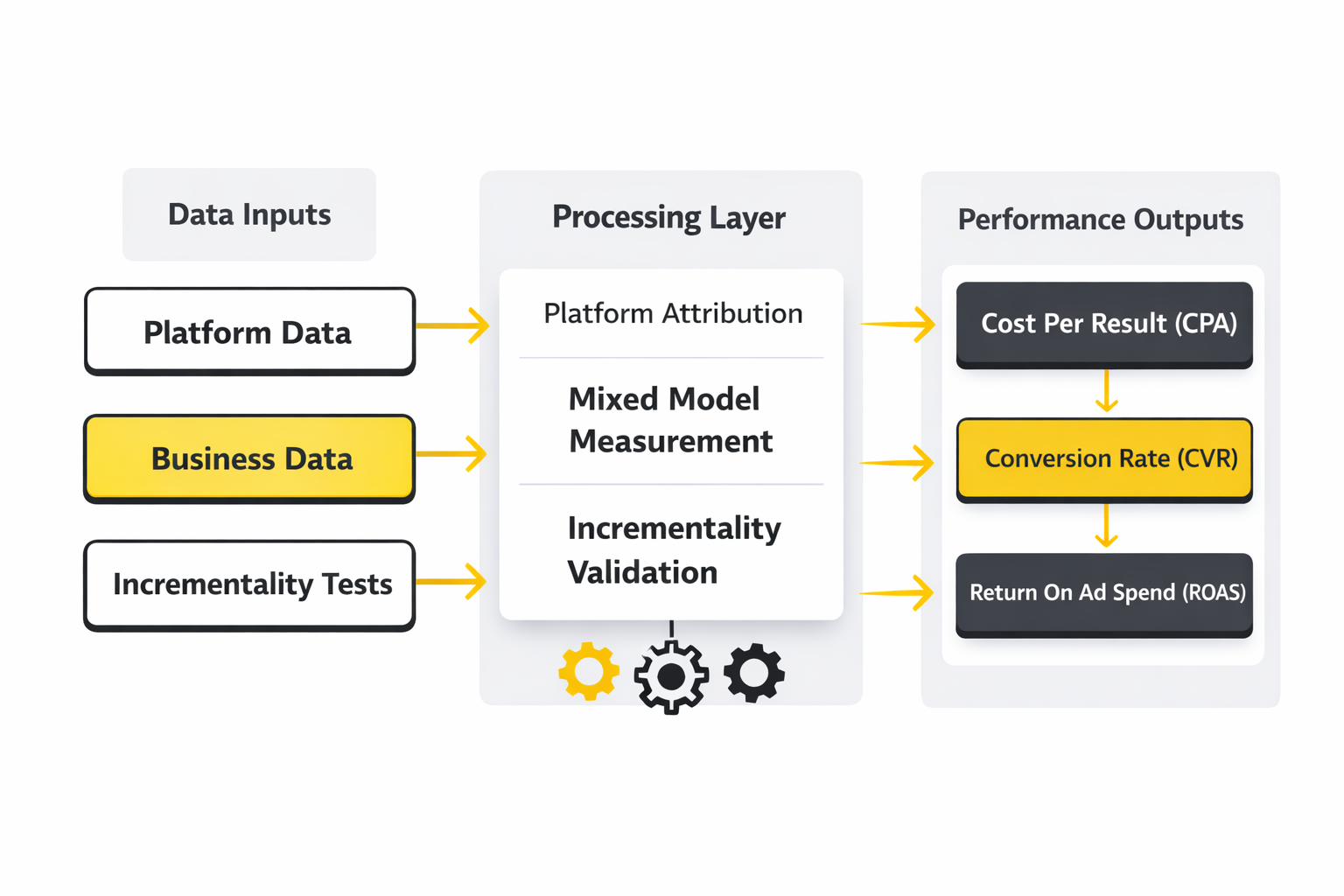
When people argue about social media ads cost, they often argue from a single dashboard. The more useful view is wider: how big the market is, what platforms are signaling about pricing, and what independent benchmark providers observe across millions (or billions) of impressions.
Start with market reality. Social media advertising revenue in the U.S. reached $88.8B in 2024, shown in the IAB/PwC Internet Advertising Revenue Report (Full Year 2024), repeated in the IAB’s release summary, and covered in Yahoo Finance’s write-up of the same report. That scale matters because it explains why auction pressure is persistent: there’s a lot of money chasing a finite amount of attention.
Platform earnings add another layer. Meta reported that its “average price per ad” increased year over year for both 2024 and 2025, with the 2025 results highlighting a +9% increase for the full year and +6% for Q4, documented in its 2025 earnings release and echoed via a mainstream distribution in PR Newswire’s publication of the same release. That doesn’t mean every advertiser paid 9% more. It means the platform-level clearing price moved, which usually reflects a mix of demand, inventory, and performance improvements.
Benchmark providers show what that movement looks like on the ground. Skai’s cross-channel reporting put average paid social CPM in Q4 2024 around the mid-single digits, with Digital 2025 summarizing Skai’s Q4 finding as $5.69 CPM (Oct–Dec 2024) and noting it was down year over year, while the primary source remains Skai’s own Q4 2024 Quarterly Trends Report and Skai’s report landing page provides additional context on how the dataset is compiled in the Q4 2024 report overview.
For TikTok specifically, Tinuiti’s benchmark reporting shows notable CPM declines year over year in 2025, including “CPM drops 22% YoY” language in its Q2 2025 Digital Ads Benchmark Report and similar “22% lower” framing in its Q3 2025 edition. This is a good reminder that “platform getting cheaper” can coexist with “my account getting more expensive” if your creative fatigues, your funnel slows down, or your tracking quality declines.
Performance Benchmarks
Benchmarks are useful when you treat them like guardrails, not targets. The best benchmark isn’t a single “average CPM” number. It’s a range by objective, geography, placement mix, and audience temperature, with enough context that you can tell whether your account is normal, unusually strong, or quietly in trouble.
A practical way to use benchmarks is to compare directionally rather than obsessing over absolute values. If your CPM moves 20–30% week over week without a major seasonal event, that’s a signal to investigate competition shifts, audience saturation, or creative relevance. If CPM is stable but cost per acquisition spikes, the problem usually lives downstream in conversion rate or lead quality, not the auction itself.
For broader market context, Skai’s quarterly reporting tracks pricing and volume trends across paid social, and the takeaway in Skai’s Q1 2025 Quarterly Trends Report is that paid social CPM rose modestly year over year (+5%), while volume dynamics kept overall spend from running away. Tinuiti’s reporting adds platform-specific nuance, especially for TikTok, where CPM trends were materially lower year over year in 2025 in both its Q2 2025 and Q3 2025 reports.
If you want an “are we sane?” benchmark for the business side, not just the ad side, keep one number front and center: the maximum acquisition cost you can afford. Everything else (CPM, CTR, CPC) becomes diagnostic inputs that explain why you’re above or below that ceiling.
Analytics Interpretation
Great dashboards don’t reduce social media ads cost by themselves. What they do is reduce panic. They let you separate “market moved” from “we broke something” and make changes with confidence instead of superstition.
Read cost changes as a chain reaction
Most cost spikes are not mysterious. They’re a chain reaction: creative engagement softens, delivery becomes less efficient, CPM rises, and your CPA follows. If you can see each link in the chain, you can fix the first weak link instead of just paying differently.
Use platform data for speed, but verify incrementality
Platforms optimize for the events you feed them, and they’re excellent at moving within their own environments. The hard question is whether results are incremental. That’s why incrementality testing is getting more mainstream, with analyses like Haus’s review of 640 Meta incrementality experiments pushing marketers to validate whether performance is new revenue or just shifted attribution.
Watch for measurement regime shifts
Sometimes performance changes because your measurement changed, not because the market changed. Web experience is one example: Google’s move to replace FID with INP as a Core Web Vital on March 12, 2024 is confirmed in Google’s announcement, reinforced by the implementation note on web.dev, and contextualized by industry coverage in Search Engine Land. If the landing experience becomes less responsive, your conversion rate can quietly fall, making ads “feel” more expensive even when the auction is stable.
Look for platform-level signals when your account looks “random”
When your account cost volatility doesn’t match your activity, it’s often worth checking platform-level pricing signals. Meta’s reporting that “average price per ad” increased year over year in both 2024 and 2025, documented in its 2024 earnings release and 2025 earnings release, is a reminder that some shifts are macro-level. Your job is to respond with stronger signals and better conversion infrastructure, not just tighter bids.
Case Stories
Target’s “online ROAS” problem wasn’t really online
The pressure wasn’t coming from a bad week in Ads Manager. It was coming from a bigger, messier problem: the kind that makes leadership question whether paid social is still worth it. When reporting over-indexed on e-commerce conversions, the numbers made it look like spend was drifting away from efficiency, even as stores stayed busy.
Target already had the scale, the brand, and the operational muscle to move volume. What it didn’t have was clean proof that social advertising was driving both online and offline outcomes in the same story. And without that proof, any rise in social media ads cost felt like a failure rather than a normal market movement.
The wall showed up when decision-makers tried to “fix” the wrong thing. If you optimize only for online purchases, you risk starving the system of shoppers who buy in-store. Meanwhile, budget conversations become tense because the dashboard can’t defend the real impact.
The epiphany was to measure the channel the way customers behave, not the way a single attribution view prefers. Target ran an A/B split test in Meta Ads Manager (Oct 13–Nov 2, 2024) to evaluate omnichannel ads and their total impact, described in Meta’s Target omnichannel ads case study. Instead of debating opinions, they designed the question so the data could answer it.
The journey wasn’t a magic creative hack. It was structural: define the right test, align the objective to total value, and let the platform optimize toward the outcome you actually care about. At the same time, the broader industry push to optimize for offline outcomes is captured in a collaboration announcement where testing Meta’s omnichannel ads drove large store-sales lifts versus standard campaigns, detailed in Ovative Group and Meta’s PR release on omnichannel optimization testing.
Then the final conflict hit: trade-offs and skepticism. Improving store sales can surface uncomfortable questions about what “good” looks like when e-commerce attribution drops. The same Ovative release explicitly notes measurement and e-commerce trade-offs, which is exactly why teams need incrementality thinking instead of platform-only attribution.
The dream outcome is what makes cost feel controllable again. When you can measure the right outcome, you can choose the right optimization strategy, and social media ads cost becomes a lever instead of a mystery. Target’s story is valuable because it shows that cost control sometimes comes from better measurement, not cheaper auctions.
Professional Promotion
If your ads are profitable, analytics makes you faster. If your ads are not profitable, analytics keeps you from wasting months “optimizing” the wrong variable. Either way, treating measurement as a first-class system is one of the most reliable ways to stabilize social media ads cost without constantly changing bids.
A professional-grade approach usually includes:
- A single source of truth for outcomes: one definition of a qualified lead or conversion that marketing and sales agree on.
- Tracking audits on a schedule: especially after site releases, checkout changes, or tag updates.
- Experiment design: clear hypotheses, controlled changes, and a consistent cadence so you’re learning every week.
- Incrementality validation: periodic tests so the business trusts results beyond the platform dashboard, guided by modern experiment thinking like Haus’s Meta incrementality analysis.
In Part 5, we’ll zoom out to the ecosystem around cost: how platform shifts, privacy changes, AI automation, and creative supply chains shape what you pay — and how to build resilience so your performance doesn’t collapse when the market changes.
Advanced Strategies
Once you’ve stabilized the basics, lowering social media ads cost stops being about “tweaking ads” and starts being about building unfair advantages: better signals, better measurement, better creative throughput, and better economics behind the conversion event.
Run incrementality tests so you stop optimizing illusions
Platform attribution can be directionally useful, but it can also flatter performance in ways that make scaling feel safer than it really is. When you validate incrementality, you learn whether budget increases are creating new outcomes or just re-labeling demand that would have happened anyway.
- Conversion lift tests: TikTok’s Conversion Lift Study explains its experiment-based approach to isolating the conversions driven by ads.
- Post-purchase behavior and delayed impact: the Haus Cyber Week incrementality report shows why short attribution windows can undercount paid social impact during high-pressure retail periods.
Optimize for value, not volume
Scaling usually breaks when the algorithm is trained to chase cheap conversions that don’t turn into durable revenue. If you’re serious about cost control, the most powerful move is to align the optimization event with real value and keep that definition consistent over time.
- Bid strategies and guardrails: Meta’s bid strategy guide is useful for deciding when to prioritize lowest-cost delivery versus more controlled cost targets.
- Automation that learns faster: Meta’s developer overview of Advantage+ Shopping Campaigns highlights how automation can shift optimization effort from manual knobs to signal and creative quality.
Engineer a creative supply chain, not a “creative project”
Advanced advertisers treat creative like inventory. When you have a steady supply of fresh angles, formats, and variations, you prevent fatigue-driven cost spikes before they become emergencies.
The practical warning sign is frequency paired with declining click-through and conversion rate. Supermetrics’ 2025 research on performance marketing reporting explicitly points teams toward examining frequency as a key lens for creative fatigue, because rising frequency often precedes higher cost per result.
Use market pricing signals to time your aggression
Sometimes your account isn’t “worse” — the market is just more expensive. Pricing shifts show up in platform-level reporting and cross-platform benchmarks, which helps you decide when to push harder, hold steady, or shift spend to less competitive inventory.
- Platform price movement: Meta’s 2025 results show year-over-year movement in “average price per ad” in the earnings release and the matching details in the SEC filing.
- Cross-platform benchmark context: Skai’s quarterly reporting provides paid social trend context in the Q1 2025 Quarterly Trends Report, while Tinuiti’s reporting adds platform-specific shifts, including TikTok CPM movement in the Q2 2025 benchmark report.
Scaling Framework
Scaling social media ads cost responsibly means you scale the system, not just the spend. A practical framework has three phases, each with a different objective and different failure modes.
Phase 1: Prove efficiency exists
Before you scale, you need a repeatable acquisition pattern: a creative concept that converts, an audience strategy that can expand, and a funnel that doesn’t collapse under higher volume. This is where most teams confuse “one great ad” with “a scalable machine.”
Phase 2: Expand without breaking learning
Scaling is often a learning problem, not a budget problem. When you raise spend too abruptly, you change delivery dynamics and the algorithm may explore new pockets of inventory that behave differently. The safer pattern is to expand in multiple directions at once: broader targeting, more placements, more creative variations, and more conversion-path resilience.
Phase 3: Protect profitability while you push volume
At scale, cost control is about defense. You defend your signal quality, your creative refresh cadence, and your measurement truth. This is also where incrementality matters most, because it keeps you from “winning” in a dashboard while losing in real profit.
If you need a macro sanity check while scaling, market-level reporting helps. The IAB/PwC Full Year 2024 ad revenue report is a reminder that you’re operating inside a massive, competitive market where demand pressure never fully disappears.
Growth Optimization
After you’re scaling, optimization becomes less about “fixing ads” and more about compounding small advantages that lower cost over time.
Shift measurement from channel metrics to business outcomes
When growth teams only look at CPM and CPC, they can accidentally optimize for cheap traffic and expensive customers. Instead, tie paid social to downstream value: lead qualification rate, time-to-close, repeat purchase rate, and margin-adjusted contribution.
Combine attribution views so you don’t over-credit any one platform
As privacy and tracking constraints evolve, single-source attribution is less reliable. That’s why measurement approaches like MMM keep resurfacing in industry planning cycles. EMARKETER’s overview of MMM’s resurgence captures why more teams are blending methods, and TikTok has been actively encouraging broader measurement via its MMM program content.
Improve site experience so conversion rate does the heavy lifting
When conversion rate improves, your social media ads cost per acquisition drops even if CPM stays flat. Web experience is measurable now in ways it wasn’t a few years ago. Google’s confirmation that INP replaced FID as a Core Web Vital is a useful anchor for teams that still treat landing performance as an afterthought.
Use channel diversification as a cost stabilizer
If you only buy results from one auction, your costs are hostage to that auction. Diversifying doesn’t mean spreading thin. It means building at least one additional scalable channel where you can shift budget when one platform becomes temporarily inefficient.
Snap’s summary of Triple Whale’s 2025 research is one example of how advertisers evaluate relative efficiency across platforms, and it’s the kind of external signal that can prompt a smart test when your primary channel overheats.
Scaling Stories
How a subscription service tried to scale automation without losing control
The first sign of trouble wasn’t a total collapse. It was the kind of quiet drift that makes a performance team uneasy: results still looked “fine,” but the efficiency cushion was shrinking. Leadership wanted growth, the platform wanted more spend, and the margin math started to feel less forgiving every week.
The team had built its acquisition engine on what worked historically: structured campaigns, careful segmentation, and manual controls that felt safe. But the more competitive the auctions became, the more those manual guardrails started to slow learning and limit expansion. Scaling began to look like a choice between speed and stability.
The wall arrived when the old approach stopped scaling cleanly. Increasing budgets didn’t just multiply results; it changed delivery patterns and pushed the account into less efficient pockets of inventory. Instead of certainty, the team got volatility, and volatility made every budget conversation harder.
The epiphany was that they needed a different kind of control — not “more knobs,” but a system that could learn faster than humans could micromanage. That led them to test automation alongside their existing approach, rather than ripping everything out at once. Meta’s case study on NOW using Advantage+ Shopping documents this type of experiment-led shift toward automation as a path to performance improvement.
The journey wasn’t just turning on an automated campaign and hoping. It required tightening the signal path, making creative iteration more predictable, and ensuring the conversion event matched what the business actually valued. It also required separating “learning campaigns” from “scaling campaigns,” so growth didn’t destroy clarity.
The final conflict showed up in the place nobody loves: operations. Automation can amplify whatever you feed it, and if product pages, offers, or creative inputs become inconsistent, the system learns the wrong lesson quickly. That’s why Meta’s own framing of automated commerce advertising emphasizes pairing automation with reliable inputs, as described in its Advantage+ Shopping overview.
The dream outcome is a scaling loop that feels calmer: you increase budget, performance holds, and the team can spend its time on creative and conversion quality instead of daily bid firefighting. When that happens, social media ads cost stops feeling like a daily surprise and starts behaving like a managed system.
Future Trends
The next era of social media ads cost will be shaped less by “which button you clicked in Ads Manager” and more by structural forces: privacy regulation, platform automation, and the steady shift from identity-based targeting to modeled and contextual signals.
EU policy pressure will keep reshaping targeting and measurement
In Europe, targeting rules are no longer a slow background change. They’re actively reshaping what platforms can do with data, and that flows straight into what advertisers pay. The European Commission’s April 22, 2025 decision and fine tied to Meta’s DMA compliance is laid out in the European Commission press release, and it connects directly to Meta’s plan to offer EU users reduced personalized ads starting January 2026, covered in The Verge’s reporting and explained in more detail by TechRadar’s breakdown.
What this means in practice: more contextual delivery, more modeled conversions, and a higher premium on strong creative and conversion experience, because precision targeting won’t always be available in the same way in every region.
Cookies won’t “die” on a neat timeline, but identity will keep fragmenting
If you’ve been waiting for a clean end date for third-party cookies, you’ve already felt the whiplash. Google’s own Privacy Sandbox cookies page reflects the ongoing changes in direction, while the ecosystem impact of Google stepping back from a standalone cookie prompt was widely reported, including Reuters coverage and The Verge’s summary.
The practical takeaway for social media ads cost is simple: the more tracking gets noisy, the more expensive “certainty” becomes. Teams that invest in first-party data, clean event mapping, and incrementality will have a cost advantage over teams relying on fragile attribution.
AI will change how creative is made and how auctions are won
Platforms are racing to remove production bottlenecks, because the biggest performance unlock for many advertisers is creative volume and relevance, not another targeting trick. TikTok’s generative tooling is positioned explicitly as a way to scale creation, starting with the TikTok Symphony announcement, the ongoing product page for TikTok Symphony tools, and the 2025 expansion described in TikTok’s AI tools update. TikTok also framed its broader AI and automation roadmap at its annual summit in TikTok World 2025.
As AI lowers creative production friction, auctions will punish stale ads faster. The “winner” won’t be the brand with the biggest budget. It’ll be the brand with the fastest learning loop and the cleanest conversion system.
Benchmarks will matter more, but only as directional signals
As automation increases, you’ll see more “blended” performance patterns and fewer easy, manual explanations. External benchmarks help keep your expectations grounded. Emplifi’s Social Media Benchmarks Report 2025 is a useful example of how cost and engagement differ by format and platform behavior, reinforcing why format mix and creative design can shift cost dynamics without any change in bid strategy.
Strategic Framework Recap

When social media ads cost rises, it’s tempting to blame the platform. The stronger approach is to treat cost like an ecosystem outcome, shaped by five connected systems.
- Auction reality: competition, seasonality, and platform-level pricing shifts you can’t control, but can respond to intelligently.
- Signal quality: clean tracking, correct events, and consistent data that lets algorithms learn quickly instead of guessing.
- Creative relevance: the fastest lever for auction efficiency, especially as platforms lean harder into automation and engagement signals.
- Conversion experience: landing speed, responsiveness, trust, and friction that decide whether clicks become customers.
- Measurement truth: attribution plus incrementality, so you scale what’s real and stop optimizing illusions.
If you build these systems together, cost becomes something you manage, not something that “happens” to you.
FAQ – Built for the Complete Guide
What actually determines social media ads cost day to day?
Most daily movement comes from auction pressure (more advertisers competing for the same audience), relevance signals (how people react to your ad), and conversion quality (whether your traffic converts). When your creative fatigues or your landing page slows down, costs often rise even if the market hasn’t changed.
What is a “good” CPM for paid social?
A good CPM is one that supports profitable acquisition for your business model. Benchmarks can help you sanity-check direction, but they can’t tell you profitability. If you want external context on how format and platform behavior can shift cost, Emplifi’s Social Media Benchmarks Report 2025 is a useful reference point.
Why is my CPC cheap but sales are weak?
Cheap clicks usually mean the platform found people willing to click, not people ready to buy. The fix is rarely “bid harder.” Align your optimization event with value, tighten your landing experience, and test messaging that pre-qualifies the click.
Should I use cost caps or let the platform run lowest-cost bidding?
Cost controls can help protect margins, but applying them too early can restrict delivery and prevent learning. Start by stabilizing your conversion signal and creative performance, then introduce caps when you have enough conversion volume to support predictable optimization.
How fast should I scale budget without blowing up efficiency?
Scale in a way that preserves learning: steady increases, multiple creative variations, and a conversion path that can handle volume. If you scale spend faster than you scale creative and funnel capacity, your social media ads cost per result usually spikes.
Why do my results look different in the EU compared to the US?
Regulation and platform compliance choices can change what targeting and measurement signals are available. The European Commission’s DMA actions are publicly documented in the April 2025 press release, and Meta’s reduced-personalization option planned for January 2026 has been covered in The Verge. When personalization is reduced, creative and conversion experience often carry more of the performance load.
What is incrementality, and why does it matter for social media ads cost?
Incrementality asks whether ads created conversions that wouldn’t have happened otherwise. It matters because scaling based only on platform attribution can make you think you’re profitable when you’re mostly capturing demand that already existed. Experiment-based measurement approaches are described in TikTok’s Conversion Lift Study overview.
Which metrics should I watch daily versus weekly?
Daily: delivery and stability (spend, CPM, frequency, conversion volume). Weekly: efficiency and quality (cost per result, conversion rate, lead quality, and downstream revenue). The point is to avoid reacting to noise while still catching real shifts early.
How do AI creative tools affect social media ads cost?
They change your production speed and testing capacity. If you can generate more relevant variations, you can reduce fatigue and keep relevance signals strong. TikTok’s direction is clear in the Symphony launch post and the continuing expansion described in its 2025 AI tools update.
Do Chrome cookie changes impact social media ads cost?
Indirectly, yes. When the wider measurement ecosystem gets noisier, it becomes harder to attribute outcomes cleanly, which can lead teams to overreact or underinvest. Google’s evolving direction is reflected on the Privacy Sandbox cookies page, and Google’s decision to avoid a standalone cookie prompt was widely reported, including Reuters coverage.
What is the fastest reliable way to lower CPA without wrecking volume?
Usually: improve conversion rate and creative relevance before touching bids. If your landing page converts better, every click becomes more valuable and your cost per acquisition falls even if CPM stays the same.
Work With Professionals
If you’re reading this because your social media ads cost is unpredictable, you already know the worst part: it steals time. It steals confidence in your numbers. It turns every week into a debate about whether the channel is “broken,” when the truth is usually simpler: the system needs better inputs, faster learning, and cleaner measurement.
That’s exactly where a marketplace built for marketers can change the trajectory. MARKEWORK positions itself as a marketing marketplace where you can connect directly, with no middleman and no project fees, and the platform emphasizes no commissions, direct communication, and token-based access to opportunities. When you’re trying to stabilize performance, speed matters, and direct access matters.
If you’re a freelancer, the opportunity is bigger than any one platform’s CPM curve. Remote demand is real, and it’s visible in job-market aggregators showing hundreds to thousands of marketing roles at any time, like Remote Rocketship’s remote marketing job listings. The edge goes to marketers who can prove they know how to control cost while protecting growth, because that’s what companies are hiring for right now.
If you want to move from “trying things” to running paid social like a system, use MARKEWORK to put yourself in front of companies that need exactly that. Build a profile, show your proof, and start conversations without a platform taking a cut of every project.
 Filip Konecny Enterprises