

Social media has evolved from a communication channel into one of the most powerful advertising ecosystems ever created. Businesses of every size now compete for attention inside algorithm-driven feeds where visibility is no longer guaranteed. Organic reach has steadily declined, forcing brands to rely on paid promotion if they want their messages to reach the right audiences at scale.
That shift explains why social media ad management has become a specialized discipline rather than a simple marketing task. Running profitable campaigns today requires technical targeting, creative testing, budgeting strategy, and constant performance analysis. Without a structured management approach, advertising budgets disappear quickly with little measurable return.
The stakes are significant. Global spending on social media advertising surpassed $234 billion in 2024, and forecasts show the market continuing to expand rapidly as companies shift budgets away from traditional channels. At the same time, the performance potential remains enormous when campaigns are managed correctly: industry analyses show average returns of roughly $4.20 in revenue for every $1 spent on social ads.
In other words, social platforms are not just marketing tools—they are revenue engines. But unlocking their potential requires disciplined planning, structured frameworks, and professional campaign execution.
Article Outline
- What Social Media Ad Management Is
- Why Social Media Ad Management Matters for Modern Businesses
- Social Media Ad Management Framework Overview
- Core Components of Social Media Ad Management
- Professional Implementation of Social Media Ad Management
What Social Media Ad Management Is

Social media ad management is the structured process of planning, launching, optimizing, and analyzing paid advertising campaigns across social platforms such as Facebook, Instagram, TikTok, LinkedIn, Pinterest, and YouTube. Instead of simply boosting posts or running occasional promotions, ad management treats social advertising as a continuous performance system that must be monitored and improved over time.
At its core, the discipline focuses on aligning advertising activity with clear business outcomes. Campaigns are designed to achieve specific goals such as generating leads, driving ecommerce purchases, building brand awareness, or increasing website traffic. Every decision—from audience targeting to creative design—is guided by measurable objectives.
Professional campaign management typically includes several ongoing activities. Marketers research and define audiences, design creative variations, structure campaigns inside advertising platforms, allocate budgets, and continuously test performance. Once campaigns are running, data analysis becomes central to decision-making because small adjustments to targeting or messaging can significantly improve conversion rates and profitability.
Modern platforms make this possible through sophisticated targeting systems. Advertisers can reach audiences based on demographics, interests, behaviors, and prior interactions with a brand. These targeting capabilities are one of the main reasons social media advertising has become so effective for both small businesses and global brands. As explained in Dash Social’s overview of social media advertising, the platforms allow marketers to match promotions with users whose interests and behaviors strongly suggest potential buying intent.
When managed strategically, these campaigns become part of a broader digital ecosystem. Paid promotion supports organic content, retargets website visitors, amplifies product launches, and feeds valuable performance data back into marketing strategy.
Why Social Media Ad Management Matters for Modern Businesses
The importance of structured social media ad management has grown rapidly as the digital advertising landscape becomes more competitive. Billions of users now spend large portions of their day on social platforms, which has transformed them into one of the most influential discovery channels for brands and products.
Research into online consumer behavior shows that roughly 29.7% of internet users discover new brands through social media advertising. That level of discovery places social platforms among the most influential channels for product awareness and purchase research.
For companies, this creates an enormous opportunity—but only if campaigns are managed properly. Advertising costs on major platforms have increased steadily as competition grows. Without careful targeting and optimization, brands risk spending significant budgets on audiences that never convert into customers.
Structured campaign management addresses this challenge by introducing measurable strategy. Campaign goals define what success looks like, whether that means purchases, leads, signups, or engagement. Budgets are then allocated in a way that supports those goals while minimizing wasted impressions.
Another reason social media ad management matters is accountability. Digital campaigns generate large volumes of data about audience behavior, conversion patterns, and creative performance. When this data is analyzed consistently, marketers gain insights that improve not only advertising but also product messaging, website design, and overall marketing strategy.
This performance-driven approach explains why social media advertising continues to attract increasing investment. Forecasts indicate that global spending could surpass $317 billion annually by 2026, demonstrating how central paid social campaigns have become within modern marketing budgets.
Social Media Ad Management Framework Overview
Successful campaigns rarely happen by accident. Behind most profitable advertising programs is a structured framework that guides decision-making from planning to optimization. A social media ad management framework acts as a roadmap for building campaigns that are both scalable and measurable.
Most frameworks follow a cyclical process that begins with strategic planning. At this stage, marketers define campaign goals, identify target audiences, and determine the platforms where those audiences are most active. Clear objectives ensure that advertising activity directly supports broader business outcomes.
The next stage focuses on campaign creation. Advertisers develop creative assets, messaging variations, and landing experiences designed to capture attention and encourage action. Because social media environments move quickly, creative testing becomes essential. Marketers often launch multiple variations simultaneously to determine which combinations of visuals, copy, and formats perform best.
Once campaigns are active, performance monitoring becomes the central activity. Advertising platforms provide real-time data on impressions, clicks, engagement, conversions, and revenue. These metrics help identify which audiences and creatives generate the strongest results.
Optimization closes the loop. Based on performance insights, marketers adjust targeting, budgets, bidding strategies, or creative elements to improve results. This iterative process turns campaigns into learning systems that become more efficient over time.
Industry frameworks consistently highlight four foundational elements: clear goals, precise audience targeting, effective creative design, and strategic budget management. These pillars form the foundation of most successful advertising systems, as outlined in Sprinklr’s explanation of social advertising campaign structure.
Core Components of Social Media Ad Management
Although every campaign is unique, most successful social media advertising programs share several fundamental components. These elements work together to create campaigns that reach the right audience, deliver compelling messages, and generate measurable results.
Audience Targeting and Segmentation
Precise targeting is one of the main advantages of social media advertising. Platforms collect large amounts of behavioral and demographic data that allow marketers to define highly specific audiences. Advertisers can reach users based on age, location, professional roles, purchasing behavior, interests, and even past interactions with a brand’s website or content.
Segmentation allows campaigns to deliver personalized messages rather than generic advertisements. For example, a company might create separate campaigns for new prospects, returning website visitors, and existing customers. Each group receives messaging designed for its specific stage in the buying journey.
Creative Development
Creative assets are often the most visible element of a campaign, but they also play a major role in performance. Images, videos, headlines, and copy must capture attention quickly within fast-moving social feeds. Strong creative not only increases click-through rates but also signals relevance to platform algorithms, which can reduce advertising costs.
Testing multiple creative variations is now considered standard practice. Advertisers often experiment with different visual styles, messaging approaches, and formats to discover what resonates most strongly with their audience.
Budgeting and Bidding Strategy
Effective social media ad management also requires thoughtful budgeting. Rather than spreading resources evenly across campaigns, marketers typically allocate budgets based on performance data and strategic priorities.
Many organizations dedicate a meaningful share of their marketing budgets to social platforms. Strategic budgeting guidelines often recommend allocating around 15–25% of total marketing budgets to social media initiatives, with a portion specifically dedicated to paid promotion and campaign optimization.
Advertising platforms use automated bidding systems to determine how ads compete for placement in user feeds. Understanding these systems helps marketers balance reach, cost, and conversion performance while maintaining profitable campaigns.
Analytics and Performance Measurement
Data analysis is the backbone of professional campaign management. Metrics such as impressions, click-through rates, conversion rates, and return on ad spend reveal whether campaigns are achieving their intended goals.
Advanced reporting systems also allow marketers to connect advertising activity with downstream outcomes such as revenue, lead quality, or customer lifetime value. This level of insight helps businesses determine which campaigns truly contribute to growth.
Professional Implementation of Social Media Ad Management
Implementing a professional social media ad management system requires more than launching ads inside a platform dashboard. It involves building a structured operational process that connects marketing strategy, creative production, data analysis, and continuous optimization.
Many organizations establish dedicated workflows to manage this complexity. Campaign planning often begins with cross-functional collaboration between marketing strategists, creative teams, and data analysts. Together they define objectives, design campaign concepts, and determine how success will be measured.
Execution typically happens in iterative cycles. Campaigns launch with controlled budgets, allowing marketers to test multiple targeting and creative variations simultaneously. Performance data from these early tests reveals which approaches deserve increased investment and which should be paused or redesigned.
As campaigns scale, automation tools frequently become part of the management process. Reporting platforms consolidate data from multiple social networks, making it easier to identify patterns across campaigns and track performance over time. Automated rules can also adjust budgets or pause underperforming ads without manual intervention.
Professional implementation ultimately transforms advertising into a repeatable growth engine. When strategy, creative testing, targeting precision, and analytics work together, social media ad management becomes far more than paid promotion—it becomes a system for acquiring customers, scaling revenue, and continuously refining marketing performance.
Step-by-Step Implementation

A clean social media ad management implementation is less “launch campaigns” and more “build a system that keeps working when things change.” Algorithms shift, tracking gets noisier, and creatives fatigue faster than most teams expect. The goal of this step-by-step approach is to make performance resilient, so your results don’t depend on one lucky ad or one person remembering how the account is set up.
Step 1: Define one primary outcome and one secondary outcome
Start by choosing a single primary outcome for the next 30–60 days, like purchases, qualified leads, booked calls, or app installs. Then choose one secondary outcome that supports learning, like add-to-cart events, lead form opens, or product page views. This keeps your reporting honest and prevents the most common failure mode in social media ad management: optimizing for five goals at once and getting none of them consistently.
Step 2: Lock measurement before you lock creative
Before you produce a library of ads, make sure you can reliably see the events you care about. For many teams, that means combining browser-based tracking with server-to-server event sharing so conversion data doesn’t disappear when cookies or devices don’t cooperate. You can see how major networks want this implemented in their first-party documentation for Meta Conversions API, the TikTok Events API, and LinkedIn Conversions API.
Step 3: Create a naming system you won’t hate later
Campaign naming isn’t a “nice-to-have.” It’s the difference between being able to scale and having to rebuild reporting every time someone asks a basic question. Set a standard that captures objective, audience, offer, creative concept, and date, then enforce it across platforms so your dashboards don’t turn into archaeology.
Step 4: Build three audience layers instead of twenty micro-segments
A practical starting point is three layers: prospecting (new people), warm retargeting (visitors/engagers), and customer expansion (existing buyers or leads). You can always refine later, but early-stage complexity often masks weak creative and muddy measurement. If you’re using broad delivery, the platform can only learn properly if your conversion signal is strong and consistent, which is why privacy-resilient conversion measurement matters so much in modern social media ad management.
Step 5: Produce creative as a test plan, not as “content”
Create ads in batches where each batch tests one idea at a time: one offer angle, one format change, or one message shift. If everything changes at once, you won’t know why something worked. If you keep one variable stable, the learning compounds and your next round of creative gets smarter instead of just different.
Step 6: Launch with controlled budgets and a learning window
Set budgets high enough to generate meaningful signal, but not so high that you’re paying for guesses. Use the first phase to confirm tracking, validate conversion quality, and identify which creative concepts deserve more inventory. This is also where you decide whether you’ll rely on platform reporting alone, or whether your analytics layer will serve as the referee for cross-channel decisions through tools like GA4 attribution reports.
Step 7: Scale what works, then prove it’s incremental
Once you find winners, scale in steps and watch what happens to efficiency as volume increases. When budgets get meaningful, the next question isn’t “Did we get conversions?” but “Did the spend create conversions that wouldn’t have happened otherwise?” That’s where incrementality measurement methods like Meta Conversion Lift and TikTok’s Conversion Lift Study become practical tools rather than fancy add-ons.
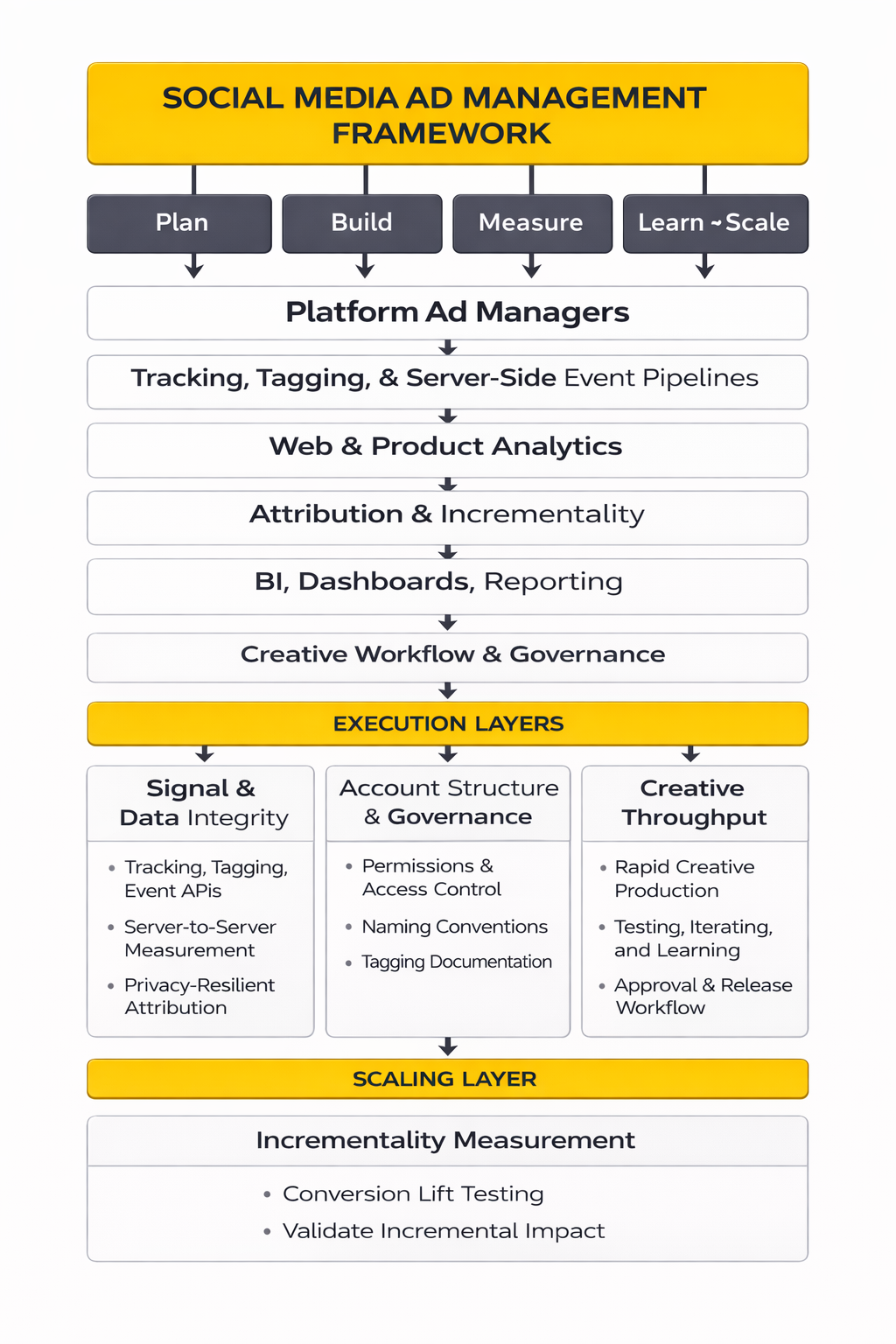
Execution Layers
Think of execution as layers that sit on top of each other. If the lower layer is unstable, the higher layer becomes expensive theater. When social media ad management is executed professionally, each layer has an owner, a checklist, and a feedback loop that pushes learning upward.
Layer 1: Signal and data integrity
- Events: You can see purchases, leads, and qualified outcomes consistently across devices and browsers.
- Server-side support: You’re not relying purely on client-side cookies when privacy and consent reduce visibility.
- Definitions: A “conversion” means the same thing in the ad platform, analytics, and CRM.
Layer 2: Account structure and governance
- Clean taxonomy: Naming conventions and UTMs make reporting readable at scale.
- Access control: Fewer people have the power to break tracking or change conversion goals.
- Documentation: Campaign logic is written down so performance doesn’t disappear when someone leaves.
Layer 3: Creative throughput
- Volume with intent: Creative is produced in testable batches, not one-off hero ads.
- Fast iteration: Underperformers are replaced quickly without redesigning the whole account.
- Learning capture: Each round creates insights that improve the next round’s odds.
Layer 4: Decision rhythm
- Daily checks: Tracking health, spend pacing, delivery anomalies.
- Weekly decisions: Budget shifts, creative swaps, audience refinements.
- Monthly proof: Incrementality checks, funnel health, and quality-of-conversion reviews.
Optimization Process
Optimization is where most teams either become disciplined—or slowly get hypnotized by noisy dashboards. The point isn’t to tweak everything. The point is to run a repeatable loop that turns data into decisions without overreacting to randomness.
1) Start with measurement quality, not performance metrics
If conversion tracking is inconsistent, performance swings can be illusions. Before you “optimize,” confirm that event volume matches reality and that your conversion definitions are aligned across systems. When you need a privacy-safe way to strengthen matching and measurement, Google outlines the core mechanism in its Enhanced Conversions documentation.
2) Diagnose the bottleneck by funnel stage
When results slip, identify where the friction lives: reach, click quality, landing experience, or conversion follow-through. This keeps social media ad management focused on the real constraint rather than the most visible number in the dashboard. A campaign with cheap clicks but weak conversion quality doesn’t need “more budget,” it needs a tighter offer and stronger intent filtering.
3) Optimize one lever at a time
Choose one primary lever for each optimization cycle: creative, audience, bidding, or landing experience. Changing everything at once feels productive, but it destroys learning because you can’t tell which lever caused the change. Professional teams treat optimization like science: isolate variables, run controlled shifts, and document outcomes.
4) Use automation where it reduces human error
Automation is valuable when it prevents obvious mistakes: overspending, broken pacing, or leaving a clear loser running for weeks. It’s less valuable when it turns into “auto everything” without an underlying strategy. Tools like TikTok’s Smart Performance Campaign are designed to reduce manual setup while letting the algorithm optimize delivery once it has the right inputs, which TikTok demonstrates in the Constellation Software success story.
5) Prove impact with lift when stakes are high
At scale, last-click and platform attribution are not enough to settle the “is this really working?” question. That’s why conversion lift studies exist: they compare exposed vs. holdout groups to estimate the incremental effect of ads. Both Meta’s Conversion Lift approach and TikTok’s Conversion Lift Study methodology are designed for that exact moment when a team needs evidence strong enough to guide budget decisions.
Implementation Stories
Real stories are messy, because real implementation is messy. Tools don’t save campaigns on their own—the team’s choices do. The two stories below are based on platform-published case studies, so the mechanics and results map to real-world constraints rather than marketing fantasy.
Story 1: Magazine Luiza tries to prove TikTok is driving real offline sales
The moment of high drama came when Magazine Luiza realized they could see offline store sales tied to TikTok campaigns—and still couldn’t answer the question leadership cared about most. Attribution was showing impact, but the doubt lingered: were these sales actually caused by TikTok, or were they sales that would have happened anyway? If they couldn’t prove incrementality, budget growth would stall right when retail competition was heating up. :contentReference[oaicite:0]{index=0}
The backstory mattered because Magalu wasn’t guessing from scratch. The retailer had already implemented TikTok’s Offline Conversions API and, beginning in Q2 2024, could attribute physical-store sales to campaigns and even optimize delivery using those events. That meant the technical foundation existed, and the channel had already earned a seat at the table. But visibility alone didn’t satisfy the deeper question of causality. :contentReference[oaicite:1]{index=1}
Then they hit the wall. A “normal” lift study wouldn’t solve it, because the standard setup measured online events, not offline purchases. The team needed an experiment design that could treat offline conversion events as first-class outcomes without breaking privacy rules or retailer data governance. Without that, every internal conversation would end the same way: “Nice reporting, but prove it’s real.” :contentReference[oaicite:2]{index=2}
The epiphany was an invitation to do something unusual. TikTok recommended a Conversion Lift Study—and then offered Magalu the chance to be the first to test a version capable of measuring offline conversion events, described in the case study as a “Conversion Lift 2.0.” Suddenly, the problem shifted from “Can we prove this?” to “Can we execute a valid experiment in the real world?” That’s a different kind of pressure, but it’s a solvable one. :contentReference[oaicite:3]{index=3}
Their journey became a disciplined implementation sprint, not a creative brainstorm. The team ran an auction campaign with a reach objective across cities where Magalu had physical stores, using learnings from previous months to shape who saw the ads. The segmentation stayed purposeful—leaning into people who had already bought offline and people similar to those customers—so the test wasn’t diluted by random reach. This is what mature social media ad management looks like: the experiment design and audience strategy are built together, not in isolation. :contentReference[oaicite:4]{index=4}
The final conflict, as always, was execution. Creative had to scale fast enough to support the campaign without losing “TikTok-native” quality, so Magalu worked with a Creative Exchange partner to build multiple video creatives around their “Liquida de Milhões” discounts. The campaign also had to run cleanly for long enough to generate statistically meaningful lift without being disrupted by last-minute changes. Even a small tracking break or mid-test goal change could have invalidated the results. :contentReference[oaicite:5]{index=5}
The dream outcome was the kind of proof that changes budget conversations. The Offline Conversion Lift Study showed a +7.8% incremental lift in conversions in physical stores, and the case study explains that these were conversions that wouldn’t have happened without the ads. That result didn’t just justify TikTok spend—it gave the team permission to scale with confidence because they could defend impact as incremental, not just attributed. :contentReference[oaicite:6]{index=6}
Story 2: Henry Rose needs scale, but doesn’t want to lose efficiency
The high drama here wasn’t about awareness—it was about pressure to produce conversions without turning costs into a runaway problem. Henry Rose had the brand story and an organic audience, but social algorithms don’t reward “nice content” with predictable sales. The team needed a way to scale conversion volume without drowning in manual optimization. That’s a familiar crisis for any brand doing serious social media ad management. :contentReference[oaicite:7]{index=7}
The backstory shows why this was possible at all. The case study describes Henry Rose as a fine fragrance line with 100% ingredient transparency, and it already had an organic TikTok community with 20K+ followers and strong video view volume. Constellation Software, positioned in the case study as a marketing technology company, stepped in to connect targeting, creative, and ROI more systematically. The opportunity was there; the question was whether the system could convert it. :contentReference[oaicite:8]{index=8}
Then came the wall: the typical scaling trap. When brands push spend, they often discover that the team can’t test creative fast enough, can’t interpret results fast enough, and starts making changes that confuse the algorithm. The case study frames the solution around combining strong creatives with TikTok tools under a conversion objective, which is essentially a choice to let the platform optimize—if the inputs are good enough. That’s a bold trade: less manual control in exchange for scalable learning. :contentReference[oaicite:9]{index=9}
The epiphany was to treat creative as the fuel and the system as the engine. Constellation Software leaned into creator-led assets to communicate the brand identity and showcase product sets, and they also featured an online fragrance matching quiz to help users find the right scent. Instead of hoping one ad did everything, they created multiple conversion paths that matched different user intent levels. That’s how you build conversion density without forcing every click to behave the same way. :contentReference[oaicite:10]{index=10}
The journey was a structured deployment. They optimized toward “Complete Purchase” events, then used TikTok’s Smart Performance Campaign so the algorithm could handle delivery once it had the core inputs of creative and budget. The case study explicitly frames this as a way to test video creatives at scale and develop stronger assets based on performance results. In practice, this is a clear blueprint: tighten the conversion event, feed the system high-velocity creative, and let automation scale what the auction rewards. :contentReference[oaicite:11]{index=11}
The final conflict is the part most teams underestimate: maintaining creative quality while scaling volume. If creator-led ads start feeling repetitive or overly “ad-like,” the audience stops caring and performance collapses. If you change too much too fast, the algorithm loses its learning. The case study implies the team kept creative best practices and strong calls to action in focus while scaling, which is the only way automation stays effective. :contentReference[oaicite:12]{index=12}
The dream outcome was measurable, not just inspirational. The published results include a 15.4% decrease in CPA, a 26.6% increase in conversion rate, and a 32.8% increase in ROAS, alongside 600+ conversions and 1.9M impressions. That’s the payoff of a disciplined social media ad management system: creative, objective, and automation working together instead of fighting each other. :contentReference[oaicite:13]{index=13}
Professional Implementation
If you want social media ad management to feel predictable, the implementation needs to be treated like operations. That doesn’t mean heavy process for the sake of process. It means a few non-negotiable standards that prevent the most expensive mistakes.
Standard 1: Make incrementality a normal part of decision-making
When budgets grow, “platform ROAS” becomes less persuasive, especially across multiple networks. The strongest teams normalize lift and incrementality measurement as a periodic health check, using tools designed for that purpose like Meta Conversion Lift studies and TikTok’s Conversion Lift Study approach. It changes the culture from “argue about attribution” to “test the real impact and move on.”
Standard 2: Treat measurement as infrastructure
Measurement isn’t a campaign task. It’s infrastructure that every campaign depends on. When you implement server-side event sharing through APIs like Meta Conversions API or TikTok’s Events API, you’re reducing the risk that performance drops simply because visibility dropped.
Standard 3: Keep a living “learning backlog”
Every week, add two things to a backlog: what you learned and what you’ll test next. Tie each test to a hypothesis, not a hunch. This is how you avoid repeating the same “new creative push” every month without ever understanding what actually drives conversions.
Standard 4: Build for speed without sacrificing control
- Speed: creative batching, fast swaps, and tight feedback loops.
- Control: locked conversion definitions, governed access, and documented changes.
- Clarity: one primary KPI, one learning KPI, and a decision rhythm the team actually follows.
Done well, professional implementation makes social media ad management feel less like gambling and more like compounding. Your stack becomes easier to operate, your learning becomes easier to trust, and scaling stops feeling like a leap of faith.
Statistics and Data
Good social media ad management is built on a simple promise: you don’t “feel” performance, you prove it. That proof comes from data that’s consistent enough to guide decisions, and broad enough to explain what’s happening beyond one platform’s dashboard.
Zoom out, and the macro trend is hard to miss. The world’s marketers spent close to US$1.1 trillion on advertising in 2024, while global forecasts for 2025 put total ad revenue around US$1.14 trillion. That rising tide matters because it increases auction pressure, which makes measurement and creative quality more important than ever.
Regional reports show the same pattern: digital keeps expanding, and social keeps absorbing more of the growth. In Europe, the digital advertising market reached €118.9 billion in 2024 and social media was one of the fastest-growing channels, up 23.9%. In the U.S., the digital advertising industry hit $259 billion in 2024, and social media advertising revenues totaled $88.8 billion.
Platform-level dynamics add another layer. Meta’s own financial reporting shows that ad delivery is getting more expensive in real terms: in 2025, Meta reported that its average price per ad increased 9% year over year for the full year. That kind of pricing shift is exactly why modern social media ad management puts so much weight on creative iteration, signal quality, and disciplined optimization, not just “more budget.”
Performance Benchmarks
Benchmarks are useful when you treat them as guardrails, not grades. They can tell you whether your account is wildly off-course, but they can’t tell you what to do next unless you connect them to your funnel, your offer, and your tracking setup.
The most reliable “benchmark” is often direction rather than a single number: costs rise when competition rises, and efficiency improves when your conversion signal is strong and your creative matches real intent. You can see the macro version of that in Meta’s reporting, where higher ad impressions and higher average prices per ad contributed to growth in 2025 results, including $200.97B revenue for the full year and a 9% increase in average price per ad.
When you do use benchmark datasets, look for ones that publish methodology and segment results by industry, because social performance varies dramatically by intent, price point, and purchase cycle. A dataset can still be useful even if it’s not “universal,” as long as you know what it represents and what it doesn’t.
- Use benchmarks to spot tracking problems: If click volume is healthy but conversions collapse overnight, it often points to broken events or landing issues more than “creative fatigue.”
- Use benchmarks to set testing expectations: If your industry typically needs higher frequency to convert, you plan for faster creative refresh cycles and more variation.
- Use benchmarks to protect budget: If cost per result rises while conversion quality drops, you pause scaling and fix the bottleneck before the auction punishes you further.
One benchmark category that has become increasingly important is incrementality. Platform-reported conversions can be directionally helpful, but lift tests are designed to answer the harder question: did the ads create conversions that would not have happened otherwise? That’s why tools like Meta’s Conversion Lift methodology and TikTok’s Conversion Lift Study are now part of performance conversations for teams that manage meaningful spend.
Analytics Interpretation
Analytics interpretation is where social media ad management becomes a craft. The same dashboard can be read in two completely different ways: one person sees “CTR is down,” another sees “we’ve hit audience saturation, and the algorithm is learning the wrong users because our conversion signal is diluted.”
Start with the health check before the performance check
Before you interpret performance, validate that the system is measuring reality. When tracking breaks, campaigns often look “worse” even if demand is unchanged. That’s why many teams lean on server-to-server event strategies and platform event APIs (plus analytics reconciliation) to reduce blind spots and stabilize conversion inputs over time.
Read metrics in sequences, not in isolation
A single metric rarely tells the truth. A drop in click-through rate means something very different if conversion rate rises, and it means something else again if your reach expands into colder audiences. Interpreting sequences helps you avoid reactive changes that destroy learning.
- Reach → Click quality: If reach expands and CTR falls slightly while conversions hold, you may be scaling into colder audiences successfully.
- Click quality → Landing friction: If CTR holds but conversion rate drops, look first at landing speed, offer clarity, and whether the traffic is misaligned.
- Conversion rate → Conversion quality: If conversions rise but downstream quality falls, the platform may be optimizing toward the easiest outcomes instead of the best outcomes.
Watch for fatigue, but don’t hallucinate it
Creative fatigue is real, but it’s also one of the most misdiagnosed issues in paid social. Repetition can drive disengagement, and research models on ad fatigue show that excessive exposure can reduce effectiveness, including a 2024 study discussing an inverted-U relationship between advertising intensity and outcomes in a dynamic advertising policy model with ad fatigue. On the other hand, wearout is not always as fast as teams assume, which is why measurement discipline matters, highlighted in WARC’s discussion of the “ad wear-out myth”.
Use lift studies when the decision is expensive
When you’re debating channel budgets, attribution arguments get loud fast. Lift studies cut through that noise by comparing exposed vs. holdout groups to estimate incremental impact, which is why brands use tools like TikTok’s Conversion Lift Study and Meta Conversion Lift to turn “it seems like it worked” into “we can prove what it changed.”
Case Stories
These stories focus on one theme: analytics becomes powerful when it changes what the team does next. Each story is drawn from published case material so the results and mechanics are grounded in real execution rather than invented hero narratives.
Story 1: Domino’s Spain tries to turn app installs into real orders without losing momentum
The pressure hit when Domino’s Spain realized installs weren’t the finish line anymore. The app was growing, but leadership wanted proof that TikTok spend was driving meaningful actions, not just downloads that never turned into orders. The team needed a way to scale without losing efficiency right as match-day attention spikes created both opportunity and chaos. Domino’s Spain on TikTok for Business
The backstory is what made the challenge difficult rather than simple. Domino’s Spain structured a strategy in phases: first optimizing for installs to build a base of users, then shifting toward purchase events during a “3×1” promotion to convert attention into revenue behavior. That phased approach created a clear hypothesis, but it also raised the standard of proof because they now had to connect app behavior to business outcomes. Domino’s Spain campaign approach
Then they hit the wall: the numbers were moving, but the “why” was still debatable. In fast-scrolling feeds, installs can rise from novelty, seasonality, or promo curiosity, and that can trick teams into scaling too early. Without incrementality-style validation, social media ad management becomes an argument between dashboards instead of a decision based on evidence. TikTok Conversion Lift Study
The epiphany was to treat measurement as part of the campaign, not an afterthought. Domino’s Spain used a Conversion Lift Study to evaluate the incremental effect, framing the question as “what did TikTok change?” instead of “what did TikTok claim?” That single shift changes how you optimize, because you stop chasing vanity movement and start chasing proven impact. Domino’s Spain CLS
The journey was built around execution that the algorithm could learn from. They started with app promotion campaigns optimized for installs to drive consistent downloads, and then moved into a second phase optimized for purchase events to drive sales during the promotion window. That’s classic professional social media ad management: one phase builds signal, the next phase monetizes it with tighter event goals. Domino’s Spain execution phases
The final conflict was timing and attention volatility. Match-day spikes create bursts of demand, but they also create bursts of competition, and campaigns can overspend quickly if you don’t control pacing and creative relevance. Domino’s needed measurement that could keep up with fast-moving consumer behavior while still producing statistically meaningful conclusions about incremental impact. Domino’s Spain CLS measurement framing
The dream outcome was a result that could survive internal scrutiny. The lift study reported a 14% increase in conversion rates for app installs, with results tied to key moments like Eurocup matches featuring the Spanish national team. That kind of insight doesn’t just say “performance improved,” it tells you when performance improves and what moments are worth planning around next time. Domino’s Spain results
Story 2: Target tries to connect online ads to omnichannel shopping without guessing
The high drama arrived when omnichannel complexity threatened to make performance look better than it really was. Online conversions were visible, but store behavior and cross-device journeys blurred the picture, and teams risked optimizing toward whatever was easiest to track. If measurement couldn’t represent how people actually bought, social media ad management would drift into “optimize the dashboard” instead of “optimize the business.” Target Meta success story
The backstory is that retailers like Target don’t have a single, clean path to purchase. Customers browse on mobile, compare on desktop, and buy in-store, sometimes days later, sometimes after seeing multiple ads. That reality forces marketers to treat data integration as a competitive advantage, not a technical footnote. Target campaign context
The wall showed up in the form of missing or fragmented signals. When off-site behavior isn’t connected back to ad delivery, the platform’s optimization can become less precise, and teams start making budget decisions based on partial credit. That’s especially dangerous when leadership expects you to defend spend across multiple channels and store outcomes. Meta Conversions API overview
The epiphany was to feed the system with better customer activity data rather than arguing about attribution windows. Target used off-Facebook customer activity data via the Conversions API to help optimize ad delivery and encourage people to shop online or in-store. Instead of hoping the pixel told the full story, the team implemented a measurement layer designed for a world where purchases don’t always happen in a browser session. Target using Conversions API
The journey became operational: align event definitions, connect systems, and keep governance tight so the signal stays clean. When Conversions API is implemented well, it strengthens matching, reduces data loss, and supports better optimization inputs, which is why it shows up repeatedly in platform documentation and enterprise setups. This is the less glamorous side of social media ad management, but it’s the side that prevents performance from collapsing when privacy rules tighten. Meta Conversions API documentation
The final conflict is that retailers can’t pause reality while measurement catches up. Promotions change, inventory changes, and consumer demand changes, so the system has to stay stable while the business moves fast. That’s why teams that manage serious spend treat measurement changes like infrastructure releases: documented, monitored, and tested before they touch decision-making. Meta Conversion Lift measurement principles
The dream outcome is not one magic number, but a stronger foundation for future decisions. When omnichannel activity is connected more reliably, the team can optimize with more confidence and justify spend using business outcomes instead of platform-only proxies. That’s the real payoff: analytics that reduces guesswork, so performance conversations get calmer while results get better. Target outcomes narrative
Professional Promotion
If you’re building a career around social media ad management, analytics is one of the fastest ways to differentiate yourself. Plenty of people can launch campaigns. Far fewer can explain why performance changed, what the next test should be, and how to prove the difference between “attributed” and “incremental.”
Position yourself around clarity, not hype
A strong professional brand in paid social is built on calm explanations and repeatable systems. You can point to the same measurement concepts platforms use for high-stakes decisions, like Conversion Lift on Meta and Conversion Lift Study on TikTok, and translate them into practical client language without drowning people in jargon.
Make your reporting story feel inevitable
- Start with the decision: What will the client do differently if the numbers move?
- Show the chain: How the metric sequence supports your conclusion (not just a single KPI screenshot).
- Protect trust: If tracking is noisy, say it plainly and show what you’re doing to improve signal quality.
Use credible industry context without turning it into trivia
Clients care about trends when trends explain their costs. It’s useful to connect rising competition with concrete market signals, like global advertising totals near US$1.1T in 2024, Europe’s digital market reaching €118.9B in 2024, and Meta reporting a 9% increase in average price per ad in 2025. When you use context like that to explain why creative and measurement discipline matter, your recommendations feel grounded rather than opinionated.
The most marketable skill isn’t knowing every platform feature. It’s being the person who can turn messy performance data into a clear next step, then prove whether that step worked. That’s what makes social media ad management valuable, and it’s what makes you hard to replace.
Advanced Strategies
Once the basics are stable, advanced social media ad management starts looking less like “campaign tweaks” and more like system design. You’re building a machine that can absorb bigger budgets, more creative volume, and noisier attribution without falling apart. That’s why the best strategies are rarely about one feature—they’re about stacking small advantages that compound.
Triangulate truth instead of arguing about attribution
Platform dashboards are useful, but they’re not neutral referees. A mature approach is triangulation: you keep platform reporting for tactical optimization, use analytics for cross-channel consistency, and then validate impact with incrementality experiments when the decision is expensive. The logic behind lift testing is built into Meta’s Conversion Lift, and the same principle shows up in TikTok’s Conversion Lift Study.
Turn creative into an operating system
At scale, creative is rarely “a deliverable.” It’s your main lever for controlling auction efficiency and audience quality. In practice, advanced social media ad management means you build a repeatable creative process: batches, hypotheses, structured variation, and a habit of documenting what worked so the next round gets smarter.
This also protects you from two common traps: assuming every performance dip is fatigue, and assuming every spike is a breakthrough. Research on wearout and exposure effects shows why the relationship between repetition and outcomes can be nonlinear, explored in a 2024 model of ad fatigue, and debated in industry analysis like WARC’s discussion of ad wearout. The operational takeaway is simple: refresh with intent, not panic.
Use automation, but keep constraints that protect learning
Automation works best when you feed it clean conversion signals and high-velocity creative. It works worst when you keep changing the goal, swapping attribution definitions, or “fixing” the campaign daily. TikTok’s automation positioning is explicit in its performance marketing guidance and the Smart+ playbook, where the promise is scale and efficiency if inputs are strong.
Optimize for value, not just volume
When campaigns mature, “more conversions” becomes a shallow goal. Better social media ad management starts optimizing toward higher-value outcomes: higher LTV customers, higher-margin products, better lead quality, or faster repeat purchase cycles. TikTok’s approach to value-based bidding shows up in performance solutions like Triumph Arcade’s Value-Based Optimization setup, where the strategy was designed to prioritize users likely to generate higher value after install.
Scaling Framework
Scaling isn’t a single action. It’s a sequence of decisions that either preserves efficiency or destroys it. A practical scaling framework for social media ad management can be thought of as four checkpoints you must pass in order.
Checkpoint 1: Signal stability
Before you add spend, confirm that the conversion signal is stable enough for the platform to learn. That means events fire reliably, definitions are consistent, and you can reconcile the story in analytics. Server-to-server event pipelines are often part of that stability layer, reflected in platform-first documentation like Meta’s Conversions API.
Checkpoint 2: Creative throughput
If you can’t ship new creative consistently, scaling becomes a slow decline. The auction will keep charging you, but your message won’t stay fresh. The practical standard is simple: you should know what your next creative batch is before performance forces you to need it.
Checkpoint 3: Budget expansion with guardrails
Scale in steps, not leaps. Guardrails can be as basic as pacing rules, spend caps, and a “no major edits during learning” discipline. This is how you avoid the most common scaling failure mode: confusing the algorithm while simultaneously increasing spend.
Checkpoint 4: Prove incrementality
Once spend is meaningful, the question becomes whether the ads created incremental outcomes. Lift methodologies exist for this exact moment, including Meta Conversion Lift and TikTok’s Conversion Lift Study. This is where scaling becomes defensible, not just optimistic.
Growth Optimization
Growth optimization is what happens after you can scale without breaking. It’s the discipline of improving efficiency while volume grows, so you don’t “buy” growth by quietly accepting worse margins.
Shift the scoreboard from platform KPIs to business outcomes
A clean growth stack connects paid social to business metrics: revenue, margin, repeat purchases, qualified leads, or retention. This is also where marketing teams increasingly use privacy-centric measurement approaches like marketing mix modeling to complement attribution. Google highlights MMM as a privacy-centric measurement method in examples like its MMM app measurement case coverage.
Use creators as distribution, not decoration
Creator-led advertising has moved from “nice-to-have” to a meaningful budget line for many brands. U.S. creator ad spend rose to $29.5B in 2024 and was projected to reach $37B in 2025. The strategic implication for social media ad management is clear: if you don’t have a repeatable way to brief, test, and scale creator-style creative, you’re competing with one hand tied behind your back.
Pair automation with TikTok-first and platform-native creative
Automation amplifies whatever you feed it. Feed it repurposed assets and vague signals, and it scales mediocrity. Feed it native creative and clean event goals, and it can scale winners. TikTok’s Smart+ positioning is built around that exact premise in the Smart+ playbook, and real execution examples show how brands paired automation with native formats to improve efficiency.
Scaling Stories
The hardest part of scaling is psychological: you’re spending more while certainty drops. That’s why real scaling stories are valuable—they show what teams did when the risk felt real, not when everything was already working.
Story 1: Wisp bets on automation, but only after it has a performance foundation
The pressure spiked when Wisp realized their TikTok performance was already “good,” but good wasn’t enough anymore. They had momentum, and momentum creates a dangerous temptation: scale fast and hope the machine holds together. At the same time, telehealth is competitive, and wasted spend isn’t just expensive—it can slow growth in a market where speed matters. Wisp’s Smart+ case study
The backstory made the stakes higher, not lower. Wisp provides telehealth services across all 50 U.S. states and had served over one million patients, which meant performance shifts had real revenue consequences at scale. They were already seeing “scaled success” on TikTok, but the team wanted to push paid campaigns further without drowning in manual optimization. When Smart+ launched in early 2024, it looked like an opportunity—and a risk. Wisp’s business context and timing
Then they hit the wall that shows up in most scaling attempts: manual effort doesn’t scale as fast as spend. More budget tends to demand more optimization, more creative decisions, and more monitoring. If you respond by making constant changes, you sabotage learning; if you respond by doing nothing, inefficiencies grow quietly. This is where social media ad management either becomes disciplined operations or becomes chaos in slow motion. TikTok performance marketing guidance
The epiphany was to treat automation as a leverage tool, not a replacement for thinking. Wisp decided to test Smart+ specifically for web conversion ads, framing success around sales and new customer acquisition rather than superficial engagement. Instead of micromanaging targeting, the team leaned into broad delivery and trusted the system to learn—on the condition that creative and conversion goals were clear. That’s a mature bet: less manual control, more focus on inputs. Wisp’s Smart+ approach
Their journey was built around creative that matched the platform, not just the brand guidelines. The case study describes Wisp leaning on Spark Ads and Display Cards, using native formats designed to feel natural in-feed while still driving conversion intent. That allowed Smart+ to do what automation does best: match the right creative to the right people at scale, without the team babysitting every lever. The work shifted from “tweak the campaign” to “ship better creative and let the engine run.” Wisp’s creative and format choices
The final conflict wasn’t dramatic in a cinematic way—it was dramatic in a business way. Smart+ outperformed control ad groups, but scaling still demanded confidence that results would hold as spend increased. If performance improved only because of temporary novelty or short-term auction conditions, the team would pay for that mistake later. That’s why the most important part of social media ad management at this stage is measurement discipline and clean comparisons against a control baseline. Smart+ vs. control framing
The dream outcome was exactly what scaling teams want: better efficiency and better returns at the same time. The published results showed 34% higher ROAS, 25% lower CPA, and 45% lower CPMs. That combination is the payoff of disciplined inputs plus automation: the system scales, but it scales something worth scaling. Wisp results
Story 2: Triumph Arcade chases higher-value users, not just more installs
The high drama started with a classic growth problem in mobile gaming: installs are easy to buy, valuable players are not. Triumph Arcade wanted to scale its iOS app in North America, but the team also needed ROAS to hold up under strict benchmarks. If they grew installs without growing value, they’d just accelerate toward a budget ceiling. That’s the kind of scaling tension that forces better social media ad management. Triumph Arcade case study
The backstory is that the product itself is value-sensitive. Triumph Arcade is a reward-based gaming platform where players compete in skill-based mini-games for real cash prizes, which changes user intent and quality requirements. They weren’t looking for passive viewers; they needed engaged players who would actually participate and monetize. That makes user acquisition less forgiving and attribution less forgiving, because “cheap” users can become expensive fast. Product and objective context
The wall showed up in the creative format itself. Standard video ads can communicate gameplay, but they can’t let a user feel the product before installing. If the install decision is based on curiosity rather than understanding, post-install value often drops. The team needed a way to filter for higher intent without adding friction that killed volume. Playables format explanation
The epiphany was to make the ad interactive, then let the algorithm optimize for value. Triumph Arcade launched a Smart+ app promotion campaign for iOS using TikTok Playables, which let users preview gameplay inside the ad. They paired that with Highest Value bidding for Value-Based Optimization, designed to prioritize users likely to generate higher value after install. It was a deliberate shift from “more installs” to “better installs.” Smart+, Playables, and VBO strategy
Their journey leaned on operational discipline rather than clever hacks. The campaign ran consistently over a seven-day period, with budget pacing and creative minimums aligned to best practices, so delivery stayed stable and learning could accumulate. Creative showcased real gameplay and emphasized the cash prize mechanic, while Playables made the experience immersive instead of abstract. Smart+ automation reduced the need for complex manual targeting so the team could focus on creative and learning velocity. Execution details
The final conflict was credibility under scale. Triumph Arcade’s results were brand-reported internal performance data, with the case study explicitly noting the limitations and that past performance doesn’t guarantee future performance. That kind of disclaimer isn’t a weakness—it’s a reminder that real scaling teams validate outcomes and then operationalize what worked into evergreen systems. The real risk wasn’t the test; it was scaling without treating the result as a hypothesis to keep proving. Results and disclosure language
The dream outcome was early value that justified further investment. The case study reports that, versus a video-only format, Triumph Arcade achieved 85% higher Day-0 ROAS and 80% higher Day-7 ROAS. Just as importantly, the format unlocked a repeatable path: scale winners from testing into evergreen campaigns using Smart+ automation. That’s what “scaling” really means in social media ad management—repeatability, not a lucky spike. Triumph Arcade results and scaling plan
Position yourself as the person who makes scale predictable
Many freelancers can run campaigns. Far fewer can explain why a system will keep working when costs rise and tracking gets noisier. If you can talk clearly about lift testing using real tools like Meta Conversion Lift and TikTok’s Conversion Lift Study, you don’t sound like a button-pusher—you sound like a growth operator.
Build proof assets that clients actually care about
- One-page scaling plan: what you’ll stabilize first, what you’ll test next, and what you’ll only scale after proof.
- Creative learning library: patterns that performed, patterns that failed, and what you learned from each batch.
- Measurement map: which events matter, where they live, and how you’ll validate them beyond one platform dashboard.
Use market reality to justify disciplined systems
When clients ask why they can’t “just run ads,” you can point to structural pressure: auctions are getting more competitive, and teams need better creative and better measurement to keep efficiency. U.S. digital ad revenue reached $259B in 2024, and social media ad revenue hit $88.8B. That kind of scale attracts competition, and competition punishes sloppy social media ad management.
The most compelling pitch you can make is simple: you don’t just launch campaigns—you build a system that can scale, keep learning, and keep proving impact when it matters.
Future Trends
The next wave of social media ad management will be shaped by three forces moving at the same time: faster AI-driven creative production, tougher measurement conditions, and new “where the sale happens” models that blur the line between ads, content, and commerce.
AI will compress the creative cycle
Teams are already shifting from “produce one big campaign” to “ship continuous iterations.” That shift is accelerating as AI makes it easier to generate variants, test hooks, and adapt formats across placements. The strategic risk is obvious: if you can produce 10x more ads, you can also produce 10x more noise. Reports tracking the 2025 landscape point to AI innovations and budget shifts as core themes in the year ahead, including Smartly’s Digital Advertising Trends 2025 report and Google’s view on 2025 digital marketing trends.
Measurement will keep moving toward “proof,” not attribution arguments
Signal loss and fragmented journeys are pushing more teams to treat incrementality as a normal part of decision-making, especially when budgets are large enough that small measurement errors become expensive. That’s why lift experiments are becoming less “enterprise only” and more a practical tool in modern stacks, using frameworks like Meta Conversion Lift and TikTok’s Conversion Lift Study.
MMM and blended measurement will keep gaining ground
As privacy and platform fragmentation complicate deterministic tracking, marketers are leaning back into marketing mix modeling to understand what’s working at the business level. That shift shows up in demand signals like an EMARKETER/Snap study where 61.4% of US marketers spending $500K+ on digital ads wanted better or faster MMM. Social media ad management will increasingly combine platform optimization with MMM-level budgeting decisions, so channel-level wins don’t accidentally undermine total profit.
Creator-led advertising becomes a default, not a specialty
Creator media is now a major budget line, not an experimental channel. U.S. creator ad spend reached $29.5B in 2024 and was projected to reach $37B in 2025. Practically, this means ad managers will spend more time building creator pipelines, performance briefs, and creative testing systems that look more like production ops than “content requests.”
Social spend keeps growing, and auctions will stay competitive
When the market grows, competition grows with it. WARC forecast social ad expenditure reaching $286.2B in 2025 and being set to exceed $300B in 2026. For practitioners, the takeaway is simple: disciplined systems (measurement + creative throughput + incrementality checks) will matter more than hacks.
Strategic Framework Recap
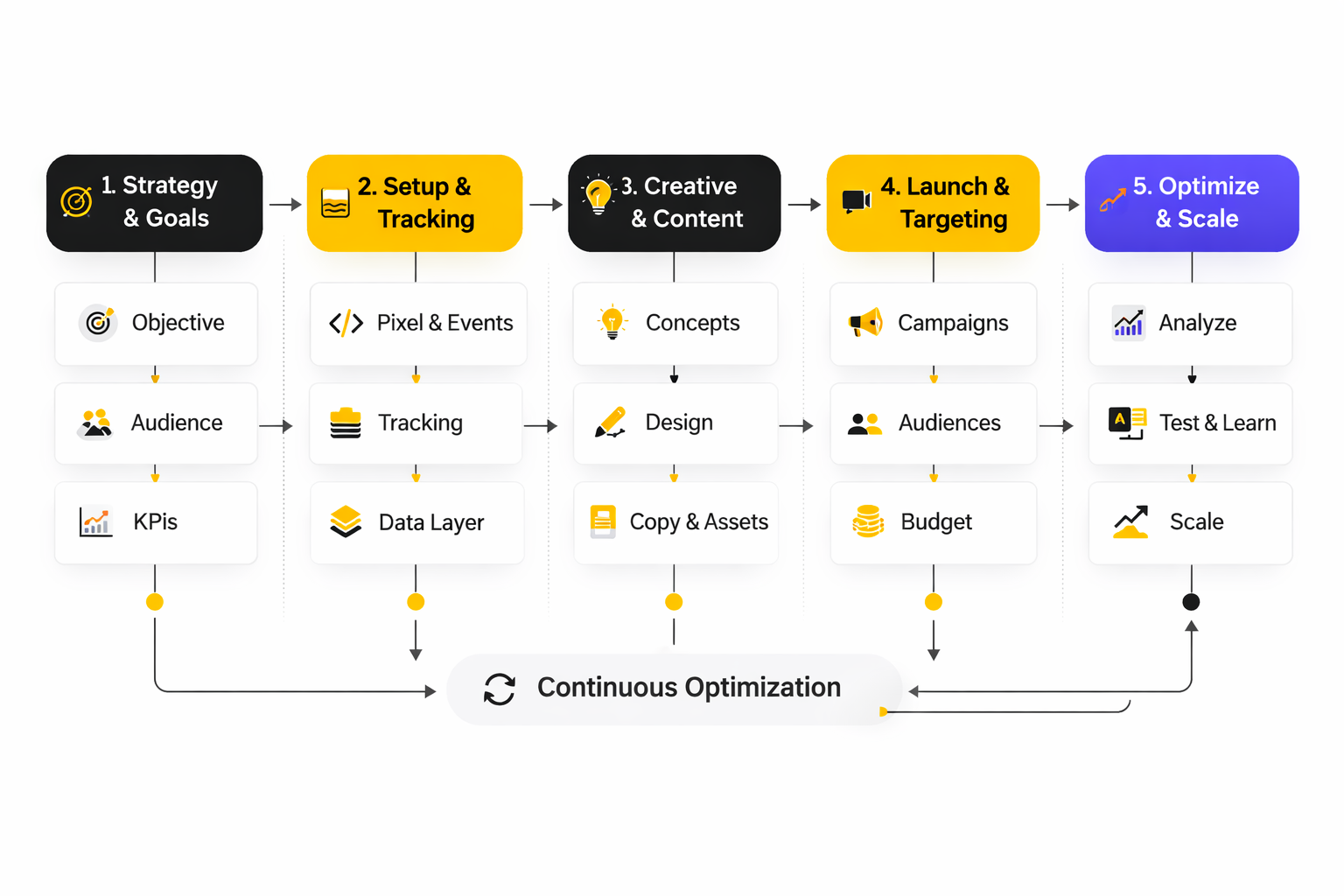
If you zoom out across the entire guide, the ecosystem for social media ad management is surprisingly consistent. Platforms change features, costs move, and attribution gets noisier, but the same core structure keeps winning because it’s built for reality.
- Start with outcomes: pick one primary KPI and one learning KPI so campaigns don’t drift into “everything matters.”
- Protect signal quality: build measurement as infrastructure, using event pipelines where they make a real difference, like Meta Conversions API and the TikTok Events API.
- Run creative as a system: testing batches, documenting learnings, and shipping consistently so scale doesn’t rely on luck.
- Optimize with a calm loop: isolate variables, make changes on a rhythm, and avoid daily tinkering that resets learning.
- Prove what matters: when decisions are expensive, validate with incrementality methods like Conversion Lift instead of debating attribution windows.
That ecosystem is what turns paid social from “campaigns we run” into a growth system you can operate, audit, and scale.
FAQ for This Complete Guide
What does social media ad management actually include?
It covers the full lifecycle: choosing objectives, structuring campaigns, building creative tests, managing budgets, validating tracking, analyzing performance, and continuously optimizing. The “management” part is the system that keeps improving results over time, not the button-click that launches the first ad.
Which platforms matter most for social media ad management in 2026?
It depends on audience and buying cycle, but most stacks start with Meta and TikTok for broad reach and performance, then add LinkedIn for B2B, YouTube for demand capture and scale, and Pinterest or Snap where discovery audiences fit. The platform mix should follow your customer journey, not your personal preference.
How do I know if my tracking is good enough to scale?
If conversions fluctuate wildly without a real business reason, or if analytics and platform reporting can’t be reconciled in a believable story, scaling is premature. Many teams improve stability by adding server-to-server event sharing, using patterns described in Meta’s Conversions API documentation.
Do I need incrementality testing, or is platform ROAS enough?
Platform ROAS can be useful for tactical optimization, but incrementality becomes important when you’re making big budget decisions and need to know what the ads actually caused. Lift approaches exist for that moment, including Meta Conversion Lift and TikTok’s Conversion Lift Study.
How often should I change creative in a mature account?
There isn’t a universal schedule, because fatigue depends on spend level, frequency, audience size, and how varied your creative is. The safer approach is to run ongoing creative batches so you always have replacements ready, and to refresh based on trend evidence rather than panic. Industry debate around wearout is a good reminder not to hallucinate fatigue, reflected in WARC’s discussion of ad wearout.
What’s the fastest way to improve performance without rebuilding everything?
Fix the biggest bottleneck first. If clicks are strong but conversions are weak, focus on landing experience and offer clarity. If conversions are strong but quality is poor, tighten the conversion definition and qualify leads better. If reach is strong but engagement is weak, your creative hook is the first suspect.
How do I compare performance across platforms without getting misled?
Use a consistent analytics layer for cross-channel comparisons, and treat platform dashboards as tactical tools for in-channel optimization. When you need a higher-confidence answer, validate with experiments and blended measurement methods like MMM, which Google highlights as a growing measurement focus in its 2025 trends analysis.
What metrics matter most for a lead-generation business?
Start with cost per qualified lead and the percentage of leads that become sales conversations, not just cost per form fill. Social media ad management works best when you optimize toward outcomes your sales team actually values, then feed that learning back into targeting and creative decisions.
What metrics matter most for ecommerce?
Focus on contribution margin and repeat purchase dynamics, not just first-purchase ROAS. Many brands scale more safely when they track the relationship between new customer acquisition efficiency and repeat behavior, then adjust offers and creative based on profitability, not vanity revenue.
How do I build a career in social media ad management that doesn’t rely on luck?
Build proof systems: a documented testing process, a clean measurement map, and a portfolio that explains decisions in plain language. When you can connect creative, measurement, and incrementality into one coherent story, you become more valuable than someone who only knows platform features.
Work With Professionals
If you’ve made it this far, you already know the hard truth: social media ad management isn’t difficult because it’s complicated—it’s difficult because it’s unforgiving. Costs rise, tracking gets noisy, and the market rewards the teams that can keep shipping strong creative while staying calm and evidence-driven.
That’s exactly why marketplaces built specifically for marketing work are becoming part of how professionals build their pipeline. MARKEWORK is positioned as a marketing marketplace where companies and marketers connect directly, built around speed, clarity, and fewer middle layers.
If you’re a freelancer, the appeal is practical. The platform highlights no commissions and no project fees, and its workflow is designed around direct communication with companies rather than handoffs through a посредник. It also emphasizes access to thousands of job listings, and at the time of writing the job board showed 1007 active listings, many of them explicitly tagged as remote contract roles.
If you’re trying to grow as a marketing freelancer, that combination matters. You can focus your energy on what actually increases income: building a credible profile, applying to roles that fit your skill set, and closing work faster through direct negotiation—while avoiding platform commission structures that take a cut of every project.
When you’re ready to turn your social media ad management skills into a more consistent client pipeline, start here:
 Filip Konecny Enterprises