
A social influencer agency can feel like a cheat code when it’s working—and a black box when it’s not. Brands see the posts, the comments, and the “link in bio,” but they don’t always see the strategy, contracts, tracking, approvals, and risk controls that decide whether a creator program becomes a growth engine or just expensive content.
This guide is written for people who need influencer marketing to behave like a professional channel: predictable inputs, clear decisions, measurable outcomes, and fewer surprises. You’ll see what a real agency actually does, why it matters now, and a framework you can use to evaluate partners (or build your own internal version).
Article Outline
- What Is a Social Influencer Agency
- Why a Social Influencer Agency Matters
- Framework Overview
- Core Components
- Professional Implementation
- Campaign Design and Execution
- Measurement and Analytics
- Operating System and Ecosystem
- Scaling and Risk Management
- FAQ
- Work With Markework
What Is a Social Influencer Agency
A social influencer agency is a specialist partner that plans, sources, negotiates, manages, and measures creator collaborations across platforms like TikTok, Instagram, YouTube, and increasingly LinkedIn. The simplest way to think about it is this: the agency turns “working with creators” into an operating system—so you can run campaigns repeatedly without reinventing everything each time.
That operating system typically includes creator discovery and vetting, outreach, contract and usage rights, creative briefing, content review, posting schedules, paid amplification options (like whitelisting/spark-style boosting), performance tracking, and reporting that ties creator activity to outcomes your business actually cares about.
Some agencies focus on brand storytelling and cultural relevance. Others are built around performance: affiliate links, promo codes, landing pages, and testing hooks until you find a formula that scales. The best ones can do both, but they’ll be explicit about what they optimize for and what they will not promise.
It also helps to separate “influencer marketing” from “creator marketing” in everyday practice. Many teams now use creators as a flexible production layer—fast content, fast iteration—then use paid media to distribute the best-performing assets. This shift shows up in how platforms are building tooling and APIs to connect brands with creators and support reporting, including Instagram’s Creator Marketplace and related APIs for agencies and platforms and YouTube’s creator partnerships tooling and APIs designed to improve discovery and reporting.
Why a Social Influencer Agency Matters
Creator programs are no longer “nice-to-have experiments.” Money is moving into creator partnerships even when marketing budgets are under pressure, because creators can deliver a mix that’s hard to replicate: distribution, trust, and native storytelling that doesn’t feel like an ad.
On the investment side, the channel is large enough that operational discipline matters. Multiple independent industry trackers have converged on a similar scale for global influencer marketing—commonly cited around $32.55B projected for 2025, with separate reporting estimating about $24B in 2024 market size and forecasting that influencer spend will comfortably top $30B globally in 2025.
In the U.S., creator advertising is also being quantified as a budget line in its own right. The IAB projects $37B in U.S. creator ad spend in 2025, and the same projection is reinforced in the IAB’s accompanying release and mainstream coverage like Business Insider’s write-up of the report. When budgets get this big, “we’ll just DM a few creators” stops being an adequate process.
A dedicated social influencer agency matters because it reduces three kinds of friction that quietly kill results:
- Execution friction: finding creators, negotiating deliverables and usage rights, managing approvals, and shipping campaigns on time.
- Measurement friction: messy links, inconsistent naming, missing data, and reports that don’t answer the CEO question: “What did we get back?”
- Risk friction: disclosure mistakes, usage-right disputes, brand safety issues, and inconsistent contracts.
That last point is increasingly non-negotiable. If your campaigns touch the U.S. market, the safest baseline is to treat disclosure and endorsements as a compliance system, not a “best practice.” The FTC’s plain-language guidance on endorsements, influencers, and reviews is the kind of document an agency should operationalize into briefs, contracts, and QA checks. In the UK, the ASA’s guidance on recognising ads in social media and influencer marketing plays a similar role.
Framework Overview
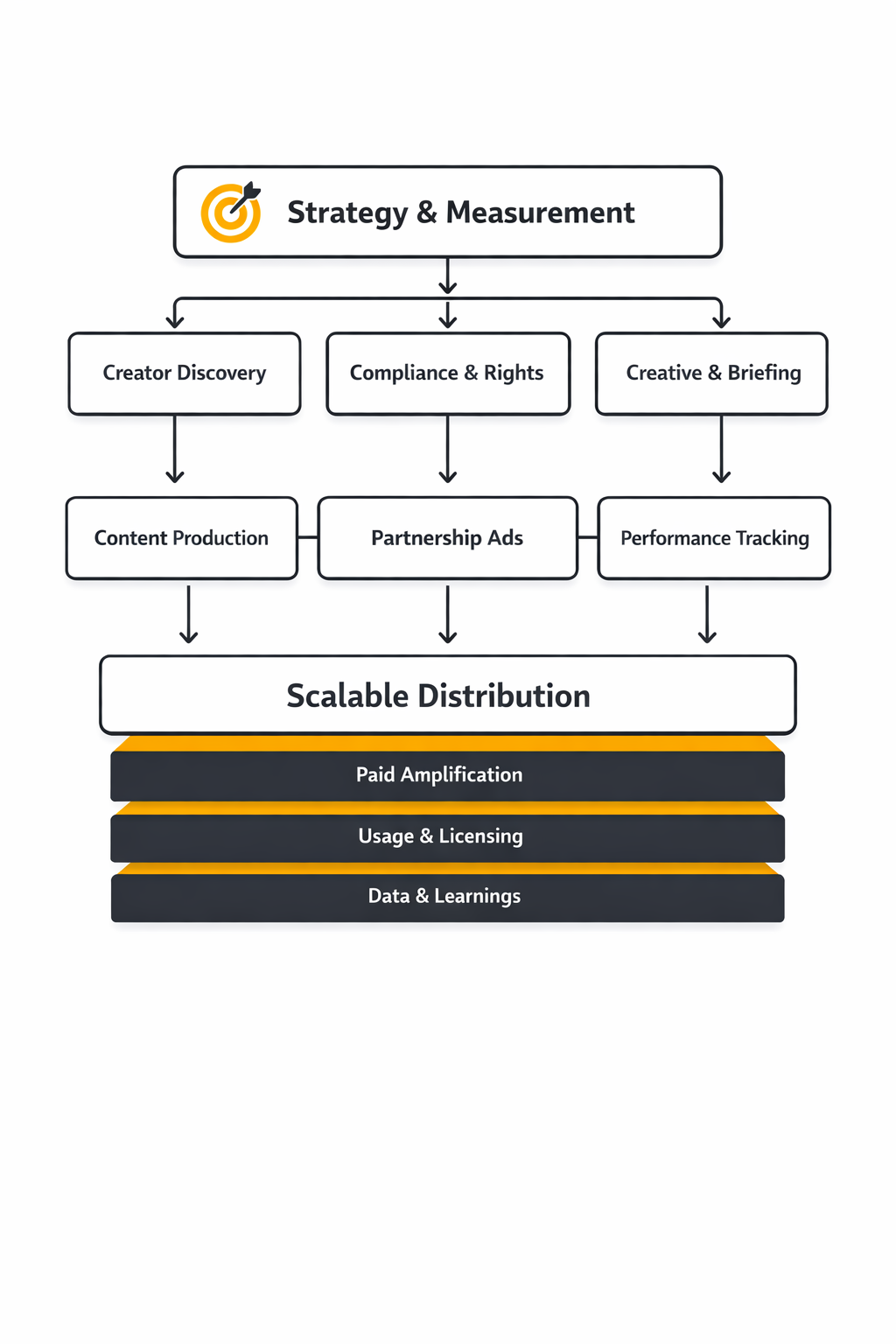
To evaluate a social influencer agency (or to run one internally), use a simple framework: Strategy → Supply → Production → Distribution → Measurement → Governance.
Most disappointing influencer programs fail because they overinvest in only one layer. A team might have great creators but weak distribution, meaning the content never reaches enough of the right people. Or they might have plenty of views but weak measurement, meaning they can’t tell what to repeat. The framework keeps the channel balanced so it can scale.
- Strategy: clear objectives, audience, offer, positioning, and what success looks like.
- Supply: reliable creator sourcing, vetting, and relationship management.
- Production: briefs that creators can actually execute, plus fast feedback loops and approvals.
- Distribution: organic posting plans plus paid amplification where it makes sense.
- Measurement: tracking that connects creator activity to business outcomes, not vanity screenshots.
- Governance: contracts, usage rights, disclosure, and brand safety controls.
Later in this guide, you’ll see how this maps to playbooks, reporting, and the tech stack that makes execution repeatable.
Core Components
1) Strategy That Starts With a Real Decision
Before an agency touches creator discovery, it should pin down a decision you need to make. Are you validating a new audience? Testing a new product angle? Trying to drive first purchases, not just awareness? A strong agency will force clarity here because your brief, creator selection, deliverables, and tracking are all downstream of this.
One sign you’re dealing with a mature partner: they talk about tradeoffs. For example, if you want lower-funnel efficiency, they’ll likely steer you toward creator tiers and formats that convert, then plan distribution around trackable mechanisms like affiliate, codes, or whitelisted ads. If you want cultural relevance, they’ll talk about volume, iteration speed, and creative risk tolerance.
2) Creator Supply and Vetting
Creator selection is not just “find people with followers.” It’s an evidence-based match between audience, credibility, content style, and your risk profile. Modern platforms are also making discovery more structured via official tools and APIs, which changes what “good sourcing” can look like at scale, including Meta’s marketplace/discovery APIs and YouTube’s creator partnership improvements.
A serious social influencer agency typically vets for audience alignment, past brand work, content consistency, comment quality, sudden follower spikes, and whether the creator can reliably hit timelines. This is also where brand safety belongs: categories they won’t touch, claims they won’t make, and disclosure standards that are enforced, not suggested.
3) Briefing, Production, and Approvals
Creators perform best when the brief is clear about what matters and flexible about how it’s expressed. The agency’s job is to translate brand needs into creator language: the insight, the product truth, the mandatory claims, the do-not-say list, and the creative guardrails.
Great agencies run approvals like a production team, not like a committee. They define who can approve, what must be approved, and what can be iterated post-launch. They also plan for versioning because the first post is rarely the best one. If you want repeatable results, you need a system that gets smarter every round.
4) Distribution and Amplification
Organic reach is not a strategy by itself. Increasingly, the play is to treat creators as a performance-grade creative engine, then amplify winning assets through paid media. TikTok, YouTube, and Meta have all been building more explicit infrastructure for creator-led advertising and brand partnerships, which is part of why creators are becoming a more formal budget line in the first place.
A capable social influencer agency will tell you, upfront, whether they can support paid amplification workflows and what data they need to do it properly. If they can’t, you can still run creator programs—just don’t expect paid-scale outcomes without a plan to distribute.
5) Measurement That Matches Your Objective
Reporting should never be a collage of screenshots. If your objective is awareness, you care about reach, frequency, view quality, and lift-style signals. If your objective is sales, you care about attributable conversions, incremental impact, and whether results hold when spend scales.
Measurement maturity is moving fast across marketing in general, with more teams leaning into incrementality and media mix approaches as privacy changes attribution. EMARKETER’s analysis of survey data notes that many marketers planned to increase investment in MMM, which matters because influencer programs increasingly need to prove impact alongside other channels.
6) Governance: Contracts, Rights, and Disclosure
Governance is where a social influencer agency earns its keep when things get tense. Usage rights, whitelisting permissions, exclusivity, payment milestones, cancellation terms, and disclosure language should be standardized. If you operate across regions, governance should also reflect local rules and guidance, such as the FTC’s guidance on endorsements and influencer disclosures and the ASA’s guidance on making ads recognisable in influencer marketing.
If an agency is vague here, you’re not buying “flexibility.” You’re buying future conflict.
Professional Implementation
When Hiring a Social Influencer Agency Makes Sense
You typically hire an agency when the opportunity is obvious but execution keeps slipping. Maybe you’ve run a few creator activations, but every campaign is a scramble. Or maybe you have a content team and a paid team, but no one owns the middle: creator relationships, rights, approvals, tracking, and reporting.
Another common trigger is scale. The moment you need consistency across multiple creators, multiple deliverables, and multiple platforms, you need a system. That’s what you’re buying.
How to Evaluate Agencies Without Getting Sold a Fantasy
Ask for proof of process, not just proof of vibes. You want to see how they brief creators, how they handle usage rights, how they track, and what a real report looks like. If they only show highlight reels, you’re being marketed to—not managed.
- Ask what they optimize for: brand lift, conversions, content production, or a mix.
- Ask how they vet creators: audience fit, consistency, brand safety, and fraud signals.
- Ask how they measure: links, codes, landing pages, lift studies, or MMM inputs.
- Ask how they manage compliance: disclosure rules and contractual enforcement.
What a Strong First 30 Days Looks Like
In the first month, the best agencies don’t chase volume. They build your foundation: creative angles, creator shortlists, tracking architecture, and a repeatable approval flow. You should end month one with a clear campaign plan, a vetted roster pipeline, and tracking that doesn’t break the moment someone posts early or changes a caption.
If your agency’s first month is mostly “let’s see what happens,” you’re likely paying for experimentation without learning. A professional partner will still test, but they’ll structure tests so you can make confident decisions.
Common Pricing Models and What They Incentivize
Pricing shapes behavior, so treat it as strategy. Retainers often work best for always-on programs because you’re paying for continuity and systems. Project fees can work for launches, but they tend to prioritize output over learning. Performance-based structures can be attractive, but they require clean tracking and clear definitions, and they can push partners toward short-term wins at the expense of brand health.
The most sustainable setups usually combine a stable operating fee with clearly scoped deliverables and a measurement plan that everyone trusts.
Step-by-Step Implementation
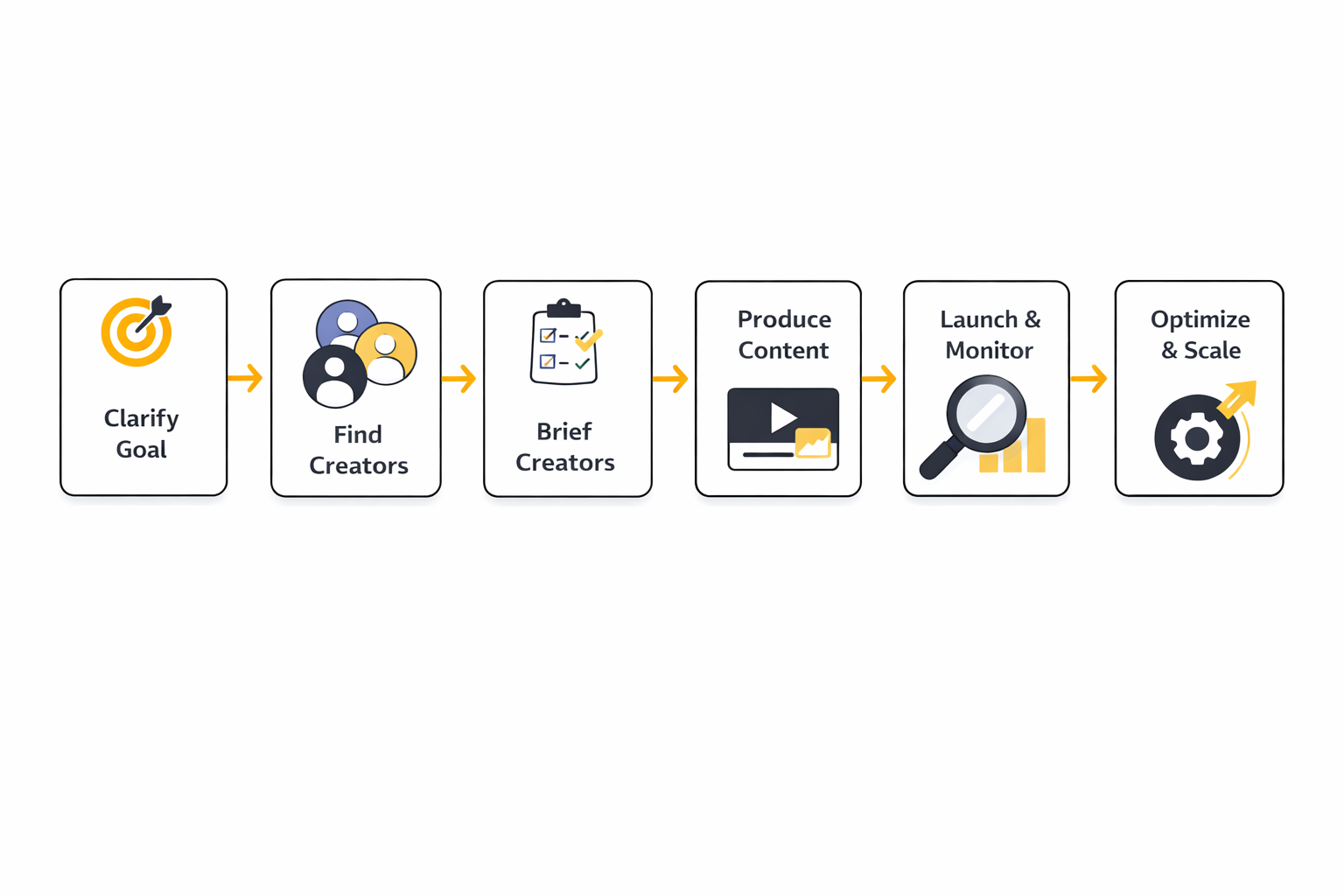
Getting a social influencer agency to perform like a real growth channel is mostly about sequencing. If you start with “let’s book creators,” you usually end up rebuilding fundamentals mid-campaign, when everyone’s stressed and timelines are already slipping. The smoother path is to lock the foundations first, then scale volume only after the first cycle produces clean learnings you can repeat.
Step 1: Define Success Like a Decision, Not a Vibe
Start with a single decision your team needs to make at the end of the first campaign cycle. Maybe it’s which creative angle to standardize, which creator tiers are reliable, or whether paid amplification is required to hit volume goals. This framing keeps the social influencer agency focused on building evidence, not just shipping content.
Step 2: Set Governance Before the First Outreach
Before you contact creators, agree on disclosure requirements, claim boundaries, usage rights, and the approval path for anything sensitive. This is the unglamorous part, but it’s what prevents relationships from turning adversarial when a post goes live and someone asks, “Do we actually have permission to use this in ads?” The clearest baseline references are the FTC’s practical rules for endorsements and influencer disclosures and the ASA’s guidance on making influencer ads recognisable.
Step 3: Build Tracking That Survives Real Creator Behavior
Creators will post early, change captions, forget links, or experiment with formats you didn’t predict. Your tracking has to survive that. A practical setup usually includes a naming system, approved landing pages, and a way to connect each creator and asset to outcomes without relying on perfect compliance.
If your organization is moving beyond last-click and trying to measure true impact, it helps to align creator programs with broader incrementality and MMM practices rather than treating influencer reporting as a separate universe. MMA’s work on incrementality and channel measurement and Ekimetrics’ perspective on modern influencer measurement are useful anchors for how mature teams approach this.
Step 4: Build a Creator Shortlist That Matches the Job
A social influencer agency should shortlist creators based on fit for the campaign job, not on who is easiest to book. For a conversion-oriented test, you want creators who can communicate benefits clearly, build trust quickly, and consistently ship on time. For an awareness-oriented test, you want creators who understand culture, can create a strong hook, and can sustain attention.
Step 5: Build Briefs That Creators Can Actually Execute
Good briefs are surprisingly short. They communicate what must be true, what must not happen, and what success looks like, then leave room for the creator’s voice. If the social influencer agency has to rewrite every script or force creators into brand copy, you’ll get stiff content and weaker performance.
Step 6: Lock Contracts, Rights, and Paid Permissions Upfront
If you might turn creator content into ads, negotiate that from the beginning. Paid activation often requires specific permissions and workflow steps inside the platform, and it’s far cleaner when it’s planned rather than retrofitted. On Meta, these workflows are closely tied to partnership ad capabilities documented in the Partnership Ads documentation.
Step 7: Run Production With a Tight Approval Clock
The fastest way to lose creators is to make them wait. Set an approval clock in advance, define who can approve, and decide what gets reviewed for compliance versus what gets reviewed for taste. A social influencer agency that runs this well feels calm even when output is high, because blockers surface early instead of exploding on launch day.
Step 8: Launch, Then Log Everything That Matters
When posts go live, capture the details that will matter later: posting time, creative format, hook type, CTA style, and any deviation from the brief. The point is not bureaucracy. The point is being able to answer, weeks later, why one concept became repeatable and another didn’t.
Step 9: Turn One Campaign Into a Repeatable Play
After the first cycle, the social influencer agency should deliver more than a report. You want a “next version” plan: what to repeat, what to stop, what to test next, and which creators should be treated as long-term partners. If you can’t name a specific next experiment, you didn’t really learn anything.
Execution Layers
Once implementation starts, most teams discover they’re actually operating in layers. When one layer is weak, the whole program becomes fragile. A high-performing social influencer agency intentionally designs each layer so results don’t depend on heroics.
Layer 1: Operating Model and Roles
This is who owns what. Someone must own creator supply, someone must own creative approvals, someone must own tracking, and someone must own the final “go/no-go” decisions. If ownership is fuzzy, the program slows down and relationships suffer.
Layer 2: Creator Supply and Relationship Management
Creator supply is not a one-time booking sprint. It’s an always-on pipeline where you continuously add new creators, develop repeat partners, and keep records of what each creator is good at. This is where the social influencer agency builds compounding advantage, because the best learnings often come from creators you work with more than once.
Layer 3: Creative System and Versioning
Think in versions, not “the one perfect post.” A creative system defines a small set of hooks, narratives, and CTAs you want to test, then iterates based on evidence. When a social influencer agency gets this right, creative improves week by week without feeling like the brand is reinventing itself.
Layer 4: Distribution and Amplification
Distribution decides whether creator content becomes a channel or stays a collection of posts. Organic distribution is valuable, but it is often unpredictable. If amplification is part of your plan, build it into the workflow early, because it changes rights, approvals, and how you evaluate what “winning” looks like in the first place.
Layer 5: Measurement and Learning
This layer is where many programs quietly die. If measurement is inconsistent, teams lose confidence and stop scaling. Mature teams increasingly align creator measurement with incrementality and MMM thinking, so creator work can be evaluated alongside other channels rather than being stuck in a silo of views and likes. Incrementality guidance from MMA and Ekimetrics’ view on the next era of influencer measurement are helpful reference points for how to structure this layer.
Optimization Process
Optimization is where a social influencer agency becomes dangerous in the best way. It’s the difference between “we ran a campaign” and “we built a system that gets smarter every cycle.” The goal isn’t to endlessly tweak micro-metrics; it’s to find a small number of repeatable patterns you can scale without losing quality or trust.
1) Start With a Hypothesis You Can Actually Prove or Disprove
Write hypotheses that tie creative to an outcome. For example: “Creators who open with a problem-first hook will drive higher intent actions than creators who open with product features.” This keeps optimization grounded, and it prevents post-campaign conversations from turning into opinions disguised as insights.
2) Design Tests Around Creative Variables, Not Creator Chaos
If every creator gets a totally different brief, you can’t learn what worked. Standardize what needs to be standardized, then let creators interpret it in their voice. When the social influencer agency is disciplined here, you can compare like with like and isolate what actually moved performance.
3) Build an Iteration Cadence That Matches Platform Speed
Optimization dies when feedback cycles are too slow. Set a weekly cadence where you review top-performing hooks, identify what’s repeatable, and immediately brief the next wave with those learnings. When approvals take weeks, creator marketing starts behaving like a traditional campaign channel, and you lose the main advantage creators give you: speed.
4) Measure Impact With Methods Your Finance Team Will Respect
Influencer reporting becomes credible when it can coexist with the measurement logic used across the rest of marketing. That often means combining direct-response signals (links, codes, partner tracking) with incrementality thinking and, for larger advertisers, MMM-style evaluation. The MMA’s reference on incrementality and Ekimetrics’ framework for influencer measurement explain why mature teams increasingly adopt these approaches as attribution becomes noisier.
5) Scale With Rules, Not Hope
When something works, write down the scaling rule. It might be a creative rule (“always open with the tension, then reveal the product”) or a distribution rule (“amplify only assets that hit a baseline engagement quality threshold”). Scaling rules keep the social influencer agency from overreacting to one viral post and instead build a portfolio of reliable wins.
Implementation Stories
Implementation gets real when a big organization changes how it behaves, not just how it briefs. The story below is based on public reporting and Unilever’s own published transcript, and it’s a useful lens on what happens when “creator marketing” stops being a side project and becomes an operating model.
Unilever’s “Influencer-First” Pivot Forced a New Operating System
The high-drama moment wasn’t a product recall or a sudden collapse in demand. It was something more unsettling for a company built on classic brand advertising: the new CEO publicly called out that corporate brand messaging had become “suspicious” to consumers, then pushed a radical shift toward creators as the primary vehicle for desirability. Inside a company like Unilever, that kind of statement isn’t just positioning; it instantly turns into a thousand operational questions about volume, control, and risk. The scale of what was being proposed made it clear that a casual influencer program wouldn’t survive what was coming. Financial Times coverage of the strategy shift
The backstory matters because Unilever isn’t a brand; it’s a universe of brands across categories, regions, and buyer behaviors. A one-size-fits-all campaign playbook doesn’t work when you’re selling everything from personal care to home care to food, often with completely different purchase dynamics. In public remarks, the company framed the move as a response to how trust and attention had migrated, especially in social environments where people respond more to individuals than institutions. That context is what makes the next decision feel less like a marketing trend and more like a structural adaptation. Unilever’s Barclays fireside chat transcript
The wall arrived immediately: if you decide to work with creators at massive scale, you need a machine that can recruit, brief, approve, pay, and measure without collapsing under its own weight. Even in the CEO’s own words, moving social investment from 30% to 50% of spend and working with 20 times more influencers isn’t a creative challenge; it’s an operational one. That wall is exactly where many creator programs fail, because the team tries to scale output without scaling governance and workflow. You can’t “wing it” when the model depends on high volume. PRWeek’s reporting on the same 30% to 50% and 20x shift
The epiphany, stated plainly in the public record, was that the company needed a different kind of content engine—one built for many-to-many communication, not a couple of polished hero ads per year. That realization reframes what a social influencer agency is for: not just booking creators, but building a repeatable system that produces relevant content continuously. It also explains why this pivot wasn’t presented as a one-off campaign, but as a rewiring of marketing systems and how desirability is created at scale. When leadership frames it as a systems problem, the solution can’t be a handful of posts; it has to be a new operating model. Transcript discussion of a “massive change” and content system shift
The journey from idea to implementation is where the real work lives. A social influencer agency supporting this kind of change would need standardized briefs that still allow local nuance, a contracting and rights system that can handle volume, and measurement that can be rolled up across brands without losing meaning. Public analysis of the shift highlighted that the intent was to move faster and be more culturally present, which implies shorter iteration loops and a heavier reliance on ongoing creator collaboration rather than seasonal bursts. In other words, the journey requires turning creator marketing into infrastructure. That’s the difference between scaling spend and scaling capability. EMARKETER’s breakdown of Unilever’s influencer-first plan
The final conflict was predictable: speed versus control. When you scale creators, you increase the surface area for compliance mistakes, brand safety issues, and internal friction, because more stakeholders want visibility and veto power. At the same time, the whole promise of creator marketing is speed and relevance, which evaporates if every asset waits weeks for approvals. That conflict is why governance has to be baked into workflow, with clear rules about what must be approved and what can be creator-led, and why disclosure standards must be operationalized rather than treated as optional. FTC guidance used as a practical baseline
The dream outcome is not “more influencer posts.” It’s a marketing engine that can generate desirability at scale, across brands and regions, while staying measurable and safe enough to keep leadership confident in the strategy. Public reporting framed the pivot as a move away from slow, corporate-led messaging toward a creator-driven model that can reach people in more localized, trusted ways. If that outcome is achieved, a social influencer agency stops being a vendor and becomes part of the operating system that keeps the content engine running. That’s what real implementation looks like when the stakes are high: systems that make the strategy executable. Financial Times on the intended strategic direction
Define Deliverables in a Way That Protects Learning
Don’t only define deliverables as “number of creators” or “number of posts.” Define deliverables as a learning system: how many creative angles will be tested, what variables will be held constant, and what the agency must document to make the next cycle smarter. When deliverables protect learning, you naturally get better results over time because the program compounds.
Set an Approval SLA and Enforce It
Set an explicit approval window and decide what happens if feedback arrives late. This protects creators from slowdowns and protects your brand from last-minute panic. A social influencer agency can’t run fast if the client environment is structurally slow, so treat the SLA as a performance lever, not a formality.
Standardize Rights and Disclosure Requirements
Standard templates reduce negotiation time and reduce mistakes. Bake in disclosure guidance that matches the markets you operate in and make it part of the brief and QA checklist. The safest approach is to treat these rules as operational requirements anchored in real regulator guidance, like the FTC’s rules for endorsements and disclosures and the ASA’s guidance for recognising influencer ads.
Make Measurement a Contractual Requirement
Require clean tracking conventions, a documented taxonomy, and a post-campaign readout that includes what to do next. If your organization is moving toward incrementality and MMM approaches, align creator reporting with those expectations so creator work can be evaluated alongside other channels. The MMA’s reference on incrementality and Ekimetrics’ work on influencer measurement are practical references for how measurement expectations are evolving.
Build an Escalation Path for Brand Safety and Mistakes
Even great programs hit surprises: a creator posts something off-brief, a disclosure gets missed, or a comment thread turns ugly. Define an escalation path in advance: who gets notified, what gets paused, and what the public response rules are. This is where a social influencer agency proves maturity, because the best teams don’t just create momentum; they know how to protect it.
Statistics and Data
When a social influencer agency says “the campaign performed,” the real question is: performed against what? The safest way to anchor expectations is to combine (1) market investment data, (2) platform-level engagement baselines, and (3) effectiveness research that looks beyond short-term clicks.
In the US, creator advertising has become big enough that it’s tracked as a category with its own growth curve. IAB’s 2025 report projects creator ad spend reaching $37B in 2025 (up from $29.5B in 2024), and the same figures are repeated in IAB’s public summary and independent coverage like Marketing Dive’s breakdown.
Effectiveness research is also getting sharper. In the UK, the IPA’s work on “ROI of Influence” reports influencer marketing delivering a higher long-term ROI index than paid social, including an ROI index of 151 (vs. 77 for paid social) and a long-term multiplier of 3.35, which is echoed in reporting from Marketing Week and analysis from Ebiquity.
Engagement benchmarks are the most tempting numbers to misuse because “engagement rate” is not a universal measurement. Rival IQ’s benchmark work (based on millions of brand posts) shows TikTok leading with a median engagement rate of 2.63% in its 2024 benchmark report, while Socialinsider’s 2026 benchmarks report different baseline rates and trends, including TikTok engagement rate figures around 3.70% and Instagram around 0.48% (using its own methodology). Hootsuite’s platform averages can look higher again because of how it defines and samples engagement across industries, with its 2025 update listing platform averages such as LinkedIn engagement around 2.8% and Instagram around 4.2%.
The takeaway for a social influencer agency is simple: benchmarks are useful when you match the methodology to your use case. They become noise when you compare incompatible definitions or use “industry averages” to justify a strategy that your own tracking can’t validate.
Performance Benchmarks
Benchmarks should help you set ranges, not promises. A social influencer agency that treats benchmarks as guarantees is either inexperienced or selling you the good-feeling version of reality.
Reach and Attention Benchmarks
For reach-oriented campaigns, the real benchmark is not “views,” it’s whether the views are high-quality enough to create downstream behavior. TikTok’s research for EUI gifting season behavior shows that special-occasion content can drive meaningful off-platform actions, with 30% of users researching more on TikTok or on a brand’s website after watching special-occasion content, and 43% buying or booking something. Those numbers are directional market context, not your KPI—but they’re helpful when you’re deciding whether your creative and CTA should aim for curiosity, consideration, or direct conversion.
Engagement Benchmarks by Platform
Engagement rates vary by platform, format, and industry. Rival IQ’s 2024 report highlights TikTok’s median engagement rate of 2.63% as a baseline across the industries it studied, while Socialinsider’s 2026 benchmarks show different baselines and trend direction, including TikTok engagement around 3.70% and Instagram around 0.48%. When a social influencer agency uses engagement as proof of performance, it should also explain the denominator (followers vs. reach), what counts as engagement, and whether the benchmark matches your industry and format.
Conversion and Lift Benchmarks
Conversion benchmarks are hardest to generalize because they depend on offer, landing page, and audience temperature. That’s why the most trustworthy “benchmarks” often come from controlled lift tests or structured platform reporting rather than vague averages. TikTok’s measurement documentation describes how its Conversion Lift Study is used to estimate incremental conversions via experimentation, which is the right mental model when you’re trying to prove causality rather than correlation.
For a social influencer agency, the practical benchmark is this: if your campaign can’t connect creator activity to a measurable business outcome (directly or via lift methods), you don’t have a scalable channel yet—you have content.
Analytics Interpretation
Analytics interpretation is where a social influencer agency earns trust. Most dashboards are easy to produce; clear conclusions are not. The goal is to move from “what happened” to “why it happened” and “what we should do next,” without over-claiming.
Start With the Funnel You Actually Care About
If the goal is awareness, you interpret performance through view quality, retention, and the volume of people who meaningfully engaged with the message. If the goal is conversion, you interpret performance through attributable actions and incremental lift. Mixing these leads to confusing decisions, like killing a creator because clicks were low even though the content was generating the strongest saves and shares, which often correlate with future intent.
Separate Creative Performance From Distribution Performance
A common analytics mistake is blaming the creator when the distribution plan is the real limiter. A piece of content can be strong but under-delivered, or average but over-delivered through paid amplification. This is why platform features that let you use creator content as ad creative matter: they help you test creative quality independently of organic reach volatility, including YouTube’s partnership ads powered by BrandConnect and TikTok’s ecosystem around Spark-style amplification described across its business resources.
Look for Repeatable Patterns, Not One-Off Spikes
When a social influencer agency reports results, the most valuable output is not the best-performing post. It’s the pattern you can repeat: the hook style that consistently holds attention, the proof point that drives saves, the CTA that doesn’t feel forced, and the creator archetype that reliably ships high-quality work. Repeatable patterns are how creator marketing becomes a program instead of a series of isolated wins.
Use Market Data as Context, Not as an Excuse
Market-level statistics help you justify investment and set ranges, like the IAB projection that creator ad spend reaches $37B in 2025 or the IPA finding that influencer marketing can deliver a higher long-term ROI index than paid social in the UK dataset. IPA’s ROI of Influence summary But those numbers do not replace your own measurement. They’re context for why the channel matters, not proof that your specific campaign worked.
Case Stories
Case studies are useful only when they’re specific enough to learn from and real enough to trust. The story below is built from TikTok’s published Valentine’s Day 2025 guide and its embedded thortful case study, with the goal of showing what “measurable creator-led execution” looks like when the plan includes both creative and amplification. TikTok EMEA SMB Valentine’s Day 2025 guide
thortful Used Creator-Style Content and Spark Ads to Win a Seasonal Spike
The pressure hit first as a calendar problem. Valentine’s Day and Mother’s Day were coming fast, and the same old “gift reminder” ads were starting to blend into the scroll. thortful needed a way to reach new customers while still feeling like the platform, not like another seasonal interruption. thortful case study section in TikTok’s guide
The backstory is that thortful isn’t selling a commodity; it’s selling a moment and a message. People don’t wake up wanting a “greeting card brand,” they wake up wanting to say something that lands emotionally, usually under time pressure. That makes the product deeply social, but also deeply seasonal, which means the marketing has to show up when intent spikes and still feel authentic. TikTok’s summary of thortful’s objective and context
The wall was visibility and differentiation at the exact same time. Seasonal demand can be huge, but so is competition, and audiences get numb to generic gifting prompts. If thortful simply pushed polished product shots, it risked becoming background noise; if it leaned too far into “fun TikTok,” it risked losing the product clarity needed for conversion. The brand needed content that could entertain quickly and still move people toward purchase. “Acquiring new customers with engaging content” objective
The epiphany was to make the brand feel human on camera and build the message around native TikTok behavior. thortful created content featuring its own staff and products, and used trending sounds to keep the creative playful rather than salesy. That choice matters because it’s a commitment to platform language: it invites attention instead of demanding it. thortful creative approach description
The journey was to turn that creator-style content into a campaign system instead of a one-off post. The plan paired an “array of content” with amplification through Spark Ads, which let thortful scale the content in-feed while keeping it feeling native. Importantly, this approach doesn’t rely on one perfect video; it relies on volume, variation, and distribution discipline. That’s a social influencer agency mindset: produce enough creative to learn, then amplify what proves itself. “Products used Spark Ads” and campaign summary
The final conflict was that performance can expose weaknesses you didn’t know you had. When a piece of content starts moving, everything downstream gets tested: landing page speed, offer clarity, and whether your tracking can capture the value without guesswork. Seasonal buyers are also impatient, and a great video can still underperform if the checkout experience is confusing or slow. In other words, creative momentum creates operational pressure, and the brand has to keep up. TikTok’s measurement tooling overview for connecting campaigns to outcomes
The dream outcome was measurable scale at the moment it mattered. TikTok’s published case study section reports the campaign reaching 4.5M video views, 1.8M reach, and a 10% conversion rate. Those numbers don’t prove that every brand can replicate the results, but they do prove something more important: the method was real, the execution was structured, and the outcome was concrete enough to learn from. A social influencer agency that can build this kind of system—creative that fits the platform plus distribution that scales—is the difference between seasonal luck and seasonal leverage. thortful results
Professional Promotion
Promotion is the bridge between “a creator posted” and “a business outcome happened.” A social influencer agency should treat promotion as a design choice, not a last-minute boost button, because promotion affects rights, measurement, and how you interpret performance.
Promote What Proves Itself, Not What You Personally Like
In professional creator programs, content earns promotion. You launch a batch, watch early signals (retention, saves, shares, comment quality), then amplify the assets that show real intent—not just the ones that “feel on brand.” This keeps spend disciplined and protects creators from being judged purely on organic reach volatility.
Use Partnership Formats That Preserve Authenticity
Promotion works best when the ad still feels like the platform. YouTube’s partnership ads powered by BrandConnect are designed to let brands promote creator videos as ads while retaining organic context, and TikTok’s Spark Ads approach is repeatedly positioned as a way to scale organic-style posts without turning them into stiff commercials. Spark Ads guidance and thortful’s usage
Measure Promotion Like Media, Not Like a Screenshot
If you’re investing in promotion, you should be thinking in terms of lift and incrementality, not just last-click. TikTok’s measurement documentation explains how tools like Conversion Lift Studies can estimate causal impact via experimentation, which is especially useful when creator content influences consideration and later conversions that won’t show up in a clean click path.
Keep Rights and Permissions Clean From Day One
The fastest way for promotion to become a mess is retroactively asking for permissions after a post performs. The professional approach is to negotiate usage rights and paid permissions before launch, then promote only within the boundaries you agreed to. This protects the creator relationship, reduces legal risk, and keeps your agency-client workflow calm when the campaign starts winning.
Advanced Strategies
Once the basics are working, a social influencer agency can stop thinking like “campaign management” and start thinking like a repeatable growth system. The channel has matured fast enough that many teams now treat creators as a core line item, with Kantar’s Media Reactions research showing 61% of marketers planning to increase investment in creator and influencer content. That kind of budget pressure changes the job: you’re no longer proving the concept, you’re building the infrastructure that makes scaling safe.
Run a Creator Portfolio, Not a Creator List
Advanced programs treat creators like a portfolio with roles, not a flat roster. A social influencer agency will usually split creators into three groups: reliable converters (repeatable sales or qualified leads), reliable storytellers (brand lift and desirability), and experimental talent (new angles, new niches, new formats). This portfolio approach prevents the common scaling failure where teams chase reach, lose message clarity, and end up with a lot of content that can’t be repeated.
Build Always-On Partnerships That Compound Trust
One-off posts can work, but the compounding effect usually comes from repeat partnerships where the creator and audience build familiarity over time. Creators themselves are increasingly vocal about preferring stability and longer programs, and eMarketer’s reporting highlights that a significant share of creators prefer longer-term collaborations rather than one-off deals. Creators seeking stable, long-term brand partnerships
The practical advantage for a social influencer agency is that repeat partnerships reduce briefing time, reduce brand safety surprises, and create more believable storytelling. You also gain a clean baseline for optimization because the creator’s audience and style remain consistent, making creative and offer testing far more measurable.
Define a Creative ICP and Enforce It Politely
Advanced creator programs stop evaluating content as “good” or “bad” and start evaluating it as “on-ICP” or “off-ICP.” Your creative ICP is the small set of narrative patterns that consistently work for your category and brand voice. A social influencer agency that can document that ICP and translate it into briefs will scale faster, because each new creator is joining an existing system instead of reinventing the wheel.
Turn Organic Winners Into Paid Assets Without Breaking Authenticity
Scaling almost always means amplification. The key is to amplify in a way that still feels native, using partnership formats designed for creator-led ads. YouTube formalizes this with partnership ads powered by BrandConnect, and TikTok frames its commerce experience around discovery-led shopping through shoppable videos and live streams. The point is not the format name. The point is preserving the creator context while adding distribution discipline.
Upgrade Measurement Before You Upgrade Volume
Scaling content volume without scaling measurement creates a fake sense of progress. Measurement is still the biggest operational friction point for many teams, with eMarketer highlighting that measuring creator performance is a leading roadblock (based on creator-industry survey data). An advanced social influencer agency treats measurement as a product: consistent naming, outcome tracking, lift methods when attribution is noisy, and a repeatable way to compare creative patterns across creators.
Scaling Framework
A scaling framework is how a social influencer agency grows output without turning the program into chaos. The healthiest frameworks are boring on purpose: clear inputs, clear workflows, and a predictable cadence for learning. When the channel is growing fast at a market level, like IAB’s projection of $37B in US creator ad spend in 2025, the brands that win are usually the ones that can scale execution without losing governance and signal quality.
Layer 1: One Goal Per Wave
Each wave should be designed to answer one question. If you ask a wave to build awareness, drive sales, generate UGC, and validate a repositioning, your reporting will become storytelling instead of decision-making. A social influencer agency that scales well keeps each wave narrow, then stacks waves over time to build full-funnel impact.
Layer 2: Creator Tiers With Different Expectations
Define tiers and what “good” looks like in each tier. Your top tier might be a small group of repeat partners who can carry bigger launches. Your mid-tier might be the workhorse group for testing and consistent output. Your experimental tier is where you find the next repeat partner. This is how a social influencer agency protects quality while increasing volume.
Layer 3: A Content System With Versions
Scaling is easier when you treat content as versions. Versioning creates continuity: you can iterate on a hook, adjust proof points, and refine CTAs without guessing what changed. It also makes paid amplification safer because you know which versions were tested organically before they were scaled.
Layer 4: Distribution Rules That Reward Proof
Decide in advance what earns amplification. A common rule is that only assets that show strong retention and high-intent engagement signals earn paid spend. This protects budget and keeps teams from amplifying “pretty” content that doesn’t move outcomes. It also keeps creator relationships healthier, because creators aren’t blamed for low reach when distribution is the real lever.
Layer 5: Quarterly Resets and Pruning
Scaling creates tool and process creep. A quarterly reset forces the agency and client to prune: remove workflows that slow things down, stop experiments that never produced signal, and double down on creator relationships that compound. This is how a social influencer agency avoids becoming a content factory with no learning loop.
Growth Optimization
Growth optimization is where creator programs become financially defensible. It’s also where you can accidentally ruin the magic if you treat creators like interchangeable ad units. The balance is to keep the creator voice intact while tightening the system around it: clearer tests, faster cycles, and better distribution decisions.
Optimize Creative Like a Lab, Not Like a Committee
Committees produce safe content. Labs produce learning. An optimization-driven social influencer agency builds a small creative hypothesis set, briefs creators to interpret it authentically, and then evaluates outcomes with consistent rules. When a message pattern wins, the agency doesn’t copy-paste it blindly. It extracts the principle and briefs the next wave to express it in new ways so the content stays fresh.
Optimize Offers Without Training the Audience to Wait for Discounts
It’s tempting to scale by pushing heavier discounts through creators. That can work short term, but it can also train your audience to delay purchase. Strong agencies optimize offer structure instead: bundles, limited drops, bonuses, or creator-specific value framing. This keeps conversion strong while preserving long-term margin and brand positioning.
Optimize Social Commerce With a Creator Flywheel
Social commerce scaling often depends on creator flywheels: creators demonstrate the product, audiences buy, the platform boosts what converts, and the program recruits more creators using proof. TikTok’s own framing of TikTok Shop emphasizes a discovery-first shopping model driven by shoppable content and live streams, which aligns with how creator-led commerce scaling actually works in practice.
Optimize Budget Allocation With Long-Term ROI in Mind
When stakeholders ask why creator budgets keep growing, long-term effectiveness research helps anchor the conversation. The IPA’s “ROI of Influence” release highlights influencer marketing delivering strong long-term impact, including an ROI index of 151 and a long-term multiplier of 3.35. Those figures won’t predict your exact results, but they do support the strategy of building creator programs that compound rather than treating them as one-off spikes.
Scaling Stories
Scaling stories matter because they show what happens when creator marketing meets operational reality. The story below is built from APR’s financial releases and multiple media reports about Medicube’s breakout and retail expansion, with a focus on the scaling mechanics a social influencer agency can actually learn from.
Medicube’s Breakout Turned Creator Demand Into Retail Scale
The high-drama moment didn’t look like a marketing crisis at first. It looked like a success problem: creator content was exploding, demand was spiking, and the brand was suddenly being pulled into new markets faster than most teams can plan for. When attention moves that quickly, you either build a system that can catch it or you watch the moment slip through your fingers. Medicube’s momentum became too big to handle with “normal campaign pacing.” Vogue’s report on Medicube’s breakout
The backstory explains why the pressure was so intense. Medicube sits inside APR, a company that blended skincare with home beauty devices, which meant creator content could be both educational and transactional. That combination is dangerous in the best way because it gives creators something to demonstrate, not just something to pose with. Over time, APR’s device business scaled dramatically, and the company ultimately reported record results for 2025, including KRW 1.53 trillion in annual revenue that was also reflected in APR’s own Q4 2025 results release and covered by The Korea Times’ reporting on APR’s record performance.
Then the wall hit: virality is not a business model unless you can fulfill demand, expand distribution, and keep the content engine running. If the product is hard to find or the shopping experience breaks, creator momentum turns into frustration and missed sales. Medicube’s challenge wasn’t just making content people liked. It was making sure that when people wanted to buy, the buying path was real and scalable.
The epiphany was that the creator engine had to connect to distribution in a way that didn’t slow down the story. One proof point was device demand at scale, with APR announcing it had surpassed 6 million cumulative AGE-R device sales, echoed in coverage from BusinessKorea’s reporting on the same milestone and republished via The Straits Times’ paid press release feed. Those numbers matter because they signal the brand had crossed into repeatable scale, not just “one viral product.”
The journey that followed was about turning creator demand into mainstream availability. Medicube secured a major US retail rollout, with reporting noting distribution into Ulta’s 1,400 stores starting in August 2025, supported by The Korea Herald’s coverage of the Ulta supply agreement and APR coverage that positioned the launch as a full-scale expansion. For a social influencer agency, the lesson is clear: when a creator channel is working, the business must be ready to scale the buying path just as aggressively as it scales the content.
The final conflict was that scaling into retail doesn’t automatically stabilize performance. Retail expansion introduces new variables: inventory timing, store execution, category competition, and the risk that the message gets diluted when the brand becomes “available everywhere.” Even after the launch, the brand still had to prove sustained performance in the new environment, and later reporting described continued traction tied to retail and marketplaces, including Ulta’s ongoing scale and performance dynamics in the US. The Korea Times on Medicube sales momentum across Ulta and Amazon
The dream outcome is what most brands want but few achieve: creator energy that doesn’t fade after the first spike. Medicube’s scaling story suggests a path where creator-led demand supports financial performance, retail expansion, and repeatable product demonstration content. That is the real endgame for a social influencer agency: not just making something go viral, but building a system that can catch the demand, serve it, and keep it growing.
Budget Promotion Like a Portfolio, Not a One-Off Decision
Set a baseline always-on budget for testing and a separate budget for scaling proven winners. This prevents the common pattern where teams either spend too early on unproven assets or spend too late after the moment has passed. It also creates a healthier relationship with creators because amplification becomes a system, not a random reward.
Choose Promotion Formats That Preserve Creator Context
Creator-led paid formats exist for a reason: they preserve the social proof and storytelling that make creator content work. YouTube’s BrandConnect partnership ads are one example of formalizing this. When a social influencer agency scales paid distribution, it should prioritize formats that keep the creator’s voice visible rather than stripping the content into generic brand ads.
Lock Guardrails Before the First Dollar Spends
Professional promotion requires guardrails: what claims are allowed, what usage rights were negotiated, what markets are covered, and how long content can run. When guardrails are explicit, scaling feels calm. When guardrails are vague, scaling feels risky, and teams start hesitating right when momentum is highest.
Report Promotion With Decisions, Not Screenshots
Scaling requires decision-grade reporting: what earned spend, why it earned spend, what the next test is, and what you’re retiring. Market-level signals can add context, like the documented growth in creator budgets and the need to prove impact, including Kantar’s finding that creator content is a top-ranked channel for future budget growth. But the real professional standard is internal clarity: the program should produce repeatable learning, not just a highlight reel.
Future Trends
The next wave of what a social influencer agency does will feel less like “running campaigns” and more like operating a creator-powered revenue system. The shift is already visible in budget movements and platform product roadmaps: creator spend keeps climbing, expectations for business outcomes keep tightening, and more of the workflow is getting automated without removing the human trust layer that makes creators work in the first place.
Trend 1: Performance proof becomes non-negotiable
Creator marketing is being held to the same standards as paid media, with teams pushing for validation, incremental lift, and cleaner reporting. CreatorIQ’s State of Creator Marketing 2025–2026 report frames this as a clear pivot toward ROI and program validation, while IAB’s 2025 work on creator ad spend reinforces that more of the money coming into the channel is now “serious budget,” not experimentation ($37B projected US creator ad spend in 2025).
Trend 2: AI automates the busywork, not the relationship
AI is increasingly used for discovery, workflow, and creative operations, but the winning programs are careful about not automating away credibility. IAB reporting highlights how widely AI is being adopted in creator programs, while still surfacing concerns about losing human connection (summary of IAB’s findings). At the same time, platform-side tools are getting more aggressive: TikTok’s direction on AI-driven influencer-style content makes it clear that synthetic production will keep expanding (The Verge on TikTok’s AI “sponcon” tooling).
Trend 3: The “post-follower era” pushes agencies toward scale and matching
Algorithms have made raw follower counts less predictive, so matching and creator program design matter more than ever. That’s why newer agency models are emerging around programmatic recruitment and micro/nano scale, like Vogue’s profile of Devotion positioning itself for the “post-follower era” (Vogue coverage). A social influencer agency that can manage volume without losing quality will have a structural advantage.
Trend 4: Partnership ads become the default scaling lever
More brands are treating creator content as an asset pipeline for paid distribution, not just organic posts. This pulls agencies deeper into rights management, platform permissions, and media buying coordination. YouTube’s formalization of creator-led paid formats through partnership ads powered by BrandConnect is one clear signal of where the industry is heading: scaling is increasingly built into the creator workflow itself.
Trend 5: Compliance pressure rises as budgets rise
Bigger budgets mean higher scrutiny. Disclosure, claims, and monitoring are becoming operational requirements, not optional “best practices.” The FTC’s live guidance on endorsements, influencers, and reviews remains the practical baseline, and teams that treat compliance as part of production (not a last-minute check) will move faster with fewer blowups.
Strategic Framework Recap
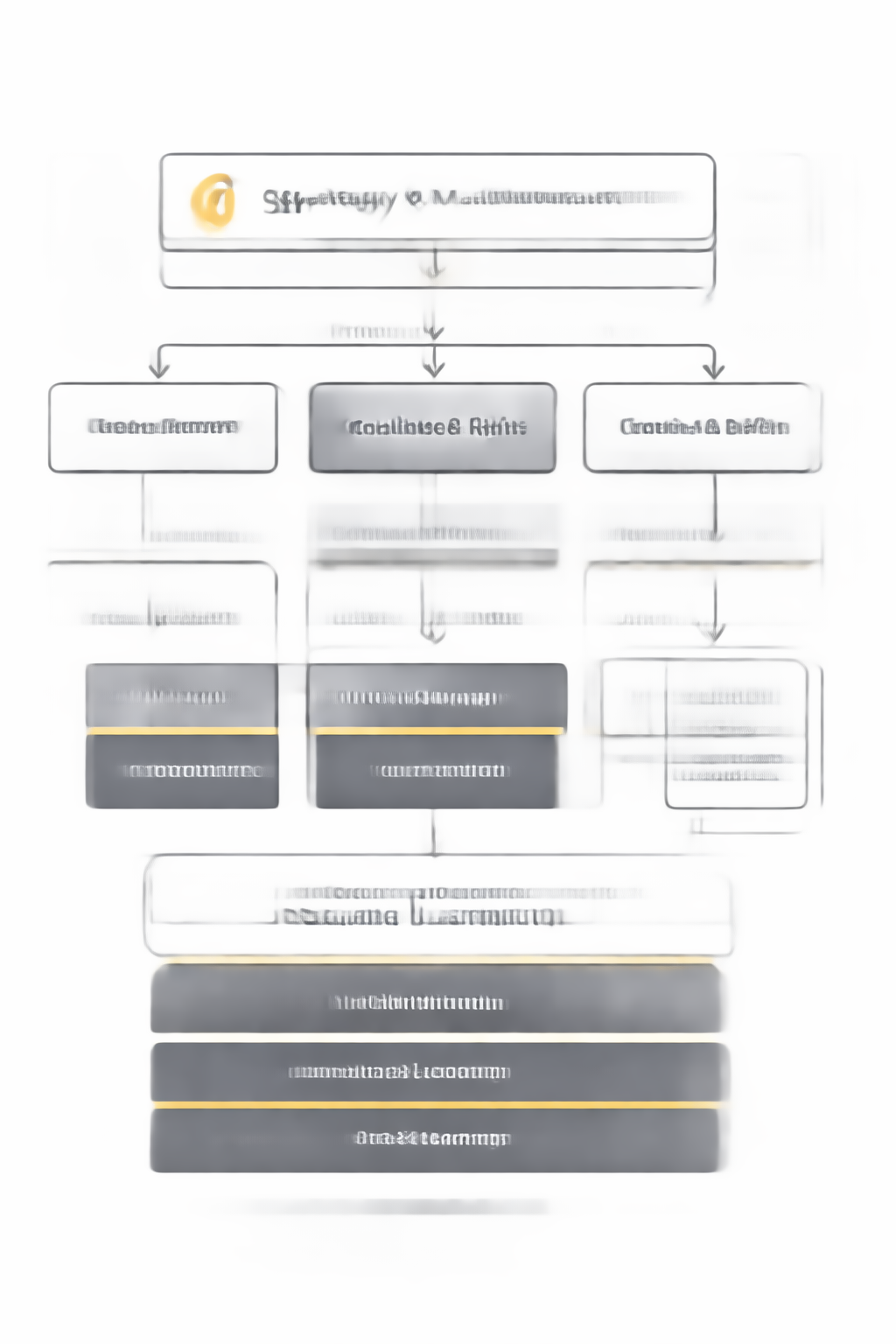
If you want the short version of this entire guide, here’s the ecosystem logic a strong social influencer agency runs on.
1) Clarity first
Define the business decision you want to make after the first cycle, then build the campaign to produce evidence that supports that decision. This keeps the program grounded and prevents “busy creator work” that looks active but doesn’t move the business.
2) Governance before outreach
Lock disclosure rules, claim boundaries, usage rights, and approvals before you contact creators. The work moves faster when the rules are clear, and the safest reference point is still the FTC’s practical guidance for influencers and endorsements.
3) A system, not a campaign
Build creator supply as a pipeline, not a one-time booking sprint. Treat creative as versions, not “the one perfect post.” Scale distribution with partnership formats so you can grow winners without destroying authenticity, including formats like YouTube partnership ads.
4) Measurement that earns trust
When measurement is sloppy, scaling becomes political. When measurement is clean, scaling becomes obvious. Use consistent tracking, document what changed, and interpret results as repeatable patterns rather than isolated spikes. Market signals can support the strategy, like IAB’s projection of $37B in US creator ad spend in 2025, but your program still needs its own decision-grade proof.
FAQ – Built for the Social Influencer Agency Complete Guide
What does a social influencer agency actually do day to day?
At a high level: creator sourcing, relationship management, briefing, compliance checks, production coordination, rights and permissions, distribution strategy (including partnership ads), and measurement. The best agencies also run the operating system: they keep workflows predictable so the program can scale without drama.
How do I choose the right social influencer agency for my brand?
Look for proof of process, not just a highlight reel. Ask how they handle rights and disclosure, how they structure testing, how they document learnings, and how they connect creator work to business outcomes. If they can’t explain measurement clearly, you’ll struggle to scale internally.
How much does it cost to hire a social influencer agency?
Pricing varies widely based on scope, creator volume, and whether the agency is also managing paid amplification and production. The practical approach is to define your first-cycle scope (one goal, one wave), then expand once you’ve proven what works and what kind of creator supply you need.
What’s the difference between UGC and influencer marketing?
UGC is content creation; influencer marketing is distribution plus trust. A creator can produce UGC without posting it. Influencer marketing includes the creator’s audience, credibility, and context. Many strong programs use both: UGC for scalable creative, influencers for trust and reach.
Should I work with micro-influencers or macro-influencers?
It depends on the job. Micro creators often win on trust and cost efficiency, while macro creators can drive fast awareness. A strong social influencer agency treats this as a portfolio decision and assigns creator tiers based on what you’re trying to prove in each wave.
What makes a creator brief actually work?
A working brief is short and specific: what must be true, what must not happen, what the audience should feel, and what action you want. It leaves room for the creator’s voice. Over-scripted briefs usually create stiff content that loses the trust you’re paying for.
What metrics should a social influencer agency report?
Match metrics to the goal: attention and retention for awareness, qualified actions for consideration, and attributable or incremental outcomes for conversion. The agency should also report patterns: which hooks, narratives, CTAs, and creator archetypes are repeatable.
How do we stay compliant with influencer disclosure rules?
Treat disclosure as part of production, not an afterthought. Use clear, prominent disclosures, document requirements in the brief, and QA before posting. The clean baseline for US programs is the FTC’s guidance on endorsements and influencers.
When should we amplify creator content with paid media?
Amplify after an asset proves itself with early signals that match your goal. Then use partnership formats that preserve creator context, such as YouTube partnership ads powered by BrandConnect. This is how you scale without turning creator content into generic ads.
What’s the biggest mistake brands make with influencer programs?
Scaling volume before scaling the system. When teams rush to “do more creators” without governance, rights, tracking, and reporting discipline, they create stress, burn creator relationships, and lose confidence internally.
How long does it take to see results from a social influencer agency?
You can see signals quickly, but real confidence comes from cycles. The first wave proves feasibility and produces learnings. The next waves refine creative and creator fit. The wins that matter most are the ones you can repeat, not the ones you screenshot once.
Work With Professionals
If you’ve read this far, you already know the truth: a social influencer agency doesn’t win because it “knows influencers.” It wins because it can build systems, prove outcomes, and move fast without cutting corners. That same mindset is what separates marketing freelancers who struggle for leads from the ones who always seem to have a pipeline.
The market demand is not the problem. There are already 10,000+ remote marketing opportunities live at once across categories like social media and digital marketing, visible in public job counts such as 15,035 open Social Media Marketing jobs and 9,259 open Digital Marketing jobs. The hard part is getting to the right opportunities fast, starting conversations without gatekeepers, and closing work without fees quietly eating your earnings.
That’s the lane Markework is building for: a marketing marketplace where companies and marketers connect directly, with no middleman and no project fees. It’s designed around momentum: profiles and listings that do the explaining for you, direct messaging so you can negotiate like a professional, and a token model that lets you choose how active you want to be when you’re ready to push harder (tokens on demand and direct communication).
If you want more than “random gigs,” you need a place that makes it normal to move quickly, be taken seriously, and keep what you earn. Markework’s model leans into that with simple monthly plans and a commission-free approach (plan and token details), so you’re not paying per project just to access your next client conversation.
 Filip Konecny Enterprises