

Most brands don’t struggle with ideas. They struggle with consistency, clarity, and compounding results. One week the content is “educational,” the next week it’s memes, then silence, then a random product push—until the calendar resets and the cycle repeats.
A solid social content strategy fixes that by giving your team a repeatable way to decide what to publish, why it matters, who it’s for, and how it connects to business outcomes. It also helps you stay sane when platforms shift, reach fluctuates, and formats evolve—because your strategy isn’t built on hacks; it’s built on decisions you can defend.
Article Outline
- What Is Social Content Strategy
- Why Social Content Strategy Matters
- Framework Overview
- Core Components
- Professional Implementation
What Is Social Content Strategy

A social content strategy is the system that turns “we should post more” into a clear operating plan: what you publish, for whom, on which platforms, in what formats, at what cadence, and how you’ll measure whether it worked.
It sits between brand strategy and day-to-day execution. Brand strategy defines what you stand for. A social content strategy translates that into content decisions that fit each network’s reality and your audience’s expectations.
The reason this matters now is scale. Social platforms aren’t niche channels anymore—global adoption keeps climbing, with the latest global digital reports tracking social media user identities in the billions and still growing year over year. Those global usage totals change the job: you’re not just “posting,” you’re competing with everything else people scroll past.
Done well, a social content strategy gives you:
- Consistency: fewer random posts, more deliberate repetition of your best angles.
- Focus: content that maps to real audience needs instead of internal opinions.
- Efficiency: planning and production systems that reduce last-minute scrambling.
- Momentum: measurable learning loops that improve results month over month.
Why Social Content Strategy Matters
Without a strategy, social becomes a treadmill. You ship a lot, feel busy, and still can’t explain what moved the needle. A strategy gives you a way to connect creative work to outcomes, so you can justify investment, prioritize formats, and stop treating every post like a fresh gamble.
It also protects you from platform volatility. Algorithms shift, feature priorities change, and audience behavior moves fast. That’s why strong teams focus less on chasing tricks and more on building durable inputs: clear positioning, consistent themes, quality creative, and feedback-driven iteration. Even the big platform guides concede that exact ranking systems are opaque, which makes your own system even more important. The broader trend data keeps pointing in the same direction: audiences have more choice, attention is fragmented, and brands that show up with a coherent point of view outperform those that post “whatever.”
Finally, social content strategy matters because trust is now part of performance. People follow, click, and buy when they feel confident in what a brand stands for and how it behaves. That’s why trust research keeps showing brands can earn meaningful trust when they act consistently and credibly over time. Recent brand trust findings underline a practical reality: social content isn’t just reach—it’s reputation, in public, every day.
Framework Overview
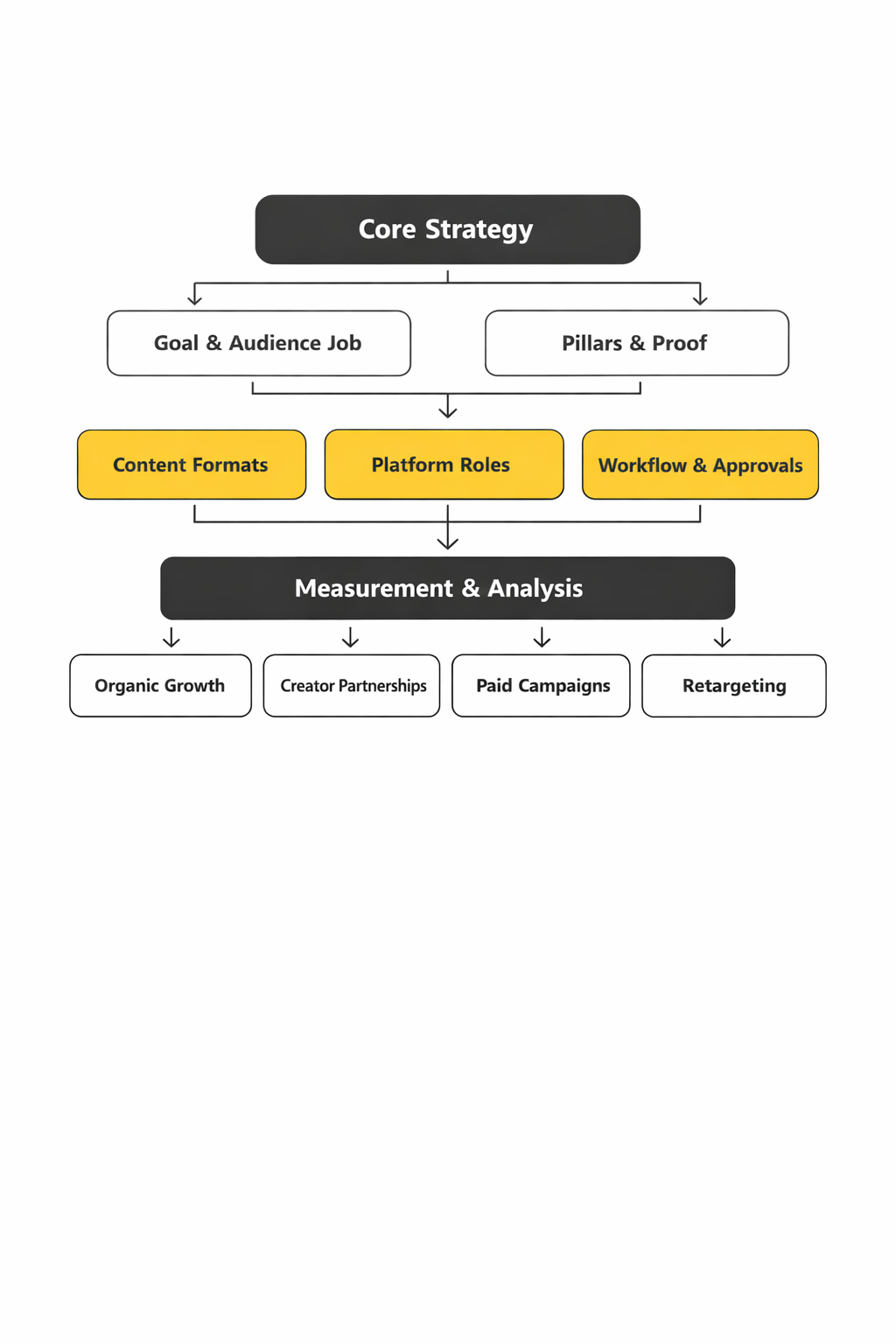
This framework is designed to be simple enough to run weekly, but rigorous enough to scale. Think of it as five connected decisions that keep your content coherent and measurable.
- 1) Audience reality: what your audience needs, fears, values, and expects from brands on each network.
- 2) Strategic themes: the small set of repeatable topics you want to be known for.
- 3) Format system: the content types you’ll produce reliably (and the standards each must meet).
- 4) Distribution plan: platform roles, cadence, and repurposing rules that protect quality.
- 5) Measurement loop: how you review results, learn, and decide what to double down on.
The goal is not to “do everything.” The goal is to create a social content strategy that your team can execute with consistency, where each piece of content has a job to do and a way to judge success.
Core Components
Most social content strategies break because they’re missing one of these core components—or they have them, but only as vague statements that never affect what gets posted.
Audience expectations by network
People don’t want the same relationship with a brand everywhere. Your content should reflect what users actually want on each platform, not what’s easiest for your team to publish. That’s why network-specific consumer research is so useful for planning themes and formats. Large-scale consumer survey research on what audiences want from brands across networks can help you avoid guessing.
Content pillars that are built to repeat
Pillars are not categories like “tips” or “behind the scenes.” Good pillars are recognizable promises you can keep repeatedly. For example: practical how-to guidance, clear opinions, customer proof, product education, or industry translation. The test is simple: could you publish 30 posts from this pillar without getting boring or off-brand?
Creative standards, not just “ideas”
Ideas are cheap; standards are what make the work compounding. Define what “good” looks like for your recurring formats: hook style, visual identity, length, voice, and what counts as a strong CTA. When standards exist, you can delegate production without losing coherence.
Production workflow and resourcing
A social content strategy is operational. You need roles, review steps, and timelines that match your reality. If you’re a solo marketer, that might mean a weekly batching routine. If you’re a team, it might mean a lightweight editorial process that prevents bottlenecks.
Measurement that matches intent
Not every post should be judged by the same metric. A thought-leadership post might optimize for saves and meaningful comments, while a product walkthrough might optimize for clicks or qualified DMs. Benchmark reports can help you set realistic expectations and avoid overreacting to short-term noise. Cross-industry social media benchmarks are especially helpful when you’re building a measurement rhythm.
Professional Implementation
Implementing a social content strategy professionally means you treat it like a system, not a campaign. You document decisions, define responsibilities, and set a review cadence that keeps learning continuous.
At minimum, professional implementation includes:
- A one-page strategy brief: audience summary, platform roles, pillars, and success metrics.
- A repeatable weekly planning routine: plan, produce, schedule, review, improve.
- A format library: templates and examples that make quality repeatable.
- A measurement loop: monthly reviews that turn performance into decisions.
If you want to ground your strategy in reality, keep a short “proof stack” of the sources that justify your assumptions—usage trends, audience behavior, and platform-level shifts. For example, the latest survey-based platform usage work helps you understand where audiences actually spend time. Recent platform usage research is a strong reminder that channel selection is a strategic choice, not a vibe.
Step By Step Implementation
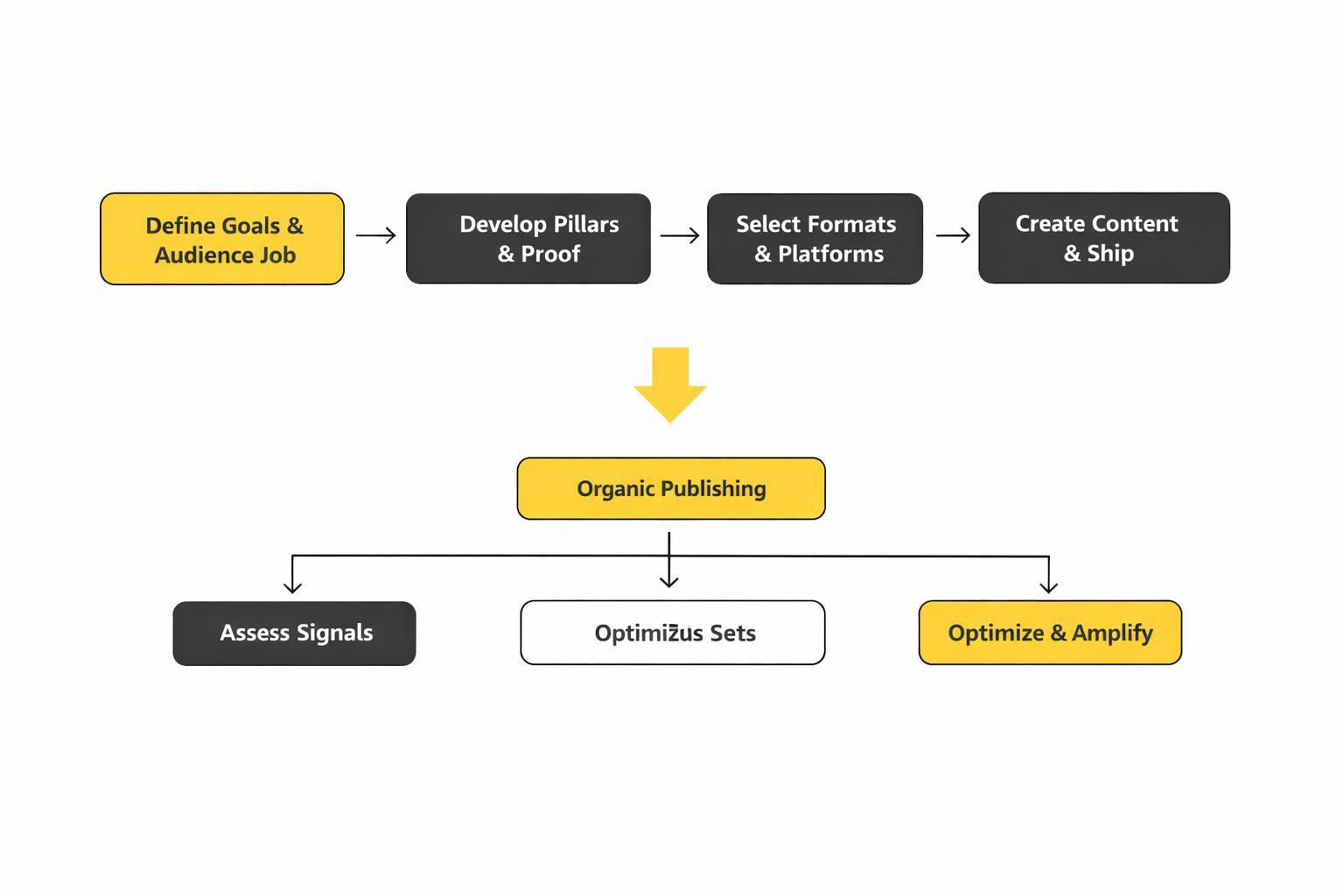
A social content strategy becomes usable when it moves from “nice ideas” into decisions your team can repeat under pressure. The goal here isn’t a perfect plan. It’s a plan that survives busy weeks, shifting priorities, and the reality that platforms never stop changing.
This step-by-step implementation is built around one principle: every step should reduce confusion for the next step. If planning doesn’t lead to clear production, production turns into chaos. If publishing doesn’t feed measurement, you’ll keep guessing. If measurement doesn’t lead to changes, you’re just collecting numbers for fun.
Step 1: Lock the business goal and the social job
Start by choosing one primary outcome for the next cycle: demand, retention, reputation, or recruiting. Then define the “job” social is doing to support it. That job might be building trust, creating product understanding, driving qualified clicks, or starting conversations that lead to sales.
If you try to do every job in every post, your strategy turns into noise. A clear job also makes measurement less messy because you’re not judging every post by the same yardstick.
Step 2: Turn audience reality into message priorities
Write down what your audience is trying to accomplish, what they’re anxious about, what they don’t understand yet, and what would make them feel confident. Keep it grounded in evidence, not internal assumptions. Consumer research that connects content preferences to how people want brands to behave is useful here, like the survey-driven findings published in Sprout Social’s Impact of Social Media report.
Then choose message priorities that match those realities. This prevents the classic trap where the brand talks about what it wants to sell while the audience scrolls for something that helps them live better or work smarter.
Step 3: Define pillars and the proof that supports them
Pillars are the themes you repeat until you become known for them. For each pillar, decide what “proof” looks like: a demo, a customer story, a behind-the-scenes explanation, an expert perspective, or a comparison that clarifies choices.
This is where strategy gets practical. If a pillar doesn’t have a proof format, it usually becomes vague advice posts that feel nice but don’t build conviction.
Step 4: Build a small format library your team can execute weekly
Pick a handful of formats you can produce consistently without quality collapsing. Each format should have standards: hook style, length range, visual rules, CTA style, and what counts as success for that format.
Social-first guidance that pushes teams toward repeatable formats and structured planning is a helpful reference point here, including frameworks like Hootsuite’s social trends research and brand-side thinking like Ogilvy’s social-first brand building shifts.
Step 5: Assign platform roles so you stop reposting blindly
Decide what each platform is for. One might be discovery, another might be authority, another might be community and care. When platform roles are clear, repurposing becomes smarter because you’re adapting the same idea to a different job, not copy-pasting the same asset everywhere.
Broader consumption research helps here too because it clarifies how much attention is being pulled toward social-first video and creator ecosystems. This shift shows up clearly in Deloitte’s Digital Media Trends.
Step 6: Operationalize approvals and publishing like a real system
Write down who creates, who edits, who approves, and who publishes. Decide what requires escalation. Then bake those rules into your workflow so “approval” isn’t a vague concept floating around in chat messages.
Even if you don’t use Hootsuite, their breakdown of what a clean approval workflow looks like is a practical model for protecting quality and brand safety. The steps are laid out in Hootsuite’s approval workflow guide.
Step 7: Create a measurement loop that forces decisions
Every review should end with decisions, not observations. Keep a simple rhythm: what worked, what didn’t, what to repeat, what to stop, and what to test next. The most useful reporting setups reduce manual work so the team can spend more time interpreting results than collecting them, which is a recurring theme in social operations research and tooling discussions like Sprout’s State of Social Media coverage.
Execution Layers
If implementation is the map, execution layers are the engine. They’re the pieces that make your social content strategy durable when you’re juggling deadlines, approvals, and platform demands.
Layer 1: Strategy and editorial decisions
This layer answers “what are we saying and why.” It includes pillar selection, audience intent, and the role each platform plays. If this layer is weak, the team ends up producing content that looks busy but feels directionless.
Research on what makes brand social content compelling keeps returning to the same idea: relevance and resonance come from aligning content with audience motivations and context, not from posting more. You can see this direction in recent scholarly work like Drossos’ research on producing compelling social media content.
Layer 2: Creative and production standards
This layer answers “how do we make this feel worth watching.” It’s where you decide the visual identity, editing rhythm, on-screen text style, and how bold your hooks should be.
When this layer is missing, teams default to whatever is fastest, and the brand slowly becomes inconsistent. A small format library with clear standards keeps your creative output recognizable even when different people produce different posts.
Layer 3: Distribution and engagement
This layer answers “how do we make sure the content actually gets seen and acted on.” Distribution includes publishing cadence, the timing logic you use, and how you handle community replies and DMs.
The hidden advantage here is responsiveness. When your engagement process is organized, you can turn questions and comments into content themes, and your social content strategy becomes a feedback-driven loop instead of a one-way broadcast.
Layer 4: Data, learning, and iteration
This layer answers “what did we learn that changes what we do next.” The point is not perfection; it’s compounding improvements. A healthy measurement layer connects content performance to the decisions in your strategy layer, so you’re not optimizing vanity metrics that don’t move the business.
Guidance on connecting social measurement to business clarity tends to emphasize the same fundamentals: consistent tracking, clean reporting, and a review cadence that produces decisions. A good baseline for disciplined tracking is laid out in Google Analytics guidance on campaign URL parameters.
Optimization Process
Optimization should feel like a calm routine, not a panic response to a dip in reach. The best teams don’t change everything at once. They change one variable at a time, learn quickly, and keep what works.
Start with hypotheses, not hunches
Instead of “videos are down,” write a hypothesis like: “Our hooks are too slow for this platform’s current viewing behavior.” Or: “We’re publishing product posts without enough proof, so the content isn’t being saved or shared.” This style of thinking keeps your social content strategy grounded in testable improvements.
Run a lightweight monthly content audit
Pick a small set of posts and review them with the same questions every time: What promise did the hook make? Did the body deliver? What was the audience signal in the comments? Was the CTA realistic for that post?
When the audit is consistent, you’ll notice patterns quickly. This is how teams move from “we think” to “we know” without drowning in dashboards.
Optimize creative before you optimize frequency
Posting more of weak content doesn’t fix the problem. It amplifies it. Improve the creative basics first: hook clarity, pacing, visual readability, and specificity of the takeaway.
Research into short-form dynamics and modern content consumption reinforces why this matters: attention is finite, and social video platforms are competing aggressively for it. That competitive reality is explored in Deloitte’s analysis of shifting entertainment time.
Scale what works by turning winners into series
When something performs well, don’t just celebrate it and move on. Turn it into a repeatable series with a recognizable format. This is one of the simplest ways to make your social content strategy compound because each new episode benefits from the familiarity and trust built by the previous ones.
Many teams also find that structured “newsroom” thinking helps create repeatable publishing rhythms around community conversations. A useful reference point is Sprout’s breakdown of social insights as a business signal.
Implementation Stories
Implementation stories matter because they show the messy middle: the moment where a brand has to choose between “safe posting” and doing something that actually stands for something. These are not fairy tales. They’re examples of social content strategy decisions under real-world pressure.
Aerie: When a Single Post Became a Public Line in the Sand
The attention spike didn’t come from a product launch or a discount. It came from a statement that instantly invited scrutiny, because it challenged a direction the industry was clearly moving toward. The post hit feeds and people didn’t just scroll past it—they reacted like the brand had made a promise in public.
The backstory matters here. Aerie has built years of positioning around “real” bodies and authenticity, and that identity is part of why people pay attention when the brand speaks. In a space crowded with polished imagery, their voice has long been tied to credibility and consistency, which is a thread covered in reporting about Aerie’s brand stance and how it has played on social over time. That context is discussed in Business Insider’s coverage of Aerie’s Instagram stance.
Then the wall showed up: the rise of AI-generated imagery in marketing. Even brands with strong authenticity positioning risk blending into the same synthetic aesthetic as everyone else. If Aerie stayed silent, it risked weakening what it had trained its audience to believe; if it spoke up, it risked backlash and debate.
The epiphany was a simple strategic choice: treat social like a trust channel, not just a distribution channel. Instead of trying to “out-create” trends, they leaned into what their audience already expected from them. That decision turned a moment into a message, and the message into a conversation that people wanted to share.
The journey wasn’t about a complicated campaign architecture. It was about a clear line, communicated in the simplest possible way, and reinforced by what the brand had already done historically. That’s a social content strategy lesson: when the strategy is real, you don’t need layers of explanation for people to understand what you mean.
Of course, once the message is public, you don’t control how people respond. Some people celebrate it, others question it, and the internet tries to pull it into wider cultural arguments. That’s the final conflict of values-based posting: you trade predictability for resonance.
The dream outcome is not “going viral.” It’s strengthening the bond between brand and audience by acting consistently in public. The reason this works as a strategy example is that it’s not a one-off trick; it’s identity expressed through content. The story is captured in the reporting around the post and its reception in Business Insider’s article.
Medicube: When Viral Demand Forced a Real Operating System
It looked like an overnight breakout from the outside. A product starts showing up everywhere, creators demonstrate it, and suddenly the brand is part of the culture. The hard part is that viral demand doesn’t politely wait for your team to “get organized.”
The backstory is that Medicube didn’t succeed by being vague. The brand leaned into clinically framed messaging and device-led skincare narratives that gave people a reason to believe there was something different here. That positioning became easier to amplify once influential creators and celebrities started posting about it, which is explored in Vogue’s reporting on Medicube’s breakout.
Then the wall: attention is unstable, and the internet moves on fast. When a product is trending, the brand has to keep up with a flood of questions, misinformation, and demand spikes while still protecting credibility. If the content becomes repetitive or sloppy, the same speed that helped the brand can turn against it.
The epiphany was that content couldn’t be treated as occasional promotion anymore. It needed to become a system that could educate, reassure, and convert at scale. That’s when a social content strategy stops being “what we post” and becomes “how we operate.”
The journey involves building repeatable content that matches the audience’s decision process: what it is, how it works, what results to expect, how to use it safely, and how to choose the right product. It also means aligning creator partnerships with the same narrative so the brand doesn’t feel fragmented across different voices. The way Medicube combined creator-driven visibility with a structured push into retail and credibility-building is described in Vogue’s breakdown of their global expansion.
The final conflict is operational: when attention scales, everything breaks first. Inventory, customer support, content review, and brand consistency all get tested at once. This is where teams either build an execution layer that can handle volume, or they burn out trying to react in real time.
The dream outcome is turning attention into sustained growth without losing trust. Medicube’s story is a reminder that social success often forces the best kind of problem: you have to become more professional because the audience expects it. That arc is captured in Vogue’s reporting.
Document the decisions that should not change weekly
Write down your pillars, voice rules, platform roles, and approval requirements. These are not meant to be debated every Monday. When the team knows what is stable, creativity becomes easier because people can experiment inside clear boundaries.
Standardize one end-to-end workflow
Pick one workflow and make it your default: idea intake, drafting, review, approval, scheduling, engagement, and monthly review. If approvals are messy, fix that first because it’s the most common source of delays and last-minute quality drops. A practical reference for building a real approval system is Hootsuite’s workflow structure.
Make tracking automatic and consistent
Don’t leave measurement to memory. Use consistent campaign parameters so traffic and conversions are attributable without detective work. The cleanest baseline is the setup described in Google Analytics campaign URL guidance.
Run reviews that end with decisions
Monthly reviews should produce a short decision list: what to repeat, what to stop, and what to test. Tie the decision list back to your pillars and platform roles so you don’t drift into random posting. This “strategy-to-iteration” mindset is reinforced across modern social operations thinking, including Sprout’s social planning and state-of-the-channel coverage.
Invest in the team’s ability to execute the system
Train people on your formats, not on tool features. The skill is not “how to click schedule.” The skill is “how to write a hook that matches the promise of the post” and “how to turn a comment thread into the next week’s content.”
When you do this well, your social content strategy stops feeling like a fragile plan and starts feeling like an operating system. That’s the difference between posting consistently and building a presence that compounds.
Statistics And Data
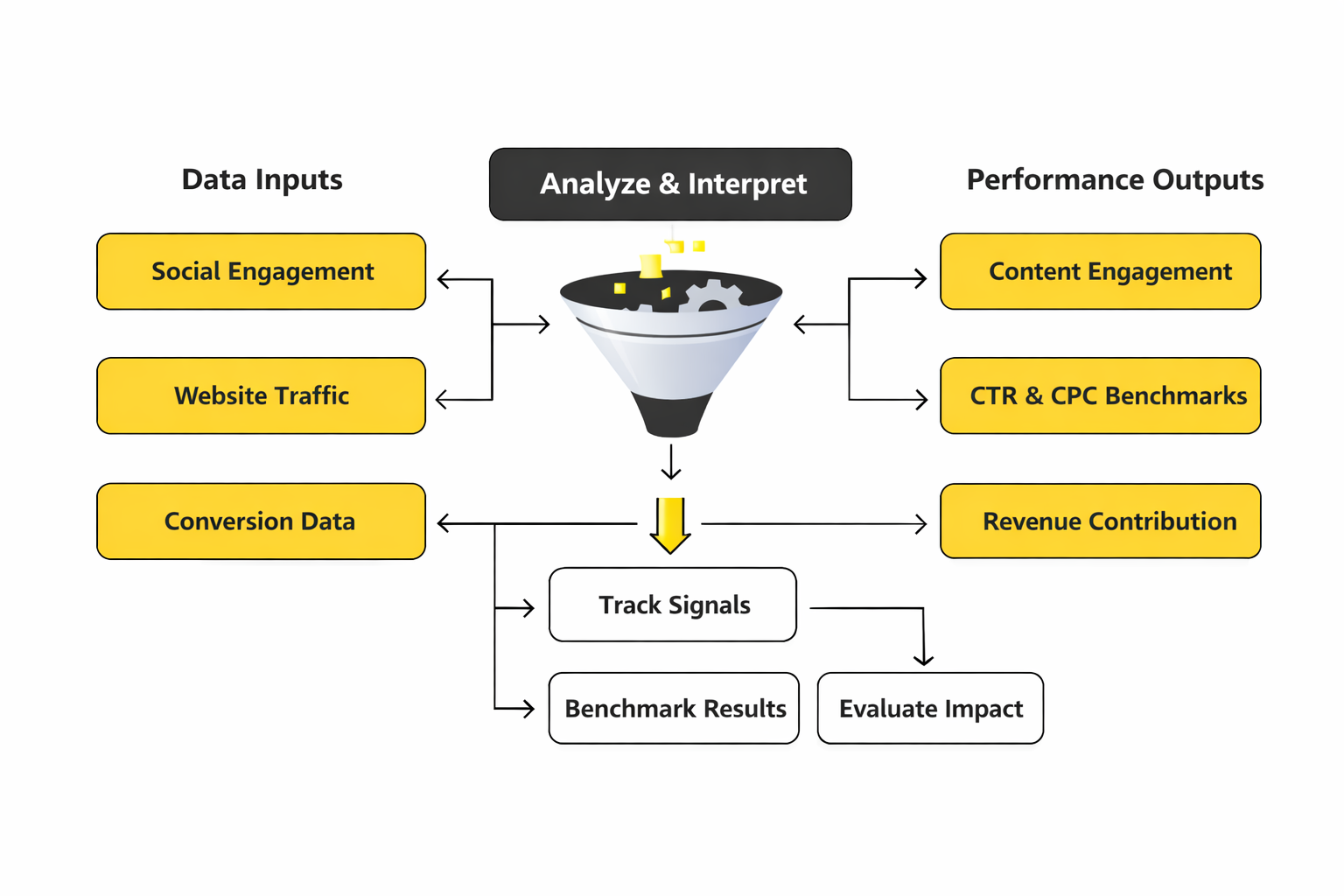
If your social content strategy is the engine, data is the dashboard. It doesn’t drive the car for you, but it tells you when you’re speeding in the wrong direction, when you’re running out of fuel, and when something is quietly breaking under the hood.
The mistake is treating analytics like a report card. Social data is closer to a navigation tool: it helps you decide what to repeat, what to adjust, and what to stop doing before you waste another month posting content that feels busy but goes nowhere.
A practical data setup for a social content strategy usually has three layers:
- Visibility signals: reach, impressions, view-through, and frequency.
- Value signals: saves, shares, meaningful comments, profile actions, and clicks.
- Business signals: qualified leads, trials, purchases, assisted conversions, and retention indicators (where you can track them cleanly).
One reason measurement matters more than ever is how fast the ad environment shifts. Meta’s own reporting shows ad impressions across its apps rose year over year in 2025, while average price per ad also increased. That combination changes the economics of promotion and makes it even more valuable to know which content deserves budget. The numbers are in Meta’s full-year 2025 results.
Performance Benchmarks
Benchmarks are guardrails, not goals. They help you answer, “Is this performance normal for our platform and industry?” so you don’t panic after one weak week or over-celebrate a spike that won’t repeat.
They’re also messy by nature because different reports measure different things (engagement per follower vs engagement per impression, median vs average, brand size splits, and different platform mixes). The trick is to look for patterns that show up across multiple datasets, then use your own historical numbers as the final judge.
Platform patterns that show up across multiple benchmark reports
- Instagram is getting tighter: multiple benchmark datasets show lower engagement trends over time, with formats like carousels holding up better than many teams expect. That format resilience shows up clearly in Socialinsider’s 2026 Instagram benchmarks and the broader year-over-year shifts highlighted in Rival IQ’s 2025 benchmark analysis.
- TikTok still leads, but consistency isn’t automatic: TikTok engagement remains strong in several benchmark views, but results depend heavily on creative quality and repeatable formats. Socialinsider reports rising engagement in its 2026 dataset, while Emplifi’s reporting emphasizes TikTok’s dominance in median interactions and engagement rates within its own measurement model. You can compare those perspectives via Socialinsider’s 2026 social benchmarks and Emplifi’s 2026 performance data release.
- Facebook is steady, not exciting: across multiple benchmarks, Facebook tends to behave like a predictable distribution channel rather than a breakout engagement engine. That stability shows up in Socialinsider’s cross-platform benchmarks and in the range-based view included in Emplifi’s 2026 performance summary.
- LinkedIn rewards strong packaging: multi-image and document-style posts often outperform plain text updates, and engagement trends can shift as the feed evolves. Socialinsider’s LinkedIn benchmark breakdown highlights format differences in its LinkedIn benchmarks.
What to benchmark inside your social content strategy
Instead of benchmarking everything, benchmark what you can actually influence week to week:
- Format performance: carousels vs Reels vs static, or short-form video vs photo vs text.
- Creative quality indicators: saves and shares per impression (or per reach), not just likes.
- Consistency indicators: posts per week and how performance changes when cadence changes.
- Conversion indicators: click-through quality and on-site behavior when traffic comes from social.
If you want an industry-level lens, some reports publish engagement ranges by industry across networks, which can help you avoid unrealistic expectations. One example is Hootsuite’s engagement rate breakdown by industry, which is useful mainly as a sanity check rather than a target to chase.
Analytics Interpretation
Analytics interpretation is where most teams lose the plot. They stare at a dashboard, pick the biggest number, and decide it must be “good.” A strong social content strategy uses interpretation rules so you don’t confuse reach with relevance, or clicks with actual intent.
Start with one question: what was the audience trying to do?
People don’t engage the same way on every post. A “quick laugh” post earns likes. A “this is genuinely useful” post earns saves. A “this changed my mind” post earns comments. A “I’m ready” post earns clicks or DMs.
So when you interpret results, judge each post by the job it was designed to do. That’s how your social content strategy stays coherent even when formats and algorithms shift.
Use a simple signal hierarchy to avoid vanity-metric traps
- Tier 1 signals (strong intent): saves, shares, qualified comments, profile actions, outbound clicks, and meaningful DMs.
- Tier 2 signals (useful but softer): likes, follows, and basic comments that don’t show intent.
- Tier 3 signals (context, not value): reach and impressions without accompanying value signals.
This doesn’t mean reach is useless. It means reach only matters when the content is doing its job. If reach rises but saves and shares collapse, the content is getting seen without being valued, which is a strategic warning, not a win.
Make attribution boring and consistent
The fastest way to sabotage measurement is inconsistent tracking. If half your links have parameters and half don’t, your reporting turns into guesswork. A clean baseline is using consistent campaign parameters so your analytics platform can reliably categorize traffic. The setup is explained in Google Analytics campaign URL guidance.
When attribution is stable, you can compare themes and formats honestly. You also stop arguing about whose numbers are right and start focusing on what to do next.
Case Stories
Data becomes easier when you see how real teams use it under pressure. These stories aren’t about perfect dashboards. They’re about the moments where analytics forced a decision inside a social content strategy.
Duolingo: When a Viral Moment Became a Measurement Problem
The moment hit like a shockwave: the brand’s mascot storyline exploded across the internet and people piled in to watch, remix, and react. The numbers were massive, but the attention wasn’t “clean.” It came with scrutiny, expectations, and a flood of commentary that could turn sour fast.
Inside the team, that kind of spike creates a different kind of anxiety. When reach jumps that high, everyone wants proof that it mattered. Leadership wants impact, the community wants responsiveness, and the brand team wants to avoid a single misstep becoming the headline.
The backstory is that Duolingo’s social voice didn’t happen by accident. Their team built a distinctive style over years, blending culture, character-based humor, and a “writer’s room” approach that kept output fast and consistent. The human cost of sustaining that pace is described in The Wall Street Journal interview with their departing social media manager.
That same approach created an audience that expected boldness. So when a high-profile campaign landed, the internet treated it like an event, not a post. Business reporting captures just how large one of these moments became, including the scale reported in Business Insider’s coverage of the campaign’s reach.
The wall showed up immediately: massive impressions don’t automatically translate into business value. The team had to separate noise from signal and decide what “success” meant beyond virality. That meant looking at sentiment shifts, retention of new followers, and whether attention translated into deeper product curiosity rather than just one-time entertainment.
It also meant dealing with risk. A highly reactive brand voice can win attention and still lose trust if it crosses the wrong line, and the WSJ reporting details how backlash and burnout became part of the operational reality. In that environment, analytics isn’t just performance tracking; it’s brand safety.
The epiphany was that the strategy needed clearer guardrails. The point wasn’t to stop being funny; it was to become more intentional about what the team optimized for and how they evaluated “wins.” That strategic shift is part of why leadership conversations around growth priorities and engagement have continued evolving, including more recent reporting on the company’s strategic tradeoffs in Reuters’ coverage of Duolingo’s growth focus.
The journey looked like building a tighter measurement loop: clearer definitions of what counts as a successful series, cleaner tracking when social drives product exploration, and more deliberate pacing so the team could sustain quality. It also meant using performance data to decide which bits deserved repetition and which were a one-time moment.
Then the final conflict: internet attention is never stable, and what the audience celebrates today can turn into critique tomorrow. When your brand identity is built in public, you have to treat every spike as both an opportunity and a stress test. That reality is part of what the WSJ interview makes uncomfortably clear.
The dream outcome isn’t “another viral hit.” It’s a social content strategy that can handle scale without breaking the team or the brand. When measurement is connected to decisions, the brand can keep its edge while staying in control of what it’s actually building.
The Washington Post: When the Algorithm Wouldn’t Explain Itself
The team knew something uncomfortable: they were publishing into a system they couldn’t see. Views would surge, then drop. Topics would pop, then vanish. Everyone had theories, but nobody had proof, and that’s a brutal place to be when your job depends on consistency.
Then they made a risky move. Instead of guessing how TikTok worked, they asked their audience for help and invited followers to share their watch history data. Suddenly the story wasn’t just about content performance—it was about pulling back the curtain on what the platform was doing to people.
The backstory is that news organizations have been pushed to behave like creators, not just publishers. That pressure has only increased as traffic patterns shift and platforms compete for attention. The broader industry anxiety around distribution is captured in The Guardian’s reporting on publisher fears and declining referral traffic.
For The Washington Post, TikTok wasn’t a side project—it was a real distribution channel with a real audience. But algorithmic opacity meant they couldn’t rely on old instincts. They needed evidence, not vibes.
The wall was simple: the platform didn’t offer the transparency they needed to understand viewing patterns. So they built their own dataset by collaborating with their followers, asking them to download and share watch histories and engagement signals. The project setup is described in The Washington Post’s reporting on the audience-powered TikTok study.
Collecting data at that scale also creates new problems. You have to handle privacy responsibly, normalize messy inputs, and interpret patterns without oversimplifying. Even when the dataset exists, the conclusions can still be uncomfortable.
The epiphany was that the audience could become part of the measurement system. Instead of treating analytics as something the platform hands you, they treated analytics as a relationship: people wanted to understand what was shaping their feeds, and they were willing to participate.
The journey became a blend of investigative work and content strategy. They turned data collection into storytelling, and storytelling into insight that audiences actually cared about. Later reporting on how TikTok clusters interests and shapes recommendations draws from that same dataset, including the scale of participation referenced in The Washington Post’s interactive mapping of TikTok topics.
The final conflict was predictably messy. Platforms shift, public attention moves, and any interpretation of algorithmic behavior invites debate. When you publish insights about a system that affects millions, you’re guaranteed pushback from people who want simpler answers than reality allows.
The dream outcome was bigger than better views. It was a clearer understanding of how distribution works and a stronger bond with the audience because the Post treated them like collaborators, not passive consumers. That’s what a mature social content strategy can look like when analytics becomes a shared project instead of a private dashboard.
Professional Promotion
Promotion is the part of a social content strategy that many teams either overuse or avoid entirely. Overuse looks like boosting everything and calling it a plan. Avoidance looks like hoping organic reach will magically carry business goals in a feed designed to maximize platform outcomes, not yours.
Professional promotion is more disciplined: you use paid and partnerships to amplify what already proved it can earn attention and action. You’re not “buying reach.” You’re buying certainty for content that has earned the right to scale.
Boost winners, not averages
The cleanest promotion habit is simple: publish organically, identify posts that generate strong intent signals (saves, shares, qualified clicks), then promote those winners to reach more of the right people. This protects your budget because you’re scaling evidence, not guesses.
This matters in a world where ad dynamics change quickly. Meta’s reporting shows both rising ad impressions and rising average price per ad in 2025, which is exactly why “spray and pray” boosting gets expensive fast. The numbers are in Meta’s 2025 results release.
Use creators as distribution, not decoration
Creator partnerships work best when they extend a clear message system. Your social content strategy should tell creators what you want the audience to believe, what proof matters, and what the next step is. When creators are left to improvise without structure, the campaign might get attention but fail to build conviction.
If you’re doing performance-focused creator work, track outcomes at the creator level and keep the model honest with clean attribution. This is where consistent UTM tagging matters again, and Google Analytics guidance on campaign URL parameters is the baseline that prevents you from guessing.
Make retargeting feel like help, not stalking
Retargeting is most effective when it matches the audience’s decision stage. If someone watched a product walkthrough, show proof and specifics. If someone visited a pricing page, answer objections. If someone engaged with thought leadership, offer a deeper asset that fits their intent.
The difference between “creepy” and “useful” is relevance. A professional promotion plan maps retargeting creative to the content journey your strategy already created.
Measure promotion like a portfolio
Don’t judge promotion on one metric. Track a small portfolio view: reach efficiency, intent signals, downstream site behavior, and conversion quality. When this is consistent, you can make calm budget decisions instead of reacting emotionally to daily fluctuations.
When promotion is integrated this way, it stops being a separate activity and becomes part of the same operating system: publish, learn, scale, repeat. That’s how a social content strategy grows without turning into chaos.
Future Trends
The next wave of social content strategy will feel less like “posting” and more like operating inside an attention market that’s crowded, algorithmic, and increasingly shaped by AI. The teams that win won’t be the ones who chase every new feature. They’ll be the ones who build a system that stays coherent while the channels keep shifting.
Three forces are already reshaping what “good” looks like:
- AI-driven feeds are raising the baseline for relevance: platforms are getting better at predicting what people will watch, which means average content is easier to ignore and harder to distribute.
- Creator media is becoming a default distribution channel: brand growth is increasingly powered by creator partnerships, not just brand accounts, with U.S. creator ad spend projected at $37B in 2025.
- Audiences are bigger, but attention is scarcer: global social media user identities reached 5.66 billion, which increases opportunity while raising the competition for time and trust.
What this means in practice is simple: your social content strategy has to earn attention with clarity, proof, and consistency, not volume. The shift toward resonance, community, and brand trust shows up repeatedly in the latest thinking from platform-focused research like Hootsuite’s Social Trends 2026 and industry guidance like Sprout Social’s 2026 social trends.
Strategic Framework Recap

If you want a social content strategy that holds up over time, it needs to work like an ecosystem. Each part supports the others, and the whole system improves as you learn.
- Goal and audience job: one primary outcome per cycle, and a clear “job” social is doing to support it.
- Pillars and proof: repeatable themes, backed by proof formats that build trust instead of vague inspiration.
- Formats and standards: a small library your team can execute weekly without quality collapsing.
- Platform roles: each platform has a purpose, so repurposing becomes adaptation, not reposting.
- Workflow and governance: approvals and ownership are designed into the system, not chased in DMs.
- Measurement loop: tracking that produces decisions, then decisions that change what you do next.
- Distribution stacking: organic learning, creator seeding, paid amplification, and retargeting working together.
That’s the difference between “having content” and building a social content strategy that compounds. It keeps your creative output human while your operations stay disciplined.
FAQ – Built for the Complete Guide
What is a social content strategy, really?
A social content strategy is the set of decisions that makes your social presence repeatable: what you talk about, who it’s for, what proof you use, how you package it, where it goes, and how you measure whether it worked. It’s less a “plan” and more an operating system.
How long does it take to build a social content strategy?
You can map a workable strategy in a few focused sessions, but the real strength comes from iteration. Most teams need one full cycle of publishing and review to see what holds up in the real world, then refine the system based on evidence.
Do I need to post every day for it to work?
No. Consistency matters more than daily posting. A social content strategy should match what you can sustain with quality. Posting less often with stronger formats and clearer proof usually outperforms high-volume posting that feels generic.
What metrics should I focus on?
Measure what matches the job of the content. For trust and education, look for saves, shares, meaningful comments, and repeat engagement. For demand, track qualified clicks and downstream behavior with consistent link tracking using campaign URL parameters.
How do I choose the right content pillars?
Pick pillars where you can consistently provide proof. If a pillar is mostly opinions without evidence, it becomes fluff. Strong pillars usually align with your audience’s biggest questions, misconceptions, and decision blockers.
Should every post include a call to action?
Not every post needs a “click here” CTA. Some posts should build understanding, others should build trust, and some should move people toward a next step. A mature social content strategy uses CTAs that match intent instead of forcing conversions too early.
How do I repurpose content without it looking lazy?
Repurpose the idea, not the asset. Keep the message consistent, but adapt the structure to the platform role. A Reel can become a carousel if you repackage it into a step-by-step visual proof, and a LinkedIn post if you expand the reasoning and keep the takeaway sharp.
What tools do I need to run this professionally?
You need a way to plan, a way to produce, a way to schedule, and a way to learn. Many teams start with a simple calendar, a design/video workflow, a scheduler, and a reporting setup that doesn’t rely on manual spreadsheets.
How do I avoid burning out while staying consistent?
Batch production, standardize formats, and keep a small library of repeatable series. Burnout usually comes from reinventing the wheel every week and relying on last-minute creativity. A strong social content strategy protects your energy by making “good” repeatable.
How do I work with creators without losing brand control?
Give creators a clear message system: what you want the audience to believe, what proof matters, and what the next step is. Keep tone flexible but claims and safety non-negotiable. Treat creators like a distribution portfolio, not a one-off campaign, especially as creator media grows into a bigger budget line, reflected in IAB’s creator spend report.
What if my industry is “boring”?
Most “boring” industries simply haven’t built better proof. If your audience is making expensive or high-stakes decisions, they want clarity, comparisons, and examples. Build formats that explain what to do, what to avoid, and how to choose confidently, and your content becomes valuable instead of entertaining.
When should I use paid promotion?
Use paid when you already have evidence a post earns intent signals organically. Paid should amplify winners, not rescue average content. That’s how promotion supports your social content strategy without turning into a budget drain.
Work With Professionals
If you’re serious about building a social content strategy that brings you clients, the hardest part isn’t knowing what to post. It’s getting consistent access to real opportunities and having a system that turns your skills into paid work.
The market is there. There are well over 10,000 remote marketing opportunities visible right now on major platforms like Upwork’s marketing jobs feed and curated boards like FlexJobs’ remote marketing listings. The difference between “scrolling past” and getting hired is having a credible profile, a clear niche, and a repeatable way to connect with companies that need help.
That’s where Markework fits beautifully if you want a cleaner path to clients. Markework positions itself as a marketing marketplace where you can build a profile, apply to roles, and message directly, with no middleman and no project fees. It’s built around speed and simplicity: listings, profiles, and direct communication, plus no commissions so you keep what you earn.
Imagine what changes if your week stops revolving around pitching into the void. Your social content strategy becomes an asset that supports your profile and positioning, while your outreach becomes more focused: fewer random proposals, more direct conversations with teams actively hiring marketing specialists.
If you want to move faster, start with a profile that makes your value obvious, then connect your content to your niche so prospects can see how you think and how you execute. When the right company finds you, the conversation becomes about fit and outcomes, not about whether you’re “legit.”
 Filip Konecny Enterprises