
Digital platforms have fundamentally reshaped how companies reach customers. Instead of relying solely on traditional media, brands now compete inside algorithm-driven ecosystems where billions of people spend their daily attention. Research compiled in the Digital 2024 global overview report shows that social platforms now connect more than five billion users worldwide, creating one of the largest advertising environments ever built.
As spending followed the audience, social advertising became one of the fastest-growing segments of the marketing economy. The IAB Internet Advertising Revenue Report documents that social media advertising alone generated about $88.8 billion in revenue in 2024, reflecting rapid growth from the previous year. At the same time, global ad budgets are shifting decisively toward digital channels, with projections from the Worldwide Ad Spending Forecast showing that more than 75% of total advertising investment now flows into digital formats.
This transformation created demand for specialized partners who understand both creative storytelling and platform algorithms. A modern social advertising agency sits at the intersection of data science, media buying, creative production, and performance analytics. Its role is not just running ads—it is building scalable systems that turn social platforms into reliable revenue engines.
Understanding how these agencies operate helps businesses evaluate partners, build internal expertise, and design campaigns that perform consistently in increasingly competitive digital environments. The sections below break down the core concepts, frameworks, and operational practices that define successful social advertising agencies today.
Article Outline
- What a Social Advertising Agency Actually Does
- Why Social Advertising Agencies Matter for Modern Brands
- Framework Overview for Social Advertising Campaigns
- Core Components of a Social Advertising Agency
- Professional Implementation in Real Campaigns
What a Social Advertising Agency Actually Does
A social advertising agency specializes in planning, launching, and optimizing paid campaigns on platforms such as Meta, Instagram, TikTok, LinkedIn, and emerging creator networks. Unlike traditional media buying firms, these agencies operate inside algorithm-driven advertising systems where audience targeting, creative formats, and machine-learning optimization determine performance.
At its core, the agency’s job is to translate business goals into measurable campaign structures. That means identifying the correct audience segments, designing compelling ad creatives, selecting bidding strategies, and continuously refining campaigns using performance data.
The scale of opportunity explains why this specialization emerged. Global social media advertising spending exceeded $234 billion in 2024, according to compiled industry statistics summarized by recent social media marketing data. As budgets grew, companies increasingly relied on specialists capable of managing complex ad ecosystems and extracting consistent returns.
A modern social advertising agency typically performs several interconnected roles:
- Audience strategy – identifying high-value customer segments and targeting parameters.
- Creative development – producing visual and video content optimized for platform algorithms.
- Campaign architecture – structuring campaigns, ad sets, and bidding models for efficient scaling.
- Performance optimization – adjusting budgets, creatives, and targeting based on real-time data.
- Measurement and attribution – analyzing results and linking campaigns to revenue outcomes.
When executed effectively, these elements transform social platforms from simple communication channels into powerful customer acquisition systems. Businesses gain the ability to test ideas quickly, scale winning campaigns, and reach highly specific audiences that would have been impossible to target through traditional advertising.
Why Social Advertising Agencies Matter for Modern Brands
Running ads on social platforms might appear simple from the outside. The interfaces are accessible, campaigns can be launched quickly, and platforms provide built-in automation tools. Yet behind that apparent simplicity lies a highly competitive auction environment where millions of advertisers compete for limited attention.
Competition has intensified as consumer behavior shifted toward social platforms. Media consumption research summarized in Deloitte’s Digital Media Trends shows that people now divide roughly six hours of daily entertainment and media time across digital channels, with social video platforms capturing a rapidly growing share of that attention.
For advertisers, this concentration of attention is both an opportunity and a challenge. Platforms provide sophisticated targeting capabilities and massive reach, but the same algorithms that help campaigns scale can also amplify mistakes. Poor creative, weak audience segmentation, or inefficient bidding strategies quickly translate into wasted budgets.
Specialized agencies reduce that risk by applying structured experimentation and data analysis. Instead of launching a single campaign and hoping it performs, experienced teams run multiple controlled tests simultaneously—comparing creatives, audiences, placements, and bidding strategies until clear performance patterns emerge.
This approach is particularly important because paid social often operates under strict efficiency requirements. Analysis of thousands of Meta advertising accounts summarized in the Meta ads benchmark analysis found that average campaigns generated roughly 2.98× return on ad spend. Achieving or exceeding those benchmarks consistently requires strategic experimentation, creative iteration, and detailed performance monitoring.
As a result, many brands rely on agencies not just for operational execution but also for strategic insight. Agencies observe patterns across dozens or hundreds of campaigns, allowing them to identify emerging creative trends, algorithm changes, and audience behaviors before individual companies notice them internally.
Framework Overview for Social Advertising Campaigns
Successful social advertising rarely happens through isolated campaigns. High-performing agencies instead rely on structured frameworks that guide every stage of campaign development, from research and creative production to measurement and optimization.
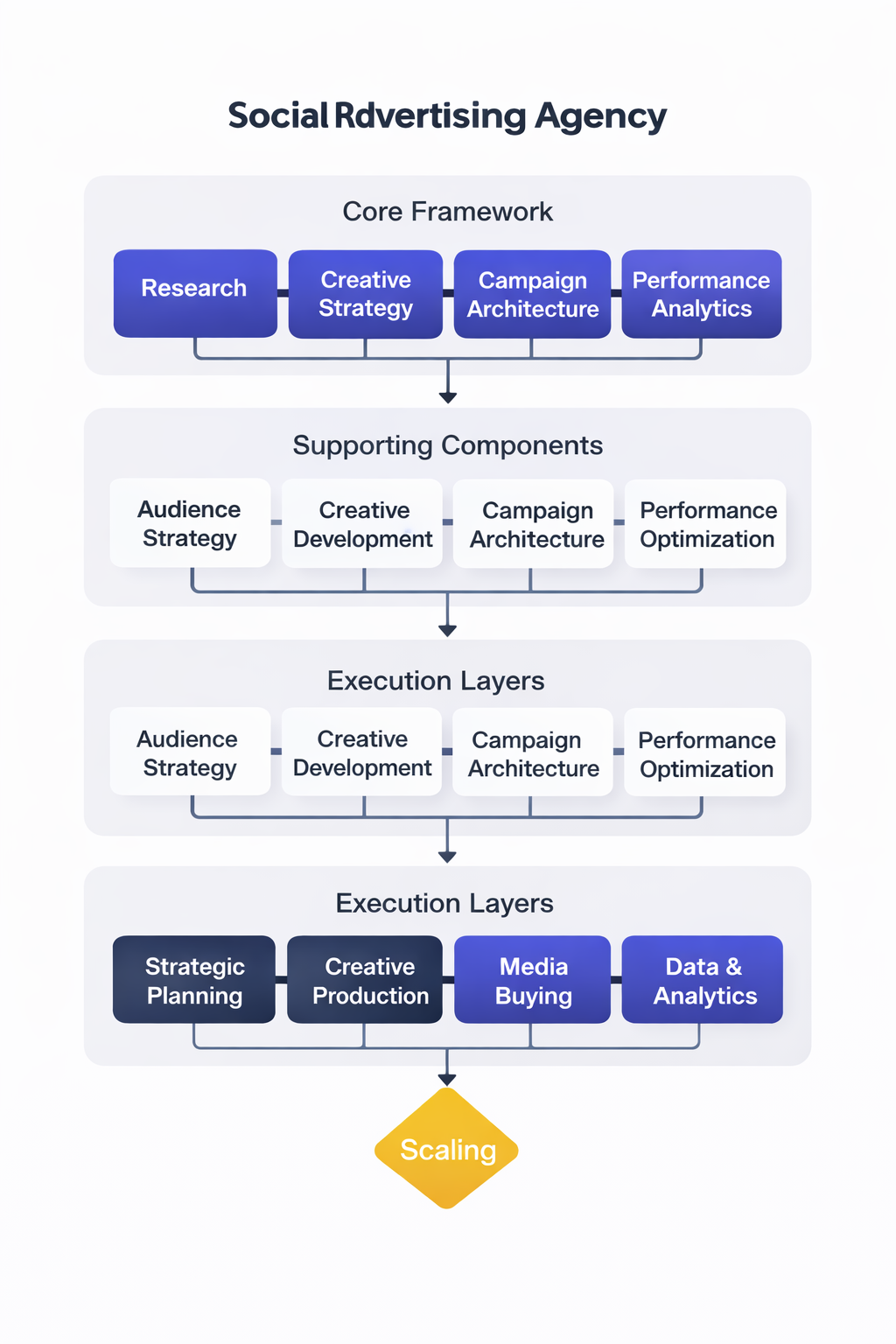
One common framework used across the industry divides campaign development into four strategic layers: research, creative strategy, campaign architecture, and performance analytics. Each layer builds on the previous one, ensuring campaigns evolve through data rather than guesswork.
The research stage focuses on understanding both the market and the audience. Agencies analyze behavioral signals such as purchasing patterns, content consumption habits, and demographic segmentation. Insights from consumer research, like those documented in the McKinsey State of the Consumer analysis, help identify how people discover products, which platforms influence purchase decisions, and how trust develops across digital channels.
Creative strategy comes next. Social platforms reward content that feels native to the environment, meaning ads must resemble organic content rather than traditional marketing messages. Agencies often test multiple visual styles, storytelling approaches, and messaging angles to discover which creative formats resonate most strongly with specific audiences.
Campaign architecture then translates strategy into technical structure inside advertising platforms. This includes segmentation of audiences, budget allocation across campaigns, and selection of bidding models designed to maximize conversions or engagement.
The final layer focuses on analytics and optimization. Because social advertising platforms generate massive volumes of performance data, agencies rely on systematic analysis to identify winning creatives, profitable audiences, and scalable campaign structures. Over time, these insights form a knowledge base that improves future campaigns and reduces experimentation costs.
When these four layers operate together, the result is a repeatable system capable of producing consistent marketing outcomes—even as algorithms and platform features evolve.
Core Components of a Social Advertising Agency
Behind every successful social advertising campaign is a multidisciplinary team combining creative, analytical, and strategic expertise. While the exact structure varies across organizations, most high-performing agencies rely on several core functional roles.
The first component is strategic planning. Strategists translate business goals into measurable marketing objectives, defining target audiences, customer journeys, and campaign success metrics. Without clear strategic direction, even technically well-executed campaigns can fail to produce meaningful business outcomes.
The second component involves creative production. Social platforms increasingly prioritize short-form video, interactive formats, and creator-style storytelling. Agencies therefore maintain creative teams capable of producing high volumes of experimental content that can be tested and optimized quickly.
The third component focuses on media buying and campaign management. Specialists manage the technical side of advertising platforms, including bid strategies, budget allocation, audience segmentation, and placement optimization.
Finally, data and analytics teams analyze campaign performance across multiple metrics. They evaluate conversion data, audience engagement patterns, and attribution models to determine which strategies generate the most profitable outcomes.
Together, these components form the operational backbone of a social advertising agency. The collaboration between strategy, creative, media buying, and analytics allows agencies to iterate rapidly and adapt to constantly evolving platform algorithms.
Professional Implementation in Real Campaigns
Turning strategy into measurable results requires disciplined execution. Professional social advertising agencies rarely rely on intuition alone. Instead, they implement structured experimentation cycles that guide campaigns from initial testing to large-scale deployment.
The process usually begins with small exploratory campaigns designed to gather data quickly. Agencies test multiple creative variations, audience segments, and messaging angles to identify early performance signals. Because social platforms provide immediate feedback, these experiments often reveal valuable insights within days.
Once promising combinations emerge, agencies gradually increase budgets and refine targeting parameters. At this stage, performance metrics such as conversion rates, engagement signals, and cost efficiency determine which campaigns receive additional investment.
Scaling campaigns also requires careful monitoring of creative fatigue and audience saturation. Social platforms can quickly exhaust audiences if the same ads appear repeatedly. Agencies therefore refresh creatives regularly and expand targeting pools to maintain consistent performance.
Over time, this iterative process transforms individual campaigns into scalable growth engines. The most successful agencies document every experiment and result, building internal knowledge systems that guide future strategies and shorten the path from concept to profitable campaign.
This combination of structured experimentation, creative innovation, and data-driven decision making is what ultimately defines the difference between basic social media advertising and the sophisticated systems developed by professional social advertising agencies.
Step-by-Step Implementation
When a social advertising agency takes over performance marketing, the goal isn’t “launch some ads.” The goal is to build a repeatable system that can survive platform changes, privacy shifts, and creative fatigue while still producing predictable outcomes. That means implementation has to be staged, because jumping straight to scaling usually locks in bad measurement and expensive guesswork.
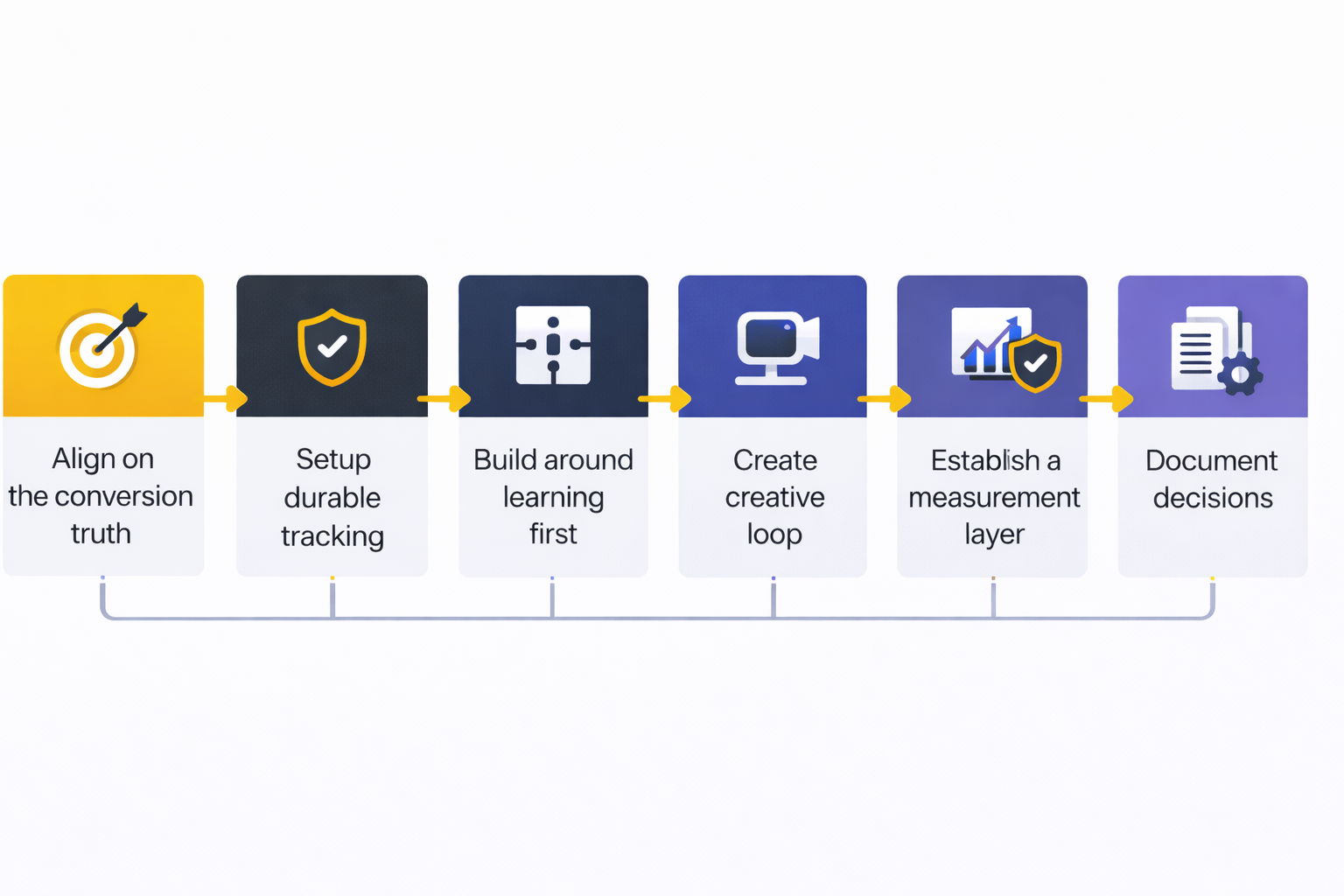
Step 1: Align on the single conversion truth. Before touching budgets, an agency defines what success means in one sentence, then translates it into trackable events. If the business can’t agree on what a “qualified lead” or “profitable purchase” looks like, the ad platform can’t optimize correctly, and the team will argue about metrics instead of improving them.
Step 2: Set up durable tracking, not fragile pixels. Modern implementations typically blend browser-based tracking with server-to-server event sharing, because the browser alone is increasingly incomplete. Meta’s own implementation guidance for the Conversions API setup shows how the system is designed around a server connection and coordinated event delivery. TikTok frames the same direction in its Events API overview, positioning server-side data as a more reliable bridge between advertiser activity and optimization signals.
Step 3: Build the campaign architecture around learning first. The first launch is not meant to be perfect; it’s meant to create clean comparisons. The agency sets up campaigns that isolate variables—one audience hypothesis, one creative angle, one objective—so the results can be interpreted without guesswork.
Step 4: Create a creative production loop with speed built in. A social advertising agency that ships one ad per month will lose. The implementation phase includes a workflow for ideation, scripting, production, and approvals, because the platform’s delivery systems reward fresh, relevant assets and punish stale ones over time.
Step 5: Establish a measurement layer that can handle reality. Platforms will always report differently from analytics tools, and analytics tools can shift attribution based on model changes and user paths. GA4 explains how data-driven attribution distributes credit based on how touchpoints change the probability of conversion, which is a helpful baseline for interpreting multi-touch journeys without treating last-click as the whole story.
Step 6: Document decisions like an engineering team. Every meaningful change—audience swaps, creative refreshes, budget shifts—gets logged with a reason and a hypothesis. This is how the agency avoids repeating the same experiments every quarter and turns implementation into a knowledge asset instead of a chaotic sprint.
Execution Layers
A clean implementation becomes much easier to manage when it’s broken into layers. Each layer has a different job, a different owner, and a different cadence, so the agency can move fast without accidentally breaking the system.
The strategy layer defines the offer, the audience, the funnel, and the constraints. This is where the agency decides what the campaign is trying to change in the business: revenue, qualified pipeline, retained customers, or a specific margin target. Without this layer, optimization becomes “cheaper clicks” chasing vanity metrics.
The data layer focuses on what gets captured, how it gets matched, and how it flows into platforms. Server-side integrations matter here because platforms are explicitly building for them. LinkedIn’s documentation on Conversions API payloads shows the level of structure required to send consistent conversion data, and that structure is exactly what makes learning more stable over time.
The creative layer turns positioning into assets the algorithm can distribute. This layer isn’t just design—it’s message testing, hook testing, and format testing. The agency structures creative into “families” (angle, proof, offer, objection) so performance feedback can be translated into a next iteration, not just a vague opinion.
The media layer controls campaign setup, bidding logic, budgets, placements, and pacing. This is where the agency protects the account from reactive decisions, using guardrails like spend caps, learning-phase rules, and controlled scaling windows.
The measurement layer reconciles what platforms claim with what the business actually sees. This includes attribution comparisons, cohort views, and conversion quality checks. It also includes adaptation when platforms change their measurement capabilities, like Meta’s notice that its Offline Conversions API would be discontinued, which forces teams to plan migrations instead of waking up to broken reporting.
The operations layer keeps implementation from collapsing under real-life constraints—approvals, legal review, asset requests, site changes, and stakeholder expectations. This layer is where a social advertising agency earns its keep, because most campaigns don’t fail from one big mistake; they fail from a slow accumulation of small delays.
Optimization Process
Optimization is where implementation stops being a setup project and becomes an operating system. The best agencies treat optimization like a weekly product iteration cycle: gather signals, prioritize hypotheses, ship changes, and validate outcomes. The key is resisting the urge to “fix everything” at once, because that makes results unreadable.
Start with signal integrity. Before adjusting creative or audiences, the agency checks whether tracking is still capturing meaningful events and whether reporting pipelines are intact. If conversion signals degrade, ad platforms learn from noise, and every “optimization” becomes a gamble. This is why platforms keep pushing server-side connections as a standard foundation, reflected in the way Meta designs Conversions API prerequisites and TikTok positions its Events API as the reliable connection for advertiser data.
Run optimization in two lanes: efficiency and growth. One lane focuses on waste reduction—cutting placements that don’t convert, pruning weak creative, and tightening spend on low-quality traffic. The other lane focuses on expansion—new angles, new audiences, new formats, and new offer tests. Mixing these lanes without a plan often results in accounts that feel “busy” but don’t progress.
Use attribution models as a compass, not a verdict. Social ads influence behavior across multiple sessions and devices, and the “credit” assigned to a channel changes depending on the model. GA4’s explanation of data-driven attribution logic is useful here, because it reinforces a practical point: if the business only trusts one lens, it will overreact to short-term fluctuations and underinvest in what actually drives downstream conversions.
Refresh creative on a schedule, not in a panic. A social advertising agency plans creative turnover like inventory. New assets are introduced in batches, evaluated against clear benchmarks, and scaled only after they prove they can hold performance at meaningful spend. This prevents the classic cycle of “one winner” that burns out, followed by frantic creative production.
Scale with control. Scaling is not just raising budgets; it’s protecting what’s working while testing what might work next. Agencies typically scale in steps, watching frequency, cost volatility, and conversion quality, then pausing when signals start to drift. This is how accounts grow without becoming unstable.
Implementation Stories
Implementation looks tidy in diagrams, but in real accounts it’s often messy, emotional, and full of competing priorities. These are the kinds of situations a social advertising agency is built to handle, because the job is not just buying media—it’s building clarity inside chaos.
A high-stakes launch that can’t afford bad tracking. The team is days from a product release, the founder is watching every dollar, and the website has changed three times in two weeks. The agency steps in and insists on stabilizing the conversion event definitions and server-side data flow first, because scaling on incomplete signals is how budgets disappear without answers. That mindset aligns with how platforms describe reliable event sharing through systems like Meta’s Conversions API and TikTok’s Events API.
A mature account that “works,” but has stopped growing. The ads are profitable, but performance hasn’t improved in months, and every new creative looks the same because the brand is afraid to change what’s already working. The agency reframes the problem: the account isn’t failing, it’s stagnating. Implementation becomes a controlled creative diversification project, where testing is structured so stakeholders feel safe and the algorithm has new material to learn from.
A B2B pipeline that’s getting leads but not revenue. The campaigns report conversions, the CRM shows a growing lead list, and yet sales complains that “none of these are real.” The agency rebuilds implementation around conversion quality, pushing deeper events and aligning definitions across platforms and internal systems. LinkedIn’s structured approach to conversion data—visible in tooling like its Conversions API payload builder—illustrates the kind of rigor needed when “a lead” isn’t the same thing as “a deal.”
Professional Implementation
The difference between “someone running ads” and a professional social advertising agency is the discipline of the system. Professional implementation means the account can withstand platform changes, measurement shifts, and creative turnover without collapsing into confusion.
- Implementation is documented. Campaign naming, event definitions, audiences, and creative testing rules are written down so the account stays coherent as teams change.
- Measurement is designed for durability. Server-side event sharing and clear attribution interpretation reduce the risk of making decisions on incomplete data, consistent with platform guidance like Meta’s Conversions API and TikTok’s Events API.
- Optimization is structured, not reactive. Changes are shipped through a weekly cadence with hypotheses, controls, and learning goals, instead of daily toggling that produces noise.
- Scaling is governed. Budget increases follow rules that protect stability, and creative refreshes are planned so performance doesn’t depend on a single “hero ad.”
- Stakeholder communication is built into the workflow. Reporting connects activity to outcomes using consistent attribution logic, supported by frameworks like GA4’s explanation of data-driven attribution, so decisions stay grounded even when metrics disagree.
When these practices are in place, implementation stops feeling like constant firefighting. It becomes a system where learning compounds, performance becomes more predictable, and the business can scale paid social without feeling like it’s gambling every time the budget increases.
Statistics And Data
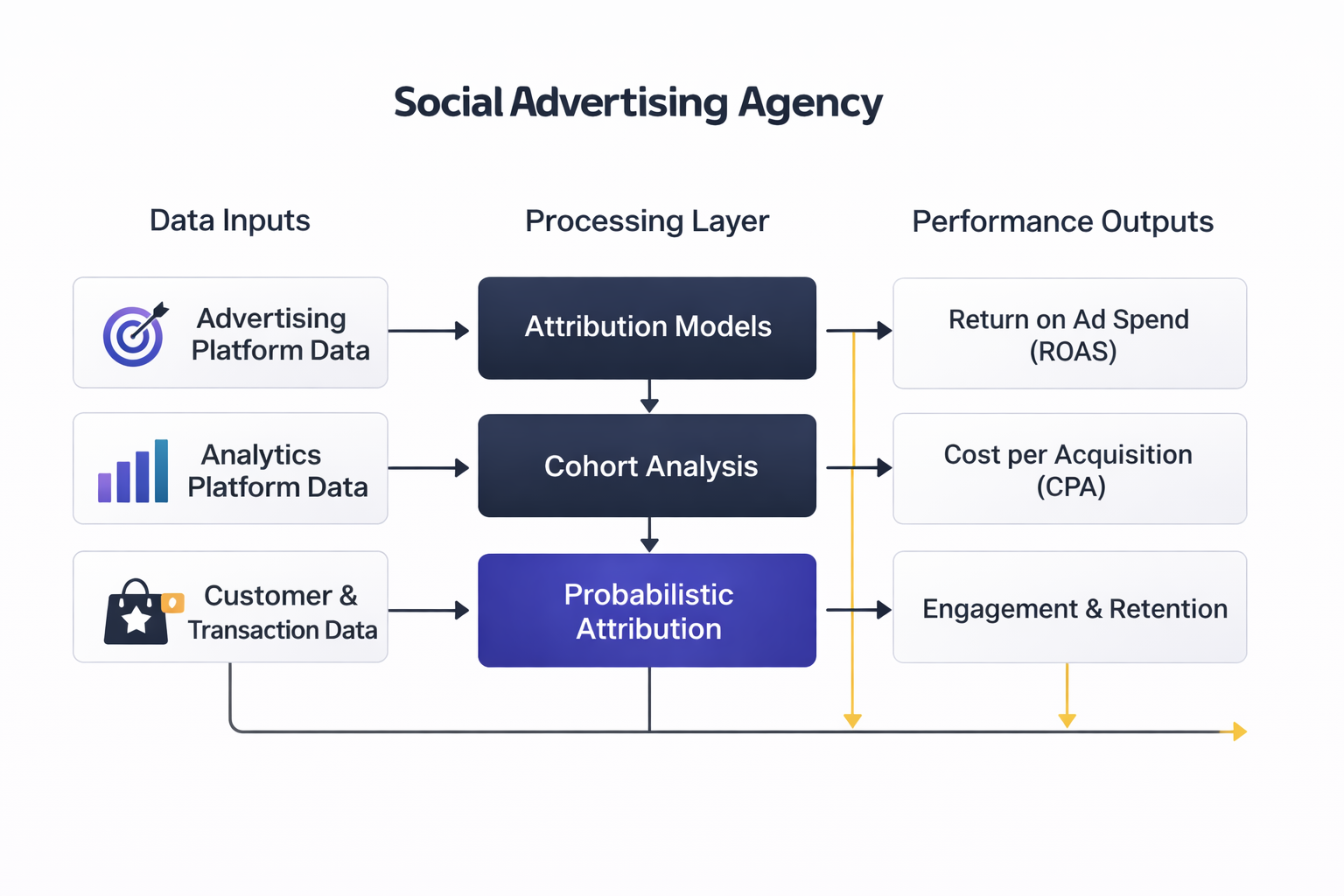
Understanding the numbers behind social advertising is essential for interpreting campaign performance correctly. A social advertising agency does not simply observe individual metrics like clicks or impressions. Instead, it evaluates how multiple layers of data interact to reveal whether marketing activity is actually producing sustainable growth.
The scale of the social advertising ecosystem is enormous. Digital advertising spending globally is projected to surpass $740 billion in 2025, with social platforms capturing a rapidly growing share of that investment, as documented in the GroupM Global Advertising Forecast. This concentration of marketing budgets has intensified competition for attention inside algorithm-driven feeds.
User behavior data helps explain why advertisers continue shifting budgets toward social platforms. The global digital usage analysis presented in the Digital 2024 Global Overview Report shows that the average internet user now spends roughly two hours and twenty minutes each day on social networks. This amount of attention creates one of the largest and most active advertising environments in modern marketing.
Because audiences are so active on these platforms, advertisers can observe extremely detailed behavioral signals. Platforms measure engagement patterns, viewing duration, content interactions, and conversion events across billions of user sessions. Agencies use this data to identify patterns that indicate genuine customer interest rather than passive scrolling.
However, the volume of available data also creates a challenge: interpreting metrics without context often leads to misleading conclusions. High engagement does not necessarily translate into revenue, and low engagement does not always indicate poor campaign performance. Effective analysis therefore requires connecting platform metrics with business outcomes such as revenue, customer lifetime value, or qualified leads.
Performance Benchmarks
Benchmarks help agencies determine whether a campaign is performing competitively within its industry. Without comparison points, it becomes difficult to evaluate whether a campaign’s results reflect strong execution or simply typical platform behavior.
One of the most widely monitored indicators is return on ad spend (ROAS), which measures how much revenue is generated for every unit of advertising investment. Large-scale advertising account analyses summarized in the Meta advertising benchmark analysis show that many industries achieve an average ROAS close to 3:1 when campaigns are managed effectively.
Cost efficiency metrics provide another important benchmark. Social advertising campaigns often track cost per acquisition (CPA), which represents how much it costs to generate a conversion such as a purchase or qualified lead. Data aggregated across thousands of campaigns in the paid social benchmark dataset demonstrates how these costs vary widely across industries depending on competition and audience demand.
Engagement metrics also provide valuable signals about creative effectiveness. When an advertisement captures attention and generates meaningful interactions, it often receives algorithmic advantages in distribution. The social media engagement benchmark research highlights how engagement rates differ dramatically between platforms and content formats, reinforcing the importance of tailoring creative assets to the environment in which they appear.
While benchmarks offer useful guidance, experienced agencies treat them as directional indicators rather than rigid targets. Every business operates within a unique market environment, and campaign performance must ultimately be evaluated based on profitability rather than comparison alone.
Analytics Interpretation
Collecting data is only the first step in campaign analysis. The real value emerges when agencies interpret metrics within the broader context of customer behavior and market dynamics.
A common challenge in social advertising analytics involves attribution. Consumers rarely move directly from viewing an advertisement to completing a purchase. Instead, they interact with multiple marketing touchpoints across different devices and time periods before making a decision.
This complexity is why modern analytics systems increasingly rely on probabilistic attribution models rather than simple last-click measurements. Google explains how data-driven attribution distributes conversion credit across several marketing touchpoints based on statistical modeling. Such approaches provide a more realistic understanding of how social campaigns contribute to customer journeys.
Another important analytical perspective involves cohort analysis. Instead of evaluating conversions individually, agencies examine how groups of customers acquired during specific campaigns behave over time. This method reveals patterns in retention, repeat purchases, and long-term revenue generation.
For example, a campaign might initially appear expensive if measured only by first purchase value. However, cohort analysis may reveal that those customers return multiple times, generating far more revenue over the long term than the initial acquisition cost suggests.
By combining attribution modeling, cohort analysis, and platform performance metrics, a social advertising agency develops a much clearer picture of campaign impact than any single data source could provide alone.
Case Stories
The importance of analytics becomes especially clear when examining real campaigns where data-driven insights changed the trajectory of a company’s marketing strategy.
In 2020, athletic apparel brand Gymshark experienced an extraordinary surge in demand during the global shift toward home fitness. Traffic across its online store increased dramatically, and the marketing team suddenly faced an unexpected problem: social advertising campaigns were generating massive engagement, but the team struggled to determine which campaigns were actually driving purchases.
The company had built its brand through strong digital communities and influencer partnerships, and its marketing operations relied heavily on social platforms. As demand exploded, however, the data infrastructure behind the campaigns could not keep up with the scale of interactions being generated.
This created a serious analytical wall. Marketing teams could see that engagement metrics were soaring, yet the connection between specific campaigns and actual revenue was unclear. Without reliable attribution, increasing advertising budgets carried significant financial risk.
The turning point came when Gymshark began investing heavily in analytics and measurement infrastructure to connect advertising signals with e-commerce data. The company expanded its internal data capabilities and improved the way campaign performance was analyzed across platforms and internal systems.
The transformation required months of work. Engineers, marketers, and analysts collaborated to rebuild data pipelines, align marketing dashboards with revenue reporting, and ensure that performance metrics could be trusted at scale.
Along the way, the company faced setbacks when attribution models produced conflicting interpretations of campaign performance. Instead of abandoning the effort, the teams refined their analytics processes until the datasets aligned more closely.
The outcome of this effort was a far more reliable understanding of marketing performance. Gymshark later described its approach to data-driven marketing and digital growth in its official company overview, highlighting how analytics and community-driven marketing played central roles in scaling the brand into a global fitness apparel company.
Professional Promotion
Data, tools, and frameworks all matter, but the real differentiator for a social advertising agency lies in the ability to transform insight into strategic advantage. Agencies that understand analytics deeply can move faster, test smarter, and identify growth opportunities long before competitors notice them.
That advantage becomes especially powerful when combined with a strong professional presence. Agencies that publish research, share campaign insights, and demonstrate measurable expertise attract clients who value performance-driven marketing rather than guesswork.
In today’s competitive environment, brands increasingly look for partners who can prove their impact with transparent data. When agencies communicate results clearly and support decisions with credible analysis, they build trust that extends far beyond a single campaign.
This combination of analytical rigor, strategic thinking, and consistent communication is what ultimately transforms a capable marketing team into a trusted social advertising partner.
Future Trends
The next wave of change for any social advertising agency will be driven less by “new ad formats” and more by structural shifts: privacy-first measurement, AI-native personalization, platform regulation, and commerce moving directly into feeds.
Measurement is moving beyond platform ROAS. As privacy changes and media fragmentation make last-click attribution less useful, more teams are rebuilding their measurement stack around marketing mix modeling and incrementality testing. The shift is reflected in Google’s outlook on the resurgence of marketing mix models for 2025 and the momentum behind incrementality testing becoming easier to run inside ad platforms.
AI personalization will change targeting signals. Social platforms are finding new inputs to guide recommendation and advertising systems, and that affects how campaigns learn. Reuters reported that Meta plans to use interactions with its generative AI tools to personalize content and ads starting December 16, 2025, outside the UK and EU rollout for now, as described in coverage of Meta’s AI chat-driven personalization.
Creators are becoming a primary media channel. The creator economy is no longer a “nice add-on” to paid social; it’s turning into a standalone budget line with its own procurement, measurement, and operational challenges. IAB’s 2025 reporting on creator marketing shows accelerating investment and mounting pressure to prove ROI and attribution in this channel, captured in reporting on creator economy ad spend growth.
Social commerce is tightening the loop from scroll to purchase. TikTok’s own forward-looking marketing research emphasizes authenticity and community-driven discovery, outlined in TikTok’s What’s Next 2025 trend report, while independent market coverage points to commerce becoming a more central piece of the platform’s business model, including growth projections in eMarketer’s TikTok Shop social commerce analysis.
Platform governance and transparency rules will keep tightening. Agencies will need stronger ad governance, clearer disclosures, and tighter audit trails as regulators demand more visibility into how ads are targeted and served. That pressure is visible in reporting on EU scrutiny tied to ad transparency requirements, including the European Commission’s preliminary findings described in coverage of TikTok and EU advertising transparency obligations.
Strategic Framework Recap

At a practical level, a social advertising agency succeeds when it turns complexity into a simple operating rhythm: set clean inputs, ship strong creative, interpret signals responsibly, and compound learning over time.
Start with the outcome. Every campaign needs one primary business goal that can be measured consistently. If “success” changes depending on who’s looking at the dashboard, optimization turns into politics instead of progress.
Protect signal quality. Better measurement isn’t just a reporting issue; it’s an optimization issue. When the inputs are noisy, the platform learns the wrong lessons and the account becomes unstable. Privacy shifts are one reason modern teams are returning to triangulation methods like MMM and incrementality testing, reflected in Google’s measurement outlook for 2025.
Build creative as a system, not a one-off. Winning accounts don’t “find one good ad.” They build a pipeline that can produce, test, and refresh creative continuously, with enough variety to keep performance from collapsing when a single concept fatigues.
Scale with guardrails. Scaling works when it’s paced, documented, and protected by clear rules. When it’s emotional and reactive, it usually turns into higher spend and lower confidence.
Operate with a real feedback loop. The loop is simple: launch, learn, iterate, and document. The sophistication comes from how cleanly you run that loop across platforms, channels, and changing market conditions.
FAQ – Built For This Complete Guide
What does a social advertising agency actually do day to day?
A social advertising agency plans campaigns, builds targeting and measurement foundations, produces and tests creative, monitors performance signals, and iterates weekly. The job is less about pushing buttons and more about running a repeatable experimentation system that ties spend to business outcomes.
When should a business hire a social advertising agency?
Hire one when paid social is becoming a core growth channel and the cost of “learning by guessing” is getting expensive. If your team can’t consistently ship new creative, interpret performance beyond surface metrics, or manage measurement changes, you’ll usually scale faster with an agency partner.
Which platforms should we prioritize first?
Start where your buyers already spend attention and where your offer fits the platform’s native behavior. For many brands that’s Meta and TikTok, but B2B can lean into LinkedIn. The best starting point is not a trend; it’s your customer’s actual media habits and your creative strengths.
How much budget do we need for paid social to work?
There is no universal minimum, but you do need enough spend to test hypotheses and generate consistent conversion signals. If the budget is too small to run structured experiments, performance becomes dominated by randomness and you can’t reliably tell what’s working.
What metrics matter most in a social advertising agency relationship?
Good agencies care about metrics that connect to the business: qualified leads, revenue, contribution margin, and retention signals where applicable. Engagement and CTR can be useful diagnostics, but they are not the finish line unless your business model is built around them.
Why do ad platform results differ from Google Analytics?
Platforms and analytics tools use different attribution rules and different ways of handling identity, privacy, and cross-device behavior. GA4’s explanation of data-driven attribution is a useful reference for understanding why credit is distributed across touchpoints instead of pinned to a single click.
What is creative fatigue and how do agencies handle it?
Creative fatigue happens when an audience has seen an ad too often, engagement drops, and delivery becomes less efficient. Agencies handle it by maintaining a creative pipeline, rotating variants, and expanding testing into new angles and formats before performance collapses.
How long does it take to see results from paid social?
Initial signals can appear quickly, but stable performance usually takes longer because it requires testing, iteration, and measurement alignment. The timeline depends on your offer strength, conversion path complexity, creative velocity, and whether tracking is reliable from day one.
What is marketing mix modeling and why is it coming back?
MMM is a measurement approach that estimates how different channels contribute to business outcomes over time. It’s returning because privacy changes and fragmentation make single-source attribution less dependable. The shift is discussed in Google’s 2025 measurement trend analysis.
How do creators fit into a modern paid social strategy?
Creators can be the fastest path to native-feeling creative that platforms distribute efficiently. Many brands now treat creator partnerships as a core media input rather than a side experiment, reflecting broader industry movement described in reporting on creator economy ad spend growth.
How do we avoid wasting budget when testing?
Waste is reduced by controlling variables, documenting hypotheses, and using clear stop-loss rules. Testing becomes expensive when you change five things at once, chase daily fluctuations, or optimize for metrics that don’t reflect conversion quality.
What should we ask for in a social advertising agency audit?
Ask to see: campaign structure logic, measurement setup and event definitions, creative testing history, budget pacing rules, and how learning is documented. A strong agency can explain not only what happened, but why it happened and what will change next.
Work With Professionals
If you’ve made it this far, you already know the uncomfortable truth: most “paid social work” isn’t hard because the buttons are complicated. It’s hard because the work demands consistency—shipping creative, reading signals honestly, and showing up every week even when performance gets weird.
That’s also why so many talented marketers get stuck. They have the skills, they can run campaigns, they can write strategy, but they’re trapped in the same loop: endless outreach, slow replies, middle layers taking fees, and not enough high-quality conversations with teams that actually need help.
Markework is built around a simpler path: a marketing marketplace where you can be discovered, apply to roles, and talk directly with companies without a middleman. The platform positions itself around no project fees and direct communication, so when you win work, you keep the value you create.
Here’s what makes that feel different in practice. Instead of pitching into the void, you build a profile once, then browse opportunities across performance marketing, paid social, lifecycle, analytics, and more. Markework emphasizes “start in minutes” flows for marketers and companies alike, plus a system of tokens to apply or unlock opportunities, outlined on its core marketplace overview.
If you’re a freelancer who can run campaigns like a real social advertising agency—clean implementation, fast creative iteration, honest measurement, steady optimization—then you’re not selling “ads.” You’re selling confidence. And there are marketing teams out there who desperately want that confidence, because the cost of getting it wrong keeps rising.
 Filip Konecny Enterprises