

Short-form video has transformed how people discover brands, products, and ideas online. What once started as a platform dominated by viral dance clips has evolved into one of the most influential marketing ecosystems in the world. Businesses that understand how to use TikTok strategically are not just gaining views—they are building communities, driving e-commerce sales, and shaping cultural conversations.
The scale of this shift is impossible to ignore. TikTok now reaches roughly 1.59 billion potential advertising viewers globally, representing close to a fifth of the world’s population online. That kind of reach fundamentally changes how brands approach social media marketing, particularly because TikTok’s algorithm distributes content based on relevance rather than follower counts.
Equally important is engagement. Studies comparing major social networks show that TikTok consistently delivers higher interaction rates than most competing platforms, with average engagement around 2.5% across accounts and up to 7.5% for smaller creators. These numbers explain why marketers increasingly prioritize TikTok as a primary channel for audience growth and brand storytelling.
Understanding how smm tiktok works requires more than simply posting videos. It involves mastering platform culture, understanding algorithmic distribution, designing content systems, and integrating analytics with broader marketing strategies. This guide explores each of those components step by step.
Article Outline
- What SMM TikTok Really Means
- Why TikTok Marketing Matters for Modern Brands
- The Strategic Framework Behind TikTok SMM
- Core Components of a Successful TikTok Strategy
- Professional Implementation for Sustainable Growth
What SMM TikTok Really Means

When marketers talk about smm tiktok, they are referring to the practice of using TikTok as a structured social media marketing channel to build brand awareness, generate demand, and cultivate long-term relationships with audiences. In broader digital marketing terminology, social media marketing itself is the practice of using social platforms to promote brands and connect with customers through content, interaction, and advertising as defined in standard marketing frameworks.
What makes TikTok unique within this landscape is the way its recommendation engine distributes content. Instead of prioritizing established creators or large follower bases, the platform’s “For You” feed algorithm evaluates viewer behavior—watch time, shares, comments, and topic interest—to determine which videos should reach larger audiences.
This system creates a radically different environment compared with traditional social networks. A new account can reach millions of viewers if the content resonates strongly with a specific niche. Academic research analyzing TikTok recommendation patterns shows that the algorithm rapidly amplifies content aligned with user interests after only a few hundred interactions with the platform, reinforcing highly relevant topics in each viewer’s feed.
For marketers, this dynamic means that success depends less on brand authority and more on content relevance. A company that understands its audience’s cultural context, humor, and interests can compete with global brands in the same recommendation feed.
Another defining feature of TikTok marketing is the speed at which attention is decided. Research examining viewer behavior shows that roughly 71% of viewers decide whether to keep watching within the first three seconds. This places enormous importance on storytelling structure, pacing, and visual hooks at the beginning of every video.
Because of these factors, effective TikTok marketing blends creative production with data-driven experimentation. Brands must continuously analyze which formats resonate with their audience and adjust their content systems accordingly.
Why TikTok Marketing Matters for Modern Brands
The growing influence of TikTok within the digital economy is reshaping how companies think about marketing channels. While earlier platforms focused heavily on follower networks, TikTok operates more like an entertainment distribution engine where compelling content can reach audiences regardless of account size.
This shift explains why businesses across industries—from retail and technology to education and entertainment—have dramatically increased their investment in TikTok content and advertising.
The platform’s economic scale highlights its importance. TikTok generated approximately $23 billion in revenue in 2024, with advertising representing the majority of that income. This level of revenue reflects the enormous demand from brands seeking visibility within the platform’s rapidly growing user base.
Audience behavior further reinforces TikTok’s role as a marketing powerhouse. Users often treat the platform as a discovery engine for products, services, and ideas rather than simply a place to watch entertainment. In practice, this means brands can move audiences from awareness to purchase inside the same ecosystem.
Retail adoption illustrates this shift clearly. Thousands of businesses now integrate TikTok content directly with social commerce features, livestream shopping, and influencer collaborations. As the ecosystem matures, TikTok increasingly functions not only as a marketing platform but also as a transactional marketplace.
Perhaps the most powerful advantage, however, lies in cultural relevance. TikTok trends spread rapidly across the internet, influencing music charts, product demand, and public conversation. Brands that participate authentically in these trends can build massive visibility without traditional advertising budgets.
In this sense, TikTok marketing is less about broadcasting promotional messages and more about participating in culture. Companies that understand this distinction are far more likely to create content that resonates with audiences.
Strategic Framework Behind TikTok SMM
A sustainable TikTok strategy rarely happens by accident. Behind every consistently growing account is a framework that guides content decisions, audience targeting, and performance analysis.
The most effective smm tiktok strategies usually follow a three-layer structure: audience insight, content systems, and algorithm optimization. Each layer supports the others, creating a cycle of continuous improvement.
The process begins with audience understanding. Marketers must analyze what viewers in their niche actually want to watch, not simply what the brand wants to promote. Successful accounts often study comment sections, trending hashtags, and competitor videos to identify patterns in audience interests.
The second layer focuses on content systems rather than individual videos. Instead of relying on occasional viral posts, experienced marketers design repeatable formats—educational series, storytelling formats, behind-the-scenes clips, or trend adaptations. These repeatable structures make it easier to produce consistent content while maintaining brand identity.
The third layer revolves around algorithm optimization. TikTok’s distribution engine evaluates engagement signals such as completion rate, replays, shares, and comments. Content that triggers these signals tends to receive broader distribution across the platform.
When these three elements operate together, TikTok marketing becomes a feedback loop. Insights about audience behavior inform new content ideas, those videos generate engagement data, and the resulting analytics refine the strategy further.
Core Components of an Effective TikTok Strategy
Although every brand approaches TikTok differently, several core components appear consistently across successful marketing campaigns.
The first is storytelling. TikTok’s short-form format demands narratives that capture attention immediately while delivering value quickly. Educational content, humor, transformation stories, and behind-the-scenes perspectives tend to perform particularly well because they create emotional or informational payoff within seconds.
The second component is authenticity. Audiences on TikTok are highly sensitive to overly polished or traditional advertising. Content that feels natural, spontaneous, and human generally receives stronger engagement than highly produced commercials.
The third component involves participation in platform culture. Trends, sounds, and memes move quickly across TikTok, and brands that adapt them creatively can tap into existing audience attention rather than competing for it.
Finally, analytics play a critical role. Successful marketers regularly analyze watch time, viewer retention, and audience demographics to understand which content resonates most strongly. These insights help guide future creative decisions and improve overall campaign performance.
Professional Implementation of TikTok Marketing
Implementing TikTok marketing professionally requires more than creativity alone. It involves structured workflows, performance tracking, and integration with broader marketing goals.
Many organizations build dedicated TikTok content pipelines that include trend research, script development, filming schedules, and post-production processes. This systematic approach ensures consistent publishing without sacrificing quality.
Professional teams also treat TikTok as part of a larger digital ecosystem rather than an isolated platform. Videos can drive traffic to websites, build email audiences, support product launches, and reinforce brand positioning across other channels.
Another important factor is collaboration with creators. Influencers and niche experts often understand platform culture better than traditional marketing teams. Partnerships with these creators allow brands to access established audiences while producing content that feels authentic to the TikTok environment.
When executed thoughtfully, TikTok marketing becomes a powerful growth engine. It can amplify brand visibility, accelerate community building, and create meaningful connections between businesses and audiences worldwide.
Step-by-Step Implementation
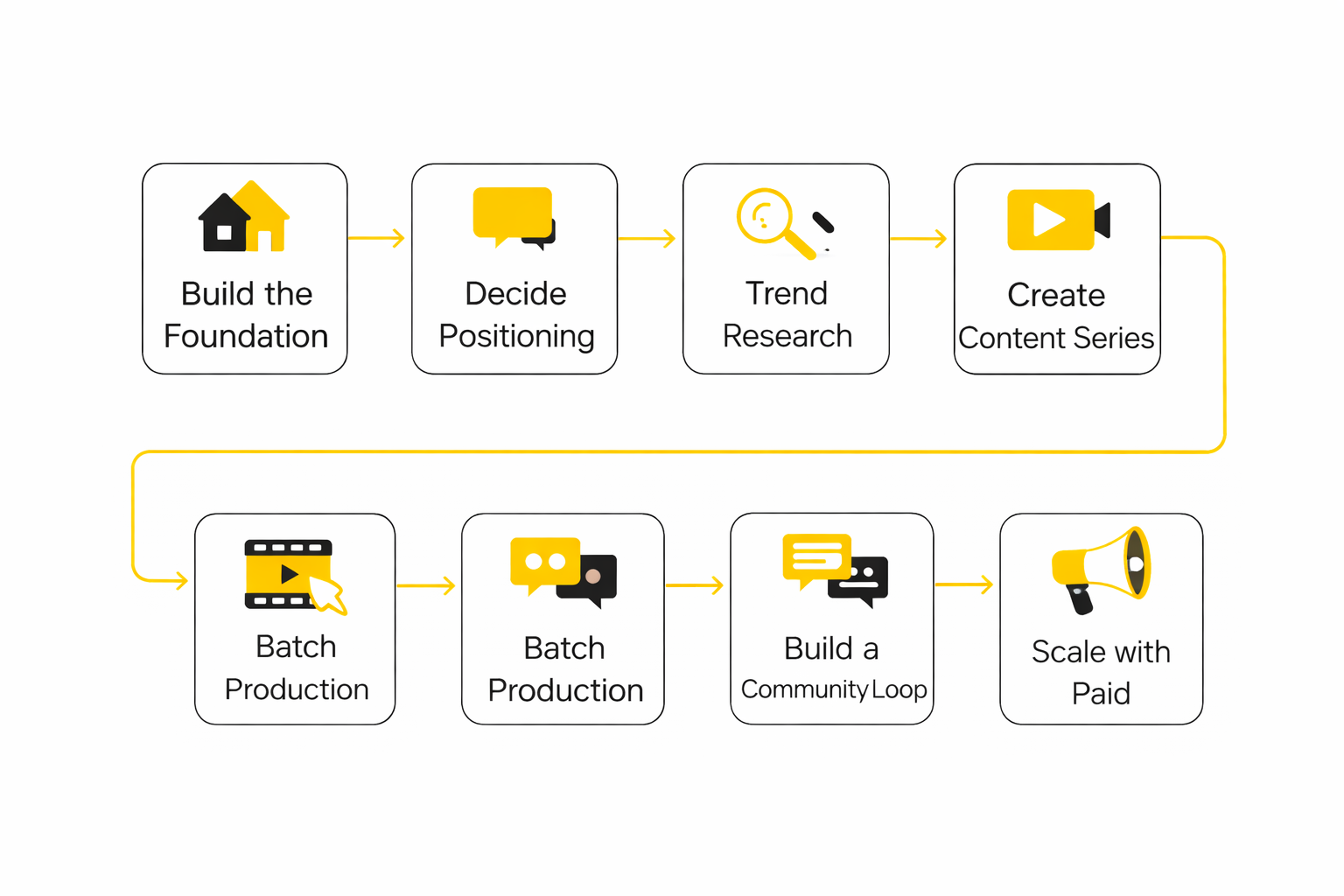
A good smm tiktok implementation isn’t “post more and hope.” It’s a sequence you can run every week, where each step feeds the next: research creates better hooks, hooks create better retention, retention improves distribution, and distribution creates enough signal to optimize.
Use this as a practical build order. You’ll notice it starts with measurement and positioning before it touches paid spend, because scaling is only helpful when you can tell what’s working.
1) Build the foundation that won’t break later
Set up TikTok Business Center access first so roles and asset permissions are clear before multiple people touch the account. TikTok’s own guidance on roles and permissions and asset-level access exists for a reason: it prevents the “who changed this?” spiral when performance dips.
If you drive traffic off-platform, implement measurement immediately. TikTok’s setup docs repeatedly push the same idea: run Pixel and Events API together to maximize signal coverage, which appears in the Pixel setup flow, the Events API overview, and the GTM server-side setup guidance.
Lock in a single source of truth for what a “conversion” means. If your team can’t agree on which events matter (view content, add to cart, purchase, lead submit), optimization becomes a debate instead of a decision.
2) Decide what you want to be remembered for
TikTok rewards relevance, but people remember meaning. Pick a narrow, repeatable point of view: the problem you solve, the audience you solve it for, and the angle you’ll say it with (founder voice, creator voice, expert voice, customer voice).
If you’re not sure what that looks like, use research-backed creative principles to anchor it. The Ipsos and TikTok “Return on Creative” work emphasizes resonance and relatability as drivers of impact, which is why many brands use it as a framework for shaping creative direction in Return on Creative and TikTok’s companion guidance on maximizing creative value.
Write one sentence you can defend: “Our TikTok exists to help X do Y by showing Z.” If you can’t say it, you can’t repeat it, and repetition is how brands win on TikTok.
3) Research trends like a system, not a mood
Open TikTok Creative Center and look at trend data through your niche lens. The Trend Discovery area is designed to show what’s rising by region and category in TikTok Creative Center and what’s popular right now.
Then pressure-test trends with “fit” questions: does the trend match your audience’s identity, does it support your positioning, and can you deliver a payoff within one scroll? If the answer is no, skip it, even if it’s big.
Finally, track the trends you didn’t use. Those often become the best ideas later, when the format matures and your angle gets sharper.
4) Turn ideas into repeatable series
Build three to five content series you can publish every week without burning out. Series beat one-offs because they train the algorithm and the audience to know what they’ll get from you.
Use a simple pattern to keep it human: hook, context, payoff, and a next step. Research into early attention on TikTok reinforces why the beginning matters so much, including a 2024 study focused on first impressions and hooks in First “3 Second” Impression of TikTok Marketing Strategy.
As you build series, bake in variation so you don’t get stuck repeating the same clip with a different caption. Change the setting, change the narrator, change the proof, change the format.
5) Produce in batches, publish in rhythms
Batch filming is the easiest way to keep consistency without living on your phone. Separate “brain days” (research and scripting) from “camera days” (batch filming) and “edit days” (fast assembly).
Plan publishing around a weekly rhythm you can keep for three months. Consistency matters more than intensity because TikTok is a long game of compounding distribution.
In practice, teams that stick to a realistic cadence tend to learn faster because they generate more comparable data over time. That’s the real advantage of consistency: better learning, not just more posts.
6) Build the comment-to-content loop
When a video performs, the comments are your next script. Reply with videos, stitch questions into new posts, and treat confusion as a gift: confusion reveals what your audience still doesn’t understand.
This loop also improves retention because your next video starts with a real question people already asked. It feels like a conversation, not a broadcast.
If you want your smm tiktok to feel alive, make it interactive on purpose. Your comment section isn’t an afterthought; it’s a research panel that never sleeps.
7) Scale the winners with the right kind of paid
Once you have organic posts that consistently hold attention, boost the best ones instead of forcing “ad-looking” creative. Spark Ads exist specifically to amplify organic posts while keeping the native feel and engagement attached to the original, outlined in TikTok’s Spark Ads guide.
If you’re selling products, connect your commerce layer so the path from video to purchase is short. For Shopify merchants, that often means the official TikTok app for Shopify plus TikTok’s own guidance on advertising a Shopify store on TikTok.
If you’re scaling a newer format like Search Ads, treat it as an incremental channel with a specific hypothesis and a clear test window. TikTok’s own work on integrated Search + In-Feed describes measurable incremental impact in Unlocking incremental growth in the future of search, while broader industry coverage shows brands and agencies actively expanding budgets into TikTok search in Digiday’s report on TikTok search ads adoption.
Execution Layers
Think of smm tiktok execution like a layered system. If one layer is weak, everything above it becomes unstable. If the layers are strong, your output feels effortless even when it’s highly engineered.
Layer 1: Strategy and positioning
This is your “why you, why now” layer. It includes your point of view, your audience definition, and the promise your content keeps making.
The easiest way to spot a weak strategy layer is inconsistency: one day you’re educational, the next you’re comedy, the next you’re selling, and nothing ties together. TikTok might still give you reach, but your audience won’t build loyalty.
Strengthen this layer by choosing a few repeatable storylines and sticking with them long enough to learn what truly resonates.
Layer 2: Creative and production
This layer is your ability to ship watchable content on a schedule. It’s not about having the fanciest gear; it’s about having a production method that protects consistency.
Research-backed creative thinking helps here because it gives you principles, not just trends. The Ipsos and TikTok creative research in Return on Creative is useful because it translates “great creative” into patterns you can actually repeat.
If the creative layer is strong, you can generate multiple variations of an idea without losing the core message, which is exactly what scaling requires.
Layer 3: Distribution and amplification
Distribution is how you turn good creative into reliable outcomes. Organically, that means posting consistently, shaping hooks, and riding patterns in the For You feed. Paid distribution means amplifying what already works.
Spark Ads are often the cleanest bridge between organic and paid because they preserve native engagement signals, as detailed in TikTok’s Spark Ads documentation.
If you add Search Ads to the mix, treat it like intent capture that complements discovery. TikTok’s own reporting on incremental lift for Search + In-Feed in its Search Ads conversion lift write-up maps well to the way agencies describe social search as a complement, not a replacement, in recent industry coverage.
Layer 4: Measurement and feedback loops
This layer decides whether you scale what works or accidentally scale what looks good. If your measurement is weak, you’ll optimize for vanity signals and wonder why revenue doesn’t move.
TikTok’s docs are unusually direct here: Pixel plus Events API is a recommended pairing to maximize event coverage and performance, stated across the Pixel setup flow, the Events API page, and the GTM implementation guide.
Once the signal is solid, you can build a real feedback loop: creative decisions informed by retention data, distribution decisions informed by conversion data, and budget decisions informed by incremental results.
Optimization Process
The biggest misconception in smm tiktok is that optimization is a one-time “fix.” On TikTok, optimization is a cycle. You ship, you learn, you adjust, and you ship again—fast enough that you don’t lose momentum, but structured enough that you don’t chase noise.
What to measure so you don’t optimize the wrong thing
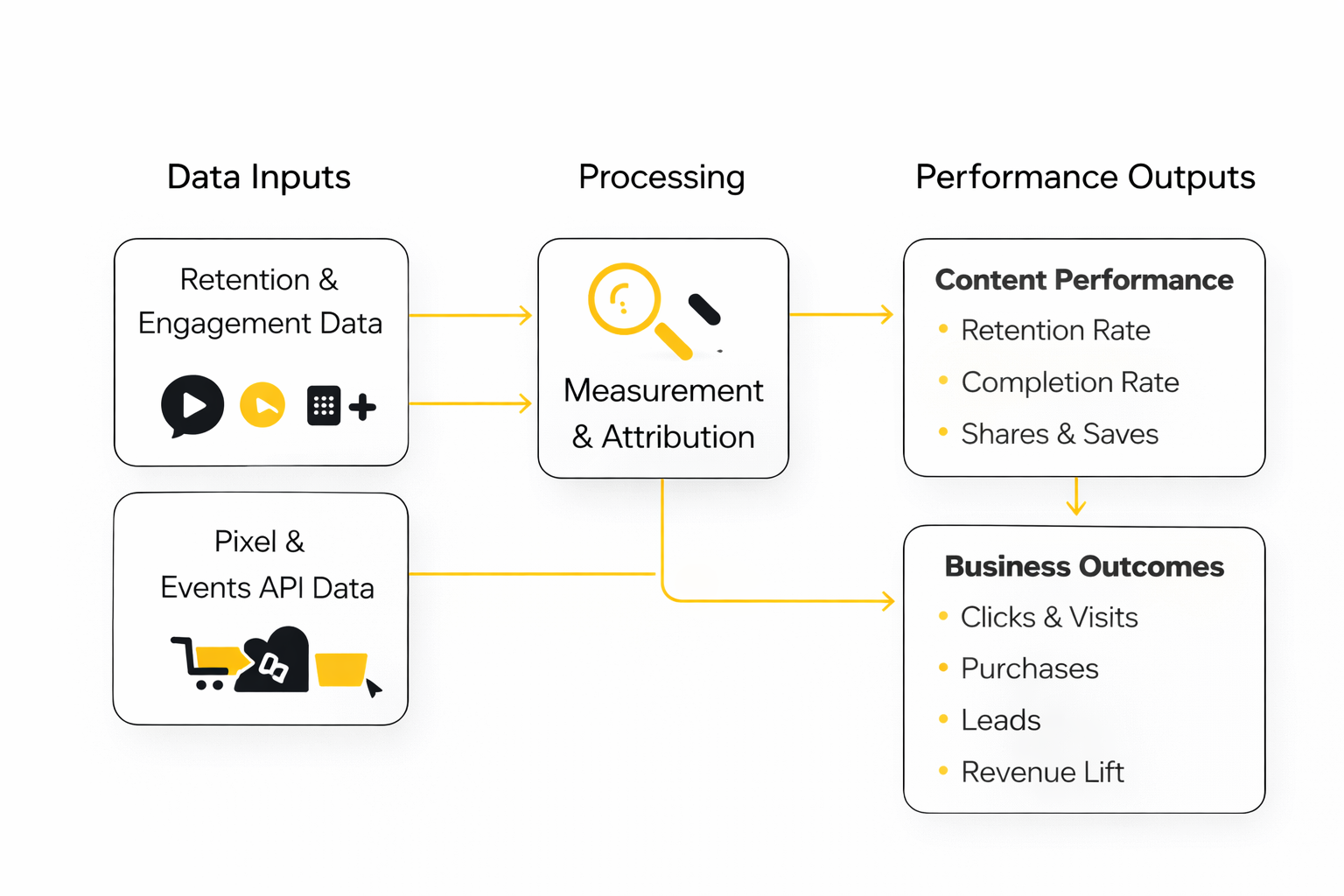
Start with retention and completion rate because they’re the closest thing TikTok has to “content-market fit.” If people don’t watch, nothing else matters.
Then look at shares, saves, and comments because those signals often reflect value and identity alignment. Shares usually mean “this represents me,” which is a high-intent signal for reach.
Finally, track downstream outcomes with a measurement stack you trust. Pixel and Events API together are repeatedly positioned as the recommended baseline in TikTok’s Pixel setup, Events API overview, and server-side tagging guide.
How to iterate creative without losing the plot
Make one change per iteration. If you change the hook, the script, the offer, and the edit style all at once, you won’t know what caused the lift (or the drop).
Use variation like a chef uses seasoning: enough to change the flavor, not so much that it becomes a different dish. Swap the first line, swap the first shot, swap the proof point, swap the pacing, but keep the core promise consistent.
Creative research can guide what to test. The Ipsos and TikTok work around creative resonance in Return on Creative is especially useful when you need a principled way to decide what “better” means beyond personal taste.
How to optimize budgets and campaign structure without panic
Scale spend only after creative is stable. If you scale too early, you amplify a weak message, fatigue sets in faster, and you blame the platform instead of the sequence.
When you test new placements like Search Ads, define success as incremental contribution, not as a replacement for existing campaigns. TikTok’s conversion lift reporting in its Search Ads blog frames integrated campaigns as additive, and industry reporting describes real-world adoption patterns that match that logic in Digiday’s search ads coverage.
Most importantly, keep the optimization cycle steady. TikTok punishes random thrashing and rewards sustained learning.
Implementation Stories
Implementation is where TikTok gets real. When the pressure is on—deadlines, budget scrutiny, performance expectations—the difference between “we post on TikTok” and “we run a smm tiktok system” becomes obvious.
American Eagle: When Discovery Wasn’t Enough and Search Became the Breakthrough
The numbers on the dashboard looked fine—until the team asked the uncomfortable question: “Are we capturing demand, or just entertaining people who were never going to buy?” Views were flowing, but the path from interest to purchase felt unpredictable. The more they pushed creative output, the more it exposed the real problem: the brand needed a way to convert high-intent shoppers at the moment they were actively looking.
American Eagle had already built serious digital marketing muscle, so the expectation was that TikTok should behave like a dependable growth lever, not a lottery ticket. The brand’s broader performance mindset shows up across its own marketing materials, including how it thinks about commerce and efficiency in published work like TikTok’s Search Ads case study. That’s the backdrop: a team that cares about outcomes, not vibes.
The wall arrived when incremental improvements stopped moving the needle the way they needed. Organic content and standard paid placements could drive awareness, but it wasn’t always catching the people who were already in “shopping mode.” At the same time, the industry conversation was shifting toward social search, with agencies describing real budget movement into TikTok search in Digiday’s coverage of TikTok search ads growth.
The epiphany was simple and sharp: treat TikTok like a place where people search with intent, not just scroll for entertainment. Instead of relying purely on discovery distribution, they tested Search Ads as a direct response layer that could meet users when they were actively hunting for products. TikTok’s own framing of this opportunity is explicit in its Search Ads incremental lift write-up, which positions Search as a complementary driver inside integrated strategies.
Then they did the unglamorous work: set up a structured test, track it cleanly, and compare it against a baseline. They ran a pilot Search Ads campaign and evaluated it versus non-search approaches, using performance metrics the business could respect. The results are published in TikTok’s American Eagle Search Ads case study, where the pilot is described as delivering a 100% increase in ROAS compared to non-search campaigns, a 46% improvement in CPA, and a 10x increase in conversion rate.
Of course, scaling something new rarely goes perfectly. Social search is still evolving, and even advertisers quoted in industry reporting describe performance as variable across accounts and categories. That variability forces discipline: creative has to match query intent, landing experiences have to be tight, and measurement has to be stable.
The dream outcome wasn’t just “better TikTok performance.” It was a more complete system where discovery and intent could work together instead of fighting each other. American Eagle’s story is useful because it turns a vague idea—“TikTok is becoming search”—into a practical implementation path, backed by the specific outcomes documented in the case study and reinforced by how the broader market is adopting search behavior on TikTok in recent industry coverage.
Listen Out: Selling Tickets Before the Lineup Buzz Faded
The clock was the enemy. An event launch window is brutal: interest spikes, then disappears, and every day you wait costs momentum. Listen Out needed to convert excitement into ticket sales fast, before attention drifted to the next trend.
Behind the scenes, the challenge was bigger than ads. Festivals don’t sell a product you can touch; they sell anticipation, identity, and the fear of missing out. That kind of emotional product can perform exceptionally well on TikTok, but only if the campaign is timed, measured, and optimized like a machine.
The wall hit when “general awareness” wasn’t enough. People might love the vibe, but ticket purchases require urgency and clarity: where to buy, what you get, and why now. Without clean measurement and a campaign structure that supports conversion, hype turns into noise.
The epiphany was treating pre-launch hype as a conversion problem, not just a reach problem. The campaign described in TikTok’s Listen Out case study frames the approach around capturing interest ahead of time, then turning it into measurable purchase actions.
The journey was a focused implementation: drive a large volume of intent, monitor performance continuously, and trim what underperforms. The same case study explains the importance of actively checking performance and removing low performers during the run in the published campaign description. That’s the operational detail most teams skip—then wonder why results flatten.
The final conflict showed up as every campaign eventually does: frequency, fatigue, and pressure to keep creative fresh while the launch window is closing. You can’t pause a festival launch and “come back next month.” You either keep the machine running or you lose the moment.
The dream outcome was a launch that didn’t just feel popular—it sold. TikTok’s published results for Tradable Bits’ campaign for Listen Out highlight 25M impressions plus performance outcomes including 87x ROAS and a 22.3% conversion rate on “Complete Payment” events in the case study results section. The deeper lesson is that urgency is a strategy, and TikTok execution has to match it.
Professional Implementation
If Part 1 is strategy and Part 2 is tools, professional smm tiktok implementation is the operating system: how you run TikTok week after week without burning out, breaking tracking, or losing creative quality.
Run TikTok like a weekly production system
Create a simple weekly cadence: one research block, one scripting block, one filming block, one editing block, and two community blocks. That cadence is what keeps output stable when the team gets busy.
Use Creative Center as a weekly input so you’re not “guessing trends.” TikTok built it as an always-on inspiration and insight layer in Creative Center, and treating it as a routine is what turns trends into strategy.
Protect creative quality by planning series and variations in advance. Professionals don’t rely on inspiration; they rely on structure that makes inspiration easier to catch.
Keep measurement clean enough to make real decisions
Implement Pixel + Events API as a baseline, then verify event quality, deduplication, and value mapping so optimization has good inputs. TikTok’s help center repeats the recommended pairing across the Pixel setup, Events API overview, and GTM setup instructions.
When stakeholders ask “what changed?”, you should be able to answer with a timeline: creative changes, targeting changes, budget changes, and landing page changes. That’s professionalism: traceability.
When you test new surfaces like Search Ads, define what “incremental” means before you start. TikTok’s own Search Ads discussion emphasizes incrementality in its conversion lift write-up, which aligns with how agencies describe social search as additive in industry reporting.
Build governance that makes collaboration safe
If you collaborate with freelancers, creators, or agencies, governance is not optional. Clear Business Center roles and asset permissions reduce risk while keeping the team fast, as laid out in TikTok’s guidance on roles and asset access.
Document your creative standards so “native” doesn’t turn into “off-brand.” Professionals can be playful without being inconsistent, and the difference is having guardrails.
Finally, keep a learning log. TikTok moves fast, and your advantage comes from what you learn, store, and reuse—long after a trend disappears.
Statistics and Data

Analytics can make smm tiktok feel either empowering or completely chaotic. The difference is knowing which numbers are “signals” and which are just noise that happens when you publish a lot. TikTok gives you plenty of metrics, but only a small handful consistently connect content quality to distribution, and distribution to business outcomes.
It helps to separate data into two buckets. The first bucket is attention quality: how long people watched, whether they rewatched, and whether they shared. The second bucket is outcome quality: what happened after they watched—clicked, purchased, booked, subscribed, or returned later through search.
One reason teams struggle is attribution drift: TikTok often influences behavior before the last click happens somewhere else. That’s why TikTok keeps pushing stronger data connections (Pixel plus Events API) and lift-style measurement to understand incremental impact, not just “who clicked last,” highlighted across TikTok’s measurement guidance in its measurement overview and the Events API documentation updated in April 2025.
If you want a simple north star for this part of your system: treat content metrics as a way to earn distribution, and treat conversion metrics as a way to earn budget.
Performance Benchmarks
Benchmarks are useful when they keep you honest, and dangerous when they make you copy someone else’s strategy. TikTok performance varies wildly by niche, creative style, and audience size, so the best benchmarks are ranges that come from multiple datasets rather than one “perfect” number.
Organic engagement benchmarks
Across large benchmark datasets, brand engagement on TikTok commonly lands in the low single digits, but the range depends heavily on how the dataset defines “engagement rate” (by views vs. by followers) and which accounts are included. SocialInsider’s 2025 benchmark report shows an average engagement rate of 4.90% in the first half of 2025, while Brandwatch summarizes brand benchmarks for 2024 as typically around 3–5%. Another perspective comes from Emplifi’s 2025 benchmark report, which breaks engagement down by size and industry using a large post sample across 2023–2024 in its benchmark appendix.
If your TikTok is consistently below 1% engagement, that’s usually a relevance problem (wrong topic, wrong hook, wrong payoff) or a distribution problem (weak retention). If you’re consistently above 5% on steady volume, you’re likely sitting on a repeatable format that deserves amplification and systematic iteration.
Paid benchmarks that help you avoid false confidence
Paid performance is even more context-dependent because creative and optimization settings can swing results dramatically. Still, broad market trackers give useful guardrails. Business of Apps summarizes TikTok Ads cost ranges (including CPM and CPC ranges) in its 2025 market snapshot at TikTok Ads Cost (2025), and Gupta Media publishes rolling platform benchmarks through its CPM tracker commentary in its 2025 TikTok ads cost breakdown. When e-commerce teams compare seasonal shifts, some ecosystem reporting highlights how TikTok CTR moved during 2024 shopping periods in Triple Whale’s Black Friday analysis.
The practical way to use these numbers is not “we should hit X.” It’s “are we wildly outside normal ranges, and if so, what changed?” A suddenly high CTR can mean your hook is strong—or it can mean your creative is clicky but misaligned with the landing page. A low CPM can mean you found cheap reach—or it can mean the algorithm is distributing into low-intent inventory that won’t convert.
Measurement benchmarks that protect your data quality
On the measurement side, TikTok repeatedly shows the same average lift when advertisers combine Pixel and Events API: more measured events and better efficiency. TikTok’s own materials cite +19% more events captured and +15% improvement in CPA on average when Pixel and Events API are used together, referenced in TikTok’s data connections performance guidance (May 2024), reinforced in its privacy-focused ecosystem update at Evolving Ads Ecosystem (Oct 2024), and repeated in the Performance Fundamentals (Jul 2024) PDF.
Even if your results don’t match those averages, the direction is the point: better signal typically improves optimization and reduces the chance you’re scaling based on incomplete data.
Analytics Interpretation
Most teams don’t fail on TikTok because they lack data. They fail because they interpret it backwards. The healthiest smm tiktok analytics workflow starts with what TikTok is built to do: distribute content that holds attention and generates interaction, then use that distribution to create business impact.
Read attention metrics as a creative diagnosis
Watch time and retention are the closest thing TikTok has to “product-market fit” for your content. If retention collapses early, you don’t have an audience problem—you have an opening problem. If retention is strong but comments are weak, you may be informative but not emotionally activating. If shares spike, you likely hit identity: people are sending it because it represents them.
This is where benchmarks help: if you’re underperforming relative to broad engagement ranges seen in benchmark datasets like Brandwatch’s 2024 brand guidance and SocialInsider’s 2025 analysis, don’t “post more.” Change the creative variable that most likely drives the drop: hook, pacing, proof, or payoff.
Read outcome metrics as a funnel diagnosis
Clicks, add-to-carts, purchases, lead submits, and booked calls are not creative metrics—they’re system metrics. If your content is strong but outcomes are weak, it often means the offer is unclear, the landing page is mismatched, or you’re measuring the wrong event.
This is also where signal quality matters. TikTok positions Events API as a “reliable connection” across web, app, and offline data in its Events API documentation, and it repeatedly recommends pairing Events API with Pixel for stronger performance and measurement in its data connections guidance.
A simple interpretation rule keeps you sane: if attention is high and outcomes are low, fix the bridge (offer, page, tracking, intent alignment). If attention is low, fix the content first—no funnel can save a video nobody watches.
Use incrementality thinking when TikTok is influencing “later” conversions
TikTok often works as an assisted-demand channel, especially for products people research or consider. That’s why TikTok and industry bodies emphasize lift studies and multi-touch measurement as a way to capture incremental impact, shown in the measurement options overviewed in TikTok’s measurement one-pager.
Practically, this changes how you interpret “weak last-click.” Instead of instantly judging TikTok as a loser, you test whether it increases total conversions, branded search, or conversion rate on other channels when it runs. This is also why TikTok keeps publishing conversion-lift style thinking alongside performance guidance in its data connections playbooks.
Case Stories
Case studies are most useful when you read them like an operator: what problem did they solve, what lever did they pull, and what result did that lever produce. The goal isn’t to copy a brand’s creative. It’s to copy the decision logic that turned creative into performance.
ASICS: When better creative wasn’t a vibe, it was a measurable lever
ASICS used TikTok’s Creative Exchange to develop video assets, then compared their performance against other creatives in the same campaign. The standout detail is not “they made better videos.” It’s that the better videos produced measurable efficiency: TikTok reports the Creative Exchange assets drove 136% higher ROAS, a 41% higher conversion rate, and a 62% more efficient CPA versus other creatives in the campaign, documented in the ASICS case study.
The take-away for smm tiktok is simple: creative quality is not subjective once you compare assets under the same distribution conditions. If you want predictable growth, treat creative as a testable variable, not a brand-debate topic.
Ray-Ban: Automation as a path to efficiency, not a shortcut
Ray-Ban’s story is useful because it frames automation as an operational advantage when you already have solid inputs (catalog, signal, creative variety). TikTok’s published results for Smart+ Catalog Ads describe a 50% decrease in CPA, a 47% increase in conversion rate, and a 42% higher ROAS, presented in the Ray-Ban case study.
The lesson isn’t “turn on automation and win.” It’s “build clean data and catalog foundations, then let automation scale what’s already structurally sound.”
The Dairy: When AI-driven structure improved the basics
Some brands don’t need a radical strategy—they need the core mechanics to run better. In TikTok’s Smart+ case study for The Dairy, the brand saw a 24% lower CPA, a 77% increase in CTR, and a 28% uplift in ROAS compared to another non-Smart+ web conversion campaign during the same period, outlined in the case study.
This is a good reminder that “optimization” is often basic hygiene: stable structure, sufficient creative variety, and measurement that lets the system learn.
Professional Promotion
Professional promotion in smm tiktok means you don’t throw budget at random posts. You promote with intent: amplify what already holds attention, match the promotion method to the goal, and keep measurement strong enough that you can explain results without hand-waving.
Promote winners, not guesses
When an organic video is already pulling strong retention and shares, it has earned distribution. That’s when paid makes sense—not to “force” performance, but to scale a message the algorithm has already validated. Spark Ads exist to boost organic posts while keeping the engagement on the original content, which is why it’s positioned as a native bridge between organic and paid in TikTok’s Spark Ads guidance.
If you can’t find organic winners, the answer usually isn’t “increase budget.” It’s “fix the creative system” until winners appear consistently.
Strengthen data connections before you scale spend
Scaling a campaign without solid measurement is like driving faster with fogged-up windows. TikTok repeatedly emphasizes that Pixel plus Events API improves event capture and efficiency, including the average +19% events captured and +15% CPA improvement claims shown in TikTok’s May 2024 data connections guidance, echoed in its Oct 2024 ads ecosystem update, and summarized again in the Performance Fundamentals PDF.
Even if you don’t hit those averages, clean data reduces guesswork and makes it easier to decide what to scale.
Scale with discipline so you don’t trigger creative fatigue
When spend rises, fatigue arrives faster. Professional teams plan for this by rotating creative variations and introducing new assets on a schedule. TikTok’s performance playbooks explicitly recommend ongoing account iteration—like adding new ad groups regularly—because stasis is one of the quickest ways to stall delivery, discussed in Performance Fundamentals.
The healthiest scaling behavior is boring: increase budget in steps, monitor performance stability, and keep creative refreshed so the system has something new to learn from.
Report like a pro: connect the story from attention to outcomes
Stakeholders don’t need a screenshot of the dashboard. They need a narrative that connects content performance to business impact: what you tested, what changed, what improved, and what you’re doing next. If TikTok influences conversions indirectly, incorporate measurement approaches that capture more than last click, reflected in the measurement stack options outlined in TikTok’s measurement overview.
When you can tell that story clearly, promotion stops feeling like gambling and starts feeling like a controlled growth system.
Future Trends
The next phase of smm tiktok won’t be won by brands that “post more.” It’ll be won by teams that build a faster learning loop than everyone else, because the platform is moving toward a more layered ecosystem: discovery, search, commerce, creators, and automation all working together.
One big signal is how openly TikTok is coaching marketers to think in culture and systems, not campaigns. TikTok’s own 2026 forecast, TikTok Next 2026, is basically a reminder that audiences will keep raising the bar for relevance, speed, and authenticity.
Another signal is the product direction: more automation, more creator-enabled scaling, and more tooling that helps teams manage creative at volume. TikTok’s Q1 2026 product preview and Smart+ updates highlight “Creative for Smart+” and features like auto-select that can pull from eligible creator content to recommend high-performing assets in the Q1 2026 product preview and the Smart+ performance update.
Commerce will continue to pull TikTok marketing closer to revenue. The platform is pushing harder into shopping formats and creator-driven selling, and mainstream business media is now treating TikTok Shop as a serious retail force, reflected in reporting like WWD’s discussion of TikTok Shop’s retail trajectory.
Measurement will keep getting more “infrastructure-like.” TikTok has been explicit about strengthening the data connection between advertisers and the platform through Pixel and Events API, with up-to-date docs for the TikTok Pixel (last updated March 2025) and Events API (last updated April 2025). The practical trend here is simple: teams that can prove impact will keep their budgets when everything gets scrutinized.
Strategic Framework Recap

If you want one clean way to remember how smm tiktok works at a professional level, think of it as an ecosystem you operate, not a platform you “use.” Every strong TikTok program is built from the same repeatable pieces.
- Positioning: a clear point of view that makes your content recognizable and worth returning to.
- Content systems: repeatable series formats that let you ship consistently without burning out.
- Distribution layers: organic reach, paid amplification, creator distribution, and (when it fits) search and commerce.
- Measurement spine: tracking that’s stable enough to connect attention signals to outcomes, anchored in tools like the TikTok Pixel and Events API.
- Optimization loop: structured testing where you change one variable, learn fast, and scale what earns it.
When these pieces work together, TikTok stops feeling like “random virality” and starts behaving like a compounding system: each week’s output makes the next week smarter.
FAQ – Built for the Complete Guide
What does smm tiktok actually mean in practice?
Smm tiktok is the disciplined practice of using TikTok to drive measurable marketing outcomes through content, community, and (when needed) paid distribution. It’s less about chasing trends and more about building a repeatable system that earns attention and converts it into the next step: clicks, sales, leads, or long-term brand demand.
How often should I post on TikTok to see results?
Post as often as you can stay consistent for at least 90 days. TikTok rewards learning velocity, but only if you can keep quality stable. A realistic weekly rhythm beats a two-week sprint every time, because the algorithm learns from patterns and your team learns from volume.
Why do my views spike and then drop?
This usually happens when the platform tests your video with a small audience first, then expands it only if retention and engagement signals stay strong. If the early audience watches but doesn’t finish, or engagement is weak, distribution stalls. Treat it as feedback on the opening hook, pacing, and payoff, not as a personal failure.
What metrics matter most for TikTok optimization?
Start with attention quality: retention, watch time, and completion. Then look at high-intent engagement like shares and saves. Finally, connect content to outcomes with stable tracking, which is why TikTok documents the Pixel and Events API as core infrastructure for performance measurement.
Do I need the TikTok Pixel if I’m not running ads yet?
If your TikTok sends people to a website where you want them to do something meaningful, setting up the TikTok Pixel early is still useful. It gives you clean baselines and avoids the “we scaled, but we can’t measure” problem later. If you never plan to run paid or measure site actions, it matters less.
What is the Events API and when should I use it?
The Events API is a server-side way to send marketing events to TikTok across web, app, and offline data sources. It becomes especially important when you want more reliable conversion tracking and stronger optimization inputs than browser-only tracking can provide.
Should I use Spark Ads or standard In-Feed Ads?
Use Spark Ads when you want to scale a post that already feels native and is earning real engagement, because Spark Ads preserve the “organic” identity and social proof on the post itself, explained in TikTok’s Spark Ads guide. Use standard In-Feed Ads when you need more control over creative variants and campaign structure, and you’re treating creative like a testing program.
Is TikTok becoming a search platform, and how should I respond?
Yes, for many categories it already behaves that way. The practical response is to build content that answers intent-based questions and to test paid search formats when they fit your funnel. TikTok’s own Search Ads Campaign launch story shows how search can improve efficiency with a real example in Introducing Search Ads Campaign.
What is Smart+ and who should use it?
Smart+ is TikTok’s automation-driven performance solution designed to simplify setup and scale optimization when you have solid inputs: clean measurement, clear conversion events, and enough creative variety. TikTok’s recent updates on “Creative for Smart+” show where the product is headed in the Smart+ performance post and the Q1 2026 product preview.
Is TikTok Shop worth building into my strategy?
If you sell consumer products that benefit from demonstration and creator-led proof, TikTok Shop can be a strong revenue channel. The reason is simple: TikTok is pushing hard to turn “content discovery” into “commerce action,” and industry reporting increasingly treats TikTok Shop as a major retail force in pieces like WWD’s TikTok Shop analysis.
How do I avoid burnout when running a TikTok program?
Build a system that protects energy: batch filming, repeatable series, and a simple weekly cadence. Most burnout comes from making every video from scratch. When you run a series-based system, you can create variety without reinventing your entire process every time.
Work With Professionals
You can learn TikTok fast, but building a predictable smm tiktok system while you’re also trying to find clients is a different kind of challenge. The hardest part isn’t knowing what to do. It’s getting consistent opportunities to do it, then turning results into your next contract.
That’s where a marketplace built specifically for marketing specialists becomes a real advantage. Markework positions itself as “the marketing marketplace” where you can build a profile, browse listings, and connect directly, with a model that emphasizes no middleman and no project fees. It’s designed for the part of freelancing that usually drains people: finding the next role, pitching, and negotiating through layers.
If your goal is to land more work, the opportunity is already massive. There are 10,000+ open marketing contracts listed on Upwork at any given time, and that’s just one platform. The advantage isn’t “more places to look.” The advantage is a cleaner path to conversations where you can actually close.
Markework’s flow is built around speed and clarity: create a profile, browse roles that match your skills, apply, and move to direct communication without a middle layer, outlined in the platform’s core workflow. For freelancers, that means less time stuck in fee-heavy marketplaces and more time doing the work that builds reputation: performance marketing, paid social, SEO, lifecycle, analytics, and the kinds of systems this guide teaches.
If you’re ready to turn your TikTok skills into consistent client work, start where the conversation happens and where the fees don’t eat your margin.
markework.com Filip Konecny Enterprises