
Most brands don’t have a “traffic problem.” They have a consistency problem: search visibility grows slowly, social reach spikes and fades, and the story customers hear changes from channel to channel.
That’s why seo and social media marketing services work best as one system. Search captures demand that already exists, social creates demand that didn’t exist yet, and both channels strengthen trust when they share the same positioning, proof, and content standards.
This article breaks the system into clear parts you can implement in-house or hand to a specialist team—without turning your marketing into a maze of disconnected tactics.
Article Outline
- What Are SEO and Social Media Marketing Services?
- Why SEO and Social Media Marketing Services Matter
- Framework Overview
- Core Components
- Professional Implementation
What Are SEO and Social Media Marketing Services?
SEO and social media marketing services are the combined planning, production, optimization, and measurement work that helps a brand get discovered in search engines and in social feeds—then turn that attention into leads, sales, and long-term loyalty.
In practice, it usually includes:
- Search demand capture: technical SEO, keyword-led content planning, on-page optimization, internal linking, and authority building so high-intent queries find you.
- Social demand creation: content strategy, creative production, community management, distribution, and (when useful) paid amplification to put ideas in front of the right people repeatedly.
- Content reuse with purpose: one “source of truth” content asset becomes multiple formats—without copy-pasting—and each format is tailored to how people actually consume it on that channel.
- Measurement that connects the dots: analytics, attribution-friendly tracking, and reporting that shows how social lifts search (and vice versa), instead of treating each channel like a silo.
When these services are split across separate plans, brands tend to publish more but win less. The goal isn’t volume—it’s compounding visibility and trust.
Why SEO and Social Media Marketing Services Matter
The internet is brutally crowded, and search makes that obvious. A large-scale analysis found that 96.55% of pages get zero search traffic, echoed by an independent breakdown of the same dataset in Informa TechTarget’s 2024 content marketing stats, and even quoted in a mainstream business context via Forbes Business Council’s 2025 SEO writing guidance.
That single reality changes how you should think about marketing:
- SEO alone can be too slow if you don’t have consistent distribution and brand pull. Great pages still need momentum, links, mentions, and returning audiences.
- Social alone can be too fragile because algorithms shift, reach fluctuates, and yesterday’s winning format can stop working next quarter.
- Together, they reduce risk: social gets your best ideas in front of people now, while SEO turns those ideas into durable discovery later.
There’s also a trust layer. Consumer surveys continue to show that people evaluate brands through multiple touchpoints, and social is often where credibility is tested—how you respond, how you explain, and whether you feel real. Research focused on social brand engagement in 2025 highlights how strongly trust and authenticity shape expectations of brands on social platforms (Emplifi’s 2025 Social Pulse consumer survey).
So the “why” is simple: integrated SEO and social prevents wasted effort. You stop creating content that disappears, and start building content that compounds.
Framework Overview
The framework in this guide treats SEO and social as one flywheel with four motions:
- Positioning: a clear promise, a clear audience, and proof that you can deliver—so every channel tells the same story.
- Content Engine: a repeatable way to create a few high-quality “core assets” that can be adapted into search pages and social formats.
- Distribution: deliberate publishing and repurposing that earns attention in feeds while sending strong relevance signals over time.
- Measurement: tracking that’s realistic about how people discover, evaluate, and return—so you optimize the system, not isolated posts.
It’s designed for modern buyer behavior: people bounce between channels, compare sources, and look for consistency. The goal is to make every touchpoint reinforce the same set of trust signals.
Core Components
Here are the components you’ll build in order. Each one feeds the next.
1) One Message, Many Formats
Start with a single positioning document: who you help, what outcome you create, how you do it differently, and what proof you can show. This becomes the filter for every keyword you target and every post you publish.
2) Topic Clusters That Match Real Intent
Instead of chasing random keywords, you build clusters around problems customers actually want solved. That means one strong “pillar” page for a core topic, plus supporting pages that answer the follow-up questions people ask when they’re evaluating options.
3) Social Content That Reuses the Research (Not the Copy)
Your search content research—questions, objections, comparisons, definitions—becomes the raw material for social. You’re not reposting blog paragraphs. You’re turning the same insights into short-form explanations, carousels, demos, and commentary that fits the platform.
4) Authority Signals That Look Human
Search engines and people both look for signs that you’re credible. That includes clear authorship, transparent experience, references to primary sources when you use numbers, and consistent brand mentions across the web. Google’s own documentation highlights the importance of quality evaluation concepts like E-E-A-T in how quality raters assess pages (Google Search Central on E-E-A-T).
5) Measurement That Connects Discovery to Conversion
Channel metrics are easy to collect and easy to misread. The more useful view is: what content creates qualified visits, what content creates returning visits, what social formats drive branded search and direct traffic, and what pages actually assist conversions.
Professional Implementation
Professional delivery of seo and social media marketing services usually succeeds or fails on operations, not ideas.
- Roles and accountability: someone owns search performance, someone owns social distribution and community, and one person owns the shared content pipeline so nothing ships half-finished.
- A real production cadence: fewer assets, higher quality, shipped consistently. The system should be boring in the best way—because boring beats chaotic.
- Editorial standards: every claim is sourced, every page has a purpose, every post has a hook, and every format has a clear next step.
- Feedback loops: social comments and objections inform what you build for SEO next; search queries and on-page behavior inform what you explain on social next.
In the next parts of the article, the framework turns into an actionable playbook: how to choose topics, how to build the content engine, how to distribute without burning out, and how to measure the system so it improves month after month.
Step By Step Implementation

Good seo and social media marketing services feel deceptively simple from the outside: the brand shows up in search, shows up in feeds, and the right people keep coming back. The “magic” is usually just a disciplined sequence that prevents wasted effort and keeps learning connected across channels.
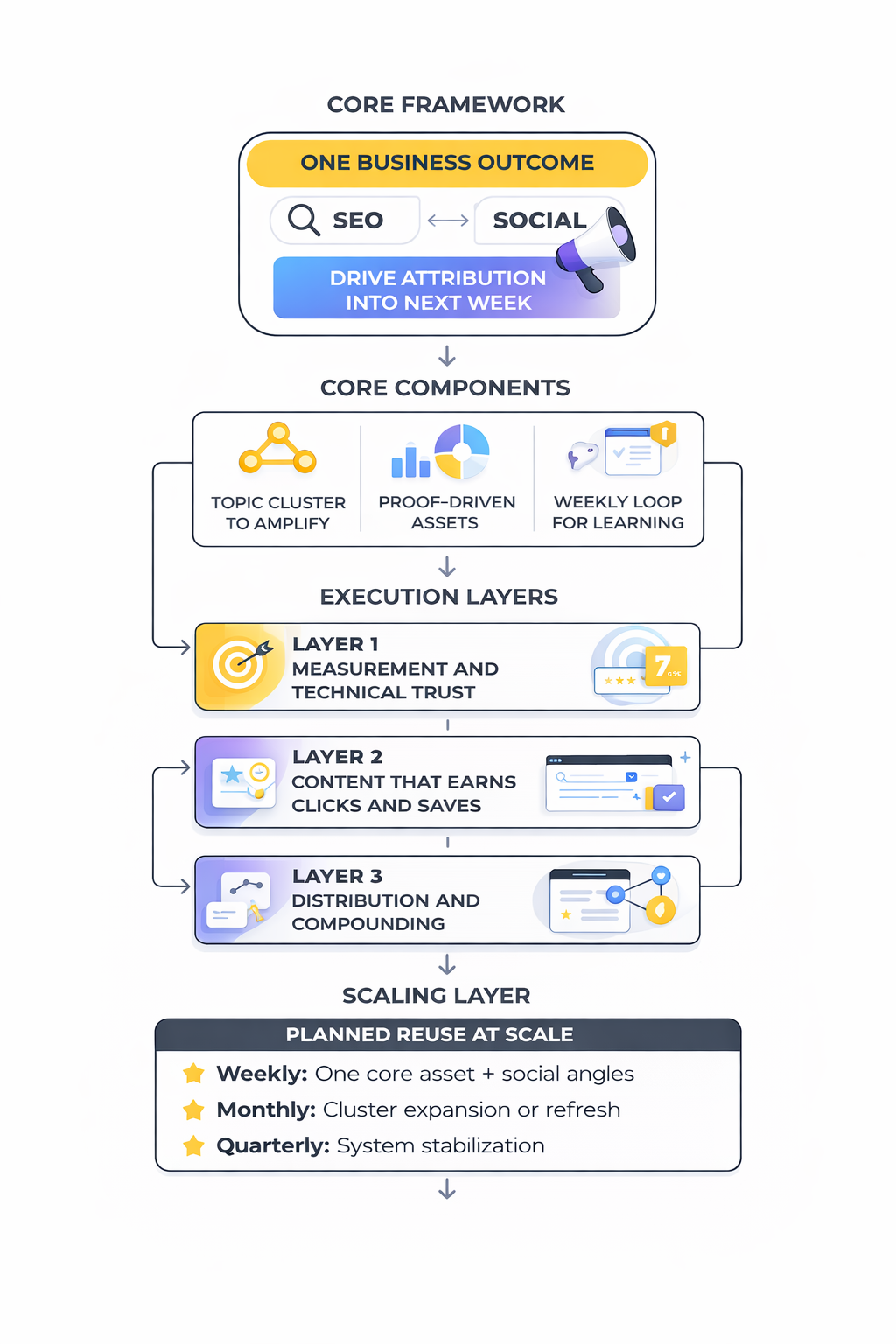
Step 1: Pick One Business Outcome And Make It Measurable
Choose one primary outcome you’re willing to optimize the entire system around: qualified leads, booked calls, trials, purchases, or demos. Then make sure your analytics reflects reality.
- Track the conversion as an event so you can measure it consistently across pages and sessions, aligned with the event-based approach explained in Google’s GA4 documentation.
- Connect Google Search Console to Analytics so you can see how search discovery relates to behavior and conversions, supported in Google’s Search Console integration help and expanded in Google’s guide to using both datasets together.
- Decide how you’ll interpret attribution before you stare at reports. Attribution is credit assignment along a path, and it’s meant to support decisions, not become a courtroom, as framed in Google’s attribution overview.
Step 2: Build A Topic Cluster That Social Can Amplify
Pick a tight topic cluster where you can win both attention and intent. This is where SEO gives you the “what people want,” while social gives you the “what people argue about.”
- Start with one pillar page that fully answers the core query and clearly guides the next step.
- Add 4–8 supporting pages that handle comparisons, objections, and “how to choose” questions.
- Create a social angle map where each supporting page becomes multiple social posts: one myth, one checklist, one mistake, one story, one teardown, one quick win.
Step 3: Publish One Core Asset, Then Turn It Into Multiple Proof-Driven Formats
Ship one high-quality core asset first. Then repurpose the research into formats that fit each platform instead of copy-pasting paragraphs.
- Search format: a structured page that earns clicks and keeps readers moving through your site.
- Social formats: short explanations, carousels, demos, and “here’s what I’d do” posts that make a single point obvious.
- Proof formats: a mini case study, a teardown, screenshots, or a process walkthrough you can reference repeatedly.
This matters because organic search is still a dominant growth lever for many sites. BrightEdge’s research highlights organic search at 53.3% of trackable web traffic, while Conductor’s benchmark analysis shows organic search averaging 33% of overall traffic across seven industries. Those numbers won’t match every business model, but they point to the same truth: when you earn visibility in search, it compounds.
Step 4: Use Social To Create Demand, Not Just Distribute Links
Social is where your message becomes memorable. People scroll fast, but they remember the brands that consistently explain the same valuable idea in slightly different ways.
There’s enough attention to justify the effort. Digital 2025 reporting shows people spending 2 hours and 21 minutes per day on social media, echoed in the We Are Social Digital 2025 report PDF and compiled in Smart Insights’ global social media research summary. Your goal is to earn enough trust in feeds that people later search your brand by name.
Step 5: Create A Weekly Loop Between Search Signals And Social Signals
This is where seo and social media marketing services stop being two separate deliverables and become a flywheel.
- Search-to-social: rising queries and high-impression pages in Search Console become social explainers and objection-handling posts.
- Social-to-search: repeated questions in comments become new supporting pages and internal links from the pillar page.
- Conversion-to-content: sales calls and lost deals become new sections on your best pages and new angles for your strongest posts.
Execution Layers
Implementation is easier when you treat it like layered construction. Each layer has a different job, and each one prevents a different kind of waste.
Layer 1: Measurement And Technical Trust
If tracking is shaky, optimization turns into guesswork. If crawling and indexing are shaky, your best content never gets a fair shot.
- Search and analytics alignment: bring Search Console and Analytics together so the team can connect queries to outcomes, following Google’s workflow for using both datasets.
- Change management: site moves and URL changes should follow best-practice checklists so rankings don’t get erased by accident, covered in Google’s site move guidance.
- Definition of conversion: keep one consistent definition across reporting and decision-making, grounded in GA4’s event-based model described in Google’s documentation.
Layer 2: Content That Earns Clicks And Saves
This layer is about building assets that people actually use. Search content earns clicks by being the best answer. Social content earns saves by being the clearest explanation.
- SEO assets: pages that solve the problem fully and guide the next step without fluff.
- Social assets: formats that match how each platform is consumed, with one idea per post.
- Proof assets: demos, frameworks, and transparent examples that reduce buyer uncertainty.
Layer 3: Distribution And Compounding
This layer is where most teams fall short. Not because they don’t publish, but because they don’t build repetition without boredom.
- Planned reuse: your best idea gets multiple shots, reframed for different objections and different stages.
- Internal linking as distribution: new posts and new pages should strengthen existing winners by sending relevance and authority through your own site.
- Promotion without burnout: a small, repeatable cadence beats a big burst that collapses next month.
Optimization Process
Optimization should feel like a predictable routine. If it only happens “when there’s time,” it becomes reactive, and reactive marketing rarely compounds.
Weekly: Improve What’s Already Working
- Search Console scan: find pages with high impressions and low clicks, then improve the promise and structure so the click feels inevitable.
- Analytics scan: identify pages that attract visitors but don’t assist conversions, then tighten the next step and remove distractions.
- Social scan: take the top-performing post and remake it with a new hook and a new example so the idea reaches more of the right people.
Monthly: Expand The Cluster Or Refresh The Core
Each month, do one major thing: add one supporting page that strengthens your cluster, or refresh your strongest page so it stays strong.
Clicks are harder to earn than they used to be, and that changes what “good” optimization looks like. SparkToro’s research highlights how many searches end with no click to the open web in its 2024 zero-click study, while Datos’ clickstream reporting points to declining organic clicks year-over-year in the Q1 2025 State of Search report PDF, discussed in Search Engine Land’s analysis. The practical response is simple: build more branded demand through social and make the clicks you do earn convert better.
Quarterly: Stabilize The System
- Technical review: crawl issues, internal linking gaps, and index coverage problems.
- Content pruning: merge overlapping pages so your best pages win harder.
- Measurement QA: confirm events, conversions, and integrations still work after site changes.
Implementation Stories
Here’s what implementation looks like when demand creation and demand capture are treated as one system instead of separate projects.
Volvo’s EX90 Launch: Turning Attention Into Search Demand
The launch had everything that makes marketers nervous. A premium product needed cultural relevance, not just product specs, and it needed to break through a feed environment where “nice” content disappears in minutes. If the campaign didn’t create real interest, the only thing that would grow was internal skepticism.
Volvo’s backstory mattered here. The brand had a long history of safety-led messaging, and that strength can become a weakness when a new audience wants emotion, not engineering bullet points. The challenge wasn’t simply getting views; it was getting the kind of attention that makes people actively seek the brand out.
The wall showed up in the classic place: proof. Awareness campaigns can look successful while leaving performance teams unsure what to do next. That’s why measurement frameworks like Google’s Search Lift exist in the first place: they’re designed to connect advertising exposure to real search behavior.
The epiphany was to treat the campaign as a demand engine, not a one-time splash. Volvo leaned into YouTube as a primary canvas and measured the downstream effect in search behavior, described in Google’s Volvo EX90 case study. When social and video create curiosity, search becomes the place people go to validate that curiosity.
The journey after that becomes operational, and this is where the SEO side of the system does its job. When a campaign increases branded demand, your site needs the right pages ready: launch pages, comparisons, “is it worth it” explainers, and dealer or availability information that answers the exact questions people type when they’re excited. This is the moment where integrated seo and social media marketing services prevent leakage, because the demand you created now has somewhere credible to land.
Then the final conflict hits: success creates new pressure. Traffic surges expose weak internal linking, confusing navigation, slow pages, and fuzzy conversion tracking. Teams that don’t have Search Console and Analytics aligned end up arguing about what happened, even when something good happened, which is why Google’s Search Console integration guidance and joint reporting workflows are so valuable in practice.
The dream outcome is a launch that doesn’t fade when the spend fades. Volvo’s published results in the case write-up include search lift, consideration lift, and earned media value in the EX90 case study. The deeper win is what that implies for your own marketing: when social and video create interest, SEO captures and converts it, and the next campaign starts from a higher baseline instead of from zero.
Scope That Protects Focus
- One cluster at a time: one pillar, a handful of supporting pages, and a defined set of social angles.
- One conversion priority: everything supports the same outcome so reporting stays clean.
- One shared measurement view: Search Console + GA4 alignment creates a single narrative for discovery and results, supported by Google’s combined monitoring guidance.
Cadence That Creates Compounding
- Weekly shipping: one meaningful SEO improvement and one “winner remake” on social.
- Monthly expansion: one new supporting page or one serious refresh of a key page.
- Quarterly stabilization: technical, measurement, and conversion-path QA.
Quality Standards That Keep Trust Intact
- Every statistic is linkable: if it can’t be tied to a reputable primary source, it doesn’t get published.
- Every post has a job: build awareness, handle an objection, drive a next step, or strengthen a cluster.
- Every report supports a decision: attribution is used as directional guidance for choices, consistent with how Google frames attribution in GA4.
When this is implemented well, the system stops feeling like “two channels to manage” and starts feeling like one engine: social creates attention and memory, SEO captures intent and converts it, and each week’s learning improves the next week’s output.
Statistics And Data
If you’re paying for seo and social media marketing services, the real “deliverable” isn’t a pile of posts or a spreadsheet of keywords. It’s clarity: what actually creates demand, what captures it, and what turns it into revenue without you needing a weekly debate about attribution.
That clarity starts with a small set of numbers that behave like truth serum. Not vanity metrics. Not a dashboard that looks busy. Just signal that helps you decide what to do next.
Demand Numbers That Explain The Market You’re In
- Time available for attention: the typical internet user spends 2 hours and 21 minutes per day on social media, echoed in Digital 2025 (We Are Social) reporting and summarized in Smart Insights’ 2025 global research recap.
- Clicks are getting squeezed: desktop behavior data shows organic-result clickers declining year over year, with EU/UK organic clicks dropping from March 2024 to March 2025 while zero-click rises, supported by the clickstream-based findings in Datos’ State of Search Q1 2025 report and contextualized in Datos’ report overview.
Performance Numbers That Prove You’re Compounding
- Search demand capture: impressions and clicks in Search Console (and the share of clicks coming from non-branded queries).
- Social demand creation: saves, shares, and profile actions that predict future searches and direct traffic.
- Revenue path: conversion rate on priority pages, assisted conversions, and lead quality (not just lead count), grounded in GA4’s event-based measurement approach.
Performance Benchmarks
Benchmarks are useful when they stop you from panicking. They’re dangerous when they replace thinking. The goal here is not to “hit the internet average.” The goal is to understand what’s normal for the channel and then build a plan that improves your numbers month over month.
Social Benchmarks That Actually Help
Engagement varies wildly by industry, audience size, and format, so use benchmark reports as guardrails, not targets.
- Platform engagement movement: the 2025 benchmark analysis across thousands of brands shows engagement rates falling on major platforms year over year, with highlights published in Rival IQ’s 2025 Social Media Industry Benchmark Report and broader trend comparisons reinforced in Socialinsider’s 2026 benchmark update.
- Instagram format reality: carousels keep holding up as a resilient format, with carousel engagement noted as stable in Socialinsider’s Instagram benchmarks and format insights reflected in Rival IQ’s 2025 report highlights.
- Short-form video reach engagement: cross-platform reporting shows Reels reach engagement outpacing TikTok in Emplifi’s benchmarks, with the specific comparison documented in Emplifi’s 2025 Social Media Benchmarks Report and reiterated in Emplifi’s explainer on reach vs impressions.
Search Benchmarks That Keep You Honest
Search performance benchmarks are best used to spot problems: a page ranking well but getting weak clicks, or getting clicks but failing to convert.
- Organic CTR by position: industry-level CTR tracking is published quarterly in Advanced Web Ranking’s Google CTR report for Q2 2025, while broader “ranking position to CTR” modeling is maintained in First Page Sage’s CTR report. Treat these as directional because SERP features and AI answers change the playing field.
- Paid search baseline for comparison: when you’re judging SEO conversion efficiency, it helps to know how “clickable” paid search is in the same environment, and WordStream’s 2025 Google Ads benchmarks provides a reference point for average search ad CTR.
Analytics Interpretation
Analytics becomes simple when you stop asking, “What happened?” and start asking, “What decision does this unlock?” A clean interpretation framework keeps your seo and social media marketing services from turning into a reporting ritual that never changes behavior.
The Three Questions That Turn Data Into Action
- Did we create demand? Look for growth in branded searches, direct traffic, profile visits, and repeat engagement. When awareness is working, people don’t just click once; they come back with intent.
- Did we capture demand? Look for non-branded search clicks landing on pages that match intent. If impressions rise but clicks don’t, you probably need a clearer promise and page structure.
- Did we convert demand? Look at conversion rate on the pages that get the most qualified traffic. If traffic rises and conversions don’t, the offer, the page flow, or the tracking is lying to you.
Attribution Without The Headaches
Attribution is a compass, not a courtroom. Use it to decide where to invest next, and keep one consistent measurement model so you can compare weeks and months without constantly moving the goalposts.
- Pick one primary conversion and measure it consistently in GA4, aligned with Google’s GA4 events and conversions guidance.
- Connect search visibility to on-site behavior by pairing Search Console and Analytics via Google’s integration setup and using the workflow described in Google’s combined monitoring documentation.
- Assume SERPs will steal clicks and plan around it. Desktop clickstream data shows the zero-click trend rising while organic clicks decline in multiple regions, captured in Search Engine Land’s breakdown of Datos findings and supported by Datos’ State of Search Q1 2025 report.
Case Stories
Numbers are easier to trust when you can picture the moment they started moving. Here’s a real example of what happens when measurement stops being an afterthought and becomes the engine.
Ray-Ban’s Performance Push: When Better Signals Turn Into Better Results
The pressure hit right before the season that matters. Summer demand was ramping, expectations were high, and the fear was familiar: spend more, get “busy” results, and still miss the numbers. The campaign needed a clean win, not a story that sounded good in a meeting.
Ray-Ban’s backstory made the challenge harder, not easier. The brand is iconic, but iconic doesn’t guarantee modern performance at scale, especially when audiences fragment and platforms evolve fast. What worked last season can quietly stop working this season, and nobody notices until the CPA spikes.
The wall was efficiency. The team needed campaigns that could expand reach and still convert, without drowning in manual optimizations or creative fatigue. When performance stalls, it’s rarely just creative or targeting; it’s often the quality of the signal going into the system.
The epiphany was to treat setup as strategy. Ray-Ban leaned into automation with Smart+ Catalog Ads and strengthened measurement with TikTok Pixel plus Events API and Advanced Matching, described in TikTok’s Ray-Ban case study. Instead of trying to “outguess” the platform, they focused on feeding it higher-quality inputs.
The journey became a full-funnel execution, not a single tactic. The automation simplified targeting, optimization, and creative decisions, which reduced operational drag and made iteration faster. With better signals and a cleaner structure, the campaign could keep learning instead of resetting every time the team changed something.
Then the final conflict showed up: scale always reveals weak links. When volume rises, tracking gaps get louder, and if your conversion events aren’t consistent, the reporting starts telling contradictory stories. That’s why the boring parts matter, and why event-based measurement frameworks like GA4’s conversion setup exist in the first place.
The dream outcome was measurable and specific. Ray-Ban reported a 50% decrease in CPA, a 47% increase in conversion rate, and a 42% higher ROAS after shifting to the automated approach with stronger data connections. The bigger lesson for seo and social media marketing services is simple: when you respect measurement, you give every channel a fair chance to perform, and you stop guessing why results changed.
Professional Promotion
Promotion is where most strategies quietly break. People either over-promote content that isn’t conversion-ready, or they build conversion-ready pages and never generate enough attention to feed them.
Promote Like A Pro: One Narrative, Two Paths
- The social path (attention to memory): publish repeatedly around one idea until it becomes familiar. The audience doesn’t need more variety; they need clearer understanding.
- The search path (intent to decision): build pages that match the exact questions people ask when they’re ready to choose. Then connect them with internal links so one good page strengthens the rest.
What To Measure So Promotion Improves Instead Of Exhausts You
- Promotion health: saves, shares, and profile actions, interpreted against industry benchmark trendlines like Rival IQ’s multi-industry report and ongoing platform snapshots such as Socialinsider’s benchmarks.
- Capture health: Search Console impressions and clicks for priority pages, with Analytics behavior and conversions connected via Search Console integration.
- Reality check: watch for click suppression and plan around it, using the clickstream-based evidence of rising zero-click behavior in regional Datos findings summarized by Search Engine Land and the underlying dataset in Datos’ report.
When promotion is done professionally, it doesn’t feel like shouting. It feels like building a reputation in public while quietly improving the pages that close the deal. That’s when seo and social media marketing services stop being “two channels” and start behaving like one system.
Future Trends
The next wave of seo and social media marketing services won’t be won by whoever publishes the most. It’ll be won by whoever earns trust in places where clicks are optional, and still captures demand when people decide they’re ready.
Search Will Keep Answering More Questions Without Sending Clicks
Google’s own documentation now treats AI experiences as a first-class part of search, including how content can appear inside AI Overviews and related features in AI features and your website. That matters because behavior shifts when the answer is already on the page.
A real-world snapshot shows how big the change already is: Pew Research found that around one-in-five Google searches in March 2025 produced an AI summary, and that people were less likely to click links when those summaries appeared. Industry datasets are pointing in the same direction, with clickstream reporting on rising zero-click behavior covered in Search Engine Land’s analysis of Datos and SparkToro findings alongside the underlying data in Datos’ State of Search Q1 2025 report.
The practical response is not panic. It’s building a brand people look for on purpose, and making sure the pages they do click are so good they convert.
Social Search Will Keep Stealing Discovery Moments
More “search” is happening in feeds and platform search bars, especially for product discovery and lifestyle decisions. Pew’s latest platform usage view reinforces how platform adoption keeps shifting by age group in Americans’ Social Media Use 2025.
For execution, the implication is simple: your SEO pages must be built to capture intent, while your social content must be built to create the intent in the first place. When you treat them as a single system, you stop losing people between the “I’m curious” moment and the “I’m ready” moment.
Creators Will Become A Core Distribution Layer, Not A Side Channel
Creator marketing is moving from “experimental” to “budget line item.” IAB projects U.S. creator ad spend reaching $37 billion in 2025, with the full methodology and numbers available in the report PDF.
The SEO angle here is underrated: creators create curiosity, and curiosity turns into validation searches. Brands that win will turn creator content into repeatable topic clusters and proof assets that keep ranking long after a post stops circulating.
People-First Content Will Matter More, Even When AI Helps Create It
As AI-generated content becomes easier to produce, the differentiator becomes lived experience, proof, and clarity. Google’s guidance pushes publishers to self-assess content quality and emphasize experience, expertise, authority, and trust in Creating helpful, reliable, people-first content.
This is exactly why integrated seo and social media marketing services work: social provides the human surface area (voice, credibility, community), and SEO provides the durable discovery layer (structure, intent matching, conversion paths).
Strategic Framework Recap
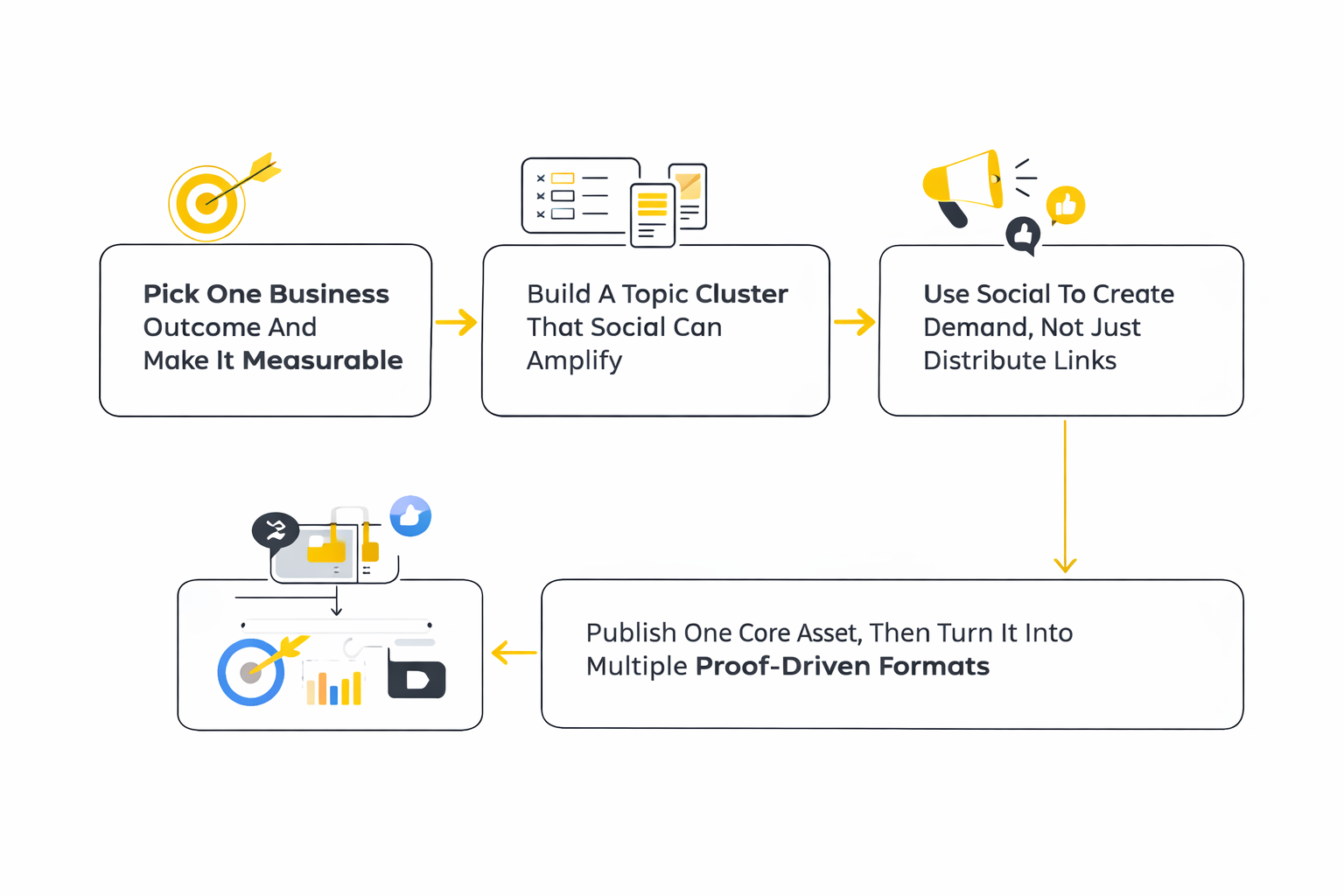
The framework you’ve built across this guide can be summarized in one sentence: create demand in social, capture demand in search, and use shared measurement to keep the flywheel honest.
- One message: positioning that stays consistent across pages and posts.
- One content engine: a small number of strong core assets that get repurposed into the right formats.
- One distribution plan: social repetition that creates memory, plus internal linking that compounds relevance.
- One measurement story: clean conversions and connected datasets that help you decide what to do next, not what to argue about.
When you run seo and social media marketing services like this, you don’t just get “more traffic.” You get more certainty about what drives revenue and what doesn’t.
FAQ – Built For A Complete Guide
What do SEO and social media marketing services usually include?
Most packages combine search visibility work (technical SEO, on-page optimization, content planning, internal linking) with social strategy and execution (content production, publishing, community management, and sometimes paid amplification). The best setups also include analytics so you can connect visibility to conversions.
Is it better to start with SEO or social first?
If you need demand quickly, start with social so you can test messaging and earn attention immediately. If you already have clear demand, start with SEO so high-intent searches can find you consistently. In practice, the fastest path is doing both at a small scope: one topic cluster plus a simple social distribution plan.
How long does it take for SEO to show results?
It depends on competition, site health, and how well your content matches intent. You can often see early signals (indexing, impressions) in weeks, but meaningful compounding is usually measured in months. The point of pairing SEO with social is that social can drive immediate attention while SEO builds durable discovery.
Do social signals directly improve SEO rankings?
Social engagement itself is not a direct ranking factor you can “optimize for,” but social can indirectly help SEO by increasing brand awareness, earning mentions, driving referral traffic, and creating more opportunities for links and citations. The strongest indirect effect is often branded search growth.
What metrics should I track to know the system is working?
Track a small set: Search Console clicks and impressions for priority pages, GA4 conversions on your primary outcome, and social saves/shares/profile actions that indicate real interest. Then watch whether branded searches and returning traffic rise over time.
How do we choose keywords without producing boring, generic content?
Start with real intent, not keyword lists. Use Search Console and customer conversations to find what people actually want to decide, compare, or solve. Then create pages that answer the full decision, and social posts that make the idea memorable in simple language.
What’s the biggest mistake companies make with seo and social media marketing services?
They treat them like separate deliverables. SEO becomes a publishing treadmill, social becomes random posting, and measurement becomes a monthly report that doesn’t change decisions. The fix is one shared topic map and one weekly feedback loop between search queries, social comments, and conversion data.
Should we rely on AI tools to write content?
AI can help draft and organize, but it doesn’t replace experience, proof, and judgment. The safest approach is using AI for speed while keeping humans responsible for accuracy, examples, and clarity. People-first standards still matter, reflected in Google’s people-first content guidance.
How do we adapt to AI Overviews and zero-click search?
Assume fewer clicks for some queries and build for brand preference. Publish social content that earns memory and trust, then make your site the best place to validate and convert. It also helps to structure pages clearly so they can be referenced and cited within AI experiences, described in Google’s AI features documentation.
When should we hire a specialist versus keeping it in-house?
If you can’t ship consistently, can’t measure reliably, or can’t connect social feedback to SEO priorities, outside help is often worth it. The best partners don’t just “do tasks.” They install a system your team can operate, improve, and scale.
How many times should we promote the same piece of content on social?
More than you think. Repetition builds recognition. The trick is to vary the hook, format, and proof so it doesn’t feel repetitive. If the idea is useful, it can be remade as a checklist, a myth-buster, a teardown, a quick demo, and a Q&A.
What does a “good” monthly scope look like for a small team?
A realistic baseline is one meaningful SEO page improvement per week, one supporting page or refresh per month, and a consistent social cadence that repurposes the same research into multiple formats. The goal is compounding, not exhaustion.
Work With Professionals
Most freelancers don’t struggle because they’re not skilled. They struggle because finding consistent clients feels like restarting from zero every month, and platforms often take a cut that makes “winning” feel smaller than it should.
Here’s the reality: demand is already massive. Upwork alone shows 11,838 open marketing jobs, which is a clean reminder that there are easily 10K+ remote marketing contracts available across the market right now if you can get in front of the right opportunities.
Markework is built for that exact moment—when you want a steady pipeline without the usual friction. The platform positions itself as a marketing marketplace where you can post a listing or build a profile and connect directly, with no middleman and no project fees. It also emphasizes no commissions, so you keep control of what you earn instead of watching margins disappear.
If you’re offering seo and social media marketing services, this is where the system you just learned becomes your edge. A clean framework makes your pitch simpler, your delivery smoother, and your results easier to defend. Companies don’t just want “a marketer.” They want someone who can create demand, capture intent, and prove impact without drama.
Build a profile that shows your outcomes, not just your skills. Apply to roles that match your strongest lane. Then use your process to close faster—because clarity sells, and consistency keeps clients.
 Filip Konecny Enterprises