

Step By Step Implementation

If you’re working with real estate social media marketing companies (or trying to run the same playbook in-house), the fastest way to waste budget is to treat “posting” and “ads” like separate worlds. In practice, the winners operate one connected system: organic content creates trust, paid distribution accelerates reach, and a tight lead workflow turns attention into appointments.
This step-by-step is designed to be repeatable. You can run it for a solo agent, a multi-office brokerage, or a developer leasing up hundreds of units, without reinventing the wheel each time.
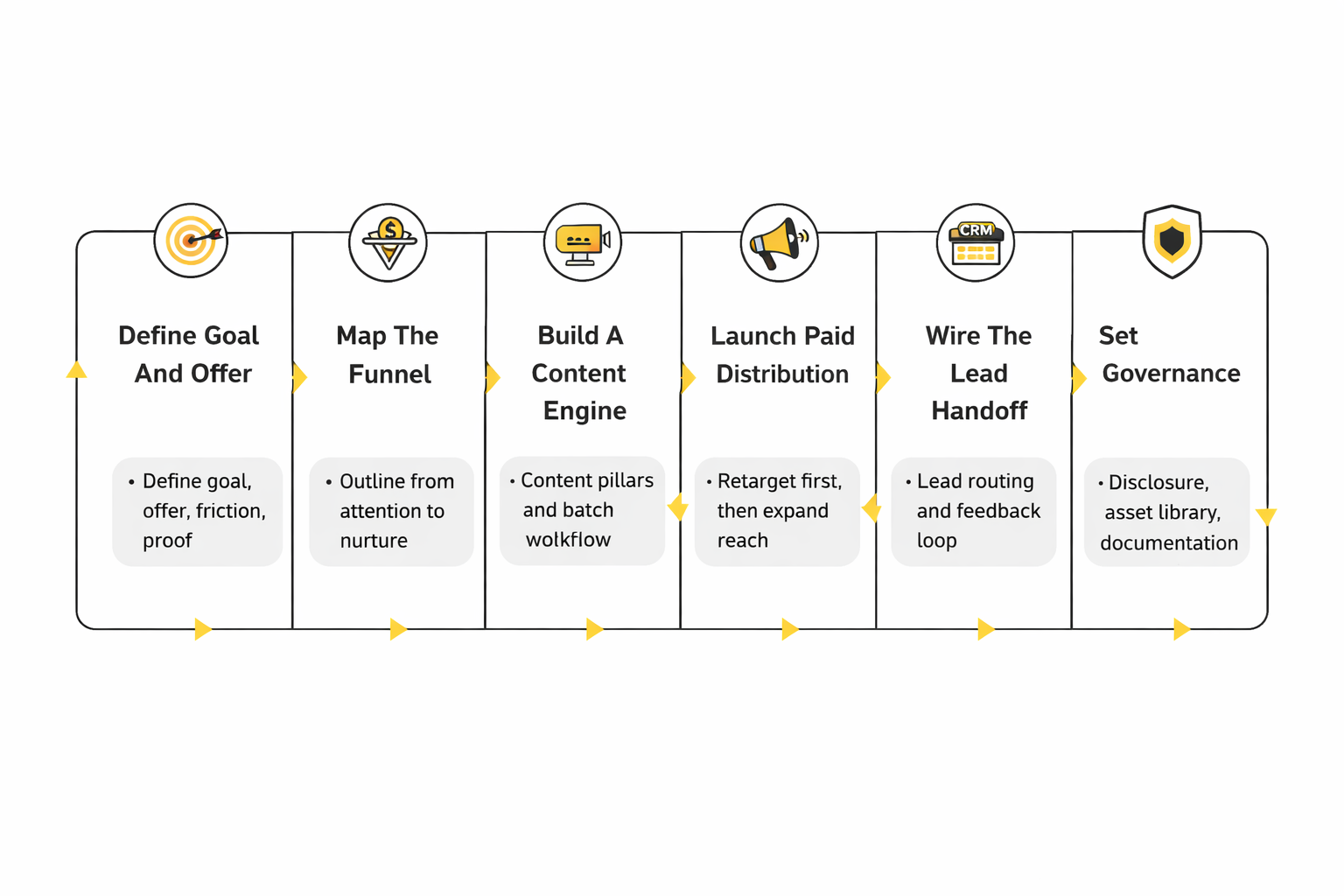
Phase 1: Define The Goal And The Offer
Start by choosing one primary outcome for the next 30–60 days, not five. “More followers” is rarely the real goal. A real goal sounds like: booked buyer consults, listing appointments, open house RSVPs, leasing inquiries, or nurture opt-ins for sellers who aren’t ready yet.
- Offer: One clear reason to raise a hand (valuation, neighborhood report, first-time buyer workshop, “new listings under X,” open house VIP list, relocation guide).
- Friction: Decide what you’re asking for (DM, form, call, WhatsApp message, booking link) and keep it consistent across content and ads.
- Proof: Pick the proof you can show repeatedly (client reviews, on-camera expertise, market updates, property walk-through quality, response speed).
Phase 2: Map The Funnel From Scroll To Conversation
A lot of teams obsess over targeting, then lose the deal in the handoff. The funnel is only as strong as the moment after the lead arrives.
- Attention: Reels/short video, carousel tours, “3 things to know” market clips, neighborhood mini-documentaries.
- Intent: Retargeting sequences that answer objections (financing, timing, price drops, neighborhood fit).
- Conversion: One simple action (book, call, DM, form) and one simple next step (confirm + qualify + schedule).
- Nurture: A 14–30 day follow-up plan that keeps helping, not begging (new listings, price movement notes, “what I’d do if I were buying this month” guidance).
Phase 3: Build A Content Engine Real People Can Maintain
Real estate social media marketing companies often win because they don’t rely on heroic effort. They create a content engine that makes consistency boring—in the best way.
- 3 core pillars: listings, local authority, and trust (process + people + proof).
- 1 “signature format”: the same structure every week (e.g., “What $X buys you in [area]”, “Market Minute”, “Neighborhood Walk”).
- Batch workflow: one filming block, one editing block, one scheduling block.
- Message handling: define who answers DMs/comments, how fast, and what happens next.
Phase 4: Launch Paid Distribution The Smart Way
Paid social doesn’t replace organic; it makes the best organic show up in front of the right people more often. Instead of inventing ad creatives from scratch, promote what already earns attention.
- Warm-first structure: start with retargeting (video viewers, engagers, site visitors), then expand to local lookalikes or interest clusters.
- Creative rules: lead with the hook in the first seconds, keep the location obvious, and make the next step feel like a natural continuation of the content.
- Lead capture: choose one path (instant form, landing page, DM) and design follow-up around it.
Phase 5: Wire The Lead Handoff So Nothing Gets Lost
This is where “marketing” turns into “revenue.” If you’re paying to generate leads, you need a clean handoff into your CRM, a clear first response, and a way to learn which leads actually became clients.
NAR’s 2025 technology survey highlights why this matters: social media is widely used by REALTORS®, and it’s also reported as the top lead-generating technology for many respondents, which makes follow-up discipline the real differentiator rather than “being on social.” https://www.nar.realtor/research-and-statistics/research-reports/realtor-technology-survey https://cms.nar.realtor/sites/default/files/2025-09/2025-realtors-technology-survey-report-09-18-2025.pdf https://www.housingwire.com/articles/nar-2025-technology-survey-realtor-tech-usage-trends/
- Instant routing: lead arrives → CRM record created → assigned owner → notification sent.
- First response: a short message that references the exact offer they requested.
- Qualification: a few essential questions (timeline, budget/price band, location, financing status, motivation).
- Booking: move to a scheduled call or showing, not an endless DM chat.
- Feedback loop: mark outcomes (qualified, appointment, no-show, closed) so your campaigns learn what “good” looks like.
Phase 6: Set Governance And Compliance From Day One
Real estate has extra complexity: fair housing considerations, brokerage disclosure rules, and platform ad policies. Define the guardrails early so the team can move fast without crossing lines.
- Approval flow: who signs off on ads, listing copy, and claims.
- Asset library: brand fonts/colors, listing photo standards, agent headshots, testimonials permission.
- Documentation: where scripts, checklists, and templates live.
Execution Layers
The easiest way to understand how real estate social media marketing companies scale is to look at their work in layers. Each layer has a different job, and if one is missing, the whole system feels “off” even if the others are strong.
Layer 1: Creative Layer
This is what people actually see: the listing tour, the neighborhood vibe, the agent’s presence, the story. If creative is weak, targeting can’t save it.
- Short-form video tours with a clear hook and a clear location context.
- Carousels that feel like a guided walkthrough, not a photo dump.
- Social proof that feels human (clients, behind-the-scenes, process clarity).
Layer 2: Distribution Layer
Distribution is how you make sure the right people see the right message at the right time. Organic distribution is inconsistent by nature; paid distribution is controllable.
- Boost what already performs (don’t guess what “should” work).
- Retarget attention first, then expand outward.
- Use frequency responsibly so you don’t burn local audiences.
Layer 3: Conversion Layer
Conversion isn’t “a landing page.” It’s the moment someone goes from curious to committed enough to talk.
- One clear action per campaign.
- One next step (book, call, DM workflow).
- One consistent follow-up system.
Layer 4: Operations Layer
This is the layer most teams don’t see until it breaks: routing, CRM hygiene, handoffs, and accountability.
- Every lead is owned by someone.
- Every lead has a status.
- Every campaign has a learning loop back from CRM outcomes.
Optimization Process
Optimization is where good teams become unavoidable. Not because they “tweak ads,” but because they build a weekly routine that steadily turns uncertainty into clarity.
Here’s the process that tends to separate professional operators from everyone else.
1) Weekly Scorecard That Connects To Revenue
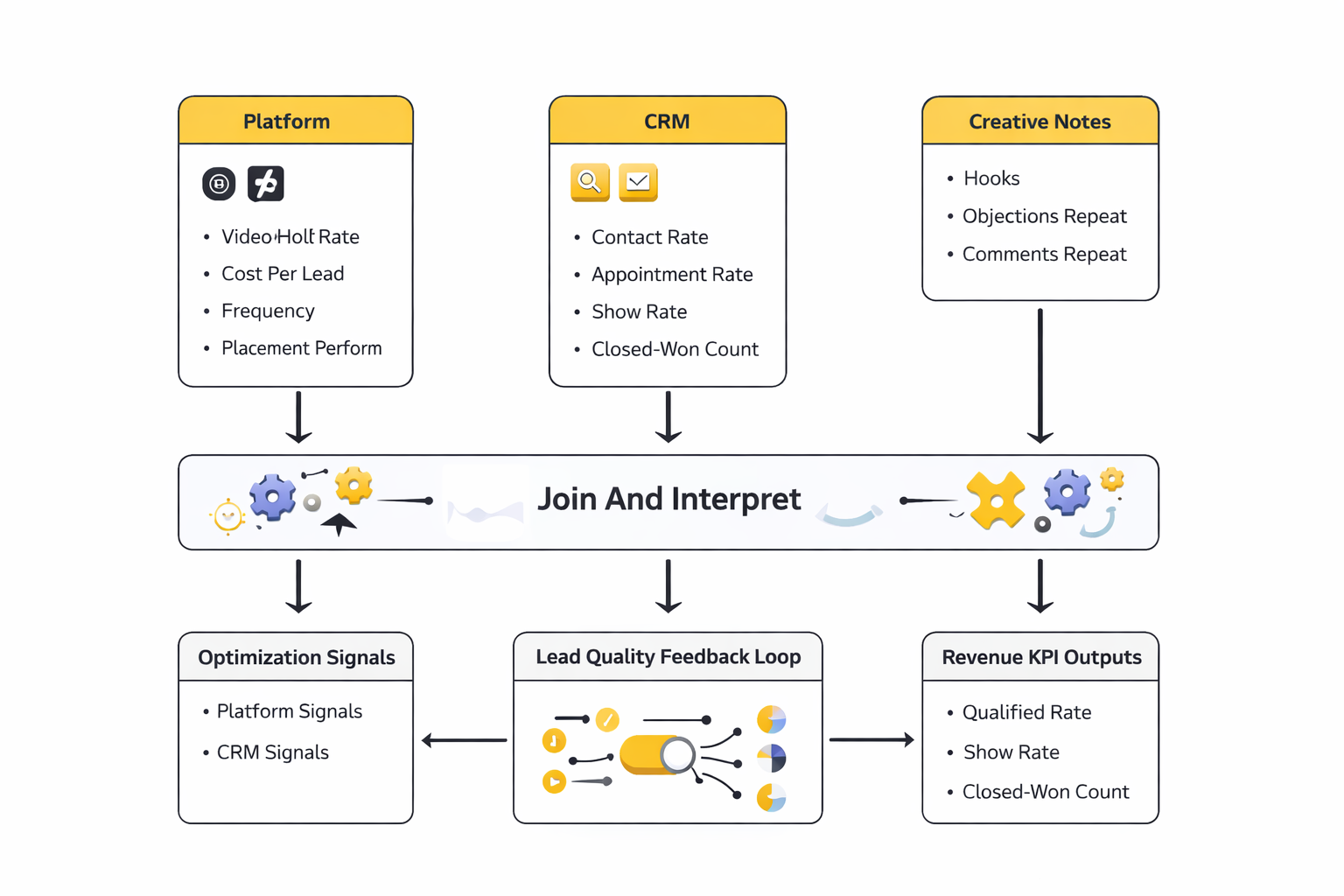
If your scorecard only lives inside the ad platform, you’ll optimize for cheap signals. Build a scorecard that includes both platform metrics and CRM outcomes.
- Platform: video hold rate, cost per click, cost per lead, frequency, placement performance.
- CRM: contact rate, appointment rate, show rate, qualified rate, closed-won count.
- Creative notes: what hook worked, what objections came up, what comments repeated.
2) Testing Cadence That Doesn’t Overwhelm The Team
Testing needs boundaries. Otherwise, it becomes chaos and everyone stops trusting the data.
- Creative tests: 2–4 variants at a time (hook, opening shot, headline, CTA).
- Audience tests: one change per test (geo radius, homeowner segments, renters, relocation interest).
- Offer tests: change the offer less often than the creative; offers need time to stabilize.
3) Follow-Up Improvements That Raise Lead Quality Without Changing Spend
The most overlooked optimization lever is follow-up. Tighten the first response, reduce friction in booking, and make the nurture sequence genuinely useful.
When the follow-up process improves, campaign data becomes cleaner because fewer “good leads” disappear into silence, and the system starts learning what really converts.
4) Feedback Loops That Teach Platforms What A Good Lead Is
Platforms optimize based on signals. If the only signal you send is “form submitted,” you’ll often get more form submits—not more real clients.
The NAR 2025 technology survey includes a lead-generation view where social media is cited as a top lead-generating technology, which is exactly why the quality loop matters: volume is common, conversion is the advantage. https://cms.nar.realtor/sites/default/files/2025-09/2025-realtors-technology-survey-report-09-18-2025.pdf https://www.nar.realtor/research-and-statistics/research-reports/realtor-technology-survey https://www.housingwire.com/articles/nar-2025-technology-survey-realtor-tech-usage-trends/
- Track qualified milestones inside your CRM.
- Push those milestones back into your ad system when possible.
- Use that data to prioritize targeting that resembles your real clients, not your cheapest clicks.
Implementation Stories
Stories are where the system becomes real. Here are two implementation narratives you can study without guessing what happened, because the details are published by the platforms involved.
D&B Properties: When Leads Piled Up And The Team Hit A Wall
The inbox didn’t look like a problem at first. Leads were coming in, campaigns were running, and the dashboards showed activity. Then the cracks started showing: too many conversations went cold, attribution was messy, and nobody could confidently say which leads turned into real deals. https://www.make.com/en/success-stories/transform-lead-management-make-meta-technologies
The backstory is the part most teams recognize instantly. Real estate isn’t a pure online checkout; it’s handoffs, calls, viewings, negotiations, and timing. D&B Properties needed a way to connect digital lead flow to the reality of a CRM-driven sales process without relying on manual busywork. https://www.make.com/en/success-stories/transform-lead-management-make-meta-technologies
The wall arrived quietly and then all at once. If the lead data lived only inside ad platforms, the team couldn’t reliably nurture the right people. If the CRM stayed isolated, campaigns couldn’t learn what “high quality” really meant. And every week that passed made it harder to separate real demand from random form fills. https://www.make.com/en/success-stories/transform-lead-management-make-meta-technologies
The epiphany was operational, not creative. Instead of asking the marketing team to “work harder,” they focused on wiring the system so lead data moved automatically and cleanly. They treated the CRM not as a storage bin, but as the source of truth for what outcomes mattered. https://www.make.com/en/success-stories/transform-lead-management-make-meta-technologies
The journey was a workflow build, not a brand refresh. They used a no-code automation platform to connect Facebook Lead Ads to Salesforce, routing new leads into the CRM and creating a structured process around lead status updates. Then they created a feedback loop so lead quality signals could be fed back into campaign optimization, tightening targeting over time. https://www.make.com/en/success-stories/transform-lead-management-make-meta-technologies https://www.facebook.com/business/generate-leads/conversions-api-for-crm
The final conflict was the kind that breaks teams if they ignore it: integrations can fail, fields can mismatch, and one “small” tracking mistake can ruin reporting for weeks. Their setup required coordination with development support to get the plumbing right, and it demanded discipline so the CRM statuses stayed accurate. The system only works when the sales reality stays clean. https://www.make.com/en/success-stories/transform-lead-management-make-meta-technologies
The dream outcome wasn’t “more leads.” It was a calmer, smarter pipeline where the team could trust the data and prioritize the prospects that actually moved through the funnel. That’s the quiet advantage real estate social media marketing companies build when they treat implementation as revenue infrastructure, not just content production. https://www.make.com/en/success-stories/transform-lead-management-make-meta-technologies
Apartments.com: Turning Retargeting Into A Better Renter Experience
The pressure wasn’t subtle. Renters browse fast, compare constantly, and vanish the moment the experience feels generic. Apartments.com needed campaigns that didn’t just “reach people,” but actually felt relevant to what someone had already shown interest in. https://ads.tiktok.com/business/en/inspiration/apartments-dot-com-video-shopping-ads-case-study
The backstory is the modern real estate reality: the product is visual, the decision is emotional, and timing is unpredictable. People might browse for weeks, then suddenly need to act. That makes generic ads feel noisy, while personalized reminders feel helpful. https://ads.tiktok.com/business/en/inspiration/apartments-dot-com-video-shopping-ads-case-study
The wall showed up as a relevance problem. Standard creatives can’t keep up with the number of listings and the speed of consumer browsing. Even strong branding struggles if the ad doesn’t match what the viewer actually cares about right now. https://ads.tiktok.com/business/en/inspiration/apartments-dot-com-video-shopping-ads-case-study
The epiphany was to make retargeting feel like service. Instead of pushing one generic message, they leaned into dynamic formats that could reflect previously viewed and relevant listings. The “ad” becomes a continuation of the browsing journey rather than an interruption. https://ads.tiktok.com/business/en/inspiration/apartments-dot-com-video-shopping-ads-case-study
The journey was an always-on system. They used catalog-driven ads to keep the experience dynamic, paired it with creative that strengthened brand recognition, and treated performance data as an input for ongoing refinement. It’s the same principle top real estate social media marketing companies use: build a machine you can keep running, not a one-time “campaign.” https://ads.tiktok.com/business/en/inspiration/apartments-dot-com-video-shopping-ads-case-study
The final conflict is what everyone hits when dynamic systems scale: creative fatigue and messy catalog data can quietly erode results. If listings are out of date or media quality dips, performance follows. The only way through is operational discipline—clean feeds, consistent QA, and a testing habit that keeps the experience fresh. https://ads.tiktok.com/business/en/inspiration/apartments-dot-com-video-shopping-ads-case-study
The dream outcome is a renter experience that feels tailored, where performance marketing and brand marketing stop fighting each other. When the system works, the platform learns, the audience feels understood, and your pipeline becomes more predictable without needing louder, more desperate ads. https://ads.tiktok.com/business/en/inspiration/apartments-dot-com-video-shopping-ads-case-study
Professional Implementation
If you’re hiring real estate social media marketing companies, “professional implementation” means more than polished posts. It means you’re paying for a system that keeps working when the market shifts, when listings change, and when team members rotate.
What A Professional Deliverable Set Looks Like
- Operating plan: content pillars, weekly cadence, channel roles, response rules, escalation paths.
- Creative system: templates, hook library, filming checklist, editing standards, brand guardrails.
- Distribution system: campaign structure, retargeting map, budget rules, testing cadence.
- Lead system: routing, CRM fields, statuses, scripts, booking flow, nurture sequences.
- Measurement: one scorecard that blends platform signals with CRM outcomes.
Quality Checks That Protect Your Budget
- Tracking QA: test lead delivery end-to-end weekly.
- Message QA: mystery-shop your own DM and lead responses monthly.
- Creative QA: review the first 3 seconds of every video before it ships.
- Follow-up QA: audit a sample of leads to confirm the process is actually happening.
Why This Approach Holds Up In Real Markets
Markets tighten, budgets fluctuate, and audiences get tired of the same recycled content. A system that connects creative, distribution, and lead operations doesn’t panic when conditions change—it adapts. That’s the real promise behind working with strong real estate social media marketing companies: less guesswork, fewer dropped opportunities, and a pipeline you can actually manage.
Statistics And Data
When people evaluate real estate social media marketing companies, the conversation often drifts into aesthetics: the vibe of the feed, the quality of the video, the “look” of the brand. But the companies that keep clients for years tend to be the ones who can prove what’s happening behind the scenes with real numbers that connect to real outcomes.
Two realities make measurement non-negotiable. First, the audience is enormous and still growing: the world had 5.24 billion active social media user identities in early 2025, and by October 2025 there were 5.66 billion social media user identities worldwide, which aligns with the 2025 global digital reporting published by We Are Social’s Digital 2025 report.
Second, ad markets keep getting more competitive. Meta reported that in Q4 2025, ad impressions increased 18% year-over-year while average price per ad increased 6%, which was also documented in the related Meta earnings release PDF and summarized in WARC’s analysis.
In other words: attention is abundant, but cheap attention is not guaranteed. Real estate social media marketing companies that can measure what’s working will keep improving while everyone else keeps guessing.
Performance Benchmarks
Benchmarks are tricky in real estate because the “right” result depends on the offer, the follow-up speed, the market, and whether you’re selling luxury homes, running a brokerage brand, or leasing apartments. Still, a few benchmark-style signals are consistently useful when you’re comparing performance across campaigns and across partners.
Benchmark: Social As A Lead-Generating Channel
For many agents, social isn’t just brand building anymore—it’s a lead engine. In the 2025 REALTOR® Technology Survey, social media was cited as the top lead-generating technology (39%), and the same figure appears in the full survey report PDF.
That number doesn’t mean “social is better than referrals.” It means something more practical: a lot of professionals already depend on social enough that improving your social workflow and measurement can materially change your pipeline.
Benchmark: Speed-To-Response Expectations
Leads don’t wait politely in a queue. When someone sends a DM about a listing or fills a form after watching a tour, they’re often talking to multiple agents or browsing multiple properties.
That’s why response time is a real benchmark, not a vanity KPI. Most consumers want brands to respond within 24 hours or sooner on social, which is a standard many real estate social media marketing companies treat as a minimum rather than a goal.
Benchmark: “Better Than Benchmark” Platform Lift
Sometimes the cleanest benchmark isn’t a universal CTR number. It’s how your campaigns compare to the platform’s own benchmarks for similar formats and objectives.
For example, TikTok’s published real estate lead generation material describes how Apartments.com used Catalog Ads and reported performance lifts versus platform benchmarks, including a 113% higher click-through rate than benchmark and 59% lower cost per click than benchmark (Jan–May 2024), with more details in the Apartments.com TikTok case study.
When you’re evaluating a partner, these “relative lift” benchmarks are useful because they remove some market noise and focus on execution quality: creative, targeting, and optimization discipline.
Analytics Interpretation
Real estate social media marketing companies can drown you in dashboards. The key is learning what the numbers actually mean, so you can make decisions that improve conversion instead of just improving charts.
Attention Metrics Versus Intent Metrics
Attention metrics tell you whether the content earned a pause. Intent metrics tell you whether the content earned a next step.
- Attention: video hold rate, average watch time, saves, shares, profile taps.
- Intent: outbound clicks, form starts, form completions, DM conversations, calls, booking events.
If attention is high but intent is low, the creative is entertaining but unclear. If intent is high but the lead quality is low, the offer is attractive but poorly filtered. Analytics interpretation is less about “good/bad” and more about identifying what kind of problem you’re solving.
The Quality Loop That Most Teams Miss
Most marketing reports stop at cost per lead. Strong operators go one step further: they connect lead source to downstream outcomes (contacted, appointment set, show rate, closed). That’s how optimization becomes real.
This is where the “social is top lead-generating tech” data point becomes dangerous if you don’t interpret it correctly. If you generate lots of leads from social but can’t trace which ones became clients, you’ll optimize for volume and slowly convince yourself your ads “stopped working.” The survey’s 39% social lead-generation statistic is most useful as a reminder that follow-up and attribution are not optional if you want social to stay profitable.
Reading The Market Through Pricing Signals
When you see costs rising, it’s not always your campaign. Sometimes you’re simply feeling a more competitive ad market.
Meta’s financial reporting offers a macro signal of competitiveness: average price per ad increased year-over-year in Q4 2025. When the auction gets pricier, creative quality and conversion rate matter more, because you can’t “bid your way out” forever.
Case Stories
RentSocial: When Performance Needed To Turn Into Leases, Not Just Clicks
The campaigns were generating activity, but the pressure was building where it always builds in multifamily: lease-ups. When occupancy targets are looming, “engagement” stops feeling comforting and starts feeling like a distraction. The team needed evidence that paid social was doing more than entertaining renters.
The backstory is the scale problem. Multifamily marketing isn’t a single listing and a single agent; it’s a network of properties with different price points, different amenities, and different demand cycles. That complexity can make performance marketing feel noisy, because every audience segment behaves differently across time and location.
The wall came when the funnel didn’t line up. If campaigns optimized for clicks, they got clicks. If they optimized for cheap leads without quality signals, they got leads that didn’t convert. The team needed a way to build demand and capture leads while keeping the story relevant to what renters actually want.
The epiphany was treating creative and data as one system. Instead of pushing the same message to everyone, they leaned into TikTok as a place to build engagement and secure leads using their first-party signals and a clearer path from attention to inquiry. The goal wasn’t “viral.” It was repeatable lead flow tied to leasing outcomes.
The journey was a structured approach: engage renters with content that matched how people browse on the platform, then use lead generation mechanics to turn that attention into a measurable pipeline. They framed their work around matching the right renter to the right property at the right time, rather than blasting every property to everyone.
The final conflict is what makes this real: consistency is hard when you’re marketing at scale. Creative fatigue, shifting renter demand, and uneven property performance can break a system if the team can’t keep learning. A lead machine that isn’t measured quickly becomes a money machine that quietly leaks.
The dream outcome is a calmer operating reality: marketing that can defend itself with numbers, because it’s built to generate leads that actually move toward leases. TikTok documents the approach and positioning in its RentSocial lead generation case study, which is useful as a reference for how a performance narrative can stay anchored in real pipeline outcomes.
Meta’s Auction Pressure: When “Good Enough” Creative Stops Being Enough
The panic doesn’t start with a failed campaign. It starts with a slow drift: costs creep up, results fluctuate, and suddenly the same budget buys less consistency than it used to. Teams often blame targeting first, then platforms, then the market—while ignoring the one thing they can control: the quality and clarity of their creative and funnel.
The backstory is that Meta’s advertising system is an auction. When more advertisers compete or when demand strengthens, efficiency gets harder unless your creative earns attention and your offer earns action. Real estate feels this acutely because local markets can spike in competition without warning.
The wall becomes visible when you realize the market is moving under your feet. Meta reported that in Q4 2025, ad impressions grew 18% year-over-year and average price per ad rose 6%. Those aren’t “your account” numbers—they’re ecosystem numbers. They tell you the environment is more competitive, which means sloppy creative and weak conversion paths get punished faster.
The epiphany for the strongest real estate social media marketing companies is shifting from “campaign management” to “system management.” If costs rise, you don’t just tweak bids. You improve the hook, tighten the offer, reduce friction in booking, and make the follow-up faster so conversion rate improves. You become harder to outbid because you’re harder to out-execute.
The journey is operational discipline: weekly creative refresh, clear KPI hierarchy, and CRM feedback loops. It’s also restraint—testing one variable at a time so the learning is real. When you do it right, rising auction pressure becomes a reason to sharpen execution, not a reason to quit.
The final conflict is human, not technical. Teams get tired, clients get impatient, and everyone wants a quick fix. That’s where measurement protects the relationship: you can show what changed, why it changed, and what the data suggests doing next.
The dream outcome is confidence. When the market shifts, you don’t spiral—you adapt. The same Q4 2025 reporting is available in the official Meta earnings release PDF, with a media summary in WARC’s breakdown, and together they provide a real-world context for why optimization discipline matters more over time, not less.
Professional Promotion
Professional promotion is what happens when analytics stops being a report and starts being a decision-making tool. Real estate social media marketing companies that promote professionally don’t just “run ads” for listings. They build momentum across the entire brand and pipeline.
What To Promote When You Want Better Leads
Promote what proves competence and reduces uncertainty. The best-performing promotions usually aren’t the most polished; they’re the clearest.
- Market clarity:</strong short, steady “what changed this week” updates that make you feel like the calm expert.
- Local authority:</strong neighborhood walk-throughs and “where I’d buy if I wanted X lifestyle” content.
- Process confidence:</strong how showings work, how offers get structured, what buyers/sellers should expect.
- Proof:</strong reviews, wins, and behind-the-scenes moments that feel human rather than staged.
How Professional Teams Budget Promotion
They don’t push everything equally. They prioritize what moves the pipeline.
- Always-on retargeting:</strong keep showing up to people who already watched, clicked, or engaged.
- Selective amplification:</strong promote only the organic posts that earn strong attention signals.
- Campaign bursts:</strong increase spend around listings, open houses, events, and seasonal demand spikes.
The Standards That Separate Real Operators
You can tell a lot about a company by how they treat measurement and responsiveness.
- Response standards:</strong they treat 24-hour response expectations as a baseline and build workflows to beat it.
- Benchmark literacy:</strong they can discuss results in context, including platform-relative benchmarks like the Apartments.com “better than benchmark” performance lifts.
- Market awareness:</strong they understand that auction pressure changes, supported by macro signals like Meta’s year-over-year ad pricing movement.
- Pipeline accountability:</strong they connect social activity to CRM outcomes, not just platform metrics.
That combination is what makes analytics feel like leverage instead of paperwork. And it’s the clearest way to judge real estate social media marketing companies without getting hypnotized by pretty dashboards.
Advanced Strategies
Once the basics are running, real estate social media marketing companies start winning in less obvious places: in the unglamorous systems that make great work repeatable across dozens of agents, neighborhoods, and markets. This is the stage where “better content” isn’t enough, because everyone has access to the same templates and the same editing apps.
The edge comes from building compounding advantages: faster feedback loops, cleaner attribution, tighter compliance, and distribution models that don’t rely on one account posting every day. At scale, the real bottleneck is never ideas. It’s coordination.
Turn Agents Into A Distribution Network (Without Losing Brand Control)
Corporate pages are useful, but they don’t carry the same trust as real people. When a brokerage treats its agents and brokers as an employee advocacy network, reach becomes a multiplier instead of a ceiling.
Colliers documented what this looks like in practice: a structured advocacy program that led to 4.7K employee posts shared in a year, reached 9.5M people in Canada (a 43% increase), and delivered a 229% year-over-year increase in impressions. The lesson for real estate social media marketing companies is simple: scaling distribution often means scaling people, not just spend.
- Make sharing easy: a content library built for agents’ actual service lines and local audiences.
- Keep edits safe: allow localization while protecting disclosure, brand voice, and link hygiene.
- Reward consistency: spotlight top advocates and make wins visible across the organization.
Build A DM-To-CRM Pipeline
In real estate, DMs are often the highest-intent touchpoint, but they’re also the easiest place to lose leads. The advanced move is treating DMs like the top of your CRM pipeline, not a casual chat window.
- DM playbooks: scripts that qualify without sounding robotic, and move toward a booked next step.
- Routing rules: messages go to the right agent or inside sales rep fast, with clear ownership.
- Logging: every serious inquiry becomes a contact record, so follow-up is deliberate instead of hopeful.
Scale With Compliance Built In, Not Bolted On
When you scale, you increase your surface area for mistakes: copy that strays into risky territory, targeting choices that feel “normal” in marketing but are sensitive in housing, and creative that unintentionally signals exclusion. Professional teams bake guardrails into the workflow instead of relying on last-minute reviews.
Fair housing risk is not theoretical. The National Fair Housing Alliance’s 2025 Fair Housing Trends Report details complaint patterns and transaction types, which is exactly why governance matters when multiple agents and offices are publishing daily.
- Copy guardrails: pre-approved phrasing and banned phrases lists, maintained like an operating manual.
- Creative checklists: required disclosures, consistent disclaimers, and approval workflows that leave an audit trail.
- Training cadence: short refreshers that fit agent schedules instead of once-a-year compliance theater.
Scaling Framework
Scaling is not “doing more.” It’s doing the same thing for more people, in more places, with fewer surprises. The best real estate social media marketing companies scale by turning strategy into an operating system: a set of repeatable plays with clear inputs, clear roles, and clear outputs.
The Three Systems You Need Before You Add Spend
If any of these systems are missing, growth becomes fragile. You’ll still get spikes, but you won’t get stability.
- Creative system: templates, hooks, filming checklists, and a weekly production rhythm that survives busy seasons.
- Distribution system:</strong organic cadence plus paid amplification rules that promote proven content instead of guessing.
- Revenue system:</strong lead routing, follow-up standards, and CRM feedback loops so marketing learns what converts.
Localize Without Fragmenting The Brand
Real estate is local by nature, but brand trust is global inside a brokerage. Scaling means letting locations speak in a local voice without turning the brand into a dozen different personalities.
- Central standards:</strong tone, disclosures, visual rules, and campaign architecture.
- Local modules:</strong neighborhood content, market updates, community events, and local proof.
- Shared measurement:</strong one scorecard format, so performance is comparable across teams.
Operationalize Agent Participation
Agents don’t need another “initiative.” They need a system that saves time and makes them look good. When participation feels like leverage, adoption becomes natural.
RE/MAX Realtron’s case study is a clear example of building a scalable program: 1,200 agents and 330 social accounts supported through a structured approach to social media management. That kind of scale doesn’t happen through reminders; it happens through operational design.
Growth Optimization
Growth optimization is where you stop asking “How do we get more?” and start asking “What’s the most efficient path from attention to closed business?” At this stage, the best real estate social media marketing companies become ruthless about signal quality.
Use A Signal Hierarchy, Not A Vanity Metric Debate
When teams argue about CTR versus CPC versus engagement, it’s usually because they don’t have a shared hierarchy. A hierarchy keeps everyone aligned and prevents random “optimizations” that feel productive but don’t move revenue.
- Tier 1: qualified conversations, appointments booked, leases or deals influenced (tracked in CRM).
- Tier 2: contact rate and show rate (the truth about lead quality and follow-up).
- Tier 3: platform signals like watch time, saves, shares, and click intent (useful, but not the finish line).
Beat Creative Fatigue With Rotation, Not Reinvention
Scaling fails when audiences get tired of seeing the same story told the same way. The fix is not constant reinvention. The fix is creative rotation: the same offer and message, expressed through different hooks, different openings, and different proof.
- Rotate hooks:</strong price anchor, neighborhood identity, lifestyle angle, problem-solution, myth-busting.
- Rotate proof:</strong testimonials, process clips, market data visuals, behind-the-scenes, “why this listing is priced this way.”
- Rotate formats:</strong short vertical video, carousels, live Q&A recaps, agent POV walkthroughs.
Plan For Auction Pressure Like A Professional
At scale, you feel platform competition more intensely. When pricing shifts in the ad auction, the teams with better conversion paths survive without panic.
Meta’s Q4 2025 reporting showed ad impressions up 18% year-over-year and average price per ad up 6%, which was also published in the official earnings release PDF. When the market gets more competitive, your best defense is tighter creative and stronger conversion, not just higher bids.
- Improve conversion first:</strong booking flow, speed-to-response, qualification clarity.
- Protect warm audiences:</strong always-on retargeting that keeps your brand familiar when demand spikes.
- Scale what earns attention:</strong amplify posts that already perform organically.
Scaling Stories
These aren’t “nice examples.” They’re what scaling actually feels like: messy, political, frustrating, and worth it when the system finally clicks. Both stories are grounded in published case studies with real program details and measurable outcomes.
Colliers: When One Team Realized Corporate Social Couldn’t Carry A Global Brand
It started as a quiet problem that didn’t look like a crisis. The brand was growing, the organization was respected, and posts were going out. But the reach ceiling was obvious, and the people who mattered most in the market were building their reputations elsewhere.
The backstory is baked into professional services and real estate: relationships are the business. Colliers had thousands of professionals whose credibility could travel faster than any corporate page, but those professionals didn’t have a simple way to share the right content. The opportunity was sitting inside the organization, unused.
The wall hit when the marketing team faced the same reality every scaling team faces: you can’t personally manage everyone’s presence. Employees didn’t know where to find content, didn’t know what was safe to share, and didn’t want to spend time crafting posts from scratch. Without a system, good intentions stayed stuck.
The epiphany was shifting the goal from “more posts” to “more professionals posting.” That reframing changed the strategy from a content calendar problem into an enablement problem. The objective became building a library that employees could share confidently, in a way that still protected the brand.
The journey turned into a real operating model. They built a content library that covered diverse service lines, published at high volume, and made sharing easy enough to become habit. Their Canadian program produced 4.7K employee posts shared in a year and reached 9.5M people in Canada (a 43% increase), with a 229% year-over-year increase in impressions.
The final conflict wasn’t technology. It was governance. Decentralized sharing creates risks, and scaling without oversight invites bad links, fraudulent accounts, and brand drift.
The dream outcome is the kind of scale most real estate social media marketing companies chase: distribution that compounds. The organization gained reach through people, not just spend, and the approach became portable across regions. The full narrative and metrics are published in Hootsuite’s Colliers case study.
RE/MAX Realtron: When A Program Built For 25 Agents Had To Serve 1,200
The breaking point didn’t come from a lack of content ideas. It came from volume. When you’re supporting hundreds of agents, every “small” manual task becomes a monster that eats your week.
The backstory is human. Some agents are brilliant on social, some aren’t, and many high earners don’t want to spend their time designing posts. RE/MAX Realtron’s marketing leadership built a co-management program to reduce time spent creating content and help agents focus on business building, but the first version was manual.
The wall arrived as the program grew. Uploading content for a small group is doable when you’re proving the concept. Scaling that approach to dozens, then hundreds, becomes physically impossible without breaking something: quality, consistency, or sanity.
The epiphany was realizing the program needed infrastructure, not effort. Instead of trying to “work harder,” they focused on systems that could standardize publishing, protect brand integrity, and support both advanced and beginner agents. That shift turned social from a support task into a scalable service.
The journey became a real rollout. They moved from manual posting toward a structured platform workflow, built around scheduling and centralized management, and expanded the program over time. Sendible’s published case study describes the scale they were managing: 1,200 agents across 330 social media accounts.
The final conflict was adoption. Scaling a program is not just adding users; it’s changing habits across an organization with wildly different skill levels. Even great tools fail if people don’t use them, so the work becomes training, enablement, and making the system feel like relief instead of homework.
The dream outcome is what every brokerage wants when they hire real estate social media marketing companies: consistent execution without forcing every agent to become a content creator. The program became a time-saving, brand-safe engine that could support both confident posters and reluctant ones. The operational story is documented in Sendible’s RE/MAX Realtron case study.
Build A Promotion Portfolio, Not A Single Campaign
Professional teams spread risk and compound results by running multiple promotion types at once. Each type has a job, and the jobs don’t overlap.
- Always-on trust:</strong market clarity, neighborhood authority, and process education that keeps the brand familiar.
- Always-on capture:</strong retargeting that converts warm attention into booked calls and inquiries.
- Burst promotion:</strong listing launches, open houses, lease-up pushes, and seasonal demand spikes.
- Reactivation:</strong campaigns built for people who went quiet but still have intent.
Standards That Make Promotion Feel “Safe” To Scale
Scaling spend without scaling discipline is how budgets get blamed for operational problems. The best real estate social media marketing companies scale promotion only when the fundamentals are stable.
- Speed-to-lead:</strong the moment a lead arrives, a human responds fast enough to win the conversation.
- Offer clarity:</strong every promotion has one clear next step that matches the content that earned attention.
- Compliance checks:</strong governance that reflects real-world fair housing risk, supported by reports like the NFHA 2025 Fair Housing Trends Report.
- Market awareness:</strong promotion plans that account for auction pressure signals, like Meta’s Q4 2025 shift in ad pricing.
What To Ask Before You Let A Company Scale Your Spend
If you want to quickly spot real operators, ask questions that force them to describe systems, not vibes.
- “How do you tie social performance to pipeline outcomes?”
- “What happens in the first 5 minutes after a lead arrives?”
- “How do you prevent brand drift across multiple agents and offices?”
- “How do you rotate creative to beat fatigue without changing the strategy every week?”
When a partner answers those questions clearly, scaling stops feeling like gambling. It starts feeling like operations.
Future Trends
Real estate social media marketing companies are moving into a new era where distribution, personalization, and trust are all being reshaped at the same time. The biggest shift is that “content” is no longer the scarce resource. Attention, credibility, and speed-to-conversation are.
AI-driven personalization is getting deeper inside the platforms themselves, not just inside marketing tools. Meta reported it would start using interactions with its generative AI to personalize content and ads across its apps beginning mid-December 2025, with important regional differences in rollout. https://www.reuters.com/business/media-telecom/meta-use-ai-chats-personalize-content-ads-december-2025-10-01/
Generative creative is also becoming more “built-in” than “optional.” Meta’s help documentation outlines generative AI ad creative features and the supplemental terms launched in May 2024. https://www.facebook.com/business/help/297506218282224
At the same time, trust risks are rising alongside reach. Social platforms have become an easy distribution channel for rental and listing scams using stolen video tours and impersonated agent identities, including cases reported in early 2026 where scammers recycled real agent content on TikTok and other platforms. https://www.sfgate.com/local/article/san-francisco-apartment-scammers-21943269.php
The teams that win in 2026 won’t be the ones who post the most. They’ll be the ones who ship fast, measure cleanly, and protect trust with stronger verification workflows and better governance, while still staying human in their content and conversations.
For broader platform-level direction, Hootsuite’s 2026 trends report highlights how AI, cultural volatility, and changing content consumption patterns are shaping what works on social. https://www.hootsuite.com/research/social-trends
Strategic Framework Recap
If you strip everything down, real estate social media marketing companies are judged on one thing: can they reliably turn attention into qualified conversations, and qualified conversations into appointments, leases, or signed agreements.
This guide’s framework has been consistent across every section for a reason. When results feel “random,” it’s usually because one layer is missing.
- Creative system: content pillars, repeatable formats, and proof that builds trust fast.
- Distribution system:</strong organic cadence plus paid amplification that promotes what already earns attention.
- Conversion system:</strong a clear next step (DM, form, booking) with low friction.
- Operations system:</strong routing, ownership, CRM hygiene, and follow-up standards that prevent lead leaks.
- Measurement system:</strong a scorecard that connects platform signals to pipeline outcomes so optimization becomes real.
When those pieces work together, results stop depending on luck. You can scale without panic, because you’re running an operating model, not chasing a viral moment.
FAQ – Built For The Complete Guide
What Do Real Estate Social Media Marketing Companies Actually Do?
The best ones don’t just “post content.” They build a system: content planning and production, publishing and community management, paid distribution, lead capture, CRM routing, and reporting that connects marketing activity to pipeline outcomes.
Which Platforms Matter Most For Real Estate In 2026?
It depends on your market and audience, but the practical rule is simple: use short-form video for reach, use retargeting for conversion, and use DMs for the highest-intent conversations. Platform shifts are real, and trend reports like https://www.hootsuite.com/research/social-trends are useful for staying current without guessing.
How Fast Should We Respond To DMs And Comments?
Fast enough to win the conversation while intent is still hot. Many consumers expect replies within a day on social channels, and response-time research like https://sproutsocial.com/insights/social-media-response-time/ is often used as a baseline for building internal standards.
Should We Run Ads Or Focus On Organic First?
Do both, but connect them. Organic builds trust and produces “proof assets” you can amplify. Paid distribution makes the best assets show up in front of the right people consistently. Treating them as separate worlds is how budgets get wasted.
What’s A Good Offer For Social Lead Generation In Real Estate?
A good offer removes uncertainty and earns a next step: valuations, neighborhood guides, “new listings under X,” open house VIP lists, relocation checklists, or short consult calls. The offer should match the audience’s intent and your follow-up capacity.
How Do We Avoid Scam And Impersonation Risk On Social?
Use verification habits: consistent branded handles, cross-linking official profiles, watermarking tours, and clear “how we take applications and payments” policies. Scams using stolen tours and impersonated identities have been increasingly documented, including examples reported in early 2026. https://www.sfgate.com/local/article/san-francisco-apartment-scammers-21943269.php
How Do We Measure Real Results Instead Of Vanity Metrics?
Keep a simple hierarchy: qualified conversations and booked appointments at the top, then contact rate and show rate, then platform engagement signals as supporting context. If the CRM outcomes aren’t tracked, the optimization will drift toward cheap attention instead of real business.
What Changes With AI In 2026?
Two things. First, platforms are personalizing more aggressively using new signals, including AI interactions in some ecosystems. https://www.reuters.com/business/media-telecom/meta-use-ai-chats-personalize-content-ads-december-2025-10-01/ Second, creative generation and variation is becoming native inside ad tools, with Meta documenting generative creative features and terms. https://www.facebook.com/business/help/297506218282224
How Much Content Do We Need Per Week?
Enough to stay consistent without collapsing your team. A realistic starting point is a small set of repeatable formats (one “signature” weekly video series plus a handful of supporting posts), then scale only when the workflow is stable and measured.
What Questions Should We Ask Before Hiring A Company?
Ask questions that force systems, not vibes: How do you route leads? What’s the response-time standard? How do you prevent brand drift? How do you tie social performance to pipeline outcomes? What’s your creative refresh cadence to beat fatigue?
Work With Professionals
If you’ve made it this far, you already understand the hard truth about growth: the real constraint isn’t talent, it’s momentum. Even strong marketers lose months to cold outreach, endless proposal cycles, and platforms that take a cut of every deal. Meanwhile, companies keep hunting for specialists who can actually execute—paid social, SEO, lifecycle, content, analytics—without babysitting.
That tension is why focused marketplaces are becoming part of the modern career stack. MARKEWORK positions itself as a marketing-only marketplace where you connect directly, without commissions or per-project fees. https://www.markework.com/ https://www.markework.com/why-us
Instead of paying a percentage every time you win, the model is built around simple plans that emphasize “no commissions” and “no project fees,” plus direct communication with companies. https://www.markework.com/pricing
And demand is not the issue. Even mainstream marketplaces show five-figure volumes of open marketing work; Upwork’s marketing category alone has shown counts in the 10K+ range of open jobs. The real opportunity is positioning yourself where marketing work is the focus, then building a repeatable pipeline instead of gambling on random outreach.
Here’s what changes when you move into a marketplace designed for marketing roles and projects. Your profile becomes your storefront. Your proof does the heavy lifting. You can apply consistently, talk directly, negotiate like a professional, and keep the full economics of the relationship because there’s no per-project commission layer. The pricing and workflow are spelled out clearly, including monthly plans and the platform’s stance that companies and marketers handle contracts and payments independently. https://www.markework.com/pricing
If your goal is simple—more remote contracts, better clients, and less friction—build your presence where marketing is the category, not an afterthought.
 Filip Konecny Enterprises