

If you’re in real estate, social media isn’t “nice to have” anymore—it’s where people quietly decide whether you feel trustworthy before they ever call, tour, or DM. The catch is that most agent accounts look active but don’t actually move business forward: random posts, inconsistent video, no clear follow-up, and no system for turning attention into appointments.
Real estate social media management is the difference between “posting content” and running a repeatable client-acquisition channel. It blends brand, content operations, lead capture, and reputation into one process—so your online presence feels steady, local, and professional even on weeks when you’re slammed with showings.
Article Outline
- What Is Real Estate Social Media Management
- Why Real Estate Social Media Management Matters
- Framework Overview
- Core Components
- Professional Implementation
- Content Engine and Posting Rhythm
- Platform Playbooks and Formats
- Paid Social and Lead Capture
- Analytics and Optimization
- Ecosystem, Referrals, and Partnerships
- FAQ
What Is Real Estate Social Media Management

Real estate social media management is the ongoing process of planning, producing, publishing, and improving social content that attracts local attention and converts it into conversations with real buyers and sellers. It’s not just “marketing.” It’s also positioning, trust-building, and customer experience—because people treat your profile like a storefront.
In practice, it includes:
- Brand clarity (who you help, where you operate, and what you’re known for)
- Content operations (a repeatable way to create short-form video, carousels, photos, stories, and live updates)
- Lead capture (DM scripts, landing pages, forms, calendar links, and follow-up workflows)
- Community signals (comments, replies, neighborhood presence, and social proof)
- Measurement (what’s working, what’s wasting time, and what to double down on)
Think of it like running an open house every day—except it’s your expertise, your listings, your local knowledge, and your personality doing the welcoming. The goal is simple: when someone finally needs an agent, your name already feels familiar.
Why Real Estate Social Media Management Matters
Real estate is a trust business. People don’t just hire skills—they hire confidence. Social is where that confidence is built at scale, one small impression at a time.
There are three reasons it matters right now:
- Buyers and sellers expect to “check you” online. A large share of younger buyers say an agent’s social presence makes them more likely to hire—Zillow’s 2025 Consumer Housing Trends data shows 41% overall reporting they’re more likely to hire based on social presence, with higher impact among Millennials and Gen Z.
- Agents already rely on social—so the baseline is crowded. In NAR’s 2025 Technology Survey, 75% of REALTORS® reported using social media as a core technology tool, which means “being on Instagram” isn’t a differentiator anymore—having a system is.
- Social is increasingly a lead-generation tool, not just visibility. The same NAR survey reports that social media remained the top lead-generating technology (39%), ahead of CRM and MLS—an important hint about where real estate attention is actually converting.
Social also solves a real operational problem: real estate pipelines are lumpy. When closings are up, posting tends to drop. When closings slow down, agents scramble and start posting again—often too late. Real estate social media management keeps your visibility steady, so your pipeline is steadier too.
And the macro reality is simple: people spend time on social every day. DataReportal’s Digital reports estimate 5.66 billion social media user identities as of October 2025. You don’t need “everyone.” You need the right slice of your city seeing you consistently.
Framework Overview
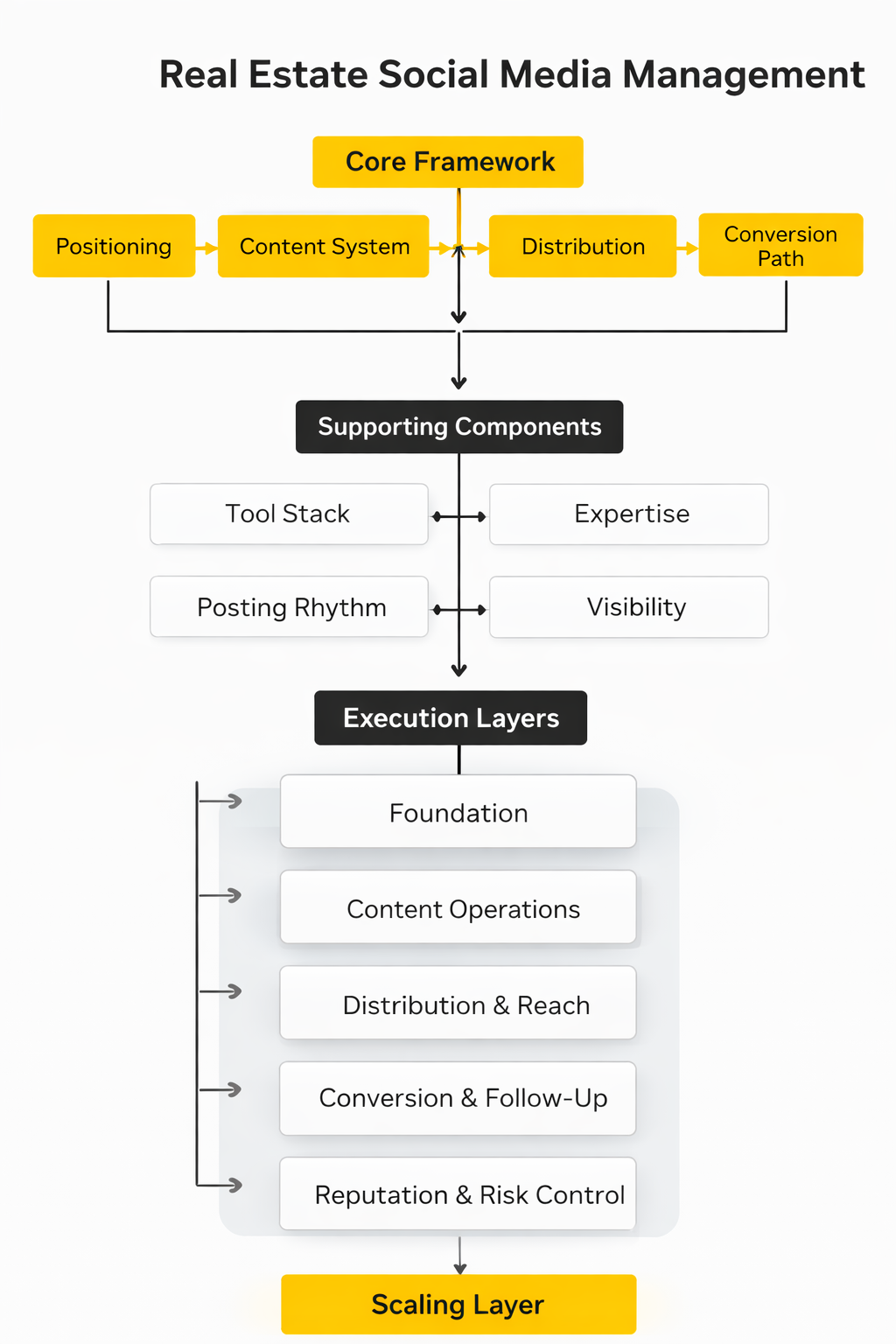
The framework in this guide is built to be realistic for real estate: fast-moving inventory, weekend-heavy schedules, and a business where referrals still matter—but attention is earned online first.
Here’s the sequence:
- Positioning → clarify your niche, area, and “why you” so content doesn’t feel generic.
- Content system → create repeatable formats that are easy to produce weekly.
- Distribution → tailor those formats to the platforms that your local clients actually use.
- Conversion → build a simple path from views to DMs to booked calls.
- Proof → capture reviews, wins, and client stories in a way that feels human (not salesy).
- Measurement → track leading indicators (saves, shares, DMs) and lagging ones (appointments, signed clients).
It’s intentionally not “post more.” It’s “post with a purpose,” using formats that are sustainable and measurable.
Core Components
A real estate social media management system works when each component supports the next. If one is missing, you usually feel it immediately: good content but no leads, leads but low quality, or strong reach that collapses when you get busy.
1) Positioning That Makes You Easy to Choose
Most agents compete on vague promises: “hard-working,” “local expert,” “excellent service.” Your positioning needs to be more specific than that—without boxing you in.
- Area: neighborhoods, suburbs, or micro-markets you can talk about like a local.
- Client type: first-time buyers, upsizers, relocations, investors, luxury, new construction, downsizers.
- Signature angle: what you consistently make easier (negotiation, inspection strategy, new-build process, pricing strategy, off-market network, timeline planning).
This matters because social is skimmed. People should understand your “lane” in seconds—without reading a bio like a résumé.
2) Content Pillars That Cover the Full Decision Journey
Real estate decisions aren’t made in one day. Your content should support three stages at once:
- Discovery: local lifestyle, neighborhood guides, quick tours, “what $X buys you,” myths vs reality.
- Trust: market explanations, contract/process clarity, pricing logic, inspection lessons, showing etiquette.
- Conversion: clear invites to DM, book, download, or attend (without sounding desperate).
If your feed is only listings, you’re talking to a tiny slice of people who are ready this week. A management approach keeps you visible to the much bigger group who will be ready in 3–12 months.
3) Community and Responsiveness
In real estate, responsiveness is part of the product. Social platforms reward active accounts, but more importantly, clients read responsiveness as competence.
That means: replying to comments, acknowledging DMs quickly, and engaging locally in a way that feels genuine. The Sprout Social Index highlights how social has become a customer-care channel and why customer service expectations now shape what people want from brands on social. Real estate is no different—except the stakes are higher.
4) A Clear Conversion Path From Content to Conversation
Social content is the magnet. Your conversion path is the container that catches interest.
- DM entry points: “DM ‘LIST’ for details,” “DM ‘MAP’ for the neighborhood guide,” “DM ‘PLAN’ for a 10-minute strategy call.”
- One primary link: don’t overload; route people to one clear next step.
- Follow-up: tagging, notes, and a simple next message that moves things forward.
Without this, you’ll get likes without appointments—and that’s the most common failure mode.
5) Social Proof You Can Scale
Reviews and client wins work best when they’re specific, timely, and tied to a real moment in the process (pricing, negotiation, appraisal, inspection, or timeline pressure). They shouldn’t read like generic testimonials.
If you’re managing social professionally, you’ll also protect credibility by treating reviews as an asset: collecting them consistently, featuring them across formats, and responding like a human.
Professional Implementation
“Professional” doesn’t mean corporate. It means dependable: your content looks coherent, your messaging is consistent, and your lead handling doesn’t fall apart when you’re busy.
Choose an Operating Model You Can Sustain
- Solo agent model: template-based content formats, batching once per week, lightweight editing, simple DM scripts.
- Team model: shared content pillars, rotating on-camera roles, centralized publishing, and tighter brand guidelines.
- Agency/manager model: strategy + production + distribution + reporting, with approvals and compliance checks baked in.
The best model is the one you can repeat for months. Consistency compounds—especially when your audience is local and you’re building familiarity rather than chasing virality.
Build a Weekly Workflow That Doesn’t Depend on Motivation
- Plan: one weekly planning slot for topics tied to listings, market shifts, and local events.
- Produce: batch filming and photography in short blocks (showings and open houses are content opportunities).
- Publish: schedule posts, then stay available for conversations when content is live.
- Review: a quick weekly check of saves, shares, profile actions, and DMs—then adjust formats.
Use Guardrails for Trust and Compliance
Real estate content can trigger fair housing concerns, platform ad restrictions, and brand-damaging misunderstandings. A professional system uses guardrails:
- Language checks for inclusivity and compliance.
- Disclosure habits for partnerships, incentives, or sponsored content when relevant.
- Media quality standards so your listing photos, videos, and captions don’t look rushed.
In the next sections, you’ll see how to turn this into a practical content engine: what to post, how often, and how to structure your formats so they reliably create conversations—not just views.
Step-by-Step Implementation
The fastest way to make real estate social media management work is to implement it like an operating system, not a creative hobby. You want a repeatable loop that turns weekly activity into visible local authority, then into DMs, then into booked conversations.
This step-by-step process is designed so it still works when your schedule gets chaotic.
Step 1: Lock Your “One-Sentence Lane”
Write one sentence you can say on video without sounding rehearsed: who you help, where you help them, and what you make easier. Your lane should feel narrow enough to be memorable, but broad enough to post about daily life in your market without forcing everything into a niche.
If you’re unsure what matters to clients right now, start with what they already signal they value in agent selection: Zillow’s latest agent-focused trends report highlights that 78% of sellers are more likely to hire an agent who offers high-resolution photography and that a large share are more likely to hire agents who provide immersive listing experiences like tours and interactive details.
Step 2: Turn Your Profile Into a Conversion Page
Before you post more content, make sure your profile can convert the attention you already get. Your bio should say what you do, where you do it, and what someone should do next. Keep one primary link and one clear DM call-to-action so prospects don’t hesitate.
Social media presence can directly influence hiring intent, and Zillow’s consumer research shows 41% of prospective buyers say they’re more likely to hire a real estate agent with a social media presence. When that’s true, a confusing bio is basically a leak in the bucket.
Step 3: Build a Simple Content Menu
Pick a small menu of formats you can repeat every week. You’re not trying to be endlessly original; you’re trying to be reliably helpful and familiar in your local area.
- Local signal: neighborhood tours, “what it’s like to live here,” local updates that people save.
- Process clarity: pricing strategy, inspection reality checks, offer structure, timelines, common mistakes.
- Property storytelling: quick walk-throughs, “3 things you’d miss in photos,” open house previews.
- Proof: client wins, review snippets, behind-the-scenes moments that show competence under pressure.
Step 4: Batch One Hour of “Capture,” Not “Creation”
Real estate content gets easier when you stop thinking of it as production and start treating it as capture. Showings, open houses, neighborhood drives, contractor visits, staging days, and inspection walk-throughs are already happening. Your job is to capture small clips and photos while you’re there.
One hour per week of intentional capture usually beats seven days of “I’ll post if I have time.” The point is to build a library, so you can stay consistent even during busy weeks.
Step 5: Set a Publishing Rhythm You Can Actually Keep
A sustainable baseline often looks like this:
- 3 short videos per week (tours, tips, local guidance)
- 2 story sequences per week (behind-the-scenes, Q&A, quick polls)
- 1 proof post per week (review, win, case moment, lesson learned)
When your rhythm is stable, people start recognizing you. That’s what builds trust before they need you.
Step 6: Install a DM System So Interest Doesn’t Die
When someone DMs “Is this available?” they’re rarely asking only that. They’re checking responsiveness, clarity, and whether you feel safe to work with. Create two or three quick reply templates that still sound human, and always give a next step: a showing slot, a short call, or a link to details.
This is where real estate social media management becomes a lead channel, not just branding. It also aligns with how REALTORS® describe social’s role today, with NAR reporting that social media remains the top lead-generating technology (39%) in its 2025 Technology Survey.
Step 7: Track a Few Signals That Predict Deals
Start simple. Track the signals that usually precede appointments: saves, shares, profile taps, website clicks, and DMs that include intent (timeline, budget, area). Then track outcomes: booked calls, showings scheduled, listing consults, buyer consults.
For listings and tours, it’s also worth remembering that immersive experiences can have measurable financial impact. A 2024 NBER working paper found virtual tours were associated with an average ~1% increase in sale prices in their dataset, with context-dependent effects, which is a strong reminder that “content” can influence real outcomes when it improves how people evaluate a home.
Execution Layers
Once the steps are in place, execution gets easier when you think in layers. Each layer has a job, and you can improve one layer at a time without rewriting your whole strategy.
Layer 1: Foundation
This is your lane, your profile setup, and your conversion path. If this layer is weak, content works harder than it should. People might watch, but they won’t know what to do next.
Layer 2: Content Operations
This is your weekly capture routine, your editing workflow, and your posting schedule. The goal is consistency without burnout. If you’re constantly “starting from zero,” your execution will break the first time you have a busy week.
Layer 3: Distribution and Reach
This layer is about packaging the same expertise for different platforms and feeding the algorithm what it rewards: clear hooks, high retention, and content people share. You don’t need to be everywhere, but you do need to show up in the places your local buyers and sellers actually spend time.
One practical clue is that people are using social for education and decision-making. National MI’s 2025 NextGen Homebuyer research notes that social media is a key resource for education, with YouTube used by 74% of Gen Z and 64% of Millennials in their findings.
Layer 4: Conversion and Follow-Up
This layer is DM handling, lead logging, and speed-to-lead. When it’s strong, you can post a video, get a few inbound messages, and turn that interest into a scheduled conversation without chaos.
Layer 5: Reputation and Risk Control
This layer protects you from the downside of being visible: impersonation, stolen content, misleading reposts, and trust erosion. It’s part of real estate social media management that many agents only think about after something goes wrong.
Optimization Process
Optimization is how you go from “we’re posting regularly” to “we’re getting predictable conversations.” The trick is to optimize for the smallest changes that produce compounding results.
1) Weekly Review: Find the One Format That Pulled People Closer
Once per week, pick one post that clearly performed better than your baseline and ask why. Did it get saved because it was practical? Did it get shared because it was local and specific? Did it trigger DMs because it reduced uncertainty?
Then decide what to repeat next week: not the exact same post, but the same underlying structure.
2) Retention Tweaks: Fix the First Three Seconds
Most real estate videos lose viewers immediately because the opening is polite instead of compelling. The goal isn’t to be clickbait. The goal is to remove friction and get to the point fast.
Try small changes: open with the most surprising feature of the property, the single biggest pricing misconception, or the one mistake buyers keep making in your market right now.
3) Local Specificity: Make It Impossible to Mistake You for a Generic Agent
If your content could be posted by someone in another city and still make sense, it’s too generic. Add hyperlocal details: street-level context, school-area considerations (without making prohibited housing claims), commute patterns, building quirks, and neighborhood tradeoffs.
4) Call-to-Action Testing: Make DMs Feel Safe
Many prospects hesitate to DM because they don’t want a sales ambush. Your CTA should feel low pressure and specific. “DM ‘MAP’ and I’ll send the neighborhood guide I use with clients” tends to convert better than “Message me to buy or sell.”
5) Lightweight Experiments: One Variable at a Time
Don’t change everything at once. Run two-week tests where you change only one variable: hook style, caption length, posting time, video length, or CTA. This keeps your learning clean and prevents “we changed ten things and don’t know what worked.”
Implementation Stories
Stories are where systems get real. This one is a reminder that implementation isn’t only about growth; it’s also about protecting trust once your content starts reaching more people.
When Your Content Starts Working and Someone Steals It
Start at a point of high drama
A real estate agent wakes up to messages that make no sense: strangers asking why “their” apartment listing is so cheap and demanding the move-in details. The videos look familiar because they are familiar. A scam account has reposted the agent’s own walk-through clips, slapped a fake price on top, and is now collecting deposits from desperate renters through social platforms, a pattern described in reporting on San Francisco rental scams spreading on Instagram and TikTok.
Backstory
The agent didn’t start filming tours to become “a creator.” They started because video reduced endless back-and-forth, helped people self-qualify, and made listings feel real before a showing. Over time, the videos got better, the hooks got sharper, and the account started reaching more locals. That’s the quiet win of real estate social media management: consistency builds reach, and reach builds inbound attention.
Wall
Then the wall hits: visibility has a shadow side. Reporting the fake accounts is slow and inconsistent, and the scam pages can reappear quickly, which the same coverage highlights as a recurring problem when stolen videos are used to impersonate agents. Worse, every scam victim associates that bad experience with the agent’s face, even when the agent did nothing wrong.
Epiphany
The breakthrough is realizing that trust protection must be part of the system, not an afterthought. If your content becomes recognizable, it becomes stealable. So the same discipline used to schedule content gets applied to branding and verification: watermarks, consistent on-screen cues, and a clear “how to verify me” highlight that lives permanently on the profile.
Journey
The agent tightens operational habits: every tour includes a consistent verbal identifier, a branded text overlay that is hard to crop, and a pinned post explaining how real listings and deposits work. DMs get an automatic first reply that warns people never to send deposits without verified paperwork, echoing the safety warning emphasized in the same reporting about renters being pressured to pay sight unseen. A simple checklist becomes part of every client conversation, turning a scary situation into a trust-building moment.
Final conflict
Even after changes, the problem doesn’t vanish overnight. Scammers adapt, sometimes using new accounts and reposting cropped versions of videos, and the agent still has to file takedowns repeatedly. The agent also faces the awkward task of calming angry strangers who believe they were involved, which is emotionally draining and time-consuming.
Dream outcome
Eventually, the profile becomes safer for prospects because verification is obvious and repeated everywhere. The agent’s audience starts flagging fakes faster, and genuine renters and buyers begin DMing with more confidence because they know what “real” looks like. The system doesn’t just generate leads; it protects reputation, which is the foundation of long-term real estate social media management.
Define Roles and Responsibilities
- On-camera lead: the person who records expertise and tours.
- Producer/editor: the person who turns raw clips into publishable assets.
- Publisher/community manager: the person who schedules, posts, and manages responses.
- Lead owner: the person responsible for converting DMs into booked conversations.
For solo agents, you can still use the same structure; you just wear all the hats. The difference is you schedule time for each hat instead of trying to do everything at once.
Build Simple SOPs and Checklists
Professional real estate social media management looks like boring documentation that creates exciting outcomes. Your SOPs don’t need to be long. They need to be clear enough that execution stays consistent.
- Pre-shoot checklist: lighting, audio, key features, disclaimers, and what not to say.
- Post checklist: hook, captions, CTA, location context, and brand cues.
- DM checklist: qualify quickly, offer a next step, log intent, and follow up.
Keep Advertising Compliance Built In
If you run paid campaigns tied to housing, compliance isn’t optional. Meta requires selecting the appropriate Special Ad Category for housing-related ads, which impacts targeting and delivery options in Meta’s Special Ad Category guidance. Professional implementation means your team knows these constraints before creative and targeting decisions get made, not after a campaign is already live.
Raise the Quality Standard Without Slowing Down
Quality doesn’t mean cinematic. It means clear audio, stable framing, and clean edits that keep attention. The better your execution, the more likely your content is to function as “proof” when someone is deciding whether to reach out.
Zillow’s agent-focused trend findings highlight that sellers respond strongly to strong visuals and immersive assets, including the stat that 78% are more likely to hire an agent offering high-resolution photography, which is a direct argument for operationalizing visual quality as a standard, not a “nice extra.”
Statistics and Data

Analytics is where real estate social media management stops being guesswork. It’s also where many agents get misled, because “good numbers” can still mean “no closings” if you’re tracking the wrong signals.
Three data points are worth keeping in the back of your mind as you build your dashboard:
- Social presence influences agent selection. Zillow’s 2025 consumer research shows 41% of prospective buyers say they’re more likely to hire an agent with a social media presence, which makes your performance metrics more than vanity if they feed real conversations.
- For many REALTORS®, social is already a lead engine. NAR’s 2025 Technology Survey reports social media is the top lead-generating technology (39%), which is a strong hint that measurement should focus on lead flow and follow-up quality, not just reach.
- When you post, you’re competing inside a massive daily habit. DataReportal’s global overview reports 5.66 billion social media user identities (as of its October 2025 update), which is why distribution is powerful but only if your content is local enough to matter to the people near you.
The practical takeaway: your analytics should answer two questions every week. First, “Did we earn attention we can keep?” Second, “Did that attention turn into conversations we can convert?”
Performance Benchmarks
Benchmarks are useful when you treat them like guardrails, not grades. Your goal isn’t to hit an internet average. Your goal is to build a baseline that reliably produces inbound interest in your market.
Why Benchmarks Vary So Much
One reason people argue about “good engagement” is that different reports use different formulas. Some calculate engagement as interactions divided by impressions (reach-based), while others use interactions divided by followers (follower-based). Even when everyone is honest, these numbers won’t match perfectly.
That said, you can still use credible benchmarks to sanity-check your performance:
- Platform-level engagement baselines: Socialinsider’s 2026 benchmarks report lists an average Instagram engagement rate of 0.48% and an average Facebook engagement rate of 0.15% (their methodology focuses on how they calculate engagement across large datasets).
- Cross-industry trend direction: Rival IQ’s 2025 benchmark report summarizes that engagement declined across major platforms, including Instagram down 16% and Facebook down 36% in their dataset, which helps explain why “what worked two years ago” can feel weaker now.
- Real-estate-specific social performance examples: Dash Social’s real estate industry cut of its 2025 Social Media Benchmark Report lists an overall real estate brand TikTok engagement rate average of 3.1% and highlights top performers like Douglas Elliman at 5.3% in its ranking table.
The Benchmarks That Actually Help Real Estate
Instead of obsessing over one engagement number, benchmark a small set of signals that map to client intent:
- Saves and shares: These often indicate “future planning,” which is what most buyers and sellers are doing long before they DM you.
- Profile actions: Profile visits, link clicks, and calls are closer to intent than likes.
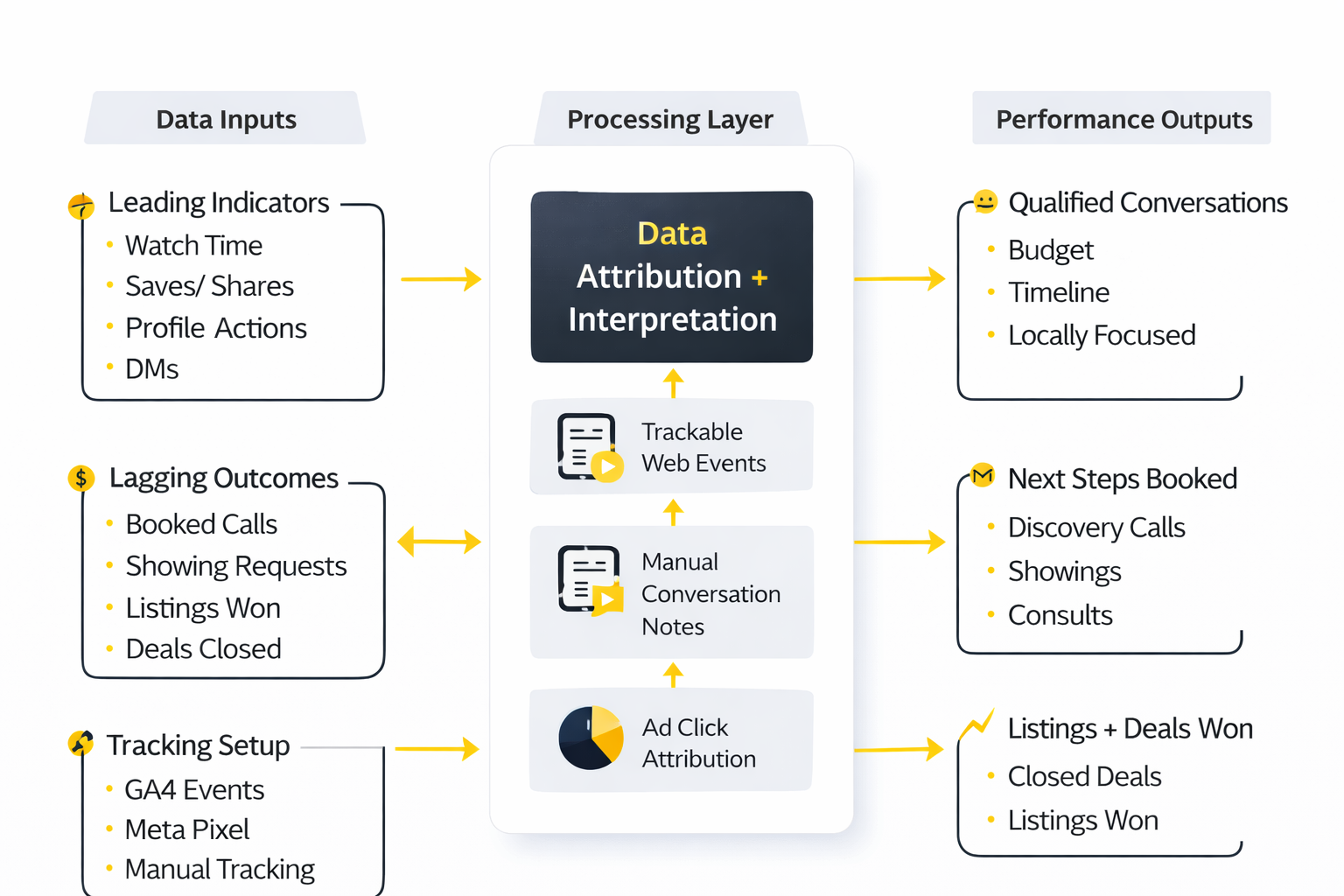
- Inbound conversations: Count DMs that include timeline, budget, neighborhood, or “can we tour?” language.
- Booked next steps: Discovery calls booked, showings scheduled, listing consults set.
If you want one simple benchmark to start with, make it this: “How many qualified conversations did we create per week?” That’s the closest thing to a universal scorecard in real estate social media management.
Analytics Interpretation
Analytics interpretation is the skill of turning numbers into decisions. The mistake most teams make is treating analytics as a monthly report instead of a weekly steering wheel.
Leading Indicators vs. Lagging Outcomes
Real estate has a long purchase cycle, so your best analytics stack separates what predicts deals from what confirms them.
- Leading indicators: watch time, saves, shares, profile taps, DMs, comment quality, website clicks.
- Lagging outcomes: booked calls, showing requests, signed representation, listings won, closed deals.
Leading indicators help you adjust content fast. Lagging outcomes help you confirm the system is producing business.
How to Read Format Performance Without Overreacting
If a carousel or Reel spikes, resist the urge to copy it endlessly. Instead, extract the “why”:
- Retention spike: the opening promised a clear outcome (“3 things you’ll miss in the listing photos”).
- Save spike: the content reduced uncertainty (timeline, inspection, pricing logic, neighborhood tradeoffs).
- Share spike: it was hyperlocal and easy to forward (“This block always surprises first-time buyers”).
Rival IQ’s 2025 benchmark write-up notes that carousels outperformed Reels on Instagram engagement in its dataset. That doesn’t mean “stop making Reels.” It means you should keep at least one save-worthy carousel format in your weekly mix, especially when your goal is to stay memorable over months.
Attribution That’s Honest Enough to Be Useful
Real estate attribution will never be perfect because people watch silently, ask friends, and come back weeks later. Your goal is “directional truth,” not spreadsheet perfection.
- Track what you can control: use event-based tracking for key actions (contact submits, schedule clicks, key page views) with GA4 event setup.
- Track paid actions: if you run Meta ads, connect website actions using Meta Pixel so you can evaluate which creative is producing real downstream actions.
- Track conversations manually when needed: a simple “How did you find me?” tag in your CRM closes the loop better than most people expect.
Case Stories
These are documented cases you can learn from without pretending every win comes from one magic post. Each example points to a measurable shift: consistency, responsiveness, or performance signals that improved after the workflow changed.
KETTLER: Social as a Managed System, Not an Afterthought
KETTLER manages a large residential portfolio, which makes “just respond faster” unrealistic without a workflow. Their published case study explains how a centralized approach using a dedicated social platform helped standardize engagement and management across communities. The same write-up highlights engagement lifts at some communities of more than 500%, which is a strong signal that operational structure can matter as much as creative.
For real estate social media management, the lesson is simple: when your inbox and publishing are controlled, your brand feels more reliable, and reliability is what prospects are looking for before they trust you with a major transaction.
RE/MAX Realtron: Keeping a Large Agent Network Consistent
Brokerages face a unique measurement challenge: performance varies wildly across agents, and brand inconsistency becomes a drag on trust. Sendible’s published case study describes social media management support for 1,200 agents, framing the work around streamlining content distribution and maintaining consistency at scale.
The learning here isn’t “use this exact tool.” It’s that once you manage multiple contributors, governance becomes a performance metric. If publishing is chaotic, analytics is noisy. If publishing is standardized, analytics becomes readable.
Douglas Elliman: Property Tours Built for TikTok Behavior
Dash Social’s 2025 benchmark report segment for real estate ranks top TikTok performers by engagement rate, with Douglas Elliman listed at 5.3% and an overall real estate brand average of 3.1% in its table. The report’s commentary points toward short, visually immersive tours as a driver of engagement.
In practice, this reinforces a useful rule: when your creative matches how people consume a platform (fast, visual, immediate), the algorithm often does more distribution work for you.
Professional Promotion
“Promotion” in real estate social media management doesn’t mean blasting ads at everyone. It means distributing the right message to the right local audience while staying compliant, measurable, and brand-safe.
Balance Organic and Paid Without Competing With Yourself
Use organic content to build familiarity and proof. Use paid promotion to put your best-performing content (the posts already earning saves, shares, and qualified DMs) in front of more local prospects. This keeps your paid budget from becoming a creativity test.
Run Housing Ads With the Right Guardrails
If you advertise housing, you’ll be working inside Meta’s Special Ad Category rules. Meta’s own guidance on choosing the correct Special Ad Category explains why housing ads have audience selection limitations designed to reduce discrimination risk. Professional promotion means your targeting and expectations are built around these constraints from day one, not discovered after an ad gets rejected or underperforms.
Budget With a Clear Objective and a Measurable Event
Every promoted campaign should have one primary action you can measure. That might be:
- Listing demand: “Schedule a showing” or “Request details”
- Seller interest: “Book a pricing call” or “Get a market snapshot”
- Longer-term nurture: “Download a neighborhood guide”
Then tie it to tracking: GA4 events for the website actions via event measurement and, for Meta traffic, website action visibility through Meta Pixel.
Promote What Earns Trust, Not What Looks Flashy
The most promotable real estate creative is usually the clearest, not the fanciest: a tight property tour, a neighborhood explanation, a pricing myth-buster, or a seller-focused “here’s what changes your final number” breakdown.
Zillow’s 2025 consumer trends for agents includes the detail that 78% of sellers are more likely to hire an agent who offers high-resolution photography, which is a helpful reminder that visual quality isn’t just aesthetics; it’s part of what people use to judge competence.
Advanced Strategies
Once the basics are running, real estate social media management becomes a game of leverage. You’re no longer asking, “What should I post?” You’re asking, “How do I turn the same hours into more trust, more reach, and better leads—without burning out?”
These advanced strategies are designed to create compounding results, especially in markets where everyone already posts listings and generic tips.
Build “Content Moats” That Are Hard to Copy
Most agents are easy to imitate because their content isn’t anchored in anything proprietary. A content moat is a repeatable series that is uniquely yours—because it’s tied to your micro-market knowledge, your negotiation experience, or your on-the-ground access.
- Micro-market weekly briefing: “What changed in this neighborhood in the last 7 days?”
- Building deep-dives: recurring tours of the same buildings with honest tradeoffs (light, noise, HOA realities, parking).
- Offer strategy breakdowns: anonymized lessons on why one offer won and another didn’t (process, not personal details).
When your content is anchored in local reality, it becomes less “content” and more “public service.” That’s the kind of presence that makes people choose you months later.
Turn Social Proof Into a System, Not an Occasional Post
People don’t trust a single testimonial. They trust patterns. Build a proof system where you consistently capture moments that demonstrate competence:
- Process proof: “Here’s how we priced it and why,” “Here’s what we negotiated,” “Here’s the inspection issue and how we handled it.”
- Speed proof: fast updates, clear next steps, and visible responsiveness.
- Visual proof: before/after staging, photography upgrades, video walk-throughs, open house flow improvements.
This matters because consumers actively judge agents by signals they can see. Zillow’s 2025 agent report highlights that 78% of sellers are more likely to hire an agent who offers high-resolution photography, which makes your proof strategy inseparable from your visual standard.
Create a Collaboration Engine With Local Businesses
Local collaborations are one of the cleanest growth levers in real estate social media management because they put you in front of an already-trusted audience. The trick is to make the collaboration valuable for the other partner, not just you.
- “Neighborhood insiders” series: quick interviews with a café owner, a gym manager, a school-adjacent tutor, a local builder.
- Move-in partner pack: feature vendors you trust (painters, cleaners, movers), then co-post content so both audiences see it.
- Community event coverage: local events become content while also building relationships that lead to referrals.
When done well, collaborations don’t feel like marketing. They feel like you’re plugged into the community—which is exactly what buyers and sellers want.
Use “Soft Qualification” in DMs to Protect Your Time
Scaling your presence increases your inbound volume. Without qualification, you’ll spend your evenings answering low-intent questions. Soft qualification keeps the conversation warm while steering it toward clarity.
- Timeline: “Are you looking this month or later this year?”
- Area: “Which two neighborhoods are you deciding between?”
- Constraints: “What’s the one thing that would make you say no to a property?”
This turns random DMs into structured leads you can act on, and it keeps you responsive without becoming trapped in endless chat.
Match Content to Platform Behavior
Advanced execution isn’t about doing more platforms. It’s about matching formats to platform-specific behavior.
- TikTok: fast visual hooks and simple story arcs often outperform overly polished production.
- Instagram: save-worthy carousels and story-based updates can build long-term memory.
- YouTube: longer explainers and neighborhood guides can capture high-intent search behavior.
National MI’s 2025 NextGen Homebuyer research highlights how often younger buyers use video platforms for education, with YouTube used by 74% of Gen Z and 64% of Millennials. That’s not a promise of leads, but it is a strong cue about where educational content can meet people while they’re learning.
Scaling Framework
Scaling real estate social media management doesn’t mean “post more.” It means widening your output without widening your stress. The cleanest way to do that is to scale in layers: first efficiency, then distribution, then delegation.
Phase 1: Scale Efficiency
Before you hire or add platforms, make your current workflow easier:
- Content templates: keep 10–15 reusable templates for captions, hooks, and carousel layouts.
- Batch capture: record 8–12 clips in one session, then drip them out over two weeks.
- Standardized editing: one caption style, one structure, one end screen, one CTA.
This phase is the foundation because it reduces the cost of creation. If creation stays expensive, scaling becomes painful.
Phase 2: Scale Distribution
Once your content engine runs, you can expand distribution without expanding production time:
- Repurpose intentionally: one property tour becomes a Reel, a TikTok, a YouTube Short, and a story sequence.
- Repackage by intent: the same topic can be framed for buyers (“what to watch for”) and sellers (“how this affects your price”).
- Boost proven posts: put paid behind posts that already pull saves, shares, and qualified DMs.
When you scale distribution, your analytics becomes more valuable because you can compare performance across platforms with a consistent creative baseline.
Phase 3: Scale Delegation
Delegation is where scaling becomes real, because it stops depending on your personal energy. The key is to delegate tasks, not judgment.
- Delegate production: editing, captioning, formatting, scheduling.
- Keep judgment in-house: positioning, local insight, proof moments, and lead qualification decisions.
- Create a review loop: weekly review that decides what to repeat, what to cut, and what to test.
Teams that scale cleanly do it by keeping one person responsible for quality standards, even if multiple people produce assets.
Growth Optimization
Growth optimization is how you earn more reach without gambling on luck. It’s the discipline of running small experiments that improve watch time, saves, shares, and qualified conversations—then turning the winners into default formats.
Optimize for Retention First
Reach is downstream from retention. If people don’t watch, algorithms don’t distribute. Your fastest retention wins usually come from structure:
- Start with the payoff: the best feature, the biggest misconception, the one thing buyers miss.
- Use a simple arc: “Problem → explanation → quick example → next step.”
- End with clarity: a single CTA that feels low-pressure but specific.
If you’re tempted to chase “viral,” remember that Instagram engagement has been pressured in many datasets. Rival IQ’s 2025 benchmark report summarizes platform engagement declines including Instagram down 16% and Facebook down 36% in their analysis, which makes retention and saves even more important than raw likes.
Engineer Saves With Decision-Making Content
Saves are often the most telling signal in real estate social media management because they show someone is planning. Content that earns saves usually reduces uncertainty:
- Neighborhood tradeoffs: “What people love” and “what surprises them later.”
- Process checklists: inspection red flags, offer structure, seller prep steps.
- Market clarity: what changes when rates move, how appraisals impact deals, why comps matter.
When you build save-worthy formats, you become the account people keep open in a tab while they plan their next move.
Use Proof to Raise Lead Quality
More reach isn’t always better if it attracts low-intent inquiries. Proof content often improves lead quality because it signals professionalism and competence:
- Show your process (pricing logic, negotiation moments, inspection handling).
- Show your standards (photography, staging, marketing plans).
- Show your outcomes (wins framed as lessons, not bragging).
This connects to what clients say they value. Zillow reports sellers respond strongly to visual quality, including that 78% are more likely to hire an agent offering high-resolution photography, which means proof isn’t just “testimonials”—it’s visible quality standards.
Scaling Stories
Scaling stories matter because they reveal what breaks when visibility grows. The best story examples aren’t perfect journeys. They’re messy, operational, and honest—because scaling is always a mix of wins and problems you didn’t anticipate.
RE/MAX Realtron: Scaling Social Across 1,200 Agents
Start at a point of high drama
Imagine trying to keep a brand coherent when hundreds of people post every day. One agent posts polished listing videos. Another shares blurry photos. Another posts off-brand graphics that look like they were made in a hurry. For a large brokerage, that inconsistency becomes a reputational problem because consumers don’t separate “agent content” from “brand trust.”
When the audience is local and competitive, small brand slips aren’t small. They shape first impressions, and first impressions decide who gets the DM.
At RE/MAX Realtron, the scale wasn’t theoretical. The documented challenge was supporting social media management for 1,200 agents, which is the point where “just train people better” stops working as a solution.
Backstory
Large brokerages often have a split identity: the brokerage wants consistency, and agents want autonomy. Agents are independent, busy, and focused on clients, so content tends to be reactive. Meanwhile, the brand needs a baseline that looks professional no matter who posts.
Over time, the gap grows. The best agents build strong personal brands, while others post sporadically or not at all. That creates a strange public image: a brokerage with both high-quality and low-quality signals at the same time.
That’s the environment where real estate social media management becomes a governance problem, not just a marketing one.
Wall
The wall is coordination. You can’t approve everything manually without slowing everyone down. You also can’t let everyone publish anything without inviting brand risk. At this scale, even simple tasks like sharing approved content or scheduling across accounts become operationally heavy.
And because the content is inconsistent, performance data becomes inconsistent too. It’s hard to know what’s working when every agent is running their own playbook.
The case study framing in Sendible’s write-up points to the same core friction: time, coordination, and consistency across a massive agent network.
Epiphany
The shift is realizing that scaling requires enabling, not policing. Instead of trying to force compliance through rules, you give agents tools and templates that make the “right” thing the easiest thing. If posting approved content is simple, adoption rises naturally.
This is also where governance becomes a creative advantage. When agents have access to polished assets, the baseline quality rises, and the entire brand looks stronger online.
In other words, the system has to be designed for human behavior: busy people choose the path of least resistance.
Journey
The documented approach focused on streamlining social publishing and making branded content easier to distribute across many accounts. When agents can access approved content quickly, they can stay active even in busy weeks.
It also creates a shared learning loop. When content formats are standardized, performance data becomes comparable, and you can identify which formats consistently earn attention.
The case study describes time savings and easier management in the same Realtron summary, which is exactly what you’d expect when governance reduces operational drag.
Final conflict
Even with a better system, culture doesn’t change overnight. Some agents adopt quickly. Some resist. Some post inconsistently no matter how easy you make it. And if the workflow is too rigid, it can feel like it removes personality—the very thing that often makes local real estate content perform well.
So the balance becomes the real work: provide structure without stripping authenticity. Protect the brand without making agents feel controlled.
This is the tension every large brokerage faces, and it’s why scaling is never purely a tools decision.
Dream outcome
The dream outcome is a brokerage that looks consistently professional online while still letting agents be human. Content becomes easier to publish, quality becomes more predictable, and analytics becomes readable because formats are standardized.
At that point, real estate social media management is no longer a scattered effort. It’s a system that helps agents stay visible, helps consumers build trust faster, and helps the brand feel reliable across every touchpoint.
The fact that this was built to serve 1,200 agents makes it a strong scaling reference for any team trying to grow beyond one personality-led account.
Build an Always-On Promotion Loop
Instead of launching random campaigns, run an always-on loop:
- Publish organic content weekly with consistent formats.
- Identify top performers based on saves, shares, and qualified DMs.
- Promote the winners to a local audience so your best content earns more reach.
- Capture leads through a simple next step (DM keyword, booking link, guide download).
- Review weekly and refresh the promoted creative regularly.
Make Measurement Part of Promotion, Not an Afterthought
If promotion is professional, every campaign has one measurable action. Event tracking is how you keep your budget honest. GA4’s event-based measurement model is designed for tracking user actions like form submissions and key page views in its GA4 events documentation.
If you run Meta traffic, website action visibility typically relies on the Meta Pixel, which helps connect ad clicks to downstream behavior on your site.
Scale Paid Without Breaking Housing Rules
Real estate advertising comes with extra constraints. Meta requires housing-related advertisers to use the Special Ad Category for Housing in its guidance, which restricts certain targeting options. Professional promotion means you plan creative and measurement around those constraints, rather than trying to force targeting strategies that aren’t allowed.
Protect Quality Standards While You Grow
Scaling tends to degrade quality unless you actively protect it. Set clear standards for:
- Visual clarity (audio you can hear, images you can trust, no rushed edits).
- Brand consistency (logos, fonts, disclaimers, tone).
- Lead handling (response time, DM scripts, follow-up expectations).
Zillow’s agent-focused findings that 78% of sellers are more likely to hire an agent offering high-resolution photography is more than a marketing insight. It’s a scaling warning: if quality drops as you grow, lead quality drops too.
Future Trends
Real estate social media management is moving away from “post often” and toward “prove you’re real, prove you’re local, and make the next step frictionless.” The next wave is less about new tricks and more about trust infrastructure, distribution shifts, and buyers using social platforms like search engines.
- Trust and provenance will matter more than polish. Platforms are expanding AI labeling and provenance signals, including detection of invisible markers tied to standards like C2PA and IPTC, as described in Meta’s update on labeling AI-generated images across Facebook, Instagram, and Threads. For agents, this pushes you toward consistent on-camera identity cues, original media handling, and clearer “how to verify me” highlights as impersonation and reposting risks rise.
- “Social search” behavior will keep growing. Adobe’s 2026 write-up on using TikTok as a search engine shows how people are using TikTok for discovery, even as preference dynamics shift. This rewards content that answers real queries buyers type (neighborhood tradeoffs, commute reality, HOA rules, inspection concerns) instead of content that only looks good in a feed.
- Community platforms will influence decisions earlier. The Guardian’s reporting on Reddit growth tied to search visibility and Gen Z engagement is a reminder that “where people research” keeps expanding beyond Instagram and TikTok. Real estate teams that monitor local forums, answer common questions, and repurpose those answers into social formats tend to sound more relevant because they’re responding to real conversations.
- Commerce mechanics are spreading across content formats. YouTube’s official support docs for the YouTube Shopping affiliate program reflect a bigger pattern: platforms are making it easier to take action without leaving the app. Real estate won’t “sell houses inside YouTube,” but the same mechanics shape expectations: viewers want clear next steps, clickable details, and less back-and-forth friction.
- Creator credibility will outcompete content volume. Recent reporting on the push and limitations of provenance systems like C2PA suggests platforms are still inconsistent in how labels surface and persist across shares, which fuels skepticism and “AI slop” fatigue, explored in coverage of deepfake detection and labeling efforts. That environment rewards agents who show consistent identity signals and real-world proof over time.
The practical move is to build your content around “searchable local certainty” and “repeatable proof,” because those two things remain valuable even as platforms change the rules.
Strategic Framework Recap

The complete real estate social media management framework in this guide is designed to survive busy weeks and still build momentum. Here’s the recap in plain language:
- Positioning: stay in a clear lane so people instantly understand who you help and where you work.
- Content system: use repeatable formats that capture local expertise and property truth without reinventing your process weekly.
- Distribution: match formats to platform behavior, and treat social search like a real discovery channel.
- Conversion path: make the next step obvious (DM keyword, booking link, guide), then follow up fast.
- Proof and reputation: show the process, the standards, and the human moments that build trust at scale.
- Measurement: track actions that predict deals, not just attention, using event-based measurement patterns like GA4 events so improvement is driven by reality, not vibes.
If you keep those pieces connected, you don’t just “post content.” You build a dependable system that turns attention into conversations and conversations into clients.
FAQ Built for the Complete Guide
What does real estate social media management include?
It includes content planning, production, publishing, community management, lead capture, and measurement. The difference from casual posting is that each part supports the next: your content earns attention, your profile converts it, and your follow-up turns it into booked conversations.
How many platforms should I use at once?
Start with one primary platform where your local audience already engages and one secondary channel for repurposing. Expanding platforms before you’ve built consistency usually creates burnout and scattered analytics.
How often should I post to get leads?
Frequency matters less than consistency and clarity. A sustainable rhythm (for example, a few short videos per week plus stories) beats bursts of daily posting followed by silence, because real estate decisions happen over months.
What metrics matter most for agents?
Saves, shares, profile actions, and qualified DMs are leading indicators. Booked calls, showing requests, and consults are lagging outcomes. If your analytics doesn’t connect those two layers, it’s easy to celebrate numbers that don’t move business.
Do I need paid ads, or can organic be enough?
Organic can work when you’re consistent and local, especially if you build save-worthy formats. Paid promotion becomes valuable when you want to amplify proven content and create a reliable flow of local discovery, while staying inside housing ad constraints like Meta’s Special Ad Category requirements.
How do I handle DMs without living on my phone?
Use soft qualification questions (timeline, neighborhood, constraints) and a clear next step (call, tour, guide). Quick replies can help with speed, but the message should still feel human and specific.
What should I post when I don’t have new listings?
Post the content that makes you easy to trust: neighborhood explanations, buyer and seller education, market clarity, and behind-the-scenes moments that show competence. If your feed only works when you have listings, your pipeline will feel unstable.
How long does it take to see results?
Many agents see early signals quickly (more profile visits and DMs), while deal outcomes take longer because transactions are slower-moving. Your best indicator that the system is working is an increase in qualified conversations, not overnight closings.
How do I protect my brand from impersonation and stolen videos?
Use consistent identity cues (voice, visual watermark, pinned verification guidance) and keep your audience trained on how you communicate payments and next steps. Platform-level AI labeling and provenance efforts are evolving, including Meta’s push to label AI-generated content using invisible markers, but self-protection habits are still essential.
Should I use AI tools for captions, scripts, or editing?
AI can speed up editing, captioning, and outlining, but your local insight and your on-camera presence are the assets that build trust. In a world worried about synthetic content, credibility and consistency often outperform “perfect copy,” a tension highlighted in reporting on provenance systems like C2PA and platform labeling efforts.
What is the best first step if I’m starting from zero?
Fix your profile conversion path, choose three repeatable formats, and commit to a realistic weekly capture routine. The first win is consistency, because consistency creates enough data to improve.
Work With Professionals
If you’re serious about building a client pipeline from real estate social media management, there’s a moment when “doing it all yourself” starts to cost you more than it saves. Content creation, posting, follow-up, and analytics can easily become a second job—right when your actual job is serving clients and closing deals.
At the same time, demand for marketing work is massive. Upwork currently lists 11,838 open marketing jobs, which is a clear signal that companies are actively searching for specialists who can drive growth right now.
That’s why marketplaces built specifically for marketing talent are getting more attractive: they reduce the “cold start” pain of hunting for work, and they remove the commission model that quietly eats your earnings on many platforms.
Markework positions itself as “the marketing marketplace” where you can build a profile, browse roles, and connect directly, with no middleman and no project fees. Its pricing page is explicit that there are no commissions and no per-project fees, and that companies and marketers handle contracts and payments directly.
For a marketing freelancer, that combination hits the dream scenario: a steady pool of opportunities, direct communication with clients, and a structure that doesn’t skim a percentage off every invoice. Markework also describes access to thousands of job listings through simple monthly plans, which makes it easier to stay active without living inside endless application loops.
If you want to grow your freelance income without giving away a cut of every win, and you want a marketplace designed for marketing work instead of “everything for everyone,” start here:
 Filip Konecny Enterprises