

The digital economy has created an entirely new category of professionals whose influence shapes culture, purchasing decisions, and even public opinion. The online influencer is no longer a niche internet personality posting occasional sponsored content. Today, influencers sit at the intersection of media, marketing, and entrepreneurship, building communities that rival traditional audiences of television networks or magazines.
This shift did not happen overnight. As social platforms matured and audiences began trusting peer voices more than conventional advertising, creators who consistently shared expertise, entertainment, or unique perspectives started attracting loyal followings. Over time, brands recognized that these creators could reach highly engaged audiences in ways traditional ads rarely achieve.
The scale of this transformation is measurable. The global influencer marketing industry is estimated to exceed $40.51 billion in 2026, reflecting how deeply online influencers are integrated into modern marketing strategies. At the same time, many campaigns deliver measurable financial returns, with brands frequently reporting around $5.78 earned for every $1 spent on influencer partnerships.
But influence online is not just about marketing. It is about trust, credibility, and the ability to create a meaningful relationship with a community. Understanding how this ecosystem works—and how professionals build influence responsibly and effectively—requires a deeper look at what defines an online influencer and why their role continues to expand.
Article Outline
- What Is an Online Influencer
- Why Online Influencers Matter
- Online Influencer Framework Overview
- Core Components of Online Influence
- Professional Implementation of Online Influencer Strategy
What Is an Online Influencer

An online influencer is a digital content creator who has built a loyal audience and can shape opinions, preferences, or purchasing decisions through their content and recommendations. Researchers studying digital marketing consistently describe influencers as individuals who maintain access to a large or highly engaged audience and can affect how that audience thinks or behaves. Academic research on influencer behavior describes them as people who build followings through content while influencing opinions and purchase decisions within their communities.
Influence online is rarely created simply by accumulating followers. It develops through a combination of credibility, storytelling, and consistent engagement with a community. Audiences tend to follow creators who demonstrate expertise, authenticity, or a recognizable personal perspective. When that relationship strengthens over time, recommendations from the influencer can carry weight comparable to advice from friends or peers.
The platforms where influencers operate are diverse. Instagram, TikTok, YouTube, podcasts, and even newsletters have become ecosystems where creators build influence through specialized content. Some focus on entertainment, others on education, technology reviews, financial insights, fashion, or health. Each niche builds its own audience culture and expectations.
What distinguishes a true online influencer from a casual content creator is the relationship with their audience. Followers do not just consume content passively; they interact through comments, shares, and discussions. Over time, that interaction builds trust. Once that trust exists, the influencer’s opinions can shape product discovery, brand perception, and cultural trends.
This is why many companies treat influencers as media partners rather than just advertising channels. Instead of pushing promotional messages directly, brands collaborate with creators who already have the trust of a community.
Why Online Influencers Matter
The importance of the online influencer stems from a simple reality: audiences increasingly trust individuals more than institutions. Traditional advertising still plays a role in brand awareness, but many consumers now rely on creators they follow to evaluate products, services, or even ideas.
Research into consumer behavior consistently shows that social influence significantly affects purchasing decisions. Studies examining influencer marketing and purchase intention demonstrate that credibility and authenticity strongly increase consumer trust in sponsored content. Findings published in the International Journal of Consumer Studies highlight how influencer credibility and message value shape how audiences respond to brand collaborations.
This trust translates into real economic impact. A large share of companies now incorporate influencer partnerships into their marketing strategies, and surveys show that around 86% of marketers use influencer marketing as part of their campaigns. For many brands, creators provide access to niche audiences that traditional advertising struggles to reach.
The power of influencers also lies in their ability to humanize brands. When a creator demonstrates how they use a product in real life, audiences see practical value rather than just promotional messaging. This form of storytelling can transform how consumers perceive a brand, making it feel relatable and trustworthy.
For creators themselves, the rise of the influencer economy has opened entirely new career paths. Individuals who once created content as a hobby now build full-scale media businesses, launching product lines, digital courses, communities, and media networks around their personal brand.
Framework Overview
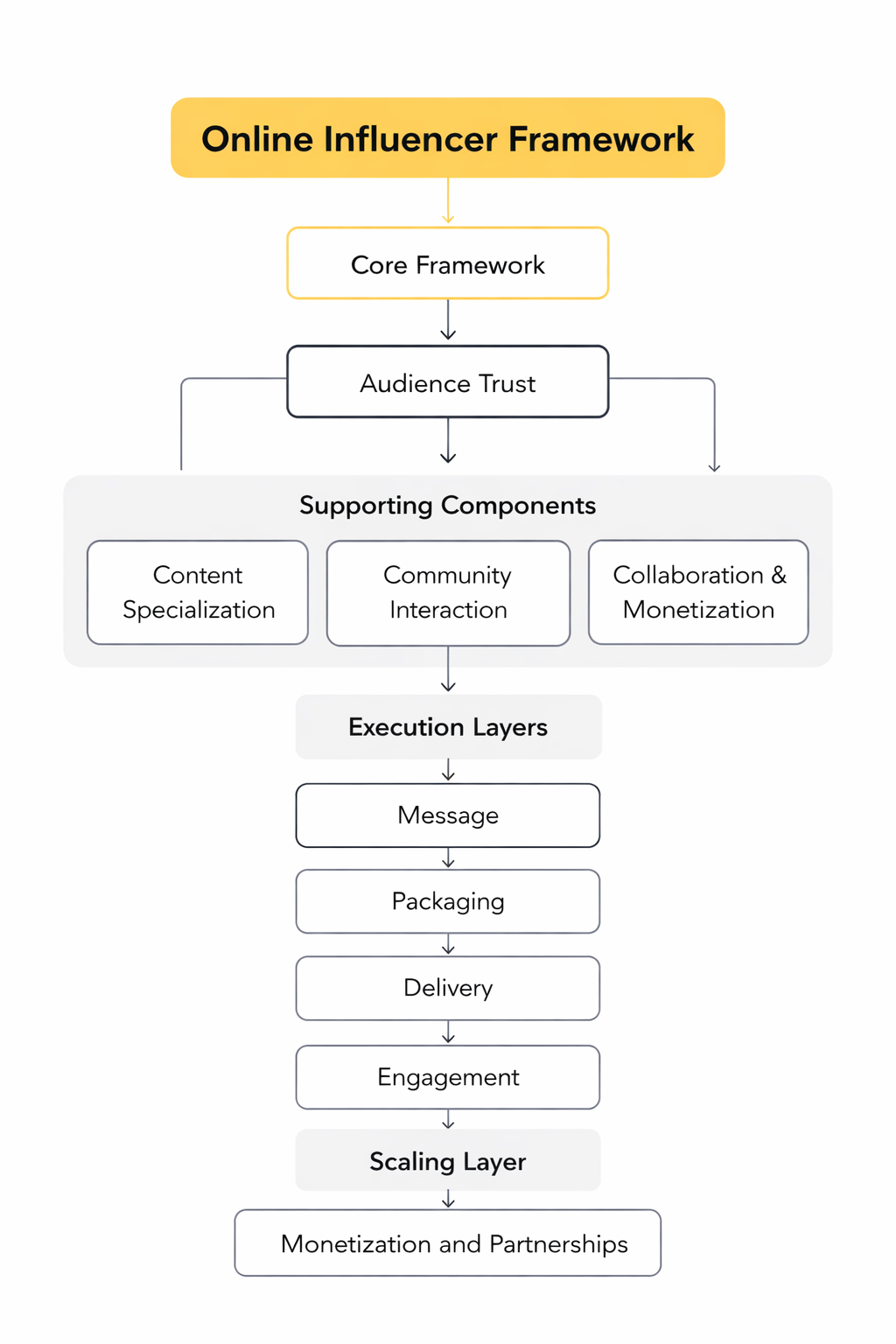
Behind every successful online influencer is a structured framework that governs how influence is built and maintained. While many creators appear spontaneous in their content, most sustainable influencer brands follow a strategic model involving audience development, credibility building, and long-term monetization.
At the foundation of this framework is audience trust. Without trust, follower counts mean little. Creators establish trust through consistent value delivery—whether that value comes from entertainment, education, or inspiration. Over time, this consistency forms the basis of a community rather than a passive audience.
The next layer involves content specialization. Influencers typically focus on specific themes or industries. Technology reviewers, travel creators, personal finance educators, and fitness experts all develop authority by consistently addressing the same topics. Specialization helps audiences understand what the influencer represents and why they should continue following them.
Community interaction forms another critical layer. Unlike traditional media personalities, online influencers can communicate directly with their audience. Comment replies, live streams, polls, and community posts create a feedback loop where followers feel personally connected to the creator.
Finally, the framework integrates collaboration and monetization. Brands, media platforms, and creators form partnerships that allow influencers to monetize their reach through sponsorships, affiliate marketing, digital products, or brand collaborations.
When these layers function together—trust, specialization, community interaction, and strategic collaboration—the result is a sustainable influence ecosystem that benefits both audiences and businesses.
Core Components of Online Influence
Although every influencer develops their own style, the structure of successful influence tends to revolve around a few core components. Understanding these elements helps explain why some creators build lasting influence while others struggle to maintain audience engagement.
Audience Trust and Authenticity
Trust is the currency of influence. Audiences follow creators who feel genuine and transparent about their experiences. When influencers openly discuss both advantages and limitations of products or ideas, followers perceive them as credible sources of information.
This credibility is essential because modern audiences are highly aware of sponsored content. Research exploring the effectiveness of influencer marketing emphasizes that authenticity and credibility strongly affect how audiences respond to promotional posts. When credibility is compromised, engagement and trust decline quickly.
Consistent Content Creation
Influencers who grow sustainably rarely rely on viral moments alone. Instead, they build momentum through consistent publishing schedules and recognizable content formats. Audiences learn what to expect, whether it is weekly tutorials, product reviews, storytelling videos, or educational threads.
Consistency also signals reliability. When followers know that a creator delivers valuable insights regularly, they are more likely to return and engage with new content.
Niche Authority
Most successful influencers specialize deeply in a particular niche. Instead of trying to appeal to everyone, they develop authority within a focused topic area. Technology influencers might analyze gadgets and software trends, while travel influencers document destinations and cultural experiences.
This specialization allows creators to become trusted sources within their field. Over time, audiences associate the influencer with expertise in that niche, strengthening both credibility and influence.
Community Engagement
Influence online grows stronger when audiences feel like participants rather than spectators. Influencers who actively respond to comments, share community feedback, and create discussions encourage followers to become part of a shared experience.
These interactions also provide valuable insights for creators. Audience questions often inspire new content ideas, allowing influencers to align their material with real community interests.
Professional Implementation
Turning influence into a sustainable professional path requires strategic planning. While creativity and personality attract audiences, long-term success often depends on treating content creation as a structured business.
Professional influencers typically begin by defining a clear niche and audience profile. Instead of producing random content, they design a content strategy that addresses the needs, questions, or interests of their target community.
Content production workflows also become increasingly sophisticated as creators grow. Influencers frequently manage editorial calendars, analytics dashboards, collaboration contracts, and production tools similar to those used by traditional media teams.
Partnership management is another major component of professional influence. As brands invest larger budgets into creator collaborations, they expect measurable outcomes such as engagement rates, audience reach, and conversion metrics. Influencers who understand these expectations can structure partnerships that benefit both sides.
Ultimately, the professional implementation of an online influencer strategy is about balance. Creators must maintain the authenticity that earned their audience’s trust while also building a sustainable business model around their influence. Those who manage that balance successfully often evolve from individual creators into full-scale media brands.
Step-by-Step Implementation

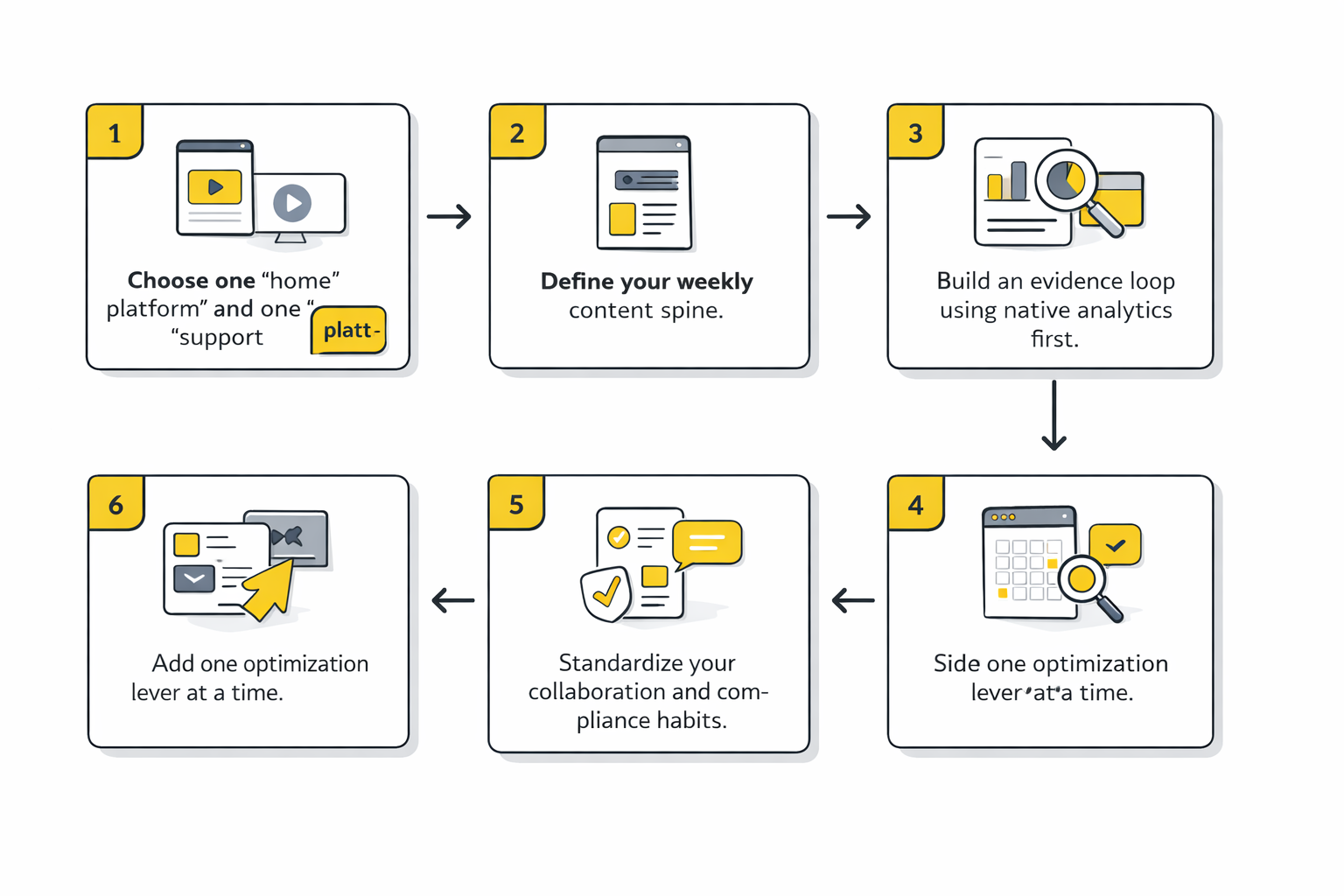
If you want to operate like a professional online influencer, the real work starts when you stop treating content as “posts” and start treating it as a repeatable system. You are building distribution, trust, and conversion pathways across platforms that change weekly. The goal isn’t to be everywhere—it’s to be consistent, measurable, and strategically memorable in the one or two places your audience actually pays attention.
This implementation process works whether you’re a solo creator or a brand-backed online influencer with a small team. The difference is only scale: solo creators automate more; teams specialize more. Either way, you’ll move faster (and waste less time) when you treat every piece of content as an experiment that earns you one of three outcomes: attention, insight, or revenue.
- Step 1: Choose one “home platform” and one “support platform”. Your home platform is where you publish the highest-effort content and build a predictable audience rhythm. Your support platform is where you repurpose and funnel attention back to the home platform. Most creators stall because they try to grow three platforms at once and end up building none.
- Step 2: Define your weekly content spine. Pick 2–3 recurring formats your audience can recognize instantly. Formats reduce creative fatigue, increase consistency, and make it easier for your audience to remember what you do.
- Step 3: Build an evidence loop using native analytics first. Use platform dashboards as your ground truth before adding tools. YouTube’s own analytics explains how thumbnail impressions, click-through behavior, and watch time connect, which matters because a beautiful video that nobody clicks is still invisible.
- Step 4: Add one optimization lever at a time. Start with the lever that multiplies distribution: packaging. On YouTube, that means thumbnails and titles, where native testing exists through the platform’s Thumbnail Test & Compare. On Instagram, it often means format selection and consistency, supported by creator guidance inside the professional dashboard.
- Step 5: Standardize your collaboration and compliance habits. If you do brand work, treat disclosure as part of production—not a last-second add-on. If you’re not confident, start with the FTC’s endorsement and influencer guidance hub and (if you work with UK audiences/brands) practical rules like placing “Ad” clearly at the start of copy, which the ASA repeatedly emphasizes in disclosure guidance.
- Step 6: Create a monthly “performance review” ritual. One day per month, you study what worked, cut what didn’t, and update your content spine. This is how an online influencer stays relevant without chasing every trend.
The implementation should feel lighter over time, not heavier. If every week feels harder, your system is probably too complex, or you’re measuring too many things without deciding what you’ll actually change based on the numbers.
Execution Layers
Execution becomes easier when you separate what you’re doing into layers. Most online influencer burnouts happen when creators try to improvise every layer at once—ideas, scripting, filming, editing, posting, engaging, and reporting—without any structure.
Layer 1: Message
This is what you stand for and what your audience will learn, feel, or do because you exist. Your message is not your niche label. It’s the promise you repeatedly keep—helping people solve a problem, see the world differently, or enjoy a specific kind of entertainment.
Layer 2: Packaging
Packaging is how your content earns the click (or the tap) and communicates value instantly. On YouTube, packaging is titles and thumbnails, and the platform itself gives creators tools to connect impressions to views and watch time inside YouTube Analytics. The moment you understand how impressions and click behavior translate into watch time, you stop guessing and start improving with intent.
Layer 3: Delivery
Delivery is the content experience once someone commits their attention. This layer includes pacing, clarity, structure, and the emotional rhythm of your content. If packaging earns the click but delivery disappoints, platforms learn quickly and distribution slows.
Layer 4: Engagement
Engagement isn’t a generic “reply to comments” checklist. It’s the moments where your audience feels seen and understood—where a follower thinks, “This creator gets me.” Strong engagement also creates content ideas automatically because questions and objections become your next posts.
Layer 5: Monetization and Partnerships
Professional monetization is built on alignment. If you promote products that don’t fit your audience, you don’t just lose conversions—you lose trust. This is also where disclosure and transparency become part of your brand, not a legal footnote, especially as regulators increase scrutiny of influencer advertising.
Optimization Process
Optimization is where an online influencer becomes dangerous—in the best way. It’s not about obsessing over vanity metrics. It’s about building a feedback loop where the content improves because the creator is consistently learning.
A simple optimization cycle looks like this:
- Observe: Use platform analytics to identify where attention drops or where reach stalls. On YouTube, this often starts with understanding how impressions and click behavior connect to watch time in the analytics interface itself.
- Hypothesize: Choose one reason something happened. Not five. If you can’t articulate a reason, you can’t design a clean test.
- Test: Change one variable and let the platform show you the difference. YouTube’s native thumbnail testing via Test & Compare is a practical example of platform-level experimentation that doesn’t require external tools.
- Decide: Keep what works, discard what doesn’t, and document the lesson in a simple “playbook note” so you don’t relearn it every month.
- Scale: Apply the winning pattern to future content, then run the next test.
The most important rule is restraint. If you change your format, hook, editing style, posting schedule, and niche angle all in the same week, you’ll never know what caused the improvement—or the collapse. The best online influencer operators treat optimization like science: one lever, one learning, repeated relentlessly.
Implementation Stories
Sometimes the clearest way to understand implementation is to look at what happens when it goes wrong—and what professionals do next.
In August 2024, three Facebook ads featuring entrepreneur and media personality Steven Bartlett were stopped by the UK advertising regulator after the ASA found they omitted key information about his commercial ties. The ads promoted Huel and Zoe with language that looked like personal endorsements, and the regulator’s rulings made the same point repeatedly: when a spokesperson has a direct financial interest, that context can be “material” to consumer understanding.
The story matters to any online influencer because it reveals a hard truth: even when an ad looks like an ad, missing disclosure context can still create risk—and that risk can derail campaigns fast.
Start at a point of high drama
The ads were live, paid, and visible to massive audiences when the complaints landed. Suddenly the campaign wasn’t about performance—it was about credibility and compliance. The ASA rulings meant the ads could not run again in the form that triggered the complaints, turning a marketing asset into a liability almost overnight.
Backstory
Bartlett’s public profile blends entrepreneurship, media, and influence, which is exactly why brands want him. His presence can make a product feel culturally relevant, not just commercially promoted. That blend of credibility and reach is why influencer-led advertising has become such a powerful tool for brands.
The wall
The issue was not that the ads were “secretly” advertising—these were paid placements. The wall was that audiences could interpret the content as a testimonial without understanding the financial relationship in full. The ASA’s published rulings on Huel and ZOE focused on omitted material information, which is the kind of problem that cannot be fixed by “better creative” alone.
The epiphany
The big realization for any professional team is that compliance is not separate from creative—it’s part of the product experience. If your online influencer content depends on trust, then disclosure is not a constraint; it’s a trust signal. Once you see it that way, you stop treating disclosures like awkward add-ons and start building them into scripts, captions, and approval workflows.
The journey
The practical solution is a structured release process: a checklist that runs before anything goes live. It starts with a “relationship inventory” (investor, director, affiliate, gifted product, paid partnership) and a “disclosure placement rule” (clear, immediate, and unmissable). It continues with a brand-and-creator approval pass where both parties confirm that the disclosure is correct, visible, and consistent with regulator guidance, including the FTC’s influencer disclosure resources and the ASA’s long-standing push for clarity in social ads.
The final conflict
Even with good intentions, real campaigns move fast and teams cut corners under deadline pressure. A creative team might assume that a paid placement label is enough, while legal teams assume the influencer will handle it, and the influencer assumes the brand already reviewed everything. That gap is exactly where compliance failures happen, and the ASA’s broader monitoring work—powered by automated systems—signals that these gaps are being found more often, not less.
The dream outcome
The dream isn’t “never get flagged.” The dream is having a system strong enough that your campaigns remain profitable and scalable without exposing your brand—or your online influencer reputation—to unnecessary risk. When disclosure is standardized and workflows are disciplined, creators keep trust, brands keep momentum, and performance becomes the focus again. That is what professional implementation really looks like: not perfection, but repeatable control.
Statistics and Data
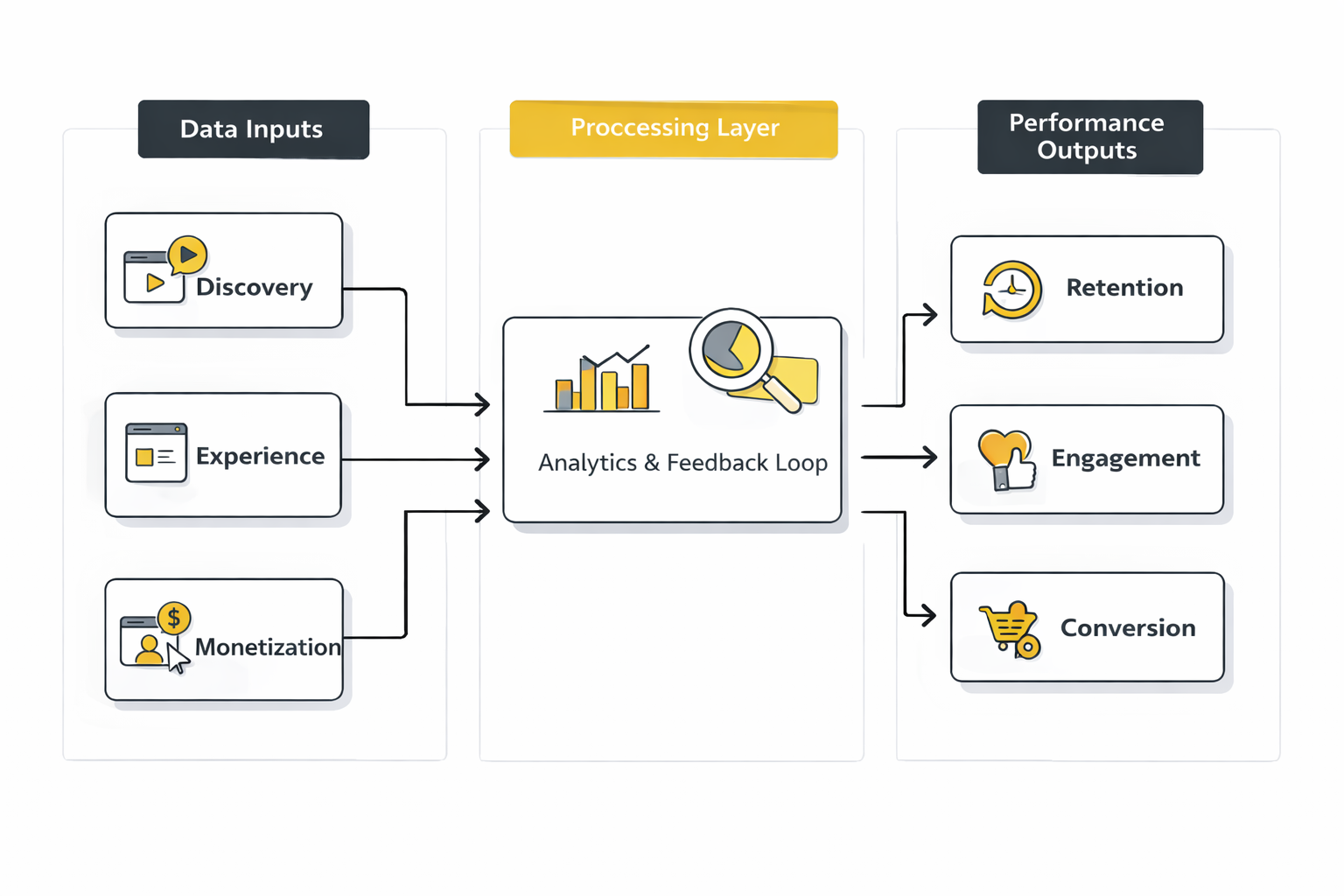
For a professional online influencer, analytics is not a scoreboard. It’s a decision engine. Numbers tell you what your audience is rewarding, what they’re tolerating, and what they’re quietly ignoring while the algorithm takes notes.
The tricky part is that “good performance” depends on what you’re measuring and how you’re calculating it. A TikTok engagement rate “by views” is a different reality than an Instagram engagement rate “by followers,” and both are different again from the metrics brands care about when they’re paying for results.
That’s why the most useful data for an online influencer does two things at once: it compares you to realistic benchmarks, and it explains what to change next. The sections below focus on benchmarks that can guide decisions, not just create anxiety.
Performance Benchmarks
Benchmarks are only valuable when they’re specific enough to be actionable and broad enough to be realistic. The safest way to use them is as guardrails: if you’re far below a platform’s normal range, you probably have a packaging or targeting problem; if you’re far above it, you’ve found a repeatable pattern worth scaling.
On Instagram, recent benchmark reporting shows the platform’s average engagement rate sitting around 0.48% across 2025, with carousels holding stronger than other formats at roughly 0.55% engagement. A separate set of platform-wide benchmarking also highlights how engagement tightened during 2025 while creators and brands leaned harder on formats that keep attention longer, which is exactly why a stable carousel rate matters even when overall engagement is sliding.
TikTok can look dramatically healthier, but the measurement method matters. One benchmark view reports TikTok closing 2024 at about 3.85% average engagement rate by views, while another widely cited report frames TikTok as the top channel with a 2.63% median engagement rate. These numbers can both be “true” because they’re not always measuring the same thing. The practical takeaway for an online influencer is simpler: your benchmark needs to match your calculation method, or you’ll chase the wrong fixes.
For creators who run YouTube seriously, retention often matters more than anything else because it’s the clearest proxy for value delivered. Brand-facing benchmark reporting in 2025 points to longer average watch-time performance and retention trends as central indicators of what audiences reward on the platform, which is why retention is often treated as a lead metric for creative quality, not a trailing metric for reporting.
When you work with brands, it’s also helpful to understand macro-level market expectations. Industry tracking continues to emphasize that influencer marketing is now treated as a core growth channel rather than an experimental line item, and market sizing projections show sustained expansion across the category, which is why brands increasingly expect creators to speak the language of outcomes and measurement, not just content.
Analytics Interpretation
Analytics becomes powerful when you stop asking “How did this post do?” and start asking “Why did the audience behave this way?” The same numbers can mean completely different things depending on context.
Engagement is a signal, not the goal
If engagement is high but follower growth is flat, the content may be resonating with your existing community but not attracting new people. If engagement is low but reach is rising, you might be getting surfaced to new audiences who don’t trust you yet. A professional online influencer treats that as a sequencing problem: trust-building content comes first, conversion content comes later.
Reach tells you what the algorithm is testing
Reach spikes often happen when the platform is “trialing” your content with a new audience cluster. If the spike collapses, it usually means the delivery didn’t match the promise. This is where you tighten your opening seconds, your structure, and your payoff so your content earns the right to keep being distributed.
Retention explains what your audience actually values
Retention is the most honest metric because it reflects attention, not approval. Likes are cheap, watch time is expensive. If your retention drops early, your hook doesn’t match your premise; if it drops in the middle, your pacing is off; if it drops near the end, your payoff isn’t satisfying enough to keep people until the finish.
Conversion metrics need a clean attribution story
Once an online influencer starts selling—whether that’s affiliate products, brand offers, or their own products—analytics needs structure. You need consistent links, consistent naming, and a repeatable way to compare offers over time. Without that, you’ll assume a “bad product” is the problem when it was actually weak framing, a mismatched audience, or poor timing.
The most important habit is to interpret metrics in layers. You fix discovery first (packaging and distribution), then you fix experience (retention and clarity), then you fix monetization (conversion and lifetime value). Trying to optimize everything at once turns analytics into noise.
Case Stories
One of the cleanest recent examples of influencer-led performance comes from a collaboration where the measurable outcome wasn’t just engagement. It was culture, press velocity, and product movement happening at the same time.
In mid-2025, Pinterest and Chamberlain Coffee launched a limited-edition Sea Salt Toffee coffee blend tied to a trend story and a creator with deep platform affinity. Coverage described it as Pinterest’s first co-branded global product and emphasized that it was sold directly in-app, turning inspiration into purchase without forcing users to leave the platform.
The journey they went on to reach the goal
The journey combined three mechanics: a trend hook, a creator whose relationship with the platform felt authentic, and a buying experience that didn’t break the flow. Press coverage highlighted the product as Pinterest’s first co-branded global drop and noted its availability through Pinterest and Chamberlain Coffee’s channels, extending reach across platform and brand ecosystems.
The collaboration was also positioned as a bridge between inspiration and commerce. Instead of asking audiences to “go search for it,” the campaign shortened the distance between “I want that” and “I bought that.”
That’s the real analytics lesson: the best-performing online influencer campaigns remove friction at the exact moment desire peaks, which is often the difference between cultural buzz and commercial impact.
Final conflict
Fast attention creates fragile expectations. If demand spikes and the product is hard to access, the conversation flips from excitement to frustration. Even when the press is positive, audiences judge the experience they personally have.
There’s also a narrative risk: when a campaign becomes a case study, every part of it is dissected. If the collaboration feels inauthentic at any point, commentary turns cynical and the story loses power.
The team needed the product story, creator credibility, and purchasing experience to stay aligned while the attention wave was at its peak.
Dream outcome
The dream outcome is a collaboration that becomes a repeatable model, not a one-time spike. Coverage described the campaign as a history-making product collaboration for Pinterest and positioned it as a sign that platforms can treat creators as long-term partners rather than transactional media placements.
The measurable signal was the press velocity, with nearly 1,500 press mentions reinforced by additional industry recaps repeating the same result as a shorthand for the campaign’s momentum. For an online influencer, that kind of earned-media amplification is essentially distribution you didn’t have to buy.
The deeper win is what it implies: when the story is real and the experience is tight, a creator partnership can generate attention, trust, and revenue in one integrated loop.
Context for the collaboration and its product-first positioning is covered in reporting on the partnership launch and product framing across Pinterest’s newsroom coverage, industry trade write-ups like MediaPost, and consumer-facing coverage like Parade.
Professional Promotion
Promotion is where a serious online influencer stops relying on luck. Great content can still underperform if it never reaches the right people, and average content can overperform if it’s packaged and distributed intelligently. Professional promotion is not “boost everything.” It’s choosing a small set of distribution moves that predictably amplify what already works.
Promote what proves itself first
Start by identifying your “validated” content: posts that outperform your baseline on reach, retention, or saves. Those are the pieces most worth repurposing, pitching to partners, or amplifying with paid support. This keeps your promotion budget—time or money—focused on assets that already have evidence behind them.
Turn one winner into multiple platform-native cuts
A single strong idea should not live only once. A professional online influencer creates a repurposing map: long-form becomes short clips, short clips become carousels, carousels become newsletter sections, and everything points back to your primary channel or owned audience. The goal is to increase “surface area” without diluting the message.
Use benchmarks to choose format, not to chase vanity metrics
If your platform benchmarks show a format holding engagement better, you treat that as a clue about attention behavior, not a mandate to copy everyone else. For example, when carousels show resilient engagement on Instagram while overall engagement tightens, that’s a practical reason to use carousels for deeper education and use Reels for discovery, then measure which one actually produces meaningful downstream action for your niche.
Earned media can be a promotion channel
The Pinterest and Chamberlain Coffee collaboration is a reminder that press momentum can act like a multiplier when the story is built for it. When a creator partnership produces a clear narrative hook, the press becomes an amplifier that extends reach beyond platform algorithms, which is a different kind of promotion than ads and often carries higher trust.
Ultimately, professional promotion is about building predictable momentum. The online influencer who wins long term is the one who can reliably create, measure, and distribute content without losing the authenticity that made people care in the first place.
Future Trends
The next era of the online influencer won’t be defined by who posts the most. It will be defined by who can package trust, prove outcomes, and adapt faster than the platforms change.
Creator-led media is becoming a default line item, not an experiment. The shift is visible in budget behavior, with U.S. creator ad spend projected to reach $37B in 2025 and brands increasingly treating creators as a must-buy channel.
AI is also moving from “nice to have” to a daily operating system. A large share of buyers report using or planning to use AI in creator marketing workflows, while still worrying about losing the human connection that makes an online influencer effective in the first place. That tension will shape how creators use automation without sounding synthetic or generic.
Social commerce is tightening the loop between inspiration and purchase. TikTok Shop’s acceleration is pushing more creators into performance-style promotion, and the UK’s surge—reported as 200,000 UK small businesses using TikTok Shop—signals how quickly creator-led selling can become mainstream when platforms reduce friction.
At the same time, the creator economy is professionalizing in ways that are uncomfortable but important. Income concentration is rising, with reporting that highlights how top creators capture a growing share of brand payments while the median creator feels more pressure to “post more” just to stay stable. The trend shows why serious online influencer operators are building owned channels and durable offers instead of relying on platform reach alone.
Finally, disclosure and advertising compliance will keep tightening. Regulators and platforms are making it harder to hide material connections, and the safest long-term move is to treat transparency as part of brand-building, supported by clear disclosure expectations outlined in the FTC’s endorsements and influencer guidance.
Strategic Framework Recap
If you strip away the hype, the online influencer ecosystem is still built on a few repeatable mechanics. The creators who last are not the ones who guess better. They are the ones who run a clearer system.
- Choose your home platform and build rhythm: consistency creates trust, and trust creates leverage.
- Package for discovery, then deliver for retention: the click earns attention, but the experience earns distribution.
- Build a measurable feedback loop: one hypothesis, one test, one lesson, repeated until your content compounds.
- Monetize in a way that matches trust: your offer ladder should feel like a natural next step, not a sudden sales pivot.
- Reduce platform risk: owned channels and diversified revenue keep you stable when algorithms shift.
- Operate like a professional: workflows, disclosure habits, and partner standards protect your reputation at scale.
When these pieces work together, your growth stops feeling like chaos. Your content becomes easier to replicate, your audience becomes easier to understand, and your income becomes less dependent on a single platform’s mood.
FAQ for This Online Influencer Complete Guide
What actually defines an online influencer today?
An online influencer is defined less by follower count and more by trust and behavior change. If your audience consistently takes action because of your opinions—watching, sharing, subscribing, buying, or changing how they think—you have influence, even if your audience is smaller.
How long does it take to build influence that brands will pay for?
It depends on your niche, output consistency, and how quickly you learn from feedback. Brands typically pay faster when you have a clear niche, reliable content cadence, and proof that your audience responds (comments, saves, clicks, email signups, sales, or strong retention).
Should I focus on one platform or be everywhere?
Pick one home platform where you publish your best work and one support platform for distribution. Being everywhere too early usually spreads your learning thin and slows growth. A strong home base makes repurposing effective instead of exhausting.
What metrics matter most for an online influencer?
Start with a simple hierarchy: discovery (reach and click behavior), experience (retention and saves), and outcomes (email signups, affiliate clicks, sales, qualified leads). The right metric depends on your goal, but retention and conversion are usually the most honest signals of real value.
How should I price brand deals without guessing?
Use a mix of inputs: audience fit, average views (or opens), engagement quality, production effort, and usage rights. When possible, negotiate outcomes (unique links, codes, landing pages) so pricing is connected to measurable value, not just “exposure.”
How do I disclose partnerships without hurting trust?
Make disclosures clear and early, then focus on being honest about why the product fits your audience. Transparency usually increases trust over time, especially as people get more skeptical of hidden incentives. Practical disclosure expectations and examples are covered in the FTC’s influencer and endorsements guidance.
What tools are actually worth paying for?
Start with native platform analytics and a simple workflow tool. Add paid tools only when they remove friction you can’t fix manually—like scheduling across channels, managing collaborations, tracking affiliate performance, or consolidating analytics for reporting.
How do I avoid burnout while staying consistent?
Reduce creative decisions by building a weekly content spine (repeatable formats), batch production where possible, and repurpose winners instead of reinventing from scratch. Consistency is easier when you run a system rather than relying on motivation.
Why do micro and niche influencers often outperform bigger creators?
Because relevance can beat reach. A smaller online influencer with high audience alignment can drive stronger action, especially in specific industries, locations, or subcultures. Brands care about outcomes, and niche trust often produces cleaner outcomes.
What is the fastest way to build an owned audience?
Offer something genuinely useful that fits your niche—templates, a newsletter with actionable insights, a resource library, or a community. Then make the call-to-action part of your content rhythm, not an occasional announcement. Owned channels protect you when platforms fluctuate.
How is social commerce changing the online influencer role?
It’s pushing creators closer to measurable performance. With more shopping happening directly inside platforms, influencers are becoming both storytellers and sales engines. The rapid growth of creator-led shopping in markets like the UK shows how quickly the expectations can shift from “awareness” to “revenue.”
Work With Professionals
There’s a moment every serious online influencer hits: you realize you don’t need more tips. You need better leverage. You need the kind of work that pays well, fits your strengths, and respects the fact that you’re building a real business—not begging for random gigs.
That’s where a focused marketplace can change the game. MARKEWORK is built for marketers who want to move faster, talk directly with companies, and keep the upside of the work they close. The platform emphasizes no project fees and no commissions, so you’re not watching a middle layer siphon off your momentum.
It also keeps the workflow simple: build a profile, browse listings, and message directly. On the “Find Work” section, the platform shows 1007 active listings at the time of writing (with more unlocked once you have an account), which is exactly the kind of consistent pipeline an online influencer can use to stabilize income between brand campaigns, product launches, and content swings.
If you’re tired of chasing leads, negotiating through посредники, or losing money to fees that don’t create value, a predictable system feels like oxygen. With straightforward monthly plans that highlight access to thousands of job listings, direct communication, and a clean account dashboard, you can spend more time doing the work you’re good at—and less time “networking” in circles.
The best part is the psychological shift: once your pipeline is real, your content gets better. You stop creating from panic and start creating from strategy. You make smarter partnerships. You build offers that fit your audience. You show up like a professional because you’re being paid like one.
 Filip Konecny Enterprises