

Pricing social media work shouldn’t feel like guessing in public. But most freelancers and small agencies end up doing exactly that—quoting a number, holding their breath, and hoping the client doesn’t immediately ask, “What does that include?”
This first part lays the foundation for social media packages pricing in a way that’s easy to explain, easy to sell, and hard to misunderstand. You’ll see what “packages pricing” actually means in practice, why it matters more now than it did a few years ago, and the framework we’ll use throughout the full guide to build packages that protect your time while staying fair to the client.
Article Outline
- What Is Social Media Packages Pricing?
- Why Social Media Packages Pricing Matters
- Framework Overview
- Core Components
- Professional Implementation
What Is Social Media Packages Pricing?

Social media packages pricing is the practice of bundling a defined scope of social work into clear “tiers” (or modules) with a fixed monthly fee. Instead of charging for “posting on Instagram” or “running ads” as vague line items, you package outcomes and deliverables into a predictable operating system: what the client gets, what you do, how often it happens, and what success looks like.
In real life, this usually includes a mix of five things: content planning, content production, publishing, community management, and reporting—sometimes with paid social management layered on. Packages pricing doesn’t mean everything is rigid. It means the rules are explicit: boundaries, turnaround times, revision limits, meeting cadence, and what counts as “extra.”
There’s also a quiet psychological advantage: packages shift the conversation from “How cheap can this be?” to “Which level fits us right now?” That one change makes it easier to sell retainers without feeling like you’re defending your worth on every call.
Why Social Media Packages Pricing Matters
Clients are spending more attention and more budget on social than ever—but that doesn’t automatically translate into easier work. It often translates into higher expectations: faster content cycles, more formats, more platforms, more proof. The result is simple: vague scopes create invisible labor, and invisible labor is what quietly kills profitability.
When social ad spend and platform competition keep climbing, clients naturally demand clearer performance stories and tighter execution. WARC’s forecast that global social ad spend would reach $286.2B in 2025 and exceed $300B in 2026 makes the stakes obvious—social is no longer “nice to have,” it’s a major budget line that gets scrutinized (WARC’s 2025 social spend forecast, Reuters on WPP’s 2025 ad outlook, eMarketer’s 2025 worldwide forecast).
At the same time, the “volume of social” keeps expanding. Kepios’ ongoing reporting shows billions of social identities globally, which helps explain why clients feel pressure to show up consistently—and why they panic when posting slows down (Kepios global social media statistics, Digital 2025 state of social, Digital 2025 global overview).
Packages pricing matters because it creates a shared reality. It tells the client, “Here’s what it takes to run social like a system,” and it tells you, “Here’s what I am—and am not—responsible for.” That’s how you protect delivery quality without turning every month into a negotiation.
Framework Overview
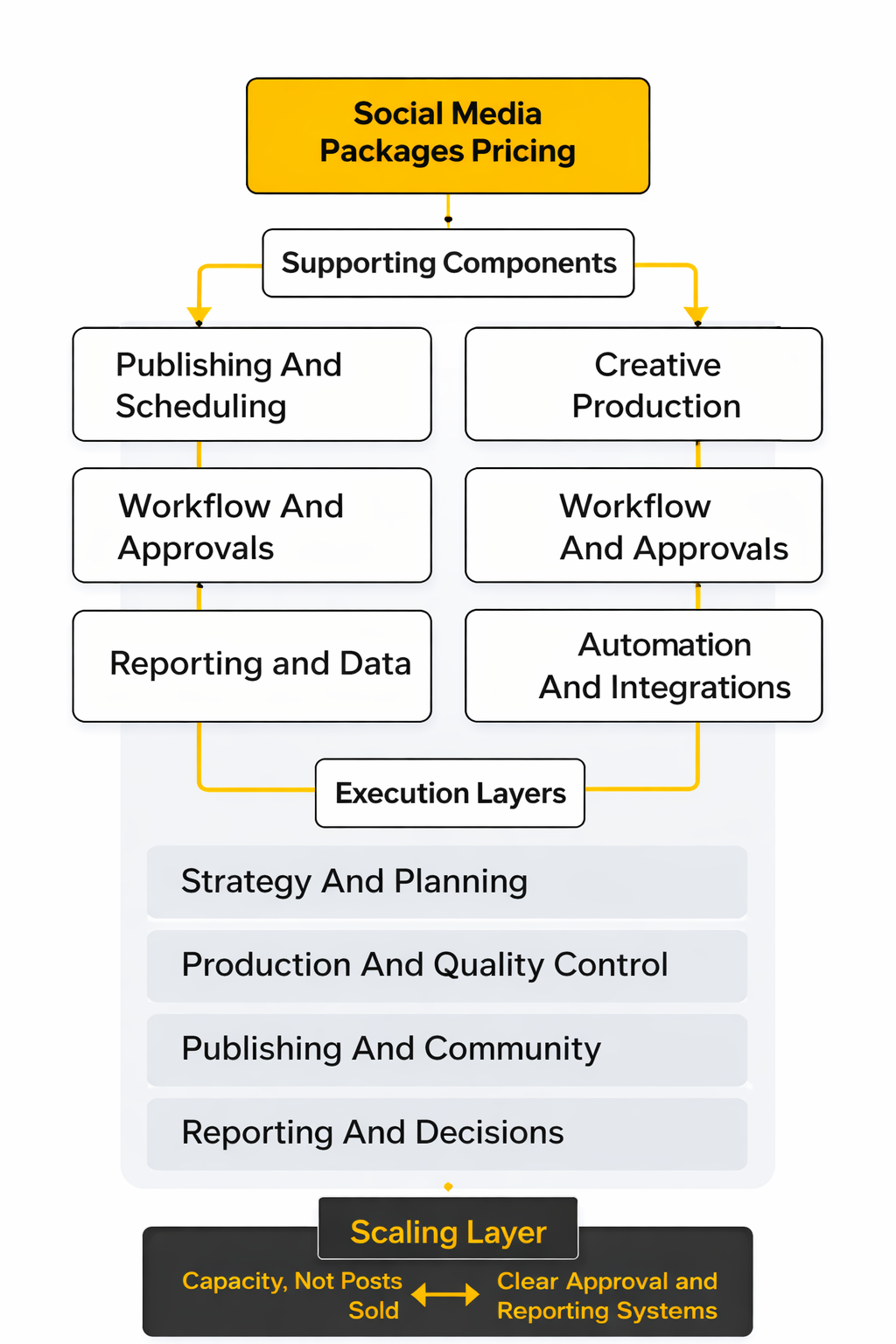
The framework in this guide treats social media packages pricing as a structured build, not a random set of deliverables. You’ll design packages from the inside out—starting with what the client is actually buying (capacity and decision-making), then translating that into outputs (content, distribution, reporting), and finally pricing it with constraints that keep the retainer sustainable.
Think of it as three layers:
- Operating layer: how you run the account(s)—cadence, approvals, collaboration, and the workflow that prevents chaos.
- Production layer: what you ship—how much content, what formats, and what level of creative lift is included.
- Proof layer: how you measure and explain value—reporting, insights, tests, and what decisions those insights unlock.
This matters because “more posts” is rarely the real goal. Clients want momentum, consistency, and evidence that social is moving the business forward. A good package makes those things predictable.
Core Components
Every strong packages-pricing model comes back to the same core components. If you miss one, you either undercharge, overpromise, or both.
- Scope boundaries: platforms covered, content types included, and what’s explicitly excluded. Boundaries are not “red tape”—they’re what keep results repeatable.
- Capacity math: the real limit is usually people-time, not ideas. Your package should reflect the amount of attention the client is purchasing each month.
- Workflow design: approvals, deadlines, revision rules, and asset collection. This is where most “surprise work” comes from, so it must be spelled out.
- Content expectations: volume and complexity. A simple graphic post and a short-form video with on-screen text are not the same job, even if both are “one post.”
- Measurement and decision-making: reporting is not just a PDF; it’s the decisions that your insights make easier. When you define that, clients stop treating analytics as decoration.
If you’re building packages for small teams, it also helps to ground your pricing in market reality—without copying anyone’s numbers. For example, Clutch aggregates pricing from verified client reviews and reports an average monthly cost for social media marketing projects in the low-$5k range, which is useful context when you’re positioning retainers against “agency-level” expectations (Clutch social media marketing pricing guide).
On the freelance side, Upwork publishes typical hourly ranges for social media managers and marketers, which helps you sanity-check whether your package price is secretly asking you to work full-time for part-time pay (Upwork social media manager cost ranges, Upwork social media marketer cost ranges).
Professional Implementation
Implementing social media packages pricing professionally is less about choosing three cute tier names and more about building a client experience that feels calm. The goal is that the client can look at your package, understand it in one pass, and immediately see how it connects to their reality—team size, approval speed, and how much content they can actually sustain.
Start by packaging the work the way it’s truly delivered. If your best results happen when you can plan content monthly, batch production, and optimize weekly, your package should mirror that cadence. When your package aligns with how work gets done, you reduce friction for both sides.
Next, make “how we work” as visible as “what you get.” Many clients have never had a clean social workflow. They’ve lived through last-minute asset requests, endless feedback loops, and unclear ownership. Your package becomes the antidote: a reliable rhythm with clear responsibilities.
Finally, treat upgrades as a natural progression, not a hard sell. A strong package structure makes it obvious when a client has outgrown their tier: they want more formats, faster turnaround, or deeper optimization than the current capacity allows. When that moment comes, you’re not renegotiating from scratch—you’re simply moving them to the package that matches their new demand.
Step-by-Step Implementation
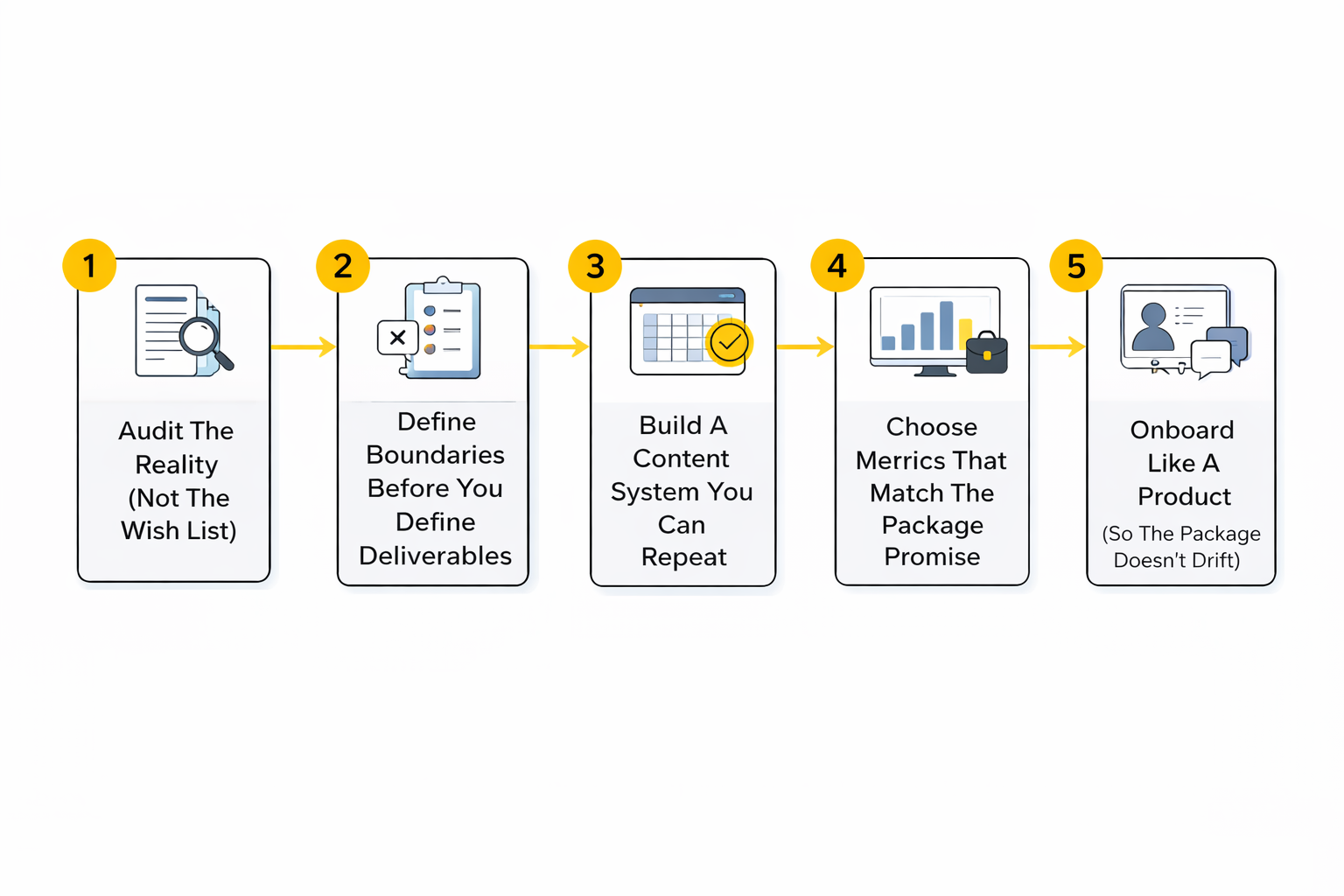
When social media packages pricing works, it feels almost boring—in the best way. The client knows what happens this month, you know what you’re responsible for, and the account moves forward without constant renegotiation. The easiest way to get there is to implement packages like a product rollout: define the rules, build the delivery engine, and only then scale.
Step 1: Audit The Reality (Not The Wish List)
Start by auditing what the client can actually support. A lot of packages fail because the service assumes a perfect world: instant approvals, endless assets, and decision-makers who reply on time. Your audit should include who provides brand assets, who approves content, how feedback arrives, and what happens when nobody answers.
Pair that with a quick baseline check inside native tools and any existing dashboards. The goal isn’t a huge report—it’s clarity: what’s working, what’s unreliable, and what the client is expecting social to do for the business.
Step 2: Define Boundaries Before You Define Deliverables
Before you decide how many posts live inside each tier, decide what you will not do inside that tier. Your boundaries are what keep social media packages pricing profitable: revision limits, approval deadlines, “included platforms,” and what counts as out-of-scope (new launches, emergency posts, event coverage, influencer negotiations, paid creative production, and so on).
This is also where you define cadence. A monthly content cycle with weekly optimization can work beautifully, but only if approvals have a deadline and feedback is structured.
Step 3: Build A Content System You Can Repeat
Packages don’t scale because you “try harder.” They scale because you have a repeatable system for planning and production. A simple baseline system includes content pillars, a weekly rhythm (what gets published when), and a clear workflow from idea to approval to scheduling.
A shared calendar is the backbone of that system, and it matters because it reduces last-minute work and creates space for quality. Hootsuite’s explanation of what a social media calendar is—and why teams rely on it—maps cleanly to package delivery because calendars make scope visible to everyone. https://blog.hootsuite.com/social-media-calendar/
Step 4: Choose Metrics That Match The Package Promise
Reporting becomes painful when a package promises one thing but measures another. If a starter package is about consistency and brand presence, you’ll focus on content cadence, engagement quality, and community responsiveness. If a growth package is about learning and improvement, you’ll focus on experiments, format performance, and what changed month over month.
Build the reporting layer so it survives real-world platform changes. Meta has documented deprecations and shifts in Page Insights metrics, which is a reminder that your package shouldn’t depend on a fragile metric set that can disappear mid-retainer. https://developers.facebook.com/blog/post/2025/08/15/page-insights-api-updates/ https://developers.facebook.com/blog/post/2023/12/14/page-insights-metrics-deprecation/
If you want a stable “single view,” build your reporting around a dashboard tool designed for sharing and reuse. Looker Studio exists for exactly that: turning data into readable reports that are easy to share with clients and stakeholders. https://cloud.google.com/looker-studio
Step 5: Onboard Like A Product (So The Package Doesn’t Drift)
Most retainers drift because onboarding is loose. You want a simple, standardized kickoff that creates the same outcome every time: you have access, you have assets, you have deadlines, and the client understands how approvals work.
It helps to document your approval process in plain language so clients don’t accidentally become the bottleneck. Even tool vendors that obsess over speed keep repeating the same idea: approvals reduce risk, but only if the workflow is clear and consistent. https://getkoro.app/blog/content-approval-process
Execution Layers
Once the package is defined and onboarding is complete, execution becomes the daily reality of social media packages pricing. The easiest way to keep execution clean is to separate your work into layers. Each layer has a different kind of effort, and mixing them together is how clients end up paying for one thing while expecting three.
Layer 1: Strategy And Planning
This is where you decide what the account is trying to accomplish right now, what topics the brand will “own,” and how the month’s content ladder builds toward those goals. Planning is also where you protect the package: content themes, posting cadence, and decision rules prevent the endless “can we just also add…” requests.
Layer 2: Production And Quality Control
This is where time can explode if you don’t control it. Production isn’t just designing and writing—it’s also feedback loops, asset sourcing, versioning, and formatting per platform. If the package includes higher-effort formats, you need a workflow that makes quality repeatable without multiplying revisions.
Layer 3: Publishing And Community
Publishing looks simple until you manage multiple platforms, formats, and time zones. Community work also sneaks up: questions, complaints, and customer care moments are public, and clients notice response speed. If you offer community management in your package, define coverage windows and escalation rules so you don’t become “always on.”
Layer 4: Reporting And Decisions
Reporting should exist to support decisions, not to decorate a slide deck. When you build this layer well, your pricing becomes easier to defend because clients see that the package produces learning and direction, not just content output.
Optimization Process
Optimization is what turns social media packages pricing from a posting service into a strategic retainer. The key is to keep optimization lightweight and consistent—small, regular improvements beat occasional “big overhauls” that never happen because everyone is too busy.
Weekly: Protect Momentum
Your weekly check should focus on simple questions: which formats held attention, what topics sparked meaningful responses, and what friction appeared in the workflow. If content approvals slipped, fix that first—speed of execution is often the hidden constraint that limits results.
Use link tracking rules that don’t change every week, so performance discussions stay grounded in consistent data collection. Google’s guidance on UTM campaign parameters is useful here because it keeps naming and attribution disciplined across posts and campaigns. https://support.google.com/analytics/answer/10917952?hl=en
Monthly: Make The Package Feel Smarter Over Time
Your monthly review is where you earn trust. The client doesn’t just want to know what happened; they want to know what you’re changing because of what happened. Bring a short list of decisions: what you’re doubling down on, what you’re pausing, and what you’re testing next.
If you’re using a dashboard, keep it client-friendly and stable. Looker Studio’s model of reusable reports makes it easier to build a repeatable reporting experience across clients without reinventing the wheel every month. https://cloud.google.com/looker-studio
Quarterly: Re-Scope Before The Client Forces It
Quarterly is the right moment to adjust scope—because it’s predictable. If the client’s needs changed, you move them to a different tier or add a clearly priced module. This is how you prevent scope creep from becoming a slow leak in your margins.
Implementation Stories
Implementation becomes easier when you’ve seen what “before” and “after” looks like. The stories below are real, publicly documented examples of teams changing their workflow so they could execute faster, collaborate more cleanly, and keep control of content at scale—the same problems that social media packages pricing is designed to solve.
Óčko TV’s Team Hit A Breaking Point, Then Rebuilt How Social Gets Done
Start (high drama): When a media brand runs a nonstop content schedule, every missed post feels louder than it should. The team can’t hide behind “we’ll fix it next week” because the audience is already refreshing. Stress doesn’t come from one mistake—it comes from knowing the next one is always one rushed handoff away.
Backstory: Óčko TV operates as part of a larger media group with multiple brands, which creates constant pressure to coordinate content across channels. The head of social stepped into the role without deep social media management experience, then had to scale up fast as expectations rose. A teammate brought in years of experience from managing large-scale social operations and carried a memory of what “manual” workflows cost in time and sanity. https://www.zoomsphere.com/case-studies https://ocko.tv/
The wall: The team described the old world as chaotic: planning in spreadsheets, publishing by hand, and chasing approvals through scattered messages and email threads. Every platform variation created another copy/paste cycle, and every approval delay pushed work into evenings. The hardest part wasn’t effort—it was fragility, because a fragile process breaks under volume. https://www.zoomsphere.com/case-studies
The epiphany: The shift happened when they stopped treating the problem as “we need better posting” and started treating it as “we need a better operating system.” A single place for planning, feedback, and scheduling wasn’t a nice-to-have; it was the only way to keep quality consistent under pressure. Once they framed it that way, the tool became a workflow decision, not a software purchase. https://www.zoomsphere.com/case-studies
The journey: They implemented a system that centralized scheduling and structured collaboration so comments and approvals lived next to the posts themselves. That meant feedback stopped being a scavenger hunt and became part of a clear process. They also built habits around performance checks and competitor context so social wasn’t just publishing—it was learning. https://www.zoomsphere.com/case-studies
The final conflict: Every workflow change comes with a fear: what if the team loses speed while learning the new system? What if stakeholders resist the new approval rules and try to pull everything back into email? The team had to hold the line long enough for the new routine to become normal—and prove that structure didn’t reduce creativity, it protected it. https://www.zoomsphere.com/case-studies
The dream outcome: The documented outcome was simple and powerful: they described it as hard to imagine going back to the old way. With a calmer workflow, they could focus on producing more consistent content and tracking performance instead of spending energy on manual coordination. That’s exactly what great social media packages pricing delivers for clients: fewer surprises, clearer collaboration, and a system that keeps working even when the content volume rises. https://www.zoomsphere.com/case-studies
A Practical Professional Checklist
- One workflow hub: every post has a status, an owner, an approval state, and a publish date in a single shared system.
- One approval rule: feedback happens in one place, with a deadline, and silence has a defined meaning (otherwise approvals become endless).
- One tracking standard: link tracking uses consistent UTM rules so “what drove results” doesn’t turn into a guess. https://support.google.com/analytics/answer/10917952?hl=en
- One reporting format: the client receives the same type of report each month, so they learn how to read it and you don’t rebuild it from scratch. https://cloud.google.com/looker-studio
- One resilience plan: your reporting and KPIs don’t depend on fragile metrics that can be deprecated; you monitor platform changes and adapt the package measurement layer when needed. https://developers.facebook.com/blog/post/2025/08/15/page-insights-api-updates/
When you run this checklist consistently, the client experience becomes predictable. That predictability is what makes packages easier to sell, easier to renew, and easier to scale—because the value isn’t “posts,” it’s a system that keeps delivering.
Statistics And Data
The fastest way to make social media packages pricing feel “real” to a client is to back it with data they can understand at a glance. Not vanity numbers. Decision numbers. The kind of numbers that answer the questions clients actually have: “Is this working?”, “What changed?”, and “What are we doing next month because of it?”
Two data trends matter more than anything when you’re pricing and delivering packages: engagement behavior is shifting across platforms, and customer expectations for brand responsiveness keep rising. That combination changes what clients consider “good social,” which means it also changes what they’re willing to pay for.
- Engagement is not evenly distributed: TikTok’s average engagement rate was reported at 3.70% in Socialinsider’s 2026 analysis, while Instagram averaged 0.48% and Facebook 0.15% over the same benchmark set. Socialinsider’s 2026 social media benchmarks Social Media Today’s summary of the same benchmark report
- Consumers reward brands that reply: 58% of surveyed consumers said it’s important to see brands respond to customers on social, which is a direct argument for packaging community management and response workflows instead of treating them as “extra.” Emplifi’s Social Pulse consumer survey (2025) Emplifi’s download page for the report
- UGC outperforms celebrity influence in purchase impact: Emplifi’s survey found 65% of shoppers are influenced by user-generated content while 14% are influenced by celebrities, which supports packages that include UGC sourcing, permissions, and repurposing workflows. The same Emplifi Social Pulse report Chief Marketer’s coverage of the findings
Performance Benchmarks
Benchmarks are not targets. They’re context. They help you explain why a client’s results look “normal,” “concerning,” or “promising,” and they keep social media packages pricing grounded in reality instead of wishful thinking.
Engagement Benchmarks By Platform
If a client expects Instagram to behave like TikTok, you’ll end up defending your work every month. Platform benchmarks reset expectations before that conflict starts.
- Cross-platform context: Socialinsider’s 2026 report summarized average engagement rates across TikTok (3.70%), Instagram (0.48%), and Facebook (0.15%), and also highlighted a broader shift toward more passive engagement as comment volume declined on TikTok and Instagram. Socialinsider’s 2026 benchmarks report A secondary breakdown of the same benchmark set
- Format nuance on Instagram: Socialinsider’s Instagram benchmark page notes that carousels remain resilient, with carousel engagement rate around 0.55% in their latest benchmark snapshot. That matters because it supports packages that include carousel design and copywriting as a “quality lever,” not just “more posts.” Socialinsider’s 2026 Instagram organic engagement benchmarks
Benchmarks For Consumer Expectations
Clients rarely say, “We need better response workflows.” They say, “People keep complaining,” or “Support is drowning,” or “We’re losing leads in DMs.” That’s exactly where packaged service tiers become valuable.
- Responsiveness expectation: 73% of social media users expect brands to respond on social within 24 hours, which supports building response SLAs into your packages instead of leaving them vague. Sprout Social’s 2026 best practices summary referencing the 2025 Index Sprout Social Index hub (Edition XX)
- Why that expectation matters commercially: Emplifi’s 2025 consumer survey found 58% say it’s important to see brands respond to customers on social, which means public responsiveness affects trust even for people who never message you directly. Emplifi’s Social Pulse consumer survey (2025) Marketing Dive’s coverage of the Social Pulse report
Analytics Interpretation
Analytics become confusing when everything gets treated as equally important. For social media packages pricing, the interpretation needs to be simple enough to guide decisions, and structured enough that clients can “feel” improvement month to month.
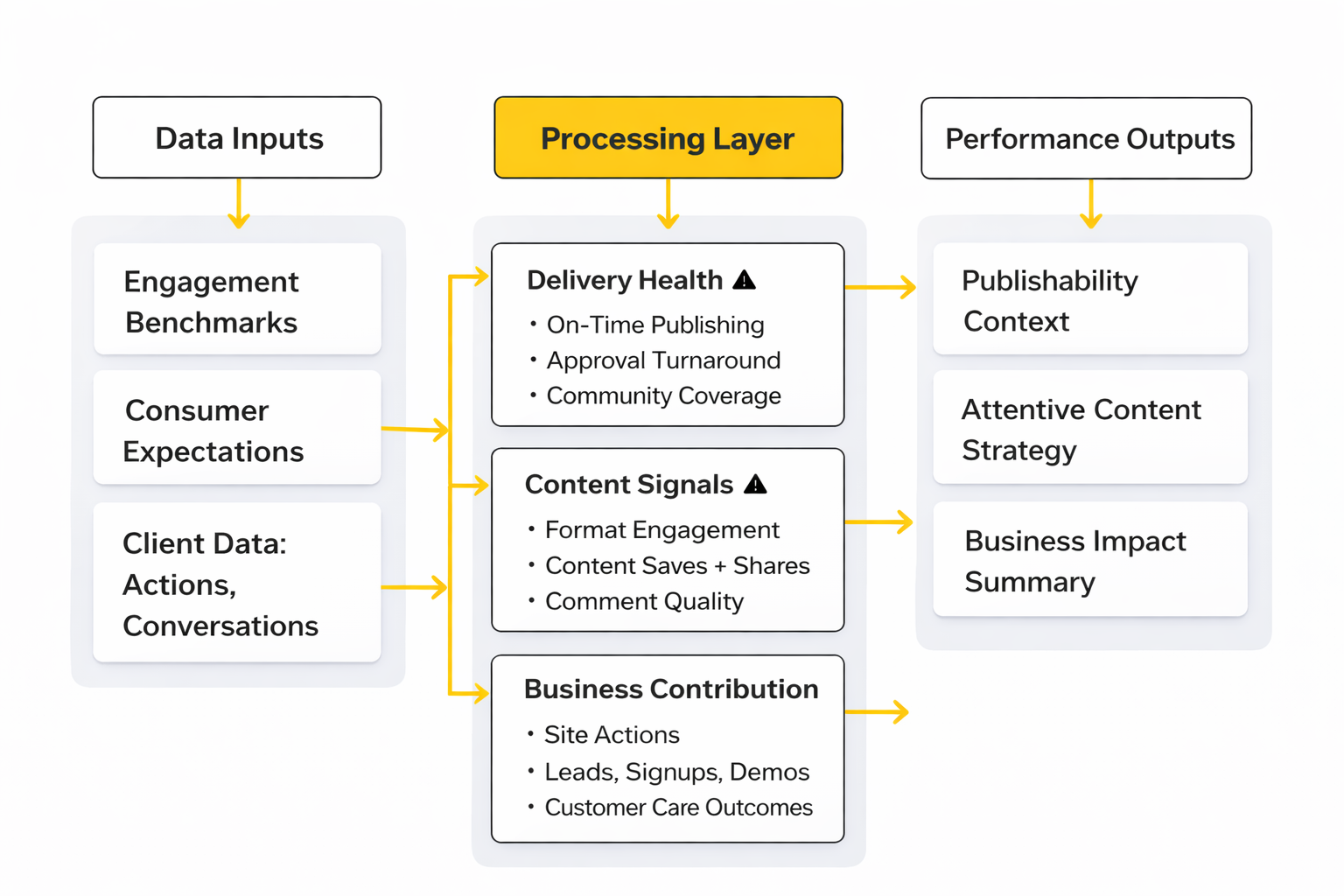
Interpret Analytics In Three Levels
- Level 1: Delivery health (did we execute what we promised?): on-time publishing rate, approval turnaround, backlog size, response time coverage. Meta even tracks response-time metrics for Pages, which can be useful context when community management is part of your package. Meta Business Help Center on Page response time Meta Business Help Center on response rate
- Level 2: Content signals (what earned attention?): engagement rate by format, saves/shares vs. likes, watch time patterns, and comment quality. Benchmarks are useful here because they stop teams from overreacting to “low engagement” on a platform where engagement is structurally lower. Socialinsider’s 2026 platform benchmarks
- Level 3: Business contribution (what changed for the business?): site actions, leads, email signups, demo requests, customer-care deflection, or reduced support load. This is where clients start seeing a package as an investment instead of a content expense.
Why Benchmarks Can Mislead (And How To Use Them Well)
Benchmarks can be dangerous if they’re used as a scoreboard. Averages hide context: industry, brand size, content type, and whether the account is in “growth mode” or “maintenance mode.”
The professional move is to use benchmarks as guardrails, then compare the client to themselves over time. Your reporting should make it obvious when the system is improving: faster approvals, cleaner creative, smarter content choices, and clearer outcomes.
Case Stories
When clients push back on pricing, it’s often because they think social is “posting,” not operations. The story below is a real example of a team using automation and measurement to protect speed and quality under pressure—exactly what good social media packages pricing is built to deliver.
Vagaro’s Support Pressure Spiked, And The Team Had To Rebuild How They Handle Conversations
Start (high drama): The inbox wasn’t just full—it was relentless. Requests kept arriving faster than humans could reasonably answer, and every delay risked turning a customer question into a public complaint. The team could feel the brand experience slipping in real time, one unanswered conversation at a time. Zendesk’s 2025 CX Trends report announcement referencing Vagaro
Backstory: Vagaro supports thousands of businesses in beauty and wellness, which creates high expectations for fast, accurate help when something goes wrong. Customer support isn’t just a cost center in that environment—it’s part of the product people judge every day. When support quality dips, loyalty dips with it, and word spreads quickly in service-based communities. The same Zendesk report announcement
The wall: The team hit a ceiling where effort stopped solving the problem. Hiring alone couldn’t instantly absorb volume, and manual workflows made it worse by forcing people to repeat the same answers and searches. Every minute spent on repetitive tasks was a minute not spent on the complicated issues that actually needed human judgment. PR Newswire coverage of the Zendesk report
The epiphany: The breakthrough was treating speed and accuracy as a system problem, not a motivation problem. The team leaned into automation to handle the predictable parts of support so humans could focus where they mattered most. They framed the goal in business terms: fewer unresolved requests, faster resolution, and a better customer experience that could be measured. Zendesk’s report announcement quoting Vagaro
The journey: Vagaro implemented Zendesk AI to resolve a meaningful portion of incoming requests without human intervention, reducing repetitive workload. The team reported resolving 44% of incoming requests through AI, which immediately changed how much capacity they had for complex cases. That also made performance easier to communicate internally because “requests resolved” and “time saved” are metrics leaders understand quickly. Zendesk’s report announcement with Vagaro metrics
The final conflict: Automation doesn’t automatically create trust—teams have to prove it won’t break the customer experience. Any system that responds faster can also respond wrongly if it’s not tuned, and one wrong answer can undo a lot of goodwill. They had to balance speed with quality and make sure the system improved outcomes rather than just closing tickets. PR Newswire coverage of the Zendesk report
The dream outcome: The reported results weren’t subtle: Vagaro cited an 87% reduction in resolution time and a CSAT of 92% after leveraging Zendesk AI. Those numbers tell a clean story: faster help, happier customers, and a support experience that can scale. For package designers, the lesson translates directly—clients pay more when you can measure “calmer operations” and show proof that the system is improving. Zendesk’s report announcement quoting Vagaro outcomes
Professional Promotion
Promotion is where a lot of freelancers accidentally undercut their own social media packages pricing. They show pretty posts and talk about creativity, but they don’t show the operational value: the speed, the reliability, the insight, and the reduced chaos.
Make Data Sell The Package (Without Turning It Into A Spreadsheet Pitch)
- Use one benchmark slide, not ten: show the client where their platform tends to sit (TikTok vs. Instagram vs. Facebook engagement realities), then pivot immediately to what you’ll do with that context. Socialinsider’s 2026 platform benchmarks
- Position responsiveness as a revenue protector: when 73% of users expect a reply within 24 hours, community management stops being “nice” and becomes part of the product experience. Package it with coverage rules so it’s deliverable and priced correctly. Sprout Social’s best practices referencing the 2025 Index expectation
- Sell UGC as an engine, not a trend: when 65% say UGC influences purchases and 14% cite celebrities, your premium tier can justify UGC sourcing, permissions, and repurposing workflows as a growth lever. Emplifi’s Social Pulse findings
Build “Proof Rituals” Into The Package
Professional promotion isn’t just ads and outreach. It’s building reporting rituals that make the value obvious before the client asks. If you do this well, renewals become a natural next step instead of a negotiation.
- Monthly decision recap: one page that answers: what we learned, what we changed, what we’ll test next.
- Quarterly scope check: a predictable moment to adjust tier or add modules based on real demand, not last-minute pressure.
- Operational scorecard: approval speed, publishing reliability, response coverage, and a short list of “friction fixes” that keep delivery smooth.
When your promotion is built around measurable calm—clear benchmarks, clean interpretation, and visible decisions—your pricing starts to feel less like a cost and more like the way the client finally gets control of social.
Future Trends
The next wave of social media packages pricing will reward operators who can package certainty in a channel that keeps changing. Platforms are pushing harder on automation, commerce, and AI-driven discovery, while clients are demanding clearer proof and faster turnaround. The result is simple: packages that feel like “a system with guardrails” will win over packages that feel like “a pile of posts.”
AI-assisted production becomes table stakes, but human judgment becomes the differentiator. Teams that use AI to speed up drafting, versioning, and analysis will raise throughput, but clients will still pay premium retainers for taste, brand safety, and decision-making—exactly the shift described across trend research like Hootsuite’s Social Media Trends 2026 hub and Sprout’s 2026 social media trends.
Paid social moves toward “input budget, get campaigns,” which changes how you price management. Meta’s direction toward deeper ad automation points to a future where execution is less about clicking buttons and more about creative strategy, audience signals, and experimentation design, which reshapes what a “paid add-on” should include in your packages. Meta’s 2026 ad automation push covered by Reuters
Social commerce and AI shopping experiences will keep rising, and clients will expect content to convert. As social platforms and commerce ecosystems add conversational discovery and shopping layers, packages will need clear conversion pathways—link tracking, offer testing, creator/UGC pipelines, and landing-page coordination—so clients can see social as revenue-connected, not just awareness. Business Insider on LTK’s AI shopping chatbot
Operational expectations will harden: faster responses, clearer governance, fewer mistakes. As more brand interactions move into comments and DMs, clients won’t accept vague “we’ll monitor messages” language. Packages will increasingly include response windows, escalation rules, and reporting on responsiveness because customer experience is now part of the brand’s public footprint. Sprout Social Index hub Zendesk’s 2026 customer service statistics roundup
Budgets keep flowing into social, but leadership will demand proof faster. Forecasts and market reporting continue to frame social as a major ad channel, which increases scrutiny and raises the value of packages that include repeatable reporting and decision rituals. We Are Social’s Digital 2026 overview summary referencing Statista projections
Strategic Framework Recap

If you want social media packages pricing that sells cleanly and delivers calmly, the framework is the same every time: build the system first, then price the system, then protect the system with boundaries.
- Define the operating layer: cadence, approvals, collaboration rules, and who owns what—so the package doesn’t drift into chaos.
- Design the production layer: content volume plus complexity, with revision limits and QA gates—so “more” doesn’t quietly mean “endless.”
- Lock in the proof layer: reporting that leads to decisions, not just screenshots—so clients can feel progress month over month.
- Package capacity, not promises you can’t keep: sell attention and execution bandwidth with guardrails—so the retainer stays profitable as expectations rise.
- Use tools to defend margin, not to add fluff: automate repetitive work, standardize workflows, and keep reporting resilient—especially as platforms change metrics and APIs over time. Meta’s Page Insights API updates
When these pieces are in place, pricing becomes easier to defend because you’re not selling “posts.” You’re selling a reliable engine that keeps a brand visible, responsive, and improving—while giving leadership the clarity they keep asking for in reports like the Sprout Social Index.
FAQ – Built For The Complete Guide
What actually drives the price of a social media package?
The biggest driver is capacity: how much strategic attention, production time, and operational reliability the client is buying each month. Content volume matters, but complexity matters more—short-form video, approvals across stakeholders, community coverage, and reporting depth can change the true cost of delivery fast.
How many package tiers should I offer?
Three is usually enough: a starter tier for consistency, a growth tier for learning and iteration, and a premium tier for deeper optimization and faster execution. If you add more than three, keep the extras modular (video add-on, community add-on, paid add-on) so prospects don’t get lost.
How do I prevent scope creep without sounding difficult?
Put boundaries in plain language: revision limits, approval deadlines, response coverage windows, and what counts as out-of-scope. When the rules are clear up front, clients usually feel safer—not restricted—because they know what to expect.
Should I price per post?
Pricing per post can work for limited, project-style delivery, but it often collapses under real client expectations because planning, iteration, and community work don’t map neatly to “one post.” If you sell retainers, pricing capacity plus a defined cadence is usually more sustainable.
What level of reporting should be included in every package?
Every tier should include a simple monthly decision recap: what you published, what worked, what didn’t, and what changes next month. Deeper dashboards and cross-channel attribution can sit in higher tiers, especially if you’re building reusable reporting in tools like Looker Studio.
How should I package community management?
Package it like coverage, not like “we’ll check messages.” Define response windows, escalation rules, what you can answer vs. what needs the client, and how sensitive issues are handled. This aligns with how social is increasingly judged as a customer experience channel, not only a marketing channel. Zendesk’s 2026 customer experience and service statistics
Should paid social management be in the same package?
Usually it’s cleaner as a module: organic operations and paid operations share strategy, but they have different risk and workload patterns. If you bundle them, be very explicit about what’s included: creative variations, budget changes, reporting cadence, and testing strategy—especially as platforms move toward more automation. Reuters on Meta’s ad automation direction
How do I raise prices for existing clients?
Anchor the increase to operational reality and improved outcomes: more formats, faster turnaround, deeper reporting, or expanded response coverage. Offer a clear path: stay in the same tier with the same scope, or upgrade to a tier that matches the new demand.
What if the client is slow with approvals and everything slips?
Build an approval deadline into the package and define what happens if it’s missed: the post moves, the week’s content compresses, or unused capacity rolls into the next cycle. Without that rule, your timeline becomes optional and your retainer turns into unpredictable overtime.
What tools are essential to deliver packages professionally?
You need one planning hub (calendar/database), one scheduling/publishing tool or platform-native workflow, one place for approvals/feedback, and one reporting format that doesn’t change every month. If you standardize link tracking, Google’s UTM guidance helps keep attribution disciplined. Google Analytics UTM parameter guide
How long does it take for a social package to show meaningful results?
Execution stability can improve in the first month (cleaner workflow, consistent posting, faster response habits). Performance clarity usually improves in months two and three as you gather comparable data, run structured experiments, and refine creative based on patterns—not guesses.
Work With Professionals
If you’re serious about social media packages pricing, you’re probably also serious about one thing: a steady flow of better clients. The painful truth is that even the best package won’t save you if your pipeline is inconsistent. Weeks of quiet lead to discounting, discounting leads to messy scopes, and messy scopes destroy the calm, scalable system you worked so hard to build.
That’s why marketplaces built specifically for marketing roles can change your reality. MARKEWORK.com positions itself as a focused marketing marketplace where companies and marketers connect directly—without commissions or project fees—and handle contracts and payments independently. Why MARKEWORK.com exists How the platform works
It’s built around momentum: publish a profile with proof and pricing, browse open listings, and message directly when there’s a fit. The platform publicly shows there are active job and project listings, and its plans are framed around “access to thousands of job listings” with no commissions or project fees. MARKEWORK.com pricing
Imagine what changes for you when your next client doesn’t come from cold DMs or random referrals, but from a marketplace where people are already looking to hire marketing specialists. You can protect your rates because you’re not begging for attention. You can stick to your boundaries because you’re not scared the deal will vanish. And you can build your business around calm, repeatable delivery—exactly what great packages require.
If you want to spend less time hunting and more time delivering retainers you’re proud of, start where the demand already lives and keep 100% of what you earn because there are no commissions or project fees baked into the platform model. markework.com
 Filip Konecny Enterprises