

If your social channels feel like a second full-time job, you’re not imagining it. The number of platforms people touch in a typical month has crept up to an average of 6.83 platforms per month, which means “just post consistently” quietly turns into a sprawling production system.
At the same time, many marketing teams are being asked to do more with less. Marketing budgets have been tightening, with the average budget sitting at 7.7% of company revenue in 2024, while a majority of CMOs still report they don’t have enough budget to execute their strategy in 2025.
This is the moment social media outsourcing stops being “nice to have” and becomes a survival skill: not as a shortcut, but as a way to build a reliable operating system for content, community, and performance.
Article Outline
- What Is Social Media Outsourcing
- Why Social Media Outsourcing Matters
- Framework Overview
- Core Components
- Professional Implementation
- Vendor Selection and Contracting
- Workflows, SOPs, and Collaboration
- Quality Control and Brand Safety
- Measurement, Analytics, and Reporting
- Scaling and Optimization Over Time
- FAQ
What Is Social Media Outsourcing

Social media outsourcing means assigning some (or all) of your social work to external specialists so your brand can publish, engage, and learn faster than an internal team could manage alone. The key word is “system,” not “help.” Done well, you’re not renting random posts—you’re building an extension of your team with clear responsibilities, standards, and outcomes.
Outsourcing can cover a wide range of work: content planning, writing, design, video editing, community management, paid social support, analytics, or even the behind-the-scenes operations like scheduling, asset organization, and reporting. The scope matters because social isn’t one job. It’s a chain of jobs—and the chain breaks at the weakest link.
It also isn’t an all-or-nothing decision. Many strong teams outsource only the pieces that create bottlenecks (like video editing or design), while keeping voice-sensitive work (like executive thought leadership or high-stakes replies) in-house. The goal is to remove the friction that slows consistency and experimentation.
Why Social Media Outsourcing Matters
The modern social landscape rewards volume, speed, and variety—without forgiving sloppy execution. When audiences bounce across many networks each month, the operational load rises fast, even before you factor in creative fatigue and community expectations. The reality that people use nearly seven platforms per month on average is less a fun stat and more a warning label for anyone trying to do everything manually.
Meanwhile, the business context has shifted. Marketing leaders are being pushed into an “era of less,” with budgets pressured and scrutiny rising. When the average marketing budget is 7.7% of revenue, social output can’t depend on heroics, late nights, and whoever has “time.” It needs a repeatable process that protects quality and makes ROI easier to explain.
Outsourcing becomes most valuable when it creates leverage in three areas:
- Consistency without burnout: content keeps moving even when internal priorities shift or one person is out.
- Specialization on demand: you can plug in a motion editor, a community manager, or a reporting specialist without hiring a full-time role for each.
- Faster learning loops: more tests, clearer reporting, and tighter iteration—especially when you standardize what “good” looks like.
And this isn’t just a theory. Organizations that invest in structured social operations tend to unlock compounding benefits over time: fewer missed publishing windows, fewer quality slips, cleaner analytics, and less decision fatigue. That operational maturity is exactly what most teams are trying to buy back when they choose social media outsourcing.
Framework Overview
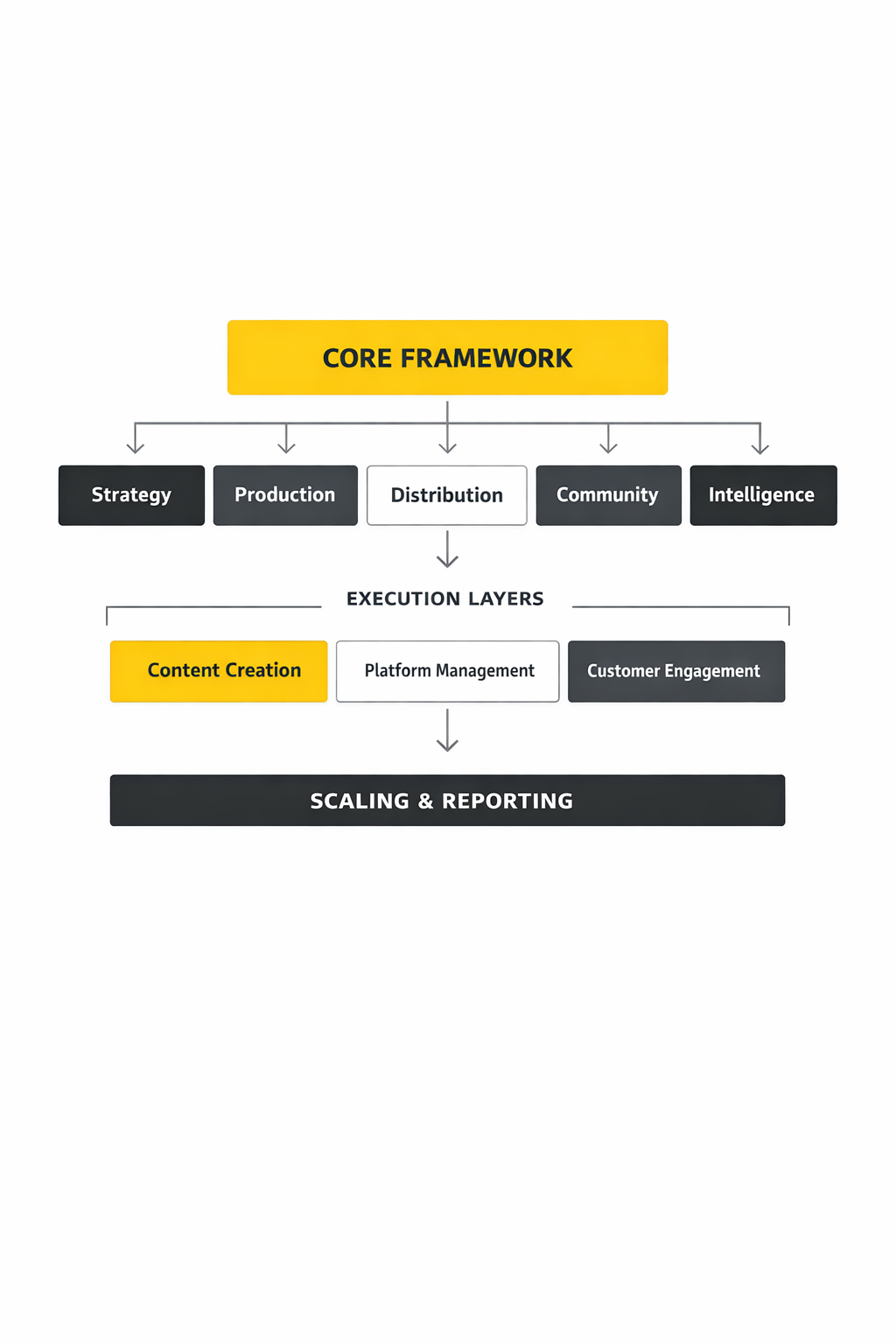
Most outsourcing failures come from the same root problem: companies outsource tasks, but never define the operating system. So you get activity without cohesion—posts without positioning, engagement without escalation rules, reporting without insight.
This article uses a simple framework that treats social as a managed production pipeline rather than a pile of deliverables. At a high level, it breaks the work into five layers:
- Strategy: what you stand for, who you’re for, and how social supports business goals.
- Production: how ideas become publish-ready assets on a dependable schedule.
- Distribution: how content is deployed across channels with format-native execution.
- Community: how you listen, respond, and build trust without brand risk.
- Intelligence: how insights flow back into decisions, not just dashboards.
Why this structure works: it mirrors how teams actually scale. When budgets tighten, you need clear ownership, fewer handoffs, and fewer “mystery expectations.” A framework gives you the language to define scope, evaluate partners, and measure results without turning everything into subjective debate.
Core Components
Before you pick a partner, you need to know what you’re outsourcing. Not in vague terms like “content” or “engagement,” but as components with inputs, outputs, and standards. These are the building blocks that make social media outsourcing predictable.
1) Scope That Maps to Outcomes
Start by describing work in outcome language. Instead of “manage Instagram,” define a scope like: publish X short-form videos weekly, maintain response times within Y hours, and produce a monthly insights memo that changes next month’s plan. Clear scope is how you prevent endless add-ons, mismatched expectations, and the slow drift into chaos.
2) Brand Voice and Guardrails
Outsourcing doesn’t mean outsourcing your identity. The best teams document voice with examples, not adjectives. Show what “confident” sounds like in your captions. Show what “never say this” looks like in replies. When guardrails are specific, external talent can move fast without making your brand sound like a template.
3) Workflow That Eliminates Bottlenecks
Social work gets stuck in predictable places: approvals, asset sourcing, last-minute changes, and unclear ownership. Your workflow should make it obvious who writes, who edits, who approves, and what “done” means for each asset type. This is also where you decide what stays internal (high-risk messaging) versus what’s safe to delegate (editing, formatting, scheduling).
4) Measurement That Answers Real Questions
Metrics only matter when they drive decisions. A healthy outsourcing setup ties reporting to questions like: which content themes create qualified conversations, which formats earn retention, and what’s the next test that could move results. If your reporting is just screenshots and vanity charts, you’re paying for activity—not learning.
5) Governance and Risk Management
Modern social is a brand safety environment, not just a marketing channel. Governance covers access control, escalation rules, response boundaries, and review cadence. It also includes how you handle platform shifts and cultural volatility—because the internet does not wait for your weekly check-in.
Professional Implementation
This is where most guides get fuzzy, so we’ll keep it practical. A professional approach to social media outsourcing looks like an operating rhythm you can run every week: a content planning cadence, a production cadence, a community cadence, and an insights cadence.
It also borrows from how larger organizations manage extended workforces. Executive sourcing strategies are shifting toward multidimensional models—mixing internal teams, partners, and specialized external talent—because it’s often the only way to access the right skills quickly. Deloitte’s research draws on insights from 500+ executives navigating this exact reality.
In the next sections, you’ll see how to:
- choose the right outsourcing model (freelancer, boutique studio, agency, hybrid)
- turn your brand voice into usable standards
- build SOPs that make quality repeatable
- set up approvals and access safely
- track performance in a way that improves decisions month after month
One final note before we go deeper: outsourcing is not automatically cheaper. It’s leverage. The best setups use external support to increase throughput and quality while protecting internal focus—especially in a world where ad investment continues to rise and competition for attention keeps intensifying, with global ad spend projected to top $1 trillion and keep climbing toward $1.24 trillion by 2026.
Step By Step Implementation
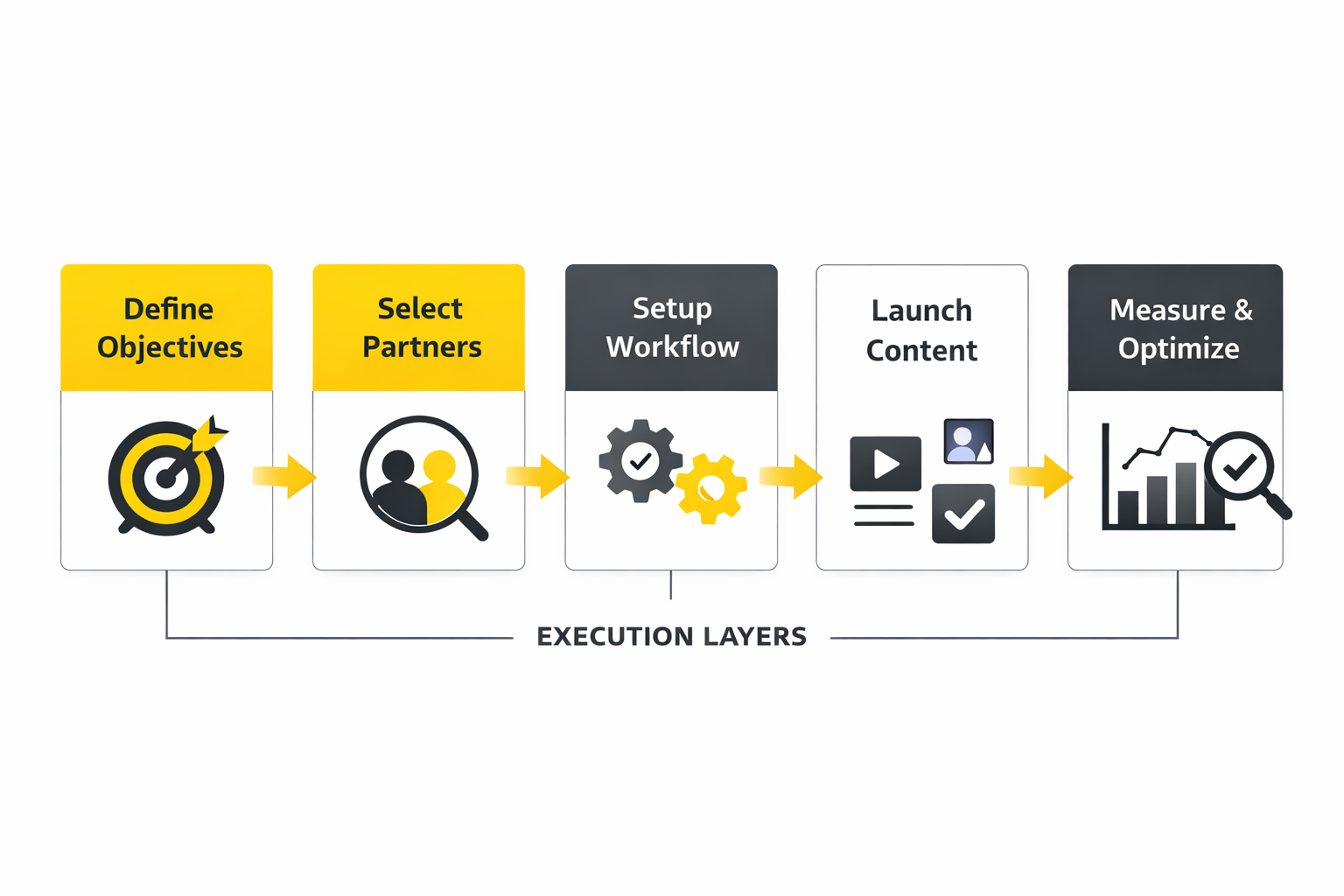
Social media outsourcing works best when you implement it like a systems rollout, not a hiring sprint. The goal is to make “good work” the default outcome, even when you’re busy, traveling, or juggling launches. That only happens when your partner can operate with clarity, guardrails, and fast feedback loops.
Use this step-by-step sequence to get from “we found someone” to “we have an engine.”
Step 1: Define the non-negotiables before you hand anything off
Start with what cannot break: brand voice, claims and compliance rules, customer care escalation, and security access. If you outsource without these, you’re not delegating work—you’re delegating risk. Platform role systems exist for a reason, and they’re built to support partner collaboration without giving away ownership, like partner access in Meta Business and LinkedIn Page admin roles.
Step 2: Package your voice into usable assets, not adjectives
A one-page “brand voice” doc rarely survives contact with real posting. Instead, give your outsourced team a swipe file: caption patterns you like, words you avoid, reply templates, and examples of what a great post looks like for your brand. When voice guidance is concrete, external creators can move fast without sounding like a generic social template.
Step 3: Build the first 30-day scope as a pilot, not a promise
Keep the first month tight and measurable: a limited set of formats, a realistic cadence, and a clear definition of “done.” If your channels include customer care, set response expectations and the routing logic up front, because waiting too long has real consequences. The pressure to respond quickly isn’t hypothetical, with “nearly three-quarters” of consumers expecting brands to reply within 24 hours in Sprout Social’s Index-based analysis, a similar expectation appearing as 76% in Freshworks’ 2025 customer service stats, and Emplifi’s consumer research emphasizing that 24 hours is the outer limit in The Social Pulse 2025 survey.
Step 4: Set up approvals that don’t kill momentum
Approvals should protect quality without turning social into a waiting room. Decide what requires review (claims, pricing, sensitive topics, executive voice) and what can be approved by process (formatting, resizing, scheduling). When agencies and clients share a clean approval workflow, it reduces rework and builds confidence, which is why platform guidance like Sprout’s recommendations on strengthening agency-client processes focuses on making approvals predictable instead of emotional.
Step 5: Lock down access and audit trails
Never run social media outsourcing on shared passwords. Use role-based access, partner permissions, and a clear offboarding checklist so you can revoke access instantly if the relationship changes. Meta explicitly supports controlled collaboration through partner access to business assets, and LinkedIn structures Page access through super admin, content admin, and analyst roles.
Step 6: Launch with a rhythm, not a big bang
Start with a weekly operating rhythm: one planning touchpoint, one approval window, and one performance review. This keeps output steady while giving you enough repetition to spot bottlenecks early. The most important thing you’re building in month one is not “more posts,” it’s a repeatable cadence your team can sustain.
Step 7: Close the loop with decisions, not dashboards
Every review should end with decisions: what you’re doubling down on, what you’re stopping, and what you’re testing next. If reporting doesn’t change next week’s plan, it’s entertainment, not operations. You’ll feel the difference immediately when your partner shows up with options and tradeoffs instead of just numbers.
Execution Layers
Once you’re live, social media outsourcing becomes easier when you separate “layers of execution.” Each layer has a different risk profile and a different need for oversight. This is how you delegate more over time without losing control of voice or brand safety.
Layer 1: Direction and positioning
This layer defines what you want to be known for and what social is supposed to do for the business. It includes campaign themes, content pillars, and the boundaries of your tone. Even if a partner helps, direction should stay close to leadership because it’s where brand and business strategy meet.
Layer 2: Creation and production
This is where outsourcing usually creates the biggest lift: scripting, writing, design, editing, and repurposing. The trick is to outsource the production muscle while keeping the creative “north star” consistent. When you treat production like a pipeline, you stop reinventing every post and start compounding quality.
Layer 3: Publishing and distribution
Distribution is not just scheduling. It’s choosing formats that make sense for each platform, timing releases, and making sure assets are native to the channel. In this layer, checklists matter more than inspiration, because small publishing mistakes can create big public embarrassment.
Layer 4: Community and customer care
This layer carries the highest reputational risk because it’s real-time and public. If you outsource engagement, you need response standards, escalation rules, and a shared inbox where work is visible. Customer expectations are unforgiving, with multiple recent sources signaling that 24 hours is the maximum acceptable window for many audiences, including Sprout’s Index-based insights, the Freshworks 2025 roundup, and Emplifi’s 2025 consumer survey.
Layer 5: Intelligence and learning
This layer turns social into a business asset: themes that resonate, objections showing up in comments, product feedback in DMs, and emerging risks in the conversation. Your outsourcing partner should be trained to capture insights in a structured way, so leadership sees “what we learned” rather than “what we posted.”
Optimization Process
Optimization in social media outsourcing isn’t about chasing every trend. It’s about increasing learning velocity while protecting brand quality. That means you need a simple process that repeats every week and a deeper process that repeats every month.
The weekly loop
- Review what shipped: not just performance, but whether execution was smooth or chaotic.
- Spot one bottleneck: approvals too slow, briefs too vague, too many revisions, or assets missing.
- Choose one test: one variable, one hypothesis, one measurement plan.
- Make one decision: keep, kill, or iterate.
If you’re building a testing habit, keep it lightweight and consistent. Many experimentation playbooks emphasize a weekly review cadence because it prevents tests from lingering and keeps momentum high, like the weekly review concept described in Strategic AI Leader’s experimentation framework and the “weekly cadence” approach in a business experimentation framework write-up.
The monthly loop
- Theme performance: which narratives earned attention and which fell flat.
- Format performance: which formats produced meaningful engagement, saves, replies, or qualified conversations.
- Operational health: how many pieces shipped on time, where rework happened, and why.
- Risk review: anything that created confusion, backlash, or support escalations.
Optimization should also include a customer care lens, because speed and quality shape loyalty. Sprout’s own customer care case study shows how operational improvements can directly impact response speed and workload, including the way Papa Johns used a unified inbox workflow to cut response time in half while managing hundreds of cases weekly.
Implementation Stories
To make this real, here’s one implementation story drawn from a documented case study. It’s not a fairy tale about “going viral.” It’s what social media outsourcing and operations look like when customer expectations collide with internal limits.
Papa Johns: When Social Customer Care Becomes a Pressure Cooker
Start at a point of high drama: The team was staring at a growing social inbox, and every unanswered message felt like a public crack in the brand. Multiple accounts meant messages were scattered, and the stress wasn’t only volume—it was the fear of missing something that would explode. When social is where customers complain, praise, and demand answers, silence doesn’t look neutral; it looks careless.
Backstory: Papa Johns’ social team needed to serve different customer segments and keep brand engagement strong, but their existing setup wasn’t helping them move faster. In the case study, their director describes the pain of using a tool that felt cumbersome and slowed the team down in Sprout’s Papa Johns write-up. Their challenge wasn’t creativity—it was coordination across planning, engagement, and reporting.
Wall: The workload kept rising, yet the workflow didn’t scale. Messages across platforms created fragmentation, which made it harder to route, prioritize, and respond consistently. The risk was bigger than a slow reply; it was slowly training customers that social was a dead end.
Epiphany: The breakthrough was treating customer care as an operational system rather than a reactive scramble. They didn’t need “more hustle,” they needed consolidation, visibility, and a way to move through work without losing context. That’s why the case study emphasizes adopting a centralized inbox model and a clearer workflow inside Sprout Social’s platform features.
Journey they went on to reach the goal: They consolidated messages through a unified inbox so the team could handle conversations in one place. They paired that operational upgrade with listening, which helped them spot opportunities and bring customer-requested ideas back into campaigns, as described in the campaign and listening examples in the case study. They also used analytics to monitor what was working so the team could spend more time on creative strategy instead of manual triage.
Final conflict (things went wrong on the way): Any workflow change creates friction: people have to trust new assignments, new tagging, and new habits before the system pays off. Consolidating an inbox also forces hard questions about escalation and ownership when messages become sensitive or time-critical. The stakes are especially high because customer expectations on social are tight, with multiple recent sources reinforcing a “within 24 hours” standard in Sprout’s Index analysis, Freshworks’ 2025 stats roundup, and Emplifi’s 2025 consumer survey.
Dream outcome: The story ends in measurable relief: the case study reports that response time was cut in half and the team could move through the inbox much faster after the switch, documented in the “Improving customer service” section. They also describe managing hundreds of cases per week and reclaiming meaningful work time because the process stopped fighting them. The deeper win is what many teams want from social media outsourcing: a system where customer care stays human, fast, and consistent even when volume surges.
A professional standard checklist you can reuse
- Access is role-based: partner permissions instead of passwords, using structures like Meta partner access and LinkedIn Page admin roles.
- Approvals are designed: a clear review window and clear “must-approve” categories, reinforced by workflow guidance like Sprout’s approval process recommendations.
- Customer care has guardrails: response standards and escalation paths that respect how quickly audiences expect replies, reflected across Sprout’s consumer expectation data, Freshworks’ 2025 roundup, and Emplifi’s 2025 consumer research.
- Optimization is weekly: one test, one hypothesis, one decision, following the weekly cadence logic described in experimentation frameworks that prioritize review rhythm.
- Reporting drives action: insights end in a next-week plan, not a screenshot deck.
When these standards are in place, scaling social media outsourcing becomes less emotional and more mechanical. You stop wondering whether you can trust the process, because the process is visible. And once it’s visible, it becomes improvable.
Statistics And Data
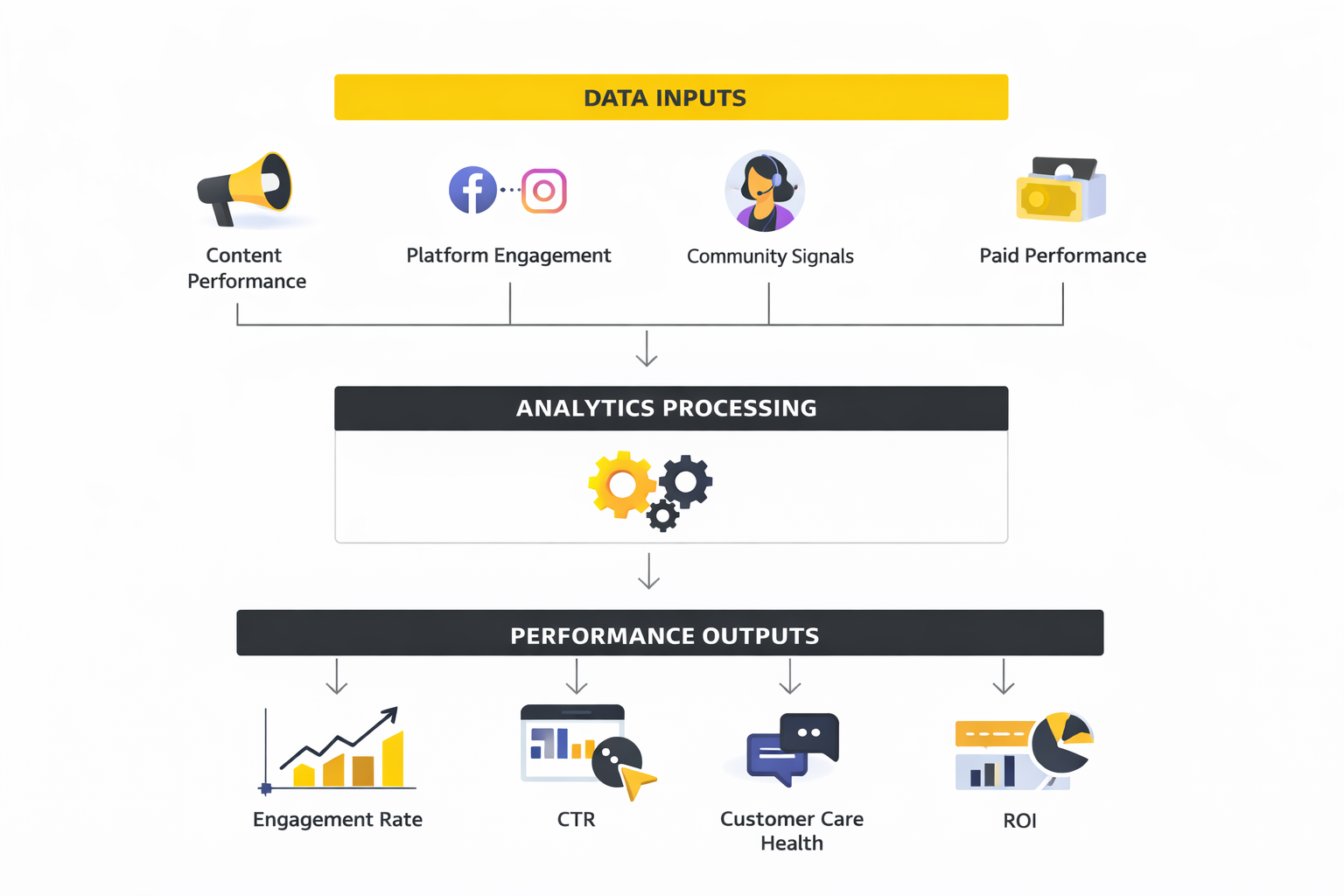
Analytics is the part of social media outsourcing that decides whether you scale with confidence or get stuck in opinion wars. When work is outsourced, “I think this post did well” stops being useful fast. You need shared definitions, shared dashboards, and shared language so decisions feel obvious instead of political.
Start with the reality of customer expectations. Multiple recent studies land in the same place: people expect brands to respond on social within about a day, not “when we get to it.” Sprout’s Index-based reporting describes this as nearly three-quarters expecting a response within 24 hours, Freshworks’ 2025 roundup frames it as about three-quarters expecting a response within a day, and Emplifi’s consumer survey reinforces the same “within 24 hours” ceiling in The Social Pulse 2025.
Quality expectations are rising too. A consistent thread across research is that audiences don’t just want speed; they want to feel recognized. Sprout’s consumer research highlights 70% expecting personalized responses, and this expectation is echoed by coverage in Marketing Dive and the associated press distribution in GlobeNewswire.
On the performance side, benchmarks can look contradictory because different firms measure engagement differently. That’s not a reason to ignore benchmarks; it’s a reason to use them responsibly. Rival IQ summarizes broad engagement-rate declines across major platforms in its 2025 Social Media Industry Benchmark Report. Socialinsider’s 2026 benchmark research provides platform-level engagement reference points in its 2026 Social Media Benchmarks page. Hootsuite adds industry-specific engagement-rate snapshots across networks in its 2025 engagement rate analysis.
The practical takeaway for social media outsourcing: don’t chase one “universal benchmark.” Build a benchmark range from multiple credible sources, then track your own trendline and your own contribution to business outcomes.
Performance Benchmarks
Benchmarks are most useful when they do two things at once: (1) they stop you from overreacting to normal fluctuation, and (2) they force you to be honest about whether your results are improving over time.
Use benchmarks through three lenses
- Platform reality: what “good” looks like on TikTok is not what “good” looks like on Facebook. Socialinsider’s platform-level benchmarks offer a quick reality check in their 2026 benchmark set.
- Industry reality: a nonprofit and a SaaS brand won’t share the same baseline engagement. Rival IQ’s industry-based approach is designed specifically to prevent apples-to-oranges comparisons in their benchmark methodology.
- Trend reality: if your numbers are flat but the market is down, you may be winning. Rival IQ’s summary of engagement declines across platforms is useful context in the 2025 report highlights.
Benchmarks that actually help you outsource well
When you outsource, you want metrics that are hard to “game” and easy to improve through process. These are the ones worth standardizing across partners and internal stakeholders.
- Engagement rate (defined consistently): choose one definition and stick to it. If you use platform reporting, document whether you’re using reach-based or follower-based engagement.
- Conversation health: response time, resolution rate, and escalation rate. The “within 24 hours” expectation is reinforced across Sprout, Freshworks, and Emplifi.
- Format performance: performance by post type and creative format. Hootsuite’s breakdown of engagement by network and sector is a useful reference point in their engagement rate analysis.
- Operational throughput: posts shipped on time, revision cycles, and approval cycle time. These determine whether your outsourced engine is truly scalable.
Analytics Interpretation
The fastest way to ruin social media outsourcing is to use analytics like a scoreboard. The purpose of measurement isn’t to “win” a weekly meeting; it’s to tighten decisions. Interpretation is where outsourced work becomes strategic, because it turns outputs into direction.
Move from numbers to decisions with a simple chain
- Signal: what changed (for example, more saves, fewer comments, slower replies).
- Meaning: why it matters (saves can indicate future intent; slow replies can signal loyalty risk).
- Cause: what likely drove it (topic, format, timing, distribution, community load).
- Decision: what you will do next week (double down, adjust, stop, or test).
Avoid the vanity traps that make outsourcing look busy
Most “good-looking” reports are just content inventories with charts. If your partner is only reporting totals, you’re missing the real value: why performance moved and what should change.
When your reporting includes customer care, interpretation matters even more because it’s tied to trust. Research consistently shows that responsiveness and personalization shape loyalty expectations, highlighted in Sprout’s consumer research on personalized responses and reinforced by coverage in Marketing Dive.
Benchmark with humility, then manage your own trendline
Benchmarks are context, not a verdict. Rival IQ, Socialinsider, and Hootsuite each use different datasets and definitions, which is why it’s smarter to triangulate ranges from Rival IQ, Socialinsider, and Hootsuite, then judge your outsourcing performance by whether your own baseline improves month over month.
Case Stories
Analytics becomes real when you watch it collide with deadlines, stakeholders, and public scrutiny. Here’s a documented story that captures what happens when a team needs to move at “event speed” without losing control.
Salesforce: Real-Time Social During Dreamforce Without Losing the Plot
Start at a point of high drama: Dreamforce isn’t a normal week. Social channels become the live nervous system of the event, and every missed moment feels like you’re watching the conversation happen without you. The pressure spikes because the audience expects real-time answers, real-time content, and real-time energy. When a global brand falls behind during a flagship event, it doesn’t just look slow; it looks out of touch.
Backstory: Salesforce’s social team supports a massive community and treats social engagement as a core part of the Dreamforce experience year-round. In 2022, they made an enterprise-wide transition to a new social media management platform, described in Sprout’s Salesforce case study. The team’s goal wasn’t “more posts.” It was building the operational capability to keep up with the pace of social when the spotlight is brightest.
Wall: The hardest part wasn’t creativity; it was coordination. Approvals had to happen while people were moving between sessions, stakeholders needed visibility, and social listening needed to catch trends before they expired. Without a system, teams end up pulling reports manually and stitching together status updates from wherever they can find them, a pain point explicitly contrasted in the quotes within the case study’s reporting section.
Epiphany: The team leaned into the idea that speed comes from workflow, not adrenaline. Mobile approvals, real-time reporting, and structured listening weren’t “nice-to-haves”; they were the only way to operate at event speed. The case study highlights how their leaders framed this as moving “at the speed of social” through automation and workflow features in the implementation narrative.
Journey they went on to reach the goal: They built a rhythm around listening and engagement, using social monitoring to track attendee and media mentions as the event evolved. They used mobile workflows to secure approvals quickly without dragging every decision into a meeting. They used reporting to keep stakeholders informed continuously, turning analytics into a live operational tool rather than a post-event recap, described in the sections on reporting and approvals.
Final conflict (things went wrong on the way): Even the best system gets stress-tested by real-time events. Multiple teams, multiple approvals, and multiple narratives can create friction when everyone wants a say. And the audience doesn’t care about internal complexity; expectations remain tight for responsiveness and relevance, the broader reality reinforced by social customer care expectation research in Sprout’s customer service statistics.
Dream outcome: The win wasn’t just smoother event coverage; it was turning analytics into confidence. The team described moving faster, reducing manual work, and sharing insights more continuously with stakeholders, captured directly in Sprout’s Salesforce case study. For teams exploring social media outsourcing, the deeper lesson is simple: when analytics and workflow are designed properly, external support can plug into a system that keeps decisions fast and brand-safe.
Professional Promotion
“Promotion” here doesn’t mean selling services. It means making your outsourced social work legible to decision-makers so it earns trust, budget, and patience. The most common failure mode is doing valuable work that nobody can understand, because results aren’t framed in business language.
Use a one-page performance story instead of a long report
Your monthly summary should read like a narrative, not a spreadsheet dump:
- What changed: one or two meaningful shifts in performance.
- Why it changed: the themes and formats driving the shift.
- What it means for the business: pipeline conversations, customer care load, reputation risk, or retention signals.
- What we’re doing next: the next set of tests and process improvements.
Promote customer care quality as a trust metric
If you’re outsourcing community management, show leadership that speed and personalization are being protected, because that’s where brands get punished publicly. The research-based expectation for fast responses is reinforced across Sprout, Freshworks, and Emplifi, and personalization expectations are highlighted in Sprout’s consumer research with reinforcement in Marketing Dive.
Set benchmark expectations before someone else weaponizes them
Benchmarks are useful until they’re used as a blunt instrument. Proactively frame them as ranges, and cite multiple credible sources so stakeholders trust the context. A simple benchmark triangulation using Rival IQ, Socialinsider, and Hootsuite helps you defend good work even when the broader market shifts.
When you promote outsourced work professionally, you stop debating tastes and start aligning decisions. That’s the point where social media outsourcing becomes something leadership protects, not something they question every month.
Future Trends
The next wave of social media outsourcing won’t be won by the teams that “post more.” It’ll be won by the teams that can stay human while scaling production, protect trust while using AI, and move fast without turning brand voice into something generic.
Authenticity beats polish as audiences push back on synthetic content
As AI-made content floods feeds, audiences are getting more sensitive to anything that feels fake, empty, or mass-produced. That pressure is showing up in industry coverage about creators leaning into “messiness” and human imperfections in Digiday’s reporting on authenticity demand in 2026, and it’s reinforced by platform research describing consumer hesitation toward AI in Hootsuite’s Social Media Trends 2026.
For social media outsourcing, this shifts the winning playbook: outsourced teams need stronger brand voice standards, more real-world storytelling, and tighter review for anything that might read like “AI slop.” The creative bar becomes less about perfection and more about credibility.
Provenance and labeling become part of brand safety
As deepfakes and synthetic assets become easier to generate, brands will increasingly be judged on whether they can prove what’s real. Standards like C2PA’s Content Credentials are designed to establish origin and edit history, but real-world adoption is messy, with platforms inconsistently handling metadata as described in The Verge’s coverage of C2PA implementation gaps.
This matters operationally: outsourcing teams will need clear rules for disclosure, asset handling, and review when AI is used anywhere in the creative pipeline. Provenance becomes a workflow requirement, not a PR checkbox.
Social customer care gets faster and more accountable
Customer expectations keep tightening, and “we’ll reply tomorrow” increasingly feels like neglect. Multiple recent sources keep landing around the same expectation window, including a 2026 roundup that cites 76% expecting a response within 24 hours and consumer expectation references anchored in the broader customer care data ecosystem.
As a result, outsourcing will shift toward dedicated coverage models (shared inboxes, shift-based community management, and escalation playbooks) rather than “someone checks comments when they can.” The teams that scale best will treat customer care like operations, not vibes.
The creator economy becomes a production engine, not a side experiment
Brands aren’t just sponsoring creators anymore; many are building creator partnerships into their content supply chain. CreatorIQ’s 2025–2026 State of Creator Marketing report reflects how creator programs are being funded and formalized, and creator-focused research like The Influencer Marketing Factory’s 2026 Creator Economy Report highlights how creator behavior is shifting toward video-heavy posting and diversified monetization.
For social media outsourcing, this means the “outsourced team” often expands to include creator ops: briefing creators, handling approvals, managing usage rights, repurposing UGC, and measuring paid amplification.
AI stays, but it moves behind the curtain
AI will keep accelerating production and analytics, but brands will be pressured to use it in ways that don’t break trust. Consumer skepticism around AI ads is becoming a headline topic, with recent reporting on backlash dynamics in Business Insider’s coverage of AI-generated ads and authenticity concerns, and industry research measuring the widening perception gap in IAB’s 2026 analysis of AI ad exposure and sentiment.
The practical implication: the best outsourcing setups will use AI for speed (drafting, variation, summarizing insights, trend scanning), then rely on human editors for voice, nuance, and credibility.
Strategic Framework Recap

If you remember one thing from this guide, let it be this: social media outsourcing doesn’t scale because you found the “perfect person.” It scales because you built a system that makes quality predictable.
- Strategy: a clear point of view, clear audience priorities, and clear boundaries for voice and risk.
- Production: briefs, templates, and workflows that turn ideas into assets without chaos.
- Distribution: platform-native execution and consistent publishing that doesn’t depend on heroics.
- Community: response standards and escalation rules that respect expectations like 76% expecting a response within 24 hours.
- Intelligence: reporting that ends in decisions, not charts.
When these five layers work together, outsourcing stops feeling risky and starts feeling like leverage. You gain consistency, you gain speed, and you gain the ability to learn faster than teams that are stuck doing everything manually.
FAQ – Built For A Complete Guide
What should I outsource first if I’m worried about losing my brand voice?
Start by outsourcing production tasks that don’t define your voice: editing, formatting, repurposing, scheduling, and basic design. Keep high-stakes copy and community replies in-house until your partner proves they can match tone using real examples and clear guardrails. The fastest way to protect voice is to give a swipe file of “this is us” and “this is not us,” then review early output tightly.
Is an agency or a freelancer better for social media outsourcing?
A freelancer is often better for a focused scope and a single channel, especially when you want deep brand familiarity. An agency is better when you need multiple skills at once and want redundancy (so output doesn’t stop if one person is unavailable). The most scalable model is often a small pod (writer + designer/editor + strategist oversight) so the system doesn’t depend on one person forever.
How do I write a scope that doesn’t turn into endless add-ons?
Define outputs (how many assets, what formats), timelines (weekly cadence), and responsibilities (who provides inputs, who approves, who publishes). Add boundaries like revision limits and response-time standards for community management. If you can’t describe “done” clearly, your scope will expand until it breaks your budget.
How do I keep approvals fast without publishing mistakes?
Create a weekly approval window and split content into “must review” and “safe to delegate.” Claims, pricing, and sensitive topics should always be reviewed. Formatting, resizing, and scheduling can be delegated once templates are trusted. The goal is to prevent last-minute surprise approvals that kill momentum.
What response time should I aim for if I outsource community management?
Many audiences view 24 hours as the outer limit, and a large share expect that standard on social, reflected in consumer expectation summaries that cite 76% expecting a response within 24 hours. The best approach is tiered: fast replies for simple questions, routed escalation for sensitive issues, and clear ownership so conversations don’t get duplicated or missed.
How do I give access safely without sharing passwords?
Use role-based permissions and partner access so contributors only have the access they need. Meta supports controlled collaboration through partner access to business assets, and LinkedIn documents tiered control via Page admin roles. You should also maintain an offboarding checklist so access can be revoked immediately.
Can my outsourced team use AI tools, or is that risky?
AI can be a speed advantage when it’s used behind the scenes for drafts, variations, and analysis, then polished by a human editor. The risk is letting AI dictate voice or making synthetic content feel inauthentic, which is why trends reporting emphasizes consumer caution in Hootsuite’s Social Media Trends 2026. Set rules: disclose when required, keep humans accountable for final output, and avoid anything that could undermine trust.
How do I measure success without obsessing over vanity metrics?
Track a blend of performance and operations: theme-level performance (what narratives win), format performance (what executions carry), customer care health (response time and escalation rate), and throughput (assets shipped on time, revision cycles). If reporting doesn’t end with a decision about what changes next week, it’s not measurement—it’s decoration.
How long does it take to see results from social media outsourcing?
Operational wins often show up first: more consistency, fewer delays, cleaner approvals. Performance gains typically follow once you have enough volume to learn reliably, which is often 6–12 weeks of consistent posting and weekly iteration. If you’re changing messaging, offers, or formats at the same time, expect a longer “calibration” period before a stable trend emerges.
Should I include creators and UGC in my outsourcing model?
If content production is your bottleneck, creators can become a reliable supply line—but only if you run creator ops well: briefs, approvals, rights, and repurposing. The move toward formal creator programs is reflected in research like CreatorIQ’s 2025–2026 report, and creator economy behavior shifts are documented in a 2026 creator economy report.
When should I switch partners if outsourcing isn’t working?
Switch when the fundamentals don’t improve after clear feedback: missed deadlines, repeated voice misses, sloppy approvals, or unreliable reporting. Before switching, check whether your system is the real problem: unclear briefs, late approvals, or conflicting stakeholder feedback will break even a great partner. If the system is solid and execution is still poor, switching becomes a strategic reset rather than a reactive move.
Work With Professionals
Social media outsourcing is supposed to buy you freedom, not another layer of stress. But if you’ve ever tried to find reliable marketing work or reliable marketing talent, you know the real pain: endless middle layers, commissions that quietly drain earnings, and slow hiring cycles that kill momentum.
That’s why marketplaces that remove friction are becoming part of how modern marketing careers get built. Markework positions itself as a marketing marketplace where companies and marketers connect directly, with no project fees and no middleman, and a workflow designed to help you move fast: profiles, listings, and direct messaging all in one place.
If you’re a freelancer, the dream isn’t “more leads.” The dream is a steady pipeline of serious opportunities that fit your skills, where you keep what you earn. There are already massive pools of remote marketing demand across the broader market, with 12,000+ open marketing jobs visible on Upwork at a single moment, and the best strategy is building a system to consistently surface, evaluate, and close the right ones.
Markework is built for that kind of momentum: create a profile that does the explaining for you, apply using a token model when you want more activity, and keep conversations direct so you can negotiate like a professional instead of waiting for platform gatekeepers. If your goal is to turn your social media outsourcing skills into a real client pipeline, you don’t need hype—you need a place where opportunities and credibility meet.
 Filip Konecny Enterprises