

Social media looks simple from the outside: post consistently, reply to comments, and hope the algorithm smiles. In reality, the brands that win are running a system. They plan content like product teams, measure performance like analysts, and handle community like customer support.
That’s what social media marketing management really is: the discipline of turning a chaotic stream of posts, messages, trends, and campaigns into a repeatable business process. With billions of active social identities worldwide, the opportunity is enormous, but so is the noise. :contentReference[oaicite:0]{index=0}
This guide is built for people who need social to perform: marketing freelancers, in-house marketers, and agency teams who are judged on leads, pipeline, conversions, retention, and brand trust. Part 1 sets the foundation and the professional framework you’ll use through the rest of the article.
Article Outline
- What Is Social Media Marketing Management
- Why Social Media Marketing Management Matters
- Framework Overview
- Core Components
- Professional Implementation
- Strategy And Goals
- Audience Research And Positioning
- Building A Content System
- Channel Playbooks And Distribution
- Community Management And Customer Care
- Paid Amplification And Campaign Ops
- Measurement, Reporting, And Optimization
- Tools, Workflow, And Automation
- Governance, Safety, And Brand Risk
- FAQ
What Is Social Media Marketing Management

Social media marketing management is the end-to-end operation of a brand’s social presence, designed to produce measurable outcomes. It includes planning what to publish, producing content efficiently, distributing it across the right channels, engaging the audience, running paid campaigns when needed, and continuously improving performance using data.
Think of it as three layers working together:
- Strategy: what you want social to achieve and how it supports the business.
- Operations: the workflow that turns ideas into consistent, on-brand execution.
- Optimization: the measurement loop that improves results over time instead of repeating the same month forever.
This matters because modern social isn’t “just marketing.” It’s also customer support, public relations, research, recruiting, and demand generation happening in one place. When social is managed professionally, you can shift priorities quickly, ship campaigns faster, and still keep quality high.
Why Social Media Marketing Management Matters
Social has become the default layer between a business and the market. People discover brands there, evaluate them there, and increasingly expect help there. When social is unmanaged, you don’t just lose reach, you lose trust in public.
Customer expectations are especially unforgiving. The moment a brand invites conversation, people assume the brand is listening. Social care research from Sprout Social highlights that a large majority of consumers expect a response within 24 hours or sooner, which turns community management from a “nice-to-have” into a real operational requirement. :contentReference[oaicite:1]{index=1}
On the paid side, the scale is equally serious. Meta’s investor reporting shows revenue in the hundreds of billions, driven primarily by advertising, which is a blunt reminder that paid social is not an accessory channel anymore, it’s core infrastructure for many growth models. You can see the current scale directly in Meta’s full-year 2025 results. :contentReference[oaicite:2]{index=2}
Zoom out further and the market trend is obvious: digital ad revenue keeps climbing. The IAB/PwC full-year 2024 internet advertising revenue report shows the overall direction of spend and why social teams are increasingly held to performance standards, not vanity metrics. :contentReference[oaicite:3]{index=3}
Finally, there’s risk. Social platforms are powerful, but they’re also messy: misinformation, impersonation, policy changes, and brand safety issues are now part of the job. Governance is becoming an enterprise concern, reflected in work like the GPAI summary on social media governance, which shows how quickly oversight expectations are evolving. :contentReference[oaicite:4]{index=4}
Framework Overview
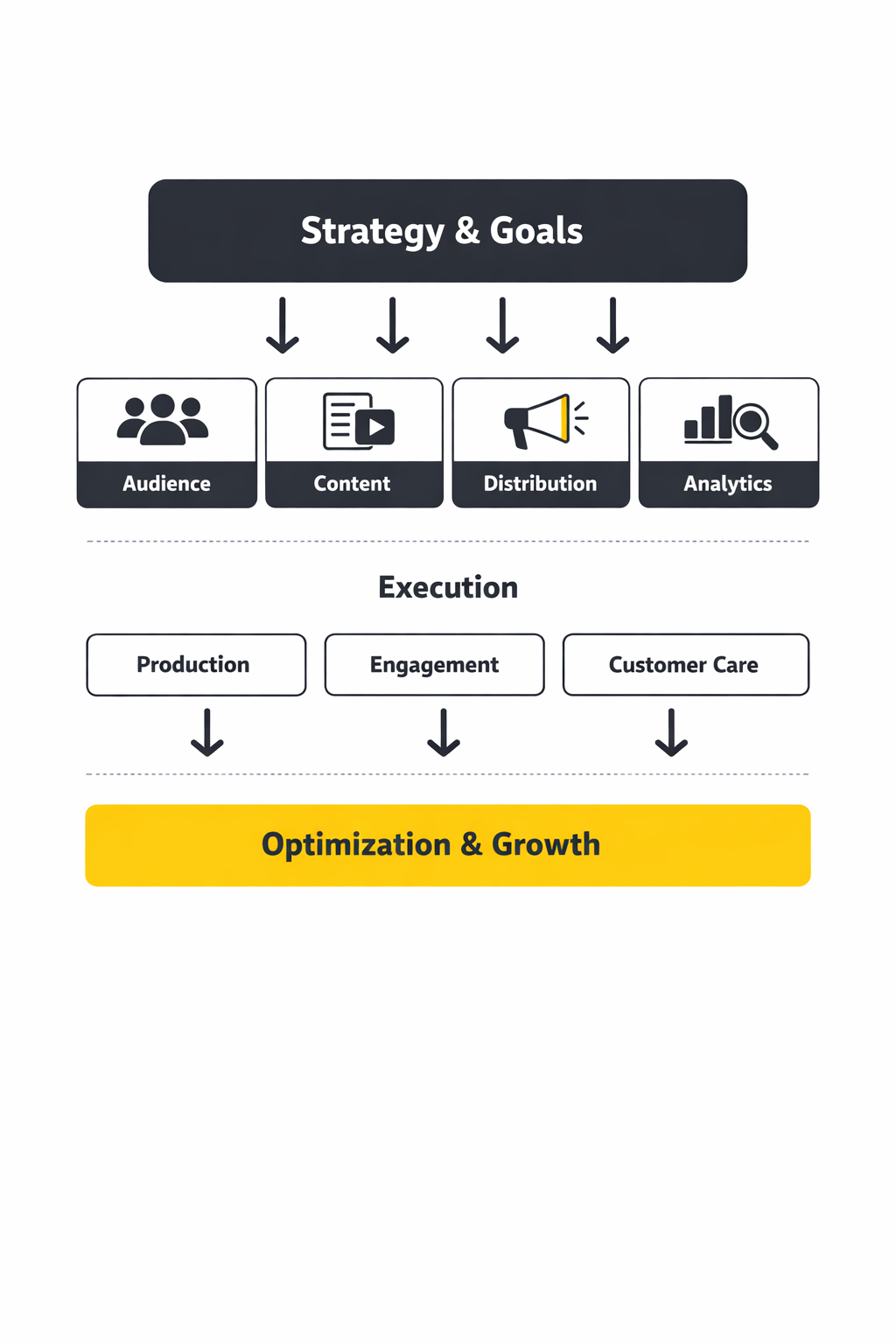
The simplest way to run social media marketing management like a pro is to treat it as a loop, not a calendar. Calendars help you publish, but loops help you improve. This framework is designed to work whether you’re managing one personal brand and two client accounts, or an enterprise team with multiple regions and business lines.
- Define: goals, audience, brand voice, and success metrics.
- Design: channel roles, content pillars, campaign architecture, and workflows.
- Deliver: production, publishing, community, and paid execution.
- Diagnose: measurement, insights, experimentation, and reporting.
- Develop: iterate the system, update playbooks, and scale what works.
What makes this framework practical is that it forces trade-offs. Social teams get overwhelmed when everything is a priority: every platform, every trend, every format, every KPI. A working framework helps you choose what matters, say no cleanly, and still show progress with evidence.
Core Components
Most strong social programs share the same building blocks. The difference is how intentionally those blocks are designed and maintained.
Strategy Layer
This is where social connects to business outcomes. You define the role social plays (awareness, demand, retention, community, employer brand), decide which metrics actually indicate progress, and establish what “good” looks like for your brand and market.
Content Operations Layer
This is the machine that produces consistent output without burning people out. It includes ideation methods, briefs, production templates, approvals, asset libraries, and repurposing workflows so one strong idea can travel across formats and channels.
Distribution Layer
Publishing is not distribution. Distribution includes timing, formatting, metadata choices, platform-specific packaging, employee advocacy, creator partnerships, and paid amplification when organic reach alone can’t carry the business goal.
Community And Customer Care Layer
This is where brands earn trust. Response standards, escalation paths, moderation policies, and tone guidelines turn social from reactive chaos into a reliable public-facing service function. When response speed becomes an expectation, the work has to be operationally designed, not improvised post-by-post.
Measurement And Insights Layer
Measurement isn’t just dashboards. It’s a decision system: what you track weekly, what you review monthly, what triggers experiments, and how you translate insights into better creative, better targeting, and better channel focus.
Governance And Risk Layer
This is the guardrail layer: access control, legal and compliance review paths, brand safety practices, documentation, and platform policy awareness. Social changes fast, and governance is what keeps speed from turning into preventable mistakes.
Professional Implementation
Professional social media marketing management starts with accepting one truth: you don’t “do social,” you run a social operation. That means you build a system you can defend, document, and improve, not just a feed you can scroll through.
In practice, that looks like:
- Clear ownership: who decides, who publishes, who responds, and who approves.
- Repeatable workflows: briefs, production steps, review cycles, and contingency plans.
- Decision-grade reporting: insights that change what you do next week, not just slides that explain what happened last month.
- A bias toward learning: small experiments, clear hypotheses, and documented outcomes.
There’s also a maturity shift happening across the industry: social teams are expected to be more agile, more data-driven, and more customer-centric. That theme runs through work like the LinkedIn B2B Marketing Benchmark, which reflects how organizations are restructuring marketing to be faster and more measurable. :contentReference[oaicite:5]{index=5}
Next, we’ll convert the framework into a practical operating model you can use to manage real accounts: how to set goals, pick platforms, build a content system, and create a measurement loop that actually improves performance over time.
Step By Step Implementation
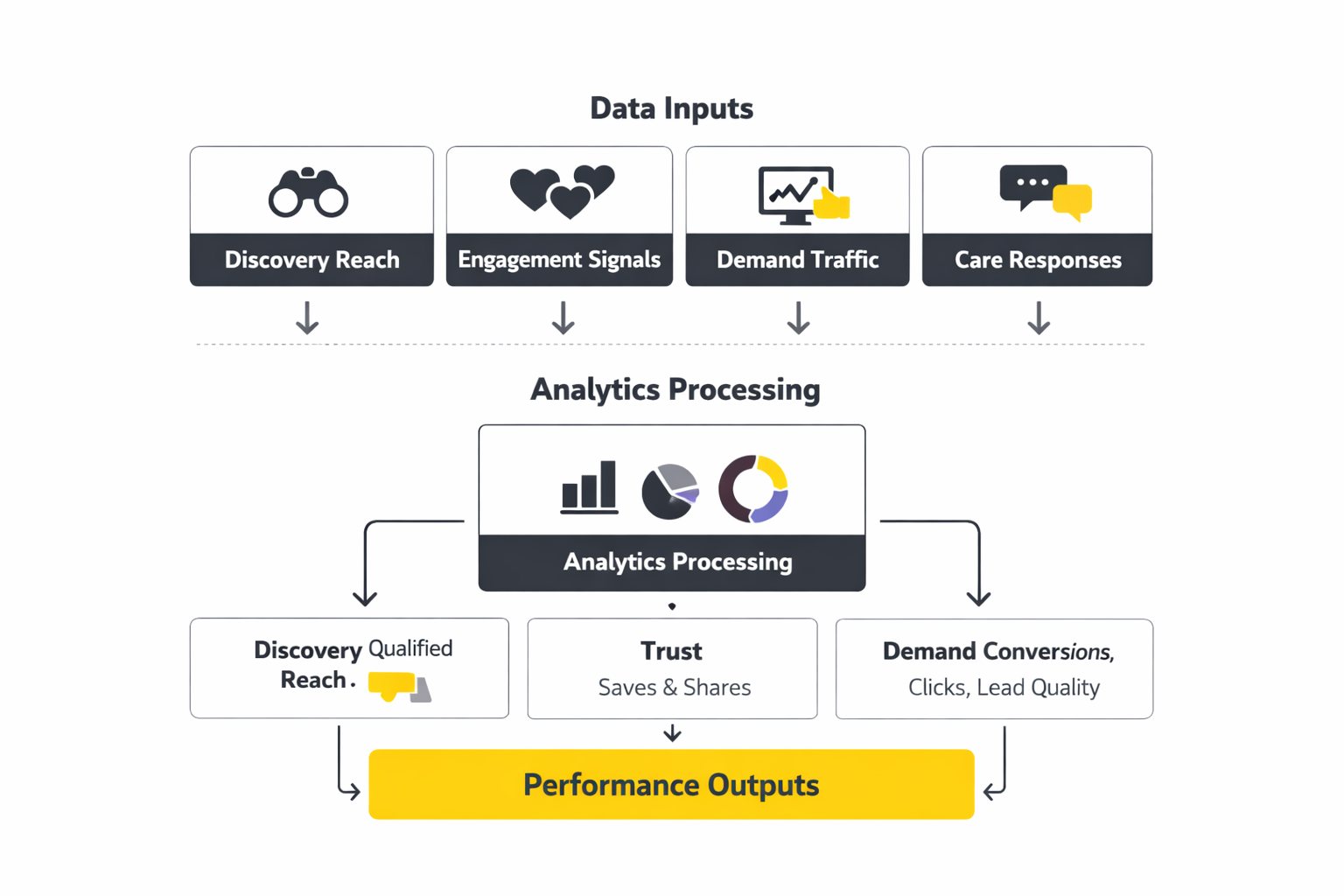
When social media marketing management is done well, it doesn’t feel like hustle. It feels like a system that keeps shipping quality work while staying calm under pressure. The easiest way to build that system is to implement it in layers, starting with what keeps you consistent, then adding what makes you faster, and only then adding what makes you smarter.
Step 1: Align On Outcomes Before You Touch A Calendar
Start by writing down the outcomes you’re willing to be judged on for the next 90 days. Not a long wish list, just a handful of outcomes that actually matter, like qualified traffic, lead volume, demo requests, retention support, or reducing time-to-response in customer care.
This matters because social is now a cross-functional channel, not just a marketing feed. Sprout Social’s 2024 10-K describes social as embedded across marketing, sales, support, product feedback, and more, which is another way of saying your goals need to match the reality of how the channel is used. :contentReference[oaicite:0]{index=0}
Step 2: Define Channel Roles So Platforms Stop Competing For Attention
Pick the few channels you can run with excellence, then give each one a job. One channel might be your discovery engine, another your credibility engine, another your customer-care front door. When every platform tries to do everything, you end up with “random acts of content” and a team that’s always behind.
- Discovery role: reach new people and create first-touch interest.
- Trust role: prove expertise through proof, perspective, and consistency.
- Conversion role: make the next step obvious and easy.
- Care role: resolve issues quickly in public and private messages.
Step 3: Build Your Operating Docs
Before you scale output, document the rules that keep quality steady. This isn’t bureaucracy, it’s how you protect speed.
- Voice and tone: what you sound like, what you never sound like, and how you handle sensitive moments.
- Content standards: what qualifies as “publishable,” with examples for each platform.
- Community playbook: what you respond to, what you ignore, what gets escalated, and who owns the final call.
- Approval rules: what needs review, who reviews it, and the maximum time allowed before a decision is forced.
Step 4: Design The Production Line
Most teams fail here because they build a calendar, not a production line. A production line is a repeatable sequence: ideas become briefs, briefs become drafts, drafts become assets, assets become scheduled posts, scheduled posts become performance learning.
If you want this to work without burnout, set weekly capacity limits. You’re not trying to post “as much as possible,” you’re trying to post the most valuable work your team can reliably produce.
Step 5: Set Response Standards Like It’s A Service Channel
If your brand invites messages and comments, people expect you to show up. Multiple surveys anchor the outer boundary for social response expectations at 24 hours, which turns community management into a measurable operational requirement, not a vibe. :contentReference[oaicite:1]{index=1}
Make response standards explicit: how fast you respond, which topics get priority, and what “resolved” means. Then set coverage so the standard is achievable during launches, outages, and weekends, not just during quiet weeks.
Step 6: Create Your Measurement Loop Before You Need It
Measurement isn’t something you bolt on at the end of the month. It’s the loop that tells you what to change next week.
- Weekly: what shipped, what spiked, what underperformed, and what you’ll test next.
- Monthly: which content pillars drove the most valuable outcomes and which channels earned their budget.
- Quarterly: what you’re doubling down on, what you’re cutting, and what your next constraint is.
Execution Layers
Execution becomes manageable when you treat social media marketing management as five connected layers. Each layer has a purpose, an owner, and a “definition of done.” That’s how you move from busy to effective.
Layer 1: Strategy And Briefing
This layer converts business goals into content and community priorities. If you skip it, the team defaults to what feels urgent, and your brand voice becomes whatever mood you woke up in.
- Outputs: content pillars, campaign briefs, audience segments, and channel roles.
- Done means: every post idea can answer “why are we publishing this?” in one sentence.
Layer 2: Production And Approval
This is the “factory floor” where ideas become finished work. Your job is to make quality repeatable: templates, asset libraries, and approval paths that don’t stall.
- Outputs: drafts, creatives, final assets, and scheduled posts.
- Done means: posts are publish-ready with platform-specific formatting, links, and tracking.
Layer 3: Publishing And Distribution
Publishing is pressing the button. Distribution is making sure the right people actually see the work. This layer is where formatting, timing, and channel-native packaging do their quiet heavy lifting.
- Outputs: scheduled posts, cross-post adaptations, and distribution boosts (employee shares, creator collaborations, paid support).
- Done means: the post is not only live, it’s positioned to travel.
Layer 4: Community And Care
This layer protects trust. It’s where your brand proves it listens, resolves issues, and treats people like humans instead of “audience.”
- Outputs: replies, escalations, moderation actions, and structured tags for recurring issues.
- Done means: every priority thread is handled within your response standard, and the team can explain how they made decisions.
Layer 5: Insights And Reporting
This layer turns activity into learning. Without it, you repeat the same month forever and call it consistency.
- Outputs: performance summaries, insights, experiment plans, and content updates.
- Done means: at least one meaningful change is made based on evidence every cycle.
Optimization Process
Optimization is where social media marketing management stops being “content” and becomes “performance.” The goal isn’t to chase every trend. The goal is to build a rhythm where you learn faster than competitors and compound small improvements into bigger results.
1) Start With Service-Level Metrics
If your social channels include messages and support requests, your first optimization priority is response performance. It’s hard to claim a brand is “community-first” if people are waiting days for a reply.
Multiple large surveys frame 24 hours as the absolute maximum for social replies, and the business risk is real: Sprout Social reports that 73% of consumers say they’ll buy from a competitor if a brand doesn’t respond on social, which turns slow response into a revenue leak, not a minor inconvenience. :contentReference[oaicite:2]{index=2}
2) Run A Weekly Insights Standup
Keep it short and ruthless: what spiked, what sank, and what changed in the audience conversation. Your output should be one or two experiments, not a slide deck.
- Pick one hypothesis: “If we change the hook format, saves will increase.”
- Pick one metric: the metric that best reflects the goal (not the easiest to inflate).
- Pick one constraint: time, creative capacity, or distribution budget, and design within it.
3) Use A Two-Speed Experiment System
Fast tests improve creative decisions. Slower tests improve strategic decisions.
- Fast tests (7–14 days): hooks, captions, posting windows, format swaps, thumbnail changes.
- Slow tests (4–8 weeks): new content pillars, channel role changes, creator programs, or community initiatives.
4) Close The Loop Into Your Playbooks
Optimization isn’t complete until you update how the team works. If a test wins, it becomes a template. If it loses, it becomes a documented “do not repeat.”
This is how you get compounding gains: each cycle makes the next cycle easier, faster, and more effective.
Implementation Stories
Implementation is where the theory gets stress-tested. You can have a great strategy and still lose if your workflows can’t keep up with reality: approvals slow you down, compliance scares people into silence, and content creation becomes a bottleneck.
A Bank That Needed Speed Without Breaking Compliance
Start (high drama): Julius Baer wanted to be visible in the same social feeds where modern investment conversations happen, but it couldn’t behave like a casual consumer brand. Every message carried regulatory weight, and a mistake in public can be amplified instantly. The pressure wasn’t only to publish, it was to publish safely, consistently, and at a pace that wouldn’t fade into irrelevance. :contentReference[oaicite:3]{index=3}
Backstory: The company started its social presence later than many brands, expanding across major platforms over time and building a follower base with LinkedIn as the strongest channel. It also developed a content engine spanning topics from philanthropy to emerging tech themes, which required steady production to keep the conversation going. Social wasn’t a side project anymore; it was a visibility and credibility layer for a global organization with 60 locations in almost 30 countries. :contentReference[oaicite:4]{index=4}
The wall: The team faced two constraints at once: compliance expectations and production capacity. They needed a reliable way to manage communications while meeting regulatory requirements, and they also needed volume they couldn’t fully produce with internal resources alone, especially with a goal of maintaining a daily cadence. Without a system, “we should post more” stays stuck as a wish, not an operating reality. :contentReference[oaicite:5]{index=5}
The epiphany: Their approach shifted when they treated social media marketing management as an operational program, not a posting task. They brought in a platform to manage owned social content while ensuring compliance, and they separated two workstreams: in-house owned content, plus an employee advocacy program supported by a content partner. That structure made it possible to scale reach through employees without sacrificing governance. :contentReference[oaicite:6]{index=6}
The journey: They organized employee advocacy globally, dividing the company into groups and onboarding people through structured training. Because the tool was simple, the session didn’t just cover how to click buttons; it created space for guidelines, best practices, and awareness that protects the brand. They also reduced planning complexity by focusing primarily on evergreen content, making the calendar easier to sustain. :contentReference[oaicite:7]{index=7}
The final conflict: Even with structure, the work stayed hard in a very human way: predicting which topics would resonate and how to tell the story. The team pointed to engagement tracking and data as vital for content planning because results depended on storytelling, not just categories. And in a regulated environment, the pressure to move fast never fully disappears; you have to keep proving that speed and safety can coexist. :contentReference[oaicite:8]{index=8}
The dream outcome: The program produced measurable lift that a leadership team can recognize immediately: 5.3 million LinkedIn impressions from employee posts, 12,500 clicks to the website, and 4,600 posts shared on employee social channels since launch, all while operating within a governance-first environment. That’s what “implementation” looks like when social media marketing management becomes a system: not just more content, but more reach and measurable business impact through a repeatable workflow. :contentReference[oaicite:9]{index=9}
Operate On Rails, Not Memory
Every recurring activity needs a “rail”: a template, checklist, or default workflow. If quality depends on someone remembering what to do, quality will fail on your busiest day.
Build For Spikes, Not Average Weeks
Plan for product launches, outages, PR moments, and unexpected attention. Your approvals and community coverage should be designed for the week that hurts, not the week that feels calm.
Make Speed A Designed Outcome
Speed isn’t “try harder.” Speed is fewer handoffs, clear ownership, and response standards that match real customer expectations. When surveys consistently frame 24 hours as the maximum acceptable window on social, your workflow needs to make that achievable without heroics. :contentReference[oaicite:10]{index=10}
Turn Insights Into Updated Work
The last step of every cycle is updating the system. Adjust your templates, refresh your playbooks, and document what you learned so the next month starts smarter than the last.
In Part 4, we’ll go deeper into analytics and performance: how to measure social work in a way that drives better decisions, proves value to stakeholders, and creates a clear optimization roadmap.
Statistics And Data

Analytics is the part of social media marketing management that turns “we posted a lot” into “we know what to do next.” It’s also the fastest way to earn trust with stakeholders, because numbers force clarity: what worked, what didn’t, and what you’re changing because of it.
Start with the macro reality: money follows attention. Social media advertising revenue in the U.S. reached $88.8 billion in 2024, up $23.8 billion from 2023, a rebound big enough to shift budgets and expectations across the entire ecosystem. The IAB/PwC Internet Advertising Revenue Report (Full Year 2024) breaks this out directly, and the same headline figures are reinforced in IAB’s release summary and industry coverage like MarTech’s breakdown.
On the platform side, scale keeps rising even as competition for attention gets tighter. Meta reported $200.97 billion in full-year 2025 revenue and highlighted that ad impressions grew 12% while average price per ad rose 9% for the full year, which is a useful reminder that performance work is happening inside a marketplace that changes under your feet. You can verify the same operational metrics in Meta’s investor release, the results PDF, and the SEC exhibit filing.
YouTube’s economics matter for social teams too, because the content ecosystem is converging around video and creator distribution. Alphabet’s Q4 and full-year 2025 materials note that YouTube revenue across ads and subscriptions exceeded $60 billion for 2025, a scale that shapes creator incentives, content formats, and competition for watch time. The figure appears in Alphabet’s earnings release PDF, the SEC exhibit, and reporting like Variety’s coverage.
Finally, don’t ignore the human side of the data. Platform usage shifts don’t just change reach; they change what “normal performance” looks like. Pew Research Center’s Americans’ Social Media Use 2025 report is valuable because it anchors your planning in real adoption, not vibes, and it includes detailed daily-use patterns in the full report PDF.
Performance Benchmarks
Benchmarks are helpful for social media marketing management in the same way road signs are helpful: they tell you where you are, but they don’t drive the car. Use benchmarks to detect problems early, set realistic targets, and stop stakeholders from expecting miracles from a single viral post.
Compare Like With Like
Before you compare numbers, confirm the denominator. Engagement can be measured per follower, per reach, or per impression, and those aren’t interchangeable. Even reputable benchmarks vary because they’re measuring different things across different account sizes and industries.
Organic Engagement Benchmarks That Keep You Honest
Rival IQ’s 2025 industry benchmark work is useful when you need a wide, cross-industry baseline and trend direction. The report highlights that engagement rates fell across major platforms year over year (with drops reported across Facebook, Instagram, TikTok, and X), which is exactly why “we’re posting consistently” is no longer a strategy by itself. Rival IQ’s 2025 Social Media Industry Benchmark Report summary and its download page are a good starting point for median baselines and macro shifts.
If you need format-level guidance, SocialInsider’s 2026 benchmark page reports that carousels held steady around 0.55% engagement rate while overall engagement tightened, which is a practical signal for teams debating whether carousels are “worth the effort” in 2025-style feeds. The key is not the exact number, it’s the decision: build a repeatable carousel workflow because the format is resilient. SocialInsider’s Instagram benchmarks adds that additional format context.
For another angle, Sprout’s Instagram engagement analysis cites average engagement rates by post type (including carousels, Reels, and images), which is helpful when you’re deciding what to prioritize in production. Treat those as directional guidance, then validate with your own account data. Sprout’s Instagram engagement breakdown is a useful reference point for format comparisons.
Paid Performance Benchmarks Without False Precision
Paid benchmarks are even more context-dependent than organic ones because targeting, creative, seasonality, and auction competition matter. Use benchmarks to spot when you’re wildly off-track, then diagnose with creative and audience splits instead of blaming the platform.
If you’re running TikTok ads, you’ll see a wide spread in CPM and CTR depending on region, objective, and creative style. That’s why it’s better to treat benchmarks as ranges and to check multiple sources before you set expectations. You can get a rough baseline from sources like Lebesgue’s TikTok benchmark summary, and then sanity-check your planning against broader ecosystem reporting like TikTok’s own research framing in TikTok’s What’s Next 2025 Trend Report, which explains how behavior shifts change creative performance over time.
For channel mix decisions, it also helps to know where budgets are flowing overall. Digital advertising hit a record $259 billion in U.S. revenue in 2024, which is a reminder that your paid-social performance is being judged in a world where CFOs increasingly see digital as measurable infrastructure, not experimental spend. The figure appears in IAB’s summary and the full report PDF.
Analytics Interpretation
Dashboards don’t create insight. Interpretation does. Strong social media marketing management teams use analytics to answer five questions, in this order, because each one protects you from wasting time on the wrong “problem.”
1) Did We Reach The Right People
Reach on its own is cheap to celebrate and expensive to misunderstand. The question is whether the content reached the audience that can actually move your business forward. If your reach rises but profile visits, site clicks, saves, and qualified comments fall, you may have “entertainment reach” instead of “business reach.”
2) Did The Creative Earn Attention
This is where you look at early signals: view duration, retention curves, hook performance, and how quickly engagement arrives. If the first second fails, everything else fails. Your job is to diagnose whether the issue is the idea, the packaging, or the targeting.
3) Did We Create The Right Kind Of Engagement
Not all engagement is equal. Saves, shares, and high-intent replies usually mean the content was valuable, not just visible. That’s one reason format benchmarks like carousels staying resilient can matter operationally: they often produce “save-worthy” value when built well. SocialInsider’s Instagram format notes and Sprout’s post-type engagement analysis help teams reason about what kinds of formats are more likely to produce meaningful engagement.
4) Did Social Create Business Momentum
Business momentum looks like qualified traffic, increased branded search, lead quality improvements, pipeline touches, and fewer support escalations. This is where platform-level scale matters because it affects your cost and your distribution power. Meta’s 2025 reporting on rising ad impressions and ad pricing is a good reminder that your funnel performance is being shaped by auction dynamics, not just your creative choices. Meta’s SEC exhibit provides those operational signals clearly.
5) What Will We Change Next Week
Interpretation without a decision is entertainment. Every report should end with specific changes: one creative shift, one distribution shift, and one experiment to validate a hypothesis. If you can’t name a next action, you don’t have insight yet.
Case Stories
Real analytics value shows up when a team is under pressure: leadership wants results, attention is volatile, and the public can see your mistakes. These stories show what performance interpretation looks like when it’s tied to real-world outcomes, not just pretty charts.
Greggs And The Viral Product Moment That Had To Turn Into Sales
Start (high drama): The Mac & Cheese buzz wasn’t politely building in the background; it was exploding in the same feeds where people decide what to try for lunch. Greggs had a product moment that could either fade as a meme or turn into measurable revenue. And because it was happening publicly, the market would see the result fast, not six months later. The Financial Times coverage captured how the viral TikTok attention lined up with improved sales momentum.
Backstory: Greggs had entered 2025 with a slower start, with consumers feeling cautious and costs rising. It was also actively pushing menu innovation and longer trading hours, which meant there was already a strategic bet on “more reasons to visit.” Social didn’t create the business model, but it could accelerate the demand for specific items when the product was right. The Guardian’s reporting describes how new menu items and better trading conditions played into the same period.
The wall: Viral attention is a brutal test because it creates demand spikes that operations have to satisfy. A product can trend and still fail commercially if availability is inconsistent or the rollout lags behind the conversation. Greggs needed to convert social momentum into store-level performance while managing the reality that some sales lift was also weather-driven, which makes attribution messy if you don’t interpret the data carefully. The FT piece makes clear that more than one factor was driving the sales story.
The epiphany: The real lesson wasn’t “go viral,” it was “treat virality like a performance signal.” If social is telling you what people want, the analytics job is to confirm whether the buzz is translating into visits, product mix shifts, and sustained demand. In that period, Greggs reported 2.9% like-for-like sales growth in the first 20 weeks of 2025 with total sales performance improving versus the earlier weeks, which gave the business a concrete way to talk about momentum rather than vibes. The Guardian article includes the 2.9% figure and timing context.
The journey: Greggs leaned into menu innovation and broadened access, expanding stores and pushing product variety so demand didn’t bottleneck into a single moment. The brand also used the attention to reinforce its “meals throughout the day” positioning, making the viral item part of a broader behavior shift rather than a one-off novelty. This is where social media marketing management becomes a coordination problem: content, product, and distribution have to move together. FT’s reporting points to the menu expansion context around the sales lift.
The final conflict: Viral moments come with a hangover: competitors respond, consumers move on, and the next trend tries to steal the same attention. Greggs also had to manage pricing pressure and broader retail risk concerns, including heightened awareness after cyber-attacks hit other UK retailers, because operational stability matters when you’re scaling demand. If you don’t track the right signals, you might mistake a temporary spike for a sustainable growth engine. The Guardian piece includes context about costs and wider sector concerns during the same period.
The dream outcome: The payoff is what every stakeholder wants: proof that social attention can translate into measurable commercial outcomes. The company’s reported sales improvement and the media framing around a TikTok-driven boost gave the brand a narrative that connects content to business performance without pretending social was the only cause. That’s the professional standard: analytics that tell the truth, then help you act on it. FT’s article and The Guardian’s reporting capture that connection clearly.
Sainsbury’s And The TikTok Shop Moment That Forced A New Kind Of Reporting
Start (high drama): Black Friday and Cyber Monday don’t forgive slow execution. In the middle of that pressure cooker, TikTok Shop demand surged, and brands that could ship content fast had a chance to turn entertainment into checkout. For retailers, it wasn’t just “a campaign,” it was a live test of whether social commerce could move inventory in days, not quarters. The Guardian’s reporting on TikTok Shop in the UK describes the scale of adoption and the intensity of the period.
Backstory: TikTok Shop had been growing in the UK for years, but 2025’s shopping period pushed it into mainstream retail conversation. Major retailers were experimenting alongside small businesses, which meant expectations rose quickly: if smaller brands can sell through video, why can’t established retailers do the same? That shift forces new measurement habits, because social performance now has to connect to stock movement and sell-through, not just views. The Guardian article lays out how widely TikTok Shop was being adopted.
The wall: Retailers hit a hard problem: the content engine required for commerce is relentless. Social commerce rewards volume, speed, and creator-native storytelling, which can clash with traditional retail approval cycles and brand guardrails. Without clean analytics, teams can’t tell whether sales are driven by the product, the creator, the timing, or the format, so decisions become guesswork at exactly the wrong moment. The Guardian reporting highlights how TikTok Shop success creates pressure to produce continuous content.
The epiphany: The win came from treating social like a commerce channel, not a branding channel. That means performance reporting has to include sell-out velocity, attributed sales, and content-to-checkout paths, not just engagement. In the same reporting, Sainsbury’s was cited for a Tu Christmas pyjamas push that drew 6.6 million views and sold out in a week, a clean example of why “views” become meaningful when they map to inventory outcomes. The Guardian article includes those specific campaign outcomes.
The journey: The path to repeatable success is operational: build a content cadence that fits the platform, coordinate with merchandising so you don’t promote what you can’t fulfill, and track performance at the product level. Teams also have to learn what TikTok audiences actually respond to, which is often creator-led and less polished than traditional retail ads. That learning loop is exactly what disciplined social media marketing management is supposed to create. TikTok’s trend research framing helps explain why audience behavior shifts change what performs.
The final conflict: Social commerce success can backfire if it trains the organization to chase trends at the expense of brand building and margin discipline. There’s also a measurement trap: attribution can over-credit last-click content and under-credit the creative that created demand earlier. Without careful interpretation, teams can scale the wrong thing, burn out creators, and still miss the real driver of performance. The Guardian reporting includes the tension around constant content pressure and competitive dynamics.
The dream outcome: The real goal is a reporting model that makes commerce decisions easy: what to restock, what to bundle, what creators to partner with again, and which content formats reliably move product. When a campaign can both rack up millions of views and sell out stock within a week, it gives leadership the confidence to invest in the system, not just celebrate the moment. That’s when analytics stops being a dashboard and becomes a growth engine. The Guardian’s TikTok Shop coverage captures the concrete outcomes that make this possible.
Professional Promotion
This section is about promoting your work professionally, not hyping yourself. In social media marketing management, the best “promotion” is clarity: you show stakeholders the truth, you show the decisions you’re making, and you show the outcomes that matter to them.
Build A Single Source Of Truth
Pick one reporting home that everyone trusts, even if it’s simple. The goal is consistency: the same definitions, the same time windows, and the same logic every month. When stakeholders trust the numbers, they stop fighting the data and start funding the work.
Sell Decisions, Not Metrics
Professional reporting is a decision memo disguised as a performance recap. Lead with what you’re changing: which content pillar you’re doubling down on, what you’re cutting, and what you’re testing next. Then use the metrics to justify those decisions.
Connect Social To Market Realities
When budgets get tight, context becomes your shield. If social ad revenue is rebounding at the scale shown in IAB/PwC’s Full Year 2024 report, and platform auction dynamics are shifting as Meta reports rising impressions and ad prices in its 2025 results filing, your performance story should reflect that reality. This isn’t making excuses; it’s showing you understand the environment and are adapting intelligently.
Package Your Results Like A Freelancer
If you’re selling your services, your reporting becomes your portfolio. Create a one-page “wins and learnings” snapshot each month: what you shipped, what moved, what you learned, and what you’re doing next. Clients don’t renew retainers because you worked hard; they renew because they can see momentum.
In Part 5, we’ll zoom out from metrics and tools into the full ecosystem: how social media marketing management fits alongside creators, communities, paid distribution, customer care, and brand governance without turning your workflow into chaos.
Advanced Strategies
Once your social media marketing management system is stable, the next level is not “posting more.” It’s designing advantage: faster learning cycles, stronger creative consistency, tighter audience relevance, and distribution that compounds instead of resetting every week.
Advanced strategy usually comes down to four moves that work together: build a recognizable creative engine, deepen audience intelligence, widen distribution leverage, and reduce the operational drag that slows everything down.
Run A Creative Engine, Not A Calendar
A calendar helps you ship. A creative engine helps you win. The difference is that a creative engine is built around repeatable formats: recurring series, distinctive angles, and reliable “packages” that your audience recognizes instantly.
This is why the “writer’s room” approach shows up in modern teams. Duolingo’s senior global social media manager described building a creator-style process that gives talent autonomy and keeps output feeling native to the platform. The Wall Street Journal’s profile on Zaria Parvez and Contagious’ interview both outline how the team treated social like entertainment with structure behind it.
Design For Speed With Guardrails
Speed is not an attitude, it’s an operating system. If approvals are unclear, access is messy, and the team is afraid to publish, your brand will always arrive late to the conversation.
At the same time, “edgy” without guardrails can create unnecessary blowback and performance whiplash. Duolingo’s CEO publicly talked about learning hard lessons from viral moments and backlash, and how tone choices can impact engagement and growth. Business Insider’s reporting and the Financial Times interview show how quickly social risk becomes a business conversation.
Build Distribution Leverage
Organic reach is volatile, so advanced social media marketing management plans distribution intentionally. That means a mix of channel-native formatting, employee advocacy, creator collaboration, and paid amplification that is used as a scalpel, not a sledgehammer.
If you need proof that responsiveness and relationship-building matter, not just reach, Sprout Social’s customer service research reports that 73% of consumers expect a response within 24 hours or sooner, which effectively turns community work into a conversion and retention lever. Sprout Social’s social media customer service overview frames why response speed is now part of brand performance.
Measure What Changes Decisions
Advanced teams measure fewer things, better. They use a tight set of indicators that connect content to outcomes: saves and shares for value, qualified clicks for intent, response time for trust, and conversion signals for growth.
This approach matches where the market is going. U.S. social media advertising revenue reached $88.8 billion in 2024, which is a blunt signal that performance expectations will keep rising. That figure is documented in the IAB/PwC full-year 2024 report PDF and summarized in IAB’s report release.
Scaling Framework
Scaling social media marketing management is really scaling three things at once: output, quality, and learning. Most teams scale output first and pay for it with burnout and inconsistency. The framework below scales in the opposite order: quality first, then throughput, then intelligence.
Stage 1: Standardize
This is where you lock in repeatable execution. You build content briefs, brand voice rules, approval paths, and community escalation guidelines so the work does not depend on one person’s memory.
- Deliverable: a small library of templates for your top formats and campaigns.
- Signal you’re ready to scale: you can publish consistently for 4–6 weeks without last-minute chaos.
Stage 2: Specialize
Specialization is how you scale without losing craft. Instead of “everyone does everything,” you define owners: creative lead, editor, community lead, paid lead, analyst. Even in a tiny team, assigning ownership reduces friction and improves decision speed.
- Deliverable: clear roles and a weekly cadence that includes publishing review, inbox review, and insights review.
- Signal you’re ready to scale: decisions happen quickly because ownership is obvious.
Stage 3: Systemize
This is where you treat social like an operating system. Your tools, workflows, and measurement loop are designed so improvements compound. Winning formats become standard playbooks, and losing experiments become documented “no” lists.
- Deliverable: a living playbook that is updated monthly, plus a small experiment backlog.
- Signal you’re scaling well: performance improves because the system is learning, not because the team is working harder.
Stage 4: Expand
Expansion means adding channels, languages, regions, or business units without breaking consistency. This is where governance becomes essential: permissions, auditing, and clear escalation paths protect the brand as complexity rises.
- Deliverable: channel playbooks per platform and a governance model that matches your risk level.
- Signal you’re expanding safely: publishing speed stays high while mistakes and escalations stay controlled.
Growth Optimization
Growth optimization is the discipline of turning attention into momentum while protecting the team’s ability to keep going. It’s where social media marketing management becomes less about content volume and more about repeatable advantage.
Build A Two-Lane Content Strategy
Lane one is your “always-on” value lane: formats that build trust and demand over time. Lane two is your “culture and moments” lane: fast, reactive content that captures attention when timing matters. This keeps the brand consistent while still letting you move quickly when the opportunity is real.
The need for speed is not a myth. Sprout Social’s 2025 Index research highlights that reaction cycles are tightening and many users believe brands have limited time to jump on trends and remain relevant. The LBB coverage of Sprout’s 2025 Index highlights reflects that reality.
Choose One Growth Metric Per Goal
When teams track too many metrics, they start optimizing for what’s easiest to inflate. Instead, choose one growth metric per goal and make it the “north star” for that workstream.
- Discovery: qualified reach signals (not just raw reach).
- Trust: saves, shares, and high-intent replies.
- Demand: qualified clicks, conversions, or lead quality signals.
- Care: time-to-first-response and resolution rate.
Use Paid As An Amplifier, Not A Crutch
Paid social should be used to scale what already works creatively, not to compensate for weak creative. The easiest paid wins come from promoting posts that have already proven they can hold attention and trigger meaningful engagement.
Platform dynamics change constantly, and that shapes your economics. Meta’s full-year 2025 reporting notes growth in both ad impressions and average price per ad, which is a reminder that optimization must include creative quality and audience focus, not just budget adjustments. Meta’s 2025 results exhibit in the SEC archive documents those auction signals.
Protect The Team As A Growth Constraint
Burnout is a scaling tax that can erase performance gains overnight. When social becomes a 24/7 expectation machine, teams either break or become risk-averse, and both outcomes reduce effectiveness.
The human cost is not theoretical. The work behind Duolingo’s social presence has been discussed publicly in the context of anxiety, backlash, and unrealistic expectations around virality. The Wall Street Journal’s interview is a useful reminder that sustainable systems outperform heroic sprints.
Scaling Stories
Scaling stories matter because they show what happens when strategy hits reality: public attention, internal politics, platform volatility, and the human limits of the people doing the work. The best stories also reveal the real secret of social media marketing management at scale: you’re not managing posts, you’re managing pressure.
Duolingo’s Social Machine And The Cost Of Staying Viral
Start (high drama): Duolingo’s brand voice became so visible that it spilled out of screens and into real life, including a wave of Halloween costumes and viral fan content that got amplified back by the brand. That level of cultural presence is a gift, but it’s also a trap: once the internet expects a certain tone every day, silence starts to look like failure. The pressure wasn’t just to post, it was to perform on demand in public, with millions watching. Business Insider’s reporting on the owl costume moment captures how visible the brand became.
Backstory: The team built a distinctive style by treating social like entertainment, with the mascot as a character and the content feeling native to platform culture. Leadership and media profiles describe the approach as giving creative autonomy and building a creator-like workflow to keep output fast and culturally fluent. Over time, the account grew into one of the most recognizable brand presences on TikTok, with media reporting placing the following at roughly 16–17 million. The Wall Street Journal profile and Contagious’ interview outline how the social engine was built.
The wall: When your brand becomes famous for being “edgy,” every post becomes a risk calculation. A single misread joke can trigger backlash, and backlash can force brand-wide caution that changes performance. Duolingo’s CEO has spoken publicly about learning hard lessons from viral moments and the blowback that can follow, including how the company scaled back at times after controversy. That is the wall: the same boldness that drives attention can also create reputational debt. The Financial Times interview and Business Insider’s coverage show this tension clearly.
The epiphany: The breakthrough wasn’t “be more viral.” It was realizing that scaling requires both creative structure and risk structure. Media reporting described a “writer’s room” style approach that supports creativity while keeping the team aligned, and it also highlighted the need to learn from mistakes and adjust boundaries when content crosses lines. In other words, the epiphany was operational: virality is not a strategy unless the system can sustain it safely. The Wall Street Journal interview discusses both the process and the pressure.
The journey: Duolingo kept evolving the machine by building a recognizable format language and leaning into character-driven storytelling that travels well across platforms. At the company level, leadership also emphasized product strength and engagement, not just marketing stunts, which matters because a social spike is only valuable if it reinforces the business. In early 2026, the company even discussed shifting focus toward faster user growth, another reminder that social decisions live inside broader strategic shifts. Reuters’ reporting on Duolingo’s strategy shift reflects how growth priorities can change what social is expected to do.
The final conflict: The hardest part of scaling is that success raises expectations faster than headcount and mental bandwidth. The same coverage that celebrates the brand’s presence also describes the anxiety, burnout risk, and the personal toll of being expected to deliver constant internet-winning ideas. On top of that, the internet does not grade on a curve: if a post lands poorly, the backlash is immediate and public. That conflict forces social media marketing management leaders to design systems that protect humans while still meeting the market’s demand for speed. The Wall Street Journal piece is particularly direct about the mental health side.
The dream outcome: The dream outcome is not “one more viral post.” It’s building a social presence that is culturally relevant, operationally sustainable, and aligned with business goals. Duolingo’s public narrative shows what that can look like: a brand that became a social icon, but also a brand that had to professionalize guardrails and rethink how much pressure is reasonable. The lasting lesson for your own social media marketing management is simple: scale the system, not the stress. Contagious’ profile and the Financial Times interview show the balance between creative identity and operational reality.
Lead With Systems, Not Claims
Clients don’t need to hear that you “do social.” They need to see that you run a system: workflows, approvals, response standards, measurement cadence, and optimization cycles. That’s what separates a posting service from professional management.
Build A Repeatable Proof Pack
Create a small, consistent set of assets you can reuse: a one-page operating model, a sample monthly reporting snapshot, and a sample experiment plan. When prospects can see how you work, they assume you can deliver.
It also helps to frame your work in the market reality. When industry reporting shows social ad spend and platform economics shifting, it signals that clients need management, not just content. You can reference macro context like the IAB/PwC 2024 report PDF as a credibility anchor without pretending macro trends automatically guarantee results.
Sell Risk Reduction And Speed
Most clients are quietly afraid of two things: missing opportunities and getting dragged publicly. You can position your services around speed with guardrails: clear approvals, response playbooks, and escalation paths that prevent disasters while keeping the brand fast.
Social care expectations are a simple example of why operations matter. If most consumers expect a response within 24 hours, then response standards become a competitive advantage you can deliver, not a vague promise. Sprout Social’s customer service research gives a concrete expectation to build around.
Make Your Work Easy To Judge
End every client month with three things: what you shipped, what changed, and what you’re doing next. This keeps the relationship grounded in momentum. It also makes you look like a partner who runs the channel with discipline, which is the real signal clients pay for.
In Part 6, we’ll close the guide with FAQs and a practical wrap-up that helps you turn this into an action plan you can execute immediately.
Future Trends
The next wave of social media marketing management will feel less like “posting” and more like running a real-time media operation. Platforms are becoming shopping surfaces, customer service desks, search engines, and reputation systems all at once, and the teams that thrive will be the ones that build workflows designed for speed, proof, and trust.
AI Content Goes Mainstream, And So Does Backlash
AI-assisted creative is moving from novelty to default, which is great for throughput and dangerous for differentiation. The more content gets automated, the more audiences reward a clear point of view, strong taste, and human decision-making that feels intentional instead of “generated.” HubSpot’s 2026 State of Marketing Report frames this shift directly through the lens of brand POV and trust.
The risk side is already visible: brands experimenting with AI-generated creative can trigger fast negative reactions when audiences feel the output looks cheap or inauthentic, like the backlash described in Business Insider’s coverage of Gucci’s AI-generated ads.
Provenance Labels And Authenticity Signals Become Normal
As synthetic media floods feeds, authenticity becomes a competitive advantage and a compliance concern. Platforms are moving toward labeling AI-generated media and using technical standards to detect signals, like the approach Meta outlined in its labeling update for Facebook, Instagram, and Threads.
At the same time, the industry is still struggling to make provenance reliable across platforms and workflows. The gap between “standards exist” and “labels are consistently applied” is a real operational headache, captured well in The Verge’s reporting on C2PA and AI labeling.
Social Is Being Treated Like A Safety And Health Topic
Expect more regulation and platform policy change, especially around minors and safety design. Public pressure is rising, and mainstream debates are starting to sound more like public health conversations than tech conversations, like the under-16 social media ban campaign described in The Guardian’s coverage of Mumsnet’s push.
For social media marketing management, this will show up as more restrictions, more enforcement of identity and disclosure rules, and more brand risk considerations around where and how you engage.
Creator-Led Distribution Keeps Taking Budget
Creators are no longer “nice to have.” They are a core distribution layer, and spend is following that reality. The IAB 2025 Creator Economy Ad Spend & Strategy Report projects U.S. creator ad spend at $37 billion in 2025, a signal that creator partnerships will keep moving from experimental to operational.
The management implication is simple: you’ll need creator workflows that look like procurement plus creative direction plus performance reporting, not ad-hoc DMs and “hoping it works.”
Social Commerce And Platform Checkout Expand
Social platforms are pushing harder into commerce, and teams are being forced to measure beyond views and engagement. When content can directly move inventory, your analytics and your creative cadence need to become tighter and more product-aware.
Even outside official platform reports, mainstream reporting has been documenting how quickly commerce behavior shifts when creators and product drops collide in the same feed, like the outcomes described in The Guardian’s coverage of TikTok Shop adoption in the UK.
More Value With Fewer Posts
As feeds get saturated, many brands are learning that high-volume posting is not the same as high performance. The next era rewards distinctive creative and content that earns saves, shares, and repeat attention, even if output is lower. Dash Social’s Social Media Trends Report 2026 page reflects this “creative is everything” direction and the push toward quality over quantity.
Strategic Framework Recap

This complete guide has one core idea: social media marketing management works when you treat social as an ecosystem, not a posting schedule. Every part of the system affects the others, and the strongest teams build an operation that stays consistent even when the market changes.
Define With Clarity
Start with outcomes you’re willing to be judged on, then translate them into channel roles and success metrics. This is how you prevent “random acts of content” and build a social presence that supports real business momentum.
Design For Speed And Quality
Build playbooks, templates, and approval rules that reduce friction. Speed matters more each year, especially as consumers expect fast responses and brands are increasingly judged by how they show up in public conversations, not just how creative their posts look.
Deliver With Operations
Publishing is only one layer. Real delivery includes production workflows, channel-native distribution, community management, and customer care coverage that can handle spikes without panic.
Diagnose With Decision-Grade Analytics
Analytics isn’t a recap, it’s a decision system. You measure what changes next week, not what flatters last week. Macro shifts in spend and platform economics are one reason stakeholders expect proof: the IAB/PwC Full Year 2024 report and Meta’s 2025 results exhibit both reflect an environment where digital is treated like measurable infrastructure.
Develop And Compound
The final step is what separates professionals from busy people: you update the system. Winning formats become templates. Losing experiments become documented “no” decisions. Your playbooks get sharper every month, and the operation becomes easier to run because it’s learning.
FAQ – Built For Social Media Marketing Management Complete Guide
Q: What is social media marketing management, in plain terms?
A: It’s the system behind your social presence: planning, producing, publishing, engaging, running campaigns, measuring performance, and improving continuously. The goal is repeatable outcomes, not just consistent posting.
Q: How many platforms should I manage at once?
A: Start with the number you can run with excellence. Many teams do better with two strong channels than five neglected ones. Give each platform a role, then expand only when your workflow is stable for 4–6 weeks.
Q: What metrics matter most for a professional social program?
A: The ones tied to outcomes: qualified reach for discovery, saves and shares for value, qualified clicks and conversions for demand, and response time plus resolution for trust. Keep it tight so the team can act on it.
Q: How often should I report results?
A: Weekly for learning and execution decisions, monthly for performance trends and stakeholder updates, and quarterly for strategy shifts. Reporting should end with actions, not just numbers.
Q: What’s the difference between content planning and content operations?
A: Planning decides what to publish and why. Operations is the production system that makes it happen: briefs, templates, asset libraries, approvals, and distribution rules that keep quality consistent.
Q: Do I need social listening tools?
A: If your brand has reputational risk, regulated constraints, or high volume, yes, because you need early warning signals. If you’re small, start with native search, community insights, and consistent tagging, then upgrade when monitoring becomes a real need.
Q: How do I handle AI content without damaging trust?
A: Use AI to accelerate drafts and variants, but keep human editing and taste in control. The market is moving toward labeling and provenance, and platforms are increasingly building detection and labeling signals into workflows, like Meta’s approach described in its AI labeling update.
Q: How fast do I need to respond to comments and messages?
A: Set a standard your team can hit consistently, and treat it like a service promise. Many consumer expectations cluster around replies within a day, and slow response can become a public trust problem. A practical starting reference is Sprout Social’s overview of social media customer service expectations.
Q: How do I prove ROI when leadership only cares about revenue?
A: Track the chain: content that earns attention, clicks that show intent, and downstream outcomes like qualified leads, demo requests, pipeline touches, or support deflection. Then present decisions you’re making based on those signals, not just performance charts.
Q: What’s the best way to avoid burnout in social roles?
A: Limit weekly capacity, use templates for repeatable work, rotate on-call responsibilities for community spikes, and protect time for planning and learning. Sustainable systems outperform heroics.
Q: Should I prioritize organic or paid social?
A: Build a strong organic creative engine first, then use paid to amplify what already works. Paid can scale winners faster, but it’s expensive when creative and targeting are weak. The macro spend environment is competitive, reflected in the scale described in the IAB/PwC Full Year 2024 report, so creative quality matters even more.
Q: How do I make social work as a freelancer without sounding salesy?
A: Share your system and your thinking. Post mini case breakdowns, show how you measure and decide, and publish small “wins and learnings” snapshots. People hire operators who can run a channel calmly, not just creators who can post.
Work With Professionals
If you’re a marketing freelancer, you already know the hard part isn’t doing good work. It’s building a steady pipeline without spending your life pitching, underpricing, and paying fees that eat into your earnings.
That’s why marketplaces that remove friction matter. MARKEWORK is built around direct matching: you create a profile, apply to roles, and negotiate without a middle layer, so the conversation stays between you and the company. The platform highlights no commissions and no project fees, which means the rate you negotiate isn’t quietly shaved down after you finally land the work.
It’s also designed to keep momentum high when you’re actively hunting: roles are public, discovery is open, and “tokens on demand” can be used to apply or unlock opportunities when you’re ready to move fast, as described on the MARKEWORK homepage.
If you want to turn your social media marketing management skills into real contracts, build a profile that shows how you operate, not just what you post. Then apply to roles that match your strongest lane, close one great client, and let consistent delivery compound into referrals and better rates.
 Filip Konecny Enterprises