

Article Outline
- What a Social Media Marketing Freelancer Really Does
- Why This Role Matters More Than Ever
- Framework Overview: A Repeatable Client-Getting System
- Core Components: Skills, Assets, and Proof
- Professional Implementation: How to Run It Like a Business
What a Social Media Marketing Freelancer Really Does

A social media marketing freelancer is a specialist a company brings in to turn attention into outcomes. That might look like consistent inbound leads, measurable ecommerce sales, booked calls, lower support tickets, or simply a brand voice that people recognize and trust.
What makes the work “freelance” isn’t the skill level. It’s the operating model: you package expertise into a service, prove impact quickly, and repeat the delivery process across clients without starting from scratch every time.
And the market is big enough to support specialists. Social platforms now touch daily life at a scale that’s hard to ignore, with recent global tracking estimating billions of social identities in use worldwide. DataReportal’s global social media statistics are one simple reminder that brands are competing for attention in a truly massive arena.
In practice, most clients don’t hire a social media marketing freelancer because they “need more posts.” They hire because social has become a frontline channel for brand discovery, trust-building, and customer conversations, and they want someone who can own the outcome end-to-end.
Why This Role Matters More Than Ever
Social media has matured into a full business system: content, community, distribution, customer care, and commerce are increasingly blended into one loop. The minute you treat it like “nice-to-have marketing,” you lose to competitors who treat it like an engine.
Two trends are driving the urgency. First, audience behavior is concentrated on a small set of platforms, and platform usage patterns shift fast enough that brands can’t afford to guess. For example, a recent large U.S. survey shows just how dominant major platforms remain for adults. Pew Research Center’s 2025 social media use report makes it clear that many brands are still meeting customers where they already spend time.
Second, money is still flowing into digital, even as budgets get scrutinized. When advertising forecasts show digital taking the majority share of global ad revenue, it’s a signal that performance expectations will rise too. WPP Media’s mid-year 2025 forecast highlights digital’s dominance in global ad revenue, while MAGNA’s 2025 global ad forecast update adds another independent view of the market’s scale and momentum.
This is where a social media marketing freelancer becomes unusually valuable: you’re not just creating assets, you’re translating business goals into platform-native execution, then into measurable results. When a client is nervous about spend, clarity and speed matter, and freelancers who can show a tight strategy and a clean measurement story often win the trust.
There’s also a more human shift happening: people increasingly expect brands to feel responsive and real. Research-driven social teams are leaning into authenticity, customer care, and content that sounds like it was made by a person, not a pipeline. Sprout Social’s State of Social Media 2025 reflects how consumer trust and expectations are changing in ways that directly shape what social work needs to look like.
Framework Overview: A Repeatable Client-Getting System
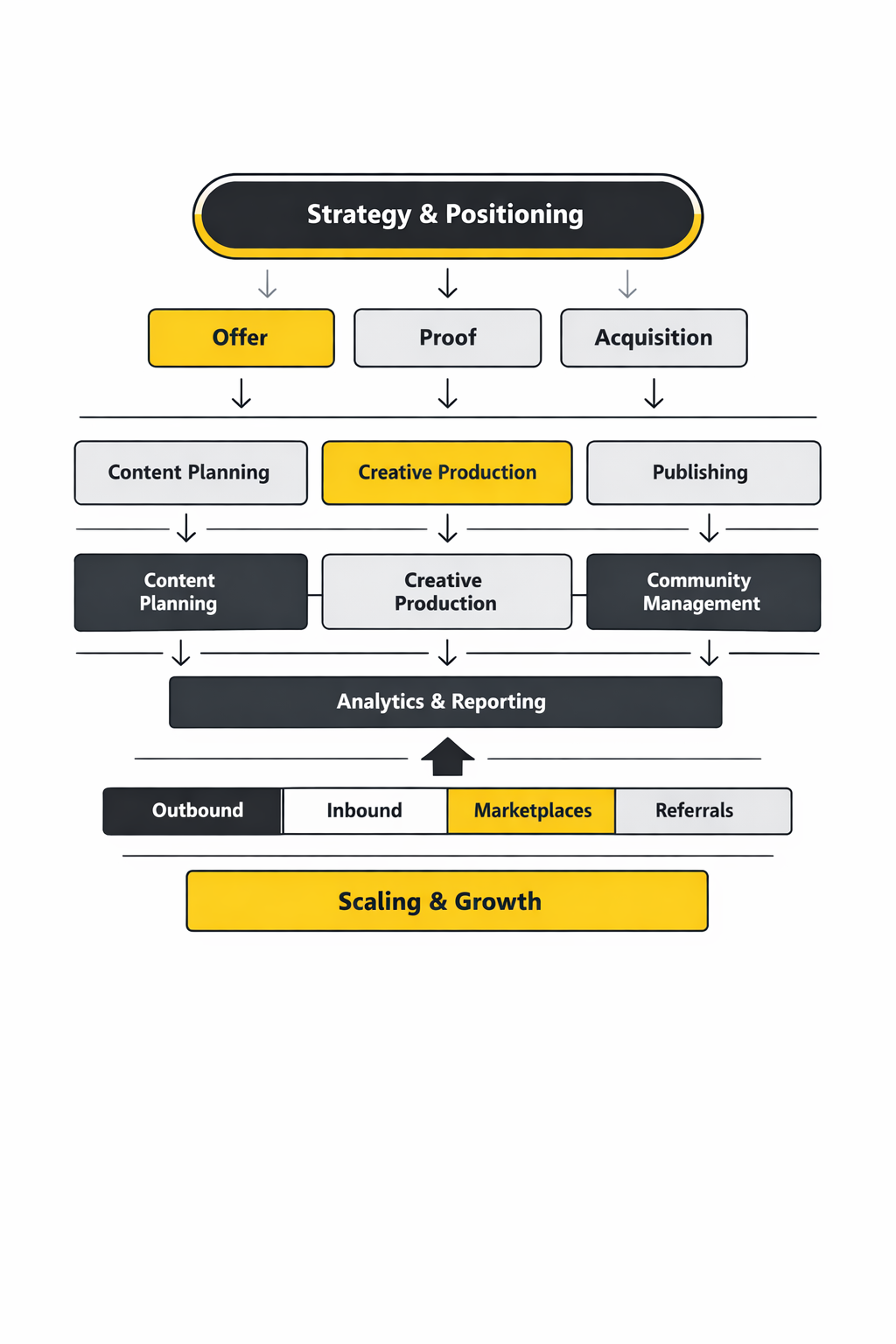
The most reliable social media marketing freelancers don’t rely on inspiration. They rely on a framework that’s easy to explain, easy to sell, and easy to deliver.
Here’s the framework we’ll build through this guide:
- Positioning: pick a clear niche, a clear outcome, and a clear “why you” that’s defensible.
- Offer design: package work into a named service with deliverables, timelines, and success metrics that clients understand.
- Proof: show credible evidence (results, process, before/after assets, or third-party validation) that reduces buyer risk.
- Acquisition: build predictable lead flow through outreach, inbound content, marketplaces, partnerships, and referrals.
- Delivery system: a repeatable workflow for strategy, production, publishing, community, and reporting.
- Measurement: tie platform metrics to business impact so clients can justify continuing (and increasing) the budget.
This structure matters because the work is getting more complex, not less. Even the labor market signals show businesses leaning on specialized freelance talent as they adapt to new tools and new expectations. Upwork’s Future Workforce Index 2025 and Upwork Research Institute findings on skilled knowledge workers both point to a growing independent workforce that companies increasingly rely on for targeted expertise.
Core Components
To succeed as a social media marketing freelancer, you need more than “being good at social.” You need a toolkit that makes clients feel safe buying from you, and a delivery engine that makes results repeatable.
1) Positioning that makes the right clients self-select
Your positioning should answer three questions in plain language: who you help, what outcome you drive, and how you do it differently. If your positioning is vague, every proposal becomes a negotiation and every call becomes a trust-building marathon.
Positioning becomes easier when it’s anchored in real platform behavior. If most of your client’s customers live on specific platforms, it makes sense to specialize in those environments rather than trying to do everything everywhere. Pew’s teens and social media fact sheet (2025) is one example of how platform preferences vary by audience, which is why “I do all platforms” often performs worse than “I win on the platforms your audience actually uses.”
2) An offer clients can understand in one minute
A strong offer has a name, a clear scope, and an outcome. It also has boundaries. Clients trust you more when you can confidently say what you do and don’t do.
Great offers often bundle the messy parts clients hate: planning, production, publishing cadence, community management, and reporting. The client gets a calm, predictable system. You get a delivery process that you can refine instead of reinventing each month.
3) Proof that reduces risk
Proof is what closes the gap between “sounds good” and “we’re ready to pay.” If you don’t have big case studies yet, proof can still be real: documented experiments, improved creative quality over time, content performance patterns, or a small pilot with a clear measurement plan.
When you do use numbers, they must be grounded in credible sources and framed in context. Industry research can help you set expectations for what brands are prioritizing and what customers respond to right now. Sprout Social’s customer care statistics and Index-based insights is one of several sources you can use to support why responsiveness and service are becoming a key part of social strategy, not a side task.
4) A delivery workflow that makes quality repeatable
Clients don’t just buy results. They buy reliability. A clear workflow helps you deliver consistently even when life happens, even when approvals are late, and even when platform changes force you to adapt.
At minimum, your workflow should cover: onboarding inputs, content strategy, production templates, publishing cadence, engagement rules, escalation for customer care, and a reporting rhythm that ties to business goals.
Professional Implementation
This is where many social media marketing freelancers plateau: they’re talented, but they run the work like a series of gigs instead of a professional service business.
Professional implementation means you treat your freelance practice like a productized operation. You define your process, document it, and make it easy for clients to say yes without needing to manage you. It’s the difference between “Can you post for us?” and “Here’s how we’ll run your social presence for the next 90 days, what you’ll get each week, how we’ll measure it, and how we’ll improve it.”
It also means understanding the macro environment clients are operating in. When market forecasts show digital advertising taking the lion’s share of spend, clients are under pressure to justify every decision, and reporting becomes part of the service—not an afterthought. eMarketer’s worldwide ad spending forecast for 2025 is a useful reference point for how the broader ad market is moving, while WPP Media’s research notes provide more detail on the shape of that shift.
From here, the rest of the guide will turn this into a practical playbook: how to design a service clients want, how to find and close work consistently, and how to build a delivery system that makes clients stay—and refer you—without burning out.
Step-by-Step Implementation
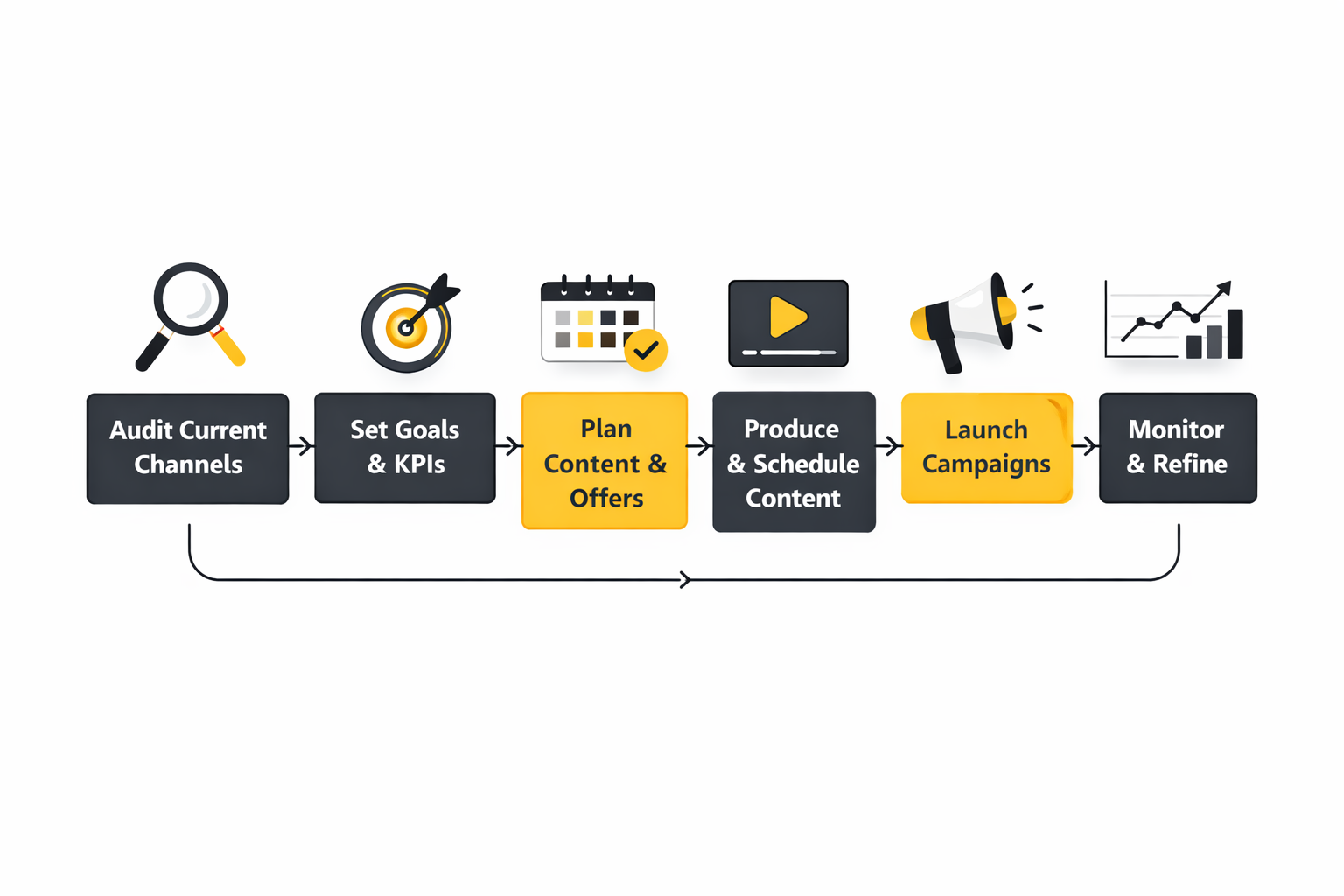
When clients hire a social media marketing freelancer, they usually want momentum fast, but they also want confidence that the work won’t collapse after the first burst of posts. The cleanest way to deliver both is to run a repeatable implementation that starts with clarity, then builds speed.
Use this step-by-step sequence as your default rollout. It’s designed to work whether you’re supporting a solo founder or plugging into an existing marketing team.
Step 1: Establish the baseline in 60–90 minutes
You’re not trying to “audit everything.” You’re trying to understand what the client is doing today, where outcomes are coming from, and what’s wasting effort. Pull the last 60–90 days of content, scan engagement patterns, and note any customer-care hotspots where response speed matters.
If the client’s DMs are part of the buying journey, build the baseline around responsiveness as well. Social care research keeps showing the same pressure: people expect quick replies and will walk away when brands stall. The expectation that most customers want a response within 24 hours, the warning that waiting longer than 24 hours can cost a brand roughly a third of customers, and Meta’s own definition of how it calculates Page response time are enough to justify why this belongs in your first-day checklist.
- Capture: top posts, worst posts, top traffic sources, and inbox pressure points.
- Decide:</strong one primary outcome for the next 30 days (leads, purchases, booked calls, retention, or support deflection).
- Lock:</strong one reporting view that will be used consistently (no moving goalposts).
Step 2: Clarify positioning and voice before you scale output
Content velocity without positioning creates confusion. Your first job is to make the brand sound like a single coherent person across posts, comments, and DMs. That reduces revisions and makes approvals smoother, which is where most implementations bog down.
- Define:</strong one audience segment you’re speaking to first (not “everyone”).
- Choose:</strong 3–5 content pillars tied to that audience’s real questions and objections.
- Write:</strong a short voice guide (tone, taboo phrases, approved claims, and do-not-touch topics).
Step 3: Operationalize the tools so execution can’t fall apart
This step is the difference between a freelancer who “posts content” and a social media marketing freelancer who runs a dependable system. Set up one workflow for approvals, one workflow for publishing, and one workflow for inbound messages.
If the client uses Meta channels heavily, you can tighten response and consistency by using saved replies and inbox automations. The official guidance for creating saved replies and setting up Inbox automations is worth using as your reference when you document the process for stakeholders.
- Approvals:</strong define who approves what, and what happens if they miss a deadline.
- Publishing:</strong set naming conventions and a weekly cadence for scheduling.
- Inbox:</strong create triage rules, escalation paths, and templated responses for FAQs.
Step 4: Build the first two-week content sprint
A two-week sprint is long enough to learn and short enough to stay flexible. You’ll produce content in batches, publish with intent, and collect signal without overcommitting to a strategy you haven’t validated yet.
- Batch:</strong scripts, hooks, captions, and creative templates in one session.
- Produce:</strong 8–12 pieces across formats (short video, carousel, static, and community posts if relevant).
- Plan:</strong engagement prompts so posts don’t feel like broadcast-only marketing.
Step 5: Put basic attribution in place before you “optimize”
Optimization without tracking is just taste. Set up a simple tracking layer so the client can see how social contributes to the funnel, even if the sale happens later. UTMs are the simplest starting point because they work across platforms and reporting tools.
If you’re building dashboards, Looker Studio is a common layer because it’s designed for shareable reporting. The product overview for Looker Studio and Google’s documentation around data connectors are useful when you standardize your reporting setup across clients.
- UTM rules:</strong keep source, medium, and campaign names consistent across every link.
- One dashboard:</strong one place the client checks weekly, not five scattered reports.
- One question:</strong “What did we learn this week that changes what we do next week?”
Execution Layers
Most implementations fail because they treat social as one thing. In reality, you’re running several layers at once, and each layer needs its own definition of “done.” When you separate the layers, your delivery becomes calmer, and the client stops pushing random requests into the middle of your process.
Layer 1: Foundation
This is the non-negotiable setup: voice, pillars, workflow, approvals, and access. If this layer is weak, everything downstream becomes slower and more political. When this layer is solid, production speeds up because decisions are already made.
Layer 2: Production
This is where your creative system lives: templates, reusable hooks, repeatable formats, and batching. It’s also where you protect quality. If you’re building on TikTok or running paid creative, using platform research tools can keep you anchored in what’s actually working right now, such as TikTok Creative Center’s Creative Insights.
Layer 3: Distribution
Distribution is how content gets seen: posting cadence, repurposing, community distribution, and (when appropriate) paid amplification. This is where many brands underinvest, then blame “the algorithm” when reach drops. A social media marketing freelancer adds value here by turning distribution into a checklist, not a hope.
Layer 4: Conversation
This layer is often where churn is created or prevented. Comments and DMs are where trust is built, objections are surfaced, and customers decide if the brand is worth their time. It’s also where response speed becomes a competitive advantage, especially when research shows how quickly poor experiences trigger customer loss. The evidence that slow replies on social can drive customers away within 24 hours makes it easier to justify why you’re building an inbox workflow, not just posting content.
Layer 5: Measurement
This layer exists to support decisions, not to impress people with charts. Your job is to connect platform signals to business outcomes and then choose one improvement to run next. If you’re reporting on video performance, it also helps to align with how platforms define engagement and watch-time signals, such as YouTube’s official guidance on engagement metrics in YouTube Analytics.
Optimization Process
Optimization isn’t “post more.” It’s a disciplined loop: observe, diagnose, change one variable, and measure again. The cleanest way to do this as a social media marketing freelancer is to run weekly micro-experiments and monthly strategic resets.
Weekly: Micro-experiments that compound
Each week, pick one variable to test. This keeps your learning clean and prevents the client from turning optimization into endless busywork. You can test hooks, formats, posting times, CTA language, comment prompts, or distribution tactics, but only one at a time.
- Hook test:</strong two versions of the first line or first two seconds of a video.
- Format test:</strong the same idea as a carousel versus short video.
- Conversation test:</strong a post designed to invite replies, not just likes.
When paid creative is part of the mix, leaning on structured creative research can keep experiments grounded. TikTok’s own documentation for Creative Insights is useful when you need a neutral reference for why you’re testing creative patterns, not just “what feels fun.”
Monthly: Strategic reset that keeps clients confident
Once a month, step back and answer three questions with the client. This is how you avoid churn even when a month was messy.
- What worked:</strong which themes or formats reliably earned attention and action.
- What didn’t:</strong what consumed time without moving any meaningful metric.
- What’s next:</strong one focused bet you’re making in the next month.
Ongoing: Inbox and community optimization
If the client has meaningful inbound volume, treat the inbox as a product that you improve. Tighten saved replies, refine routing rules, and reduce the time it takes for a real human response to land. Meta’s own resources on best practices for tools in Inbox are useful when you document how you’ll keep response quality high without sounding automated.
Implementation Stories
The best implementation stories aren’t about “going viral.” They’re about turning chaos into a repeatable system that a team can actually run. This one is useful because it shows how a brand can move fast without losing narrative control, and it’s well documented across primary and reputable sources.
Duolingo’s “Duo Is Dead” rollout and what it teaches freelancers about execution
Start at a point of high drama. Duolingo announced that its mascot was dead, and the internet reacted like it was real. The campaign hit fast enough that people didn’t have time to “warm up” to it; the story was already everywhere. Within days, the stunt was being analyzed as a moment where a brand seized attention without buying it. Axios’s breakdown of the campaign’s impact
Backstory. Duolingo didn’t build that moment from scratch; it built it from years of personality-driven social content and community memes. The company has described its approach as using entertaining social content to drive organic growth rather than pushing promotional posts. That’s not a vibe, it’s a strategy choice that shows up in its public filings. Duolingo’s 2024 annual report (SEC filing)
Wall. Once you commit to an “edgy” narrative, the risk isn’t reach, it’s control. The internet can hijack your story, competitors can jump in, and a single off-tone reply can flip sentiment in hours. Duolingo also operates in a category where trust matters, so any public backlash can create real business pressure, not just awkward comments. The tension is simple: move fast enough to win attention, but not so recklessly that you create lasting damage. The Wall Street Journal’s reporting on Duolingo’s social team and the pressure behind virality
Epiphany. The campaign worked because it treated social as a narrative engine, not a posting schedule. The team didn’t just publish one announcement; it staged a sequence of beats that kept the audience watching and participating. That’s the real lesson for a social media marketing freelancer: strong execution is a chain of deliberate moments, not a single clever post. Axios’s breakdown of the narrative mechanics
Journey they went on to reach the goal. After the initial announcement, Duolingo sustained the story across platforms, letting the community do part of the distribution through reactions, memes, and remixes. Measurement vendors tracked the conversation spikes and showed how quickly attention accelerated once the storyline kicked off. Meltwater’s recap captured the scale of mentions and the intensity of the spike during the campaign window, which helps explain why the narrative felt unavoidable. Meltwater’s data recap of the campaign’s conversation volume
Final conflict. Big attention brings scrutiny, and scrutiny brings backlash risk. Duolingo’s leadership has publicly acknowledged learning hard lessons about how “edgy posts” can backfire and force tone adjustments, even when a brand’s identity is built on humor. That’s the point where many teams panic and either go silent or start posting bland filler that drains momentum. The tighter move is to keep the workflow steady, keep approvals fast, and respond like a human while the conversation is still hot. Business Insider’s reporting on how Duolingo adjusted after backlash
Dream outcome. The campaign reinforced Duolingo’s cultural relevance and proved that a social-first storyline can compete with massive paid moments in attention share. It also strengthened the company’s broader positioning: entertaining content that the community wants to spread is a growth lever, not a brand accessory. In other words, the stunt wasn’t a random meme; it was consistent with how Duolingo says it drives organic user growth. That alignment between story, workflow, and brand strategy is exactly what clients are buying when they hire a social media marketing freelancer who knows how to implement at speed. Duolingo’s 2024 annual report (SEC filing)
Set service-level expectations that match real customer behavior
If the client expects you to manage DMs and comments, define response-time targets and escalation rules. This isn’t bureaucracy; it’s how you avoid “Why didn’t anyone reply?” surprises. It’s also easy to justify when consumer research shows how unforgiving people can be about delays, including the warning that brands can lose customers after waiting longer than 24 hours.
Document the workflow like you’re handing it to a future team
Even if you’re a solo freelancer, document the process. Clients change staff, approvals shift, and emergencies happen. A short operating document keeps the work stable when everything else is moving.
- Access map:</strong who owns which accounts, and what permissions you have.
- Approval map:</strong who approves what, how fast, and what happens if they’re unavailable.
- Inbox map:</strong what you answer, what gets escalated, and what’s out of scope.
Build quality control into the system, not into late-night panic
Create a simple pre-publish checklist: claims, compliance, brand voice, links, tags, and creative specs. This reduces mistakes without slowing the team down. If you’re supporting Meta channels, Meta’s guidance on Inbox best practices and features like Inbox automations can be part of your quality layer for customer care as well.
Keep reporting on a rhythm clients can rely on
Send a short weekly note that answers: what happened, what you learned, and what you’re changing next. Then use a monthly review to reset strategy with calm, not drama. If you use dashboards, align them with a shareable reporting tool like Looker Studio so stakeholders can check progress without requesting custom reports every time.
Statistics and Data
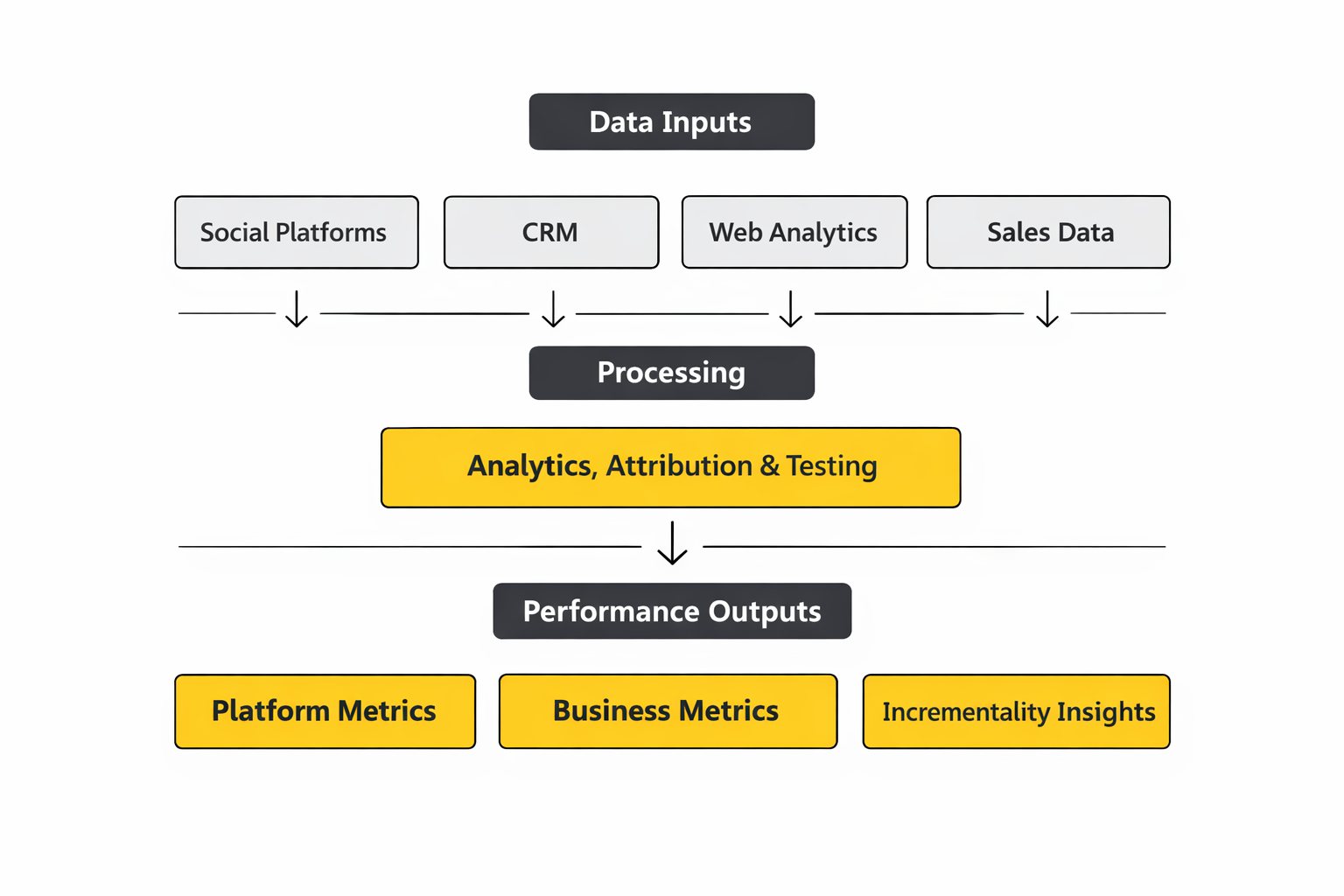
Numbers don’t make your work valuable by themselves. What makes a social media marketing freelancer valuable is using the right numbers to make better decisions than the client could make alone, then translating those decisions into predictable action.
It also helps to understand the macro environment your clients are living in. Social ad spend is still growing fast, with industry forecasts putting 2025 global social ad investment in the high hundreds of billions and projecting it to cross the $300B mark in 2026. WARC’s 2025 social media ad spend forecast and a separate market lens in eMarketer’s coverage of WARC’s updated global ad outlook both reinforce the point: clients are spending, but they’re also demanding proof.
On the U.S. side, that “proof pressure” shows up in audited industry totals. The IAB/PwC Internet Advertising Revenue Report for full-year 2024 documents social media advertising revenue at $88.8B in 2024 (and notes a $23.8B increase versus 2023), which is a useful baseline when a client asks why social is treated as a serious budget line instead of a creative hobby.
Even platform scale matters for analytics interpretation. When a platform reaches “everyone,” your creative has to work harder to earn attention. That’s why it matters that Reuters reported Instagram reaching 3 billion monthly active users in 2025; for most clients, the game is no longer “be present,” it’s “be memorable and measurable.”
Performance Benchmarks
Benchmarks are guardrails, not goals. They’re most useful for two things: spotting when a client is underperforming because fundamentals are broken, and preventing overreaction when performance is actually normal for the category.
To keep benchmarks honest, treat them as “ranges” and triangulate across multiple independent datasets, because sources measure engagement differently (per follower, per reach, per impression, per view). You’ll see that variation clearly when you compare network-wide benchmarks across Socialinsider’s 2026 benchmarks, format-level engagement findings in the Emplifi Social Media Benchmarks Report 2025, and industry snapshots in Sprout Social’s benchmarks-by-industry analysis.
Engagement context you can actually use
If a client asks, “Is our engagement good?” your best answer is usually, “Good compared to what, and measured how?” Socialinsider’s multi-network benchmarking has TikTok standing out with materially higher engagement than other networks in its dataset, while Instagram and Facebook sit far lower in the same reporting frame. Socialinsider’s 2026 benchmark summary
Format also matters more than most clients realize. Emplifi’s benchmark report notes short-form video dynamics across major platforms and highlights how reach-based engagement rates can shift year to year, including comparative observations between Reels and TikTok reach engagement rates in its dataset. Emplifi’s 2025 benchmarks report (PDF)
Posting volume is not a flex
Many brands still confuse “more posts” with “more progress.” Benchmarks show brands publish at significant volume across networks, but volume alone doesn’t protect performance if creative and targeting aren’t sharp. Sprout Social’s benchmarking analysis notes that brands averaged 9.5 posts per day across networks in 2024, which is a helpful reality check when a client insists that “posting twice a week” should dominate the category. Sprout Social’s benchmarks-by-industry
Directional paid-social signals (use carefully)
Paid social benchmarks are useful when they come from primary datasets tied to real spend, not scraped guesses. Quarterly benchmark reports from large media managers and platforms are usually the safest reference points, especially when you’re explaining whether a change is “your creative” or “the market.”
For example, Tinuiti’s quarterly benchmark program is based on performance data from advertising under its management, which makes it useful for directional trend framing when a client wants to know whether Meta costs are easing or tightening. Tinuiti’s Digital Ads Benchmark Report hub
Skai’s quarterly reporting is another widely cited reference point for paid media trends across paid social, retail media, and search, and it’s especially useful when you need to explain why “our CPM changed” might be a market effect rather than a sudden creative failure. Skai’s Q1 2025 Quarterly Trends Report (PDF)
Analytics Interpretation
Analytics is where a social media marketing freelancer either becomes a strategic partner or gets treated like a posting contractor. The difference is whether your reporting answers business questions, not just platform questions.
A useful interpretation model is to read results in three layers: attention, intent, and outcome. Attention tells you whether the creative earned the right to be seen. Intent tells you whether the message created curiosity or trust. Outcome tells you whether the client made money, gained qualified leads, or reduced service load.
Layer 1: Attention signals
Attention signals include reach, impressions, video views, watch time, and early engagement velocity. These metrics help you identify whether the hook is working and whether distribution is healthy. They do not tell you if the campaign is profitable, but they do tell you whether your creative is even getting a chance to sell.
When you’re working with video-heavy strategies, it helps to align your language with how platforms define engagement and retention metrics, especially if a client has stakeholders who will challenge definitions. YouTube’s official documentation for engagement reports in YouTube Analytics is a solid example of platform-defined measurement language you can borrow when you want discussions to stay factual.
Layer 2: Intent signals
Intent signals include link clicks, profile visits, saves, shares, comment quality, and DM starts. These are the metrics that tell you whether people are moving from “that’s entertaining” to “I might actually want this.” They’re also where you can diagnose message-market mismatch: strong reach with weak intent usually means the story is broad, but the offer or CTA is unclear.
If your strategy includes customer care in the inbox, treat response speed as an intent-and-trust metric. It’s hard to sell “premium” when the brand replies slowly. The consumer expectation that most people want a response within 24 hours pairs uncomfortably well with the finding that a significant share of customers will abandon brands after waiting longer than 24 hours, which makes inbox workflow improvements an easy win to measure.
Layer 3: Outcome signals
Outcome signals include purchases, qualified leads, booked calls, subscription starts, and customer retention improvements that can be credibly linked to social activity. This is where tracking discipline matters: consistent UTMs, consistent campaign naming, and one reporting location that doesn’t change every month.
Looker Studio is a popular layer for this because it makes dashboards shareable and standardized across clients, which reduces “custom reporting” churn. When you build a repeatable reporting template for every client, you’re productizing your analytics work in the same way you productize your content system. Looker Studio’s official overview
Case Stories
Good case stories aren’t “we posted a lot and got views.” They’re about measurement clarity in moments where the client is under pressure and needs proof to keep investing.
Torrid’s attribution shock on TikTok and the measurement lesson most brands learn too late
Start at a point of high drama. The numbers looked fine, but the story didn’t add up. On the surface, standard last-click reporting suggested TikTok wasn’t pulling its weight, which made budget conversations tense and defensive. When leadership starts asking whether a channel “really works,” a social team can lose funding long before it loses performance. TikTok for Business: Torrid full-funnel case study
Backstory. Torrid is an established retailer, and paid media decisions don’t happen in a vacuum; they happen inside forecasting meetings where every channel has to justify its existence. Like many brands, they were operating in an environment where conversion credit often goes to whatever got the last click, even if earlier touchpoints created the desire. That bias makes upper- and mid-funnel channels look weaker than they are, which quietly pushes teams toward short-term tactics. TikTok for Business: Torrid full-funnel case study
Wall. The wall wasn’t creative fatigue or targeting issues; it was measurement credibility. If TikTok’s impact couldn’t be proven in a way stakeholders trusted, investment would shrink regardless of what customers were actually doing. The more the team relied on last-click reporting, the more TikTok’s role in the journey risked being undervalued, creating the perfect setup for a “cut the budget” decision. TikTok for Business: Torrid full-funnel case study
Epiphany. The breakthrough was treating attribution as a strategic lever, not a reporting afterthought. Instead of accepting last-click as “truth,” Torrid’s team leaned into incrementality thinking: what would have happened without TikTok in the mix? Once you ask that question, the reporting conversation shifts from “who gets credit” to “what actually caused growth.” TikTok for Business: Torrid full-funnel case study
Journey they went on to reach the goal. Torrid worked with its agency and used a marketing technology approach to test the gap between last-click reporting and a model designed to capture incremental impact. They focused on proving conversion lift rather than simply optimizing to in-platform metrics. The case study describes how the approach revealed that last-click reporting was materially undervaluing TikTok conversions, which reframed the channel’s performance narrative for decision-makers. TikTok for Business: Torrid full-funnel case study
Final conflict. Even when better measurement exists, the battle isn’t instantly won. Teams still have to communicate the logic clearly, because stakeholders often distrust anything that challenges the “simple” last-click story. There’s also the risk of overcorrecting: when a channel looks undervalued, the temptation is to flood it with budget before creative systems are ready to scale. The real discipline is to increase investment only as fast as the execution engine can maintain quality. TikTok for Business: Torrid full-funnel case study
Dream outcome. The case study reports that TikTok’s incremental ecommerce ROAS measured through their approach was dramatically higher than what last-click attribution models suggested, and that TikTok compared favorably versus other non-social digital channels in their analysis. Beyond the headline metric, the more valuable win is the one most freelancers miss: once measurement credibility improves, the team can defend budget, scale experiments, and compound results instead of constantly re-litigating whether the channel matters. That’s the kind of outcome a social media marketing freelancer can sell with confidence because it’s rooted in proof, not vibes. TikTok for Business: Torrid full-funnel case study
Professional Promotion
Promotion gets easier when you stop trying to “market yourself” and start proving you run a measurable system. Clients don’t need you to be famous. They need you to be reliable, and reliability is easiest to show with clean reporting and clear decisions.
Turn analytics into a portfolio asset
A portfolio that only shows creative is easy to dismiss as “pretty.” A portfolio that shows creative plus the measurement story is harder to ignore. Share one-page snapshots that connect a goal to a test, a result, and the decision you made next, using consistent definitions and one dashboard view.
When you reference market context, use credible anchors that clients recognize. The signal that U.S. social ad revenue reached $88.8B in 2024 helps frame why social is a serious performance channel, while the forecast that global social ad spend is projected to exceed $300B in 2026 explains why competition is fierce and why measurement discipline is a differentiator.
Use “decision language,” not “metric language”
Instead of saying, “Engagement is up,” say, “This format created higher saves and shares, so we’re turning it into a weekly series.” Instead of saying, “CPM rose,” say, “Market costs rose, so we tightened creative and improved targeting to protect cost per lead.” If you need a neutral reference for market movement, quarterly benchmark programs like Tinuiti’s Digital Ads Benchmark Report and trends reporting like Skai’s quarterly report (PDF) give you credible context without forcing you to invent numbers.
Sell trust by operationalizing the inbox
If you manage DMs and comments, that is a premium service when it’s done professionally. Share before/after response-time improvements, message categorization, and escalation rules, because those outcomes feel tangible to clients. When the client understands that most people expect a reply within 24 hours and that slow replies can directly trigger customer loss, your “community management” stops sounding like fluff and starts sounding like revenue protection.
Future Trends
The next wave of demand for a social media marketing freelancer is being shaped by one uncomfortable truth: audiences are getting better at spotting “manufactured” content, while platforms are getting better at distributing what keeps people watching.
That tension is pushing strategies in two directions at once. On one side, there’s a surge in AI-assisted production and AI-led discovery, including the kind of AI shopping experiences now being rolled into social commerce ecosystems. LTK’s AI shopping chatbot rollout is a clear signal that creator content and product discovery are moving toward conversational, AI-mediated experiences.
On the other side, there’s growing public sensitivity to content that feels “too synthetic,” especially when brands use AI in ways that undermine perceived authenticity. The backlash around high-profile AI creative experiments, like Gucci’s AI-generated campaign controversy, is a reminder that automation can accelerate production while simultaneously increasing reputational risk.
So what does that mean for your day-to-day work as a social media marketing freelancer?
- Community-first beats broadcast-first: The most resilient brands are building formats that invite participation and reward returning viewers. Hootsuite’s Social Media Trends 2026 frames this shift around agility, culture, and faster iteration.
- Short video becomes the operating system: It’s less “a content type” and more the default language of attention. That’s why even workplace storytelling formats like WorkTok are becoming mainstream cultural content, not niche posts. The Financial Times reporting on WorkTok
- Social becomes search and support at the same time: More people use social to research, compare, and ask questions, which means your content system and inbox system must work together. Sprout Social’s 2026 trend write-up emphasizes the rising importance of trust, caution around AI influencers, and stronger community signals.
- Scale raises the bar for distinctiveness: When platforms reach massive scale, “being present” stops being a strategy. Reuters reporting that Instagram reached 3 billion monthly active users puts pressure on creative clarity, because the feed is crowded even before you post.
Strategic Framework Recap
This guide has been building one simple promise: a social media marketing freelancer wins long-term by running a system clients can trust.
- Positioning: You pick a clear audience and outcome so the right clients self-select.
- Offer: You sell a named service with boundaries, timelines, and measurable goals.
- Proof: You reduce buyer fear with credible evidence, not vague claims.
- Acquisition: You build a reliable pipeline across outbound, inbound, marketplaces, and referrals.
- Delivery: You run a repeatable workflow for planning, production, publishing, community, and reporting.
- Measurement: You connect platform signals to business outcomes so clients can justify continuing and scaling.
When you do this well, you stop being “the person who posts.” You become the person who makes social feel predictable, measurable, and worth funding.

FAQ – Built for This Complete Guide
1) What does a social media marketing freelancer actually deliver?
The deliverable is rarely “posts.” The real deliverable is a system: content planning, creative production, publishing cadence, community engagement, and reporting tied to business outcomes. Clients hire you because they want social to feel managed and measurable, not chaotic.
2) How do I pick a niche without boxing myself in?
Choose a niche based on the outcome you can reliably drive (leads, ecommerce revenue, bookings, retention, or service deflection) and the environment you understand (platform + audience + buying cycle). You can broaden later, but you need a clear “first identity” so clients know why you’re the right hire.
3) How many platforms should I manage for one client?
Start with the smallest set that can produce results. One or two platforms is often enough for the first 30–60 days, because adding channels increases approval load, creative load, and measurement complexity. Expand only after the workflow is stable and the client is seeing progress.
4) What should I track if the client says, “We just want brand awareness”?
Treat awareness as the top of a real funnel. Track attention (reach, watch time), intent (saves, shares, profile visits, clicks), and outcomes when possible (email signups, demo requests, purchases). This keeps the work accountable without forcing every post to “sell.”
5) How do I avoid getting trapped in endless revisions?
Install guardrails early: a short voice guide, clear content pillars, and an approval SLA. Series-based content helps too, because once the format is approved, you’re iterating inside a known structure instead of reinventing the wheel every week.
6) Should I offer community management and DM support?
If you can run it professionally, yes, it can become a premium differentiator. Many customers expect fast replies, and slow response can directly damage trust. That’s why service expectations like replying within 24 hours have become a practical standard for many brands.
7) What’s the simplest way to prove ROI as a freelancer?
Pick one primary outcome, install UTMs consistently, and report from one dashboard view. Avoid vanity-only reporting. If the client wants paid + organic combined, use a simple narrative: what you tested, what changed, and what decision you’re making next.
8) How do I scale results without burning out?
Scale systems, not effort. Use batching, reusable templates, and series architecture. When demand outgrows your capacity, add a creator pipeline with standardized briefs and approvals instead of trying to personally produce everything.
9) How do I keep content “human” while using AI tools?
Use AI for speed in drafting, repurposing, and ideation, then apply human judgment to voice, taste, and risk. Public reactions to AI-heavy creative can shift quickly when audiences feel authenticity is compromised, which is why moments like the Gucci AI ad backlash are worth paying attention to.
10) Where do I find enough opportunities to build a consistent pipeline?
Use multiple channels: outbound to a tight ICP, inbound content that demonstrates expertise, partnerships, and marketplaces designed for marketing work. The broader market is also deep: LinkedIn currently shows 12,000+ remote digital marketing roles in the U.S., which is a useful reminder that “there aren’t enough opportunities” is rarely the real problem—positioning and pipeline design usually are.
11) How do pricing and “no commission” marketplaces affect my earnings?
When a platform doesn’t take per-project fees or commissions, you keep more of what you earn because your rate isn’t being shaved down by transaction charges. Look for clear policies that confirm this structure, like marketplaces that explicitly state no project fees or commissions.
12) What should I have ready before I pitch a new client?
Bring three things: a simple offer (scope, timeline, success metrics), a proof asset (mini case study, pilot results, or a teardown of their current funnel), and a 30-day plan that shows you understand their reality. Clarity closes deals faster than cleverness.
Work With Professionals
If you’re serious about landing better clients as a social media marketing freelancer, the hardest part isn’t talent. It’s volume and access. Most freelancers lose momentum because they can’t keep a steady flow of real opportunities in front of them, week after week.
That’s where a focused marketing marketplace can change your week overnight. MARKEWORK is built to connect businesses and marketing specialists directly, with a structure designed to remove the usual friction. It’s positioned around direct communication and no project fees, and it explicitly states there are no commissions or transaction charges, so you’re not watching your earnings get sliced down after you win the work.
Now zoom out for a second. There are already over 12,000+ remote digital marketing roles listed on LinkedIn in the U.S. alone, and that’s before you count contracts and projects across niche boards and internal hiring pipelines. The opportunity is real. What most freelancers need is a cleaner way to reach it, filter it, and close it without playing platform games.
MARKEWORK is built to help you move faster: the platform highlights over 1,000 active listings and offers membership plans that emphasize access to thousands of job listings, direct communication, and no project fees. Instead of paying per project, you pay a simple subscription, then negotiate directly like a professional.
Imagine what changes when your pipeline stops depending on luck. You wake up, open a marketplace designed for marketing work, and see a steady stream of roles you’re actually qualified for. You pitch from a position of calm because you’re not desperate for one “maybe.” You can be selective, charge what you’re worth, and keep your full rate because there’s no commission layer sitting between you and the client.
If you want a practical next step, build a profile that reads like a decision-maker wrote it: clear niche, clear offer, proof, and a simple onboarding promise. Then start applying consistently, using the same system you’d use to run a client campaign: weekly targets, a tight message, and iteration based on response.
 Filip Konecny Enterprises