tags.• Instead, always create a separate anchor element immediately before the heading.• Use this exact pattern for every section that must support page jumps:
This is the implementation path that keeps delivery clean and performance measurable, even when the client’s requests (and the platform algorithms) change mid-month.
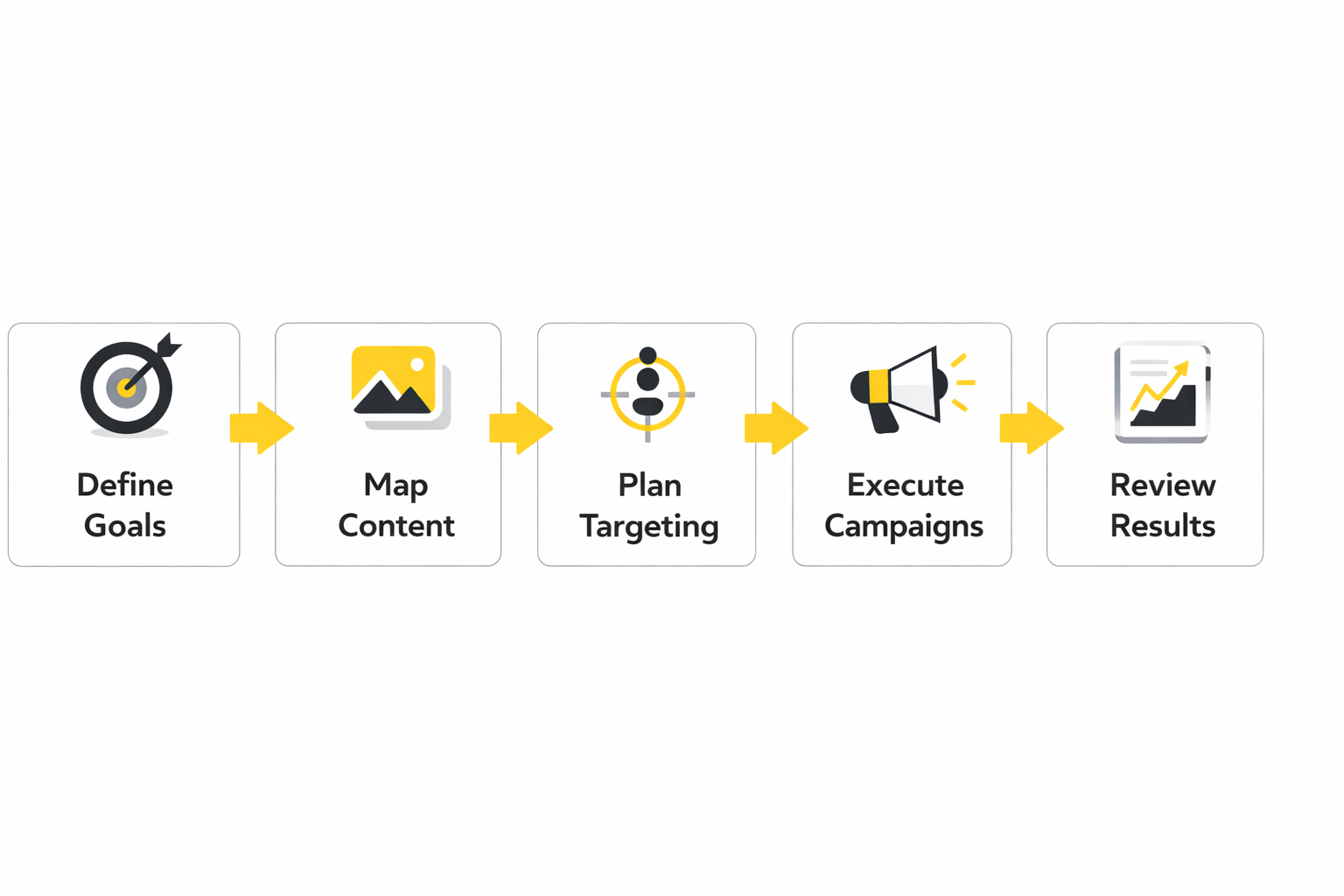
Step 1: Lock the outcome and define “done”
Before you schedule anything, define the outcome you’re being judged on and what “done” looks like in plain language. A lead-gen client might define “done” as qualified leads that match a specific job title or budget threshold, not just form fills. An ecommerce client might define “done” as purchases with healthy margin, not just traffic spikes.
Step 2: Build the content map before you build content
Create a map that connects content to intent: what introduces the problem, what proves credibility, what handles objections, and what asks for action. This prevents the classic agency trap where everything becomes “top-of-funnel content” because it’s easier to make. Your content map is also how you decide which formats deserve paid amplification and which are strictly organic trust builders.
Step 3: Set up tracking that won’t collapse under privacy changes
If you run paid social, you want tracking that survives browser limitations and ad blockers. That’s why server-side event sharing has become a core expectation, not an advanced add-on, with platforms publishing detailed implementation guidance like Meta’s Conversions API best practices and the broader GA4 Measurement Protocol documentation for sending events server-to-server.
Step 4: Create a weekly production rhythm that protects quality
Pick a cadence you can actually sustain, then make it your default. Most teams do best with a weekly rhythm: one day for insights and planning, one day for production, one day for approvals, then scheduled publishing with room for reactive posts. The rhythm matters more than the “perfect calendar” because consistency is what lets you compare week-over-week performance without confusing the results.
Step 5: Launch with a testing plan, not a pile of posts
Every launch should include a small set of intentional tests: a messaging test, a format test, and a distribution test. Your first month is about learning what the audience responds to, not proving you can produce volume. If you start with disciplined experiments, your optimization becomes simpler and your reporting becomes more believable.
Execution Layers
A social media marketing business runs smoother when execution is layered. Each layer has a job, and the layers reinforce each other instead of competing for time and budget.
Layer 1: Foundation layer
This is the “always on” layer: the client’s profile health, brand voice, baseline content pillars, and a predictable posting rhythm. It’s not meant to go viral every week. It’s meant to make the brand feel alive, coherent, and trustworthy when people check the profile after seeing an ad or a creator mention.
Layer 2: Campaign layer
Campaigns are how you create spikes of attention and intent around a specific offer, launch, or seasonal moment. Campaign work should have tighter creative direction, clearer conversion paths, and a defined start and end date. It’s also where you coordinate organic, paid, and creators so the story looks consistent across touchpoints.
Layer 3: Performance layer
This layer is about efficiently turning intent into action. It includes paid optimization, landing page alignment, and conversion event integrity. When performance is done well, you can confidently answer the client’s hardest question: “What did social actually contribute?”
Layer 4: Relationship layer
Community management and trust-building content live here. It’s where you respond, moderate, and make the audience feel seen, which compounds over time. This layer also reduces the cost of future campaigns because audiences convert faster when they already trust the brand.
Optimization Process
Optimization is where most teams either become professionals or slowly burn out. The difference is having a process that tells you what to change and why, rather than chasing random tweaks every time a metric dips.
Rule 1: Separate “creative problems” from “distribution problems”
If reach is low, it might be a distribution problem (posting time, format fit, platform behavior) or it might be a creative problem (weak hook, unclear promise, mismatched audience). Treating everything like a creative problem leads to constant rewrites and no learning. Treating everything like a distribution problem leads to boosting weak content and wasting budget.
Rule 2: Use a consistent weekly review format
Pick a weekly review format that forces clarity: what won, what lost, what changed in the environment, and what you’ll test next. Your best weekly review feels almost boring because it’s repeatable. That’s how a social media marketing business scales without turning reporting into a monthly emergency.
Rule 3: Protect your measurement spine
Optimization is only as good as the signal you’re reading. If you’re running paid, keep event setup and deduplication clean, and follow platform guidance that’s designed to reduce attribution chaos, like Meta’s Conversions API implementation best practices. When analytics needs broader stitching across sources, keep your event structure consistent with GA4’s Measurement Protocol so reporting doesn’t collapse when browsers change.
Rule 4: Optimize in the same order every time
To avoid thrash, optimize in a fixed order: conversion path first (landing page, offer clarity), then creative (hooks, structure, proof), then targeting and budget. If you change everything at once, you don’t learn. If you change in order, your wins compound and your losses become useful data.
Implementation Stories
Implementation looks tidy in frameworks and messy in real life. That’s why real stories matter: they show where teams get stuck, what they change, and how the work actually becomes repeatable inside a social media marketing business.
DSB’s measurement panic, and the shift to first-party signal
Start at a point of high drama. A performance dip hits, and the client meeting turns sharp: “Are we losing conversions, or are we losing visibility?” The marketing team is staring at dashboards that don’t agree, and every answer sounds like a guess. When the numbers feel unstable, budgets get questioned fast, even if the creative is strong.
Start at a point of high drama. The worst part isn’t the uncertainty—it’s the speed at which uncertainty spreads. Stakeholders don’t wait for a forensic audit; they want a confident explanation now. And without that, a social program can get blamed for problems it didn’t create.
Start at a point of high drama. This is the moment where many social teams fall into the trap of “more content” or “more spend” just to prove activity. That usually makes the confusion worse, because it adds more variables while measurement is already shaky.
Backstory. DSB, Denmark’s national train operator, has a real-world business with real-world constraints: demand swings, route planning, and operational complexity. Social and paid media can influence behavior, but only when the measurement chain is credible enough for teams to act on it. Like many advertisers, DSB was operating in a world where browser-based tracking can miss events and create blind spots.
Backstory. In that environment, even honest teams can end up arguing about the wrong thing: whether the platform is “wrong” or the business is “wrong.” Meanwhile, the customer journey continues, regardless of whether the dashboard agrees. That’s why improving signal quality becomes an operational priority, not a technical side quest.
Backstory. Over time, the lesson becomes obvious: you can’t optimize what you can’t reliably observe. And if you can’t reliably observe results, you can’t defend budget decisions, even when your strategy is sound.
The wall. The team hits a hard wall when platform reporting can’t be trusted to capture enough of the journey. Small gaps become big arguments, especially when leadership wants quick answers. When conversion paths include mobile devices, privacy limits, and multiple steps, “pixel-only” tracking can leave too much uncertainty.
The wall. At that point, optimization becomes guesswork, because you can’t confidently tell whether changes helped or hurt. You start seeing symptoms: teams overreacting to daily noise, pausing campaigns too early, and chasing “safe” tactics that don’t actually move the business. And that makes a social media marketing business feel chaotic from the inside, even if it looks busy from the outside.
The wall. The bigger the budget, the more painful this wall becomes. Money amplifies outcomes, but it also amplifies mistakes and uncertainty. Without a stronger signal, you end up managing emotions instead of performance.
The epiphany. The shift happens when the team stops asking, “Which dashboard is right?” and starts asking, “How do we make the signal stronger?” Instead of treating measurement as reporting, they treat it as infrastructure. That reframing changes priorities immediately: tracking integrity becomes part of the marketing plan.
The epiphany. This is where first-party data and server-side event sharing stop sounding like buzzwords and start sounding like relief. If more conversions can be observed reliably, teams can return to what they’re good at: creative, messaging, and customer insight. And clients can trust decisions again, because the measurement chain is less fragile.
The epiphany. In practice, it’s the moment you realize you don’t need perfect attribution—you need dependable direction. Better signal gives you better direction. Better direction gives you calmer decision-making.
The journey. DSB implemented the Meta Conversions API and enriched the setup with more first-party data, documented in Meta’s DSB success story. That kind of change is not just “turning on a feature”; it’s mapping events, setting up deduplication, and aligning internal data flows so reporting doesn’t drift. It’s also a mindset shift: measurement becomes a shared responsibility between marketing and whoever touches the website, booking flow, or analytics stack.
The journey. For a social media marketing business supporting a client like this, the operational takeaway is powerful: build tracking setup into onboarding, not as an emergency repair. When you treat signal resilience as part of the deliverable, you can optimize faster and defend results with less hand-waving. And your reporting becomes less about explaining anomalies and more about scaling what’s working.
The journey. The work doesn’t end after implementation, either. You keep the system healthy by revisiting event quality, consent flows, and platform guidance as it evolves, using resources like Meta’s Conversions API best practices to keep the setup aligned with current recommendations.
The final conflict. Even after signal improves, reality still fights back. Teams discover that “more data” can create new debates if you don’t define which metrics matter most. Stakeholders can also misread improved attribution as “free growth,” pushing for aggressive scaling before creative and customer experience are ready.
The final conflict. This is where professional operators slow down and insist on disciplined testing. They use improved signal to make smarter changes, not faster chaos. And they protect the client relationship by setting expectations: better measurement reduces uncertainty, but it doesn’t eliminate the need for creative iteration and clear offers.
The final conflict. In other words, measurement fixes the compass, not the terrain. You still have to travel the terrain with good strategy. Better signal just prevents you from walking in circles.
The dream outcome. The best outcome isn’t a single campaign win—it’s a calmer operating environment. With a stronger measurement spine, teams can make decisions with confidence, and clients can trust that optimization isn’t guesswork. That’s the kind of trust that turns a short contract into a long partnership.
The dream outcome. For a social media marketing business, this is where you start to scale without fear. You can onboard faster, optimize more cleanly, and report with fewer disclaimers because your infrastructure supports your claims. And when you can defend your work, you can price it like a professional.
The dream outcome. Most importantly, the team gets time back. Instead of spending weeks explaining why numbers don’t match, you spend that time building better creative, better campaigns, and a better customer journey that makes social a true growth channel.
Professional Implementation
Professional implementation is what makes clients feel safe saying “yes” again after a bad month. It’s not just tactics. It’s the experience of working with your social media marketing business: clear decisions, clean execution, and reporting that reads like a confident plan, not a defensive explanation.
Run a fixed operating cadence
Set a cadence that your clients can rely on: weekly performance review, biweekly creative planning, and monthly strategy recalibration. When the cadence is fixed, clients stop micromanaging because they know there’s a built-in moment to adjust course. That predictability is a hidden retention lever.
Build quality controls into the workflow
Quality controls should be part of the process, not a last-minute scramble. Use a pre-publish checklist that covers brand voice, claims, link checks, and creative specs, plus a post-publish check that confirms everything rendered correctly across placements. This is how you avoid the painful situation where the client sees a mistake before you do.
Standardize the proof
Clients don’t need more metrics; they need clearer proof. Standardize a small set of outcomes that connect to business reality, and keep the measurement chain resilient with tools and setups designed for privacy constraints, like server-side event sharing best practices and consistent analytics event structures via GA4’s Measurement Protocol.
Write decisions down like you’re building an asset
Every month, document three things: what you learned, what you changed, and what you’re betting on next. This turns your work into a compounding knowledge base instead of a set of disconnected campaigns. Over time, that knowledge base becomes one of the most valuable assets inside a social media marketing business, because it makes results more predictable and onboarding dramatically faster.
Statistics and Data
Data is the difference between a social media marketing business that feels “creative” and one that feels inevitable. When your numbers are clean, you can defend decisions, set expectations early, and avoid the monthly panic spiral where everyone argues about what’s real instead of what to do next.
Inside that same IAB/PwC dataset, social media advertising revenue reached about $88.8B in 2024, a jump also highlighted in the IAB overview page (IAB’s Full Year 2024 release) and in trade reporting (TVREV’s breakdown of channel growth). Translation: your clients are increasingly betting on social, but they’ll only keep betting if you can show what the money is doing.
Benchmarks are useful when you treat them like weather, not like a report card. They help you notice when you’re operating in a storm (platform shifts, content fatigue, seasonality), but they don’t tell you whether your strategy is smart. Different vendors also calculate “engagement” differently, so the only safe way to use benchmarks is to compare your performance to your own baseline first, then use external benchmarks to sanity-check.
Organic engagement benchmarks that set realistic expectations
When you communicate this to clients, the message isn’t “TikTok is better.” The message is: the format and the audience behavior are different, so your content and your measurement should be different. Shares, saves, and watch time often tell a cleaner story than comments when the culture shifts toward passive consumption.
Posting frequency benchmarks without the “post more” trap
Use that number as a reference point, not a mandate. A social media marketing business wins by building a repeatable cadence that protects quality: fewer “random posts,” more series, clearer creative standards, and a distribution plan that matches the client’s goals.
Consumer behavior benchmarks that explain why social impacts revenue
This matters because it changes the standard for success. You’re not only competing with other ads. You’re competing with creators, community recommendations, and the client’s own customer experience. Benchmarks help you explain why the path from content to revenue isn’t linear, and why measurement needs to account for assist value, not just last-click wins.
Analytics Interpretation
Analytics interpretation is where a social media marketing business earns trust. Anyone can export a dashboard. Professionals can explain what changed, why it changed, and what the next move should be without sounding defensive.
Stop chasing one number, start reading the system
If you fixate on one metric, you’ll optimize the wrong thing. Reach can be up while conversions are down because the offer is unclear. Clicks can be up while revenue is flat because the landing page leaks. Engagement can look “low” while brand demand rises because people are saving and sharing instead of commenting.
The practical approach is to read the system in layers: attention (reach, watch time), intent (click quality, on-site behavior), and outcome (leads, purchases, pipeline). That layering makes your analysis calmer and your decisions more consistent.
Your job is to translate that into client language: “This report isn’t a perfect truth machine. It’s a decision machine. We’re using multiple views so we can make better bets, not prettier charts.”
Signal resilience is now part of your deliverable
As tracking restrictions tighten, server-side and first-party measurement have moved from “advanced” to “expected.” Meta outlines incrementality tooling like Conversion Lift (Meta’s Conversion Lift overview) and publishes best-practice guidance for clean tests (Meta: best practices to set up a Conversion Lift test). This is the measurement mindset shift: instead of only asking “what did we get,” you ask “what did we cause.”
When you explain this clearly, clients stop arguing with platform discrepancies and start investing in better measurement infrastructure. That’s a huge retention lever because it turns reporting from a monthly battle into a shared operating system.
Case Stories
These stories are real, and they’re included for one reason: to show how analytics becomes a turning point, not a spreadsheet. Notice how the “win” isn’t a magic tactic. It’s a cleaner signal, a clearer decision, and a calmer process.
DSB’s signal crisis and the moment measurement became strategy
Start at a point of high drama. The numbers stopped making sense right when the pressure was highest. Reporting conversations became tense, because every question sounded like an accusation: “Is social actually working?” The team could feel trust slipping, even though they were doing the work.
Start at a point of high drama. Worse, the uncertainty spread internally. When teams don’t trust measurement, they start optimizing based on instinct and politics. And once that happens, everyone is busy, but nobody is confident.
Start at a point of high drama. That’s the nightmare scenario for a social media marketing business: you can’t defend decisions, so you can’t hold a strategy line. Every meeting turns into reactive changes and rushed “quick wins.”
Backstory. DSB is Denmark’s national train operator, which means marketing isn’t a vanity game. Demand, planning, and customer experience are real constraints, and performance has to map to real outcomes. Social can influence behavior, but only if the measurement chain is credible enough to steer decisions.
Backstory. Like many advertisers, DSB was operating in an environment where browser-based tracking can miss events. That creates gaps between what platforms report and what business systems observe. Those gaps don’t just affect dashboards; they affect confidence.
Backstory. Over time, that confidence gap becomes expensive. Teams hesitate to scale what could be working, and they overreact to noise when performance looks unstable. The hidden cost is slower learning.
The wall. The team hit a wall where optimization felt like guesswork. Without a reliable signal, improvements were hard to validate and even harder to defend. When stakeholders asked “why,” there wasn’t a clean answer—only theories.
The wall. That uncertainty also made planning harder. If you can’t trust the feedback loop, you can’t confidently move budget or adjust creative direction. Everything becomes a debate instead of a decision.
The wall. The more complex the customer journey, the worse the wall gets. Multi-step paths and cross-device behavior make measurement fragile, and fragile measurement makes teams reactive.
The epiphany. The shift came when measurement stopped being treated as a report and started being treated as infrastructure. The team didn’t need a prettier dashboard; they needed a stronger signal. That reframing changed priorities immediately.
The epiphany. Instead of asking which platform was “right,” they focused on making tracking more resilient. The goal was confidence, not perfection. Confidence would unlock better decisions.
The epiphany. That’s the moment analytics becomes strategy. When you can observe outcomes more reliably, you can return to creative and customer insight instead of constantly explaining discrepancies.
The journey. DSB documented its move toward stronger first-party signal using the Meta Conversions API in a public customer story (DSB’s Meta success story). For a social media marketing business, the operational takeaway is simple: bake measurement upgrades into onboarding, not into emergency response. You want signal resilience before the first performance review, not after trust has already cracked.
The journey. The team approach also aligns with the broader measurement shift toward incrementality: proving what marketing causes, not just what it touches. Meta’s resources on conversion lift make that mindset explicit (Meta’s Conversion Lift overview) and show how to run tests cleanly (Meta’s setup best practices).
The journey. Once the measurement spine is stronger, optimization becomes more disciplined. You can test creative ideas without fearing that tracking gaps will make results unreadable. And you can defend budget changes with calmer reasoning.
The final conflict. Better signal doesn’t automatically create better decisions. It can also create new arguments if the team doesn’t agree on what matters most. More data can overwhelm stakeholders who weren’t prepared for the nuance.
The final conflict. The solution is to standardize interpretation: pick a few core outcomes, define what “good” looks like, and keep the narrative consistent. Otherwise you trade one kind of chaos (missing data) for another (too much data). Professional teams prevent that by setting a measurement hierarchy.
The final conflict. There’s also a scaling temptation: “If tracking is better, let’s push harder.” That’s where disciplined experimentation protects you. You use the better signal to learn faster, not to gamble bigger.
The dream outcome. The real win is trust returning to the room. When reporting feels credible, teams can plan, test, and scale without constant defensiveness. That trust is what keeps social budgets stable when the market gets nervous.
The dream outcome. For a social media marketing business, this is how you graduate from “posting and reporting” to “operating a growth system.” Your recommendations carry more weight because they’re supported by a healthier feedback loop. And healthier feedback loops compound.
The dream outcome. Most importantly, time comes back. Less time spent arguing about numbers means more time spent building better creative, better offers, and better customer experiences—the things that make social performance sustainable.
Domino’s and the moment “incremental” became the only word that mattered
Start at a point of high drama. The campaign looked strong on the surface, but the question that followed was brutal: “Did any of this actually create new purchases?” When a brand is already famous, correlation is cheap. Incremental impact is the hard part.
Start at a point of high drama. The team could feel the trap closing. If they couldn’t prove lift, budget decisions would get conservative fast. And conservative decisions kill learning.
Start at a point of high drama. For agencies, this is the moment where relationships break. You can do great work and still lose the client if you can’t defend what the work caused.
Backstory. Domino’s runs in a competitive environment where small shifts in behavior matter. Social can influence decisions, but only if you can separate “people bought anyway” from “people bought because of this.” That’s what makes incrementality such a powerful idea.
Backstory. TikTok has pushed hard on measurement options that focus on business outcomes, including Conversion Lift studies that compare exposed audiences with statistically similar control groups (TikTok: about Conversion Lift Study). That framing is built for the exact question Domino’s faced.
Backstory. In other words, the measurement problem wasn’t unique to one campaign. It was the modern marketing problem: proving causality in a world where signals are fragmented and attention is noisy.
The wall. The wall was simple and painful: performance reports can look good without proving incremental value. If leadership believes the results are mostly “existing demand,” the budget won’t scale. The team needed a cleaner way to prove that advertising created net-new outcomes.
The wall. Traditional attribution couldn’t settle the argument, because every model has bias. Last-click is overly harsh. Platform-reported metrics can be overly optimistic. Without experimentation, everyone can cherry-pick the view that supports what they already believe.
The wall. That’s exactly why teams turn to lift studies. A controlled comparison is harder to argue with than an attribution model debate.
The epiphany. The breakthrough was choosing to measure the campaign the way scientists measure outcomes: with a holdout. Instead of trying to make every dashboard match, the team focused on one question: did exposure cause incremental purchases? TikTok’s own guidance is explicit that this is what Conversion Lift is designed to answer (TikTok’s Conversion Lift explanation).
The epiphany. That mindset shift changes how you run creative, too. You stop chasing vanity metrics and start designing campaigns you can test honestly. And when the test design is clean, the result becomes useful for budgeting.
The epiphany. For a social media marketing business, this is a positioning upgrade. You stop being a “content + ads” vendor and become a partner that proves impact with credible measurement.
The journey. Domino’s documented a TikTok Conversion Lift approach as part of a public case story (Domino’s Conversion Lift case page). The implementation is what matters: define the outcome, set up a test/control structure, run the campaign, and interpret lift in a way that informs next steps, not just headlines.
The journey. Then you bring the learning back into your operating system. You don’t just say “it worked.” You say what creative patterns drove lift, where frequency started to fatigue, and what audience pockets reacted differently. That’s how you turn one test into a compounding asset.
The journey. When you adopt this approach, your reporting gets simpler. You still track standard metrics, but you anchor big budget decisions to incrementality results. That prevents the team from scaling based on illusions.
The final conflict. Lift studies can also create uncomfortable truths. Sometimes a campaign looks great in-platform but shows weak incremental impact. That can trigger defensive reactions, especially if teams are emotionally attached to certain creative ideas.
The final conflict. The professional move is to treat that discomfort as useful information. If lift is weak, you don’t panic—you refine offer clarity, adjust creative structure, or rebuild the audience hypothesis. You use the test result as a compass.
The final conflict. You also protect the relationship by explaining what the study does and doesn’t prove. Lift doesn’t answer every question, but it answers the one question that matters most for budgeting: did the campaign cause growth?
The dream outcome. The dream outcome is a client who stops arguing about dashboards and starts investing in learning. When a team trusts the measurement method, they’re willing to test bolder creative and scale with more confidence. That’s when social becomes a controlled growth channel instead of a constant debate.
The dream outcome. For a social media marketing business, this is how you build long-term retainers. You’re not selling posts. You’re selling a measurement-backed improvement cycle that compounds results and reduces decision anxiety.
The dream outcome. And once you’ve done this once, you can repeat it. The process becomes part of your brand: calm, credible, and focused on what you can prove.
Professional Promotion
Promotion is the art of making your results legible. A social media marketing business can be doing excellent work and still lose renewals if the client can’t explain the value internally. Your job is to give them language, evidence, and a story they can repeat.
Build a monthly “proof pack” that sells your work for you
One-page summary: what changed, what it means, what you’re doing next.
Three highlights: one creative win, one audience insight, one operational improvement.
One chart that matters: show the outcome metric the client cares about, not ten graphs that distract.
One risk you’re watching: fatigue, tracking gaps, or platform shifts—and your plan to handle it.
Sell the “why,” not the dashboard
Dashboards are reference material. Promotion is interpretation. When you anchor your narrative to credible, recent data—like the reality that social ad revenue reached about $88.8B in 2024 and digital advertising reached record highs overall—you make your recommendations feel grounded rather than personal preference.
Translate metrics into decisions clients can say “yes” to
Clients don’t renew because you tracked engagement. They renew because you helped them decide. If engagement is flat but shares are rising, you propose distribution changes. If clicks are up but conversion quality is down, you propose offer and landing improvements. If reporting is uncertain, you propose stronger measurement, using resources like data-driven attribution documentation and incrementality tooling to explain why measurement maturity is part of growth.
That’s professional promotion: not hype, not fluff—just a clear story of impact, learning, and next steps that makes the client feel smarter for keeping you.
Advanced Strategies
Once a social media marketing business has reliable delivery and clean measurement, the next constraint is usually not “more ideas.” It’s leverage. Advanced strategies are the moves that let you create more impact without multiplying headcount, meetings, and approvals.
Treat creators as a real channel, not a “nice add-on”
The creator economy isn’t a trend you sprinkle on top of your plan. In IAB’s latest research, U.S. creator ad spend is projected to reach $37 billion in 2025, with spend more than doubling from 2021 to 2024 and continuing to accelerate (IAB report overview, IAB press release summary).
For scaling, the practical play is simple: build a creator system where you can brief, approve, repurpose, and amplify creator-led assets as performance creative. This gives you a faster feedback loop than studio production and often a more believable “voice” than brand ads.
Make incrementality the default for big decisions
When budgets grow, attribution debates get louder. The fastest way to calm the room is to anchor major calls to experimentation, not platform dashboards. TikTok positions Conversion Lift as the “gold standard” for measuring true impact (TikTok’s Conversion Lift overview), and the same measurement mindset is reinforced by modern incrementality guidance in performance tooling (a practical incrementality primer).
In a scaling social media marketing business, the rule of thumb is: if the client is deciding whether to double spend, change positioning, or shift the creative direction, use a lift study or holdout test to reduce argument and increase confidence.
Build for commerce behavior, not just content behavior
The advanced move is to design content as “proof + path.” Proof earns belief (demos, comparisons, reviews, creator-led use), and path removes friction (shop links, landing pages that match the creative promise, retargeting that answers objections instead of repeating the hook).
Turn community into a measurable asset
Social-first brands are doubling down on community because it compounds. Deloitte’s 2025 research highlights why social-first organizations invest across community, content, and conversion rather than treating social as a posting machine (Deloitte Digital’s State of Social research).
The scaling move is to define community KPIs that connect to business reality: repeat buyers, retention signals, support deflection, referral behavior, and creator momentum. That gives your social media marketing business a durable advantage that doesn’t vanish when CPMs spike.
Scaling Framework
Scaling is easiest when you stop thinking of growth as “more output” and start thinking of growth as “better systems.” This framework keeps your social media marketing business predictable as client count, budget, and complexity rise.
1) Standardize the work that should never be reinvented
Create one way to do onboarding, one way to brief creative, one way to run weekly optimization, and one way to report. Standardization isn’t about being rigid. It’s about making quality repeatable so you can scale without drowning in decisions.
2) Modularize offers so you can scale revenue without overpromising
When every client gets a custom scope, you build a fragile business. Modular offers let you add complexity only when the foundation is stable. A clean modular ladder might look like: core organic engine, then performance amplification, then creator system, then experimentation (lift/MMM), then full-funnel optimization.
3) Build a measurement architecture that survives scale
As spend increases, you need measurement that supports integrated decision-making across channels. Google’s marketing mix modeling guidebook emphasizes combining signals to understand contribution to business results (Marketing Mix Modeling Guidebook (PDF)).
In practice, scaling teams combine three layers: platform reporting for day-to-day steering, experiments for causality, and MMM or blended analysis for budget allocation across channels.
4) Treat creative like a factory with taste, not a gallery
Scaling performance usually becomes a creative throughput problem. Your job is to ship high-quality iterations quickly without exhausting your team. The key is a creative pipeline with clear formats (series), clear briefs (one hypothesis per asset), and a refresh cadence that prevents fatigue from creeping in unnoticed.
Growth Optimization
Growth optimization is the discipline of getting more upside from the same inputs. A mature social media marketing business optimizes in a fixed order so learning compounds instead of resetting every month.
Optimize the offer first
If the offer is unclear, no amount of creative testing will save you. Tighten the promise, the proof, and the call to action. Then align landing pages so the first screen repeats the same promise the ad or post makes. This is how you reduce “interest with no conversion” without blaming the platform.
Optimize creative next, with a disciplined testing cadence
Creative optimization works when you test specific variables: hook, proof type, format structure, and objection handling. The goal is not endless variety. The goal is a small set of patterns that predictably perform, which you can scale across audiences and placements.
Optimize distribution as a system, not as boosts
Distribution is not just “paid versus organic.” It’s sequencing. A scaling plan usually includes: discovery content to widen the pool, retargeting to convert intent, and creator-led proof to reduce skepticism. As creator-driven platforms grow, WPP forecasts creator-generated revenue reaching $184.9 billion in 2025 and more than doubling by 2030, which reinforces why creator-led distribution is becoming a core lever, not a side project (WPP Media TYNY forecast summary).
Optimize budget last, only after signal quality improves
Scaling spend without signal is how teams burn money and confidence. When you’ve validated impact via lift or holdouts, you can scale more calmly. That’s why experimentation-led measurement is becoming central to modern social advertising decision-making (TikTok on lift methodology, Meta’s conversion lift overview).
Scaling Stories
Scaling stories matter because they show what happens when strategy meets pressure. These are real case narratives pulled from public brand and platform documentation, written as a practical blueprint for how a social media marketing business scales without losing control.
Quay’s scaling moment: when creative refresh became the only way forward
Start at a point of high drama. Performance starts slipping and nobody wants to say it out loud: the creative is tired. The numbers still look “fine” in weekly reports, but the trend is obvious—results are getting harder to buy. When scaling is the goal, slow decay is dangerous because it hides inside averages until a client suddenly panics.
Start at a point of high drama. The pressure builds because the brand isn’t just trying to maintain performance; it’s trying to grow. That means the system needs to keep finding fresh pockets of attention, not just retargeting the same people harder. And if the creative isn’t changing, the audience isn’t either.
Start at a point of high drama. This is where many teams make the worst move: they “fix” fatigue by tweaking targeting and budgets while leaving creative untouched. It feels like action, but it often just spreads the same tired message across more placements.
Backstory. Quay, working with Monks, pursued a methodical TikTok approach built around lower-funnel objectives and structured measurement. Their setup included multiple campaign types and a clear focus on proving outcomes, not just generating views. When you’re building a scalable social media marketing business, that combination—performance intent plus credible measurement—is what keeps stakeholder trust intact.
Backstory. TikTok also frames incrementality testing as a core measurement tool for understanding what campaigns truly drive beyond what would happen anyway. That matters because as you scale, stakeholders ask tougher questions about what is truly incremental. This is exactly the context where lift studies become a strategic advantage rather than a “nice experiment.”
Backstory. The hidden challenge, though, is that even a strong measurement approach can’t rescue stale creative. If the audience has seen the story too many times, performance slowly drifts downward while the team argues about everything else.
The wall. Quay hit the wall that performance marketers recognize instantly: creative fatigue. It wasn’t a single dramatic crash; it was the creeping realization that doing more of the same wouldn’t scale. When fatigue shows up, the system stops rewarding consistency and starts rewarding freshness.
The wall. This wall is especially brutal because it’s operational. You can’t “optimize” your way out of it with dashboards. You need more high-quality creative, delivered on a reliable cadence, without breaking approvals or burning out the team.
The wall. Without a refresh system, scaling becomes a stress test you can’t pass. The business might still run, but it can’t grow.
The epiphany. The turning point was treating creative refresh as a strategic lever, not a creative preference. Quay and Monks adopted a rhythm where creative was refreshed every 7–14 days, keeping content aligned with what audiences were responding to in real time (Quay’s TikTok Conversion Lift case study).
The epiphany. That one operational decision changes everything for scaling. When creative is systematically refreshed, optimization becomes cleaner because you have new variables to test. You stop trying to squeeze more from declining assets and start building a pipeline of new winners.
The epiphany. For a social media marketing business, this is the moment where your “creative factory” stops being a metaphor and becomes the growth engine.
The journey. The work becomes repeatable: define creative hypotheses, produce variations quickly, launch, read results, and feed learnings back into the next cycle. Quay’s case documents a methodical approach that combines lower-funnel objectives with experimentation to understand true impact (the documented campaign and measurement approach, TikTok’s lift study explanation).
The journey. This is also where scaling gets calmer. When refresh cadence is planned, performance swings feel less personal. The team expects winners and losers and focuses on learning speed rather than perfection.
The journey. Over time, the system compounds: you build a library of proven hooks, proof formats, and objection handlers that you can reassemble quickly for new launches and seasonal pushes.
The final conflict. Faster creative cycles can create new failure points: inconsistent approvals, off-brand executions, and teams shipping too fast without checking the conversion path. When scaling is the goal, speed without guardrails can damage trust faster than slow performance decline.
The final conflict. The fix is operational discipline: tighter briefs, clearer review criteria, and pre-launch checks that protect the offer and tracking setup. That’s how you keep velocity without chaos.
The final conflict. In other words, scaling creative requires governance, not just energy.
The dream outcome. The outcome is a system that can grow with the budget. Creative refresh becomes a built-in lever you can pull instead of an emergency scramble when performance dips. For a social media marketing business, that’s what “scale” actually feels like: not louder stress, but faster learning and more predictable recovery.
The dream outcome. Clients also feel safer. When they see a planned creative cadence backed by credible measurement, they’re more willing to expand spend because they believe the system will adapt.
The dream outcome. And your team gets a new kind of confidence—the confidence that growth is a process, not a gamble.
The scaling shock that changed client expectations: creators became the center of content-driven revenue
Start at a point of high drama. A client who used to treat creators like a side experiment suddenly wants a creator plan “by next week.” The brief is urgent, the expectation is high, and the budget is real. It doesn’t feel like a trend anymore—it feels like the market moved while everyone was busy arguing about CPMs.
Start at a point of high drama. The uncomfortable truth is that many brands are behind. They have influencer spreadsheets and one-off sponsorships, but they don’t have a creator operating system that can scale. And now, the cost of being behind is paid in lost attention.
Start at a point of high drama. This is the kind of moment where agencies either become indispensable or become replaceable. If your social media marketing business can operationalize creators, you win. If you can’t, you get squeezed into “posting and reporting” work.
Backstory. The economics explain the urgency. IAB’s research shows creator ad spend growing rapidly, projected at $37 billion in 2025, with brands increasingly treating creators as a strategic channel across the funnel (IAB’s overview framing).
Backstory. At the same time, WPP’s forecasting highlights how creator-driven platforms are shaping where content-driven ad revenue comes from. WPP projects creator-generated revenue at $184.9 billion in 2025, rising sharply and expected to more than double by 2030 (WPP Media TYNY forecast summary).
Backstory. That combination changes client expectations. Leaders stop asking “Should we do creators?” and start asking “How do we build creators into the growth system without losing brand control?”
The wall. The wall is operational, not strategic. Brands can find creators, but they struggle to scale the process: briefing, approvals, legal, usage rights, whitelisting, repurposing, and measurement. One-off sponsorships don’t translate into a system that can drive predictable impact every month.
The wall. The second wall is measurement. Without credible proof, creator spend becomes vulnerable when budgets tighten. That’s why research points to ROI and measurement as a central challenge in creator buying (IAB’s buyer-focused findings (PDF)).
The wall. Finally, there’s the brand risk wall: scaling creator output can accidentally scale inconsistency if guardrails are weak.
The epiphany. The unlock is realizing that “creator strategy” is really two systems: a content system and a media system. The content system produces believable proof at scale. The media system amplifies the best proof as performance creative, using consistent measurement and experimentation to defend spend.
The epiphany. That’s why a scaling social media marketing business invests in creator workflows the same way it invests in paid ops: clear briefs, clear rights, clear review criteria, and a library of reusable assets.
The epiphany. When you build those systems, creators stop being unpredictable and start being scalable.
The journey. The journey is operational: start with a small creator bench, standardize briefs, define usage rights up front, and run a monthly cadence that produces proof assets you can test and amplify. Use incrementality or holdouts when budgets are meaningful so you can defend creator-led spend with confidence (lift methodology for proving impact, MMM guidance for integrated decisions (PDF)).
The journey. As you scale, the work becomes more about selection and governance than about “finding more creators.” You pick the creators who consistently produce believable proof, then build repeatable formats around them.
The journey. Over time, your asset library becomes the compounding advantage: you’re not starting from zero every campaign, you’re assembling proven building blocks.
The final conflict. Scaling creators can create internal friction. Legal teams worry about rights, brand teams worry about voice, and performance teams worry about measurement. If you move too fast, trust breaks. If you move too slow, you miss the moment.
The final conflict. The resolution is process clarity: standardized terms, standardized review, and a clear measurement plan. This reduces fear because stakeholders can see the guardrails, not just the risk.
The final conflict. When the system is visible, scaling becomes a business decision instead of an emotional debate.
The dream outcome. The dream outcome is a creator engine that produces both culture and conversion. Clients stop treating creators as “awareness only” and start treating creators as a measurable growth lever. That shifts your social media marketing business into a higher-trust, higher-value category of work.
The dream outcome. And once you can scale creator-led proof with credible measurement, you’re no longer dependent on any single platform format. You can adapt as the ecosystem changes, because your core asset is the system itself.
The dream outcome. That’s what real scaling looks like: less fragility, more leverage, and growth that doesn’t require heroics.
Promote the system, not the month
Monthly wins are great, but scaling clients stay for the system: creative refresh cadence, creator pipeline, measurement credibility, and a consistent experimentation rhythm. When you frame growth as a repeatable process, you reduce the emotional volatility that kills retainers.
Give executives a story they can repeat internally
What we’re scaling: the specific creative patterns, audiences, and offers that have proven impact.
As you scale, stop describing deliverables and start describing leverage. Your message should sound like: “We built a system that turns creator-led proof into measurable outcomes with a testing cadence that keeps performance stable.” That’s the kind of positioning that supports premium retainers, because it’s tied to business outcomes and operational confidence—not just output.
Future Trends
The next wave of growth for a social media marketing business won’t come from “posting more.” It will come from building systems that match how people discover, trust, and buy now—often inside the platform, often through creators, and increasingly through AI-shaped feeds.
Social commerce is moving from experiment to default behavior. DHL’s 2025 research highlights that 7 in 10 global shoppers already buy on social media, and the same report signals that social shopping could become even more central over the next few years (DHL E-Commerce Trends Report 2025 (PDF), DHL’s 2025 release summary). That changes what “good creative” looks like: less branding theater, more proof, more product clarity, and fewer steps between interest and checkout.
Creators are becoming the core distribution layer for trust. IAB’s latest creator economy research projects U.S. creator ad spend reaching $37B in 2025, a signal reinforced by IAB’s own overview and press release framing (IAB report overview, IAB summary). For delivery teams, the implication is operational: creator briefs, rights, whitelisting, repurposing, and creative testing need to be as standardized as paid ops.
Social is increasingly a search and validation engine. Digital reporting continues to emphasize social’s role in discovery and decision-making, alongside continued growth in social ad spend forecasts (Digital 2026 Global Overview highlights). If you treat social like it’s only “awareness,” you’ll miss the reality that people use TikTok, Instagram, YouTube, Reddit, and communities to research, compare, and validate—often before they ever touch Google.
Measurement will keep shifting toward first-party signal and causal proof. Platform and industry guidance increasingly pushes marketers toward incrementality and stronger signal collection, because attribution will always have gaps. Lift studies are designed to answer the most important question: did the work cause net-new results? (Meta’s Conversion Lift overview, TikTok’s Conversion Lift explanation). For a social media marketing business, that shift is a positioning advantage: you stop being judged by dashboards and start being judged by credible decision-making.
Social-first organizations are building community, content, and conversion as one system. Deloitte Digital’s State of Social research argues that brands focused on social as an operating system—rather than a posting channel—are investing differently, especially around community and creator strategy (Deloitte Digital State of Social research, Deloitte’s social commerce and creator strategy breakdown).
Strategic Framework Recap
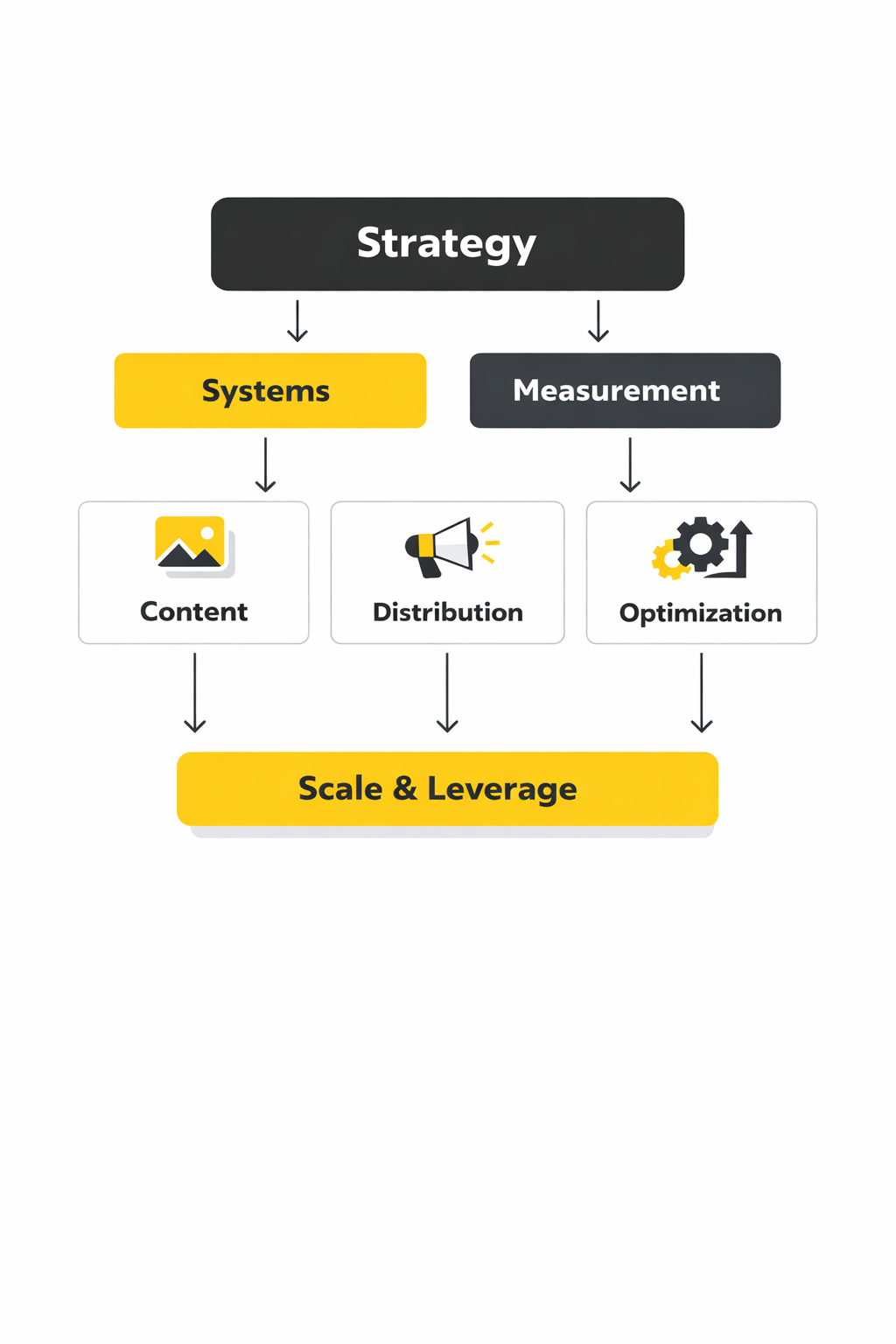
The fastest way to make a social media marketing business feel “professional” is to build an ecosystem where every part supports the next. Strategy sets direction, systems protect quality, and measurement turns chaos into decisions.
Start with outcomes: define what the client is really paying for (pipeline, purchases, retention, efficiency) and what “done” looks like.
Build a repeatable content map: proof, objections, offers, and trust signals—so the feed and the funnel tell the same story.
Ship with a cadence: weekly reviews, planned refresh cycles, and clean handoffs so the team isn’t living in reactive mode.
Scale with leverage: creators, modular offers, standardized briefs, and a creative pipeline that doesn’t depend on heroics (creator spend accelerating in 2025).
If you keep those pieces connected, your work stops feeling like “social media tasks” and starts feeling like a growth system clients can trust—especially as commerce and discovery move deeper into platforms (social commerce adoption at global scale).
FAQ – Built for the Complete Guide
What makes a social media marketing business different from “being good at social”?
Being good at social is a skill. A social media marketing business is a system: it has a repeatable way to onboard clients, ship content, run campaigns, measure outcomes, and explain decisions. Clients don’t pay extra for talent alone—they pay for reliability, speed, and proof.
Which results should I promise without overcommitting?
Promise process and accountability, not magic numbers. Commit to a cadence (what you’ll ship), a learning loop (what you’ll test), and a reporting rhythm (how decisions get made). When you need stronger proof for scaling decisions, use causal measurement approaches like lift studies (Meta conversion lift, TikTok conversion lift).
How many platforms should I focus on at the start?
Usually one primary platform and one secondary channel is enough. Start where your client’s buyers already spend attention, then build depth: consistent formats, a proof library, and a distribution plan. Spreading thin across five platforms often looks “busy” but produces weak learning.
Is organic reach still worth it, or is everything pay-to-play?
Organic is still worth it when it’s built for trust and repeatable formats. Organic also supports paid performance by improving profile credibility, creative iteration speed, and audience understanding. Paid amplifies what works; organic helps you find what’s worth amplifying.
What metrics matter most for clients who care about revenue?
Read the system in layers: attention (reach, watch time), intent (click quality, on-site behavior), and outcome (leads, purchases, pipeline). When stakeholders want a single number, anchor the conversation on the business outcome and use the supporting metrics only to explain what changed and what you’ll do next.
How do I explain platform attribution gaps without sounding defensive?
Frame measurement as a decision tool, not a truth machine. Explain that different systems observe different slices of the journey, then standardize your interpretation with a consistent hierarchy of KPIs. When the decision is big (like doubling spend), use experiments to reduce debate (incrementality measurement guidance).
Should I build a creator program even for small brands?
Yes, if you treat it as proof and distribution rather than celebrity sponsorship. A small creator bench can outperform expensive production by producing believable demonstrations and objection handling. The market signal is clear: creator investment continues to grow rapidly (IAB’s creator economy spend projections).
What’s the simplest weekly workflow that still feels premium?
One day for review and planning, one day for production, one day for approvals and scheduling, then daily light-touch community management and performance checks. Premium isn’t “more meetings.” Premium is clarity: fewer surprises, cleaner reporting, and faster iteration.
How do I price services when clients compare me to cheap “content packages”?
Price around outcomes and risk reduction. Packages can still work, but the difference is what they include: a measurement spine, a testing plan, and a reporting cadence that makes decisions easier. When clients only want volume, clarify that volume without learning is expensive noise.
What are the biggest mistakes that stop agencies from scaling?
The big ones are predictable: custom scopes for every client, inconsistent reporting, creative that isn’t connected to a test plan, and measurement that can’t defend decisions. Another common issue is treating creators as a side task instead of a system—especially as social commerce keeps accelerating (global social commerce adoption data).
How do I keep quality high when I’m managing multiple clients?
Standardize the parts that shouldn’t change: onboarding checklists, briefing templates, naming conventions, review criteria, and weekly reporting format. Then keep creativity where it belongs: messaging hypotheses, proof formats, and experimentation. Quality scales when the system carries the load.
Where is social going next, and how should I prepare?
Expect more in-platform shopping, stronger creator influence, and more pressure to prove incremental impact. DHL’s research shows how deeply buying behavior is already moving into social environments (DHL 2025 report (PDF)), while industry research shows creator spend continuing to climb (IAB creator economy overview). Prepare by building a creator workflow, a testing plan, and a measurement approach that supports confident decisions.
Work With Professionals
If you’re serious about building a social media marketing business, you already know the hardest part isn’t “knowing what to post.” It’s landing consistent work, avoiding the race-to-the-bottom marketplaces, and building a pipeline that doesn’t collapse the moment one client pauses.
That’s why focused marketplaces matter. Markework positions itself as a marketing-specific platform where you can build a profile, apply to roles, and connect directly—without commissions or per-project fees (Markework homepage, pricing details, why Markework exists).
Instead of fighting for attention in a noisy general marketplace, you can step into a space built around marketing roles and projects, with direct communication and clear listings. Markework’s active work hub shows the platform operating with a large, rotating inventory, including 1007 active listings visible on the browse page, with the full set available after signup.
Here’s what makes it feel different when you’re trying to grow:
If your goal is a steady stream of better-fit clients—and you want to keep more of what you earn—build a proof-first profile, package your offer around outcomes, and use a focused channel that doesn’t tax every project you close.





 Filip Konecny Enterprises