

A social media management proposal is one of those documents people think is “just admin” until it either wins the contract… or quietly loses it. The difference usually isn’t talent. It’s clarity.
Clients don’t hire “good posting.” They hire confidence: that you understand their business, you know what you’ll do next week, and you can prove it’s working. With more than 5.24 billion social media user identities worldwide, social has become default behavior, and that makes expectations brutal: speed, consistency, and results. Recent Kepios reporting reinforces the same reality—social is now an everyday layer of how people discover, compare, and decide.
Article Outline
- What Is a Social Media Management Proposal?
- Why a Social Media Management Proposal Matters
- Framework Overview
- Core Components
- Professional Implementation
- Part 2: Discovery That Makes Clients Say “Yes”
- Part 2: Scope, Deliverables, and Boundaries
- Part 3: Strategy, Creative Direction, and Content System
- Part 3: Editorial Calendar and Production Workflow
- Part 4: Pricing, Packages, and Terms
- Part 4: Compliance, Approvals, and Brand Safety
- Part 5: Measurement, Reporting, and Optimization
- Part 5: Proposal Template and Example Structure
- Part 6: FAQ
- Part 6: Wrap-Up and Next Step
What Is a Social Media Management Proposal?

A social media management proposal is a written plan that turns “we need help with social” into a clear decision. It explains what you’ll manage, how you’ll manage it, what success looks like, and what it will cost—without the client having to guess what they’re buying.
Think of it as the bridge between marketing ambition and execution reality. The client is picturing outcomes (more leads, stronger brand, better retention). Your proposal is where you translate that into a system: channels, content, cadence, workflows, approvals, measurement, and constraints.
A strong proposal also protects both sides. It makes scope visible (so expectations don’t expand silently), and it makes accountability fair (so you’re judged on what you can actually influence).
Why a Social Media Management Proposal Matters
In a crowded market, the proposal is often the product demo. Most prospects can’t accurately evaluate your skills in a short call, so they evaluate your thinking. If your proposal feels organized, specific, and measurable, you become the “safe choice.”
It also prevents the most common failure mode in social engagements: messy measurement. A lot of teams still struggle to connect channels into one coherent view—only 32% of marketers say they measure digital and traditional spend holistically, a gap Nielsen also highlights in its 2025 Annual Marketing Report materials and is echoed in industry commentary discussing the same finding. When measurement is unclear, clients fall back to vibes—and that’s where good work gets undervalued.
Finally, the proposal is where you establish how you’ll handle real-world pressure. Customers increasingly treat social like customer support. When 73% of consumers expect a response within 24 hours or sooner, and reporting also frames it as roughly three in four people willing to switch if a brand ignores them, your plan can’t be “we’ll post three times a week” and call it done. A proposal that addresses responsiveness, escalation, and responsibility instantly feels more senior.
Framework Overview
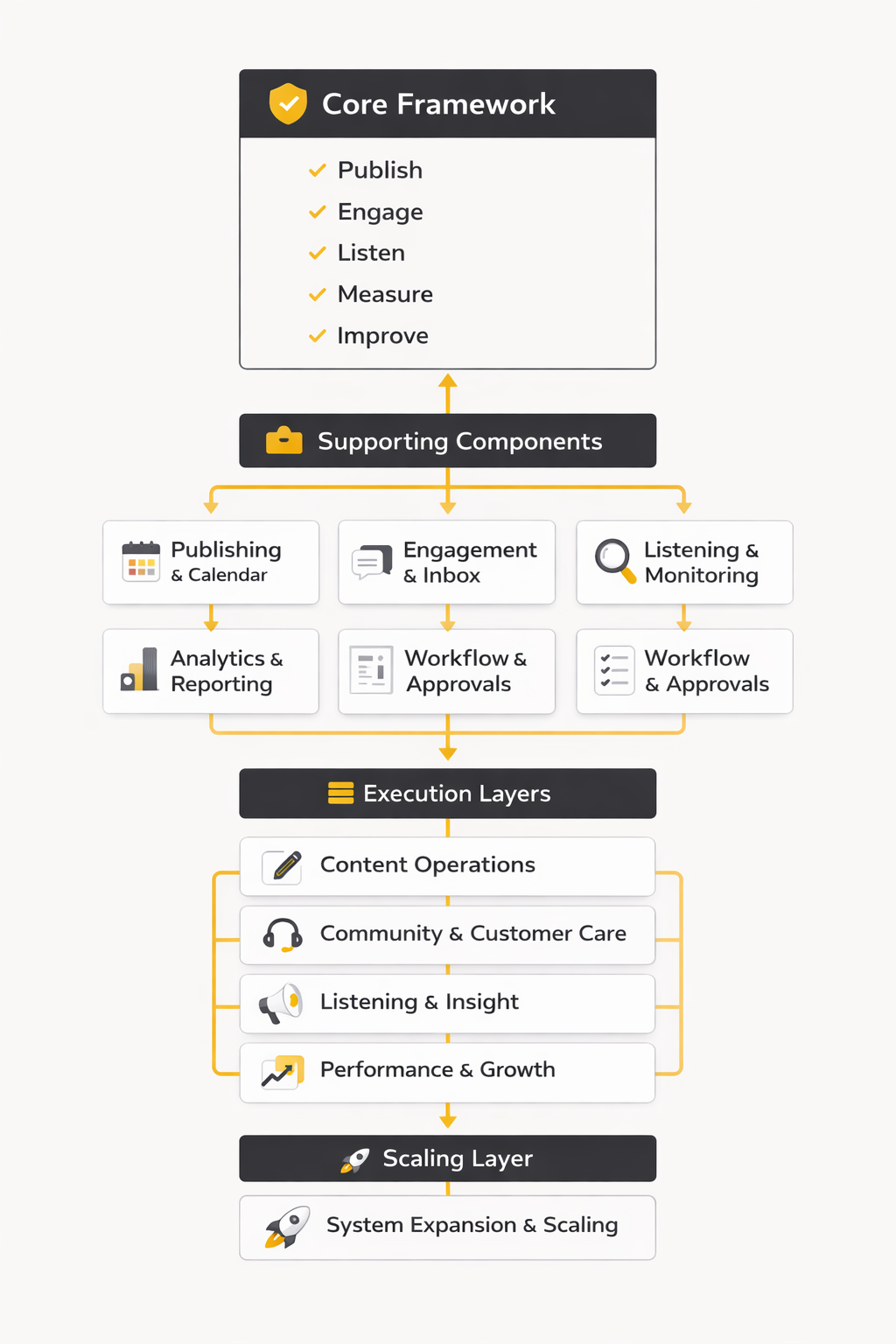
The easiest way to build a social media management proposal that wins is to follow a simple framework: align on outcomes, define the system, prove how you’ll measure progress, and make it easy to say yes.
Here’s the flow you’ll use throughout this guide:
- Context: What’s happening in the business, what’s working now, and what’s getting in the way.
- Goals: A small set of outcomes the client actually cares about (and will pay for).
- Strategy: The positioning, channel roles, and content pillars that connect to those goals.
- Execution: Deliverables, cadence, workflow, approvals, community management, and escalation.
- Measurement: KPIs, reporting rhythm, attribution expectations, and optimization loop.
- Terms: Pricing, timelines, responsibilities, and boundaries.
If you stick to this sequence, your proposal reads like a decision document, not a menu of tasks.
Core Components
Every effective social media management proposal has a few “non-negotiables.” You can change the style, the length, and the voice, but these components make the offer understandable and comparable.
Outcomes the Client Can Repeat Back
Clients should be able to summarize your proposal in one sentence without squinting: “This will help us grow qualified demand and reduce response chaos, and we’ll track it weekly.” If they can’t repeat it, they can’t champion it internally.
Scope That Prevents Scope Creep
Spell out what’s included (platforms, content formats, number of posts, community management windows, ad support if any) and what’s explicitly excluded (new brand identity work, full website rebuilds, 24/7 support). This is where you protect delivery quality.
A Workflow That Matches Reality
Most proposals fail in production, not strategy. You need a clean path from idea to asset to approval to publishing to reporting. If the client has slow approvals, your workflow should account for it instead of pretending it won’t happen.
Metrics That Don’t Depend on Hope
Pick KPIs that match the engagement type you’re driving. A top-of-funnel content engine should be judged differently than a retention-focused community program. Also, be honest about what requires other inputs (e.g., landing pages, sales follow-up, offer quality) so expectations stay fair.
Compliance and Platform Rules
If influencer or branded content is involved, you need the basics in writing. That includes disclosure standards like the FTC’s guidance on endorsements, influencers, and reviews and platform-specific rules like Meta’s branded content policies. If you operate in the EU, it also helps to show you understand ad transparency requirements shaped by the Digital Services Act.
Professional Implementation
A proposal can sound smart and still lose if it doesn’t feel deliverable. Professional implementation is where you prove that you can run the work like a system, not a scramble.
A 30/60/90-Day Plan Clients Can Visualize
Clients relax when they can see the first three months. A practical plan usually looks like: first 30 days to audit, align, and stand up the workflow; next 30 days to launch consistent publishing and community rhythms; next 30 days to optimize based on what the data is actually saying.
A Cadence for Decisions, Not Just Posts
Posting schedules matter, but decision schedules matter more. Your proposal should define when content gets planned, when it gets approved, when performance gets reviewed, and when strategy shifts are allowed. This prevents last-minute “can we just post something today?” panic.
An Optimization Loop That Clients Can Trust
Social media performance rarely improves because of one “big idea.” It improves because you test, learn, and iterate—creatives, hooks, formats, timing, audience segments, and offers. When your proposal describes that loop clearly, it signals maturity.
Proof You Understand the Market Direction
The strongest proposals don’t chase trends, but they acknowledge where budgets and expectations are moving. For example, social ad spend is projected to reach $306.4B in 2025, and brands are treating creators as a standalone channel as creator economy ad spend grew from $13.9B (2021) to $29.5B (2024). You don’t need to build your offer around those numbers—but referencing them in a grounded way shows you’re not operating in a bubble.
Step-by-Step Implementation
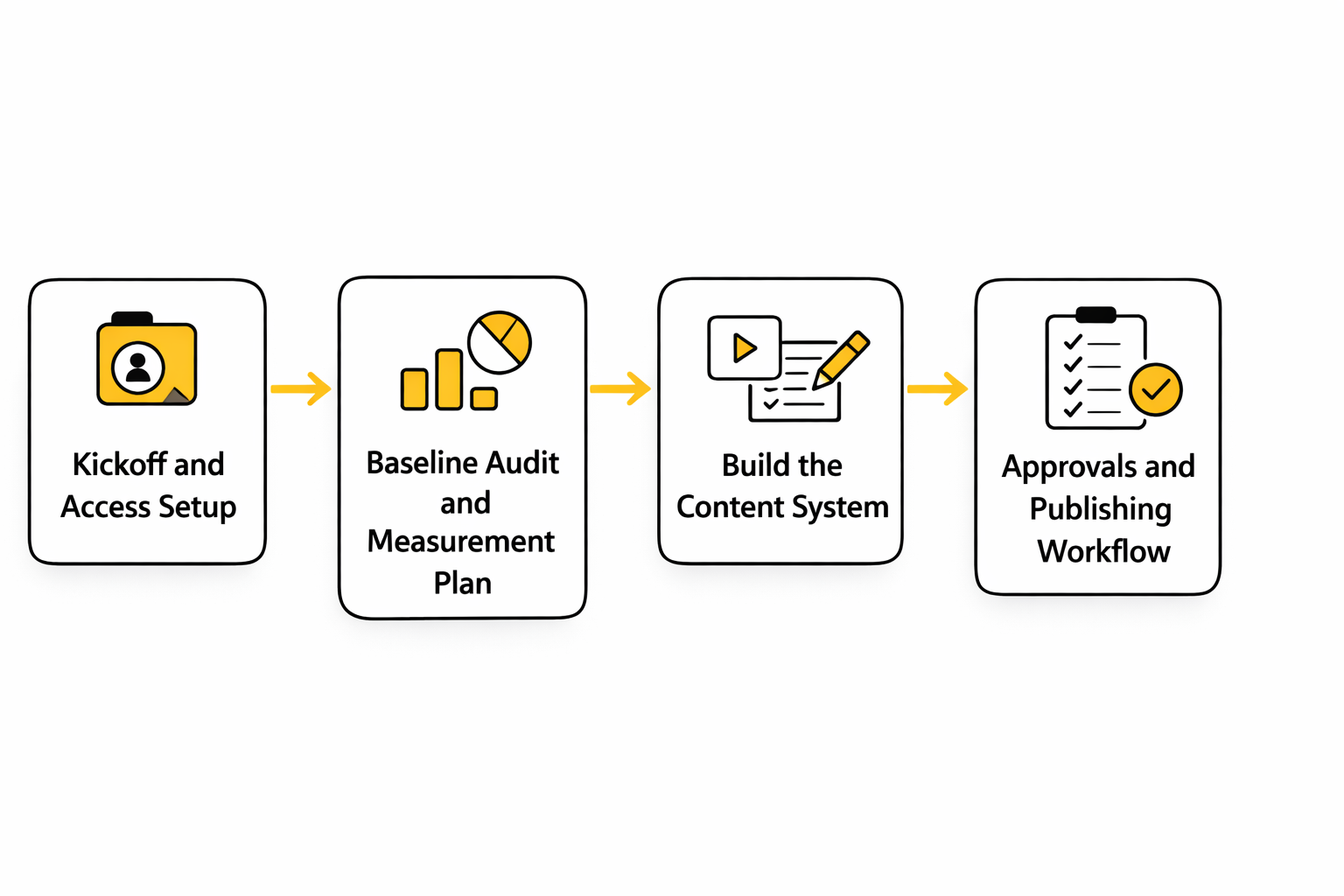
A social media management proposal becomes “believable” when it reads like a plan you can start on Monday. Implementation is where you turn strategy into a predictable operating rhythm: what happens first, who does what, how approvals work, and how you avoid the two classic failures—random posting and random reporting.
One reality check that helps clients commit is channel focus. Most audiences still concentrate on a few platforms, so you don’t need to “be everywhere” to be effective. Pew’s 2025 survey shows 84% of U.S. adults use YouTube, while the same study documents Facebook at 71%, and WARC’s write-up highlights how usage is fragmenting across networks. In a proposal, this supports a simple message: start with the channels where the audience already is, then expand when the system is stable.
Step 1: Kickoff and Access Setup
Begin with access, roles, and guardrails. If a client can’t grant admin permissions quickly, your timeline slips before your first post goes live. For Meta-heavy brands, it helps to define exactly how you’ll use the planner and scheduling workflow described in Meta’s best practices for the Business Suite planner and the official guide to scheduling Facebook and Instagram content.
In your proposal, list what you need (page access, ad account access if relevant, brand assets, password manager expectations) and what the client needs to provide (approvers, escalation contacts, customer-care owner if support is involved). This is also the moment to define response windows so “community management” doesn’t quietly become “24/7 support.”
Step 2: Baseline Audit and Measurement Plan
Before you optimize anything, you need a baseline that both sides trust. Capture the current state: posting cadence, top-performing formats, audience growth trend, inbound message volume, and any recurring themes in comments and DMs. The goal is not to shame the past—it’s to create a starting line.
Then define how you’ll report. If you’re using a unified tool, explain why: research-based guidance in a 2025 academic review on social media reporting for strategic decision-making emphasizes the value of consolidated data and cross-team alignment when teams manage marketing, PR, and customer service in the same environment.
Step 3: Build the Content System
This is where you turn “we need more content” into something sustainable. Define content pillars, format rules, and a repeatable production flow: idea intake, scripting, design, review, scheduling, and repurposing. If the client is video-heavy, it’s worth referencing the broader media shift Deloitte highlights in Digital Media Trends 2025, because it supports the logic of investing in formats audiences already treat as entertainment, not ads.
In your social media management proposal, this step should include a simple promise: every piece of content has a job. Some posts drive reach, some build trust, some move people to a next step, and some reduce support load by answering common questions.
Step 4: Approvals and Publishing Workflow
Most content doesn’t fail because it’s “bad.” It fails because it’s late, unapproved, or stuck in feedback loops. Your proposal should define an approval SLA (for example, “client feedback within 48 hours”) and a fallback rule if approvals stall (“approved-by-silence” is risky; a safer approach is a smaller pre-approved content bank).
For Meta-led stacks, reference the practical workflow reality of planning and scheduling in Business Suite so stakeholders understand what can be scheduled, how far ahead, and how the calendar stays visible.
Execution Layers
Execution works best when it’s layered. Layers prevent chaos because they separate the work that must happen daily from the work that should happen weekly and monthly. In a social media management proposal, layering also makes pricing easier to justify because each layer maps to a clear responsibility.
Layer 1: Content Operations
This layer covers planning, creation, scheduling, and publishing. It includes the calendar, the asset pipeline, and the “definition of done” for each format (caption, creative, links, tags, accessibility checks). It’s also where you set the cadence for batching work so the brand isn’t always scrambling.
Layer 2: Community and Customer Care
This is the human layer: replies, moderation, routing issues, and escalating problems fast. It’s also where the most reputational risk lives, so the process must be explicit. A practical reference point for describing this layer is Sprout’s breakdown of how social media customer service works, which helps you define response windows, triage rules, and when a conversation should move to private channels or a ticketing system.
Layer 3: Listening and Insight
Publishing tells you what you said. Listening tells you what the market is reacting to. This layer includes monitoring brand mentions, competitor moves, sentiment shifts, and recurring customer questions you can turn into content. It also protects the account because you see problems earlier, when they’re smaller and easier to resolve.
Layer 4: Performance and Growth
This layer is where you test, learn, and scale what works. It includes creative experimentation, audience segmentation (where relevant), and distribution decisions like when to boost a post versus keep it organic. The critical difference between amateurs and pros is that pros run experiments with clear hypotheses, not random “let’s try this.”
Optimization Process
Optimization is not a monthly report ritual. It’s a loop that runs continuously, with different depths at different cadences. Your social media management proposal should explain the loop in plain language so a non-marketer can follow it and trust it.
Weekly: Micro-Adjustments
Weekly optimization is about small steering decisions: which hooks are winning, which formats are stalling, and what topics are generating meaningful comments versus empty engagement. This is where you adjust timing, tighten captions, and refine creative patterns without changing the entire strategy.
If a client wants proof that you’re not guessing, anchor your approach in consolidated reporting discipline. The 2025 research review on strategic social reporting supports the idea that centralized insights help teams move faster because everyone is looking at the same reality.
Monthly: Narrative and Strategy Refinement
Monthly optimization is where you zoom out: are you building the right audience, are you earning attention in the right way, and are you contributing to business goals the client recognizes? This is also where you review recurring customer issues and decide what should become content, what should become product feedback, and what should become a support process change.
Quarterly: System Upgrades
Quarterly optimization is where you upgrade the system itself. You may add a new format, shift the content mix, introduce more structured listening, or expand into a new channel if the team can support it. Deloitte’s State of Social research is a useful reference here because it frames why social-first brands invest not just in content, but in community and conversion systems that can be sustained.
Implementation Stories
If you want your proposal to feel real, tell one real story about operational pressure—and how a structured implementation process changed outcomes. The point is not to name-drop tools. It’s to show what happens when a team moves from “posting” to a managed system.
How Uber Built a Faster, More Consistent Social Care System
The complaints weren’t the scary part. The scary part was the silence between them—messages arriving from everywhere, handled by different teams, with no consistent standard for what “good” looked like. When a customer’s problem becomes a screenshot, the brand doesn’t get to choose the stage; the audience does.
Uber’s scale makes this pressure constant. The company operates across markets, languages, and time zones, and social messages don’t arrive politely in one queue. They arrive as public posts, replies, DMs, and mentions—and the expectation is that someone competent is listening.
The wall came in the form of inconsistency. Some customers got fast help, others waited too long, and teams had to switch between systems to find context. Even when agents worked hard, the experience could feel random from the customer’s perspective.
The shift started when the problem was reframed as an operating model issue, not an agent effort issue. Uber’s Sprinklr story describes how the company used a unified service environment to support social teams globally and improve response standards, including reducing first response time and saving agent hours over time, which is outlined in Sprinklr’s customer story on Uber.
The journey wasn’t a single launch. It meant standardizing workflows, defining routing rules, and creating shared visibility so teams could see what was happening across markets. It also meant building a clearer playbook for what belongs in public, what belongs in private, and what needs escalation.
Then a new conflict appeared: speed can collide with accuracy. When you respond quickly at scale, mistakes can spread quickly too, especially if agents don’t have consistent guidance. The fix was governance—templates, guardrails, and training—without turning responses into robotic scripts.
The dream outcome was not “perfect sentiment.” It was reliability. Customers experienced more consistent support, and internal teams gained clearer accountability and fewer duplicated efforts. That’s the real promise you’re making when your social media management proposal includes implementation detail: the work becomes dependable, not heroic.
Document the Rules of the Road
Include a lightweight playbook: voice principles, response rules, escalation paths, and what topics require approval. If your engagement touches customer care, point to practical guidance like Sprout’s overview of customer service on social so stakeholders understand that speed and consistency are part of the service, not an afterthought.
Set a Cadence for Work and Decisions
Define weekly planning, midweek check-ins, and monthly performance reviews. A cadence protects both sides: you’re not improvising, and the client isn’t surprised. If the stack is Meta-centric, reference the calendar reality of using the planner in Meta Business Suite to show how content stays visible and scheduled ahead of time.
Build Quality Control Into the Process
Quality control doesn’t mean perfection. It means fewer preventable mistakes: wrong links, wrong tags, missing captions, inconsistent formatting, and off-brand replies. Make quality a checklist inside your workflow so the system improves as you go.
Scale Only After the System Holds
Expansion is tempting—new platforms, more formats, more volume. But the right move is to stabilize first, then scale. Pew’s 2025 platform usage data reinforces that audiences concentrate heavily on a few major platforms, as shown in its core findings and the supporting fact sheet, so professional implementation often means doing fewer channels better before doing more channels worse.
Statistics and Data
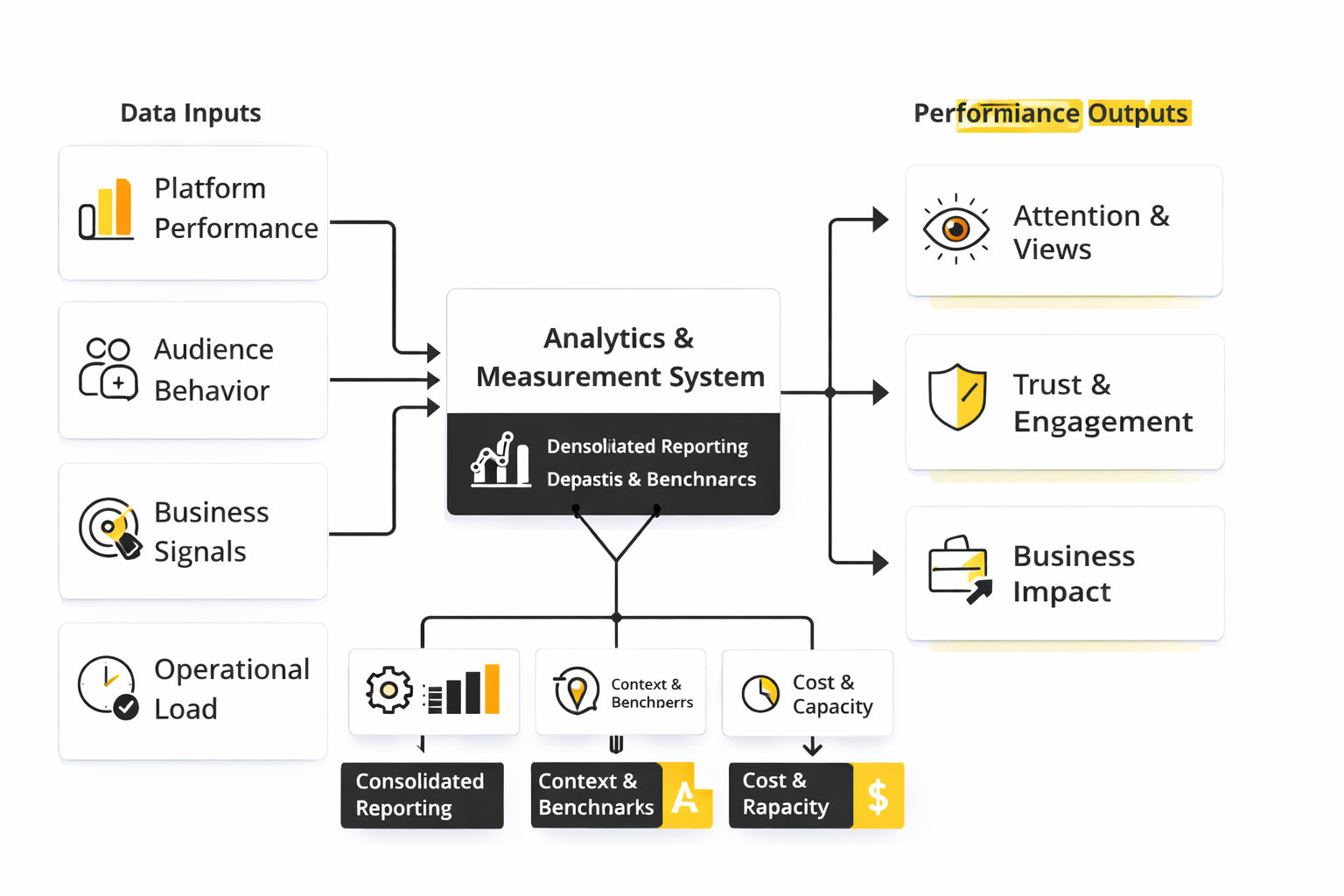
The fastest way to make a social media management proposal feel credible is to show that you treat social like an operating system, not a guessing game. That starts with data you can explain without hiding behind a dashboard. A client doesn’t need every metric. They need the right handful, tied to decisions you’ll actually make.
A practical proposal pulls data from four places: platform performance (what happened), audience behavior (why it happened), business signals (what it influenced), and operational load (what it cost in time and attention). When those four are visible, stakeholders stop debating whether social “works” and start debating which lever to pull next.
Even platform-level market signals can help set expectations in a grounded way. Meta’s own reporting shows how quickly the environment changes: ad impressions across Meta’s apps rose 18% year over year in Q4 2025, while average price per ad rose 6% in the same quarter, a pattern also summarized in industry analysis of Meta’s results. That matters because it frames the reality clients feel: competition is rising, and measurement needs to be sharper to prove value.
For context beyond one platform, ad market forecasts help explain why clients are demanding clearer reporting. WPP Media’s latest forecast projects global advertising revenue rising to $1.14 trillion in 2025, a figure widely covered across the industry, including a breakdown of what’s driving the growth and Reuters coverage of the same forecast. In a proposal, this isn’t trivia. It’s the reason stakeholders expect social to be accountable, not just active.
And when you’re proposing a short-form strategy, it helps to anchor how massive the attention pool really is. YouTube’s CEO shared that Shorts are averaging over 200 billion daily views, reported again in coverage of his Cannes Lions remarks and summarized by industry trade reporting. In practice, that supports a simple decision in your social media management proposal: if the audience is spending attention in short-form feeds, your content system needs a short-form lane that can be produced consistently.
Performance Benchmarks
Benchmarks only matter when they prevent bad decisions. They’re not there to flex numbers. They’re there to answer: are we underperforming because the strategy is wrong, because the creative is wrong, or because we’re judging the work with the wrong yardstick?
The cleanest way to handle benchmarks in a social media management proposal is to keep them directional and paired with what you’ll do if you’re above or below the range. If a metric doesn’t change your next move, it doesn’t belong in the proposal.
Reach Engagement Benchmarks by Format
Short-form video is a good example of where a benchmark can protect a client from overreacting. Emplifi’s 2025 benchmark report, built from activity across 200,000+ brand accounts in 2023 and 2024, highlights that Reels continued to outperform TikTok on average reach engagement rate in the dataset, with the comparison also reinforced in Emplifi’s related benchmark guidance and discussed in its format-performance announcement. The point isn’t “Reels is better.” The point is that you can set realistic expectations for what “healthy” looks like, then focus on creative execution instead of blaming the platform every time a post underperforms.
Competition Benchmarks You Can Borrow from Ad Markets
Even if the engagement is primarily organic, clients often feel pressure because the broader attention market is tightening. When Meta reports simultaneous growth in ad impressions and ad pricing, also covered in industry commentary, it signals that more inventory is being served and advertisers are still bidding up attention. In a proposal, that justifies a more disciplined content system and sharper reporting cadence, because “posting more” is rarely enough on its own.
Analytics Interpretation
Most analytics problems aren’t math problems. They’re interpretation problems. A client sees reach drop and assumes the strategy failed. A social lead sees reach drop and asks whether the mix shifted, whether distribution changed, whether the hook weakened, or whether the audience is simply saturated.
A social media management proposal should teach the client how you’ll read the numbers, because that becomes the foundation for trust. The best way to do it is to define a few “translation rules” that connect metrics to action.
Rule 1: Separate Attention from Value
Views and reach tell you what people noticed. They don’t tell you what they decided. This is where you map the funnel honestly: top-of-feed content earns attention, but value content earns trust, and the conversion moment often happens elsewhere. Using attention metrics to judge conversion work is one of the quickest ways to kill a good program.
Rule 2: Track Operational Load Like a KPI
If social is acting as customer support, you need to track it like customer support. Message volume, response time, and escalation count are not “nice extras.” They’re the cost of running the channel, and they shape how fast you can publish, how fast you can respond, and what resourcing the client actually needs.
Rule 3: Use Context Signals to Explain Volatility
When audiences shift their time into short-form feeds at massive scale, performance patterns will shift too. The Shorts milestone is useful here because it reminds stakeholders that the behavior is not small or niche: Shorts averaging over 200 billion daily views changes what “normal” looks like for attention dynamics, a figure echoed in press coverage and industry reporting. In your proposal, you can use that to set expectations: short-form wins on velocity and hooks, while longer-form and community posts often win on depth and intent.
Rule 4: Reporting Exists to Make Fewer, Better Decisions
Clients don’t need a report that proves you were busy. They need a report that makes next week smarter. In a proposal, define three recurring questions your reporting will always answer: what’s working and why, what’s not working and why, and what you’re changing next.
Case Stories
A convincing social media management proposal doesn’t just promise results. It shows you understand how messy the real world gets when performance becomes a boardroom topic. The story below is grounded in public reporting and reputable coverage, and it focuses on the thing clients actually fear: when social performance becomes tied to business expectations and the market reacts.
Duolingo’s Pivot: When Growth Became the Only Metric That Mattered
The stock dropped hard in after-hours trading, and suddenly every product choice looked like a referendum. Analysts and headlines focused on one message: Duolingo’s outlook had spooked the market. Internally, the pressure wasn’t just about revenue—it was about whether the engine that fuels the brand’s momentum was slowing down.
Duolingo didn’t become a culture brand by accident. Its social team built a reputation for turning the comment section into a creative brief, a mindset described in industry coverage of its social-first approach, and researchers have explored how the brand leans into TikTok-native entertainment rather than traditional promotion in academic analysis of its TikTok presence. Over time, that approach made the brand feel alive, not managed.
Then the wall showed up: user growth slowed, and the company acknowledged that heavier monetization could have created friction for users. When that happens, social can’t save the business with a few viral posts, because the product experience becomes part of the story people share. The market reaction made it clear that leadership needed to protect the long-term growth curve, even if it hurt short-term numbers.
The epiphany was a strategic reset: prioritize user growth over monetization in the near term. Reuters described Duolingo’s shift toward faster user growth and the decision to broaden access to AI-driven features like “Video Call with Lily,” even as bookings guidance lagged estimates, in reporting on the company’s 2026 outlook. The story wasn’t “we’ll market harder.” It was “we’ll remove friction and earn growth back.”
The journey that followed required a different way of running social and measurement. When a company shifts toward growth, social becomes both acquisition and retention fuel, which means you track signals that reflect habit: repeat engagement, community participation, and audience-driven content loops. That logic also appeared in broader coverage of the pivot, including commentary around the goal to reach 100 million daily active users by 2028 in financial analysis of the strategy change.
But the final conflict was unavoidable: markets don’t always reward long-term moves in the short term. A growth-first strategy can look like a step backward if the dashboard is dominated by near-term bookings, and public reaction can create a second wave of pressure on the team. That’s the moment where many brands start chasing vanity wins, because it’s easier to show activity than to defend a strategic tradeoff.
The dream outcome, if the strategy works, is simple and powerful: user momentum returns, and the brand’s social engine amplifies a product experience people actually want to share again. The public target and its implications have been discussed openly in mainstream business coverage, including Reuters reporting on the pivot and industry reporting on how the brand builds social relevance. In a proposal, the lesson is clear: analytics are only useful when they reflect the real strategic priority, not when they impress someone in a meeting.
Professional Promotion
This section is about promoting your work professionally inside the proposal, not hyping yourself. The client wants to feel safe choosing you, and analytics is one of the strongest trust builders you have—if you present it with restraint and clarity.
Show the Dashboard, Then Explain the Decisions
Include a one-page “example report” view in your proposal: top KPIs, top content, inbound volume summary, and next actions. The point isn’t the chart design. It’s showing that your reporting is built to answer decisions, not decorate a PDF.
Use a KPI Ladder Instead of a KPI List
A KPI ladder is a simple hierarchy: attention metrics at the top, trust metrics in the middle, business signals at the bottom. It helps clients understand why reach and views matter without letting those numbers hijack the conversation. If a stakeholder pushes for “more impressions,” you can point to the reality of competition and pricing pressure reflected in Meta’s reporting on impression growth and pricing changes, reinforced by industry analysis, and then steer them back to outcomes.
Position Benchmarks as Guardrails, Not Grades
Benchmarks should protect the relationship. They help you and the client avoid panic when a post underperforms or when a format behaves differently across platforms. When you reference external benchmarks, tie them to a plan, like how Emplifi’s dataset on reach engagement rates across formats in its 2025 report informs which formats you prioritize first, reinforced by its implementation guidance and supported by its format performance notes.
Anchor the Proposal in Market Reality Without Turning It Into a Research Paper
A proposal doesn’t need fifty stats, but it benefits from a few that reset expectations. Global ad revenue projections reaching $1.14 trillion in 2025, covered across the industry in places like marketing trade reporting and Reuters coverage, provides the subtext clients already feel: budgets are large, scrutiny is high, and your social media management proposal must show how you’ll prove impact with discipline.
Advanced Strategies
Once the basics are stable, a social media management proposal can shift from “we’ll keep you consistent” to “we’ll help you compound results.” Advanced strategy isn’t about chasing every new feature. It’s about building unfair advantages: faster feedback loops, better creative pattern recognition, stronger distribution partnerships, and a tighter connection between social signals and business decisions.
The first upgrade is treating creative like a product, not a one-off. TikTok’s marketing science team frames creative as a system that evolves with culture in its What’s Next 2025 trend report, and it pairs well with TikTok’s own research on creative effectiveness that emphasizes first impressions and early branding as levers you can test deliberately. That’s exactly the type of language clients trust when you propose an experimentation roadmap.
The second upgrade is building “many voices” distribution, not just “one brand” distribution. Large advertisers are moving in that direction at scale. Unilever has spoken publicly about shifting social investment from 30% to 50% and dramatically increasing influencer volume, with leadership describing a “machine of content creation” built around creators and velocity in a Q1 2025 trading statement webcast transcript, reinforced by coverage in the Financial Times and business press like Fortune. In a proposal, the lesson isn’t “copy Unilever.” It’s “scale voice, not just posting volume.”
The third upgrade is upgrading measurement maturity. Many teams still struggle to prove impact even when social is gaining budget attention. Sprout’s 2025 Impact of Social Media Marketing report is useful here because it focuses on the gap between activity and proof, and what leaders do differently when they can defend social ROI in executive conversations.
Scaling Framework
Scaling should feel safe. That means you scale the system in the same order you built it: operations first, then distribution, then optimization. The simplest way to explain it in a social media management proposal is a three-phase framework that a client can picture instantly.
Phase 1: Stabilize the Operating System
This is where you make the work predictable: a calendar that stays filled, approvals that don’t bottleneck everything, and response coverage that doesn’t collapse when someone takes a day off. If you can’t deliver consistently, you can’t scale without breaking trust.
Budget pressure is another reason to start here. Marketing budgets staying flat forces sharper allocation, and Gartner’s 2025 survey highlights that marketing budgets remain around 7.7% of company revenue. When budgets are tight, operational efficiency becomes part of the outcome, not just a behind-the-scenes detail.
Phase 2: Multiply Distribution Without Losing Control
Once operations are stable, you scale reach by multiplying distribution sources: creators, employees, partners, and communities. This is where brand voice becomes a network effect instead of a single account doing all the work.
The creator economy is no longer a niche bet. IAB projects U.S. creator ad spend reaching $37 billion in 2025, and the same figure is summarized in IAB’s public report page and covered by mainstream business media like Business Insider. In a proposal, that supports a clean scaling choice: creator partnerships are not “extra,” they’re part of modern distribution strategy.
Phase 3: Optimize and Compound
This is where you stop thinking post-by-post and start thinking in patterns. You identify repeatable creative structures, repeatable topics, repeatable hooks, and repeatable community prompts, then you turn them into a production and testing machine.
Hootsuite’s research points to a market-wide shift toward faster creative cycles and rapid experimentation, which shows up clearly in its Social Trends 2025 report and the broader direction described in its social trends hub. This is the strategic argument for building an experimentation lane into your ongoing scope, not treating testing as a once-a-quarter activity.
Growth Optimization
Growth optimization is the difference between “we post and report” and “we improve every month.” The proposal should make your growth logic explicit, because clients don’t just buy output—they buy your ability to learn faster than their competitors.
Creative Pattern Analytics
Instead of only reviewing top posts, review top patterns: opening hooks, on-screen pacing, caption structures, recurring visual motifs, and the emotional tone of comments. TikTok’s marketing science framing in its creative effectiveness research makes this approach easy to justify because it treats creative impact as a measurable input, not a mysterious art.
Velocity Without Sloppiness
Speed helps, but only if the system protects quality. This is where you propose a “fast lane” for time-sensitive posts and a “core lane” for planned content. Hootsuite’s reporting on faster creative cycles in Social Trends 2025 supports the idea that rapid response is becoming a competitive advantage, but your proposal should also include the guardrails that keep fast content on-brand.
Distribution Partnerships That Scale Trust
Creators scale trust because audiences already have a relationship with them. The trick is to structure partnerships in a way that stays measurable and repeatable. Unilever’s public shift toward creator volume and social-first velocity, described in a Q1 2025 trading statement transcript and covered by the Financial Times, is a real-world example of what “distribution at scale” looks like when a global company decides social can’t be a side channel anymore.
Benchmarking That Leads to Action
Benchmarks are useful when they prevent the wrong conclusions. Emplifi’s benchmark dataset, based on activity across 200,000+ brand accounts in 2023 and 2024, is best used as a directional guardrail: if a format is underperforming relative to broader patterns, you diagnose whether it’s a creative issue, a cadence issue, or a distribution issue, then you run a focused test instead of changing everything at once.
Scaling Stories
A social media management proposal gets taken seriously when it shows you understand the tradeoffs that come with scaling. The story below is grounded in public executive statements and reputable coverage, and it focuses on how scaling changes the work, not just the content.
Unilever’s Social-First Pivot: Scaling Creator Volume Without Losing the Brand
The pressure hit in public: growth expectations, investor scrutiny, and a media environment where attention is more fragmented than ever. When a company of Unilever’s size signals a major change, every stakeholder has an opinion, and every internal team feels the shift immediately. The most uncomfortable part is that you can’t scale quietly—you scale in full view of competitors and consumers.
The backstory is a slow erosion of trust in traditional brand messaging and a growing reliance on social platforms as the real discovery layer. Leadership acknowledged the need to have “others speak for your brand at scale,” and the plan to move social investment from 30% to 50% has been reported across major outlets, including the Financial Times and trade press like PRWeek. Internally, that kind of shift is not just a budget move—it’s an operating model change.
The wall showed up in the form of scale itself. “Work with 20 times more influencers” sounds exciting until you imagine the coordination, approvals, payments, usage rights, and brand safety risks that come with it. Unilever’s leadership described building what it called a “4V model” of social—variety, volume, virality, and velocity—in a Q1 2025 trading statement transcript, and that’s basically a blueprint for a content machine that can overwhelm teams if the process isn’t built first.
The epiphany was recognizing that scaling content requires scaling infrastructure. Instead of treating creators as occasional add-ons, the strategy became creator-first: more collaborations, more output, and more speed as a deliberate growth lever, summarized in business coverage like Fortune’s reporting on the CEO’s plan and industry analysis like eMarketer’s summary of the strategy. The mindset shift was simple: social couldn’t be “campaign support” anymore; it had to be “campaign engine.”
The journey was about turning that mindset into a repeatable system. That means standardizing briefs, setting brand guardrails that creators can actually follow, and building a workflow that supports a huge volume of assets without slowing everything down. It also means building measurement that can handle many-to-many distribution, which is why creator spend projections like IAB’s $37B creator ad spend forecast for 2025 matter in a proposal: they signal that this complexity is becoming normal, not rare.
Then the final conflict arrived: scale creates inequality and volatility in creator markets, and it can distort what “good” looks like. Creator economy reporting shows how concentrated earnings can become, with CreatorIQ findings on the top 10% receiving a majority of ad payments discussed in recent coverage of creator income inequality. For a brand, that means a strategy that relies only on top-tier creators can become expensive and brittle, while a strategy that relies only on small creators can become noisy and inconsistent.
The dream outcome is a scalable content engine that feels human and trustworthy, not manufactured. When a brand can sustain high volume without becoming generic, it earns both reach and relevance, and it stops being dependent on a single “hero campaign” moment. That’s what a strong social media management proposal is really selling at the scaling stage: a system that grows without breaking.
Position Scaling as Risk Management
Scaling isn’t just upside. It’s also brand safety, operational load, and measurement complexity. When you frame scaling as controlled expansion, you signal maturity. That’s especially persuasive when clients know budgets are pressured and performance has to be proven, reflected in Gartner’s 2025 finding that marketing budgets remain about 7.7% of revenue.
A Proposal Template That Makes Scaling Easy to Approve
When you pitch scaling, give the client a structure they can approve in phases. A clean template section looks like this: what stays the same (core operations), what expands (distribution lanes like creators or employee advocacy), what new risks appear (brand safety and approvals), and what measurement upgrades you’ll introduce (creative pattern analysis and outcome reporting).
Use one or two hard anchors to make the case feel grounded. For creator-led scaling, the market trajectory is easy to justify with IAB’s projection of $37B in U.S. creator ad spend in 2025. For creative velocity, support your approach with the shift toward rapid experimentation described in Hootsuite’s Social Trends 2025 and the creative testing mindset reflected in TikTok’s creative effectiveness research.
Make the Upgrade Path Feel Like Momentum
Clients hesitate when scaling sounds like “more work, more money.” They commit when scaling sounds like momentum: fewer bottlenecks, faster learning, and clearer proof. This is where you connect the dots between better systems and better outcomes, using the ROI-proof gap highlighted in Sprout’s 2025 Impact of Social Media Marketing report as the reason your scaling plan includes measurement upgrades, not just more output.
Close With a Clear “Next 30 Days” Scaling Sprint
End the section by making scaling feel actionable. Define a 30-day sprint with deliverables that matter: a creator partnership pilot, a creative testing roadmap, and an upgraded reporting format that answers executive questions. When the client can picture the first month, the rest of the scaling plan feels less like a leap and more like a logical next step.
Future Trends
The next wave of winning a social media management proposal won’t be about who can “post more.” It’ll be about who can operate inside a noisier, more regulated, more automated attention economy without losing trust. The winners will look less like content schedulers and more like systems designers.
Trust signals will become a competitive advantage. AI-generated media is flooding feeds, and platforms are trying to respond with provenance and labeling standards like C2PA’s Content Credentials specification. The friction is real: even when labels exist, metadata can get stripped or ignored, which is why debates around “AI slop” and authenticity are accelerating in coverage like reporting on inconsistent implementation across platforms. In practice, your proposal needs a policy: when you use AI, what gets disclosed, and how you protect brand voice.
Regulation is moving from theory to enforcement. For teams operating in the EU, the Digital Services Act is no longer something “legal handles later.” It directly shapes transparency, content moderation reporting, and platform accountability, outlined in the EU’s official overview of the Digital Services Act and illustrated by recent enforcement updates like the Commission’s DSA developments summary. A modern proposal should include compliance-friendly workflows, especially for branded content and creator campaigns.
Social discovery will keep stealing “search” moments. People increasingly use feeds to discover products, creators, and services, which is exactly why social content has to answer questions, not just entertain. If you want a simple proof point to justify investing in searchable content, LinkedIn’s live job search pages routinely show 11,000+ remote marketing manager roles, which is a practical reminder that demand is moving fast and brands need always-on visibility, not only campaigns.
Creators will become an operating model, not a tactic. The creator economy is turning into a core distribution layer, with IAB projecting U.S. creator ad spend reaching $37B in 2025. That shift changes what clients should expect from you: not “find one influencer,” but build a repeatable creator pipeline with rights, disclosures, and measurement baked in from day one.
Strategic Framework Recap
If you want your social media management proposal to consistently win, the framework stays simple: align on outcomes, define the operating system, execute with layered responsibility, and prove impact through decisions—not dashboards.
- Outcomes: Clear goals the client can repeat back and defend internally.
- System: A workflow that makes planning, approvals, publishing, and community coverage predictable.
- Execution layers: Content operations, community and care, listening and insight, performance and growth.
- Optimization loop: Weekly steering, monthly narrative refinement, quarterly system upgrades.
- Governance: Compliance, disclosure, permissions, escalation, and response windows defined upfront.
This is the difference between “we’ll manage your socials” and “we’ll run a social program you can trust.” And as trust becomes harder to earn—because of AI content, regulation, and feed volatility—clients will increasingly choose the provider who has the clearest system.
FAQ – Built for This Complete Guide
1) What should a social media management proposal include?
A strong social media management proposal includes: business context, goals, channel roles, deliverables, workflow and approvals, community management scope, measurement plan, timeline, responsibilities, and terms. If it doesn’t clearly say what happens each week and how success is measured, it’s too easy for expectations to drift.
2) How long should a social media management proposal be?
Long enough to remove uncertainty, short enough to stay readable. Many winning proposals land in the 3–8 page range when turned into a document, but length matters less than clarity. If the client can’t summarize what they’re buying in one sentence, it needs tightening.
3) What KPIs should I promise in a proposal?
Promise process and improvement, not guaranteed outcomes you don’t fully control. Use a KPI ladder: attention (reach, views), trust (saves, meaningful comments, shares), and business signals (qualified clicks, leads, retention indicators). Tie each KPI to a decision you’ll make, so reporting stays practical.
4) Should I include benchmarks in the proposal?
Yes, but as guardrails, not grades. Benchmarks help avoid panic when formats behave differently across platforms. Use reputable benchmark sources and explain how you’ll respond if performance is above or below the expected range.
5) Should I list the tools I’ll use?
Yes, but only as part of a workflow. Clients care less about the tool name and more about what it prevents: missed approvals, lost messages, inconsistent scheduling, and unclear reporting. Present tools by role (publishing, inbox, listening, reporting), not as a random stack.
6) How do I define community management without promising 24/7?
Define coverage hours, response targets, escalation rules, and what counts as “support.” If the client needs near-real-time care, propose it as a separate workstream with explicit resourcing. This keeps the relationship fair and prevents burnout.
7) Can I use AI in social content production?
Yes, but your proposal should include guardrails so AI speeds you up without flattening the brand voice. It also helps to show you understand where trust is heading by referencing provenance standards like C2PA Content Credentials and acknowledging that platform implementation is still uneven, as explored in recent reporting on authenticity labels.
8) What compliance points should I include for influencers and branded content?
At minimum: disclosure rules, approval requirements, and usage rights. For U.S.-facing campaigns, it’s smart to align your process with the FTC’s guidance on endorsements, influencers, and reviews. If you operate in the EU, a general awareness of transparency expectations shaped by the Digital Services Act helps the proposal feel professional and current.
9) How should I price social media management?
Price based on layers and workload: content volume and formats, community coverage, listening depth, reporting cadence, and production complexity (especially video). Packaging works when each tier changes something meaningful (like response coverage or creative throughput), not just “more posts.”
10) Why do clients reject proposals even when they like the call?
Usually: unclear scope, unclear measurement, unclear timeline, or unclear ownership. If internal stakeholders can’t see how you’ll run the work without constant supervision, they hesitate. A proposal wins when it reduces perceived risk.
11) How soon should a client expect results?
Most clients will feel operational improvements quickly (cleaner calendar, fewer missed messages), while performance improvements typically emerge after consistent publishing and iteration. Set expectations in phases: stabilization, growth testing, and compounding optimization.
12) What are red flags I should watch for before signing?
Missing decision-makers, slow or unclear approvals, no defined goals, and “we want to go viral” as the primary strategy. If they can’t commit to basic inputs (access, approvals, feedback cadence), performance will be harder to sustain no matter how strong your work is.
Work With Professionals
If you’re reading this because you’re tired of pitching into the void, you’re not alone. The market is full of opportunities, but most freelancers lose time to the same two problems: finding the right clients and getting stuck in platforms that take a cut or slow down the conversation.
That’s why a clean system matters—not just for your clients, but for you. When you can show a confident social media management proposal and pair it with a simple way to connect and close, your pipeline starts to feel less like luck and more like momentum.
Remote demand is real. At any given moment, job marketplaces show massive volume for marketing work—LinkedIn’s live search pages regularly display 11,000+ remote marketing manager roles. Not all of those will be your perfect fit, but the signal is unmistakable: companies are hiring remotely, and they need marketers who can execute fast and prove impact.
What you want is a place where the deal stays yours. Markework positions itself as a marketing marketplace where you can post listings or build a profile and connect directly, with no middleman and no project fees. It also highlights no commissions, which is the kind of detail that matters when you’re trying to build a sustainable freelance income without watching margins disappear.
Picture this: instead of spending your best hours chasing leads, you spend them refining one irresistible offer, polishing one proposal template, and having direct conversations with companies that are already looking for your skill set. You move faster because the path is simpler. You feel calmer because you’re not negotiating through layers.
If you want a straightforward way to find work, talk directly, and keep the value of what you earn, start here:
 Filip Konecny Enterprises