

Posting more doesn’t automatically mean growing faster. In most teams, the real problem isn’t effort—it’s that content decisions happen in the moment, driven by last-minute ideas, shifting trends, and whatever the algorithm seems to reward this week.
A strong social media content strategy fixes that by giving you a repeatable way to decide what to publish, why it matters, and how it will be measured—without turning your calendar into a rigid checklist. When the average person still spends over two hours a day on social platforms, the opportunity is huge, but attention is expensive and easy to waste if your content has no system behind it. DataReportal’s Digital 2025 analysis of daily social media time
Article Outline
- What Is a Social Media Content Strategy
- Why a Social Media Content Strategy Matters
- Framework Overview
- Core Components
- Professional Implementation
- Audience and Positioning
- Goals, Metrics, and KPIs
- Content Pillars and Formats
- Editorial System and Workflows
- Distribution and Promotion
- Community and Customer Care
- Analytics and Iteration
- Building a Content Ecosystem
- Templates and Examples
- FAQ
What Is a Social Media Content Strategy

A social media content strategy is the decision-making system behind everything you publish: who you’re for, what outcomes you’re targeting, what content you’ll consistently create, how you’ll distribute it, and how you’ll improve it over time.
Think of it as a bridge between brand goals and daily posts. Without a strategy, content is reactive—teams chase formats, imitate competitors, and celebrate vanity spikes that don’t translate into pipeline, customers, or long-term trust. With a strategy, content becomes intentional: each post plays a role in a bigger plan, and you can explain why it exists.
It also respects the reality of modern social: platforms change constantly, reach is uneven, and audiences are quick to scroll past anything that feels generic. Strategy doesn’t make you rigid—it gives you a consistent structure so you can adapt without starting from zero every time.
Why a Social Media Content Strategy Matters
Most brands are competing in feeds where attention is fragmented, trust is hard-earned, and the “cost” of inconsistency shows up fast: uneven performance, unclear priorities, creator burnout, and content that looks busy but doesn’t build momentum.
A clear social media content strategy matters because it aligns three things that are often disconnected: audience expectations, business outcomes, and the real capacity of your team. For example, when customer care is treated as part of the content system—not a separate “support” task—brands can meet expectations that directly influence loyalty. The 2025 Sprout Social Index data summarized in Sprout’s customer care guidance shows that 73% of consumers expect a response within 24 hours or sooner. Sprout Social’s breakdown of response-time expectations (2025 Index)
Strategy also protects you from measuring the wrong wins. A post that gets a burst of likes can feel successful, but if it doesn’t reinforce positioning, drive qualified actions, or strengthen retention, it’s entertainment—not marketing. Benchmarks help here, not as targets to copy, but as guardrails to spot when something is off. Emplifi’s 2025 report, for instance, highlights how engagement rates and format performance shift year to year, which is exactly why a system matters more than a single tactic. Emplifi Social Media Benchmarks Report 2025 (PDF)
Finally, a strategy gives you leverage. Instead of reinventing every post, you build reusable pillars, repeatable workflows, and an analytics loop that turns performance into better decisions—so growth becomes less random and more predictable.
Framework Overview
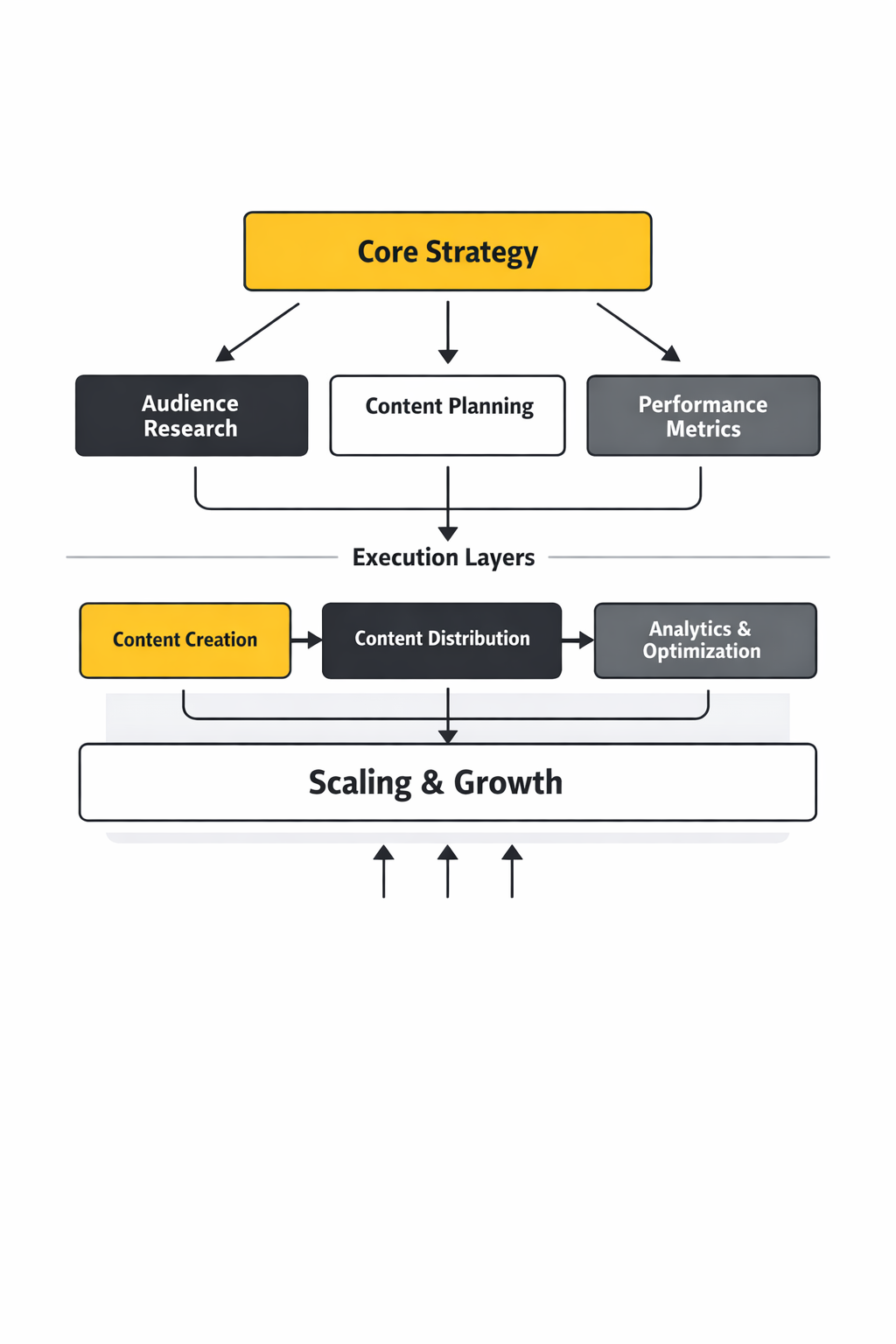
This framework is designed to work whether you’re a solo freelancer managing multiple clients or an in-house team juggling stakeholders. It’s simple on purpose: a strategy should be easy to run every week, not something you revisit once a quarter.
The framework has five connected layers:
- Direction: audience, positioning, and the outcomes your content is meant to create.
- Design: content pillars, formats, and message angles that you can repeat without sounding repetitive.
- Production: workflows, approvals, and a calendar that matches real capacity.
- Distribution: publishing, repurposing, paid support (when relevant), and community management.
- Learning loop: measurement, insights, and iteration so the strategy improves over time.
If you only take one idea from this: strategy is not a document—it’s a loop. Your best content strategy is the one your team can actually execute, measure, and refine.
Core Components
These components are the “minimum viable system” for a social media content strategy that performs consistently. You can add complexity later, but these are the parts that prevent chaos and make improvement measurable.
1) Goals and Success Metrics
Start with outcomes, not output. If the goal is pipeline, you’ll prioritize content that earns clicks, saves, replies, and qualified conversations. If the goal is retention, you’ll prioritize trust-building content, customer education, and customer care responsiveness.
A practical approach is to choose one primary goal per channel and one secondary goal. That stops you from trying to make every post do everything—an easy way to end up with content that’s vague and forgettable.
2) Audience Insights You Can Use Weekly
You don’t need a 40-page persona. You need a short list of audience tensions you can write from every week: what they want, what they fear, what they misunderstand, what they’re comparing you to, and what “proof” changes their mind.
In B2B especially, teams often underestimate how much clarity matters. LinkedIn’s benchmark research emphasizes the shift toward more agile, data-informed marketing organizations—exactly the kind of environment where clear audience insight becomes a competitive advantage. LinkedIn B2B Benchmark 2024 report (PDF)
3) Content Pillars That Match the Buyer Journey
Pillars are the repeatable themes that prevent “random posting.” The easiest way to build them is to map them to how people move from unaware to ready:
- Trust builders: point of view, teaching, and behind-the-scenes expertise.
- Proof: customer outcomes, credible social proof, and comparative clarity.
- Conversion support: offers, FAQs, objections, and next-step prompts.
- Relationship: community questions, conversations, and customer care signals.
This mix helps you avoid a common trap: posting only “tips” (which gets polite engagement) while never creating the content that actually moves people to act.
4) A Production System That Prevents Burnout
Most teams don’t need more ideas—they need fewer decisions. A simple production system includes a weekly planning ritual, a reusable briefing template, and a repurposing habit (one core idea turned into multiple platform-native pieces).
It also means planning formats your team can sustain. Video may be powerful, but only if you can produce it consistently at a quality level your audience trusts. Wyzowl’s long-running tracking shows how widely video is used as a marketing tool, which is a useful signal that audiences increasingly expect it in the mix. Wyzowl’s video marketing statistics page (multi-year dataset)
5) Distribution and Community as a Single Motion
Publishing is not the finish line—it’s the start. Strategy includes how you’ll seed content, repurpose it, and participate in conversation. If you publish and disappear, your content is doing all the work alone.
Community management is part of distribution because it shapes what the algorithm learns about your content and what your audience believes about your responsiveness. When response expectations are tight, community isn’t “nice to have”—it’s part of brand reliability. Sprout Social on customer care expectations and loyalty
6) Measurement That Produces Decisions
Measurement only matters if it changes what you do next. Track a small set of signals that match your goals (for example: saves and shares for education, replies for relationship building, clicks and qualified DMs for demand).
Benchmarks are useful when you treat them like context, not grades. Use them to ask better questions: “Are we improving?” and “What format is carrying results this month?”—not “Why aren’t we like the top 1%?” Emplifi’s 2025 benchmarks on engagement and format shifts (PDF)
Professional Implementation
Once the strategy is clear, professional execution is about governance: making sure the system can run across real constraints—stakeholders, approvals, brand risk, limited time, and changing priorities—without slowing everything to a crawl.
Set Clear Ownership (Even If It’s Just You)
Define who owns each part of the loop: planning, creation, publishing, community, reporting, and experimentation. In small teams, one person may own multiple steps, but it still helps to name the roles so work doesn’t fall into gaps.
If you’re a freelancer, this is also where you protect focus: you’re not “on call for content.” You’re running a system with defined inputs (briefs, assets, approvals) and defined outputs (posts, reports, iterations).
Run a Simple Operating Cadence
- Weekly: decide pillars, create batch content, schedule, and plan community time.
- Monthly: review performance, identify repeating winners, and prune what’s not working.
- Quarterly: refresh positioning, offers, and the experiments you want to run next.
This cadence is how you stay consistent without becoming repetitive. It also makes performance more explainable to clients and stakeholders because you can show how insights turn into action.
Build Trust Into the System
Modern platforms can amplify the wrong thing quickly, and brand trust is fragile. Strategy should include basic guardrails: what topics require review, what claims need sources, and how you’ll respond when a post attracts criticism or misinformation.
This matters even more as platforms test new moderation and context systems. When the environment changes, a strategy-based team adapts faster than a trend-based team because it already knows what it stands for and how it responds. Business Insider coverage of Meta’s Community Notes testing (March 2025)
In the next sections, we’ll turn this into a practical build: how to define audience and positioning, set measurable goals, choose pillars and formats, and design a workflow that makes high-quality content sustainable.
Step-by-Step Implementation
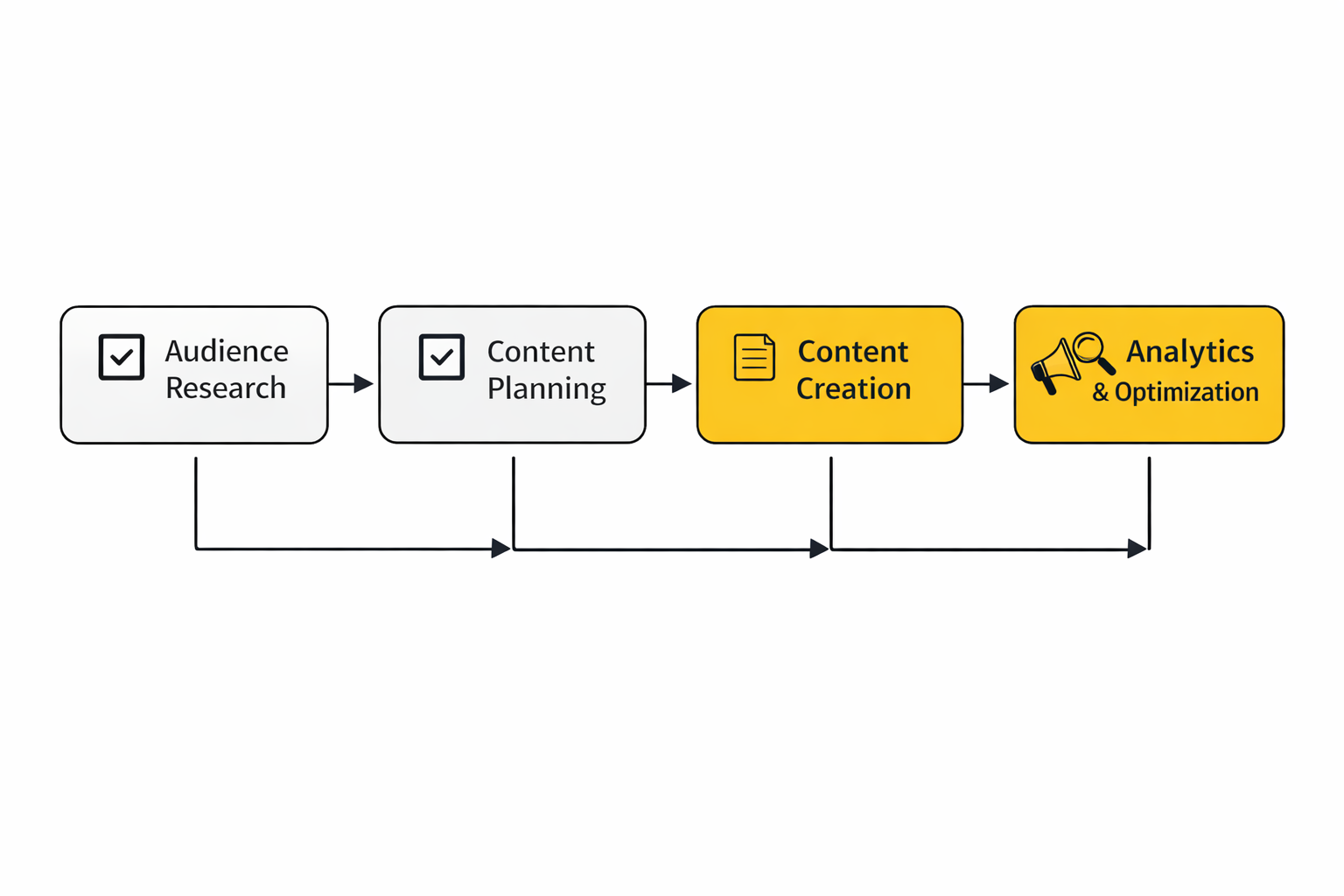
Implementing a social media content strategy is less about “having a plan” and more about building a weekly operating rhythm your team can repeat even when things get hectic. The goal is to move from reactive posting to a system where ideas become assets, assets become content, and content becomes measurable learning. If you do this well, you’ll feel the difference fast: fewer last-minute scrambles, clearer creative direction, and less time wasted arguing about what to post next.
Step 1: Lock Your North Star and One Primary Signal
Pick one business outcome your social media content strategy will support over the next 6–8 weeks: pipeline, product adoption, retention, recruiting, or community growth. Then choose one primary signal you’ll treat as “proof of progress” on each platform (for example: qualified replies and DMs on LinkedIn, saves on Instagram, watch time and profile actions on TikTok). This keeps you from chasing everything at once and ending up with content that feels busy but directionless.
Step 2: Build 3–5 Pillars You Can Sustain
Create a small set of pillars that reflect how people actually decide to trust you: clarity, proof, perspective, and relationship. Each pillar should be specific enough that a writer can generate 10 angles without repeating themselves, but broad enough that you won’t burn it out in two weeks. If you’re stuck, pull language directly from customer questions, support tickets, and sales objections so your content sounds like the market, not a marketing brainstorm.
Step 3: Choose 2–3 Core Formats Per Platform
Formats aren’t aesthetics; they’re production commitments. Choose formats your team can produce consistently at a quality level that won’t erode trust, then build templates around them so execution becomes faster over time. The winning move is usually a tight mix: one “fast” format for consistency, one “deep” format for authority, and one “conversation” format designed to invite replies.
Step 4: Create a Weekly Content Loop
Run social like a loop, not a calendar. In one weekly planning session, decide what you’re publishing, what you’re repurposing, what you’re testing, and how you’ll respond to the community. Then schedule a short mid-week check-in to adjust distribution and engagement coverage before the week drifts off course.
- Plan (30–45 minutes): pick pillars, assign drafts, confirm deadlines.
- Produce (batch blocks): write, design, edit, and package posts in batches.
- Publish + Engage (daily): post with intention and stay present for replies.
- Review (20 minutes weekly): capture what worked and what to change next week.
Step 5: Track With Clean Measurement (So Learning Isn’t Guesswork)
If you want your social media content strategy to improve, your tracking has to be consistent enough to compare week to week. Keep link naming clean and predictable so you can actually tell which posts drove meaningful actions after the click. A practical baseline is using structured campaign tagging and then reviewing social traffic patterns inside Google Analytics 4 so reporting isn’t trapped inside platform dashboards.
Execution Layers
Execution gets easier when you separate the work into layers. Each layer has its own goal, its own “definition of done,” and its own failure mode. This prevents a common trap where everything gets treated as one big content task, which is how deadlines slip and quality drops.
Layer 1: Strategy and Briefing
This layer turns business goals into content direction that creators can actually use. A good brief names the pillar, the audience tension, the single idea, the desired reaction, and the proof or example that will make it believable. When this layer is weak, you get vague posts that look polished but don’t land because they never say anything concrete.
Layer 2: Production and Quality Control
This is where content becomes an asset: a finished post with the right format, the right hook, and the right call-to-action for that platform. Quality control means checking for brand clarity, accuracy, and whether the post matches the platform’s native behavior (especially for short-form video and comment-driven distribution). When this layer is weak, you get inconsistency: posts feel off-brand, claims go uncited, and small errors chip away at credibility.
Layer 3: Publishing and Distribution
Publishing is the moment your content enters the real world, and distribution is how you help it find the right people. This includes posting cadence, repurposing, employee advocacy where it fits, and deliberate engagement in the first hour when attention is most fragile. When this layer is weak, content becomes “post and hope,” which is the fastest way to waste good creative.
Layer 4: Community and Feedback
Community isn’t a bonus; it’s part of the content engine because replies create insight and insight creates better posts. A simple operating rule is to treat meaningful responses as content prompts: objections become posts, patterns become series, and recurring questions become weekly formats. This matters even more when audiences expect fast replies, like the 73% of social users who want a brand response within 24 hours.
Layer 5: Measurement and Iteration
This layer closes the loop: you take performance signals, interpret them, and change what you do next week. Strong teams don’t just report numbers; they write down decisions. If your reporting doesn’t produce a clear “keep, kill, test next,” you’re collecting metrics without building momentum.
Optimization Process
Optimization is where a social media content strategy stops being theory and starts compounding. The point isn’t to chase tiny tweaks; it’s to build a repeatable method for learning what your audience rewards, what the platform distributes, and what outcomes your content actually drives. The fastest way to stall growth is to “optimize” based on vibes instead of structured tests.
1) Test One Variable at a Time
If you change the hook, the format, the topic, and the CTA all at once, you can’t learn what caused the outcome. Instead, decide what you’re testing: opening line, visual style, post length, or call-to-action. Then keep everything else stable for long enough to see a pattern.
2) Use Platform-Native Experiments When You Need Certainty
When optimization decisions affect budget or big campaigns, “correlation” isn’t enough. Lift studies and A/B tests help answer the real question: did this content create incremental impact, or did it just appear next to impact that would have happened anyway? TikTok’s experiment tools like Conversion Lift Study and Brand Lift Studies exist for exactly this reason.
3) Run Clean A/B Tests on Creative and Messaging
A/B testing is most useful when it’s boring and controlled. Choose a realistic time window, keep budgets stable, and avoid changing targeting mid-test so results don’t get muddied. If you’re using Meta, the platform’s own guidance on best practices for A/B tests is a solid baseline for keeping tests interpretable.
4) Build a Winners Library (So You Don’t Relearn the Same Lesson)
Most teams waste insight because it lives in someone’s memory instead of a system. Keep a simple winners library: screenshot the post, note the pillar and hook style, capture the key metric, and write one sentence on why it worked. Over time, this becomes your brand’s unfair advantage because your strategy is built on your own evidence, not generic advice.
5) Use Benchmarks as Context, Not as a Scorecard
Benchmarks help you spot shifts in platform behavior and format performance so you don’t misread normal volatility as failure. They’re most useful when they come from large datasets and recent time windows, like the analysis of 200,000+ brand accounts reviewed across 2023 and 2024 in Emplifi’s 2025 benchmarks report. The right question isn’t “are we average,” it’s “are we improving with a consistent method?”
Implementation Stories
NYX Professional Makeup: Turning a Campaign Into a Repeatable Social System
It started with pressure you can feel in your chest: the brand needed to reconnect with Gen Z, and a normal campaign wouldn’t cut through. Attention was fragmenting, creator culture was moving faster than brand approvals, and the cost of being forgettable was real. The team didn’t just need a good post—they needed a social media content strategy that could move like the internet moves.
The backstory is that NYX had already lived inside social for years, but the bar kept rising as creators reshaped what “authentic” looks like. Short-form video wasn’t a trend anymore; it was the default language of discovery and identity. When your audience expects participation, a one-way campaign feels like talking to an empty room.
The wall hit when “brand-safe” started to sound like “brand-invisible.” A traditional approach would have produced polished assets, predictable messaging, and a neat timeline. That’s the kind of work that gets approved easily—and ignored instantly. The team needed something that could invite people in rather than broadcast at them.
The epiphany came from leaning into identity as the story, not just the theme. Instead of treating creators as add-ons, the campaign was built to be creator-led and culturally participatory from the start. That shift matters because it changes production: you’re no longer making a single hero asset, you’re building an engine for many pieces of content to evolve in public.
The journey turned strategy into execution: a clear pillar (self-expression), a repeatable format (creator-led stories), and distribution designed for participation, not perfection. The results reported for the campaign show what happens when the system works: 20K ID requests, a 28% increase in brand preference, and a 20% increase in sales. Those numbers aren’t just “performance,” they’re evidence that the content aligned with what the audience wanted to do and share.
Then the final conflict showed up in the place most teams underestimate: scaling without losing the soul of the idea. When something works, everyone wants more of it—more posts, more versions, more channels, more approvals. That’s where strategy either holds or collapses, because volume amplifies weak workflows and unclear ownership. Creator-led work especially can break teams if the production loop isn’t designed for speed and collaboration.
The dream outcome wasn’t one viral moment; it was a repeatable operating model. The team proved they could build campaigns that move with culture while still tying back to measurable outcomes. That’s the real win of a social media content strategy: you don’t rely on lightning strikes—you build a system that can earn attention again and again.
Professional Implementation Playbook
At a professional level, implementation is about reliability. Clients and stakeholders don’t just want creative—they want confidence that the system won’t break when something unexpected happens. Your social media content strategy becomes “professional” when it can handle deadlines, approvals, community spikes, and measurement without turning into chaos.
Set Operating Rules Your Team Can Actually Follow
Define what “done” means for each layer: briefing complete, draft approved, asset final, scheduled, community coverage assigned, reporting captured. This prevents the silent killer of social programs: tasks that look finished but aren’t actually shippable. It also makes it easier to onboard collaborators because the system is explicit instead of tribal knowledge.
Build Permissions and Risk Controls Into the Workflow
Professional execution treats access like a safety system, especially when multiple people touch the same accounts. Use role-based access and keep admin permissions tight so accounts don’t become vulnerable to accidental changes or security issues. Meta’s own guidance on Page access and roles is a practical baseline for structuring that control.
Make Reporting Decision-First, Not Slide-First
A good report ends with actions: what you’re doubling down on, what you’re stopping, and what you’re testing next week. Tie social performance to broader measurement when possible so stakeholders can see what happens after engagement, using tools like GA4 alongside platform insights. Over time, this is how your social media content strategy earns trust: not by promising outcomes, but by showing a consistent loop of learning and improvement.
Statistics and Data
If your social media content strategy is meant to create predictable growth, you need numbers that can tell you what’s actually happening. Not “we feel like engagement is down,” but signals that separate a creative problem from a distribution problem, and a distribution problem from an offer problem.
Start with the context your stakeholders already live in: social isn’t a side channel anymore. The typical user still spends 2 hours and 23 minutes per day on social platforms, which means your content is competing inside a daily habit loop, not a neat marketing funnel. In developed markets, that time has also shown signs of cooling, with an analysis of GWI data highlighting around 2 hours and 20 minutes per day in 2024 and a decline from the 2022 peak.
This is exactly why measurement matters: when attention becomes more selective, content that earns real intent (saves, searches, site actions, purchases) becomes more valuable than content that merely gets seen.
Performance Benchmarks
Benchmarks are useful when you treat them like guardrails, not grades. They help you spot platform shifts, set reasonable expectations with clients, and avoid panic when a channel becomes noisier or more competitive. The catch is that benchmarks only help if you’re comparing the same metric definitions.
Engagement Rate Benchmarks Only Work if You Match the Formula
One report might calculate engagement per follower, another per reach, and another per impressions. If you mix them, you’ll think your performance changed when really the math changed. For example, Rival IQ defines its benchmark engagement as engagement rate per post by follower, while Emplifi’s dataset highlights reach engagement rates for formats like Reels and TikTok. Both are valid, but they answer different questions.
What “Good” Can Look Like on Organic Social
If you’re benchmarking a typical brand account across industries, Rival IQ’s 2024 report shows a median engagement rate of 2.63% on TikTok, compared with a median of 0.43% on Instagram and 0.029% on X (Twitter). That gap doesn’t mean Instagram is “worse.” It usually means Instagram is harder to earn engagement on when measured against followers, and TikTok’s content discovery dynamics can deliver stronger interaction relative to the audience base.
From a format perspective, Emplifi’s 2025 benchmarks call out how quickly short-form video has become a default behavior for brands, with Reels representing 38% of brand posts by the end of 2024. At the same time, it shows the reality check most teams feel: video reach engagement rates dipped from 2.6% in 2023 to 2.2% in 2024, which is exactly why your strategy needs an optimization loop instead of a “set it and forget it” calendar.
Posting Frequency Benchmarks and the “More Isn’t Always Better” Trap
Teams often try to fix performance by posting more. Sometimes that helps, but not always, and benchmarks can prevent you from confusing activity with progress. Rival IQ reports a cross-industry median of 4.69 Facebook posts per week and 4.7 Instagram posts per week, which is a helpful reminder that consistency can be modest if the content is strong.
Your goal isn’t to match a benchmark. It’s to find the minimum effective cadence your team can sustain while still producing content that earns the response you care about.
Analytics Interpretation
Analytics becomes useful when it answers one question: what should we do next? That means translating metrics into decisions, not turning them into a monthly screenshot parade.
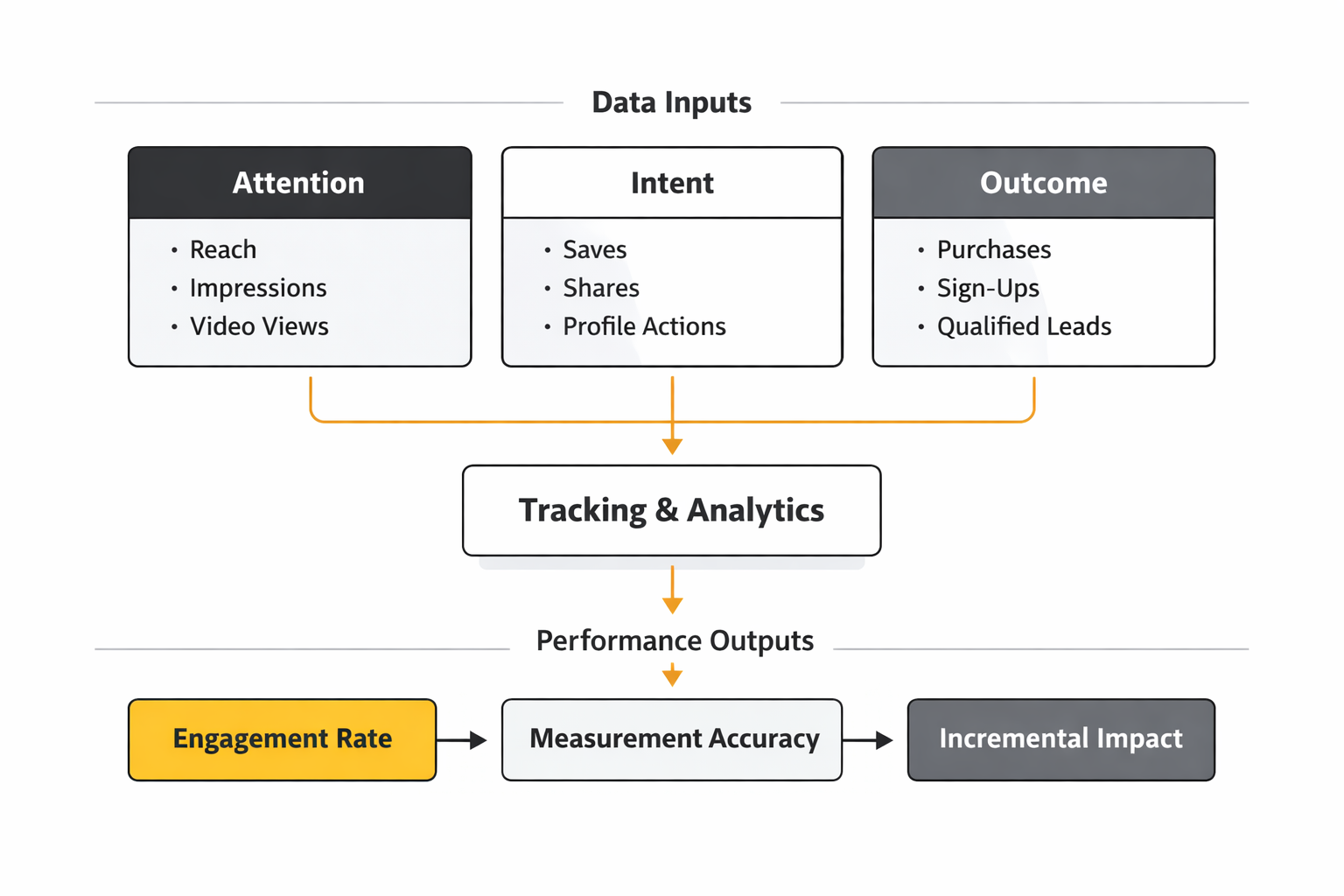
1) Separate Attention, Intent, and Outcome
A clean social media content strategy tracks three layers:
- Attention: reach, impressions, video views, watch time. This tells you whether distribution is happening.
- Intent: saves, shares, profile visits, searches, replies, link clicks. This tells you whether the content is resonating.
- Outcome: sign-ups, purchases, qualified leads, offline conversions. This tells you whether social is contributing to real business results.
If attention is high but intent is weak, the creative is likely too generic or the hook is misaligned. If intent is high but outcomes are weak, the issue is often the landing page, the offer, or the handoff between social and conversion.
2) Commit to Clean Tracking So You’re Not Guessing
When links are messy, attribution gets messy, and your strategy decisions become political. A practical baseline is using campaign parameters consistently so you can see what social actually drives in your acquisition reports. Google’s own guidance on GA4 URL builders and UTM parameters is worth standardizing across every client and campaign, even if you keep the naming simple.
3) Use Incrementality When the Stakes Are High
If you’re investing serious budget or running a flagship campaign, you eventually need to know whether the results were incremental. TikTok’s measurement approach explains how a Conversion Lift Study isolates the impact by comparing a treatment group exposed to ads with a control group that isn’t. This kind of design helps you avoid a classic mistake: crediting social for conversions that would have happened anyway.
Even if you’re not running formal lift studies every month, the mindset matters. When performance changes, ask whether it’s a true lift in behavior, or just a shift in attribution visibility.
4) Turn Insights into Actions, Not Opinions
The simplest way to make analytics actionable is to end every review with three calls:
- Keep: formats, topics, and hooks that reliably drive intent.
- Kill: patterns that attract attention but never produce meaningful actions.
- Test next: one variable you’ll change (hook, format, CTA, distribution method) so learning stays clean.
This is how your social media content strategy stops drifting. Decisions stay tied to evidence, and evidence stays tied to outcomes.
Case Stories
Quay: When “Good Results” Still Didn’t Prove What Was Real
The team hit a stressful moment that felt familiar: performance looked solid, but nobody could confidently say what part of it was truly driven by TikTok. The budget conversations were getting sharper. If they scaled spend and the results flattened, the campaign would be blamed for a problem it couldn’t control.
The backstory mattered here. Quay had already built a presence on TikTok, and the brand wasn’t trying to “discover” the platform. The real challenge was proving lower-funnel impact while still protecting CPA goals and overall profitability. That’s the point where many strategies crack, because attention metrics are easy, but business proof is not. Quay’s objective and setup on TikTok for Business
The wall arrived when the team realized reporting couldn’t answer the question stakeholders actually cared about: did TikTok drive incremental conversions, or was it just capturing demand created elsewhere? When you can’t prove incrementality, you can’t defend budget. And when you can’t defend budget, your content strategy becomes vulnerable to the next “we should cut social” meeting.
The epiphany was choosing a measurement method that matched the problem. Instead of relying on last-click attribution or platform-reported conversions alone, they used an experimental design. TikTok describes splitting the audience into treatment and control groups so the brand can see what changes when ads are present and what stays the same when they aren’t. How TikTok frames Conversion Lift Studies
The journey became a disciplined operating loop rather than a one-off campaign. Quay and its agency ran multiple campaign types, kept creative fresh on a regular cadence, and used lift measurement to validate what was working across the funnel. That’s what a mature social media content strategy looks like in practice: creative, targeting, and measurement working together instead of competing for credit. Quay’s approach and cadence in the case study
Then a final conflict showed up that most teams ignore until it hurts: once the data starts proving impact, the pressure to scale gets intense, and creative fatigue can arrive fast. Scaling isn’t just “increase budget.” It’s maintaining message clarity while refreshing creative before performance decays, and doing it without breaking the production system. The case study even calls out the practical cadence of refreshing creatives every 7–14 days, which is the kind of detail that separates theory from execution. Creative refresh cadence noted in the Quay story
The dream outcome was clarity that changed decisions. The Conversion Lift Study reported a 417% lift in search, a 70% lift in add-to-cart actions, and a 54% lift in purchases, with the brand also surpassing ROAS targets by 91%. That kind of measurement doesn’t just make a report look good. It makes the strategy defensible, scalable, and easier to improve because the team knows what’s real.
Professional Promotion
Promotion is where many strategies quietly fail. Teams create strong posts, publish them, and then act surprised when distribution is uneven. Professional promotion means you decide in advance what content deserves amplification, what audiences it should reach, and what success should look like beyond likes.
Amplify What Already Works (Don’t Boost Random Posts)
The fastest way to waste budget is promoting content that hasn’t earned organic intent. A better rule is simple: promote posts that already generate saves, shares, qualified replies, or meaningful click behavior. Those are the signals that your message has traction before you pay to scale it.
Use Creator Partnerships When Trust Is the Bottleneck
Creator-led promotion works best when your audience needs reassurance, context, or social proof before they act. Partnership ads are designed to scale collaborations while keeping the creator’s identity present, and Instagram’s own explanation highlights that partnership ads can use either original ad content or boosted organic content.
For teams that need a performance case to justify the approach, industry reporting has pointed to Meta’s data showing partnership ads can deliver 19% lower CPAs and 13% higher click-through rates on average compared with standard brand ads. That doesn’t mean every campaign will see those numbers, but it’s a strong reason to include partnership testing inside a modern social media content strategy.
Make Measurement Non-Negotiable
Promotion without clean measurement turns into “feelings marketing,” especially when multiple channels run at once. Use standardized tagging so performance can be compared across campaigns and time windows, and so you can connect social exposure to what happens next on your site. Google’s own documentation on collecting campaign data with custom URLs is a straightforward reference for setting this up without overcomplicating it.
Test Like a Pro, Not Like a Gambler
Professional promotion includes controlled testing so you can learn without burning budget. If you’re running Meta campaigns, the platform’s A/B testing overview explains how to run controlled experiments in Ads Manager, which is the kind of discipline that keeps optimization honest. Your goal is to test one variable at a time so you can confidently scale what works and stop funding what doesn’t.
When promotion is integrated this way, it stops feeling like “paid vs. organic.” It becomes one system: content earns intent, promotion scales intent, and analytics tells you what to build next. That’s how a social media content strategy stays professional under real-world pressure.
Future Trends
The next wave of social media content strategy work won’t be won by “posting more.” It’ll be won by teams that can create faster, prove impact cleaner, and build trust while platforms keep changing the rules.
AI is moving from “nice-to-have” into the default layer of content operations—ideation, repurposing, editing, personalization, and even distribution decisions. The brands that win won’t be the ones who automate everything; they’ll be the ones who use AI to remove busywork while keeping a strong human point of view and recognizable voice. Hootsuite’s Social Media Trends 2026 report framing AI as an operating shift 2026 trend analysis highlighting rising audience awareness of AI use
Social discovery will keep blending into search behavior. People increasingly use platforms to find answers, compare options, and validate decisions, which means your strategy has to include language people actually search for, not just creative that looks good in a feed. That pushes more teams toward “search-minded social” where captions, on-screen text, and recurring series are built to be found later. Google Trends as a simple way to validate real-world search language
Creator-led distribution is getting more operational. Instead of one-off influencer campaigns, platforms are making it easier for brands to identify creator posts that already work and scale them with paid support. Meta’s Partnership Ads Hub updates are a signal of where this is going: creator content becomes a performance asset you can evaluate, permission, and amplify inside a repeatable workflow. Meta’s announcement of AI-powered Partnership Ads tooling Meta partnership ads performance benchmarks highlighted in December 2025 coverage
Finally, measurement expectations will keep rising. Stakeholders are increasingly skeptical of vanity metrics, and they want clearer proof of incremental impact—especially when budgets tighten. This will push more teams toward consistent tracking, cleaner attribution, and experimental measurement for high-stakes campaigns. We Are Social’s Digital 2026 overview emphasizing how fast the ecosystem keeps shifting TikTok’s conversion lift methodology as a model for incrementality
Strategic Framework Recap

A social media content strategy becomes reliable when it behaves like an ecosystem: every post has a purpose, every purpose has a metric, and every metric creates a decision that improves the next cycle.
- Direction: one clear outcome, one primary signal per platform, and pillars that match real audience tensions.
- Design: repeatable formats and content IP that keep production consistent without sounding repetitive.
- Production: workflows, templates, and roles that keep quality stable as volume increases.
- Distribution: publishing plus community plus amplification treated as one motion, not separate jobs.
- Learning loop: clean tracking, benchmark context, and focused experiments that produce “keep, kill, test next.”
If you build your system around those five parts, your strategy doesn’t depend on luck or a single viral moment. It compounds because you’re turning content into evidence and evidence into better decisions.
FAQ – Built for This Complete Guide
What is a social media content strategy, in plain English?
It’s the system you use to decide what to publish, who it’s for, what outcome it should create, and how you’ll improve it over time. Instead of “random posting,” a social media content strategy gives each post a job to do and a way to measure whether it did it.
How many platforms should a social media content strategy cover?
Start with one platform you can execute consistently. Once your planning, production, engagement, and reporting loop is stable, add a second platform using a hub-and-spoke approach so you’re repurposing intelligently instead of doubling your workload.
How often should I post to see results?
Consistency matters more than intensity. Use a cadence you can sustain without lowering quality, then increase only when your workflow can handle it. Benchmarks can help set expectations, but they shouldn’t force you into volume that breaks your production loop. Cross-industry engagement and posting trend context from Rival IQ
What metrics matter most for a professional strategy?
Track three layers: attention (reach, watch time), intent (saves, shares, qualified replies, clicks), and outcomes (sign-ups, purchases, qualified leads). This helps you diagnose what’s broken: distribution, creative resonance, or the offer and conversion path.
What are content pillars, and how do I pick them?
Pillars are the repeatable themes you build your calendar around. Pick 3–5 pillars tied to real buyer questions: clarity (how it works), perspective (your point of view), proof (results and credibility), and relationship (community conversations and support signals).
How do I avoid burnout while staying consistent?
Design your strategy around repeatable formats and batch production. Build templates for hooks and post structures, keep a winners library, and treat repurposing as a core habit. When your system removes decision fatigue, consistency becomes easier.
How should I use AI without making content feel generic?
Use AI for speed on the mechanical parts—summaries, drafts, repurposing, formatting, and variations—then add human judgment where it matters: point of view, examples, nuance, and brand voice. Trends research suggests audiences increasingly notice AI and reward content that feels deliberate and owned by real people. Hootsuite’s Social Trends 2026 on purposeful, agile content Discussion of transparency and audience expectations around AI
Should paid promotion be part of my social media content strategy?
Yes, but selectively. The most efficient approach is scaling what already earns organic intent (saves, shares, qualified replies) rather than boosting random posts. Paid should amplify proven messages and help you reach the right audiences faster.
Are creator partnerships worth it, or is it just hype?
They’re worth it when trust is the bottleneck. Creator content often feels more native and credible, and Meta’s own published data has highlighted partnership ads delivering lower acquisition costs and higher click-through rates on average, which is why many teams are building creator scaling into their distribution system. Meta’s Partnership Ads Hub update Reported Meta performance benchmarks for partnership ads
How do I prove ROI if social attribution feels messy?
Start with clean tracking (consistent campaign parameters) so you can see post-level patterns in your analytics. For bigger bets, use experimental measurement like lift studies to understand incremental impact, not just last-click credit. GA4 campaign URL guidance for consistent tracking How conversion lift isolates incremental impact
What tools do I actually need to run the system?
You need a planning space (calendar + briefs), production tools (design/video), a publishing workflow, and a simple reporting loop. The best stack is the one your team will use weekly without friction—especially around approvals, asset management, and community coverage.
Work With Professionals
You can build a strong social media content strategy on your own, but the hard part is turning it into a steady stream of real opportunities—especially when you’re freelancing and your pipeline depends on momentum.
If you’re tired of chasing clients, negotiating through layers, or losing fees to platforms that take a cut, MARKework is built around a simpler idea: a focused marketplace for marketing roles and projects where you connect directly and keep your earnings. The platform is positioned around direct communication and no project fees, so you’re not paying a commission every time you land work.
And the demand is real. Even outside any one platform, there are already 12,102 open remote marketing jobs listed right now, which is a useful reality check that companies are actively hiring independent specialists at scale.
MARKework is designed to help you tap into that market with less friction: you build a profile that shows your skills, rates, and proof, then apply to active listings and negotiate terms directly. The marketplace itself shows 1,007 active listings and promotes access to thousands of job listings through simple subscription plans. MARKework pricing details and “no project fees” plans
If you want your strategy skills to translate into more paid work—without losing money to commissions—start by building your profile, applying to roles that fit your strengths, and turning your social results into proof that closes deals faster.
 Filip Konecny Enterprises