

Article Outline
- What Is Social Media Agency Pricing?
- Why Social Media Agency Pricing Matters
- Framework Overview
- Core Components
- Professional Implementation
- Pricing Models You’ll See in the Wild
- The Real Cost Drivers Behind Every Proposal
- Benchmark Ranges Without the Hand-Waving
- Turning “We Need Social” Into a Clean Scope of Work
- How to Compare Agencies Without Getting Burned
- Measurement, Reporting, and What You’re Actually Paying For
- Red Flags and Pricing Traps to Avoid
- A Decision Checklist Before You Sign
- FAQ
Social media agency pricing looks simple until you’re the one approving the budget. One agency quotes a tidy monthly retainer, another sends a menu of add-ons, and a third proposes a “performance model” that somehow still includes a hefty base fee.
This guide is built to remove the fog. You’ll get a clear vocabulary for what you’re buying, a framework for evaluating proposals, and the practical levers that make prices move up or down—without turning this into a spreadsheet lecture.
What Is Social Media Agency Pricing?

Social media agency pricing is the way an agency turns your goals (growth, demand, awareness, retention, recruiting, community) into a paid scope of work—then assigns a cost to the people, processes, tools, and risk required to deliver it.
That sounds obvious, but it’s why two “social media management” quotes can be miles apart. One might mean three posts per week and basic reporting. Another might include platform-native creative, short-form video production, community management, creator partnerships, paid media operations, analytics, and stakeholder review workflows.
It also helps to separate three buckets that often get blended together:
- Labor: strategy, creative, production, community management, paid media management, and reporting.
- Tooling: publishing, listening, analytics, and approval systems—often priced per seat and per network, like the pricing structures you see in platforms such as Sprout Social and other management suites.
- Media and pass-through costs: the ad spend itself, creator fees, photography locations, licensing, and other non-labor costs (sometimes marked up, sometimes not).
When you see a number on a proposal, you’re not just paying for output. You’re paying for the operating system that produces output reliably—even when platforms change, performance dips, approvals drag, or a campaign needs to pivot within 48 hours.
Why Social Media Agency Pricing Matters
Pricing is not a procurement exercise. It’s a strategy decision that shapes what your social presence can realistically do.
Here’s the uncomfortable truth: most teams don’t “underinvest” in social because they don’t believe in it. They underinvest because pricing feels unpredictable, and unpredictable spending is hard to defend internally. That’s why the business case matters as much as the creative.
In the latest wave of The CMO Survey, marketing leaders reported social media spending at 11.3% of marketing budgets, and they still projected increases over time. The direction of travel is clear: social remains central, even when budgets get scrutinized.
At the same time, cost pressure is real. Digital agency leaders reported continued rate increases in recent benchmarks, with many agencies clustering in higher hourly bands in the 2025 Digital Agency Industry Report. Translation: you can’t treat agency pricing like a static rate card you negotiate once and forget.
There’s also a trust angle. When remuneration models feel misaligned, relationships corrode fast. A large share of multinational advertisers have signaled they want to change how agencies are paid, as shown in the WFA’s work on the future of media agency remuneration. That pressure is one reason pricing conversations are shifting from “hours and posts” toward clearer accountability and outcomes.
So if you’re trying to make social profitable—not just busy—understanding social media agency pricing is the first step to buying the right capability, at the right level, with the right incentives.
Framework Overview
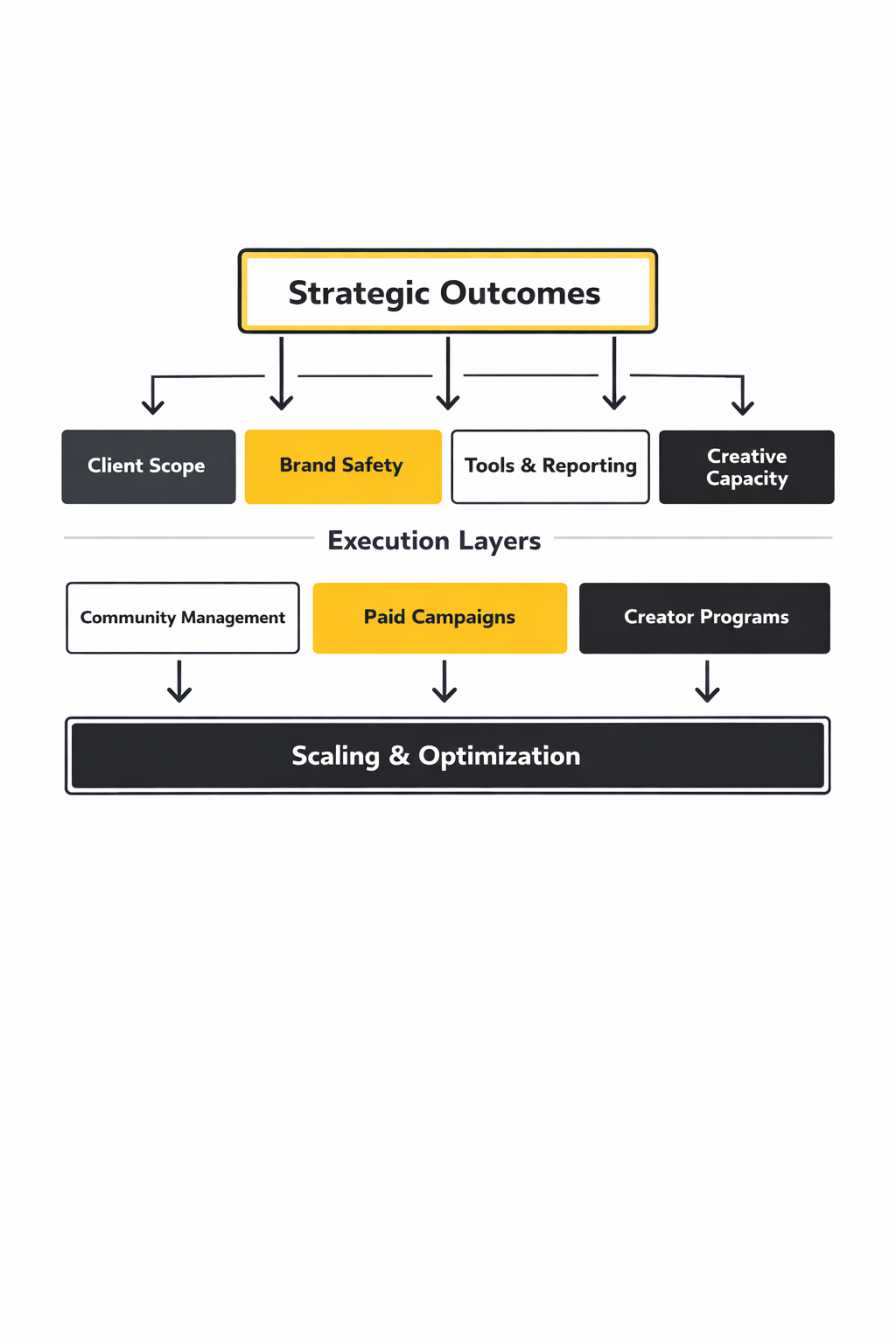
Most pricing confusion disappears when you evaluate proposals through a simple framework:
- Outcomes: what business result are we trying to move, and how will we know?
- Scope: what work will be done weekly and monthly (and what explicitly won’t)?
- Capacity: how many skilled hours and senior touchpoints are actually allocated?
- Complexity: how many platforms, content formats, stakeholders, and approval layers are involved?
- Risk and accountability: what happens when performance drops, priorities change, or the platform updates the rules mid-campaign?
Notice what’s missing: “number of posts” as the headline. Posts matter, but pricing anchored only to volume is how you end up with busy feeds and weak results. Strong proposals tie volume to a system: research, creative direction, production standards, distribution, optimization, and reporting cadence.
This framework also makes it easier to compare quotes that look nothing alike. If one agency is cheaper, you can pinpoint whether it’s because they’re truly efficient—or because they’ve quietly removed strategic work, production quality, or community coverage that you assumed was included.
Core Components
Across markets, you’ll see the same building blocks repeated in almost every social media agency pricing package. What changes is the depth, seniority, and frequency.
Strategy and Planning
This is the thinking layer: brand voice, audience research, content pillars, channel roles, creator strategy, paid-and-organic integration, and a measurement plan. The difference between “we post” and “we grow” usually starts here.
Strategy costs more when the agency is expected to align social to revenue, not just engagement. It also costs more when you need stakeholder alignment across multiple departments or regions.
Creative Direction and Production
Production isn’t one thing anymore. A modern scope might include static design, short-form video, motion graphics, creator-style UGC, photography, copywriting, and platform-native iterations. Each format has a different production curve and review cycle.
If an agency is transparent, they’ll show how production is “metered” (per asset, per batch, or as a monthly capacity). When that’s vague, it’s a sign you’ll be negotiating every deliverable later.
Community Management and Customer Care
Community work is one of the most underestimated pricing drivers. “Replying to comments” is not the job. The job is protecting brand tone, handling edge cases, escalating issues, and building trust in public—often outside of business hours.
This is also where tooling and workflows matter. Agencies managing care at scale often rely on platforms and processes similar to what social management vendors describe in guides like Sprout Social’s breakdown of social media management costs, because speed, tagging, approvals, and reporting become operational necessities.
Paid Social Management
Paid social has its own pricing logic. Some agencies charge a flat management fee, others use a percentage of ad spend, and many use hybrids. The real question is what’s included: creative testing, landing page coordination, measurement setup, reporting depth, and how frequently optimizations happen.
Marketplace data also shows the spread in how agencies position paid and organic work. For example, Clutch’s compiled marketplace benchmarks often cite social media marketing agency hourly rates in bands such as $25–$49/hour for many listed providers, while broader digital agency benchmarks can land much higher depending on seniority and specialization.
Analytics and Reporting
Reporting is either a monthly PDF that nobody reads, or it’s the steering wheel. When it’s done well, reporting connects platform metrics to business decisions: what to double down on, what to stop, what to test next, and what the next month’s plan changes because of.
Pricing rises when reporting includes attribution work, experimentation design, and stakeholder readouts—not just dashboards.
Professional Implementation
Knowing the components is one thing. Buying them in a way that actually works inside a business is another.
Professional implementation is the gap between a “nice proposal” and a partnership that survives real life: internal approvals, brand risk, shifting priorities, platform volatility, and the pressure to show impact.
In practice, implementation comes down to three disciplines:
- Operational clarity: a written scope that defines deliverables, response times, review rounds, and ownership—so you don’t pay premium rates while decisions stall internally.
- Governance: who approves what, how fast, and what happens when a post needs to be pulled or a crisis hits.
- Measurement alignment: shared definitions of success and a reporting cadence that supports decisions, not just accountability theater.
Over the next sections, we’ll translate social media agency pricing into concrete pricing models, benchmark ranges, and a comparison method you can use even if you’re looking at wildly different proposals.
Step-by-Step Implementation
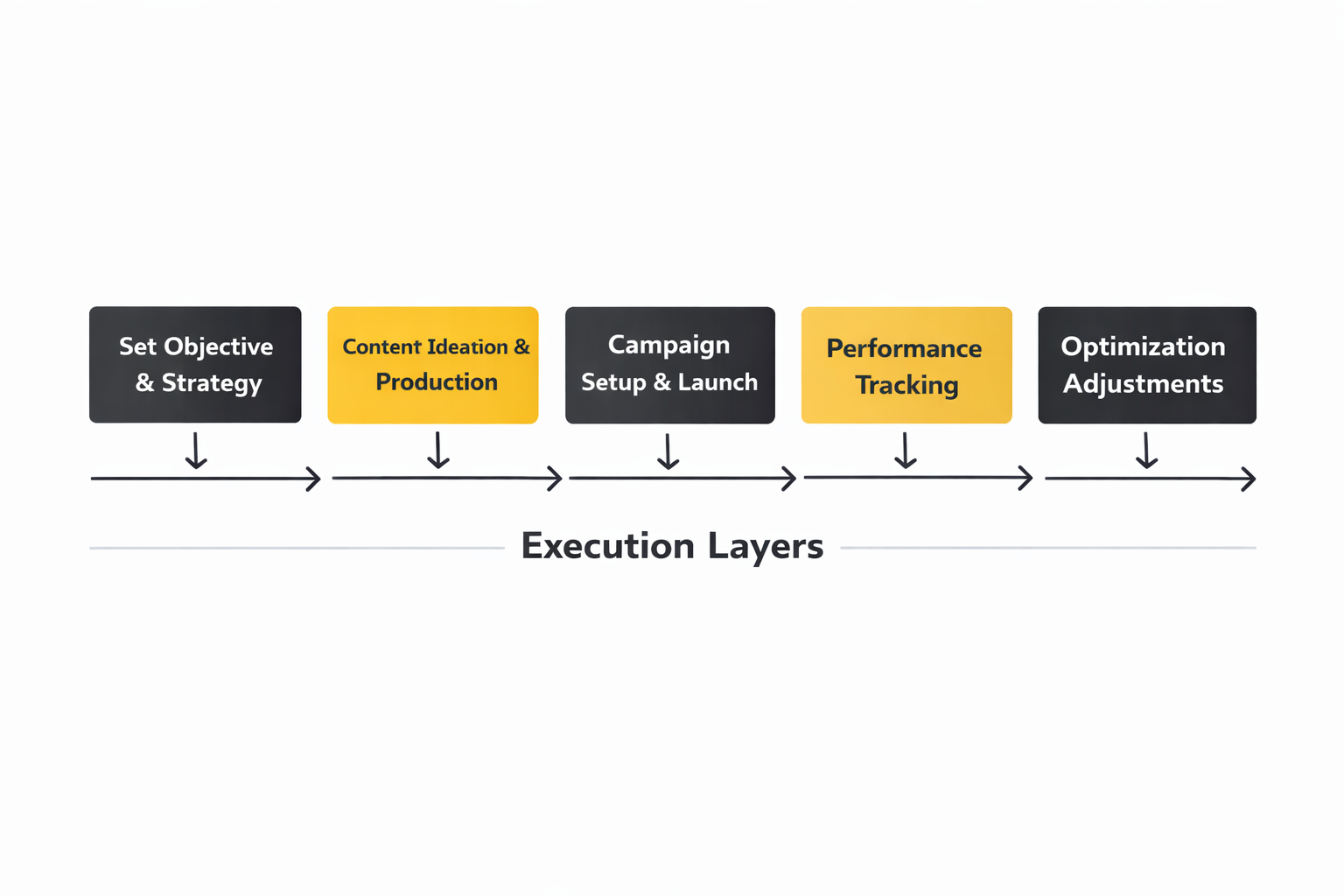
When social media agency pricing feels expensive, it’s usually because the buyer is imagining “content,” while the agency is imagining “a working system.” Implementation is where that system gets built. Do it well, and the work compounds. Do it loosely, and you pay every month for avoidable chaos.
Here’s a practical implementation path that agencies use when they’re pricing for outcomes instead of activity.
Step 1: Align on outcomes and non-negotiables
Start with a short list of outcomes that leadership actually cares about and the constraints you can’t violate. Outcomes might be demand, retention, recruiting, or community trust. Constraints might be compliance, brand safety, approval speed, or customer care coverage.
This step matters because it prevents scope drift, which is the silent killer of social media agency pricing. If the agency is expected to “figure it out later,” you’re paying for rework later.
Step 2: Audit what exists and decide what gets kept
Most brands don’t need a blank-slate strategy. They need clarity on what’s working, what’s wasting time, and what’s creating risk. A solid audit reviews content performance, cadence consistency, audience signals, and operational friction like approvals and handoffs.
If you want a simple sanity check for what a professional audit covers, structured checklists like Sprout Social’s reporting workflow and governance-oriented guides like KPMG’s board-level social governance playbook reveal the typical gaps brands miss when they’re only looking at engagement.
Step 3: Build the operating rules before building the calendar
This is the unsexy part that saves your budget. Before anyone writes a caption, define how work moves: who drafts, who approves, how many review rounds exist, what “urgent” means, and what happens when something goes wrong.
Organizations with strong digital governance tend to push decision-making toward the people closest to the work while still verifying decisions are sound, a principle captured in NHS provider guidance on good governance for digital delivery. In agency terms, that translates to fewer bottlenecks and faster execution without trading speed for risk.
Step 4: Create a content system that scales
A content system is not “30 posts a month.” It’s a repeatable way to generate ideas, produce assets, and publish on time. A good agency will define content pillars, format mix (static, short-form video, stories, carousels), and a production rhythm that matches your team’s reality.
The goal is to stop reinventing the process every week. That’s where social media agency pricing starts paying for itself: less time arguing about what to post, more time making the posts better.
Step 5: Set up measurement that matches the goal
Measurement is where many engagements quietly fail. If you’re paying for growth but measuring only likes, the work becomes performative. If you’re paying for demand but can’t connect social activity to downstream actions, you end up debating opinions in monthly calls.
For paid social and conversion-oriented programs, implementation often includes technical foundations like server-side event collection. Meta’s implementation checklist for Conversions API setup is a useful reference point because it makes the prerequisites explicit: accounts, pixel, app access, and server connection choices.
Step 6: Launch with controlled experiments, not a big-bang “new strategy”
Professional teams launch with a baseline and a small set of experiments they can actually learn from. That means limiting variables, agreeing on what “success” looks like, and setting a review cadence that turns results into decisions.
This approach is also a mental model for pricing: retainers become easier to defend when the agency can show what was tested, what was learned, and what changed as a result.
Execution Layers
Execution is where social media agency pricing becomes visible. You can feel the difference between an agency that “makes posts” and an agency that runs a coordinated operation. The easiest way to see that difference is to break execution into layers.
Layer 1: Governance and safety
This layer protects the brand. It includes access control, approval rules, escalation paths, and crisis readiness. If you’re in a regulated or high-visibility category, this layer is not optional. It’s the foundation that allows speed without fear.
Board-level guidance highlights how quickly a single post can spiral into institutional consequences, which is why governance playbooks like KPMG’s social media governance report focus heavily on accountability and guardrails, not “best captions.”
Layer 2: Content engine
This is the production layer: creative direction, copywriting, design, editing, and publishing. The work looks simple from the outside, but the engine matters because platforms reward consistency and speed.
A mature content engine also includes a feedback loop from comments and community signals back into ideation. That “comment section as a brief” mindset is described in Duolingo’s social-first approach coverage, where the team emphasizes community-driven direction in Adweek’s profile of Duolingo’s mascot-led marketing strategy.
Layer 3: Distribution and amplification
Publishing is not distribution. Distribution includes cross-posting choices, timing strategy, creator partnerships, and paid amplification when organic reach isn’t enough. This is where agencies often earn their fee because they can turn one strong creative concept into multiple platform-native variants and then back it with targeting, testing, and optimization.
Layer 4: Community operations
Community is execution, not afterthought. It includes reply management, escalation, moderation, and customer-care style handling when needed. When this layer is priced correctly, you get consistency and speed. When it’s priced vaguely, you get coverage gaps and delayed responses.
Layer 5: Reporting that drives decisions
Reporting is the layer that turns activity into strategy. When the agency is serious, reporting includes not only what happened, but what it means and what changes next month because of it.
Efficiency gains here can be significant when tooling and process are implemented properly. The Forrester TEI study for Sprout Social describes an 80% reduction in time spent on social reporting, a result also summarized publicly in Sprout’s TEI overview and discussed in the context of business performance disclosures in Sprout Social’s SEC filing.
Optimization Process
Optimization is where social media agency pricing stops being a recurring expense and starts behaving like an investment. But only if optimization is a real process, not a motivational word that shows up on a slide.
Weekly: Tune execution, remove friction
Weekly optimization is about speed and quality. It covers what to publish more of, what to pause, and what to adjust in production so the next week is smoother than the last. This is also where agencies remove operational bottlenecks: slow approvals, unclear feedback, and asset handoffs that waste time.
Workflow guidance from enterprise social teams often emphasizes reducing indecision and last-minute scrambling through structured routines, which is the core theme in modern workflow templates like Metricool’s 2026 social workflow guide.
Monthly: Run a small number of experiments you can actually learn from
Monthly optimization should look like controlled experimentation. One or two creative hypotheses. A clear definition of what “better” means. A decision at the end: scale, iterate, or kill it.
This discipline matters because it keeps the agency honest. If everything is a “test,” nothing is. If nothing is a test, you’re paying for repetition.
Quarterly: Fix measurement foundations and risk exposure
Quarterly optimization is where teams tackle the bigger problems: tracking gaps, reporting structure, channel roles, and governance updates as platforms change. For performance-focused programs, this is also the moment to revisit implementation choices like event quality and server-side connections using resources such as Meta’s Conversions API setup guide.
Implementation Stories
It’s easier to understand implementation when you see the human pressure behind it. The following stories are real, and they illustrate the operational choices that often sit underneath social media agency pricing.
Duolingo: Building a “Writer’s Room” to Move at Internet Speed
It started with a problem that doesn’t show up neatly in a KPI dashboard. The internet was moving faster than the brand could respond, and every time Duolingo hesitated, someone else owned the joke, the moment, and the attention. The team could feel it: the window for relevance was shrinking, and slow work was becoming invisible work.
Then the pressure spiked. A single idea could light up the comment section and spiral into a public conversation within hours. But if the brand’s response arrived a day later—after approvals, after rewrites, after internal debates—it didn’t land as clever; it landed as late.
The backstory is that Duolingo’s social voice wasn’t built by accident. Profiles of the brand’s approach describe a social-first strategy rooted in culture and community signals, where the team treats audience reactions as direction, not noise, as captured in Adweek’s look at Duolingo’s social strategy. That kind of approach demands fast iteration and a tight internal workflow.
But even with a strong voice, the wall arrived as burnout and friction. A high-output, high-attention channel creates a constant demand for fresh ideas, and the cost of getting it wrong is public. Coverage of the departing social media lead highlights how virality pressure can collide with mental health and operational strain, including the need to structure creativity rather than rely on personal endurance, as described in The Wall Street Journal’s profile of Duolingo’s social leader and echoed in Business Insider’s summary of the same transition.
The epiphany was that speed doesn’t come from “working harder.” It comes from designing a system where ideas can be generated, evaluated, and shipped without turning every post into a mini-committee meeting. That’s when the team leaned into a “writer’s room” model to scale creativity and reduce single-person dependence, a structure referenced in the WSJ coverage.
The journey looked less like a campaign plan and more like operational design. They built a repeatable rhythm for ideation, created faster feedback loops, and used the comment section as a real-time signal for what to build next, reinforcing the community-led approach described in Adweek’s reporting. That kind of system is exactly what agencies are pricing when they charge for “strategy + execution,” not just content volume.
Then the final conflict arrived, because speed always tempts brands into risk. When you move fast, you occasionally step on cultural landmines or misjudge the room, and the backlash is instant. The same reporting that celebrates Duolingo’s success also describes moments where edgy posts sparked criticism and forced recalibration, a reality discussed in the WSJ profile.
The dream outcome wasn’t “more posts.” It was a brand that could respond in real time without collapsing internally. The implementation lesson is simple: if your goal requires speed, you can’t buy it with a bigger calendar. You buy it with a workflow that keeps creativity high, approvals sane, and risk managed without killing momentum.
Why Governance Became Part of the Implementation Conversation
Sometimes implementation gets serious because the stakes get serious. A single bad post can turn into a reputational event, and once that happens, leadership stops treating social as “marketing” and starts treating it as operational risk.
That shift is reflected in governance playbooks built for senior decision-makers, like KPMG’s guidance for boards, which frames social platforms as environments where personal and professional accountability blur quickly. For teams, the practical takeaway is that implementation must include guardrails, not just creative.
It’s also why crisis readiness and trust-and-safety expectations are rising. When even platform-level issues can become headline risk, teams need a plan for how they respond, how they verify, and how they avoid acting on bad information under pressure, a theme that shows up repeatedly in modern crisis planning discussions like Telum Media’s 2025 crisis communications recap.
Statistics and Data
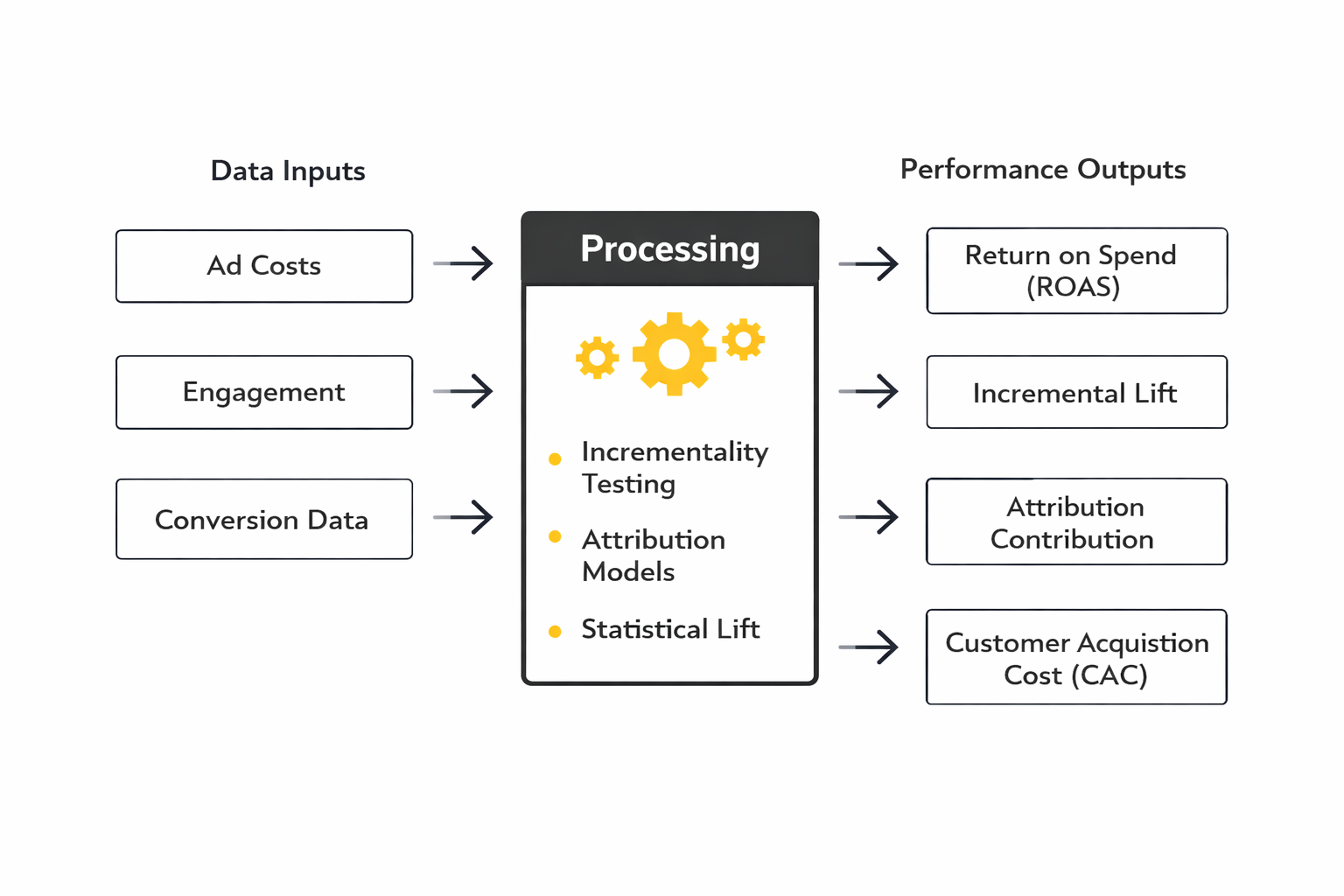
If you want social media agency pricing to feel fair, you need the numbers to be legible. Not “more metrics,” but a small set of measurements that explain what’s happening, why it’s happening, and what an agency should do next.
The reason analytics belongs inside the pricing conversation is simple: measurement is work. Reliable tagging, clean reporting, attribution hygiene, and performance diagnosis take time and senior thinking. When an agency underprices analytics, they usually pay for it by cutting depth, delaying insights, or reporting vanity metrics that can’t guide decisions.
These data points help anchor expectations around cost and outcomes without pretending every industry behaves the same.
- Social media share of budget: marketing leaders reported spending 11.3% of marketing budgets on social media, a figure shown again in the topline tables and reinforced in Deloitte’s WSJ CMO briefing.
- Marketing budgets and pressure to prove ROI: marketing budgets stayed flat at 7.7% of company revenue in 2025, a number echoed in Marketing Brew’s coverage.
- Where engagement is trending: platform-level benchmarks show wide spreads, with TikTok’s engagement rate listed at 3.70% in Socialinsider’s 2026 report, while Instagram sits at 0.48% and Facebook at 0.15%, a summary also carried by Social Media Today’s recap.
- Short-form format performance signals: brand benchmarking found Reels reach engagement rates dropping from 2.6% in 2023 to 2.2% in 2024, while still outperforming TikTok’s average reach engagement rate of 1.7%.
- Paid inventory cost movement: Meta reported average price per ad increasing 10% year-over-year in 2024 and 9% year-over-year in 2025, which matters because ad-cost inflation changes the “efficient spend” threshold agencies must hit to justify fees.
Performance Benchmarks
Benchmarks are useful when you treat them like guardrails, not targets. Their job is to tell you whether you’re wildly off-course, not whether you’re “winning” on every metric.
Here are benchmark lenses that tend to map directly to social media agency pricing because they influence how much work is required to move results.
Organic engagement benchmarks that shape content costs
Organic engagement is often where buyers get confused: they expect a higher retainer to automatically produce higher engagement. In reality, retainer size influences consistency and quality, but platform distribution rules still decide how far your content travels.
To sanity-check performance, it helps to anchor to broad cross-industry datasets. Socialinsider’s 2026 benchmark summary reports TikTok engagement at 3.70%, Instagram at 0.48%, and Facebook at 0.15%. These aren’t “good” or “bad” numbers; they’re context for what it takes to outperform a baseline.
Short-form benchmarks that change the production math
Short-form video can be cost-efficient in reach, but it can be expensive in iteration. You’re often producing more variations, testing more hooks, and working faster.
Emplifi’s benchmarking shows Reels reach engagement rates at 2.2% in 2024 versus TikTok’s average reach engagement rate of 1.7%. That kind of gap affects pricing decisions because it can justify shifting creative resources toward the formats that buy you more distribution per asset.
Paid cost benchmarks that affect “what success looks like”
Even if your engagement is strong, paid social is where budgets get interrogated. When platform costs rise, agencies must either improve conversion efficiency or accept that the same spend buys fewer outcomes.
Meta’s reported increases in average price per ad (+10% in 2024, +9% in 2025) are a practical reminder: if your agency pricing model assumes “costs stay the same,” the model will break the moment the market shifts.
Analytics Interpretation
Most brands don’t have a data problem. They have an interpretation problem. Dashboards can tell you what happened; they rarely tell you what to do.
In a pricing conversation, interpretation is the difference between paying for a monthly report and paying for a performance partner. It’s also the difference between a cheap retainer that looks fine on paper and an effective retainer that changes decisions.
Start with one “north star” per channel role
Instead of tracking 40 metrics, define one primary signal that matches what the channel is supposed to do. If Instagram is brand demand and TikTok is discovery, don’t judge them by the same KPI. Compare each platform to its own job description.
Separate leading indicators from lagging indicators
Leading indicators tell you whether your creative is resonating now: watch time, saves, shares, comment velocity, click quality. Lagging indicators tell you whether resonance turned into value later: signups, pipeline, purchases, retention.
Agencies that price higher often do so because they’re committing to both sides: they optimize creative signals quickly, then validate downstream impact over time.
Use “effort vs. impact” to decide what’s worth producing
When teams feel overloaded, it’s usually because content production is disconnected from impact. A professional team asks, “Which assets buy us disproportionate results?” and then reallocates production accordingly.
This is also where tool-assisted reporting becomes a real cost lever. The Forrester TEI study for Sprout describes an 80% reduction in time spent on social reporting, which is also referenced in Sprout’s summary of the TEI findings and supported as a cited business point in Sprout Social’s SEC filing discussion of the TEI results. When reporting takes less time, agencies can spend more time on decisions that move performance.
Be honest about attribution, then design around it
Social rarely behaves like a single-click channel, especially in B2B and higher-consideration purchases. That doesn’t mean it’s unmeasurable; it means measurement needs to reflect how people actually decide.
If your agency is pricing “growth” or “revenue impact,” you want to see how they connect social activity to business outcomes without pretending attribution is perfect. This is where many proposals look similar but behave differently once the work starts.
Case Stories
Case stories are only useful when they’re specific and verifiable. The point isn’t to copy someone else’s tactics; it’s to see what kind of measurement discipline and operational choices created the result.
Sprout Social: Turning reporting into faster customer care
Sprout’s own customer care team handled massive message volume through its Smart Inbox and used reporting to tighten operations. The case study notes 36,000 messages handled in 2023 alongside a 55% decrease in average response time.
The pricing lesson is straightforward: when an agency promises “community management,” the real cost isn’t replying. It’s building the tagging, routing, and reporting habits that make reply speed and quality sustainable.
Ray-Ban: Using automation to change the efficiency curve
Ray-Ban’s TikTok success story highlights a shift to Smart+ Catalog Ads and reports a 50% decrease in CPA, a 47% increase in conversion rate, and a 42% higher ROAS.
The pricing lesson here isn’t “automation fixes everything.” It’s that performance improvements often come from system-level changes (how campaigns are structured and optimized), not just from swapping creative. Agencies that price for performance typically include this kind of structural work as part of their paid media scope.
Professional Promotion
When you’re evaluating social media agency pricing, analytics should be treated like a product you’re buying—not a slide deck you receive. The best agencies make reporting feel like a leadership tool: clear narrative, tight priorities, and decisions that are easy to make after you read it.
If you want a simple standard to hold agencies to, look for these signals in how they talk about measurement:
- They define what matters first: one primary KPI per channel role, with supporting metrics that explain it.
- They show their methodology: how content is tagged, how experiments are run, and how conclusions are reached.
- They connect the dots: engagement and reach are linked to downstream behavior where possible, without pretending attribution is perfect.
- They buy back time with tooling: automation reduces manual reporting so the team can spend time on analysis and action, the kind of productivity impact described in the Forrester TEI study for Sprout Social.
That’s the real “analytics premium” inside social media agency pricing: you’re paying for fewer surprises, faster course-correction, and a monthly rhythm where performance improves because decisions get made with confidence—not because someone stayed up late polishing charts.
Advanced Strategies
At a certain point, social media agency pricing stops being driven by “how much content” and starts being driven by “how fast you can learn and scale without breaking quality.” Advanced strategy is the layer that makes that possible. It’s also the layer that separates agencies that look affordable on paper from agencies that keep compounding results six months in.
These are the strategies that typically move the needle when a brand is already posting consistently and running paid campaigns, but growth has started to plateau.
Build a modular creative system instead of chasing one-off winners
The fastest scaling teams treat creative like a system of parts: hook, format, proof, offer, and close. When a concept works, they don’t just “boost the post.” They rebuild the concept into variations, then test the parts that matter most. That’s how you get to high-volume iteration without turning production into chaos.
This is also why TikTok case studies repeatedly emphasize pairing TikTok-first creative with automation. Marks & Spencer’s shift toward creator-led creative paired with Smart+ is described as a deliberate move away from repurposed studio assets and toward UGC-style formats like hauls and styling tips, alongside dynamic Catalog Ads tied to product feeds in TikTok’s Marks & Spencer case study.
Turn creators into a repeatable acquisition engine, not a one-time campaign
Creator work scales when it’s treated like a pipeline: discovery, briefing, production, whitelisting/usage rights, distribution, and measurement. The moment it becomes “let’s hire a creator,” the program stops being measurable and starts being vibes.
Creator marketing is also becoming too large to treat as a side experiment. US creator ad spend is projected to hit $37B in 2025, up 26% year over year, with 2024 estimated at $29.5B. When the market is moving that fast, the strategy is less about “should we do creators?” and more about “how do we operationalize it so it scales safely?”
Measure incrementality, not just attribution
When you scale, last-click metrics can trick you into cutting the very channels that create demand. The fix isn’t “ignore data.” The fix is using experiments (geo lift, conversion lift, holdouts) that can separate what truly caused outcomes from what merely happened near them.
Nordic Naturals’ TikTok case study is a clean example of this mindset. Their team and agency focused on proving impact beyond last-click attribution and used a Geo Lift study to quantify causal outcomes, reporting $1.94 incremental ROAS and finding that traditional attribution under-reported the channel’s contribution by 98%.
Use automation to buy back human time for creative and decisions
Automation is not a shortcut for thinking. It’s a shortcut for repetitive setup and manual optimization, so the team can spend more time on creative direction, testing strategy, and measurement design.
Marks & Spencer framed their shift as a move from manual campaign building to an automated performance approach, and the case study reports a 44% increase in conversion rate alongside a 94% decrease in purchase CPA. BSSET used GMV Max to scale performance while claiming they only needed 5 minutes daily to manage campaigns during the run.
Scaling Framework
Scaling gets easier when everyone agrees on what “scale” actually means. In practice, scaling is not “spend more” or “post more.” It’s increasing output and investment while keeping quality, governance, and measurement stable.
This framework keeps social media agency pricing tied to real capacity needs instead of vague expectations.
Stage 1: Stabilize the operating system
This is where you lock workflows, approvals, tagging, and reporting cadence. The goal is to stop losing time to internal friction. If the system is unstable, adding more content or spend only amplifies confusion.
Stage 2: Prove repeatable creative patterns
At this stage, you’re not looking for one viral post. You’re looking for creative patterns that can be reproduced across formats and platforms. This is where modular creative and structured iteration starts paying for itself.
Stage 3: Expand distribution without breaking efficiency
Once patterns are working, you expand distribution: more audiences, more placements, more creator variations, and better product-feed integration. The discipline is to expand one axis at a time so you can learn what caused the gain.
The TikTok case studies that emphasize automation plus TikTok-first creative are essentially describing this stage as a system: native creative formats scaled through automated delivery and personalization, as shown in Marks & Spencer’s approach.
Stage 4: Validate incrementality and reallocate budget with confidence
This is where you stop arguing about attribution models and start making decisions based on experiments. You validate which investments are creating net new outcomes and then reallocate budget toward what’s truly driving growth.
Nordic Naturals’ Geo Lift approach is a clear example of this stage, using experimentation to quantify causal impact and uncovering under-reporting in standard attribution by 98%.
Growth Optimization
Optimization at scale is not a checklist. It’s a rhythm: decisions made weekly, experiments run monthly, and structural fixes handled quarterly. If an agency can’t explain this rhythm clearly, the “optimization” line item in social media agency pricing is usually just hope packaged as a service.
Creative optimization: test fewer things, more intelligently
Scaling teams don’t test 20 random ideas. They test a few hypotheses with clean variations: different hooks, different proofs, different formats. That makes results interpretable and decisions obvious.
If you want a reality check on how format performance can shift year to year, Socialinsider’s 2026 dataset analyzed 70M posts, and its summary shows TikTok engagement at 3.70% while Instagram sits at 0.48%. The point isn’t to chase a number; it’s to choose formats that give you a better “learning rate” per asset.
Budget optimization: scale what’s proven, protect learning budget
When spend increases, brands often squeeze learning out of the system by demanding efficiency at all times. That creates a trap: you stop testing, performance stalls, and then you blame the channel.
A healthier model is to protect a fixed percentage of budget for experimentation and keep the rest in proven structures. The Marks & Spencer case study describes how efficiency gains enabled reinvestment and further scaling, elevating TikTok as a top-performing platform within an MMM attribution window in the published results.
Measurement optimization: stop paying for dashboards that don’t change decisions
At scale, reporting must answer two questions quickly: what changed, and what do we do next? Anything else is decorative.
Tool-assisted reporting can materially change the agency’s capacity. The Forrester TEI study for Sprout Social describes an 80% reduction in time spent on social reporting, which matters because time saved on manual reporting becomes time spent on experiments, creative direction, and performance diagnosis.
Operational optimization: scale coverage without burning the team
Scaling social means scaling feedback, approvals, community care, and stakeholder expectations. If you don’t redesign how work moves, your team becomes the bottleneck.
This is where the martech utilization problem becomes a pricing problem. Marketing leaders have been warned that only 49% of martech is used, a figure also discussed in Marketing Week’s reporting on Gartner’s 2025 findings. Scaling isn’t about adding more tools; it’s about using fewer tools more deeply so the process stays fast and reliable.
Scaling Stories
Scaling stories only matter when they show the operational choices underneath the result. Here’s one that illustrates how automation, TikTok-native creative, and measurement discipline can reshape what “efficient scale” looks like.
Marks & Spencer: When Manual Performance Hit a Ceiling
It started with an uncomfortable realization: the numbers weren’t collapsing, but they weren’t improving either. The team could keep pushing budget into the same approach, yet the outcomes felt increasingly predictable. In a channel that rewards momentum, predictability can be a quiet warning sign.
The backstory was simple and very common. Marks & Spencer wanted to understand whether moving from manually built campaigns to automation could unlock stronger conversion performance and incremental customer growth at scale, as described in TikTok’s published case study. They weren’t chasing novelty; they were trying to find a repeatable lever that could hold up under budget growth.
The wall showed up as efficiency limits. Manual builds can only react so fast, and they can only personalize so far before the structure becomes too complex to manage cleanly. When a team is stuck tuning the machine instead of improving the inputs, scale becomes more expensive than it should be.
The epiphany was that scaling wasn’t a bidding trick; it was a system change. The plan wasn’t “optimize harder,” it was “pair TikTok-first creative with an automated delivery system built for scale,” a combination emphasized in the strategy section of the case study. That shift also required creative humility: moving away from repurposed, highly produced assets and leaning into creator-led formats that belonged in the feed.
The journey became about building the right inputs and letting the system do what it does best. They activated UGC and creator content through an ambassador program and fashion influencers, using familiar TikTok formats like hauls and outfit-of-the-day videos, as described in the creative pillar breakdown. They also connected inspiration to commerce through dynamic Catalog Ads tied to their product feed, so the system could personalize at scale without adding manual overhead.
The final conflict was trust. Automation only works when you allow the algorithm room to learn, which can feel risky to teams used to tight controls and constant manual adjustments. At the same time, TikTok-first creative can feel uncomfortable to brands that are used to polished studio execution, because authenticity is harder to approve than perfection.
The dream outcome was what scale is supposed to look like: better results while reducing effort per incremental conversion. The published results report a 44% increase in conversion rate, a 94% decrease in purchase CPA, and a 56% reduction in CPC. More importantly, the case study describes how those gains enabled reinvestment and positioned TikTok as a core growth channel within an MMM attribution window in the scaling note in the results section.
Future Trends
Social media agency pricing is moving in a clear direction: less emphasis on “how many posts,” and more emphasis on risk management, creative velocity, and measurable business impact. The work is getting more operational, more regulated, and more automated at the same time.
AI-generated content disclosure is becoming part of the production workflow. Platforms and regulators are pushing toward clearer labeling of synthetic media, which means agencies are pricing more time for review, approvals, and documentation. You can see the direction of travel in X rolling out a “Made with AI” label for creators to flag AI-generated posts, which signals that transparency expectations are becoming product-level features rather than optional ethics statements. The coverage of X’s new “Made with AI” label highlights how rapidly disclosure norms are moving into mainstream workflows.
Brand safety is being redefined by “AI slop” and provenance battles. As low-quality synthetic content floods feeds, brands are becoming more cautious about adjacency, authenticity, and distribution choices. That tension is captured in reporting on provenance standards like C2PA and the uneven way platforms apply labels or strip metadata, which makes verification messy in real-world content supply chains. This breakdown of provenance labeling and why it’s not working consistently shows why agencies are increasingly priced for governance, not just creativity.
Automation is accelerating, but it’s not making agencies cheaper. Automation reduces repetitive labor, yet it raises the bar for strategic oversight. Paid platforms are competing aggressively on AI-driven ad creation and optimization, pushing agencies to price for experimentation design and measurement interpretation rather than manual button-pushing. eMarketer’s 2026 paid social FAQ captures how AI tooling, platform cost shifts, and brand safety concerns are converging into one operational challenge.
Creator marketing is becoming infrastructure, not a side channel. The market is scaling fast enough that brands can’t treat creators as one-off campaigns anymore; they need pipelines, rights management, distribution strategy, and standardized measurement. US creator ad spend is projected to reach $37B in 2025, up from $29.5B in 2024, which is why creator operations are increasingly priced as a standing capability rather than an add-on.
Regulation is creeping closer to advertising execution. Disclosure requirements for synthetic performers in advertising are moving from theory to enforceable timelines, which affects how agencies price legal review, compliance checks, and documentation. Reuters’ coverage of New York’s law requiring disclosure of AI-generated performers in ads (effective June 9, 2026) shows how quickly these expectations are becoming concrete production requirements. The Reuters report on New York’s AI disclosure law for advertising is a clear signal that “compliance” is no longer a separate department’s problem.
Strategic Framework Recap

By now, the pattern behind social media agency pricing should feel a lot less mysterious. The cost isn’t just the output you see. It’s the system that makes output consistent, safe, and improvable.
Use this recap as your decision lens whenever you’re comparing proposals:
- Outcomes: the proposal clearly defines what the work is meant to change and how success will be measured.
- Scope: deliverables, response expectations, review rounds, and exclusions are written clearly enough that nobody has to “interpret” the contract later.
- Capacity: you can see who is on the account and how senior oversight shows up in planning, reviews, and optimization.
- Complexity: platforms, formats, stakeholders, languages, regions, and compliance needs are priced intentionally rather than hidden inside a vague retainer.
- Optimization rhythm: the agency can explain how weekly decisions, monthly experiments, and quarterly measurement fixes are handled in practice.
- Tooling and governance: the stack and workflows reduce friction and risk, rather than adding licenses nobody uses.
If a proposal is missing one of these, the price isn’t necessarily wrong. It’s incomplete. And incomplete pricing is how brands end up paying twice: once for the retainer, then again in time, stress, and rework.
FAQ – Built for the Complete Guide
What actually determines social media agency pricing?
Pricing is driven by the outcomes you want, the scope required to pursue them, the complexity of your channels and approvals, and the capacity the agency must allocate to deliver consistently. If community management, paid optimization, creator programs, or compliance are included, the operational load rises fast.
Is a retainer always better than project pricing?
Retainers work best when your brand needs continuous execution, optimization, and community coverage. Project pricing is more suitable for one-off launches, audits, or a defined campaign with clear boundaries. The best choice is the one that matches how frequently your strategy needs to adapt.
What should a solid scope of work include?
It should list deliverables, platforms, content formats, publishing cadence, review rounds, response times for community, reporting frequency, and what is explicitly out of scope. Ambiguity is expensive because it turns every request into a negotiation.
How many platforms should one agency handle?
As many as they can run well without degrading quality. If your strategy needs multiple platforms, you want clear channel roles and a production system that can generate platform-native assets. Too many platforms without capacity usually leads to generic content and weak learning.
Why do paid social fees vary so much?
Because “paid social” can mean anything from basic campaign management to full-funnel creative testing, landing page coordination, measurement setup, and experiment design. Fees rise when the agency is responsible for outcomes and has to manage performance volatility.
Do tools and software costs belong inside the agency fee?
Sometimes. If the agency runs the stack and provides dashboards, publishing workflows, and governance, tools may be bundled. If you need seats for multiple stakeholders, tool pricing often becomes a direct pass-through or a separate line item because it scales with access and usage.
What KPIs should we track to judge value fairly?
Pick one north-star KPI per channel role, then use supporting metrics to explain it. For example: discovery channels may prioritize watch time and shares, while conversion channels prioritize qualified clicks and downstream actions. The key is that reporting should lead to decisions, not just summaries.
How will AI change social media agency pricing over the next year?
AI will reduce repetitive work, but it will increase the need for oversight: brand voice control, disclosure expectations, provenance challenges, and faster experimentation. Coverage of platforms and standards struggling with consistent labeling shows why “trust and verification” is becoming part of the operating cost. This look at provenance and labeling limits is a practical preview of where agency workflows are headed.
How should we budget for creators without wasting money?
Budget for a pipeline, not a stunt. That includes creator sourcing, briefing, content production, usage rights, distribution, and measurement. The market’s growth signals why this is becoming a core capability, with creator ad spend projected to hit $37B in 2025.
What are the biggest red flags in agency proposals?
Vague scope, unclear ownership of approvals, “unlimited” deliverables without capacity detail, reporting that’s all vanity metrics, and performance promises without a measurement plan. If the agency can’t explain how they learn, iterate, and change decisions month to month, the retainer often becomes a content subscription.
How long should we commit before judging results?
For mature brands with existing assets, you can often see directional improvements within 30–60 days. For new strategies, creator pipelines, or measurement rebuilds, a 90-day window is more realistic because you need time for testing, iteration, and operational stabilization.
Work With Professionals
If you’re reading this because you want better clients, not just better theory, here’s the uncomfortable part: most freelancers don’t lose deals because they’re not good. They lose deals because companies can’t find them fast enough, can’t verify fit fast enough, or get stuck in platforms that take a cut and slow everything down.
MARKEWORK is built around the opposite idea: keep the process clean, keep communication direct, and keep costs predictable. The platform describes itself as a focused marketplace where companies and marketers connect directly, with no project fees and direct communication baked into how it works. Pricing is structured as simple monthly plans that include access to thousands of job listings and direct messaging, rather than commissions on what you earn.
Imagine what changes when you’re not constantly negotiating platform rules. You can present your rate like a professional, negotiate like a professional, and keep the relationship between you and the client clean. That’s the emotional core of freedom in modern marketing work: you keep control, you keep momentum, and you keep what you earn because the model is subscriptions instead of commissions. The pricing page makes the “no commissions, no project fees” model explicit.
If you’re serious about landing more remote contracts, build your profile like a product page, apply with intention, and use direct communication to close faster. When the platform removes the middle layer, your portfolio and your clarity do the selling.
 Filip Konecny Enterprises