

Influencer marketing stopped being a “nice-to-have” the moment teams were asked to prove it works like any other channel: with clean tracking, repeatable processes, and predictable outcomes.
That’s where a social influencer marketing platform earns its keep. It’s not just a database of creators. The right platform becomes the operating system for partnerships—helping you find the right people, manage collaboration at scale, stay compliant, and connect creator content to business results.
Article Outline
- What Is a Social Influencer Marketing Platform?
- Why a Social Influencer Marketing Platform Matters
- Framework Overview
- Core Components
- Professional Implementation
- Discovery and Vetting at Scale
- Campaign Operations and Workflow Automation
- Measurement and Attribution That Finance Trusts
- Compliance and Brand Safety
- Integrations and Ecosystem
- Platform Selection Checklist
- FAQ
What Is a Social Influencer Marketing Platform?

A social influencer marketing platform is software that helps brands and agencies run creator partnerships end to end—typically covering discovery, outreach, contracting, content approvals, payments, reporting, and governance.
In practice, it replaces the messy stack most teams start with: spreadsheets for shortlists, DMs for negotiation, email threads for approvals, shared drives for assets, and a patchwork of tracking links that break the moment content gets repurposed. A platform puts those moving parts into one system so campaigns can scale without losing control.
The easiest way to sanity-check what counts as a platform is to ask: Does it manage the whole relationship lifecycle? A directory helps you browse creators. A measurement tool helps you read results. A true platform connects the lifecycle—so you can go from “we should work with them” to “we can prove what changed because we did.”
This category has become big business because creator work is no longer a side budget. In the U.S. alone, creator economy ad spend was measured at about $29.5B in 2024, with a projection of $37B for 2025—figures echoed in IAB’s release notes and covered by Marketing Dive.
At the same time, the software market supporting it has expanded fast. Multiple independent market analyses peg the influencer marketing platform space at tens of billions today and growing sharply—see estimates like Grand View Research’s 2024 market sizing, alongside forecasts from Research and Markets and Fortune Business Insights.
Why a Social Influencer Marketing Platform Matters
Influencer marketing looks simple from the outside: pay a creator, post content, collect engagement. The reality is closer to supply-chain management—multiple partners, timelines, approvals, compliance requirements, and performance risk.
Without a platform, most teams hit the same ceiling: results may be decent, but the process is fragile. One person “owns” the creator relationships in their inbox. Briefs live in a folder no one can find. Usage rights are unclear when paid media wants to amplify the post. Then the CFO asks what revenue moved—and everyone goes quiet.
A platform matters because it makes creator marketing operational:
- It reduces coordination drag. You centralize outreach, negotiation, contracts, content review, and deliverables so campaigns don’t stall on “where is the latest version?”
- It lowers compliance risk. Regulators and watchdogs increasingly monitor disclosures. The UK ASA’s monitoring exercise used its Active Ad Monitoring System to analyze 50,000+ pieces of content across Instagram and TikTok, backed by their published report PDF.
- It makes measurement defensible. The IAB has been blunt that creator marketing still suffers from fragmented measurement and the need for consistent reporting and standards, reflected in the Creator Economy Ad Spend & Strategy Report.
- It lets you scale what’s working. When you can see which creators, formats, and audiences actually move business outcomes, you can turn “one-off collaborations” into a repeatable growth engine.
There’s also a creative performance angle that’s hard to ignore. In controlled testing reported by Kantar’s India Context Lab coverage, ads featuring influencer content held attention longer—showing a 2.2x lift in skip time (17.8 seconds vs. 7.9 seconds), covered by outlets like Business Standard and The Economic Times as well as exchange4media.
Finally, platforms help you protect trust. When creator content feels authentic, it can create real emotional connection—Nielsen reporting found that 77% of creator fans felt connected to brands featured in creator content, with methodology details available in the supporting Nielsen case study PDF.
Framework Overview
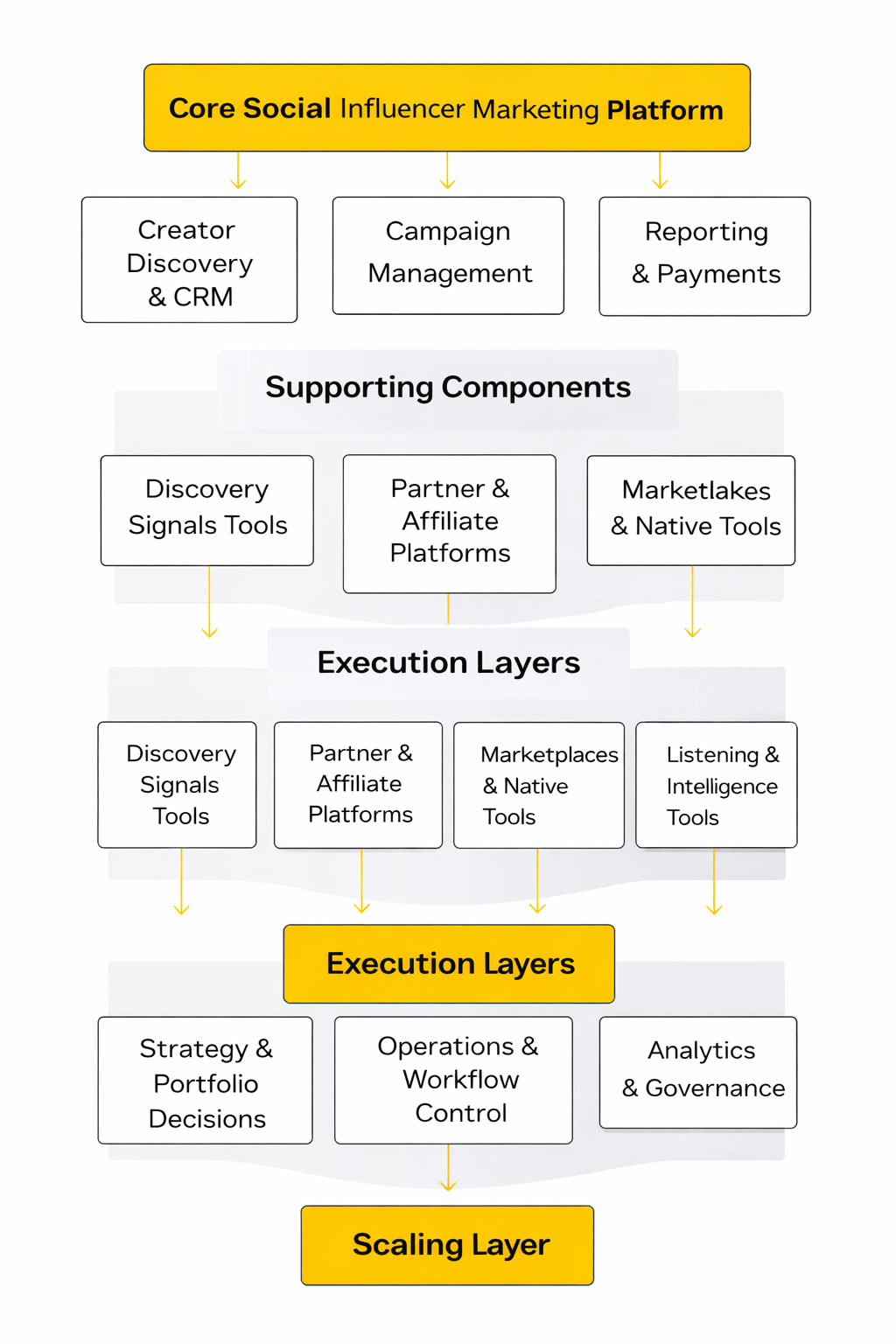
If you’re evaluating or rebuilding your stack, it helps to think of a social influencer marketing platform as five connected systems—not a single “tool.”
- Supply: creator discovery, audience fit, fraud checks, and shortlist logic
- Deal: outreach, negotiation history, contracting, usage rights, and payments
- Production: briefing, content review, approvals, version control, and asset storage
- Distribution: organic publishing support plus amplification workflows (whitelisting/partnership ads, allowlisting, repurposing)
- Proof: measurement, attribution, reporting, and learning loops that improve the next campaign
The trap is optimizing one system while the others stay manual. For example, you can find amazing creators (Supply) but still lose weeks to approvals (Production), or you can ship content fast but fail to connect it to outcomes (Proof). The platform you choose should close the gaps between these systems—because the gaps are where money and trust leak out.
This framework also aligns with what industry bodies flag as the blockers to growth: brands want creator partnerships to be a core channel, but they need better discovery, consistent reporting, and stronger standards to connect activations to business outcomes—needs repeatedly highlighted in IAB’s 2025 creator economy research and the full report.
Core Components
Most platforms advertise long feature lists, but the components that actually determine success are simpler—and easier to test.
Creator Discovery That Matches How You Really Buy
Discovery isn’t about “millions of creators.” It’s about whether you can consistently find creators whose audience and content style match the job you’re hiring them for. The best systems let you filter by audience demographics, geography, brand affinity, content topics, past partnerships, and performance signals—then save that logic so your team isn’t reinventing the shortlist every month.
Relationship and Deal Management
When budgets rise, memories get short. You need a reliable record of what you offered, what was delivered, what rights you bought, and what you can legally reuse. This is where platforms earn their keep: centralized negotiations, contract templates, usage-rights tracking, and payment workflows that don’t rely on one person’s inbox.
Workflow for Briefing, Review, and Approvals
Creator marketing breaks when approvals are vague. Strong platforms force clarity: a structured brief, explicit do’s and don’ts, timelines, checkpoints, and a single place where stakeholders can comment and sign off. That reduces revisions, keeps creators happy, and prevents “great content” from dying in committee.
Measurement That Connects to Outcomes
Engagement is nice, but it’s not a business result. A platform should support clean link tracking, promo code governance, integration with your analytics stack, and reporting that separates what happened organically from what happened because you amplified or retargeted.
If you plan to scale through paid, this matters even more. Meta has publicly shared performance advantages for partnership-style creator ads—coverage of Meta’s own data has cited lower CPAs and higher CTRs for partnership ads, reinforcing why rights management and “amplification-ready” workflows belong inside your platform, not in a spreadsheet.
Compliance and Brand Safety
Compliance isn’t a checkbox; it’s a process. Platforms should help you enforce disclosure requirements, store approvals, and keep evidence of what was agreed. In the U.S., the FTC’s guidance makes it clear that material connections must be disclosed in ways people will actually notice—see the FTC’s hub on endorsements, influencers, and reviews for the practical expectations that brands and creators are held to.
Professional Implementation
Buying a social influencer marketing platform is the easy part. Implementing it in a way that changes outcomes is where most teams stumble—usually because they try to “move everything over” before they decide how they want to operate.
A professional implementation starts with one decision: what will be standardized (so you can scale) and what will stay flexible (so creators can stay creators). The goal isn’t to make creator work feel corporate. The goal is to remove the friction that wastes time while protecting brand safety and measurement integrity.
- Define a minimum campaign spec. One-page brief format, required disclosure language, usage-rights defaults, and a baseline measurement plan.
- Establish a rights-first workflow. If you might amplify content later, bake that into contracting from day one so paid media isn’t blocked by missing permissions.
- Build a measurement ladder. Decide what “success” means for awareness, consideration, and conversion campaigns, then map platform reporting to those outcomes so stakeholders stop debating metrics after launch.
- Set governance early. Who can approve creators, who can approve claims, who can approve spend, and where the audit trail lives—especially important in markets with active monitoring like the UK ASA’s influencer disclosure reporting.
Once those foundations are in place, the platform becomes leverage. You can onboard new team members faster, run more campaigns without losing quality, and scale partnerships while staying confident that what you’re publishing is compliant, on-brand, and measurable.
Tools Supporting the Framework
The framework from Part 1 only works when your tooling matches the way creator partnerships behave in the real world: lots of small moving parts, high creative variability, and a constant tug-of-war between speed and control.
A modern social influencer marketing platform typically acts as the “system of record” for creator relationships. Around it, most teams assemble a support layer: tools for discovery signals, paid amplification permissions, rights management, affiliate-style tracking, and reporting that can survive a finance review.
One reason stacks keep expanding is that influencer marketing is still scaling rapidly. The IAB’s creator economy research points to creator ad spend climbing to $37B in 2025, echoed in the full report PDF and reported by Business Insider’s coverage. When spend rises, the tolerance for messy operations drops fast.
At the same time, platforms (especially Meta) have evolved the mechanics of “turning creator content into media” in ways that reward teams who can operationalize permissions. Instagram’s help documentation makes it explicit that branded content ads are now called partnership ads, and Meta’s own announcement frames partnership ads as a way to amplify creator content at scale via Creator Marketplace workflows directly inside Instagram.
So the question isn’t whether you need tools. It’s whether your tools are aligned around a single operating model, or whether they’re quietly fighting each other.
Tool Categories
Instead of thinking in vendor names, it’s more useful to think in categories—because most brands end up mixing at least two categories, even if they start with one social influencer marketing platform.
1) Core Influencer Platforms
This is the “home base” for creator programs: discovery, CRM-like relationship history, campaigns, deliverables, approvals, payments, and reporting. In practice, your core platform is where you want every creator to exist as an entity you can manage over time, not a one-off row in a spreadsheet.
- Why teams pick them: centralized workflow and repeatable operations
- Where they can fall short: attribution depth and paid amplification permissions may still require additional tooling
2) Partner and Affiliate Platforms
When brands want creator marketing to behave more like performance marketing, they often layer in partner platforms that were built for affiliates and then expanded into creators. These tools are especially useful when you’re moving beyond flat fees and need clean conversion tracking, payouts, and partner-level governance across many relationships.
- Why teams pick them: performance tracking and payouts that align with revenue accountability
- Good fit signals: you’re blending affiliates + creators, or building creator affiliate programs at scale
Impact.com has been pushing this convergence heavily, with a Resident example that blends influencer partnerships and affiliate-style measurement across the funnel in its published case study PDF and follow-on materials like its convergence write-up.
3) Marketplaces and Native Platform Tools
Marketplaces are great for speed, seeding, and discovery—especially when you want to recruit creators already active on a platform. But they’re not always designed to be your long-term system of record, which is why many brands use them as a feeder into a core social influencer marketing platform.
- Examples of what “native” looks like: Instagram Creator Marketplace and partnership ads workflows inside Meta’s ecosystem
- Why teams like this category: faster creator matching and simpler permissions for amplification
4) Social Listening and Competitive Intelligence
Listening tools help you spot what creators are already saying about your brand, your competitors, and your category—often before you ever send an outreach email. They’re also useful for brand safety checks, trend detection, and identifying emerging creators in your niche.
5) Rights, Content Libraries, and Asset Reuse
Once creator content is working, paid teams will want to reuse it, e-commerce teams will want it on PDPs, and brand teams will want it in presentations. That’s when rights and licensing stop being “legal detail” and become a growth lever. If your platform doesn’t make usage rights obvious, your content library becomes a risk warehouse.
6) Measurement, Attribution, and Reporting
Some brands can live with platform-level reporting. Most can’t—especially if they’re investing in performance outcomes. This category includes link tracking, coupon governance, MMM/attribution integrations, and incrementality approaches. It’s also where finance teams start asking hard questions, which is why partner platforms and analytics layers often appear as creator programs mature.
Tool Comparison
Comparing tools is hard because vendors often claim the same outcomes. The easiest way to cut through it is to compare how each category behaves across five real-world requirements: scale, control, creativity, proof, and risk.
What to Score (Even Before You Book Demos)
- Relationship depth: can you see negotiation history, deliverables, approvals, and usage rights in one place?
- Workflow friction: does the tool reduce approvals and asset chaos, or does it just move the chaos into a new interface?
- Permission pathways for paid: can you operationalize partnership ads cleanly, given that Instagram positions partnership ads as the current standard?
- Measurement credibility: can reporting connect to business outcomes, not just likes and views?
- Governance and compliance: does the system help you enforce disclosures and keep an audit trail?
When a Core Social Influencer Marketing Platform Wins
If your biggest problem is operational—too many campaigns, too many creators, too many stakeholders—then a core social influencer marketing platform usually gives the fastest relief. The most valuable feature is rarely “discovery.” It’s the ability to run creator work like a production line without stripping away creativity.
This is also where creator expectations matter. Sprout Social’s research highlights that 65% of influencers want to be involved earlier in creative or product development, which shows up in the supporting report PDF. Tools that force rigid, late-stage briefs tend to create silent failure: creators accept, deliver, and the content lands flat.
When Partner Platforms Win
If your biggest problem is proof—especially revenue proof—partner platforms often win because they were built for conversion governance first. They’re a strong fit when you want to blend creators with affiliate economics, build creator affiliate programs, or prove incremental value using stronger tracking logic.
Impact.com’s materials around convergence and full-funnel partnerships show what this looks like when it works at scale in the Resident case study and the broader framework it promotes as “partner marketing”.
When Native Platform Tools Win
Native tools are often the fastest route to action because they live where creators already operate. Meta’s February 2024 update positions Creator Marketplace as a way to find and collaborate with creators, while pairing that workflow with partnership ads to scale distribution directly inside Instagram. If you’re primarily running Meta-first campaigns, native tooling can be surprisingly efficient—until you need cross-channel governance and deeper reporting.
The Stack Reality Most Teams Land On
Most mature programs end up with a hybrid:
- One core social influencer marketing platform as the system of record
- One performance layer (partner/affiliate tracking or analytics)
- Selective native tools for permissions and distribution where they reduce friction (especially partnership ads workflows)
- Optional listening and rights tooling depending on risk and reuse volume
This hybrid approach is also consistent with where the market is heading. Sprout Social’s marketer survey data shows 59% of marketers plan to partner with more influencers in 2025, amplified by Chief Marketer’s write-up of the same dataset—which implies stacks will keep evolving simply because volume is rising.
Real Tool Stack Stories
Tool stacks feel abstract until you see what happens when a team hits a wall. The stories below are based on published materials from the brands and platforms involved, with links so you can read the originals and judge the context for yourself.
Resident’s “Full-Funnel or Bust” Moment
The numbers on the dashboard looked fine—until they didn’t. Campaigns were shipping, creators were posting, and the brand was visible everywhere. Then the hard question arrived internally: which partnerships were actually moving customers through the funnel, and which ones were just noise?
The pressure wasn’t theoretical. Resident operates in a brutally competitive mattress category, and even a small efficiency leak gets expensive fast. When leadership wanted growth, “more creators” wasn’t a strategy; it was a cost line that had to justify itself.
Before the shift, the team’s creator work behaved like a set of disconnected experiments. There were engagement campaigns that made the brand feel present, but conversion was harder to prove and harder to scale. The process also created a familiar operational drag: partnerships lived across too many places, so it was difficult to connect what was agreed, what was delivered, and what outcomes followed.
That tension shows up in impact.com’s discussion of the challenge of converting with creator partners after early engagement success in its convergence article. It’s also reflected in the way Resident is framed in the platform’s published story: a team trying to reach customers across every stage of the journey, not just the top of the funnel in the official case study PDF.
The wall arrived when the team realized that “influencer marketing” wasn’t the channel they needed—it was an operating model they needed. They didn’t just need creators; they needed governance, tracking logic, and a way to manage partners like a portfolio. As soon as that clicked, the problem changed from “find more creators” to “build a partner system that can scale.”
The epiphany wasn’t romantic, but it was powerful: a creator program that can’t connect content to outcomes will always be treated like a discretionary budget. Once that becomes obvious, the mandate becomes clear—tie creator relationships to measurable partner economics and make it repeatable. That shift is exactly what impact.com positions as the convergence of affiliate and influencer approaches in its platform framing.
The journey that followed looked less like a creative brainstorm and more like infrastructure work. Resident’s team moved toward a model where influencer partnerships could be managed alongside other partner types, with better attribution discipline and clearer performance expectations. The published case study materials describe this as blending affiliate marketing with influencer partnerships for a full-funnel result and supporting assets.
And because process change is never only process, they also had to align people: paid media, partnerships, finance, and brand all needed to agree on what “success” meant and how it would be measured. That kind of internal alignment shows up in the way Resident’s leadership discusses partnerships and measurement in impact.com content like the Partnership Economy Podcast episode with Jennifer Bentz.
Then reality did what it always does: it fought back. Partners don’t change behavior overnight, and measurement systems surface uncomfortable truths quickly. Some relationships that felt strong in the old model suddenly looked less valuable when evaluated through a performance lens, which forces hard decisions about renewals, budgets, and creative direction.
Even the best tools can’t prevent this part—tools only make it visible. When visibility increases, accountability follows, and that can be politically painful inside organizations that have grown used to reporting top-line engagement. That tension is why many teams avoid “serious” measurement until they’re forced into it.
In the end, the dream outcome wasn’t a single viral campaign. It was a creator program that could survive scrutiny because it behaved like a scalable system. The team’s goal became repeatability: clearer partner economics, more defensible attribution, and the ability to build creator partnerships that support the entire customer journey as framed in the published case study page.
That’s the quiet win most teams actually want—less chaos, more leverage, and a creator channel that can grow without begging for belief every quarter.
1) Pick One System of Record (and Enforce It)
Decide where “truth” lives: creator profiles, rate history, contracts, usage rights, deliverables, approvals, and reporting outputs. If those are split across four tools, you’ll recreate spreadsheet chaos—just with nicer interfaces.
2) Map Tools to Workflows, Not Departments
Departments buy tools. Workflows create outcomes. Map your stack to real motions like “seed product,” “approve content,” “grant amplification permission,” and “prove conversion,” then assign each motion a primary tool and a backup process for exceptions.
3) Operationalize Permissions for Paid Amplification
Creator content often becomes media. If you’re using partnership ads, align your process with platform reality: Instagram documents partnership ads as the current format in its help center, and Meta provides technical pathways like the Partnership Ads API documentation for how these ads are constructed. That means your workflow needs a clean, repeatable way to secure permissions and track what content can be promoted.
4) Build a Reporting Taxonomy Before You Launch
Decide how you will label campaigns (objective, product line, region, creator tier, content format, channel, amplification status). Taxonomy feels boring until you try to answer a simple question like “Which creator format is driving the best outcomes in Germany?” and realize you can’t filter cleanly.
5) Bake Compliance into the Workflow, Not the Training Deck
Compliance fails when it relies on memory. Build it into briefs, approvals, and checklists so the right disclosure language and audit trail happen automatically. Regulators and watchdogs are watching; the UK ASA’s influencer disclosure monitoring publicly describes analyzing 50,000+ pieces of content, with supporting detail in its report PDF.
6) Run a “Stack Pilot” Before You Migrate Everything
Choose one product line or one region, run a complete campaign cycle end to end, and test where the stack breaks: approvals, rights, payment, reporting, or attribution. Fix the breakpoints, then scale. Most failed implementations fail because teams migrate data first and process second.
7) Protect the Creator Experience While You Standardize Internals
Creators don’t want to feel like they’ve been hired into your org chart. Use tools to reduce friction: fewer revisions, faster approvals, clear expectations, and faster payments. The best stacks feel invisible to creators—because the structure is doing its job quietly in the background.
Step-by-Step Implementation

Implementing a social influencer marketing platform works best when you treat it like a rollout of a new operating system, not a “tool install.” The goal is simple: turn creator partnerships into a repeatable motion your team can run every week without losing quality, compliance, or measurement credibility.
Step 1: Align on the job the platform must do
Start by writing one sentence your leadership team would actually sign. Something like: “We use creator partnerships to drive qualified demand, then scale the best content through paid while maintaining compliant disclosures and clean reporting.” If you can’t say the job in one sentence, the platform will become a feature museum.
Make your success definition match the pressure creator teams are now under. CreatorIQ’s 2025–2026 research shows 51% of brands say economic volatility sharpened their focus on ROI, while 29% cite attribution challenges as a barrier to investment.
Step 2: Map your creator lifecycle from “first touch” to “renewal”
Before configuring anything, map the lifecycle you want to standardize: discovery, outreach, negotiation, contracting, briefing, approvals, publishing, amplification, payment, reporting, and renewal decisions. Then mark what currently breaks most often—late approvals, missing rights, unclear deliverables, or “we can’t prove impact.”
This map becomes your implementation backlog. It also makes it obvious what the platform must own versus what stays in your stack (affiliate tracking, BI dashboards, social listening, or paid media tooling).
Step 3: Build the data foundation before migrating anything
Create a clean taxonomy so reporting doesn’t collapse later: campaign objective, region, product line, creator tier, format, amplification status, and the primary KPI you’re responsible for. If your naming system is inconsistent, you’ll end up re-tagging everything manually when leadership asks for comparisons across quarters.
Then decide what data must be captured every time: usage rights, disclosure requirements, publishing dates, paid amplification permissions, and tracking primitives like links, codes, or partner IDs.
Step 4: Choose a tracking model your finance team will trust
Pick one primary measurement approach per campaign type. For awareness campaigns, you might rely on reach, brand lift proxies, and view-through signals. For conversion campaigns, you’ll need disciplined link and code governance, and you may need a partner layer if you’re paying commissions.
If you plan to scale creator content through paid, treat “permission for partnership ads” as a required input, not an optional add-on. Instagram’s own help documentation makes it clear that branded content ads are now called partnership ads, which is a practical hint that amplification is no longer a fringe use case.
Step 5: Configure workflows around the moments where campaigns usually die
Most creator campaigns don’t fail because you couldn’t find a creator. They fail because stakeholders can’t approve content quickly, usage rights are unclear, or payments stall and creators disappear. Configure the platform to remove those failure points first: templated briefs, approval routing, contract and rights fields, and a payment workflow that doesn’t require detective work.
Build a single “source of truth” record per creator and per campaign. If your team can’t answer “what did we agree to, what did we get, and what can we reuse?” in under two minutes, your implementation isn’t done.
Step 6: Run a pilot that includes paid amplification and reporting
Run one complete cycle end to end with a small number of creators, but include the complicated parts: approvals, rights, disclosure checks, paid amplification, and a final reporting readout. The pilot is where you discover what your org actually does under pressure.
Keep the pilot short and decisive. The “win” is not perfect creative. The win is a workflow you can repeat next month with twice the volume and half the chaos.
Step 7: Roll out in waves, not a big-bang migration
Wave 1: centralize creator records and campaign workflow. Wave 2: standardize contracts, rights, and payments. Wave 3: integrate partner tracking, analytics, and paid amplification permissions. This sequence protects your team from “migration fatigue,” where everything feels broken at once and everyone quietly returns to spreadsheets.
Execution Layers
A social influencer marketing platform can only deliver predictable results if you run it through clear execution layers. Think of these as five “lanes” that keep creator marketing moving without turning it into corporate sludge.
Layer 1: Strategy and portfolio decisions
This layer answers: which creator segments matter, which formats we’re betting on, and how partnerships fit into the broader media mix. It’s also where you decide what “good” looks like for each objective, so teams stop arguing about metrics after launch.
IAB’s creator economy research shows how quickly this space is professionalizing, with creator ad spend projected to reach $37B in 2025, which makes portfolio thinking less optional and more survival.
Layer 2: Operations and workflow control
This is where the platform earns its keep: structured briefs, timeline management, version control, approvals, and deliverables. If this layer is weak, your program becomes a string of late posts and “we missed the moment” regrets.
Layer 3: Creative enablement
Creators need constraints that protect the brand, but they also need freedom to sound like themselves. Your platform should support creative flexibility with guardrails: claim substantiation rules, disclosure requirements, and examples of what “good” looks like without forcing creators into copy-paste templates.
Layer 4: Distribution and amplification
This layer is where creator content becomes a growth asset. Organic posts are one channel; amplification is another. If your workflow doesn’t reliably capture usage rights and permissions, scaling becomes messy, slow, and legally risky.
Layer 5: Analytics and governance
This is where you keep the program investable. It includes KPI definitions, dashboards, partner tracking, and compliance evidence. In the UK, the ASA has published that it received over 3,500 complaints in 2024 about potential non-disclosure, which is a reminder that governance is not “nice-to-have” once you’re operating at scale.
Optimization Process
Optimization is where creator programs quietly separate into two camps: teams who get better every month, and teams who run the same campaign forever while hoping for a bigger number.
1) Set baselines you’ll defend later
Pick a baseline per objective before you “optimize” anything. For conversion campaigns, a baseline might be cost per purchase or cost per qualified lead for creator-driven traffic. For awareness, it might be reach efficiency and retention (repeat creators who consistently deliver).
Baselines also make internal conversations easier. When leadership asks “should we invest more,” you can answer with trendlines, not feelings.
2) Build a test plan that creators can actually execute
Creator testing should feel like creative exploration, not lab conditions. The simplest approach is to test one variable at a time across a small set of creators: a hook style, a content format, a product angle, or a CTA. Then scale the winning pattern through amplification or a second wave of creators.
3) Optimize rights and reuse, not just posts
High-performing creator content is an asset. If you don’t have rights clarity, you can’t reuse it on PDPs, in emails, in paid ads, or in sales enablement without slowing down to renegotiate. Treat rights tracking as part of optimization, because reuse is often where ROI accelerates.
4) Add attribution discipline as volume grows
At low volume, teams can “eyeball” what happened. At scale, you need a consistent measurement layer so results survive scrutiny. CreatorIQ’s 2025–2026 report signals the shift clearly: attribution pressure is rising, and many teams cite measurement limitations as a blocker to bigger investment.
5) Make risk reviews part of the monthly rhythm
Risk doesn’t show up as a red alert on launch day. It shows up later, when a post gets questioned, when disclosure is unclear, or when claims can’t be substantiated. Build a monthly review that checks disclosure compliance, claim substantiation, and usage-rights hygiene so you can scale with confidence.
Implementation Stories
Implementation becomes real when something is on the line. Here’s what it looks like when a brand stops treating creator marketing as “content” and starts treating it as a system.
Duradry’s CAC Crisis and the Pivot to a Managed Creator Program
The numbers were creeping up, then suddenly they were glaring. Paid acquisition was getting more expensive, and every new customer cost carried a little more pressure than the last. The team could feel the ceiling coming: keep spending more to get the same results, or change the machine.
Duradry’s story began with a very specific frustration: deodorants that didn’t work for people dealing with excessive sweating. The brand leaned into science-backed ingredients and built a loyal customer base that actually cared about the problem being solved. But as the company grew, the reality of rising advertising costs threatened the economics that made growth feel exciting in the first place.
The wall wasn’t creativity. The wall was efficiency. The team wanted to lower customer acquisition costs, find authentic creators who genuinely used the products, and stop wasting time on scattered creator discovery and manual workflows. That exact challenge is described in Shopify’s write-up of Duradry’s case study.
The epiphany was simple and practical: if creators were going to help, the program needed structure. Not more one-off deals, but a repeatable system for discovery, gifting, affiliate-style tracking, and relationship management. So the team turned to Shopify Collabs as the backbone of a Partners Program and treated creators as a managed community instead of a rotating cast.
The journey looked like operational work disguised as marketing. They built a creator and affiliate network, then managed those relationships directly in the platform so the program could scale without turning into spreadsheet chaos. Over time, their creator community grew to more than 250 creators, and the program generated over $50,000 in affiliate sales in under 7 months while increasing the volume of tutorials and reviews being posted across social channels.
Then things got harder in the way they always do when a program starts working: volume creates friction. Gifting workflows can explode, creator communication can fragment, and the effort of managing payouts and approvals can quietly eat the margin you were trying to protect. Duradry’s founder described the relief bluntly in Shopify’s case study, pointing to how Collabs simplified affiliate and gifting workflows while the product continued improving.
The dream outcome wasn’t a viral moment. It was a measurable shift in unit economics that the team could defend. Shopify reports that Duradry achieved a 29% decrease in customer acquisition cost (CAC) by working with creators, turning creator partnerships into an alternative marketing and sales stream rather than an expensive side project.
Define roles so approvals don’t turn into bottlenecks
Assign one owner for each decision type: creator approval, claim approval, legal/compliance checks, paid amplification permissions, and final reporting. Creator programs slow down when everyone is “responsible,” because no one is accountable for clearing blockers.
Set an operating rhythm that forces learning
Run a weekly campaign ops review (deliverables, approvals, payments, escalation) and a monthly performance review (what scaled, what didn’t, what changed in the playbook). This rhythm is what turns your platform into an engine rather than a dashboard.
Document governance like you expect to be audited
Store contracts, usage rights, and disclosure requirements in the platform record, not in email threads. If a post gets questioned, you want an audit trail in minutes, not a scavenger hunt across inboxes. The ASA’s disclosure monitoring work and complaint volume are a reminder that transparency isn’t theoretical at scale when thousands of concerns are raised in a single year.
Upgrade measurement as the program matures
Start with what you can measure reliably, then level up as volume and investment grow. When creator marketing becomes a meaningful line item, “trust me” stops working—especially when ROI focus and attribution pressure are rising across the industry in recent creator economy research.
Scale the system, not the chaos
The moment your pilot works, your instinct will be to add more creators. Instead, scale the parts that prevent breakage: templated briefs, permissions capture for amplification, rights fields, and reporting conventions. When those are stable, adding creators increases output. When they’re not, adding creators just increases confusion.
Statistics And Data

If you’re using a social influencer marketing platform seriously, the numbers you track should map to a business decision: what to fund, what to cut, and what to scale. The creator economy isn’t a side quest anymore—U.S. creator ad spend is projected at $37B in 2025, the same projection also published in PR Newswire’s release of the report and covered by Forbes.
That scale is exactly why measurement hygiene matters. When budgets get real, the margin for “it felt like it worked” disappears, and your social influencer marketing platform becomes less of a creator directory and more of a finance instrument—one that has to reconcile creative performance with revenue, retention, and margin.
One more data point worth respecting because it changes the way you interpret dashboards: creator-led paid distribution is not just “nice-to-have.” Meta has shared that partnership ads deliver 19% lower CPAs and 13% higher click-through rates on average—an improvement reported across eMarketer, Marketing Dive, and Social Media Today. That’s not a vanity lift—it’s a signal that the “creative unit” you’re measuring is evolving from a post into a scalable performance asset.
Performance Benchmarks
Benchmarks are only useful if they’re compatible with the way your social influencer marketing platform calculates engagement and attribution. Different research groups use different denominators (followers, reach, impressions, or views), so the smartest benchmarking isn’t hunting for one magic number—it’s triangulating a credible range, then comparing your creators and content types inside the same measurement system.
Across three widely used benchmark datasets, TikTok engagement for brands consistently lands in the low single digits, but with meaningful variance by methodology: Rival IQ reports a median engagement rate of 2.63%, Socialinsider reports an average engagement rate of 3.70%, and Emplifi reports TikTok’s average reach engagement rate around 1.7% in its benchmarks reporting. You don’t need those to match perfectly—you need to know which one matches your internal definition, then benchmark like-for-like.
For Instagram and Facebook, the “good” bar is usually lower if you’re measuring classic visible engagement. Socialinsider’s latest cross-platform benchmarks place Instagram’s engagement rate at 0.48% and Facebook at 0.15%, while Rival IQ’s broader industry benchmarking repeatedly shows TikTok outpacing other major channels in engagement rate even when the absolute numbers shift year to year (benchmark highlights and definitions).
So what’s a practical benchmark inside a social influencer marketing platform?
- Creator content effectiveness: compare creator posts against your own brand posts on the same platform, same time window, same engagement definition (your platform should allow this side-by-side view).
- Paid amplification readiness: treat partnership-ad eligible content as a separate class of asset and benchmark it against your brand’s business-as-usual creative, since Meta has reported consistent CPA/CTR lifts for partnership ads (supporting coverage).
- Commercial output: benchmark by cohort—nano/micro/mid-tier—using revenue per creator, revenue per 1,000 views, or assisted revenue per click, because raw engagement doesn’t pay invoices.
Analytics Interpretation
A dashboard can tell the truth and still mislead you if you don’t read it in layers. In a social influencer marketing platform, the top layer is what happened (views, clicks, sales), the second layer is why (creative format, creator-audience fit, offer strength), and the third layer is whether it was worth repeating (incrementality, margin, and operational cost).
Start by separating signal from noise. A spike in views is not automatically a win; it’s only useful if it reliably predicts downstream actions in your funnel. That’s why “creator content as an ad unit” matters: if partnership ads are delivering lower CPA and higher CTR on average across Meta’s reporting and industry coverage (one example), then your platform should help you identify which creator assets are most likely to hold performance when scaled with spend.
Next, interpret performance through the lens of attribution reality. Affiliate links, discount codes, and platform-reported conversions each tell a different story; none of them are the whole story. The practical approach is triangulation: treat platform conversions as directional, validate with ecommerce analytics, and use cohort trends (repeat purchase, returning customer rate, LTV proxies) to confirm whether you’re buying short-term sales or building a compounding channel.
Finally, interpret the data with an operations mindset. If your best-performing creator segment requires triple the approvals, manual follow-ups, and exception handling, your true ROI is lower than the dashboard says. A strong social influencer marketing platform makes this visible by tying results to workflow friction: time-to-ship, revision cycles, whitelisting approvals, and content licensing status.
Case Stories
Start at a point of high drama. Moonboon had a product people genuinely loved, but love doesn’t automatically travel—especially across multiple European markets with different languages, different creator cultures, and different buying triggers. The team could feel demand building, yet their growth was constrained by the same brutal bottleneck: finding the right creators, onboarding them cleanly, and turning content into sales without the program collapsing under admin work.
Backstory. Moonboon sells baby sleep accessories, a category where trust is everything and recommendations spread through tight parent communities. That made creator partnerships feel like the obvious path, but the obvious path still requires structure. They needed a system where creators could apply, be vetted, and be activated consistently, not a chaotic stream of one-off collaborations.
Wall. Scaling creator partnerships across regions creates a quiet kind of failure: you don’t “break” publicly, you just stall. Every extra creator meant more emails, more approvals, more tracking links, more questions about commissions, and more room for attribution to get messy. Without a repeatable process, the program couldn’t expand fast enough to match demand—or prove impact confidently to justify bigger investment.
Epiphany. The unlock was treating creators like a real channel with an operating system, not a string of collaborations. Moonboon built an ambassador family across Europe using Shopify Collabs, leaning into applications and structured onboarding instead of chasing creators one by one. That shift reframed the work: less persuasion, more selection—getting the right people in, then giving them a clean path to perform.
Journey they went on to reach the goal. Moonboon scaled its creator community to 300+ creators across five key European markets, with most new members applying organically through the Collabs application flow. Over time, key creators helped drive more than $1,000,000 in affiliate sales, and the ambassador program contributed to around 10% of monthly total net sales. The economics held up too: Moonboon reports an average ROI of 6.5x from creator and influencer activations.
Final conflict. Even when the numbers are working, the pressure doesn’t disappear—it changes shape. As the program grows, the definition of “good creator” tightens, because every misfit creator costs more than money; it costs credibility inside the community. Moonboon kept the bar high for brand fit while expanding, because a parent audience can smell inauthenticity instantly, and one wrong partnership can poison future performance.
Dream outcome. The result looks like what a mature social influencer marketing platform workflow is supposed to produce: a creator community that grows without chaos, content that doesn’t just get likes but drives measurable sales, and a program that can be defended in a budget meeting. Moonboon’s story isn’t “influencers worked”—it’s that a structured creator system generated seven-figure affiliate sales while remaining operationally scalable. That’s the point where creator marketing stops being a gamble and starts behaving like an asset.
Professional Promotion
If you’re running campaigns for clients (or reporting to leadership), your job isn’t just to generate results—it’s to make results legible. The fastest way to lose trust is to show a screen full of metrics without a clear conclusion, then ask for more budget. A social influencer marketing platform becomes a promotion tool when you can turn performance into a clean narrative that answers three questions: what did we learn, what do we do next, and how confident are we?
Use a simple hierarchy when you present creator performance:
- Business outcome first: revenue (or leads), CAC/CPA, and margin impact, framed by a benchmark like IAB’s documented growth of creator ad spend as a major budget line (one reference point).
- Then efficiency: where creator-led distribution outperformed standard creative, especially if you’re using partnership ads where Meta has reported average CPA/CTR lifts (coverage of the performance lift).
- Then repeatability: what the system will do again next month (creator cohorts, content formats, offers), and what you’re changing because the data told you to.
When you do this well, the platform stops being “software you use” and becomes “proof you can sell.” That’s the real professional edge: not claiming creator marketing works, but demonstrating—cleanly, credibly, and with benchmarks grounded in current research—why your next recommendation is the safest bet in the room.
Future Trends
The next wave of the social influencer marketing platform category won’t be won by whoever has the biggest creator database. It will be won by whoever helps teams run creator marketing like a modern revenue channel: measurable, compliant, fast to execute, and flexible enough to keep content feeling human.
Here are the trends that are already shaping how platforms evolve in 2026.
- AI shifts from “content help” to “operations engine.” Platforms are leaning into AI to speed up the non-creative work: matching, brief generation, asset routing, and performance triage. Meta is explicitly positioning new AI-powered tools as a way to scale creator partnerships, while repeating performance lift claims tied to partnership ads in its own product update directly on Meta for Business.
- Creator commerce becomes conversational and personalized. Social shopping is moving beyond static affiliate links toward AI-driven discovery experiences built on creator content. LTK’s launch of an AI chatbot inside its consumer app shows where this is heading: conversational product recommendations fueled by creator content and search in Business Insider’s coverage.
- Long-term partnerships replace “campaign bursts.” Brands are shifting toward ongoing creator relationships because it’s easier to build trust, improve creative consistency, and create a reusable content library. WPP Media’s 2026 creator marketing trends emphasize that human storytelling remains central even as AI accelerates execution in its January 2026 trends briefing.
- Partnership ads become the default scaling lever. Creator content is increasingly treated like an ad unit that can be tested organically and then scaled through paid. That’s why Meta keeps highlighting that partnership ads deliver 19% lower CPAs and 13% higher CTRs on average, a claim that has also been repeated in industry reporting about the latest partnership ads updates in eMarketer’s coverage.
- Measurement moves from “what happened” to “what changed.” Teams will increasingly demand incrementality thinking as creator budgets become more material. CreatorIQ frames this shift as moving into an “Era of Efficacy,” driven by ROI pressure, attribution needs, and risk management in its 2025–2026 report PDF.
- Regulation and enforcement continue tightening, especially in Europe. Platforms are being pressured to support better disclosure workflows, evidence trails, and governance features that make compliance automatic. The European Parliament’s briefing highlights the fragmented but tightening EU legal landscape around influencer marketing in its 2025 paper, while the European Commission’s Influencer Legal Hub centralizes guidance and resources for the region as an official reference point.
The headline is simple: the winning social influencer marketing platform won’t just help you “work with creators.” It will help you scale creator partnerships into an operating system that keeps pace with paid media, commerce, compliance, and analytics.
Strategic Framework Recap

If you read Parts 1–5 and felt the same tension most teams feel, that’s normal: creator marketing is creative, but scaling it requires structure. The most durable approach is treating your social influencer marketing platform as the core of an ecosystem, then designing everything around a repeatable lifecycle.
- Supply: find creators through audience fit, content patterns, and brand alignment, then manage them as a portfolio.
- Deal: record negotiation history, usage rights, and payment terms so you can scale without losing control.
- Production: run briefs and approvals like a creative pipeline, keeping creators supported and stakeholders aligned.
- Distribution: separate organic publishing from scalable paid distribution, especially with partnership ads as the common scaling path as Meta frames it.
- Proof: connect creator activity to outcomes with measurement discipline, because creator ad spend is now treated as a major line item, projected at $37B in the U.S. in 2025.
When these five systems connect, the channel stops feeling like a gamble and starts behaving like a compounding asset.
FAQ – Built for This Complete Guide
What is a social influencer marketing platform, in plain terms?
It’s software that helps you run creator partnerships end to end: discovery, outreach, contracting, content approvals, payments, and reporting. The “platform” part matters when it becomes a system of record, not just a directory.
Do I need a platform if I only run a few influencer campaigns per quarter?
If your campaigns are truly occasional and low-risk, you can often get by with lightweight tools. The moment you want repeatability, paid amplification, content reuse, or defensible reporting, a platform quickly pays for itself by removing operational friction.
How do I choose the right social influencer marketing platform?
Start with your bottleneck: operations, measurement, compliance, or scaling through paid. Then evaluate platforms on workflow quality, rights and permissions tracking, audit trails, and how well reporting connects to business outcomes.
What metrics should I prioritize inside the platform?
Pick metrics that map to decisions: renewal and budget allocation. For awareness programs, focus on reach efficiency and repeatable creator performance. For conversion programs, focus on tracked revenue or leads, CAC/CPA, and whether creator assets scale through paid without collapsing performance.
Why do partnership ads matter so much right now?
Because they turn creator content into a scalable media asset while keeping the creator identity front and center. Meta has consistently promoted partnership ads as outperforming standard formats, citing lower CPA and higher CTR averages, which is why modern workflows capture permissions and usage rights up front.
How should I handle usage rights and content licensing?
Make rights explicit in every deal: where content can be used, for how long, whether it can be edited, and whether it can be amplified. Your platform should store these terms in the creator record so paid media and ecommerce teams can reuse assets without guesswork.
How do I reduce the risk of fake followers or inflated performance?
Use a combination of audience quality signals, engagement patterns, and content consistency over time, not one-off snapshots. The safest approach is portfolio thinking: test small, track outcomes, then renew creators who perform repeatedly under the same measurement rules.
What compliance issues should I be most aware of in Europe?
Disclosure and consumer protection expectations are tightening, and the legal landscape can vary across countries. A practical way to stay grounded is using official resources like the European Commission’s Influencer Legal Hub and staying aware of policy analysis like the European Parliament’s overview of how influencer marketing is regulated at EU level.
What role will AI play in influencer marketing platforms in 2026?
AI is increasingly used to speed up operations: matching, brief creation, content triage, and reporting summaries. The direction is clear in platform updates like Meta’s push for AI-powered tooling to scale partnerships inside its creator ads ecosystem, and commerce platforms experimenting with conversational shopping built on creator content as seen with LTK.
When should I scale from one-off campaigns into an always-on program?
Scale when you have proof of repeatable performance and a workflow that doesn’t break under volume. A good trigger is when you can confidently answer: which creators to renew, which formats convert, and which assets deserve paid amplification.
What budget size makes influencer marketing “serious enough” for leadership attention?
It’s less about a magic number and more about accountability. As creator budgets become a meaningful part of the media mix—supported by research framing creator advertising as a fast-growing spend line in IAB’s 2025 report—leaders expect measurement rigor and operational control that looks like other channels.
Work With Professionals
You can feel it when creator marketing is about to level up. Your campaigns are working, but you’re spending too much time chasing approvals, stitching together reporting, and explaining results instead of scaling what’s winning. The pressure isn’t subtle: stakeholders want proof, creators want speed, and paid teams want permission-ready content yesterday.
That’s exactly where the right marketplace can change your momentum. MARKEWORK.com is built to connect companies and marketers directly, without project fees or commission cuts, so you can move faster and keep your economics clean based on how the platform describes its model. It’s also designed around clear profiles and clear listings, so both sides can qualify fit quickly from the platform’s homepage positioning.
If you’re a marketing freelancer, the upside is straightforward: you’re not competing in a generic talent pool. You’re showing up in a marketing-only marketplace where clients are already looking for specialists in performance, paid social, SEO, lifecycle, content, analytics, and marketing ops as categorized on the site. If you’re a company, you get a cleaner path to talent without the “platform tax” that quietly eats budgets.
And the demand is not abstract. MARKEWORK’s job board shows the marketplace operating with over 1,000 active listings, which is the kind of volume that creates real opportunity when you have the right positioning and proof.
Here’s the move: treat your social influencer marketing platform skills as a premium capability. Brands are shifting into ROI-first creator programs and operationalizing paid scaling, and that’s exactly the kind of work that pays better when you can show you’ve done it before in the “Era of Efficacy” framing. Build a profile that communicates outcomes, not tasks. Show how you reduce friction, protect compliance, and turn creator content into scalable performance assets.
If you want a place to do that without handing over a percentage of every invoice, start here:
markework.com Filip Konecny Enterprises