

Most B2B teams don’t “lose” on social because their content is bad. They lose because their social presence isn’t designed to match how B2B decisions actually happen: in committees, over long timelines, across private conversations, and with a heavy bias toward risk reduction.
A professional b2b social media strategy closes that gap. It turns social from a posting habit into a system: the right message, to the right buying group, in the right format, with a measurement model that doesn’t fall apart the moment attribution gets fuzzy.
Article Outline
- What Is B2B Social Media Strategy
- Why It Matters
- Framework Overview
- Core Components
- Professional Implementation
- Measurement and Analytics
- Ecosystem and Governance
- Advanced Plays
- FAQ
What Is B2B Social Media Strategy

A b2b social media strategy is the operating plan for how your company earns attention, credibility, and demand through social channels—while aligning every activity to a buying journey that’s driven by multiple stakeholders and high perceived risk.
That means social isn’t just “brand” and it isn’t just “leads.” It’s a coordinated system that:
- Shapes category perception (so you’re remembered when a buying committee defines what “good” looks like).
- Builds trust with proof (so risk-averse stakeholders feel safe moving you forward).
- Creates sales-enabling momentum (so conversations start warmer, and deals stall less).
- Produces signals you can act on (so you can prioritize accounts, topics, and formats that actually move pipeline).
At its best, social becomes the place where future buyers quietly “pre-decide” you’re credible—long before they fill out a form. That’s one reason Forrester highlighted how heavily younger buyers lean on external sources, including social media, to make purchase decisions.
Why It Matters
B2B buying has shifted hard toward digital self-navigation, and social is now one of the most influential external surfaces buyers touch while they’re doing that work. When you don’t show up with clarity and proof, buyers don’t just “not follow you.” They build their shortlist without you.
Three changes make this unavoidable:
- More buying happens without vendor contact. In practice, social often becomes your “salesperson” before you ever get a meeting. That dynamic fits with the broader shift McKinsey described when its 2024 B2B Pulse Survey noted buyers’ comfort with remote and self-service spending rising sharply—even for large orders.
- Trust is now the core performance constraint. If stakeholders don’t feel safe, they delay. Social is one of the few channels where you can consistently show competence, consistency, and customer-backed proof. In LinkedIn’s research, 93.7% of surveyed B2B marketers agreed that building trust is the most important factor for achieving success as a B2B brand.
- Digital buying is becoming the default for big deals. Social is a major driver of the confidence that makes self-serve buying possible. Forrester’s 2025 predictions included that more than half of large B2B transactions (US$1M+) will be processed through digital self-serve channels, which raises the bar on how well your digital presence communicates value and reduces perceived risk.
Put simply: if your social presence doesn’t help the buying group feel informed and safe, it becomes invisible at the exact moment buyers are deciding what to trust.
Framework Overview

This framework is built to handle the reality of B2B social: messy attribution, multiple stakeholders, long cycles, and a constant tension between “be interesting” and “be measurable.”
We’ll use a simple flow that stays stable even when platforms, algorithms, and formats change:
- Positioning: define the category story you want buyers to repeat about you.
- Buying-group mapping: identify who influences the deal (including the people who rarely talk to sales).
- Content system: produce a repeatable mix of proof, perspective, and practical guidance.
- Distribution and amplification: match each message to the platform behaviors that actually drive reach and retention.
- Conversation design: turn engagement into real business conversations without forcing “book a demo” on every post.
- Measurement: track what you can prove, and what you can strongly infer, without pretending attribution is perfect.
The credibility backbone here is “social validation inside the category,” not vague awareness. That emphasis is directly aligned with LinkedIn’s findings that peer-backed social proof and trust signals are central to building B2B brand success.
Core Components
Every high-performing b2b social media strategy is made of the same building blocks. The difference is whether those blocks are connected into a system—or left as isolated tactics.
- Category narrative: one clear point of view about the market problem you solve, and what “better” looks like.
- Audience precision: a real buying-group model (roles, anxieties, objections, internal politics), not just firmographics.
- Proof architecture: customer evidence, peer signals, third-party credibility, and tangible “how it works” content.
- Format strategy: a deliberate mix of short-form hooks, mid-form explanation, and deep assets that earn saves and shares.
- Cadence and consistency: a publishing rhythm you can sustain for months, not a two-week sprint.
- Human distribution: executive voices, subject-matter experts, and employee advocacy—structured, not accidental.
- Feedback loop: measurement that changes what you do next week, not just a dashboard you screenshot for leadership.
Notice what’s missing: platform gimmicks. Algorithms change, but buying-group psychology doesn’t. The components above stay useful even when the content format du jour flips again.
Professional Implementation
Professional implementation is where most strategies break. Teams either over-engineer the plan and never ship, or they ship constantly but can’t connect activity to revenue or trust-building.
In the next parts of this article, we’ll translate the framework into execution you can run with a small team:
- Operating model: roles, workflows, approvals, and a sustainable content cadence.
- Content production: how to build a repeatable system for perspective, proof, and practical content without burning out subject-matter experts.
- Distribution mechanics: how to pair company channels with executive and employee reach, so performance doesn’t depend on one page.
- Measurement that holds up: how to connect social to pipeline with a model that leadership trusts (even when attribution is incomplete).
If you want to jump ahead to measurement, use Measurement and Analytics. If your bigger challenge is aligning people and process, the most useful next step will be Ecosystem and Governance.
Step By Step Implementation
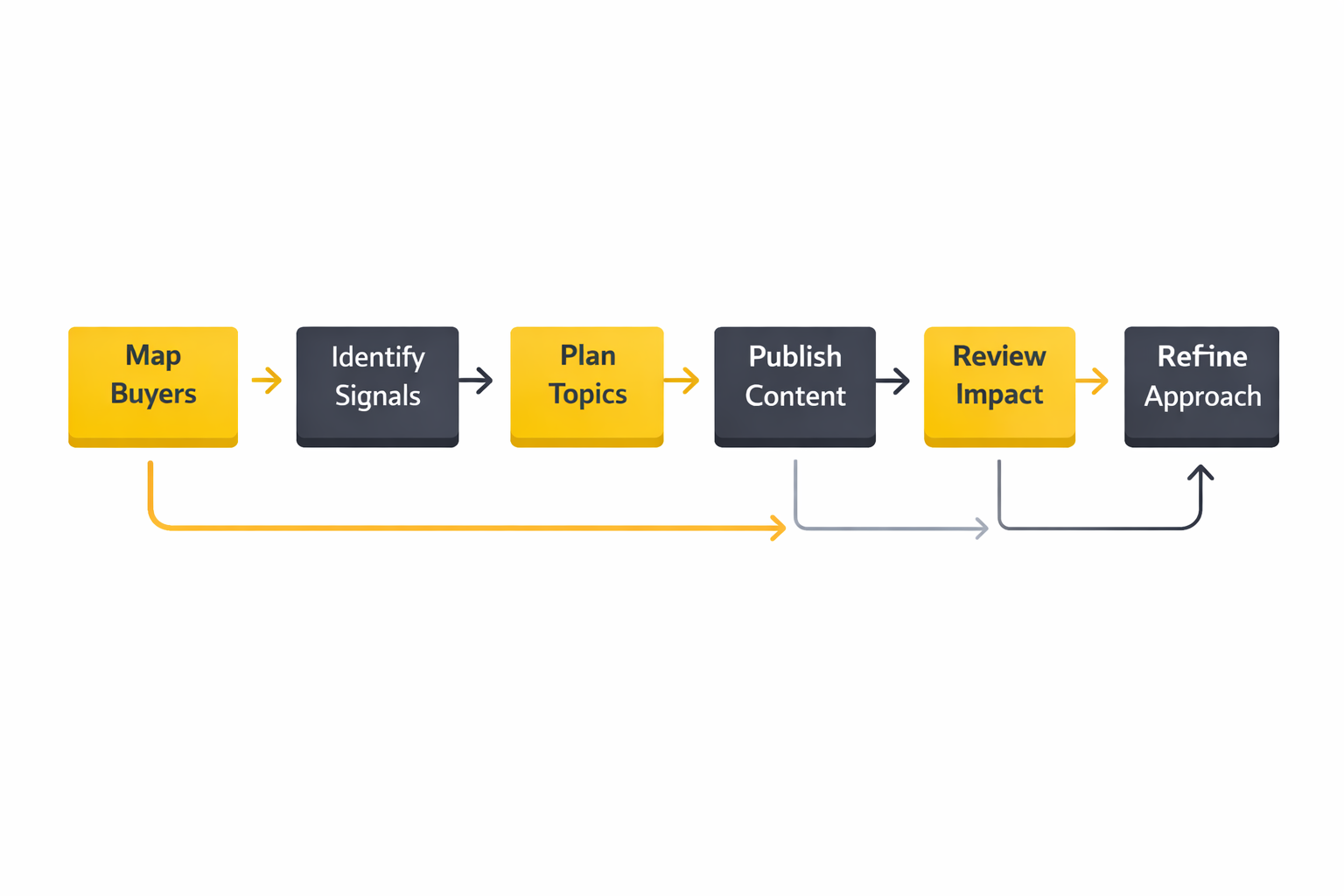
Implementation is where a b2b social media strategy stops being a set of opinions and becomes an operating system. The difference isn’t hustle. It’s sequencing: you put the foundations in place first, then scale what works without turning the program into a fragile machine that collapses the moment someone goes on vacation.
1) Define The Non-Negotiables
Start by writing down the constraints that will shape every decision you make. Who needs to approve what? What claims can you and can’t you make? Which products or industries create higher compliance risk? What can sales follow up on immediately, and what should stay “conversation-first” until the buyer signals intent?
This step sounds boring, but it prevents the most common failure mode: content that performs publicly while causing internal panic. When governance is clear, your team can move faster, not slower.
2) Build A Buying-Group Map You Can Actually Use
A b2b social media strategy gets traction when it speaks to the whole buying group, not just the person who clicks “Book a demo.” Map the 4–7 roles that commonly influence your deals (economic buyer, technical evaluator, champion, security/compliance, procurement, end-user lead, executive sponsor), then write what each role worries about when they imagine the project going wrong.
From there, convert those worries into content promises. If security fears delays, your content must make security feel seen and respected. If procurement fears hidden costs, your content must make pricing logic and implementation scope feel predictable.
3) Choose Three Content Lanes That Cover Trust, Proof, And Momentum
You don’t need ten “content pillars.” You need a small set that you can publish consistently for months, with enough variety to stay interesting and enough repetition to become memorable.
- Perspective: What you believe about the market that helps buyers make sense of change. This is how you become the brand people quote internally.
- Proof: Customer outcomes, behind-the-scenes process, demonstrations, and credible third-party support. This is how you reduce perceived risk.
- Practical: Templates, checklists, “how to evaluate,” and “what to ask your vendor.” This is how you earn saves, shares, and repeat exposure.
When your lanes are stable, content becomes easier to produce because every new post is a variation of a known pattern, not a fresh reinvention.
4) Design A Distribution Plan Before You Publish
Most teams hit “post” and hope the algorithm blesses them. Professional teams decide, in advance, how a piece of content will travel: who shares it, which channel gets the native version, what the follow-up post looks like, and what question they’ll ask to invite replies without sounding like they’re begging.
If leadership voice is part of the plan, treat it like a product launch: write a short message guide, a “what not to say” section, and a menu of angles that still feel authentic. A b2b social media strategy becomes more resilient when distribution is shared across the brand handle and real humans, instead of being trapped in one corporate feed.
5) Set Up A Workflow That Ships
Implementation dies in the gap between “great idea” and “approved.” Your workflow needs to make shipping the default. Keep the system lightweight: one weekly planning session, one content batch day, clear owners for copy/design/legal review, and a fixed publishing cadence your team can sustain.
If approvals are slow, create tiers. Low-risk content ships fast. High-risk content gets longer review. You’ll protect the brand without turning every post into a committee meeting.
6) Connect Social To Follow-Up Without Forcing It
Social becomes revenue when it changes conversations, not when every post screams “demo.” Build a simple playbook for what happens after engagement: who monitors comments, how responses get routed, which signals trigger a sales nudge, and how to follow up in a way that feels helpful instead of predatory.
If you do this well, social stops being a broadcast channel and becomes a relationship channel, which is the real superpower in B2B.
Execution Layers
Once the steps are in motion, execution becomes easier if you think in layers. A b2b social media strategy runs smoothly when each layer has a clear purpose and a clear owner.
Layer 1: Positioning And Message
This layer answers: “What do we want to be known for?” It’s where you define the themes you’ll repeat, the language you’ll consistently use, and the point of view you’ll defend even when the market is noisy.
If this layer is weak, everything else becomes random. You’ll chase trends because you don’t have a narrative strong enough to resist them.
Layer 2: Content And Creative
This layer is your production system: formats, templates, and repeatable content types. The goal is not to “be creative” every day. The goal is to make good content easy to produce and hard to mess up.
When this layer is mature, the team can create variations quickly while keeping quality and brand consistency high.
Layer 3: Distribution And People
This is where you decide how reach is earned. Brand handles matter, but people often outperform logos in B2B because trust is personal. Distribution includes executives, subject-matter experts, employee advocates, partners, and sometimes creators who already have your audience’s attention.
If this layer is missing, you’ll always feel like you’re shouting into the void, even if your content is strong.
Layer 4: Conversation And Community
This layer is the difference between “content that gets likes” and “content that changes outcomes.” It’s how you respond, how you ask questions, how you handle objections in public, and how you keep conversations going without turning every reply into a sales pitch.
When this layer is done well, your comments section becomes a credibility asset buyers can browse when they’re quietly evaluating you.
Layer 5: Feedback And Measurement
This layer is your learning system. It tells you what topics create real attention, what formats create retention, what conversations suggest purchase intent, and what distribution sources are compounding over time.
If measurement is disconnected from decision-making, you’ll end up with reporting theater instead of optimization.
Optimization Process
Optimization should feel less like “tweaking posts” and more like running a calm weekly experiment cycle. A b2b social media strategy improves fastest when the team has a repeatable loop that turns performance signals into smarter decisions.
The Weekly Loop
Pick one day each week to review what happened, decide what it means, and change what you’ll do next. Keep it simple: what topics earned attention, what posts earned saves and shares, what comments revealed real objections, and what distribution sources created the biggest second-order reach.
Then make one deliberate change for the next week. One new angle. One new format. One new CTA style. One new distribution play. Small changes beat big reinventions because they’re easier to attribute and easier to sustain.
Signal Hygiene: Make Metrics Actionable
Not every metric deserves attention. Focus on signals that tell you something useful about buyer behavior: sustained engagement from the right audience, recurring questions that reveal evaluation criteria, and content that gets shared into private conversations.
When you’re deciding what to scale, it helps to remember that social teams often win by prioritizing resonance over volume, a theme emphasized in Sprout Social’s 2024 Social Media Content Strategy Report.
Refine Content Without Losing Your Voice
Most optimization mistakes happen when teams overfit to what “performed” and accidentally erase what made them distinct. If a post does well, don’t just repeat it. Identify why it worked: the promise, the clarity, the point of view, the structure, or the proof.
Then create a new version that keeps the underlying strength while adding new information. Buyers can feel when you’re recycling; they reward you when you’re building a body of work.
Refine Distribution Like A GTM Team
Distribution is often the biggest lever, and it’s the one most teams underuse because it feels “political.” Treat it like a system. Identify 10–20 people who can share content consistently without sounding scripted, then make it easy: give them a menu of angles, suggested hooks, and an “optional comment” they can adapt.
If one leader consistently sparks smart comments, study what they do and teach it. Social skills compound when you coach them instead of hoping they appear.
Implementation Stories
A real implementation story makes the point better than a checklist ever will, because it shows what happens when a strategy hits real-world constraints.
Start at a point of high drama. Sprout Social was staring at a familiar B2B ceiling: the brand was respected, but breaking through the noise on LinkedIn-first conversations was getting harder. The team could feel the market shifting toward creator-led influence, but “influencer marketing” still carried baggage in B2B. If they got it wrong, it would look like a cringe campaign chasing attention instead of building credibility.
The pressure wasn’t just external. Internally, influencer work can become a distraction machine—time-consuming, hard to measure, and easy for stakeholders to dismiss as fluffy.
Backstory. Sprout didn’t approach this as a one-off social experiment; it was part of a broader push to make their marketing louder, more human, and more connected to the communities they serve. Their positioning also had a practical edge: they had acquired Tagger (later branded as Sprout Social Influencer Marketing), announced through their investor communications, which meant they had both the ambition and the capability to scale. But capability doesn’t guarantee adoption—especially when multiple teams need to collaborate.
They needed influencer marketing to behave like a program, not a stunt. That required structure that could survive real calendars, real approvals, and real cross-functional demands.
Wall. The first constraint was operational: if influencer activations lived only with the social team, they would stay small and fragile. The second constraint was credibility: B2B audiences punish anything that feels like borrowed clout. The third constraint was measurement: if results weren’t concrete, the program would lose internal support the moment budgets tightened.
At that stage, “more influencers” wasn’t the answer. They needed a model that embedded creators into the marketing ecosystem without turning the whole org into a bottleneck.
Epiphany. The breakthrough was treating micro-influencers as strategic partners rather than loudspeakers. Instead of thinking, “Who can amplify our message?” the team leaned into, “Who can help shape the conversation in a way buyers trust?” That shift shows up clearly in the Shorty Awards entry describing how they built a long-term, scalable influencer framework rather than running isolated collaborations.
Once the goal became “meaningful conversations,” the operational design got sharper. The program needed repeatable workflows, clear ownership, and integrations across content, research, events, and demand gen.
Journey they went on to reach the goal. They built a center-of-excellence model that connected influencer work to multiple teams and multiple initiatives, detailed in Sprout’s own breakdown of how they scaled the program from ad hoc activations into a core marketing motion. They integrated influencers into webinars, event coverage, and thought leadership distribution, so influence wasn’t a side quest—it was part of the system. And they kept the program LinkedIn-forward while still using other channels when it served the story, a strategic choice reinforced in the campaign description and execution notes.
They also made the work visible. When a brand publicly documents the program’s philosophy, it becomes easier for internal stakeholders to understand what’s being built and why it’s worth continuing.
Final conflict. Visibility invites scrutiny, and performance claims invite skepticism. Sprout didn’t just describe the work; they put results in public channels where anyone could challenge them, including in a brand post sharing the campaign outcomes on LinkedIn and in their public social updates. That kind of transparency raises the stakes because it forces the program to be real, repeatable, and defensible.
They also had to prove the program wasn’t just “a social thing.” The work had to connect to leads, influence, and measurable business impact without collapsing into vanity reporting.
Dream outcome. The program produced outcomes Sprout was willing to publish in multiple places, including their Shorty Awards entry, their program scaling write-up, and a public recap on LinkedIn. Those sources consistently describe results like 4M+ impressions and 100K+ engagements alongside lead impact and program scale. More importantly for implementation, the outcome wasn’t just performance—it was a repeatable system that moved influencer work from “campaign” to “capability,” which is exactly what a b2b social media strategy needs to do if it’s going to compound over time.
The 90-Day Rollout That Builds Momentum Without Breaking The Team
- Days 1–30: Lock the non-negotiables, confirm buying-group mapping, choose content lanes, and ship consistently at a sustainable cadence. Your success metric is rhythm, not perfection.
- Days 31–60: Build distribution muscle. Recruit internal voices, train them lightly, and establish a repeatable “share kit” workflow. Your success metric is repeatable reach beyond the brand handle.
- Days 61–90: Formalize optimization. Run weekly reviews, document what you’re learning, and build a small library of proven formats and themes. Your success metric is fewer one-off experiments and more compounding patterns.
Documentation That Prevents Chaos
Write a short playbook your team can actually use. Keep it human. Include: brand voice guardrails, claims and compliance rules, approval tiers, response and escalation guidelines, and how to route high-intent signals.
This is the quiet work that keeps a b2b social media strategy from becoming “whatever the newest person thinks social should be.” When the playbook exists, your program becomes a system, not a personality.
What To Do When It Stalls
Most stalls aren’t algorithm problems. They’re message problems, proof problems, or distribution problems. If engagement drops, don’t panic-post. Diagnose which layer is failing: is the point of view too safe, is the proof too thin, or is distribution too concentrated in one channel or one person?
Then fix one thing and run the loop again. That’s how professional teams keep momentum without turning the strategy into a constant reinvention project.
Statistics And Data
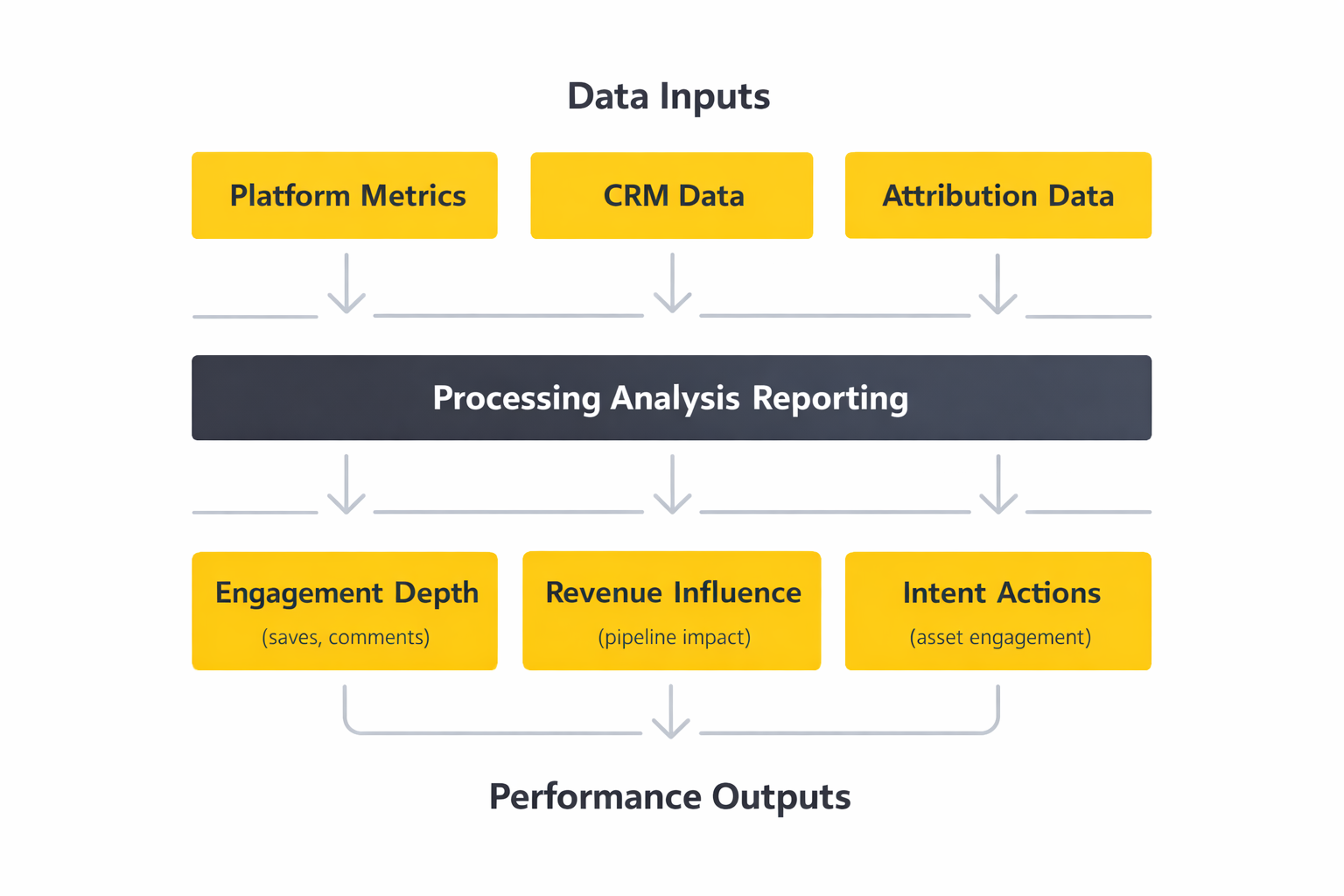
A B2B social media strategy gets a lot easier to run once you stop treating metrics like a scoreboard and start treating them like navigation. The goal isn’t to “prove social works” in a vacuum. The goal is to understand which signals predict pipeline, which signals protect brand demand, and which signals are simply noise that looks good in a slide deck.
One reason measurement matters more in B2B than B2C is how buyers behave before they ever talk to you. A Gartner survey found 61% of B2B buyers prefer a rep-free buying experience, and the same research highlights that 73% actively avoid suppliers who send irrelevant outreach—a pattern also reported by independent coverage of the Gartner findings. That shifts the job of social: you’re not just “posting,” you’re shaping the research environment buyers move through.
So, what should your dashboard actually contain? A practical B2B social media strategy usually tracks four layers that connect cleanly to business outcomes:
- Attention quality: impressions to the right audience, follower growth among target roles, and repeat reach (how often the same buyers see you).
- Engagement depth: comments and saves (signals of consideration) over likes (signals of exposure).
- Intent actions: link clicks to “decision” assets (pricing pages, demo pages, comparison pages), webinar sign-ups, and newsletter subscriptions.
- Revenue influence: assisted conversions, CRM-sourced opportunities touched by social, and pipeline influenced over time windows that match your sales cycle.
If you’re wondering why “trust” shows up so often in modern measurement frameworks, it’s because B2B brand strength increasingly determines whether you even make the shortlist. In LinkedIn and Ipsos research, 93.7% of marketers agreed that trust is the most important factor in building a successful B2B brand, which is reinforced in coverage of the same research and echoed in LinkedIn’s own write-up that 94% of surveyed marketers see trust as key to B2B success. When your measurement stack can show trust-building signals compounding over time, social stops being a “soft” channel and becomes a strategic asset.
Performance Benchmarks
Benchmarks are useful, but only if you treat them like climate data, not a weather forecast. A benchmark can tell you what “typical” looks like for a platform or format. It can’t tell you what your audience should do if your positioning is sharper, your category is more complex, or your buying cycle is longer than average.
For LinkedIn, it helps to benchmark by format, because the distribution mechanics reward different behaviors. Socialinsider’s 2025 benchmarking work cites that LinkedIn engagement rate by impressions sits at 5.20%, and the same source breaks out formats where multi-image posts average 6.60% engagement by impressions. Those figures are frequently repeated in industry summaries, including a LinkedIn post summarizing the Socialinsider benchmarks and additional write-ups that reference the same dataset (for example, independent benchmark commentary that cites 5.20% by impressions).
Use benchmarks like that to set expectations for content experiments, not to judge your strategy as “good” or “bad.” A healthier approach is to create three internal benchmark bands inside your B2B social media strategy:
- Baseline: what an average post delivers when you simply show up consistently.
- Breakout: what happens when topic-market fit is strong (posts that pull comments from the right roles).
- Evergreen: the steady performers that keep working month after month (usually problem framing, practical how-tos, and strong POV content).
Then layer in benchmarks that reflect buyer behavior rather than platform mechanics. Thought leadership is a good example, because it’s measurable through downstream actions (search lift, direct traffic lift, and higher conversion rates on “decision” assets). Edelman and LinkedIn’s 2024 research found that 73% of decision-makers say thought leadership is a more trustworthy basis for assessing capabilities than marketing materials, a result also reinforced by Edelman’s report overview page and repeated in LinkedIn’s execution guidance that references the same study (LinkedIn’s summary of the 73% trust finding).
Analytics Interpretation
Most B2B teams don’t struggle because they lack data. They struggle because they have too many metrics that don’t answer a decision. The most valuable reporting in a B2B social media strategy does one thing: it explains what to do next and what trade-off you’re making by doing it.
Here are a few interpretation rules that keep reporting honest and action-oriented:
- Separate correlation from contribution: social spikes often follow product launches, PR hits, or exec announcements. Your dashboard should tag those moments so you don’t misread the lift as “content improvement.”
- Use time windows that match your sales cycle: weekly reporting is fine for content ops, but revenue influence needs monthly or quarterly windows to avoid false negatives.
- Prefer buyer-journey signals over vanity signals: if comments include problem language (“we’re dealing with this too”), that’s a stronger indicator than raw reactions.
- Triangulate trust: rising direct traffic, increasing branded search, and higher conversion rates on comparison pages often move together when trust is building.
Interpretation gets sharper when you accept how modern B2B buying actually works. When 61% of buyers say they prefer rep-free experiences, you can’t rely on “sales touched it” attribution as your only proof. You need measurement that reflects what your content did before the form fill: did it shape the shortlist, reduce uncertainty, and make your brand feel like the safe choice?
This is also why creator and expert-led content is becoming more measurable in B2B. LinkedIn’s research notes that 55% of B2B marketers are already working with influencers, reinforced by another LinkedIn benchmark summary that puts the same figure at 55% for influencer/creator partnerships and third-party coverage that repeats the finding (independent reporting of the 55% adoption statistic). In analytics terms, those collaborations tend to show up less as “instant conversions” and more as a compounding lift in trust signals and inbound demand quality.
Case Stories
The numbers look clean on a dashboard right up until leadership asks the uncomfortable question: “What did social actually change?” HCLTech faced that moment as the market got noisier and buyers got harder to reach. Their employer brand and marketing teams could feel momentum slipping because corporate posts were starting to blend into the same polished feed as everyone else. And when visibility drops, it doesn’t just hurt awareness—it quietly erodes confidence inside the company, too.
The backstory is that HCLTech is massive and global, and that scale creates a strange problem: you have thousands of credible experts, but the outside world mostly hears from a logo. The team knew employees were already active online, but activity wasn’t the same as a system. Their posts were scattered, inconsistent, and hard to connect to any business narrative. Over time, “social” started to feel like effort without leverage.
The wall came when they tried to push harder with the usual playbook—more corporate content, more internal nudges, more campaigns—and it still didn’t create the kind of trust and reach they needed. Participation plateaued because employees didn’t want to sound like a press release. Measurement stayed fuzzy because leadership couldn’t see a repeatable engine, only one-off wins. Even worse, the team risked burning out the very people they hoped would advocate.
The epiphany was simple and uncomfortable: the brand didn’t need louder messaging, it needed more believable messaging. That meant building a program where employees could sound like themselves, not like the company. It also meant treating enablement as the product—training, confidence, content options, and a workflow that fit real workdays. The shift wasn’t “get people to share,” it was “make it easy and safe for experts to show up as experts.”
The journey turned into what they call the Supercharged Ambassadors Club, designed to scale globally while staying human. The public case study describes how the program focused on authentic employee voices and structured advocacy, supported by tools and process (HCLTech’s employee advocacy case study). Behind-the-scenes conversations also highlight how the club grew into a multi-country community and how participation became something people wanted, not something they were pushed into (an interview summary discussing the program’s growth and outcomes). And the operating details—how they structured the program, kept momentum, and made it sustainable—are expanded in a deeper breakdown of the approach (the behind-the-program write-up).
The final conflict is the part most case studies skip: scale introduces fragility. The moment advocacy starts working, content demand explodes and quality control becomes harder. If you over-templatize posts, authenticity collapses; if you under-support employees, participation drops. The team had to keep the balance—enough structure to make it easy, enough freedom to keep it real.
The dream outcome is what every B2B social media strategy should aim for: a distribution engine buyers actually trust. In the program’s documented results, the team reports a 187% increase in reach and a 154% increase in engagement, which is also reiterated in public discussion of the same initiative (a third-party post repeating the 187% and 154% figures) and in the operational recap (the program breakdown that restates the results). But the deeper win is more strategic: HCLTech didn’t just publish more content—it built a system where credibility scales through people, not just through ads.
Professional Promotion
Promotion in B2B isn’t about “boosting posts” as a reflex. It’s about placing your best ideas where buyers already look for confidence: peers, experts, and proof. A professional B2B social media strategy uses promotion to accelerate what’s already working organically, so you’re paying to amplify resonance—not paying to compensate for weak messaging.
A practical promotion mix usually includes:
- Paid distribution for decision assets: promote webinars, research, product comparisons, and category POV content that helps buyers justify choices internally.
- Retargeting that respects intent: sequence messaging based on what someone consumed (for example, from problem framing to evaluation to implementation).
- Expert and creator partnerships: not for borrowed fame, but for borrowed trust in the exact communities you sell into.
- Employee and executive amplification: the fastest way to humanize credibility when brand channels feel interchangeable.
The creator piece is no longer “experimental.” LinkedIn’s own research shows 55% of B2B marketers already work with influencers, reinforced by LinkedIn’s benchmark content that again cites 55% using influencer marketing and creator partnerships and validated by third-party reporting that repeats the 55% adoption figure. The implication for promotion is clear: your paid strategy should increasingly distribute expert-led content that buyers perceive as useful, not self-serving.
Finally, promotion has to align with the trust reality. When 93.7% of marketers say trust is the most important factor in building a successful B2B brand, your promotion plan should prioritize credibility signals—customer proof, practitioner insight, and clear POV—over “feature-first” messaging. That’s how a B2B social media strategy stops being a content calendar and becomes a repeatable growth system.
Future Trends
The next evolution of a b2b social media strategy won’t be about chasing the latest format. It will be about earning attention in a world where buyers are more self-directed, more skeptical, and more influenced by peer signals than brand claims.
Five shifts are already shaping what “good” looks like:
- Social becomes a buyer’s research layer, not a top-of-funnel add-on. When 61% of B2B buyers prefer a rep-free buying experience, your content has to stand on its own as a trusted guide before anyone opts into a conversation.
- Trust signals outcompete “brand polish.” A strategy built on real expertise, real proof, and consistent voice aligns with how B2B brands win when 93.7% of marketers say trust is the most important factor for B2B brand success.
- Video becomes the default for credibility at scale. It’s not about entertainment. It’s about making your thinking visible: walkthroughs, evaluation guidance, implementation reality, and expert debate. That shift matches LinkedIn’s platform dynamics where video uploads were up over 20% and views grew 36% year-over-year.
- Creators and practitioners become the new distribution infrastructure. In B2B, people trust people. That’s why adoption of influence is accelerating, reflected in LinkedIn’s finding that 55% of B2B marketers are working with influencers.
- “Dark social” becomes the real battlefield. The posts that win are the ones that get shared privately into Slack channels, internal docs, and email threads. You can’t fully track it, but you can design for it: clear frameworks, decision tools, and content that makes the buyer look smart inside their company.
The practical takeaway: future-proof your b2b social media strategy by building assets that reduce buyer uncertainty, not just assets that look good in public.
Strategic Framework Recap

A b2b social media strategy that compounds is an ecosystem, not a calendar. When it’s working, each part reinforces the others: your POV makes you memorable, your proof makes you safe, your distribution makes you visible, and your measurement makes you smarter.
Here’s the framework distilled into a simple sequence you can keep coming back to:
- Positioning: a clear category narrative buyers can repeat internally.
- Buying-group mapping: content that respects how decisions really happen in committees.
- Content system: a repeatable mix of perspective, proof, and practical guidance.
- Distribution engine: brand channels plus humans (leaders, experts, employees, partners, creators).
- Conversation design: replies and follow-up that feel helpful, not pushy.
- Measurement loop: signals that lead to decisions, not reporting theater.
If you remember one thing, make it this: the goal isn’t to “do social.” The goal is to make your company the safest, clearest choice in your category while buyers are researching on their own, which is why rep-free preference data like Gartner’s 61% figure matters so much for modern execution.
FAQ – Built For The Complete Guide
Q: What is the main purpose of a b2b social media strategy?
A: The purpose is to build category credibility and buyer confidence in a way that supports pipeline over long cycles. It helps your brand show up during buyer research, earn trust, and turn engagement into meaningful conversations without forcing a demo ask on every post.
Q: Which platform matters most for B2B social today?
A: It depends on where your buyers already learn and compare vendors. For many categories, LinkedIn is central because it concentrates decision-makers and professional context, and its continued investment in video and premium ad surfaces is highlighted by LinkedIn’s expansion of BrandLink and video growth.
Q: How often should we post for a b2b social media strategy to work?
A: Consistency beats intensity. Pick a cadence your team can sustain for months (not weeks), then increase volume only after workflow and approvals are stable. A reliable rhythm builds memory and trust, while random bursts train your audience to forget you.
Q: What should we measure if attribution is messy?
A: Measure what supports decisions: engagement depth (comments and saves), repeat reach among target roles, intent actions (clicks to decision assets), and revenue influence over a realistic time window. In rep-free buying environments like the one described in Gartner’s buyer preference research, you need signals that reflect buyer confidence before the form fill.
Q: How do we create content that gets shared privately?
A: Make buyers look smart inside their company. Publish evaluation tools, “what good looks like” checklists, implementation realities, and clear frameworks that can be dropped into internal threads. Design posts for screenshots and forwarding, not just public engagement.
Q: Should we use influencers in B2B?
A: If you treat them as trusted practitioners, yes. The strongest partnerships are educational and buyer-centric, not promotional. This is becoming a standard motion, reflected in LinkedIn’s reporting that 55% of B2B marketers already work with influencers.
Q: What kind of video works best for B2B?
A: Video that reduces risk: product walkthroughs, implementation explainers, common pitfalls, and expert Q&A. It works because it shows clarity and confidence, and platform attention is clearly shifting as LinkedIn’s 36% year-over-year video view growth suggests.
Q: How do we get leaders and employees to share without sounding scripted?
A: Give them angles, not copy-and-paste posts. Provide a short message menu, a few hooks, and optional talking points, then let their voice do the work. A b2b social media strategy scales when distribution is human and repeatable, not forced.
Q: How do we handle approvals without slowing everything down?
A: Use approval tiers. Low-risk educational content ships fast. Higher-risk content (claims, regulated topics, competitive comparisons) gets deeper review. This protects the brand while keeping the content engine moving.
Q: What’s the biggest mistake teams make when they try to scale?
A: They scale output before they scale the system. If distribution depends on one person, if reporting can’t be reproduced, or if approvals are unclear, growth will create chaos. Build the workflow first, then scale the volume.
Q: How long does it take to see results from a b2b social media strategy?
A: You can usually see early signal changes (better comments, clearer audience fit, more inbound conversations) within weeks, but trust and pipeline influence compound over months. The bigger the deal size and the longer the cycle, the more your strategy should focus on steady credibility building rather than quick spikes.
Work With Professionals
If you’re building a b2b social media strategy for clients, you already know the hard part isn’t the framework. The hard part is the constant pressure to find the next contract while still doing great work. One month you’re shipping strong campaigns; the next month you’re stuck in a feast-or-famine cycle, refreshing job boards and rewriting proposals instead of building momentum.
That’s why having a reliable place to meet serious marketing teams matters. The demand is there in plain sight: LinkedIn shows 12,000+ remote digital marketing roles, and Upwork lists 11,838 marketing freelance jobs. The opportunity isn’t “finding work exists.” The opportunity is finding work faster, with less friction, and with fewer fees draining your earnings.
Markework is built around that exact problem. It’s positioned as a marketing marketplace where you can connect directly, without a middle layer, and with no middleman and no project fees. Instead of paying commission on every invoice, you operate on simple plans and direct communication, so you keep control of your relationships and your income.
When you’re ready to stop treating client acquisition like a second job, and start treating it like a system, build your presence where marketing teams are actively looking. Create a profile, apply to roles that match your strengths, and negotiate directly with the people who can actually say yes.
 Filip Konecny Enterprises