

B2B social media marketing used to be treated like a “nice-to-have” brand channel—something you did after the real work was finished. That era is over. Buyers now build their shortlist while you’re not in the room, and social is one of the few places where trust, expertise, and relevance can compound in public.
The catch is that most B2B teams still run social like a posting schedule, not a system. They push product updates, recycle blog links, and hope the right decision-maker happens to scroll by. This guide is designed to replace that hope with a clear, repeatable framework you can run like a professional program.
Article Outline
- What Is B2B Social Media Marketing
- Why B2B Social Media Marketing Matters
- Framework Overview
- Core Components
- Professional Implementation
What Is B2B Social Media Marketing

B2B social media marketing is the discipline of using social platforms to shape how the market understands your category, your point of view, and your credibility—so the right accounts move toward you long before a demo request happens. It’s not “posting content.” It’s positioning, distribution, and relationship-building in the places buyers already use to sanity-check claims and reduce risk.
In practice, that means your social presence does three jobs at once. First, it makes your company (and the people inside it) easy to trust at a glance. Second, it helps buyers self-educate—without forcing them into a form fill just to get answers. Third, it creates lightweight signals of intent that sales and marketing can act on without guessing.
It also works differently than B2C social. You’re usually selling higher-consideration solutions, to committees, with longer timelines and higher stakes. Your content has to hold up under scrutiny, your distribution has to reach multiple stakeholders, and your credibility has to survive a skeptical internal Slack thread.
Why B2B Social Media Marketing Matters
If your buyers can complete most of their learning without talking to you, then your social presence becomes part of the buying experience—whether you planned it or not. One reason this matters is the growing preference for self-serve discovery: 61% of B2B buyers said they prefer an overall rep-free buying experience, based on a Gartner survey fielded in August–September 2024 and published June 25, 2025. The same findings show how unforgiving irrelevant outreach has become, with buyers actively avoiding suppliers who don’t respect context—a pattern also summarized in industry coverage of the survey.
That reality flips the usual question from “How do we get more clicks?” to “How do we show up when buyers are quietly forming opinions?” Social is where people look for proof that you’re real: the consistency of your thinking, the credibility of your team, the way customers talk about outcomes, and whether your point of view feels grounded in the world they operate in.
It also matters because attention is fragmenting, and the marketing mix is shifting toward creator-driven distribution. Even outside pure B2C, budgets are flowing toward content that feels human and trusted. The pace is clear in the broader market: U.S. creator economy ad spend grew from $13.9B (2021) to $29.5B (2024) and is projected to reach $37B in 2025, figures also published on IAB’s release page and widely reported in reputable trade coverage such as TV Tech’s summary of the same report. B2B doesn’t need to cosplay consumer virality—but it does need to learn the lesson: trust travels faster when it’s carried by people, not just logos.
When B2B social is executed well, it reduces CAC pressure in a surprisingly practical way. It pre-handles objections. It creates “familiarity bias” so cold outreach isn’t actually cold. It gives sales proof assets that don’t feel like proof assets. And it turns your team into a distributed credibility engine that keeps working even when campaigns pause.
Framework Overview
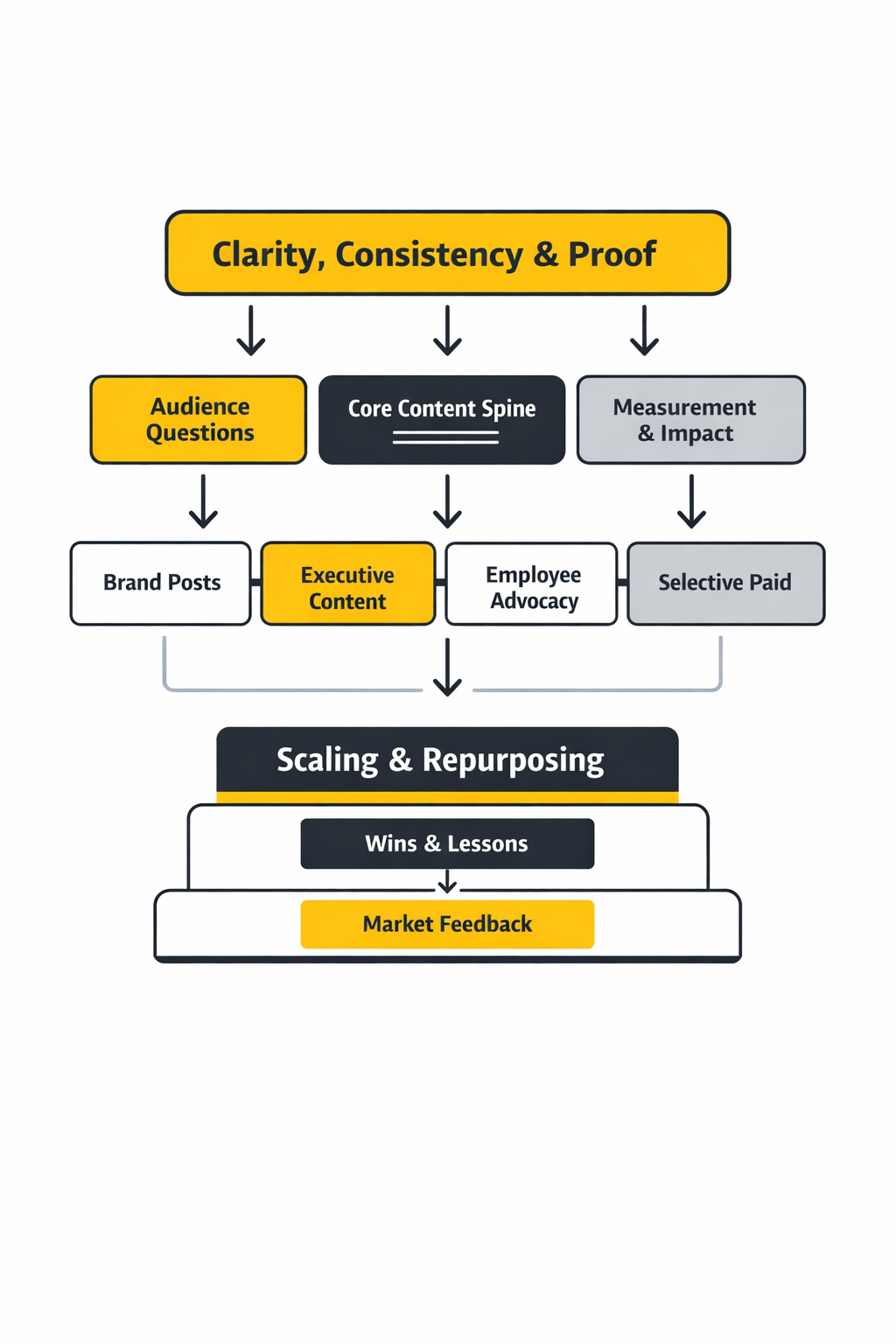
To make B2B social media marketing predictable, you need a framework that separates what you’re trying to achieve from what you happen to be posting this week. The system in this article is built around five moving parts that reinforce each other: positioning, content design, distribution, conversion paths, and measurement.
Here’s the big idea: your social program should behave like a product. It needs a clear promise (what people will consistently learn or gain), a recognizable interface (formats and voices people can identify), and a feedback loop (signals that tell you what to double down on). When those pieces exist, you stop chasing trends and start compounding trust.
And because B2B buying is multi-stakeholder, the framework assumes you’re building for a buyer group—not a single persona. Your job is to create enough clarity that different roles can each find what they need: an executive sees risk reduction, a technical evaluator sees proof, and an internal champion sees language they can reuse in their own pitch internally.
Core Components
Most teams fail at B2B social media marketing because they focus on activity instead of components. These are the foundational elements you need in place before you worry about frequency, hashtags, or “best times to post.”
1) Category clarity
If your audience can’t explain what you do in one sentence, your content will always underperform—because buyers can’t categorize you. Category clarity means you consistently answer three things: what problem you solve, who it’s for, and why your approach is meaningfully different. This is positioning, expressed repeatedly, from multiple angles, until the market stops guessing.
2) Proof that feels native
B2B buyers don’t want glossy claims; they want credible signals. Social proof works best when it looks like normal social content: lessons learned, behind-the-scenes decisions, tradeoffs, and before/after thinking. The goal is not to “show testimonials.” The goal is to make competence obvious through how you explain and how you respond.
3) A content spine
Your content spine is a small set of repeatable themes you can own for 12 months without getting bored. Think: common failures you fix, contrarian beliefs you can defend, “how it actually works” breakdowns, and decision criteria buyers can steal. This is how you avoid the random-walk feed where every post sounds unrelated to the last one.
4) Distribution by design
Posting isn’t distribution. Distribution means intentionally getting your ideas into the places where buyer attention already lives: employee amplification, partner ecosystems, community threads, influencer collaborations, and paid boosts that are built around the best-performing organic angles (not generic lead-gen creative). The compounding effect comes from repeating the same ideas across multiple surfaces, not from inventing new topics every day.
5) Conversion paths that match buyer intent
Not everyone is ready for a call. Your social program needs multiple “next steps” that fit different levels of certainty—like a diagnostic, a comparison guide, a technical teardown, a recorded walkthrough, or a clear “here’s what to do next if you’re evaluating.” When you only offer “Book a demo,” you force buyers to pretend they’re ready before they are.
Professional Implementation
Execution is where most social strategies die—usually because ownership is vague, the process is too fragile, or success is measured by numbers that don’t map to revenue. Professional B2B social media marketing looks more like an operating system than a creative hobby.
Start with roles. Someone needs to own the editorial spine and quality bar. Someone needs to own distribution and relationships (employees, partners, creators, communities). Someone needs to own measurement and the feedback loop to pipeline. In small teams, one person can wear multiple hats, but the hats still need to exist—otherwise everything collapses into “post when we have time.”
Then define the cadence in a way that protects consistency. A professional cadence is not “daily posting.” It’s a rhythm you can maintain for a year: a weekly flagship insight, a few supporting posts that reframe it for different stakeholders, and a distribution plan that gives the idea more than one chance to land. If you can’t repeat it, it’s not a system.
Finally, align your program with how buyers actually self-educate. When self-directed research is the default, your social presence has to do work that sales used to do: set context, define tradeoffs, and build confidence without pressure. The most effective teams treat every strong post as a reusable sales enablement asset—something that can be forwarded internally, dropped into outbound, or used to reframe a stalled deal without sounding like a pitch.
In the next sections (coming up in Part 2 and beyond), we’ll turn this into a step-by-step playbook: how to choose platforms based on deal reality, how to build the content engine, how to measure what matters, and how to scale distribution without losing credibility.
Step By Step Implementation
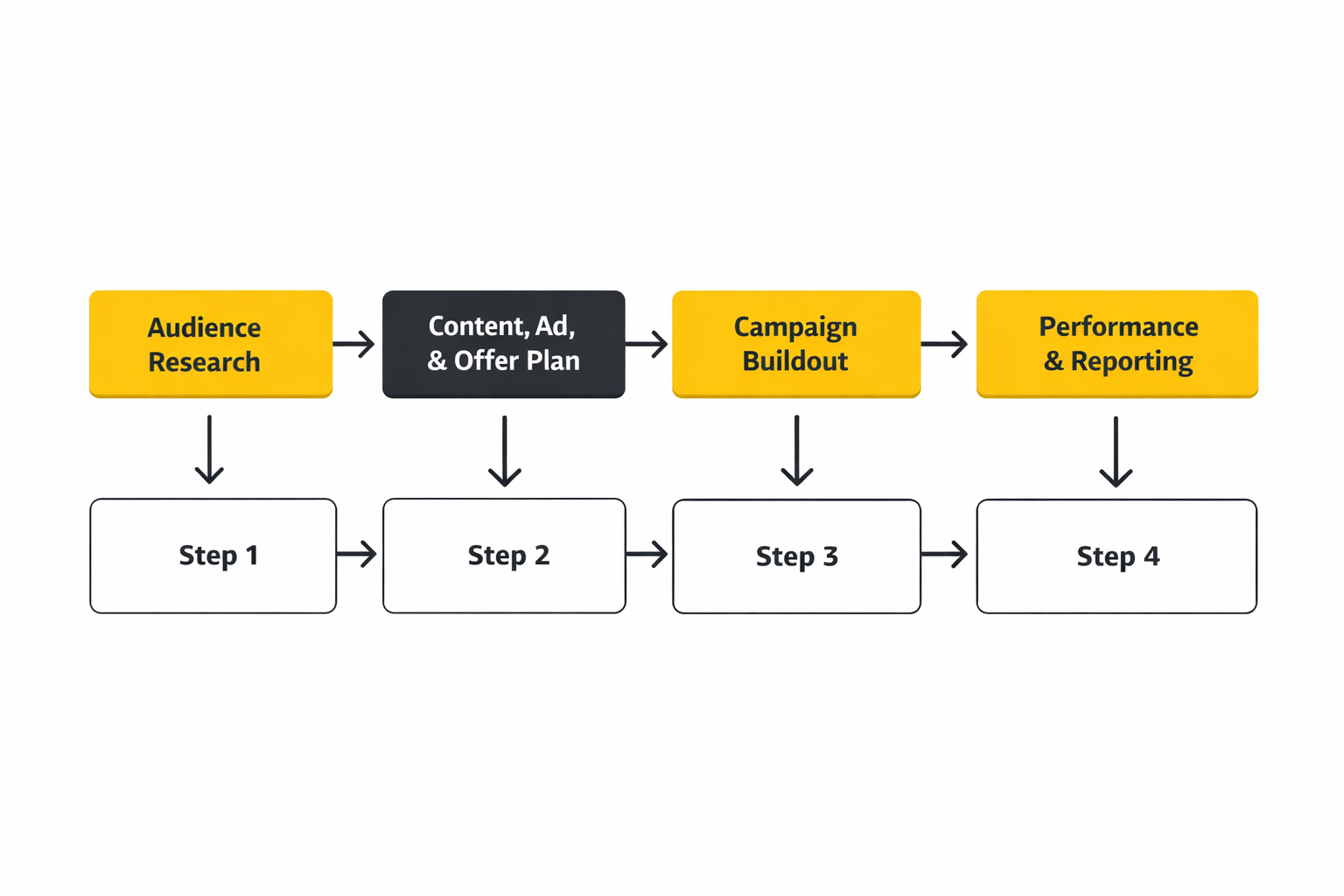
The easiest way to make b2b social media marketing feel “hard” is to start by producing content. You end up debating topics, formats, and posting frequency while the foundations are still missing. Implementation is simpler when you build in a sequence that protects clarity first, then consistency, then scale.
Step 1: Define Success In Business Terms
Pick one primary outcome your leadership will actually recognize, then choose two supporting outcomes that indicate you’re moving toward it. For most B2B teams, the primary outcome is pipeline influence (not last-click attribution), and the supporting outcomes are account engagement quality and sales enablement usefulness.
If your dashboard can’t answer “which target accounts are leaning in?” you’ll get trapped in vanity metrics. Tools and frameworks like the 2025 Impact of Social Media Report exist because social leaders are repeatedly asked to prove value in the language of the business, not the language of the platform.
Step 2: Map The Buyer Group And Their Questions
B2B decisions are rarely made by one person, so your content system has to support multiple stakeholders without turning your feed into a generic “we help everyone” mess. Map the buyer group into three roles: the executive sponsor, the evaluator (often technical or operational), and the internal champion who has to sell the decision internally.
Then write down the questions each role asks at three moments: “Why change?” “Why you?” and “Why now?” This becomes your content backlog. It also makes your editorial decisions easier, because you’ll stop guessing what to post and start answering real purchase questions in public.
Step 3: Build A Content Spine You Can Repeat For 90 Days
A spine is not a list of topics. It’s a small set of themes you’re willing to be known for. Aim for five themes max, each with a distinct job: one for category clarity, one for proof and outcomes, one for implementation reality, one for the executive point of view, and one for community-level insights (what you’re seeing in the market).
Keep it stable for 90 days. Stability is what creates recognition and compounding distribution—especially in b2b social media marketing, where “familiarity” often determines whether a skeptical buyer even gives you 10 seconds.
Step 4: Design Formats That Match Your Team’s Capacity
Choose two flagship formats and three supporting formats. Flagship formats are the ones you can reliably execute at a high quality bar: a weekly perspective post from a leader, a recurring breakdown series, a monthly customer learning, or a short video pattern you can replicate.
Supporting formats are your distribution multipliers: short takes, screenshots with context, comment-driven follow-ups, and quick clarifications that keep you present without draining production time. This is how you stay consistent without burning out.
Step 5: Set Up Distribution Before You Publish
Most teams publish first and then hope the post travels. Flip that. Decide how a flagship idea will move through your ecosystem: brand page, employee voices, partner shares, community reposts, newsletter inclusion, and selective paid amplification.
If you’re serious about making b2b social media marketing perform, build distribution like a checklist. You can’t scale trust with a single surface area.
Step 6: Create Conversion Paths That Don’t Force A Demo
One post can create demand without creating a lead. That’s not failure—it’s reality. Give buyers next steps that match their intent: a diagnostic, a teardown, a buyer checklist, a comparison page, or an “implementation guide” that helps evaluators do their job.
This is where b2b social media marketing becomes a pipeline engine instead of a content treadmill. You’re not trying to trap attention. You’re trying to help the right accounts make progress.
Execution Layers
Execution gets smoother when you separate what you’re building into layers. Each layer has a different owner, a different cadence, and a different definition of “done.” When you mix them, everything feels urgent and nothing feels complete.
Layer 1: Positioning And Narrative Control
This is the layer that decides what you stand for in the market. It includes your category language, your perspective on tradeoffs, and the stories you consistently tell about outcomes. It should be reviewed quarterly, not weekly, because it’s your foundation.
If your positioning is fuzzy, social will amplify the fuzziness. When it’s sharp, social turns repetition into momentum.
Layer 2: Editorial System And Production
This is your content spine, formats, calendar, and production workflow. It’s where consistency is protected: drafts, approvals, asset reuse, and scheduling. The goal is not more posts. The goal is reliable output at a quality level your buyers respect.
Execution speed matters, but in B2B, credibility matters more. A slower cadence that feels thoughtful often beats a fast cadence that feels like noise.
Layer 3: Distribution And Amplification
This layer ensures your best ideas get more than one chance to land. It includes employee advocacy, executive posting support, partner activation, community participation, and paid amplification of content that already proved itself organically.
Industry movement toward creator-driven distribution is one reason this layer is getting heavier. LinkedIn’s expansion of BrandLink into creator-led video and its broader push into video advertising has been covered in places like Reuters’ reporting on LinkedIn’s video ad strategy, which is a signal that “who delivers the message” is becoming as important as the message itself.
Layer 4: Capture, Handoff, And Sales Enablement
This layer is where social stops being “marketing content” and becomes a revenue asset. Capture the posts that create high-quality conversations, turn them into sales-ready links, and build a small library sales can use without feeling awkward.
Enablement is not just collateral. It’s shared language. When a champion inside a target account borrows your framing in an internal meeting, your social program just did the job a salesperson can’t do alone.
Optimization Process
Optimization in b2b social media marketing is less about hacks and more about feedback loops. You’re not chasing an algorithm. You’re building a system that learns.
Weekly: Signal Review, Not Performance Worship
Once a week, review your strongest posts through three lenses: audience quality (who engaged), intent signals (what they did next), and sales usefulness (what the team used in real conversations). Save the top 5% of posts into a “proof library” and tag them by theme and buyer role.
This prevents the most common failure mode: celebrating reach while missing the fact that none of it came from accounts you could actually sell to.
Monthly: Theme And Format Decisions
Every month, decide what to double down on and what to retire. Keep it brutally practical: which themes attracted the right titles, which formats created thoughtful replies, and which posts triggered downstream actions like website visits, demo page views, or inbound messages.
If you need a reality check, read research that frames how modern B2B teams are being built around agility, data, and customer focus, like LinkedIn’s B2B Marketing Benchmark 2024 report. The value isn’t the trend headline—it’s the reminder that your process must be measurable enough to evolve.
Quarterly: Narrative, Buyer Language, And Distribution Partnerships
Quarterly optimization is where you update the story you’re telling. Review the objections you’re hearing in sales calls, the language prospects use in replies, and what your competitors are pushing. Then adjust your narrative and content spine without rewriting everything.
It’s also when you should deepen distribution partnerships: executives, employees, partners, and credible creators. The most sustainable growth comes from better distribution of your best ideas—not endless production of new ones.
Implementation Stories
Implementation becomes real when you see how other teams navigated messy constraints: approvals, risk, slow adoption, internal politics, and the pressure to show results. The stories below are grounded in publicly documented case studies and articles, and they focus on the decisions that made execution possible.
ServiceNow: Humanizing A Complex Message Without Losing The Thread
Start of high drama: ServiceNow was trying to talk about AI in a market where everyone sounded the same. Every feed was full of confident claims, and buyers were getting numb to the noise. Meanwhile, the stakes were high: if the message landed wrong, it would either feel like hype or feel too technical to care about. That tension shows up in how the brand approached video and premium placements, described in LinkedIn’s own customer story write-up.
Backstory: ServiceNow’s audience isn’t one person; it’s a buyer group spread across IT, operations, and executive leadership. That means the message needs to travel across roles without breaking. The company leaned into a full-funnel approach that kept awareness and demand connected, highlighted in LinkedIn’s breakdown of what marketers can take from the playbook. The story frames the goal as connecting brand to outcomes in a way leadership can support. That context is discussed in the LinkedIn playbook summary.
Wall: The wall wasn’t “getting views.” The wall was credibility. AI messaging can trigger skepticism fast, and B2B audiences punish vague claims. ServiceNow needed a format and a distribution environment that could carry nuance without feeling like a lecture. It also had to prove internally that investing in video wasn’t just a brand exercise. Marketing Week’s coverage shows how the brand thought about the wider ecosystem and credibility of where ads appear, in its reporting on ServiceNow’s approach.
Epiphany: The breakthrough was treating social distribution as an ecosystem rather than a channel. Premium environments and trusted media aren’t just about prestige; they reduce perceived risk for skeptical buyers. ServiceNow blended formats to make the message feel human and still anchored to business relevance, a theme that runs through the LinkedIn customer story and the industry discussion around LinkedIn’s evolving video ecosystem. Both LinkedIn’s write-up and Marketing Week’s coverage describe the approach as a deliberate brand-and-demand bridge.
Journey: Execution looked like a disciplined system: build a video narrative that can be repurposed, place it in environments buyers trust, and measure it with tools that help connect brand activity to business outcomes. The team treated agility as essential, using flexible buying and measurement to adapt rather than locking into one creative direction forever. This is the key b2b social media marketing lesson: you don’t “set and forget” video; you ship, learn, and refine. LinkedIn’s own summary emphasizes agility and full-funnel connection in the customer story lessons.
Final conflict: Even with a strong plan, teams still face internal skepticism when budgets tighten. Video costs more than text posts, and premium placements invite scrutiny. The brand still had to defend the strategy inside the company while the external world kept changing weekly. That’s where measurement and narrative clarity become survival tools. Marketing Week notes the role of studies and internal performance evidence in making the case, in its article on ServiceNow and LinkedIn.
Dream outcome: The real win was not a single campaign spike; it was an execution model. ServiceNow demonstrated how to keep brand and demand connected while using social video as a credibility vehicle rather than a vanity play. For b2b social media marketing teams, that’s the outcome worth copying: a repeatable way to tell complex stories in a market that’s tired of hype, using a system you can defend and improve over time via the documented playbook.
Carahsoft: Turning Employee Participation Into A Governed System
Start of high drama: Carahsoft’s employees wanted to show up professionally online, but “wanting to” is not the same as having a safe way to do it. In regulated, partner-heavy B2B environments, one off-message post can create headaches with vendors, customers, and internal stakeholders. The company had to find a way to enable employee sharing without turning governance into a handbrake. That tension is the setup in Hootsuite’s Carahsoft social success story.
Backstory: Carahsoft sits in the middle of a large ecosystem of technology partners and public-sector relationships. That kind of business lives on credibility and clarity, and employees are often the most trusted messengers because they’re closer to the work than a brand account. But employees also have day jobs, and asking them to write posts from scratch is a recipe for low adoption. The case study frames the core need as giving employees “approved, relevant, well-crafted” content they can share easily, described on Hootsuite’s Carahsoft page.
Wall: The wall was not motivation; it was friction. Without a system, advocacy becomes inconsistent, risky, and forgettable. Marketing teams also hit the wall of scale: even if you can create content, can you distribute it through hundreds or thousands of people without creating chaos? Carahsoft needed an infrastructure layer that made participation simple and kept messaging safe. The story positions that solution as employee advocacy tooling rather than ad hoc sharing, in the success story narrative.
Epiphany: The breakthrough was treating employee advocacy like enablement, not like a culture campaign. When employees are given ready-to-share content, they can participate without becoming copywriters. When the content is governed, the brand can scale distribution without fear. That’s the pattern you can reuse: make the right action the easiest action. The case study explicitly frames Amplify as a way to let employees share approved posts, described in Hootsuite’s write-up.
Journey: Implementation looks like operational design: build a content stream employees actually want to share, create guardrails that don’t feel like micromanagement, and make it easy for people to participate in minutes, not hours. Over time, you learn what content employees naturally amplify and what they ignore, and that becomes feedback for the editorial spine. This is b2b social media marketing at scale: content, distribution, and learning connected in one loop. Hootsuite positions these workflows as part of a broader system that includes publishing, governance, and analytics, reflected in its B2B social media marketing guidance.
Final conflict: Advocacy programs often stall after the initial excitement. Teams get busy, participation drops, and the program becomes “that thing we tried.” The way through is to keep the program lightweight, keep content genuinely useful, and keep recognition visible so participation feels worthwhile. The Carahsoft story exists because sustaining participation required a system, not a one-time push, described in the success story framing.
Dream outcome: The real win is a governed distribution engine that doesn’t rely on constant nagging. Employees get to show up professionally, the brand gets more credible reach, and the marketing team can focus on improving the system rather than chasing people for posts. For b2b social media marketing, it’s a blueprint: build advocacy like a product, with ease-of-use and safety built in, as illustrated in Carahsoft’s documented approach.
ACI Worldwide: Making Expertise Findable Across A Global Organization
Start of high drama: ACI Worldwide operates in payments, where trust is non-negotiable and a vague message can feel dangerous. The company was growing across segments and markets, and that growth created a familiar B2B problem: the expertise existed across the organization, but the market couldn’t reliably see it. When your credibility is distributed across teams, a single brand page can’t carry the load. The setup is described in Oktopost’s ACI Worldwide case study.
Backstory: Payments buyers are skeptical, detail-oriented, and often influenced by multiple internal stakeholders. That means trust is built through repeated signals: clarity, consistency, and evidence of expertise over time. ACI’s challenge wasn’t “post more,” it was “show the depth of the organization without losing control of the message.” The Oktopost case study frames the goal as enabling authentic, seamless, and consistent messaging through employees, described on the case study page.
Wall: The wall was consistency at scale. When many people can speak, the message can become fragmented. When only the brand account speaks, the message can become generic. ACI needed a way to showcase company-wide expertise while keeping messaging aligned and easy to participate in. That’s the core tension in most b2b social media marketing programs that try to scale beyond a small team: visibility versus control. The case study presents employee advocacy as the mechanism to balance both, outlined in Oktopost’s write-up.
Epiphany: The breakthrough was recognizing that advocacy isn’t just distribution; it’s a way to make expertise discoverable. When employees can share content that reflects real knowledge, buyers see competence where it actually lives. The message also feels more credible because it comes from people, not just the logo. The Oktopost story highlights the idea of showcasing expertise and driving greater recognition through employee participation, described in the ACI case study summary.
Journey: Implementation becomes a structured routine: curate content employees are proud to share, align it to a clear narrative, and measure participation so the program can be improved. Over time, the organization learns what expertise resonates publicly and which topics need clearer framing. This is the compounding advantage: your b2b social media marketing program becomes smarter because your organization is participating in the feedback loop, not just the social team.
Final conflict: In global organizations, internal adoption is always the fight. Different teams have different priorities, and participation can feel optional. The only sustainable path is to make it easy, make it relevant, and make the program visibly valuable for the employees as well as the brand. The ACI case study positions advocacy as a way to deliver consistent messaging while enabling authenticity, reflecting that balance in the published story.
Dream outcome: The outcome worth copying is not a one-time spike; it’s a model for making expertise findable. ACI’s story shows how a B2B brand can scale credibility by enabling employees to participate safely and consistently, using a system built for B2B workflows as outlined in the case study.
The Operating Rhythm That Holds Up In Real Life
- Weekly: Ship one flagship idea, create supporting derivatives, and run a distribution checklist through employees and partners.
- Monthly: Decide what to scale, what to stop, and what new objections need to be addressed publicly.
- Quarterly: Refresh narrative based on market language, sales call reality, and competitive positioning shifts.
A Quality Bar Buyers Can Feel
Set standards your team can actually follow: fewer posts, clearer thinking, more specificity. B2B audiences can smell fluff fast, especially in crowded categories. The quickest way to earn attention is to say something real: tradeoffs, constraints, implementation lessons, and what you’d do differently next time.
Measurement That Protects Budget Without Killing Creativity
Use reporting to create freedom, not fear. Capture what your best posts do in the real world: which target accounts engage, which titles show up, which content gets shared into private conversations, and which themes sales uses to start better outreach.
If leadership expects modern social teams to prove impact, you’re not imagining it. Research and reporting like Sprout Social’s Impact of Social Media Report exists because proving social ROI has become a recurring executive requirement. The advantage goes to teams who can show credible signals while still creating human, thoughtful content.
What To Do Next If You’re Implementing This Now
If you want to move fast, don’t try to fix everything. Choose one platform, one flagship format, and one distribution motion (employee advocacy or executive posting support). Build the workflow, ship consistently for 30 days, and only then expand. That’s the fastest path to a b2b social media marketing program that compounds instead of collapsing.
Statistics And Data
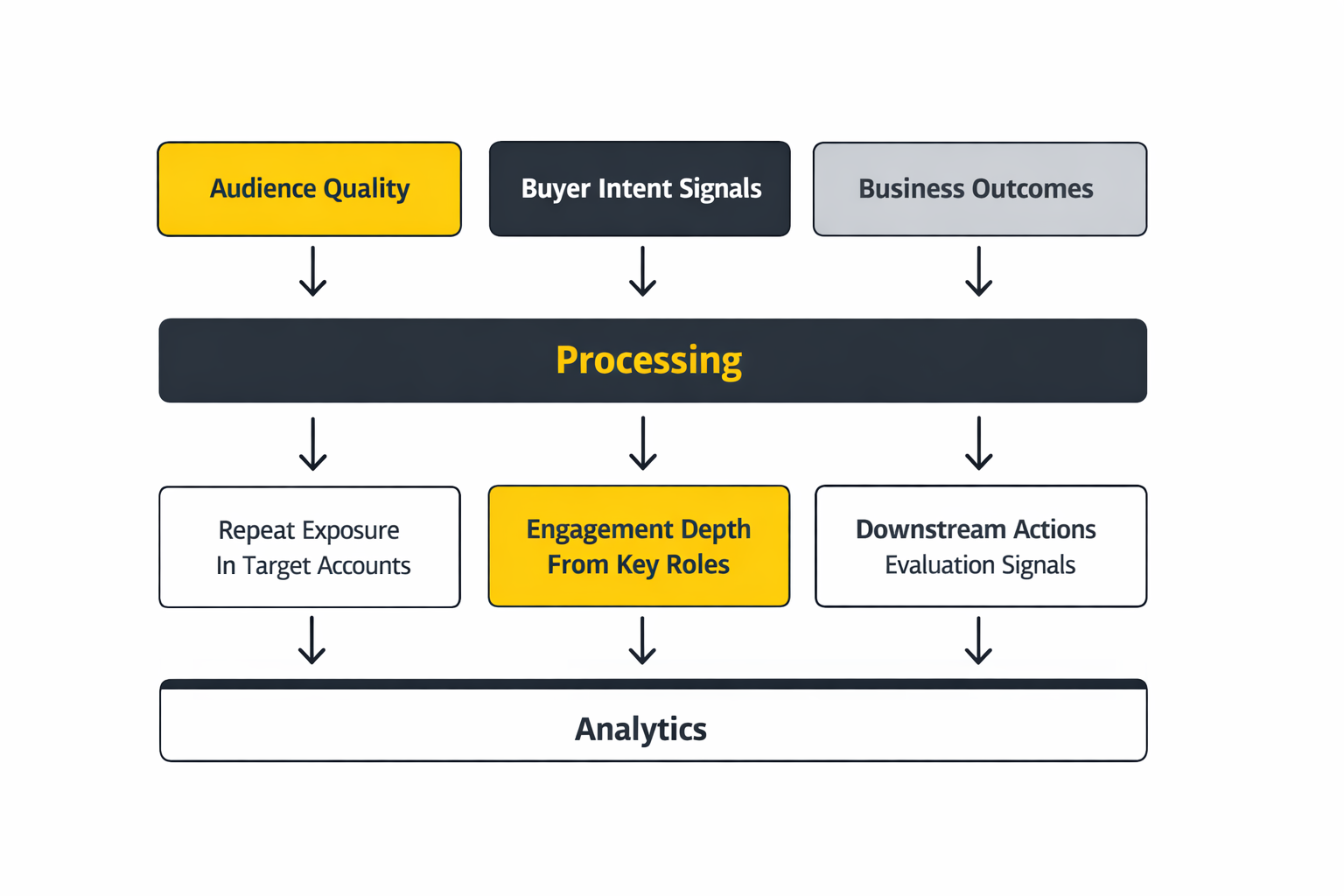
The fastest way to level up b2b social media marketing is to stop arguing about “how social feels” and start aligning on what social is supposed to prove. Not vanity metrics. Proof that your social presence is doing work while buyers are quietly researching, comparing, and building internal consensus.
That “quiet research” point matters because a large share of buying happens before anyone wants to talk to sales. A Gartner survey of 632 B2B buyers (fielded Aug–Sep 2024) found 61% prefer a rep-free buying experience, and the same release highlights that 73% actively avoid suppliers sending irrelevant outreach. Those exact figures were also covered in Demand Gen Report’s recap and MI-3’s write-up, which is useful for teams that want corroboration outside a single press page.
So your analytics system needs to answer a simple question: Did social help the buyer do their job? In practice, that means your dashboard should connect four types of signals—visibility, engagement quality, buyer intent, and downstream business impact—without pretending you can “last-click” your way through a long B2B cycle.
- Visibility: Are the right people reliably seeing you? (Reach, impressions, frequency, follower growth quality.)
- Engagement quality: Are decision-makers reacting in ways that suggest belief, not entertainment? (Comments with substance, saves, shares, profile visits, video watch time.)
- Intent: Are people raising their hand in ways your revenue team can act on? (Form fills, demo requests, event signups, high-intent page views, retargeting pools.)
- Impact: Are you influencing pipeline and retention? (Opportunities touched, acceleration, win-rate lift in accounts exposed to social, support deflection, advocacy.)
Performance Benchmarks
Benchmarks are helpful, but only if you treat them as guardrails—not as a scorecard. In b2b social media marketing, the most dangerous benchmark mistake is copying a number from a blog and declaring victory or failure without matching the measurement method (by impressions vs by followers, organic vs paid, brand vs personal profiles, and industry mix).
If you want one broad sanity check for engagement, Hootsuite’s 2026 update on engagement rate benchmarks cites an analysis of over one million posts and reports an average LinkedIn engagement rate of 2.8% (plus platform-by-platform averages). You can cross-reference that methodology and see industry slices in Hootsuite’s own charts, including their breakdowns by sector (for example, the April 2025 industry benchmark post lists LinkedIn engagement rates by industry using the same framework) with industry-level engagement rate examples. For a second lens that’s explicitly “engagement rate by impressions,” Socialinsider’s LinkedIn benchmarks show a trendline rising from 4.48% in Jan 2024 to 5.42% in Dec 2024, which is a different measurement basis and can’t be compared 1:1 to follower-based rates.
For video, the benchmark isn’t a single number—it’s momentum. Multiple outlets have reported LinkedIn video growth signals that matter for B2B distribution: Reuters described video as one of LinkedIn’s fastest-growing formats, noting uploads up over 20% and views up 36% year over year. Digiday reported a similar 36% viewership increase based on LinkedIn-shared stats with the same 36% YoY viewership signal, and Business Insider echoed the viewership trend while describing LinkedIn’s push into creator-led video shows with 36% video viewership growth referenced by LinkedIn. If your competitors are shifting attention into native video and you aren’t measuring watch time and retention, you’ll miss what the algorithm is rewarding.
Use benchmarks like this:
- First: confirm you’re measuring the same way (by impressions vs followers, organic vs paid).
- Second: set a “floor” metric (the minimum that signals your content is not being ignored).
- Third: set a “north star” metric tied to buying behavior (for example: comment quality from target roles, repeat exposure in named accounts, demo-intent actions).
Analytics Interpretation
Data doesn’t become insight until you can explain why a number moved—and what you’ll do next. That’s where most b2b social media marketing reporting breaks: teams either drown stakeholders in charts, or they cherry-pick a handful of “good” metrics and hope no one asks follow-up questions.
A practical interpretation workflow looks like this:
- Start with the buying stage: Was the goal awareness, consideration, or conversion support? Your “best” metric changes depending on the stage.
- Segment by audience quality: Compare performance in target roles/companies vs the general audience. A smaller, more relevant audience often beats broad reach.
- Separate format effects from topic effects: If video is up but leads are down, you might be winning attention while losing intent. That’s a content offer problem, not a “social is broken” problem.
- Track lagging impact with leading signals: Pipeline influence is slow; repeated exposure, high-signal engagement, and return visits move faster and can forecast outcomes.
- Use comparisons that matter: Week-over-week is noisy. Compare against your last campaign, your last quarter, and your last “similar offer.”
When you present results, try to say it in one sentence before you show the chart. For example: “We improved relevance in mid-market IT by narrowing topics, and that created more qualified conversations, even though total impressions fell.” That one line gives the chart meaning and prevents the room from obsessing over the wrong number.
Finally, analytics should help you defend investment. For teams asked to justify tooling and resourcing, a commissioned Forrester Total Economic Impact study can be a useful way to frame operational value. The 2025 TEI study for Sprout Social reports 268% ROI and $1.31M net present value for a composite organization, and those figures are reiterated in Sprout Social’s investor news release and referenced in Sprout Social’s 2024 annual report language noting up to 268% ROI from the Forrester study. That doesn’t prove your exact ROI—but it gives stakeholders a credible framework for why analytics + workflow consolidation can pay back.
Case Stories
LinkedIn’s Video Turning Point: When “Professional” Stopped Meaning “Static”
Monday morning, the paid social team opens Campaign Manager and sees something that makes their stomach drop. The CPMs are climbing, attention is fragmenting, and the old playbook—single-image ads plus polite thought leadership—suddenly looks invisible. The exec team still wants “more leads,” but the feed isn’t waiting for anyone to catch up.
The backstory is simple: LinkedIn became the town square for B2B, and everyone moved in at once. Brands chased the same job titles, the same keywords, the same gated PDFs. At the same time, creators got better at packaging insight into formats people actually watch, and the platform started leaning harder into video.
The wall hit when distribution stopped behaving like it used to. Even great writing struggled to earn time, and “reach” became a misleading comfort metric. Without watch-time and retention data, teams couldn’t tell whether the audience was learning—or just scrolling past.
The epiphany arrived in the form of signals that were hard to ignore. Multiple outlets reported LinkedIn’s own claims that video viewership was surging—Reuters described views growing 36% year-over-year and uploads up over 20%, while Digiday covered the same 36% viewership growth and Business Insider framed it as part of LinkedIn’s push into creator-led programming with the 36% growth referenced by a LinkedIn VP. This wasn’t a trend piece; it was a distribution shift.
The journey changed from “post more” to “measure what the feed rewards.” Teams started tracking first-3-second retention, average watch time, saves, and comment depth—then mapping those signals to retargeting audiences and account-level exposure. They stopped treating video as a brand film project and started treating it as a weekly operating cadence: short, specific, and built to teach one thing per clip.
The final conflict was operational. Video is harder to produce consistently, stakeholders want approvals, and the first versions often underperform. Teams that tried to bolt video onto old workflows burned out fast, because they never rewired measurement, resourcing, or creative iteration speed.
The dream outcome is not “we went viral.” It’s more valuable: consistent attention from the right roles, repeat exposure inside target accounts, and a clearer read on which topics actually pull buyers deeper into consideration. When you measure b2b social media marketing through retention and intent—not just impressions—you build a system that keeps working even as formats change.
Proving ROI Without Guesswork: Turning Social Reporting Into a Finance-Friendly Story
The crisis wasn’t a bad campaign—it was a budget meeting. Social leaders walked in with charts, the CFO walked in with questions, and everyone could feel the gap. “We’re busy” didn’t matter. “We’re growing followers” didn’t matter. The only thing that mattered was whether social created measurable business value.
The backstory is familiar in b2b social media marketing: the team is doing real work—publishing, community, listening, customer care—but the data is scattered across platforms and spreadsheets. Reporting becomes a monthly fire drill, and insights arrive after decisions have already been made. When pipeline slows, social becomes an easy target because impact is hard to articulate.
The wall shows up when leadership asks for a clean financial narrative. Time spent building reports looks like overhead. Tool spend looks like a luxury. Without a defensible model, even a strong social team can’t protect its resources.
The epiphany came from reframing social operations as an efficiency and intelligence problem, not just a content problem. A commissioned Forrester Total Economic Impact study gave teams a language finance understands: the 2025 TEI study for Sprout Social reports 268% ROI and $1.31M net present value for a composite organization over three years. Those figures are echoed in Sprout Social’s investor announcement and reinforced by Sprout’s own annual report language citing up to 268% ROI from the Forrester study. The important part wasn’t the exact number—it was the framework: benefits, costs, risks, and payback logic.
The journey became practical: define a reporting spine (visibility, engagement quality, intent, impact), automate data collection, and tie social activity to revenue motion where possible. Teams started building quarterly “decision memos” instead of monthly metric dumps—one page that explained what changed, why it changed, and what the team would do next. That shift turned analytics from noise into leadership support.
The final conflict was skepticism. Stakeholders rightly challenged assumptions, especially around attribution. The teams that won didn’t overclaim. They paired influenced-pipeline reporting with operational wins (time saved, faster response cycles, fewer missed signals) and made the story consistent enough that leadership could trust it.
The dream outcome is a social function that can’t be casually cut because it’s no longer “content.” It’s an intelligence system that helps buyers self-educate, helps sales understand what resonates, and helps leadership make faster decisions. When analytics is interpreted honestly and presented clearly, b2b social media marketing becomes easier to fund—and easier to scale.
Professional Promotion
“Promotion” in b2b social media marketing shouldn’t mean “boost everything.” Professionally promoted content is content that has earned the right to be amplified because it already demonstrates buyer value in organic signals (watch time, saves, thoughtful comments, repeat reach inside target accounts).
A clean professional promotion approach looks like this:
- Promote what already works: Use organic performance as a filter. If a post earns meaningful engagement from the right roles, it’s a candidate for paid distribution.
- Promote to stages, not personas: Awareness gets broad but relevant targeting; consideration gets retargeting and job-function layers; conversion support gets high-intent audiences and clear CTAs.
- Promote with credibility assets: In a world where buyers prefer self-service research, credibility compounds. The Gartner buying-behavior findings—61% preferring rep-free buying and 73% avoiding irrelevant outreach—are a reminder that promotion must feel helpful, not intrusive; the same figures are reinforced by Demand Gen Report and MI-3.
- Promote with measurement built in: Define what success means before spend starts (for example: qualified profile visits, high-retention video views, lead quality checks, opportunity touch rates).
- Promote with executive-friendly reporting: If leadership needs confidence, use a financial framework they recognize. The Forrester TEI figures for social tooling—268% ROI and $1.31M NPV, echoed in investor communications and a reference in Sprout Social’s annual report—show how to present benefits, costs, and payback without hype.
Professional promotion is ultimately a trust exercise: trust that your content is genuinely useful, trust that your targeting respects the buyer, and trust that your reporting tells the truth. When those three are in place, your analytics dashboard stops being a rear-view mirror and becomes a steering wheel.
Future Trends
The next phase of b2b social media marketing won’t be won by the teams who post the most. It’ll be won by the teams who build the most believable ecosystem: video that feels like expertise, creators who feel like trusted peers, measurement that feels like business reality, and distribution that doesn’t depend on the brand page alone.
Video becomes the default language of “I’ve done this before.” LinkedIn’s own 2026 B2B insights series frames video as “the conversation,” and cites research from its 2025 B2B Marketing Benchmark showing 78% of B2B marketers already use video and 56% plan to increase use in the next year. The same piece also notes videos are 20x more likely to be shared than any other post on LinkedIn, which is less a “nice stat” and more a distribution clue: teach something clearly and it travels.
Creator collaboration becomes measurable, not mysterious. LinkedIn’s BrandLink expansion is a signal that the platform is industrializing B2B creator distribution. Reuters reported BrandLink’s growth, including video uploads up over 20% and views up 36% year over year, alongside the move into creator-led shows. eMarketer also covered the broader implication for B2B marketers, highlighting the shift toward creator trust in LinkedIn’s video ecosystem in its BrandLink analysis.
Self-serve buying keeps pushing content upstream. When buyers prefer to research without a sales rep, your social content is no longer “awareness.” It’s part of the buying experience. Gartner’s sales survey press release reports 61% of B2B buyers prefer a rep-free buying experience and 73% actively avoid suppliers who send irrelevant outreach. That trend reshapes what “good social” looks like: fewer generic posts, more practical clarity that helps a buyer group make progress.
AI doesn’t replace teams, it raises the standard. As more content becomes easier to generate, original thinking becomes the scarce asset. The teams that win will use AI for repurposing, editing, and operational speed, while protecting human judgment for point of view, tradeoffs, and credibility. In practice, that means your best-performing content will sound more like a practitioner and less like a brochure.
Strategic Framework Recap

If you’ve made it this far, you’ve already seen the core truth: b2b social media marketing works when it’s treated like an ecosystem, not a posting schedule. The framework is simple, but it has to be run as a system.
- Clarity first: define success in business terms and map the buyer group’s real questions.
- Consistency next: build a content spine you can repeat for 90 days and choose formats your team can actually sustain.
- Distribution on purpose: move your best ideas through multiple surfaces—brand, executives, employees, partners, and selective paid.
- Proof that leadership trusts: measure audience quality, intent, and impact without overclaiming attribution.
- Compounding advantage: capture what works, repurpose it intelligently, and keep sharpening your narrative using market feedback.
When those parts are connected, you stop “doing social” and start building a program that creates familiarity, credibility, and demand while buyers are still researching. That’s why the ecosystem matters: it’s how your best ideas get more than one chance to land.
FAQ – Built For The Complete Guide
What makes b2b social media marketing different from B2C?
B2B buyers usually make decisions in groups, take longer to evaluate options, and need proof they can defend internally. That changes your content: it needs to educate, reduce perceived risk, and build credibility over time instead of chasing impulse conversions.
Which platforms matter most for b2b social media marketing?
It depends on where your buyer group already spends attention, but LinkedIn is the default “work network” for most B2B categories. If your audience learns through video and creators, LinkedIn’s video momentum and creator ecosystem expansion are worth tracking through sources like Reuters’ BrandLink coverage.
How often should we post?
Consistency beats frequency. Start with a cadence you can sustain for 90 days without quality dropping—one flagship post per week plus a few lighter supporting posts is a strong baseline for many B2B teams. Scale only after you prove you can stay consistent.
What content formats tend to work best?
In most B2B categories, the content that travels is the content that teaches: clear frameworks, implementation lessons, decision criteria, and honest tradeoffs. Video is also becoming a bigger part of B2B distribution; LinkedIn’s 2026 insight series ties video to modern buyer behavior and notes 78% of B2B marketers already use video.
How do we measure b2b social media marketing without obsessing over vanity metrics?
Use a simple ladder: visibility, engagement quality, intent signals, and impact. Visibility tells you if the market can see you, but engagement quality and intent tell you if the right accounts are leaning in. Impact is where you connect social to pipeline influence, sales enablement, and retention.
What does “good engagement” look like in B2B?
It’s less about like counts and more about buyer behavior: thoughtful comments, saves, shares into teams, repeat engagement from target accounts, and inbound messages from credible roles. If your engagement is high but it’s coming from the wrong audience, it’s not helping revenue.
How can social support sales without feeling salesy?
Create content that gives sales better conversations: objection handling, decision checklists, implementation traps, and clear points of view. Then package your best posts into a small “sales library” so reps can share useful insight instead of sending generic follow-ups.
Should we use paid social for b2b social media marketing?
Yes, but treat paid as an amplifier, not a replacement for good content. Promote what already earned trust organically, then retarget engaged audiences with deeper evaluation assets. This respects the reality that buyers increasingly prefer self-serve research, reflected in Gartner’s finding that 61% prefer a rep-free buying experience.
How long does it take to see results?
You can see engagement and audience-quality signals within weeks, but trust and pipeline influence take longer because B2B cycles are longer. A practical expectation is 90 days to stabilize output and learn what resonates, then another quarter to see clearer downstream impact.
What are the most common mistakes teams make?
The big ones are publishing without a strategy, chasing frequency without quality, measuring only vanity metrics, and treating the brand page as the only distribution channel. Another common mistake is sounding generic; when content could be posted by any competitor, it won’t build preference.
Do executives need to post for the strategy to work?
It’s not mandatory, but it can be a multiplier when done well. Executive content works best when it shares real thinking: what changed, what you learned, what surprised you, and what tradeoffs you made—especially in formats buyers actually consume, including short video.
Work With Professionals
If you’re reading this and thinking, “We know what to do, but we don’t have the bandwidth to execute it consistently,” you’re not alone. Most teams don’t fail because they lack ideas. They fail because the work gets squeezed between launches, meetings, approvals, and constant context switching. Then social becomes sporadic, and sporadic social doesn’t compound.
There’s a faster path: work with specialists who already run this system every day—strategy, production, distribution, and measurement—without reinventing the wheel. That’s the promise of a marketplace built specifically for marketing work.
MARKEWORK is designed to connect companies directly with marketing professionals and marketing companies, with direct communication, no commissions and no project fees, and a simple monthly subscription model. If you want opportunities on the marketer side, the platform highlights access to thousands of job listings, and the listings page shows over 1,000 active listings visible on the marketplace.
That matters if you’re a marketing freelancer trying to build a steadier pipeline. Instead of spending your best creative energy on cold outreach, you can focus on showing your expertise, applying to relevant roles, and negotiating directly—without a middle layer taking a cut. And if you’re a company, you can post a listing, browse profiles, and hire faster with fewer process bottlenecks.
 Filip Konecny Enterprises