

B2B social has changed quietly, then all at once. The people who influence deals spend months researching in plain sight on LinkedIn, YouTube, and niche communities, while the “real” buying conversations happen later—often after opinions are already formed.
That’s why choosing (or building) a b2b social media agency capability isn’t just about posting consistently. It’s about earning attention from buying groups, turning visibility into trust, and making sure trust turns into sales conversations your team can actually close.
In this series, you’ll get a clear framework you can use to evaluate agencies, brief them properly, or run the playbook in-house—without relying on vague “brand awareness” promises.
Article Outline
- What a B2B Social Media Agency Is
- Why a B2B Social Media Agency Matters
- Framework Overview
- Core Components
- Professional Implementation
What a B2B Social Media Agency Is

A b2b social media agency is a specialist partner that designs and runs social as a revenue-supporting system—built for long buying cycles, multiple stakeholders, and high-consideration decisions. Instead of chasing viral spikes, it focuses on repeating patterns: the right people see you often enough, trust you enough, and click or reply when timing is right.
In practice, this kind of agency sits at the intersection of brand, demand, and sales enablement. It translates what your best salespeople say in calls into content that travels, then connects that content to targeting, distribution, and measurement that a leadership team can defend.
What makes it “B2B” isn’t just the platform mix (though LinkedIn usually matters more). It’s the operating model: messaging that survives procurement scrutiny, proof that stands up to technical review, and content that nudges internal consensus rather than pushing one individual to buy.
Why a B2B Social Media Agency Matters
There’s a simple reason social now deserves a real operating system: buyers are comfortable completing serious research and even major parts of purchasing digitally. When McKinsey reported that 39% of B2B buyers were willing to place $500K+ orders through self-service or remote channels in 2024, it wasn’t a quirky ecommerce stat—it was a signal that digital influence has moved upstream. The same figure shows up in Digital Commerce 360’s coverage of the survey and is repeated in Coveo’s analysis.
At the same time, many of the people shaping the decision aren’t raising their hands publicly. They read, they compare, they screenshot, they forward links internally—and they often avoid sales outreach until a shortlist is already taking shape. That’s why thought leadership and credibility content matter so much: Edelman and LinkedIn found that 95% of hidden decision-makers become more receptive to outreach when a vendor consistently produces strong thought leadership, reinforced by Edelman’s published highlights and reported by Marketing Interactive’s write-up.
A b2b social media agency exists to make those two realities actionable. It gives your team a way to show up earlier, influence more stakeholders, and stay consistent long enough for the market to notice—without asking your sales org to “just post more.”
Framework Overview
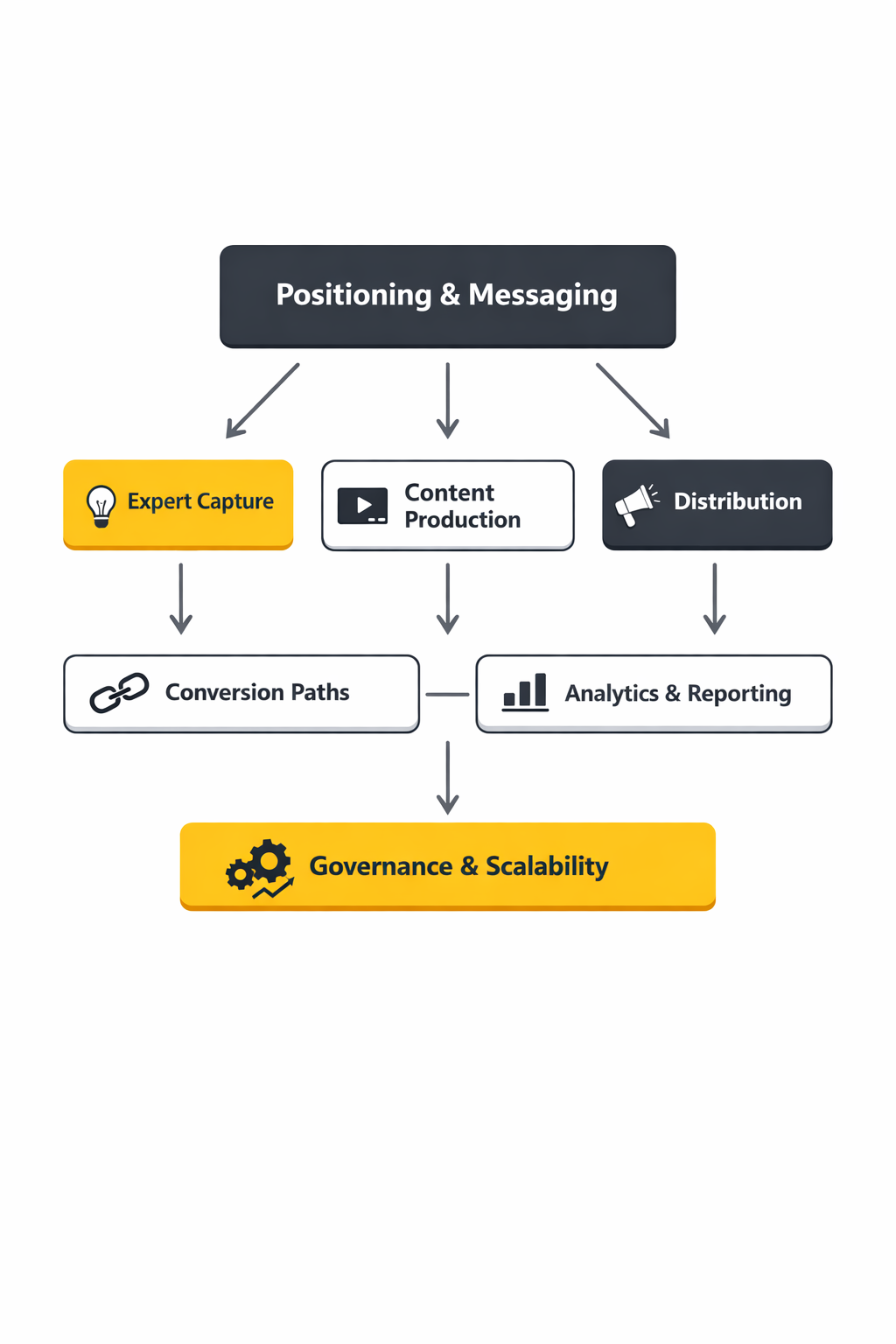
This framework treats social as a connected system, not a content calendar. Each layer supports the next, and the whole thing is designed to survive real-world constraints: limited expert time, long feedback loops, and the fact that attribution will never be perfect in complex B2B deals.
- Positioning: a clear point of view that makes the right buyers feel understood (and makes the wrong buyers self-select out).
- Content engine: a repeatable way to turn expertise into assets—without burning out your subject-matter experts.
- Distribution: organic + paid designed for reach, frequency, and stakeholder coverage across the buying group.
- Conversion paths: low-friction next steps that fit how B2B people actually evaluate risk.
- Measurement: a scorecard that leadership trusts, even when the deal closes months later.
- Governance: roles, review loops, and brand safety rules so the system scales without drama.
The rest of this article breaks these layers down into practical components you can implement—whether you’re hiring an agency or building the function inside your team.
Core Components
Positioning That Makes a Buyer Pause
In B2B, “good content” isn’t the goal—clarity is. A strong b2b social media agency starts by identifying the few claims your brand can own and proving them with examples, language, and framing that buyers recognize from their day-to-day work.
- Category lens: what you believe about the market that most competitors won’t say out loud.
- Problem clarity: how you describe the pain in a way that feels uncomfortably accurate.
- Proof style: what counts as evidence for your audience (numbers, demos, architecture, peer references, methodology).
A Content System Built for Busy Experts
The fastest way to kill a social program is to rely on heroic effort. The work has to feel light for experts and heavy for the system. That usually means structured interviews, content briefs that reduce decision fatigue, and formats that can be repeated without sounding templated.
- Expert capture: short, consistent sessions that produce multiple posts, not one.
- Format library: a stable set of post types (point of view, teardown, myth-busting, lessons learned, “how we think”).
- Quality controls: technical accuracy checks without turning every post into a committee meeting.
Distribution That Reaches the Buying Group
Organic reach is helpful, but B2B growth usually requires planned coverage. A capable agency builds distribution around roles and influence, then designs frequency so your message actually sticks—especially during quiet buying phases when deals are forming in the background.
- Stakeholder mapping: primary users, technical evaluators, finance/procurement, exec sponsors.
- Paid amplification: boosting the posts that already prove resonance, instead of forcing ads to do all the work.
- Retargeting logic: sequencing that respects attention and earns the next click.
Community Signals and Credibility Loops
In B2B, people watch who interacts with you. The agency’s job isn’t to manufacture hype—it’s to build credible signals: employees showing up with real opinions, customers seeing themselves in your thinking, and peers recognizing your expertise over time.
Measurement That Leadership Can Defend
A useful social scorecard balances three realities: you need leading indicators to steer week to week, you need pipeline indicators to justify spend, and you need qualitative signals to understand trust. The point is direction and consistency, not pretending social is a last-click channel.
Governance That Keeps the System Running
Governance is where most programs quietly fail. Clear roles, predictable review windows, and a “what counts as approved” checklist stop the work from stalling every time someone has a concern. This is especially critical in regulated or technical industries.
Professional Implementation
Professional implementation is what separates a content vendor from a true b2b social media agency. The goal isn’t more activity—it’s a reliable operating cadence: the right inputs come in, strong outputs go out, distribution is intentional, and reporting creates confidence instead of arguments.
A solid implementation typically starts with an audit (message, audience, competitors, content performance, and conversion paths), then moves into a production system with clear owners. Teams that do this well tend to formalize process and measurement, which lines up with LinkedIn’s direction of travel in modern B2B org design, highlighted in LinkedIn’s 2024 B2B Marketing Benchmark and the downloadable benchmark report PDF.
From there, the agency should help you build a content and distribution plan that matches how buyers actually consume information now—especially video, which many B2B teams plan to invest in more heavily. That trend is documented in CMI’s 2025 B2B content marketing benchmarks, supported by the CMI/MarketingProfs 2025 outlook key takeaways, and echoed in commentary drawing from the same research like Exo B2B’s breakdown of the findings.
In the next part, we’ll turn this into a step-by-step playbook: what to demand in an agency scope, what to measure early, what to automate, and how to avoid the most common “everything looks busy, nothing moves” trap.
Step-by-Step Implementation
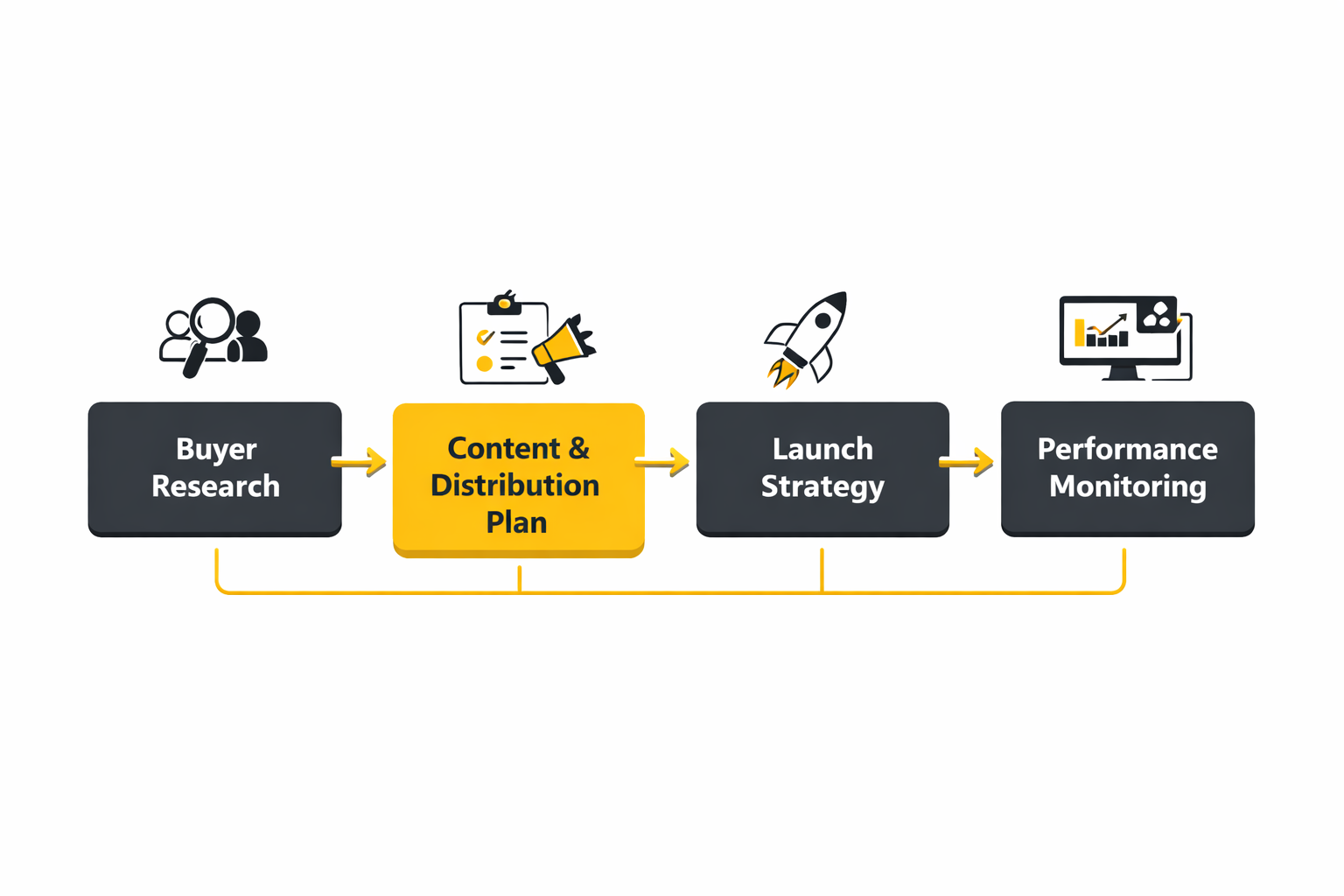
A b2b social media agency implementation works best when it’s treated like an operating system rollout, not a “content sprint.” You’re building a machine that can run every week with the same level of quality, even when experts are busy and sales is chasing end-of-quarter deals.
The steps below are designed to get you to a stable cadence fast, then improve it without constant rebuilds.
Step 1: Align on the Buyer Group You’re Actually Trying to Influence
Before a single post goes live, define the buying group in plain language: who uses the product, who evaluates risk, who controls budget, and who can kill the deal quietly. This is the difference between “we’re targeting IT” and “we’re targeting security leadership, the ops lead who will own the rollout, and procurement who will ask why we’re not choosing the cheaper option.”
If your team only targets the 5% who are ready to buy right now, you’ll feel like social “doesn’t work” most of the year. The LinkedIn B2B Institute’s research is blunt about it: only 5% of buyers are typically in-market at a given time, and the companion explainer makes the practical implication clearer: the other 95% still need to remember you when their window opens. A third perspective that traces where this stat comes from (and why marketers misquote it) is worth skimming before you brief an agency: the breakdown of the “95:5 rule” sourcing and nuance.
Step 2: Build a Message House You Can Repeat Without Sounding Repetitive
Most teams don’t fail because they lack ideas. They fail because they can’t repeat the same core ideas in enough angles for the market to remember them. Create a message house with three layers: the category belief you stand for, the pains you solve, and the proof you’re willing to show.
- Category belief: the point of view that makes the right buyer feel seen.
- Problem language: the way your buyers describe the pain in meetings, not the way marketing writes it.
- Proof: what counts as evidence (technical depth, outcomes, methodology, customer validation).
Step 3: Create an Expert-Capture Rhythm That Doesn’t Burn People Out
A b2b social media agency should reduce load on experts, not increase it. The simplest structure that works: one short weekly capture session per expert, turned into multiple content assets across formats and channels.
- Capture: 25 minutes of guided prompts, recorded, with the agency doing the heavy lifting.
- Convert: one insight becomes a post, a carousel-style narrative (written as a thread or sequence), a short clip, and a sales enablement snippet.
- Approve: experts only review accuracy and tone, not formatting and distribution details.
Step 4: Design Distribution Around Frequency, Not Hope
Organic reach is unpredictable. That’s not a moral failing of your content; it’s how feeds work. Treat distribution like you would treat any B2B channel: decide who needs to see your message, how often, and in what sequence.
That’s where paid support becomes a stabilizer. Instead of boosting everything, a b2b social media agency should identify posts that already resonate and amplify those to the buyer group you defined in Step 1.
Step 5: Attach Easy Next Steps to Every Theme
B2B buyers hate being pushed, but they love being guided. For each content theme, define a next step that matches the level of trust you’ve earned.
- Low-friction: subscribe, follow, save, share internally, or download a short technical brief.
- Mid-friction: benchmark, checklist, teardown session, short assessment, or recorded demo.
- High-friction: workshop, proof-of-concept, security review, stakeholder Q&A.
Step 6: Measure Like You Know the Journey Is Long
If you measure social like a short-cycle channel, you’ll make bad decisions and starve the program right before it compounds. Multiple independent sources converge on the same uncomfortable truth: in B2B, time-to-revenue is long.
Dreamdata’s benchmark highlights show the time from first LinkedIn ad impression to revenue averaging 320 days for LinkedIn ad impressions, while LinkedIn’s own coverage of the same benchmark reinforces the broader context with an overall average journey of 211 days and a LinkedIn impression-to-new-business average of 320 days. That aligns with the “out-of-market” reality described in the 95:5 rule explainer.
Execution Layers
When a b2b social media agency runs smoothly, it’s because execution is layered. Each layer has its own owner, cadence, and definition of “done,” so the whole program doesn’t stall when one piece slows down.
Layer 1: Strategy and Planning
This is where themes, buyer-group priorities, and campaign sequences get decided. It should feel like a weekly newsroom meeting and a monthly business review combined: what’s changing in the market, what’s resonating, what’s slipping, and what needs a sharper point of view.
Layer 2: Production and Approval
Production is not “make content.” It’s “turn expertise into assets reliably.” A strong agency creates templates that preserve your voice, then uses approvals for accuracy and risk—never for taste debates that eat calendar time.
Layer 3: Distribution and Coverage
Distribution is where you decide whether you’re playing to win or playing to post. Coverage means you can explain, in one sentence, which roles you’re reaching and why. It’s also where you connect the dots between organic traction and paid amplification so your best ideas travel further than your existing followers.
Layer 4: Conversion Paths
B2B conversion paths need to respect buyer preference for independent discovery. Gartner’s sales survey press release spells it out: 61% prefer a rep-free buying experience, and 73% actively avoid suppliers who send irrelevant outreach. So conversion design should feel like “help me learn faster,” not “talk to sales now.”
Layer 5: Measurement and Reporting
Measurement should reduce internal arguments. If marketing and RevOps can’t agree on what’s real, the program will get cut the first time budgets tighten. The stack should make it easy to answer three questions: Are we reaching the right buyer group? Are we earning trust signals? Are we creating measurable movement toward revenue over time?
Optimization Process
Optimization is where social becomes predictable. Not because you “cracked the algorithm,” but because you systematically reduce waste: fewer posts that go nowhere, fewer campaigns with broken tracking, fewer weeks where approval cycles kill momentum.
What to Optimize First
- Message clarity: if people don’t immediately recognize the problem you solve, nothing else matters.
- Format-market fit: if your audience saves and shares certain formats, double down and stop forcing the rest.
- Distribution sequencing: amplify what already proves resonance instead of guessing what might work.
- Conversion friction: remove steps that force buyers to “talk to sales” before they’re ready.
- Measurement integrity: fix tracking gaps before you debate performance.
Upgrade Measurement Without Turning It Into a Science Project
When teams try to prove impact, the most common failure is data fragmentation. Sprout Social’s report on business value shows how real this is: tool incompatibility is cited as the #1 reason many leaders can’t understand social’s impact, and the report hub reinforces the same theme around ROI pressure and confidence gaps. That’s why optimization has to include stack hygiene, not just creative tweaks.
On LinkedIn specifically, server-side measurement is increasingly used to improve signal quality. LinkedIn’s measurement guidance explains how Conversions API can improve attribution and performance measurement, while Dreamdata’s benchmark write-up repeats the same magnitude of lift and efficiency when CAPI is used well: a 31% increase in attributed conversions and up to 20% lower CPA. A third LinkedIn source references the same pattern in the context of ROI reporting and campaign optimization. That consistency across sources is what you want before you build process around a statistic.
The Weekly Optimization Loop a B2B Social Media Agency Should Run
This loop keeps you honest without drowning you in dashboards.
- Monday: review what earned real attention (saves, qualified comments, shares inside the industry).
- Tuesday: pick 1–2 winners to amplify and decide who needs to see them next.
- Wednesday: capture new SME insights based on what buyers are reacting to.
- Thursday: ship new assets and update conversion paths that are underperforming.
- Friday: report learnings in plain language: what changed, what you’ll test next, what you’re stopping.
Implementation Stories
Implementation is easiest to understand when you see what it looks like under pressure. Here’s a real story where measurement, workflow, and distribution had to become more disciplined—because “content” alone wasn’t going to solve the business problem.
Otaree: When Measurement Became the Bottleneck
The pressure arrived quietly at first, then all at once. Campaigns were running, engagement looked healthy, and the team could point to plenty of activity in the feed. But when budget conversations came up, the room went cold—because the numbers weren’t connecting cleanly to qualified outcomes.
It didn’t help that buyers were behaving more independently than ever. The team felt the gap between “people are seeing us” and “we can prove influence,” and that gap started to threaten the entire program. In B2B, once leadership stops trusting measurement, social becomes the easiest line item to cut.
The backstory is familiar to any b2b social media agency that inherits a messy stack. Tracking had grown organically over time, different campaigns used different naming conventions, and attribution lived in too many places at once. Some data was in platform dashboards, some in CRM, and too much in spreadsheets no one wanted to own. The team wasn’t lazy—it was running at speed without infrastructure designed for long-cycle B2B.
The wall hit when optimization started to feel like guesswork. If you can’t tell which campaigns are creating qualified movement, you end up “optimizing” for cheap clicks or surface-level engagement. That’s how teams accidentally train their programs to attract the wrong attention. Worse, it can create internal conflict: marketing claims momentum, sales claims noise, and nobody has shared truth.
The epiphany was deciding that measurement itself had to be part of the implementation plan, not a reporting afterthought. Instead of asking, “Which ad got the click?” the team moved toward, “Which campaign touched the journey that led to qualified outcomes?” That’s where server-side signals and centralized measurement views become powerful—not because they’re trendy, but because they reduce blind spots in long journeys.
The journey focused on two concrete moves: centralizing insight and improving data flow. LinkedIn’s Campaign Manager updates describe a Measurement Insights dashboard designed to bring deeper performance visibility into a single view, and the same update explicitly ties improvements to implementing Conversions API and measurement changes. That post reports Otaree increased spend by 25% while reducing CPQL by 37% after using Measurement Insights and implementing CAPI. In parallel, LinkedIn’s measurement overview explains how CAPI supports stronger attribution and performance signals across customer journeys. That context matters because it shows why the tooling change can influence optimization decisions.
Then the final conflict arrived, because every implementation has one: change management. It’s one thing to install tracking; it’s another to keep it consistent as new campaigns ship. Naming conventions drift. Teams create “one-off” exceptions. Someone launches a new initiative without looping in the person who owns the measurement layer. Without governance, the system slowly breaks again—and you don’t notice until the next executive review.
The dream outcome wasn’t a perfect dashboard. It was confidence. Confidence to invest more because the team could explain what was happening and why. Confidence to stop chasing vanity metrics and start optimizing for qualified movement. And confidence that the b2b social media agency motion—content, distribution, and measurement—was operating as one system instead of five disconnected activities.
The Deliverables That Separate a Real Agency From a Content Vendor
- Operating cadence: weekly production rhythm, monthly performance review, quarterly strategy refresh.
- Governance rules: approvals that protect the brand without creating gridlock.
- Measurement blueprint: how tracking works end-to-end, including how CRM outcomes connect back to campaigns when possible.
- Distribution plan: who you’re reaching, how often, and how paid support is allocated based on proven resonance.
- Optimization log: a running record of what you tested, what changed, and what you learned.
Why This Level of Rigor Matters Right Now
Buyer behavior keeps pushing B2B brands toward credibility and self-serve discovery. Gartner’s survey press release makes the direction unmistakable: most buyers prefer independent research, and irrelevant outreach gets actively avoided. That means your social program can’t be built on volume. It has to be built on relevance, proof, and the ability to stay consistent long enough for the right buyer group to remember you.
In Part 4, we’ll go deeper into analytics and reporting—how to build a scorecard a CFO won’t dismiss, how to interpret “dark funnel” signals without guessing, and how to connect social to pipeline movement without pretending attribution is perfect.
Statistics and Data
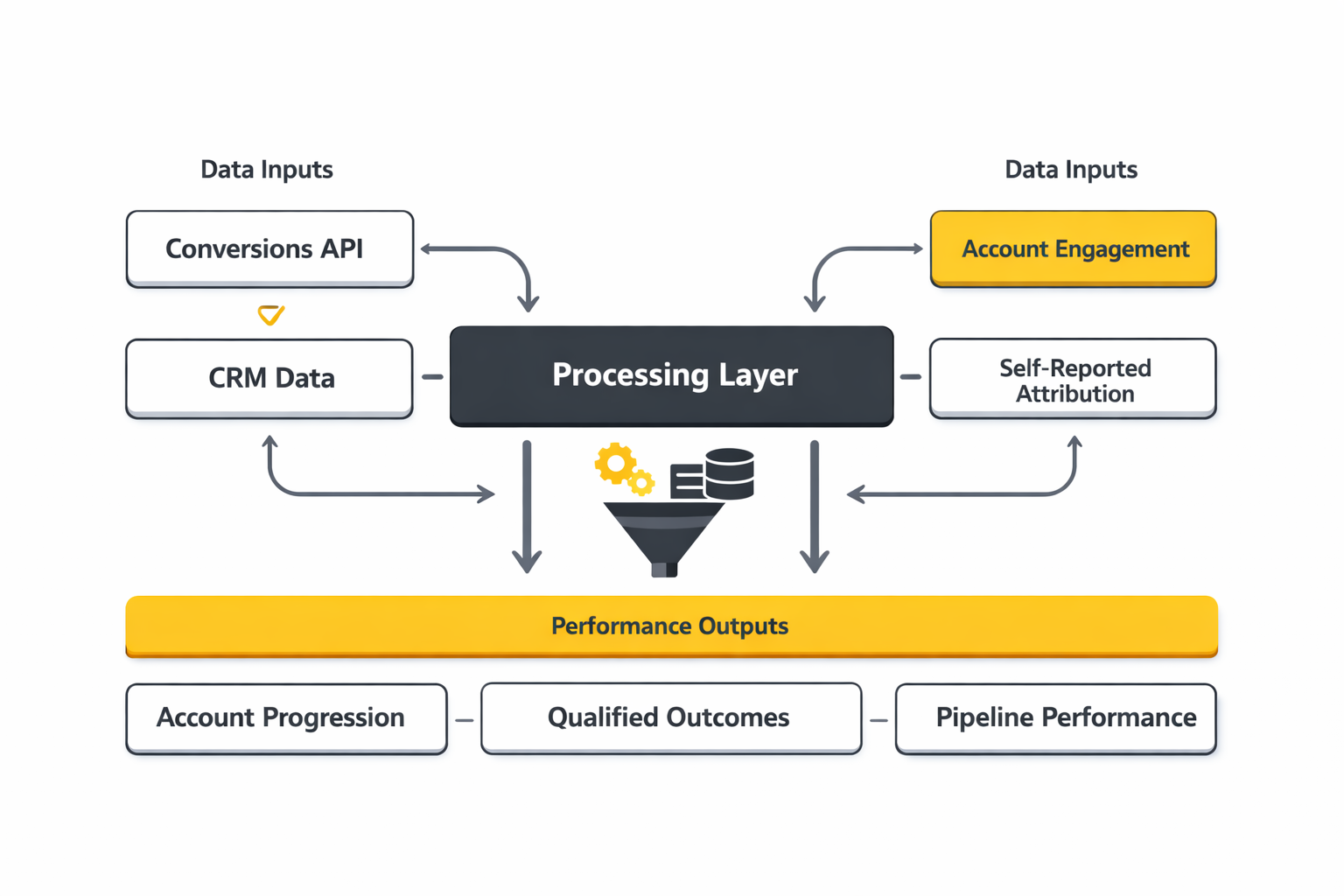
When a b2b social media agency says “we’re driving impact,” the next question is always the same: impact on what, exactly? The only way to keep social out of the “nice-to-have” bucket is to ground it in numbers that a revenue team recognizes, while still respecting how messy B2B journeys really are.
The journey length alone forces a mindset shift. LinkedIn’s summary of Dreamdata’s benchmarks describes an average B2B customer journey of about 211 days from first ad impression to decision, and the same benchmark highlights that LinkedIn ad impressions average 320 days from first touch to new business. Dreamdata’s own highlights page reinforces the long-cycle reality in the context of how LinkedIn contributes across the journey. That’s exactly why short-term reporting can accidentally punish the channels that create future pipeline.
And if your organization is struggling to prove ROI, you’re not alone. Sprout Social’s 2025 research shows over half of marketing leaders cite incompatibility between social management tools and the wider martech stack as the #1 reason they can’t understand social’s business impact. The same point is repeated in Sprout’s public write-up, with the practical implication spelled out: broken integration makes social data hard to trust and harder to operationalize.
So the goal of analytics in a b2b social media agency program is not to “prove every post.” It’s to create a credible chain of evidence that links attention to trust signals, and trust signals to revenue movement over time.
Performance Benchmarks
Benchmarks are useful when they stop you from lying to yourself. They’re dangerous when they become a scoreboard you chase blindly, especially in B2B where the best-performing program might look “slow” before it looks successful.
Benchmark 1: Expect Long Feedback Loops
If your organization expects social to show pipeline impact in weeks, it will churn agencies, churn strategy, and churn budgets. Dreamdata’s benchmark summary points to an overall journey length around 211 days, with LinkedIn impressions showing an average of 320 days to new business. Their highlights post frames the same story as a strategic reality: LinkedIn’s value shows up across longer customer journeys, not as a quick last-click win.
Benchmark 2: Use Business Benchmarks, Not Only Platform Benchmarks
CTR and CPC can help you diagnose creative and targeting problems, but they don’t tell you if you’re influencing the accounts that matter. Dreamdata’s benchmark recap on LinkedIn highlights business-level metrics that better match B2B reality, including a reported 113% ROAS and a €154 cost per company influenced. If you want context for why “cost per influenced company” exists as a metric, Dreamdata explains it as a B2B-specific way to assess acquisition cost at the company level. That perspective is helpful when stakeholders keep asking why your CPC is higher on LinkedIn than on search.
Benchmark 3: Measurement Upgrades Can Change What You See
It’s common to think performance “improved” when tracking improves. That’s not always a trick; sometimes it’s simply the reality that you were undercounting outcomes before. LinkedIn’s newsroom update reports that marketers using Conversions API are seeing an average 31% increase in attributed conversions and a 20% decrease in cost per action, with early results showing a 39% decrease in cost per qualified leads. The same efficiency theme appears in Dreamdata’s benchmark highlights. That consistency is why mature b2b social media agency teams treat measurement as an ongoing implementation layer, not a one-time setup.
Benchmark 4: The Buying Journey Is Crowded
When you feel like buyers are harder to move, you’re not imagining it. HockeyStack’s analysis describes the increase in journey complexity, including a 19.8% rise in touchpoints and a 9.5% rise in impressions to close deals in 2024. Industry coverage of the same report highlights the headline figures that often shock leadership: 2,879 impressions and 266 touchpoints to close a deal in 2024. A curated summary repeats the same benchmark and adds deal-size context.
Analytics Interpretation
Good analytics interpretation feels less like a dashboard tour and more like a conversation that ends in decisions. A b2b social media agency should be able to say: “Here’s what changed, here’s why we think it changed, and here’s what we’re doing next week.”
Use Three Layers of Signals
- Attention signals: reach into the right roles, frequency, and content resonance (saves, shares, meaningful comments).
- Trust signals: repeat engagement from relevant accounts, inbound mentions, DM replies, executive profile growth, and peer validation.
- Revenue movement signals: qualified lead rates, cost per qualified lead, influenced accounts, progression through stages over time.
This layering matters because B2B journeys are long and complex, and you need early signals to steer without pretending you can close attribution perfectly. LinkedIn’s B2B Institute research pushes the same strategic patience by highlighting that most buyers are out of market most of the time, with a deeper report explaining how modern B2B teams build for the long term. That same long-horizon thinking shows up across LinkedIn’s benchmark work.
Why “Cheap Leads” Can Be a Trap
If you optimize social purely for low CPL, you can accidentally build a machine that makes sales miserable. Cheap leads often mean low intent, and low intent often means wasted follow-up time and internal distrust. That’s why CPQL (and influenced accounts) tends to create better alignment between a b2b social media agency and the revenue team.
LinkedIn’s own measurement updates emphasize qualified outcomes and improved signal quality, noting early CPQL reductions when Conversions API is implemented. The message underneath the metric is simple: stop rewarding volume that doesn’t convert, and start rewarding evidence that the right accounts are moving.
How to Read Lagging Signals Without Panicking
Lagging signals (pipeline and revenue) arrive late, and that’s normal. What’s not normal is changing strategy every time you don’t see immediate pipeline lift. Dreamdata’s benchmark framing makes the “lag” explicit, showing how long the path can be before revenue appears. That’s why stable measurement and consistent content themes matter more than chasing weekly volatility.
Case Stories
Case stories are where analytics becomes real. Not “we ran ads and got leads,” but the uncomfortable moment where a team has to fix measurement, governance, or workflow before the program can scale.
Alaan: When the Numbers Finally Had to Match the Story
The team could feel the heat. Spend was rising, expectations were rising with it, and every review meeting started to sound the same: “We’re seeing activity, but can we prove impact?” Even when campaigns looked strong in-platform, confidence was fragile because leadership didn’t trust what they couldn’t connect to downstream outcomes.
Then the pressure turned personal. When your job depends on a budget that’s questioned every month, “vanity metrics” isn’t an insult—it’s a threat. And in B2B, once trust in reporting breaks, the entire social motion can get labeled as optional.
The backstory is what makes this common. Buyers were taking longer, more stakeholders were involved, and the path from first impression to decision was anything but linear. That long-cycle behavior matches what LinkedIn’s Dreamdata benchmark summary describes, with an average journey around 211 days and LinkedIn impressions stretching to 320 days to new business. The team wasn’t failing; the measurement setup was failing to represent reality.
And when reality is long-cycle, gaps in tracking don’t just cause minor reporting errors. They create strategic confusion: what do you double down on, what do you cut, and what are you actually paying for?
The wall arrived as a reporting problem that felt like a business problem. Campaigns were producing leads, but confidence in attribution was weak, especially for offline steps that mattered. Without stronger tracking, optimization felt like guessing, and guessing doesn’t survive a finance review.
Worse, the moment a team can’t explain why one campaign is better than another, the conversation shifts from “how do we scale?” to “should we stop?” That’s how good B2B programs die—quietly, under the weight of uncertainty.
The epiphany was realizing that measurement itself was the lever. If the team could connect online and offline conversions more reliably, they could optimize on outcomes that mattered instead of proxies. LinkedIn’s measurement updates emphasize that stronger attribution can change what marketers can see and act on, including a reported average lift in attributed conversions and improved cost efficiency with Conversions API.
And once you can see more truth, you can make better decisions. That’s the real power of measurement upgrades: they don’t “create” performance, they reveal it and help you steer it.
The journey moved from scattered signals to a cleaner picture. LinkedIn’s customer story describes how Alaan implemented Factors.ai’s Conversions API to improve tracking of online and offline conversions, and reports a 56% decrease in cost per lead after implementation. The same story frames the impact as confidence to scale because the team could prove ROI and improve targeting based on better conversion visibility.
In other words, the b2b social media agency job here isn’t “run ads.” It’s “build measurement credibility so the business can invest without fear.”
Then the final conflict showed up, because measurement fixes create a new problem: maintenance. If conversion definitions drift, if naming conventions break, if teams launch campaigns without governance, the system slowly returns to chaos. That’s why Sprout’s research about tool incompatibility is so relevant, because leaders already struggle to trust social impact when tools don’t integrate cleanly.
So the win isn’t a one-time integration. The win is a standard operating rhythm that keeps the integration reliable month after month.
The dream outcome was simple and rare: alignment. Marketing could defend spend, sales could trust lead quality signals more, and leadership could see enough truth to keep investing. That’s what a mature b2b social media agency program buys you—less noise, more confidence, and a steadier path to scale.
Salesforce: When Operational Efficiency Became the Hidden Growth Lever
The pressure wasn’t coming from a lack of creativity. It was coming from volume, complexity, and the sheer operational load of managing social at scale. When your brand runs across dozens of channels, “we’ll just do it manually” stops being a plan and starts being a risk.
And when that risk shows up, it’s usually in the worst way: slow response times, inconsistent reporting, and teams spending more energy compiling data than using it. In a market where trust is hard to earn, moving slowly is not neutral—it’s expensive.
The backstory starts with scale. Salesforce’s social team manages a large footprint and treats social engagement as part of its ongoing relationship with its community. In 2022, Salesforce made an enterprise-wide transition to a new social media management platform, and the decision was framed around improving workflow, reporting, and community management. Sprout Social’s published case study describes the shift and the goals behind it.
That’s the kind of environment where a b2b social media agency can’t just deliver content. It has to deliver systems that keep response, publishing, and reporting stable under heavy load.
The wall was time. Reporting wasn’t intuitive, manual work was eating hours, and teams were stuck stitching together native exports and spreadsheets. When social teams spend that much effort just getting numbers, they lose the bandwidth to interpret what the numbers mean and act on them.
And in B2B, losing bandwidth doesn’t just hurt social. It hurts customer experience, sales enablement, and brand trust because the organization starts reacting instead of leading.
The epiphany was recognizing that operational efficiency is a growth lever. When you remove manual work, you don’t just move faster—you create space to do better work. Salesforce’s case study reports the team saved 12,000 hours since implementing Sprout Social in August 2022, alongside an increase in community management efficiency.
That kind of time recovery changes what a team can do. It turns “we’re surviving” into “we can actually improve.”
The journey became about building repeatable reporting and faster response loops. The same case study describes how Sprout’s reporting helped the team measure engagement quickly, share insights with stakeholders, and keep pace with what the audience responds to. It frames reporting speed and workflow automation as the practical wins that freed the team to focus on strategy.
That’s the type of implementation detail that matters in a b2b social media agency engagement: not only what you post, but how you operate.
The final conflict was adoption at scale. New systems only work if teams actually use them consistently, and enterprise rollouts always expose variation in habits. Governance has to protect consistency without slowing down the people doing the work every day.
That’s where integration and workflow choices become strategic, echoing Sprout’s research that incompatibility across tools can block leaders from understanding social impact. If data can’t flow, trust in reporting breaks again.
The dream outcome was a social operation that could breathe. Faster reporting, less manual busywork, and more time spent interpreting what mattered. In a mature b2b social media agency model, this is what “analytics” really means: not prettier charts, but a system that consistently turns social signals into decisions.
Professional Promotion
If you want analytics to influence budget decisions, you have to promote the analytics internally the same way you promote your product externally: make it simple, make it credible, and make it hard to ignore.
Build a Scorecard That Sounds Like the Business
A b2b social media agency should help you translate social performance into language leadership already uses. That usually means fewer metrics overall, but stronger logic behind each one.
- Audience coverage: are we reaching the buyer group roles we care about, with enough frequency to be remembered?
- Trust momentum: are relevant accounts engaging repeatedly and moving from passive to active signals?
- Qualified movement: are we improving CPQL or increasing influenced accounts over time?
- Measurement integrity: is the stack stable enough that stakeholders trust what they see?
Why This Matters More Than Ever
Modern buyer behavior keeps pushing decision-making earlier and quieter, and measurement has to keep up. Gartner’s sales survey press release describes the direction clearly: 61% of B2B buyers prefer a rep-free buying experience, and 73% actively avoid suppliers who send irrelevant outreach. That makes social influence and self-serve discovery more important, not less.
In Part 5, we’ll zoom out to the full ecosystem: how a b2b social media agency connects social to email, search, events, partnerships, and sales enablement so the whole go-to-market motion feels coordinated instead of scattered.
Future Trends
The next wave for any b2b social media agency won’t be about “posting more.” It’ll be about earning trust in a world where buying groups research quietly, content is easier than ever to produce, and measurement is getting stricter under privacy pressure.
Self-Serve Buying Will Keep Rising, So Social Has to Do More of the Heavy Lifting
More buyers want space to figure things out without being chased. Gartner’s sales survey press release notes 61% of B2B buyers prefer a rep-free buying experience, and 73% actively avoid suppliers who send irrelevant outreach. The natural response for a b2b social media agency is to design content and distribution that help buyers self-educate, then offer next steps that feel like help rather than pressure.
Proof Will Beat Polish as AI Makes “Good Enough” Content Cheap
As generative tools flood feeds with competent-but-empty content, differentiation shifts toward credibility: original insights, real tradeoffs, and clear evidence. Edelman and LinkedIn’s thought leadership research keeps reinforcing that high-quality thinking influences who gets invited into serious buying conversations. The 2024 report is publicly available as the Edelman-LinkedIn B2B Thought Leadership Impact Report PDF, and the 2025 edition’s overview adds a strong emphasis on the “hidden buyer” dynamic. That shift makes a b2b social media agency’s editorial standards and SME workflow more important than its design templates.
B2B Creator Marketing Will Mature Into a Serious Channel
Creator partnerships are moving beyond consumer categories, especially on LinkedIn. LinkedIn’s overview of the trend cites strong buyer preference for credible influencer content and frequent engagement with creator posts, and it also highlights 45% year-over-year growth in video uploads. For a b2b social media agency, the opportunity is simple: collaborate with trusted expert voices to borrow credibility, then connect that credibility to measurable account movement.
Measurement Will Keep Moving Server-Side as Privacy Changes Continue
Whether third-party cookies fully disappear or not, the direction is unmistakable: measurement is becoming more constrained and more regulated, which pushes teams toward server-side signals and cleaner first-party data practices. Google’s Privacy Sandbox updates and cookie documentation show how fluid the landscape remains, including ongoing changes to Privacy Sandbox technologies, and independent reporting has tracked Google’s shifts in approach. That uncertainty is why modern b2b social media agency stacks treat Conversions API and CRM-connected measurement as foundational.
AI Governance Will Become Part of Brand Safety
If you operate in the EU, governance around AI-generated content is becoming more explicit. The European Commission’s AI Act policy page notes transparency expectations for generative AI and timelines for transparency rules, and the Commission’s work on a code of practice for marking and labelling AI-generated content is part of that compliance push. For a b2b social media agency, this lands in a practical place: content workflows need clear rules for disclosure, sourcing, and review so speed doesn’t become risk.
Strategic Framework Recap

If you remember one thing from this guide, make it this: a b2b social media agency isn’t a posting machine. It’s an operating system that turns expertise into repeatable trust, and repeatable trust into pipeline influence.
The Ecosystem View
- Positioning: a point of view buyers can repeat to each other.
- Expert capture: a lightweight rhythm that produces heavy insight.
- Production: formats and standards that keep quality consistent.
- Distribution: coverage of the full buying group, not just active demand.
- Conversion paths: next steps that respect self-serve behavior.
- Measurement: a chain of evidence that leadership trusts over time.
- Governance: rules that protect speed and protect the brand.
What “Good” Looks Like in Practice
Good looks like stability: the machine runs every week, learning accumulates, and reporting gets clearer instead of noisier. It also looks like restraint: fewer themes, repeated more intelligently, amplified more intentionally, and measured more honestly.
FAQ – Built for a B2B Social Media Agency Complete Guide
1) What should a b2b social media agency deliver in the first 30 days?
You should see a clear buyer-group map, a message house, a production workflow that respects SME time, and a distribution plan tied to real roles. You should also see measurement foundations being validated (tags, conversions, naming conventions), because reporting credibility takes longer to rebuild than content output.
2) How do you know if a b2b social media agency understands B2B and not just “social”?
They talk about buying groups, risk reduction, proof, and long-cycle measurement without flinching. They design content that helps internal alignment inside the buyer’s company, not just content that “gets engagement.”
3) Which KPIs matter most early on?
Early KPIs should help you steer, not declare victory. Look for buyer-role reach, repeated engagement from relevant accounts, meaningful comments from practitioners, and growth in the right audience segments. Treat pipeline and revenue as lagging signals that need patience and consistent measurement rules.
4) Should a b2b social media agency focus only on LinkedIn?
LinkedIn is often the core channel, but not the only one. The right answer depends on where your buyers learn: YouTube for deeper explainers, podcasts for category narrative, communities for peer validation, and email for nurturing. A strong agency chooses channels based on buyer behavior, not habit.
5) How many posts per week is “enough”?
Enough is the volume you can sustain while staying credible. Many teams do better with fewer high-signal posts amplified intentionally than with daily filler. Consistency beats intensity, especially when you’re trying to build memory with out-of-market buyers.
6) What’s the best way to involve executives without turning it into a nightmare?
Give executives a simple capture format: 20–30 minutes of guided prompts, turned into multiple posts, with approvals focused on accuracy and risk. The agency should do the heavy lifting: drafting, formatting, and distribution planning, so leaders only need to be leaders.
7) How do you prevent AI-generated content from damaging trust?
Set editorial standards that force originality: real opinions, real tradeoffs, and real proof. Use AI for friction removal (summaries, first drafts, repurposing), not as the source of truth. Add governance rules for sourcing, disclosure where needed, and human review for claims.
8) What questions should you ask in an agency discovery call?
Ask how they map buying groups, how they extract expertise without burning SMEs out, how they decide what to amplify, how they keep measurement clean over time, and what they do when sales disagrees with marketing. The answers should sound operational, not inspirational.
9) How do you measure “dark funnel” influence without guessing?
Use a layered approach: account-level engagement trends, repeat interaction from target roles, CRM progression over time, and buyer-recall prompts in forms or calls. The goal is to reduce delusion, not to pretend you can attribute every post perfectly.
10) What budget range is realistic for a b2b social media agency?
It varies widely by scope: executive content, paid amplification, video, and analytics depth all change the cost. The more important question is whether the budget is aligned with your goals and cycle length. Underfunded programs tend to chase short-term metrics and never compound.
11) What are the most common reasons B2B social programs fail?
The usual culprits are weak positioning, inconsistent cadence, approval gridlock, and measurement nobody trusts. Many programs also fail because they optimize for cheap leads or vanity engagement instead of credibility and qualified account movement.
12) When should you build in-house versus hiring a b2b social media agency?
If you already have strong internal operators, an agency can be a specialist extension for distribution, production systems, and analytics. If your team lacks process, measurement, and content operations, an agency can help you install the operating system faster—then gradually transfer capability in-house.
Work With Professionals
If you’ve made it this far, you already know the uncomfortable truth: most B2B teams don’t lose because they lack talent. They lose because they can’t keep the machine running. Content slips when the quarter gets busy. Measurement turns into spreadsheets. Great work dies in approvals. And even when things start working, it’s hard to scale without burning people out.
That’s also why many marketers end up stuck on the other side of the problem: you have the skills to build growth, but finding reliable clients can feel like an endless loop of cold outreach and underpriced gigs.
Markework is built to remove the friction from both sides. It positions itself as a marketing marketplace where you can build a profile, browse listings, and connect directly with companies, without a “middle layer” slowing everything down. The homepage makes the promise explicit: no middleman and no project fees, plus direct communication to message and negotiate without a middle layer.
If you’re a marketing freelancer, that directness matters. You’re not just “applying.” You’re building leverage: a clean profile that sells your outcomes, access to roles that match your skill set, and a workflow designed to help you close work faster. Markework also describes a simple activity model with monthly plans and tokens that let you apply or unlock opportunities on demand, so you can ramp up when you want momentum and slow down when you’re full.
If you want your next client to value your expertise instead of negotiating you down to tasks, start where the marketplace is designed for modern marketing work:
 Filip Konecny Enterprises