

Step-by-Step Implementation
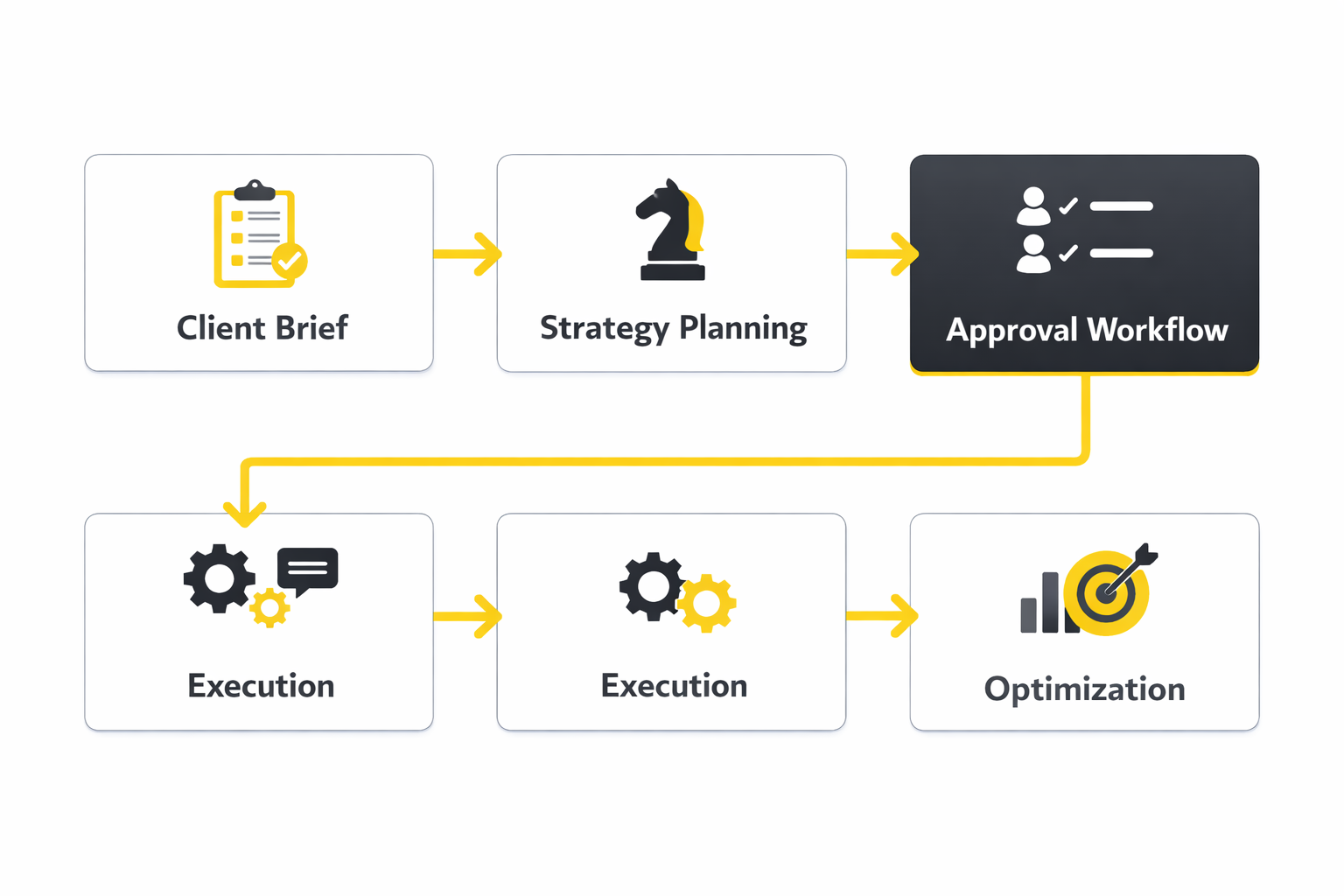
When white label social media management goes wrong, it usually isn’t because the ideas were bad. It breaks when ownership is fuzzy, approvals are messy, and everyone is working from a different “final” file. A professional implementation turns the service into a system clients can trust—week after week—without you needing to heroically babysit every post.
The reality is that social is a daily habit for billions of people, and the average user still spends around 2+ hours a day across social platforms. That amount of attention is a gift, but it also raises the bar: the client experience around planning, approvals, publishing, and responsiveness has to feel effortless.
1) Lock Scope, Outcomes, And “What Good Looks Like”
Start by making the deliverables feel tangible. Not “we’ll post 12 times per month,” but what those 12 posts are supposed to accomplish: awareness, demand, community momentum, customer care relief, or a mix. If a client wants everything, decide what comes first—because “everything” without priorities becomes chaos with invoices.
- Outputs: cadence, content formats, platforms, publishing windows, community management coverage.
- Outcomes: the handful of signals that matter for the client’s business (not every metric a dashboard can show).
- Standards: tone of voice, visual rules, compliance constraints, and what requires escalation.
2) Set Up Secure Access And Permissions
This step is boring right up until it saves you from a nightmare. White label social media management should never require password sharing. Use platform-native access and partner permissions so you can work safely, and so the client can revoke access cleanly if needed.
- Meta assets: configure business portfolio and asset permissions so the right people have the right level of control (Meta business portfolio and asset permissions).
- Page access: request or grant the correct level of Page access without handing over logins (how Page access works in Meta Business Suite).
- Permission hygiene: document who has access, review it regularly, and adjust quickly when roles change (changing permissions for people and assets).
3) Build A Review And Approval Workflow People Will Actually Use
The goal isn’t “more process.” The goal is fewer last-minute scrambles, fewer misunderstandings, and fewer posts going live with avoidable mistakes. A good workflow makes approval feel predictable and calm, which is exactly what clients pay for when they outsource.
- Stages: draft → internal QA → client review → revisions → final approval → scheduled/published.
- Rules: what gets approved (copy, creative, links, hashtags, tags), and what triggers a re-approval.
- Speed: define review windows so “urgent” stops being the default.
If you need practical patterns to model this, Sprout’s breakdown of how approvals reduce brand risk is a solid reference point (approval workflow guide), and Planable’s step-by-step view of a reliable review process helps translate it into day-to-day execution (review and approval process).
4) Create A Content System, Not A Content Sprint
White label social media management gets easier when you stop reinventing the wheel every week. Build repeatable content pillars, recurring series formats, and template structures that make the brand recognizable even when topics change. This is how you scale without turning your team into a caption factory.
- Pillars: education, proof, culture, product, community, and “why us” storytelling.
- Series: weekly themes, monthly campaigns, seasonal drops, and recurring formats that audiences learn to expect.
- Asset library: approved visuals, brand-safe templates, and evergreen copy blocks.
5) Define Community Management SLAs And Escalations
Clients often assume posting is the job. In reality, the work becomes truly valuable when you protect the brand in the comments and inbox, and when you turn audience signals into better decisions. Customers are also getting less patient with slow responses—Zendesk’s CX Trends 2026 highlights how expectations are accelerating, including how many people want faster response times than even a year ago.
- SLA coverage: when you respond (hours, days), and what happens outside coverage windows.
- Escalations: refunds, legal issues, safety issues, and anything that requires the client’s internal team.
- Voice: response principles that match the brand so replies don’t sound like outsourced scripts.
6) Establish A Reporting Rhythm That Feels Like Leadership
Reporting is where white label social media management becomes “real” inside the client’s organization. A good report doesn’t just say what happened; it explains why it happened, what it means, and what you’re changing next. If you want a simple structure that doesn’t turn into a spreadsheet marathon, use a consistent reporting cadence and narrative approach (Sprout’s state-of-social insights are a useful model for storytelling with data).
- Weekly: what shipped, what performed, what needs attention.
- Monthly: trend lines, content learnings, audience insights, next-month priorities.
- Quarterly: strategy review, channel bets, and resource decisions.
Execution Layers
Think of execution as a stack. Each layer has its own owners, quality checks, and failure modes. When you design white label social media management this way, you prevent small operational issues from becoming client-facing problems.
Layer 1: Strategy And Briefing
This is where you translate business goals into content direction. The deliverable isn’t “ideas”—it’s clarity: what you’re trying to achieve, who you’re speaking to, and what you want them to do or believe after engaging. If the brief is vague, everything downstream becomes rework.
- Inputs: offers, priorities, seasonality, customer objections, brand rules.
- Outputs: monthly content plan, campaign briefs, creative direction, KPI focus.
- Quality check: every post idea ties to a pillar and a purpose.
Layer 2: Production And Assembly
Production is where speed can ruin quality, or systems can unlock quality at speed. Create in batches, keep assets organized, and build “ready to approve” drafts that feel complete. If you hand clients half-finished work, approvals drag and trust erodes.
- Batching: create captions and visuals in cycles (weekly or biweekly) instead of daily scrambling.
- Consistency: templates, brand kits, and repeatable creative patterns.
- Accessibility: build alt text habits and readable design choices into the workflow.
Layer 3: Review, Approval, And Governance
This is the “risk management” layer. A clean approval workflow reduces mistakes and prevents internal politics from leaking into delivery. When approvals are designed well, they speed you up instead of slowing you down (how structured approvals prevent last-minute chaos).
- Governance: who can approve what, and what needs legal/compliance review.
- Auditability: keep track of decisions and final versions.
- Control: changes after approval trigger re-approval when needed.
Layer 4: Publishing And Distribution
Publishing is where your internal process becomes public reality. Check links, tags, formatting, and platform-specific quirks before anything goes live. If something breaks here, the client doesn’t care that the strategy was brilliant—they only see the mistake.
- Pre-flight checklist: links, UTM rules, tags, hashtags, spelling, and previews.
- Timing discipline: publish windows tied to the content goal, not superstition.
- Contingencies: backup posts ready for sudden news or cancellations.
Layer 5: Engagement And Customer Care
Engagement is where brands feel human. It’s also where operational excellence matters most, because customers are publicly watching whether a brand responds with care or indifference. That’s why many enterprise teams invest heavily in structured engagement workflows and tooling (enterprise social management capabilities reflect how complex this can get at scale).
- Response playbooks: tone rules, escalation rules, and boundaries.
- Tagging: categorize issues so patterns show up in reporting.
- Coverage: define hours and handoffs so nothing falls through.
Layer 6: Measurement And Insight
Measurement is how you protect renewals. Clients don’t stay because you post; they stay because you learn and improve. Treat every month like a cycle: ship, measure, decide, refine.
- Scorecard: a few KPIs that map to business priorities.
- Learning agenda: what you’re testing and what you hope to discover.
- Decisions: what changes next month because of what you learned.
Optimization Process
Optimization is how white label social media management stays valuable after the “newness” wears off. It’s also how you move from being a vendor to being a strategic partner. The best optimization processes are simple enough to repeat, but disciplined enough to produce real learning.
The Monthly Optimization Loop
- Week 1: plan content and experiments with a clear hypothesis.
- Week 2: publish and watch early signals without overreacting.
- Week 3: double down on what’s working and adjust what’s clearly not.
- Week 4: synthesize learnings into next month’s plan and client narrative.
Optimize For Responsiveness, Not Just Reach
Many brands obsess over reach while ignoring the part customers actually feel: response and resolution. Zendesk’s CX Trends 2026 points to a world where more consumers expect service to be available 24/7 and where expectations for speed are rising. That shifts how you prioritize community management: it’s not “extra,” it’s a core part of perceived quality.
- Set SLAs: define response expectations by message type (questions, complaints, praise, spam).
- Use tags: categorize issues so recurring problems become visible in reporting.
- Measure resolution: the goal isn’t fast replies; it’s fewer repeat issues.
Optimize For Risk And Resilience
One unexpected post can become a crisis in hours, especially when platforms amplify outrage. Having a crisis-ready playbook keeps your team calm and your client protected (a practical 2026 crisis management framework is a helpful reference for building steps and escalation roles). For clients in regulated industries, approvals, audit trails, and compliance controls become part of the product, not a nice-to-have (how compliance tooling supports governance).
- Escalation map: who is notified, how fast, and what decisions require the client.
- Kill switch: rules for pausing scheduled content during sensitive moments.
- Post-mortems: after incidents, document what changed so the system improves.
Implementation Stories
American Honda’s Shift From “Clunky And Manual” To A Social Operating System
The pressure didn’t arrive politely. Customer conversations were rising, expectations were rising, and the social team was stuck wrestling with a platform that felt like it was fighting them every day. The fear wasn’t “we might miss a post,” it was “we might miss the moment where a customer needed us.”
Behind the scenes, Honda’s social team wasn’t trying to become louder; they were trying to become more useful. They wanted social to be a two-way dialogue engine, not just a publishing channel. And they needed tools and structure that fit a four-person team instead of demanding endless manual maintenance (Honda’s case study describes the problem in plain language).
The wall showed up in the inbox. When conversations scale, “keeping up” becomes a full-time job, and strategy gets squeezed into whatever time is left. A clunky system quietly steals attention until the team is always reacting and rarely improving.
The epiphany came when they reframed the problem. It wasn’t a content volume issue; it was an engagement quality and workflow issue. If they could prioritize high-value engagement and reduce friction inside the inbox, they could buy back time for strategy.
The journey looked like building a real operating rhythm around engagement. They focused on prioritizing the right interactions, tightening workflows, and turning engagement into something measurable and repeatable. That shift helped them reduce time spent in the inbox and reclaim meaningful capacity for proactive work, with the case study noting 40 hours per month saved alongside a stronger engagement action rate.
Then the final conflict hit: scaling success. When the system starts working, more stakeholders suddenly care, more requests pour in, and the temptation to “just add more” returns. The only way through is governance—clear priorities, clear definitions of high-value work, and a process strong enough to say no without drama.
The dream outcome was bigger than time savings. Social stopped being a fragile machine that needed constant babysitting and became a strategic asset with repeatable execution. That’s what great white label social media management aims for: not just good posts, but a system that makes good work inevitable.
Randstad And Nebo’s High-Stakes Overhaul To Make Social Work Like A Team Sport
It started with a feeling of being exposed. A massive brand with a massive audience can’t afford messy collaboration, because one misstep is public. The urgency wasn’t performative—it was operational, because the volume of interactions made “manual” feel like a liability.
The backstory is a classic scale problem. Randstad wanted to transform its social presence, and it partnered with agency Nebo to overhaul the strategy while using a platform to support collaboration and reporting (Randstad’s case study). When an internal team and an agency collaborate, the workflow becomes the relationship.
The wall was the daily grind of community management and proof. Without a unified workflow, teams waste energy jumping between tools, reconciling versions, and rebuilding context. When context is missing, decisions slow down and opportunities pass by.
The epiphany was realizing that the platform wasn’t the “solution,” the workflow was. They needed a shared environment where collaboration and insight were built into the same place the work happened. That’s how you stop spending your best hours on coordination instead of creativity.
The journey focused on consolidating execution so the team could act faster and learn faster. The case study highlights how community management became more efficient and how collaboration with an agency partner can remove “very manual stuff” from the client’s plate (the collaboration and automation benefits). When the system is clear, the relationship feels calmer.
The final conflict was maintaining momentum while raising standards. Once results start improving, stakeholders want more: more content, more channels, more experiments. Without guardrails, growth turns into overload.
The dream outcome was a partnership that could scale. With collaboration and insight operating as a single system, the team could invest more time into strategy and social-forward creative, instead of spending it on coordination. That’s the moment white label social media management stops feeling like outsourced labor and starts feeling like a high-performing extension of the client’s team.
Professional Implementation
Professional implementation is what makes white label social media management retainable. Tools can be swapped later; process debt is harder to fix once clients are used to chaos. This is the checklist mindset that keeps delivery clean even when you scale clients, platforms, and team members.
The Implementation Checklist You Can Reuse For Every Client
- Access: platform permissions set correctly and documented (Meta asset permissions).
- Workflow: review and approval stages defined, with a clear “source of truth” (reliable approval process steps).
- Governance: what requires escalation, what requires legal/compliance, what can be handled autonomously.
- Content system: pillars, series, templates, asset library, and an editorial calendar rhythm.
- Community SLAs: response expectations and escalation paths that match the client’s risk tolerance (CX expectations shifting in 2026).
- Measurement: a scorecard that ties to business priorities and a monthly learning agenda.
Quality Assurance That Prevents Embarrassing Mistakes
Quality assurance isn’t about perfectionism; it’s about preventing avoidable errors that damage trust. A lightweight QA process is faster than fixing a public mistake, and it’s far cheaper than losing a client.
- Pre-publish QA: links, tags, spelling, formatting, and platform previews.
- Approval integrity: if approved content changes, it routes back to approval.
- Operational resilience: pause rules for sensitive moments and a crisis playbook (crisis management steps).
Scaling Without Breaking The Client Experience
Scaling white label social media management is mostly about protecting two things: the client’s sense of control and your team’s ability to deliver without burnout. A stable system means you can onboard faster, deliver more consistently, and improve month over month without turning every client into a custom project.
- Standardize onboarding: one onboarding path, one set of templates, one set of definitions.
- Package clarity: clients should instantly understand what’s included, what’s not, and what costs extra.
- Continuous improvement: monthly learnings feed next month’s plan, so the service keeps getting smarter.
Statistics and Data
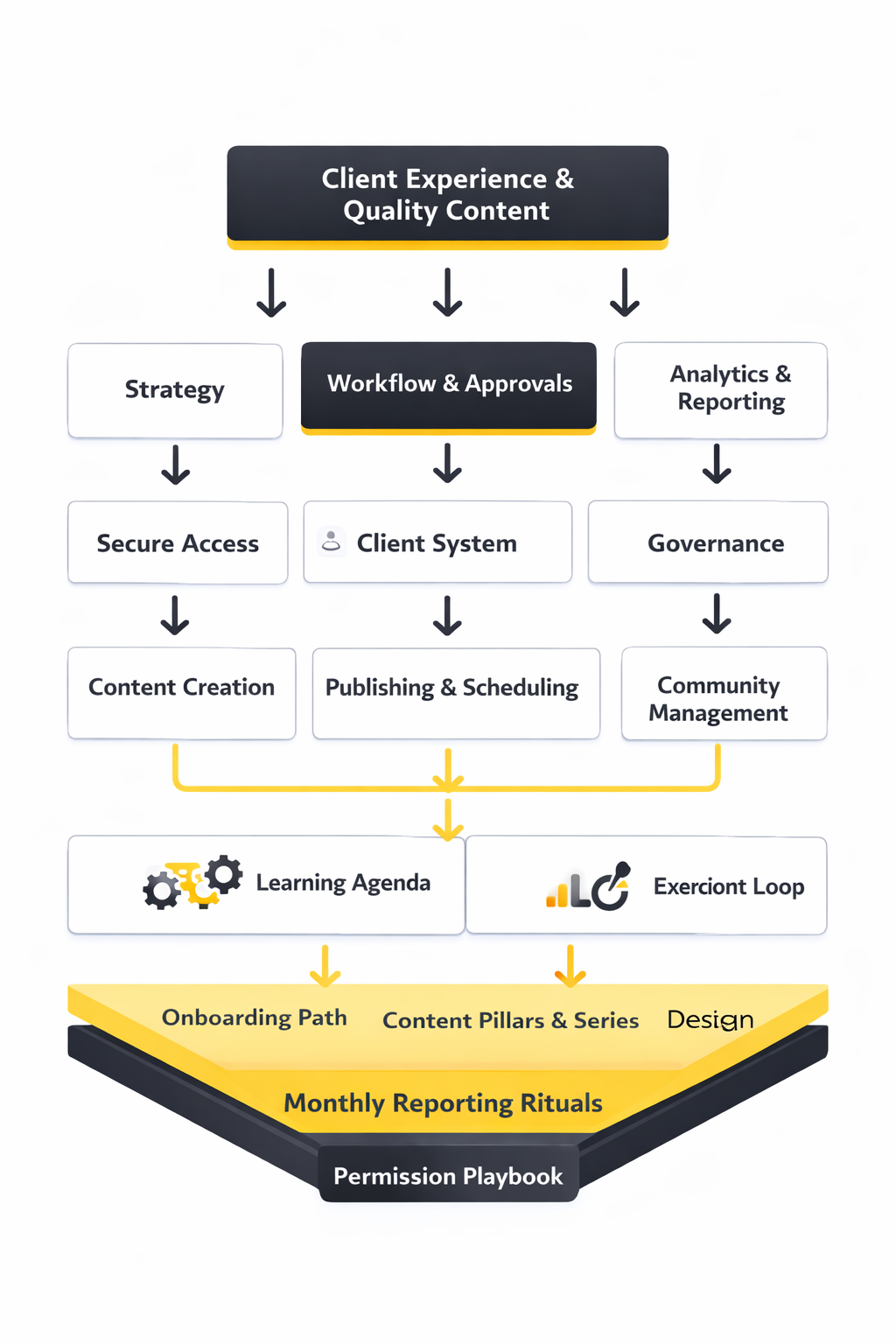
In white label social media management, analytics isn’t a “reporting task” you do at the end of the month. It’s the system that keeps your service believable, scalable, and defensible when a client asks the only question that matters: “Is this working?”
The bigger context matters too. Social has become a daily habit at a global scale, with the latest global digital snapshot showing people spend around 2+ hours per day using social platforms. That’s a lot of attention to earn, and it’s also a lot of competition to outperform.
Here are the kinds of data points that help you set expectations early, anchor your strategy in reality, and keep conversations grounded when clients feel emotional about a single post.
- Social usage scale: the same global report notes a “supermajority” of people now use social media each month (Digital 2026 overview).
- Attention isn’t evenly distributed: Gen Z respondents spend materially more time on social platforms and user-generated content than the average consumer, reshaping what “normal engagement” looks like (Deloitte Digital Media Trends 2025).
- Platform economics shift fast: Meta’s own results show ad impressions and average price per ad moved up year over year, which is a reminder that paid amplification costs and inventory dynamics change even when your organic strategy stays steady (Meta Q4 and full-year 2025 results).
- Engagement is tightening: large-scale benchmarking that analyzed millions of posts found engagement rates fell across major platforms over the prior year, changing what “good performance” means for brands (Rival IQ 2025 benchmark report highlights).
- Format still matters: recent Instagram benchmarks show carousels continue to hold up as a resilient engagement format compared to other post types (Socialinsider Instagram benchmarks (updated 2026)).
- Cross-platform snapshots help reality-check: Socialinsider’s broader benchmark roundup provides platform-level engagement context for TikTok, Instagram, and Facebook (Socialinsider 2026 benchmarks).
- Benchmarks can be “apples to oranges”: Hootsuite’s 2026 engagement-rate explainer shows how platform-level averages depend on definitions and formulas, which is why you should standardize your calculation method inside your reporting (Hootsuite engagement rate benchmarks (2026 update)).
- High-signal TikTok performance data exists: Emplifi publishes quarterly benchmark insights based on large datasets and reports very high median engagement rates on TikTok in late 2025, reinforcing why format-first strategy matters (Emplifi data release (Feb 2026) and Emplifi benchmark report hub).
Performance Benchmarks
Benchmarks are useful for one reason: they stop you and the client from confusing “feelings” with “signals.” They don’t tell you what to do, but they do tell you whether you’re playing in the right ballpark for the client’s industry, channel mix, and content formats.
The trick in white label social media management is choosing benchmarks that match how you report. If you benchmark “engagement rate per follower” but report “engagement rate per impression,” you’ll end up arguing about math instead of improving content.
Benchmark Rules That Keep You Out of Trouble
- Match the formula: choose one engagement-rate definition for each platform and stick with it (benchmark formulas and examples).
- Match the peer set: a consumer brand shouldn’t compare itself to a creator account, and a global brand shouldn’t compare itself to a local retailer.
- Match the format: carousels, short-form video, and static images behave differently, so your benchmark should be format-aware (Instagram format performance notes).
- Use trend lines, not one-month verdicts: benchmarks help you validate direction over time, not “win” a month.
Practical Platform Snapshots You Can Use in Client Conversations
When you need a grounded starting point, combine industry-wide datasets with platform-specific studies. Rival IQ’s annual benchmark work is widely used because it analyzes millions of posts across industries and platforms, which helps you frame realistic expectations for engagement declines and posting patterns (Rival IQ 2025 benchmark report and benchmark report library).
If your clients live on Instagram and LinkedIn, Socialinsider’s rolling benchmark pages are especially useful because they’re updated frequently and break out formats and engagement definitions by platform (Instagram and LinkedIn).
For timing and publishing cadence discussions, Sprout’s “best times to post” research can help you set a testing plan rather than guessing, especially when clients want a simple reason behind scheduling decisions (best times to post (2025 data)).
Analytics Interpretation
Most clients don’t need more metrics. They need clearer meaning. Interpretation is what turns raw analytics into decisions that improve performance without turning your monthly check-in into a defensive debate.
In white label social media management, interpretation should answer three questions in a predictable order: what happened, why it happened, and what you’re changing next.
Build a Metric Hierarchy That Matches the Business
A clean hierarchy prevents “vanity metric whiplash,” where a client celebrates reach one week and panics about clicks the next. Anchor every dashboard to the business outcome first, then work backward into the social behaviors that support it.
- Outcome metrics: leads, sign-ups, purchases, bookings, demo requests, pipeline influence, support deflection.
- Behavior metrics: link clicks, saves, shares, replies, watch time, profile actions, message starts.
- Visibility metrics: reach, impressions, video views, frequency, follower growth.
If you need an external reference for how marketing teams are being pushed toward measurable impact, Gartner’s 2025 findings on budget pressure and productivity priorities are a useful context cue for why clients demand clarity (Gartner 2025 CMO Spend Survey press release).
Separate Leading Indicators From Lagging Results
Clients often want “sales this month,” but social performance frequently compounds over multiple touchpoints. Your job is to connect early-stage signals to later outcomes without pretending social is a direct-response machine for every business.
- Leading indicators: saves, shares, repeat engagement, meaningful comments, DM starts, completion rates, time watched.
- Lagging results: web conversions, assisted conversions, sales, bookings, pipeline influence.
- Translation step: the story of how attention turned into intent, and intent turned into action.
How to Interpret Engagement Declines Without Overreacting
Benchmarking research regularly shows that engagement rates can decline even as content becomes more competitive and platform behavior changes. That’s why you should treat “lower engagement” as a diagnosis prompt, not an immediate strategy reversal (Rival IQ engagement trend notes).
A practical interpretation approach looks like this:
- If reach is stable but engagement drops: test format and hooks, and prioritize saves/shares over likes.
- If reach drops first: review posting consistency, creative quality, and whether formats match current platform distribution patterns.
- If clicks drop but engagement holds: improve offer clarity and CTA structure, and reduce friction between post and landing page.
A Reporting Structure Clients Actually Understand
To keep reporting clean and conversational, use a simple monthly narrative:
- What we learned: the two or three most important insights from performance.
- What we changed: the concrete adjustments you made because of those insights.
- What we’re testing next: the next set of experiments and what success will look like.
If you want a strong “industry language” reference for turning social performance into ROI conversations, Sprout’s impact research and thought leadership materials are built around proving value to leadership teams (Sprout’s 2025 Impact of Social Media report (PDF)).
Case Stories
Papa Johns’ High-Pressure Shift From Overwhelmed Inboxes to Faster Customer Care
The panic wasn’t theoretical. Customer messages were stacking up, and every unanswered complaint was a public reminder that the brand wasn’t listening. The team could feel the clock ticking because, in social, silence reads like indifference.
The backstory was a familiar scaling problem. Papa Johns was dealing with high volumes of customer care cases across channels, and their team needed a way to manage the work without drowning in tab-switching. They weren’t trying to “do more social,” they were trying to protect the brand’s customer experience at speed (Papa Johns case study).
The wall showed up in the daily workload. When the inbox becomes unmanageable, you start making bad tradeoffs: rushing replies, missing context, or letting messages sit. That’s how response time creeps up and trust erodes, even when the team is working hard.
The epiphany was realizing the problem wasn’t effort, it was workflow. They needed a system that treated social care as a real customer-care channel, not an afterthought attached to publishing. Once they centered the inbox as a core operational priority, the rest of the process could finally align around it.
The journey was about turning messy inputs into a manageable queue. Their case study highlights measurable improvements after implementing their approach, including a 50% improvement in response rate and handling 600+ cases per week. That kind of throughput changes what a social team can promise internally, because it replaces “best effort” with a repeatable system.
The final conflict came from the moment success became visible. When response performance improves, more stakeholders pay attention and more issues get routed to social because it’s suddenly working. Without clear rules about what belongs in social care versus other support channels, you can accidentally recreate the overload you just fixed.
The dream outcome is the kind clients love because it’s concrete. The same case study reports 830+ hours saved annually, which is time the team can put back into proactive engagement and better customer experience design. For white label social media management, this is the lesson: analytics isn’t only about content performance—it’s also about operational performance that clients can feel.
Salesforce’s Breakthrough From Spreadsheet Reporting to Faster Decisions Across 150+ Channels
It started as a quiet frustration that turned into a real business risk. The team was managing an enormous social footprint, but reporting and insight felt slow, manual, and fragile. When leadership expects confident decisions, “we’ll get back to you after we export everything” stops being acceptable.
The backstory is what makes the story credible. Salesforce runs a massive community presence with 150+ social channels, and their social team needed to understand what resonated with the Trailblazer community without drowning in admin work. The objective wasn’t just “more posts,” it was smarter engagement decisions backed by reliable data (Salesforce case study).
The wall showed up in reporting and the speed to insight. Manual reporting workflows force teams into reactive mode, where analysis arrives after the moment has passed. It also creates a trust problem internally, because stakeholders can sense when numbers are stitched together across multiple exports.
The epiphany was recognizing that speed is a strategic advantage. They needed a workflow where insights were accessible enough to guide decisions in real time, not just decorate a monthly slide deck. The case study captures this mindset shift by emphasizing decisions based on accurate data rather than “hunches” (Salesforce case study narrative).
The journey was a shift from fragmented reporting toward a unified operational view. Salesforce’s story highlights how centralizing workflows eliminated manual spreadsheet work and accelerated reporting and learning cycles (reporting and manual work reduction). When analytics become easy to access, teams spend more time interpreting and acting rather than collecting.
The final conflict is the one most big teams hit next: scale multiplies complexity. With many channels, it’s easy to lose consistency in tagging, measurement definitions, and the “single source of truth.” Without governance, even the best tools can turn into multiple parallel reporting realities.
The dream outcome is what white label social media management should aim to package: time saved, better engagement, and faster decision-making. The Salesforce case study reports over 12,000 hours saved since implementation and describes a 10x increase in community management speed in their own words. That’s the power of analytics when it becomes part of daily execution, not a monthly ritual.
Professional Promotion
Promotion, in the context of white label social media management, doesn’t mean hype. It means packaging proof so clients can understand value quickly, share it internally, and justify renewing or expanding scope without awkward conversations.
Marketing leaders are operating under pressure to prove efficiency and results, and budget context helps you frame why your reporting and experimentation discipline matters. Gartner’s 2025 updates on flatlining budgets and the growing share of digital spend show why clients are asking tougher questions and expecting clearer answers (marketing budgets holding at 7.7% of revenue and digital channels at 61.1% of marketing spend).
Create “Proof Assets” That Sell Without Feeling Salesy
Clients don’t renew services; they renew confidence. Build proof assets that make your work easy to trust and easy to defend inside the client’s organization.
- One-page monthly narrative: three wins, three learnings, three decisions for next month.
- Quarterly story deck: trend lines, what changed, and what you’re betting on next.
- Before/after operational proof: response time improvements, cases handled, hours saved—especially for community management packages (Papa Johns metrics).
- Decision log: a simple record of what you tested and what you learned, so the strategy feels intentional.
Use Benchmarks to Frame Wins Without Overpromising
Benchmarks help you keep wins believable. When engagement tightens across platforms, a steady or improving performance can be a real win—but only if you explain it with context the client can understand (platform-wide engagement declines and cross-platform benchmark summaries).
- Contextualize performance: show where the client sits versus relevant industry medians, not against the internet’s best creators.
- Highlight format lessons: what content types proved resilient and why you’re leaning into them next (format notes for Instagram).
- Make the next bet explicit: what you’ll change and what you expect to see if the hypothesis is right.
Turn Analytics Into Natural Upgrades Clients Actually Want
The easiest upsells are the ones that feel like common sense after the data. If your reporting shows consistent inbound questions, a community management add-on becomes a logical next step. If your analytics show strong saves and shares but weak clicks, a landing page optimization or offer refinement sprint becomes a smart extension.
- From “posting” to “operating”: add inbox coverage with SLAs when conversation volume proves social is a customer-care channel.
- From “content” to “conversion”: add a monthly conversion audit when social intent signals rise.
- From “reporting” to “strategy”: add quarterly planning workshops once you have enough data to make meaningful bets.
When you treat analytics as the engine of improvement, promotion becomes a side effect. The client sees momentum, understands the story behind the numbers, and feels safe expanding scope because your white label social media management process behaves like a real system—not a collection of posts.
Future Trends
White label social media management is heading into a period where operations matter as much as creativity. The teams that win won’t just be “good at content.” They’ll be good at trust, speed, and measurement—because platforms, customers, and regulators are all pushing in that direction at the same time.
Here are the shifts that are already changing what clients expect from outsourced social teams, and what you’ll need to build into your delivery system.
Trend 1: Trust Signals Become Part of the Deliverable
As synthetic media floods feeds, audiences are learning to doubt what they see. Platforms are experimenting with provenance and labeling, but investigative testing has shown that even when media is embedded with Content Credentials, many platforms don’t reliably preserve or display those signals (a platform labeling test with Content Credentials). That gap creates a new opportunity for premium white label social media management: building a “trust layer” into production, approvals, and publishing.
- Operational implication: keep source files, track edits, and maintain an internal audit trail so you can prove origin and intent when questions arise.
- Client implication: brands will ask for documentation and clarity, not just content calendars.
Trend 2: AI Disclosure Moves From Optional to Regulated
Policy is catching up to deepfake-driven scams and deceptive ads. South Korea has reported plans to require AI-generated advertisements to be labeled starting in early 2026, aimed at reducing deceptive celebrity deepfakes and fabricated endorsements (South Korea’s AI ad labeling requirement). This kind of rule tends to spread, because it gives regulators a clear enforcement handle.
- Operational implication: approval workflows should include “AI disclosure checks” for markets and categories where it applies.
- Client implication: brands will want you to be the team that keeps them compliant without slowing production.
Trend 3: Social Customer Care Becomes Non-Negotiable
For many clients, the biggest “social problem” is no longer reach—it’s response. Customers increasingly treat DMs and comments like support tickets, and a large share of them want replies within a day. Sprout’s Index research has been widely cited for showing that nearly 75% of customers want brands to respond within 24 hours or less. That means the scope of white label social media management keeps expanding from “publishing” into “operating.”
- Operational implication: SLAs, escalation maps, and inbox workflows become core parts of the package.
- Client implication: the client experience improves when social feels like a reliable customer-care channel, not a “nice-to-have.”
Trend 4: Transparency Reporting and Documentation Become Standard
Even if your clients aren’t “regulated brands,” the ecosystem is moving toward more formal transparency expectations. The EU has been harmonizing transparency reporting requirements under the Digital Services Act, including reporting rules that started applying on July 1, 2025. This nudges brands toward cleaner internal documentation—especially around moderation, ads, and platform governance.
- Operational implication: keep clean records of approvals, publishing changes, and moderation decisions.
- Client implication: clients will value teams that can answer “why did we do that?” months later, without guessing.
Trend 5: Content Provenance Standards Keep Growing, Even If Implementation Is Messy
Standards like C2PA are building the technical foundation for content provenance, but real-world implementation is inconsistent. Independent reporting has highlighted how “AI slop” pressure is pushing big platforms to talk about provenance while still struggling to preserve metadata in the wild (coverage of C2PA and platform follow-through). For white label social media management teams, the practical move is to treat provenance as a quality practice, not a guarantee the platform will display.
Strategic Framework Recap

At the end of the day, white label social media management is a promise: the client gets consistent, brand-safe output—and they feel calm about what goes live. The framework you’ve built across this guide works because it turns that promise into a repeatable operating system.
1) Client Experience Comes First
The client shouldn’t have to learn your internal chaos. They should see one clear workflow for requests, approvals, publishing, and reporting. When that experience is smooth, trust grows, and renewals feel natural.
2) Process Protects Quality
Great content is fragile when the process is weak. A clean review and approval system keeps quality high and prevents the “wrong version went live” moments that damage trust.
3) Tools Support the Workflow, Not the Other Way Around
The best tool stack is the one that matches your real delivery stages and removes friction. If a tool forces extra handoffs, it quietly taxes your team and slows your client.
4) Measurement Turns Delivery Into Improvement
Analytics isn’t a monthly ritual. It’s the engine that turns output into learning and learning into better results. Benchmarks help reality-check expectations, and clear interpretation keeps conversations focused on decisions instead of dashboards.
5) Scaling Is Governance Plus Momentum
Scaling works when “on-brand” becomes the easiest default and when improvements compound. A strong governance layer lets you move faster, not slower—especially as trust, disclosure, and customer-care expectations rise.
FAQ – Built for This Complete Guide
What is white label social media management in plain terms?
It’s when you deliver social media strategy, content, publishing, engagement, and reporting under another brand’s name. The client experiences it as the agency’s service, but your team powers the work behind the scenes.
Who benefits most from white label social media management?
Agencies that want to expand capacity without hiring a full internal team, consultancies that need ongoing execution for their strategy clients, and web/branding studios that want to add recurring revenue without building a social department from scratch.
What should be included in a white label SLA?
Response time expectations, approval timelines, the number of revisions, publishing coverage windows, community management coverage (if included), escalation rules, and reporting cadence. If the client expects fast replies, reference consumer expectations like the 24-hour response window many customers want and set a realistic operating model around it.
How do you handle approvals without slowing everything down?
Use a defined workflow: draft → internal QA → client review → final approval → schedule. The speed comes from structure: clear review windows, one source of truth, and rules that prevent “approved copy” from being edited after sign-off without triggering re-approval.
How do you price white label social media management?
Most teams price by monthly deliverables and service layers: content volume, platforms, creative complexity, community management coverage, and reporting depth. The clearest pricing is tied to an operating model: what you own end-to-end, what requires client input, and what is billed as an add-on.
What metrics should you report to keep clients happy?
Start with the business outcome, then work backward. For many clients, that’s leads, bookings, sign-ups, or support deflection. Pair that with leading indicators like saves, shares, watch time, replies, and DM starts, then add visibility metrics like reach and impressions as context.
Should community management be included in white label packages?
If the client’s brand receives meaningful message volume, it’s often worth packaging community management as a distinct layer with SLAs and escalation rules. Social customer care expectations are rising, and the 24-hour response expectation is a simple anchor for scope conversations.
How do you prevent brand drift across multiple creators and clients?
Build a brand system: templates, tone rules, “safe defaults,” and a governed approval process. Keep an asset library of approved visuals, recurring series formats, and a decision log so new team members can match style quickly.
How should AI-assisted content be handled in 2026?
Use AI to speed up drafting and repurposing, but keep human judgment in charge of context and risk. Add a check for disclosure and labeling in markets where requirements are tightening, including the direction signaled by South Korea’s AI ad labeling rule.
What is content provenance, and does it matter for social?
Content provenance is the ability to verify where media came from and how it was edited. It matters more as deepfakes spread and platforms struggle to preserve authenticity signals consistently, as shown by testing that found platforms often don’t display Content Credentials.
What tools do you actually need to deliver white label social media management well?
You need a collaboration and approvals system, a publishing layer, an engagement inbox (if you manage community), and a reporting workflow. The exact tools matter less than having one source of truth for final copy, final assets, and final approvals.
How do you win and keep white label clients long-term?
Make the client feel safe. Ship consistently, communicate predictably, and show learning month over month. Clients renew when the experience is calm, the work improves, and reporting makes the value easy to defend internally.
Work With Professionals
If you’re delivering white label social media management as a freelancer or a small agency, you already know the hardest part isn’t doing the work. It’s keeping a steady pipeline without spending half your week chasing leads, negotiating in circles, and losing momentum between projects.
That’s why a focused marketplace can change your day-to-day. MARK EWORK is built specifically for marketing roles and projects, and it’s designed to remove the friction that makes freelance life exhausting: it prioritizes clear listings, richer profiles, and direct communication without platform commissions or per-project fees (how MARK EWORK positions its marketplace).
Imagine opening your week with options instead of uncertainty. Instead of waiting for referrals, you can browse active roles, apply, and connect directly—while keeping costs predictable through simple subscription plans that emphasize no commissions and no project fees. On the marketplace itself, the “Find Work” section shows there are hundreds of active listings available at a time, with more unlocked through an account.
If you want your white label social media management offer to grow into a real income engine, momentum matters. A marketplace that’s built for marketers helps you spend more of your energy on delivery, not on hunting.
 Filip Konecny Enterprises