tags.• Instead, always create a separate anchor element immediately before the heading.• Use this exact pattern for every section that must support page jumps:
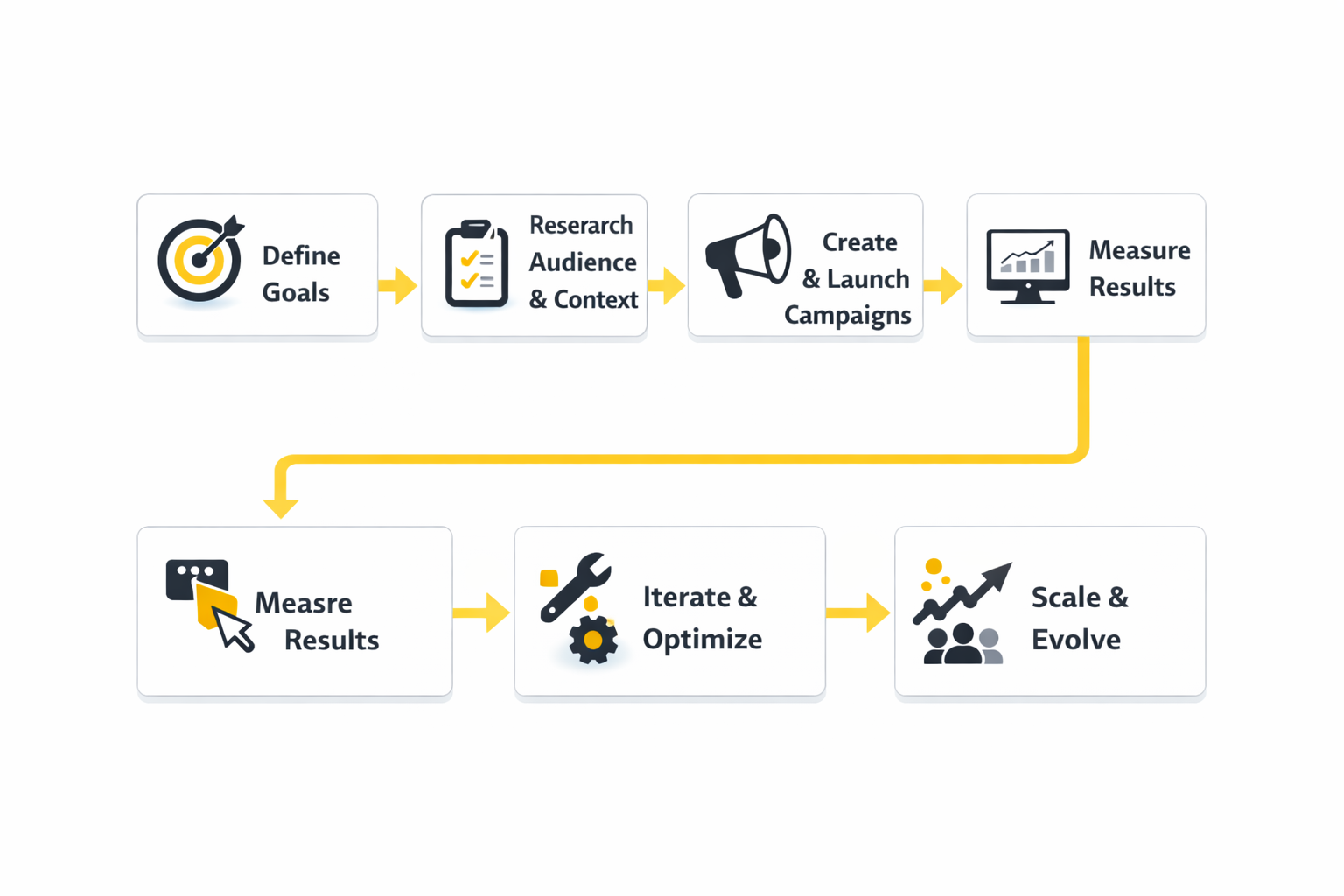
Step 1: Align on one business goal the whole team can repeat
Pick one primary outcome for the next 6–12 weeks: qualified leads, purchases, trials, booked calls, or repeat orders. Secondary metrics can exist, but they can’t be allowed to hijack decisions. Most “social isn’t working” situations are really “everyone is optimizing for a different scoreboard.”
Lock the definition in writing, including what counts as a qualified conversion and what doesn’t. If you’re using GA4 for that definition, keep it consistent with how events and conversions are configured in GA4’s experiment framework so testing doesn’t drift into debate.
Step 2: Map the conversion path people actually take
Draw the real journey from platform to outcome. Where do people land, what do they do next, and what are the “micro-yes” moments that predict the final conversion? This is where a social network marketing company earns its keep, because it stops teams from optimizing for clicks when the real bottleneck is the step after the click.
Write down the 3–5 highest-signal events across the funnel. For ecommerce that might be view content, add to cart, initiate checkout, and purchase; for lead gen it might be form start, form submit, booked call, and qualified lead. Then make sure those events can be measured reliably across browsers and devices.
Step 3: Fix tracking before scaling spend
Scaling ads on broken measurement is like turning up the volume on a radio with static. You get more noise, not more signal. This is why many teams add server-side events to support client-side pixels, using building blocks like Meta’s Conversions API and Google Tag Manager server-side tagging.
If TikTok is part of the plan, the same logic applies: connect deep-funnel events so optimization doesn’t get stuck on shallow proxies. TikTok frames this approach directly in its Events API overview and the practical setup guidance in TikTok Events API help.
Step 4: Build a creative system, not a single campaign
Most brands don’t need “the big idea” as much as they need a repeatable set of formats that can be produced and improved every week. That means deciding what your repeatable content types are (founder POV, product demos, proof, objections, comparisons, customer stories, creator-led UGC) and how each one supports a stage of the funnel.
Then set production standards: hook types, pacing, caption style, editing rules, and claim substantiation. On platforms that actively generate creative variations, it’s also smart to understand what the platform can automate and what you should control, including tools explained in Meta’s Advantage+ creative overview.
Step 5: Launch small, but learn fast
Start with a controlled test plan so you can interpret results without guessing. If you’re testing landing pages or on-site experiences alongside social, keep the testing logic aligned with GA4 experimentation concepts in Google’s experiment documentation.
For ad-side learning, structure tests so you’re isolating one variable at a time. When the question is “did ads create new demand or just harvest it,” incrementality methods like holdouts are built for that exact question, which Meta describes in Conversion Lift testing.
Step 6: Institutionalize weekly optimization
A social network marketing company that gets results treats optimization like a weekly ritual, not a quarterly post-mortem. Every week has the same heartbeat: review, decide, produce, launch, and document. The compounding comes from keeping the loop tight, even when performance is “fine.”
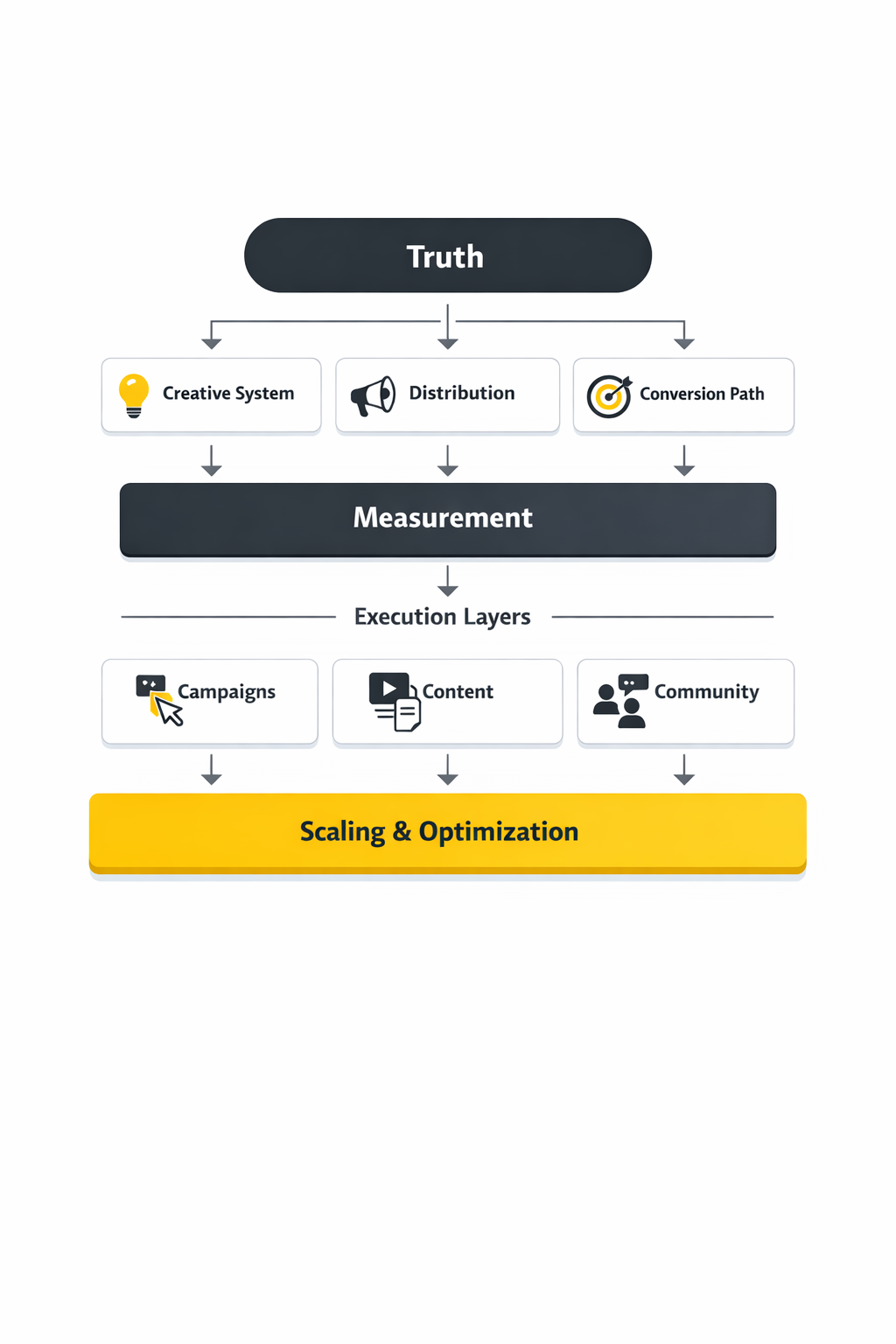
Execution Layers
Implementation gets dramatically easier when you separate the work into layers. Each layer has a different cadence, a different owner, and a different failure mode. When teams mix them together, everything feels urgent and nothing improves.
Layer 1: Strategy and constraints — positioning, audience focus, offer framing, and what you refuse to do. This layer changes slowly, but it should be referenced constantly.
Layer 2: Creative production — formats, briefs, creator pipeline, editing, approvals. This layer wins by speed and consistency.
Layer 3: Media and distribution — campaign structure, budget allocation, targeting approach, placements, retargeting logic. This layer wins by discipline, not constant tinkering.
Layer 4: Conversion experience — landing pages, lead flows, checkout friction, messaging, follow-up. This layer wins when it removes “silent drop-offs.”
Layer 5: Measurement and learning — event reliability, attribution views, incrementality checks, and decision rules. This layer wins when it settles arguments with evidence, using tools like Meta lift testing and structured experimentation logic supported by GA4 experiments.
The practical takeaway is simple: don’t try to “optimize everything.” First stabilize the layers that create leverage: reliable tracking, a creative engine, and a weekly learning cadence.
Optimization Process
Optimization is where most teams accidentally become reactive. Something dips, panic starts, and the campaign gets rebuilt from scratch. A professional optimization process does the opposite: it makes changes predictable, reversible, and grounded in what you’re actually trying to learn.
Set guardrails before you touch budget
Define what “stable enough” looks like: minimum spend per ad set, minimum time in market, and what qualifies as a meaningful signal. Without guardrails, you end up cutting creatives before they’ve had a chance to find the right audience, or scaling winners that were just early noise.
If your measurement is fragile, fix that first. Server-side connections exist for a reason, and the official docs are clear about the architecture: Meta Conversions API and server-side GTM both emphasize sending events in a way that’s less dependent on browser limitations.
Optimize creative before you optimize targeting
In practice, creative is often the biggest performance lever because it changes what people feel, not just who sees the ad. This is why many modern stacks lean into high-velocity creative iteration while allowing delivery systems to do their job, especially when platforms can generate variations as described in Advantage+ creative features.
Run creative in “families” so you can learn faster: one hook, multiple proofs; one proof, multiple CTAs; one creator, multiple edits. You’re not hunting for a single winning ad; you’re building a library of patterns you can reuse.
Treat measurement like a triangulation problem
Attribution views are helpful, but they’re not the whole truth. A healthier posture is triangulation: platform reporting plus site analytics plus experimentation. Meta’s own approach to isolating causal impact is reflected in Conversion Lift testing, while GA4 supports structured testing concepts in its experiment documentation.
Document decisions so learning compounds
Most teams repeat the same mistakes because they don’t write down what they learned. Every weekly review should end with a short decision log: what changed, why it changed, what you expect to happen, and when you’ll check again. This is the simplest “tool” that separates a social network marketing company that compounds results from one that just stays busy.
Implementation Stories
The easiest way to spot a real implementation is to look for the unglamorous work: tracking fixes, workflow discipline, and a learning loop that survives stress. The stories below are based on publicly available case studies from platform-owned sources, and the outcomes are described without invented metrics.
DSB rebuilt its measurement foundation before asking creative to carry the whole load
The first sign of trouble wasn’t a dramatic public failure. It was worse: performance looked “fine” in dashboards, but the team didn’t trust what they were seeing, and every budget discussion turned into an argument about whose numbers were real. That uncertainty made every next step feel risky. A campaign can survive a bad week, but it can’t survive permanent doubt.
The backstory was a classic scale problem. DSB, the Danish train operator, runs marketing across Meta platforms, and like many advertisers, measurement quality gets squeezed by device changes, browser restrictions, and the messy reality of cross-device journeys. When leadership needs clarity, “we think it worked” stops being acceptable. The organization needed a more resilient connection between customer actions and campaign optimization.
The wall showed up as slow decision-making. Creative teams were asked to produce more variations, media teams were asked to rebalance spend, and analysts were asked to reconcile conflicting reports. None of it solved the underlying issue, because the system collecting signals was the bottleneck. The team was working harder inside a fog.
The epiphany was that the next win wasn’t a new ad. The win was rebuilding the signal path so optimization could work the way platforms expect it to. That realization pushed the team toward a server-to-server approach, described in Meta’s own success story about DSB and its use of Meta’s Conversions API implementation. Once the team could trust the inputs, the rest of the machine had a chance to perform.
The journey was deliberate and operational. They implemented Conversions API, then enriched it with first-party data so more events could be matched and understood in a privacy-safe way, as outlined in the DSB case study. The work wasn’t glamorous, but it changed how confident the team could be in its decisions. That confidence is what makes weekly iteration possible.
The final conflict was governance. Any time you touch tracking and data, you invite hard questions about compliance, ownership, and technical debt. The team had to coordinate across marketing, analytics, and technical stakeholders to keep the setup reliable rather than “installed once and forgotten.” The implementation had to become part of the operating system.
The dream outcome wasn’t just better reporting. It was a calmer, faster organization where creative and media could iterate without constantly second-guessing the scoreboard. When measurement becomes dependable, meetings stop being debates and start being decisions. That is the real value signaled by DSB’s documented approach in Meta’s success story.
Paint Your Life connected deep-funnel signals so TikTok could optimize beyond the first click
The crisis didn’t happen in a single day. It built quietly as campaigns brought traffic, but the team could feel a gap between what people started and what they finished. Users bounced between devices, started steps on mobile, and completed later on desktop, leaving attribution messy and optimization shallow. The team wasn’t losing because the product was weak; it was losing because the system couldn’t see clearly.
The backstory was a complex purchase journey. Paint Your Life sells custom portraits, and the buying process includes multiple steps that don’t fit neatly into a single click-to-purchase moment. That complexity matters because ad platforms learn from signals, and weak signals create weak optimization. The brand needed TikTok to understand deeper intent, not just surface-level visits.
The wall was simple: without better attribution, scaling became guesswork. If the algorithm only sees shallow events, it optimizes for the wrong thing, and the team ends up paying to acquire the easiest click instead of the likeliest customer. That’s a brutal place to be, because it makes every creative test feel inconclusive. Momentum disappears when learning stalls.
The epiphany was to treat tracking as a growth lever. Paint Your Life’s team moved toward a server-to-server approach so TikTok could receive the right events and parameters, described in TikTok’s Paint Your Life Events API case study. Instead of asking TikTok to “figure it out,” they gave TikTok the signals it needed. That shift changes what the algorithm can optimize for.
The journey required collaboration, not just marketing work. The case study describes how Paint Your Life’s developer team worked with TikTok’s technical team to integrate Events API with the required events and parameters in the published write-up. This is the kind of implementation step that separates casual advertisers from teams building a durable system. Once deep-funnel events flow, optimization can aim at the outcome that actually matters.
The final conflict was operational reliability. Server-side integrations have to be maintained, validated, and monitored, or they silently degrade. The team had to ensure event quality, parameter accuracy, and consistency across devices while continuing to run campaigns. The stack couldn’t become a one-time project; it had to become stable infrastructure.
The dream outcome was learning that finally stuck. When TikTok can see meaningful customer actions, testing becomes clearer, and creative iteration stops feeling like random swings. The story isn’t “a magic ad went viral”; it’s “the system became measurable,” which is the exact value proposition of the Events API described in TikTok’s Events API overview. That’s what makes performance sustainable.
Professional Implementation
A social network marketing company that implements professionally doesn’t just ship assets and dashboards. It builds a way of working that’s resilient when performance dips, when platforms change, and when the team grows.
Implementation non-negotiables
One source of truth for events: a clear event map, naming convention, and ownership so tracking doesn’t drift. The building blocks for resilient tracking are documented in Meta Conversions API and server-side GTM.
A test plan that matches the question: if you’re testing page variants, use structured experimentation logic like GA4 experiments; if you’re testing whether ads create new demand, use causal methods like lift testing.
A creative library, not a creative roulette wheel: organize winning patterns by hook, proof, offer, creator style, and funnel stage so you can build on learnings instead of starting over.
A weekly cadence that protects focus: one meeting for decisions, one window for production, one window for launches, one place for learnings. This is how iteration becomes normal instead of exhausting.
Clear responsibilities: who owns creative standards, who owns media structure, who owns measurement integrity, and who signs off on risk-sensitive claims.
When these pieces are in place, implementation stops being a “setup phase” and becomes the engine itself. That’s the moment social begins to compound: not because the team works harder, but because the system learns faster.
Statistics and Data
Analytics is where a social network marketing company either earns trust or loses it. It’s easy to make a dashboard look busy. It’s harder to make the numbers answer the questions leadership actually cares about: “Did social create new demand?” “Are we buying the right attention?” “Can we scale without guessing?”
To keep this grounded, the numbers below focus on the parts of the market that are measurable and consistently documented across multiple independent sources. If a metric can’t be verified cleanly, it doesn’t belong in a professional report.
The “platform reality” is massive scale: Meta reported $196.175B in 2025 advertising revenue, alongside 12% growth in ad impressions and 9% growth in average price per ad, published in Meta’s Q4 and full-year 2025 results release, mirrored in the results PDF, and filed as an exhibit with the SEC in Meta’s 8-K exhibit.
Performance Benchmarks
Benchmarks are useful when they prevent self-deception, not when they turn into a fake scoreboard. A good social network marketing company uses benchmarks as guardrails: signals that tell you whether performance is “in a healthy range” or whether something is broken.
Instead of chasing generic click-through “industry averages,” professional teams benchmark the parts of the system that reliably predict outcomes across channels.
Signal coverage benchmark: Are your key conversion events firing consistently across web, app, and offline sources? Server-side event sharing exists because client-side tracking alone can fail quietly, which is why infrastructure guidance like server-side Google Tag Manager and Meta’s Conversions API documentation is treated as foundational, not optional.
Creative velocity benchmark: How many new creative variations do you ship each week, and how quickly can you replace losers without losing message consistency? This matters more as video absorbs spend, reflected in IAB’s view of where the market is going in its 2025 digital video report and the broader shift described in the IAB-linked release.
Budget efficiency benchmark: With marketing budgets flat at 7.7% of revenue, the benchmark is often internal: “Are we improving cost per qualified outcome month over month?” Tight budgets make systematic learning more valuable than sporadic wins.
Analytics Interpretation
Numbers don’t speak for themselves. They argue with each other, and your job is to decide which arguments matter. A social network marketing company that’s serious about measurement interprets analytics in layers, so leadership can trust the story without pretending the data is perfect.
Layer 1: Diagnostics
This is where you answer, “Is the system working?” Are events firing? Are platforms receiving the right signals? Is attribution suddenly shifting because tracking broke? This is also where server-side setups matter, which is why teams lean on server-side tagging guidance and Conversions API documentation as a standard operating baseline.
Layer 2: Performance
This is the daily and weekly view: spend, reach, frequency, cost per outcome, and creative performance. The key interpretation habit here is separating “what changed” from “why it changed.” Creative, inventory, competition, and seasonality can all shift results without meaning your strategy is wrong.
Layer 3: Causality
This is where you stop asking “what got credit?” and start asking “what caused growth?” Lift tests exist for this reason, described in Meta’s lift testing overview and TikTok’s framework at TikTok’s lift study documentation. When teams rely only on last-click or platform-reported attribution, they often end up rewarding the easiest-to-measure touchpoint, not the touchpoint that actually drove demand.
Layer 4: Cross-media context
As budgets spread across creators, video, and multiple platforms, measurement needs to compare performance across screens. That’s why cross-media initiatives matter, including the move described in Nielsen’s announcement of cross-media measurement work with TikTok. This layer is where you decide whether social is acting as discovery, conversion, retention, or all three.
Case Stories
Case studies are only useful when they show the operational decisions behind results, not when they read like a highlight reel. The story below uses publicly available documentation and avoids invented performance claims.
NOW hit a wall, then used automation plus lift testing to prove what social was really doing
The pressure point wasn’t subtle. NOW was trying to drive subscriptions in a market where streaming choices are endless and attention is brutally expensive. Every campaign risked turning into “more spend, same outcome,” and the team needed clarity fast. When growth stalls in a subscription business, the clock feels loud.
Here’s the backstory that made it harder than it sounds. NOW is Sky’s contract-free streaming service, built around memberships for entertainment, cinema, and sports, described directly on NOW’s product site and in Sky’s framing of the brand after the NOW TV rebrand to NOW. That positioning is powerful, but it also means the offer has to land quickly: people can join, leave, and compare in minutes. In that kind of market, creative and targeting need to be both persuasive and efficient.
The wall showed up as a measurement problem disguised as a creative problem. When you run both manual and automated approaches, it’s easy to argue endlessly about which one “works” and which one “just steals credit.” Without a stronger testing lens, budget decisions become political. And politics is expensive.
The epiphany was deciding to stop debating and start proving. The team ran an automated Meta Advantage+ shopping campaign alongside their usual manual campaign and focused on measuring incremental impact rather than relying only on platform-reported attribution. Meta’s published success story describes the setup and reports a 6% lift in purchases tied to the approach in the NOW case study on Meta for Business. The key move wasn’t automation by itself; it was using testing to create confidence.
The journey was about building a system the team could repeat, not a one-off win. They didn’t abandon manual campaigns; they layered automation in a way that let the platform learn while the brand kept control of the broader plan. That kind of hybrid setup is a hallmark of mature teams because it balances experimentation with stability. The implementation logic fits with how Meta positions Advantage+ shopping in its own product framing and test-oriented guidance.
Then came the final conflict: trust. Automation can feel like giving up control, especially when stakeholders want to know exactly why results changed. That’s why lift testing and structured experiments matter; they reduce fear by separating signal from noise. Meta’s testing approach is laid out in its Conversion Lift overview, which is designed for exactly these “did it really work?” moments.
The dream outcome wasn’t just a single lift metric. It was the ability to make budget decisions with less guessing and fewer arguments, while keeping the team focused on creative iteration and offer clarity. When a social network marketing company brings this discipline, reporting stops being a weekly scoreboard and starts being a decision engine. That’s the real payoff of the NOW example documented in Meta’s published case study.
Professional Promotion
“Promotion” is often treated like the flashy part of marketing. In professional teams, it’s the disciplined part: how you present results, justify budget, and expand what works without losing credibility.
Start with proof, not claims
When budgets are constrained, credibility becomes a growth lever. Marketing budgets staying at 7.7% of revenue changes the tone of every conversation: leaders want confidence, not optimism. Build your promotion narrative around what you can defend: tracked outcomes, tested lift, and clean definitions.
Use the right measurement tool for the right argument
If the argument is “performance is improving because the signal is cleaner”, tie it to infrastructure decisions like Conversions API and server-side tagging, which exist to reduce measurement fragility.
Promote your winners like a product team
When a creative pattern works, treat it like a product feature you can ship repeatedly. Document the hook, the proof, the objection it addressed, the offer framing, and the audience context. Then scale distribution across formats and placements while keeping the core promise intact.
Connect promotion to market reality
In 2024, U.S. internet ad revenue reached $258.6B, and video spend keeps accelerating toward $72B projected in 2025. At the same time, creator media is becoming a core channel, moving from $29.5B in 2024 to $37B projected in 2025. Your promotion strategy should reflect that reality: modern campaigns aren’t “ads or content,” they’re coordinated distribution across paid, organic, creators, and measurement that can stand up in a budget meeting.
Advanced Strategies
Once the basics are stable, the difference between “good” and “dominant” social is usually not a new channel. It’s how a social network marketing company uses measurement, creative systems, and distribution mechanics to scale without losing the plot.
Advanced strategy is mostly about two things: creating clearer signal for the platforms and creating clearer signal for humans. When both are true, you can move faster, spend more confidently, and avoid the slow death of “we’re busy but nothing compounds.”
Prioritize incrementality over vanity attribution
At scale, attribution becomes a noisy narrator. You need a way to answer the harder question: would these outcomes have happened without the spend? That’s why mature teams rely on lift-style experiments for causal impact, built into platforms like Meta via Conversion Lift measurement documentation and explained at a higher level in Meta’s Conversion Lift overview.
When the organization needs cross-channel truth, marketing mix modeling (MMM) is increasingly the “second layer” of confidence, because it uses aggregated data and avoids user-level tracking. Google’s open-source MMM framework is designed for that privacy-durable reality, described in Google’s Meridian developer hub and the project overview in Meridian’s documentation.
Measure reach and overlap across screens
Scaling breaks when you buy the same audience twice and call it growth. The fix is cross-media measurement that clarifies incremental reach and overlap, especially when budgets are split across digital, CTV, and social video. Nielsen and TikTok have been explicit about enabling a cross-media view that includes TikTok, described in Nielsen’s partnership announcement and expanded in TikTok’s measurement framing in TikTok’s cross-media measurement partners post.
In practice, this changes how you scale. Instead of only asking “did CPA drop,” you also ask “did we reach people we weren’t reaching before,” and “did social expand the audience, or just re-touch the same buyers?” The strategy becomes smarter because the measurement is less self-referential.
Build creator amplification into distribution, not as a side project
Creator-led content is no longer “nice to have” when scaling social, because it changes both attention and trust dynamics. Industry research shows creator media is becoming a major budget line item, captured in the IAB Creator Ad Spend & Strategy Report 2025 PDF and summarized in IAB’s official news post.
A social network marketing company that scales well treats creators like a distribution layer with standards: briefing templates, claim substantiation, whitelisting rules, usage rights, and performance reporting. That’s how you avoid the two common failure modes: one-off influencer spend that doesn’t repeat, and “UGC” that looks staged and loses credibility.
Use automation, but keep guardrails where your business is fragile
Automation can scale delivery decisions faster than humans can, but it’s only safe when the inputs are clean and the boundaries are clear. Meta’s Advantage+ sales campaigns are explicitly designed to maximize sales performance with less setup time, described in Meta’s help page for Advantage+ sales campaigns. The job of the operator is to decide which levers are “hand off” and which levers are “hands on.”
Guardrails usually belong around offer integrity, brand safety, and measurement integrity. When those three are stable, automation becomes leverage instead of chaos.
Scaling Framework
Scaling is not “spend more.” Scaling is making sure each additional euro buys new learning and new customers, not just more exposure to the same people. A social network marketing company that scales responsibly uses a framework that protects performance while increasing volume.
Stage 1: Validate the engine
This stage is about proving you can create signal consistently. Your tracking is stable, your core conversion path works, and you have at least a few creative patterns that reliably generate outcomes. If you can’t run lift-style tests yet, you at least have the discipline to isolate variables and keep definitions consistent.
For causal confidence, you graduate into experimentation such as Meta lift studies, supported by Meta’s lift study documentation. This is where the team stops arguing about “what the platform says” and starts building evidence the organization can trust.
Stage 2: Expand distribution without breaking creative quality
Once the engine is validated, you expand in controlled directions: more creative volume, more placements, more geographies, more creator partners, or more funnel stages. The important part is sequencing. You don’t expand five variables at once and then pretend you learned something.
This is also where cross-media overlap starts to matter, because the fastest way to waste scale is to pay repeatedly for the same audience. Cross-media measurement initiatives like Nielsen’s TikTok measurement partnership exist because modern media plans need a shared view of reach and incremental contribution.
Stage 3: Compound with a measurement layer that survives complexity
At serious scale, teams typically add an aggregated measurement layer so planning doesn’t collapse into platform-by-platform optimization. MMM is one of the most common approaches because it’s privacy-safe and built for cross-channel planning, which is exactly how Google frames Meridian and why its playbook positions MMM as a planning tool rather than a vanity report (see the Meridian playbook PDF).
This stage is also where a social network marketing company starts optimizing for marginal returns and saturation, not just average CPA. The goal becomes “where is the next best euro,” not “what did we do last month.”
Growth Optimization
Growth optimization is where most teams accidentally get reckless. They see a channel working, then they widen budgets until performance collapses, and only then do they ask why. The more professional approach is to treat growth like a controlled expansion of a system that has limits.
Optimize for marginal performance, not average performance
Average ROAS can look great while marginal ROAS is quietly dying. The fix is to monitor how performance changes as spend increases, and to treat diminishing returns as normal, not as a personal failure. This is one reason incrementality approaches matter: lift studies help clarify what’s truly incremental as you scale, supported by Meta’s framework in its Conversion Lift overview.
Separate creative fatigue from market fatigue
When results soften, teams often blame “the algorithm” or “the market.” Sometimes the real problem is creative fatigue: the audience has simply seen the same promise too many times. The practical fix is a creative rotation system that introduces fresh hooks and proofs without changing the brand’s core point of view.
Automation can help scale delivery, but it can’t replace creative renewal. That’s why scaling strategies pair automation like Advantage+ sales campaigns with disciplined creative production and testing.
Use MMM for budget planning, not for ego
MMM is not there to “prove social is best.” It’s there to make future allocation decisions with fewer blind spots. Meridian is positioned as a framework to answer planning questions like ROI and budget optimization, described in Meridian’s project overview and reinforced by the open-source implementation context in the Meridian GitHub repository.
A social network marketing company that uses MMM well will translate the model into action: which channels to scale, which to cap, and what creative or offer inputs are likely to change the curve.
Scaling Stories
Scaling stories are only worth reading when they reveal the uncomfortable part: the trade-offs, the constraints, and the decisions made under pressure. The example below is rooted in public reporting and reputable media coverage, not invented outcomes.
Ryanair scaled attention with a cheeky social engine, then reinforced it with digital product discipline
The drama wasn’t a single viral video. It was the feeling of being permanently misunderstood: customers complaining loudly, competitors sounding more polished, and the brand constantly fighting the perception that “cheap” means “careless.” When you’re Europe’s biggest airline by passenger volume, every public narrative becomes amplified. A small reputational wobble can turn into a weekly headline.
The backstory is that Ryanair has always been blunt about what it sells: low fares at massive scale, with add-ons that drive the economics. That positioning shows up clearly in the company’s own filings, which describe a marketing strategy centered on online advertising, social media, and its digital platforms in Ryanair’s SEC-filed Form 20-F. The business reality meant they needed marketing that was cost-effective, fast, and built for volume rather than polished prestige.
The wall came when attention stopped being the hard part and trust became the fragile part. Social can make you famous, but it can also make you feel like you’re performing in front of a jury. As Ryanair leaned into bolder content, the risk of backlash and misinterpretation increased, and internal teams had to decide what “on brand” actually meant under scrutiny. The brand needed a voice that could cut through the noise without turning every week into crisis management.
The epiphany was embracing the fact that the voice itself could be the engine, not just the wrapper around campaigns. In a detailed interview with Ryanair’s CMO, Skift describes how the airline built visibility by turning memes and social snark into earned attention while keeping spend disciplined in Skift’s profile of Ryanair’s cheeky marketing strategy. The shift wasn’t “we should do TikTok,” it was “we should sound like ourselves everywhere.” That decision made content creation simpler because it reduced overthinking and increased consistency.
The journey was not only content. It was also digital product improvement that made marketing more effective, because marketing could send people into a booking experience that improved over time. Skift notes the airline’s focus on incremental improvements in digital booking and app functionality as part of how the business drives results beyond attention in the same interview-driven piece. That combination matters: social creates demand, and the product experience captures it.
The final conflict arrived as the company pushed further into digital-first operations. Big operational changes can trigger customer friction, and friction spills into social fast. Ryanair’s move to go fully digital for boarding passes became a public talking point, described in mainstream coverage like Business Insider’s reporting on the end of paper boarding passes. When operational policy shifts, the social team doesn’t just “market”; it absorbs questions, frustration, and confusion at scale.
The dream outcome is a brand that can stay visible without drowning in media costs, while also building a digital audience that supports the broader business strategy. Industry observers have connected that digital leadership to competitive advantage, including recognition that highlights Ryanair’s digital marketing and viral social approach in FlightGlobal’s coverage of Ryanair’s digital leadership award story. The deeper lesson for a social network marketing company is simple: scale gets safer when brand voice, distribution, and product experience reinforce each other instead of pulling apart. That’s how attention becomes durable demand.
Package scaling results in a way leadership can defend
Leadership rarely wants more charts. They want fewer doubts. That’s why the most persuasive scaling narrative is built on causal methods and aggregated planning tools, not just platform screenshots, supported by lift testing frameworks like Meta lift studies and cross-channel measurement approaches like Google’s Meridian MMM framework.
Make the scaling plan look like a system, not a gamble
Show the constraint: what limits growth right now (creative volume, measurement confidence, landing page capacity, creator throughput).
Show the lever: what you will change next week to relieve the constraint (new creative families, stronger signals, new distribution layer, cross-media reach validation).
Scaling increases risk: more exposure means more scrutiny, more comments, and more chances for misinterpretation. The Ryanair story shows how fast operational and brand decisions can become social conversations, documented in coverage of its digital boarding pass shift and the broader strategy described in Skift’s interview-driven profile.
A professional social network marketing company scales with safeguards: claim validation, escalation playbooks, creator guidelines, and a measurement layer that prevents teams from chasing short-term spikes that damage long-term trust.
Future Trends
The next wave of work for any social network marketing company will feel less like “social media management” and more like building a resilient growth system in public: creator-led distribution, privacy-safe measurement, AI-assisted production, and stricter platform regulation—all happening at the same time.
Trend 1: AI content volume will explode, and trust will become the scarcest asset
As generative tools make it easy to publish at scale, audiences will get more selective. Brands that win won’t be the loudest—they’ll be the most believable. You’ll see more emphasis on proof-based creative, creator credibility, and community-driven validation, especially as creator media keeps pulling budget and attention in IAB’s 2025 creator economy research and its headline forecast of $37B projected creator ad spend in 2025.
Trend 2: Creator distribution becomes a default layer, not an “influencer experiment”
Creator-led media is getting treated like paid media: planned budgets, repeatable partnerships, and measurable outcomes. The story is increasingly backed by formal market research, including IAB’s report hub and third-party coverage that frames creator media as a must-buy channel in 2025, such as Forbes’ analysis of the IAB findings.
Trend 3: Measurement shifts toward privacy-safe infrastructure and aggregated truth
Signal resilience will keep separating serious operators from everyone else. Server-side event sharing is now a baseline for many programs, grounded in platform and analytics documentation like Google Tag Manager server-side tagging and Meta’s Conversions API.
At the same time, aggregated modeling will become more common for planning and cross-channel clarity, especially as organizations look for privacy-durable measurement approaches such as Google’s Meridian MMM framework and the practical planning guidance in the Meridian playbook.
Trend 4: EU regulation reshapes targeting, ad transparency, and platform operations
Platforms are already being pushed on ad transparency. The European Commission’s scrutiny of ad repository requirements has been covered in mainstream reporting like AP’s report on TikTok and DSA ad transparency concerns. At the same time, ad personalization choices are changing fast in the EU, including Meta’s move to offer reduced personalization options reported in The Verge’s coverage of Meta’s EU ad model change.
Trend 5: Automation becomes the default buying mode, with humans shifting to guardrails
As platforms move toward more automated campaign experiences, the operator’s job becomes defining boundaries, feeding clean signals, and shipping creative that the system can learn from. Meta’s direction is explicit in product documentation like Advantage+ sales campaigns and the broader shift explained in the new Advantage+ campaign experience.
Strategic Framework Recap
When everything changes at once, it helps to come back to a simple truth: a social network marketing company wins by running a loop that compounds, not by chasing tactics.
Truth: real audience demand, real objections, real reasons people choose you.
Creative system: repeatable formats and proofs that can scale without losing credibility.
Distribution: paid, organic, creator, partnerships—planned together, not in silos.
Conversion path: the experience after the click that determines whether attention becomes revenue.
If you keep the loop intact, trends become inputs, not distractions. Creators, automation, and regulation all fit inside the same system: produce trust, distribute intelligently, measure honestly, and iterate weekly.
FAQ – Built for This Complete Guide
1) What does a social network marketing company actually do day to day?
It runs the operating system behind social growth: strategy, creative production, paid distribution, community workflows, and performance measurement. The day-to-day work is usually a mix of shipping new creative, optimizing campaigns, reviewing learnings, and maintaining reliable tracking infrastructure.
2) How is this different from a regular “social media agency”?
The difference is accountability and integration. A social network marketing company is built to connect creative and distribution to measurable outcomes—leads, sales, trials, retention—while keeping measurement and experimentation strong enough to support real decisions.
3) Do we need server-side tracking, or is a pixel enough?
For small programs, a pixel can be a start. For serious optimization and scaling, many teams add server-side event sharing so measurement is less fragile. The baseline building blocks are documented in Meta’s Conversions API and Google’s server-side tagging overview.
4) How do we prove social is driving incremental results, not just taking credit?
At scale, the most useful metrics are the ones that protect decision quality: event reliability, cost per qualified outcome, creative hit rate, audience saturation signals, and incrementality checks. If the business is multi-channel, aggregated planning tools like Meridian MMM can help answer budget allocation questions with fewer blind spots.
6) Are automated campaigns like Advantage+ worth it?
They can be, when your tracking is solid and your creative system is strong. Automation works best when you set clear guardrails and keep creative iteration flowing. Meta’s intent for automation is outlined in Advantage+ sales campaigns documentation.
7) How should we think about creators without wasting money on one-off influencer posts?
Use creators as a repeatable distribution layer: consistent briefs, clear usage rights, measurable goals, and ongoing partnerships. Market signals show creator media is becoming a major budget category, highlighted in IAB’s 2025 creator economy report and its summary of projected creator ad spend in 2025.
8) What’s changing for ads and targeting in the EU?
9) How long does it take to see results after hiring a social network marketing company?
It depends on what’s already in place. If tracking is broken or creative production is slow, the first wins often come from fixing the system: event reliability, conversion path clarity, and a weekly testing cadence. When those are stable, performance improvements tend to compound because learning becomes faster and more consistent.
10) What should we ask before we hire a partner?
Ask how they measure incrementality, how they build creative systems, how they handle tracking and server-side events, and what their weekly operating cadence looks like. A strong partner will be comfortable discussing documentation-level details like Conversions API and the logic behind experimentation methods like lift testing, because those are the tools of predictable growth.
Work With Professionals
If you’re reading this because you’re tired of being “the social person” who has to justify everything—this is the moment to change your leverage. The market is moving toward creators, automation, and privacy-safe measurement, and companies need specialists who can keep performance stable while the rules keep shifting.
The hard part isn’t talent. It’s getting into the rooms where budgets exist, decisions happen fast, and you can actually do the work. A focused marketplace can compress that timeline by putting you directly in front of companies who are hiring for performance, paid social, SEO, lifecycle, and marketing operations—without the usual platform tolls.
That’s the appeal of Markework: it’s built around direct communication and simple plans, with a clear promise of no project fees and no middleman delays. You post a profile that shows your proof, apply to relevant opportunities, and negotiate scope and pay directly with the company—exactly the flow described on the platform’s homepage.
If you want a pipeline that feels less like cold outreach and more like “right place, right time,” start by building a profile that makes your value obvious in 30 seconds: the outcomes you drive, the systems you run, the tools you’re fluent in, and the kinds of businesses you help. Then treat applications like mini-proposals—clear, specific, and grounded in how you’ll create signal, ship creative, and measure what matters.





 Filip Konecny Enterprises