

Social media promotion isn’t “posting more.” It’s the discipline of taking a message people actually care about, packaging it in the right format for the right platform, and distributing it with enough consistency (and sometimes budget) that it becomes hard to ignore.
When it’s done well, it feels natural—like you just keep showing up in the right places with the right angle at the right moment. When it’s done poorly, it feels like shouting into a crowded room and hoping the algorithm feels sorry for you.
This guide is built to help you treat promotion like a system. Not a one-off campaign. Not a set of hacks. A repeatable workflow you can run every week—whether you’re doing it for your own brand or delivering it professionally for clients.
Article Outline
- What Is Social Media Promotion
- Why Social Media Promotion Matters
- Framework Overview
- Core Components
- Professional Implementation
- Part 2: Strategy and Planning
- Part 3: Content and Creative
- Part 4: Paid Distribution and Amplification
- Part 5: Measurement and Optimization
- Part 6: Ecosystem, Scaling, FAQ, and Next Steps
What Is Social Media Promotion

Social media promotion is the intentional distribution of content (organic, paid, or partnered) designed to create outcomes—attention, demand, leads, sales, retention, reputation. The word “intentional” matters because most brands accidentally “do social” and then wonder why the results feel random.
At a practical level, social media promotion is a set of choices you make in advance:
- Who you’re trying to reach (and what they care about right now).
- What you want them to think, feel, or do next.
- Where you’ll show up (platform, placements, communities, creators).
- How you’ll package the message (format, hook, proof, CTA, cadence).
- How you’ll win distribution (consistency, collaborations, and/or spend).
Notice what’s not on that list: “go viral.” Viral reach is a side effect. A real social media promotion strategy is built to perform even when nothing spikes, because you’re running a reliable process—not gambling on one post.
Why Social Media Promotion Matters
Social has become a default discovery layer for everything: products, people, opinions, brands, careers. That shift changes how marketing works, because the first “touch” often happens long before someone hits your website or fills a form.
Three realities make social media promotion especially important right now:
- Attention is fragmented, but concentrated inside platforms. People move across multiple apps, formats, and communities—yet most of that time is still spent inside a handful of ecosystems.
- Trust is earned in public. Prospects don’t just read your claims; they look for signals—comments, creator mentions, consistent expertise, proof of work, and how you handle feedback.
- Distribution is a competitive advantage. Great content without distribution often loses to “good enough” content with a smarter promotion engine.
If you want one clean indicator of how massive the distribution opportunity is, look at the scale of Meta’s network alone: Meta reported 3.58 billion family daily active people, the same figure echoed in coverage of the earnings release and in reporting tied to Meta’s annual filings such as summaries referencing the 2025 Form 10-K metrics. That’s not a niche channel. That’s where the internet hangs out.
At the category level, budgets also tell the story. Global advertising revenue forecasts have been pushing past the trillion-dollar mark, with WPP Media projecting $1.08T for 2025, DataReportal highlighting roughly $1.1T in 2024 spend via Statista Market Insights, and eMarketer framing 2025 as a milestone year in worldwide ad revenues. The obvious implication: brands are funding distribution at scale—and social media promotion is one of the most direct ways to compete.
Finally, platform usage data makes it clear that “reach everyone everywhere” is not the job anymore. It’s “reach the right people in the right places.” In the U.S., Pew’s platform breakdowns show where audiences actually are—see Pew’s 2024 usage snapshot, the updated Pew social media fact sheet, and the Pew 2025 update. Social media promotion works best when you treat platform choice like targeting, not tradition.
Framework Overview
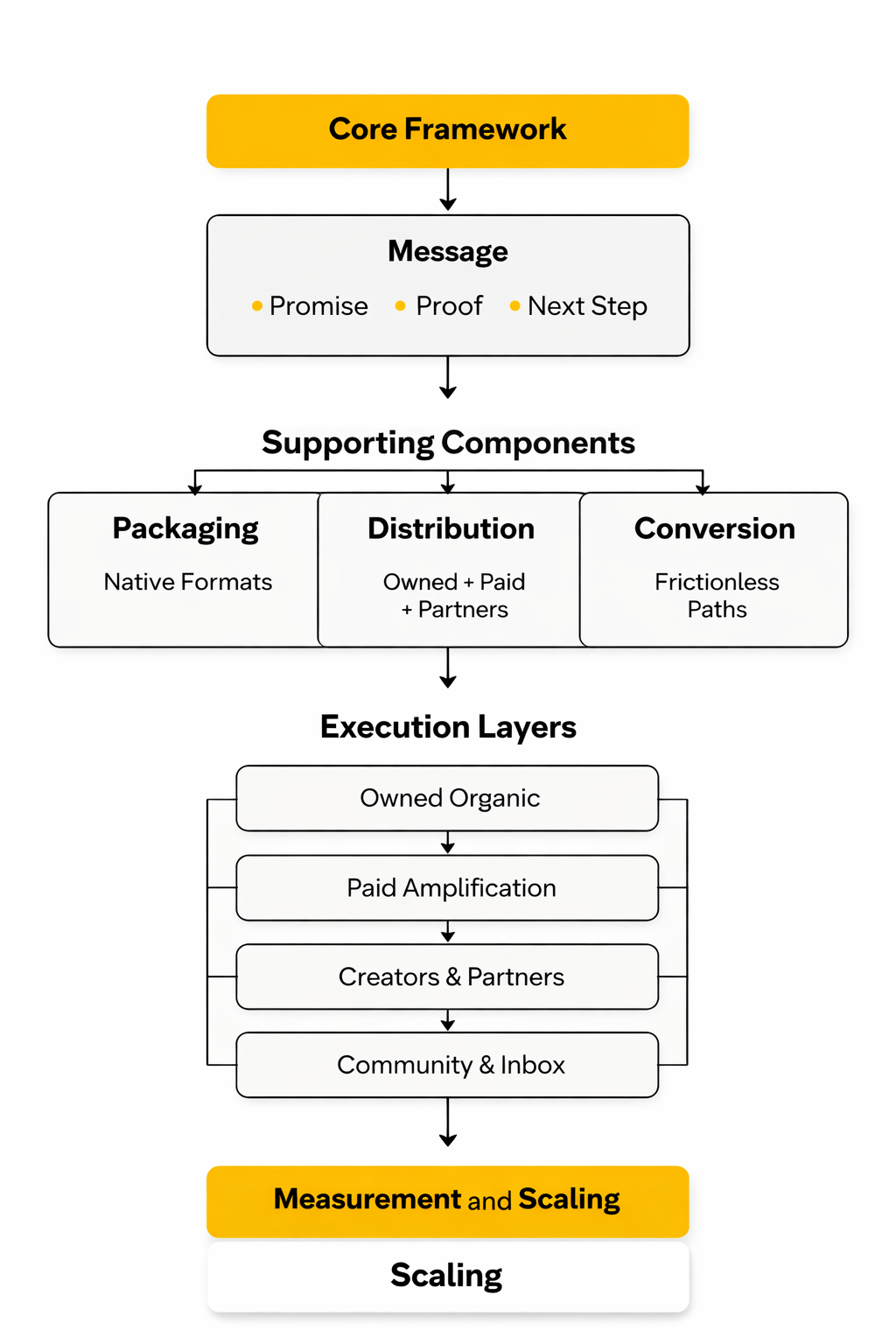
Here’s the simplest reliable framework for social media promotion:
- Message: One clear promise + one clear proof + one clear next step.
- Packaging: Platform-native creative that earns the first second of attention.
- Distribution: A repeatable cadence across owned channels, partners, communities, and paid.
- Conversion: A frictionless path from attention to action (click, DM, signup, purchase).
- Measurement: A feedback loop that improves the system weekly, not quarterly.
Most teams accidentally invert this. They start with packaging (“Let’s make a reel”), then distribution (“Post it on Tuesday”), then measurement (“How did it do?”). The framework flips it back into a professional order: decide the job, build the message, then earn reach on purpose.
This framework also helps you avoid a classic trap: confusing content volume with promotion. Content is what you publish. Promotion is how you make sure the right people actually see it—and how you turn that attention into an outcome you can measure and repeat.
Core Components
To run social media promotion like a system, you need five core components working together. If one is missing, you’ll feel it immediately (usually as inconsistent results and constant “what should we post?” debates).
1) Audience and Positioning
Effective promotion starts with being brutally specific about who you’re for and what you’re known for. “Small businesses” isn’t a target. “VC-backed HR tech under 200 employees hiring in EMEA” is closer to a target.
Your positioning then turns into a filter: what you talk about, what you ignore, and what proof you lead with. This is how you make your social presence feel coherent instead of noisy.
2) Offer and CTA Path
Social media promotion fails when the next step is fuzzy. People don’t mind staying on-platform, but they need a clear action that matches their intent:
- If they’re curious: “Watch this,” “Follow for more,” “Save this checklist.”
- If they’re comparing: “See pricing,” “Read case studies,” “Book a demo.”
- If they’re ready: “Start trial,” “Order now,” “DM ‘READY’ and we’ll set it up.”
Promotion works best when the CTA path is designed, not improvised. That includes landing pages, link-in-bio structure, lead forms, pinned posts, DMs, and a simple follow-up mechanism.
3) Creative That Earns Attention
Creative isn’t decoration—it’s the delivery mechanism for the message. On social, the first job is to earn the next second. The second job is to make the idea easy to understand quickly.
For B2B, this is often where teams play it too safe. LinkedIn’s own research on B2B ad performance emphasizes that creative choices (including format and storytelling approaches) can materially shift brand outcomes—see LinkedIn’s breakdown of creative tactics, the broader evidence base collected in The B2B Effectiveness Code, and resources like the 2024 B2B Marketing Benchmark that reinforce the operational shift toward data-driven creative systems.
4) Distribution Engine
Distribution is where promotion becomes real. A distribution engine is a plan you can execute without reinventing it every week. It usually includes:
- Owned: Your profile, your newsletter, your site, your community, your employees/creators.
- Earned: Shares, saves, mentions, collaborations, PR, partners, UGC.
- Paid: Boosting winners, retargeting warm audiences, and structured acquisition.
Distribution also includes repackaging. One strong idea can become a short video, a carousel, a thread, a live clip, a newsletter section, and a sales enablement asset—without feeling repetitive—because each format solves a different “consumption mood.”
5) Measurement Loop
If you can’t tell what’s working, you can’t scale it. The measurement loop is a weekly habit: review signals, form a hypothesis, ship an iteration. It’s less about dashboards and more about decisions.
For paid social media promotion, incremental measurement has become increasingly central. Meta’s own guidance on lift studies explains the test/control logic behind incrementality—see Meta’s conversion lift best practices, paired with broader measurement discussions in platforms and measurement-focused research ecosystems like IAB/PwC’s reporting on digital ad categories and independent marketing effectiveness work that emphasizes isolating causal impact over vanity metrics.
Professional Implementation
Doing social media promotion professionally means you don’t sell “posts.” You sell outcomes, process, and consistency. The client isn’t paying for content; they’re paying for a system that creates demand without burning out the team.
Here’s what “professional” looks like in practice:
- A clear operating cadence: weekly planning, daily execution, weekly review.
- A promotion-first workflow: every asset is built with a distribution plan (not posted and forgotten).
- A creative testing culture: small bets, fast feedback, scale what proves itself.
- Channel-specific standards: each platform gets native formatting, not recycled leftovers.
- Measurement that drives action: decisions tied to leads, pipeline, revenue, retention, or brand lift—depending on the goal.
The most important shift is psychological: social media promotion stops being a “marketing task” and becomes a revenue habit. When the system is set up well, you don’t need constant motivation. You just run the process, learn, refine, and compound results over time.
In Part 2, we’ll turn this into a strategy: defining goals that don’t fight each other, mapping audiences to platforms, and building a promotion plan that’s actually feasible to execute week after week.
Step-by-Step Implementation

A workable social media promotion system isn’t built in a brainstorm. It’s built in the small decisions that make execution predictable: what gets made, when it ships, how it’s amplified, and how you learn fast without burning out.
This step-by-step process is designed to be repeatable. You can run it weekly as a solo marketer, or scale it across a team with approvals and multiple channels.
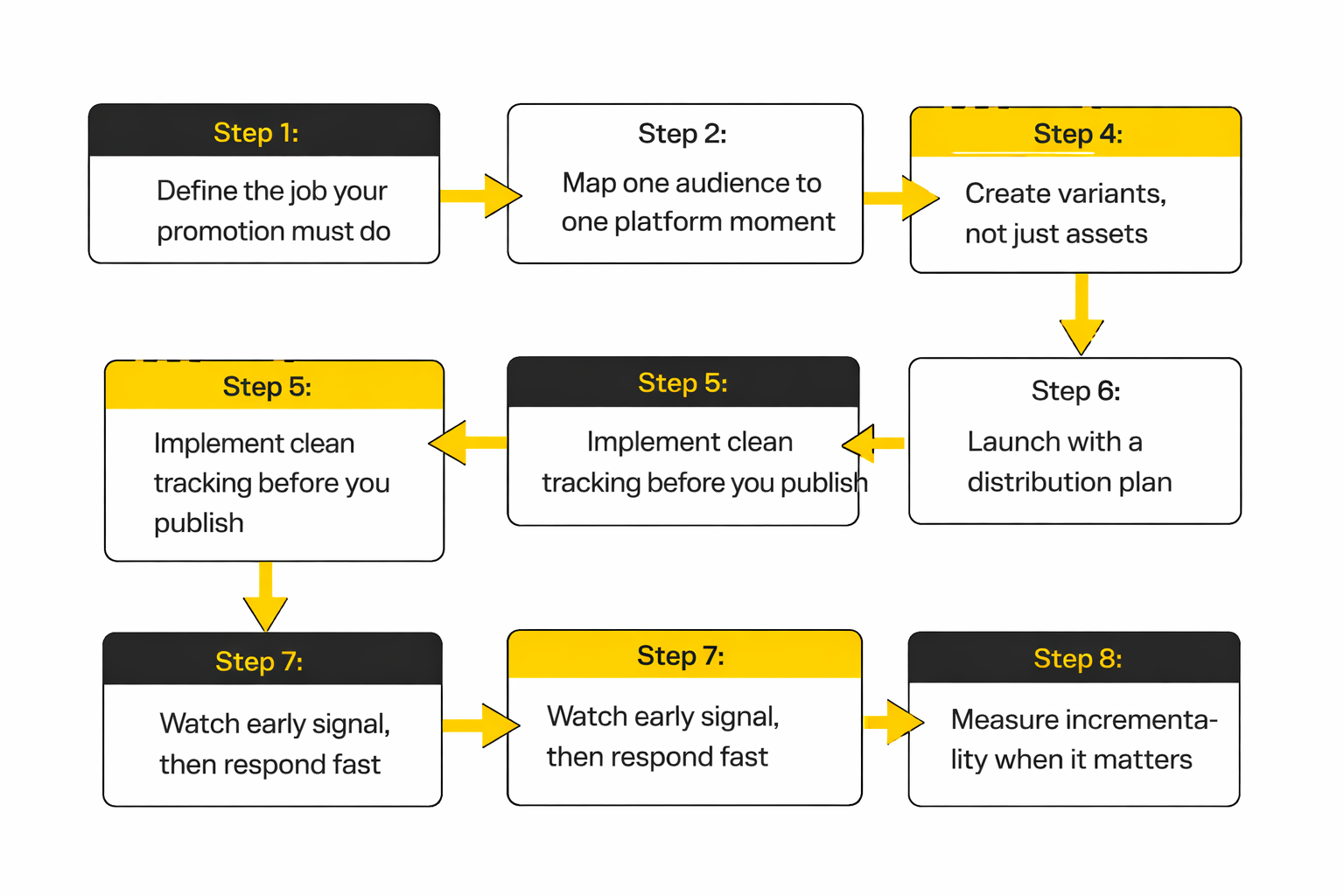
Step 1: Define the job your promotion must do
Start with one clear outcome for the next cycle: demand, leads, trials, sales, retention, event signups, or a brand perception shift. When you try to do everything in the same week, your creative ends up vague and your measurement becomes meaningless.
Pick a primary KPI and one supporting KPI. Then write the simplest version of the promise you want the audience to understand after seeing your content.
Step 2: Map one audience to one platform moment
Promotion works best when you match intent to context. LinkedIn is often a “career brain” environment, TikTok is often an “entertainment brain” environment, and Instagram can be a hybrid of aspiration and relationships depending on the niche.
Your job is to choose where your message will feel most native and least interrupted. If you’re unsure, start where you already have momentum, then expand once the system is stable.
Step 3: Build a creative brief you can actually produce
The brief should be short enough that it gets used. Include the hook, the proof, the CTA, and the constraints (format, length, and the platform’s creative rules).
For short-form video ads on Meta surfaces like Reels and Stories, Meta’s own guidance on Instagram video ad best practices is a useful constraint set, because it forces you to design for mobile behavior instead of repurposing a “nice looking” edit that doesn’t hold attention.
Step 4: Create variants, not just assets
A single “final video” is a fragile strategy. Create a small set of variants so you can test what’s actually driving performance: different hooks, different proof points, and different CTAs.
If you’re running TikTok campaigns with automation, TikTok’s setup for Smart+ Web Campaigns is built around the idea that the system can optimize delivery, but it still needs creative inputs to learn from. In plain terms: creative variety becomes fuel for optimization.
Step 5: Implement clean tracking before you publish
Do not publish first and “fix tracking later.” Standardize UTM conventions and campaign naming so your dashboards don’t become a debate. Google’s explanation of how campaign and traffic-source data is handled in GA4 campaign and traffic source documentation is a practical baseline for building consistent tags.
This step is boring right up until the moment you need to explain results to a client or leadership. Then it becomes the difference between confidence and hand-waving.
Step 6: Launch with a distribution plan
Publishing is not distribution. Write down what happens after the post goes live: employee shares, partner shares, creator reposts, community seeding, paid amplification of winners, and retargeting.
Distribution should be time-boxed and realistic. If your plan requires ten people to coordinate but you only have two people available, the system will break the first week.
Step 7: Watch early signal, then respond fast
In the first hours and days, you’re looking for signal, not perfection. Which hook held attention, which comments show confusion, which CTAs triggered action, which formats got saved or shared.
When a piece hits, you don’t “celebrate and move on.” You package it into more shapes and extend its life through distribution.
Step 8: Measure incrementality when it matters
Last-click reporting can undervalue social media promotion, especially when you’re influencing demand that converts later through search or direct. If budget is meaningful and decisions are high-stakes, use lift testing rather than guessing.
Meta’s overview of Conversion Lift testing explains how test/control design estimates incremental impact. TikTok’s conversion lift studies use a similar logic, and the point is the same: if you want to scale responsibly, you need to know what your promotion caused, not just what it touched.
Execution Layers
The easiest way to keep social media promotion organized is to think in layers. Each layer has a different purpose, a different operational rhythm, and a different measurement style.
Layer 1: Owned organic
This is your baseline presence: consistent posts, platform-native formats, and messaging that builds familiarity over time. Owned organic content is where you earn trust and create signal about what your audience cares about.
It’s also where you find “winners” that deserve amplification. Promotion becomes far more efficient when you boost what already works instead of trying to force performance from an unproven idea.
Layer 2: Paid amplification
Paid turns consistency into reach and turns reach into reliability. It’s how you keep message delivery stable even when organic distribution fluctuates.
Short-form video has become central to this layer. Changes like Meta’s move to classify new Facebook videos as Reels, covered in Reuters reporting on Facebook’s Reels shift, matter because they change what “default distribution” looks like on major platforms.
Layer 3: Creators and partners
Creators aren’t only for awareness. When you treat creators as a distribution channel with clear offers and clean tracking, they can support consideration and even conversion.
The key is alignment: the creator’s audience should already care about the problem you solve. If you have to “convince” the audience to care, you’re paying for friction.
Layer 4: Community and inbox
This layer is where trust becomes measurable. Replies, DMs, and comment threads are often the real conversion path, especially for services and B2B where buyers need reassurance.
If your team can’t respond reliably, your promotion is leaking value. A post can perform while the business quietly loses opportunities in the inbox.
Layer 5: Measurement and learning
This layer turns activity into decisions. It’s where you separate “nice engagement” from outcomes that compound: leads, demos, purchases, retention, and lift.
Industry-wide spend patterns make it clear why this matters. The IAB/PwC full-year 2024 internet ad revenue report shows how large and fast-moving digital budgets are, and IAB UK’s Digital Adspend 2024 topline highlights continued growth in a major market. When the market is this competitive, measurement discipline is not a luxury.
Optimization Process
Optimization is not “tweak targeting until something works.” Real optimization is a loop: hypothesis, test, learn, ship the next iteration. It’s how you turn social media promotion into a system that improves over time instead of resetting every month.
1) Set your testing rhythm
Choose a cadence you can sustain: weekly reviews for creative and offers, daily checks for delivery health, and monthly deep dives for attribution and lift. The rhythm matters more than the perfect dashboard because it keeps learning continuous.
If you’re using short-form video heavily, use external signals and platform best practices as constraints, then test your own variants inside those constraints. Google’s creative write-ups like how storytelling drove 2024’s best YouTube ads are useful here because they turn vague “be creative” advice into patterns you can test.
2) Prioritize creative before targeting micro-tweaks
Creative is often the fastest lever. If the first second doesn’t land, targeting changes won’t save it.
Platforms are increasingly structured around automation, which makes creative input even more important. TikTok’s documentation for Smart+ Web Campaigns explicitly frames optimization as system-led; your job becomes feeding the system strong, diverse creative and clear objectives.
3) Validate causality when budget is real
If you’re making meaningful spend decisions, you need to know whether your social media promotion is creating incremental outcomes or simply collecting credit for conversions that would have happened anyway.
Lift testing is a practical answer. Meta’s Conversion Lift overview explains the incrementality logic, and TikTok’s case studies frequently use conversion lift to measure the difference between exposed and non-exposed groups. When you have lift insight, you can scale with confidence instead of scaling based on hope.
4) Build a simple decision tree
Most teams waste time arguing about what to do with performance data. A decision tree removes drama.
- If attention is weak: change hooks, tighten the first seconds, rebuild the promise.
- If attention is strong but clicks are weak: adjust the offer clarity and CTA, improve proof.
- If clicks are strong but conversion is weak: fix landing flow, reduce friction, align message.
- If conversion is strong but scale is weak: expand distribution layers and increase creative volume.
Implementation Stories
These stories are pulled from published case studies, because social media promotion is full of fake victory laps. The real value is seeing how teams structured their implementation, what they measured, and what outcomes were documented publicly.
Quay and Monks: Proving TikTok Could Drive Incremental Purchases
Start (high drama): Quay wanted to scale on TikTok without letting acquisition costs spiral. The pressure wasn’t subtle: scale would only be “real” if it protected CPA goals while still pushing bottom-line results. Without proof of incremental impact, bigger spend would have been a bet, not a strategy.
Backstory: Quay already had a presence on TikTok and understood the platform could generate attention. The open question was whether that attention translated into measurable lower-funnel actions, not just vibes. Their agency Monks helped set up a structure that could actually validate outcomes.
The wall: Standard reporting can make social look great while hiding the truth about what it actually caused. If conversions would have happened anyway, scaling spend simply inflates cost without creating new demand. That’s why the team needed a design that could separate correlation from incrementality.
The epiphany: They treated measurement as part of implementation, not an afterthought. TikTok’s published case study shows they ran a conversion lift study with a control and treatment split to quantify incremental impact across behaviors like search, add-to-cart, and purchase. The setup turned the campaign into an experiment, not just a media plan.
The journey: They deployed a structured mix of campaign types—Catalog Ads Retargeting, Web Conversion, and Smart+ Web Campaigns—so TikTok’s system could optimize toward conversion outcomes. They refreshed creatives every 7–14 days to keep performance from decaying, a detail called out in the Quay conversion lift case study. The creative itself was designed to feel native to TikTok, leaning into authentic, trend-aligned visuals rather than polished interruption ads.
The final conflict: Even strong setups can fail if teams can’t keep creative supply steady. Creative refresh demands production discipline, and performance campaigns punish inconsistency quickly. The system also needed to prove value fast, because scaling without evidence is where budgets get cut later.
The dream outcome: The conversion lift study published by TikTok reported a 417% lift in search, 70% lift in add-to-cart, and 54% lift in purchases during the study window (July–August 2024), plus exceeding ROAS targets. The bigger win was strategic: once incrementality was demonstrated, future scaling became a disciplined decision instead of a leap of faith. That’s what professional social media promotion looks like when measurement is baked into implementation.
Jasper: Turning a Rebrand into Measurable Full-Funnel Demand on LinkedIn
Start (high drama): Jasper launched a major rebrand in June 2025, and “buzz” wasn’t enough. They needed the rebrand to translate into long-term growth, not a short spike of attention. If the market didn’t understand the shift, the new positioning would be expensive theater.
Backstory: Jasper sells to marketers, which raises the bar: the audience is trained to ignore vague claims and demand proof. Their team needed to reach decision-makers across multiple countries and segments while keeping messaging consistent. The LinkedIn environment was a natural fit, but the investment strategy had to change.
The wall: Lead-gen-only spending can produce volume while starving the top of funnel, making growth brittle over time. Jasper’s case study frames the challenge as shifting the majority of LinkedIn investment away from pure lead generation into a full-funnel approach. Without that shift, the rebrand could have landed as “new look, same story,” and the market would move on.
The epiphany: They stopped treating brand and performance as competitors. The implementation used a structured budget split and a wide mix of formats to build awareness, shape consideration, and convert demand, all documented in LinkedIn’s Jasper case study. The key idea was compounding: trust-building formats make conversion formats cheaper and more effective over time.
The journey: They ran In-Feed Video and CTV Ads for reach, Thought Leader Ads to amplify executives, and Carousel/Image/Document Ads to build trust and capture demand, all listed in the same case study breakdown. They targeted strategic accounts across the US, UK, and Canada and used multiple formats to keep the message consistent while matching different consumption behaviors. The “content pipeline” wasn’t just creative—it was a system of assets designed to move people across stages.
The final conflict: Full-funnel programs often collapse when teams can’t connect outputs to outcomes. If awareness doesn’t translate into qualified demand, leadership quickly forces budgets back into short-term lead gen. Jasper’s implementation had to prove that full-funnel investment could still drive measurable pipeline movement.
The dream outcome: LinkedIn’s published results for the campaign include 6.3M impressions, a 226% increase in qualified leads, and a 40% decrease in CPL, along with a 14% increase in demo requests. The real lesson is operational: this wasn’t one “hero ad.” It was coordinated creative layers, delivered with a plan, measured with business outcomes, and structured so future cycles could build on what worked.
Install an operating cadence
Pick a cadence that matches the speed of the platforms. Weekly planning, daily execution checks, and a weekly performance review is the minimum for most teams.
Make the review decision-driven. End every review with a short list of actions: what to scale, what to pause, what to remake, and what to test next.
Define creative QA standards
Most performance problems are creative problems in disguise. Set standards for hook clarity, on-screen text legibility, branding, and CTA alignment.
Platform guidance is useful as a constraint set, such as Meta’s Instagram video ad best practices and Instagram’s creator-focused best practices hubs like Instagram’s best practices for creators, because they push you toward formats that match real user behavior.
Standardize structure and naming
Professional social media promotion should be auditable. Use consistent naming for campaigns, audiences, creatives, and UTMs so you can trace performance back to decisions.
When stakeholders ask “What worked?” you should be able to answer without digging through messy exports.
Use lift testing when scaling spend
When budgets grow, incrementality becomes the difference between scaling and wasting. Use lift testing frameworks to validate what your promotion is actually causing.
Meta’s Conversion Lift testing is one example of a platform-native approach, and TikTok’s conversion lift programs are demonstrated in case studies like Quay’s incremental lift results. If you can’t validate causality for a claim, don’t build your strategy on that claim.
Build a compounding library
Every cycle should leave behind reusable assets: proven hooks, winning angles, high-performing formats, and FAQs your audience keeps asking. This becomes your content and creative library, and it makes next month faster and cheaper.
The long-term advantage is compounding. You’re not “making posts.” You’re building a promotion engine that gets sharper with every iteration.
Statistics and Data
When people argue about social media promotion, they usually argue about tactics. The teams that win tend to argue about data instead—because data forces clarity. It tells you where attention is actually flowing, which formats are compounding, and where you’re quietly paying for noise.
Start with the macro picture: the connected population keeps expanding, and social platforms sit right in the center of daily behavior. DataReportal’s latest global overview points to more than 6 billion people using the internet and describes social media usage reaching “supermajority” status in its Digital 2026 global overview.
Then look at the money. In the U.S., digital advertising hit a record $258.6B in 2024 with a 14.9% year-over-year increase, summarized in the IAB internet ad revenue release and echoed in coverage like Finance Yahoo’s recap and TVREV’s breakdown. The practical takeaway is simple: budgets are there, but performance is being audited harder than ever.
Platform-level signals show the same shift toward scale and automation. Meta reported 3.58B family daily active people as of December 2025, with ad impressions up 12% year over year for full-year 2025 and average price per ad up 9%, in its Q4 and full-year 2025 results release. If you’re promoting on Meta properties, it’s a reminder that the system can deliver huge volume—but your creative and measurement choices decide whether that volume becomes profit.
Finally, organic distribution patterns still matter because they help you choose where to invest effort. Emplifi’s benchmark report (based on 200,000+ brand accounts across 2023–2024) shows TikTok leading with a median monthly follower growth of 21%, Instagram holding at 6%, and X declining at -0.8%, all described in its 2025 social media benchmarks report. It also notes Instagram Reels’ median reach engagement rate for video at 2.2% in 2024 compared with TikTok’s 1.7% in the same context, in that same report.
Performance Benchmarks
Benchmarks can help you set expectations, but they can also wreck decision-making if you treat them like universal truth. Social media promotion performance changes by objective, creative format, audience temperature, seasonality, and the reality that platforms constantly tweak delivery.
A useful benchmark is one you can act on. That means defining benchmarks in layers—first for your business, then for your category, then for the platform.
1) Build your baseline before you borrow anyone else’s
The best benchmark is the one created from your last 30–90 days of consistent execution. It answers questions that generic averages can’t, like: which hooks drive the highest-quality DMs, which creative formats attract the wrong buyers, and which placements look cheap but never convert.
If you already have stable spend, take a clean slice of results by objective (traffic, leads, purchases) and by format (short-form video, static, carousel, creator content). That becomes your “truth table” for decisions.
2) Use objective-specific benchmarks, not one-number averages
Click-through rate, for example, behaves very differently depending on the job. LinkedIn benchmark summaries that break CTR down by objective illustrate this clearly—website visits tend to be higher than engagement campaigns, while lead-gen sits in the middle in many datasets, as shown in reports like Chartis’ CTR-by-objective breakdown and discussed in other benchmark write-ups like Huble’s LinkedIn benchmarks commentary and HockeyStack’s benchmark report framing.
The point isn’t to worship those numbers. The point is to stop comparing apples to oranges. A video view campaign can be “excellent” with low click volume, while a lead campaign with similar CTR might still be unprofitable if the leads are junk.
3) Treat engagement as a signal, not the goal
Engagement helps you diagnose creative fit: the message landed, the packaging held attention, the audience understood what you meant. Emplifi’s format-level engagement comparisons (like Reels vs. TikTok reach engagement rates) are valuable here because they show how format and network change the “normal,” as noted in its 2025 benchmark report.
But engagement can also mislead you. A post can spark debate, attract the wrong audience, or get shared for the wrong reasons. Benchmarks are helpful only when they are paired with outcome metrics: leads, trials, revenue, retention, or lift.
4) Watch cost trends as a market signal
When costs rise across a platform, it often means competition is intensifying or inventory is shifting. Meta’s reporting that full-year 2025 average price per ad increased while impressions also grew is a signal of demand and system efficiency moving together, outlined in Meta’s full-year 2025 results release.
Your response to rising costs shouldn’t be panic. It should be sharper creative, clearer offers, more disciplined measurement, and a wider distribution mix so you’re not hostage to one channel.
Analytics Interpretation
Analytics isn’t a scoreboard. It’s a conversation with reality. When you interpret social media promotion data well, you stop “optimizing” randomly and start making focused changes that match what the numbers are actually saying.
1) Separate attention metrics from business metrics
Attention metrics include views, reach, watch time, saves, shares, and engagement rate. They tell you whether your message and creative are earning the right to be seen.
Business metrics include leads, qualified conversations, purchases, revenue, retention, and incremental lift. They tell you whether attention is turning into value.
When teams mix these together, they get stuck. They chase cheap reach when they need qualified demand, or they chase direct response when they actually need trust-building reach first.
2) Diagnose the funnel breakpoint
Most performance issues come from one breakpoint. Your job is to find it quickly and fix it without making ten other changes at the same time.
- If reach is fine but engagement is weak: your hook and framing aren’t landing, or the creative feels like an ad too early.
- If engagement is strong but clicks are weak: the offer isn’t clear, the CTA is timid, or the audience is entertained but not motivated.
- If clicks are strong but conversion is weak: the landing flow is misaligned, the page is slow, or the promise doesn’t match what you deliver.
- If conversion is strong but scale is weak: you need more creative volume, more distribution layers, and cleaner testing.
3) Look for incrementality, not just attribution
Attribution tells you what got credit. Incrementality tells you what your promotion actually caused. If you scale spend without incrementality, you can easily pay more for the same outcomes while thinking you’re growing.
Lift studies exist for this reason. Meta explains the test/control logic and practical considerations in its conversion lift best practices guide and its Conversion Lift overview. TikTok also frames lift studies as a way to measure “what would not have happened otherwise” in its conversion lift study explainer.
4) Use quality and safety signals, not just performance signals
Performance can look great while your brand is quietly accumulating risk. If you’re buying attention at scale, you need guardrails: placement controls, creative guidelines, and monitoring for suspicious traffic or low-quality placements.
Reuters reporting on fraud and scam ad exposure highlights why this matters for platform-scale advertising systems, even when they deliver impressive reach, in investigations like its November 2025 report on scam advertising. You don’t need to live in fear, but you do need to treat brand safety as part of professional analytics, not an afterthought.
Case Stories
Data feels abstract until you watch it save (or sink) a real campaign. These stories are based on published case studies and measurement write-ups, because social media promotion is full of made-up wins—and the only stories worth learning from are the ones that show their work.
Turkish Airlines: Proving Social Ads Drove Incremental Search Demand
Start (high drama): The campaign was running, the creative looked strong, and reports were showing performance. But a brutal question hung over the results: were the ads actually creating new demand, or just taking credit for people who were already going to search and book? Without a clear answer, scaling would have been a gamble dressed up as confidence. The pressure was simple—either prove impact or risk cutting what might be working.
Backstory: Airlines don’t get infinite patience from finance teams. Every budget increase needs a justification that goes beyond vanity metrics, especially when purchase cycles include comparison behavior like search. Turkish Airlines needed a way to connect exposure on social to downstream intent that traditional attribution could undercount.
The wall: Last-click attribution doesn’t naturally credit “interest created” when someone later searches the brand, compares routes, or books after multiple touchpoints. That gap can make effective social media promotion look weaker than it truly is—or make ineffective promotion look strong because it touched a journey somewhere. Either way, decision-making becomes political instead of analytical.
The epiphany: They shifted from attribution arguments to experimental measurement. Meta’s published case study describes using a Conversion Lift study with search lift methodology across the period of December 2, 2024 to January 31, 2025. Instead of debating models, they used test/control design to estimate how exposure changed search behavior.
The journey: They treated the study itself as part of the promotion plan, not as an optional add-on. The focus was on quantifying incremental search traffic driven by ad exposure, which is often where travel intent shows up first. By tying measurement to intent rather than only to final bookings, the campaign could be evaluated on what it was truly influencing.
The final conflict: Search lift measurement is only as good as your discipline: clean setups, stable test periods, and a commitment to trust the outcome even if it challenges your assumptions. Teams often sabotage lift tests by making constant changes mid-study or by “fixing” results they don’t like. The real challenge is operational maturity, not the statistics.
The dream outcome: The real win is that the campaign could now be discussed in business terms: did social exposure create measurable incremental intent? Meta’s case study frames the work as quantifying the search traffic driven by exposure to ads, turning social media promotion into something the organization could scale with more confidence instead of relying on attribution guesswork.
Gruvi: Finding Incremental Search Lift When Attribution Wasn’t Enough
Start (high drama): The ads were running, numbers were coming in, and the team still couldn’t shake the feeling that something didn’t add up. Conversions were credited to campaigns, but the pattern looked like demand was coming from somewhere else too. If they scaled spend on a false signal, they’d pay more to stand still. The uncomfortable truth was that “good performance” might not have meant “new customers created.”
Backstory: DTC brands often grow through a mix of discovery, retargeting, and brand search—especially when customers see an offer, hesitate, then come back later. That reality makes social media promotion hard to value with simple last-click reporting. Gruvi needed a measurement approach that could handle delayed intent and cross-channel behavior.
The wall: Attribution can credit the loudest channel, not the most causal one. If retargeting catches people right before purchase, it can look like it “did everything,” even if discovery happened elsewhere. That mismatch pushes teams toward short-term tactics and away from strategies that actually build demand.
The epiphany: They moved to experimental measurement. Meta’s published case study describes running a Conversion Lift study with search lift methodology to determine results for campaigns running from November 12, 2024 to January 5, 2025. The goal was to measure outcomes that standard attribution could miss.
The journey: The study framed search as a core intent signal, then used test/control structure to estimate incremental change driven by ad exposure. That approach aligned with how people actually buy: they see something, think, compare, and often return via search. Instead of forcing the journey into a last-click narrative, the measurement matched the real behavior.
The final conflict: Lift tests can surface uncomfortable results—sometimes revealing that a “best performing” campaign was mostly capturing existing demand. The temptation is to ignore the finding and keep spending. Professional promotion requires the opposite: accept the truth quickly, then rebuild creative and distribution around what genuinely moves the needle.
The dream outcome: With lift-based insight, Gruvi could evaluate social media promotion as a growth lever rather than a credit-collection tool. Meta’s case study centers on using a Conversion Lift study to determine results, which is exactly what you need when you want to scale without fooling yourself.
Søstrene Grene: Measuring True Holiday Impact with Conversion Lift
Start (high drama): The holiday window was approaching, and the pressure was immediate: get measurable sales impact or waste the most expensive season of the year. The brand could run ads, but that wasn’t the hard part. The hard part was proving whether the platform was driving incremental purchases or simply showing up in journeys that would convert anyway. Without measurement, every optimization decision would be built on assumptions.
Backstory: Pinterest often sits earlier in the shopping journey, where people browse ideas before they commit. That makes it powerful for discovery but tricky for simplistic attribution models. Søstrene Grene needed a way to quantify what Pinterest contributed across multiple European markets.
The wall: If you only look at last-click performance, you can undervalue channels that create demand and overvalue channels that harvest it. That can lead to the worst possible holiday strategy: starving discovery, then spending heavily on retargeting and calling it “efficient.” The business needed a measurement method that matched how people actually shop.
The epiphany: They treated measurement as part of the plan. Pinterest’s own success story explains that Søstrene Grene ran a focused 7-week conversion lift study ahead of the holiday season to measure Pinterest’s true impact. Instead of guessing, they designed a test to isolate incrementality.
The journey: The strategy combined prospecting and dynamic product retargeting using Catalog Sales ads, plus Lead ads across fourteen European markets, all described in Pinterest’s success story. That mix let the campaign cover both discovery and re-engagement, while the lift study provided a cleaner read on what exposure actually changed. The execution wasn’t just “run ads”—it was build a measurement-backed system that could be optimized with confidence.
The final conflict: Full-funnel setups can break when teams only optimize the bottom of the funnel. Prospecting gets cut the moment it looks “less efficient” in last-click reports, even when it’s building the pool that retargeting depends on. The challenge is staying disciplined long enough to measure incrementality properly and then optimize based on the truth, not on comfort.
The dream outcome: The lift study gave them a framework to discuss performance as incremental value rather than as attribution credit. Pinterest’s success story positions the work as measuring the platform’s true impact, which is exactly what professional social media promotion needs when budgets and seasons raise the stakes.
Professional Promotion
Professional social media promotion is not “reporting metrics.” It’s building a decision system that tells you what to do next, backed by measurement you can defend.
Create a single-source-of-truth dashboard
Your dashboard should answer a small set of questions fast: what worked, what didn’t, what changed, and what we’re doing next. If it takes an hour to find the truth, the organization will default to opinions.
If you’re operating in the U.S., using industry context like the IAB internet ad revenue report release can help stakeholders understand why competition and costs fluctuate—because the whole market is growing and shifting, not just your account.
Bake in lift testing for serious scale
If budgets are meaningful, incrementality should be a standard part of your measurement stack, not a special project. Meta’s documentation and guidance on Conversion Lift and its best practices for lift studies gives a practical framework for running tests without breaking operations.
The professional move is to decide in advance when you will run a lift study—new channel, major budget increase, new offer, or a season where outcomes matter more than usual.
Turn weekly reviews into decisions
A weekly review should end with a short action list:
- Scale: which creatives, audiences, and distribution layers get more budget or more publishing weight.
- Remake: which winners should be turned into new variants (new hooks, new proof, new CTAs).
- Fix: where the funnel breakpoint is (creative, offer, landing, follow-up).
- Test: one or two controlled experiments for the next cycle.
This is how analytics stops being a post-mortem and becomes a growth engine.
Include quality and safety guardrails
Professional promotion protects the brand while it grows. That means monitoring placements, watching for suspicious patterns, and treating quality as part of performance. Investigations into ad fraud and scam exposure show why platforms at scale can carry unique risks even when performance looks strong in-platform, discussed in reporting like Reuters’ analysis of scam advertising dynamics.
When you combine incrementality, funnel diagnosis, and quality controls, social media promotion becomes what it’s supposed to be: a repeatable system that turns attention into measurable business outcomes—without pretending the numbers are simpler than they are.
Advanced Strategies
Once the basics are stable, the fastest gains in social media promotion usually come from a handful of “advanced” moves that look simple on paper, but require discipline in execution: automation without losing control, creative scale without quality collapse, and measurement that can survive a skeptical CFO.
The shift you’re making here is subtle but important. Instead of asking, “How do we improve this campaign?” you start asking, “How do we build a machine that improves itself?”
Creative volume as a growth lever
At scale, creative is not a deliverable—it’s inventory. Automated delivery systems can only find efficiency if you give them enough distinct inputs: multiple hooks, angles, proof points, and formats that match the way people actually consume content on each platform.
This is why teams that treat creative refresh as an operational habit outperform teams that treat creative as a quarterly event. It’s not because the algorithm “likes fresh content.” It’s because audiences do, and the system follows attention.
Automation with guardrails
Automation can scale wins, but it can also scale mistakes. The professional approach is to automate delivery and optimization while keeping humans responsible for strategy, creative direction, measurement design, and safety controls.
Meta’s Conversions API exists precisely because a modern social media promotion stack needs more reliable event capture than browser-only tracking can provide, described in both the Meta Conversions API developer documentation and Meta’s business overview of Conversions API. When you improve signal quality, automation gets smarter with less guesswork.
Triangulated measurement instead of single-source “truth”
Attribution models are useful, but they’re not reality. A strong measurement practice triangulates across methods: platform reporting for operational signal, experiments for causality, and marketing mix modeling for long-range allocation.
This approach is reinforced in recent research on post-cookie measurement, including a 2025 study on MMM, attribution, and incrementality and a companion summary on measurement models in a post-cookie era. The takeaway is practical: if you’re betting real budget, don’t build your strategy on one measurement lens.
Search synergy and lagged effects
Advanced social media promotion teams plan for delayed impact. People see a message, think about it, talk about it, then return later through search, direct, or referrals. If you only evaluate same-day clicks, you’ll under-invest in the work that actually builds demand.
Incrementality research on TikTok emphasizes that effect can strengthen over time and in post-treatment windows, discussed in analyses like Haus’s summary of TikTok incrementality experiments and in recent coverage framing TikTok impact as demand-building first, then conversion later in eMarketer’s February 27, 2026 write-up.
Creator distribution as performance infrastructure
Creators and employees aren’t just “awareness.” In many categories, they’re the most scalable trust channel you can plug into your distribution engine—especially when your paid social CPMs rise and attention gets more competitive.
WARC’s discussion of 2025 social and influencer trends highlights the growth and structural importance of creator ecosystems in modern marketing plans, captured in its 2025 trend analysis. The practical implication: treat creator distribution like a system, not a one-off sponsorship.
Scaling Framework
Scaling social media promotion isn’t “spend more.” It’s increasing output without increasing chaos. The framework below is built around five levers that scale together. If one lever lags, growth becomes fragile.
1) Signal
If the platform can’t see outcomes clearly, scaling turns into expensive guesswork. Strengthen signal with clean tracking, consistent naming, and server-side event capture where it makes sense.
For Meta ecosystems, the rationale and mechanics of stronger event capture are explained in Meta’s Conversions API documentation and its business help overview. Better signal doesn’t guarantee profit, but poor signal almost guarantees waste at scale.
2) Creative supply
Creative is your scaling fuel. If you don’t have enough high-quality variants, you’ll hit a ceiling where spend increases but efficiency collapses. The answer isn’t endless random testing—it’s a structured creative pipeline that generates variants around proven angles.
When organizations treat creative operations as an engine, automation becomes a multiplier. Smartly’s case study on The Times describes using creative automation to unlock the potential of Meta’s automated campaign types like Advantage+ and increase real-time performance, outlined in Smartly’s published write-up.
3) Distribution mix
At small scale, one channel can carry you. At real scale, channel concentration becomes risk. The healthiest growth comes from a distribution mix that includes:
- Owned: consistent platform presence and repeatable series formats
- Paid: amplification and structured acquisition with measurement discipline
- Partners and creators: trust and reach that you don’t have to buy at auction every day
Market-level spend data shows why distribution is a competitive battleground. The U.S. market hitting roughly $258.6B in 2024 digital ad revenue (with IAB’s release summary and media coverage like TVTechnology’s recap) and Europe surpassing €118.9B in IAB Europe’s 2024 AdEx benchmark are reminders that you’re not “running ads,” you’re competing in a fast-growing auction ecosystem.
4) Measurement design
Scaling breaks when measurement can’t keep up. Your job is to design measurement that stays useful as budgets grow: dashboards for weekly decisions, incrementality tests for major spend shifts, and MMM for long-term allocation.
Nielsen’s marketing research continues to highlight how marketers are adapting to measurement and data-driven decision-making, summarized in its 2025 Annual Marketing Report release and available as a downloadable report in the report PDF.
5) Operating system
Scale is an operations problem disguised as a marketing problem. You need clear ownership, creative throughput standards, review cadence, and “what happens when things break” rules.
When operating systems are missing, teams turn scaling into heroics. When operating systems exist, scaling becomes routine.
Growth Optimization
Growth optimization is what happens after you have a framework and before you have full scale. It’s the middle zone where your social media promotion can either become a compounding system—or a cycle of constant resets.
Build a weekly decision loop
Optimization should produce decisions, not reports. A clean weekly loop typically looks like: review signal, pick one bottleneck, ship one meaningful iteration, and document what you learned.
If you’re managing TikTok performance, studies and platform research often emphasize longer flighting and allowing lagged effects to surface, which aligns with the broader “slow burn” framing described in eMarketer’s February 27, 2026 analysis.
Choose the right constraint
Most teams fail because they optimize the wrong thing first. If creative quality is weak, targeting tweaks won’t save you. If the landing flow is broken, higher CTR simply sends more people into a leaky funnel.
A useful constraint to keep in mind is creative effectiveness. Research and industry reporting repeatedly highlight that emotionally engaging creative tends to drive stronger business impact than “dull” advertising, explored in reports like Hallam’s summary document referencing the cost of dull advertising.
Test for causality when you raise spend
When you scale budget, you should validate that you’re creating new outcomes, not just buying credit. Incrementality testing is the simplest way to protect your scaling decisions from attribution illusions.
Meta’s approach to incrementality is documented through Conversion Lift measurement, and TikTok continues to publish incrementality-focused research and meta-analyses like its TransUnion partnership meta-analysis and its MMM study write-up with NIQ describing incremental contribution and ROI comparisons.
Accept assisted conversions as real
Advanced social media promotion teams don’t try to force every conversion to happen inside the platform’s click window. They plan for assisted behavior: view → search → direct → purchase, or view → DM → call → close.
This is one reason MMM has resurfaced as a serious planning tool in a privacy-first environment, explained in eMarketer’s overview of MMM’s comeback.
Scaling Stories
Scaling stories are usually told as victory speeches. The useful versions include the messy parts: the bottlenecks, the wrong turns, and the operational changes that made growth sustainable. The stories below are based on published case studies and official write-ups so the outcomes aren’t fictional.
The Times: When Growth Hit a Creative Throughput Wall
Start (high drama): Performance was live, expectations were high, and the numbers started moving faster than the team could keep up with creatively. The campaign engine wanted more inputs, more variations, more tests—but the production pace couldn’t match delivery pace. Every day the team stayed “creative-starved” was a day efficiency could slip and momentum could die.
Backstory: Subscription businesses live and die by conversion efficiency at scale. When growth teams expand spend, they need new creative quickly to avoid fatigue and keep the message aligned with changing segments. Automated campaign types also shift the workload: less time spent on micro-targeting, more time needed for a steady supply of strong creative.
The wall: The team couldn’t scale creative output without either adding massive headcount or accepting lower-quality work. Manual production processes slowed iteration and created friction between performance needs and design capacity. Even worse, the organization risked treating automation as a magic fix, when the real bottleneck was creative throughput.
The epiphany: They stopped treating creative as “assets” and started treating it as an optimization feed. The solution leaned on creative automation designed to generate many variants efficiently while still keeping brand rules intact. The approach is described in Smartly’s case study on The Times, framing Meta’s Advantage+ automation as something that becomes stronger when creative volume and variation are available.
The journey: They implemented dynamic templates and automation so new creative could be produced faster and in larger quantities. Instead of waiting for a few “perfect” designs, they built a system that could test more ideas and let performance data guide what scaled. Creative became modular and repeatable, which reduced the cost of experimentation and increased speed.
The final conflict: Automation can create chaos if governance isn’t clear. Template-driven systems still need human ownership: QA standards, message consistency, and rules for what creative gets approved for scale. Without those guardrails, creative automation can become a factory that produces volume without impact.
The dream outcome: The published write-up emphasizes doubling real-time performance through creative automation tied to Meta Advantage+ workflows, documented in the case study details. The deeper win is operational: scaling no longer depended on heroic production sprints, because the creative pipeline itself became scalable.
Alaan: When Measurement Became the Reason to Double Down
Start (high drama): The leads were coming in, but confidence wasn’t. The team could see activity, yet the question that matters in B2B kept hanging in the air: are these leads turning into real pipeline, or are we just buying forms? Without a credible measurement story, budget increases would have been a fight—and the growth plan would stall.
Backstory: B2B buyers don’t move in straight lines. They click, leave, come back later, and often convert after multiple touches and internal discussions. That behavior makes it easy for teams to under-credit social media promotion that builds demand early, or to over-credit the last touch that captures the final click.
The wall: If you can’t connect campaigns to meaningful outcomes, you can’t scale responsibly. Leadership hears “we think it’s working,” and responds with “prove it.” The team needed better conversion insight and a clearer line between LinkedIn investment and business impact.
The epiphany: They treated conversion data as a scaling lever rather than a reporting artifact. By integrating conversion insights via a Conversions API connection and tightening the optimization loop, the team could evaluate campaigns with more confidence and make bolder scaling decisions. LinkedIn’s published customer story describes this approach in the Alaan and Factors.ai case study.
The journey: They used improved conversion visibility to refine campaigns, identify what was driving better leads, and optimize toward stronger outcomes rather than surface metrics. The process created a tighter feedback loop between campaign decisions and lead quality indicators. As confidence grew, budget decisions became less emotional and more analytical.
The final conflict: Scaling spend can expose weak foundations fast. If targeting, creative, or funnel alignment is shaky, more budget simply amplifies the problem. The team had to keep measurement, optimization, and execution moving together so growth didn’t become a cost explosion.
The dream outcome: LinkedIn’s write-up reports a 56% reduction in cost per lead and describes proving the business case for doubling LinkedIn advertising budget through data-driven decisions. The real lesson is that scaling becomes easier when measurement is strong enough to defend the decision.
Set scaling triggers
Write down what qualifies a campaign to scale before you’re emotionally attached to it. Common triggers include stable CPA at higher spend, strong incrementality results, or consistent downstream quality.
When you scale without triggers, you end up chasing yesterday’s metrics and explaining surprises after the fact.
Make incrementality a standard, not a surprise
If you scale spend, you should validate causality. That can be lift studies, holdouts, geo tests, or MMM triangulation—what matters is that you’re measuring “what changed because we ran this,” not “what got credit.”
Platform and research ecosystems increasingly treat incrementality as central to modern measurement, reflected in TikTok’s research narratives like its TransUnion meta-analysis, MMM-focused work like its NIQ MMM study write-up, and broader measurement framing in eMarketer’s MMM overview.
Scale creative operations before you scale spend
If you increase budget without increasing creative throughput, you’ll often see short-term gains followed by efficiency decay. The professional move is to scale the creative system first: briefs, production rhythm, QA, and variant strategy.
Operational case studies like The Times’ creative automation approach highlight the principle: creative capacity is a growth constraint, not a branding preference.
Protect brand safety and quality
As you scale, you don’t just buy more reach—you buy more exposure to edge cases: low-quality placements, suspicious traffic patterns, and misaligned audiences. Professional teams set guardrails: placement controls, creative standards, and monitoring for anomalies.
This is especially important in platform-scale environments where fraud and scams can exist alongside legitimate inventory, discussed in investigative reporting like Reuters’ November 2025 analysis of scam advertising dynamics.
Document the machine
Scaling breaks when it lives in one person’s head. Document your naming conventions, tracking rules, creative QA checklist, response standards, and the weekly decision loop. That’s how social media promotion becomes transferable, trainable, and resilient under pressure.
Part 6 will zoom out to the ecosystem view—how channels reinforce each other, how to build long-term compounding distribution, and how to turn this system into a reliable client-winning advantage.
Future Trends
Social media promotion keeps evolving, but the direction is getting clearer: platforms reward content that feels native, distribution is becoming more automated, and measurement is moving away from “one dashboard truth” toward triangulation and experimentation.
Platform fragmentation and sharper audience splits
“Be everywhere” is fading because audiences are splitting by age, intent, and habits. Pew’s 2025 survey shows YouTube and Facebook still dominate overall usage, while younger adults over-index on platforms like Instagram and TikTok, detailed in Americans’ Social Media Use 2025 and summarized in the companion Social Media Fact Sheet. The practical move is to stop spreading one message thinly across every platform and instead build platform-specific plays where your audience is actually paying attention.
Short-form video as the default distribution layer
Short-form video isn’t a tactic anymore; it’s becoming the default distribution format on multiple platforms. Meta’s ongoing shift to make Reels central to Facebook video experiences has been widely reported, including platform changes and product updates covered by outlets like The Verge’s reporting on Facebook becoming more Reels-driven. The practical implication for social media promotion is that your creative system must be built for fast hooks, mobile-first storytelling, and variant production—because the feed is increasingly optimized around video consumption behavior.
Social search and “discovery without clicks”
People increasingly use social platforms as search engines for products, places, and opinions. At the same time, external web traffic is facing pressure from AI summaries and in-platform experiences. That shift is discussed in reporting on publisher traffic decline and AI search summaries such as The Guardian’s January 2026 coverage. If clicks get harder, social media promotion becomes more about “conversion inside the ecosystem”: profile optimization, DMs, native lead forms, and content that answers the questions people would have Googled.
AI content flood and an authenticity premium
AI-generated content is going to increase dramatically, which means attention will not just be scarce—it will be suspicious. Trend roundups heading into 2026 repeatedly emphasize the tension between AI volume and audience trust, including industry perspectives like Sprout Social’s 2026 social media trends and Hootsuite’s Social Media Trends 2026. The practical move is to keep your content grounded in real proof: real work, real outcomes, real product details, real voices, and clear disclosures when automation is used.
Incrementality and experiment-led measurement
As tracking gets noisier, the teams that scale will be the teams that can prove causality. Market-level spend growth continues to raise the stakes, with Europe’s digital ad market reaching €118.9B in 2024 and IAB Europe’s benchmark hub highlighting that social media grew 23.9% in 2024. In a market this competitive, “it looks good in-platform” is not enough for serious scaling—lift tests, holdouts, and MMM become part of professional social media promotion operations.
Strategic Framework Recap

Here’s the ecosystem view you can carry forward. Social media promotion works best when you treat it as a connected system, not a weekly content chore.
- Message: One clear promise, one clear proof, one clear next step.
- Packaging: Platform-native formats that earn attention quickly and communicate clearly.
- Distribution: A repeatable mix of owned presence, paid amplification, and partner/creator reach.
- Conversion: Frictionless paths that match intent (DMs, lead forms, landing pages, trials, checkout).
- Measurement: A decision loop that improves weekly, with incrementality methods for big bets.
The most important mindset shift is this: you’re not trying to “post better.” You’re building a promotion engine that compounds—creative learns, distribution widens, measurement gets cleaner, and outcomes become more predictable.
FAQ – Built for This Complete Guide
What is social media promotion, in plain language?
It’s the intentional distribution of messages and content on social platforms to create outcomes—attention, demand, leads, sales, or retention. “Intentional” means you plan the audience, the offer, the creative, the distribution path, and the measurement before you hit publish.
What is the fastest way to see results with social media promotion?
The fastest path is usually paid amplification of already-working creative. Use organic content to find winners (hooks, angles, formats), then amplify those winners with paid distribution and a clear conversion path that matches intent.
Which platform should I start with?
Start where your audience already behaves the way you need them to behave. If you need B2B demand and credibility, LinkedIn is often a strong starting point. If you need attention and fast creative learning, TikTok and Reels ecosystems can be powerful. Pew’s 2025 platform usage research is a helpful reality check when choosing where to focus, especially by age group, in Americans’ Social Media Use 2025.
How often should I post for social media promotion to work?
Consistency matters more than “high frequency.” A realistic cadence that you can sustain for 8–12 weeks will outperform a bursty sprint followed by silence. If your workflow can’t support daily posting, publish fewer posts with stronger distribution and repurposing.
What should I measure first?
Measure the bottleneck that’s most likely to block outcomes: attention quality (watch time, saves, meaningful engagement), conversion path health (CTR, landing conversion, lead quality), and downstream business outcomes (qualified conversations, pipeline, revenue). As budgets grow, shift toward incrementality methods because attribution alone can mislead.
What are the most common mistakes people make?
The big ones are: posting without a distribution plan, using one-size-fits-all creative across platforms, measuring vanity metrics without business outcomes, and scaling spend without validating incrementality. Another common mistake is treating short-form video like a “nice-to-have” even as platforms increasingly optimize for it.
Do I need paid ads for social media promotion?
Not always, but paid distribution is the fastest way to make outcomes more predictable. Organic can build trust and discover winning angles, while paid can scale what works and maintain stable reach when algorithms fluctuate.
How do I avoid creative fatigue?
Build a creative system that produces variants, not one “final asset.” Rotate hooks, proof points, and CTAs while keeping the core message consistent. Most fatigue problems aren’t about “audience got bored,” they’re about “creative supply didn’t keep up with scale.”
What if my links get fewer clicks than before?
Plan for “conversion without clicks.” Strengthen your profile, use native lead forms where appropriate, improve DM workflows, and design content to answer questions in-platform. As AI summaries and in-platform experiences expand, external traffic patterns can change, discussed in reporting like The Guardian’s January 2026 analysis.
How do I prove social media promotion is working to a client or leadership team?
Use a layered proof approach: platform reporting for operational signal, clean tagging for directional attribution, and incrementality methods for high-stakes decisions. Market benchmarks can help frame why costs move (and why competition is real), like IAB Europe’s documentation of rapid growth in social advertising in its 2024 AdEx benchmark hub.
What tools do I actually need to run this professionally?
At minimum: a planning system (calendar + briefs), a publishing/engagement tool or workflow, consistent tracking conventions, and a reporting layer that supports weekly decisions. If you’re scaling paid social, strengthen event signal with server-side tracking where it fits your stack.
Work With Professionals
You can read frameworks all day and still feel stuck when it’s time to turn “knowledge” into a steady stream of paid work. The hard part isn’t knowing what to do. The hard part is getting into the right rooms, with the right companies, at the right moment—before someone else takes the role.
That’s why marketplaces built specifically for marketing talent matter. Markework positions itself as a marketing marketplace where you can build a profile, connect directly with companies, and avoid the “middleman friction” that slows down hiring and kills momentum, described on markework.com.
If you’re serious about making social media promotion a paid skill—not just a personal project—here’s the play: set up a clean, credible profile, showcase real skills and proof, then use the platform’s direct messaging flow to start conversations that lead to contracts. Markework highlights that it’s built around no project fees and direct communication, which means you can negotiate and close faster without handing over a cut just for being introduced.
Instead of waiting for “one big break,” you build a pipeline: publish your expertise publicly, use your own social media promotion system to demonstrate results, then convert that credibility into paid opportunities by connecting with teams actively looking for performance, lifecycle, SEO, content, and marketing ops support, all categories shown on the Markework homepage.
 Filip Konecny Enterprises