

Somewhere between “post more” and “prove ROI,” most teams hit the same wall: social stops being a channel and turns into a tangled system. Messages land in five different inboxes, stakeholders want approvals yesterday, and performance data lives in screenshots that can’t be compared week to week.
A social media marketing platform exists for that exact moment. It’s not just a scheduler. It’s the operating system that connects planning, publishing, community, paid amplification, measurement, and governance—so your social work becomes repeatable, auditable, and scalable without burning out the humans running it.
Article Outline
- What a Social Media Marketing Platform Is
- Why a Social Media Marketing Platform Matters
- Framework Overview
- Core Components
- Professional Implementation
What a Social Media Marketing Platform Is

A social media marketing platform is a centralized workspace that helps you run social like a business function, not a series of one-off posts. At its best, it gives you one place to plan content, collaborate on creative, schedule and publish, manage conversations, amplify with paid, and measure outcomes in a way stakeholders actually trust.
The “platform” part matters because it’s not only a tool you log into—it’s a set of connected workflows and integrations. That typically includes permissions, approval routing, asset management, and links into analytics, CRM, customer care systems, and ad accounts. The goal is simple: fewer handoffs, fewer lost context-switches, and fewer “where did that metric come from?” meetings.
It also sits on top of the reality that social is massive and fragmented. There were 5.24 billion active social media user identities at the start of 2025, and the number keeps moving. A good platform doesn’t try to “beat” that complexity with more dashboards—it reduces chaos by making the work predictable.
Think of it as the difference between owning a bunch of power tools and having a workshop with labeled drawers, safety rules, and a repeatable process. You still need skilled people. You just stop wasting their time.
Why a Social Media Marketing Platform Matters
Social has become a frontline channel, and not just for marketing. Customer care expectations have shifted fast: when one interaction goes wrong, the fallout is immediate and public. In a 2025 consumer survey, nearly a quarter of consumers said they’ll stop purchasing after a single bad experience. That’s not a “community manager problem.” That’s a business risk problem.
At the same time, the money flowing into social makes measurement non-negotiable. In the U.S., the digital advertising market reached about $259 billion in 2024, and within that, social media advertising revenue hit $88.8 billion in 2024. When budgets look like that, “trust me, it’s working” stops working.
Here’s what a social media marketing platform changes in practice:
- It turns speed into a system. You can publish quickly without skipping approvals, and you can respond fast without losing tone or compliance.
- It makes cross-channel consistency realistic. Teams stop reinventing the wheel for every platform because templates, assets, and workflows are shared.
- It makes reporting defendable. Performance isn’t stitched together from native screenshots—it’s tracked with consistent naming, attribution logic, and time windows.
- It reduces operational risk. Access controls, audit logs, and role-based permissions become standard instead of “who still has the password?”
Most importantly, it helps you stop treating social as content output and start treating it as a managed pipeline: inputs (research, creative, offers, community signals) turn into outcomes (reach, leads, revenue influence, retention signals), with visibility into what actually drove what.
Framework Overview
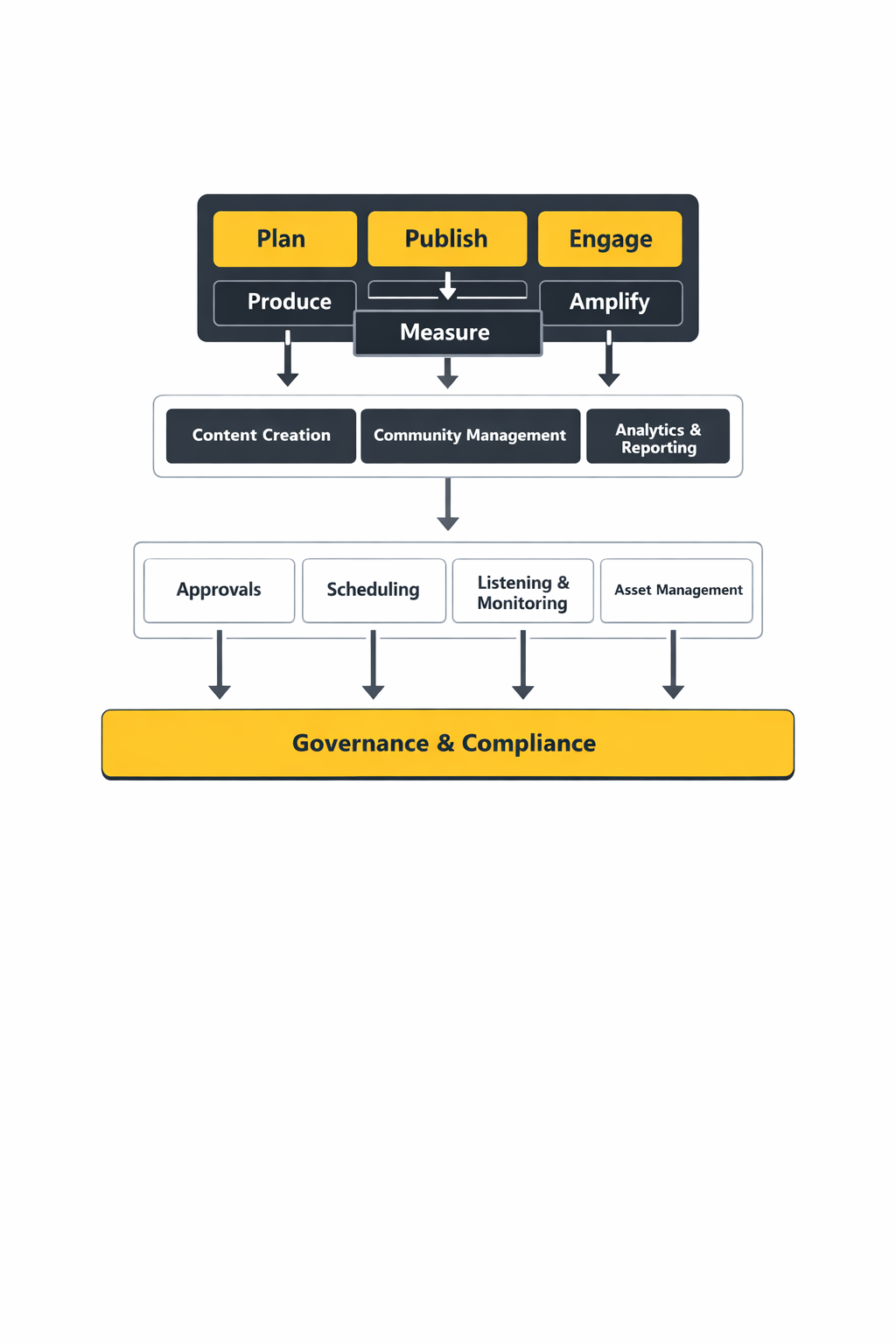
To evaluate or build a social media marketing platform without getting lost in feature lists, use a simple framework: Plan → Produce → Publish → Engage → Amplify → Measure → Govern.
This sequence matches how mature teams actually operate:
- Plan: Decide what you’re trying to achieve, for whom, and how you’ll know it worked.
- Produce: Create assets with a workflow that protects quality (and your team’s sanity).
- Publish: Schedule and distribute content reliably, with platform-native requirements handled correctly.
- Engage: Manage comments and messages like customer conversations, not interruptions.
- Amplify: Use paid support and creator/influencer distribution when organic reach isn’t enough.
- Measure: Turn data into decisions, not dashboards.
- Govern: Control access, approvals, brand safety, and compliance—without slowing everything down.
This framework also aligns with how the major networks structure professional tooling. For example, Meta positions its suite as a place to manage presence and insights across Facebook, Instagram, and Messenger, with publishing and analytics built in via Meta Business Suite. On the paid side, platforms increasingly provide programmatic options (and rules-based management) through official APIs like LinkedIn’s Campaign Management and TikTok’s API for Business.
The point isn’t to become an API engineer. The point is to choose a platform that can keep up with how the ecosystem is already evolving—automation, privacy shifts, and faster iteration cycles—without forcing your team into fragile workarounds.
Core Components
A useful social media marketing platform is made of a few core capabilities that stack together. If one is missing, teams usually compensate with spreadsheets, scattered logins, and a lot of manual copying—and that’s where quality and consistency start to slip.
1) Content Operations
This is the engine room: editorial calendar, asset library, post templates, and collaboration. You want clear status stages (draft, review, approved, scheduled, published), plus version history so feedback doesn’t turn into chaos. If your team works with partners or clients, permissions and approval routing are the difference between “fast” and “fast with regrets.”
2) Publishing and Scheduling
Scheduling isn’t just about time slots; it’s about reducing error. A good platform helps you tailor copy, formats, and link handling per network, while keeping a single source of truth for what went live and when. Native tools like Meta’s scheduling inside Business Suite can be great for a narrow stack, but most teams outgrow single-network workflows quickly.
3) Community and Customer Care
Social inbox management matters because the stakes are higher than “engagement.” When response quality drops, churn follows. Emplifi’s 2025 survey highlights how fragile loyalty can be, with one bad experience pushing 1 in 4 consumers away. Your platform should support routing, tagging, saved replies that still sound human, and escalation paths to support teams.
4) Paid Amplification and Distribution
Organic and paid aren’t separate worlds anymore—especially with creator-driven distribution and commerce features. At minimum, the platform should help you connect posts to campaigns, keep naming consistent, and understand how paid support changes outcomes. When social advertising rebounds as strongly as the IAB/PwC report showed in 2024, it’s a signal that serious teams will treat amplification as part of the system, not a last-minute boost button.
5) Measurement and Decision Support
Metrics are only helpful when they’re comparable and tied to intent. A platform should help you answer practical questions: Which content themes are driving saves and shares? Which posts are pulling qualified clicks? Which response behaviors reduce repeat complaints? The difference between “analytics” and “decision support” is whether the tool helps you choose the next move.
6) Governance, Security, and Compliance
As teams grow, governance becomes the silent requirement that decides whether you can scale. You need role-based access, approval logs, and controls for who can publish, who can spend, and who can export data. This matters even more when network policies and regional regulations change—like LinkedIn’s recent marketing API changes tied to EU ad requirements.
Professional Implementation
The biggest implementation mistake is treating a social media marketing platform like software you “roll out,” instead of a workflow you install. Tools don’t fix messy operations—they make them more visible. Professional implementation starts by making a few decisions that feel boring, but save you months of friction.
Start with a one-page operating model
Define what “done” means for social in your organization. Pick 2–3 primary outcomes (pipeline influence, retention signals, qualified traffic, customer care containment—whatever fits your business), then decide which teams own which parts of the workflow. This prevents the classic failure mode where everyone assumes someone else is replying to DMs or tagging posts correctly.
Standardize naming before you standardize reporting
Consistent naming sounds trivial until you try to compare results across quarters. Set rules for campaign names, content pillars, offers, regions, and funnel stages. If your platform supports it, enforce these as required fields. This is how you turn “reporting” from detective work into a reliable habit.
Build an approval path that matches risk, not ego
Not every post needs the same approval chain. Create tiers: low-risk content can be approved by the channel owner; higher-risk content (legal claims, pricing, sensitive topics) triggers additional review. The platform should make this automatic, so speed doesn’t depend on who happens to be online.
Integrate only what you’ll actually use in decisions
It’s tempting to connect everything. A better approach is to integrate what supports action: link tracking, CRM or lead capture, customer care routing, and analytics that map to outcomes. If you can’t explain how an integration changes what you do next week, it’s usually noise.
Train for scenarios, not features
Teams remember playbooks, not menus. Train around real moments: a product launch with approvals, a community flare-up, a sudden spike in complaints, a paid test that needs clean measurement. When the platform becomes the default way to handle pressure, adoption stops being a “change management” issue and starts becoming muscle memory.
Step By Step Implementation
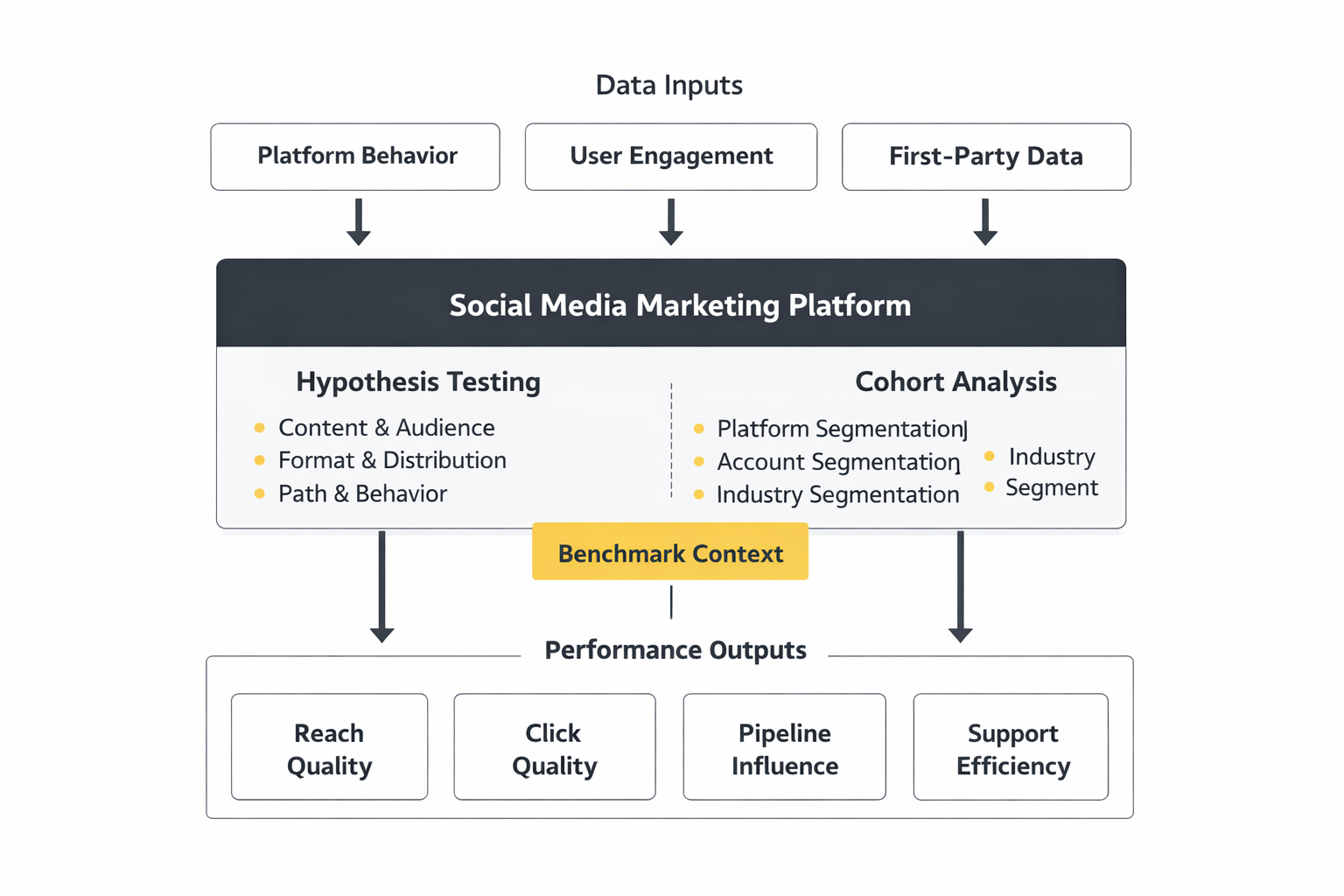
Implementing a social media marketing platform works best when you treat it like building an operating system, not installing an app. The goal is to make the work predictable: who plans, who creates, who approves, who publishes, who responds, and how performance flows back into decisions.
Step 1: Lock the outcomes before you touch the tool
Start with the outcomes you’re responsible for this quarter, then translate them into what the platform must make easier. If your priority is customer care, the social inbox and routing rules matter more than the content calendar. If your priority is pipeline, you’ll care more about tracking links, naming conventions, and how reporting connects to web analytics and CRM.
This step is also where you set expectations around response speed. In one consumer study, one-third of consumers expected replies to tags and DMs within one hour, and the same research warned that waiting beyond 24 hours risks losing the customer. The finding was echoed in a press release recap of the same dataset that broke down response-time expectations by hour range in a published summary of the survey results and in an independent media write-up highlighting how few people are willing to wait past 24 hours in Customer Experience Dive’s coverage.
Step 2: Inventory channels, accounts, and risk
Make a clean list of every social profile you manage, who owns it, and what “risk” means in your business. Risk can be legal (claims, regulated language), reputational (sensitive topics), or operational (paid spend, account access, outages). This sounds administrative, but it prevents the most common implementation failure: building workflows for an ideal world while the real world is a messy mix of brands, regions, and legacy access.
Step 3: Define a simple taxonomy that your team will actually use
Taxonomy is the hidden backbone of reporting and collaboration. Decide how you’ll label campaigns, content themes, markets, and formats. Keep it small enough that people won’t dodge it, but structured enough that reporting becomes comparable month to month.
If you want your platform to drive decisions instead of just creating dashboards, the taxonomy needs to reflect how you think about strategy. The fastest way to see what “decision-ready” reporting looks like is to compare your labels against current benchmark research, then adjust your categories so they map to real performance patterns in Emplifi’s 2025 benchmarks report.
Step 4: Build approval paths that match risk, not hierarchy
Approvals fail when every post follows the same slow path. Build tiers instead. A low-risk post should move quickly with a lightweight review. A high-risk post should trigger the right stakeholders automatically. The platform should help you enforce this without relying on memory or Slack pings.
Step 5: Set up the inbox like a contact center
If you manage community or support, treat the inbox like a queue: tagging, routing, escalation, and ownership. Decide what gets answered publicly, what moves to DMs, and what becomes a support ticket. This is also where you standardize tone and quality so the brand sounds like one team, even when multiple people are replying.
Customer expectations around “human-feeling” support have been moving quickly, especially with AI entering service workflows. Zendesk’s CX trends research highlights how consumers want AI support that still feels human in its 2025 CX Trends report summary, which is a useful reminder: automation is only helpful if it improves the experience, not just the metrics.
Step 6: Connect tracking so social outcomes can be defended
Decide how links will be tracked (UTMs, naming rules, landing page standards) and what “conversion” means for your business. Then connect the tools that turn social activity into business visibility: analytics, CRM, helpdesk, or a data warehouse. You’re aiming for one source of truth, not five spreadsheets arguing with each other.
Step 7: Pilot one workflow end-to-end before full rollout
Pick a single workflow that matters and run it end-to-end for two to four weeks: planning → production → approval → publishing → engagement → reporting. The pilot should feel real, not gentle. If the workflow survives a busy week, it’s ready to scale.
Execution Layers
Once the basics are implemented, mature teams run their social media marketing platform in layers. Each layer solves a different kind of problem, and trying to skip layers usually creates fragile workarounds.
Layer 1: Governance and access
This is where you prevent chaos before it happens: roles, permissions, audit trails, and clear ownership. If you handle paid amplification, governance also includes spend controls and who can connect ad accounts.
Layer 2: Content operations
This layer keeps publishing consistent: briefs, asset management, templates, and approvals. It’s also where you set standards for what “ready” looks like so creators aren’t stuck in endless revision cycles.
Layer 3: Community and customer care
This is where social becomes high stakes. Routing rules, saved replies that still sound human, escalation paths, and coverage plans all live here. If your response quality depends on one hero community manager, the layer is missing structure.
Layer 4: Measurement that influences decisions
Measurement is not a separate report at the end of the month. It’s a feedback loop that changes what you publish, how you respond, and what you amplify. Benchmark research helps here because it gives your team a reality check on what’s changing across platforms and formats in current performance patterns from 2024–2025 data.
Layer 5: Automation and AI support
AI can speed up first drafts, tagging, triage, and summarization, but it needs guardrails. The safest approach is to automate low-risk tasks first, then expand only when quality holds up under real volume. Zendesk’s research focuses on the shift toward human-centric AI and its effect on customer expectations in its 2025 trends findings, which pairs well with a cautious rollout plan.
Optimization Process
After rollout, the platform becomes valuable through iteration. Optimization is how you turn “we’re using the tool” into “we’re getting better every month.”
Weekly: Fix friction and protect speed
Every week, look for the bottleneck that slowed execution the most. Maybe approvals created delays, maybe tagging isn’t happening, or maybe the inbox is becoming a dumping ground. Fix one friction point per week. The compounding effect is huge.
Monthly: Review the signals that actually predict outcomes
Pick a small set of signals that connect to outcomes: response time and resolution quality for care, click quality for traffic, or content themes that consistently drive saves and shares. This is also the right time to compare your internal trends against external benchmarks so you don’t optimize into a bubble, using current benchmark data in the 2025 social benchmarks report.
Quarterly: Re-tune the operating model
Quarterly reviews are where you adjust ownership, coverage, and the rules of engagement. Customer expectations and platform behavior move quickly, and your model should evolve with them. The reason to keep this on a quarterly cadence is simple: you want change to be intentional, not reactive.
Implementation Stories
Implementation gets real when the stakes are real. Here’s a documented example of what it looks like when a global company treats its social media marketing platform as infrastructure for customer experience, not just marketing output.
3M’s Global Wall: When Social Care Became Too Big to “Handle Manually”
The breaking point didn’t arrive as a tidy dashboard alert. It showed up as a slow, creeping loss of control: inconsistent moderation across regions, customer cases piling up, and teams in different markets solving the same problem in different ways. The brand could feel the risk building because the volume wasn’t just “more messages,” it was more chances for the wrong response to become public.
For years, the backstory looked manageable. Local teams owned local channels, tools differed by region, and process lived in people’s heads. The approach worked until it didn’t, and by the time the cracks were obvious, they were everywhere at once.
The wall was scale. When you operate globally, social doesn’t behave like a channel anymore—it behaves like an always-on service surface. Without a unified system, you can’t consistently route cases, enforce brand standards, or learn from what customers are repeatedly asking. In 3M’s own customer story, the need for a scalable approach is framed around unifying workflows and improving how teams handle customer cases worldwide in the published overview of their transformation.
The epiphany was operational: they didn’t need “more effort,” they needed one way of working. Instead of treating social as a set of separate teams, they treated it like a connected system—shared tooling, shared governance, shared insights. A senior leader at 3M discusses the shift toward unified operations and AI-supported workflows in a recorded walkthrough of how the team approached the change.
The journey was a rollout, not a switch. Governance came first: roles, access, and standard workflows. Then came the practical layers: consistent routing, moderation, and translation support, plus analytics that could be shared across teams. The same story is reinforced in a broader company recap that explains the operational focus behind the change in Sprinklr’s published narrative on the 3M program.
Then the final conflict hit, the one every implementation faces: once the system improves, expectations rise. Better workflows invite higher volume and higher scrutiny because stakeholders start trusting the channel more. The team had to keep quality stable while scaling the new way of working across markets, a challenge highlighted again in the public video version of the 3M story.
The dream outcome wasn’t just “faster.” It was consistency: a unified method for handling social customer care, a shared playbook across regions, and a platform foundation that could support learning and improvement over time. That’s what makes this story useful: it shows implementation as organizational design, not tool configuration.
Use a simple RACI so ownership never goes missing
Define who is responsible, accountable, consulted, and informed for publishing, approvals, community responses, escalation, and reporting. Most implementation failures aren’t technical. They’re ownership failures that show up as slow approvals and unanswered messages.
Set service-level expectations for the inbox
Set internal response targets that are realistic for your team and aligned to customer expectations. The reason this matters is that expectations are measurable and public. Research has shown how quickly people expect replies in DMs and how sharply willingness drops after 24 hours in Emplifi’s 2025 consumer-brand engagement findings, which were summarized in a public results breakdown and covered independently in Customer Experience Dive.
Train with scenarios, not features
Run drills: a product launch with approvals, a sudden spike in complaints, and a high-risk post that requires escalation. Scenario training reveals gaps in taxonomy, permissions, and routing rules faster than any “click here” onboarding.
Create a lightweight change-control process
Decide who can change workflows, tags, approval rules, templates, and integrations. Without change control, teams slowly drift into inconsistency, and reporting becomes less trustworthy over time.
Measure maturity, not just performance
Performance tells you how content did. Maturity tells you whether your system is becoming more reliable. Track a few maturity signals: percentage of posts tagged correctly, approval turnaround time, inbox routing accuracy, and how often reports can be produced without manual cleanup. When those improve, performance improvements become easier to repeat.
Statistics And Data

Analytics is the moment a social media marketing platform stops being “a place to post” and starts being a place to learn. But to learn anything useful, you need a few grounding numbers that keep the team honest about scale, competition, and what “good” looks like right now.
Social ad budgets are not a side quest anymore. U.S. internet ad revenue hit $259B in 2024, and social media advertising revenue inside that total reached $88.8B in 2024. That budget reality is why measurement needs to be defensible, not just pretty.
Zoom out globally and you see the same pressure. A forecast for global social media ad spend in 2024 landed around $247.3B, which helps explain why networks keep refining ad products and why brands feel the “move faster” heat.
Now layer in attention. Social platforms have reached a point where they behave like entertainment engines as much as social networks, and the shift shows up in consumer behavior research exploring how social and creator ecosystems are pulling time and budgets toward algorithm-driven feeds in Deloitte’s 2025 Digital Media Trends.
Finally, the operating reality: the biggest platforms are huge, and that scale changes what you can expect from organic distribution. Meta reported 3.35B Family Daily Active People in December 2024. Pinterest closed 2024 with 553M monthly active users. When platforms operate at that scale, your analytics needs to focus less on vanity spikes and more on repeatable systems.
Performance Benchmarks
Benchmarks are useful when they do one job: stop you from overreacting to noise. If your engagement dips this month, the question isn’t “are we failing?” It’s “did the platform shift, did our mix shift, or did the audience shift?” A social media marketing platform becomes much more valuable when it lets you answer that quickly.
Instead of chasing a single “average engagement rate,” use benchmarks in three layers:
- Platform layer: What “good” looks like differs by network and format. A short-form video benchmark doesn’t behave like a link post benchmark, and a community-heavy brand won’t look like a brand built for impulse discovery.
- Account-size layer: Performance patterns change as accounts grow. Median engagement can move differently for smaller accounts versus enterprise-sized profiles, a nuance explored in the breakouts by brand size and platform inside Emplifi’s 2025 social benchmarks report.
- Industry layer: Your category changes the ceiling. People behave differently around finance, SaaS, entertainment, retail, and consumer goods, which is why benchmarks that segment by industry are more actionable than a single universal “average.”
Benchmarks also need to match the outcome you’re optimizing for. If your goal is customer trust and retention, then response time and resolution quality matter as much as reach. Consumer expectation data shows how unforgiving “slow” can feel in social environments, especially when people treat DMs like a service channel in recent consumer-brand engagement research.
And if your goal is paid efficiency, keep one eye on the macro market. Social ad spend growth and platform earnings cycles influence auction pressure, which can shift your results even when your creative stays the same. A good benchmark habit prevents you from blaming the team for what the market is doing.
Analytics Interpretation
Data becomes dangerous when it’s read like a scoreboard. The healthiest way to interpret analytics inside a social media marketing platform is to treat it like a diagnostic: it tells you what changed, where it changed, and what hypothesis to test next.
1) Pick a small set of North Star signals
Most teams don’t need 40 metrics; they need 4 that reflect outcomes. For awareness, that might be reach and video watch quality. For community, it’s response time and repeat issue volume. For pipeline influence, it’s click quality and conversion behavior.
The trick is to choose signals that still matter when platforms shift. Platform MAU growth and revenue changes can influence feed dynamics and ad competition, which is why combining platform context with your internal trends keeps your interpretation grounded.
2) Separate volume from quality
High reach can be meaningless if it’s the wrong audience, and high clicks can be meaningless if the landing experience doesn’t convert. One of the cleanest ways to protect your interpretation is to pair a volume metric with a quality metric every time. Reach pairs with watch time or saves. Clicks pair with engaged sessions or assisted conversions.
3) Use cohorts to avoid “one-post bias”
Single posts can spike for reasons you’ll never fully explain. Cohorts make the story clearer: compare content themes, compare formats, compare creator-led posts versus brand-led posts, and compare paid-supported versus purely organic distribution. If your social media marketing platform can’t group content into cohorts easily, your team will default to anecdotes.
4) Add context from outside the dashboard
Analytics interpretation improves when you combine what happened on your channels with what’s happening in culture and consumer behavior. One example is the growing role of influencers and creators as information sources. A national survey found 21% of U.S. adults regularly get news from influencers on social media, and the number rises sharply among younger audiences. That kind of shift changes what “authority” looks like online, which changes what kinds of content people trust and share.
5) Track commercial intent signals, not just engagement
Engagement tells you people reacted. Intent tells you people are moving. Social commerce behavior research can help here: a consumer study found 56% of consumers browsed products on social media in the past year. Even if you don’t sell directly in-app, that browsing behavior suggests you should measure how social content influences product discovery and consideration, not just likes.
Case Stories
Stories are where analytics stops being theoretical. Here’s a real example of a team using analytics inside a social media marketing platform to rebuild control over customer conversations when the stakes got uncomfortable.
Sprout Social’s Inbox Pressure Test
It started as a slow panic that nobody wanted to name. Messages were coming in faster, replies were getting delayed, and the silence between customer questions and brand answers began to feel louder than the answers themselves. The team could see the risk: on social, the wait is public, and every missed window teaches people that the channel can’t be trusted.
The backstory wasn’t incompetence, it was growth. Social requests were spreading across regions and time zones, and different teams were handling different slices of the workload. The work was happening, but the system didn’t make it easy to see what mattered most, which meant urgency was being guessed instead of managed.
The wall arrived when effort stopped being enough. Even with people working hard, delays persisted because the team couldn’t consistently prioritize, route, and measure conversations at scale. The problem wasn’t “try harder,” it was “build a workflow that can carry volume without relying on heroics.”
The epiphany came from treating social conversations like an operation, not a vibe. They leaned into structured reporting and inbox analytics to identify where response time was breaking and what kinds of messages were creating the biggest backlog. The shift is described in their documented walkthrough of improving social customer care using their Smart Inbox and reporting in their published case story.
The journey wasn’t glamorous, but it was effective. They reorganized how conversations were tagged, clarified ownership, and used reporting to keep the team aligned on what “good” looked like week after week. They also shared the practical shape of the approach in a public recap showing how they used their platform to run customer care in their video walkthrough.
The final conflict hit once the system started working: expectations rose. Faster replies made the channel feel more reliable, which can drive more usage, more questions, and more scrutiny. Maintaining quality under that pressure required the team to keep tightening the workflow rather than celebrating a short-term win and moving on.
The dream outcome was stability. Instead of social care swinging between “manageable” and “overwhelming,” the team created a measurable operation that could be staffed, improved, and defended to leadership. That’s what makes it a useful analytics story: the dashboard wasn’t the point, the operational change was.
Professional Promotion
If you’re building or managing a social media marketing platform professionally, your advantage isn’t that you can read dashboards. Your advantage is that you can turn messy signals into a plan that leadership trusts.
Position your analytics work like a product:
- Start with a clear promise: “We will know what’s working, why it’s working, and what to do next.”
- Deliver a repeatable reporting rhythm: weekly decisions, monthly learning, quarterly strategy tuning.
- Translate metrics into actions: content themes to double down on, formats to retire, audience segments to test, and service workflows to fix.
- Use external reality checks: benchmark reports and market spend context prevent internal overconfidence and reduce blame when platforms shift.
That’s the difference between being “the person who posts” and being the person companies rely on when they need social to perform under pressure. A social media marketing platform gives you the infrastructure; your professional value is the interpretation layer that turns that infrastructure into growth.
Advanced Strategies
Once the basics are stable, the biggest gains come from treating your social media marketing platform like a performance system. That means you stop optimizing individual posts and start optimizing the machine that produces posts, routes conversations, and turns feedback into better decisions.
Build a content supply chain, not a content calendar
A calendar tells you what’s scheduled. A supply chain tells you where ideas come from, how they’re shaped, who approves them, and how fast the whole system can react when the internet moves. The teams that scale fastest treat the comment section as real-time research, then feed it into a structured workflow that turns signals into briefs.
Duolingo’s social team has described this idea explicitly by framing the comment section as the brief, in coverage of how the brand built a social-first operating model in Adweek’s deep dive on Duolingo’s approach.
Upgrade “posting” into experiment design
At scale, the biggest risk is mistaking activity for learning. Advanced teams run a steady cadence of tests that isolate one variable at a time: hook style, format, creator presence, CTA placement, landing experience, or distribution mix. Your social media marketing platform should make those tests easy to tag, group, and review without turning reporting into a side project.
This is where benchmarks help, but only when used as guardrails. When you compare your results to current cross-platform patterns, you can tell whether you’re improving or just riding a platform wave, using the segmentation and trend context in Emplifi’s 2025 benchmarks report.
Run community like customer experience, not engagement
Advanced strategy treats social inbox work as part of retention. That means routing, escalation, coverage planning, and quality control live inside the same operational mindset you’d apply to a support queue. When social care is managed well, it reduces repeat issues, improves trust, and creates a stream of product feedback that marketing alone would never see.
Consumer expectation research has made the stakes very clear: response speed and authenticity strongly influence trust and purchase behavior in Emplifi’s 2025 consumer-brand engagement survey.
Create a measurement throughline from social to business reality
Advanced teams stop debating vanity metrics by connecting social performance to outcomes the business already respects: qualified traffic behavior, pipeline influence, retention indicators, or deflection from support channels. This is partly why the “social tool” conversation has shifted toward platform-grade systems—social budgets and scrutiny have become too large for casual measurement.
U.S. internet ad revenue reached $259B in 2024, with social media advertising revenue at $88.8B, which is the kind of environment where a social media marketing platform needs to produce reporting that can survive tough questions.
Scaling Framework
Scaling is rarely about doing more. It’s about doing less manual work per unit of output while improving consistency. A practical scaling framework for a social media marketing platform is: Standardize → Modularize → Automate → Integrate → Govern → Expand.
1) Standardize what “good” looks like
Decide what must be consistent across every channel: naming rules, brand voice principles, approval thresholds, and response standards. This is where your taxonomy becomes a real scaling lever, because it enables comparisons across time, formats, and markets without endless cleanup.
2) Modularize your content into reusable building blocks
Scaling content doesn’t mean copying and pasting the same post everywhere. It means building repeatable modules: hooks, proof points, visual templates, and CTA patterns that can be recombined for different platforms and campaigns. Your platform should support this with templates, asset libraries, and structured briefs that make reuse frictionless.
3) Automate low-risk tasks first
Automation should start where failure is cheap: tagging suggestions, draft generation for internal review, summarizing long comment threads, or routing based on keywords. As the system proves it can preserve quality, you expand automation to higher-impact steps.
Customer experience research has highlighted the growing expectation that AI should help without making support feel robotic, which is why “human-feeling automation” is becoming a practical requirement, not a nice-to-have, as discussed in Zendesk’s 2025 CX trends summary.
4) Integrate so context survives handoffs
Integration is how you scale without breaking trust. When a social conversation becomes a ticket, the context should move with it. When a campaign goes live, the naming and tracking should flow into analytics automatically. When leadership asks what drove a change, you should be able to answer without reconstructing the story from screenshots.
5) Govern like a newsroom and a contact center
As volume grows, governance becomes a speed feature. Clear permissions, audit trails, and tiered approvals prevent chaos, especially when multiple teams publish or respond on behalf of the brand. This is also where you reduce platform risk by aligning workflows with what the networks allow and support through official tooling.
6) Expand to new channels only when the system is stable
New channels and formats are tempting, but expansion should be earned. If you can’t run consistent approvals, accurate tagging, and reliable reporting on your current channels, adding more platforms just multiplies confusion. Scale should feel like adding lanes to a highway, not driving faster on an unfinished road.
Growth Optimization
Growth optimization is the craft of making your system produce better outcomes without increasing chaos. The cleanest approach is to optimize in three loops: creative loop, distribution loop, and conversion loop.
The creative loop: make the audience your co-writer
Great social teams don’t guess what people want; they listen and iterate. Your platform should make it easy to capture recurring questions, objections, jokes, and phrases from comments and DMs, then translate them into content briefs. When this loop is working, you feel less like you’re “coming up with ideas” and more like you’re editing what the audience already told you.
This style of community-driven creative direction has been described in mainstream coverage of modern social teams, including how Duolingo’s team treats community feedback as a core creative input in Adweek’s reporting.
The distribution loop: pair organic signals with paid amplification
Organic performance is a testing ground. Paid distribution is where you scale what already shows promise. When your social media marketing platform can connect organic posts to paid boosts and campaigns with consistent naming, you can see which creative patterns hold up when reach expands beyond your current followers.
Macro spending context matters here because auction pressure and platform investment influence results even when your creative stays constant, which is why market reports like the IAB/PwC 2024 revenue breakdown are useful as reality checks.
The conversion loop: stop counting clicks and start measuring intent
Clicks can be curiosity. Intent shows up in what people do next: time on page, return visits, sign-ups, or assisted conversions. Your optimization loop should connect content themes and formats to downstream behavior, so the team learns which types of posts actually drive meaningful actions.
Consumer research has shown how frequently social is used for browsing products and discovery, which is a reminder to measure consideration signals—not just engagement—in Deloitte Digital’s consumer findings on social browsing behavior.
Scaling Stories
Scaling sounds clean on slides. In reality, it’s messy, emotional, and public. Here’s a real story of a brand scaling its social approach under pressure, where the operational system mattered as much as the creativity.
Duolingo’s “Writer’s Room” Moment
It didn’t feel like a victory at first. The brand was going viral, and that kind of attention is a double-edged sword: every post has more upside, but every mistake is louder and faster. The pressure wasn’t just to be funny—it was to stay consistent, stay relevant, and not burn out the people making the work.
The backstory is that Duolingo’s social presence didn’t become iconic because the company “posted more.” It became iconic because the team built a recognizable character, embraced culture moments, and let community feedback shape what they made next. Coverage of how the team fine-tuned a social-first approach over multiple platforms and treated community feedback as a creative engine appears in Adweek’s profile and in an operations-focused write-up on how the team structured their work in Technical.ly.
The wall hit when the cost of virality became personal. Sustaining a high-volume, high-expectation social presence can produce anxiety, creative exhaustion, and constant risk management—especially when the brand voice is deliberately bold. That tension is explored directly through the lens of burnout, mistakes, and pressure in The Wall Street Journal’s interview with Duolingo’s departing social media lead.
The epiphany was that the system had to match the audience size. Instead of relying on one person’s taste and stamina, the team adopted a “writer’s room” model—more like entertainment than traditional brand marketing—so ideation, iteration, and quality control could be shared. The shift toward a writer’s room approach and how it helped the brand manage output at scale is described in the same WSJ coverage and reinforced by broader reporting on the team’s operating model in Technical.ly’s breakdown.
The journey was operational, not just creative. When you run social like a writer’s room, you need workflows that protect consistency: a shared calendar, fast approvals, a clear taxonomy for experiments, and a way to translate community signals into briefs. This is where a social media marketing platform stops being “a tool” and becomes the infrastructure that lets a creative model scale without collapsing under its own pace.
The final conflict was inevitable: when you scale reach, you scale scrutiny. The same boldness that creates cultural relevance can also create backlash, and the system has to handle that without losing the brand voice or endangering the team’s mental health. That reality is not theoretical—it’s discussed openly in the WSJ interview, including examples of what went wrong and what it took to keep going.
The dream outcome wasn’t “one more viral post.” It was a sustainable operating model: a creative engine that could keep producing, a workflow that could withstand public pressure, and a brand voice that stayed coherent as the audience grew. That’s what scaling looks like when it’s real—less magic, more system.
Position your work around outcomes leadership already understands
Frame your service as building a system that makes performance repeatable: faster approvals, cleaner reporting, safer governance, and better decision loops. Connect your scope to business reality—especially in a world where social ad budgets are enormous and measurement expectations are high, reflected in the scale of U.S. digital advertising revenue.
Package deliverables that feel like infrastructure
- Operating model kit: roles, approvals, escalation paths, and a playbook for community response.
- Taxonomy and tagging system: campaign naming, content pillars, experiment labels, and reporting rules.
- Experiment pipeline: a weekly test cadence with hypotheses, cohort grouping, and learning summaries.
- Reporting rhythm: a weekly decision report and a monthly learning review that aligns to benchmarks.
Build credibility with externally validated context
Use current benchmarks and consumer expectation research to justify priorities and reduce subjective debates. When response speed and authenticity influence trust and purchase behavior, the inbox workflow becomes part of growth strategy, not just “community management,” supported by consumer engagement research on expectations in social channels.
Make “why now” emotionally obvious
Brands are trying to scale output while audiences demand faster, more human engagement. The professional who can install a system that protects quality while increasing speed becomes hard to replace. That’s the real promotion: you’re the person who makes social reliable when the internet is not.
Future Trends
The next generation of a social media marketing platform won’t be defined by “more features.” It will be defined by how well it helps teams operate in a world where content is easier to create, harder to trust, and increasingly regulated.
Content trust becomes a product requirement
AI-generated content is flooding feeds, and platforms are being pushed to prove what’s real, what’s altered, and what’s synthetic. Open standards like C2PA Content Credentials are designed to carry provenance data across the ecosystem, and the technical direction is laid out in the C2PA specifications. The uncomfortable part is that implementation is inconsistent, with real-world coverage showing how provenance metadata can be stripped or ignored across platforms in a recent report on “AI slop” and authenticity labels.
Practically, this means your social media marketing platform will need stronger review workflows, clearer provenance and asset tracking, and more rigorous governance over what gets published, reshared, or amplified.
Regulation moves from “legal” to “workflow”
In the EU, compliance expectations are already shaping platform behavior. The European Commission’s Digital Services Act reporting highlights the scale of moderation disputes, noting over 165 million user appeals of moderation decisions since 2024, with reversals in a meaningful share of cases. That kind of environment forces brands to build audit-ready workflows: clear approvals, documented rationale, and visible ownership.
At the same time, policy around young users is tightening. A recent policy push in Germany backed stricter age standards and verification for social platforms in Reuters reporting on proposed youth social media restrictions. If age-gating and verification expand, marketers will face audience shifts, measurement disruptions, and tighter requirements for responsible targeting.
Political ad rules spill over into broader targeting norms
New political advertising rules in the EU became applicable on October 10, 2025, and the ripple effects have been immediate. Meta announced it would stop political, electoral, and social-issue advertising in the EU starting in early October 2025, driven by operational and legal complexity discussed in AP’s coverage of Meta’s decision. When platforms change what they allow, a social media marketing platform has to help teams adapt fast: new compliance checks, revised campaign planning, and cleaner segmentation logic.
First-party data isn’t a buzzword anymore
Measurement is shifting toward what you can prove with durable signals: on-platform conversions, first-party audience data, and privacy-safe attribution. Google’s changing approach to third-party cookies in Chrome has been covered as a strategic reversal, with reporting noting the move away from a new standalone cookie prompt in Reuters analysis of Chrome’s cookie direction. The net effect is simple: brands and freelancers who can build first-party measurement habits will have a clearer advantage than those relying on fragile tracking assumptions.
API-native publishing and automation expand, but under rules
Platforms are opening posting capabilities through official APIs, which changes how stacks are built. TikTok’s official documentation lays out how posting works via the Content Posting API product and step-by-step guidance in the get-started guide. This expands automation potential, but it also raises the bar on governance: when posting can be automated, review and permissions need to be stronger, not weaker.
Strategic Framework Recap
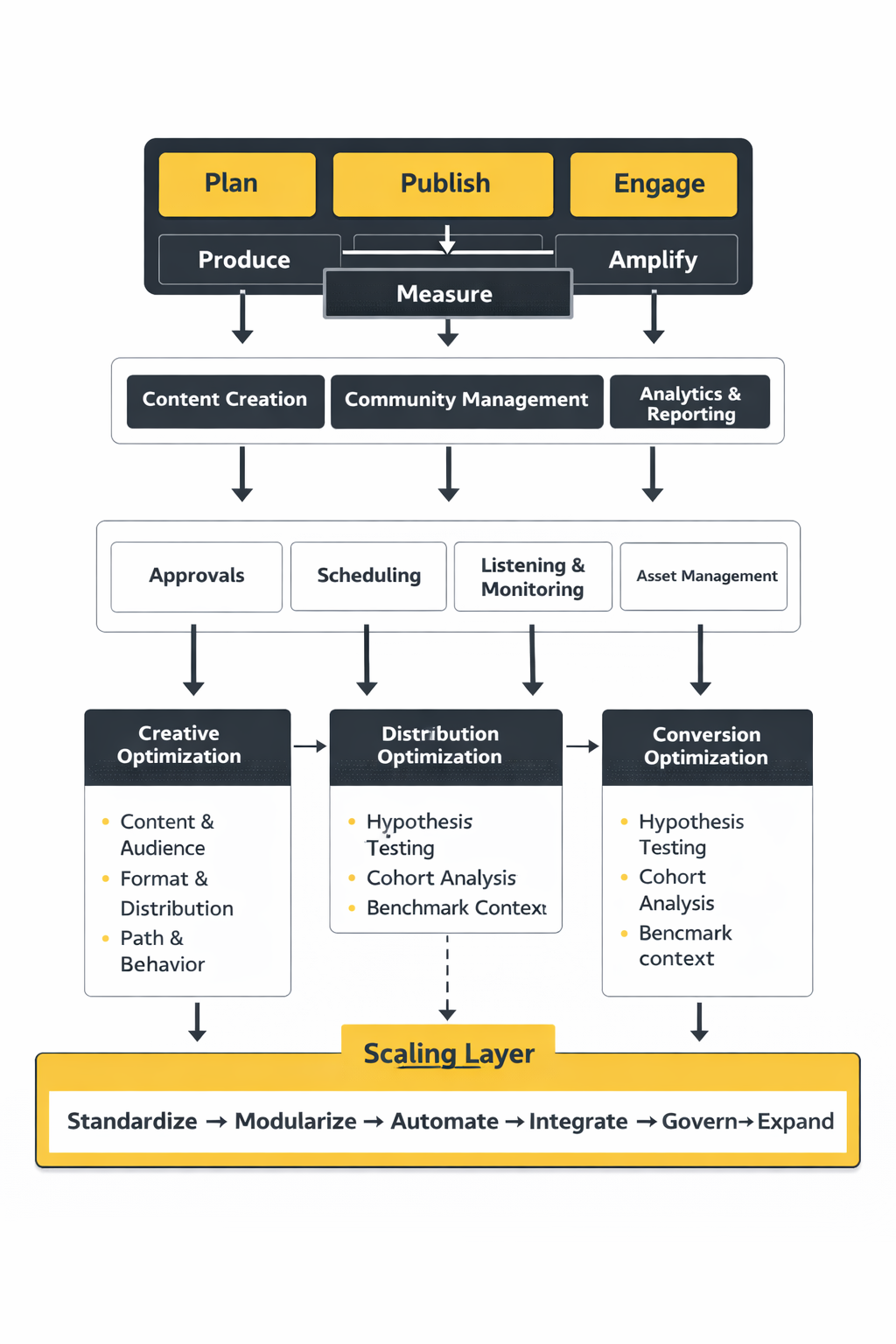
If you remember one thing from this guide, let it be this: a social media marketing platform is only as good as the operating model wrapped around it. Tools don’t create consistency; systems do.
The most reliable strategy is to run social as a connected loop:
- Plan: Choose outcomes, define audiences, and set a taxonomy that makes learning possible.
- Produce: Build repeatable creative workflows, templates, and asset management that reduce friction.
- Publish: Ship confidently with tiered approvals and platform-native formatting discipline.
- Engage: Treat the inbox like customer experience, not interruptions.
- Amplify: Scale what proves itself organically, and keep naming consistent across paid and organic.
- Measure: Translate metrics into decisions, supported by reality checks like current cross-platform benchmarks.
- Govern: Make compliance and trust part of the workflow, especially as policies tighten under frameworks like the EU Digital Services Act.
When this loop is working, social stops feeling like chaos and starts feeling like a repeatable growth system.
FAQ – Built For A Complete Guide
What counts as a social media marketing platform?
A social media marketing platform is a centralized system for planning, publishing, community management, amplification, measurement, and governance across social channels. The key word is “system”: it connects workflows so teams can move faster without losing control.
Do I need one all-in-one tool, or a stack?
Most teams end up with a stack. A core platform handles publishing and inbox workflows, while specialized layers handle listening, creative operations, and BI. The goal isn’t fewer tools; it’s fewer broken handoffs.
How do I choose the right platform without getting lost in feature lists?
Start with what must be reliable every week: approvals, inbox routing, reporting consistency, and account governance. Then compare tools based on workflow fit and auditability rather than “how many features it has.”
What’s the best way to set up approvals?
Use tiered approvals based on risk. Low-risk content moves quickly with light review. High-risk content automatically triggers additional stakeholders. This protects speed without sacrificing safety.
How fast do brands need to respond on social?
Fast enough that people feel seen. Consumer research shows many users expect replies within hours, with strong preference for very fast responses in DMs and tags in Emplifi’s 2025 engagement study. Your internal targets should match your staffing reality, but the workflow should be designed to prioritize urgency.
Why does taxonomy matter so much?
Because reporting becomes trustworthy only when labels are consistent. If campaigns, themes, and formats are tagged the same way over time, you can compare performance honestly and build repeatable wins.
Should I rely on benchmarks to judge performance?
Use benchmarks as guardrails, not grades. They help you sanity-check trends and avoid overreacting to platform shifts. Segment-based benchmarks are especially useful for interpreting results by platform, format, and brand size in current benchmark reporting.
How should AI fit into a social media marketing platform?
Start with low-risk automation: summarizing threads, suggesting tags, drafting internal versions, and routing messages. Expand only when quality remains stable under real volume, especially as trust challenges grow around provenance and authenticity in standards like C2PA Content Credentials.
How do EU regulations affect social workflows?
They push brands toward stronger documentation, clearer ownership, and audit-ready operations. The scale of moderation appeals reported under the DSA’s platform impact reporting is a reminder that governance isn’t optional when enforcement and scrutiny rise.
What happens if my category is affected by political ad rules?
Your workflows need stricter labeling, documentation, and targeting discipline. The EU’s political advertising rules applied on October 10, 2025, and platform responses have included major changes like Meta’s EU political ad halt covered in AP reporting.
How do privacy changes affect measurement?
They increase the value of first-party signals and clean tracking discipline. Chrome’s shifting direction on third-party cookies has been covered as a meaningful industry change in Reuters reporting, which is why durable measurement now depends more on what you can validate directly.
When do I need enterprise-level governance?
When multiple teams publish, when you operate across regions, when regulated claims are involved, or when the inbox becomes high-stakes customer care. The moment mistakes become expensive, governance becomes a speed feature.
Work With Professionals
Social can feel like a moving target because it is one. The formats shift, algorithms evolve, and expectations keep rising. If you’re a freelancer or independent marketer, that volatility can either drain you or become your advantage.
Here’s the opportunity: companies don’t just need “someone to post.” They need operators who can build a social media marketing platform workflow that stays calm under pressure—clean reporting, faster approvals, smarter community operations, and a test cadence that keeps learning.
That’s where a focused marketplace can change your momentum. Markework is built to connect marketing specialists and teams directly, with no middle layer. The homepage frames it clearly: direct matching with no project fees, plus structured profiles and listings designed to reduce friction.
If you’re trying to land more remote contracts, the fastest move is to get in front of active demand and make it easy for teams to say yes. Markework’s work board shows 1,000+ active listings, and the platform is designed around direct communication so you can negotiate scope and terms without platform gatekeeping described in the “Why Us” breakdown.
What makes the pitch feel different is the structure: simple monthly plans, no commissions, and “no project fees” repeated across the product and pricing pages in the current pricing plans. You keep your relationship with the client direct, which means you keep control over your work and your rates.
If you’re ready to turn your skills into a steady pipeline, build a profile that reads like a system builder: what you optimize, how you report, how you run workflows, and how you protect brand risk. Then go where the demand is already live.
 Filip Konecny Enterprises