

Most businesses don’t struggle with “doing social media.” They struggle with doing it consistently, measuring it honestly, and connecting it to revenue without burning time (or teams) out.
That’s why social media marketing packages exist: to turn scattered posts, impulsive boosts, and last-minute creative into a repeatable system you can price, deliver, and improve. When the work is packaged properly, expectations get clearer, results get easier to track, and clients stop treating social as a never-ending list of “quick tweaks.”
Part 1 lays the groundwork: what these packages actually are, why they matter right now, and the framework you’ll use to evaluate (or build) packages that make sense for real businesses.
Article Outline
- What Are Social Media Marketing Packages?
- Why Social Media Marketing Packages Matter
- Framework Overview
- Core Components
- Professional Implementation
What Are Social Media Marketing Packages?

Social media marketing packages are pre-defined bundles of services that turn “help with social” into a clear scope, a predictable workflow, and an agreed set of outcomes. Instead of selling isolated tasks (post this, design that, boost something), a package groups the work into a coherent system: strategy, content, publishing, engagement, reporting, and iteration.
A strong package answers five questions upfront:
- What channels are included? (and which are not)
- What outputs will be delivered? (posts, reels, stories, ads, community replies, reports)
- What inputs are required from the client? (access, approvals, assets, SMEs, offers)
- How success will be measured? (business-aligned KPIs, not vanity metrics)
- How the work will run week to week? (cadence, approvals, revision limits, escalation paths)
In practice, packages usually sit on a spectrum. On one end, they’re “content-first” (consistent organic publishing and light community management). On the other, they’re “growth-first” (paid distribution, creator partnerships, landing page alignment, and conversion tracking). The best fit depends on the client’s constraints: budget, creative capacity, operational readiness, and how quickly they need measurable pipeline or sales.
Packages have become more valuable as platforms evolve and buyer behavior fragments. The number of people using social platforms globally keeps climbing, and the competition for attention rises with it, which is one reason the global count of active social media user identities reached 5.24 billion.
Why Social Media Marketing Packages Matter
When marketing budgets tighten, vague scope becomes expensive. Many teams are operating in an “era of less,” with pressure to prove impact while keeping spend under control. Gartner’s CMO research has highlighted that average marketing budgets fell to 7.7% of company revenue in 2024, and their paid media snapshots show digital taking a majority share, with social advertising called out among the top paid channels in 2024.
That context changes how clients buy. They don’t just want “more posts.” They want clarity: what they’re paying for, what will happen each month, and what decisions the data will support. Packages create that clarity by turning social into an operational service with a deliverable rhythm.
Packages also help because social isn’t one thing anymore. A single brand might need:
- Short-form video for discovery
- Creator collaborations for trust
- Community responses for retention and reputation
- Paid amplification for predictable reach
- Measurement that ties activity to pipeline or sales
That “multi-lane” reality is visible in how advertising dollars are moving. Creator partnerships, in particular, have shifted from experimental to budgeted line items. The IAB’s research projects U.S. creator economy ad spend reaching $37B in 2025, and its accompanying summary notes this growth is outpacing the broader media industry.
At the same time, platform usage remains broad and habitual, which is why a package has to be designed around how audiences actually behave. For example, Pew’s latest platform research shows YouTube and Facebook remain the most widely used platforms among U.S. adults. That doesn’t mean every business should be on both—it means your package should justify channel choices with audience fit, content format fit, and measurement readiness.
Finally, packages matter because they reduce the most common delivery failure: mixing strategy decisions with daily production chaos. When the scope is structured, you can separate “what we’re trying to achieve” from “what we’re publishing this week,” and that separation is what keeps quality stable over months instead of collapsing after the first content sprint.
Framework Overview
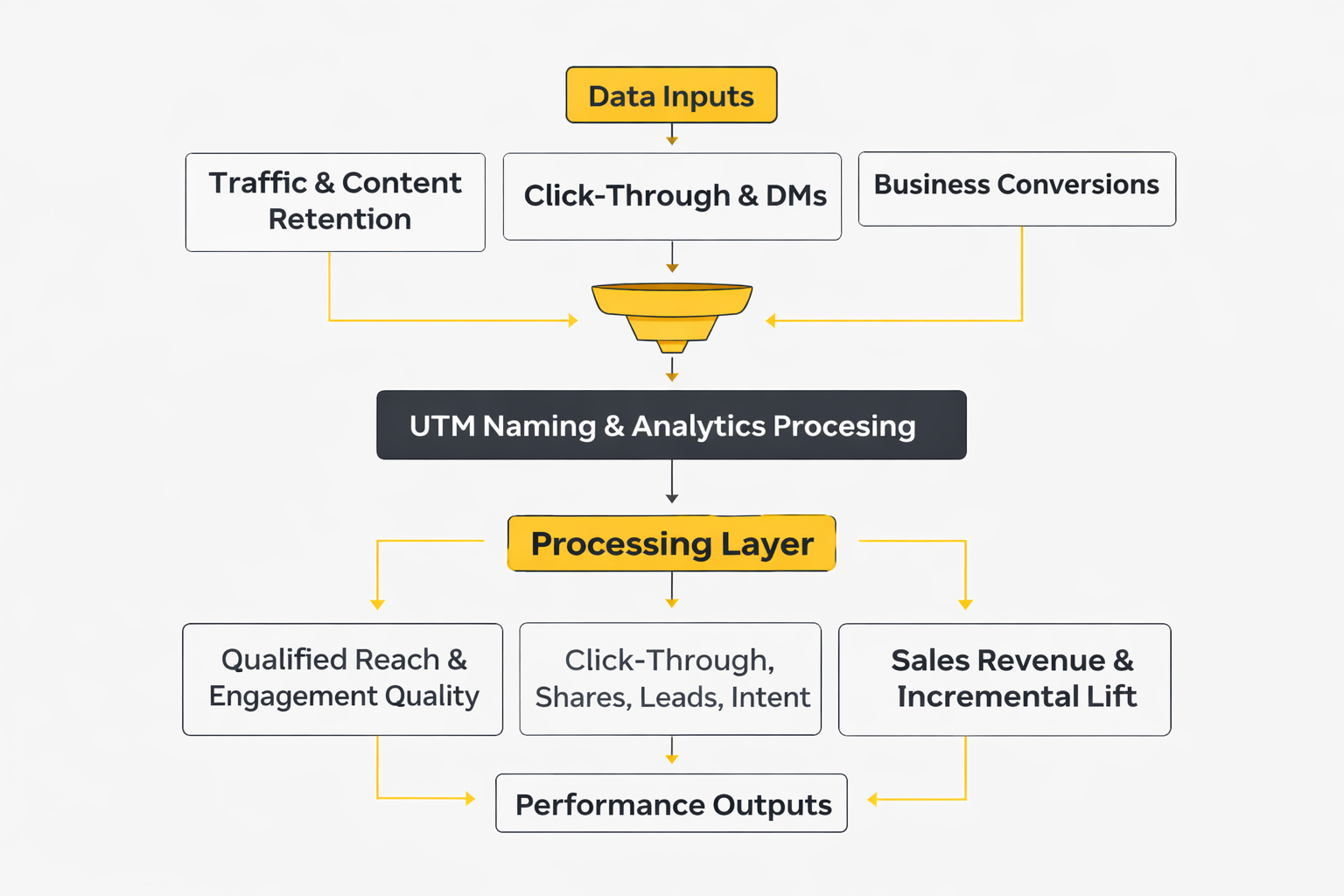
To evaluate (or build) social media marketing packages that actually work, you need a framework that forces hard choices. Not more features—better structure. The framework in this guide uses five layers, stacked in the order that reduces risk:
- Positioning: Who the brand is for, what it stands for, and why anyone should care.
- Offer and conversion path: What the audience is being invited to do, and where that happens (DM, landing page, shop, call booking).
- Content engine: A repeatable set of formats that match the platform and the buyer journey.
- Distribution: Organic, paid, creators, partnerships, and how each is used (and measured).
- Measurement and iteration: What gets tracked, how insights change the plan, and how reporting stays honest.
This order matters because many packages fail by starting at the bottom. They jump straight to posting schedules, ad sets, or weekly reports without agreeing on positioning and the conversion path. The result is “busy work metrics” that look active but can’t explain why leads are weak or why sales are inconsistent.
Modern reports from major marketing research organizations keep pointing to the same theme: the winners aren’t the loudest brands, they’re the best-connected systems—data, creative, and measurement working together. You can see that emphasis in the latest editions of major industry research, including Salesforce’s State of Marketing and Nielsen’s Annual Marketing Report, both of which focus heavily on data quality, measurement, and proving impact.
Core Components
Every package can look different on the surface, but the components underneath are surprisingly consistent. The difference between a “cheap bundle” and a professional package is not the number of posts—it’s whether these components are present and connected.
Strategy and Constraints
This is where you define what the package is trying to accomplish and what must be true for it to work. Constraints are not negative—they’re the guardrails that protect execution. A package should be explicit about:
- Primary goal (pipeline, sales, retention, recruitment, awareness)
- Target audience and buying context
- Brand voice boundaries
- Approval workflow and turnaround times
- What “done” means each week
Content System
A content system is a set of repeatable formats with clear roles. Instead of brainstorming from scratch, you build a menu of formats that match the platform and the buyer journey (discovery, consideration, decision, retention). That might include educational carousels, proof-based reels, founder-led POV posts, FAQs that defuse objections, and customer stories.
Good packages also respect how audiences actually use platforms. Pew’s platform studies are useful here because they make it harder to rely on assumptions; for example, their reporting on adult platform usage and their teen fact sheets help you avoid designing a TikTok-heavy package for a brand whose buyers aren’t there.
Distribution Mix
Distribution is where many packages either shine or quietly fail. Organic alone can work for some brands, but predictable growth often needs a plan for amplification. That might include paid social, creator partnerships, or channel-specific boosts for high-performing assets.
Creator and influencer work, in particular, has become large enough that it often deserves its own add-on tier. The IAB’s research on the creator economy provides helpful context for why clients increasingly ask for it, including the projection that creator ad spend in the U.S. is expected to hit $37B in 2025.
Community and Trust
Community management isn’t just replying to comments. It’s reputation, conversion assistance, and qualitative research happening in real time. When buyers ask questions in comments or DMs, they’re often revealing objections you can later address in content and landing pages.
For B2B, trust is not a “nice to have”—it’s often the deciding factor. LinkedIn’s research-focused reports repeatedly emphasize trust as a core lever for decision-making, including its 2025 B2B marketing benchmark on trust.
Measurement That Changes Decisions
Reporting should not be a PDF graveyard. A package earns its keep when measurement drives clearer choices: which formats to repeat, which offers convert, where paid spend should concentrate, and what messaging reduces objections.
Industry-wide measurement pressure is one reason clients ask for packaged services instead of vague “social management.” Nielsen’s 2025 Annual Marketing Report overview highlights how global marketers are leaning into data-driven marketing and holistic measurement, which aligns directly with how a professional package should be run.
Professional Implementation
It’s easy to design a package that looks good on a sales page. It’s harder to implement one that stays profitable, repeatable, and results-driven across multiple clients. Professional implementation is where you translate the framework into operations.
At a minimum, implementation needs three things: a production calendar, an approval workflow, and a measurement cadence. The calendar prevents frantic posting. The workflow prevents endless revisions. The cadence prevents “reporting for reporting’s sake” and keeps everyone focused on decisions.
Implementation also means protecting focus. Many clients will try to pull a package into random acts of marketing: “Can you also edit this landing page?” “Can you also run an email campaign?” If you want the package to remain effective, you define what belongs inside the scope and what becomes an add-on. That’s not rigidity—it’s what keeps the outcomes achievable.
In Part 2, you’ll map these components into tiered offers (starter, growth, performance), so a client can choose a package based on readiness and goals—without you reinventing delivery every time.
Step By Step Implementation

The difference between “we manage your social” and social media marketing packages that clients renew is implementation. Not the big strategy deck. Not the first month’s excitement. The boring, repeatable process that keeps quality steady when timelines slip, approvals stall, or performance dips.
This step-by-step is designed to work whether you’re delivering organic-only packages or adding paid distribution and conversion tracking. It’s also built around real-world platform behavior: people expect fast replies, and short-form video increasingly drives discovery. For example, Sprout’s Index reporting repeatedly shows most consumers want brands to respond within 24 hours or sooner, and video length preferences keep clustering in the “short and watchable” range, with 71% saying videos between 30 seconds and 2 minutes are the most effective, echoed by similar write-ups that cite the same benchmark in 2025 video marketing summaries and video marketing roundups.
1) Onboarding That Prevents Future Fire Drills
Start by making the invisible visible. Your onboarding checklist should force clarity on logins, ownership, and who approves what. If those basics aren’t locked, the package becomes a monthly scramble where every delay feels like “social media is unpredictable.”
- Access: pages, ad accounts (if used), analytics, link shorteners, shared drives, brand assets.
- Decision makers: who can approve, who can request changes, who can sign off on paid spend.
- Response rules: what requires escalation (refunds, safety issues, PR risk), and what can be answered with saved replies.
2) Align Goals to a Real Offer and a Real Path
A package can produce content forever and still fail if there’s no clear “next step” for the audience. Before you plan content, agree on the offer and where conversion happens: a booking link, a product page, a lead form, a store locator, or a DM workflow.
This is also where you decide what success looks like in plain language. If the client can’t explain the goal in one sentence, reporting will turn into a debate later.
3) Set Tracking Hygiene Before You Publish Anything
Tracking isn’t an add-on. It’s the foundation that keeps reporting honest and optimization possible. At minimum, standardize UTMs so traffic and conversions don’t get misattributed, using the same naming rules each month, grounded in GA4’s UTM parameter guidance.
If paid social is included in your social media marketing packages, consider whether you need stronger data connections. Platforms increasingly push server-side options because they’re designed to send events directly from your systems to theirs, which is the point of Meta’s Conversions API documentation and TikTok’s Events API overview.
4) Build a Monthly Content Engine
This is where implementation becomes real. You’re not “creating content.” You’re building a production system that reliably ships.
- Week 1: research, angles, hooks, and a draft calendar.
- Week 2: production and internal QA.
- Week 3: client review with structured feedback and limited revisions.
- Week 4: schedule, publish, engage, and document learnings.
If short-form video is part of the package, keep formats repeatable. Research keeps reinforcing that short-form video can meaningfully influence consumer trust and purchase intention, including findings published in Scientific Reports, industry-focused analysis in Journal of Business Research, and broader research discussions in social commerce literature.
5) Decide Distribution Before You Hit Publish
Distribution should be intentional, not reactive. For each piece of content, decide whether it lives as organic only, gets boosted, becomes an ad, or gets repurposed for creators/partners. This prevents the “post it and hope” cycle that makes social feel random.
If you’re doing performance work on TikTok, their own guidance emphasizes getting the foundations right for repeatable results, which is the focus of the TikTok Performance Fundamentals guide.
6) Build a Community Workflow That Matches Expectations
Community management is where packages often win renewals. It’s the part clients feel immediately: faster replies, cleaner tone, fewer missed messages, and a brand presence that feels alive.
Response speed matters because it changes trust and purchase behavior. Sprout’s research repeatedly highlights the expectation that brands reply quickly, including their response time analysis, the broader impact reporting tied to the 2025 Index, and the summary stats shared in customer service benchmarks.
7) Report Like a Strategist, Not Like a Screenshot Collector
Monthly reporting should answer three questions: what worked, what didn’t, and what you’re changing next. That’s it. If your report can’t lead to decisions, it’s just paperwork.
Measurement matters more now because marketers are being pushed to show impact across channels and prove efficiency, which is a core theme in Nielsen’s 2025 Annual Marketing Report and their deeper writing on data-driven decision-making.
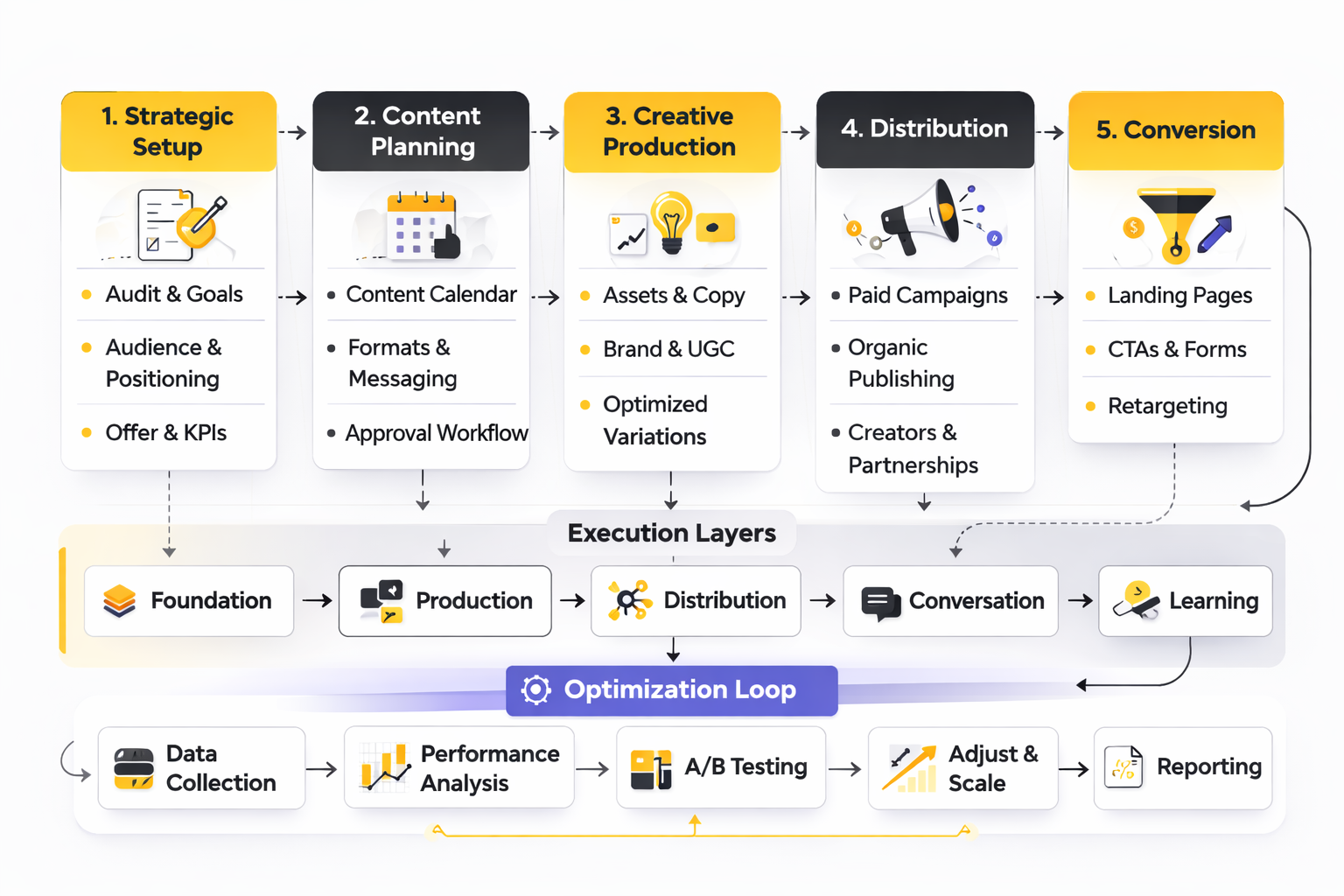
Execution Layers
Step-by-step gets you started, but execution layers keep social media marketing packages stable as complexity increases. Think of layers like a stack: if a lower layer is weak, the upper layers wobble.
Layer 1: Foundation
This is identity, access, and rules. Brand voice, approval roles, tracking standards, escalation policies, and “what we never do.” A strong foundation is why a package can scale to multiple stakeholders without turning into a politics problem.
Layer 2: Production
This is the content engine: briefs, templates, filming rhythms, design systems, and editorial QA. If production is inconsistent, everything else feels unstable because the audience experiences the brand through content, not through your planning documents.
Layer 3: Distribution
This layer determines whether content gets seen by the right people. Distribution includes organic scheduling, boosts, paid campaigns, creator activation, and channel-specific repurposing. It also includes the discipline to stop pushing content that clearly isn’t landing.
Layer 4: Conversation
This is community, DMs, comment threads, and how the brand behaves in public. It’s also where you harvest real language: objections, needs, and questions that become your next month of content angles.
Layer 5: Learning
This is measurement and iteration. It’s where you stop guessing and start improving. It’s also where the package becomes more valuable over time, because you build a history of what actually works for that specific audience.
Optimization Process
Optimization is not “tweak captions and hope.” It’s a repeatable loop that turns data into decisions without killing creativity.
1) Set One Clear Hypothesis per Cycle
Pick one thing to learn. A stronger hook style. A tighter video length. A different offer framing. A different targeting cluster. When you try to optimize everything at once, you learn nothing.
2) Design a Test You Can Actually Run
Tests should match your capacity. If your package can reliably produce four videos a week, don’t design a test that needs fifteen variants. Use your real cadence and embed experiments into the normal workflow.
3) Bake Learnings Into the System
The biggest mistake is learning something and not updating the process. When a format works, update the brief template. When a hook style fails, write it into a “do not repeat” note. That’s how social media marketing packages get smarter without requiring more time.
4) Strengthen Measurement When Needed
If you’re running conversion-focused paid campaigns, measurement quality becomes a competitive advantage. Platforms document server-side options because they’re built to support more reliable event sharing, like Meta’s Conversions API and TikTok’s Events API.
5) Review on a Human Cadence
Weekly check-ins are for small adjustments. Monthly reviews are for changing priorities. Quarterly reviews are for shifting strategy. This keeps you from overreacting to one bad week or one lucky spike.
Implementation Stories
Implementation sounds tidy on paper. In reality, it’s messy, political, and emotional because it touches budgets, reputations, and the fear of wasting time. These are real stories where the implementation details mattered as much as the creative.
Etihad Airways: Making Performance Repeatable Without Guessing
It started with pressure that felt impossible to ignore. Travel demand is volatile, and every campaign has to justify itself fast. The team couldn’t afford a “brand awareness month” that didn’t translate into real commercial movement.
Etihad already had marketing experience and a clear product, but the challenge was turning social into a more reliable performance lever. The audience was browsing constantly, yet intent could swing based on price, timing, and route availability. Creative alone wasn’t the problem; repeatability was.
The wall was measurement confidence. When results fluctuate, teams naturally argue about what caused it: creative, targeting, seasonality, or pure luck. Without strong testing and measurement, the team risks optimizing for noise.
The shift came from leaning into a setup designed for performance learning. TikTok’s case study describes using conversion lift studies to evaluate impact, rather than relying on surface-level platform signals. That made the conversation less emotional and more evidence-led.
The journey was an operational one, not just a creative one. They had to align feeds, creative variations, and the ad system so that ads stayed relevant as inventory and demand changed. They also had to build a process where learnings could be applied quickly instead of waiting for a post-campaign retrospective.
The final conflict was the usual reality: even strong systems get tested by time constraints and internal expectations. Creative refreshes, stakeholder questions, and the pressure to show results can push teams back into short-term decisions. Implementation only works if the process holds when stress rises.
The dream outcome is a package-style system: campaigns that can be launched, measured, and improved without rebuilding everything each time. TikTok’s write-up highlights Etihad’s approach to measurement and lift testing in their Dynamic Travel Ads case study, which is exactly the kind of operational foundation performance-focused packages depend on.
Meta Lift Studies: When Tracking Becomes the Turning Point
The moment tracking fails, teams start arguing with each other instead of improving the work. The marketing lead thinks the creative is strong. The CFO thinks social is a cost center. The agency thinks attribution is broken. Everyone feels like they’re losing, and nobody knows what to fix first.
This scenario is common for brands that already spend on paid social and want more predictable outcomes. They have traffic, they have offers, and they have content, yet results look inconsistent. The underlying issue is often that the measurement system isn’t trusted, so optimization becomes guesswork.
The wall is that platforms don’t read minds. If conversion signals are weak or inconsistent, ad systems have less to learn from, and performance can become harder to stabilize. Even when you do everything else right, a shaky data foundation can cap your ceiling.
The epiphany is that measurement is part of implementation, not a separate “analytics phase.” Meta’s documentation frames the Conversions API as a direct connection between your marketing data and Meta systems, which is the rationale laid out in their Conversions API overview and expanded in the developer documentation.
The journey then becomes operational: getting events right, aligning first-party data, and pairing tracking improvements with testing practices. You see that approach reflected across Meta’s case study library where lift studies and Conversions API show up together, such as Sky Italia’s campaign write-up and similar examples in Samsung UK’s measurement discussion.
The final conflict is implementation friction. Access issues, privacy reviews, internal IT constraints, and changing priorities can slow progress. When teams hit those hurdles, the temptation is to abandon measurement work and “just run the ads,” which puts you right back in the guessing trap.
The dream outcome is not a perfect dashboard. It’s confidence: reporting that supports decisions and a process that keeps improving month after month. That’s why measurement and data connections show up as foundational building blocks in both Meta’s guidance and TikTok’s performance setup materials like the Performance Fundamentals guide.
Publish With a Pre-Flight Checklist
Before anything goes live, run a checklist that covers links, UTMs, correct handles, spelling, claims (especially in regulated niches), and mobile formatting. This is the easiest way to prevent credibility damage from tiny mistakes that clients never forget.
Set Service Levels for Approvals and Responses
If your package includes engagement, define response expectations and escalation rules. If your package includes approvals, define deadlines. Clients often don’t realize their approval speed is the bottleneck until you make it visible and measurable.
Document Decisions, Not Just Outputs
Keep a living “what we learned” log: what formats worked, what messages flopped, which offers converted, and what changed. This is how you avoid repeating the same experiments every quarter and how you build a strategic narrative that clients respect.
Run Quarterly Resets to Prevent Drift
Packages drift over time. A quarterly reset brings the work back to goals, keeps measurement honest, and forces the client to make strategic choices instead of adding endless “nice-to-have” tasks. It also aligns with the broader marketing push toward clearer measurement and decision-making highlighted in Nielsen’s 2025 Annual Marketing Report.
Statistics And Data
Analytics is where social media marketing packages either become a compounding asset or a monthly argument. When the data is clean, clients stop judging the work by vibes and start judging it by decisions: what to scale, what to cut, and what to test next.
A few numbers are worth keeping in your mental dashboard because they shape expectations. For example, multiple independent surveys in the last 24 months point to the same practical truth: brands are expected to reply fast, and “tomorrow” often feels like “never.” Sprout’s Index reporting shows nearly three-quarters of consumers expect a response within 24 hours or sooner, Emplifi’s consumer survey emphasizes 24 hours as the maximum tolerance, and MarketingCharts highlights that only a small minority are willing to wait longer than 24 hours.
That matters because response-time expectations change how you structure packages. A “content-only” package might be fine for a brand that treats social as a billboard. The moment social becomes support, community, or sales enablement, your package has to budget time for conversations, not just publishing.
Another data shift that’s changing packages is where budgets are flowing. Creator partnerships keep moving from experimental to essential, with the IAB reporting that U.S. creator economy ad spend rose to $29.5B in 2024 and is projected to reach $37B in 2025, echoed in coverage that explains the same figures in plain language for marketers in Marketing Dive and Forbes.
Performance Benchmarks
Benchmarks are useful when you treat them like guardrails, not grades. Social performance varies wildly by industry, audience size, content format, posting cadence, and even what you count as “engagement.” The only benchmarks that help are the ones you can interpret alongside your specific goal.
To keep benchmarks practical inside social media marketing packages, anchor them to outcomes. Instead of obsessing over one universal “good engagement rate,” use benchmarks to answer questions like: Are we publishing enough to learn? Are we generating enough meaningful actions per post to justify distribution? Are we creating enough qualified site sessions to feed the funnel?
Benchmark 1: Content Output
Output isn’t about volume for its own sake. Output is what buys you learning. If you publish too little, you can’t tell whether the strategy is wrong or you simply didn’t give the audience enough chances to respond.
If you want reality-based context, you’ll get far more useful insights from benchmark reports that show how often brands actually post by industry, such as the annual reports from Rival IQ, the multi-platform benchmarks from Emplifi’s 2025 report using 2024 data, and the large-scale dataset Sprout used in its content benchmarks reporting referenced in Sprout’s 2025 benchmarks by industry.
Benchmark 2: Attention Quality
Attention quality is how you tell the difference between “people saw it” and “people cared.” Saves, shares, profile visits, link clicks, and meaningful comments tend to be more useful than raw likes, especially when your package is supposed to drive revenue outcomes.
Format matters here, and the cleanest pattern is that short-form video continues to be a major attention driver even as competition rises. Emplifi’s reporting, for example, breaks out performance by format and notes that short-form video formats like Reels remained strong in 2024 in its 2025 benchmarks report.
Benchmark 3: Business Actions
This is where social media marketing packages become measurable. Business actions are leads, purchases, registrations, bookings, downloads, or any event that represents real intent.
When packages include paid social, measurement quality becomes even more important because platforms optimize based on conversion signals. Meta’s documentation explains the purpose of the Conversions API as a direct connection between marketing data and Meta systems, and TikTok documents a similar idea with its Events API. The practical implication is simple: the better your event signals, the more confidently you can judge performance and iterate.
Analytics Interpretation
Analytics interpretation is the skill that turns a dashboard into strategy. The goal isn’t to “report everything.” The goal is to explain why results moved and what you’re doing next because of it.
Pick a North Star Metric That Matches the Package
If a package is built for awareness, your north star might be qualified reach and repeat exposure. If it’s built for pipeline, your north star might be booked calls or qualified lead volume. If it’s built for ecommerce, your north star might be incremental purchases or revenue-per-session.
What you don’t want is a package sold as “growth” but judged on likes. That’s how you get busy work metrics, not business outcomes.
Separate Leading Indicators from Lagging Results
Lagging results are the outcomes clients care about: sales, leads, revenue, sign-ups. Leading indicators are what you can influence faster: content retention, saves, shares, click-through to key pages, and message volume with intent.
Packages feel stable when you can say, “Sales didn’t jump yet, but leading indicators moved in the right direction and here’s why that matters.” This is also where a more holistic measurement mindset helps, which is a major theme in Nielsen’s recent work on marketing effectiveness in its 2025 Annual Marketing Report.
Standardize Naming So Your Data Stays Clean
UTM chaos ruins reporting. Standardized naming makes it possible to compare months, compare campaigns, and explain what worked without guessing.
If you need a simple foundation, Google’s GA4 documentation on campaign tagging is a solid baseline for package delivery, including how to structure UTM parameters.
Avoid False Certainty When Attribution Is Messy
Most clients want one neat number that proves social caused revenue. Real life is messier: people discover on social, research elsewhere, and convert days later.
That’s why lift testing exists. TikTok’s measurement guidance explains how a Conversion Lift Study can quantify incremental impact beyond last-click reporting. Even when you don’t run lift studies, the mindset helps: look for patterns that repeat, not one-off spikes that flatter the report.
Case Stories
Real performance stories don’t read like tidy marketing copy. They feel tense because the stakes are real: budgets, reputations, and the fear that social is just noise. These stories show what happens when analytics and implementation are treated as part of the package, not an afterthought.
Artlist: When “Last-Click” Made TikTok Look Useless
The tension started when the numbers didn’t match what the team could feel. TikTok was clearly driving attention, but the conversion reporting wasn’t giving the channel credit. The budget conversations got uncomfortable fast because it looked like spend was drifting into a black hole.
Artlist wasn’t guessing at creative, and it wasn’t new to performance marketing. The brand sells a product people often discover through inspiration, not through direct intent. That meant discovery behavior mattered, but the reporting model didn’t reflect how people actually moved through the funnel.
The wall was attribution. If the dashboard says “low conversions,” leadership pushes spend elsewhere, even if TikTok is quietly creating demand. The more the team argued from intuition, the less confidence stakeholders had in the channel.
The shift came when measurement became the focus, not another creative tweak. TikTok’s case study describes using a Conversion Lift Study to quantify incremental impact. Instead of debating opinions, the team could debate evidence.
The journey was about proving the channel’s role in discovery and intent creation. The lift study results showed TikTok driving meaningful upstream behavior, including higher site traffic and stronger search behavior. TikTok’s write-up highlights lifts like 24% in total website traffic and 51% in Google Search traffic, along with a 64% lift in website registrations.
The final conflict was what comes after proof: the pressure to scale without breaking the system. Once stakeholders believe a channel works, they want more volume, faster creative, and bigger budgets. That’s exactly when teams can lose tracking discipline and fall back into messy reporting.
The dream outcome is a package that can scale without turning into chaos. With measurement clarity, the channel can be funded with confidence and optimized with purpose. That’s what the Artlist example demonstrates when a social media marketing package treats analytics as a core deliverable, not a monthly add-on.
DSB: When Ticket Sales Needed Better Signals Than the Pixel Alone
The pressure wasn’t theoretical. DSB needed campaigns that could sell tickets efficiently, and the moment performance wobbled, every euro had to be defended. When results feel fragile, teams stop experimenting and start clinging to whatever “used to work.”
DSB already had a real product, a real audience, and a real reason to advertise. The backstory wasn’t “we don’t know what to post.” It was a measurement and optimization challenge: how to keep improving campaigns when tracking quality is under constant stress from the modern web environment.
The wall showed up as uncertainty in conversion reporting and optimization confidence. If your conversion signals are incomplete, ad systems have less to learn from. Even strong creative can look weak when the data feeding optimization is thin.
The shift came from strengthening the data connection. Meta documents the Conversions API as a way to connect marketing data more directly to Meta systems in its developer documentation. In DSB’s case study, Meta highlights implementing the Conversions API and enriching it with more first-party data.
The journey was operational: aligning data sources, validating events, and making sure the reporting reflected real outcomes. This kind of work is invisible to most audiences, but it changes everything about how confidently you can optimize. Meta’s DSB case study frames the result as a conversion improvement tied to that implementation.
The final conflict is that tracking projects often compete with “more creative” requests. Teams get pulled into new campaign ideas while the foundation work is still being finalized. If you don’t protect time for instrumentation and QA, you end up with a beautiful campaign powered by shaky signals.
The dream outcome is performance you can explain and improve. Meta’s case study states DSB saw an 18% increase in conversions after implementing the Conversions API and enriching the setup with more first-party data. That’s the kind of win that makes a package feel professional because it ties execution work to measurable business impact.
Professional Promotion
This section isn’t about “promoting on social.” It’s about promoting your social media marketing packages so the right clients understand the value before they ask for a discount. The strongest packages sell themselves when the positioning is clear and the proof is easy to grasp.
Sell the Operating System, Not the Post Count
Clients can buy posts anywhere. What they struggle to buy is consistency, measurement, and a team that turns social into a predictable workflow. Position your package as an operating system: planning, production, publishing, engagement, reporting, and iteration.
If you want a simple, credible point to underline why operations matter, response expectations are an easy one. The “24 hours or sooner” expectation is reinforced across Sprout’s Index reporting, Emplifi’s consumer survey, and MarketingCharts’ write-up of response-time tolerance, which makes it clear that engagement and community aren’t “nice extras” for many brands.
Show Proof in Three Layers
Layer one is a short narrative: what was happening, what changed, and what improved. Layer two is a simple metric tied to business value: leads, conversions, registrations, incremental lift. Layer three is credibility: a source the client can click and trust, like a platform case study or an industry report.
That structure mirrors how decision-makers actually buy: they need a story they understand, a number they can repeat internally, and a source that reduces risk.
Make Tiers Feel Like a Journey, Not a Price Menu
Your tiers should map to readiness. A starter tier buys consistency and clarity. A growth tier buys distribution and learning velocity. A performance tier buys measurement depth, experimentation, and optimization discipline.
When tiers feel like a journey, clients stop asking, “Why is this expensive?” and start asking, “Which level gets us where we want to go?”
Anchor to Measurement Confidence
In many niches, the “killer feature” isn’t a content format. It’s confidence in reporting. When you can explain why performance moved and what you’re doing next, packages feel safe to renew.
That’s why measurement is increasingly treated as a core growth lever in major industry discussions, including Nielsen’s emphasis on data-driven effectiveness in its 2025 marketing report and Google’s measurement guidance focused on unlocking ROI in its 2025 measurement perspective.
Advanced Strategies
Once the basics are running, the best social media marketing packages stop feeling like “content delivery” and start behaving like a growth system. That’s where advanced strategy lives: not in doing more, but in making the same effort produce bigger outcomes through smarter distribution, better measurement, and more believable trust signals.
Build a Creator Lane Instead of Treating Creators as a One-Off
Creators scale because they borrow trust. When a package adds creators in a structured way, you’re no longer limited by a brand handle’s reach, format habits, or tone constraints. This matters more now that creator spend is becoming a permanent budget line for many teams, with the IAB estimating U.S. creator economy ad spend at $29.5B in 2024 and projecting $37B in 2025.
The advanced move is to build a “creator lane” into the package: creator scouting, a short creator brief template, a usage-rights checklist, and a repeatable repurposing workflow so the best creator assets can become paid ads and evergreen organic posts.
Test Incrementality, Not Just Attribution
Attribution tells you what got credit. Incrementality tells you what actually caused lift. When social media marketing packages promise growth, incrementality testing keeps you from over-investing in “channels that get the last click” and under-investing in channels that create demand.
TikTok’s documentation for lift testing is explicit about the goal: a Conversion Lift Study is designed to answer whether ads drove incremental growth by comparing test and control groups over time, explained in TikTok’s Conversion Lift Study help center and expanded in the overview of how lift studies work.
Make Social a Response Channel, Not Just a Broadcast Channel
When packages include community management, social stops being “posts” and becomes a relationship engine. That shift is measurable because responsiveness changes how people feel about a brand. Multiple independent surveys keep landing on the same reality: people expect fast replies, with Sprout’s research showing nearly three-quarters expect a response within 24 hours and Emplifi’s consumer survey reinforcing 24 hours as the outer limit for many customers.
The advanced strategy is to operationalize that expectation: saved-reply libraries, escalation rules, tagging that feeds content ideation, and a weekly “objection report” that directly influences next week’s hooks, FAQs, and offer framing.
Design for Trust in B2B
If you sell to businesses, scale usually hits a wall when the brand feels too corporate or too vague. Buyers want proof, and they want it from humans. LinkedIn’s benchmark work frames this clearly in its 2025 B2B Marketing Benchmark focused on trust.
In package terms, that means building an “expert lane” alongside the brand lane: founder POV posts, employee stories, product walkthroughs, and customer proof designed to reduce perceived risk. You’re not just scaling reach; you’re scaling believability.
Use Benchmarks as Diagnostics, Not Scoreboards
Advanced teams don’t chase a universal engagement rate. They use benchmarks to diagnose friction. If reach engagement is dropping, is it creative fatigue, format mismatch, or weak distribution? If video engagement is flat, is the hook failing in the first two seconds, or is the topic irrelevant?
For multi-industry perspective, reports like Emplifi’s 2025 benchmark report using 2024 data and Rival IQ’s benchmark datasets such as their 2024 report are useful as guardrails, especially when you’re explaining to clients why “average engagement” is not a strategy.
Scaling Framework
Scaling social media marketing packages isn’t a single lever. It’s a sequence. If you skip steps, you might grow output while margins collapse, quality slips, or measurement becomes too messy to defend.
1) Standardize the Core Deliverables
Scaling starts when your package has a default operating rhythm: onboarding checklist, monthly planning template, content briefs, revision rules, publishing QA, and reporting format. The goal is that you can add clients without reinventing how you work.
2) Modularize Add-Ons
Advanced packages stay clean by keeping add-ons modular: creator partnerships, paid distribution, listening, employee advocacy, TikTok Shop support, or conversion tracking. Modular add-ons protect clarity and prevent scope creep from turning your “growth package” into a random pile of tasks.
3) Instrument Measurement Early
When packages scale, reporting questions scale too. If tracking isn’t clean, you’ll spend your week arguing about numbers instead of improving performance. Even basic discipline like UTM consistency anchored in GA4 campaign tagging guidance removes a surprising amount of friction.
If performance marketing is included, stronger data connections can support optimization, which is why Meta positions the Conversions API as a direct connection to Meta systems and TikTok documents its Events API for reliable event sharing.
4) Build a Proof System Clients Can Repeat Internally
Scaling retention means making results legible. Dashboards are helpful, but executives buy stories that are backed by credible numbers. A proof system is a repeatable way to explain: what changed, why it mattered, and what happens next.
This matters even more in a “do more with less” environment where budgets are scrutinized, reflected in budget pressure reporting like Gartner’s note that marketing budgets have stagnated around 7.7% of revenue, shared in Gartner’s 2025 CMO spend survey press release.
Growth Optimization
Optimization at scale is less about “more testing” and more about improving your learning velocity. The goal is to turn every month of delivery into compounding advantage for the client and for your package margins.
Upgrade Creative Testing From Ideas to Systems
Instead of random experiments, use structured creative testing: one hook variable, one angle variable, and one proof variable at a time. This makes results interpretable, which is what clients actually pay for when they buy higher-tier social media marketing packages.
If you want a neutral way to frame creative expectations, benchmark reports can help explain that even strong formats fluctuate as competition rises, including Emplifi’s breakdown noting shifts like Reels reach engagement moving from 2.6% in 2023 to 2.2% in 2024 in their 2025 report.
Build a Distribution Flywheel
At scale, your best content should travel further. A simple flywheel is: publish organically, identify winners, repurpose into ads, and feed insights back into the content brief template.
Lift testing also supports this flywheel because it helps you decide where distribution actually creates incremental impact, which is exactly why TikTok keeps emphasizing lift studies in resources like its Conversion Lift Study overview.
Add Employee Advocacy When Trust Is the Bottleneck
Some brands don’t need more ads. They need more credibility. Employee advocacy scales reach while making the message feel human, especially in B2B and recruiting-heavy industries.
Employee advocacy works best when it’s treated as a product inside the package: a weekly content library, lightweight training, governance rules, and a cadence that keeps participation alive. Hootsuite’s own program write-up is a useful example of measurable outcomes when employee advocacy is run as a system, outlined in its Amplify case study.
Make Measurement a Product Feature
Many packages claim they “report monthly,” but advanced packages sell measurement as a feature: decision-ready insights, attribution hygiene, and clear next steps.
Nielsen’s industry-level framing makes this easy to justify because they emphasize data-driven confidence and measurement clarity as core 2025 needs in the 2025 Annual Marketing Report.
Scaling Stories
Scaling is never clean. It’s emotional, political, and high-stakes, because growth forces teams to confront what’s actually working and what’s just familiar. These stories show what “scale” looks like when the pressure is real.
Domino’s Spain: Proving TikTok Wasn’t Just Entertainment
The tension hit when the campaign had to perform like a business tool, not a brand stunt. Euro 2024 is noisy, expensive, and packed with competitors trying to win the same attention. If the spend didn’t produce real outcomes, the channel would get blamed fast.
Domino’s wasn’t starting from zero. They already knew how to sell pizza and how to run campaigns, and they had the brand recognition to show up in the conversation. But TikTok can be brutally honest: it rewards relevance, not reputation.
The wall was proof. When leadership asks whether TikTok is incremental or just stealing credit from other channels, “it feels like it’s working” doesn’t survive a finance meeting. Without a measurement method designed for incremental impact, the conversation stays stuck in opinions.
The epiphany was to measure incrementality directly. Domino’s used a Conversion Lift Study to answer whether TikTok ads created additional business results rather than simply capturing demand that already existed. TikTok outlines this approach in its lift-study materials like the Conversion Lift Study help center.
The journey became a full-funnel effort built for scale: creative designed for the TikTok environment, a measurement plan that could survive scrutiny, and a structure that connected attention to outcomes across web and app behavior. The case write-up describes lifts across multiple business signals, including app installs and complete payments.
The final conflict came from success itself. When early indicators look strong, the pressure to scale spend rises, and teams can accidentally sacrifice creative freshness or measurement discipline to move faster. That’s how “working campaigns” turn into “tired campaigns” within weeks.
The dream outcome is the kind of repeatable proof that makes scaled social media marketing packages defensible. TikTok’s Domino’s Spain story highlights lift results including a 9% lift in complete payments, which is exactly the kind of measurable impact that keeps a channel funded and a package renewing.
Hootsuite: When Employee Advocacy Needed to Grow Up
It started with an uncomfortable realization: the product existed, the opportunity was obvious, and yet internal adoption wasn’t where it needed to be. That’s a uniquely frustrating kind of pressure because it feels like losing with a full deck of cards. The team could see the potential, but the results didn’t reflect it.
The backstory is that employee advocacy is easy to admire and hard to run. People are busy, confidence varies, and consistency fades when the program relies on enthusiasm instead of process. Without a system, participation spikes and then quietly disappears.
The wall was operational. If you can’t keep content flowing, can’t keep participation motivated, and can’t tie outcomes back to the business, leadership stops treating advocacy as strategic. It becomes “nice,” which usually means “temporary.”
The epiphany was treating advocacy like a product with clear inputs and outputs. The program needed better internal storytelling, clearer routines, and a more consistent content supply so employees didn’t have to invent posts themselves. Hootsuite’s own case study frames this shift in the Amplify success story.
The journey involved building repeatable habits: a curated content library, structured participation drives, and measurement that connected posts to recruiting and revenue outcomes. Instead of hoping employees would share, the team made sharing easy and predictable. That’s what turns employee advocacy into a scalable channel inside social media marketing packages.
The final conflict was maintaining momentum. Programs like this are vulnerable to novelty fade, and a few slow months can convince stakeholders it was a fad. Keeping participation alive requires ongoing governance, not a one-time launch.
The dream outcome is leverage: reach and business impact without buying every impression. Hootsuite reports outcomes like an 80% sign-up rate and a 250% YoY increase in sourced revenue, which is exactly why advocacy can be a serious scaling lever when it’s packaged properly.
Position the Package as a Growth System
Instead of selling “content and management,” sell the system: creator lane, distribution flywheel, responsiveness workflow, and measurement that supports decisions. That language matches what leaders care about in a constrained budget environment, reinforced by budget pressure reporting like Gartner’s 2025 budget snapshot.
Lead With Proof Clients Can Click
Advanced buyers don’t want promises. They want evidence from reputable sources: platform case studies, benchmark reports, and measurement frameworks. Using click-through proof like TikTok’s Domino’s Spain lift-study story or Meta’s measurement-driven outcomes such as DSB’s Conversions API case study makes your pitch feel grounded instead of promotional.
Sell Trust as an Outcome
In B2B and higher-ticket industries, the best promotion is trust acceleration: consistent expertise content, human voices, and proof that reduces perceived risk. LinkedIn’s research makes this easy to justify in the language executives respect, including the framing in its 2025 trust benchmark report.
Make Upgrades Feel Obvious
When you structure packages well, clients upgrade naturally. Starter becomes growth when they want distribution and faster learning. Growth becomes performance when they want incrementality testing, stronger tracking, and deeper optimization. That path is easier to sell when measurement is positioned as a core advantage, aligned with the industry-level push for data-driven confidence emphasized in Nielsen’s 2025 Annual Marketing Report.
Future Trends
The next wave of social media marketing packages won’t be won by whoever posts the most. It’ll be won by whoever builds the most trustworthy, measurable system in a world where attention is fragmented, AI content is everywhere, and buyers are increasingly skeptical.
AI is already reshaping how teams produce content, but the bigger shift is how AI changes distribution and discovery. Emplifi’s 2026 research highlights how quickly AI is becoming normal inside workflows, including the stat that 82% of surveyed marketers say AI tools have made them more productive. That kind of productivity boost will raise the baseline volume of content across every niche, which means quality and credibility will matter even more.
At the same time, social will keep absorbing budgets because it’s one of the few channels where brands can combine awareness, community, and performance under one roof. We Are Social’s Digital 2026 reporting cites Statista projections that global social media ad spend is expected to reach $277B in 2025. When that much money is flowing into feeds, organic attention becomes harder to earn, and packages that include smart distribution (not just posting) become more valuable.
Three more trends are already forcing package redesign:
- Social search and “zero-click discovery”: People increasingly discover brands without visiting a website first, and publishers are warning that AI search summaries may shrink referral traffic even further, captured in reporting about the “end of the traffic era” in The Guardian’s coverage of Reuters Institute findings.
- AI shopping assistants moving into social commerce: Shopping discovery is becoming conversational, illustrated by Business Insider’s report that LTK launched an AI chatbot for product discovery built around creator content.
- Communities as an antidote to AI noise: As feeds fill with synthetic content, people look for human signal. That’s one reason Vogue describes how Reddit is positioning itself as an antidote to AI shopping through real discussion and lived experience.
What this means for social media marketing packages is simple: the value shifts from “making content” to “building an ecosystem.” Packages that win will include community workflows, creator partnerships, measurement that can survive scrutiny, and a clear plan for discovery that doesn’t depend on one platform’s mood.
Strategic Framework Recap
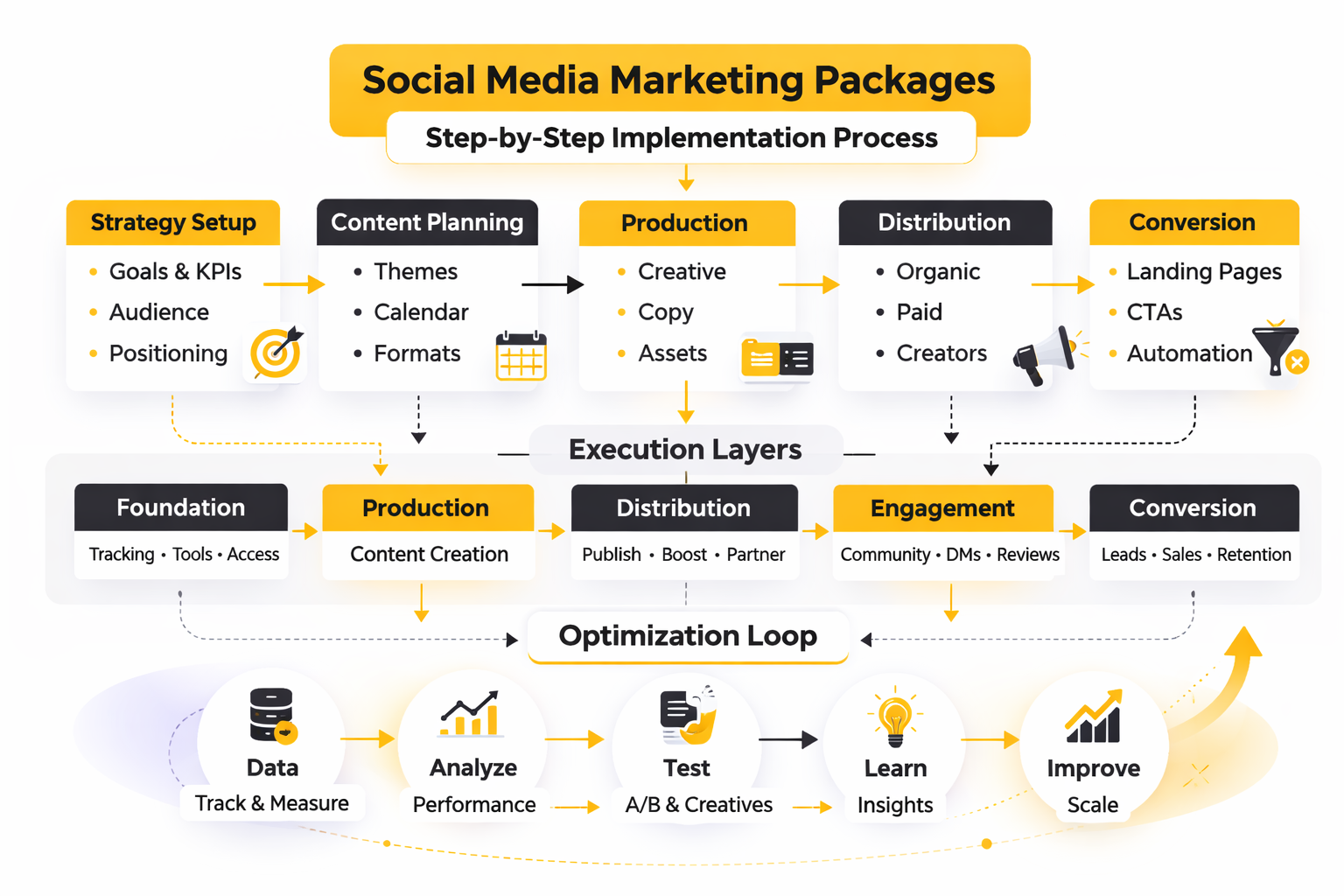
Across all six parts, the framework stays consistent: great social media marketing packages work because they connect strategy to execution in a way that stays stable under stress.
Here’s the ecosystem recap you can use to audit any package (yours or someone else’s):
- Positioning: the sharp promise and point of view that makes content feel like it came from a real brand, not a template.
- Offer and conversion path: the “next step” you want the audience to take, and the simplest route to get there.
- Content engine: repeatable formats that match the platform and the buyer journey, so production doesn’t rely on constant brainstorming.
- Distribution mix: organic, paid, creators, and partnerships working together instead of competing for attention.
- Community and trust: responsiveness, conversation, and social proof that make the brand feel alive and reliable.
- Measurement and iteration: tracking hygiene, dashboards, and a learning loop that turns results into next-month decisions.
If you keep these pieces connected, packages stop drifting. They stay focused, clients understand what they’re buying, and your work compounds instead of resetting every month.
FAQ – Built for the Complete Guide
1) What exactly are social media marketing packages?
They’re structured service bundles that define scope, cadence, deliverables, and success metrics for social. Instead of selling random tasks, you deliver a repeatable operating system: planning, production, publishing, engagement, reporting, and iteration.
2) What should be included in a “starter” package?
A strong starter package usually focuses on consistency and clarity: a monthly content plan, a predictable posting cadence, one revision cycle, basic community monitoring (if included), and a simple report that explains what to do next.
3) How do I price social media marketing packages without undercharging?
Price around outcomes and complexity, not post counts. The more stakeholders, channels, approvals, and performance expectations involved, the more operational load you’re carrying. Clear boundaries (like revision limits and response SLAs) protect your margin.
4) Do packages work for B2B, or only for ecommerce?
They work for both, but the focus changes. B2B packages often prioritize trust-building, expert content, and lead flow, while ecommerce packages often emphasize creative testing, distribution, and conversion tracking.
5) How many platforms should a package include?
As few as needed to win. Most packages fail because they spread effort too thin. It’s usually better to dominate one or two platforms with strong formats than to post everywhere with mediocre execution.
6) What metrics matter most inside a package?
Metrics should match the goal. For awareness, look at qualified reach and engagement quality. For pipeline, focus on clicks to key pages, inquiries, and form fills. For ecommerce, prioritize conversions and revenue signals. Tracking hygiene (like consistent UTMs) is a foundation, supported by GA4 guidance on campaign tagging with UTM parameters.
7) How fast should brands respond to comments and DMs?
Fast enough that customers feel seen. Many consumers expect answers within a day, and response speed affects loyalty. That expectation shows up in multiple recent surveys, including Sprout’s customer service statistics and Emplifi’s consumer research in The Social Pulse survey.
8) Should packages include paid social by default?
Not always. Paid makes sense when the client needs predictable reach, faster learning, or conversion volume. If paid is included, tracking quality becomes part of the package value, which is why platforms document direct data connections like Meta’s Conversions API and TikTok’s Events API.
9) How do you prevent scope creep inside packages?
Write boundaries into the package: what channels are included, what counts as a revision, what “rush” means, and what becomes an add-on. Most scope creep comes from vague definitions and unclear approval workflows.
10) How long does it take to see results from social media marketing packages?
It depends on starting conditions. If a brand already has product-market fit and a clear offer, you can see leading indicators move within weeks. If the offer, tracking, or creative system is weak, the first phase is often about building a foundation so optimization is real instead of guesswork.
11) Are creators and UGC still worth it in 2026?
Yes, especially because creators scale trust and distribution. Creator spend is being treated as a serious channel, reinforced by the IAB’s reporting that U.S. creator economy ad spend reached $29.5B in 2024 and is projected to hit $37B in 2025.
12) What’s the biggest mistake people make when selling packages?
They sell outputs instead of the system. Clients can buy posts anywhere. What they can’t easily buy is a reliable workflow, clean measurement, and a team that turns social into repeatable growth decisions.
Work With Professionals
If you’re a marketing freelancer, you already know the hardest part isn’t doing the work. It’s finding consistent clients who respect it, pay for it, and don’t turn every week into a negotiation.
That’s what makes marketplaces tempting, and also what makes them frustrating. Too many platforms take a cut, add a middle layer, and turn your income into someone else’s business model.
Markework is built around a different idea: direct communication, simple plans, and no project fees. Their homepage spells it out clearly: you can post a listing or build a profile and connect directly with no middleman and no project fees, and the platform emphasizes direct messaging without a middle layer plus public discovery of profiles and listings.
And the demand is real. Even one mainstream job board shows the scale of opportunity with over 14,000 remote marketing roles listed, and remote-first boards keep publishing fresh marketing openings globally in places like We Work Remotely’s sales and marketing category. If you’re serious about packaging your services, this is the kind of market where social media marketing packages can turn into steady retainers, not one-off gigs.
The moment your offer is packaged well, you stop sounding like “someone who can do social” and start sounding like someone who can run an operating system that produces results. Pair that with a place where companies and marketers can meet directly, and you give yourself the best shot at building a pipeline you actually control.
 Filip Konecny Enterprises