
Most people think they’re hiring an agency for “posts and ads.” In reality, the value of social media marketing agency services is much closer to an operating system: a repeatable way to create demand, capture intent, and prove results in a channel where attention shifts weekly.
That shift is exactly why this matters. When there are 5.24 billion active social media user identities in play, and marketing budgets keep moving toward measurable digital outcomes, execution without a framework turns into noise fast.
Article Outline
- What Social Media Marketing Agency Services Are
- Why Social Media Marketing Agency Services Matter
- Framework Overview
- Core Components
- Professional Implementation
What Social Media Marketing Agency Services Are
Social media marketing agency services are the end-to-end work required to make social channels reliably generate business outcomes. That includes building a strategy that fits your market, producing content people actually want to watch or share, distributing that content intelligently, and turning performance signals into better creative and better targeting.
In practical terms, agencies usually sit across three “lanes” that have to work together:
- Organic growth: content planning, production, publishing cadence, community management, and brand voice consistency.
- Paid growth: creative testing, audience strategy, budgeting, campaign structure, and conversion optimization.
- Measurement: tracking, attribution, reporting, and decision-making routines that connect social activity to pipeline or revenue.
The easiest way to spot whether an agency is serious is how they talk about measurement. If they don’t mention durable tracking (like server-to-server event sharing) and the realities of modern attribution, you’re often paying for activity instead of outcomes. For example, Meta’s Conversions API and TikTok’s Events API exist because browser-only tracking is fragile; agencies that ignore that usually end up “optimizing” on incomplete data.
Why Social Media Marketing Agency Services Matter
Social is no longer a side channel. It’s where people discover products, sanity-check brands, and decide whether your company feels trustworthy. The catch is that the “market” you’re competing in isn’t just your category—it’s everything in a user’s feed.
That competition is getting more intense because money keeps following attention. Worldwide advertising is projected to cross the $1 trillion line, with digital taking the majority share, and social platforms absorbing a meaningful slice of the growth. That doesn’t automatically make social easier; it makes it more auction-driven, more creative-driven, and less forgiving of sloppy execution.
At the same time, social is turning into a standalone media channel—especially through creators. In the U.S., creator economy ad spend grew from $13.9B in 2021 to $29.5B in 2024 and was projected to reach $37B in 2025. When creators become a “must-buy” line item, brands need partner vetting, contracts, content review, and performance reporting that doesn’t fall apart after the first campaign.
And measurement itself is evolving. The industry is moving beyond impressions toward attention quality, which is why the IAB and MRC attention measurement guidelines matter: they’re a signal that the market is demanding more consistent ways to judge whether ads were actually seen and processed, not just served.
Put simply: social is bigger, noisier, more expensive to do poorly, and more valuable when done with discipline. That’s the real job of social media marketing agency services—turning chaos into a system.
Framework Overview
A useful way to think about social media marketing agency services is as a loop. The goal isn’t to “post more.” The goal is to learn faster than competitors and compound that learning into better creative, better distribution, and better conversion paths.
This framework keeps that loop honest:
- 1) Positioning and audience clarity: define who you win with, what you’re known for, and what content themes prove it.
- 2) Content system: a production pipeline that can ship consistently without sacrificing quality.
- 3) Distribution engine: organic patterns plus paid amplification where it actually makes financial sense.
- 4) Conversion layer: landing pages, lead capture, messaging flows, and sales handoff that don’t leak intent.
- 5) Measurement and optimization: tracking you can trust and routines that force decisions, not “reports.”
- 6) Governance: brand safety, approvals, access control, and crisis response so growth doesn’t create risk.
When agencies skip steps, you feel it. Content looks “fine” but doesn’t move numbers. Ads get clicks but no qualified leads. Reporting is busy but unclear. The framework is designed to prevent that by making every piece accountable to the next one.
Core Components
Even though every agency packages things differently, high-performing social media marketing agency services usually include the same core components—because the platforms reward the same fundamentals.
Strategy and channel decisions
This is where the agency decides what not to do. Which platforms fit your buyer’s attention patterns? What content formats can you sustain? Where does paid support organic (and where does it replace it)? Good strategy looks like constraints, not slogans.
Creative and production
Social performance is increasingly creative-driven. That means the agency needs a repeatable production approach: briefs that are specific, hooks that are tested, editing that matches platform-native pacing, and a backlog that doesn’t die after one “launch month.”
Community, customer care, and trust
For many brands, social is now part marketing channel, part support desk. Agencies that can handle community management reduce risk (public complaints spiraling) and increase conversion (questions answered at the moment of intent). When Meta ships product updates focused on customer support and discoverability, it’s a reminder that platforms are optimizing around conversations, not just content.
Paid media execution
Paid social isn’t “boosting.” It’s structured experimentation: creative testing, audience segmentation, budget rules, and offer alignment. The work only scales when tracking is solid—using tools like the Meta Conversions API, TikTok’s Events API, and the LinkedIn Insight Tag to improve signal quality and optimization.
Analytics and decision-making cadence
Dashboards aren’t the product. Decisions are. Agencies add value when they define what success means, choose the few metrics that actually predict outcomes, and run a cadence that forces action—weekly creative conclusions, biweekly account structure changes, and monthly strategic resets.
Professional Implementation
The difference between an agency that “does social” and an agency that runs social media marketing agency services professionally is operational maturity. You can usually see it within the first two weeks.
Professional implementation typically includes:
- Access and safety setup: correct permissions, asset ownership, and a clean handoff process so accounts aren’t held hostage.
- Clear approval workflows: who reviews what, how fast, and what happens when something is time-sensitive.
- A documented testing plan: what the agency will test first, how long tests run, and what “winning” means.
- Tracking and attribution hygiene: event definitions, deduplication, and platform signals integrated responsibly (for example, Meta’s Conversions API overview explains the goal of connecting marketing data to optimization systems).
- Reporting that answers business questions: not just performance snapshots, but what changed, what was learned, and what happens next.
If you’re evaluating providers, a simple litmus test is this: can they describe their process without hiding behind deliverables? “12 posts per month” is a volume promise. A real service promise sounds like a system—how they plan, produce, distribute, measure, and iterate until results are predictable.
Step-by-Step Implementation

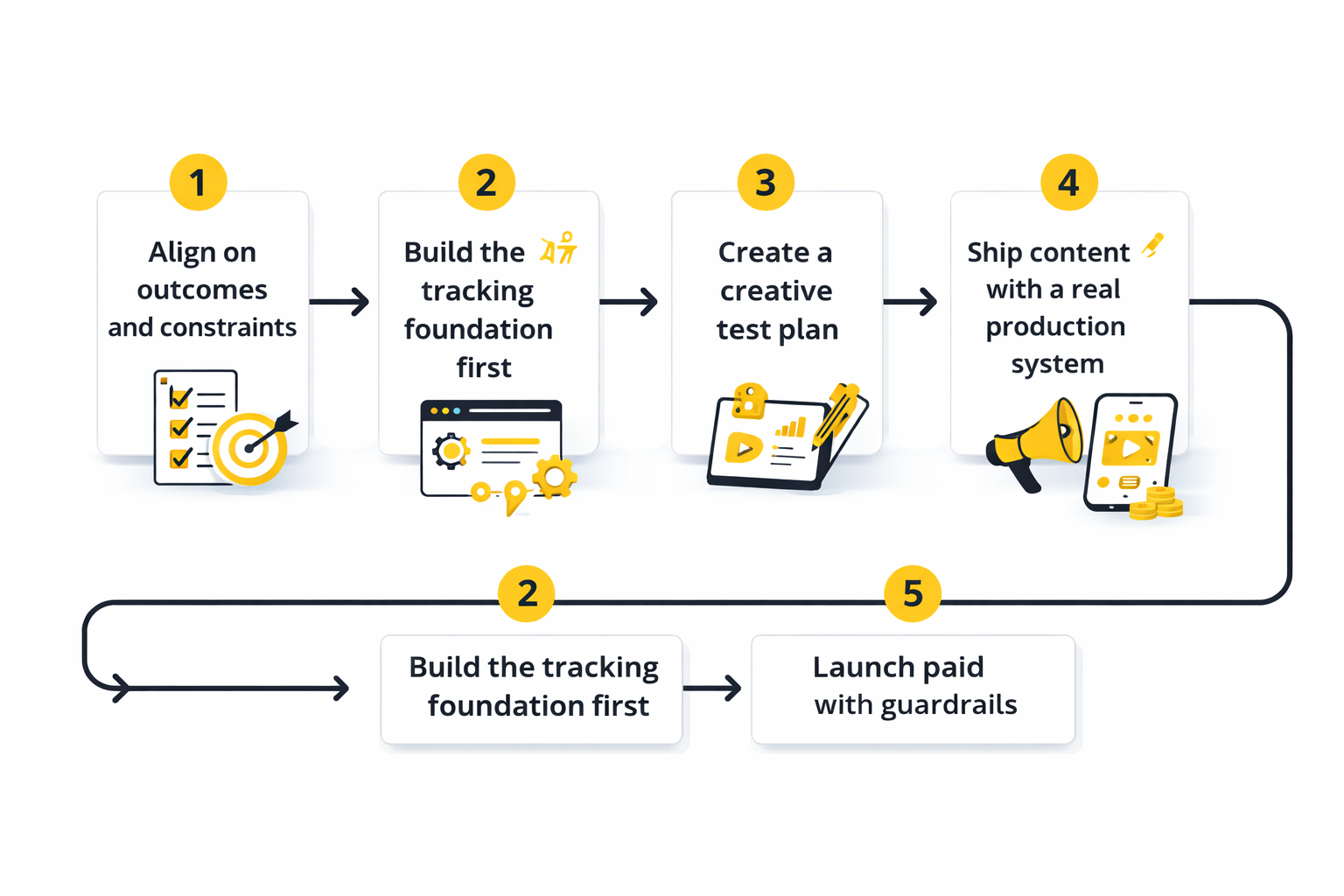
The easiest way to waste a social budget is to treat social like a content calendar plus a few ads. The best social media marketing agency services run implementation like a product launch: clear scope, tight tracking, fast creative iteration, and a feedback loop that turns performance into better decisions every week.
Here’s a practical implementation sequence that works whether you’re building demand in B2B or driving purchases in eCommerce.
Step 1: Align on outcomes and constraints
Start by writing down what “success” means in business terms, not platform terms. If you need bookings, define the booking event and the value rules. If you need leads, define what qualifies as a lead and what happens after submission.
Then set constraints that protect focus: the few platforms you’ll prioritize, the audiences you’ll speak to first, and the creative formats you can realistically produce every week without burning out your team.
Step 2: Build the tracking foundation first
Before creative production ramps up, lock in measurement so learning is trustworthy. For paid, that often means pairing pixel-based tracking with server-side signal sharing, using tools like Meta’s Conversions API and TikTok’s Events API setup for server-side tagging in Google Tag Manager.
If you skip this step, you’re basically asking the platforms to optimize using partial feedback. If you do it well, you get cleaner attribution across devices and a more reliable view of what content and ads actually move people deeper into the funnel.
Step 3: Create a creative test plan
Social rewards teams that learn fast. Build a testing plan that forces variety in hooks, angles, formats, and offers. Make it explicit how long each test runs, what counts as a “win,” and how winners get scaled.
For teams that want to go beyond delivery metrics, it’s also worth agreeing on how you’ll interpret quality signals. The move toward formal attention standards is one reason the IAB and MRC attention measurement guidelines have become a reference point for modern campaign evaluation.
Step 4: Ship content with a real production system
Implementation succeeds when content production is boring in the best way: briefs are clear, drafts move through approvals quickly, and publishing is consistent. Set a weekly cadence (for example: concept on Monday, draft on Tuesday, approvals Wednesday, publish Thursday and Friday), and protect it like a meeting that can’t be moved.
If your team uses scheduling tools, use them to support the system, not replace it. A scheduler can queue posts, but it can’t fix unclear messaging or inconsistent creative standards.
Step 5: Launch paid with guardrails
When paid social begins, protect performance with simple guardrails: budget pacing rules, clear campaign structure, and a rule that creative testing comes before aggressive scaling. The goal in the first phase is to identify what resonates, not to force spend.
Then use the strongest conversion signals available to help delivery systems learn. Platforms explicitly frame server-to-server event sharing as a way to improve measurement and optimization, which is why both Meta Conversions API and TikTok Events API show up so often in serious implementations.
Execution Layers
Execution gets simpler when you separate what’s happening into layers. Social media marketing agency services work best when each layer has an owner, a weekly routine, and a clear definition of “done.”
Layer 1: Foundation
This layer includes access control, account structure, tracking, and naming conventions. It’s not glamorous, but it’s what keeps your team from losing weeks to basic problems like missing permissions, inconsistent event definitions, or untraceable results.
When this layer is strong, you can actually trust what your dashboards say and move faster without constant rework.
Layer 2: Creative production
This layer is where most outcomes are won or lost. It includes concept development, scripting, filming or design, editing, and packaging content so it feels native to the platform. It also includes content governance: what’s allowed, what needs approval, and what’s risky.
Good agencies treat creative production like a pipeline, not a burst of inspiration.
Layer 3: Distribution
Distribution includes organic publishing strategy, community engagement, creator collaborations, and paid amplification. It’s not just “posting everywhere.” It’s choosing where a message should live, how often it should appear, and how it should evolve based on audience response.
At this layer, consistency beats intensity. You want steady coverage so performance data reflects reality, not a one-week spike followed by silence.
Layer 4: Conversion and retention
This layer connects social attention to business outcomes. It includes landing pages, offers, lead forms, email flows, and retargeting sequences. Social becomes much easier to scale when the “next step” is frictionless and clearly aligned with the promise made in the content.
When conversion is treated as part of the system, creative and paid teams stop arguing about results and start improving the funnel together.
Optimization Process
Optimization isn’t a report. It’s a weekly habit of turning signals into decisions. The point is to create a loop where every week makes the next week smarter, especially when algorithms and user behavior shift constantly.
A weekly optimization rhythm that actually works
- Monday: review last week’s results and isolate the few creatives that earned attention and action.
- Tuesday: write down conclusions in plain language, then turn them into new briefs that test the next hypothesis.
- Wednesday: adjust paid structure and targeting only where the data is strong enough to justify change.
- Thursday: ship new creative variants and launch controlled tests.
- Friday: sanity-check tracking, confirm events, and log learnings so they aren’t lost.
Signal quality before scale
Scaling spend before your signals are clean is like turning up the volume on a broken speaker. If measurement is inconsistent, every optimization decision becomes guesswork. That’s why server-side implementations are often treated as a performance prerequisite, supported by documentation like Google Tag Manager’s server-side tagging overview and platform-side guidance like TikTok’s Events API server-side tagging setup.
Once signals are stable, optimization becomes much more straightforward: improve creative clarity, reduce friction in the conversion path, and let the algorithm learn from consistent feedback.
Creative learning is the compounder
Many teams over-focus on targeting tweaks because they feel precise. In practice, the biggest leaps often come from creative improvements: a stronger hook, clearer promise, or better proof. When you treat creative like an experiment, you build a library of insights that compounds over time.
That’s also where attention metrics can be useful, especially as the industry tries to standardize how attention is defined and measured through efforts like the IAB and MRC attention measurement guidelines.
Implementation Stories
Real implementation stories are messy, because real funnels are messy. The best social media marketing agency services earn trust by fixing the boring, technical parts and then using that stronger foundation to let creative and optimization do their job.
Paint Your Life: When tracking broke the growth engine, Events API made learning possible again
Everything looked fine in the TikTok dashboard—until it didn’t. Purchases were happening, but the reporting made it feel like the ads were suddenly getting worse, even while the business still felt demand coming in. The team was staring at performance numbers that didn’t match reality, and every budget decision started to feel like gambling.
Paint Your Life had been building on TikTok since 2020, leaning into creators and paid campaigns to bring in new buyers. Their product is emotional and personal, but the buying journey is not simple: customers upload photos, choose parameters, and move through multiple steps before paying. TikTok itself describes the funnel as complex, with journeys that can start on mobile and finish on desktop, which makes clean attribution harder to maintain at scale.
Then the wall hit: the algorithm couldn’t optimize deeply because the signal was too weak. If the platform can’t reliably “see” what matters, it learns the wrong lessons and chases the wrong people. The team wanted to run deeper-funnel campaigns more efficiently, but attribution gaps kept pulling them back toward shallow optimization.
The epiphany was technical, not creative. If the funnel couldn’t be measured reliably with pixel-only tracking, the answer was to strengthen measurement rather than endlessly tweaking ads. That’s why they moved to implement TikTok’s Events API, which TikTok frames as a secure server-to-server integration for sending events like add-to-cart and purchase directly into the system.
The journey wasn’t a “toggle it on” moment. Their developer team worked with TikTok’s technical team to integrate the Events API with the required events and parameters, and they used it alongside the pixel so the platform could capture more of the funnel than before. TikTok’s write-up makes the intent clear: more signals enable better optimization, especially for deep-funnel strategies.
Of course, implementation rarely stays neat. Funnel events have to be defined consistently, parameters need to match platform expectations, and teams have to validate what’s firing where. Even small mismatches can corrupt learning, which is why the case emphasizes the collaboration needed to get the integration working properly.
Then the dream outcome showed up in the numbers that actually mattered. The case study reports that CPA dropped 32% while conversions grew 48%, and that adding Events API to the pixel helped them capture more signals than pixel alone. Once reporting became more accurate, the algorithm could find higher-intent people, and optimization stopped feeling like guesswork.
Standards that keep implementation stable
- Event clarity: define the handful of actions that truly matter, then keep naming and parameters consistent across tools and platforms.
- Server-side readiness: treat server-to-server measurement as a core capability, using references like Google’s server-side tagging overview and platform documentation like TikTok’s Events API server-side tagging setup.
- Creative governance: build an approval process that is fast enough to keep up with social, but strict enough to protect the brand.
- Learning logs: every test produces a written conclusion, and those conclusions become briefs for the next iteration.
What to expect from strong social media marketing agency services
A strong agency won’t just tell you what they posted. They’ll tell you what they learned, why it mattered, and what they changed because of it. They’ll also be comfortable owning the unsexy work—like making sure event signals are reliable through tools such as Meta Conversions API and TikTok Events API—because that’s what makes scaling possible without losing control of performance.
When professional implementation is in place, growth stops being a lucky streak. It becomes a repeatable system that gets sharper every month.
Statistics and Data

Analytics is where social media marketing agency services either become a growth system or a monthly ritual of pretty charts. The goal isn’t to “track everything.” The goal is to track the few signals that explain what’s working, what’s wasting budget, and what needs to change next.
If you want one data point that explains why measurement has become so serious, look at the money following performance. The IAB/PwC Internet Ad Revenue Report for Full Year 2024 reports $259B in U.S. internet ad revenue for 2024, with social media advertising revenues totaling $88.8B.
On the content side, volume and competition are rising fast. Sprout Social’s benchmarks work pulls from massive datasets, including a Content Benchmarks Report analysis covering more than 3 billion messages from over 1 million public social profiles active between February 1, 2024 and January 31, 2025, which is exactly the kind of scale you want behind any “typical performance” conversation.
Performance Benchmarks
Benchmarks are useful when they’re treated like guardrails, not grades. A “good” CTR or CPA depends on your category, offer, audience temperature, creative quality, and tracking setup. The purpose of benchmarks inside social media marketing agency services is to answer one question: are we underperforming because we’re doing something wrong, or because the market economics are simply different?
Benchmark the right layer first
- Market layer: seasonality, auction pressure, and platform shifts that affect everyone at once.
- Account layer: tracking quality, conversion signal strength, and campaign structure.
- Creative layer: hooks, pacing, proof, and whether the content earns attention before asking for action.
- Funnel layer: landing page speed, offer clarity, and what happens after the click.
If a team benchmarks only the ad metrics but ignores the funnel, they usually “optimize” forever without fixing the real bottleneck.
Content and engagement benchmarks that actually help decisions
For organic performance, your most practical benchmark is consistency and audience response trends over time, not one viral spike. Reports like the Emplifi Social Media Benchmarks Report 2025 are useful here because they summarize how key engagement patterns shifted through 2024 across industries, helping you sanity-check whether your content is improving relative to wider trends.
If you’re operating in a specific vertical, vertical benchmark snapshots can be especially actionable. Dash Social publishes category-focused benchmark PDFs, including a H1 2025 social media benchmark report for the media industry that outlines typical ranges across TikTok, Instagram, and YouTube for sampled global companies.
Customer care benchmarks that impact revenue
Not every brand thinks of customer care as a performance lever, until they see how quickly social can redirect purchase decisions. Sprout’s published consumer research highlights that around 73% of social users agree they’ll buy from a competitor if a brand doesn’t respond on social. If response speed and tone aren’t owned by someone, you’ll feel it in both sentiment and conversion rates over time.
Analytics Interpretation
Most teams don’t struggle because they lack data. They struggle because they don’t know what the data is allowed to mean. Professional social media marketing agency services build interpretation rules so that metrics lead to decisions instead of debate.
Start with the question, not the dashboard
Every report should begin with one sentence: what are we trying to learn? If the question is “Are we growing efficient demand?” then vanity metrics can’t be the headline. If the question is “Are we earning attention that converts later?” then you need content retention signals and downstream conversion behavior, not just impressions.
Separate signal from noise
A clean way to interpret performance is to split metrics into three roles:
- Leading indicators: signals that a piece of content is earning attention (for example: strong click-to-conversion behavior, saves, shares, or high-intent comments).
- Core outcomes: actions tied to revenue or pipeline (purchases, qualified leads, bookings).
- Diagnostic metrics: numbers that explain why something worked or failed (frequency, placement mix, landing page drop-off).
This keeps teams from celebrating the wrong win. A rising CTR with collapsing conversion rate is a warning, not a victory, because it often means the message is enticing but misaligned with what the user finds after the click.
Know when to trust the data
Interpretation depends on signal quality. If your setup is mostly browser-based, you should expect gaps, especially across devices and privacy settings. That’s why modern measurement stacks increasingly include server-to-server components, and why platforms teach implementation paths like Google Tag Manager server-side tagging and advertiser-focused measurement guidance like TikTok’s 2024 Back-to-School playbook noting average CPA improvement when using Pixel and Events API together.
Case Stories
Case studies are only valuable when you read them like an operator: what changed in the measurement and execution system, what broke during rollout, and what the team did to stabilize results. These stories are real, sourced, and messy in the same way real implementation always is.
Accor: The moment travel ads had to prove they could drive bookings, not just views
Start at a point of high drama: Summer demand was surging, and travel brands were fighting for the same attention at the same time. Accor needed direct reservations, not another wave of cheap engagement that looked good in a meeting but didn’t move bookings. The pressure was simple: if spend rose and bookings didn’t, the channel would lose trust internally.
Backstory: Accor operates at global scale, with thousands of hotels and a wide mix of customer intent. Their campaigns had to speak to destination curiosity while still pulling people toward a concrete booking action. They also had to keep messaging consistent while promoting discounts and membership benefits across regions, which makes “one-size-fits-all” creative a risky bet.
Wall: The wall wasn’t a lack of content. The wall was proving incremental performance in a category where users can browse on one device, compare on another, and finally book later. Without strong signal capture, optimization gets pulled toward shallow events and the business can’t tell what truly drove a booking.
Epiphany: The breakthrough was treating measurement infrastructure as a growth lever, not a technical chore. Accor leaned into a setup that could capture intent signals securely and consistently, especially for travel-specific behavior. The plan was to build the plumbing first, then run a true comparison test that finance could respect.
Journey they went on to reach the goal: Accor partnered with TikTok and iProspect to launch Dynamic Travel Ads and built the supporting infrastructure in stages. The case study describes integrating a server-to-server connection via TikTok Events API as part of the data connection, linking a hotel catalog, and producing catalog-style creatives for retargeting. With infrastructure in place, they ran a split test where dynamic travel ads and standard web conversion campaigns ran simultaneously with identical budgets and targeting parameters.
Final conflict: Running two campaigns side by side sounds clean on paper, but it forces discipline in execution. Targeting and budgets had to stay controlled, or the test would turn into a debate about setup differences rather than results. The team also had to make sure the catalog and event signals stayed consistent throughout, because even small mismatches can distort what the algorithm learns.
Dream outcome: The test delivered a result stakeholders can actually act on. Accor’s published TikTok success story reports a 46% reduction in CPA versus standard web conversion ads, a 1.8x increase in hotel bookings, and a 2.3x higher ROAS. More importantly, the story shows how infrastructure plus controlled testing turns “TikTok is interesting” into “TikTok is measurable.”
DSB: When conversion reporting got blurry, first-party signal made optimization believable again
Start at a point of high drama: One month the campaigns looked stable, and the next month the numbers started to feel unreliable. Teams were still doing the work, still publishing, still running ads, but performance reporting didn’t match the operational reality on the ground. When that happens, budget approvals slow down and everyone starts second-guessing decisions.
Backstory: DSB is a national operator with campaigns that often need to drive measurable actions, not vague awareness. Their marketing has to translate into real conversions, and they need reporting that can survive scrutiny from stakeholders who care about outcomes. As privacy and tracking constraints increased across the industry, relying solely on browser-based tracking became less dependable for many advertisers.
Wall: The wall was trust. Without trustworthy conversion signals, it’s hard to know whether you should refresh creative, adjust offers, or change spend allocation. Optimization becomes a guessing game, and the algorithm is forced to learn from incomplete feedback.
Epiphany: The realization was that the measurement layer itself had to be upgraded before expecting the performance layer to improve. Instead of endlessly tweaking campaigns, the smarter move was to enrich what the platform could learn from. That’s where first-party data and server-to-server event sharing become practical, not theoretical.
Journey they went on to reach the goal: DSB implemented the Meta Conversions API and enriched the setup with more first-party data, which is designed to send conversion events directly from a server environment rather than relying only on the browser. This kind of approach fits the direction platforms have been pushing for years, and it aligns with the broader move toward more privacy-resilient measurement. The work is rarely just “turn it on,” because teams have to align event definitions, validate fires, and ensure deduplication logic is correct so results don’t get inflated or lost.
Final conflict: Even after implementation, teams have to hold the line on process. If event definitions change mid-flight, reports become apples-to-oranges comparisons. If stakeholders demand instant results, the optimization loop doesn’t get time to learn from higher-quality signals.
Dream outcome: The success story reports that DSB saw an 18% increase in conversions after implementing the Conversions API and enriching the setup with more first-party data. Beyond the percentage, the practical win is that better signal quality reduces internal conflict and speeds up decision-making. When the numbers feel believable again, the team can focus on creative and scaling instead of arguing about reporting.
Professional Promotion
Professional promotion is not hype. It’s the skill of using analytics to earn confidence, protect budgets, and keep stakeholders aligned on what social is doing for the business. In strong social media marketing agency services, “promotion” means presenting performance in a way that makes the next decision obvious.
Turn results into a story stakeholders believe
The most persuasive performance update is simple: what we tried, what we learned, what we changed, and what we expect next. Case studies like Accor’s split test write-up are a good model because the story includes infrastructure, testing design, and outcome metrics, not just a “look how great we are” conclusion.
When your reporting follows that structure, you don’t need aggressive claims. The work speaks for itself, and stakeholders understand that performance is being managed as a system.
Use industry data to frame expectations without hiding behind it
Industry-scale data helps you explain what’s normal, what’s exceptional, and what’s changing. For example, the IAB/PwC Full Year 2024 report shows the scale and growth of digital advertising categories like social, which helps stakeholders understand why competition and auction dynamics keep evolving. And datasets like Sprout’s 2025 benchmark analysis window help you contextualize content volume and engagement shifts without pretending one brand’s results should match another’s.
Make the next step clear
A professional performance summary ends with a decision. Scale this winning angle. Cut this underperforming offer. Fix this measurement gap before increasing spend. When analytics is framed this way, your promotion isn’t selling—it’s leadership.
Future Trends
The next wave of social media marketing agency services will look less like “posting and ads” and more like running a high-speed revenue lab. The platforms are pushing automation, consumers are changing how they discover brands, and measurement expectations are getting stricter at the same time.
AI-driven campaign automation becomes the default
Creative production and paid distribution are moving toward “inputs and guardrails” rather than manual builds. Meta’s roadmap points in this direction, with reporting that it aims to fully automate key parts of ad creation and targeting with AI by the end of 2026. For agencies, the advantage won’t be knowing where to click. It’ll be writing better prompts, setting brand-safe guardrails, and building testing systems that keep quality high as automation increases.
Attention measurement matters more than impressions
Brands are getting more serious about the difference between an ad being served and an ad being noticed. Industry bodies are formalizing this shift with frameworks like the IAB and MRC attention measurement guidelines, which are designed to standardize how attention is measured and reported across media. That changes how agencies justify spend: the conversation moves from “reach” to “quality of attention” and what that attention does downstream.
Social search keeps eating traditional discovery
People increasingly use TikTok, Instagram, and YouTube the way they used Google: to find recommendations, reviews, “how to” answers, and local tips. Research highlighted by Forbes found that Gen Z is using social platforms for search at meaningful rates, including 67% using Instagram for search and 62% using TikTok in one survey set. The practical impact is simple: agencies need “search-style” creative that answers questions clearly, uses platform-native language, and earns saves and shares because it’s genuinely useful.
Creators keep moving from experiment to “must-buy”
Creator partnerships are no longer a side tactic. IAB projects that U.S. creator ad spend will reach $37 billion in 2025, with the underlying report showing growth from $13.9B (2021) to $29.5B (2024). That forces agencies to build real creator operations: sourcing, vetting, contracts, usage rights, creative QA, amplification strategy, and performance reporting that clients can trust.
Social commerce gets more normal
Social platforms are pushing deeper into shopping and checkout behaviors, and audiences are getting more comfortable buying without leaving the feed. TikTok Shop’s scale illustrates the pace, with reporting that it nearly matched eBay’s quarterly sales in late 2025 and reached about $19 billion in global merchandise sold in one quarter. For agencies, this changes the funnel design: content has to do more of the education, proof, and objection-handling before the click.
Brand safety and fraud risk rise with scale
As budgets grow and automation increases, risk grows with it. Investigative reporting has highlighted the scale of the fraud problem on large ad platforms, including Reuters reporting that internal Meta documents projected significant revenue tied to scam ads and that users can be exposed to massive volumes of “higher risk” ads daily. The story matters because it explains why mature teams build strong governance and verification processes into social media marketing agency services instead of assuming the platform will catch everything. Meta scam-ads investigation summary.
Strategic Framework Recap

If you read this guide as one system, the framework is simple: build a clean foundation, ship creative consistently, distribute intelligently, measure what matters, and compound what you learn.
- Foundation: access, governance, tracking, and definitions that keep your data believable.
- Creative engine: a production pipeline that can test angles, formats, and offers without chaos.
- Distribution: organic and paid working together, not competing for credit.
- Conversion layer: landing pages, offers, and follow-up flows that don’t waste attention.
- Optimization loop: weekly learning that turns results into decisions, not just reports.
When social media marketing agency services are run professionally, the result is not “more content.” It’s a faster learning cycle than your competitors can match, backed by measurement solid enough to scale budgets without fear.
FAQ – Built for This Complete Guide
What should social media marketing agency services include?
At minimum, you want strategy, content production, publishing, community management, paid execution, and measurement. If paid social is part of the scope, you also want modern signal capture options like Meta’s Conversions API or TikTok’s Events API so optimization isn’t built on fragile browser-only tracking.
How do I choose the right agency for my brand?
Pick the agency that can describe a repeatable process, not just deliverables. Ask how they define success, how they test creative, how they structure paid campaigns, and how they validate tracking. If they can’t explain how decisions get made week to week, results will usually feel random.
What are the biggest red flags when hiring an agency?
Common red flags are: reporting that focuses on vanity metrics only, unclear ownership of accounts and data, vague “we’ll go viral” promises, and a content plan that doesn’t explain how it leads to conversion. Another major warning sign is when an agency can’t talk confidently about measurement quality and signal reliability.
How long does it take to see results from social?
It depends on whether you already have demand and how strong your funnel is. In many cases, paid can produce early signals quickly, while organic and brand trust compound over months. The more mature your tracking and conversion path, the faster you can learn what works and scale it.
Do I need both organic and paid, or can I pick one?
You can pick one, but the strongest systems use both. Organic builds trust and reduces creative fatigue because you learn what resonates. Paid turns those learnings into reach and consistent lead or sales volume. When they work together, you avoid “posting into the void” and “buying clicks that don’t convert.”
Which platforms should I focus on in 2026?
Choose platforms based on buyer behavior and content format fit, not trends alone. Social search behavior is rising on TikTok and Instagram in particular, with research cited by Forbes showing Gen Z using both platforms for discovery at scale. Gen Z social search research summary.
How do I evaluate whether reporting is actually useful?
Useful reporting tells you what changed, what you learned, and what you’ll do next. It should also connect platform metrics to business outcomes. If a report can’t clearly answer “what decision should we make now?”, it’s not doing its job.
What budgets are realistic for paid social right now?
Budgets should match your testing needs and your funnel capacity. If you can’t produce enough creative to test, spending more usually increases frequency and fatigue. If your conversion path is weak, more spend just buys more drop-off. Mature teams scale when the system can absorb volume without losing efficiency.
How do creator campaigns fit into an agency program?
Creator work is increasingly a core channel, not a novelty. IAB projects U.S. creator ad spend will reach $37B in 2025, which is why agencies need a real creator operations layer: sourcing, rights, approvals, amplification, and measurement.
How do I protect brand safety while scaling social ads?
Use governance, verification, and clear controls on targeting, placements, creative approvals, and landing pages. Also assume risk increases with scale and automation. Investigative reporting has highlighted how scam ads can persist on major platforms, which is exactly why professional oversight matters even when AI tools get better. Reuters reporting on scam ad volume and enforcement challenges.
What does “success” look like with social media marketing agency services?
Success is predictable learning and predictable outcomes: a creative pipeline that produces winners, measurement you trust, and a repeatable process for scaling budget without panic. It feels calm, because the system is working.
Work With Professionals
If you’re building social media marketing agency services as a freelancer, you already know the hardest part isn’t skill. It’s pipeline. Weeks can disappear into prospecting, follow-ups, and dead-end chats while your actual craft sits on the shelf.
That’s why marketplaces win when they’re designed for your niche. Markework is positioned as a focused marketing marketplace where you can build a profile, browse opportunities, and connect directly with companies without platform gates or commission layers.
What makes it feel different is the operating model: the homepage promises no middleman and no project fees, and the pricing page repeats the same idea with “No commissions. No project fees.” If you’ve ever watched a platform take a cut while you do the work, that line alone changes the math.
And there’s real activity. The public listings page shows 1007 active listings while only displaying a small slice before login, and the plans describe access to thousands of job listings with direct communication included. That means you’re not begging for attention in a general marketplace—you’re positioning yourself where marketing work is the main event.
If you want more freelance clients without sacrificing your margins, build a profile that reads like a landing page: what you do, who you do it for, your proof, and one clear offer. Then apply consistently, message directly, and treat every conversation like the beginning of a long-term client relationship instead of a one-off gig.
 Filip Konecny Enterprises